




 Open access

Crossref Citations

This article has been cited by the following publications. This list is generated based on data provided by Crossref.
Christ, Hanna J.
White, Rachel
Hood, Lincoln
Vianna, Gabriel M. S.
and
Zeller, Dirk
2020.
A Baseline for the Blue Economy: Catch and Effort History in the Republic of Seychelles’ Domestic Fisheries.
Frontiers in Marine Science,
Vol. 7,
Issue. ,
Vianna, Gabriel M. S.
Zeller, Dirk
and
Pauly, Daniel
2020.
Fisheries and Policy Implications for Human Nutrition.
Current Environmental Health Reports,
Vol. 7,
Issue. 3,
p.
161.
Zeller, Dirk
Hood, Lincoln
Palomares, M.L.D.
Sumaila, U.R.
Khalfallah, Myriam
Belhabib, Dyhia
Woroniak, Jessika
and
Pauly, Daniel
2020.
Comparative fishery yields of African Large Marine Ecosystems.
Environmental Development,
Vol. 36,
Issue. ,
p.
100543.
Marques, Luiz
2020.
Capitalism and Environmental Collapse.
p.
275.
Báez, José C.
Gimeno, Luis
and
Real, Raimundo
2021.
North Atlantic Oscillation and fisheries management during global climate change.
Reviews in Fish Biology and Fisheries,
Vol. 31,
Issue. 2,
p.
319.
Murphy, Erin L.
Bernard, Miranda
Gerber, Leah R.
and
Dooley, Kevin J.
2021.
Evaluating the role of market-based instruments in protecting marine ecosystem services in wild-caught fisheries.
Ecosystem Services,
Vol. 51,
Issue. ,
p.
101356.
Zeller, Dirk
Vianna, Gabriel M. S.
Ansell, Matthew
Coulter, Angie
Derrick, Brittany
Greer, Krista
Noël, Simon-Luc
Palomares, Maria L. Deng
Zhu, Audrey
and
Pauly, Daniel
2021.
Fishing Effort and Associated Catch per Unit Effort for Small-Scale Fisheries in the Mozambique Channel Region: 1950–2016.
Frontiers in Marine Science,
Vol. 8,
Issue. ,
Gozzer-Wuest, Renato
Alonso-Población, Enrique
and
Tingley, Geoffrey A.
2021.
Identifying priority areas for improvement in Peruvian Fisheries.
Marine Policy,
Vol. 129,
Issue. ,
p.
104545.
Palomares, M. L. D.
Khalfallah, M.
Zeller, D.
and
Pauly, D.
2021.
The Arabian Seas: Biodiversity, Environmental Challenges and Conservation Measures.
p.
883.
Mohsin, Muhammad
Hengbin, Yin
Luyao, Zhang
Rui, Li
Chong, Qian
and
Mehak, Ana
2022.
An Application of Multiple-Criteria Decision Analysis for Risk Prioritization and Management: A Case Study of the Fisheries Sector in Pakistan.
Sustainability,
Vol. 14,
Issue. 14,
p.
8831.
Bennett, Nathan J.
Villasante, Sebastián
Espinosa-Romero, María José
Lopes, Priscila F.M.
Selim, Samiya A.
and
Allison, Edward H.
2022.
Social sustainability and equity in the blue economy.
One Earth,
Vol. 5,
Issue. 9,
p.
964.
Canty, Steven W. J.
and
Deichmann, Jessica L.
2022.
Do small‐scale fisheries have the capacity to provide food security to coastal populations?.
Fish and Fisheries,
Vol. 23,
Issue. 3,
p.
708.
Madsen, Niels
Ern, Rasmus
and
Olsen Alstrup, Aage Kristian
2022.
Estimating Discard Mortality in Commercial Fisheries without Fish Dying: A 3R Challenge.
Animals,
Vol. 12,
Issue. 6,
p.
782.
Borges, Teresa C.
Veitayaki, Joeli
Moreno-Báez, Marcia
Cisneros-Montemayor, Andrés M.
and
Santos, Jorge
2022.
Blue Economy.
p.
87.
Bennett, Nathan J.
Alava, Juan José
Ferguson, Caroline E.
Blythe, Jessica
Morgera, Elisa
Boyd, David
and
Côté, Isabelle M.
2023.
Environmental (in)justice in the Anthropocene ocean.
Marine Policy,
Vol. 147,
Issue. ,
p.
105383.
Mehak, Ana
Mu, Yongtong
Mohsin, Muhammad
and
Zhang, Xing-Can
2023.
MCDM-Based Ranking and Prioritization of Fisheries’ Risks: A Case Study of Sindh, Pakistan.
Sustainability,
Vol. 15,
Issue. 11,
p.
8519.
Gatto, Andrea
Sadik-Zada, Elkhan Richard
Özbek, Sürmeya
Kieu, Huong
and
Nguyen Huynh, Nhat Thanh
2023.
Deep-sea fisheries as resilient bioeconomic systems for food and nutrition security and sustainable development.
Resources, Conservation and Recycling,
Vol. 197,
Issue. ,
p.
106907.
Österblom, Henrik
Wabnitz, Colette C. C.
Tladi, Dire
Allison, Edward H.
Arnaud-Haond, Sophie
Bebbington, Jan
Bennett, Nathan
Blasiak, Robert
Boonstra, Wiebren
Choudhury, Afrina
Cisneros-Montemayor, Andrés
Daw, Tim
Fabinyi, Michael
Franz, Nicole
Harden-Davies, Harriet
Kleiber, Danika
Lopes, Priscila
McDougall, Cynthia
Resosudarmo, Budy P.
and
Selim, Samiya A.
2023.
The Blue Compendium.
p.
485.
Zeller, D.
Ansell, M.
Andreoli, V.
Heidrich, K.
and
Randhawa, Haseeb
2023.
Trends in Indian Ocean marine fisheries since 1950: synthesis of reconstructed catch and effort data.
Marine and Freshwater Research,
Vol. 74,
Issue. 4,
p.
301.
Selvaraj, John Josephraj
Cifuentes-Ossa, Maria Alejandra
Penna-Narvaez, Jeider
Miranda-Parra, Maira Alejandra
and
Herrera-Rozo, Fabio Andrés
2023.
Species Distribution Models as Tools for Community Empowerment and Informed Decision Making in Colombia’s Chocó Pacific Coast Fisheries.
Fishes,
Vol. 8,
Issue. 7,
p.
349.
Social media summary
Reducing industrial overcapacity and encouraging well-managed small-scale marine fisheries could save seafood supply.
1. Where we came from in fisheries
Humanity has been fishing for at least 90,000 years (Yellen, Brooks, Cornelissen, Mehlman, & Stewart, Reference Yellen, Brooks, Cornelissen, Mehlman and Stewart1995). However, despite Europeans having fished in the waters off North America for centuries (Kurlansky, Reference Kurlansky1997, Reference Kurlansky1999) and Japanese early industrial fishing for tuna around Pacific Islands in the early twentieth century (Gillett, Reference Gillett2007), the majority of marine fishing, for thousands of years, was undertaken by small-scale fishers in nearshore waters using mainly passive fishing gears (Cashion, Al-Abdulrazzak et al., Reference Cashion, Al-Abdulrazzak, Belhabib, Derrick, Divovich, Moutopoulos and Pauly2018).
The growth of industrial (i.e., large-scale) fishing after World War II was largely driven by two factors: (1) the reliance on and availability of cheap fossil fuels; and (2) the gradual incorporation of technologies developed for warfare (e.g., radar, echo sounders, satellite positioning, etc.; i.e., ‘peace dividend’) (Pauly et al., Reference Pauly, Christensen, Guénette, Pitcher, Sumaila, Walters and Zeller2002). While both of these factors may also have influenced some small-scale fisheries more recently, this industrialization rapidly turned most marine fisheries from generally local and domestic affairs into the expanding, global corporate enterprise it has now become (Pauly, Reference Pauly2018b; Swartz, Sala, Tracey, Watson, & Pauly, Reference Swartz, Sala, Tracey, Watson and Pauly2010). Other factors clearly also played a role in this development, notably increased demand driven by growing disposable incomes.
This development of industrial fishing fleets often ignored the fact that the rapidly increasing fishing capacity depleted the accumulated and until then largely sustainably renewing fish biomass along the coastlines of developed countries. Therefore, in order to maintain and grow the industrial fisheries, a spatial expansion by industrial fleets occurred until essentially the majority of the world's ocean areas were accessed or accessible (Pauly, Reference Pauly2018b; Swartz et al., Reference Swartz, Sala, Tracey, Watson and Pauly2010), including in the Arctic (Zeller, Booth, Pakhomov, Swartz, & Pauly, Reference Zeller, Booth, Pakhomov, Swartz and Pauly2011) and around Antarctica (Ainley & Pauly, Reference Ainley and Pauly2014).
The spatial expansion by roving industrial fleets was soon considered an encroachment on the marine resources of coastal countries, particularly where nearshore resources were concerned. This became a serious issue during the ‘cod wars’ off Iceland between the late 1950s and mid-1970s (Bonfil et al., Reference Bonfil, Munro, Sumaila, Valtysson, Wright, Pitcher and Pauly1998; Kurlansky, Reference Kurlansky1997; Steinsson, Reference Steinsson2016). Thankfully, in the two decades following World War II, the newly created United Nations system provided a venue for the rational discussion on the governance of fisheries and other maritime affairs. This eventually resulted in the Law of the Seas (UNCLOS), arguably the most important international legal ocean instrument (Holbrook Smith, Reference Holbrook Smith2017). Besides many other topics, UNCLOS provides the principles, legal framework and conflict resolution mechanism (Rothwell, Reference Rothwell2003) for countries to declare Exclusive Economic Zones (EEZs) of up to 200 nautical miles (370 km) from their coasts, within which countries have resource ownership, but also management and conservation responsibilities.
EEZs enabled countries that wished to be host to foreign fishing fleets to gain compensation for the extraction of their resources, generally via foreign fishing access agreements or joint venture operations (although generally for meagre amounts; see e.g., Belhabib, Sumaila et al., Reference Belhabib, Sumaila, Lam, Zeller, Le Billon, Kane and Pauly2015; Kaczynski & Fluharty, Reference Kaczynski and Fluharty2002). However, far too often, the enforcement capacity by developing countries is inadequate, which leads to agreement violations and illegal fishing by foreign industrial fleets (e.g., Cashion, Glaser, Persson, Roberts, & Zeller, Reference Cashion, Glaser, Persson, Roberts and Zeller2018; Seto et al., Reference Seto, Belhabib, Mamie, Copeland, Michael Vakily, Seilert and Pauly2017).
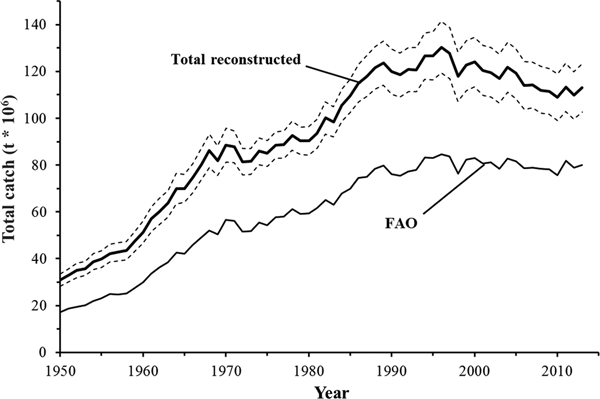
The growth and expansion of the global industrial fleets, ‘fuelled’ by large government subsidies (Sumaila et al., Reference Sumaila, Khan, Dyck, Watson, Munro, Tyedmers and Pauly2010; Sumaila, Lam, Le Manach, Swartz, & Pauly, Reference Sumaila, Lam, Le Manach, Swartz and Pauly2016), seemed to have approached its limits by the 1990s, when global fisheries catches reached their peak (Figure 1). Importantly, global expansion in the marine space appears to have reached its zenith also around that time (Figure 2).
Global total reconstructed marine fisheries catch (± 95% confidence intervals), including discards (Zeller et al., Reference Zeller, Cashion, Palomares and Pauly2018), based on the sum of the national catch reconstructions performed or inspired by the Sea Around Us (Pauly & Zeller, Reference Pauly and Zeller2016a, Reference Pauly and Zeller2016c), and global catches (landings only) as reported by the Food and Agriculture Organization (FAO) based on the submissions of its member countries (reported by countries and by the FAO without confidence intervals, despite being estimates and sampled data). The approximate confidence intervals of reconstructed data (dashed lines) were estimated by combining for each year, using a Monte Carlo method, the uncertainty associated with each sector in each national reconstruction into an overall 95% confidence interval (Pauly & Zeller, Reference Pauly, Zeller, Pauly and Zeller2016b, Reference Pauly and Zeller2017a), which was then doubled to counter the tendency of Monte Carlo methods to underestimate the confidence interval of sums. All data represent wild capture fisheries (no aquaculture production) and exclude plants, corals, sponges, reptiles and marine mammals (Zeller et al., Reference Zeller, Palomares, Tavakolie, Ang, Belhabib, Cheung and Pauly2016).
Average decadal reconstructed fisheries catches for the start of globally reported time series (1950s) and for the decade of peak global catches (1990s), mapped onto a global 0.5° × 0.5° grid-cell system by the Sea Around Us through consideration of biological distributions of each taxon in the catch data and observed or permitted fishing access to each country's Exclusive Economic Zone (Zeller et al., Reference Zeller, Palomares, Tavakolie, Ang, Belhabib, Cheung and Pauly2016).
Unfortunately, official reported statistics on the landed catch of the world, as reported annually by the Food and Agriculture Organization of the United Nations (FAO) on behalf of its member countries (see Figure 1), largely masked this fact (FAO, 2016). This masking is mainly due to: (1) the confounding of declining reported landings from countries with reasonably accurate and reliable statistics by data from a group of countries that largely have questionable statistics with an ever-increasing trend (Pauly & Zeller, Reference Pauly and Zeller2016a, Reference Pauly and Zeller2017b); and (2) structural issues with national data collection and reporting systems (e.g., the ‘presentist bias’; Zeller & Pauly, Reference Zeller and Pauly2018) that are unintended and easily correctable by-products of data collection system development (FAO, 2018: p. 8). While some disagreements may still exist regarding the estimation of total global catches or their interpretation (Pauly & Zeller, Reference Pauly and Zeller2017a; Ye et al., Reference Ye, Barange, Beveridge, Garibaldi, Gutierrez, Anganuzzi and Taconet2017), or other criticisms (Belhabib, Koutob, et al., Reference Belhabib, Koutob, Sall, Lam, Zeller and Pauly2015; Chaboud et al., Reference Chaboud, Fall, Ferraris, Fontana, Fonteneau, Laloë and Thiao2015) or misunderstandings (Al-Abdulrazzak & Pauly, Reference Al-Abdulrazzak and Pauly2014; Garibaldi, Gee, Tsuji, Mannini, & Currie, Reference Garibaldi, Gee, Tsuji, Mannini and Currie2014), the decline of overall catches is no longer among them (FAO, 2018).
Thus, in essence, over the last six decades, fisheries have undergone the largest transformation in the history of fishing. In many developed and emerging economies, fisheries moved from largely sustainable, small-scale fisheries with a local focus in terms of fishing capacity, ownership, control and livelihood, to a system of largely corporate-owned and controlled and heavily tax payer-subsidized fleets that can roam the world's oceans, accessing developing countries’ resources (legally or illegally). The new system contributes to the increased marginalization of small-scale fisheries (Pauly, Reference Pauly, Pikitch, Huppert and Sissenwine1997, Reference Pauly2006, Reference Pauly2018a; Pauly & Charles, Reference Pauly and Charles2015) and endangers the food and nutritional security of millions in developing countries (Golden, Allison, et al., Reference Golden, Allison, Cheung, Dey, Halpern, McCauley and Myers2016).
2. Where we are now
It is disturbing, in a world prone to food and nutritional insecurity (Barrett, Reference Barrett2010; Golden, Allison, et al., Reference Golden, Allison, Cheung, Dey, Halpern, McCauley and Myers2016; Golden, Chen, et al., Reference Golden, Chen, Cheung, Dey, Halpern, McCauley and Allison2016) that nearly a third of global marine landings is not used for direct human consumption (Cashion, Le Manach, Zeller, & Pauly, Reference Cashion, Le Manach, Zeller and Pauly2017). Rather, this third of global marine landings is used for fishmeal or animal feed, including for feedlot-type aquaculture operations that produce carnivorous fish (e.g., Atlantic salmon, Salmo salar) for developed-world consumers. Crucially important in this context is that 90% of all fish destined for uses other than direct human consumption consist of food-grade or even prime food-grade fish species, and much of this is caught in some of the poorest and most food-insecure regions in the world (Africa, Asia and South America; Cashion et al., Reference Cashion, Le Manach, Zeller and Pauly2017). This represents a substantial redirection of food and essential nutrients from low-food-secure countries to rich, high-food-secure countries.
At the same time, there is growing evidence that the downward trend of fisheries is not likely to be reversed easily, notably because they seem to have reached the limits of spatial expansion (Swartz et al., Reference Swartz, Sala, Tracey, Watson and Pauly2010; Tickler, Meeuwig, Palomares, Pauly, & Zeller, Reference Tickler, Meeuwig, Palomares, Pauly and Zeller2018). While virtually no waters are too deep (Devine, Baker, & Haedrich, Reference Devine, Baker and Haedrich2006; Koslow, Reference Koslow1997; Koslow et al., Reference Koslow, Boehlert, Gordon, Haedrich, Lorance and Parin2000) or too remote (e.g., deep southern ocean and Antarctic fisheries; Agnew, Reference Agnew2000; Kock, Reference Kock1992) for human technical ingenuity and determination to reach and exploit, not all remote areas are fished all the time. Economic considerations of profitability, driven by a balance between the ex-vessel value of their catch (Sumaila, Marsden, Watson, & Pauly, Reference Sumaila, Marsden, Watson and Pauly2007; Swartz, Sumaila, & Watson, Reference Swartz, Sumaila and Watson2013) and cost of fishing (predominantly driven by fuel and labour; Lam, Sumaila, Dyck, Pauly, & Watson, Reference Lam, Sumaila, Dyck, Pauly and Watson2011), determine when and whether it is worthwhile to fish remote or deep waters. However, such cost–benefit calculations are heavily skewed by cost minimization provided through: (1) the large, harmful subsidies paid to industrial and distant-water fleets (Sumaila et al., Reference Sumaila, Khan, Dyck, Watson, Munro, Tyedmers and Pauly2010; Sumaila et al., Reference Sumaila, Lam, Le Manach, Swartz and Pauly2016); (2) illegal fishing by distant-water fleets in the EEZ waters of other countries without any or, if fishing legally, often inappropriate levels of compensation for extracting their resources (Kaczynski & Fluharty, Reference Kaczynski and Fluharty2002; Schiller, Alava, Grove, Reck, & Pauly, Reference Schiller, Alava, Grove, Reck and Pauly2015; Seto et al., Reference Seto, Belhabib, Mamie, Copeland, Michael Vakily, Seilert and Pauly2017); and (3) growing evidence of rampant labour abuses and even modern slavery (Walk Free Foundation, 2016, 2018) in a growing number of fishing fleets (Kittinger et al., Reference Kittinger, Teh, Allison, Bennett, Crowder, Finkbeiner and Aulani Wilhelm2017; Simmons & Stringer, Reference Simmons and Stringer2014; Stringer, Simmons, Coulston, & Whittaker, Reference Stringer, Simmons, Coulston and Whittaker2014; Stringer, Whittaker, & Simmons, Reference Stringer, Whittaker and Simmons2016). Thankfully, efforts are being made to address some of these influences (FAO, 2018: p. 183), while others have only recently started attracting the required attention (Tickler, Meeuwig, Bryant, et al., Reference Tickler, Meeuwig, Bryant, David, Forrest, Gordon and Zeller2018).
Formal fisheries stock assessments (i.e., the estimation of the biomass of a given exploited species of fish in the ocean on an annual or regular basis by means of often complex and data-demanding population dynamics models) allow estimation of likely sustainable catch limits year on year (Hilborn & Walters, Reference Hilborn and Walters1992). Such stock assessments contribute to the information systems underlying fisheries management decisions in some countries, although political decisions driven by societal choices and expedience may influence or redirect ultimate management decisions. However, many of these traditional stock assessment approaches are, by and large, technically and financially challenging for most developing countries to invest in on an ongoing, regular basis. Not even wealthy, developed countries undertake such assessments for all their fished stocks (e.g., in Europe, around 40% of total fish catches come from stocks that have no formal stock assessments undertaken; www.eea.europa.eu/data-and-maps/indicators/status-of-marine-fish-stocks-2/assessment).
Thankfully, methods have now been developed that permit more streamlined and simpler assessments of stocks to be undertaken with less demanding data and analytical requirements (e.g., Froese, Demirel, Coro, Kleisner, & Winker, Reference Froese, Demirel, Coro, Kleisner and Winker2017; Froese et al., Reference Froese, Winker, Coro, Demirel, Tsikliras, Dimarchopoulou and Pauly2018; ICES, 2014, 2015; Martell & Froese, Reference Martell and Froese2013; Rosenberg et al., Reference Rosenberg, Fogarty, Cooper, Dickey-Collas, Fulton, Gutiérrez and Ye2014). In our opinion, one of the most suitable and most widely applicable of these methods is the ‘CMSY’ method (Froese et al., Reference Froese, Demirel, Coro, Kleisner and Winker2017; Martell & Froese, Reference Martell and Froese2013), which at the minimum requires only reliable catch data and basic, species-specific biological population parameters easily obtained either from local studies or from global, online biodiversity databases such as FishBase (www.fishbase.org) for finfish or SeaLifeBase (www.sealifebase.org) for non-finfish marine life (Froese & Pauly, Reference Froese and Pauly2000, Reference Froese and Pauly2017; Palomares & Pauly, Reference Palomares and Pauly2017). The beauty of this approach is that it can also use and incorporate any additional stock biomass-related data that may be available from other assessments and data sources, thus clearly making it far more versatile than the unfortunate misnomer of being a ‘catch-only’ method or even a ‘data-limited’ assessment method may suggest.
The considerations above do not deny that some well-managed fisheries exist, notably in Alaska, USA, such as on Alaska pollock (Gadus chalcogrammus, see assessments at, e.g., www.afsc.noaa.gov/REFM/Docs/2017/aipollock.pdf) and salmon (Oncorhynchus spp., www.adfg.alaska.gov/fedaidpdfs/sp15-04.pdf). These well-managed fisheries exist because the core underlying US legal instrument, the Magnuson–Stevens Fishery Conservation and Management Reauthorization Act (Macpherson, Reference Macpherson2001; MSA, 2007), and its execution are clear and harsh with regards to overfishing and legally binding actions. However, while some other jurisdictions seem also to have excellent management rules and policies (e.g., Australia; HSP, 2018), how well these are actually implemented and enforced seems uncertain or even questionable given the state of some of these resources (Edgar, Ward, & Stuart-Smith, Reference Edgar, Ward and Stuart-Smith2018). Given this rather disconcerting and pessimistic assessment given here by us, the core question arises: where do we go from here? Obviously, there are various options, as already expounded on by the Millennium Ecosystem Assessment in the early 2000 (e.g., Millennium Ecosystem Assessment, 2005), and currently again as part of the UN's Sustainable Development Goals (e.g., UN, 2017).
3. Where we should be going
We live on a single, finite planet (at least for now; see Shiga, Reference Shiga2008) whose ability to produce services and products that we need for our survival is ultimately limited. Fishing does not ‘produce’ fish the way agriculture produces a crop, given largely human-controlled inputs such as seeds, water, fertilizers and so on. Fishing vessels only collect the fish that nature produces without our input, free of charge. Hence, when collecting fish becomes unprofitable (and declines), nature is sending us a very clear message: we are taking too much.
Thus, we need to stop paying lip service to the concept of sustainability and actually address it. Declining catches in the general absence of effective management, as is the case in most parts of the world, are indicative of a lack of fisheries sustainability, and the farming of carnivorous species will not solve this issue. Indeed, while the production of farmed salmon or other carnivorous species can be further increased by using zooplankton as feed, such as copepods from waters around Jan Mayen, Norway (or ‘red feed’; Tiller, Reference Tiller2010), or krill from around Antarctica (Olsen, Reference Olsen2011), the likely price to pay via disrupted food webs could be extremely high. Thus, such steps provide substantial political, environmental and ethical ramifications and concerns (Tiller, Reference Tiller2010).
Similar concerns also apply to lanternfish (Myctophidae) and other mesopelagic fishes (i.e., mainly inhabiting the twilight zone at depths between 200 and 1000 m) that are increasingly viewed as a resource for the future and that some might argue should be targeted in order to realize the extravagant catch projection involving hundreds of millions of tonnes proposed some decades ago (Gulland, Reference Gulland1971). Here, again, what is threatened is the very fabric of the oceanic food webs that support tuna and other large pelagic fishes currently already heavily, fully or over-exploited, many of which feed on mesopelagics (Alverson, Reference Alverson1963; Battaglia et al., Reference Battaglia, Andaloro, Consoli, Esposito, Malara, Musolino and Romeo2013; Karakulak, Salman, & Oray, Reference Karakulak, Salman and Oray2009; McHugh, Reference McHugh1952; Olafsdottir, MacKenzie, Chosson-P, & Ingimundardottir, Reference Olafsdottir, MacKenzie, Chosson-P and Ingimundardottir2016; Potier et al., Reference Potier, Marsac, Cherel, Lucas, Sabatié, Maury and Ménard2007).
In our opinion, instead of trying to continue expanding our fisheries, what is needed is to stop the expansion and overcapacity of most industrial fisheries. Stopping and eliminating this expansion and overcapacity would involve: (1) rebuilding the fish populations and ecosystems in the areas where industrial fisheries began (e.g., in Western European seas, off New England and eastern Canada, around Japan, etc.); (2) creating enough no-take marine reserves to secure the continued existence of our most sensitive marine species (O'Leary et al., Reference O'Leary, Ban, Fernandez, Friedlander, García-Borboroglu, Golbuu and Roberts2018; Roberts, Bohnsack, Gell, Hawkins, & Goodridge, Reference Roberts, Bohnsack, Gell, Hawkins and Goodridge2001; Roberts et al., Reference Roberts, O'Leary, McCauley, Castilla, Cury, Duarte and Lubchenco2017); and (3) halting the provision of harmful, capacity-enhancing subsidies to fisheries in order to shrink our fishing fleets to economically viable and ecologically sustainable levels. This would also help address the growing overfishing challenges faced by developing countries, often due to foreign fleets.
It is largely fuel subsidies that enable a small number of countries to deploy large distant-water fleets (Sala et al., Reference Sala, Mayorga, Costello, Kroodsma, Palomares, Pauly and Zeller2018; Tickler, Meeuwig, Palomares, et al., Reference Tickler, Meeuwig, Palomares, Pauly and Zeller2018) that can threaten and even devastate the resource base of mainly developing countries that let them operate in their EEZs, usually for low access fees (Belhabib, Sumaila, et al., Reference Belhabib, Sumaila, Lam, Zeller, Le Billon, Kane and Pauly2015; Kaczynski & Fluharty, Reference Kaczynski and Fluharty2002), or that cannot prevent them from accessing their waters illegally (Agnew et al., Reference Agnew, Pearce, Pramod, Peatman, Watson, Beddington and Pitcher2009). Without fuel subsidies and other harmful subsidies, many distant-water fleets would not be able to operate profitably (Sala et al., Reference Sala, Mayorga, Costello, Kroodsma, Palomares, Pauly and Zeller2018). Instead, developing maritime countries, such as in Africa, should be assisted in developing their own carefully managed, domestically owned, controlled and operated fisheries and, if they so choose, could themselves develop seafood export capacity to the countries now fielding distant-water fleets.
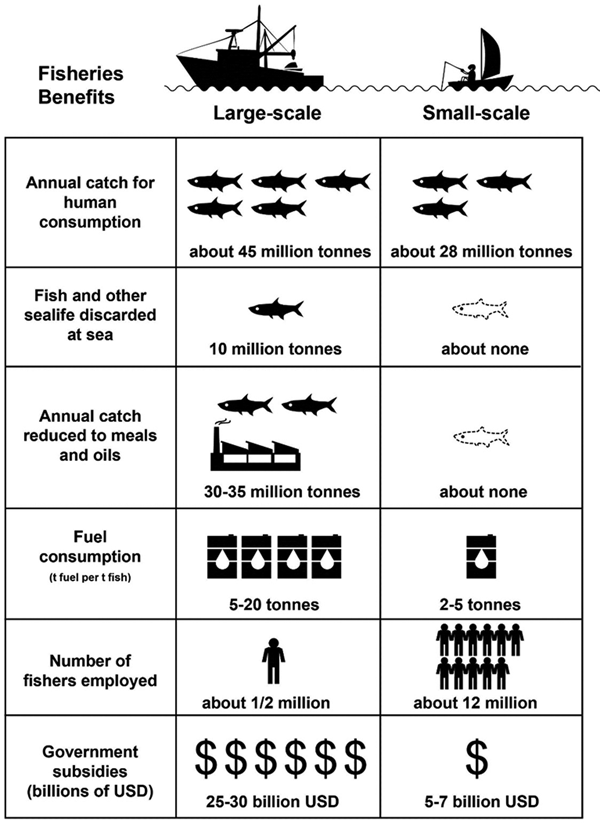
Finally, the very idea of continuing with the excessive subsidization of industrial fisheries is incompatible with social equity and ecological as well as economic sustainability, because (Figure 3): (1) industrial fisheries employ relatively few people compared with small-scale fisheries; (2) they often use more fuel per tonne of fish landed; (3) they generate around 10 million tonnes of discards annually (Zeller, Cashion, Palomares, & Pauly, Reference Zeller, Cashion, Palomares and Pauly2018); and (4) they land fish of which a third is destined to become animal feed (Cashion et al., Reference Cashion, Le Manach, Zeller and Pauly2017). Thus, we strongly support all efforts by countries and the World Trade Organization (WTO) to reduce and eliminate harmful (i.e., capacity-enhancing) fisheries subsidies, which support the existing massive overcapacity in global industrial fishing fleets (Pauly & Zeller, Reference Pauly and Zeller2019; Sala et al., Reference Sala, Mayorga, Costello, Kroodsma, Palomares, Pauly and Zeller2018; Sumaila et al., Reference Sumaila, Lam, Le Manach, Swartz and Pauly2016; Sumaila & Pauly, Reference Sumaila and Pauly2007; Tickler, Meeuwig, Palomares, et al., Reference Tickler, Meeuwig, Palomares, Pauly and Zeller2018).
Contrasting large-scale (i.e., industrial) and small-scale (artisanal and subsistence) fisheries for several key criteria through a Thompson graph (Pauly, Reference Pauly2006; Thompson, Reference Thompson1988). The definitions of large-scale (industrial), often mislabelled as ‘commercial’, and small-scale, often mislabelled as ‘traditional’, as used also in Pauly and Zeller (Reference Pauly and Zeller2016a), are those prevailing in each country, although they do not differ much (Chuenpagdee & Pauly, Reference Chuenpagdee, Pauly, Nielsen, Dodson, Friedland, Hamon, Musick and Vespoor2008). The data for annual fishmeal-destined catches (Cashion et al., Reference Cashion, Le Manach, Zeller and Pauly2017) and fuel consumption per tonne of catch (Greer, Reference Greer2014; Greer et al., Reference Greer, Zeller, Woroniak, Coulter, Palomares and Pauly2019a; Reference Greer, Zeller, Woroniak, Coulter, Palomares and Pauly2019b; Tyedmers, Watson, & Pauly, Reference Tyedmers, Watson and Pauly2005) were scaled up from nominal reported landings data. The numbers for annual discards (Zeller et al., Reference Zeller, Cashion, Palomares and Pauly2018), fishers employed (Teh & Sumaila, Reference Teh and Sumaila2013) and subsidies (Sumaila et al., Reference Sumaila, Lam, Le Manach, Swartz and Pauly2016) were split into large- and small-scale (Jacquet & Pauly, Reference Jacquet and Pauly2008). Graph updated from figure 14.4 in Pauly and Zeller (Reference Pauly, Zeller, Pauly and Zeller2016b).
The overcapitalized industrial fisheries have overshot the optimum level of fishing effort (i.e., that associated with ‘Maximum Sustainable Yield’) of far too many stocks around the world, which has resulted in the declining catches we have been seeing around the world since at least the mid-1990s (Pauly & Zeller, Reference Pauly and Zeller2016a, Reference Pauly and Zeller2017a, Reference Pauly and Zeller2017b, Reference Pauly and Zeller2019; Ye et al., Reference Ye, Barange, Beveridge, Garibaldi, Gutierrez, Anganuzzi and Taconet2017). Reducing overfishing by eliminating the excessive overcapacity that is maintained by harmful subsidies will contribute to the rebuilding of fish stocks to levels that can support ‘Maximum Sustainable Yield’, and thus produce greater, yet sustainable catches with fewer industrial boats and less fishing effort than we currently use. This capacity reduction needs to be accompanied by serious implementation of monitored and enforced no-take marine reserves, which have unambiguously been shown to serve as biodiversity and biomass pools that benefit surrounding fisheries (Edgar et al., Reference Edgar, Ward and Stuart-Smith2018; O'Leary et al., Reference O'Leary, Ban, Fernandez, Friedlander, García-Borboroglu, Golbuu and Roberts2018; Roberts et al., Reference Roberts, O'Leary, McCauley, Castilla, Cury, Duarte and Lubchenco2017; Zeller, Reference Zeller, Chircop and McConnell2005), even for high seas fisheries (Schiller, Bailey, Jacquet, & Sala, Reference Schiller, Bailey, Jacquet and Sala2018; Sumaila et al., Reference Sumaila, Lam, Miller, Teh, Watson, Zeller and Pauly2015; White & Costello, Reference White and Costello2014). This apparent paradox of ‘fish less and catch more’ when excess effort leads to overfishing is little understood or emphasized by most decision-makers and industry supporters, or civil society. Yet, the science is unambiguous on this, as is the economics.
In addition to massively reducing industrial overcapacity to allow stock rebuilding, we should encourage carefully managed, owner-operated, small-scale fisheries operating in home-country waters, because they are the ones generating the benefits we should expect from a fishery (i.e., local employment and the provision of long-term sustainable and varied seafood for human consumption; i.e., food security) (Teh & Pauly, Reference Teh and Pauly2018). This is also one of the main drivers behind the FAO's ‘Voluntary Guidelines for Securing Sustainable Small-Scale Fisheries in the Context of Food Security and Poverty Eradication’ (FAO, 2015). Thus, we argue that going ‘back to the future’ is the right direction for humanity to take in terms of marine fisheries.
Author ORCIDs
Dirk Zeller, 0000-0001-7304-4125.
Acknowledgements
We thank all current and former members of the Sea Around Us and the Sea Around Us – Indian Ocean at the University of British Columbia and the University of Western Australia, respectively, for their dedication and contributions over the years. A special thank you is given to Sarah Popov for preparation of the maps in Figure 2.
Author contributions
DZ conceptualized the topic and drafted the outline, DZ and DP co-wrote the manuscript.
Financial support
Sea Around Us research and activities have been generously supported for many years by The Pew Charitable Trusts, and more recently the Paul G. Allen Family Foundation and its technical executive arm, Vulcan, Inc. For current funding, the Sea Around Us and the Sea Around Us – Indian Ocean thank the Minderoo Foundation, the Oak Foundation, the Marisla Foundation, the Paul M. Angell Family Foundation, the MAVA Foundation, the David and Lucile Packard Foundation, Bloomberg Philanthropic and Oceana.
Conflict of interest
None.
Ethical standards
This research and article complies with Global Sustainability’s publishing ethics guidelines.