





Introduction
The frequency and intensity of heatwaves are increasing across the globe as a direct result of climate change (Thompson, Hornigold, Page, & Waite, Reference Thompson, Hornigold, Page and Waite2018). High ambient temperatures are known to affect physical health, causing immediate risks like heat exhaustion and heat stroke, as well as longer-term issues, such as increased vulnerability to cardiovascular and respiratory diseases (Ebi et al., Reference Ebi, Capon, Berry, Broderick, De Dear, Havenith, Honda, Kovats, Ma, Malik, Morris, Nybo, Seneviratne, Vanos and Jay2021). Recent evidence has also revealed risks to mental health. Various systematic reviews have confirmed the effect of temperature increases on mental health-related mortality, morbidity, and community well-being (Liu et al., Reference Liu, Varghese, Hansen, Xiang, Zhang, Dear, Gourley, Driscoll, Morgan, Capon and Bi2021; Thompson et al., Reference Thompson, Lawrance, Roberts, Grailey, Ashrafian, Maheswaran, Toledano and Darzi2023; Thompson, Hornigold, Page, & Waite, Reference Thompson, Hornigold, Page and Waite2018), for example, finding that a 1°C temperature rise was correlated with a 2.2% increase in mental health-related mortality (Liu et al., Reference Liu, Varghese, Hansen, Xiang, Zhang, Dear, Gourley, Driscoll, Morgan, Capon and Bi2021). Although recent reviews have examined the impacts of extreme heat in general (e.g. Thompson et al., Reference Thompson, Lawrance, Roberts, Grailey, Ashrafian, Maheswaran, Toledano and Darzi2023) or in specific populations (e.g. mood disorders; Manoj, Kennedy, Liu, & Olagunju, Reference Manoj, Kennedy, Liu and Olagunju2025), these have primarily focused on associations between temperature and mental health outcomes, rather than factors that influence individual vulnerability. Therefore, while the mental health impact of extreme heat is now recognized, the factors that contribute to individual vulnerability remain poorly understood. A better understanding of risk and protective factors could help identify high-risk groups, guide clinical decision-making, and support early intervention during periods of extreme heat. However, the lack of screening tools specifically designed to assess heat-related mental health vulnerability currently limits clinicians’ ability to systematically identify at-risk service users.
The purpose of this mixed-method study was twofold. First, we explored risk and protective factors for heat-related mental health issues through a systematic literature review and a qualitative investigation. Here, heat-related mental health issues were defined broadly as excess mental health issues during or immediately following days of extreme hot weather, including clinical outcomes (e.g. hospital visits) and subclinical mental health outcomes (e.g. self-reported mental well-being). The qualitative investigation involved a series of focus groups with people with lived experience of extreme heat and/or mental health issues and healthcare professionals. Second, together with participants in the focus groups, we co-developed a screening tool, ‘HEAT-MH’ (Heat Exposure Assessment Tool for Mental Health), that could inform future research and, pending validation, support mental health professionals in identifying service users who are at increased risk during extreme heat.
Methods
Systematic review
The protocol for the systematic review followed the PRISMA guidelines (Page et al., Reference Page, McKenzie, Bossuyt, Boutron, Hoffmann, Mulrow, Shamseer, Tetzlaff, Akl, Brennan, Chou, Glanville, Grimshaw, Hróbjartsson, Lalu, Li, Loder, Mayo-Wilson, McDonald and Moher2021) and was registered on PROSPERO (CRD42024607805). We searched PubMed and Web of Science for publications up to August 28th, 2025, using search terms relating to heat, mental health, and risk or protective factors (full search terms in Supplementary Material S1). The inclusion criteria were: (1) studies reporting original data on one or more potential risk or protective factors; (2) published in peer-reviewed journals; (3) published in English. In this review, a risk/protective factor was defined as a baseline characteristic that makes an individual more/less likely to experience mental health issues during heat. Any kind of mental health outcome was considered, ranging from clinically diagnosed psychiatric disorders and psychiatric healthcare utilization (e.g. ICD/DSM-coded hospital admissions, emergency department visits, clinical records) to broader self-reported mental health and well-being outcomes (e.g. psychological distress, perceived well-being, emotional symptoms such as worrying). This definition was intentionally broad to allow for a wide range of study designs to be considered. In the quantitative studies, risk and protective factors were identified based on associations reported within studies, including moderation or interaction analyses, stratified subgroup analyses, and adjusted regression models; where statistical significance between groups was assessed, these findings are reported in the results. In the qualitative studies, any statements on self-reported increased or decreased vulnerability were considered. The exclusion criteria were: (1) studies reporting an association between extreme heat and mental health without reporting risk or protective factors; (2) reviews not presenting original data; and (3) studies based on temperatures averaged over a period longer than 1 day (e.g. average monthly temperature). Further information on literature screening, data extraction, and quality assessment is provided in the Supplementary Materials (S2, S3).
Qualitative investigation
Participants for the focus groups were recruited from the general population using purposive and snowball sampling methods, e.g. via the King’s College London recruitment newsletter. While the study was open to anyone aged 18 or above, the recruitment text especially encouraged people with lived experience of mental illness and mental health professionals to participate. Further information on recruitment is provided in the Supplementary Material (S5).
Six 90 min focus groups were conducted on the King’s College London campus or virtually. They were facilitated by two researchers and audio-recorded for transcription. The groups were divided into three stages (Figure 1) with topic guides covering participants’ mental health during extreme heat (or that of their clients), and their perspectives on potential risk and protective factors (see topic guide in Supplementary Material S4). The screening tool was co-developed iteratively across the focus groups with the intended target group of existing service users of mental health services in the UK, and participants were asked for feedback on each item of the draft screening tool.
Timeline of focus groups. The six focus groups were divided into three stages. Each stage contained one focus group with people with lived experience and one with healthcare professionals. The topic guides per stage were largely the same between groups, though where people with lived experience were asked about their own experiences during extreme heat, healthcare professionals were asked about their clients. Within each stage, participants were first asked to freely name and discuss potential risk and protective factors before being asked to provide feedback on either a list of potential factors identified in a preliminary literature search (stage 1) or a draft of the screening tool developed in the previous stage (stages 2 and 3). When providing feedback on the drafts, participants were asked to rate the importance, the clarity of expression, the order of questions, and identify if any factors were missing. Further information on the topic guides is provided in Supplementary Material S4.

Figure 1. Long description
The flowchart is organized into three vertical stages, with two parallel columns for participant groups: People with lived experience on the left and Healthcare professionals on the right.
* Stage 1: Both groups engage in a Free discussion of risk/protective factors, followed by a plus symbol leading to a Prompted discussion of risk/protective factors. Arrows from both groups converge on a central box: Development of first draft of the screening tool.
* Stage 2: Both groups engage in a Free discussion of risk/protective factors, followed by a plus symbol leading to an Item-by-item discussion of first draft. Arrows from both groups converge on a central box: Development of second draft of the screening tool.
* Stage 3: Both groups engage in a Free discussion of risk/protective factors, followed by a plus symbol leading to an Item-by-item discussion of second draft. Arrows from both groups converge on the final central box: Development of the final screening tool.
Vertical labels on the far left indicate Stage 1, Stage 2, and Stage 3 corresponding to each horizontal row of activities.
Thematic content analysis (Green & Thorogood, Reference Green and Thorogood2018) was used to identify factors contributing to heat-related mental health issues. Given the inverse relationship between many risk and protective factors (e.g. access to vs. lack of greenspace), a joint analytical approach was adopted. Transcripts were double-coded using NVivo software (version 14) after each stage of focus groups, and the resulting codes informed both the thematic content analysis and the co-development of the screening tool at each stage. Further information on the analytical process is provided in the Supplementary Material (S5).
The qualitative investigation received full ethical approval by the Psychiatry, Nursing and Midwifery Research Ethics Subcommittee at King’s College London (reference number LRS/DP-23/24-41409). Participants provided written informed consent.
Previous results from this qualitative investigation were presented in Baecker, Iyengar, Del Piccolo, & Mechelli (Reference Baecker, Iyengar, Del Piccolo and Mechelli2025) (further details in Supplementary Material S4).
Results
Systematic review
Summary of systematic review
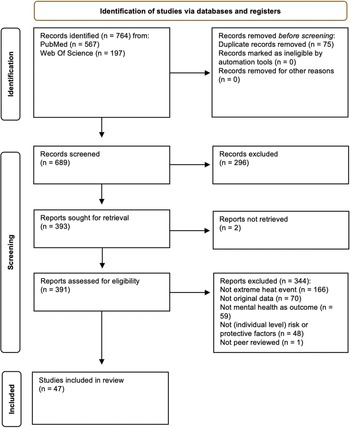
The PRISMA flow diagram (Page et al., Reference Page, McKenzie, Bossuyt, Boutron, Hoffmann, Mulrow, Shamseer, Tetzlaff, Akl, Brennan, Chou, Glanville, Grimshaw, Hróbjartsson, Lalu, Li, Loder, Mayo-Wilson, McDonald and Moher2021) of the search results is presented in Figure 2 with further detail on study selection in the Supplementary Material (S6). Out of 764 search results, 47 were deemed eligible for inclusion. Forty-two studies reported on quantitative results, four studies presented qualitative findings, and one used mixed methods. Tables 1 and 2 provide an overview of the quantitative and qualitative/mixed-methods studies, respectively; further details on methods, findings, and quality ratings of individual studies can be found in the Supplementary Materials (S7, S8). The majority of quantitative studies examined clinical outcomes from administrative or clinical records (n = 38) or vital statistics databases (n = 5), such as number of hospital visits for psychiatric diagnoses or suicide data, with a minority reporting data from validated mental health scales (n = 6) and/or self-reported mental health impacts (n = 4). All qualitative studies described self-reported or perceived well-being impacts of heat. Across all included studies, the majority only examined risk factors (n = 40), with three studies looking solely at protective factors, and four exploring both. Findings on individual risk and protective factors are summarized below.
PRISMA flow diagram.

Figure 2. Long description
The flowchart is organized into three vertical phases: Identification, Screening, and Included.
1. Identification Phase:
- Top-left box: Records identified (n = 764) from PubMed (n = 567) and Web Of Science (n = 197).
- Top-right box (connected by a horizontal arrow): Records removed before screening (n = 75) due to duplicates (n = 75), automation tools (n = 0), or other reasons (n = 0).
2. Screening Phase:
- Second central box: Records screened (n = 689).
- Second right box: Records excluded (n = 296).
- Third central box: Reports sought for retrieval (n = 393).
- Third right box: Reports not retrieved (n = 2).
- Fourth central box: Reports assessed for eligibility (n = 391).
- Fourth right box: Reports excluded (n = 344) for specific reasons: Not extreme heat event (n = 166), Not original data (n = 70), Not mental health as outcome (n = 59), Not (individual level) risk or protective factors (n = 48), and Not peer reviewed (n = 1).
3. Included Phase:
- Bottom central box: Studies included in review (n = 47).
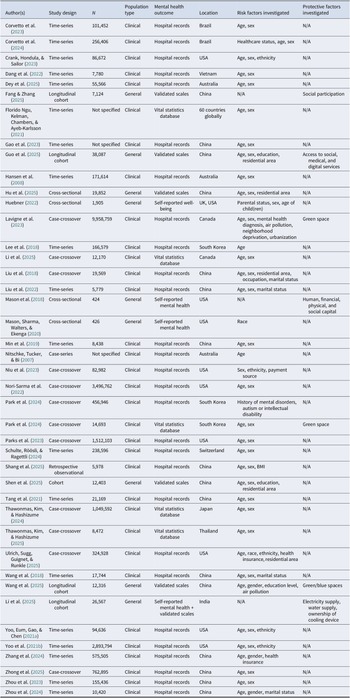
Overview of the quantitative studies included in the systematic review

Table 1. Long description
The table consists of 8 columns: Author(s), Study design, N (sample size), Population type, Mental health outcome, Location, Risk factors investigated, and Protective factors investigated.
Key entries include:
* Corvetto et al. (2023 and 2024): Time-series studies in Brazil with clinical populations (N = 101,452 and 256,406) using hospital records.
* Lavigne et al. (2023): Case-crossover study in Canada with the largest sample size (N = 9,958,759), investigating risk factors like air pollution and urbanization, and green space as a protective factor.
* Nori-Sarma et al. (2022): Case-crossover study in the U S A with N = 3,496,762 clinical subjects.
* Multiple studies from China (e.g., Fang and Zhang 2025, Guo et al. 2025, Hu et al. 2025) focus on general populations using validated scales, investigating social participation and digital services as protective factors.
* Locations span globally, including Vietnam, Australia, 60 countries globally (Florido Ngu et al. 2021), U K, South Korea, Switzerland, Thailand, and India.
* Risk factors frequently include age, sex, and residential area. Protective factors are less commonly investigated but include green/blue spaces, social capital, and access to medical or digital services.
* Sample sizes range from 424 (Mason et al. 2018) to nearly 10 million (Lavigne et al. 2023).
Note: The categorization into risk or protective factors is in line with the original studies. An extended version of this table, along with detailed findings and quality ratings of each study, is provided in the Supplementary Material (S7). BMI, body mass index; N/A, not applicable.
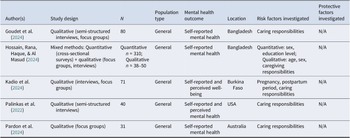
Overview of the qualitative articles included in the systematic review
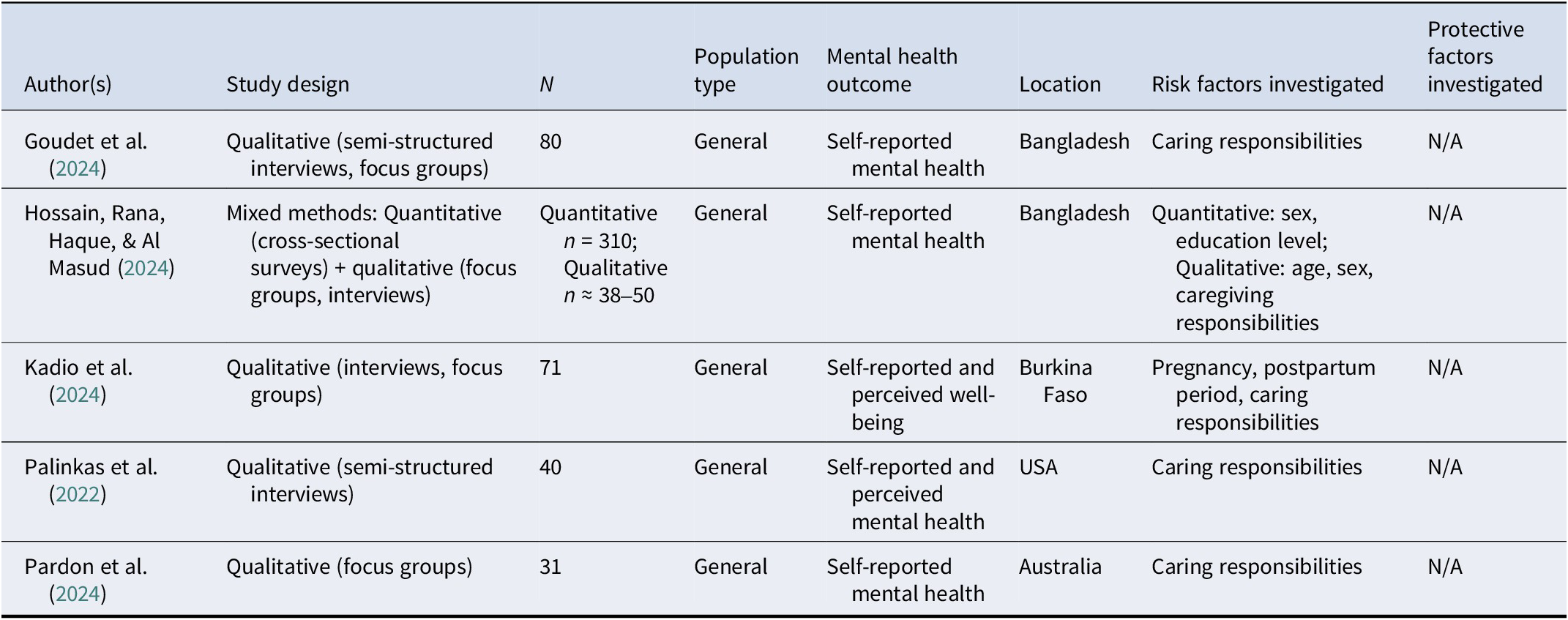
Table 2. Long description
The table consists of eight columns: Author(s), Study design, N, Population type, Mental health outcome, Location, Risk factors investigated, and Protective factors investigated.
* Row 1: Goudet et al. 2024. Qualitative semi-structured interviews and focus groups. N equals 80. General population. Self-reported mental health. Bangladesh. Risk factors: Caring responsibilities. Protective factors: N / A.
* Row 2: Hossain, Rana, Haque, and Al Masud 2024. Mixed methods: Quantitative cross-sectional surveys plus qualitative focus groups and interviews. Quantitative n equals 310; Qualitative n is approximately 38 to 50. General population. Self-reported mental health. Bangladesh. Risk factors: Quantitative: sex, education level; Qualitative: age, sex, caregiving responsibilities. Protective factors: N / A.
* Row 3: Kadio et al. 2024. Qualitative interviews and focus groups. N equals 71. General population. Self-reported and perceived well-being. Burkina Faso. Risk factors: Pregnancy, postpartum period, caring responsibilities. Protective factors: N / A.
* Row 4: Palinkas et al. 2022. Qualitative semi-structured interviews. N equals 40. General population. Self-reported and perceived mental health. U S A. Risk factors: Caring responsibilities. Protective factors: N / A.
* Row 5: Pardon et al. 2024. Qualitative focus groups. N equals 31. General population. Self-reported mental health. Australia. Risk factors: Caring responsibilities. Protective factors: N / A.
Note: An extended version of this table, along with detailed findings and quality ratings of each study, is provided in the Supplementary Material (S8). N/A, not applicable.
Risk factors
Age. Thirty-six studies reported on age, with inconsistent findings. The vast majority examined clinical outcomes (n = 31), such as hospital attendance or suicide incidence, while a few analyzed self-reported mental health using validated scales (n = 4), such as depression symptoms, or qualitative interviews (n = 1); however, there was no discernible trend for differences in findings between these study types. In total, 11 reported a higher risk for younger to middle age groups, typically ages <60 (Corvetto et al., Reference Corvetto, Federspiel, Sewe, Müller, Bunker and Sauerborn2023; Florido Ngu, Kelman, Chambers, & Ayeb-Karlsson, Reference Florido Ngu, Kelman, Chambers and Ayeb-Karlsson2021; Gao et al., Reference Gao, Liu, Jing, Wang, Song, Liu, Wang, Wang and An2023; Guo et al., Reference Guo, Zheng, Zhang, Li, Wang and Lai2025; Lavigne et al., Reference Lavigne, Maltby, Côté, Weinberger, Hebbern, Vicedo-Cabrera and Wilk2023; Min et al., Reference Min, Shi, Ye, Wang, Yao, Tian, Zhang, Liang, Qu, Bi, Duan and Sun2019; Shen et al., Reference Shen, Zhang, Yuan, Zhang and Hu2025; Thawonmas, Kim, & Hashizume, Reference Thawonmas, Kim and Hashizume2025; Wang et al., Reference Wang, Zhang, Xie, Zhao, Zhang, Zhang, Cheng, Bai and Su2018; Wang, Li, & Rajagopalan, Reference Wang, Li and Rajagopalan2025; Zhou et al., Reference Zhou, Huang, Su, Tang, Qin, Huo, Zhou, Lan, Zhao, Huang, Huang and Wei2024), whereas another 11 studies found that older adults (typically >60) were more affected (Hansen et al., Reference Hansen, Bi, Nitschke, Ryan, Pisaniello and Tucket2008; Lee et al., Reference Lee, Lee, Myung, Kim and Kim2018; Li et al., Reference Li, Henderson, Coker, McLean and Lee2025; Liu et al., Reference Liu, Liu, Fan, Liu and Ding2018, Reference Liu, Yu, Pan, He, Wu, Yan, Yi, Li, Song, Yuan, Liu, Wei, Jin, Li, Liang, Sun, Mei, Song, Cheng and Su2022; Nitschke, Tucker, & Bi, Reference Nitschke, Tucker and Bi2007; Shang et al., Reference Shang, Xu, Xie, Ji, Tang, Wang, Wang, Liu, Zhu and Huang2025; Tang et al., Reference Tang, Ji, Li, Yao, Cheng, He, Liu, Pan, Wei, Yi and Su2021; Thawonmas, Kim, & Hashizume, Reference Thawonmas, Kim and Hashizume2024; Zhang et al., Reference Zhang, Li, Wang, Wu, Yang, Wang, Huang, Feng, He, Wang, Ling and Zhou2024; Zhou et al., Reference Zhou, Ji, Tang, Liu, Yao, Liu, Xu, Xiao, Hu, Jiang, Li, Du, Li, Zhou and Cai2023). In many studies (n = 8), findings differed depending on the thresholds used for temperature intensity and duration (Corvetto et al., Reference Corvetto, Helou, Kriit, Federspiel, Bunker, Liyanage, Costa, Müller and Sauerborn2024; Dang et al., Reference Dang, Vy, Thuong, Phung, Van Dung and Le An2022; Hossain, Rana, Haque, & Al Masud, Reference Hossain, Rana, Haque and Al Masud2024; Niu et al., Reference Niu, Girma, Liu, Schinasi, Clougherty and Sheffield2023; Schulte, Röösli, & Ragettli, Reference Schulte, Röösli and Ragettli2024; Ulrich, Sugg, Guignet, & Runkle, Reference Ulrich, Sugg, Guignet and Runkle2025; Yoo et al., Reference Yoo, Eum, Roberts, Gao and Chen2021b; Zhong et al., Reference Zhong, Xu, Liu, Tang, Zhang, Xie, Liu, Huang, Zhu and Wang2025). For example, Dang et al. (Reference Dang, Vy, Thuong, Phung, Van Dung and Le An2022) found that younger ages (18–40) were most affected by temperature intensity (i.e. daily mean temperature), whereas older groups (>60) were more affected by heatwave duration. The remaining six studies reported comparable risks between age groups (Crank, Hondula, & Sailor, Reference Crank, Hondula and Sailor2023; Dey et al., Reference Dey, Wu, Uesi, Sara, Dudley, Knight, Scott, Jay, Bowden and Perkes2025; Nori-Sarma et al., Reference Nori-Sarma, Sun, Sun, Spangler, Oblath, Galea, Gradus and Wellenius2022; Parks et al., Reference Parks, Rowland, Do, Boehme, Dominici, Hart and Kioumourtzoglou2023, Reference Park, Moon, Kwon, Ji, Kim and Kim2024; Yoo, Eum, Gao, & Chen, Reference Yoo, Eum, Gao and Chen2021a).
Sex. Similar to age, of the 35 studies that examined sex differences, the majority used clinical outcomes such as hospital attendance or suicide incidence (n = 29), while a smaller number examined broader self-reported mental health and well-being outcomes from validated scales (n = 4) or other quantitative or qualitative approaches (n = 2). Overall, more studies found increased risk for men (n = 9) (Crank, Hondula, & Sailor, Reference Crank, Hondula and Sailor2023; Dang et al., Reference Dang, Vy, Thuong, Phung, Van Dung and Le An2022; Gao et al., Reference Gao, Liu, Jing, Wang, Song, Liu, Wang, Wang and An2023; Li et al., Reference Li, Henderson, Coker, McLean and Lee2025; Min et al., Reference Min, Shi, Ye, Wang, Yao, Tian, Zhang, Liang, Qu, Bi, Duan and Sun2019; Nori-Sarma et al., Reference Nori-Sarma, Sun, Sun, Spangler, Oblath, Galea, Gradus and Wellenius2022; Shang et al., Reference Shang, Xu, Xie, Ji, Tang, Wang, Wang, Liu, Zhu and Huang2025; Tang et al., Reference Tang, Ji, Li, Yao, Cheng, He, Liu, Pan, Wei, Yi and Su2021; Wang et al., Reference Wang, Zhang, Xie, Zhao, Zhang, Zhang, Cheng, Bai and Su2018) than those reporting higher risk for women (n = 6) (Corvetto et al., Reference Corvetto, Federspiel, Sewe, Müller, Bunker and Sauerborn2023; Florido Ngu, Kelman, Chambers, & Ayeb-Karlsson, Reference Florido Ngu, Kelman, Chambers and Ayeb-Karlsson2021; Guo et al., Reference Guo, Zheng, Zhang, Li, Wang and Lai2025; Hossain, Rana, Haque, & Al Masud, Reference Hossain, Rana, Haque and Al Masud2024; Thawonmas, Kim, & Hashizume, Reference Thawonmas, Kim and Hashizume2024; Zhou et al., Reference Zhou, Ji, Tang, Liu, Yao, Liu, Xu, Xiao, Hu, Jiang, Li, Du, Li, Zhou and Cai2023). Others observed no statistically significant difference (n = 13) (Dey et al., Reference Dey, Wu, Uesi, Sara, Dudley, Knight, Scott, Jay, Bowden and Perkes2025; Hu et al., Reference Hu, Hu, Xu, Peng, Cheng, Rong, Wang, Zhang, Guan and Yu2025; Lavigne et al., Reference Lavigne, Maltby, Côté, Weinberger, Hebbern, Vicedo-Cabrera and Wilk2023; Liu et al., Reference Liu, Liu, Fan, Liu and Ding2018, Reference Liu, Yu, Pan, He, Wu, Yan, Yi, Li, Song, Yuan, Liu, Wei, Jin, Li, Liang, Sun, Mei, Song, Cheng and Su2022; Parks et al., Reference Parks, Rowland, Do, Boehme, Dominici, Hart and Kioumourtzoglou2023; Schulte, Röösli, & Ragettli, Reference Schulte, Röösli and Ragettli2024; Shen et al., Reference Shen, Zhang, Yuan, Zhang and Hu2025; Thawonmas, Kim, & Hashizume, Reference Thawonmas, Kim and Hashizume2025; Wang, Li, & Rajagopalan, Reference Wang, Li and Rajagopalan2025; Yoo, Eum, Gao, & Chen, Reference Yoo, Eum, Gao and Chen2021a; Yoo et al., Reference Yoo, Eum, Roberts, Gao and Chen2021b; Zhang et al., Reference Zhang, Li, Wang, Wu, Yang, Wang, Huang, Feng, He, Wang, Ling and Zhou2024). The findings in an additional seven studies varied depending on the choice of temperature threshold, outcome measure, or region (Corvetto et al., Reference Corvetto, Helou, Kriit, Federspiel, Bunker, Liyanage, Costa, Müller and Sauerborn2024; Hansen et al., Reference Hansen, Bi, Nitschke, Ryan, Pisaniello and Tucket2008; Huebner, Reference Huebner2022; Niu et al., Reference Niu, Girma, Liu, Schinasi, Clougherty and Sheffield2023; Park et al., Reference Park, Moon, Kwon, Ji, Kim and Kim2024; Zhong et al., Reference Zhong, Xu, Liu, Tang, Zhang, Xie, Liu, Huang, Zhu and Wang2025; Zhou et al., Reference Zhou, Huang, Su, Tang, Qin, Huo, Zhou, Lan, Zhao, Huang, Huang and Wei2024). For instance, in a case-crossover study for heat and mental disorder-related hospital visits by Zhong et al. (Reference Zhong, Xu, Liu, Tang, Zhang, Xie, Liu, Huang, Zhu and Wang2025), risks for total mental disorders were similar across sexes. However, in cause-specific analyses, women showed higher risks for anxiety and depression, while men had slightly higher risks for schizophrenia; statistical significance of group differences was not assessed.
Pre-existing mental health conditions. Two studies identified pre-existing mental health conditions as risk factors for heat-related clinical outcomes using hospital records. Lavigne et al. (Reference Lavigne, Maltby, Côté, Weinberger, Hebbern, Vicedo-Cabrera and Wilk2023) reported higher risks of mental health-related emergency department visits among individuals with mood disorders, neurotic disorders, personality behavior disorders, or developmental disorders compared to those without these conditions. Similarly, Park et al. (Reference Park, Kim, Bell, Kim and Lee2024) reported that people with intellectual disabilities or a history of mental disorders had a higher risk of mental health-related emergency department admissions during heat, while people with autism did not; however, the statistical significance of group differences was not assessed.
Ethnicity. Six studies examined ethnicity, mainly using hospital records (n = 5). Findings were inconsistent. Two studies identified a higher risk for people of non-white ethnicities (Crank, Hondula, & Sailor, Reference Crank, Hondula and Sailor2023; Niu et al., Reference Niu, Girma, Liu, Schinasi, Clougherty and Sheffield2023), two reported no significant modification effect (Yoo, Eum, Gao, & Chen, Reference Yoo, Eum, Gao and Chen2021a); Yoo et al., Reference Yoo, Eum, Roberts, Gao and Chen2021b, one had mixed results depending on the outcome measure (Ulrich, Sugg, Guignet, & Runkle, Reference Ulrich, Sugg, Guignet and Runkle2025). Finally, in a survey on self-reported mental health impacts, Mason, Sharma, Walters, & Ekenga (Reference Mason, Sharma, Walters and Ekenga2020) found that white participants were more likely to report heat-related mental health impacts.
Socioeconomic and environmental factors. Socioeconomic and environmental risk factors were less frequently investigated and yielded mixed findings. One study using hospital records reported that heat had the highest impact on individuals living in materially and socially deprived neighborhoods, and on those exposed to high levels of air pollution (Lavigne et al., Reference Lavigne, Maltby, Côté, Weinberger, Hebbern, Vicedo-Cabrera and Wilk2023). Five studies compared risks of residential setting using data from hospital records or obtained using validated mental health scales: three found increased vulnerability in rural areas (Guo et al., Reference Guo, Zheng, Zhang, Li, Wang and Lai2025; Hu et al., Reference Hu, Hu, Xu, Peng, Cheng, Rong, Wang, Zhang, Guan and Yu2025; Ulrich, Sugg, Guignet, & Runkle, Reference Ulrich, Sugg, Guignet and Runkle2025), one found a higher risk in urban areas (Liu et al., Reference Liu, Liu, Fan, Liu and Ding2018), and one found no difference (Shen et al., Reference Shen, Zhang, Yuan, Zhang and Hu2025). Payment source for hospital visits was analyzed in four studies as a proxy for socioeconomic status, with mixed findings (Corvetto et al., Reference Corvetto, Helou, Kriit, Federspiel, Bunker, Liyanage, Costa, Müller and Sauerborn2024; Niu et al., Reference Niu, Girma, Liu, Schinasi, Clougherty and Sheffield2023; Ulrich, Sugg, Guignet, & Runkle, Reference Ulrich, Sugg, Guignet and Runkle2025; Zhang et al., Reference Zhang, Li, Wang, Wu, Yang, Wang, Huang, Feng, He, Wang, Ling and Zhou2024). For example, in the USA, commercial insurance, Medicaid, and self-pay were all found to increase the risk of mental health-related hospital visits depending on the age group of children, adolescents, or young adults, respectively (Niu et al., Reference Niu, Girma, Liu, Schinasi, Clougherty and Sheffield2023). In Brazil, private patients had a 4.3% higher risk of emergency department visits during extreme heat (99th percentile), while public patients were at a 7.5% increased risk during moderate heat (90–99th percentile) (Corvetto et al., Reference Corvetto, Helou, Kriit, Federspiel, Bunker, Liyanage, Costa, Müller and Sauerborn2024). Education level was also examined in three studies on self-reported mental health using validated scales; here, one study suggested a greater risk for those with a lower education level (Guo et al., Reference Guo, Zheng, Zhang, Li, Wang and Lai2025), one for those with a higher education (Shen et al., Reference Shen, Zhang, Yuan, Zhang and Hu2025), and one reported no difference (Wang, Li, & Rajagopalan, Reference Wang, Li and Rajagopalan2025).
Caring responsibilities. Six studies explored caring responsibilities or parental status as a risk factor, all using self-reported mental health or well-being outcomes. In the five qualitative studies, concerns about caregiving – especially for children – briefly emerged in broader discussions of heat or climate change, e.g. in relation to women’s mental health (Goudet et al., Reference Goudet, Binte Arif, Owais, Uddin Ahmed and Ridde2024; Kadio et al., Reference Kadio, Filippi, Congo, Scorgie, Roos, Lusambili, Nakstad, Kovats and Kouanda2024; Pardon et al., Reference Pardon, Dimmock, Chande, Kondracki, Reddick, Davis, Athan, Buoli and Barkin2024) or heat adaptation in low-income communities (Palinkas et al., Reference Palinkas, Hurlburt, Fernandez, De Leon, Yu, Salinas, Garcia, Johnston, Rahman, Silva and McConnell2022). Notably, in cross-sectional surveys in the UK and USA by Huebner (Reference Huebner2022) on self-reported well-being impacts, parents were not more worried about their homes overheating than non-parents. Since heat was not defined and the discussion of risk factors was only brief in the qualitative studies, these studies were rated as low quality for the purposes of this review (Supplementary Material S8).
Protective factors
Only seven studies examined protective factors, including good health, social support, and access to green/blue spaces, on a range of clinical and self-reported mental health outcomes. For example, surveying US residents in low- and moderate-income areas on self-reported health impacts, Mason et al. (Reference Mason, Erwin, Brown, Ellis and Hathaway2018) identified good physical health and social cohesion as statistically significant protective factors. Similarly, among older adults in China, social participation (incl. visiting friends) and/or access to social, medical, or digital services buffered the effects of heatwaves on depressive symptoms, assessed using validated mental health scales (Fang & Zhang, Reference Fang and Zhang2025; Guo et al., Reference Guo, Zheng, Zhang, Li, Wang and Lai2025). Three studies found that exposure to green and/or blue spaces was protective (Lavigne et al., Reference Lavigne, Maltby, Côté, Weinberger, Hebbern, Vicedo-Cabrera and Wilk2023; Park et al., Reference Park, Moon, Kwon, Ji, Kim and Kim2024; Wang, Li, & Rajagopalan, Reference Wang, Li and Rajagopalan2025), e.g. suicide risk examined in a vital statistics database was lower in districts with more green space (Park et al., Reference Park, Moon, Kwon, Ji, Kim and Kim2024).
Qualitative investigation
Sample characteristics
Thirty-three participants took part across the six focus groups run in June and July 2024 (n = 21 people with lived experience, n = 12 healthcare professionals). Participants in the lived experience group had past experience of extreme heat and the majority also had a history of mental illness (68.2%). Further information on sample demographics is provided in the Supplementary Material (S9).
Results of thematic content analysis
We developed three overarching themes relating to (1) ability to adapt behavior during heat, (2) personal heat sensitivity, and (3) disparities in heat exposure. All information provided in this section directly arose from participant statements. A visualization of the themes and sub-themes, as well as additional quotes, is provided in the Supplementary Materials (S10, S11).
Theme 1: Ability to adapt behavior. Participants discussed various mental, cognitive, and physical factors that may limit a person’s ability to recognize the impact of heat and adjust their behaviors to cope. In terms of mental and cognitive factors, healthcare professionals noted that service users with a severe learning disability or mental illness might require additional support to understand the need for adaptation in hot weather. One participant explained:
When you work with people who have psychosis, they might not be able to tell that it’s really hot outside, and then they’re wearing all their jumpers […], but then they’re getting really angry and irritated.
A related factor limiting adaptability is a lack of knowledge about coping mechanisms, which was highlighted by several participants. Conversely, knowing how to manage heat was seen as highly protective. Many participants – drawing from experience in hotter countries – noted that those accustomed to high temperatures often cope better.
The risk from lack of knowledge may be compounded by lack of social support, leaving no one to turn to when struggling. Participants considered social isolation a major risk factor, especially during prolonged heatwaves. In contrast, a strong social support system was seen as protective by providing emotional support (e.g. sharing struggles with friends to feel less alone) and practical support (e.g. someone remembering to close the curtains before it gets hot).
The discussions highlighted that some people may recognize the need to adapt behavior but face personal or external constraints. Participants identified three key barriers: impaired mobility (e.g. due to old age or disability), inflexible work schedules (meaning one cannot avoid being outside during heat), and inability to afford cooling products (e.g. fans). Several healthcare professionals also highlighted the heat risk to inpatients, explaining that UK hospitals often lack air-conditioning or sufficient ventilation. Conversely, having control over one’s schedule was seen as protective, as some participants reflected on their own experience as students and noted that being able to reduce their workload on hot days was highly beneficial.
Theme 2: Personal heat sensitivity. Participants reported that some people experience negative health impacts at lower temperatures than others, either because they are more sensitive to temperature or are less resilient to external stressors. Many participants identified risk relating to altered thermoregulation in themselves or in service users, e.g. because of medication or a physical health condition. One person with lived experience described feeling the negative effects of heat at considerably lower temperatures than others around them:
I’ve been on medication for years already, and I had no clue why I felt the way I did during periods of really hot weather. And then I came across some article […] and I was like, ‘God, I wish I knew this earlier. I wouldn’t have beaten myself up so much.
Participants suggested that thermoregulation may also be affected by sex-specific physiological states, such as pregnancy, the postnatal period, and menopause (including perimenopause). These periods were described as particularly vulnerable times, both psychologically and physically, that may lower someone’s ability to cope with extreme heat. Thermoregulation was also perceived to be affected by substance use, with one healthcare professional highlighting that many substances raise core body heat and noting summer festivals as events that carry particular risk.
Participants felt that some individuals may have lower resilience to external stressors due to poor mental well-being or heightened sensitivity. They noted that for those already under significant stress, such as from mental illness, heat discomfort could trigger a crisis. Caring responsibilities were also seen as a risk factor, as they add the burden of managing another’s well-being alongside one’s own. This reduced resilience can be compounded during pregnancy and postnatal periods, as one healthcare professional illustrated through their own personal experience:
I had my son four years ago and it was extreme heat, and I remember that I wasn’t sleeping, and it was so hot that I just didn’t see anybody for a long period. […] The isolation, the sleep, the anxiety, the discomfort […] will definitely predispose mothers who have just given birth.
Theme 3: Disparities in heat exposure. Participants noted that certain living conditions (e.g. homelessness), work environments (e.g. around ovens, outdoors), and leisure activities (e.g. exercising outdoors) increase heat exposure and thus risks. Highlighting the link between living conditions and socioeconomic factors, one healthcare professional speculated about poorer insulation in social housing:
If somebody lives in a tiny little housing association flat and it’s three floors up, then it’s much more difficult to find a cool space than if they live in a cottage with fat stone walls that keep your house cool.
Participants highlighted access to cool spaces (e.g. parks, air-conditioned rooms) as highly protective. One person with lived experience noted that air-conditioning at home ‘takes away the factor of extreme heat,’ which was seen as particularly important for the quality of sleep. However, participants stressed that financial inequality exacerbates heat risk, as those with lower socioeconomic status often lacked both air-conditioning and nearby green spaces to cool down.
Screening tool
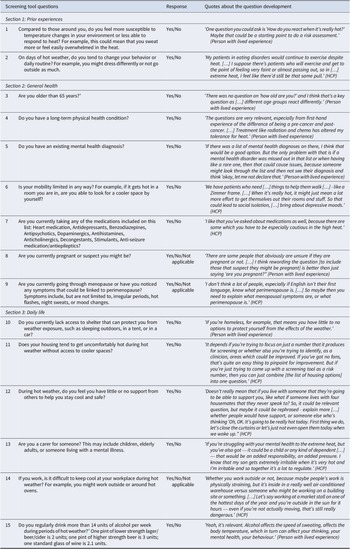
The preliminary screening tool HEAT-MH was co-developed on the basis of the thematic content analysis and the item-by-item discussion of the drafts in the focus group stages 2 and 3 (Figure 1). HEAT-MH consists of 15 questions across three domains: prior experiences of heat, general health, and daily life. The full tool is presented in Table 3 along with participant quotes on co-development, with further details provided in the Supplementary Material (S12).
Proposed screening tool ‘HEAT-MH’ (Heat Exposure Assessment Tool for Mental Health) co-developed with focus group participants

Table 3. Long description
The table is titled Table 3. Proposed screening tool H E A T minus M H (Heat Exposure Assessment Tool for Mental Health) co-developed with focus group participants. It consists of four columns: Screening tool questions (split into number and text), Response, and Quotes about the question development.
Section 1: Prior experiences
* Question 1: Asks about susceptibility to temperature changes or inability to respond to heat (e.g., sweating more). Response: Yes/No. Quote from a person with lived experience emphasizes using heat reaction as a starting point for risk assessment.
* Question 2: Asks about changes in behavior or routine during hot weather. Response: Yes/No. Quote from a healthcare professional (H C P) notes that patients with eating disorders may continue to exercise despite extreme heat.
Section 2: General health
* Question 3: Age older than 65 years. Response: Yes/No. Quote notes different age groups react differently.
* Question 4: Long-term physical health condition. Response: Yes/No. Quote mentions how cancer treatments like radiation and chemo altered heat tolerance.
* Question 5: Existing mental health diagnosis. Response: Yes/No. Quote discusses the pros and cons of listing specific diagnoses.
* Question 6: Limited mobility (e.g., ability to find a cooler space). Response: Yes/No. Quote from an H C P mentions how limited mobility can lead to social isolation and depressive moods in heat.
* Question 7: Current medications (Heart medication, Antidepressants, Benzodiazepines, Antipsychotics, Dopaminergics, Antihistamines, Anticholinergics, Decongestants, Stimulants, Anti-seizure). Response: Yes/No. Quote highlights the need for caution with specific medications.
* Question 8: Pregnancy or suspected pregnancy. Response: Yes/No/Not applicable. Quote suggests including those who suspect pregnancy.
* Question 9: Menopause or perimenopause symptoms (hot flashes, mood changes). Response: Yes/No/Not applicable. Quote suggests explaining these terms for clarity.
Section 3: Daily life
* Question 10: Lack of access to shelter (sleeping outdoors, tent, car). Response: Yes/No. Quote notes homelessness leaves no options for protection.
* Question 11: Housing getting uncomfortably hot without access to cooler spaces. Response: Yes/No. Quote discusses identifying specific areas for clinical improvement like lack of fans.
* Question 12: Lack of support from others to stay cool and safe. Response: Yes/No. Quote notes that living with others does not guarantee support.
* Question 13: Being a carer for children, elderly, or those with mental illness. Response: Yes/No. Quote mentions the added pressure of regulating a dependent’s irritability in heat.
* Question 14: Difficulty keeping cool at work (outside or near ovens). Response: Yes/No/Not applicable. Quote mentions the danger of prolonged sun exposure even if not moving.
* Question 15: Drinking more than 14 units of alcohol per week. Response: Yes/No. Quote notes alcohol affects sweating and body temperature.
A footnote indicates the tool is for mental health professionals in UK outpatient services, with a risk score scale of 0 to 15.
Note: Pending validation, HEAT-MH is intended for use by mental health professionals within UK outpatient and community mental health services to help identify individuals who may be particularly vulnerable to heat-related mental health difficulties. The tool is intended to complement existing clinical judgment and support preventative interventions, care planning, and resource allocation during heat. This HEAT-MH prototype was designed for adult mental health service users with capacity to understand the questions. However, it will require validation before potential use in clinical settings and may also require additional adaptation and evaluation for use in different populations or service settings. The table lists the questions, suggested response options, and participant quotes from the co-development of the individual questions. Further supportive quotes on the content are provided in the Supplementary Material (S12). Service users are assigned a risk score on a scale of 0–15, where ‘yes’ and ‘no’/‘not applicable’ responses are counted as 1 and 0 points, respectively. Therefore, a higher score is proposed to correspond to higher risk. HCP, healthcare professional.
a Specific thresholds for age and alcohol consumption were not discussed during the focus groups. The values here were informed by the systematic review and general health guidance, respectively.
Questions were grouped into domains by the researchers and ordered by general importance based on participant feedback. The final selection, phrasing, and scoring of questions, as well as the naming of the tool, were carried out by the researchers to create a simple and time-efficient screening tool. The selection was based on the following key criteria: (1) a binary response (yes/no), (2) clear relevance to heat-related risk, and (3) appropriateness for the target population, i.e. adult service users in mental health services with the capacity to understand the questions. As a result, some risk factors that were discussed in the focus groups, such as severe learning disability or use of illicit substances, were not included.
HEAT-MH generates a risk score on the scale of 0 to 15, with each ‘yes’ response contributing one point. We propose the following risk categories: scores <5 indicate low risk, 5–10 suggest medium risk, and scores >10 indicate high risk. Future research is needed to evaluate potential redundancies amongst the questions, determine the optimal weighting for each item, and validate the proposed thresholds for the different risk categories.
The majority of participants expressed positive views on the development and potential clinical use of a screening tool for extreme heat and mental health, such as HEAT-MH. While a few noted that clinicians often know their clients well enough to assess risk informally, HEAT-MH was seen as a way to raise awareness of heat-related mental health risks and facilitate clinician-client dialogue. Some healthcare professionals emphasized the time constraints in clinical settings, underscoring the need for a brief, efficient tool.
Discussion
This study used a mixed-method approach to explore risk and protective factors for heat-related mental health issues, leading to the proposal of the screening tool HEAT-MH for researchers and clinicians to identify the most vulnerable service users.
The systematic review revealed some evidence for age, sex, existing mental illness, ethnicity, socioeconomic status, and caring responsibilities as risk factors; however, the results were inconsistent across studies. This inconsistency may reflect the substantial methodological heterogeneity across studies, including differences in location, demographics (e.g. sex, age, socioeconomic status), definitions of heat exposure, outcomes, and analytical approaches. Notably, the review included both clinical and subclinical mental health outcomes, and the distinction between subclinical distress and clinically significant psychopathology was not always clear within studies. Furthermore, studies differed in whether they used data on healthcare utilization from administrative or clinical records or self-reported mental health data from surveys or interviews. This may have contributed to inconsistent findings on some risk/protective factors, particularly socioeconomic status. Healthcare utilization is unlikely to capture the full underlying burden of heat-related mental health impacts, as it may also be influenced by differences in healthcare access. More broadly, associations between demographic factors (e.g. socioeconomic status, ethnicity, age) and mental health outcomes may vary across populations according to contextual factors such as occupational heat exposure, housing quality, social support, and local access to cooling or shaded spaces.
As previously noted by Thompson et al. (Reference Thompson, Lawrance, Roberts, Grailey, Ashrafian, Maheswaran, Toledano and Darzi2023), the heterogeneity of findings highlights the importance of using local data to inform policies. While previous systematic reviews identified adults over 65 as consistently vulnerable to heat-related poor mental health issues (Liu et al., Reference Liu, Varghese, Hansen, Xiang, Zhang, Dear, Gourley, Driscoll, Morgan, Capon and Bi2021), our findings suggest a more nuanced relationship between age and vulnerability. Specifically, different age groups may be at risk depending on the mental health outcome or the presence of other risk factors like socioeconomic status (Corvetto et al., Reference Corvetto, Helou, Kriit, Federspiel, Bunker, Liyanage, Costa, Müller and Sauerborn2024; Niu et al., Reference Niu, Girma, Liu, Schinasi, Clougherty and Sheffield2023). For example, younger ages appeared to be at higher risk for suicide (Florido Ngu, Kelman, Chambers, & Ayeb-Karlsson, Reference Florido Ngu, Kelman, Chambers and Ayeb-Karlsson2021), whereas older adults were more vulnerable to depression (Zhou et al., Reference Zhou, Ji, Tang, Liu, Yao, Liu, Xu, Xiao, Hu, Jiang, Li, Du, Li, Zhou and Cai2023). Similarly, people of working age are more likely to be exposed to higher temperatures at work, specifically those reliant on outdoor work. The present study did not find a clear sex difference, although men seemed to be at slightly increased risk, possibly also due to greater heat exposure at work (Liu et al., Reference Liu, Varghese, Hansen, Xiang, Zhang, Dear, Gourley, Driscoll, Morgan, Capon and Bi2021; Thompson, Hornigold, Page, & Waite, Reference Thompson, Hornigold, Page and Waite2018). In contrast, while there were only two studies specifically looking at pre-existing mental illness (Lavigne et al., Reference Lavigne, Maltby, Côté, Weinberger, Hebbern, Vicedo-Cabrera and Wilk2023; Park et al., Reference Park, Kim, Bell, Kim and Lee2024), they highlight this group as particularly vulnerable in line with a previous review (Thompson, Hornigold, Page, & Waite, Reference Thompson, Hornigold, Page and Waite2018). However, many included studies on heat-related hospital utilization stratified by diagnostic category without distinguishing between pre-existing diagnoses and diagnoses identified during the heat-related hospital presentation itself (Supplementary Material S6). Overall, while there is emerging evidence for several risk factors for heat-related mental health impacts, further research using clearly defined outcome measures and more consistent methodological approaches is needed.
Our qualitative investigation identified additional risk and protective factors that were not part of the systematic review, highlighting the importance of lived experience insights. The key themes identified in the thematic content analysis related to (1) ability to adapt behavior (e.g. learning disability, impaired mobility), (2) personal heat sensitivity (e.g. medication-induced thermoregulation issues), and (3) disparities in heat exposure (e.g. homelessness, access to cool spaces). Interestingly, the factors identified across the systematic review and qualitative investigation partially overlap with those for physical and general health risks (Ebi et al., Reference Ebi, Capon, Berry, Broderick, De Dear, Havenith, Honda, Kovats, Ma, Malik, Morris, Nybo, Seneviratne, Vanos and Jay2021). This suggests that risk for physical and mental health issues may be closely linked.
The focus groups led to the co-development of the 15-item screening tool HEAT-MH to assess individual vulnerability to heat-related mental health impacts among existing mental health service users. The tool includes questions on prior experiences of heat, general health, and lifestyle. While it is designed to generate a numerical risk score, determining the weighting of individual items and an appropriate threshold for risk levels was beyond the scope of this study and should be addressed in future research, along with its overall validity and feasibility. Our primary goal was to create a user-friendly, time-efficient prototype that could potentially be integrated into routine clinical workflows following further testing and validation in real-world mental health service settings. Some focus group participants also suggested incorporating a qualitative element, noting that the tool could serve as a conversation starter to help clinicians better understand individual challenges in hot weather and discuss possible support strategies.
Currently, research and clinical frameworks lack standardized screening tools for identifying individuals vulnerable to the mental health impacts of extreme heat. Existing tools, like the Heat Vulnerability Index (Reid et al., Reference Reid, O’Neill, Gronlund, Brines, Brown, Diez-Roux and Schwartz2009), focus on physical health risks, considering factors like age, urban living, and chronic illnesses. While some resources, such as the Extreme Heat and Mental Illness Toolkit by the University of California, San Francisco (Cooper & Fleming, Reference Cooper and Fleming2022) or the Heatwaves and Mental Health guide by the Royal College of Psychiatrists (2025), raise awareness of mental health risks, these do not include screening tools. In this context, HEAT-MH addresses a critical research and clinical gap by offering a practical tool to assess heat-related mental health vulnerability among existing mental health service users in the UK. It should be stressed that, in its current form, HEAT-MH must be considered preliminary. While it could be used to support research on the mental health impacts of extreme heat, it is not yet suitable for clinical use. Future longitudinal studies should examine whether HEAT-MH scores predict mental health difficulties during and following periods of extreme heat, while also evaluating potential redundancies amongst the items, optimal item weightings and risk thresholds, test-retest reliability, and the acceptability and feasibility among service users and clinicians across different clinical, demographic, and geographic settings. Following such validation, we hope HEAT-MH could help mental health professionals identify individuals at greatest risk of heat-related mental health issues early on and inform resource allocation during heatwaves. For example, clinicians could conduct check-in calls with high-risk individuals and provide them with targeted guidance on heat management. Because risk could be identified ahead of periods of heat, HEAT-MH could support earlier preventative interventions aimed at reducing mental health deterioration and the burden on mental health services during heatwaves.
Our study had several limitations. For the systematic review, the number of included studies was limited for many factors, and a few had low-quality ratings, so the findings may have limited robustness. Furthermore, the majority used ambient outdoor temperature without assessing personal exposure, and a few studies did not account for the impact of other interacting weather variables, such as sunshine hours or humidity. The vast majority of studies were conducted in the Global North (see further details in Supplementary Material S6), which may limit the generalizability of findings on risk/protective factors to the Global South and lower-resource settings. Similarly, since few studies focused on Europe, it was expected that our qualitative investigation (conducted in the UK) might highlight some factors not present in the literature.
For the qualitative investigation and co-development of HEAT-MH, the demographic characteristics of our lived experience sample may affect the generalizability of the findings. The sample size was relatively small and consisted mostly of highly educated women; as suggested in the systematic review findings, vulnerability to heat-related mental health issues may be different for men or people with lower education levels. Furthermore, most participants lived in London, UK; different risk and protective factors may therefore be relevant in other countries experiencing more frequent and intense heatwaves. However, many participants had lived in hotter climates, contributing to a diverse range of perspectives within each focus group. Additionally, although many participants reported lived experience of mental illness, the sample was not designed to be representative of the broader population of UK mental health service users. Therefore, further validation of HEAT-MH in clinical populations is required. Lastly, all health impacts were self-reported and all focus groups but one took place online, which may have also influenced the findings.
Conclusion
Our mixed-method approach identified several risk and protective factors related to demographic, socioeconomic, health, and lifestyle factors. Our findings highlight the need for targeted interventions to provide greater support to vulnerable individuals, such as people with existing mental health conditions. Healthcare providers may need to consider these risk factors during clinical appointments, potentially adjust medication regimens, and offer additional support during heatwaves. Meanwhile, the identified protective factors may be utilized in education initiatives in community settings to help mitigate the mental health impacts of extreme heat. We hope that our qualitative findings, especially the proposed screening tool, will contribute to future research and inform efforts to safeguard mental health in an increasingly hot climate.
Supplementary material
The supplementary material for this article can be found at http://doi.org/10.1017/S0033291726105169.
Data availability statement
Data are available upon reasonable request.
Acknowledgments
We thank all participants of the focus groups for their time and invaluable contributions to this study. We would also like to thank the following students on the MSc Early Intervention in Psychosis at King’s College London who supported the qualitative study: Mirra Banerjee, Dhriti Chadha, and Edward Johnston.
Author contribution
LB: Data curation, Investigation, methodology, formal analysis, project administration, visualization, writing – original draft, writing – review & editing. MK: Formal analysis, writing – original draft, writing – review & editing. UI: Investigation, methodology, writing – review & editing. AT: Investigation, formal analysis, writing – review & editing. AM: Conceptualization, funding acquisition, methodology, supervision, writing – review & editing.
Funding statement
This work was supported by a Wellcome Climate Impacts Award to AM (Grant Ref: 228033/Z/23/Z). The funder of this study had no role in study design, collection, analysis, or the decision to submit the manuscript for publication.
Competing interests
The authors declare no competing interests.
Ethical standard
The qualitative investigation received full ethical approval by the Psychiatry, Nursing and Midwifery Research Ethics Subcommittee at King’s College London (reference number LRS/DP-23/24-41409).



 Open access

