




No one knows exactly how General Gordon died. As no eyewitnesses to the fall of Khartoum were immediately available, Victorian Britain was awash with ‘many wild rumours regarding his fate’.Footnote 1 George William Joy’s painting The Death of General Gordon (1893) popularized a portrayal in which Gordon, his sword sheathed and his revolver unfired, accepted a Christian martyr’s death with passive serenity.Footnote 2 However, another, contradictory, account supplied by Gordon’s Egyptian aide-de-camp, Orfali, described Gordon as ‘hacking down Dervish with his own blade’ and fighting to the bitter end.Footnote 3 Colonel Herbert Kitchener, then a young intelligence officer serving with the Egyptian army, reported that Gordon had been ‘killed by a rebel volley’ as he attempted to organize a defence against the Mahdi’s attack.Footnote 4
While Gordon’s precise fate remains a mystery, the tumultuous impact that the news of his death had on British public opinion is well documented. The Times asserted that ‘no words of ours can adequately express the mingled feelings of shock, dismay, consternation, and indignant disgust universally evoked’ by the loss of Khartoum.Footnote 5 Edward White Benson, the archbishop of Canterbury, noted in his diary that: ‘There has never been so universal a sense of loss and danger in England’.Footnote 6 The Methodist Recorder did not exaggerate when it stated: ‘One cry of lamentation will be heard through the whole nation as the calamitous tidings spread as a wail of almost personal bereavement.’Footnote 7 Very quickly, this sense of profound national mourning developed into what Lord Elton described as the ‘speedy establishment of a nation-wide cult of Gordon’.Footnote 8 Not simply a hero, martyr or saint, but a man revered as, in the words of one early biographer, ‘the nearest approach to that one man, Christ Jesus, that ever lived’.Footnote 9 As the Rev. Dr Henry Montagu Butler, the dean of Gloucester, claimed in a service attended by William Gladstone, the prime minister: ‘The most conspicuously Christ like man of his day had just crowned a Christ like life with a Christ like death’.Footnote 10
It has been acknowledged that this quasi-messianic assessment of Gordon was encouraged by the fact that his life and death at Khartoum ‘could be portrayed in the familiar imagery of the passion of Christ’.Footnote 11 Nonetheless, this observation understates the range and effect of this interpretation, and the influence this phenomenon exerted on sections of British opinion and attitudes, both within the church and the military. By analysing the contemporary narratives of the siege of Khartoum, its fall on 26 January 1885, and the British response to ‘a disaster … which left a stain on the reputation of England’,Footnote 12 it becomes apparent that, in the immediate aftermath of Gordon’s death, the record was substantively reimagined to emphasize the apparent parallels with the life, death and resurrection of Christ. In turn, it becomes possible to assess the impact this soldier-saint would exert on the church, the military and the relationship between them.
General Gordon was already a well-known British public figure when he was sent to the Sudan in 1884. A military engineer, he had served with distinction during the Crimean War (1853–6), where he established a reputation for strong, charismatic leadership, along with a tendency to disobey orders if he considered them wrong or unjust.Footnote 13 Gordon’s character was also marked by his profound but unconventional Christianity, a faith distinguished by an intense desire to submit to the divine will, augmented by ‘a dash of fatalism and a natural tendency to mysticism’.Footnote 14 In 1863–4, he was posted to China during the Taiping Rebellion (1850–64), where his command of the ‘Ever Victorious Army’,Footnote 15 which was publicized widely in the British press, earned him the nickname ‘Chinese Gordon’. In the 1870s, with the approval of the British authorities, Gordon entered the service of the khedive of Egypt.Footnote 16 Gordon was first appointed governor of Equatorial Province and then governor-general of the Sudan.Footnote 17 It was during this period that Gordon, who promoted military expeditions against East African slave traders, emerged as ‘the key figure at the centre of British concern and involvement’ in the abolition of Sudanese slavery.Footnote 18
Slavery was fundamental to the social, economic and religious structure of the Sudan. As the Sudanese historian Muhammad Ibrahim Nugud has observed, domestic slavery was ‘pivotal in the state’s affairs and the livelihood of its nationals, as it was entrenched in the weft and warp of society’.Footnote 19 Or, from a British perspective: ‘This Soudanese soil has been more terribly drenched in the bloody sweat of human beings than any other soil in the world’.Footnote 20 Gordon, as a zealous Christian abolitionist, attempted to disrupt the Sudanese slave traffic, a policy that earned him the ‘implacable hatred of [the Sudan’s] slave-trading aristocracy’.Footnote 21 He was nonetheless a realist who recognized the distinction between the slave trade and the institution of slavery. Appalled by the horrors of large-scale slave trading, which he considered to be inconsistent with any form of civilized governance, he made no attempt to interfere with (let alone abolish) domestic slavery, which he recognized as integral to Sudanese society. This pragmatism initially provoked a rift with the total but pacific abolitionists of the British Anti-Slavery Society. After Gordon’s return to Britain in 1880, however, he was reconciled with the Anti-Slavery Society, and from that point onward he was ‘fully preoccupied with the question of the slave trade and slavery in the Sudan’.Footnote 22 However, Gordon’s reputation as an effective opponent of the Sudanese slave trade is disputed by historians. Abbas Ali contends that his reputation has been ‘grossly exaggerated’ in a British literature that is ‘full of distortions, prejudices and misconceptions’. He concluded that ‘Gordon did not do much to advance the cause of anti-slavery in the Sudan. … Indeed, some of his deeds did much to foster the trade in slaves’.Footnote 23 Gordon was effective nonetheless in promoting his own apparent achievements and this set the contemporary tone. A Times editorial on 2 October 1879 described him as ‘the suppressor of the slave trade and the civilizer of Central Africa’.Footnote 24
In June 1881, Muhammad Ahmad, an obscure Sufi scholar, announced himself as ‘al-Mahdi’, a messianic deliverer ordained to restore true Islam, going on to lead a jihadist rebellion against Ottoman rule in the Sudan. Successive victories against smaller Egyptian forces culminated in the annihilation of a large Egyptian army led by William Hicks, a British colonel, in November 1883. The ‘Hicks disaster’ confirmed the British Liberal government’s desire to evacuate the Egyptian garrisons from the Sudan.Footnote 25 In January 1884, Gordon accepted the government’s commission to return to the Sudan to report on the best approach to carrying out this policy. His candidature had been promoted by W. T. Stead, a devout Congregationalist and editor of the Pall Mall Gazette, in an editorial entitled ‘Chinese Gordon for the Sudan’.Footnote 26 It was assumed that Gordon’s previous experience in the Sudan, during which (it was claimed) ‘the tide of slavery was driven back, humanity enlarged its borders and civilisation made its way to the very heart of Africa’,Footnote 27 would combine with his ‘genuine unaffected piety’ and his ‘lofty, vital and eminently practical faith in God’ to produce a ‘winning personality’.Footnote 28 Even before his arrival in Khartoum, therefore, Gordon was celebrated in the popular press – and specifically in religious newspapers and journals – as a kind of ‘mythical hero’, a ‘single Paladin’ who would be able to ‘redeem the wrongs of a province by the unaided force of his own right arm’.Footnote 29
Gordon entered Khartoum on 18 February 1884. He was welcomed enthusiastically by the city’s inhabitants, who believed that his arrival promised a determined Anglo-Egyptian defence against the Mahdist uprising. Frank Power, the Times correspondent, recorded that Gordon’s appearance encouraged the belief that ‘there was no longer any fear for the garrison or people of Khartoum’.Footnote 30 He reinforced his humanitarian credentials immediately by freeing prisoners, publicly destroying implements of torture, burning taxation records, and promising a more benevolent and just government, in which care would be improved for the poor and sick.Footnote 31 From that point on, however, Gordon’s position deteriorated rapidly. In March, the telegraph line to Cairo was cut, meaning that communication with the British and Egyptian authorities became extremely difficult, and, by late April, Khartoum was completely surrounded by the Mahdi’s army. As Gordon’s situation appeared to become more exposed and dangerous, the prevailing mood of British public opinion saw him as isolated and alone, a man abandoned by his country and in acute, immediate peril.Footnote 32 Eventually, in July 1884, the British government approved a relief expedition, and although General Wolseley’s force did not set off until October, there was little sense of foreboding or potential failure, particularly after the crushing British victory at Abu Klea, Sudan, on 18 January 1885. A cartoon in Punch on 7 February 1885, entitled ‘At Last!’, depicted Gordon welcoming Wolseley to Khartoum, cheered by the men of the expeditionary force.Footnote 33 This optimism persisted until the news of Khartoum’s defeat arrived as ‘a crushing blow … too cruel to be true’.Footnote 34
Throughout the period of the siege of Khartoum, the image of Gordon as a pious, courageous and self-sacrificing Christian soldier-hero was reaffirmed by popular publications and newspaper profiles. In January 1884, Charles Allen, as secretary of the Anti-Slavery Society, published The Life of ‘Chinese’ Gordon. Footnote 35 Priced at 1d. and ‘designed to reach the widest possible audience’, it ‘met with notable success’.Footnote 36 For Allen, a lapsed Quaker, Gordon’s decision to return to the Sudan could only be explained by a desire to resume the fight against the Nile slave trade. Gordon’s ‘sublime faith’ did not merely inform his views on slavery, it also empowered him, giving him the courage and strength to pursue his mission, often alone and against the odds.Footnote 37 In April 1884, as the situation in Khartoum deteriorated, Gordon himself published Reflections in Palestine, an account of his 1883 visit to the Holy Land. A curious mix of travel guide, amateur archaeological study and religious tract, the Daily Telegraph opined that ‘the value of these short messages can hardly be overstated’ as an illustration of Gordon’s ‘heroic mood and absolute self-forgetfulness and reliance on divine help’.Footnote 38 Alfred Egmont Hake’s The Story of Chinese Gordon (1884) portrayed him as a man empowered by his Christian faith.Footnote 39 For Hake, Gordon had followed Christ’s example ‘of a perfect life … as closely as mortal man may do’.Footnote 40 Then, in mid-1884, the Rev. William Frith, the minister of Trinity Memorial Church in Chiswick, London, published General Gordon, or The Man of Faith. Footnote 41 As a ‘man of prayer’ who placed his ‘trustful reliance on the Bible and the providence of God’, Gordon was a ‘character altogether unique and exceptional in all human biography’.Footnote 42 A biography published in the Times in September 1884 described Gordon as a ‘man of unflinching courage, of unwavering fortitude, of inexhaustible energy and resolve, of hope in circumstances of despair, of splendid devotion to duty’.Footnote 43 Religious publications like the Christian Commonwealth similarly described his ‘singleness of eye, brave and prayerful endeavour, perfect reliance upon God, wonderful self-renunciation, and practical righteousness’.Footnote 44 Gordon could not evacuate Khartoum and leave ‘women and children to be speared’, as to do so would betray not only the honour of England, but also the example of Christ.Footnote 45
While several biographies of General Gordon were published in the wake of his arrival at Khartoum, the Mahdist capture of the city and Gordon’s death in January 1885 greatly amplified this trend. In 1955, Richard Hill reviewed the ‘lush diversity’ of this hagiography and identified at least one hundred biographical works published before 1890.Footnote 46 Cynthia Behrman repeated the exercise in 1971, by which time the biographical canon was so large that she was able to subdivide it into four distinct chronological categories.Footnote 47 Fergus Nicoll, focussing on the period prior to the Anglo-Egyptian reconquest of the Sudan in 1898, has referred to it as a catalogue characterized ‘by a prevailing tone of sentimental, uncritical hero-worship’, in which Gordon is acclaimed as an ‘imperial icon who fell victim to political betrayal and non-Christian savagery’.Footnote 48 Insofar as this article is concerned specifically with the enduring significance of the ‘Gordon myth’, three modern works are of particular relevance. In ‘The Death of General Gordon: A Victorian Myth’, Douglas Johnson began to look at the ways in which the story of Gordon’s death was moulded and shaped, and the purposes for which it was told.Footnote 49 In Great Deaths: Grieving, Religion and Nationhood in Victorian and Edwardian Britain, John Wolffe noted how the motif of a Christ-like, sacrificial death inspired a vigorous ‘Gordon cult’ for at least a generation.Footnote 50 Stewart J. Brown, in ‘The Martyr of Khartoum: General Gordon, the Mahdi and Christian Britain’, critically examined the subsequent challenges to the portrayals of Gordon as a martyr and saint.Footnote 51 For Johnson, however, the phenomenon post-dated 1891, and Wolffe’s analysis minimizes the Nonconformist contribution to the ‘Gordon cult’; while Brown’s study of the critical response to Gordon concentrates on ‘the Secularists’ and not on Christian opinion. These studies encourage further research on the influence of a man who was regarded as having ‘laid down his life for his country and empire, his fellow human beings and his God’.Footnote 52
Following Gordon’s death, the straightforward narrative of the siege of Khartoum was actively refashioned to accentuate any possible resemblance to Christ’s Passion. Gordon’s return to Khartoum was equated with Jesus’s entry into Jerusalem. The Rev. W. M. Sinclair, the rector of St Stephen’s Westminster, typified this trend.Footnote 53 ‘The people’, he wrote, had ‘crowded around Gordon, kneeling at his very feet, hailing him as their saviour’.Footnote 54 The image of Gordon’s vulnerability and abandonment was recast positively to recall the Devil’s temptation of Jesus in the desert. ‘It resembled’, claimed the Christian Commonwealth, ‘our Lord’s treatment of Satan in the wilderness’.Footnote 55 Gordon, whose relief had been more or less guaranteed, was retrospectively portrayed as a man awaiting an inevitable death that had been preordained by God as part of His plan. As the Methodist Recorder put it: ‘His hour had come, he had to die’.Footnote 56
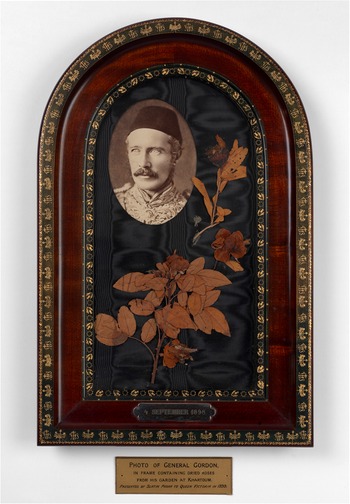
The Mahdi’s assault on Khartoum, when it finally came after ten months of siege, commenced during the early hours of Sunday 26 January 1885. Surviving reports of Gordon on the eve of the Mahdist attack place him within the palace, chain smoking and visibly anxious.Footnote 57 Yet, through the prism of his Christ-like sacrifice, Gordon is transported to another location, the palace garden. It was known that Gordon had tended an English rose garden and ‘Gordon’s garden’ had emerged as another poignant image of a proud Englishman, abandoned yet resolutely loyal to his duty and country. In many biographies published during the immediate aftermath of his death, Gordon is to be found in his garden, where he wrestles alone with the agony of his impending suffering. As Jeanie Lang put it in The Story of General Gordon, ‘realising that his death was drawing near … Gordon retreated to his own Gethsemane’.Footnote 58 This image of ‘Gordon’s Gethsemane’, the notion of a sacred but quintessentially English space, was remarkably enduring. Immediately after the Battle of Omdurman in September 1898, the climax of Kitchener’s reconquest of the Sudan, British troops scrambled to visit what was left of the garden and retrieve cuttings from the defiant remains of the roses. George Warrington Steevens, the Daily Mail’s war correspondent, who visited it two days after Omdurman, reflected that ‘in this garden you somehow came to know Gordon … to feel near to him’.Footnote 59 Rudolf von Slatin, the Anglo-Austrian administrator who had been a Mahdist prisoner for twelve years,Footnote 60 brought cuttings from Gordon’s rose garden to a greatly moved Queen Victoria.Footnote 61 Von Slatin preserved the cuttings with a photograph of Gordon in a frame shaped like a tombstone (Figure 1).Footnote 62
Cuttings from Gordon’s roses, preserved by Rudolf von Slatin and presented to Queen Victoria. © Royal Collection Enterprises Limited 2025 | Royal Collection Trust. Permission for one-time use.

Figure 1. Long description
At the top center of the arched wooden frame is a sepia-toned portrait photograph of General Gordon, partially faded. Below the photograph, two clusters of dried rose cuttings with stems, leaves, and flowers are arranged diagonally on a black fabric background. The larger cluster is positioned lower and to the left, while a smaller cluster is above and to the right. The frame is bordered with gold floral and geometric motifs. At the bottom of the inner frame, a plaque reads ‘September 1898.’ Below the frame, a brass plaque states ‘Photo of General Gordon, in frame containing dried roses from his garden at Khartoum. Presented by Slatin Pasha to Queen Victoria in 1899.’
Almost immediately after the news of Gordon’s death was reported in London on 5 February 1885, rumours began to circulate that Khartoum’s fall had been precipitated by the treachery of Faraj (or Faragh) Pasha, Gordon’s garrison commander, who had allegedly opened a city gate to the advancing Mahdists. This allegation was subsequently demonstrated to be false, although Faraj had certainly defected (or surrendered) to the Dervish when the defence of the city appeared hopeless.Footnote 63 Faraj survived the assault, but only for a few hours; he was summarily executed later that day on the Mahdi’s order. The belief that Gordon’s cause had been undermined by betrayal appealed to both the Liberal government and the Conservative opposition. For Gladstone, it provided some arguable mitigation for the political and military failure of the relief expedition. For critics of the government, any reference to betrayal echoed the wider censure that Gordon had been undone by the vacillation and delay of the administration. In the context of Gordon’s messianic sacrifice, however, Faraj’s treachery was portrayed as not just a perfidy, but more specifically as a Judas kiss betrayal. As the bishop of Newcastle, Ernest Wilberforce, grandson of the great anti-slavery campaigner, put it in his sermon at the Gordon memorial service at St Paul’s Cathedral on 13 March 1885, Gordon had succumbed to a ‘Judas Kiss … a single act of betrayal’.Footnote 64 He had, in the words of the Nonconformist and Independent, fallen ‘by the treachery of one he loved’.Footnote 65 Gordon, in this depiction, had been betrayed by one whom he had chosen, called, promoted and loved, but whose courage had faltered at the crucial moment of crisis, a failure expressed in an act of self-destructive treachery that was as futile as it was self-serving.
However Gordon died, his end was assuredly brutal. While his mutilated body was tossed into the Nile, his severed head was carried in a sack to the Mahdi, where it was identified by von Slatin, at that time still a captive. It was later suspended from a tree so that passers-by could hurl stones at it, before what was left was thrown into a pit containing the remains of the Mahdi’s other executed enemies.Footnote 66 Yet, it was the fact of this lonely, agonising death that further stimulated comparisons with the suffering of Jesus on the cross. Gordon, betrayed and disowned, had to ‘bear his cross’,Footnote 67 and, in the words of the Rev. Thomas Teignmouth Shore, chaplain to Queen Victoria, ‘suffer the agony of death beneath the awful shadow of the Crown of Thorns’.Footnote 68 The Rev. James Fleming, Shore’s predecessor as chaplain to the queen, was even more expressive in his rhetoric: ‘What to Christ, now, the thorns that crowned Him, or the nails that pierced Him? What to Gordon, now, that he stood like one lashed to the post of duty till he was compelled to say “No man stood with me, but all men forsook me”?’Footnote 69
Gordon’s surviving journals were recovered and published in the summer of 1885.Footnote 70 The reviews were generally favourable and not entirely free of scriptural analogy. As one anonymous biographer put it: ‘In no other way is he revealed to us’.Footnote 71 However, it was another publication that provided one of the more extraordinary and revealing illustrations of Gordon’s messianic legacy. In 1865, John Henry Newman had published his allegorical poem ‘The Dream of Gerontius’. Gordon owned a copy, in which he made numerous annotations and which, in February 1884, he gifted to Frank Power, the Times correspondent in Khartoum. Power, in turn, sent the book home to his mother in Dublin. After the fall of Khartoum, Mary Murphy, Power’s sister, wrote to Newman (having noted from the press that he had made a large donation to the Gordon Memorial Fund), and the cardinal was ‘deeply moved to find that a book of mine had been in General Gordon’s hands’.Footnote 72 This exchange was publicized in the press, specifically the Weekly Register.
Jeffrey Richards, whose subject is the music of British imperialism, has suggested that, by the end of the 1880s, Gordon’s admirers had started to produce facsimile editions of ‘The Dream of Gerontius’, in which Gordon’s markings were transcribed onto their own copies, and that a few such copies were circulating in the English Midlands. Edward Elgar was given one in 1889 as a wedding present, and it was this gift that encouraged him to write his oratorio, The Dream of Gerontius, composed (at least in part) as a tribute to Gordon.Footnote 73 John Pollock, one of Gordon’s more recent biographers, has also suggested that a friend of Mary Murphy may have published a professional facsimile, with Gordon’s annotations reproduced in red.Footnote 74 More detailed research suggests an earlier, more widespread, but resolutely amateur phenomenon. The author owns a copy that was produced informally by a Fr Neville on 7 April 1885, just two months after the news of the fall of Khartoum had been reported in London. Neville faithfully reproduced not only Gordon’s highlighting of the text, but also his and Power’s dedications. It comprises, in other words, an exact facsimile.Footnote 75 Newman himself, writing to his friend Lord Blachford, believed that Gordon, by his use of ‘The Dream’, was following St Paul’s instruction to ‘die daily’: that we should always, in other words, ‘pass the day as if it to be our last’.Footnote 76 The impression, as Newman possibly anticipated, is that admirers like Neville were attempting to reproduce vicariously some part of Gordon’s own experience, seeking not only to look through Gordon’s eyes and face the challenges of life and death with his courage and resolution, but, in so doing, to establish a connection with the martyr of Khartoum.
There were other manifestations of this extraordinary religious response. Several commentators toyed with the image of Gordon’s ascension. Fleming, the queen’s chaplain, pictured Gordon’s ‘translation, as if in a chariot of fire, to Heaven’,Footnote 77 and William Rice, a Christian writer, depicted him as ‘an angel beckoning from the skies, shining onto our darkness, a new-risen star’.Footnote 78 There were even examples of what might be loosely referred to as non-canonical histories. In his 1889 book Who is the White Pasha? A Story of Coming Victory, John Meaburn Bright, a London surgeon who had ‘devoted himself to the study of theology’,Footnote 79 postulated the theory that Gordon, having miraculously survived the fall of Khartoum, would one day return to defeat Mahdism.Footnote 80
This was all, however, secondary to the overarching conclusion, which was that Gordon, in laying down his life for the people of Khartoum, had sacrificed himself as an atonement for the manifold sins of his country and, indeed, humankind generally, so that Gordon, like Christ, had lost in life but won the victory in death. Mary Ann Hearn, the Christian author and hymn writer, produced a poem in which she claimed: ‘He has given, as his Master gave, His life, for the lives of men’.Footnote 81 Writing under her nom de plume, Eva Hope, in her 1900 biography, The Life of General Gordon, Hearn wrote: ‘Gordon was following in the very footsteps of his Lord, for he was willing to lay down his life for the sake of any poor creature who may be benefitted by his self-sacrifice’.Footnote 82 John Meaburn Bright similarly described Gordon as: ‘So true a type of one, who loved us and gave Himself for us.’Footnote 83 How, then, did this quasi-messianic assessment of Gordon influence attitudes within the church and the military and, indeed, the relationship between the two?
For many within the churches, Gordon’s life and the manner of his martyrdom singled him out as the ‘complete Christian in thought, word and deed’.Footnote 84 For the Rev. William Frith, the minister of Chiswick’s Trinity Memorial Church, Gordon was a ‘character altogether unique and exceptional in all human biography’.Footnote 85 His was not simply a life to be revered, but an example to be emulated: ‘We should do well to admire his devoted and pious life and, if possible, make his devotion stimulate our own energies.’Footnote 86 Very quickly, churches of all denominations sought to preserve and exploit Gordon’s memory as a stimulus to restoring Britain’s spiritual and moral mission. This ambition was cited explicitly in an editorial in the Tablet:
We have two things to do, a double work to accomplish. We have to keep alive the heroic and enabling memory of the dutiful and detached life of General Gordon. And, secondly, we have to utilise and turn to account and permanent profit the generous impulses which have been stirred throughout the land by the story of sacrifice at Khartoum.Footnote 87
This acclaim for Gordon as an important Christian exemplar was reinforced practically by his very public ecumenicalism. His theology, as one contemporary acquaintance and admirer conceded, was ‘never exact and homogenous in all its details’.Footnote 88 This doctrinal eccentricity did not, however, prevent his popularity from spreading across the denominational spectrum. He was, noted the Christian Commonwealth, ‘no sectarian zealot’, as his ‘religious belief was in a special degree elevated above all littleness of sectarian bias’.Footnote 89 Henry Gordon, his brother and biographer, publicized a remark made by Gordon just before his departure for Khartoum: ‘Catholics and Protestants are but soldiers in different regiments in Christ’s army: but it is the same army, and we are all marching together.’Footnote 90 Gordon’s dogma-less creed and his rejection of factionalism allowed each denomination to project onto him their own ideals and adopt him as an inspiration. As the Primitive Methodist Quarterly Review put it: ‘No church claims him, yet any church would be proud to have him.’Footnote 91
For Anglicans, therefore, Gordon was simultaneously the ‘highest of high Sacramentalists’ and a member of the ‘Evangelical party of the Church of England’.Footnote 92 Methodists, impressed by individual leadership that was both charismatic and anti-establishment, compared him with John Wesley.Footnote 93 Roman Catholics likened him to ‘the first Jesuit missionaries’ in his ‘pure morals, firm faith and practical mind’.Footnote 94 He was also ‘the most ultra or hyper Calvinist’ and ‘almost a Plymouth Brethren’.Footnote 95 The Christian World recognized ‘the zeal of an ancient Jew’.Footnote 96 Even the Society of Friends saw something in Gordon to admire and identify with: the British Friend approved of his habit of going into battle unarmed as ‘such a Quaker like practice’.Footnote 97
During the years that followed, Gordon would be invoked as a catalyst for the revival of a personal and collective religious conviction, as a stimulus for domestic and international Christian mission, and in the promotion of a practical, philanthropic Christianity. Gordon’s demonstration of an unwavering sacrificial faith, one in which someone ‘surrenders himself to Christ complete, entire, and absolute’ could, it was argued, inspire a restoration of national religious conviction, a revival that would operate first on a personal and then a collective level.Footnote 98 The dean of York, the very Rev. Arthur Purey-Cust, at a service at St Paul’s Cathedral on 15 March 1885, two days after memorial services for Gordon were held in most Church of England cathedrals,Footnote 99 focused on the individual: ‘Let us make Gordon not merely a subject of curiosity and commendation, but of prayer for ourselves, that our duties towards our fellows and our discipleship of Christ may be lauded upon the same high principles as his.’Footnote 100 The Congregationalist considered the effect in terms of a domestic evangelical effort:
He was the embodiment of true Christian chivalry, alone in his noble unselfishness, his passionate devotion to the cause of the oppressed, his dauntless courage, and that faith in God that was at the root of all that was noble in his character. These qualities were manifested by him in the life of a soldier, why should they not be developed by us in the different work of the conversion of men? A hundred men working in Gordon’s spirit, with the one aim of brining sinners to Christ, would work a revolution the extent of which could not be easily over-estimated?Footnote 101
As George Emerson acknowledged: ‘There are many episodes in his life which would furnish texts for little sermons’.Footnote 102
Gordon’s death also had a notable effect on the development of overseas missionary thought and activity. In March 1885, less than a month after Khartoum’s fall was reported in London, the Church Missionary Society launched the ‘Gordon Memorial Mission Appeal’, which quickly raised over £3,000, although these funds remained unused until Kitchener’s victory at Omdurman in September 1898 appeared to act as ‘a cleansing fire [that] left a pathway clear for the preaching of the Gospel in a renovated land’.Footnote 103 At the same time, the Society for Promoting Christian Knowledge published Gordon: A Life of Faith and Duty (1886),Footnote 104 a 36-page biography that actively promoted international evangelism. The idea that Gordon’s martyrdom would stimulate a new generation of young evangelists was a prominent theme at the national memorial services for Gordon in March 1885. Thus, the bishop of Newcastle, Ernest Wilberforce, anticipated that Gordon’s sacrifice would ‘infallibly produce an abundant harvest’, namely a Christian revival in Africa.Footnote 105
Gordon’s martyrdom, which, as Andrew Porter records, was regarded as an exemplification of ‘the highest heroism’, appealed necessarily to ‘faith missions’ emphasis on commitment and sacrifice’.Footnote 106 Indeed, both the fact and the circumstances of Gordon’s death were understood by many Christians to represent a missionary event. Giuseppe Cuzzi, an Italian merchant who acted as the British consular agent in Berber, was captured by Mahdist forces in April 1884 and remained a prisoner until his release by Kitchener in 1898. Speaking of Gordon in 1900, he affirmed: ‘He combined himself the missionary and the warrior, the fearless hero who is ready to sacrifice his last drop of blood for the dissemination of his Faith, and for the salvation of his black brothers languishing in the night of unbelief’.Footnote 107 To many in the churches, Gordon’s sacrifice compelled an active response, as if the act itself was a call from God. As Charles Roger Watson, a Presbyterian missionary in Cairo, would subsequently claim: ‘What was the death of Gordon but a dramatic call to the Church of God to enter and occupy the land for Christ?’Footnote 108 Mission, moreover, was also portrayed explicitly as a fitting commemoration ‘to the lifework of the great Christian hero’.Footnote 109 ‘Gordon’, argued William Conor Magee, the bishop of Peterborough, ‘would hardly [have been] content with a memorial that was not true to Christianity’.Footnote 110 Mission, in other words, was the ‘noblest Christian revenge for the death of Gordon’, and a failure to pursue it successfully would constitute a second betrayal of the ‘martyr of Khartoum’.Footnote 111
During the years that followed, many British and foreign missionaries were motivated and influenced by the life and death of General Gordon. Llewelyn Gwynne, a Welsh Anglican priest and CMS missionary, arrived in the Sudan in 1900, ‘inspired by the story of Gordon’s heroism and devotion’.Footnote 112 Gwynne, who saw the Anglo-Egyptian reconquest under Kitchener as ‘God carrying out his plan for the people of the Sudan’,Footnote 113 acknowledged Gordon as an inspirer of mission and a man whose sacrifice would redeem the Sudanese people:
Looking back and taking into consideration all that happened before and after the time of Gordon, the one and only happening that could begin the redemption, the civilising and educating, the progress of the people of the Sudan was the death of some great Christian man whose death would stir the people of his own race to redeem and lift up and develop the people bought by his own sacrifice.Footnote 114
Gwynne hero-worshipped Gordon and relied on his memory as a source of spiritual guidance and support.Footnote 115 As Henry Jackson, a friend of Gwynne’s for over forty years, noted: ‘In times of spiritual and mental distress, he drew courage and inspiration from the thought that General Gordon had suffered as he did “though with far less reason” from a sense of unworthiness, and often consoled himself by reading pages in the General’s diaries’.Footnote 116
Both Douglas Thornton and Temple Gairdner, also the travelling secretary of the Student Christian Mission, were missionaries eager to follow Gwynne to Khartoum, although the restrictions on Christian mission in the Sudan instituted by the Condominium government eventually forced them to follow their calling in Cairo.Footnote 117 Thornton and Gairdner regarded Gordon ‘with a sense of hero worship bordering on reverence’ and they were convinced that converting the tribes of the Sudan ‘was Gordon’s wish’.Footnote 118 Karl Kumm, ‘one of the most active members of the Sudan United Mission’, was impressed by Gordon as ‘a man who laid down his life to bring liberty to the captives’.Footnote 119 Charles Watson, a missionary from the United Presbyterian Church of North America, recognized that: ‘The death of Gordon at Khartoum had moved hearts in America as well as England’.Footnote 120 Proving this point, J. Kelly Giffen, another American Presbyterian missionary to the Sudan, revered Gordon’s ‘life and death of magnificent power’.Footnote 121 ‘Gordon’, he wrote, ‘had trod the death vale in his Master’s steps, and we can almost hear him say: “Father, forgive them, for they know not what they do”’.Footnote 122 Missionaries to other parts of the world were similarly influenced by Gordon’s martyrdom. Charles Studd, the English cricketer who, as one of the ‘Cambridge Seven’,Footnote 123 served at the China Inland Mission for over twenty years, travelled to the Sudan in 1910, convinced that God was recalling him to Africa. Mrs Bradshaw, Studd’s sister, believed that Studd, who was by then in poor health stemming from typhoid, was motivated by ‘a sincere desire to sacrifice himself to God’s work’ at the site of Gordon’s martyrdom in Khartoum.Footnote 124
Gordon’s appeal to Christians as an agent of social improvement has been neglected by historians. He was depicted as a ‘friend of the poor’ and ‘a despiser of Mammon’.Footnote 125 Focussing on his service in Gravesend, Kent, between 1865 and 1871,Footnote 126 Gordon’s extensive social work and teaching at the local ‘ragged school’ was celebrated after his death and contributed to his portrayal as a man who, shorn of personal ambition, had surrendered himself to the service of God.Footnote 127 This aspect of Gordon’s legacy appealed particularly to Nonconformity.Footnote 128 He was, noted Elizabeth Charles, ‘not at home in conventional society’, and rejected the ‘rewards, notice and lionizing’ of the establishment.Footnote 129 Thus, the Methodist Recorder, referring to Gordon’s work with Gravesend’s poor, acclaimed his ‘pure and active benevolence’ and his ‘practical prudence’. ‘His courage’, the article concluded, ‘was not more manifest than his humility’.Footnote 130 The Rev. Hugh Carruthers Wilson, the minister in charge of the Presbyterian church in Gravesend attended by Gordon, was active in promoting him as an exemplar of ‘a most practical theology’.Footnote 131 It was noted that when attending church, Gordon ‘would sit among the poor’ rather than in the ‘luxurious seats appointed for the grandees’.Footnote 132 For many members of the free churches, overborn by the elite and not readily impressed by tales of military glory, this was an attractive counterweight. As another old Gravesend acquaintance wrote in the Congregationalist: ‘His deeds of splendid daring and magnificent courage awaken our wonder, but these simple acts of goodness and devout humility awaken our love’.Footnote 133
This veneration of Gordon maintained that the character of the courageous, dutiful, sacrificial soldier matched almost exactly the qualities required of a Christian disciple, reinforcing an existing notion that many Christian and military virtues were compatible. Christian eulogies for Gordon routinely associated religious and military terminology as a means of emphasizing the affinity between the devout Christian and the courageous soldier. Hence Gordon was a ‘brave soldier in the Church militant’ and a ‘Christian warrior’ who radiated an ‘unaffected and manly piety’.Footnote 134 ‘Gordon was’, wrote George Emerson, ‘emphatically a Christian soldier’, to a degree that ‘no career in modern times is more thoroughly imbued with a rare union of manly vigour and active Christianity’.Footnote 135
Nowhere was the value of Gordon’s legacy more apparent than in the wish to promote him as an inspiring example to future generations of Britons, and specifically the churches’ recognition that his martyrdom could be utilized as a means of influencing young men towards a more virile, masculine and dutiful Christianity. The Rev. Dr Henry Montagu Butler ‘affectionately dedicated’ his memorial sermon at the Chapel Royal, St James’s, ‘to the boys of Harrow School, in the hope that they may ever be drawn to “things above” by the example of heroic Christian souls, and follow them as they follow Christ’.Footnote 136 Soon a huge biographical literature emerged that portrayed Gordon as the personification of heroic Christian virtue. Gordon’s influence and example was emphasized on the first page of Seton Churchill’s General Gordon: A Christian Hero: ‘There are thousands of young men in this country who may be helped to live better lives by the study of such a Christian hero as Gordon undoubtedly was’.Footnote 137 Mary Ann Hearn (writing as Eva Hope)’s Life of General Gordon was published ‘so the young can learn the beautiful lessons of obedience and humility, of loyalty to God, and devotion to others for His sake, that the life of General Gordon so well illustrates’.Footnote 138 Mrs Lang, in her Red Book of Heroes, believed in a contagious virtue: ‘We cannot all be Gordons … but if we read about them and think about them, a touch of their nobility may come to us.’Footnote 139 The Rev. S. A. Swaine, writing in 1890, explained why his biography was produced ‘for the benefit of the young’:
The boys and girls of England want to grow up brave, and good, and true. Where then shall we find an example more likely to captivate their imaginations and influence them in such a direction than that of the Christian soldier who – though not faultless, but no man is – manfully sought to serve Christ, and was lost and dead to everything except God and duty?Footnote 140
As such, Gordon’s life represented a ‘priceless legacy to Englishmen’ which ‘our valiant youth shall resort to’.Footnote 141
This desire to inculcate the next generation was also reflected in the influence the Church of England exercised in the establishment and development of the Gordon Boys’ Home. Established by public subscription in 1885 with twenty boys at Fort Wallington, Portsmouth, by 1904 it housed 240 boys and girls at Gordon’s School in Woking, Surrey. The initial aim, as the Rev. James Fleming explained, was to rescue disadvantaged boys who would otherwise be ‘fit for Communism, Nihilism and Atheism at the cost of our National safety’.Footnote 142 The work of the home, as related by the Rev. T. T. Shore, canon of Worcester, was carried out ‘under the consecrating shadow of Gordon’s great and heroic name’ and emphasized the importance of ‘careful and constant religious training’ which ‘develops that Christian spirit and character which are the only sure foundations of national safety’.Footnote 143 The bishop of Thetford acknowledged an explicit imperial purpose, stating that the boys were instructed ‘that they may become either true English soldiers and sailors or else walk those quieter paths of good citizenship, which make for the building of Empire, and all under God’.Footnote 144 In the first decade of its existence, the Home raised nearly 600 boys, of whom 331 joined the army or navy, with 252 entering civil employment, specifically in the service of the empire.Footnote 145
Gordon’s life, asserted the Methodist Recorder, confirmed ‘the compatibility of true piety with the life of a soldier’.Footnote 146 This positive association was as attractive to many in the military as it was to the churches. Gordon was revered as a devout, courageous and self-sacrificing officer. ‘Although he could have fled’, noted Giuseppe Cuzzi, ‘he remained steadfast and loyal, on his post, preferring to meet death together with those who had joined him trustfully’.Footnote 147 Gordon’s death coincided with a period of readjustment within the British army, a process that was characterized by attempts (or at least an articulated desire) to develop a more professional leadership cadre, an exercise that Field Marshal Wolseley described as the ‘promotion of worth over birth’.Footnote 148 Moreover, Gordon – a man of relatively humble birth and outlook, experienced and of proven courage, modern (he was, like Kitchener who followed him to the Sudan, an engineer), married to his country and duty, and a man of devout religious conviction – appeared to personify these virtues. It was no coincidence that many of Gordon’s early biographers were military men. One of the most successful was Colonel Seton Churchill, whose General Gordon: A Christian Hero, published in 1890, promoted the ‘Hero of Khartoum’ as an icon of muscular, soldierly Christianity. Kennith Henderickson III has observed that, with Gordon, the image of the national Christian hero soon became an ‘institutionalised expression, a tradition, of the good that the army and imperial representatives of Britain carried forth to subject people.’Footnote 149
During the decades that followed, military officers would be purposefully exposed to the Gordon legend, not merely by virtue of their service in Egypt and the Sudan where, after the reconquest, Gwynne would invariably lecture new arrivals on ‘the peerless character of Gordon’;Footnote 150 but also through events like the annual commemoration services held on ‘Gordon Sunday’. Edward VII, first as Prince of Wales and then as king, hosted a ‘Gordon Memorial Service’ at Sandringham for twenty-five years until his death in 1910. Senior clerics were invited to preach, and the address was invariably published as a pamphlet. It was also common for junior staff officers of promise to be invited to attend. In January 1898, for example, the invitees included not only Evelyn Wood, then the army’s Adjutant General, but also a young cavalry officer, Captain Douglas Haig, who was travelling to join Kitchener’s staff in the Sudan.Footnote 151
This process was exemplified by the ‘Gordon Memorial Service’, convened by Kitchener and held in Khartoum on 4 September 1898, two days after the Battle of Omdurman. Led by the four chaplains attached to the British infantry – Church of England, Roman Catholic, Presbyterian and Wesleyan Methodist (an inter-denominationalism that mirrored Gordon’s own ecumenicalism) – it represented, in the words of C. Brad Faught, ‘a set piece of British imperial memorialisation’.Footnote 152 Fr Brindle, the Roman Catholic chaplain, wrote and read the final prayer, and, after the service, a young staff officer asked if he could keep the original draft. Henry Rawlinson treasured this note and carried it throughout the rest of his military career.Footnote 153 It was still in his possession when he died in 1925, and was reproduced in facsimile when Rawlinson’s papers were published several years later.Footnote 154 Rawlinson, like other officers in attendance, saw the service as an ‘occasion for solemn resolve … as we pledged ourselves to complete the work for which Gordon died’.Footnote 155
Gordon’s death came as a great shock to British public opinion and, given the circumstances surrounding the fall of Khartoum and the general’s profound and overt Christian faith, the rapid evolution of a ‘Gordon cult’ was perhaps not that surprising. In the decades preceding his return to Khartoum in 1884, Gordon had become established in the public consciousness as a man of deep personal faith, broad religious sympathies, and abiding compassion for others, a ‘military genius’ whose innate humanitarianism was manifest in a passionate desire to abolish the East African slave trade.Footnote 156 He was, claimed Hake, ‘a true disciple of the Divine Master’ and the ‘complete Christian in thought, word and deed’.Footnote 157 As such, propelled into the maelstrom of the Mahdist rebellion, he emerged, in the words of Andrew Griffiths, ‘not simply as a man proposing a solution, but as a solution in human form’.Footnote 158
The notion of sacrificial Christian heroism engaged in the pursuit of the empire had already become an established trope in Victorian Britain. The lives of Henry Havelock, another general driven by religious conviction;Footnote 159 John Patteson, the Anglican missionary bishop killed in the Solomon Islands in 1871 because of his opposition to the South Pacific slave trade; and David Livingstone, the missionary pioneer whose African expeditions had revealed to the British public the horrors of the East African slave trade,Footnote 160 had all, to varying degrees, prefigured Gordon’s self-sacrifice. Indeed, some of Gordon’s contemporaries regarded him as a God-sent successor to men like Livingstone. Before his departure for the Sudan in 1874, for example, the Rev. Horace Waller, the anti-slavery activist, missionary and Anglican clergyman, recognized ‘a heroic apostolic succession’ and sent Gordon a strand of Livingstone’s hair as a sort of relic.Footnote 161 Gordon’s own credentials as ‘the Christian hero of the Sudan,’ as he was described in the Christian Commonwealth, were then developed further during the siege of Khartoum in numerous newspaper profiles and popular biographies.Footnote 162
The fall of Khartoum in January 1885 did not only come as a blow to British public opinion; it represented a disaster for Britain’s self-image and reputation as a pre-eminent imperial power. Steevens, the Daily Mail’s war correspondent who covered Kitchner’s victory at the Battle of Omdurman in 1898, was typical in referring to the defeat of 1885 as ‘a great humiliation’, and the period that elapsed before the British reconquest of the Sudan as ‘years of unavenged insult’.Footnote 163 General Wolseley, who commanded the unsuccessful Gordon relief expedition, referred to the Mahdi’s victory as ‘a holocaust offered on the altar of Mr Gladstone’s self-opinionated ignorance’.Footnote 164 In this atmosphere of critical national introspection, Gordon’s heroic self-sacrifice could readily and profitably be portrayed as a redemptive act, as an atonement for the sins of a nation for its shameful desertion of the Sudan.
As the cult of Gordon took off in the immediate aftermath of his death – buttressed by a quasi-messianic reinterpretation of his final passion – it reinforced the perception that the core Christian and military virtues were ultimately synonymous. Canon Cadman, giving the address at the Gordon memorial service at Canterbury Cathedral, summed this up: ‘His death at last brought into prominence two truths. The first of them was that a soldier as a soldier might be a true servant of God; and secondly, that a true servant of God might consistently be a soldier.’Footnote 165 ‘The life of Gordon’, echoed Canon Body at Durham Cathedral, ‘told plainly that the military spirit could exist together with the most intense devotion to Christ’.Footnote 166 Gordon, in this portrayal, was not merely a heroic exemplar, a man dead to everything except God and duty, but a man whose apparent defeat was rendered triumphant by preordained sacrifice. As one religious journal put it: ‘Gordon, so powerless to work out his will in life, had conquered in death’.Footnote 167

 Open access

