


A. Introduction
Platforms are entities that connect providers and users, facilitate the exchange of products and services, and enhance convenience for information sharing, enabling participants to generate value through network effects.Footnote 1 With the advent of digitization, platforms have transformed into marketplaces offering two-sided and multifaceted services online, broadening their reach to encompass e-commerce, finance, social media,Footnote 2 search, and digital advertising.Footnote 3 Tech giants—including Amazon, Alibaba, and Coupang—have become deeply intertwined with daily life.
Furthermore, the geographic boundaries of marketability in e-commerce are being eroded, for example by the expansion of platform companies’ business beyond their domestic market.Footnote 4 For instance, the rapid delivery of Chinese goods to U.S. consumers via Temu and AliExpress illustrates how platforms are reshaping international trade.Footnote 5 Similarly, Google’s global data collection for personalized advertisements and the borderless reach of social media platforms such as Facebook, TikTok, and X underscore this transformation.
The infrastructure offered by platforms serves as a shared resource and a common marketing tool, significantly lowering the cost of establishing a business,Footnote 6 particularly during its early stages. Without in-person store visits, platforms save consumers time and money,Footnote 7 while network effects provide broader choices for tailored consumption. Furthermore, platforms refine personalized consumption by artificial intelligence (AI)Footnote 8 to analyze consumers’ interests, purchase history, and other data. Thus, many explain that consumer utility has been enhanced through more sophisticated consumption customization.
Against this backdrop, this Article focuses on the shift toward platforms’ AI-driven dynamic pricing. While consumers benefit from various platform services, AI-based personal data collection enables platforms to implement granular price discrimination.Footnote 9 Before the AI era, traditional dynamic pricing—commonly observed in contexts like ticket sales—was primarily driven by external circumstances, such as imminent departure times or remaining inventory.Footnote 10 In this framework, the timing of a purchase is decisive, and a “uniform market price” applies to all consumers within the same situational context. By contrast, in AI-driven dynamic pricing, the price determinants shift toward each consumer’s internal data, including profiles and behavior history, enabling “personalized prices” even within an identical situational context.Footnote 11 Timing and market factors like the supply–demand conditions persist, but they function as subsidiary variables integrated into price individualization based on who consumers are.
Even without a single platform’s formal monopolies, multiple platforms may effectively function as an “AI-driven de facto single entity” from the consumer’s perspective.Footnote 12 For example, AI development may facilitate explicit collusion among platforms or, even in the absence of direct coordination, lead to implicit collusion or parallel conduct. In addition, platforms’ algorithms may also be able to infer rival platforms’ AI-driven pricing mechanisms, so that, over time, AIs learn from one another and converge toward similar pricing structures. Even apart from these considerations, individualized consumer data will likely become a “common resource” among platforms, enabling surviving firms to identify nearly identical personalized prices, thus reinforcing the AI-driven de facto single entity phenomenon.
In this light, this Article puts forward that genuine concerns about monopoly arise not merely from a single firm’s market dominance, but from pricing behaviors that substantially reduce consumer welfare even in competitive platform environments. Even worse, in the foreseeable future, the prices faced by consumers will likely be those generated by first-degree price discrimination, which, from the standpoint of overall consumer welfare, are even more detrimental than classic monopoly prices.
This Article also explores how, unlike traditional dynamic pricing based on occasional adjustments, AI-powered personalized pricing can subject individuals to perpetual “consumer-surplus-exhausting pricing” potentially over their entire lifetime.Footnote 13 Consequently, consumers’ behavioral profiling eventually becomes locked into the platforms’ AI systems. Under these circumstances, the foundational premise of mutual gain between platforms and consumers no longer holds, calling into question the legitimacy of welfare gains in AI-mediated markets. This process undermines the “invisible hand” mechanism, a fundamental principle of the market economy. Furthermore, this Article explains that while the coexistence of two market failures—monopoly and information asymmetry—may paradoxically enhance economic efficiency, it may compromise market fairness.Footnote 14
This Article also highlights the concealed “quasi-tax effect” of AI-driven dynamic pricing. As AI technology advances, platforms—including state-owned enterprises (SOEs)—approximate first-degree price discrimination. As a simple example, under full state ownership, the consumer surplus transferred to the SOE essentially functions as an additional payment to the SOE and thus in principle to the state—effectively a new form of informal taxation, namely a quasi-tax.Footnote 15 In addition, regarding privately-owned platforms, AI-driven first-degree price discrimination also drastically reduces consumer welfare. Even without a direct transfer of surplus to the state, this phenomenon can still be characterized as a quasi-tax in that consumers suffer from a reduction in disposable income, which is functionally similar to taxation.Footnote 16
Another point that should be emphasized is that for platforms’ AI-driven dynamic pricing with first-degree price discrimination to materialize, a “no-arbitrage condition” must be met, where consumers charged lower prices are unable to resell to those facing higher prices. AI advancements and various market characteristics in the foreseeable future may enable this no-arbitrage condition to persist at a substantial level, even if not perfectly realized.Footnote 17
In a competitive environment where multiple platforms contend for market share, they may temporarily lower prices to attract consumers, which might appear to counteract the “AI-driven de facto single entity” thesis. However, this Article does not argue that such competitive behaviors are entirely absent; rather, it emphasizes that the probability of such a single entity phenomenon emerging increases significantly as AI technology advances. This logic applies equally to the concepts of consumer-surplus-exhausting pricing and the quasi-taxation effect. The claim is not that platforms will invariably reach a state of perfect first-degree price discrimination immediately. Instead, it underscores that the overarching trajectory of AI-driven evolution leads toward such an outcome. Therefore, it is crucial to establish an analytical framework to address the increasing possibility of these structural changes.
This Article provides theory-based research without reference to specific jurisdictions. Rather than merely analyzing extant AI-based platforms, this Article explores a foreseeable future where advanced AI fully leverages personal data for pricing. While legal systems generally provide solutions, they face inherent constraints, such as legislative lag, inadequate codification or case law, and inefficient enforcement. Laws and regulations, in particular, struggle to keep pace with entirely nascent technologies like AI, which possess the potential to fundamentally transform the global economic order. Given that our comprehension of AI-mediated markets is still in its infancy, it is imperative to first establish a theoretical foundation by analyzing AI-driven de facto monopolies, consumer welfare, and quasi-taxation—topics that have hitherto been explored with limited depth. The proposal of specific regulatory measures—tailored to the unique market and legal contexts of individual jurisdictions—is deferred to subsequent research following a comprehensive understanding of consumer welfare issues.
The remainder of this Article is structured as follows. Section B explores various types of price discrimination, the concepts of traditional and dynamic pricing,Footnote 18 and monopoly concerns.Footnote 19 Section C then analyzes “consumer-surplus-exhausting pricing,”Footnote 20 “profiling lock-in,” the coexistence of two types of market failures,Footnote 21 the quasi-tax effect in both SOE and non-SOE contexts,Footnote 22 and the complexities of consumer consent.Footnote 23 Finally, Section D summarizes the findings and concludes the Article.Footnote 24
B. Price Discrimination and Dynamic Pricing
Section B begins with a general overview of price discrimination (B.I), followed by a discussion of dynamic pricing, with particular emphasis on the distinction between traditional and AI-driven approaches (B.II). It then explores potential monopoly concerns arising from AI-based platforms (B.III). Finally, Section B examines key issues related to information asymmetry in the platform economy (B.IV).
I. Price Discrimination: General Overview
Section B.I begins with the no-arbitrage condition, a fundamental precondition for the sustainable implementation of price discrimination. Price discrimination is then categorized reflecting the logic of consumer grouping. Third-degree price discrimination is addressed first because it represents the most common and foundational form, in which sellers divide consumers into a finite number of identifiable categories. First-degree price discrimination is examined next as the theoretical extreme of grouping, where segmentation approaches the individual level. Second-degree price discrimination is structurally distinct from the other two types, as it operates through consumer self-selection rather than seller-imposed grouping. This Section primarily explains traditional—pre-AI—price discrimination but also covers AI-based price discrimination implemented by platforms.
1. No-Arbitrage Condition
Theoretically, price discrimination is categorized into first-, second-, and third-degree forms.Footnote 25 According to economic theory, price discrimination is most effective when consumers encounter barriers to arbitrage between groups, a state referred to as the “no-arbitrage condition.”Footnote 26 Suppose consumers operate in a market with favorable conditions, such as low prices, and have the opportunity to resell goods or services to other consumers at higher prices. In other words, arbitrage opportunities exist and prevent the original sellers from sustaining price discrimination.Footnote 27
2. Third-Degree Price Discrimination
Consumers can often be segmented into groups with distinct characteristics, enabling sellers to charge different prices to each group. In microeconomic theory, this practice is known as third-degree price discrimination.Footnote 28 In general, sellers often pursue the goal of maximizing profits,Footnote 29 although other goals also exist. In this context, grouping primarily occurs among individuals with similar characteristics, usually categorized by their demand elasticity. Traditionally, the process of grouping, i.e., consumer segmentation, is often straightforward. It is typically based on geographic, demographic, or other socioeconomic factors, allowing sellers to adjust prices to reflect the differing demand elasticities. More specifically, a seller maximizes profitability by charging a premium to consumers with low price elasticity, leveraging their relatively inelastic consumption patterns. Conversely, a lower price point is strategically offered to those with high elasticity to mitigate a significant contraction in demand or potential consumer attrition.
Third-degree price discrimination with market segmentation has many examples. For instance, Korean automakers often adopted varied pricing strategies for the same model in domestic and export markets. In the past, the U.S. export market of Korean passenger cars tended to feature lower prices, particularly when quality considerations came into play.Footnote 30 This tendency was reflected in either lower prices in the U.S. market or the same prices accompanied by better-quality passenger cars and enhanced warranty coverage.Footnote 31 This pattern illustrates how sellers strive to optimize profitability across segmented markets, a process shaped by varying degrees of demand elasticity and the specific competitive dynamics of the U.S. market. The effectiveness of this strategy depends on the no-arbitrage condition, which precludes the resale of vehicles exported to the United States back to Korea. In this instance, the condition remains largely intact because such arbitrage-driven re-exportation is logistically and economically challenging, even if not entirely impossible.
Offering discounts to seniorsFootnote 32 or teenagers also represents third-degree price discrimination, as these groups generally exhibit higher price elasticity due to their less stable incomes.Footnote 33 Similarly, products such as books and pharmaceuticals, as well as subscription services, are priced differently across countries to account for regional variations in demand elasticity. For instance, in the cases of over-the-top (OTT) services such as YouTube Premium and Netflix,Footnote 34 it is difficult, if not impossible, for consumers to subscribe at the low prices offered in other countries while residing in a higher-priced country.
A classic parallel can exist in nightclub pricing, where admission fees often vary by genderFootnote 35—a phenomenon illustrating two-sided platform market dynamics.Footnote 36 This case also exemplifies third-degree price discrimination, where consumers are segmented into distinct groups based on observable attributes. In such environments, the platform seeks to maximize network effectsFootnote 37 as a meeting place for distinct user groups.
3. First-Degree Price Discrimination
First-degree price discrimination is a pricing strategy in which, if perfect, the seller has complete knowledge of consumers’ preferences, consumption patterns, and other personal information relevant to their purchasing behavior. This includes understanding each consumer’s “willingness to pay,”Footnote 38 which varies based on factors such as income, wealth, individual tastes, and purchase history. In practice, achieving first-degree price discrimination remains challenging due to the complexity involved in collecting and processing detailed consumer information. However, with the advent of AI and big data analytics,Footnote 39 companies are increasingly able to implement strategies that approximate first-degree price discrimination by analyzing vast amounts of real-time data to predict consumer behavior and adjust prices accordingly.
If first-degree price discrimination can be achieved, the seller can set individualized prices that align with each consumer’s maximum willingness to pay along the demand curve, thereby enabling the seller, in theory, to capture the entire consumer surplus.Footnote 40 For instance, e-commerce and ride-hailing services increasingly, though not yet perfectly, approximate first-degree price discrimination.Footnote 41 By contrast, the OTT service industry presents a notable exception. Google (Alphabet), operating YouTube, and Netflix, running its own platform, are among the most prominent global big-tech firms with significant market capitalizations.Footnote 42 However, unlike Amazon and Alibaba, which have begun moving toward first-degree pricing models, these OTT platforms largely remain within the realm of third-degree price discrimination based on geographic segmentation.
When consumers purchase relatively inexpensive, nondurable goods, they rarely engage in extensive price comparisons or abandon a seller entirely based on price alone. Moreover, different consumers seldom purchase the same product simultaneously. Thus, comparing contemporaneous prices across different consumers is inherently difficult. The OTT market, however, presents a contrasting dynamic. Consumers frequently discuss OTT services with peers and can readily compare the prices they are charged for identical packages. Accordingly, an attempt by OTT providers to implement first-degree price discrimination would likely generate swift consumer awareness of price disparities, producing strong feelings of dissatisfaction, unfairness, and even betrayal. This pattern of consumer response appears, at least for the present, to explain in part why OTT platforms refrain from actively adopting a strategy toward first-degree price discrimination.
Conversely, in the context of ride-hailing services, prices fluctuate based on various factors such as time of day, day of the week, and season, even for the same itinerary.Footnote 43 While consumers are aware that platforms personalize prices using consumer-specific data beyond such observable factors, they may not be able to immediately verify whether they are being charged higher prices than other consumers. It is particularly difficult for consumers to ensure that all relevant conditions, including exact origin and destination, are truly identical when comparing their fares with those of others. Accordingly, pricing practices approximating first-degree price discrimination can be more readily implemented.
The primary economic outcome of first-degree price discrimination—if perfect—is that all consumer surplus is transferred to the seller, maximizing the seller’s profits.Footnote 44 From the consumers’ perspective, this results in paying their maximum willingness to pay for each unit of the good or service,Footnote 45 leaving them with little or no surplus.Footnote 46 Thus, although this form of pricing is often considered allocatively efficient,Footnote 47 it is controversial as well due to the fairness issue in the distribution of surplus. Moreover, first-degree price discrimination raises concerns about privacy, as platform AI can collect, store, and analyze consumers’ personal information.
4. Second-Degree Price Discrimination
Second-degree price discrimination allows consumers to choose from different pricing tiers based on their consumption level or product preferences.Footnote 48 In this framework, price variation arises from consumers’ own decisions, rather than being imposed externally by the seller, enabling the seller to segment the market without directly identifying each consumer’s willingness to pay.
Electricity rates and mobile data usage fees are common examples of this type of pricing strategy.Footnote 49 For instance, electricity rates in certain jurisdictions typically follow a progressive pricing structure, where consumption below a certain threshold is billed at a lower rate per unit, while usage beyond that threshold incurs a higher rate per unit. Under this self-selection mechanism, consumers choose their consumption levels based on the incremental cost of further consumption. Similarly, mobile data usage plans often charge a base rate for a set amount of data, with excess usage charges applied once the consumer exceeds the predefined limit.
Volume discounts provide another example of second-degree price discrimination,Footnote 50 and are widely used in retail and wholesale markets as well as e-commerce platforms. For instance, if a product is priced at $10 per unit for a single purchase, the price drops to $9 when a consumer purchases three units. The price further declines to $8 when six units or more are bought. The per-unit price decreases as the quantity purchased increases, encouraging consumers to buy in larger volumes.
Second-degree price discrimination may provide consumers with the flexibility to influence the price they pay through their purchasing choices. This strategy also benefits firms by capturing more consumer surplus than uniform pricing would permit. With respect to volume discounts in particular, this strategy is likely employed to induce consumers to purchase larger quantities by highlighting the low unit price.Footnote 51 In some cases, this approach may serve to clear excess inventory, thereby boosting revenue and improving profits.
II. Dynamic Pricing
Section B.II begins by outlining dynamic pricing and price discrimination. It then examines both traditional and AI-driven forms of dynamic pricing, emphasizing how dynamic pricing has evolved with the advancement of AI technology.
1. Dynamic Pricing and Price Discrimination
In general, “dynamic pricing” refers to a pricing strategy in which sellers adjust the prices of products or services in response to changing market conditions, including fluctuations in demand, supply variations, and competitors’ pricing behavior.Footnote 52 It is also associated with “price discrimination,” as both concepts involve differences in prices based on variations in consumer characteristics or market conditions. Although these two concepts are distinguishable in a literal sense, they are increasingly used interchangeably, particularly in the context of (quasi-) first-degree price discrimination. This convergence is driven by the advancement of AI,Footnote 53 which enables platforms and other businesses to analyze individual consumer profiles and adjust prices over time. In essence, dynamic pricing is evolving into personalized pricing,Footnote 54 which, in practice, closely resembles first-degree price discrimination.Footnote 55
2. Traditional and AI-Driven Dynamic Pricing
Common examples of dynamic pricing prior to the pervasive use of AI include airline ticket pricing and hotel room reservation pricing. For instance, the price of the same seat on the same flight changed as the departure date neared. Despite the dynamic change of prices, this pricing strategy generally applied uniformly to all consumers. Over time, information such as consumers’ gender, age, inferred occupation, and address became accessible to ticket sellers, enhancing their ability to set prices. More recently, dynamic pricing has become significantly more sophisticated with the advancement of AI. AI efficiently collects and processes vast amounts of personal data, enabling businesses to implement highly personalized pricingFootnote 56 strategies. Specifically, in China’s e-commerce sector, if a consumer repeatedly purchases the same product or service, AI may identify the consumer’s higher willingness to pay and subsequently charge them a higher price.Footnote 57 This shift toward AI-driven information collection has important implications.
First, dynamic pricing in the era of sophisticated AI often operates in tandem with first-degree price discrimination. As will be discussed further in Section C, with the refinement of AI technology, this phenomenon is likely to exert profound effects on consumer welfare.
Second, while traditional dynamic pricing could still rely on price changes in the sense that different prices are offered at different times, it did not generally involve finely classified types of discrimination based on consumers’ inherent traits. Traditional dynamic pricing could be complemented by third- or second-degree price discrimination. Nonetheless, it remained essentially interpersonally non-discriminatory at any given point in time.Footnote 58
Third, in the pre-AI economy, businesses often offered discounts or favorable terms to loyal customers as part of long-term relationship and marketing strategies. This practice was partly attributable to informational limitations: sellers lacked precise knowledge of consumers’ loyalty and willingness to pay, which rendered loyalty-based discounts a rational, long-term profit-maximizing approach. However, with AI’s continued advancement, platforms’ dynamic pricing algorithms can analyze consumers’ past spending habits and even track how frequently they search for specific products. This technological development will enable platforms to more accurately estimate the maximum prices that consumers are willing to pay in individual transactions. As a result, rather than rewarding loyal customers with discounts or favorable terms, AI-driven dynamic pricing may instead reduce such benefits or even charge higher pricesFootnote 59 to maximize profits more effectively.Footnote 60
Fourth, in theory, consumers assigned higher prices could attempt arbitrage by relying on those receiving lower prices. However, such strategies already entail non-trivial search and coordination costs. Looking ahead, the evolution of AI and technical controls will likely render arbitrage increasingly obsolete. Platforms are already deploying sophisticated tools—such as user authentication, product registration, and embedded identifiers like dynamic QR codes—to tie consumption to a specific end-user. In this light, the concept of perfect price discrimination serves as a stylized theoretical benchmark that increasingly reflects the reality of a future shaped by pervasive AI-driven market control.
III. Is the Platform Business a Monopoly?
The discussion of price discrimination and dynamic pricing is particularly relevant in the context of monopoly power in platform markets. While this Article does not preclude the possibility of a single platform operating as a complete monopolist, Section B.III also considers whether platform businesses may effectively wield monopoly power even in markets where multiple platforms coexist.
1. Monopolistic Power of Platforms
Price discrimination and dynamic pricing become more pronounced when a platform company possesses significant market power and occupies a (quasi-) monopolistic position.Footnote 61 In this respect, a crucial step in understanding these pricing practices and their effects is to examine whether platform companies in fact hold significant market power.Footnote 62
Some argue that the contemporary platform economy effectively operates as a monopoly,Footnote 63 while others disagree, pointing out that most relevant markets are served by more than one platform provider. For example, after successfully competing with eBay, Alibaba has maintained a leading position in the Chinese e-commerce market since the 2000s,Footnote 64 benefiting from the rapid development of the Internet in China. However, its market dominance was not absolute even at its heyday. JD.com, also known as Jingdong, consistently held a significant position as a large market player,Footnote 65 and Pinduoduo later emerged as another formidable competitor.Footnote 66 More recently, the rise of social media-based e-commerce platforms, such as Douyin and Kuaishou,Footnote 67 has significantly reshaped the competitive landscape of the Chinese e-commerce market. Additionally, Alibaba’s leading position was further weakened by regulatory actions, including an 18.2 billion yuan fine imposed by the governmentFootnote 68 as well as restructuring of Ant Group and the suspension of its initial public offering. Shifting consumer preferences, driven by the integration of social media and e-commerce, also contributed to the erosion of Alibaba’s top-tier market share.
2. Personalized Pricing and an AI-Driven De Facto Single Entity
As the foregoing example illustrates, pure monopolies—where only one seller provides a good or service within a relevant market—are rarely observed in platform markets in most countries or globally. Instead, the prevailing market structure is one in which a limited number of platforms hold substantial market power, thereby effectively dominating key segments and limiting competitive dynamics. As AI technologies continue to evolve, AI-driven dynamic pricing—particularly the personalized pricing encountered by individual consumers—may exhibit increasing convergence across multiple platforms.
This price convergence may result (1) from explicit or tacit collusionFootnote 69 facilitated by AI,Footnote 70 or (2) from mere alignment of pricing strategies with those of the leading platform even in the absence of collusion. (3) In addition, the convergence can occur if AI enables platforms to analyze and learn from the dynamic pricing strategies of other platforms’ AI systems.Footnote 71 (4) Most fundamentally, this convergence can arise as a natural consequence of technological evolution, where eventually personal data effectively functions as a “common resource” accessible to and processed by various AI systems. In other words, dominant platforms will likely achieve informational parity by acquiring vast consumer data. This shared informational base—even in the absence of the conditions described in (1), (2), and (3)—is likely to lead even independent, multiple AI systems to converge toward the same profit-maximizing, consumer-surplus-exhausting prices.
Under all these four circumstances—as particularly emphasized in this Article regarding (4)—the formal presence of multiple platform providers may lose much of its competitive relevance to consumers. Rather, this critically leads to a situation where consumers face prices nearly identical to those under first-degree price discrimination—the most detrimental state for consumer welfare—notwithstanding the fact that multiple platforms are competing in the market. In this respect, the market outcome is functionally similar to that of a single platform’s dominance in the relevant market. In such a scenario—while yet to materialize—multiple platforms may share the market, but consumers are confronted with what I refer to as an “AI-driven de facto single entity” and suffer from a wholesale extraction of consumer surplus. This concept surpasses the conventional understanding of a single entity, typically applied to corporate groups like parents and subsidiaries that share different legal identities.
This situation is akin to monopoly or what I term an “AI-driven de facto monopoly.” Within the broader context of the platform economy, the traditionally emphasized advantages that multi-homing typically provides to consumers may be substantially weakened, rendering them less meaningful. Instead, a “de facto single-homing structure” may arise. These developments call for a comprehensive reassessment of existing regulatory frameworks and the formulation of medium- to long-term policy responses that extend beyond the current regulatory preference for multi-homing.
IV. Information Asymmetry in the Platform Business
Section B.IV delves into classical economic theories on information asymmetry and explores how information imbalances contribute to challenges in dynamic pricing within platform markets.
1. Information Asymmetry: Classical Economic Theory
When discussing information asymmetry in product or financial markets, we typically refer to situations where buyers lack familiarity with the goods, services, securities, or financial instruments being sold by the sellers. This asymmetry often arises because sellers generally possess more knowledge about the quality, value, or risks associated with the products or financial instruments they are offering.Footnote 72 By contrast, buyers typically have limited access to such critical information, leading to an imbalance in the decision-making process.Footnote 73
In classical economic theory, information asymmetry is frequently illustrated through examples such as the “lemon problem,”Footnote 74 where the seller of a used car has more information about its condition than the buyer, potentially resulting in “adverse selection.”Footnote 75 Similarly, in financial markets, asymmetry might manifest when investors—including institutional investors, but particularly retail investors—are unaware of the inherent risks or potential returns of securities, while issuers are better informed about their intrinsic value or future prospects.Footnote 76
If focused on product markets, this asymmetry pertains, at its core, to knowledge imbalances between buyers and sellers regarding the characteristics and risks of goods and services.Footnote 77 This imbalance can significantly distort price formation and reduce market efficiency, potentially leading to adverse selection and, under certain conditions, market unraveling—phenomena that are classic forms of market failure.Footnote 78 Moreover, information asymmetry has long provided a rationale for regulatory interventions in financial markets, such as disclosure requirements and investor protections, to mitigate the negative effects of asymmetry and foster a more transparent and well-functioning marketplace.
2. Information Imbalance Regarding Counterparties
The widely discussed concept of “information asymmetry” can ultimately be viewed as a phenomenon of “information imbalance” occurring between the supply and demand sides of the market. “Information imbalance” is particularly pronounced in AI-driven markets, where platforms’ data-driven capabilities allow them to collect, analyze, and leverage vast amounts of consumer data, ranging from browsing behavior and purchase history to preferences and other personal characteristics.Footnote 79 In addition, platforms can, with growing precision, infer granular details of consumers’ budget constraints, location data, and other behavioral characteristics, including even sensitive attributes such as political views and religious beliefs. By contrast, consumers have limited knowledge of platforms’ data practices, pricing mechanisms, and algorithmic decision-making processes.
Compared with classical information asymmetry models, the information structure underlying AI-driven dynamic pricing—especially under conditions approximating first-degree price discrimination—exhibits important structural differences, as detailed in Table 1. To put it simply, in the case of product markets, whereas information imbalance in classical models primarily concerns the goods and services themselves, in AI-driven dynamic pricing, this imbalance revolves chiefly around the counterparty. Of course, information imbalances regarding goods and services also arise in the context of AI-driven dynamic pricing.
Structural differences between classical information asymmetry models and information imbalance in AI-driven dynamic pricing

In AI-driven dynamic pricing, one may argue that information asymmetry is reduced because transparency in transactions is enhanced through the platforms’ comprehensive understanding of consumer information and behavior. Additionally, some may suggest that the clear presentation of take-it-or-leave-it prices, without further negotiation, appears more transparent than traditional bargaining practices, where initial prices are often set higher in anticipation of subsequent discounts.
However, the argument that AI-driven dynamic pricing reduces information asymmetry and enhances transaction transparency overlooks a persistent and structural issue of information imbalance. In such pricing schemes, consumers inherently lack knowledge not only about platforms’ intentions and business strategies but also about key operational aspects, such as data collection practices and profiling mechanisms. Furthermore, consumers are often unaware of how their data is utilized, which algorithmsFootnote 80 determine the prices they see, and what factors influence their transactions. Under these circumstances, consumers are unable to assess whether prices are fair or competitive, or whether their data is being used ethically and responsibly. Absent a safeguard or a remedy for this information imbalance, a structurally embedded information asymmetry persists, raising concerns about fairness, equity, and the potential exploitation of consumers.
3. Sophisticated Identification of Personalized Reservation Prices
AI-driven dynamic pricing models have become highly sophisticated and granular in their design. Platforms can collect not only basic demographics—such as age, gender, residential and work addresses, and IP addresses—but also extensive behavior data, including travel patterns, real-time location information,Footnote 81 search and browsing history, movement trends, culinary and dietary habits, purchasing history, and financial status. Specifically, with further development of AI, platforms may gather detailed payment information, including payment methods, installment plans, credit card types, and purchase amounts. They may also analyze online shopping cart information—namely, goods and services that have been added but not purchased—and infer potential future purchasing intentions.
For example, if a consumer lives in an affluent neighborhood and their residence is of higher value, in theory, a more sophisticated AI-driven dynamic pricing system can enable a platform to offer a higher price that the consumer is more likely to accept. In other words, with advanced AI-driven dynamic pricing, the platform can approximate each consumer’s reservation price. Thus, the platform’s profitability may improve. Another example is a platform’s ability to access personal photographs stored on users’ smartphones. In certain instances, a platform may require users to grant access to their smartphone photo galleries as part of its service terms.Footnote 82
When users upload a few photos on social media, they may actually retain dozens or even hundreds of images on their devices, as people typically choose to upload their best or most memorable images on Instagram or Facebook. A consumer’s friends may only see a few photos after taking the time to search through the consumer’s social media accounts. By contrast, as AI technology further advances, platforms—subject to their terms of service, relevant regulation, and its actual enforcement—may be able to access numerous images without needing to visit those accounts. Consequently, when it comes to analyzing an individual’s day-to-day behavioral patterns—not just what they choose to showcase, but their less curated aspects of daily life—platforms may possess a comparative informational advantage even over close friends or family members. Such asymmetrical access to high-volume, less curated data enhances platforms’ ability to estimate individual reservation prices more accurately, thereby driving pricing outcomes toward first-degree price discrimination.
Moreover, platforms can utilize metadataFootnote 83 embedded in photos. This may enable them to identify the type of clothing or footwear worn by individuals in the photo, as well as to recognize logos or product names. Additionally, by leveraging global positioning system (GPS) data and other advanced tools, location informationFootnote 84 within the photo may indicate where and when the user has been. Furthermore, facial recognition technologyFootnote 85 may be used to analyze who the user is with, thereby potentially enabling inferences about their social interactions.
Of course, this gives rise to concerns about privacy and may constitute a violation of regulations governing the collection and use of personal information. Specifically, such practices could fall within the scope of frameworks such as the European General Data Protection Regulation (GDPR),Footnote 86 the California Consumer Privacy Act (CCPA),Footnote 87 and the Personal Information Protection Act (PIPA) of Korea. However, these legal regimes may not fully encompass the complexities arising from the aforementioned technological capabilities. In practice, as long as the data-processing activities of platforms remain technologically feasible, they may rely on ambiguities within the regulatory frameworks. Additionally, ensuring the effective enforcement of such regulations within individual jurisdictions, as well as achieving comprehensive global coordination, remains a formidable challenge.
One may argue that the use of personal information does not pose significant concerns, citing requirements for platforms to explicitly state the reasons for requesting access to personal data, such as photos, and for users to provide consent prior to granting such access. Nevertheless, it is frequently noted that most users fail to thoroughly review the terms and conditions or privacy policies of platforms.Footnote 88 Even when they attempt to do so, they often struggle to fully comprehend the legal and practical implications of consenting to the use of their personal information. Moreover, users may feel compelled to accept these terms and policies in order to access services that other people use.Footnote 89 Given that many major platforms adopt similar approaches to privacy and data collection, consumers often find themselves with little choice but to comply.
As the volume of available personal data grows and technologies continue to evolve, platform AI systems are likely to become increasingly refined, enabling them to estimate income and assets with enhanced precision, utilizing them as proxies for a consumer’s “ability to pay.” These assessments may be integrated into pricing strategies by linking them with a consumer’s “willingness to pay,” determined by analyzing preference intensity through search history and engagement with online shopping carts or wish lists. In sum, the synergy between estimated ability and willingness to pay will likely allow platforms to calibrate reservation prices with unprecedented precision, increasingly approximating the theoretical model of perfect price discrimination.
C. Dynamic Pricing and Consumer Surplus
Section C begins by examining the negative implications of AI-driven dynamic pricing, particularly how personalized pricing may extract consumer surplus (C.I). It then explains how such pricing mechanisms consistently and systematically erode consumer surplus through algorithmic precision (C.II). Furthermore, it argues that the coexistence of two market failures—monopoly and information asymmetry—may enhance allocative efficiency while undermining distributive fairness (C.III). It also explores the quasi-taxation effect inherent in AI-driven dynamic pricing in both SOE (C.IV) and privately-owned platforms (C.V). Finally, it evaluates the challenges surrounding consumer consent (C.VI).
I. AI-Driven Price Discrimination: Negative Implications for Consumer Surplus
Unlike traditional dynamic pricing, AI-driven dynamic pricing can give rise to outcomes that I refer to as “consumer-surplus-exhausting prices.”
1. Third-Degree Price Discrimination and AI-Driven Dynamic Pricing
Third-degree price discrimination, among other types, includes practices such as offering lower prices to specific groups like students, military personnel, senior citizens, individuals with disabilities, and other special needs groups.Footnote 90 This form of price discrimination involves segmenting consumers based on identifiable characteristics—such as their status or eligibility—and applying differentiated prices accordingly.Footnote 91 As such, in many third-degree price discrimination applications, consumers are often divided into a small number of broad categories with straightforward pricing, such as (1) those who benefit from preferential pricingFootnote 92 and (2) those who pay the standard price. This simple grouping, classified by easily observable characteristics,Footnote 93 usually reflects the fact that achieving (quasi-) first-degree price discrimination is not practically feasible due to technological and informational limitations.
By contrast, AI-driven dynamic pricing is often designed to achieve first-degree price discrimination even if it is not yet perfect. Consequently, the sub-grouping of consumers on platforms becomes far more granular, often resembling a continuum rather than discrete categories. In theory, as the number of sub-groups approaches infinity, third-degree price discrimination increasingly approximates first-degree price discrimination.Footnote 94 Moreover, whereas AI-driven dynamic pricing may adjust prices based on individualized data, behavioral patterns, or real-time market conditions, third-degree price discrimination relies on predetermined criteria to establish who qualifies for different price tiers. This distinction highlights the rigid, category-based nature of traditional pricing methods, contrasting with the sophisticated, data-driven approaches enabled by AI.
2. AI-Driven Dynamic Pricing: Consumer-Surplus-Exhausting Prices
In third-degree price discrimination, even consumers in the higher-paying groups typically retain a portion of their consumer surplus, as the pricing schemes are not designed to capture their precise reservation prices. However, with the ongoing evolution of data analytics, AI-driven dynamic pricing is more likely to identify the specific characteristics of individual consumers and determine prices that closely align with their ability and willingness to pay. As these technological proficiencies become more refined, this approach may significantly reduce consumer surplus,Footnote 95 compared to what they might have received in a competitive market.
In this context, with respect to sophisticated AI-driven dynamic pricing, I introduce the term “consumer-surplus-exhausting prices”—or pejoratively “punitive prices”Footnote 96 for at least some consumers—to refer to pricing strategies that effectively strip consumers of most of the surplus they would otherwise enjoy in a competitive market. I do not suggest that at present these prices are a fully realized phenomenon. Instead, I point to a potential trajectory where such conditions may emerge in the foreseeable future under continued technological development. Such a pricing mechanism represents a structural shift in how platforms extract value from consumers, raising important questions about surplus allocation and distribution as well as the broader societal implications of AI-driven economic models.
However, even under a consumer-surplus-exhausting pricing regime, certain consumers may access economic opportunities that were previously unavailable to them. Individuals with low reservation prices—who might otherwise be excluded from the market under competitive or standard monopoly conditions—are able to engage in consumption under first-degree price discrimination, as the prices imposed upon them are set at a lower threshold commensurate with their reservation prices. Nevertheless, the prices they encounter remain consumer-surplus-exhausting, indicating that their surplus is near-zero or non-existent under perfect first-degree price discrimination. While this Article primarily analyzes the generally adverse effects of first-degree price discrimination on consumer welfare, it also acknowledges the paradox wherein certain consumers gain new economic opportunities despite retaining near-zero surplus.
II. Consistent and Systematic Deprivation of Consumer Surplus
By leveraging its ability to consistently and systematically extract consumer surplus substantially, AI-driven dynamic pricing facilitates “profiling,” in which algorithms rely on personalized data. Given its nature, this practice may be seen as bearing a limited functional resemblance to “racial profiling,”Footnote 97 if one focuses primarily on the persistent character of the system. Such extraction of consumer surplus undermines the “invisible hand” mechanism, as consumers can no longer expect to share in the mutual benefits typically generated in market transactions.
1. Traditional Dynamic Pricing: Uniform Market Pricing
Consider pre-AI traditional dynamic pricing, particularly in its rudimentary form as seen in airline ticketing. For example, a person who makes a spontaneous travel plan and books a plane ticket and hotel only a few days before the departure is likely to pay a higher price, albeit with exceptions such as last-minute discounts. Such dynamic pricing could either align with third-degree price discrimination or emerge independently. This higher price often reflects the increased demand or limited availability closer to the date of travel. On the next trip, however, if the same person books three months in advance, they are likely to secure a significantly lower price. This illustrates that timing—rather than individualized data profiling—and market-wide factors play a crucial role in determining the price a consumer pays.
Consumers may lose a portion of their surplus; however, their loss is limited to specific circumstances—in a single transaction in this example. Thus, it does not constitute an ongoing pattern of loss over time across other transactions. The applied price is not a tailored “personalized price,” but rather a “uniform market price” available, in principle, to all consumers in a similar situational context. If Individual A purchases a flight ticket at a high price on the day of departure, Individual B who purchases at the same time for the same itinerary faces the same price. Even if B is significantly wealthier or has a more urgent need for the journey than A, such individualized attributes remain uncaptured.
2. Advanced AI-Driven Pricing: Consistent and Systematic Deprivation of Consumer Surplus
Unlike traditional dynamic pricing, which adjusts prices based on timing or broader market trends, AI-driven pricing personalizes price adjustments to target individuals directly. Over time, as the platform collects increasingly detailed data, it may become more adept at approximating the highest price a consumer is willing to pay, leaving progressively less room for the consumer to retain surplus. Put differently, the “dynamic” pricing mechanism encountered by consumers is driven not mainly by external factors such as timing or market circumstances, but by consumers’ internal personalized data designed to minimize individual consumer surplus. Ultimately, even external factors are integrated with existing personalized data, serving as a foundation for generating more refined, new personalized datasets. Accordingly, “personalized prices” rather than “uniform market prices” are applied to a broader range of consumers. In sum, while the focal point of traditional dynamic pricing is “when to sell,” that of AI-driven dynamic pricing is “to whom to sell.”
Sophisticated AI-driven dynamic pricing enables the platform to extract as much value as possible from each transaction. I refer to this situation as the “systematic and consistent deprivation of consumer surplus.” It represents a structural shift in how pricing strategies operate, as platforms leverage advanced algorithmsFootnote 98 and personal data to impose highly individualized pricing, thereby eroding consumer surplus in a manner that is persistent and algorithmically reinforced.Footnote 99 While AI-based platforms do not yet possess complete information regarding the factors that shape a consumer’s reservation price, the technological landscape is progressively converging toward such a state.
3. AI-Driven Dynamic Pricing: Profiling Lock-in
In microeconomics, the term “discrimination” in “price discrimination” does not inherently carry a negative connotation. This reflects the traditional emphasis on allocative efficiency rather than distributive fairness, where “social surplus”—the sum of consumer and producer surplus—serves as a central measure of welfare. In this context, price “discrimination” is often analytically framed as a form of price “differentiation,” indicating that the traditional concept of “price discrimination” is generally regarded as a neutral term.Footnote 100
By contrast, AI-driven price discrimination, in my view, shares certain characteristics with forms of “discrimination” that carry negative implications. This pricing consistently and systematically applies price discrimination to individual consumers by utilizing personal data to determine personalized prices for goods and services. The following analysis explores the negative connotations of such a pricing strategy, especially its pursuit of first-degree price discrimination.
Gender, location,Footnote 101 occupation, and marital status, though relatively conventional demographic variables, serve as important factors for platforms to segment consumers. Additionally, individual interests can be profiled through search histories and even the time spent on apps or websites. For instance, clickstream analysis tracks the sequence of clicks users make while navigating a website or application. By examining these click paths, companies can identify popular pages, navigation patterns, and potential points of user drop-off, enabling data-driven enhancements to site structure and content. These practices raise critical concerns about privacy and may contribute to systemic forms of consumer exploitation and discrimination. In the context of e-commerce, data is collected on consumer satisfaction with products and the extent to which this satisfaction is achieved through human-computer interaction.Footnote 102 In particular, it is theoretically conceivable that facial expression data could be analyzed to predict consumer satisfaction based on psychological responses during shopping.Footnote 103 In addition, several studies have analyzed consumer behavior using AI and eye-tracking technologies.Footnote 104 Such technologies are destined to evolve into even more sophisticated forms.
Algorithms on platforms like YouTube or TikTok also target individuals by analyzing their preferences and behavioral patterns. Moreover, as discussed, regular, loyal customers are sometimes charged higher—rather than lower—prices, which provides another example of such segmentation. Media reports have suggested that in certain instances, ride-hailing platforms in China charged iPhone users higher fares than Android users for similar routes.Footnote 105 Likewise, it was reported that the travel retailer Orbitz displayed more expensive hotel options to users browsing from Mac computers.Footnote 106 These examples highlight that the device type may function as a proxy for consumers’ ability and willingness to pay, suggesting that such practices may be emerging across different markets rather than confined to a single jurisdiction.
Theoretically, platforms with vast amounts of personal data can construct detailed consumer profiles to predict purchasing behavior and set prices not only for current transactions but across future interactions. In essence, as AI technology advances, platforms may, given consumer personal data, establish a cyclical process that begins with the analysis of a consumer’s “ability to pay,” followed by the estimation of “willingness to pay” and the formulation of personalized prices, and culminates in the continuous adjustment of those prices through iterative interactions. The data generated by this sequence could, in principle, remain accessible to the platform throughout a consumer’s lifecycle. Although personal variables like income or assets may fluctuate over time, highly sophisticated AI-driven systems would be poised to adapt to these shifts, approximating a consumer’s evolving ability and willingness to pay with greater precision.
In this sense, sufficiently advanced AI-driven dynamic pricing may come to bear a troubling resemblance to practices such as “racial profiling.”Footnote 107 The analogy is not intended to invoke a human rights-based critique of AI-driven dynamic pricing. Rather, the comparison concerns the systemic persistence of a profiling mechanism that, once established, becomes exceedingly difficult for individuals to escape through their own efforts. Racial profiling raises profound legal and ethical concerns in part because it relies on immutable characteristics, rendering the resulting classification effectively permanent.
Similarly, AI-driven dynamic pricing relies on algorithmic profiling and segmentation based on specific attributes—such as device type, purchasing history, behavioral patterns, residence location, or inferred income and wealth levels—that may become entrenched within algorithmic systems. Although a consumer’s personal profile may change over time, updated data may recalibrate the assessment of their ability and willingness to pay, thereby maintaining the individual within a persistently disadvantageous pricing structure. While the intent may differ from racial profiling, the systemic nature of consumer-profiling practices raises important questions about fairness, transparency, and the broader societal implications of algorithmic decision-making in consumer markets.
For instance, much like the logic of racial profiling, dominant platforms with advanced AIs may apply price discrimination on a continuous basis, tracking individual circumstances over the course of a consumer’s lifecycle. This phenomenon, which I refer to as “profiling lock-in,” functions as a structurally constraining mechanism, leaving consumers with no viable alternative but to face the price set by platforms. In markets characterized by strong network effects, consumers may become locked into a recurring take-it-or-leave-it predicament for a broad range of platform-mediated transactions on a systemic scale.
4. Erosion of the Invisible-Hand Mechanism
“Invisible hand”Footnote 108 describes the spontaneous coordination of market activities, driven by the self-interest of both sellers and consumers. Adam Smith famously explained that we do not rely on the generosity of the butcher, the brewer, or the baker to provide our dinner, but rather on the pursuit of their own self-interest. These private interests are inadvertently coordinated through the market forces of supply and demand, resulting in an efficient allocation of resources under competitive conditions, and thereby promoting the welfare of society as a whole. The fundamental premise underlying this concept is that producers seek to maximize profits, while consumers strive to maximize their utility. However, in the context of dynamic pricing characterized by first-degree price discrimination, if perfect, consumers may obtain the efficient level of consumption yet capture no surplus from the transaction.Footnote 109
Note that the incentive for two parties to engage in a transaction lies in the creation of mutual gains.Footnote 110 Through this process, the invisible hand leads to market equilibrium and coordinates resource allocation by means of the interaction of supply and demand, thereby fostering reciprocal participation in the market. However, under the AI-based perfect first-degree price discrimination model, the entire social surplus accrues to the seller, eliminating deadweight loss while leaving consumers without any surplus gains from the transaction. Although allocative efficiency may be preserved, the distribution of gains is fundamentally altered. Should this phenomenon materialize on a consistent and systematic basis, it could significantly erode consumers’ motivation to engage in market transactions. Just as sellers such as the butcher, the brewer, or the baker engage in transactions motivated by self-interest rather than altruism, consumers are likewise driven by their own self-interest to participate in the market.
III. Effects from a Combination of Two Market Failures: Enhanced Efficiency, But Reduced Fairness
Section C.III explores the “two market failures” in platform markets—(quasi-) monopolistic structures and information asymmetry—and their implications for efficiency and fairness.
1. Concurrent Occurrence of Two Types of Market Failures: Monopoly and Information Asymmetry
In the platform market, the two aforementioned market failures are occurring concurrently, and this dual failure is expected to intensify alongside further technological advancement.
First, platforms often maintain monopoly or quasi-monopoly positions by leveraging significant market power derived from network effects, extensive user data, and economies of scale.Footnote 111 Furthermore, their dominance is reinforced by various structural factors, including the costs associated with server and data center deployment, data protection and security compliance, and the acquisition of initial users, providers, and partners, as well as consumer inertia, switching costs, and ecosystem-based lock-in strategies. Among these factors, certain elements exhibit the characteristics of sunk costs.Footnote 112 These sunk costs, in particular, may operate as significant barriers to entry when potential competitors seek to penetrate platform markets. As discussed, with further technological advancement, the platform industry is likely to confront AI-driven de facto monopolies.
Second, platforms have accumulated substantial data regarding their users’ personal information and continue to collect and refine even more data to enhance understanding of user behavior. This wealth of data serves as the foundation for platforms’ ability to implement personalized pricing. By contrast, users of platforms—consumers—generally lack detailed knowledge about how platforms operate. While users may understand that some form of dynamic pricing is used, they are often unaware of the specific underlying algorithmic processes. This lack of transparency on the consumer side—an information imbalance—creates significant information asymmetry. Such information asymmetry will also likely intensify in tandem with further technological progress.
2. Paradox of the Concurrent Occurrence of Two Types of Market Failures: Improved Social Efficiency
If first-degree price discrimination occurs, consumer surplus disappears and producer surplus rises significantly.Footnote 113 As a comparison point, under a traditional monopoly model without price discrimination, the market suffers from significant inefficiencies. More specifically, traditional monopoly market failures are characterized by (1) reduced output, leading to unmet consumer demand, (2) a uniform monopoly price—higher than a competitive price—applied to all purchasing consumers regardless of heterogeneity in willingness to pay, and (3) substantial deadweight losses, reflecting the reduction in output and the associated loss of welfare.Footnote 114 In contrast to traditional monopoly pricing, first-degree price discrimination, if perfect, can align output levels with those of a perfectly competitive market through personalized pricing, thereby eliminating deadweight loss and improving overall social welfare.
While the claim that first-degree price discrimination enhances overall social welfare is not novel, this Article’s focal point is the paradoxical outcome that such welfare enhancement can be achieved in platform markets through the concurrent occurrence of the two market failures. In such markets, monopoly-related failures can be partially mitigated through platforms’ AI-driven first-degree price discrimination, which is made possible by the information imbalance between consumers and platforms. However, while social efficiency may improve, the significant transfer of surplus from consumers to producers raises fundamental questions about equity and fairness, which remain crucial considerations for economic policy and market regulation.
3. Efficient Allocation vs. Fair Distribution
From an efficiency perspective, price discrimination is often considered positive or at least neutral, because it facilitates the allocation of resources so as to maximize total output or utility. By contrast, from a fairness perspective—concerned with the distribution of resources—it tends to be viewed negatively,Footnote 115 as it often results in unequal distributions of surplus among the parties involved in a transaction. Given the complexities surrounding the definition, interpretation, and measurement of fairness,Footnote 116 economic analysis generally emphasizes efficiency over fairness or equity. Nonetheless, if the surplus from transactions disproportionately benefits platform operators and sellers to the detriment of consumers, it may give rise to social discontent and impose broader social costs. For instance, countries with low Gini coefficients,Footnote 117 reflecting high levels of economic equality, tend to experience greater social stability, stronger trust among citizens, and lower crime rates.Footnote 118 Conversely, countries with high Gini coefficients, indicating low levels of economic equality, tend to face greater social unrest, higher crime rates, and weakened social trust. These correlations underscore the importance of distributive fairness not only as an ethical concern but also as a key factor in practically maintaining social harmony and reducing systemic risks.
The notion that a system in which one party maximizes total social utility by capturing the entirety of transactional gains is inherently superior to one characterized by a more equitable distribution is not generally persuasive even if the latter results in lower social utility. This challenges the traditional economic emphasis on efficiency alone and highlights the need for a balanced approach. Of course, the appropriate balance between fairness and efficiency can only be achieved after addressing the complex issue of measuring fairness, which remains methodologically intricate and conceptually challenging. This Article does not seek to quantify fairness. Nonetheless, it emphasizes that dynamic pricing based on first-degree price discrimination should be evaluated from multiple perspectives, including both efficiency and fairness.
IV. Quasi-Taxation: SOE Platforms with AI-Driven Dynamic Pricing
Section C.IV provides a theoretical discussion of the “quasi-taxation effect” that arises when the government owns and operates a platform. Specifically, it examines how this phenomenon is exacerbated as AI-driven dynamic pricing evolves with technological advancements.
1. Government Entities as Market Participants
Governments occasionally assume the role of a significant market participant. With the rise of the platform economy, there are—and likely will be—instances in which governments own or operate platforms, primarily to achieve strategic state objectives or serve the public interest. In addition, governments sometimes compete directly with privately-owned platforms. For example, in China, Alipay and WeChat Pay have long formed a duopoly in the mobile payments market.Footnote 119 However, the Chinese government has been developing the digital yuan, a central bank digital currency (CBDC).Footnote 120 This move has the potential to challenge the market dominance of Alipay and WeChat Pay.Footnote 121 Of course, in other instances governments appear to rely on regulatory oversight of platform companies and to align their operations with national goals, rather than directly competing with privately-owned platforms. Governments have also partnered with the private sector to establish and operate platform companies.
There are also unsuccessful examples of governments acting as direct operators in the platform sector. In addition, government-led platforms may be less efficient, in part because they lack strong profit incentives. For example, in Korea, local governments developed public delivery apps to support small businesses, but these apps sometimes struggled to compete with private apps, and many were subsequently discontinued, reportedly due to operational challenges and inefficiencies. However, the CBDC example demonstrates that governments can nevertheless become powerful, direct actors in platform markets. Although the Chinese CBDC represents a special type of SOE platform instrumental to the monetary policy, it poses a direct challenge to private companies such as WeChat Pay and Alipay in the payment industry. Moreover, if substantially subsidized, government-led platforms may generate a crowding-out effect on privately-owned platforms. In this regard, these developments call for a careful examination of their implications.
2. AI-Based SOE Platforms’ Quasi-Taxation Effect
Hypothetically, suppose a platform is wholly owned by the government or the state—a 100% SOE. Although the government can establish a platform in equity-based joint ventures with privately-owned entities—such as mixed-ownership enterprises—focusing on full government ownership provides a useful benchmark for analyzing the effects of a government-run platform on social efficiency and citizens’ welfare. Suppose further that the SOE platform can utilize dynamic pricing with near first-degree price discrimination. Although such a situation has not yet fully materialized, this theoretical model serves as a necessary starting point for understanding the implications of the SOE platform’s AI-driven dynamic pricing.
Most of all, citizens who purchase goods and services from an SOE platform effectively pay a premium to the government-owned entity. Because the allocation of these funds is determined unilaterally by government policy rather than direct reciprocal benefits, I refer to this financial burden as the “SOE platform’s dynamic pricing quasi-tax.” Note that it does not formally constitute a tax, because it arises from consumer surplus transferred to the SOE platform through market transactions, and thus operates only as a “quasi-tax.”Footnote 122 While the “quasi-taxation effect” would inherently arise from the state-owned structure of a platform, AI-driven dynamic pricing would significantly augment this phenomenon. By leveraging granular personal data, SOE platforms could transition from uniform pricing to individualized, consumer-surplus-exhausting prices, effectively transforming a standard market transaction into a sophisticated mechanism for informal taxation.
Another point is that although the government legally owns the SOE platform, in principle, citizens—as a collective—are the ultimate principals of the state, and thus, of the platform.Footnote 123 In this light, citizens can be regarded as metaphorical “owners”—or, in more technical terms, as “residual claimants”—of the state and the SOE platform. Under this logic, if the SOE platform maximizes profits, those profits should, in principle, ultimately accrue to citizens. At the same time, citizens can also be viewed from a different vantage point. In economies where SOE platforms are likely to become widely used—for instance, in jurisdictions with a tradition of strong state involvement in markets—consumers and citizens substantially overlap.
Therefore, in theory, under conditions approximating perfect first-degree price discrimination, the resulting improvement in allocative efficiency—characterized by the elimination of deadweight lossFootnote 124—may be normatively preferable from a distributive standpoint compared to privately-owned platforms. In the case of a privately-owned platform, even if social efficiency is maximized in first-degree price discrimination, the enhanced welfare may accrue almost entirely to the privately-owned platform to the detriment of consumers. By contrast, in the case of the SOE platform, the surplus extracted through personalized pricing, which accrues to the platform and then to the state, may ultimately benefit citizens who are principals of the state and the platform. This theoretical analysis suggests that consumers, as a group, may benefit from the platform’s personalized pricing because in this context the consumer group is largely, and functionally, equivalent to the citizen group.Footnote 125 In this light, when the platform is government-owned, the distributive concerns associated with first-degree price discrimination may be attenuated, though not entirely eliminated. This conclusion, however, warrants careful qualification.
First, one might certainly conceive of a scenario in which an SOE platform is so highly inefficient that both its profit-generating ability and its capacity to implement first-degree price discrimination are significantly weakened. Also, an SOE platform may pursue objectives other than profit maximization. Given that the alleged inefficiencies of SOEs are a conventional critique—though a complex topic that merits independent research—this Article briefly acknowledges this critique only here before proceeding to the next stage of the discussion. Moreover, the analysis assumes a profit-oriented SOE platform as a theoretical benchmark.
Second, citizens do not hold shares in the SOE platform but retain merely an indirect economic interest as the state formally remains the legal owner of the platform. The profits generated from first-degree price discrimination could be kept within the platform and allocated for purposes that do not directly benefit citizens. For instance, such profits could be absorbed into administrative expenditures—such as increased salaries for the platform’s employees and government officials—or redirected toward institutional and political priorities. As a result, an equitable distribution of profits to the public is not guaranteed. Absent such redistribution, the theoretical distributive advantages of SOE ownership may not fully materialize in practice. This aspect exhibits characteristics closely resembling those of a tax.
Third, even if profits generated through first-degree price discrimination are entirely redistributed to the public—which is, in itself, a significant challenge—this merely implies that consumers, as a collective group, would ultimately receive social benefits from governmental redistribution. However, at an individual level, the loss borne by a specific consumer through personalized pricing does not necessarily correlate with the benefits that the same individual receives via redistribution. In this sense, the mechanism further mirrors the characteristics of a de facto tax, where the burden and the benefit are fundamentally decoupled.
Fourth, it is important to note that under first-degree price discrimination, individuals who were previously excluded from purchasing goods and services due to high prices in perfectly competitive or standard monopoly markets may now gain access to them. If this phenomenon occurs on an SOE platform, such consumers would effectively receive a “quasi-subsidy” rather than paying a quasi-tax. Nevertheless, the underlying mechanism remains unchanged: the price that the government continues to impose on these individuals is consumer-surplus-exhausting, even if that price is lower than the standard market rate. This logic applies equally to the subsequent discussion regarding privately-owned platforms.
V. Quasi-Taxation: Privately-Owned Platforms with AI-Driven Dynamic Pricing
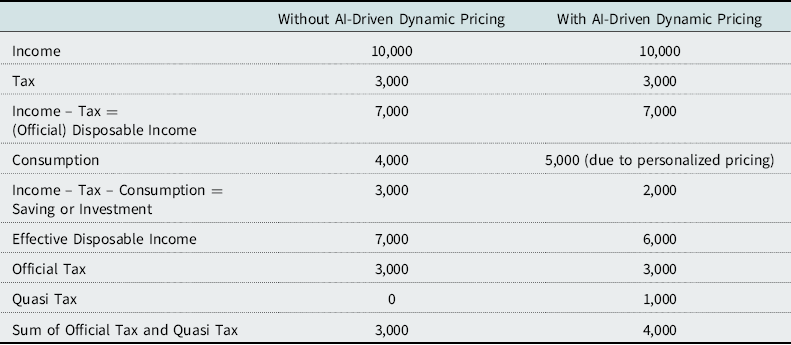
Consider a straightforward hypothetical example involving two scenarios.Footnote 126 Suppose Individual X earns $10,000 per month. The first scenario examines how traditional pricing models without AI-driven dynamic pricing affect Individual X’s spending behavior, while the second scenario explores the implications of AI-driven dynamic pricing. This discussion is fundamentally applicable to both SOE and privately-owned platforms, but the following analysis and interpretation will focus primarily on privately-owned platforms. The crucial point here is that a quasi-tax effect can also arise from the AI-driven dynamic pricing mechanisms of privately-owned platforms.
1. Scenario 1: Without AI-Driven Dynamic Pricing
Consider a situation in which AI-driven dynamic pricing is not used. Individual X pays 30% of their income in taxes. Individual X earns $10,000 a month, so their disposable income after taxes is $7,000. With this amount, Individual X allocates $4,000 toward consumption, covering both essential and discretionary expenses. The remaining $3,000 can be saved or invested.
2. Scenario 2: AI-Driven Dynamic Pricing
Consider another situation in which AI-driven dynamic pricing is widely adopted. Individual X again earns $10,000 per month. After paying 30% in taxes, their disposable income remains $7,000, so the situation is initially the same as in Scenario 1. However, Individual X now spends $5,000 to maintain the same consumption bundle that previously required only $4,000 in Scenario 1. The additional $1,000 of expenditure is attributable to the AI-driven platform’s ability to identify the upper bound of Individual X’s willingness to pay and to capture a significant portion of their consumer surplus. As a result, the amount available for savings and investment declines to $2,000.
Unlike a temporary price fluctuation, this erosion of consumer surplus may operate on a consistent and systematic basis under AI-driven dynamic pricing. In this respect, Scenario 2 is economically comparable to a situation in which Individual X pays $4,000 in taxes instead of $3,000. Although nominal taxes are $3,000, and thus, nominal disposable income remains $7,000, the “effective disposable income”—a term I refer to describe the income available for savings, investment, and discretionary spending after accounting for the effect of AI-driven dynamic pricing on consumer surplus—is reduced to $6,000. The platform’s pricing mechanism thereby operates in a manner analogous to an additional economic levy, constraining Individual X’s capacity to allocate resources freely. This raises significant concerns about long-term financial equity and the broader implications for consumer welfare in an economy increasingly shaped by AI-driven pricing strategies.
3. Implications of Quasi-Taxation
In sum, while the disposable income that Individual X can use is $7,000 in Scenario 1, the effective disposable income that Individual X can use is $6,000 in Scenario 2. The additional $1,000—representing 10% of Individual X’s income—functions as what I term a “platform’s quasi-tax.” Unlike both traditional taxes and the SOE platform’s dynamic pricing quasi-tax discussed earlier, in the case of a privately-owned platform, this amount is not paid to the government or an SOE platform but is instead transferred to the privately-owned platform. In this light, from Individual X’s perspective, the $1,000 operates as a de facto tax, reducing effective disposable income and constraining savings capacity and consumption flexibility. While the official tax rate remains at 30%, the combined burden of taxation and surplus extraction results in an effective total burden of 40% of income. Table 2 summarizes the comparison between Scenarios 1 and 2.
Comparing costs with and without AI-driven dynamic pricing
This situation in Scenario 2 highlights broader concerns about the pervasive implementation of AI-driven dynamic pricing across a wide range of transactions and its potential to reduce individuals’ effective disposable income and purchasing power. In simplified terms, household-level real income or purchasing power may effectively decline. It should be noted that this decline would not stem from an increase in the general price level—that is, from inflation—but from individualized pricing strategies enabled by AI-driven platforms.Footnote 127 AI-based price discrimination thus stands to produce inflation-like welfare effects, even in the absence of observable inflation.
Traditionally, the level of disposable income has been determined mainly by taxation. However, if platforms consistently and systematically erode consumer surplus through personalized pricing, the surplus transferred from consumers to platforms may reduce the level of effective disposable income. From the standpoint of consumers, this situation means that there are effectively two entities that can diminish their disposable or effective disposable income: the government, through formal taxation, and platforms, through quasi-tax-like surplus extraction. Regardless of how these burdens are labeled or whether they are classified as formal taxes or quasi-taxes, what ultimately matters for consumers is that their purchasing power effectively shrinks due to platforms’ AI-driven dynamic pricing.
The quasi-taxes imposed by AI platforms may generate profound ripple effects, particularly if such practices encompass a vast share of consumer transactions. Theoretically, in the absence of regulation, AI-driven pricing could move toward capturing full reservation prices, thereby exhausting disposable income. Under these extreme conditions, the consistent and systematic extraction of surplus would seriously weaken individual incentives to increase earnings. Even falling short of such an extreme, this trajectory could trigger a significant cascade across the labor market, the product markets, the tax system, the macroeconomy, and even monetary systems. In this light, ultimately, the widespread reduction in effective purchasing power poses a structural risk, potentially redefining the tripartite interaction between governments, platforms, and consumers.
VI. Challenges of Consumer Consent
Due to the extensive use of consumer data, platforms’ AI-driven dynamic pricing is associated with privacy concerns and the potential deprivation of consumer surplus.Footnote 128 These concerns are often addressed, at least formally, through consumer consent. For example, regulations may require that consumers not be compelled to agree to the use of their personal information as a condition for accessing an e-commerce platform. However, challenges arise when consumers do not fully comprehend the technical descriptions in a platform’s standard-form contract. In such contracts, platforms are typically required to disclose the specific circumstances and extent of personal information collection.
Nonetheless, consumer consent is more complex than it initially appears. There are two primary models for obtaining consent in platform standard-form contracts. The first adopts a default-consent—opt-out—model, under which consumers are deemed to have consented unless they actively decline specific items. The second adopts an explicit opt-in model, under which personal data may be used only upon affirmative consumer authorization. The latter model is generally perceived as more protective of consumers. However, this perception is not necessarily true in light of behavioral economic considerations. Even under an opt-in framework, platforms may structure the consent-interface so that consumers are confronted with an extensive array of granular opt-in options. While platforms might claim they allow consumers to make informed choices regarding the use of their personal information, such complexity can impose significant cognitive and time costs. As a result, many consumers may rationally choose to, for example, accept all options with a single click, rather than review each item individually. This phenomenon aligns with behavioral economics theories that explain the systematic constraints on consumers’ decision-making capacity in digital markets.
Another concern is that platforms may offer preferential treatment to consumers who consent to broad data usage, while imposing functional or economic disadvantages on those who decline. Consequently, many consumers, faced with immediate and tangible disadvantages, may feel pressured to provide their personal information.
Against this backdrop, I propose a few regulatory measures to address the complexities of consumer consent. For instance, consumers should have the right to suspend a platform’s use of their personal information. This could be conceptualized as akin to a platform-specific version of the “right to be forgotten.”Footnote 129 However, if the process for exercising this right is cumbersome, most consumers are unlikely to navigate to a platform’s website to complete the necessary procedures. Instead, platforms could be required to notify consumers of their rights, for example, via email. Such notifications should also be sent periodically for the renewal of consent, such as every six months, even if consent has previously been granted.
Nonetheless, significant challenges remain. For instance, as discussed, platforms may present consumers with extensive arrays of consent-related choices. Expecting consumers to individually accept or decline each option is practically infeasible. This detailed consent structure might be a highly calculated strategy adopted by platforms to discourage consumers from exercising their rights. Therefore, to facilitate meaningful consumer control over personal data and avoid consent fatigue, it would be more preferrable, to some extent, to provide consumers with a streamlined, few-click selection mechanism—one that is structured yet not excessively complex—rather than a one-click take-it-or-leave-it choice that effectively favors the platform. Such a mechanism should be offered as an option in parallel with a more detailed consent structure.
Additionally, if consumers are granted the right to suspend a platform’s use of their personal information, a further regulatory question arises as to whether platforms should be required to delete such information entirely or be permitted to retain it for a limited period—for example, six months—even if its use is suspended during that time. However, in a market dominated by a few platforms, such suspension is a difficult choice for consumers to make. Also, it is questionable whether personal data can be effectively erased once it has been integrated into an AI model. Moreover, regulatory bodies often lack the practical means to verify whether platforms genuinely do not use personal information, a challenge that is further exacerbated when foreign platforms from particularly powerful countries maintain their servers abroad.
Likewise, even if workable solutions to consumer consent issues can be identified, they are likely to be only partial. Consumer consent is embedded within broader dynamics of global digital competition, cross-border e-commerce, regulatory harmonization among jurisdictions, and divergent national approaches to privacy and competition law. Furthermore, consumer consent in platform ecosystems may also intersect with national security considerations, as illustrated by developments surrounding the Didi Chuxing listing on the U.S. capital market and its subsequent delisting,Footnote 130 as well as regulatory measures taken in relation to TikTok in the United States.Footnote 131
Numerous issues regarding consumer consent remain unresolved and are not discussed in detail herein. Despite the importance of such consent, this Article aims to touch only briefly on the related issues, and a comprehensive treatment lies beyond the scope of this Article. While outlining key issues related to consumer consent is valuable, the succinct discussion thereof presented here inevitably risks oversimplification, as this complex subject needs an independent research project.
D. Conclusion
Through a theoretical framework,Footnote 132 this Article analyzes AI-driven dynamic pricing and first-degree price discrimination on digital platforms.Footnote 133 Characteristics of price discrimination and dynamic pricing may change significantly as AI technologies become more sophisticated.Footnote 134 The platform industry is sometimes characterized by (quasi-) monopolistic structures. However, even in multi-homing environments, an AI-driven de facto single entity can emerge from explicit or tacit collusion, mere alignment of pricing strategies with those of the leading platform, or cross-platform AI learning.Footnote 135 It may also emerge as a natural trajectory of technological advancement, as platforms achieve information parity by utilizing personal data as a common resource.Footnote 136 Due to the characteristics of first-degree price discrimination, AI-driven dynamic pricing may lead to distributive outcomes more adverse to consumers than traditional monopoly pricing.Footnote 137 Although transaction volumes may be similar to those of a competitive market and deadweight loss may be minimized, platforms can employ consumer-surplus-exhausting prices that consistently and systemically extract value. While such pricing enables participation for consumers with low reservation prices who might otherwise remain outside the market, it simultaneously subjects them to the same surplus-exhausting mechanisms.
In this respect, AI-driven dynamic pricing—pursuing first-degree price discrimination—represents a qualitatively different form of price discrimination. Pre-sophisticated AI price discrimination was closer to price “differentiation.” By contrast, AI-driven dynamic pricing by platforms exhibits a stronger element of “discrimination.”Footnote 138 These structural shifts are deeply intertwined with a “profiling lock-in” effect that the AI-driven platform’s dynamic pricing engenders. Platforms can retain individualized data and implement first-degree price discrimination on a continuous basis across most transactions. Pricing thus becomes persistently personalized and structurally embedded.Footnote 139 In this light, AI-driven dynamic pricing may weaken the traditional invisible-hand mechanism that presumes mutually beneficial surplus creation for both producers and consumers in market exchanges.Footnote 140
Platforms may function as essential market infrastructure, whether they are purely private entities, hybrid public-private partnerships, or SOEs. In certain contexts, SOE platforms may raise concerns regarding “quasi-taxation.”Footnote 141 Similarly, even in privately-owned platforms, quasi-taxation can arise, as AI-driven dynamic pricing functions to reduce consumers’ effective disposable income and purchasing power.Footnote 142 In this sense, the quasi-tax effect offers a distinct perspective on how consumer welfare may be compromised by AI-driven dynamic pricing. In addition, although consumer consent mechanisms may provide partial protection against the use of personal information by AI-powered platforms, such mechanisms face structural limitations posed by information imbalance and behavioral economic constraints.Footnote 143
Ultimately, the rise of AI-driven dynamic pricing poses a fundamental challenge to the traditional economic perspective that has long privileged efficiency as the primary metric of market evaluation. In an AI-driven platform environment where consumer surplus is significantly diminished, the mechanism of the invisible hand is substantially undermined. In this light, a more comprehensive analytical framework that integrates allocative efficiency with distributive fairness is indispensable for understanding and regulating platform markets in the age of AI. To this end, the core concepts introduced in this Article—such as an AI-driven de facto single entity, profiling lock-in, platforms’ quasi-taxation effect, and consumer-surplus-exhausting prices—must be comprehensively understood, and their application to future research should be encouraged.
Acknowledgement
The author declares none.
Funding Statement
The author declares none.
Competing Interests
No specific funding has been declared in relation to this Article.


 Open access

