


Introduction
Supreme Court applications involving stays and injunctions play an important role in law and politics. Vladeck (Reference Vladeck2023a) contends that the “best predictor” of which party prevails “is the partisan valence of the dispute,” which suggests that outcomes are determined by “political actors acting politically.” Members of Congress have suggested that justices use these applications as vehicles to promote their “social agenda”Footnote 1 and “impose their legislative priorities and values on our country….”Footnote 2 Journalists have asserted that justices use these applications to promote their favored “political agenda” (Mystal Reference Mystal2021) and “achieve [their] preferred [policy] outcomes….” (Donegan Reference Donegan2021).
The underlying hypothesis is that votes are related to preference alignment with merits positions (see also Das et al. Reference Das, Epstein and Gulati2023, 94–98). Using original data on applications involving stays and injunctions decided by the Court from the 2017 through 2023 Terms, combined with new contextual information extracted from case filings and docket entries, this paper presents empirical evidence that is consistent with the preference-alignment hypothesis. Specifically, the likelihood of Democratic (Republican) appointees voting to grant relief is higher on average when applicants advance liberal (conservative) merits positions. Similarly, using a continuous preference measure, the likelihood of voting to grant relief is positively (negatively) associated with judge conservatism when applicants advance conservative (liberal) merits positions. These results illustrate the politics of stays and injunctions, while informing the broader link between procedure and substance in judicial decision-making.
This paper also presents new evidence indicating that the relationship between voting and preference alignment with merits positions is especially pronounced when the merits remain pending before a lower court. Applications that arise in this procedural context generate heightened legal and political scrutiny, but have not yet been isolated for purposes of empirical analysis. This result heterogeneity is consistent with existing evidence that accounting for procedural context can sharpen inference about applications involving stays and injunctions (Goelzhauser Reference Goelzhauser2023). Furthermore, this heterogeneity has implications for proposals to enhance reason giving and the widespread use of undifferentiating conceptual labels such as shadow docket, emergency docket, and interim docket. Footnote 3 Combined with a largely overlooked Roberts Court era shift in the procedural context in which these applications arise (Goelzhauser Reference Goelzhauser2023), this result also helps explain increased decision salience and controversy.
The remainder of this paper proceeds in four parts. First, I discuss the preference-alignment hypothesis, bridging already well-developed but somewhat disconnected theoretical foundations. Second, I discuss research design, including data collection and measurement strategy. As part of this discussion, I contextualize contemporary concern about voting clarity (see Baude Reference Baude2015, 14). This is a common issue in the merits context that applies to decisions with signed opinions prior to introduction of the lineup for the 1970 Term and per curiam opinions to the present day. When registered dissents are common, the standard solution combines attributing acquiescence with a conceptual distinction between public and private voting—an approach that I contend is plausibly transportable to this sample. Third, I discuss the empirical results, which are robust to a variety of specifications, such as the inclusion of judge- and case-level fixed effects. Fourth, I conclude by discussing inferential and normative implications, as well as directions for future research.
Preference alignment with merits positions
Supreme Court decisions involving stays and injunctions are prominent in law and politics. As an initial matter, an injunction “directs the conduct of a party” by “telling someone what to do or not to do,” while a stay “operates on the judicial proceeding itself…by halting or postponing some portion of [it], or by temporarily divesting an order of enforceability” (Nken v. Holder, 556 U.S. 418, 428 (2009)). Legal frameworks can vary by the specific type of relief requested, but generally call for judges to consider factors such as irreparable harm and the likelihood of success on the merits.
During a hearing on the Court’s “shadow docket,” the chair of the Senate Judiciary Committee suggested that the Court’s decisions involving stays and injunctions “appear on their face to be ideologically driven.”Footnote 4 The underlying hypothesis, consistent with commentary reported in this paper’s opening paragraph, is that votes are related to preference alignment with merits positions.Footnote 5 To fix ideas, since Republican-appointed (Democratic-appointed) judges are, on average, more (less) likely to support limiting abortion access (Sunstein et al. Reference Sunstein, Schkade and Ellman2004, 327–328) and proceeding with executions (Beim et al. Reference Beim, Clark and Lauderdale2021), the preference-alignment hypothesis predicts that they will be more (less) likely on average to vote to grant relief involving stays and injunctions for parties advancing congruent merits positions.
The theoretical foundation for this hypothesis is well established. First, as noted previously, the legal frameworks governing stays and injunctions generally invite judges to consider the likelihood of success on the merits. Indeed, some legal scholars have argued that this consideration is now paramount in certain contexts (see, e.g., Bray Reference Bray2025b; Vladeck Reference Vladeck2019). Second, there is extensive evidence linking votes and preferences in the merits context (see, e.g., Epstein Reference Epstein2024; Segal and Spaeth Reference Segal and Spaeth2002). Combining these two features of judicial decision-making, it is reasonable to hypothesize that votes on stays and injunctions will be related to preference alignment with merits positions.
Although the likelihood of success on the merits inquiry may strengthen the theoretical connection between votes and preference alignment with merits positions, the hypothesis would be well grounded even absent that assessment being part of the relevant analytical frameworks.Footnote 6 The empirical relationship between procedure and substance has been well documented (see, e.g., Goelzhauser Reference Goelzhauser2011; Solimine and Gely Reference Solimine and Gely2010). In the justiciability context, for example, experimental evidence indicates that motivated reasoning can link preference alignment with merits positions to conclusions about whether parties have standing to sue (Braman Reference Braman2006). Moreover, judicial votes on standing have been linked to expected preferences for resolving the merits (Pierce Reference Pierce1999; Rowland and Todd Reference Rowland and Todd1991). The preference-alignment hypothesis applies the same theoretical logic to stays and injunctions.
There is a burgeoning empirical literature on the politics of stays and injunctions, both regarding Supreme Court (e.g., Baum Reference Baum2020, Reference Baum2022; Goelzhauser Reference Goelzhauser2023) and lower court (e.g., Bray Reference Bray2025a; Fischman Reference Fischman2025; Miller and Curry Reference Miller and Curry2022) decisions.Footnote 7 Most of this literature does not address the preference-alignment hypothesis, but there are exceptions. Most comprehensively, Das, Epstein, and Gulati (Reference Das, Epstein and Gulati2023, 94–98) analyze forty-four initially referred Supreme Court applications from the 2021 Term, finding that votes are associated with merits preferences. Furthermore, a descriptive analysis of votes on a sample of applications submitted by the Trump and Biden administrations reveals that “partisan affiliations map onto voting patterns quite closely” (Liptak Reference Liptak2025; see also Epstein et al. Reference Epstein, Martin and Nelson2025).
Research design
Sample
Parties generally submit requests involving stays and injunctions as an “application.”Footnote 8 By Court rule, applications are submitted to the relevant circuit justice. The acting circuit justice then decides whether to grant relief, deny relief, or “refer” the application to the Court for collective disposition.Footnote 9 Applications that are denied in chambers can be “renewed” to “any other” justice, but this practice is generally “not favored” by rule.Footnote 10 Decisions on applications by the Court are published in the Journal and later included in the United States Reports. Footnote 11 Unless orally argued, decisions on applications by the Court are also included on the orders list.Footnote 12
The sample includes original data on applications involving stays and injunctions that were decided by the Court from the 2017 through 2023 Terms.Footnote 13 This sample selects on referral, which is the relevant criterion for cases decided by the Court but excludes in-chambers dispositions. Existing evidence indicates that referral is unrelated to preference alignment with merits positions.Footnote 14 McFadden and Kapoor (Reference McFadden and Kapoor2021, 836) suggest that “non-trivial” applications are referred for initial disposition, and indirect empirical evidence supports this proposition (Baum Reference Baum2022, 9; Das et al. Reference Das, Epstein and Gulati2023, 82–87). Moreover, the Court has denied every renewed application since at least the 2003 Term (Goelzhauser Reference Goelzhauser2023, 149) through at least the 2023 Term, and there was only one dissent during that time (see Baum Reference Baum2022, 10). This purported referral norm is also consistent with the Court’s rule-based presumption disfavoring renewal.
Dependent variable
The outcome of interest is each participating justice’s vote on whether to grant relief. For signed opinions, the lineup comprehensively specifies votes. But orders-list matters are generally decided without signed opinions. Absent a lineup, participating justices are only listed in orders when they write opinions, join opinions, or note disagreement.Footnote 15 Orders do not otherwise identify justices who agree with the majority disposition, though they can be inferred when the number of dissenters reveals a minimum-winning coalition. Concerned about whether unlisted justices agreed with the majority disposition or suppressed dissent, Baude (Reference Baude2015, 14) suggests that “we often do not…know the votes of the orders with any certainty.” Others have since amplified this concern, suggesting, for example, that “we cannot assume the vote count [for applications involving stays and injunctions] unless it is explicit” (Wermiel Reference Wermiel2025).
In the merits context, the same issue applies to decisions with signed opinions prior to the 1970 Term, when the Court added the lineup of the syllabus (Wagner Reference Wagner2001, 20), and per curiam opinions to the present day. The standard approach for purposes of general commentary and empirical analysis is to attribute public acquiescence to the majority position absent registered dissent.Footnote 16 Attribution does not assume the absence of dissent suppression, nor does it attempt to recover or proxy for the internal lineup. Indeed, attribution is often employed to classify votes from eras with frequent suppression.Footnote 17 Rather, attribution rests on a standard conceptual distinction between public and private votes (see, e.g., Post Reference Post2001, 1331; Sunstein Reference Sunstein2015, 787). Dissent suppression is generally conceptualized as public acquiescence to the majority position, not as obscuring some true internal vote.
Whether attribution is transportable to orders-list matters depends on the dissent-disclosure norm. In the certiorari context, for example, registered dissent is unusual and justices have repeatedly emphasized a non-disclosure norm.Footnote 18 As a result, scholars use archival data to study votes (e.g., Black and Owens Reference Black and Owens2009). For applications involving stays and injunctions, however, noted and written dissents are now common (Goelzhauser Reference Goelzhauser2023, 134, 153; see also Baum Reference Baum2020, 4–5; Das et al. Reference Das, Epstein and Gulati2023, 89). This does not mean that there is no suppression. Indeed, justices have explicitly (see Baude Reference Baude2015, 14) and indirectly (see Goelzhauser Reference Goelzhauser2023, 113 n. 64) revealed that suppression occurs. But as justices demonstrate a frequent willingness to register dissent, including the low-cost option of noting disagreement, refusing to do so can more plausibly be treated as if it constitutes public acquiescence to the Court’s disposition. Supporting this perspective, Justice Alito analogizes dissent suppression on applications involving stays and injunctions to “graveyard dissents” on the merits (Barlow Reference Barlow2021).Footnote 19 This suggests that it is reasonable to treat the absence of dissent as the observational equivalent of publicly acquiescing to the majority disposition.
Stipulating that the conception of “vote” employed in this paper incorporates the preceding analysis, I attribute public acquiescence to the majority disposition absent dissent for participating justices whose position is not otherwise registered in the order or an opinion. Das et al. (Reference Das, Epstein and Gulati2023, 89) adopt the same approach for applications involving stays and injunctions, referring to these as “apparent” votes.Footnote 20 As with standard practice in the merits context, I do not assume anything about a justice’s internal vote or attempt to recover or proxy for the internal lineup, all of which is currently unobservable for this sample. Rather, inference is conditioned on a standard conception of public voting that treats suppression as the functional equivalent of public acquiescence to the majority disposition.Footnote 21 The resulting dependent variable is scored 1 for justices who vote to grant relief and 0 for those who vote to deny relief. Overall, there are 4,475 votes in the sample, 19% of which are to grant relief.
Independent variables
Testing the preference-alignment hypothesis requires interacting a measure of judicial preferences with a measure orienting merits positions. I capture judicial preferences in two ways.Footnote 22 First, I use a Republican appointee indicator scored 1 for justices appointed by Republican presidents and 0 for Democratic appointees (62% of the sample = 1). Second, I use Martin and Quinn’s (Reference Martin and Quinn2002) ideal point scores as a continuous measure of judicial conservatism. Footnote 23 The former is easier to interpret, while the latter captures preference variation among justices appointed by same-party presidents. For expositional clarity, I discuss the appointing-president proxy in the main text and the ideal-point proxy in Appendix A. The results are similar.
To orient applicants’ merits positions, I classified their “ideological direction” using the Supreme Court Database’s coding protocol (Spaeth et al. Reference Spaeth, Epstein, Martin, Segal, Ruger, Benesh and Nelson2025, 37).Footnote 24 The resulting conservative merits position indicator is scored 1 for applicants advancing a conservative merits position, and 0 for a liberal position (32% of the sample = 1). The key explanatory variable is an interaction between the Republican appointee and conservative merits position indicators.
Inference about decisions on applications involving stays and injunctions may depend on the referral pathway (Goelzhauser Reference Goelzhauser2023). As noted previously, the default rule is that acting circuit justices decide whether to rule in chambers or refer the application to the Court. Yet there are norms to refer to (1) renewed applications and (2) capital applications. The Court does not acknowledge these norms in its rules, but they are known and observable features of institutional practice (see, e.g., Baum Reference Baum2022, 8–11; Goelzhauser Reference Goelzhauser2023, 118–119, 137–138; Shapiro et al. Reference Shapiro, Geller, Bishop, Hartnett and Himmelfarb2019, 17-7, 18-4). These referral norms partly determine which applications are decided by the Court and therefore observed in the sample. Since applications proceeding through different referral pathways may vary in unobserved ways, including latent characteristics such as request quality, it is important to account for them empirically.
The norm to refer renewed applications disincentivizes judge shopping and promotes judicial economy by preventing cascading renewals (Shapiro et al. Reference Shapiro, Geller, Bishop, Hartnett and Himmelfarb2019, 16–19). To account for this structural difference in referral pathways, I include a renewed application indicator scored 1 if the application was renewed following an in-chambers denial, and 0 if it was referred for initial disposition (20% of the sample = 1).Footnote 25 The norm to refer capital applications may be designed to manage the time constraints associated with imminently scheduled executions. Given this norm, capital applications do not proceed through the standard in-chambers filtering mechanism. Thus, I include a capital application indicator scored 1 if the application arises in a capital case and 0 otherwise (42% of the sample = 1).Footnote 26
Amicus participation may be correlated with voting and the ideological orientation of merits positions (see, e.g., Box-Steffensmeier et al. Reference Box-Steffensmeier, Christenson and Hitt2013; Collins Reference Collins2008). To account for potential confounding, I include an amicus participation variable scored 1 if an amicus brief was filed in connection with an application and 0 otherwise (18% of the sample = 1).Footnote 27 The information available on docket pages, from which I coded amicus participation, does not always permit classifying the brief’s position on whether the Court should grant relief. Nonetheless, evidence from the agenda-setting context (see, e.g., Caldeira and Lampert Reference Caldeira and Lempert2022; Caldeira and Wright Reference Caldeira and Wright1990; Goelzhauser and Vouvalis Reference Goelzhauser and Vouvalis2013) indicates that amicus participation can signal case salience regardless of position and may be associated with voting patterns.
I also include three sets of fixed effects. First, term fixed effects absorb systematic within-term voting differences that may be associated with factors such as political pressure and changes to the substantive composition of applications. Second, request type fixed effects distinguish applications requesting stays (78% of the sample), vacatur of stays (8%), injunctions (11%), and vacatur of injunctions (3%), absorbing systematic within-type voting differences associated with factors such as variation in legal standards and deference norms.Footnote 28
The third is procedural context fixed effects, which distinguish applications decided while the merits remain pending before a lower court (40% of the sample), while the linked petition is pending decision by the Court (7%), while the Court awaits filing of the linked petition (19%), simultaneously with the Court denying the linked petition (33%), and under miscellaneous circumstances (1%).Footnote 29 Procedural context can alter inference about stays and injunctions (Goelzhauser Reference Goelzhauser2023), and these fixed effects absorb systematic within-context voting differences that may be associated with factors such as variation in dissent-disclosure norms and the weight justices assign to particular prongs of the governing analytical frameworks.Footnote 30
Empirical analysis
This section examines the relationship between voting and preference alignment with merits positions across (1) all applications and (2) the subset decided while the merits remain pending before a lower court. The latter generates heightened legal and political scrutiny (see, e.g., Goldsmith Reference Goldsmith2025; Vladeck Reference Vladeck2023b), partly due to concern about precedential impact absent adherence to plenary procedural protocols. Furthermore, the record is presumably less developed on average in this context, which at the margin should increase uncertainty about whether the case will warrant merits review in the regular course. This uncertainty could shift more decision-making weight to evaluating the likelihood of success on the merits, which may amplify any relationship between voting and preference alignment with merits positions.
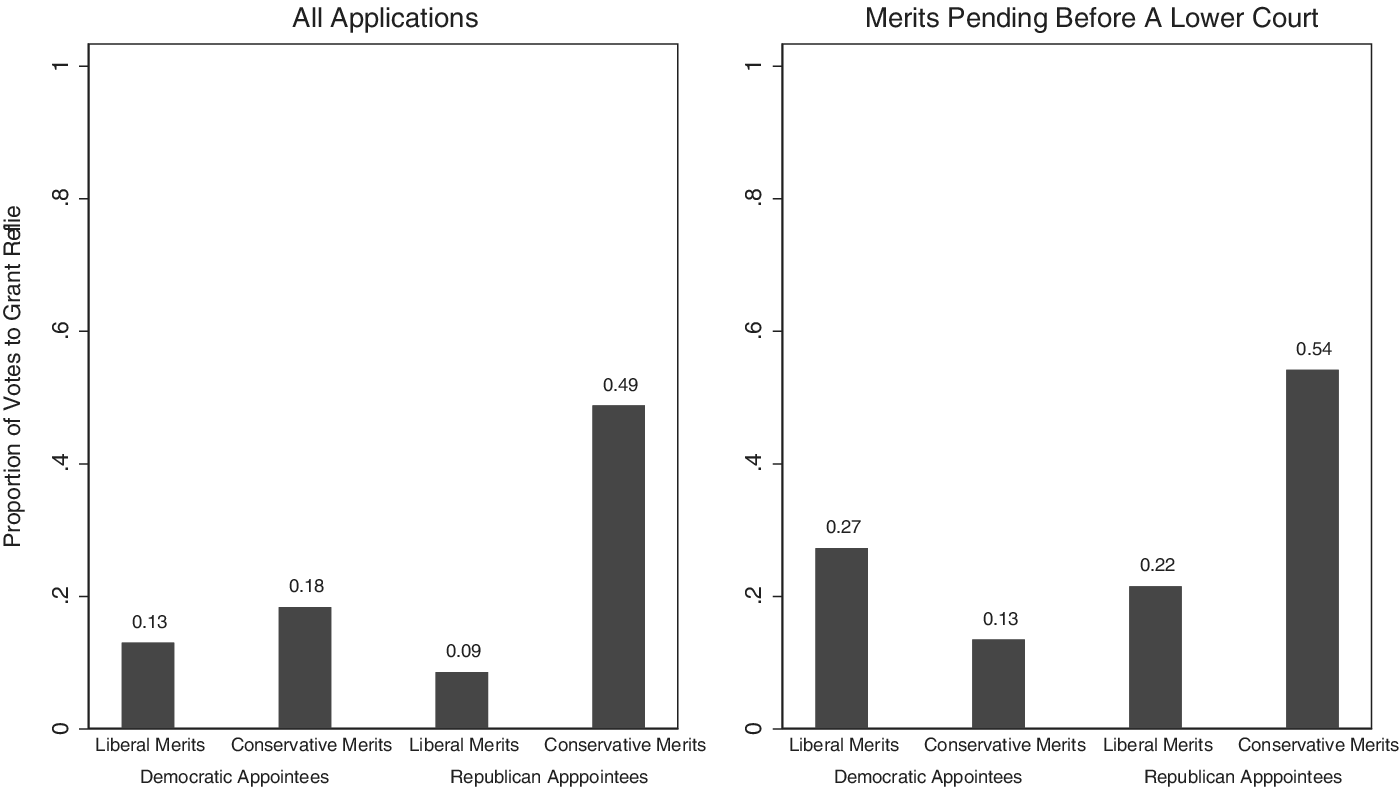
As a first empirical cut, Figure 1 presents proportions of votes to grant relief by appointing-president party and the ideological orientation of applicants’ merits positions. As shown later, the counterintuitive result for Democratic appointees in the pooled sample does not hold in the multivariate context, which is consistent with evidence indicating that accounting for procedural context and referral pathways can alter inference (see Goelzhauser Reference Goelzhauser2023). For the subset decided while the merits remain pending before a lower court, which not only isolates a particular procedural context but also one in which applications tend to be referred for initial disposition, the descriptive results are consistent with expectations.
Proportion of Votes to Grant Relief by Appointing-President Party and the Ideological Direction of Applicants’ Merits Positions.

Moving to the multivariate analysis, Table 1 presents results from logistic regressions using Firth’s (Reference Firth1993) penalized maximum likelihood estimator. Zorn (Reference Zorn2005) proposes using this estimator to address quasi-complete separation, which occurs in this sample because there are zero votes to grant renewed applications.Footnote 31 Appendix C presents robustness checks using Bayesian logistic regression with weakly informative Cauchy priors, which Gelman et al. (Reference Gelman, Jakulin, Pittau and Su2008) recommend as an alternative strategy for handling separation.Footnote 32
Voting to Grant Relief on Applications Involving Stays and Injunctions

Note: DV = 1 (0) if a justice votes to grant (deny) relief. Models fit with Firth’s (Reference Firth1993) penalized-likelihood correction for logistic regression. Standard errors are in parentheses. * p < .05 (two-tailed).
To assess model discrimination, I examine the area under the receiver operating characteristic curve (AUC) and associated 95% confidence intervals. In this context, for each randomly selected [0,1] pair of observed votes, the AUC represents the probability that the model assigns a higher predicted probability of voting to grant relief to the actual vote to grant rather than the vote to deny. An AUC = .50 indicates that the model performs equivalent to a random guess. For the models in Table 1, discrimination is good (see Muchlinski et al. Reference Muchlinski, Siroky, He and Kocher2016, 94), with AUC = .88 [.87, .90] in the combined sample and .83 [.81, .85] for the subset of applications where the merits remain pending before a lower court.
The results are consistent with the preference-alignment hypothesis: Democratic appointees are, on average, more likely to vote to grant relief for applicants advancing liberal merits positions, while Republican appointees are more likely to support relief for applicants advancing conservative merits positions. Moreover, this relationship is especially pronounced when the merits remain pending before a lower court. As shown in Appendix A, the results for both samples are similar when using Martin and Quinn’s (Reference Martin and Quinn2002) ideal point scores as an alternative measure of judicial preferences.
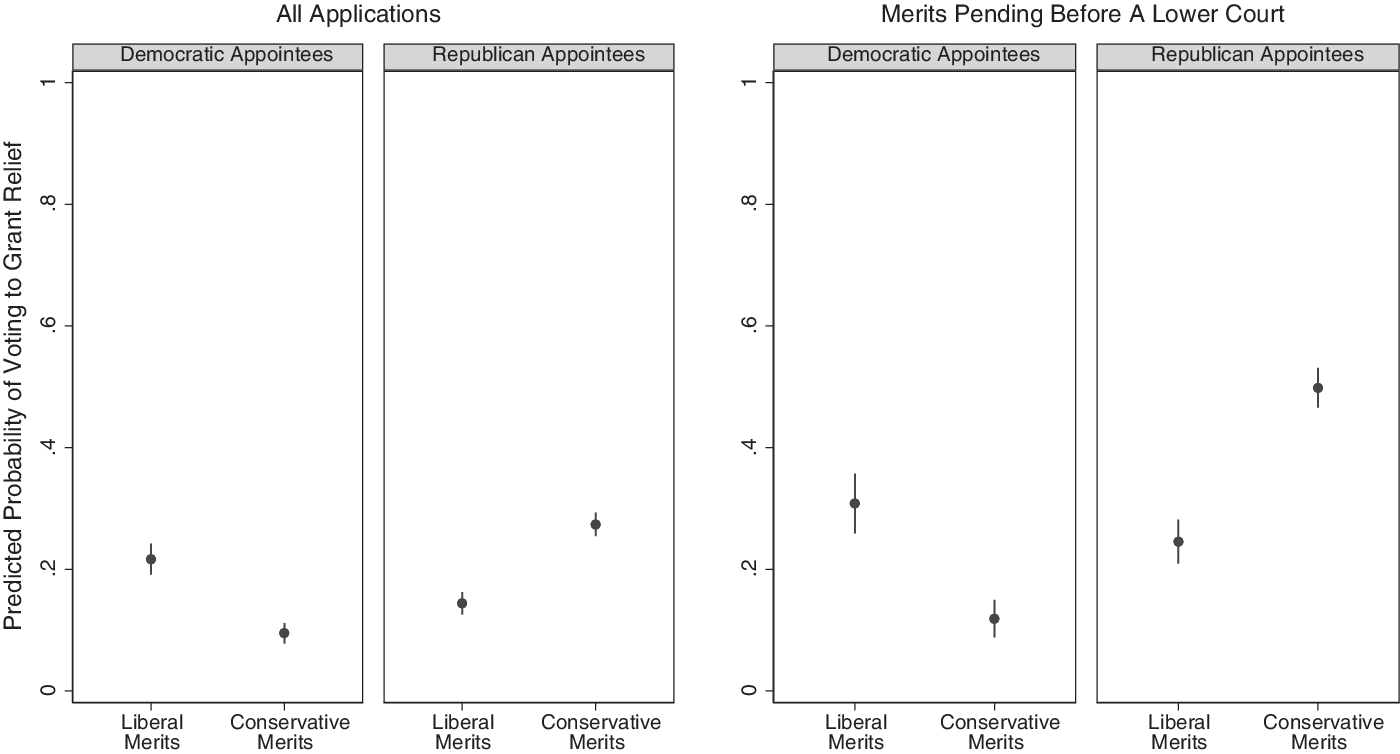
To examine substantive effects and comprehensively display the interactive results, Figure 2 plots predicted probabilities of voting to grant relief by appointing-president party and the ideological orientation of applicants’ merits positions.Footnote 33 Covariate levels are set using the observed-value approach recommended by Hanmer and Kalkan (Reference Hanmer and Kalkan2013). The differences in predicted probabilities are statistically distinguishable from zero (p < .05, two-tailed) both within appointing-president party across merits positions and across appointing-president party within merits positions.
Predicted Probabilities of Voting to Grant Relief by Appointing-President Party and the Ideological Direction of Applicants’ Merits Positions.

The substantive effects are considerable. For Democratic appointees, moving from a liberal to conservative merits position is associated with a decrease in the predicted probability of voting to grant relief across applications from .22 [.19, .24] to .09 [.08, .11], and from .31 [.26, .36] to .12 [.09, .15] when the merits remain pending before a lower court. For Republican appointees, moving from a liberal to conservative merits position is associated with an increase in the predicted probability of voting to grant relief across applications from .14 [.13, .16] to .27 [.25, .29] , and from .25 [.21, .28] to .50 [.47, .53] when the merits remain pending before a lower court.
Regarding the control variables, capital applications are not associated with voting differences in either model.Footnote 34 Amicus participation is associated with an increase in the likelihood of voting to grant relief across models. As noted previously, there are zero votes to grant renewed applications in this sample, but the empirical approach employed here follows standard practice by including the separating variable to avoid specification bias while accounting for it through the modeling strategy. Consistent with the observed data, renewed applications are associated with a decreased likelihood of voting to grant relief across models. Appendix E presents robustness checks including additional case-level variables.Footnote 35
The appendix presents two additional sets of robustness checks that further stress test the preference-alignment results. First, Appendix F estimates models with judge fixed effects, which absorb all time-invariant, judge-level characteristics. These specifications identify the relationship between merits positions and voting from within-judge variation in votes across cases. Second, Appendix G estimates models with case fixed effects, which absorb all case-specific variation. These specifications effectively condition on dissent (cf. Baum Reference Baum2020; Baum Reference Baum2022; Conway and Gagloeva Reference Conway and Gagloeva2023), and identify the relationship between appointing-president party and voting from differences in votes among justices within cases.
Conclusion
This paper presents empirical evidence that the Supreme Court’s voting on applications involving stays and injunctions is associated with justices’ preferences for resolving the underlying merits. Specifically, Democratic (Republican) appointees are more likely to vote to grant relief for applicants advancing liberal (conservative) merits positions. Similarly, using a continuous measure of preferences, the likelihood of voting to grant relief increases (decreases) with judicial conservatism when applicants advance conservative (liberal) merits positions. These results illustrate the politics of stays and injunctions, while informing the broader link between procedure and substance in judicial decision-making.
The relationship between voting and preference alignment with merits positions is especially pronounced when the merits remain pending before a lower court. This result heterogeneity is consistent with existing evidence that accounting for procedural context can sharpen inference about applications involving stays and injunctions (Goelzhauser Reference Goelzhauser2023). While undifferentiated conceptual labels such as shadow docket, emergency docket, and interim docket may have some coordinating and signaling value, this result heterogeneity demonstrates that they can be limited empirical constructs to the extent they obscure important variation that is relevant for evaluating institutional performance.
Accounting for variation in procedural context can help focus normative arguments concerning institutional reform. To the extent shadow docket is a relational concept that benchmarks orders-list protocol against plenary review on the merits, it is most useful analytically as applied to orders-list matters that are sufficiently analogous to plenary review on the merits to warrant this benchmarking as a theoretical matter. The results presented here suggest that a particularly potent form of “quasi-merits adjudication” (Baude Reference Baude2022, 2649) is whether to grant relief involving stays or injunctions when the merits remain pending before a lower court. In this procedural context, the argument for enhanced reason giving, for example, may be more compelling than when, say, the Court simultaneously denies the application’s linked petition.
Evidence that the relationship between voting and preference alignment with merits positions is heightened when the merits remain pending before a lower court also helps explain increased decision salience and controversy. Justice Alito says there is “nothing, absolutely nothing new” about this practice area (Totenberg Reference Totenberg2021), which is true in the sense that it is longstanding, but incorrect to the extent that it suggests nothing important has changed in recent years. During the Roberts Court era, there has been a fundamental but often overlooked shift in docket composition (Goelzhauser Reference Goelzhauser2023). Previously, most dispositions were capital applications denied concurrently with the Court denying their linked petitions. In this context, decisions are subsumed by broader agenda-setting considerations. Recently, however, noncapital applications are more prevalent, and those are often decided while the merits remain pending before a lower court—thus having more of an independent effect on litigation. Since, as shown here, this is also the context in which votes appear most likely to track the political dynamics of decision-making on the merits, increased salience and controversy is understandable.
Applications involving stays and injunctions warrant further study. The complexity of this practice area complicates statistical analysis, and comprehensive contextual data is difficult to acquire prior to the Court posting electronic case filings to docket pages during the 2017 Term. As decisions accumulate, thereby increasing available statistical power, scholars will be able to employ more granular measurement strategies to better understand this practice area. Example refinements include accounting for lower court decisions, what would be stayed or enjoined, and variation across parties and issue areas. Decades of incremental advancement inform what we know about plenary decisions on the merits, but the empirical study of stays and injunctions remains nascent. Enhancing our understanding of this practice area will be important for improving institutional performance evaluations and broadening perspective concerning contemporary law and politics.
Supplementary material
The supplementary material for this article can be found at http://doi.org/10.1017/jlc.2026.10025.



 Open access

