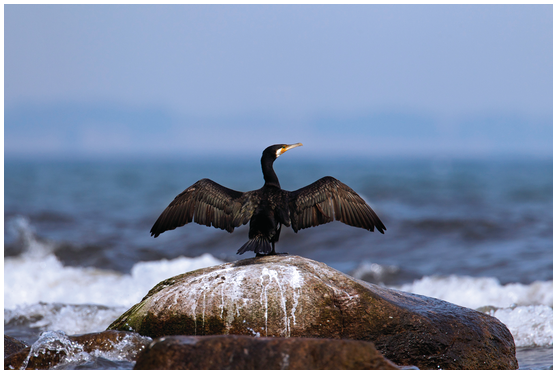
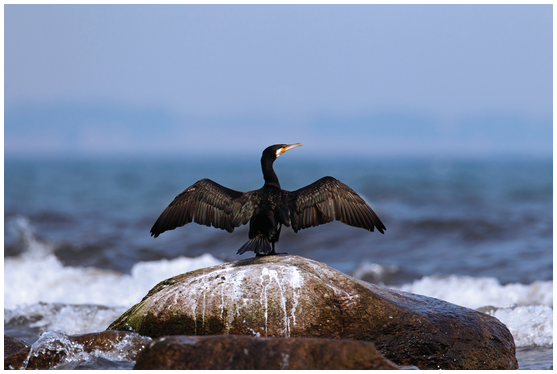
The cormorant. You may or may not recognise it, yet you probably see cormorants every time you are near a decent-sized stretch of water, fresh or salt. If you like fishing, you will certainly know the cormorant, and you probably resent it for eating with such natural efficiency the fish you are trying to catch. They are supreme fishers, these birds. From a vantage point high enough over a shallow pond or lake, you can watch the relentless sinuousness of their movement under water, the fiercely targeted twisting and turning that fish living in an area predated by cormorants must quickly learn to evade. Cormorants move more naturally beneath the surface than they do in the air, where they seem to be straining to stay airborne. Amy Clampitt describes the bird and its flight perfectly in her poem ‘The Cormorant in Its Element’ – ‘That bony potbellied arrow, wing-pumping along / implacably, with a ramrod’s rigid adherence’ – just as she captures too the brief effortless movement that constitutes the cormorant’s dive: ‘one sleek involuted arabesque’.1 This is the cormorant that writers see and, in Clampitt’s case, admire. But there is also the cormorant that writers see and hate or fear or at least associate with fearful contexts. In a way, this is not so surprising. There are obstacles in the way of loving this bird. Anyone who has seen a cormorant colony will be aware that tree-nesting cormorants destroy with their own acidic, odorous shit the trees they nest in. Avian traits that appeal to human beings – melodic song, brightly coloured plumage, sociability with humans – are all unavailable to cormorants. These birds do not sing. They do not have the haunting late-night call of a loon or of a raft of eiders just offshore. They are mostly silent; in those bleached, leafless nesting colonies they croak and rattle. Black, heavy-tailed, heavy-footed, somehow more visibly murderous than other fish-eating birds, they can appear cold, aloof, prehistoric, representative of a time before animals were obliged to interact with human beings. This sense of distance, social and temporal, has led poets to invent a catalogue of unfavourable comparisons for this bird. Standing on a rock with its wings stretched out to dry (Figure I.1), the lone cormorant has been described as looking like a broken umbrella, a crucifixion – even (and this is where the direction of travel becomes disturbing) a swastika. Such comparisons resonate unhappily, in part because they have a very long history, and they have an impact in the world. They give meaning to a bird, and the meaning they give that bird is destructive.
This book is the history of a bird. It is also a book about what happens when nature, culture and prejudice collide over time. It is about a bird that may not be recognisable to everyone yet is the object of a remarkable level of loathing in many places today, a loathing based not only in recent experience but in a long global history. It has been called ‘the most hated bird in America’.2 The bird is by no means hated everywhere in the world – it is appreciated, even loved, in Japan and China – but it is most certainly hated by a significant number of people not only in North America but in Europe too. This book is the story of how the bird came to be loathed, of how poets and other creative writers across time have unwittingly facilitated that loathing, and of how the loathing plays out today. The story tells us a great deal about the relationship human beings have with the natural world we inhabit and about what happens in return to human beings when we impose our discourses of prejudice on nonhuman animals. The history of how the cormorant came to be loathed and the conflicts that have resulted from that history underline the need to examine the causes of prejudice not only synchronically – looking, that is, at manifestations around the world now, today, of the prejudice in question – but also diachronically – to look back over a sustained historical period in order to learn how and where the prejudice originated and how it has modulated and adapted as times and circumstances have changed.
The history of the cormorant, then, is not simply a history of a bird. It is a study in something broader. It is the story of what happens to a nonhuman animal when that animal becomes caught up in the tendency of human culture to sort animals and birds into binary categories of ‘good’ and ‘bad’, imposing a moral perspective on nature. The bird has long been considered ‘evil’. It is ‘greedy’. Fishermen call it ‘the Black Death’. An article some years ago in The New York Times quoted a scientist reflecting on the way people view the bird: ‘I’ve heard them called “devil birds”,’ she recalls: ‘They sit with their wings out like Dracula. They sit really low in the water – they’re built for diving. Maybe they look snakelike. There’s a lot of them. And they smell.’3 ‘Devil’, ‘Dracula’, ‘snakelike’: how did these dramatic, disproportionate comparisons come about? How did the things the bird is thought to be like become fixed in this way? And why are the birds viewed this way now, long after human beings have apparently moved on from the mythical understanding of the natural world that was the preserve of the past? Why do poets and other writers continue to treat this bird as evil, as greedy, as an unwelcome invader? And how do these attitudes fit with other instances of loathing in human culture? What, in other words, can the cultural history of a bird tell us about prejudice – all forms of prejudice, whether directed at animals or at people – and how prejudice comes to be sustained over time? These are the questions I will seek to answer in this book.
I.1 Zoological Cormorant, Cultural Cormorant
The Australian writer Les Murray wrote a series of short poems about animals in which he set out with immense care to avoid the customary anthropomorphism of such writing – the tendency, that is, for poets to imagine the animal in question in human terms. Murray, rather, tries to find words for what you might call animalness. One of these poems is ‘Echidna’. An echidna is an Australian spiny anteater, one of only two mammals that lay eggs – a strange animal, to say the least, in Old World terms – and Murray sets out to do its strangeness full justice. His poem begins like this:
This is extraordinary writing, all the poet’s skills deployed to oblige the reader to try, impossible though it is, to imagine being an echidna. Murray plays fascinating games with word order (‘I feast life on and sleep it, / deep loveself in calm’), with compound word coinages (‘ant-ribbon’, ‘loveself’ and, later in the poem, ‘quill-ruff’ and ‘Corner-footed tongue-scabbard’), with bewildering similes (‘the gloss we put like lightning on the brimming ones’) and with unexpected word pairings (towards the end of the poem, the echidna describes itself as ‘trundling doze’). In the process, Murray builds a picture of a creaturely existence that is very clearly quite other than that of a human being. It is a writerly trick, to be sure, but a highly effective one, requiring the reader imaginatively to ‘become’ the animal and so derailing the automatic tendency to anthropomorphise, to think in human ways about nonhuman lives. It does what a good poem ought to do. It defamiliarises the world; it makes it strange. The poem is one of the best attempts I have seen to create in words the unhuman creatureliness of a creature.
The following is the beginning of another poem, this time about a less unfamiliar creature. This is Irish poet Dermot Healy’s ‘Cormorants’:
For Healy, the cormorant is the devil’s messenger. As the poem proceeds, we learn it is the ‘only’ living creature ‘allowed into hell’, and the bird’s habitual pose, wings spread wide like a cross, a gesture only partially drained of its Christian resonance by the poem’s overt classicism (‘Ulysses’, ‘Lethe’) – ‘he stands with his wings out … imploring the heavens’ – becomes its desperate plea for forgiveness for its ongoing, apparently willing, long-term implication in evil. The bird is alien not in the sense of being made strange for the reader but by way of its association with images of evil and death familiar enough to readers inculcated in Western/Northern Hemisphere culture.
There is, very obviously, a considerable difference between these two poems. Each aims to project a mindset – though Murray makes it clear that ‘mindset’ is not remotely the right word for nonhuman animals – and each does so in very different ways. Murray seems to have preferred to write about animals that nobody had written about previously – although his poems about eagles, ravens and dogs are extraordinary too – and in this he had the advantage of being Australian. Why is this an advantage? Because in the Anthropocene – in the current epoch of history, that is, defined by the impact of human beings on the planet – animals cannot be understood outside their unavoidable interaction with humans, and if, like Murray, you wish to write a poem from the animal’s perspective, it helps to choose an echidna, an animal with no or minimal cultural history. (Settler cultural history, that is. The echidna has plenty of meanings in Indigenous Australian culture, but those meanings have not transferred to non-Indigenous culture.)
Animals native to the Old World cannot so easily be addressed without reference to human culture, as Healy’s poem makes only too clear. It is obvious that all sorts of creatures, from eagles to robins, from deer to dormice, will not be understood fully without at least some awareness of the meanings they have acquired for human beings. Michel Pastoureau’s magnificent history of the bear, for instance, offers a fascinating account of the place of an animal in human culture. Bears, he tells us, have across time been venerated, reviled, dethroned and then slyly and parodically reinserted into popular culture in the form of the teddy bear.4 More recently, Peter Arnds has shown how another animal, the wolf, has at different times been made to stand prejudicially for a variety of human groups as diverse – and as profoundly contradictory – as Jews, Romanis, Nazis, terrorists, immigrants and wayward women.5 And Peter Coates’ account of the treatment of the grey squirrel in Britain since its introduction shows how intensely interwoven the treatment of certain animals can be with fluctuating discourses of tension and exclusion among humans.6 What seems clear is that there are two versions of a given animal – the zoological animal and the cultural animal – and that the two co-exist in a complex manner. If you drew a graph of the features of the zoological animal and the cultural animal, the lines would touch briefly in places and diverge wildly in others. Sometimes the animal’s habits find direct expression in human culture, and sometimes the animal acquires cultural attributes that bear no tangible relationship whatsoever to its actual being or behaviour. That culture over time determines to a greater or lesser extent our understanding of animals and birds seems to be true even of creatures for which you might think there is little or no cultural history. The cormorant is one such animal.
Why the cormorant? It is hardly, you might think, the most obvious choice of animal or bird, and certainly not the most appealing. The first and simplest reason is that the bird has long been, and continues to be, a source of controversy and conflict. During the nineteenth century, cormorant populations in many places around the world, from Europe to New Zealand, plummeted due to persistent persecution. This decline in numbers was compounded in the mid twentieth century on both sides of the Atlantic by the unintended but profoundly destructive impact of DDT (dichloro-diphenyl-trichloroethane, the first modern synthetic insecticide) and other pesticides on a range of bird populations, including cormorants. The combination of the introduction of legal protections and a ban on these pesticides – partly as a result of the societal impact of Rachel Carson’s highly influential book Silent Spring – led to the cormorant’s extraordinary resurgence in the later twentieth and early twenty-first centuries, an increase in numbers so dramatic that it reignited the urge in certain quarters to ‘regulate’ (to use the fishing industry’s preferred term) the cormorant. The bird became, as a result, the subject of conflict between, on the one hand, environmentalists and conservationists and, on the other, a range of fishing interests – sea fisheries, fish-farm owners, anglers – in locations across the planet, from Denmark to Canada, from Britain to Israel, most visibly in the United States. The conflict in North America has been thoroughly addressed by writers including Dennis Wild and Richard King – and most passionately of all by Linda Wires in her account of the double-crested cormorant, a history of how the bird became a ‘feathered pariah’ and of the origins and science of the tensions between the fishing industry and environmentalists over the question of cormorant ‘management’.7 These tensions are palpable, atavistic – the most basic of struggles between humans and animals for control over the resources necessary for survival.
The European conflicts, by contrast, running as they do in so many ways parallel to the American, have not been discussed to the same extent, though they are the subject of a report undertaken by way of a European Union–funded project called INTERCAFE, a distracting acronym for the wordy full title: ‘Interdisciplinary Initiative to Reduce Pan-European Cormorant-Fisheries Conflicts’. This project, which took place between 2004 and 2008, set out to ‘improve European scientific knowledge of cormorant-fisheries interactions in the contexts of the interdisciplinary management of human/wildlife conflicts and of sound policy formation, so as to inform policy decisions at local to international levels across Europe’.8 One of the project’s primary aims was to address what the report calls ‘the fundamental distrust between the main stakeholder groups’ – ‘fundamental’ being, in context, almost an understatement. The crucial difference of opinion between fishing groups and ecologists is whether or not there is a direct correlation between the recovery of cormorant numbers in the last quarter of the twentieth century and the marked reduction in fish stocks in certain bodies of water that has occurred over roughly the same period. Few on the fishing side seem willing to hear discussion of other possible reasons for the reduction of stocks – the effects of overfishing, for instance, tangible though they have been in the past. Polarised viewpoints vary from ‘cormorants are a scourge and their populations should be greatly reduced’ to ‘cormorants are being scapegoated and should be left alone’.9 In either case, the bird is overtly anthropomorphised in ways that are very much to its detriment. It is not obvious how perspectives such as these can be harmonised, but the INTERCAFE project set out to see what could be done. (I will discuss this at greater length in Chapter 2.) The project’s reports include a lengthy and valuable discussion of cultural issues, but their focus is very firmly on now (the now of the period of the project, that is). In this book, I make a plea for awareness of the impact of culture on science over what historians call the longue durée – over, that is, the full historical duration of the emergence of an idea (or, in this case, of a set of ramifying prejudices) – following the curve from a distant then to a very current now.
The second reason for my interest in this bird is that the cormorant turns out, surprisingly, to have a rich cultural history in the Western Hemisphere/global North, one that has been addressed in recent years both by Wires and by King in his engaging global narrative.10 Much of the present book is devoted to giving the reader a sense of the identity of the cultural cormorant across time in order to reflect on two phenomena: first, the general relationship between humans and nonhuman animals and, second and more specifically, the impact of culture – and, in particular, one of culture’s least appealing aspects, prejudice – in the ‘real world’. Sometimes it pays to look away from the familiar and to reflect on examples whose history may be largely hidden to us now but which continues to exert an impact both on the animals in question and on human beings too. The cormorant is one such creature. To many people, the cormorant is either invisible or barely visible, not recognisable enough be the object of hatred and certainly not an obvious candidate to be ‘the most hated bird’. In the past, however, when certain economic activities and their natural challenges were more generally visible at local level, people were more aware of the cormorant. The bird seems to have been part of everyday parlance to the extent that it became a by-word for greed, for unheeding consumption, and thus, by extension, a symbol of evil.
My argument about this bird is twofold. One, if we are to understand the intersections in the world between human beings and the zoological cormorant, then we need also to understand the cultural cormorant and how it has come into being across time. Two, understanding the cultural cormorant necessarily involves observing the ways in which human discourses of prejudice cross the so-called human/animal divide – an arbitrary divide, as we have come over the last couple of centuries to understand, but one that retains a great deal of cultural power. Cormorants are a source of controversy for two basic reasons. One, they are highly efficient predators, competing with humans for consumption of fish. Two, when they nest in trees, the extent and pungency of their excrement in due course reduces thriving woodland to bleached ruin. Because of the relatively recent resurgence of cormorant numbers after a long period of suppression, these are both very current reasons. But when it comes to cormorants, now is very much the product of then. The loathing the cormorant inspires in certain people today cannot be detached from the bird’s long cultural history and thus from the loathing it has inspired in certain people in the past. Nor – more challengingly and much less comfortably – can that loathing be detached from the loathing certain people have for other kinds of people. If you hate cormorants, in other words, you may well also hate (at least some) people. To make sense of this, it matters to understand that culture has a grammar – a set of invisible rules that enable apparently unconnected cultural threads to function on parallel tracks – meaning that prejudice on the one hand against a bird and prejudice on the other against human beings can manifest itself in mutually recognisable ways.
This book is, first of all, then, a study of the place of a bird in culture across time. Second, it is a study of human discourses of prejudice – systems of thought that direct prejudice both at the bird and at other humans in parallel or overlapping ways. This intertwined history, I rapidly realised, cannot be adequately understood without crossing borderlines both of historical period and of intellectual discipline. In the course of this book I engage with a number of fields of knowledge, from zoology to environmental science, from sociology to theology. I especially hope the book will be of interest to scientists because I believe the history it outlines has implications for science. I am nonetheless a literary scholar by trade, fascinated by the bird’s place across time in poetry and in other forms of creative writing. I began this account with two poems, and in the chapters to come I will discuss poetry, novels, short stories and plays by a wide range of writers. I also look at books not intended as literature – works of ornithology, for example – through the lens of literary analysis. This may be a book about a bird, then, but it is also a book about language, about the things language can do in and to the world.
I.2 Dead Trees
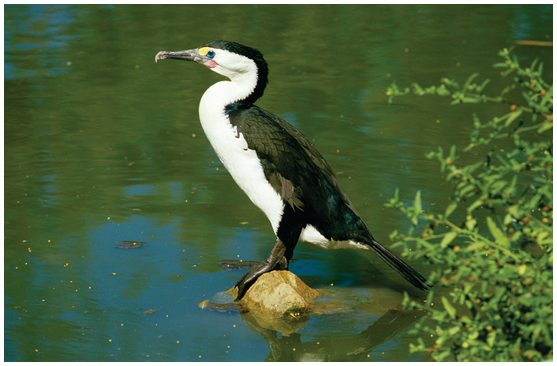
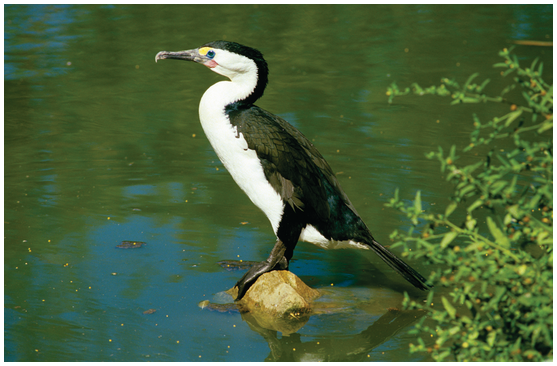
There is no single zoological cormorant. There are thirty-nine species of cormorants across the globe, and they vary in size and plumage. The Australian pied cormorant, for instance, is fairly small, and it is white-fronted from beak to tail, at first glance not entirely unlike a penguin (Figure I.2). The South American red-legged cormorant is even smaller, mostly black with a red-and-yellow beak, a white neck patch, blue eyes and, as its name proclaims, luridly red legs and feet. The South Georgia shag, from the South Atlantic, is white-fronted like the pied cormorant, pink-legged and blue-eyed, and has a yellow carbuncle where its beak meets its forehead. The cormorant that functions as the generic cormorant in Western/Northern cultural contexts, however, is none of these. The cultural cormorant is a large black bird, either the North American double-crested cormorant, Nannopterum auritum, or its cousin the great cormorant, Phalacrocorax carbo, which is found across most of the world. The former has had the bulk of the attention in the last couple of decades, due partly to the predominance of American concerns online and partly to the sheer intensity of local conflict over these birds – most notoriously, the shooting of a thousand or so double-crested cormorants on Little Galloo Island, a small islet in eastern Lake Ontario a few miles off the New York mainland, close to a community economically dependent on recreational fishing where attempts to create dialogue between the community and environmental scientists failed and locals took lethal action instead. The great cormorant has received rather less attention than the double-crested, yet it is a truly global bird – its extraordinary range runs from Canada to Europe, China and Japan, where it has for millennia been the vehicle for traditional fishing – and it was the cormorant of literary tradition prior to the rise of American literature. Both species are fairly large, not far from the size of a small goose, although leaner; they are black all over (at least, they appear black from a distance, though close up they turn out to be a lot of colours); they look prehistoric; they have a tendency to seem, for want of a better word, aloof; and they are very very good at fishing. The cormorant’s characteristic stance, as the poet Dermot Healy knew, is to perch on a rock or post with its wings spread wide to dry after a period of diving for fish – a stance that has got it into a great deal of (cultural) trouble over time.
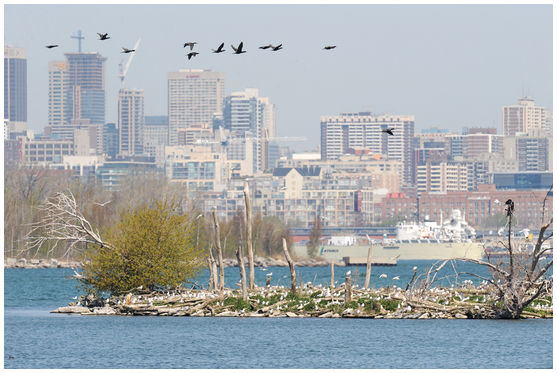
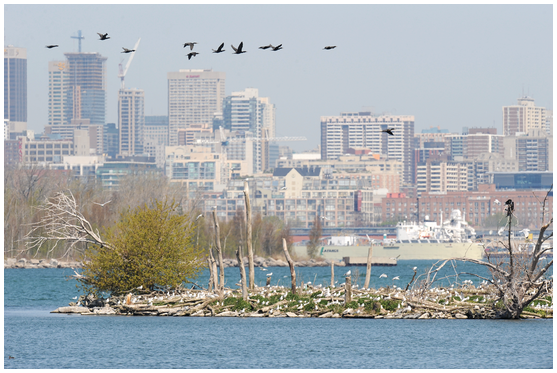
Not far from where I have lived for the last quarter of a century in Walthamstow, north-east London, is a set of reservoirs providing water for much of the northern section of the capital. The area is now a formal wetlands reserve, though it did not have this status when I first visited. The nearest reservoir has two tiny islands in the middle, both of which are covered in spindly, mostly leafless trees that provide a nesting site for a colony of cormorants. One cold January morning more than a decade ago I cycled there and found myself watching the cormorants beginning the process of rebuilding their nests for the spring, skimming the water with long twigs in their beaks, prehistoric and fixated, wings beating steadily yet with a certain apparent tension, birds that appeared shocked (I thought, fancifully) to discover that they inhabit the modern world. Suddenly a flight of shelduck came in to land on the water, an unexpected sight in such an urban location, their black-white-and-chestnut plumage a keen variation on that of the more familiar, and more opinionated, Canada geese patrolling the banks of the reservoir. These modest urban waters serve as a stopping-off point for a surprising range of migrating birds, and the tree-nesting cormorants serve as reassurance for the incomers that this is no urban mirage but a place of genuine respite on the way from sea to sea. One thing that was obvious, however, is the cormorant’s habit of wrecking trees. This is stated at its pithiest in the Collins Bird Guide, standard handbook of British birdwatchers. ‘Tree-nesting cormorants’, the editors note, deadpan, ‘eventually kill their nest-trees by their droppings.’11 This environmental paradox, or parable, explains the state of these islands. It also underlines the cormorant’s ability to create controversy not only through consumption but also through digestion. It is only a matter of time before these Walthamstow islands become bereft of greenery, just as has happened on, for instance, the islands in the Sortedams Sø in central Copenhagen or, on a larger scale, the Leslie Street Spit in Toronto (Figure I.3). Yet – and the desolation of these nesting sites makes this seem a perverse claim – cormorant excrement, fossilised and powdered, can serve as a powerful fertiliser. It was the commodity at the heart of the mid to late nineteenth-century ‘Guano Rush’ off the coast of Peru, a remarkably little-known yet profoundly important event in world history, the prompt both for the emergence of the Pacific into the global economy and for American imperialism. (I will discuss this history, and the particular cormorant that was its focus, in Chapter 3.) In the context of a cormorant’s nest site, however, the bird’s excrement is simply destructive.
Cormorants at Leslie Street Spit, Toronto.
I was puzzled by the Walthamstow cormorants because I had not previously been aware that cormorants nested in trees. I had always associated them with cliffs and islands – Northumbrian cliffs and islands, specifically – and not with trees. But I was reminded of a curious choice made by John Milton in his epic seventeenth-century poem Paradise Lost. There is a key moment fairly early on when the poem’s de facto protagonist, the fallen angel Satan, arrives for the first time in the Garden of Eden – created by God for humankind, not for rebel angels – and settles with characteristic insolence in the least appropriate place, at the top of the Tree of Life, regarding with distaste the beauty all around him. What form does Satan choose as his guise for his arrival in Eden? That of a cormorant. Not an eagle or a vulture or a mythical bird of some kind. A cormorant. This intrigued me, though it struck me on reflection that, given what cormorants were doing to those Walthamstow reservoir trees, there might be a wry logic to Satan’s choice of bird, bringing the prospect of messy, inexorable death to the Tree of Life. The Garden of Eden and Toronto’s Leslie Street Spit, alike bleached and desolate. A powerful image. Yet this decision of Milton’s to bring Satan into the Garden of Eden as a cormorant – making the bird the embodiment of evil at the beginning of time – has been itself a destructive move, a brief moment in a celebrated poem that subsequently had an extraordinarily sustained impact on the cultural cormorant – and, as a result, also on the zoological cormorant – long beyond the period in which Paradise Lost was household reading. Certainly, it is remarkable how sustained two things turned out to be: the cormorant’s place in human culture and its ongoing association with evil.
Home from watching those Walthamstow cormorants in their dying nest trees and wondering about Milton’s decision to metamorphose Satan into a cormorant, I decided after dinner that evening to do a little Googling about the bird. By the time I took my eyes off the screen, it was two in the morning, and I was hooked.
I.3 A History of Greed, a History of Prejudice
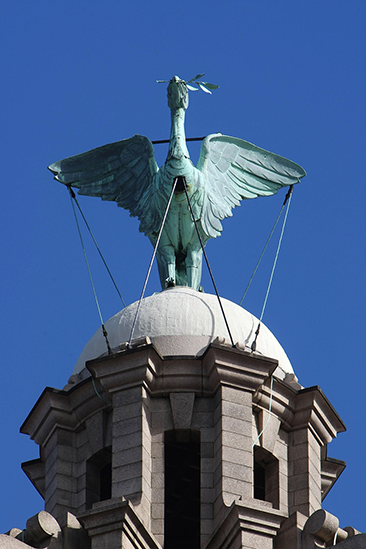
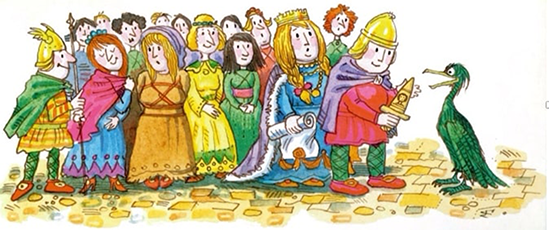
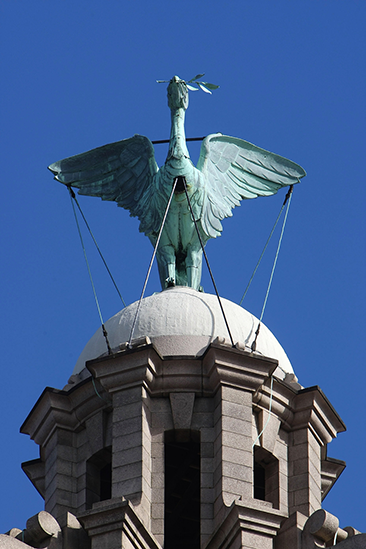
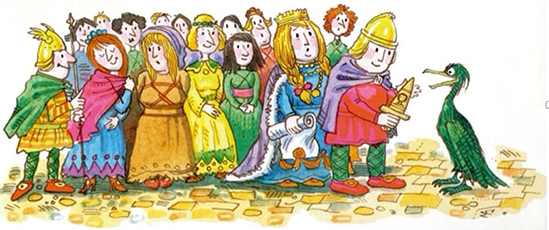
I am not a Londoner. I have been fortunate to work for thirty years in central London, a stone’s throw from the Thames, where if you walk down to the Embankment you can see cormorants perched on mooring posts or flying low along the river. But I first saw these birds across a different river. I was born not in London but in Liverpool, meaning that the first cormorants I encountered as a child were most probably the green-patinated copper pair that stand atop the towers of Liverpool’s most celebrated riverfront edifice, the Liver Building (Figure I.4) – and that feature also on the badge of the rich red shirt of my football team, Liverpool FC. The Liver Bird (pronounced ‘lie-vuh’) is a mythical creature with some of the qualities of phoenix, eagle and dove, but it is very clearly at core a cormorant.12 Thus the bird was for me as a child a positive creature, the symbol of my city – and there was further positive representation when I was small in the form of Graculus, wise counsellor to Noggin the Nog in the gentle children’s animation of that name, a benign talking cormorant (or possibly a shag) (Figure I.5).
Far more frequently across time and geography, though, the cormorant has been treated as a harbinger of doom. Its habit of destroying stands of trees by nesting in them turns out not, culturally speaking, to be its worst fault. Over time it has primarily been a touchstone not for the destruction of trees but for the all-encompassing sin of greed, for a kind of extreme ruthless natural capitalism in its efficient predation of fish. The cormorant is the sea-crow, bird of ill omen, shot at on church roofs or over fish farms; it is one embodiment of the vampire; it is the ‘bête noire’, the ‘black beast’, the ‘fish terrorist’ of anglers’ nightmares, allegedly consuming multiples of its own weight in precious fish, the ‘black pig of the fish farms’, where it is loathed and dissuaded from its natural desire to eat fish, often by the most direct method: shooting.
The history of the cormorant is a history of greed.
Yet this allegedly greedy bird has far more often, as Shakespeare’s Falstaff might have phrased it, been the cause of greed in others – that is, in human beings. Which makes this history of greed a history not of the greed of the cormorant but of the greed of humankind. Humans have harnessed the bird and capitalised on it by way both of the artificially constricted throat of the fishing cormorant of Japan and China and of the unconstricted anus that created the guano islands of Peru. Yet despite the value the bird has had in these contexts for humankind, human beings have for the most part hated the cormorant and feared the cormorant and killed the cormorant. This process is one, in part, of displacement. The Liver Birds atop Liverpool’s proud waterfront may proclaim the past prosperity of the city, but they also serve as a reminder that that prosperity derived from the city’s role as the European capital of the Atlantic slave trade, a local history that precisely nobody taught me when I was at school.13 The epicentre of the Liverpool slave trade was the Canning graving docks, located near where the grand buildings known as The Three Graces now stand – one of which is the Liver Building with its copper cormorants – and the racism and oppression that facilitated the slave trade are, needless to say, in so many ways still with us, infecting our relations not only with other humans but also with the natural world. The Peruvian guano trade – a globally transformative trade that, as it happens, was kickstarted in Liverpool – was an oblique after-effect of the slave trade: Atlantic slave ships were repurposed to transport Chinese indentured labourers to dig cormorant guano in unspeakable conditions. (I will address this in Chapter 3.) The conjunction of the cormorant, of human discourses of prejudice and of the history of slavery can most immediately – and most painfully – be seen in the local name given to the cormorant (the double-crested cormorant, that is) in the southern United States, where the bird is loathed by those involved both in the angling economy and in the fish-farm industry. There, some people call it the ‘[n-slur] goose’. As this suggests, the symbolic system human beings have created for the cormorant drags the bird into the histories of racism, xenophobia, migration and invasion that seem an inevitable hallmark of human culture. (I will address this in Chapters 4 and 5.) The forms of expression of that symbolic system may vary across time, place and context, but the system itself has proved remarkably persistent, meaning that the cormorant has for a very long time been both the object of prejudice and the vehicle for prejudice. It is still both.
The history of the cormorant is a history of prejudice.
Over recent decades, the cormorant has been shot and suffocated and its eggs oiled and its nests destroyed. It has been treated as an invader, an interloper, a foreigner, an intruder into someone’s Eden. It is not welcome. Persecution led to the total extinction of this native bird in Denmark between the 1870s and 1938; its successful return to that country and its shores, fjords and lakes has been treated by many of those involved in the fishing industry – both commercial fishing and angling – as an invasion.14 For one prominent Swedish cormorant antagonist, as for many Americans involved in the fishing industry, the birds should simply, as an (alleged) invasive species, be exterminated all over again. (I will address the issue of invasiveness in Chapter 4.)
What can a bird tell us about prejudice? In the case of the cormorant, a very great deal.
Cormorants and prejudice, then, are the subject matter of this book. I reflect on the ways in which human beings have imagined cormorants and how they have written about them and about what these imaginings, these writings, have done to cormorants and what they have done in turn to human beings. The cultural history of the cormorant serves as a case study in the history of two connected phenomena: one, the persistent interweaving of cultural and scientific forms of knowledge about the natural world and, two, the ways in which prejudicial discourse bleeds across the so-called human/animal divide. In the twenty-first century, we tend to believe we have moved a long way from the symbolic understanding of animals characteristic of earlier eras to a sophisticated, objective understanding of the natural world based on science. But scientific objectivity can so easily slip. The Oxford English Dictionary rightly prides itself on its precise, neutral definitions, yet its primary definition of the cormorant is ‘A large and voracious sea-bird’. ‘Voracious’ does not seem so very neutral. Contemporary animal-related debates – the most obvious instance being conflicts over the reintroduction of wolves to places where they were once indigenous – underline the extent to which socio-cultural and scientific understandings of natural phenomena can radically diverge. Moreover, prejudice against nonhuman animals and against certain human beings intersects, not least through the broader cultural resonances of terms routinely deployed without, as it were, prejudice in natural science – ‘native’, ‘invasive’, ‘migration’, ‘diversity’, colony’ – and these intersections function in ways that have direct ramifications both for humans and for nonhumans. The chapters of this book trace a series of interconnected narrative threads in the cultural history of the cormorant, each both embedding the book’s arguments in specific times and places and referencing the overarching framework of the conjunction of prejudice and human–animal relations.
The history of the cormorant demonstrates how human discourses of prejudice extend to animals, the persistence of these discursive displacements and the variations in form they acquire across time and cultures. The bird’s blackness, its prehistoric appearance and its natural ability as an efficient predator of fish have for millennia opened it up to a broad range of negative associations. It has been consistently defined by its greed – its ‘voraciousness’, to use the OED’s word – and where it is indigenous, which is across a great deal of the world, the cormorant is nonetheless typically treated as a ‘foreign’ migrant, eating fish to which it is not entitled. Its alleged greed led to a historical association with usury and thus, in the medieval and early modern mindset, with Jews, a pattern of thought underpinned by the bird’s imposed identity as a wanderer, a migrant. The word ‘cormorant’ was for centuries deployed specifically as an anti-Semitic epithet. If you were a ‘money-cormorant’ in Shakespeare’s day, you were a grasping banker or landlord and, explicitly or implicitly, Jewish. (I will address this in Chapter 2.) In the twenty-first century, long after this anti-Semitic association between Jews and cormorants has faded from cultural memory, the contexts for understanding cormorant–human relations include contemporary expressions of racism, nationalism and Islamophobia, ranging from anti-immigration rhetoric to the language of loathing of the European Union. My aim in this book is to address the seepages between tenor and vehicle – that is, between what the bird is made to stand for and the bird itself – showing that the process of making a nonhuman animal symbolic is not one-way but rather works back and forth across the metaphoric borderline, affecting both humans and the animal (or bird) itself.
Might there be ramifications for science in this work? I believe so. If you look at the contents page of a recent European Union document reporting on measures to address ‘the cormorant conflict’, you will see that there is a brief introduction, a chapter on the impact of cormorants on inland fisheries resources, a chapter on actions being taken to ‘resolve’ (a coyly bureaucratic word choice) the impact of fish-eating birds on fish stocks, and recommendations for a management strategy (another quintessential bureaucratic turn of phrase).15 This is all entirely logical and sensible. It is measured, it reports on the concerns of the fishing industry, it reports on the concerns of conservationists, and it seeks a negotiated outcome. At no point, though, does it address cultural issues. The INTERCAFE project, by contrast, did so, as I have noted, but the definition of ‘culture’ in its reports remains relatively narrow, technical and local – addressing the economic and social situation of the immediate area under discussion in the here and now rather than any sense of the impact of historical understandings of the cormorant on its current cultural status and thus on the ways in which conflict between human beings and birds is expressed. I argue that understanding the cultural cormorant necessarily requires a far longer perspective, along with a recognition of the way discourse in the focal area – that of cormorant conflicts in specific locations – bleeds into and is, to a greater or lesser degree, engaged with other, broader cultural issues. I would also suggest that the case of the cormorant demonstrates that cultural understandings of nonhuman animals at times affect science in very direct ways – that not only popular but scientific understandings of natural phenomena can themselves be more indebted to culture than might be apparent. (I will return to this in the Conclusion.)
Global conflict over cormorants is at least as cultural as it is economic, and over time the way human beings have represented cormorants has to a significant extent determined how human beings treat these birds in the present. The following is from a brief news article of 2010:
A group of cormorants has abused Swiss hospitality by eating too many fish, forcing authorities to approve measures aimed at kicking out the unwanted migrants. The coastal natives used to come to Switzerland on a sporadic basis to escape harsher winters further north, but since 2001, some 260 cormorant couples have nested on two islands on Lake Neuchatel. While their permanent residence at the country’s biggest natural bird reserve had been greeted with enthusiasm by bird-lovers, their appetite for fish from the lake has provoked the ire of fishermen. To control the population of cormorants, local authorities can now close off access to part of the lake’s shoreline, and ‘remove the residual nests from the previous season’.
It is impossible to read this report about cormorant migration and not see the parallels with the contemporary rhetoric of resistance to human migration, not least because the journalist is consciously having verbal fun with those parallels. ‘A group of cormorants has abused Swiss hospitality’, he reports wryly, and then he writes about the authorities ‘kicking out the unwanted migrants’. This is pejorative language familiar from contemporary debates over human immigration, over freedom of movement between countries, over asylum seeking and economic migration, language that, for anyone living in Great Britain today, is familiar from the history of debates over ‘Brexit’, the departure of the United Kingdom from the European Union – the language of those who prefer ‘sovereignty’ to ‘mobility’. The problem, of course, is that concepts such as borders and the ‘nation-state’ mean precisely nothing to birds.
I.4 Sympathy for the Devil
It is important to reiterate that the cormorant is not loathed absolutely everywhere in the world. It has, at different times and in different places, been appreciated, even loved. The Norwegian folktale ‘The Cormorants of Utrøst’ is the story is of a poor fisherman called Isak who gets caught in a fierce storm and, just as he is ready to give up the fight, sees ‘three cormorants sitting on a floating log’ and finds himself ashore. He has landed on a beautiful island where ‘[h]ills and mountains were green all the way up to the top, fields and meadows sloped up to them, and flowers and grass seemed to have a sweeter fragrance than he had ever noticed before’.16 Isak realises this is Utrøst – an Atlantis-like island that notionally lies beyond (‘ud’ or ‘ut’ means ‘outside’ in Scandinavian languages) Rust, the outermost islands of the Lofoten chain in northern Norway – and he follows a path to a hut where there ‘sat a little, blue-clad fellow, sucking on a briar pipe’, who welcomes him by name (58). ‘I dare say you’d like me to put you up for the night,’ he says, to which Isak replies that if that were possible, he would be very grateful. There is just one problem, the old fellow adds:
‘The trouble is with my sons, they can’t stand the smell of a Christian man,’ said the old fellow. ‘Haven’t you met them?’
‘No, all I met was three cormorants, sitting and shrieking on a floating log.’
‘Well, those were my sons,’ said the old fellow. Then he knocked the ashes out of his pipe and said to Isak, ‘You’d better come in for the time being. I imagine you must be both hungry and thirsty.’
‘Much obliged, father,’ said Isak.
They step into the hut, where there is a table ‘decked with the tastiest dishes’, and Isak ‘ate and drank as much as he was able, and still the plate was never empty and the glass was just as full’ (58). But then they hear ‘a shrieking and a rattling outside the door’, and the old fellow goes out and comes back in ‘with his three sons’, the cormorants. ‘Isak started a little when they came in the door,’ we are told, but he could see that ‘the old fellow had probably managed to calm them down, for they were quite gentle and good-natured’ (59). Isak begins to get up from the table, but the cormorants tell him ‘to mind his manners and remain seated and drink with them’ (59), which he does, and soon they all become friends. They go on fishing trips together – the cormorant sons prove to be superb fishermen – and they give Isak a large quantity of fish to take home with him; they also present him with a brand new fishing boat filled with provisions, and the old fellow says he will guide him to Bergen. Isak asks ‘which course to follow when he wanted to come back to Utrøst again’, to which the fellow says, ‘Straight behind the cormorants, when they head out to sea. Then you’re on the right course!’ (59–60). Isak takes his catch to Bergen and sells it, and just before he sails for home the old fellow comes aboard, foretelling ‘both good fortune and prosperity for Isak’. ‘From that time’, the tale concludes, ‘Isak always had good fortune’ (60). The tale marks, very belatedly, the transition from paganism to Christianity. The cormorants are ambiguous: they ‘shriek’ and ‘rattle’, they are reluctant to meet Isak – their father unsettlingly notes that ‘they can’t stand the smell of a Christian man’ – and they need calming down before they do so. Yet they turn out to be ‘gentle and good-natured’, they befriend Isak and help him restore his fortunes, and the tale concludes with Isak’s awareness that he owes his continued good luck to the inhabitants of Utrøst. Any encounter with huldre (elven) beings in Nordic tales tends to be unsettling, no matter how positive the outcome, and ‘The Cormorants from Utrøst’ is very much a product of its genre in this respect, but what stands out is the inversion the tale effects – partial and ambiguous, but an inversion nonetheless – of the ominousness normally attributed to cormorants in Western culture.
It is not in Europe, however, but in China and Japan where the cormorant has been most fully appreciated and where the divide between cormorants and human beings seems to be at its narrowest. Chinese folklore claims that if a woman holds a cormorant immediately before childbirth, the pain of labour will be reduced.17 For millennia the bird has been a cherished companion species for Chinese and Japanese fishermen – it still is, if only for the most part in the form of displays for tourists – and it has evoked in writers a sense of identity and of pity. One of the best known of all haikus is that of Kobayashi Issa, one of the ‘Great Four’ haiku masters of Japan, writing in the late eighteenth and early nineteenth century:
Wonderful? Cormorants? This would, to say the least, surprise the principals in contemporary Western cormorant–fisheries conflicts. Another of the ‘Great Four’, Matsuo Basho, wrote a haiku after watching ukai, the practice of cormorant fishing:
This poem, like all the great haikus, has been the subject of much cumulative commentary over time. Moro Nanimaru understood this particular poem in the following way: ‘The poet had been watching the scene with excitement, until he saw the cormorants being forced to regurgitate the trout. Now the excitement was all gone. Struck by the sadness of the scene, he wondered if any living creature would be glad to lose its life.’18 In this reading, the poet’s empathy is drawn specifically to the birds because of the essential frustration of their working lives. A haiku by the eighteenth-century poet Yosa Buson, on the other hand, shifts the source of empathy from the bird to the fish the cormorants catch:
This empathy with the cormorant’s prey is central to the Noh play Ukai (‘Cormorant Fishing’), written by Enami No Sayemon around 1400 CE. Noh is a heavily codified and stylised dance-based theatrical form, originating in the fourteenth century, that demands intense training for its actors; it is the oldest major performance art staged with regularity anywhere in the world. Its plots typically involve people in ordinary forms of employment interacting with supernatural beings. In Ukai, a fisherman (Figure I.6) reflects on his profession: ‘[T]his bird-fishing, / Cruel though it be in the wanton taking of life away, / Is a pleasant trade to ply / Afloat on summer streams.’19 The cruelty, though, makes him fretful: ‘when the torches on the boats burn low, / Then, in the dreadful darkness comes repentance / Of the crime that is my trade.’ Two priests on pilgrimage encounter the fisherman. They reprove him for his trade and tell him to find another, and then one of them recalls that, years earlier, he had met a cormorant fisherman whom he had also told to find another trade, yet the man had lodged him ‘with uncommon care’. The fisherman explains that he is in fact the ghost of that earlier fisherman, killed by his neighbours for secretly practising the trade of cormorant-fishing, which was illegal at the time. He acts out the fishing process, sending the cormorants down by torchlight to catch the ayu (sweetfish) and reflecting on both the pleasure and the savagery of the trade:
The play ends as the priest writes prayers for the fisherman on pebbles and casts them into the river, and Yama, King of Hell, appears and announces that, despite his sins, the fisherman will go to heaven (‘Buddha’s Place’) ‘because he once gave lodging to a priest’. What remains in the audience’s mind is not only the reciprocal kindness shown by and to the fisherman but also the empathy expressed for the fish that are the cormorant’s prey.

Empathy across the so-called human/animal divide, expressing Buddhist principles, drives engagement with cormorants both in Japanese poetry and in theatre – empathy either with the fish the bird catches or with the bird itself. Arthur Waley cites a song (two near-identical songs, in fact) from the twelfth-century Ryōjin Hisshō anthology as the seed from which the Noh play Ukai grew:
In medieval Japanese culture, human beings pay a heavy price for their domination of the natural world. Empathy for the cormorant is equally apparent in Chinese poetic tradition too. ‘Like a Cormorant’ is a poem by the eleventh-century Chinese poet Su Tung-Po in which the emotional parallel between bird and human is made very clear:
The cormorant stands still, thinking, all alone at the river’s edge. his staring eye follows the changing waters.
when strollers come too close to him, balancing his long neck he flaps away, waiting in the tall reeds till the intruders pass … wishing to stare again at the undulations of the stream.
and at dusk, when the moon is rippling on the waves, the cormorant still stands, thinking, with one foot in the current … just so a man, his heart burning with passion, stares at the undulations of his dream.21
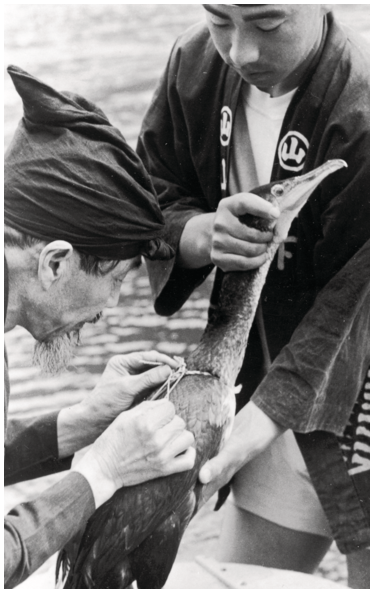
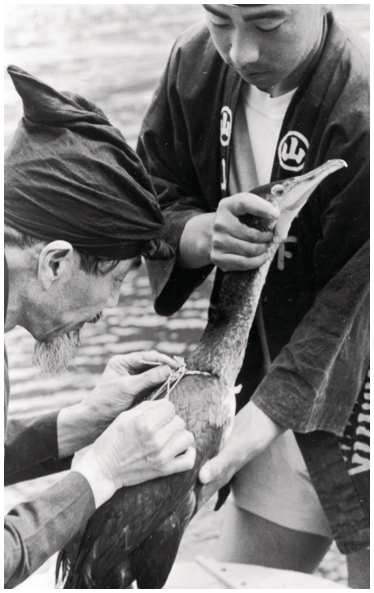
The cormorant here – a thinking animal – shares the natural dreams and desires of human beings. The bird is clearly not the same as a human being, but it is not entirely other – a very different way of understanding the cormorant from that so firmly entrenched in Western writing. At the same time (I will return to this in Chapter 5) we need to be aware that the predatory capacities of the cormorant have been harnessed to great effect by human beings over millennia in Japan and China – harnessed most visibly in the form of the fishing cormorant’s neck-collar (Figure I.7) – and that this has very clearly not been to the bird’s advantage.
I.5 Science and Culture
In the twenty-first century, we – by which I mean those of us who inhabit technocratic liberal-capitalist cultures – appear happy with the narrative of progress in the understanding of nonhuman animals from symbol to science, an intellectual development that historians of science have traced particularly across the eighteenth and nineteenth centuries. We understand that they in the past, particularly the classical and medieval past, had a mythic or symbolic understanding of the natural world and that we in the present have moved beyond this to a scientific understanding, one that might often be simplified for non-specialists but is fundamentally modern nonetheless. We observe and record, viewing the natural world coolly and objectively, whereas they absorbed tales and legends, viewed nature analogically, accepted the myths and the allegories, failing to perform what we would call observation. Not only is this a highly limited reading of cultures of the past; it also offers a clear danger for the present – that of complacency, of a happy but naïve belief that zoological science has not only triumphed over but wholly replaced the symbolic field, an assumption that seems wilfully to overlook the many intersections of science and culture and, in the process, the persistence of a set of long-standing perceptual attitudes towards certain animals, attitudes that continue – sometimes explicitly, often under the radar – to influence how humans interact with those animals. Wolves are the most obvious current instance of this. The fascination, the appeal, they hold for us is not notably scientific, and the resistance to their reintroduction in certain parts of Europe is far more a product of the animal’s long cultural history than it is of contemporary science. If certain attitudes, certain social phenomena, are to be understood, then culture requires our attention just as much as does science.
Animal rights activists and academics working in the field of animal studies alike vehemently resist the idea of a human/animal binary, seeing instead a continuum of sentient beings in the world. My interest in this book is in certain prejudicial discourses that work hard to resist this displacement of binaries, not least by establishing alternative binaries within the world of nonhuman animals. Pastoureau notes that the bear ‘takes on its full meaning only insofar as it is connected with or opposed to one or more other animals’ (6), and it is not alone in this regard. My primary case study in this book is a bird that is, as I have made clear, pretty much nobody’s favourite – black, ugly, unapproachable – and at the same time it is a bird that, historically, has not in fact stood alone, one whose meaning in culture has been substantially established through a particular binary relationship. It is impossible, I have found, fully to understand the natural and cultural history of the cormorant without also bringing into the story its ostensibly benign polar opposite or twin, the pelican – a bird that is perceived culturally as much more acceptable, imagined as white, sociable, nurturing and selfless. (Readers who recall the ungrateful ‘pelican daughters’ of Shakespeare’s King Lear may wonder about this; I will explain in Chapter 2.) As will by now be clear – I hope uncomfortably so – the binary black/white is a necessarily central concept in this book, with all of the profound challenges of the symbolic history of race and racism that it invokes, not least because one of the most apparent connecting factors throughout the history I will tell is that the cultural cormorant (unlike the zoological cormorant) is invariably uniformly black and the cultural pelican is invariably uniformly white (unlike, again, the zoological pelican). Moreover, pelicans seem to have been comparatively easy to anthropomorphise across time. By contrast, and in the teeth of the questioning of the human/animal divide in contemporary culture, cormorants seem almost impeccably to embody the concept of the unthinking, unfeeling animal. They fly arrow-straight. They are wholly targeted. They exist to consume. They are oblivious of humanity; they ignore us if they possibly can. They eat and they shit and they reproduce. They are, in this sense, quintessential beast. Unfortunately for them, they are, as a consequence, culturally constructed from what French speakers call our bêtises, our beast-like stupidities, meaning that the zoological bird has been reinvented culturally through a discursive assemblage – that is, by way of a set of connected idea-driven expressions determining how we think about things – made up of many of humanity’s least appealing habits and tendencies. It is hardly surprising that such associations have both taken attitudes to the cormorant into politically fraught territory and had a significant negative impact on the cormorant’s existence in the world. The pelican, by contrast, is the subject of a myth sustained across time that associates it with self-sacrificial generosity. The pelican is Christ. The cormorant is Satan. (I will address this in Chapters 1 and 2.) Fascinatingly, this apparently theologically driven pairing impinges also upon science. Culture’s insistence on the closeness of the relationship between cormorant and pelican pre-empted by many centuries the grouping of both birds under the heading Pelecaniformes by Carl Linnaeus, the originator of modern taxonomy. Culture, it seems, had long understood what science would eventually acknowledge. Yet there is a twist. Equally fascinatingly, it seems now – long after the cultural connection between the two species has faded from memory – that these birds are not, after all, so closely related, zoologically speaking. Might culture have informed – or, as it turns out, misinformed – science? (I will return to this in the Conclusion.)
In human culture, the cormorant has long been a touchstone for prejudice. Human–cormorant interactions seem always in one way or another to invoke or provoke expressions of prejudice, sometimes directed at the bird, sometimes directed at human beings by way of the bird, often directed, consciously or unconsciously, at a combination of the two. And sometimes the cormorant is a pivot for prejudicial discourse that functions in a way that is quite oblique to the bird itself. In this book I will explore each touchstone variation, from direct loathing of the cormorant by some of those involved in the fishing industry, via the symbolic meanings given to the bird in medieval and early modern times, to the racist exploitation of and violence against a particular category of human that characterised the nineteenth-century guano industry. It is worth noting, too, that not everyone beyond Japan and China hates the cormorant. On the contrary, much of the vehemence of cormorant–fisheries conflicts comes from the force – the not always empathetic force – with which the bird’s defenders make their case. In recent times, the cormorant seems to have begun the journey right across the cultural line from evil perpetrator to innocent victim, the latter emerging for the first time during the First Gulf War of 1990–1, when the image of an oiled cormorant dead on a beach became a symbol of the environmental catastrophe attendant on the fighting. In the process it became a key image for Jean Baudrillard’s book The Gulf War Did Not Take Place (a title that was inevitably misread as a literal, and thus absurd, claim), in which he argued that the war presented to the world by the media was a very different event from that experienced by those involved in the fighting. Why was the image of a dead cormorant significant? Because it was used as propaganda by both sides, each blaming the other both for the oil spillage that had caused the bird’s death and, by extension, for the conflict as a whole. It became a symbol not only for humanity’s impact on the environment but also for the media simulacrum that was all the world could know about the war – a surprisingly postmodern role for such a prehistoric bird. Since that time, the image of an oiled cormorant has become a staple of news stories addressing ecological catastrophes, and the bird is as likely now to surface in poems lamenting the degradation of the environment as it is in those seeking a natural image of evil. (I will discuss this in Chapter 6.)
The cultural cormorant has been constructed over centuries as a means to negotiate the zoological bird – very occasionally positively, celebrating its identity as a native bird that is representative of a given locale, but overwhelmingly negatively as the avian embodiment of evil and greed. This cultural imposition – the evil cormorant – has resulted in the bird being compared with a constantly changing, extraordinarily inconsistent set of contradictory human comparisons, each of which, through the claim of likeness, is detrimental not only to the bird but also to humanity. The cormorant has at different times and places been Satan, a Nazi, a terrorist, and it has been a Jew, an African American, a Muslim. The contradictions of these ‘likenesses’ are as destructive as they are perverse, yet they are all somehow encompassed in the cultural history of this bird. The history of the cormorant shows both the precision and the indiscrimination of prejudice. It shows how cultural memory and cultural amnesia each function in discourses of prejudice across time. And it shows that prejudice directed at a nonhuman animal is always also prejudice directed at human beings. For all that, in this age of environmental awareness, there are signs that the cormorant is beginning to undergo cultural rehabilitation, it remains the case that what human beings still see in this bird, what we continue to see this bird as being like, suggests that we have a long way to go before we have truly outstripped the Miltonic inheritance and freed the bird – along with ourselves – from the dead weight of the history of prejudice.