


Introduction
This paper considers differential perspectives on food insecurity using critical theory, specifically Habermas’s distinction between the lifeworld and the system. Within the academy, the political and ethical implications of food insecurity have been considered largely in relation to food banks and, concomitantly, have been assessed through three inter-related critical frameworks: neoliberal political economy (Poppendieck Reference Poppendieck1999; Riches Reference Riches2002; Tarasuk and Eakin Reference Tarasuk and Eakin2003; Power et al. Reference Power, Doherty, Small, Teasdale and Pickett2017a); food insecurity (Dowler and O’Connor Reference Dowler and O’Connor2012; Baglioni et al. Reference Baglioni, De Pieri and Tallarico2017) and, more recently, economies of care (Cloke et al. Reference Cloke, May and Williams2017; Lambie-Mumford Reference Lambie-Mumford2017). Public accounts of the relationships between food banks and service users have centred on either the authenticity of need (Wells and Caraher Reference Wells and Caraher2014) or the shame and stigma experienced by service users in the food bank encounter (van der Horst et al. Reference van der Horst, Stefano and Wilma2014; Purdam et al. Reference Purdam, Garratt and Esmail2016; Garthwaite Reference Garthwaite2016).
Academic literature on UK food aid and food insecurity is growing quickly but remains limited, largely restricted to the operational procedures, scale and lived experience of ‘clients’Footnote 1 in Trussell Trust foodbanksFootnote 2—Britain’s largest, most professionalised food bank franchise. The scope, performance and political positioning of food insecurity service providers other than Trussell Trust foodbanks, as well as the role of public health professionals in the governance and provision of food aid, have been relatively neglected. Likewise, minimal attention has been allocated to the experiences of those who, despite food insufficiency, do not access formalised food charity or who seek food charity other than Trussell Trust foodbanks.
We adopt a novel critical lens to consider the tensions inherent within contemporary UK food insecurity. We address the question, ‘how can a Habermasian framework assist an understanding of food aid and food insecurity?’ Drawing on interviews and focus groups conducted over 2 years with both food insecurity service providers and women in or at risk of food insecurity (service users), we present conflicting perspectives on food insecurity informed by, on the one hand, neoliberal political economy and instrumental rationality and, on the other, the lived experience of food in the context of poverty. Situating divergent subjectivities within a Habermasian framework, we underscore the cleavages between system rationalities of service providers and the experiential nature of lay knowledge, arguing that, amongst service users and ‘the poor’ this discursive difference precipitates individual and collective disempowerment and a corrosive sense of shame.
Dominant Models of Food Banking in the UK
The conspicuous expansion and contested politics of food banks in North America, since the early 1980s, have become iconic of both escalating inequality and the deleterious effects of recent austerity and globalisation (Poppendieck Reference Poppendieck1999; Sommerfeld and Reisch Reference Sommerfeld and Reisch2003; Riches Reference Riches2011). Theoretical perspectives on food banking in North American scholarship, which tend to situate food banks within wider economic and political shifts (Poppendieck Reference Poppendieck, Riches and Silvasti2014; Fisher Reference Fisher2017), have closely informed the character of academic literature on food banking in the UK. The two predominant theoretical approaches in North American and, increasingly, UK scholarship are termed by Cloke et al. (Reference Cloke, May and Williams2017) ‘food insecurity’ and ‘neoliberal political economy’. According to the former perspective, food should be considered a human right rather than a charitable responsibility (Dowler Reference Dowler2002). The development of food charity in the UK is in danger of replicating that of food banks in North America, in which a temporary response to contemporary food insecurity has become accepted and institutionalised as a permanent ‘solution’ to a phenomenon which, without advocacy and political engagement to address underlying inequalities, cannot be solved. In mirroring this history, food banks in the UK not only dissemble the nature and extent of the food insecurity ‘problem’ (Poppendieck Reference Poppendieck1999), diverting attention away from the state’s duty to provide an adequate safety net for its citizens, but also further the ‘anti-hunger industrial complex’ (Fisher Reference Fisher2017, p. 8). Corporate philanthropy allows for the continuation, if not expansion, of food charity while simultaneously producing both positive public relations and reduced costs of food waste disposal for food corporations, themselves engaged in systems of inequality and low pay (Fisher Reference Fisher2017).
The second perspective—neoliberal political economy—is intertwined with the first. Food banks are consequent upon, and embody, neoliberal economic and political shifts (Lambie-Mumford Reference Lambie-Mumford2017). As such, they are allied to the wider neoliberalisation of the economy and welfare (Cloke et al. Reference Cloke, May and Williams2017), characterised by punitive social security reforms (O’Hara Reference O’Hara2015), the professionalisation and institutionalisation of the voluntary sector (Nicholls and Teasdale Reference Nicholls and Teasdale2017) and the associated replacement of established models of welfare provision with free-market fundamentalism that normalises individualism. Cloke et al. (Reference Cloke, May and Williams2017) suggest that, given the close association of food banks (in both the UK and internationally) with faith-based organisations (Poppendieck Reference Poppendieck1999; Power et al. Reference Power, Doherty, Small, Teasdale and Pickett2017a), food charity may also be interpreted as an essential part of ‘religious neoliberalism’ (Hackworth Reference Hackworth2012), in which ‘a political mobilisation of individualistic, anti-state and pro-religious interests serves to promote an ideational platform fuelled by the apparent rationality of replacing collectivist state welfare with religiously delivered charity’ (Cloke et al. Reference Cloke, May and Williams2017, p. 706).
Some recent UK scholarship on food banking has presented an alternative to the above critical frameworks, depicting food banks as potential sites of morality, social solidarity and care (Williams et al. Reference Williams, Cloke, May and Goodwin2016; Cloke et al. Reference Cloke, May and Williams2017; Lambie-Mumford Reference Lambie-Mumford2017). Food charity represents an embodiment and performance of morality, with provision underpinned by moral imperatives (Lambie-Mumford Reference Lambie-Mumford2017), both secular and religious (Power et al. Reference Power, Small, Doherty, Stewart-Knox and Pickett2017b). Food banks may, thus, function as ‘ambivalent spaces of care’ (Cloke et al. Reference Cloke, May and Williams2017), in which people of different classes, ethnicities, genders and histories share a single encounter. In the performance of care within the ‘liminal space’ of the food bank exists the potential for collectively formed new political and ethical beliefs and identities that challenge neoliberal austerity (Cloke et al. Reference Cloke, May and Williams2017).
The heterogeneity of food aid, of which food banks are just one type, as well as the diverse character and operational procedures of food banks themselves (Power et al. Reference Power, Doherty, Small, Teasdale and Pickett2017a), precludes a singular analysis of the recent history of UK food charity. Food banks—which have dominated political and academic discourse on UK food charity since 2010 (Wells and Caraher Reference Wells and Caraher2014)—are commonly defined as charitable initiatives that provide emergency parcels of food for people to take away, prepare and eat (Lambie-Mumford and Dowler Reference Lambie-Mumford and Dowler2014). While the Trussell Trust remains the largest food bank provider, with roughly 1235 food bank distribution centres connected to 427 foodbanks, there are over 700 independent food banks also operating in the UK (The Trussell Trust 2017). In addition, there is a multiplicity of other types of initiative—soup kitchens, community cafes, social food charities, community supermarkets and community gardens—also responding to the ‘problem’ of food insecurity. Reflecting such breadth and heterogeneity, the Department for the Environment, Food and Rural Affairs (Defra) defines ‘food aid’ as ‘an umbrella term encompassing a range of large-scale and small local activities aiming to help people meet food needs, often on a short-term basis during crises of immediate difficulty’ (Lambie-Mumford et al. Reference Lambie-Mumford, Crossley, Jensen, Verbeke and Dowler2014, p. 15).
Characteristics and Constructions of the ‘Food Poor’ and Their Relationship with Food Banks
Given the close relationship between food charity and household- or individual-level food insecurity, a discussion of the character and politics of food aid must necessarily be entwined with a consideration of food insecurity more generally. Attempts to associate the two within a single framework are, however, complicated by the absence of a precise, widely accepted definition of the food insecurity ‘problem’. Following Lambie-Mumford (Reference Lambie-Mumford2017), this paper adopts the definition of food insecurity developed by Anderson (Reference Anderson1990, p. 1560):
[Food security is] Access by all people at all times to enough food for an active, healthy life and includes at a minimum a) the ready availability of nutritionally adequate and safe foods, and b) the assured ability to acquire acceptable foods in socially acceptable ways…Food insecurity exists whenever the availability of nutritionally adequate and safe foods or the ability to acquire safe foods in socially acceptable ways is limited or uncertain.
This definition surpasses conceptualisations of food insecurity as a nutritional or physiological question, emphasising the social and cultural components of food and food experiences.
Public accounts of the relationship between food banks and service users centre on bipolar axes, the authenticity and validity of the food need itself; and the stigma and shame experienced by service users. As food bank use in the UK has risen, Government ministers’ responses have shifted from celebrating food banks as leading examples of the ‘Big Society’ to characterising individuals as responsible for their food insecurity, with a specific focus on poor financial management and faulty behavioural practices (Garthwaite Reference Garthwaite2016). Accompanying this rhetoric—and intimately associated with the post-2010 welfare reform agenda—is a distinct deepening of personal responsibility (Patrick Reference Patrick2012). As responsibility for welfare has shifted from the state to individual citizens, notions of ‘dependency’ have been denigrated while ideas of ‘active citizenship’ valorised (Kisby Reference Kisby2010). Framed as a ‘problem’ of moral contagion, the shifting threat of welfare dependency has proven instrumental to the political crafting of welfare austerity (Jensen and Tyler Reference Jensen and Tyler2015), which has been presented as a necessary step towards both restoring economic productivity and reforming the welfare subject’s character (Edmiston Reference Edmiston2017). The welfare reform programme is, thus, situated within a justificatory programme of neoliberal paternalism (Whitworth Reference Whitworth2016), which functions to problematise the motivations and behaviours of ‘poor citizens’ while valorising the subjectivity of those deemed as ‘overwhelmingly self-sufficient’ and ‘financially independent’ (Edmiston Reference Edmiston2017, p. 317).
The above perspective conflicts sharply with alternative accounts of the relationship between food banks and service users, prominent in the academic literature. It is well established that accessing food aid can be a degrading experience. Receiving food assistance forces an individual to abandon both embodied dispositions towards food and norms about obtaining food (van der Horst et al. Reference van der Horst, Stefano and Wilma2014), while placing the receiver in interactions of charitable giving which may be harmful to their self-esteem (van der Horst et al. Reference van der Horst, Stefano and Wilma2014). The implicit social rules governing interactions within the food bank inform the emotions ‘appropriate’ to the situation (Turner and Stets Reference Turner and Stets2005), with gratitude and shame constructed within the food bank as appropriate emotions [van der Horst et al. Reference van der Horst, Stefano and Wilma2014 (see also Tarasuk and Eakin Reference Tarasuk and Eakin2003)].
Outside the Food Bank: The Lived Experience of Food Insecurity
Beyond the work of Dowler (Dowler et al. Reference Dowler, Turner and Dobson2001; Dowler and Caraher Reference Dowler and Caraher2003), UK-based literature on the lived experience of food insecurity itself is very limited and, therefore, this section is largely informed by international scholarship.
Food insecure households exhibit a wide range of coping techniques apposite to their level of vulnerability (Ruel et al. Reference Ruel, Garrett, Hawkes and Cohen2010), including food and non-food based strategies (Farzana et al. Reference Farzana, Rahman, Sultana, Raihan, Haque, Waid and Ahmed2017). Food insecure households may reduce the quality and/or quantity of food consumed (Pfeiffer et al. Reference Pfeiffer, Ritter and Hirseland2011), adopt careful budgeting strategies for food and other households items and utilities (Huisken et al. Reference Huisken, Orr and Tarasuk2017), draw upon credit and loans, and sell possessions (Perry et al. Reference Perry, Martin, Sefton and Haddad2014). Social networks, including friends, neighbours and, particularly, families may be used for social and nutritional support (Pfeiffer et al. Reference Pfeiffer, Ritter and Hirseland2011; Chhabra et al. Reference Chhabra, Falciglia and Lee2014). The assistance provided by social networks includes immediate food aid, information about food preparation or sources of food, and emotional support. However, the tendency or ability to seek support from social networks may vary by demography. Parents describe reliance on others as ‘stressful and often threatening’ (Ahluwalia et al. Reference Ahluwalia, Dodds and Baligh1998, p. 599), while African American respondents are more likely than other ethnic groups to depend upon formal support systems due to the high levels of poverty amongst their own social networks.
The System and the Lifeworld
It is evident from the case we have made thus far that food insecurity and the provision of food aid engage with issues that fall within the remit of political and economic systems, and yet they also impact on us in our social and our private worlds. Philosopher and sociologist Jurgen Habermas, has sought to consider the shifting relationship between such different systems—public and private; economic and social—we live within by elaborating on both the impact of rationality and the nature of communication; of particular importance to our explication of food insecurity and food aid is his distinction between lifeworld and system.
The lifeworld is the medium or symbolic space within which culture, social integration and personality are sustained and reproduced. It is something individuals live within, rather than overtly recognise or know. It is a domain of communicative action in contrast to instrumental or strategic action that characterises the system (Habermas Reference Habermas1984, Reference Habermas1987). The system is concerned with material reproduction; it is the realm of the state and of the economy, characterised by the production and distribution of money and power.
These two ‘worlds’ are not in stasis—there is an increasing uncoupling of system and lifeworld. The system seeks to dominate the lifeworld, to colonise it via what Habermas calls, the ‘hyper-rationalisation’ of the concerns of the lifeworld. For example, the sorts of social participation that exist in the lifeworld become judged in instrumental terms rather than appreciated as manifestations of those human relations that foster the development of ones’ personality or that sustain social bonds, such as trust. Likewise, the lifeworld as a place of critical judgement is reframed by the system as a set of social-psychological variables that can—and should—be smothered or manipulated in the cause of pursuing instrumental reason (Beilharz Reference Beilharz and Roberts1995, p. 57).
The system/lifeworld distinction is central to three aspects of Habermas’s project: first, his identification that the basic contradiction of the capitalist order has two dimensions—the private appropriation of public wealth and the suppression of generalisable interests through treating them as particular; second, his account of a crisis in the legitimation of social institutions, with an erosion of citizens’ sense that these institutions are just, acting in their best interests and deserving of their support and loyalty; and third, his argument that the absence of space for a reflective rationality—or deliberation—precludes a social order based upon a public sphere free from domination; indeed, Habermas emphasises an encroaching split in society between ‘social engineers’ and people who are controlled by the engineers’ instrumental rationality (McCarthy Reference McCarthy1978). All three areas are relevant to our examination of food insecurity and food aid. We have depicted an emerging clash between the experiential nature of lay knowledge and the evolving system rationalities of service providers, with the latter converting the particular circumstances of individual need into a generalised discursive position that may debilitate the agency and self-esteem of food aid service users. The erosion of legitimation that follows relates directly to the colonisation of lifeworld by the system.
The potential to utilise Habermas’s distinction between system and lifeworld has been demonstrated in Williams and Popay’s (Reference Williams, Popay and Scambler2001) examination of lay health knowledge. They argue that there is a complex interplay of personal biography and local history as well as perspectives that are rooted in gender and class that shape lay health knowledge. This can create a ‘ferment of critical thinking’ in the lifeworld and, concomitantly, a contested realm of knowledge when it encounters a rationalised and instrumental system view about the appropriate knowledge on which to build state action. The interface of these worlds can be manifest in the encounter between a lay-person and a health professional or service provider. The professional, in this case a member of food aid staff, is pursuing a mode of communication that is designed to achieve their own aims, to get compliance. It is communication focussed on achieving ‘success’ as defined by the professional. But the lifeworld operates with a different sort of communication, one in which speakers—in our situation, people who are living through food insecurity—are seeking ‘an agreement that will provide the basis for a consensual coordination of individually pursued plans of action’ (Habermas Reference Habermas1984, p. 289). A contest between communication designed to successfully pursue an aim and communication designed to foster understanding ensues, with the system world manipulating, even seeking to deceive, in order to reach its goals.
The inherent ‘expansionist’ tendency in the system leads to the subversion of communicative action within the lifeworld, adversely impacting upon individual subjectivity. As the media of the system—money and power—dominates the lifeworld, the integrative function of language, a fundamental prerequisite for trust, is subverted. With this erosion of trust comes a breakdown in the sense that the relationship between the state and the citizen is a cohesive or collaborative one (Misztal Reference Misztal1996), thereby undermining the legitimacy of the state itself. Nevertheless, while the system seeks to colonise the lifeworld, there are also residual affiliations and understandings from the lifeworld that can moderate the instrumentality of the system. Some social movements can give their members an opportunity to construct personal and joint narratives which, in turn, can allow for critique of accounts generated within the system and, thus, resist lifeworld colonisation (Kelleher Reference Kelleher and Scambler2001).
Habermas does consider how we counter the colonisation of the lifeworld by the system. Key here are his concepts of ‘ideal speech situation’ and ‘communicative competence’, which we will consider in our Discussion.
Methodology
Study Site and Population
The study was undertaken in Bradford, a city and metropolitan area in West Yorkshire with a population of over half a million (ONS 2017). At 20.4%, Bradford has the largest proportion of people of Pakistani ethnic origin in England, which contributes to its large Muslim population (24.7%). Bradford is the 19th most deprived local authority (out of 326) in England as measured by the Index of Multiple Deprivation (ONS 2015) and scores substantially below country averages on most health indicators.
Methods
The study addressed the following research question:
How can a Habermasian framework assist an understanding of food aid and food insecurity?
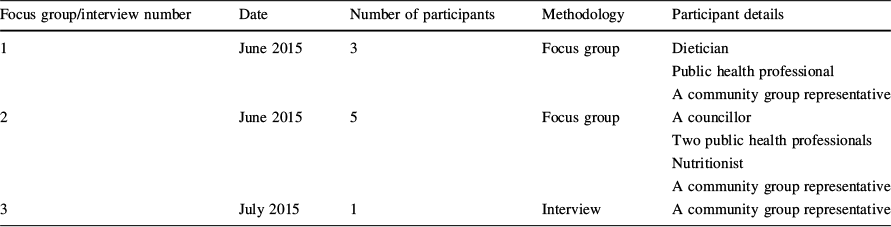
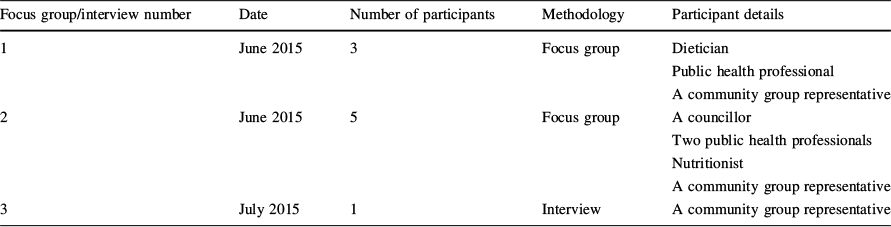
Three separate phases of qualitative research were conducted over 2 years. Phase one, from June to July 2015, consisted of two focus groups and one interview, lasting between 1 and 2 h, with individuals (N = 9) who had experience of food security-related service provision and governance. Ethical consent was obtained from the University of York Department of Health Sciences Research Governance Committee (HSRGC) (Ref HSRGC/2015/98A). Participants were purposively sampled to include councillors in Bradford; members of the Bradford Metropolitan District Council Public Health team; members of NHS services in Bradford addressing food/health; and Third Sector Organisations with experience of food-related coordination/policy. The final sample (Table 1) consisted of nine participants, with one of the intended focus groups conducted as a one-to-one interview.
Sample characteristics
Focus group/interview number |
Date |
Number of participants |
Methodology |
Participant details |
|---|---|---|---|---|
1 |
June 2015 |
3 |
Focus group |
Dietician |
Public health professional |
||||
A community group representative |
||||
2 |
June 2015 |
5 |
Focus group |
A councillor |
Two public health professionals |
||||
Nutritionist |
||||
A community group representative |
||||
3 |
July 2015 |
1 |
Interview |
A community group representative |
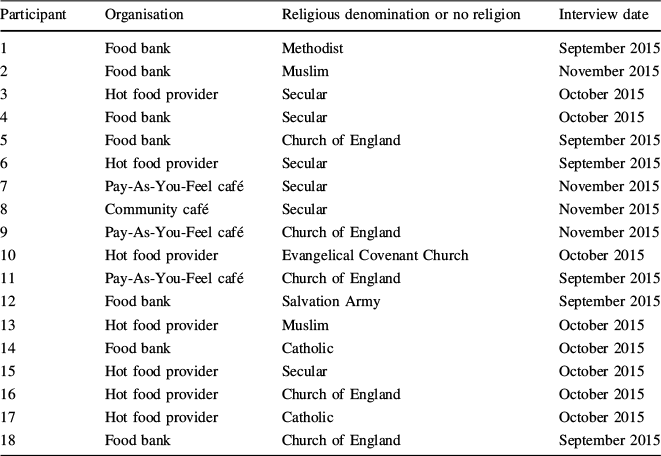
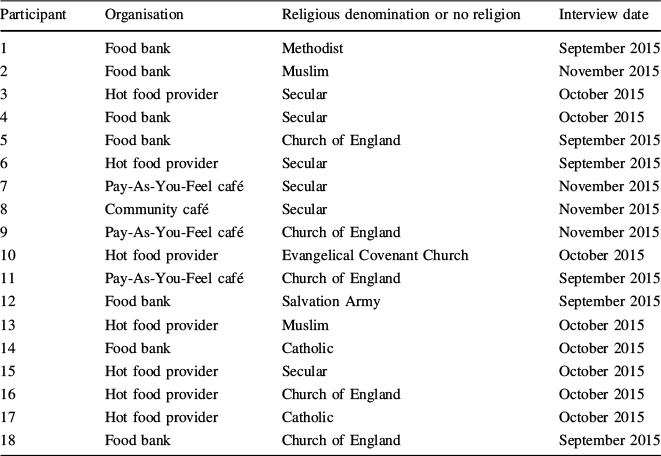
Phase two, conducted between September and November 2015, comprised 18 interviews, of between 45 min and 1 h, with representatives of organisations providing food aid at a local level. Ethical consent was obtained from HSRGC (Ref HSRGC/2015/160A). Sample organisations were chosen purposively from the 67 food aid organisations identified in a preliminary desk-based analysis of community food provision in the Bradford District to form a representative sample, including various types of organisations and religious affiliations. In line with the religious demography of Bradford, the faith-based organisations in the sample were Christian and Islamic only. Interviewees within the sample organisations were also chosen purposefully to capture perspectives that would best represent each organisation’s viewpoint. Interviewees were either the manager of the organisation or a key member of staff with managerial responsibilities; ethnicity and religion were not a consideration in the choice of particular staff members. Organisations that failed to respond to invitations to participate in the study and those that declined to be involved were removed from the sample. Reasons given for declining to participate included a perception of limited relevant experience and failure to see the study’s value. Table 2 sets out the sample characteristics.
Sample characteristics
Participant |
Organisation |
Religious denomination or no religion |
Interview date |
|---|---|---|---|
1 |
Food bank |
Methodist |
September 2015 |
2 |
Food bank |
Muslim |
November 2015 |
3 |
Hot food provider |
Secular |
October 2015 |
4 |
Food bank |
Secular |
October 2015 |
5 |
Food bank |
Church of England |
September 2015 |
6 |
Hot food provider |
Secular |
September 2015 |
7 |
Pay-As-You-Feel café |
Secular |
November 2015 |
8 |
Community café |
Secular |
November 2015 |
9 |
Pay-As-You-Feel café |
Church of England |
November 2015 |
10 |
Hot food provider |
Evangelical Covenant Church |
October 2015 |
11 |
Pay-As-You-Feel café |
Church of England |
September 2015 |
12 |
Food bank |
Salvation Army |
September 2015 |
13 |
Hot food provider |
Muslim |
October 2015 |
14 |
Food bank |
Catholic |
October 2015 |
15 |
Hot food provider |
Secular |
October 2015 |
16 |
Hot food provider |
Church of England |
October 2015 |
17 |
Hot food provider |
Catholic |
October 2015 |
18 |
Food bank |
Church of England |
September 2015 |
The focus groups and interviews across the two phases were semi-structured, recorded on a Dictaphone and transcribed verbatim. The topic guides were informed by a literature review and discussions within the project team.
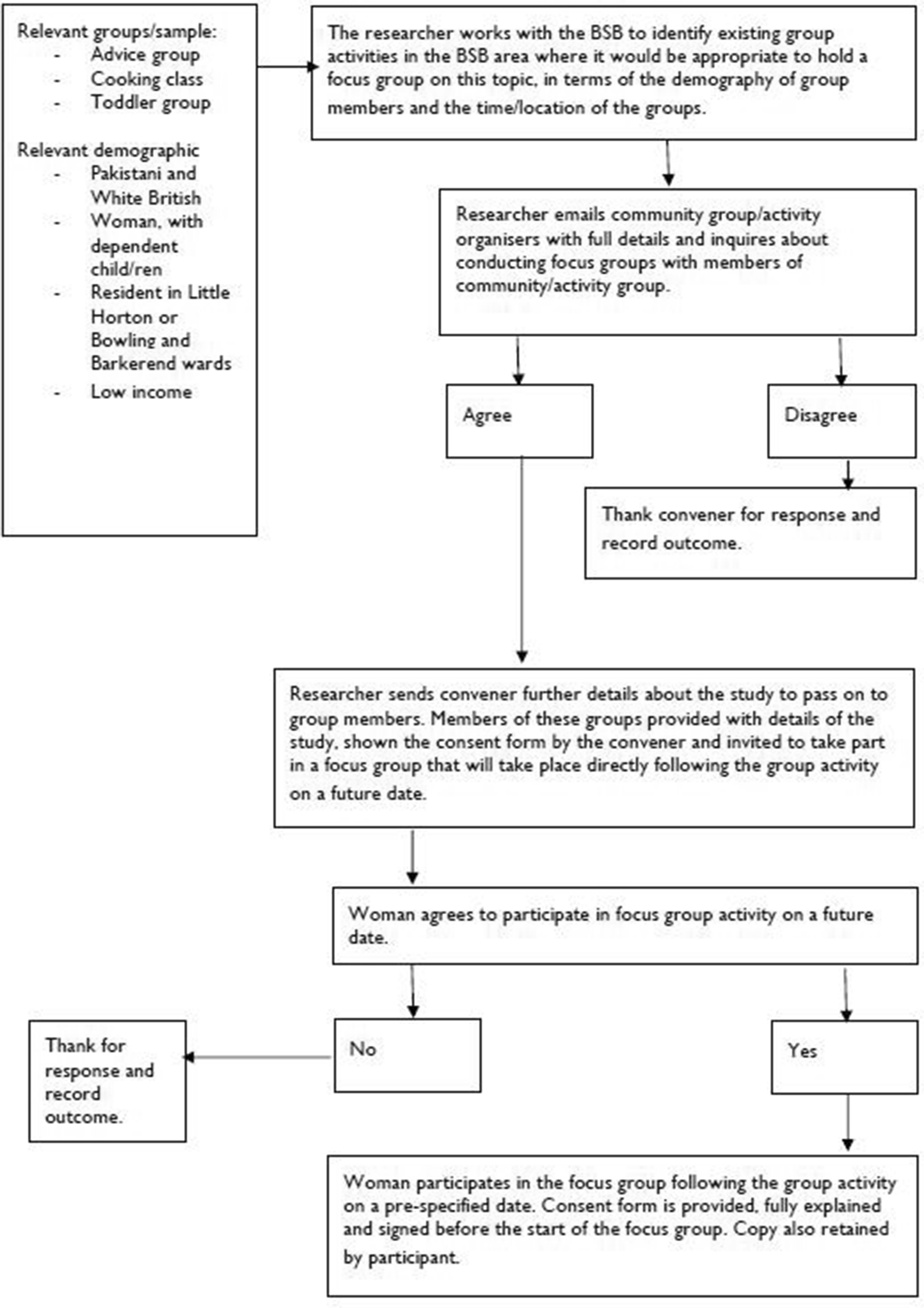
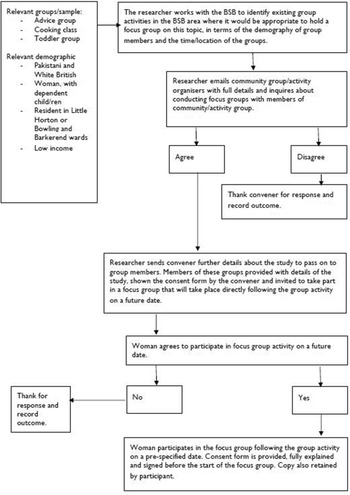
Conducted between July and November 2016, phase three consisted of three focus groups and one interview with White British and Pakistani women in or at risk of food insecurity (N = 16). In the light of potential recruitment difficulties and language and capacity restrictions, focus groups were arranged within pre-existing activity/community groups. Ethical consent was obtained from HSRGC (Ref HSRGC/2015/121A) and, with the assistance of Better Start Bradford, a community initiative, existing group activities in Bradford in which it would be appropriate to hold focus groups were identified. Members of these groups were invited to participate in the study (see Fig. 1). The first author worked with Better Start Bradford to ensure a diversity of groups and participants and, specifically, to include:
Recruitment process
• White British and Pakistani women with dependent children;
• Women who spoke only Urdu, women who were bilingual and women who spoke only English;
• Women who were severely disadvantaged, as well as those who lived in low-income households.
Three focus groups were conducted and, as a consequence of recruitment difficulties, one interview. The focus groups were semi-structured and moderated by the first author. The topic guide was informed by the findings of phase one and two, a literature review and discussion with the project team. The topic guide was discussed extensively with Better Start Bradford and the convenors of the community groups in which the focus groups were to be held. It was also piloted with two Better Start Bradford staff members, one Pakistani-Muslim and one secular White British. The focus groups were recorded on a Dictaphone and transcribed verbatim.
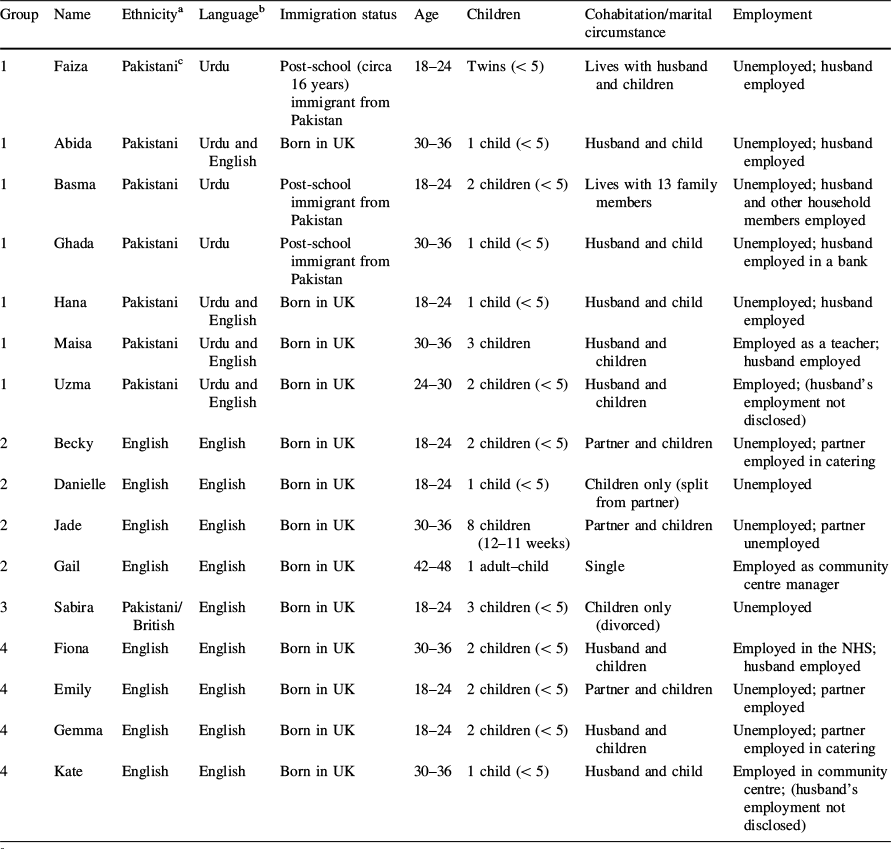
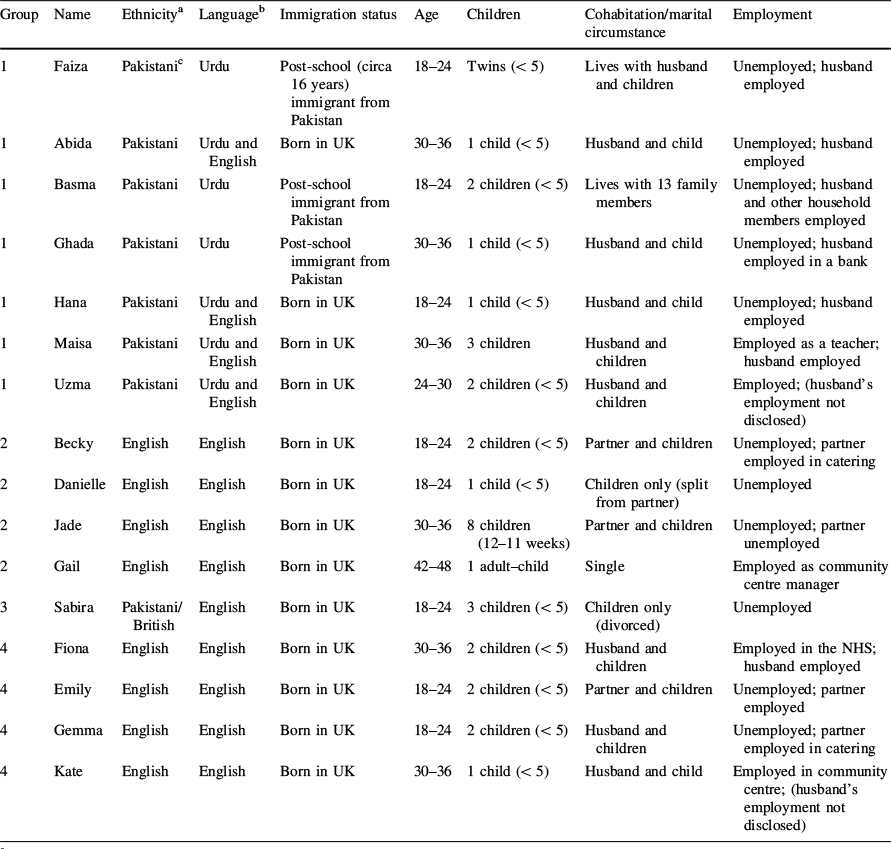
Full details of the sample are set out in Table 3. Descriptions of the sample use pseudonyms, and identifying material is removed.
Sample characteristics
Group |
Name |
Ethnicitya |
Languageb |
Immigration status |
Age |
Children |
Cohabitation/marital circumstance |
Employment |
|---|---|---|---|---|---|---|---|---|
1 |
Faiza |
Pakistanic |
Urdu |
Post-school (circa 16 years) immigrant from Pakistan |
18–24 |
Twins (< 5) |
Lives with husband and children |
Unemployed; husband employed |
1 |
Abida |
Pakistani |
Urdu and English |
Born in UK |
30–36 |
1 child (< 5) |
Husband and child |
Unemployed; husband employed |
1 |
Basma |
Pakistani |
Urdu |
Post-school immigrant from Pakistan |
18–24 |
2 children (< 5) |
Lives with 13 family members |
Unemployed; husband and other household members employed |
1 |
Ghada |
Pakistani |
Urdu |
Post-school immigrant from Pakistan |
30–36 |
1 child (< 5) |
Husband and child |
Unemployed; husband employed in a bank |
1 |
Hana |
Pakistani |
Urdu and English |
Born in UK |
18–24 |
1 child (< 5) |
Husband and child |
Unemployed; husband employed |
1 |
Maisa |
Pakistani |
Urdu and English |
Born in UK |
30–36 |
3 children |
Husband and children |
Employed as a teacher; husband employed |
1 |
Uzma |
Pakistani |
Urdu and English |
Born in UK |
24–30 |
2 children (< 5) |
Husband and children |
Employed; (husband’s employment not disclosed) |
2 |
Becky |
English |
English |
Born in UK |
18–24 |
2 children (< 5) |
Partner and children |
Unemployed; partner employed in catering |
2 |
Danielle |
English |
English |
Born in UK |
18–24 |
1 child (< 5) |
Children only (split from partner) |
Unemployed |
2 |
Jade |
English |
English |
Born in UK |
30–36 |
8 children (12–11 weeks) |
Partner and children |
Unemployed; partner unemployed |
2 |
Gail |
English |
English |
Born in UK |
42–48 |
1 adult–child |
Single |
Employed as community centre manager |
3 |
Sabira |
Pakistani/British |
English |
Born in UK |
18–24 |
3 children (< 5) |
Children only (divorced) |
Unemployed |
4 |
Fiona |
English |
English |
Born in UK |
30–36 |
2 children (< 5) |
Husband and children |
Employed in the NHS; husband employed |
4 |
Emily |
English |
English |
Born in UK |
18–24 |
2 children (< 5) |
Partner and children |
Unemployed; partner employed |
4 |
Gemma |
English |
English |
Born in UK |
18–24 |
2 children (< 5) |
Husband and children |
Unemployed; partner employed in catering |
4 |
Kate |
English |
English |
Born in UK |
30–36 |
1 child (< 5) |
Husband and child |
Employed in community centre; (husband’s employment not disclosed) |
aEthnicity was self-defined by the participant at the start of the focus group
bLanguage represents the language used by the participant during the focus group. In focus group 1, some participants used two languages, Urdu and English, to simultaneously converse with the moderator and other participants
cAll Pakistani participants described themselves as Muslim; thus, their religion was Islam
A three-stage analysis approach (see Dwyer Reference Dwyer2002) was used to analyse the transcripts from the three research phases. Each transcript was initially summarised to understand the narrative. Thematic analysis was used; a coding frame was devised based upon common themes/sub-themes and, using Nvivo 10, this was applied to each transcript. Relevant text was indexed whenever a theme appeared. The appropriately indexed material was transferred to a grid with basic organisational and/or demographic details about the sample. To preserve the anonymity of participants, details about the organisations and individuals in the sample are kept to a minimum.
A form of inductive reasoning was adopted: the authors collaboratively immersed themselves in the data and discursively found routes to explore the themes that emerged once data saturation had been reached. The Habermasian theoretical framework was, thus, used to interpret ex-post the research results rather than forming an intimate component of the research design.
Results
Drawing on phases one and two data, we start by examining system (itself constituted by money and power) definitions of the nature of need; approved food choices; the reification of selected skills associated with household management; and the imposition of a construct of virtue. We then turn to lifeworld (the medium within which culture, social integration and personality are reproduced) truths about the lived experience of food insecurity amongst participants in phase three, in particular understandings of the structural causes of food insecurity and recognition that the potential of social solidarity to respond to such systemic factors exists. The section closes with a consideration of the space between system and lifeworld.
System
Hierarchical Definitions of Need
The system of service providers is characterised by instrumental rationality, itself in accord with the individualistic ethics of neoliberal political economy, and manifests in hierarchal definitions of need and dismissive judgements about recipients. Amongst service providers, conceptualisations of the ‘food need’ in the local population tended to be ill-informed, inconstant and moralised. A perceived absence of data on food insecurity, as well as the lack of a clear, accepted conceptualisation of the term, allowed for discussions based on speculation and subjectivities. Service providers disputed whether food insecurity was a question of scales or absolutes; food quality or food quantity; poverty or food poverty:
I get asked this question a lot and ask it a lot to people in Keighley and Bradford, and people feel there are levels of poverty, not food poverty.
Community group representative, phase 1, focus group 3 (FG3)
This discussion of ‘need’ was situated within a wider neoliberal framework in which poverty was pathologised. Echoing popular discourse, some service providers in phases one and two characterised service users as responsible for their food insecurity, emphasising defective behavioural practices—laziness, greed, fraud—and financial mismanagement. The notion that food insecurity is a ‘choice’ was explicit and repeated:
I think that skills links to culture, there is a culture of not being bothered. I know there are people in extreme situations but I think there are certain people who, kind of by default, are choosing their situation.
Public health professional, phase 1, FG1
Framing food insecurity as, not an inevitability induced by systemic faults, but a self-inflicted and, thus, avoidable phenomenon, permitted service providers to question the authenticity and legitimacy of the ‘food need’. A notable—and vocal—minority of service providers suggested fraud was a preoccupation in the provision of food charity:
For the coordinator the biggest challenge is not being abused, not having the wool pulled over our eyes – people who shouldn’t be getting food when they are.
Participant 1 (food bank/Methodist), phase 2
Such discussions of the authentic, deserving and the illegitimate, undeserving ‘food poor’ cut across organisational and religious boundaries. Christian food banks and hot food providers (soup kitchens) were just as likely as secular food charities or secular health professionals to question the legitimacy of service users and defend restricted access to food charity, largely implemented via referral vouchers (access to the food bank was contingent upon presentation of a voucher gained from an external party, e.g. social worker).
Approved Food Choices
Service providers broadly concurred that a ‘healthy’ or ‘good’ diet includes sufficient fruit and vegetables, is low in salt and sugar and requires most food to be freshly prepared. This expensive, time-consuming diet was presented by multiple participants in phases one and two as their own diet, in contrast to that of the people using their services who ate ‘salty’, ‘rubbish’ or pre-prepared food. Correspondingly, approved food behaviour involved skilled food preparation and knowledge; service users who displayed ignorance, arrogance or laziness in food choices and food behaviour were condemned:
It’s that mindset of thinking, “I don’t have to make my own food; I can afford to buy it now because there is a Roti house there”. There is that element of turning what we would class as a negative thing that people couldn’t be bothered to make their own Rotis, to someone thinking, “I can buy them professionally made”.
Public health professional, phase 1, FG1
Approved food choices were, thus, entwined with the reification of select skills associated with household management. Budgeting, planning meals, buying in season and cooking with raw ingredients were valorised. Incompetence in or failure to perform such skills was attributed to laziness and passivity, ignorance and thoughtlessness:
They don’t have a clue. They think they are cooking a decent meal when they buy a jar of sauce. I can’t believe one of my volunteers…I had loads of those bags of already prepared carrot batons but the date was that day so I said, “Do you want to take a load of vegetables home for your family?” She went, “No, I’m not feeding my family vegetables this week. I’ve been in Farmfoods and I got pizzas and things like that so I won’t be giving them vegetables this week”. (Laugh). Not even a bean?
Participant 7 (Pay-As-You-Feel café/Secular), phase 2
Virtue
Underpinning the moralisation of food need and food choices, and the reification of select household management skills was a particular construct of ‘virtue’, but notably one which applied only to service users. Virtue was conceived by service providers as an individual phenomenon associated with a particular type of behaviour and the performance of certain skills. Virtue was not characterised by civic duty to the state or community but personal responsibility; a virtuous citizen (service user) aligned with Galvin’s ‘ideal neoliberal citizen’ (Galvin Reference Galvin2002, p. 117): autonomous, active—but not politically active—and responsible. Virtue could be inculcated in service users through teaching ‘life skills’, such as cooking, demanding a certain standard of behaviour (obedience and politeness) in the arena of food aid, and in the immediate act of providing people with food, thereby mitigating other deviant behaviour:
Sometimes we give him food because we think it stops him stealing.
Participant 1 (food bank/Methodist), phase 2
When applied to service providers, however, ‘virtue’ was conceptualised by phase one and two participants in an alternative manner. Amongst those providing food aid, virtue evolved and was solidified through community engagement and the performance of civic duty, primarily via donations of food, and was situated within a paternalistic—and Christian—framework of responsibility for ‘the poor’:
Our people (the congregation), rich people, generous people. They give money so we don’t ask for money from the public. To do good, we don’t need a lot of money, just good will.
Participant 14 (food bank/Catholic), phase 2
Lifeworld
Understandings of the Structural Causes of Food Insecurity
Participants in phase three (women living on low-incomes) offered a strikingly different analysis of rising ‘food need’ in the local area to that presented by some service providers in phases one and two. Participants described at length the structural obstacles which occluded food security. While food insecurity was exacerbated by ‘crises’, it was also a chronic, cyclical experience:
We always do a big shop every month and it gets to the last day of the month before pay-day and we are like, “what are we going to eat today?”
Gemma, phase 3, FG4
Food insecurity was a highly gendered issue, with women describing their responsibility to negotiate food needs within large families or suffering food shortages (for themselves and their children) because of domestic and/or financial abuse by a male partner:
When I was living with my husband, life was hard and money and food were very short. He had control over most of the money and I just didn’t know where it went.
Sabira, phase 3, FG3
Beyond the household, structural barriers to accessing sufficient or desired food jeopardised household food security. While high and rising food prices were a key obstacle to food sufficiency, food insecurity was also induced by time constraints, such as employment hours misaligned with supermarket opening times; limited transport to access large supermarkets; and the absence of certain cheaper food products, available in large supermarkets, in local, smaller retailers.As has been widely reported elsewhere (Perry et al. Reference Perry, Martin, Sefton and Haddad2014; Loopstra and Lalor Reference Loopstra and Lalor2017), issues associated with social security were a key factor in acute and rising food insecurity. Chronic food shortages were induced by inadequate social security payments. Against this background, specific changes to payments, such as benefit sanctions and the automatic reduction of income following the non-payment of bills, could precipitate food insecurity crises:
Yorkshire Water will get in touch with your benefits to take it off. ‘Cos we’re meant to get £200 a fortnight for me and my husband and we only get £100 a fortnight ‘cos all the deductions are taken off.
Danielle, phase 3, FG2
While the food bank was described by some participants as a ‘lifeline’, access restrictions were unsuited to the realities of life on a low-income and jeopardised the food security of some households, particularly those with children:
Now it’s only three every six months you can go for. I need to go more with six-week (school) holidays. I’ve got ten people in my house and trying to cook on a budget is…I get a packet of pasta, a tub of sauce and that’s your tea.
Jade, phase 3, FG2
Social Support and Social Solidarity
Family, predominantly parents and occasionally grandparents, were identified as crucially important to survival in hard times. The apparently unconditional support available from the families of many participants stood in stark contrast to hierarchical, financially bound relationships of exchange in the neoliberal capitalist economy, described in the context of the supermarket, Jobcentre Plus and employment:
To cope (with food shortages), I went to my mum’s for emotional support and food – I would always be able to go to my mum’s.
Sabira, phase 3, FG3
Family members provided emotional, childcare and material support, most often food; they helped avoid isolation in times of hardship; and provided skills that could be used to avoid or mitigate food insecurity. However, parents were not necessarily an unproblematic source of help. Seeking help transgressed the ethic of independence which permeated some families. Requesting help from the family could, thereby, undermine a participant’s sense of agency and self-esteem. Accordingly, participants who drew on parental support in times of food insecurity either described previously assisting their parents with material resources or substituting their unpaid labour for the resources received, thereby retaining a sense of independence and self-worth:
I would help out a lot at home to repay the debt. I would work really hard, I would clean and cook; it would be nothing just to make an extra chapatti – four rather than three.
Sabira, phase 3, FG3
For those women who could not access family support (attributable to an ethic of independence and/or inter-generational poverty), key members of the local community provided invaluable assistance:
If it weren’t for Gail last Christmas – she gave us a food parcel – if it weren’t for Gail, we would have had no meal; we wouldn’t have eaten all week.
Jade, phase 3, FG2
Key members of the community who provided food and emotional support to others were also those who themselves experienced food insecurity (e.g. Gail), forwarding a holistic sense of the community, rising and falling together and illustrating the democratising possibilities of communicative power. Similarly, there appeared to be minimal separation between local charitable food aid (the local food bank) and the local community:
I am actually friends with the person who started the food bank. He delivers to me because I don’t have any transport, so if I go over there, he will bring me home. He will ring me up and say he’s got a big bag of rice because they can’t divide it.
Gail, phase 3, FG2
It was notable that the nature and extent of familial and community support could be ethnically mediated. Pakistani participants regularly described receiving food support from the local South Asian community, including cooked food passed directly over the garden fence or credit from local shops. White British participants either did not discuss community support, or discussed receiving support from key members of the local, predominately ‘White’ community. Amongst Pakistani households, food itself was commonly shared not only with family members but also with neighbours:
If you live in the heart of an Asian community food is always circulating. Neighbours give to neighbours; you cook a little extra as standard and give to others.
Maisa, phase 3, FG1
This sharing of food, which was a perceived reason for the apparently lower food insecurity amongst the South Asian community (see Power et al. Reference Power, Uphoff, Kelly and Pickett2017c, Reference Power, Uphoff, Stewart-Knox, Small, Doherty and Pickettd), was both culturally and religiously informed. Food was most commonly shared between neighbours during religious festivals, especially Ramadan and Eid when food was regularly donated to and freely available from local mosques. However, religiously informed sharing of food also operated outside religious festivals, with religious doctrine underpinning this apparently cultural practice:
It is part of Islam to give to your neighbours, even if your neighbours are non-Muslims. It is written in the Qur’an that you must give to them if you have a full stomach and they have gone hungry. But you give anyway, even if you don’t know if they are hungry – you can’t ask!
Abida, phase 3, FG1
The Space Between the System and the Lifeworld
Shame
Food insecure participants in phase three struggled to reconcile structural barriers to accessing food in the context of poverty with narratives of individual independence, fundamental to neoliberal political economy. Food insecure women highlighted their ‘will-power’, optimism and complex household resource management strategies enabling them to live through and, potentially, escape food insecurity. The ability to ‘live within your means’ and prudently ‘manage money’ was presented as a form of virtuous active unemployment. The binary of the ‘feckless’, food insecure woman and the prudent, food secure woman created an uncomfortable tension for those participants who, despite their best attempts to ‘manage money’ within the household were, in fact, managing a household income so insufficient that food security was arguably impossible.
Yet, despite such structural obstacles, feelings of shame in respect of their poverty and/or food insecurity were predominant in participants’ narratives of the lived experience of food insecurity. Shame was most explicit in discussions around accessing formal food aid, i.e. the food bank; in this context, shame was co-constructed through the convergence of an individual’s internal sense of inadequacy and externally imposed disapproval for failing to satisfy societal expectations (see Chase and Walker Reference Chase and Walker2013). Accessing the food bank was an acknowledgement of an inability to satisfy externally imposed expectations of financial independence. Thus, in response to the threat of shame, there was a distinct attempt by both relatively affluent participants and those who described experiences of acute food shortages and anxieties around food sufficiency but had not accessed food aid, to distance themselves from those in more severe food insecurity and from food banks.
Ambivalence
The views of service providers in phases one and two incorporated a tension between conceptualisations of service users, largely informed by neoliberal narratives of independence, and the lived experience of assisting people in (food) poverty. Amongst phase one participants, there was widespread acknowledgement that chronic low-income and an increasingly punitive social security system were key causes of food insecurity. ‘Nutritious’ food, in particular, was recognised as unaffordable on a low-income, forcing people to consume food that was deemed by service providers to be unhealthy:
So I guess for the person who has a pound and are trying to decide what to do, well, why have they only got a pound? I mean real food is more expensive than actually a low-income can afford.
Community group representative, phase 1, FG2
In addition, there was broad acknowledgement that for many people, not only those on low-incomes, the components of a healthy diet could be ambiguous, with competing messages trumpeted by different parties. For a minority of participants in phases one and two, such structural obstacles were situated within a broader system of inequality ‘between the rich and poor’ which maintained the future necessity of food aid.
Discussion
The two processes of rationalisation in Western society (the system, constituted by money and power, and the lifeworld, reproduced by communicative action, or language) shape conflicting conceptualisations of food insecurity and food aid. The innate ‘expansionist’ tendency in the system, itself provoked by the systemic necessity of accommodating tensions generated by (neoliberal) capitalist exploitation—for example, food insecurity—results in the intrusion of the constitutive media of the system (money and power) into the lifeworld, particularly those areas which are contingent on communicative action. The social pathology induced by this colonisation process varies from that identified by Marx or Durkheim (alienation and anomie, respectively); it materialises as individual- and community-level shame, which compels ‘the poor’ to conceal the extent of their poverty (and exploitation), while also undermining social—and possibly also political—solidarity within and between exploited communities.
System Analyses of Food Aid and Food Insecurity
The system of service providers, characterised by instrumental rationality, was closely aligned with a neoliberal framework which individualised and pathologised poverty. Conceptualisations of the ‘food need’ in the local population were subjective and moralised. Amongst a large minority of service providers, food insecurity was portrayed as self-inflicted, the product of defective behaviour, which permitted scrutiny of the authenticity of the food need presented in food aid. While not expressed by the majority of participants this pathologisation of food insecurity (or, more specifically, the need for food aid) cut across organisational and religious boundaries and was distinctly the dominant narrative; amongst the remaining majority, views were variegated and narratives diffuse.
Approved food choices and a condoned form of household management were defined according to White, middle-class ideals; failure to consume an approved diet or perform certain reified skills in the arena of the household and the family was framed as a reflection of moral failings. Service users were frequently portrayed as unable or unwilling to cook with raw ingredients, consume vegetables or plan for the week or month ahead. Food insecurity was attributed to such failings, echoing a widely held narrative amongst members of the political and the media establishment and service providers more broadly that food insecurity is, in part, a product of poor cooking skills. Yet, the extent to which food skills can protect poor families from food insecurity is questionable (Huisken et al. Reference Huisken, Orr and Tarasuk2017). Nutrient intakes by women in food insecure households reflect less complex food preparation but no less preparation from scratch than women in households with no hunger (McLaughlin et al. Reference McLaughlin, Tarasuk and Kreiger2003).
The system construct of ‘virtue’ was informed by neoliberal ideals of independence and economic activity. Virtue was not characterised by civic duty to the state or community but personal responsibility; a virtuous citizen was autonomous, active and responsible (see Galvin Reference Galvin2002). As such, virtue could be taught through defined and delimited activities, such as cooking or career classes. This construct of virtue was, however, applied only to service users. Service providers were judged according to an alternative form of virtue, one which was situated within a paternalistic—and Christian—framework. In this latter form of virtue, responsibility was directed not to the self but to ‘the poor’ and, thus, virtue could materialise in the performance of civic duty, such as food charity.
Lifeworld Perspectives on Food Insecurity and Food Aid
Women living in or at risk of food insecurity, some of whom were service users, offered starkly different analyses of the causes and experience of food insecurity to that of service providers. As has been reported elsewhere (Lambie-Mumford et al. Reference Lambie-Mumford, Crossley, Jensen, Verbeke and Dowler2014), food insecurity was induced or exacerbated by one-off events or crises, but it could also be a chronic experience, caused by high food prices, limited transport, isolation and persistent low-income, especially the prolonged financial inadequacy of social security payments (Loopstra and Lalor Reference Loopstra and Lalor2017). Such structural causes of food insecurity were experienced by both Pakistani and White British women, who adopted common strategies in their response to food insecurity, studiously budgeting resources within the household and looking to outside sources of support.
Social and familial solidarities were fundamental to the maintenance of food security in hard times. Family members provided emotional, childcare and material support and helped avoid isolation. Familial and social solidarity was sustained through food technologies, which, amongst the Pakistani community, appeared to be underpinned by religious tenets—specifically, Islamic doctrines of food sharing with neighbours and those in need. And so, it would appear that in this community there is evidence of a more robust lifeworld. However, in keeping with the Habermasian framework, this is not a culturalist conception of the lifeworld; it is not one which implies a culturally constructed ‘common stock of knowledge that actors draw on in everyday interactions’, rather Habermas is identifying a dimension of social solidarity, mutual aid and communication amongst and within groups. Hence, this refers, ‘not only to cultural traditions but also to group solidarities and loyalties., and to the motivation…that actors mobilise in their quest for mutual understanding’ (Mouzelis Reference Mouzelis1992, p. 277). The similarities and variations between Pakistani and White British women in their response to food insecurity, as well as the social solidarities that mitigate food insecurity and the use of food aid, are discussed at length by these authors elsewhere (Power et al. Reference Power, Small, Doherty and Pickett2018).
Colonisation of the Lifeworld by the System
Service providers tended to pathologise the ‘food poor’, disregarding the subjectivities of service users and subverting communicative competence. The dialogue here—albeit of a limited study in a particular context—suggests there is minimal potential for communicative action in the arena of ‘emergency’ food aid. In this study, food aid, as most conspicuously exemplified by food banks, did not offer the potential for new political narratives or emancipation; the symbolic reproduction of society was not possible in such a context where shared understandings and the coordination of action based on this were precluded by institutionalised classism and the, related, neoliberal narratives of the deserving/undeserving poor. Habermas argues that legitimacy can only be regenerated from the lifeworld; however, the experience of food aid recipients, and the study of the practice of food aid providers, suggests that there is little or no space for the development of a public-minded rational consensus that would see the provision of food aid, via food banks in particular, as a route for the revival of the public sphere in this area. Such a revival would require food aid service users being able to demonstrate social solidarity, mobilise for peer support and provide mutual care.
New ethical possibilities are more likely to be inculcated via social and familial solidarities outside the food bank, as intimated by the democratising possibilities of communicative power evident at points in the focus groups with low-income women and the mutual aid performed within communities of White British and Pakistani women. Food banks, as currently constructed in the UK, may be limited, from the point of view of the service user, in their emancipatory potential. However, alternative models of food banking and/or other forms of community food aid, which adopt an advocacy role, provide job skills and employment opportunities for people in food insecurity and/or harness the socialising, if not universalising, power of food through communal, open-access meals and community gardens, may offer opportunities for resistance against classist and racist structures and provide arenas for new ethical and political encounters (see Fisher Reference Fisher2017 for an extended consideration). The over-sampling of ‘emergency’ food providers in this study, at the expense of other ‘non-emergency’ forms of community food aid, precluded investigation of the emancipatory possibilities of the latter.
In the process of colonisation, system rationalities increasingly usurped communicative action in the lifeworld to become the predominant narrative. The social pathology induced by this colonisation process materialised as individual- and community-level shame, which compelled ‘the (food) poor’ to conceal the extent of their (food) poverty by avoiding food charity (Loopstra and Tarasuk Reference Loopstra and Tarasuk2015) and, possibly also, eschewing familial assistance (Ahluwalia et al. Reference Ahluwalia, Dodds and Baligh1998). Correspondingly, colonisation of the lifeworld functioned to undermine commonality, trust and social solidarity within and between exploited communities. Participants in phase three who were in or at risk of food insecurity frequently ascribed to dominant narratives of the ‘culture of poverty’ (Lewis Reference Lewis and Moynihan1969), opposing their own attitudes and behaviour to that of the food insecure ‘Other’ (Lister Reference Lister2004.), who was profoundly stigmatised and whose food insecurity, as in system analyses, was attributed to personal failings. This narrative conflicted with the structural obstacles to food security experienced by all, but particularly by the most socioeconomically deprived, participants. While the most severely food insecure participants were the least likely to engage in such narratives of blame, the threat of stigmatisation impacted significantly on their interactions and activities, inducing some participants to withdraw from familial and community interactions and undermining the potential for solidarity precipitated by (the awareness of) political and economic exploitation.
Strengths and Limitations
This is a small-scale study in a single city, focusing on a distinct population—in particular women from two groups (White British and Pakistani)—and, therefore, the findings may not apply in other settings. Further, the diverse range of participants limits depth of analysis in any one group. However, it is the first UK study to combine a varied range of service providers and service users in a single analysis. It includes multiple types of food aid, exposing consistent narratives regardless of the type of food provision and is one of few studies on the lived experience of food insecurity in the UK to recruit service users and those at risk of food insecurity through channels other than food banks, allowing for an understanding of individuals who, despite food insufficiency, do not access food aid. Finally, by drawing upon the work of Habermas, the paper offers a theoretically grounded analysis of contemporary narratives of food insecurity and food aid.
Conclusion
Use of the system-lifeworld framework not only elucidates the gulf between the perceptions and discourse of service providers and the experiences and opinions of service users, but also helps explain the disjuncture experienced by service users when rationalising their own experiences of the structural obstacles to food insecurity according to dominant—system—narratives which pathologise and individualise (food) poverty.
The conflict between system and lifeworld analyses of food insecurity and food aid and the perverse implications of system colonisation of the lifeworld for the self-esteem and agency of service users brings into question the benevolence of some food charity. Even when the system meets an individual’s practical needs—for example, by providing food—that provision may still be via an interaction characterised by system domination. The recipient will not be empowered to build on a communal solidarity that might collectively respond to a shared need but will retain a sense of feeling shame and being shamed. Shame is co-constructed: it combines internal judgements of one’s own inabilities with an anticipated assessment of how one will be judged by others as well as the actual verbal or symbolic gestures of others who are considered, or consider themselves, morally superior to the person sensing shame (Chase and Walker Reference Chase and Walker2013). Shame not only impacts social bonds, eroding social solidarity and generating feelings of powerlessness, but it may also reinforce a subjectivity fundamental to the way that people living in poverty respond to the social demands made upon them. As Habermas says, ‘Liberation from hunger and misery does not necessarily converge with liberation from servitude and degradation’ (Habermas Reference Habermas1986, p. 169).
While Habermas has occupied a changing position about activism throughout his career, praxis, the relationship between how we think and what we do and the importance of the priority of action over thought, has retained a particular meaning: the core of any action is communication, and the task is to create conditions for communicative action (Jeffries Reference Jeffries2016). Thus, praxis, for Habermas, is a matter of seeking the conditions for an ‘ideal speech situation’ in which disagreements and conflicts are rationally resolved through a means of communication that is free from compulsion and in which only the force of the better argument will prevail. Achieving this communicative competence occurs when a speaker and a hearer are oriented towards mutual reciprocal understanding and, importantly, when equality prevails to such an extent that either speaker or hearer has the agency and security to adopt an affirmative or negative stance when a validity claim is challenged (Pusey Reference Pusey1987, p. 5). While it is evident that we are far from achieving a mutual reciprocal understanding in relation to either food insecurity or food aid, we have identified routes towards this—in particular, the fostering of opportunities for service users to demonstrate social solidarity, mobilise for peer support and provide mutual care—that are closer to respecting and reconciling variegated needs and experiences.
Acknowledgements
One of the authors of this paper (MP) was supported by the NIHR Collaboration for Leadership in Applied Health Research and Care Yorkshire and Humber (NIHR CLAHRC YH) (Grant Number IS-CLA-0113-10020). www.clahrc-yh.nihr.ac.uk. The views and opinions expressed are those of the author(s) and not necessarily those of the NHS, the NIHR or the Department of Health.
Compliance with Ethical Standards
Conflict of interest
The authors declare that they have no conflicts of interest.

 Open access

