

6.1 Introduction
If you were thousands of years old, and in your youth had passed by the ancient city of Ur, Babylon,Footnote 1 at around 2000 bce, you might have been lucky enough to visit Simat-Enlil, King Shulgi’s daughter. Over a cold drink, she may have shown you a gift from her father: a bowl already over a hundred years old that he had inscribed as a gift to her (Reference ThomasonThomason 2005: 74). This is the first documented case of people reusing and reappropriating already old materials in historical archaeology. One and a half thousand years later,Footnote 2 Nebuchadnezzar and Nabonidus, successive kings of Babylon, excavated and restored earlier structures at Ur. While doing so, they re-incorporated into their architecture inscriptions made by different kings, thousands of years earlier. Due to written records, we also know that Nabonidus’s daughter, the princess En-nigaldi-Nanna, dug at the temple of Agade and had a room in her palace dedicated to items of antiquity, making her possibly the first known antiquarian (Reference DanielDaniel 1981: 14; Reference OatesOates 1979: 162). These instances of the curation of already old artefacts are usually understood by archaeologists to be efforts to reinforce authority through emphasizing a connection to past rulers or ancestors.
In prehistory (i.e., without the benefit of written information), our understandings are built through narrative explanations based on the suite of physical evidence we encounter. The amount and nature of this evidence vary wildly – sometimes preservation is excellent and at other times very poor – but in general terms there is more evidence from time periods closer to the present day than from the more distant past. Already old materials incorporated into later deposits have been noted by archaeologists at prehistoric sites (Teather 2018; Reference Knight, Boughton and WilkinsonKnight, Boughton and Wilkinson 2019), and recent applications of absolute dating methods in prehistory have led to more instances of out-of-time artefacts being uncovered. I will argue in this chapter that this greater focus on attempting to ascribe more precision to an archaeological event has forced archaeologists to confront their own assumptions of what kinds of time they are trying to measure, and use, to frame accounts of past lives.
Archaeological information can be an important source of identity for human societies, providing an alternative narrative of life in the past and its connection to the present that can sit alongside origin myths, religion and history. As a uniquely integrated discipline of history and science, archaeology has made increasingly sophisticated use of narrative tools in the last 30 years. While it has always used narration to report and discuss evidence retrieved from past people’s lives, this has been problematic. Narrative approaches have sometimes been seen as unduly historical and not scientific or objective enough; but scientific results are equally understood to be subjective and selective (or, at least, ‘theory laden’) and require explanation. In undertaking archaeological analysis, we are inextricably tied to both disciplinary approaches. This chapter traces the structure of knowledge creation in archaeology, how this applies to measuring time and how these are brought into coherent narrative form by archaeologists. In conclusion, archaeological information both contains stories and suggests stories: some that are ours and some that belong to the past.
6.2 Archaeological Knowledge and Narrative
6.2.1 What Is an Archaeological Narrative?
The craft of building an archaeological narrative is referenced in the profession as a type of interpretation, and in archaeology the study of types of interpretation, while often epistemological, is referred to as ‘archaeological theory’. Archaeological interpretation is therefore the creation of narratives about the past, based on the evaluation of different kinds of facts.Footnote 3 For archaeologists, facts encompass a wide range of different categories of evidence. These might be historic, artefactual or architectural; comprise chemical or biological information; and, for both sets of these types of facts, be comparative or analogous. Reference Wylie, Howlett and MorganWylie (2011: 302) has referred to these as facts of the record/mediating facts; and historical facts, which themselves comprise two types of facts – facts of the past and narrative facts. It is useful for the purposes of this chapter to think of facts as defined by Reference Haycock, Howlett and MorganHaycock (2011: 424): ‘a fact is not of necessity something that is true; it is rather something that is taken to be true on the basis of current evidence in the context of a particular scaffolding of knowledge, ideas and beliefs that supports it’.Footnote 4
Archaeology has different, and separate, types of scaffoldingFootnote 5 that each constitute a body of interrelated facts, that themselves are composed of combinations of knowledge, ideas and beliefs of different kinds. For half a century, archaeologists have been familiar with visualizing this process, with much less sophistication than Reference Chapman and WylieChapman and Wylie’s (2016) work, as a ladder of inferenceFootnote 6 where the further one travels up the ladder of knowledge, the further one is removed from the archaeological facts (or facts of the record, as Reference Wylie, Howlett and MorganWylie (2011) might say). If we continue for the moment with a ladder analogy for scaffolding in archaeology, we can begin to see the types of scaffolding as separate self-supporting pillars of knowledge, or chronicles, that create genealogiesFootnote 7 by a process of colligation (Reference MorganMorgan 2017: 88–89).Footnote 8 For this chapter it might be easier to visualize them as subject-based – for example, one genealogy might be that of pottery production (following a particular technical and historical trajectory and incorporating chronicles encompassing the types of clay, temper and firing times, experimental work and ethnographic analogy); another genealogy might be an account of animal husbandry (following animal domestication, genetics, behaviour, meat or dairy yield and comparative ethnographic information of the composition of different kinds of herds for different economic purposes). For example, in northern Europe the remains of sheep, cattle and pig in domestic species form a consistent contribution to past economies from 4000 bce to the modern period, but their proportion in deposits changes depending on the subsistence focus.Footnote 9 The chronicles might be broadly the same in many instances, but branch into different genealogies and narratives.
6.2.2 Construction of Archaeological Narratives
Narratives in archaeology weave between these chronicles and genealogies, as if with ribbon, creating individual cat’s cradles by encompassing different facts from different chronicles and genealogies. For example, I conducted a synthesis of prehistoric human burials with strike-a-light kitsFootnote 10 that determined that the overwhelming majority occurred with male burials between 2200 and 2000 bce (Reference Teather and ChamberlainTeather and Chamberlain 2016). While already considered to be a gendered practice, this research showed it was more common, very strongly male-related, often seen in higher status burials and, as a product of new radiocarbon dating, the duration and peak occurrence of the practice could be ascertained. In terms of scaffolding, this paper relied on many different chronicles of knowledge: experimental work; chemical work on the degradation of iron pyrites in soils over time; a genealogy of situating the practice within European prehistoric analyses of similar types of burials; and finally, the metaphorical work of Reference Lakoff and TurnerLakoff and Turner (1989) (a genealogy based on the use of textual analysis and material culture in archaeology) to suggest that death may have been seen as a type of journey for the dead men during this time period and requiring a portable source of light and/or heat. Each of these elements as brought to that paper have their own histories and scaffolds of knowledge in archaeology and cognate disciplines of anthropology and ethnology, but it was the authors’ preference and choice to bring them together in this particular narrative. Other authors could use the same starting point of evidence and produce a different cat’s cradle of narrative.Footnote 11 The success of this particular approach was that it has stimulated more attention during excavation to record and identify these otherwise quite functional and unremarkable objects; the thorough synthesis accompanied with a compelling narrative proposing a rich metaphorical significance has affected field practices. In Berry’s terms (Chapter 16), the authors are present in the archaeological narrative through this process. Yet, the motive of the original research question or puzzle that stimulated that work is not actually mentioned in that paper.Footnote 12 As a specialist in artefacts made from chalk in the Neolithic, I have proposed that most chalk artefacts mimic artefacts made from different substances, such as stone or wood (Reference Teather and ShaffreyTeather 2017; Reference Teather, Chamberlain and Parker PearsonTeather, Chamberlain and Parker Pearson 2019). I was puzzledFootnote 13 by chalk ‘charms’Footnote 14 found in a small number of burials of predominantly women and children, and their visual resemblance to iron pyrite strike-stones that were in a few adult male burials (Figure 6.1).
Iron pyrites (left) and chalk charms (right) from the burial of a female, dated to 3600 BCE
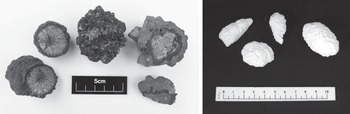
No recent research had been conducted on strike-a-light burials so I had to complete it myself and having done so can argue (and will do so further in a monograph in preparation) that strike-a-light burials may have been male-dominated in this period, but that there was a metaphorical past connection in a different material within the burials of women and children. Therefore, the strike-a-light burials are male-gendered, but a similar practice included women and children in a different, and potentially socially subversive, way. In order to argue that position and create a convincing narrative, the research had to be completed in this sequence.
These examples show that archaeological narratives appear to map well onto a narrative science framework. I will now turn to focus on archaeological dating methods and how these fit into this proposal.
6.3 Archaeological Dating
Chronologies in archaeology are manifold and can refer to temporal changes in certain types of artefact or in modes of an economy or social system. In effect, they are types of chronicle that seek to order selected events by the inclusion and exclusion of information. Relative and absolute chronologies (Figure 6.2) sit side by side in archaeology and can include many different facts of the record, but are constructed in different ways.

6.3.1 Relative Dating
In the history of archaeology, an interest in relative chronology began in earnest with typological studies of antiquities that initially made a categorical separation of geological objects and human-made artefacts. In the 1880s, Oscar Montelius created extensive relative typologies of archaeological artefacts across Europe with the goal being to devise a chronology for the broad cultural sequence (see Reference TriggerTrigger 1989: 155–156). Yet it was Christian Jürgensen Thomsen who advocated an approach to determining chronology through the typology of ‘closed finds’, representing objects found together in burial, hoard or other groupings, which suggested they were deposited at the same time (Reference TriggerTrigger 1989: 76). As a result, he was able to organize prehistoric material culture into a Three Age System that defined a narrative progression from the Stone Age to the Bronze Age and the Iron Age (Reference MarilaMarila 2019: 94–95). The left-hand side of Figure 6.2 shows the end phases of the Stone Age into the Bronze Age.
Therefore, it was not only the individual artefact that was important but what it was found with – i.e., its systematic co-occurrence with other artefacts. For example, it was not simply that a bronze axe was discovered with a particularly distinctive pottery vessel together with a human burial in a mound, but rather that bronze axes were repeatedly found with that type of pottery with burials in those types of earthen mound. Thus, the first chronologies in archaeology were the product of a scaffolding of facts – such as the typologies of artefacts commonly found together and through stratigraphic sequences,Footnote 15 where deposits are discovered above or below other deposits. The terminologies for this are specified as the terminus post quem and the terminus ante quem: something has to be later (post) or earlier (ante) than something else either because of where it appears in the archaeological sequence or what it contains, but a firmer date cannot be specified. For example, a coin hoard might contain currency minted in ad 83, ad 104 and ad 200, and therefore it would have a terminus post of ad 200 in that it would have had to have been deposited after ad 200, even though it contained earlier coins. If this hoard were buried under a sixth-century Anglo-Saxon brooch, the coin hoard would have been deposited between ad 200 and 600, as the brooch provides a terminus ante of ad 599.
Relative dating in archaeology is therefore predicated on two distinctions: first, that combinations of portable material culture,Footnote 16 as assemblages,Footnote 17 are distinctive to a particular culture and indicative of the subsistence, economics and social relations of that past population; and second, that each archaeological context such as a burial is physically separated from another context as a time capsule (making it a closed context) that we can discern through stratigraphic excavation. Therefore, typologies (systems of classification of evidence into distinct categories) and seriation (the sorting of evidence into a temporal sequence) were first established alongside chronology and relative dating, and all continue to be core elements of archaeological research practice. Assemblages, formed of typologies, closed contexts and seriation, can be seen as the scaffolding for chronicles, that form the basis of narratives.
Types of comparative assessments are also key to relative dating but might be seen more effectively as genealogies rather than as chronicles (Berry, Chapter 16). For example, aerial surveys using light detection and radar (LiDAR), or other remote sensing methods, produce images that can be compared with known excavated sites to produce an initial identification and assessment. The kinds of question that are approached here primarily rely on size and form: a 30 m circular banked and ditched enclosure may suggest an earthen henge monument like Avebury in Wiltshire (refer to the left-hand side of Figure 6.2), whereas a 10 m × 10 m square enclosure suggestive of stone-built foundations may indicate a Romano-Celtic temple.
Broader-scale narrative sequences are therefore built from aggregations of evidence from many excavated sites. Alongside typological considerations of materials present in archaeological deposits, they enable temporal chronologies to be brought together. Only limited comparisons may be possible between different archaeological sites unless cultural expressions such as pottery, buildings or monument styles are widespread and very similar. Where these are present, it allows for broad regional- and continental-scale syntheses, a particular kind of narrative. Relational dating is therefore reliant on a series of comparative interpretations of artefact and site typological data that are assessed and applied to each example, and are effectively genealogies. These are nested within a wider geographical and temporal understanding of comparative data as chronicles. Narratives can emerge at these different scales: the artefact, the period, the site, the region, the continent. While relative chronologies still have their uses for broadly determining an outline chronology, they can fail where we cannot easily determine chronologies from artefacts (e.g., through typologies where artefacts are degraded/when material culture changes little through time) or when we attempt to compare sites that are geographically separated.
6.3.2 Absolute Dating
The advent of absolute scientific dating in the mid-twentieth century had a significant effect on archaeological chronologies. It meant that materials and deposits could be placed within a chronicle of a measured time-scale of calendar years (refer to the right-hand side of Figure 6.2) rather than being reliant on relative factors alone. Initial methods included dendrochronology (tree-ring dating) and radiometric (commonly, radiocarbon) dating. Radiocarbon dating measures the decay of an unstable isotope of carbon from the time the living organism ceased respiration, and as such provides a date of ‘death’ as a probabilistic range.Footnote 18 Dendrochronology can identify the year at which the living tree was felled, and as such is potentially much more accurate than any other form of dating but is only applicable to suitable surviving timbers that preserve a sufficient number of tree rings to allow them to be matched to a reference chronology. Direct dating methods such as these are preferred particularly for human and animal remains, and due to the prevalence of these organic materials in deposits, radiocarbon dating has proved to be a key tool in discerning chronologies.
However, these have now been joined by further physico-chemical dating methods. These include uranium series dating of cave minerals, optically stimulated luminescence (OSL) to date sediments to when they were last exposed to sunlight, and palaeomagnetic dating that can be used to date deposits such as hearths that have been subject to an episode of burning. Amino acid racemization measures time-dependent changes in protein molecules (Reference Demarchi, Collins, Rink and ThompsonDemarchi and Collins 2014) and ceramic rehydroxylation (RHX) is able directly to date pottery through the chemical reaction on firing the pottery.
Indirect methods are also increasingly important. For example, molecular clock (or coalescent analysis dating) analyses molecular diversity to determine the sequence and timing of past demographic and evolutionary events that have left traces in both modern and ancient genomes. This means that we can assess the diversity of ancient populations in particular areas, and pinpoint times that they began to diverge from each other. These different methods speak to the different aspects and scales of the archaeological record; whether the research aim concerns the activities of living people such as firing pottery, or a much wider scale such as questions of genetics and evolution. They all result in establishing archaeological chronologies for the methods and assist in creating genealogies and narratives that refine archaeological sequences and constrain the duration of temporal events.
Absolute dating is seen as a preferred and more robust, scientific way of determining ageFootnote 19 as it can order events and material culture within a fixed temporal chronology and make it possible to compare within and between sites in a greater range of archaeological settings. While it might be considered better and more objective science to discard the application of anything but the broadest use of relative chronology, there are some instances where relative dating techniques are the preferred method. Relative chronologies are still very informative for styles of prehistoric rock art, which by their nature are often impossible to date using absolute methods. For historic periods, relative chronologies such as seriation are more often employed as many of the dating methods (apart from dendrochronology) are not more accurate. Therefore, clay pipes, for example, can be attributed to periods of manufacture and sometimes individual makers (e.g., Reference WilliamsonWilliamson 2006), and as they are commonly discarded when broken their period of use is reflected in deposits.
In summary, our archaeological chronologies have been subject to a shift and expansion in reasoning with the advent of the direct dating of materials. From a relative-based chronological approach, which is inherently genealogical, we now include an absolute chronology, or a chronicle, that does not rely on the storied or narrative aspect of the archaeological record but simply ranks the dates in sequential order (Figure 6.2, right-hand side). Absolute dating chronicles can be used to generate different genealogies and narratives without attention to the existing genealogy of relative chronology. This has resulted in a suite of new approaches to examining archaeological time.
6.4 From Dates to Narratives: Impacts of Recent Studies
As detailed above, relative and absolute dating provide different ways to build narratives. For relative chronology, narratives are built piecemeal from the contributions of seriation, typologies and closed contexts – often by individual scholars working on sets of material with continual reference to the existing genealogies and chronicles. When syntheses are produced, they are agreed in chronicles by the process of accepting individual facts within the scaffolding of each chronicle. Therefore, these have been subjected to continuous revision and refinement over time (Reference Chapman and WylieChapman and Wylie 2016), as new discoveries have been made or inferences or assumptions have been successfully challenged. This process produces rich and subtle narratives that often incorporate previously overlooked evidence and challenge earlier interpretations or narratives, such as the Glastonbury Iron Age village where the excavators’ results were revisited and reworked five times between the 1960s and 1990s (Reference Chapman and WylieChapman and Wylie 2016: 108–136).
On a wider scale and using data from the British and European Neolithic period, the span of data derived from relative dating originates from the accretion and consensus of primary analyses of archaeological finds. These initially consist of collections of multi-authored specialist reports of pottery, flint and other materials, that when taken together lead to a consensus of date or date range that subsequently fits into the broader relational chronological framework. At this stage, it is usual for a few ‘range-finder’ radiocarbon dates to be obtained to confirm the proposed artefact-based chronology. Therefore, at an initial and primary assessment stage, three to five radiocarbon dates may be taken per site to confirm and establish, or conversely challenge, the range of activity and sequence proposed through the relative dating methods. When information from many sites is aggregated, this results in a fairly even spread of absolute dates throughout the chronological sequence, as seen with the numbered dates on the right-hand side of Figure 6.2.
In the last decade and a half, advanced computational approaches have permitted new analyses of absolute dating evidence undertaken on archives of previously excavated materials that have challenged this traditional means of narrative building in archaeology. Intensive radiometric dating studies on archival material that have often focused on a particular category of site or research question have increasingly been undertaken. These dates supplement the range-finder dates typically gained through excavation and have the effect of creating blocks of data in the temporal framework and consequently an uneven distribution of information (please refer to the tightly spaced lines on the right-hand side of Figure 6.2). Two approaches have been particularly prominent: new absolute dating on sequential stratigraphic layers within archaeological deposits to produce Bayesian statistical analyses of site chronologies; and large-scale geo-spatial analysis of aggregated radiocarbon dates. These projects produce narratives and chronologies that are based on either inclusive or reductive reasoning. Inclusive narratives use absolute dating to establish how events are chronologically and spatially related. They are inclusive, as they seek to address all the findings uncovered, and they are narrative in that they provide an explanation for those findings through attention to the type of artefactual material under study and the sequence revealed. Reductive chronologies use absolute dating to provide a more precise date for an event. They are chronologies in that precise time measurement is their goal; and they are reductive in that they exclude dating evidence that does not easily confirm their chronological goal. This is because they assess any type of material culture as solely contributing in terms of chronological (and not cultural) evidence.
6.4.1 Case Studies Producing Inclusive Narratives
Absolute dating can help archaeologists establish how events are chronologically and spatially related. When projects consider all dates obtained and attempt to explain them by attending to questions of artefact type and sequencing, they produce inclusive narratives. Two examples of inclusive research-led projects that involved gaining new radiocarbon dates follow.
Reference Parker Pearson, Sheridan, Jay and ChamberlainParker Pearson et al. (2019) presented the results of a large-scale project on dating the Early Bronze Age phenomenon of Beaker burialsFootnote 20 in Britain that date from 2600 to 1700 bce. The aimFootnote 21 of this project was to discover and assess the level of mobility of those buried people during their lives. The skeletal remains from 370 individuals were investigated, with 17 found to date earlier than the period under study and 19 later, together with a number of examples that could not be dated by absolute methods (Reference Parker Pearson, Sheridan, Jay and ChamberlainParker Pearson et al. 2019: 426). Constraining the dates of the ‘Beaker phenomenon’ is an important archaeological question but one that has become more current due to ancient DNA analyses that have suggested that Beaker people arrived in the UK as migrants from continental Europe (Reference Olalde, Brace, Allentoft and ArmitOlade et al. 2018).
The second project directly dated archival material from mining and quarrying sites that were thought to date from the start of the Neolithic in Britain and continental north-west Europe (6500–1500 cal bc: Reference Schauer, Shennan, Bevan and CookSchauer et al. 2019b; Reference Schauer, Bevan, Shennan and Edinborough2019a; Reference Edinborough, Shennan, Teather and BaczkowskiEdinborough et al. 2020). The goal here was to determine if stone axes (the primary products of mines and quarries) were in increased demand for clearing forest during the economic change to agriculture at this time, and, if so, precisely when this occurred.Footnote 22
For both projects, the radiocarbon dates as new ‘facts of the record’ are treated as fully correct, even if they do not answer the research question. The impact of the small proportion of dates that fall outside the timespan of the research question is minimal, but the anomalous dates are nonetheless recorded and discussed informatively. In the first example on Beaker burials, the absolute dating related to one phenomenon (the death and subsequent burial), the one dating material type (the body) and the accompanying analyses on mobility (the body) have created a different genealogy of Beaker practices through new radiocarbon dates. Each burial is contextualized in the project publication within its geographical location at death, location/s of the life of the past person, the character of the grave (mound/cist/cut grave) and its accompanying grave goods. In terms of evidence, it could be argued that this research dating programme has enriched the primary archive and allows further reconsideration of that primary archive in future through informing different chronicles, even when the information is unexpected. The second example of the summed probability dating has enhanced the suite of absolute dates available for mining and quarrying and so enhanced the primary archive. In both cases, the computer modelling for activity trends takes place with the achieved raw dates to detach them from their immediate context within the archaeological siteFootnote 23 and to re-contextualize the dates as proxies for population.Footnote 24
At these different scales of analysis, the recontextualized narrative permits the puzzle to be convincingly answered while the non-compliant results are explicable either by producing new knowledge, or by reassessing the facts of the record. For flint mining, radiocarbon dates from Church Hill, West Sussex, demonstrated that there was an early Bronze Age phase that had been previously suspected but not substantiated (Reference Edinborough, Shennan, Teather and BaczkowskiEdinborough et al. 2020). In the case of Beaker human remains from Linch Hill, Oxfordshire, that surprisingly produced a Neolithic radiocarbon date, it was suggested that the human remains from this site were mislabelled at some point post-excavation. These remains now have the correct attribution for future researchers (Reference Parker Pearson, Sheridan, Jay and ChamberlainParker Pearson et al. 2019: 426); the known fact has been corrected. Therefore, inclusive narratives seek to use the chronicles created to produce as many genealogies and narratives as are required, even if they were not the primary goal.
6.4.2 Case Studies Producing Reductive Chronologies
Some projects use absolute dating with the unique aim of precise time measurement. In the process, they evaluate material culture only in chronological (not cultural) terms, while excluding dating evidence that doesn’t ‘fit’ their chronological goal. Such studies tend to produce reductive chronologies.
Bayesian analysis has been an innovation in archaeology in recent years that uses a statistical process to constrain the probability range that radiocarbon dates provide, thereby increasing dating precision. This type of methodology is increasingly used on large datasets to examine trends,Footnote 25 but is also used by some researchers for analyses within a small physical scale of archaeological remains in a stratigraphy-based Bayesian analysis. Here, the stratigraphic record is used to enable the research team to restrict the radiocarbon dates by considering whether a datable deposit is higher or lower in the depositional sequence than another datable deposit (terminus post quem or terminus ante quem).
‘Gathering Time’, a project led by Alasdair Whittle early this century, focused on dating causewayed enclosures, an early Neolithic type of monument.Footnote 26 Deposits from ditches were multiple dated to ascertain an accurate construction date in order to map the temporal distribution of UK enclosures. For example, at Whitehawk enclosure, in Sussex, an additional 38 radiocarbon dates were gained from deposits in the 4 concentric ditches in addition to the two dates already obtained from Ditches III and IV (Reference Whittle, Healy and BaylissWhittle, Healy and Bayliss 2011: 214–226). The original two post-excavation radiocarbon dates suggested that the enclosure was built and used within a broad range of time between 3710 and 3090 cal bc.Footnote 27 New dates were taken assuming that the digging of the original ditches and the accumulation of chalk rubble within them constituted one phase and that silting above this was a secondary phase. Using their analyses,Footnote 28 the conclusion is that Whitehawk was constructed between the mid-37th and 36th centuries bc, and ‘in primary use for 70–260 years (95% probability), probably for 100–115 years (4% probability), or 155–230 years (64% probability)’ (Reference Whittle, Healy and BaylissWhittle, Healy and Bayliss 2011: 226). This project concluded with assessing the radiocarbon dates from enclosures, alongside other modelled regional dates, to propose that, as a phenomenon, causewayed enclosures were constructed at slightly different times in different regions in southern Britain, although all between 3710 cal bc and 3630 cal bc, with some later in Wales (to 3550 cal bc: Reference Whittle, Healy and BaylissWhittle, Healy and Bayliss 2011: 694). Apart from these new chronicles, the further narrative conclusions of this project are based on the estimation that the Neolithic transitionFootnote 29 began in each of the causewayed enclosure areas two hundred years prior to the actual construction of causewayed enclosures, thus the chronicles have been combined with other models in order to create a plausible narrative for the Neolithic transition (q.v. Reference Whittle, Healy and BaylissWhittle, Healy and Bayliss 2011: 727–729).
In order to be successful, this method either completely excludes – or assigns very low prior probability weightings – to radiocarbon dates that are regarded as erroneous or that simply lie too far outside the acceptable range of possible dates. This rationale creates new chronicles by detachment, permitting the separation of dates into acceptable and unacceptable categories that lead to inclusion or rejection. The expectation is for conformity. By filtering the dates, two chronicles are created: one normative and used as a source model and one that remains peripheral.Footnote 30 The new normative chronicle is based on this filtered data, and these chronicles are aggregated to include multiple archaeological sites that have been assessed in a similar way (another chronicle) to lead to an overarching narrative of the beginning and end dates of particular types of site. A genealogy is not necessarily produced (as chronology is the goal, not the identification of causation), but rather new chronicles for each archaeological site – that are then aggregated again into another larger chronicle. The narrative is created through reference to existing archaeological genealogies.
These stratigraphy-based Bayesian methods have been responsible for a greater number of radiocarbon dates as facts, but the density of the information is intra-site rather than inter-site. The multiple radiocarbon dates produced are separated in the archaeological record not by archaeological site but by archaeological layer.Footnote 31 They are therefore not representative of different activities in different places, but rather episodes of similar activity at the same location in a broadly temporally similar or adjacent time.
6.4.3 Summary: From Dates to Narratives
The absolute dating of archaeological material as a separate and secondary procedure that takes place on already excavated material held in museum archives is often completed with a particular research question in mind. From this initial stage, a new chronicle begins to be constructed that will ultimately assess certain categories of archaeological material, and not others. Monuments or burials that were excavated by different people, decades apart, become one synthesized category for the purposes of the project, producing new chronicles. These may lead to new genealogies and narratives at different scales, although that is not always certain. If the research question is primarily temporal, the narrative implications may be largely to construct new chronicles. Whatever their primary aim may have been, their enduring influence is in enhancing the archaeological record with more absolute chronological data as facts of the record.
Alongside these new methods, new ways of accessing radiocarbon dates have also been developed. For example, the University of Kiel in Germany has created RADON,Footnote 32 a free online database of radiocarbon dates across Europe. It is possible to compare the radiocarbon dates gained on archaeological material from different countries and their regions through this database. Interestingly, the UK has almost double the number of radiocarbon records of any other country,Footnote 33 perhaps reflecting an uneven approach to dating in the UK – or perhaps the inclusion of UK dates in the database has been higher for other reasons. Nevertheless, in the RADON chronicle of chronology, any dates from peripheral chronicles and excluded from a stratigraphically based Bayesian narrative have been reapplied to their site context: the distinction in the Bayesian narrative between ‘right’ and ‘wrong’ dates is removed. This reincorporation is important, as it allows all the primary data for each site to be held together as a single site chronicle.
6.5 Conclusion
This chapter began with a discussion of the use of already old material culture in later deposits in ancient Babylon. Between the third and first millenniums bce, the connection between the curation, deposition in graves and/or powerful display of material culture initially had the purpose of legitimizing the power of individuals in their leading societal role, both locally and regionally. In the British Neolithic (4000–2000 bce), it is possible that old bones were already incorporated into pits or burial chambers, which may have been for the purpose of integrating past material with those of that present (Teather 2018), and, later in prehistory, human bodies appear to have been deliberately mummified, curated and buried at a later date (Reference Booth, Chamberlain and Parker PearsonBooth, Chamberlain and Parker Pearson 2015). For archaeologists, time and temporality are different faces of the same coin: time is simply a clock; temporality encompasses the human experience of time and is not easily measured.
I have sought to discuss how narratives in archaeology are created through chronicles and genealogies. Archaeologists are familiar with only achieving a temporary success with our narratives; research in our archives and in the field is a continual process, and new discoveries can quickly destabilize existing narratives. By separating our narratives into the use of facts, chronicles and genealogies, it allows us to comprehend the complex structure of archaeological knowledge and how we construct it. New information is readily incorporated into our existing genealogies and chronicles.
I have chosen to discuss chronology in archaeology, and how absolute dating methods have moved our primarily genealogical reasoning into establishing chronologies which, in the end, produce only chronicles. Further, the different methodologies within absolute dating projects have resulted in a diversity of composed narratives. In particular, the creation (or not) of filtered chronicles and use of detached narratives (narratives detached from context) have been seen to be pivotal to this process, and I have termed these inclusive narratives and reductive chronologies.
While more absolute dating allows us to create more chronicles of absolute chronologies, these are not equal. Some will provide us with more adjacent temporal moments that do not necessarily produce better understandings of the archaeology but answer questions of time. Normative approaches will produce a normative view of human behaviour. But the peripheral, inconvenient and subversive facts construct entirely different chronicles, genealogies and narratives. These are where the human stories lie.Footnote 34


 Open access