





1. Introduction
Among the different world sailing classes, the 49er and 49erFX are a twin-trapeze high-performance class, in which sailors stand on the side wings of the boat supported by a wire that is extended from the rigging (Figure 1). These classes are sailed by a skipper and a crew. The skipper steers the boat and makes decisions, while the crew works with the sails and speed of the boat. The 49er class is for the men´s category and 49erFX is for the women´s category. Both classes are considered as the premiere Olympic skiff and represent the culmination of high-performance sailing (Begovic et al., Reference Begovic, Bertorello, Mancuso and Saporito2020). The hull of the boat is the same for both classes (weight, 94 kg; average overall length, 4.9 m; beam, 1.75 m). Compared with the 49erFX class, the 49er class has a larger sail area for mainsail (19.97 m2 versus 13.8 m2), jib (6.7 m2 versus 5.8 m2) and gennaker (37.16 m2 versus 25.1 m2).
49er class boat.

Since 2016, the number of trapeze classes on the Olympic program has increased to represent 53% of all sailors in a full national Olympic delegation (Bojsen-Moller et al., Reference Bojsen-Moller, Larsson and Aagaard2015). The 49er has been an Olympic class since 2000 at the Sydney Olympics, and the first appearance of the 49erFX class in the Olympic Games was in Rio de Janeiro in 2016. In the Olympic regatta for the 49er and 49erFX classes, the main objective is to cover a course established by mark rounding in the shortest possible time. In this kind of regatta, the sailors must sail in upwind and downwind courses, and is characterised by shorter racecourses with many mark roundings, rapid and many manoeuvres, many laps, and high intensity.
Among different variables, the performance in Olympic sailing is determined by the mastering of the technique (velocity), tactics (distance and manoeuvres), characteristics of the boat and the weather conditions (Spurway et al., Reference Spurway, Legg and Hale2007; Pluijms et al., Reference Pluijms, Cañal-Bruland, Kats and Savelsbergh2013; Bernardi et al., Reference Bernardi, Quattrini, Rodio, Fontana, Madaffari, Brugnoli and Marchetti2007). Performance in the regatta is determined by velocity, manoeuvres and distance (Hagiwara and Ishii, Reference Hagiwara and Ishii2016; Caraballo et al., Reference Caraballo, Conde-Caveda, Pezel, Milavic and Castro-Piñero2021a, b).
Currently, global positioning system (GPS) devices are designed to withstand the high demands in the sports field such as heat, humidity and potential impacts (Edgecom and Norton, Reference Edgecomb and Norton2006). Detailed information on external load, such as movement patterns and physical activities of the athlete during training or competition, is provided by GPS devices (Cummins et al., Reference Cummins, Orr, O’Connor and West2013). External load is the movement or work that an athlete performs during sports practice, and it provides information about variables such as velocity, distance travelled, manoeuvres and time (Coutts et al., Reference Coutts, Gomes, Viveiros and Aoki2010; Wallace et al., Reference Wallace, Slattery and Coutts2009). This monitoring process could help coaches and sports scientists to optimise performance and to adjust the training load to the individual needs of the players (Scott et al., Reference Scott, Scott and Kelly2016). Likewise, real-time feedback by means of live transmission of these data can also offer useful information to make technical and tactical decision during competition. The precision of these devices is not the same in all cases, and will be determined by the type of sport being monitored, measurement frequency of the device and distance measured (Aughey, Reference Aughey2011). This precision of the devices is crucial when measuring individual athlete metrics (Kathryn et al., Reference Kathryn, Sisson, Hudgins, Noonan and Bunn2020). The conditioning progress of the athlete and the goals of training staff could be adversely affected by incorrect data. Current GPS devices usually use sampling frequencies of 1, 5, 10, 15 and 20 Hz, although a frequency of 5 Hz can be used to measure distance and velocity (Duffield et al., Reference Duffield, Reid, Baker and Spratford2010). From previous research, GPS technology is often used to analyse athlete movement and motion intensity in different sports, such as tennis (Pluim et al., Reference Pluim, Jansen, Williamson, Berry, Camporesi, Fagher, Heron, Janse van Rensburg, Moreno-Pérez, Murray, O´Connor, de Oliveira, Reid, van Reijen, Saueressig, Schoonmade, Thonton, Webborn and Ardern2023), cycling (Broach et al., Reference Broach, Dill and Gliebe2012), triathlon (Stanley et al., Reference Stanley, D´Auria and Buchheit2014) and volleyball (Bellinger et al., Reference Bellinger, Newans, Whalen and Minahan2021).
Recent advances in technology such as GPS enable a much more detailed study of sailing compared with what was previously possible. This type of device is widespread in the evaluation of sailing sports performance, with good validity and reliability to register variables of velocity, velocity made good (VMG), distance, manoeuvres and time (Caraballo et al., Reference Caraballo, Conde-Caveda, Pezel, Milavic and Castro-Piñero2021a; Anastasiou et al., Reference Anastasiou, Jones, Mullan, Ross and Howatson2019; Caimmi and Semprini, Reference Caimmi and Semprini2017). In the 2.4mR class, the influence of wind velocity on sailing performance has been analysed during an Olympic regatta (Caraballo et al., Reference Caraballo, Cruz-León, Pérez-Bey and Gutiérrez-Manzanedo2021c). The results suggest that performance in the 2.4mR class is determined by downwind distance. A study with Olympic Laser class sailors, where 63 races were analysed, observed that sailing course setting and race characteristics were affected by wind velocity (Pan and Sun, Reference Pan and Sun2022). The researchers in this study stated that the sailors´ level could be classified according to VMG, upwind/reaching legs time and distance. The tactical and technical qualities of RS:X class windsurfers were analysed in different wind conditions using GPS devices (Chun et al., Reference Chun, Park, Kim and Kim2002). In this study, 23 races were analysed, and the results showed that the high-performance sailors presented a different start and race strategy compared with low-performance sailors in strong wind conditions. Nevertheless, no differences were found when comparing high-performance and low-performance sailors during light and moderate wind conditions. Other studies have focused on the Kiteboarding class, which has been analysed in a Course Racing Championship (Caimmi and Semprini, Reference Caimmi and Semprini2017). Their results showed that the sailors reached a higher speed in the downwind leg compared with the upwind leg. In the Formula Kite class, it was observed that the mean velocity, VMG, time spent travelling upwind and beam reach were key to differentiating the sailors based on their performance level (Caraballo et al., Reference Caraballo, González-Montesinos, Casado-Rodríguez and Gutiérrez-Manzanedo2021b). Therefore, greater knowledge of the changes produced in these variables during the race and in different wind conditions could provide relevant information to better understand the technical and tactical aspects that determine a regatta in the 49er and 49erFX classes.
During a regatta, the speed and direction of the wind are constantly changing. Therefore, sailing will be influenced by environmental conditions. However, to date, no study has focused on the characteristics of the regatta variables, and the relationship between these sailing variables and the wind conditions in high-level 49er and 49erFX classes sailors. Accordingly, the aim of the present study is to analyse the influence of wind speed on the variables of velocity, distance and manoeuvres during a regatta in the 49er and 49erFX classes using GPS devices.
2. Materials and methods
2.1. Participants
The study sample consisted of 78 Olympic sailors divided into two groups: 38 females (age range, 19–35 years) for the 49erFX group and 40 males (age range, 18–39 years) for the 49er group. The data were collected from World-Sailing (World Sailing, 2019).
2.2. Regatta
The analysed regatta was the 2018 Sailing World Series, held in Hyéres (France), from April 22nd to 29th, 2018. The velocity (knots), VMG (knots), distance (m) and manoeuvres (number of manoeuvres) variables were obtained through the SAP-Sailing® application (SAP-Sailing, 2019). This application uses a TracTrac® GPS, which is placed on the sailor. The GPS device data transmission frequency was 5 Hz. The data of the variables were transmitted through the mobile network and were processed by the application. The average values of velocity, distance, manoeuvres and VMG during the upwind and downwind courses, as well as the total number of manoeuvres, were obtained from the total number of races performed in the regatta.
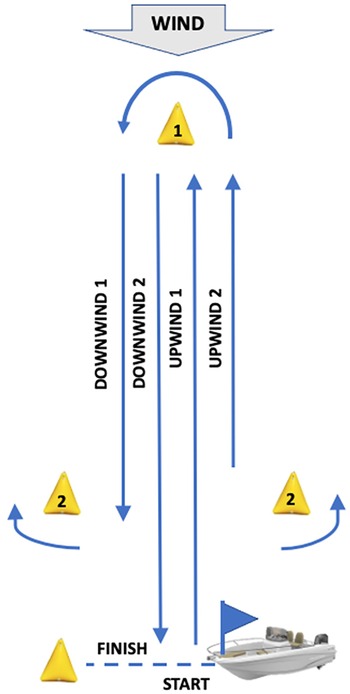
A total of 20 races were analysed: 12 in the 49erFX class and 8 in the 49er class. The wind speed ranges in the regatta were 4.4–12.8 knots and 5.5–11.6 knots in the 49erFX and 49er groups, respectively. Wind speed was categorised in each of the races according to the three ranges established by the Royal Yachting Association (Royal Yachting Association, 2019): 5–8 knots (very light wind), 8–12 knots (light wind), 12–15 knots (moderate wind) and >15 knots (strong wind). The race course consisted of 4 legs: 2 upwind and 2 downwind (Figure 2).
Regatta course in the 49erFX and 49er classes.

2.3. Statistical analyses
Descriptive data are presented as mean ± standard deviations. The Kolmogorov–Smirnov and Levene’s tests confirmed the normal distribution of the data and the homogeneity of variance (p > 0.05). Two-way ANOVA was used to evaluate the differences in performance variables between wind speed ranges and legs (upwind and downwind). Three wind speed conditions were evaluated for the 49erFX group (0–8 knots, 8–12 knots and 12–15 knots) and two wind speed conditions were evaluated for the 49er group (0–8 knots and 8–12 knots). Bonferroni post hoc test was applied for pairwise comparisons. A 95% confidence interval was included, and effect size (ES) was calculated by Cohen’s d and defined as follows: trivial (ES < 0.19), small (ES = 0.20–0.49), medium (ES = 0.50–0.79) and large (ES > 0.8). The level of significance was set at p < 0.05. The SPSS package was used for all analyses (v24, SPSS Inc., Chicago, IL, USA) and STATA package was used for the graphics (v16, StataCorp LP., College Station, Texas, USA).
3. Results
The results of all dependent variables in the 49erFX group are presented in Figure 3. When comparing the overall differences across different groups, a significant group effect was found for the different wind speed ranges (i.e. 0–8 knots, 8–12 knots and 12–15 knots, p<0.001) and legs (i.e. upwind and downwind, p<0.01). Furthermore, a significant interaction effect was found for mean velocity, mean distance, mean VMG and total distance (p<0.001).
Differences between wind speed groups, and upwind and downwind legs in the female category. The groups are divided according to the course of the regatta (upwind and downwind) and the wind speed ranges (knots). Here, * indicates differences between upwind and downwind in the specific wind speed range for the same wind speed range; a indicates differences with respect to 0–8 knots for the same course; b indicates differences with respect to 8–12 knots for the same course. VMG, velocity made good.

The post hoc analysis revealed significant differences between the three wind speed ranges, both in upwind and downwind legs, for the variables mean velocity (p<0.001; ES, 2.62–6.61), mean distance (p<0.001; ES, 1.32–8.16), mean VGM (p<0.001; ES, 2.74–6.57) and total distance (p<0.001; ES, 1.32–8.16). For the variables mean manoeuvres and total manoeuvres, significant differences were only found in 0–8 knots with respect to 12–15 knots in upwind (p<0.05; ES, 0.31) and in 8–12 knots with respect to 12–15 knots in downwind (p<0.05; ES, 0.38). Finally, significant differences were found between upwind and downwind in all wind speed situations for all variables (p<0.001; ES, 0.64–8.25).
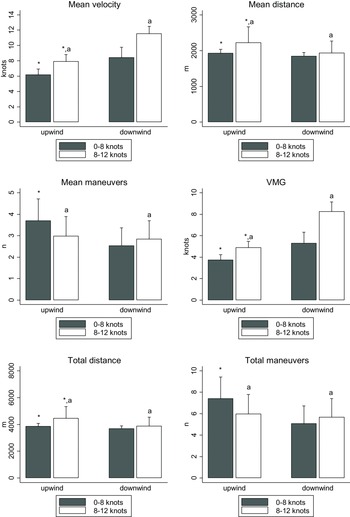
The results for the 49er group are presented in Figure 4. A group effect was found for the different wind speed ranges (i.e. 0–8 knots and 8–12 knots, p<0.01) and for legs (i.e. upwind and downwind, p<0.001) in all variables. A significant interaction effect was also found for all variables (p< 0.001).
Differences between wind speed groups and upwind and downwind legs in the male category. The groups are divided according to the course of the regatta (upwind and downwind) and the wind speed ranges (knots). Here, * indicates differences between upwind and downwind in the specific wind speed range for the same wind speed range; a indicates differences between the two wind speed ranges in the same course. VMG, velocity made good.

The post hoc analysis revealed significant differences between the two wind speed groups, both in upwind and downwind situations, in all variables (p<0.05; ES, 0.36–3.06). Regarding differences between legs (upwind and downwind), significant differences were found in all variables (p<0.05; ES, 0.75–4.54), except when comparing mean and total manoeuvres in the 8–12 knots situation.
4. Discussion
The objective of this study was to analyse how wind speed affects the variables of velocity, distance and manoeuvres in a real regatta of the 49er and 49erFX classes, using GPS devices. To our knowledge, this is the first study to evaluate these variables in different wind conditions during a regatta, and it is also the first study to analyse the two types of legs developed during the competition (upwind and downwind).
The main findings of the present study are as follows. In both female and male groups, it was observed that mean velocity and VMG increased with wind speed. In the same way, and in all wind conditions, mean velocity and VMG were higher in downwind compared with upwind. In the downwind legs, the boat can exceed the speed of the wind, as it creates its own apparent wind. VMG is the best combination of velocity and sailing angle (Pan and Sun, Reference Pan and Sun2022). To calculate this variable, the vertical component of the velocity relative to the wind direction is used as a reference and the velocity of the boat is multiplied by the cosine of the angle of the wind direction. This variable will be conditioned by the sailor’s ability to reach the course buoys at the highest speed and covering the shortest possible distance (Caraballo et al., Reference Caraballo, González-Montesinos, Casado-Rodríguez and Gutiérrez-Manzanedo2021b). Like the boats in the RS:X class, the boats in the 49er and 49erFX classes are designed to overcome the speed of the wind in which they are sailing (Castagna et al., Reference Castagna, Brisswalter, Lacour and Vogiatizis2008). This design allows reducing the hydrodynamic resistance of the boat when reaching high velocities, since the planing situation is facilitated, enabling the sailor to reach a higher speed. In addition, it must be emphasised that the aerobic demand is 25% higher when sailing downwind compared with upwind (Bay et al., Reference Bay, Bojsen-Moller and Nordsborg2018). Regarding the course of the regatta, it was observed that the sailors reached a greater VMG in downwind compared with upwind. These results are in line with those obtained in Laser class, kitesurfing class and RS:X class (Caraballo et al., Reference Caraballo, Conde-Caveda, Pezel, Milavic and Castro-Piñero2021a; Caimmi and Semprini, Reference Caimmi and Semprini2017; Pan and Sun, Reference Pan and Sun2022; Chun et al., Reference Chun, Park, Kim and Kim2002). Our study is the first to determine the fastest course in the 49er and 49erFX classes, and it is the first study to offer results on this variable in all wind conditions. Therefore, wind velocity, most notably in downwind legs, should be considered as an important variable of performance in the 49er and 49erFX classes.
In the present study, the results show that the distance to sail the upwind leg course was longer than that in the downwind leg. This was observed in all wind conditions. Additionally, the distance travelled is longer as the wind speed increases, which is more beneficial in terms of boat performance, i.e. the boat could develop greater velocity, which most likely allows it to obtain a more efficient VMG to reach the upwind mark. It can be considered that this longer distance travelled in upwind is compensated by higher velocity. This could therefore suggest that the strong winds helped some sailors achieve the optimal combination of velocity and sailing angle in these conditions. This would imply a greater physiological demand; therefore, it should be considered by coaches when planning the training of the sailors (Caraballo et al., Reference Caraballo, Conde-Caveda, Pezel, Milavic and Castro-Piñero2021a,b; Cunningham et al, Reference Cunningham and Hale2007). It should be noted that the sailors with a higher performance level completed the course in a shorter distance (Hagiwara and Ishii, Reference Hagiwara and Ishii2016). Therefore, the sailors’ training should be focused on improving the relationship between the velocity reached in the boat and the distance travelled, with VMG being the result obtained between these two variables.
The main manoeuvres that are carried out in a regatta are tacking, gybing and bearing away onto a run. Compared with downwind, the results of our study show that the sailor performs a larger number of manoeuvres in upwind. It is considered that the aerobic demand increases in manoeuvres compared with straight sailing. This demand is higher when the sailor is sailing in upwind compared with downwind (Bay et al., Reference Bay, Bojsen-Moller and Nordsborg2018). The results of previous studies have shown that these actions reduce the velocity of the board; thus, a lower number of manoeuvres means a lower loss of velocity during both upwind and downwind legs (Bojsen-Moller et al., Reference Bojsen-Moller, Larsson and Aagaard2015). Reducing the number of manoeuvres should make the boat sail faster and quicker towards the target mark. Studies carried out in a simulator have shown that more experienced sailors perform fewer manoeuvres to complete the course (Aráujo and Serpa, Reference Araújo and Serpa1999). Therefore, based on our results, we could consider that the sailor’s training should be focused on the upwind course and on improving the efficiency of the manoeuvres.
In our study, it was observed that the technique and tactics showed differences in terms of wind speed. It can be considered that velocity, distance and manoeuvres played an important role under strong wind velocity conditions. These results are similar to those shown in previous studies in the RS:X class (Anastasiou et al., Reference Anastasiou, Jones, Mullan, Ross and Howatson2019). Some studies have reported that the starting strategy in light or moderate wind velocity is different from that in strong wind velocity (Chun et al., Reference Chun, Park, Kim and Kim2002). Thus, it can be considered that technical and tactical variables play an important role in strong wind velocity conditions. The results obtained in this study could aid the formulation of technical or tactical pacing strategies that are required to manage a regatta.
Regarding manoeuvres, as the wind velocity increases, the number of manoeuvres decreases in upwind. These results were observed in both the 49erFX and the 49er groups. Manoeuvres can be more complex to perform when the wind speed is high, since the boat is more unstable. Accordingly, the sailor will try to carry out a smaller number of manoeuvres so as not to lose velocity or stability, or modify the trajectory that he/she had established to reach the windward buoy. In dinghy sailing, the intensity of the wind is one of the variables that determines the level of neuromuscular fatigue during upwind sailing (Cunningham and Hale, Reference Cunningham and Hale2007). Moreover, it must be considered that the sailor sails upwind first before starting the downwind leg, so he/she would have accumulated fatigue. During upwind, sailors counteract the heeling force on the boat and sideways force on the sails. However, the lateral force and heeling are lower when the sailor is sailing downwind, since the resulting forces tend to be concentrated towards the forward motion of the boat. This could explain why our results showed a smaller number of manoeuvres in upwind compared with downwind. Previous studies have shown the relationship between wind speed and the number of manoeuvres performed by the sailor in upwind. Previous research has shown that the number of tacks in light wind was larger compared with moderate and strong wind in the Laser class (Winchocombe et al., Reference Winchcombe, Goods, Binnie and Doyle2021). This situation is due to the fact that the sailors would be concentrated in a small area, as there was not enough wind to advance. Thus, the sailors would be forced to make a larger number of tacks to get right of way and reach areas with better wind conditions. Nevertheless, our result was different in the group of males during the downwind course. During downwind, as the wind velocity increases, the number of manoeuvres increases. During this course, although sailors have less time to complete the manoeuvres due to greater boat velocity, as well as increased demand for gennaker control, these technical and tactical actions require moderate aerobic energy production and a modest elevation in blood lactate concentration (Bay et al., Reference Bay, Bojsen-Moller and Nordsborg2018). Therefore, the sailor could increase the number of manoeuvres in strong wind conditions to achieve a higher speed by being in the areas where the wind is more favourable. Likewise, this larger number of manoeuvres can favour orienting the boat in a more rectilinear trajectory towards the leeward buoy. Our results are in line with those obtained in previous research with elite sailors in the Laser class, where the number of downwind manoeuvres increased with the increase of wind speed (Pan and Sun, Reference Pan and Sun2022). The Laser class sailors analysed in the mentioned study modified their body weight inside the boat to alternate the heel between windward and leeward, to achieve greater boat velocity.
Our results regarding the velocity and distance of each leg in different wind conditions are similar to those obtained by Olympic sailors in the RS:X class. In this class, it is observed that the high-performance sailors obtained greater velocity and shorter distance to complete the course in almost all legs for strong wind conditions (Chun et al., Reference Chun, Park, Kim and Kim2002). Other studies have asserted the importance of the upwind course in the Laser class, where the most successful sailors were faster and travelled a shorter distance compared with low-level sailors (Caraballo et al., Reference Caraballo, Conde-Caveda, Pezel, Milavic and Castro-Piñero2021a).
Our results suggest that GPS is a suitable device to provide information on the technical (velocity) and tactical (distance and manoeuvres) characteristics of a regatta in the 49er and 49erFX classes. In these classes, and as in other classes of light sailing, the course taken during a regatta is characterised by being linear and continuous. In addition, tacks, gybes and buoy manoeuvres are performed at a speed that can be adequately recorded by GPS devices. Studies have shown that GPS devices with a recording frequency of 5Hz are suitable for evaluating speed and distance in linear movements (Gray et al., Reference Gray, Jenkins, Andrews, Taaffe and Glover2010). Therefore, the data obtained with the device that was used in our study could be considered valid and reliable.
Improving performance is the goal of any elite athlete. This performance can be improved by means of the information obtained in regattas carried out by the sailor’s boat through GPS devices (tracking monitoring). Variables related to performance can provide objective information about the outcome of strategies and tactical decisions made through each of the races that are part of a regatta (Huges et al., Reference Huges and Bartlett2002). Due to the characteristics of dinghy sailing regattas, the races are very difficult to watch, and coaches have limited times when they can provide feedback to their sailors on the development of the competition. Nevertheless, the SAP-Sailing® application can be used by coaches to analyse the variables related to performance in real time. This information can be transmitted to the sailors during the breaks between races. Thus, it can lead to a better understanding of the within-race strategies implemented. Our recommendation is that the use of these devices should not be limited to regattas, but it should also be used during sailors’ training. In this situation, the coach does not have so many limitations to offer this information compared with at a regatta. Some studies show that monitoring training and competition load through a scientific approach plays an important role in modern-day sporting environments (Buchheit, Reference Buchheit2014). This monitoring of training and competition is essential for coaches, sailors and sports scientists to identify the specific characteristics of their sport, to know whether the objectives established in training are being achieved (Kellman et al., Reference Kellman, Bertollo, Bosquet, Brink, Coutss, Duffield, Erlacher, Halson, Hecksteden, Heidari and Kallus2018).
4.1. Limitations and further research
Some limitations could be considered in our study. First, the sailors’ anthropometric characteristics were not recorded. It would have been interesting to analyse those variables; unfortunately, it was not possible to include such data in this study, since the SAP-Sailing application did not collect them. Second, based on the available data, only two wind ranges (0–8 and 8–12 knots) in the men’s group of sailors were analysed in this study. This was because these were the only wind conditions present during the analysed races of the regatta. Future studies could be focused on the analysis of the technical and tactical variables in different wind conditions in different regattas and specifically analyse each of the races that make up the regatta. Likewise, in terms of weather conditions, variables such as waves, wind gusts and currents on the racecourse should be analysed.
However, our study provides relevant information on the characteristics of a regatta in the 49er and 49erFX classes. Moreover, the performance on short intensive courses is determined by the handling of the boat, and thus the data obtained in our study offer a detailed analysis of optimal/economic movement patterns in specific manoeuvres. This information can be used by coaches and sailors alike to enhance their performance in regattas.
5. Conclusions
Both the mean velocity and the VMG exhibit a positive correlation with wind speed in the 49er and 49erFX class races studied. In all wind conditions, it was observed that sailors reached a greater mean velocity and VMG in downwind compared with upwind. Under all wind conditions, the distance and manoeuvres carried out required to complete the upwind leg were consistently greater than those required in the downwind leg. Training efforts should prioritise the upwind course and aim to enhance manoeuvring efficiency, more prominently in strong wind conditions.
Acknowledgements
The authors would like to thank Prof. L. Pezelj from the University of Split for their cooperation and keen interest in the study design.
Data availability statement
Publicly available datasets were analysed in this study. These data can be found at https://49er.org/teams/ and https://www.sapsailing.com/gwt/Home.html#/event/:eventId=74e27348-ee53-4b1c-b042-3a6f09c27bb2
Author contributions
Conceptualisation, I.C., J.V.G.M. and L.P.; methodology, I.C., J.V.G.M. and J.G.U.; software, I.C. and J.V.G.M; validation, I.C. and J.V.G.M.; formal analysis, I.C. and J.G.U.; investigation, I.C., J.V.G.M. and L.P.; resources, L.P. and J.G.U.; data curation, I.C. and J.V.G.M.; writing-original draft preparation, I.C. and J.V.G.M.; writing-review and editing, I.C., J.V.G.R, J.J.R.A, J.G.U. and L.P.; visualisation, I.C. and J.V.G.M.; supervision, I.C. and J.V.G.M; project administration, I.C.; funding acquisition, I.C. All authors have read and agreed to the published version of the manuscript.
Institutional review board statement
The study did not require ethical approval. Ethical review and approval were waived for this study, since all the data used in this study are publicly accessible, and these are in World-Sailing® and SAP-Sailing®.
Informed consent statement
Participant consent was waived, since all the data used in this study are publicly accessible, and these are in World-Sailing® and SAP-Sailing®.
Funding statement
The publication of this article was financed by the University of Cádiz Library.
Competing interests
The authors declare no conflict of interest.



 Open access

