

8.1 Introduction
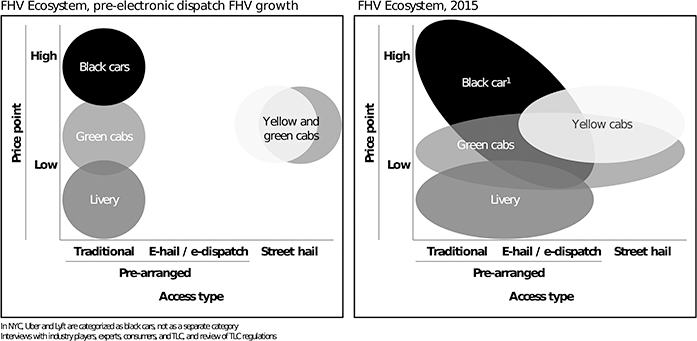
The advance of GPS technologies and the swift adoption of smartphones has enabled the rapid growth of on-demand ride services. People, being connected to the network anywhere anytime, started to see the benefits of having on-demand access to a ride from multiple competing providers. It was a convenient system for all involved parties. Moreover, not adapting to the new network-based system meant missing out on benefits for the riders and losing the market share for the ride-hailing companies. As a result, as Figure 8.1 illustrates, even traditional street hailing services adopted e-hailing systems quite quickly. On-demand ride-hailing platforms, such as Uber and Lyft, have grown rapidly in the last decade in almost all countries; in some markets, they doubled the number of riders each year. It is fascinating to see a service that did not exist just ten years ago become so significant. It is now the fastest-growing transportation mode, has gained a larger market share than taxis in many cities, and has provided another transportation option and much more flexibility to passengers. It has altered the urban mobility landscape in a significant way. However, just like any other disruptive technology in its early years, it has brought some problems too. Municipal officials are concerned about congestion and pollution, drivers complain about their working terms (as evident in the forum [1]), taxi companies are enraged about unfair competition, and passengers are often agitated with sudden spikes in fares, all suggesting that this new experience is far from being stabilized.
The figure shows the categories of for-hire vehicles (FHV) in New York City and the fact that they all adopted e-hail/e-dispatch systems by 2015 [2].
One of the primary questions about ridesharing services is whether they decrease or increase traffic congestion (and relatedly carbon dioxide [CO2] emissions). Traffic congestion is a serious and growing concern in modern life in metropolitan areas. The 2019 Urban Mobility Report of the Texas Transportation Institute [Reference Schrank, Bill and Tim3] shows that the national congestion cost in the United States has risen from $75 billion in 2000 to $179 billion in 2017 (both in 2017 dollars), a whopping 139 percent increase in less than two decades that signifies the urgency of addressing this issue. Due to the rapid expansion of ridesharing services in urban areas in the last decade, the question of their impact on traffic congestion and carbon emissions has gained considerable interest among researchers and policymakers. Researchers are clearly split between advocates and critics of ridesharing services. On the one hand, these platform-enabled ride-hailing services may decrease traffic by increasing capacity utilization and reducing ownership/use of private cars. On the other hand, this type of ride-hailing may increase traffic congestion and pollution by replacing carpooling and nondriving modes such as mass transit, biking, and walking with separate and nonshared platform-initiated rides or motivating a new trip that would have not been made otherwise. These latter findings have surprised many observers since these services were expected to help mitigate traffic congestion.
This chapter reviews the literature and analyzes different perspectives on this debate,Footnote 1 describes key policy measures, and determines the future research opportunities that could help to settle this debate. The remainder of this chapter is organized as follows. Section 8.2 provides a historical overview of ridesharing services. Section 8.3 details the arguments on each side of the debate concerning ridesharing and traffic congestion. Section 8.4 reviews some policy measures for mitigating the negative impact of ridesharing services on congestion. Finally, Section 8.5 identifies the research gaps in this area for future research.
8.2 Ridesharing – A Historical Overview
The idea of ridesharing (people sharing a trip in the same vehicle) is as old as the history of transportation and human traveling. Additionally, the negative externalities and challenges that appear to be associated with ridesharing services are similar to the negative externalities brought with any other disruptive technology throughout history. In the field of urban mobility, when the first hackney coach/carriage, the ancestor of modern days taxis [Reference Gilbey4], was introduced in London in 1605, everybody was excited and pleased with the service. However, the number of hackney coaches grew very fast, brought great nuisances to the streets of London, and raised fierce competition and bitterness between hackney coaches, wherries, barges, and sedan chairs (the popular urban transportation modes of that time) [Reference Gilbey4]. By 1635 Charles I, the king of England, issued a proclamationFootnote 2 banning and limiting the usage of hackney coaches in specific regions [Reference Anderson7]. Hackney coaches had a bumpy road with many ups and downs until the 1660s, when finally the Hackney Carriages Act of 1662 recognized the hackney carriages as one of the modes of transportation and regulated their usage concerning fares, crawling, days and hours of operation, licensing, the permissible number of licensed coaches, and specifications of horses used [Reference Gilbey4]. The current questions and debates about ridesharing services and some of the policy responses are remarkably similar. As Mark Twain famously said: “History doesn’t repeat itself, but it often rhymes.”
By the end of the twentieth century, ridesharing became a necessary and inseparable part of modern life. Because of the rapid expansion of technologies and inventions in recent decades and the complexities of modern societies, current app-based ridesharing services are conglomerates of different features of older ridesharing services, each having a different history. It is useful to learn these histories to understand their impact on current transportation systems. The rest of this section briefly reviews the histories of dial-a-ride transit, carpooling, and carsharing as the predecessors of modern ridesharing options, and then it reviews the history of platform-based services.
8.2.1 Dial-a-Ride Transit
The paratransit system, commonly known as Dial-a-Ride, is a door-to-door or curb-to-curb transportation service for people with special needs, including seniors and people with disabilities, who cannot use the standard fixed-route transit systems. People can request this service for commuting to work or school, going to a hospital, visiting a friend, or just shopping or doing groceries, typically trips constrained within a geographic zone. The establishment of the service in the United States dates back to 1970 when it started in Mansfield, Ohio in a collaboration project with Ford Motors. Two years later it was followed by a similar service in the United Kingdom in the town of Abingdon [Reference Oxley8]. The service is technically an on-demand service, but in reality most often it must be prescheduled. There is a spectrum of services in different paratransit systems where on the one end the service could be an on-demand ridesharing service that would go through a fixed route and on the other end, it could be a fully responsive transport system providing door-to-door service from any origin to any destination within a city or a specified service area. The vehicles are usually specialized cars, minivans, vans, or minibuses well-equipped to handle passengers with wheelchairs or other special needs. The passengers are pooled together to share a ride based on their origin–destination (OD) pairs and requested time intervals.Footnote 3
8.2.2 Carpooling
The concept of carpooling (and vanpooling) goes back for decades and in the United States it became very common during World War II with efforts to save fuel for the war (see Figure 8.2). It again became popular during the oil crisis in the 1970s, due to the high cost of gasoline, before gradually declining in the years that followed [Reference Ferguson10, Reference Morency11]. Carpooling can occur in three different ways: 1) commute carpooling, where people arrange their commute on a long-term basis and commit to mutually agreed and predetermined pick-up and drop-off locations and times; 2) long-distance carpooling, where drivers and riders match for a potentially one-time long-distance trip with advance scheduling and typically with an abundance of flexibility; and 3) casual carpooling (also known as “slugging”) [Reference Kelly12], where drivers and riders start a one-time relatively short rideshare trip on the spot similar to hailing a taxi on the street.Footnote 4
World War II posters promoting carpooling for work commute.

8.2.3 Carsharing
Carsharing typically refers to short-time car rentals, often for less than an hour, for a single trip within the city. The fleet usually is comprised of small electric/hybrid cars and is geographically distributed in different parts of the city. The members of a carsharing club can see the location of the closest car on a map in the carshare provider’s mobile application. Depending on city regulations, sometimes they have specific parking places, and sometimes they can be parked at any free curbside parking spot. Notable providers of this service in the last fifty years include Witkar, Communauto, ZipCar, FlexCar, City Car Club, and City CarShare. In recent years peer-to-peer carsharing is also becoming popular through services such as RelayRides and Getaround.Footnote 5
8.2.4 Application-Based Ridesharing Services
It is difficult to pinpoint the first app-based or peer-to-peer ridesharing service. Neither Lyft nor Uber gets the credit, as many other platforms started offering ridesharing services ahead of them. These platforms include Craigslist Ride Board, CarPoolWorld, BlaBlaCar, GoLoco, PickupPal, Avego (currently Carma), ZimRide, Flinc, SideCar, and Tickengo (currently Wingz).
Among these platforms perhaps SideCar is the most notable. It was the first ridesharing service that started operation in San Francisco in 2011, and its purchase by General Motors in 2015 was very well-publicized [Reference Nagesh16, Reference Paul17], bringing more attention to app-based ridesharing services. SideCar could also be credited as the inventor of platform-based, on-demand, short-distance, intracity ridesourcing, as Chief Executive Officer (CEO) Sunil Paul’s Reference Paul2002 patent suggests [Reference Paul18]. Another notable platform is ZimRide. ZimRide is a long-distance, intercity ridesharing service initially targeting college students and was founded in 2007 after one of its founders observed strangers to each other sharing a ride in Zimbabwe. ZimRide connected drivers and riders through Facebook to ensure security.
The currently dominant ridesharing services were born through these early experiences. Lyft was started as a side project within Zimride to provide intracity ride services and initially launched in San Francisco in May 2012. Since the market was extremely asymmetric in favor of Lyft, the founders offloaded the intercity carpooling section of the company and sold ZimRide to the car-rental giant Enterprise in 2013 to focus more on developing Lyft. Uber was founded in 2009 and officially launched its service in San Francisco in 2011 as a limousine or luxury black car service for more affluent customers. Later, in the summer of 2012, it developed into the ridesharing service as we know it now by launching Uber X, which allows individuals to be Uber drivers with their own cars. This was about the time of Didi’s inception in China, which later became the second largest ridesharing service in the world, as Lyft and Uber also started to expand globally. Many other similar services were developed in other countries; see Table 8.1 for a short list.
Company | Country of Origin | Operation Started in |
|---|---|---|
BlaBlaCar | France | 2006 |
Carma (formerly Avego) | Ireland | 2007 |
Flinc | Germany | 2010 |
Ola | India | 2010 |
Gett | Israel | 2010 |
Cabify | Spain | 2011 |
Yandex | Russia | 2011 |
Didi | China | 2012 |
Grab | Singapore | 2012 |
Careem | UAE | 2012 |
Via | Israel | 2012 |
Bolt (formerly Taxify) | Estonia | 2013 |
Snapp | Iran | 2014 |
Gojek | Indonesia | 2015 |
FreeNow | Germany | 2019 |
Initially, neither Lyft nor Uber had a carpooling or ridesharing option leading many transportation experts to use the term “ridesourcing” for their service instead of any term that would include “pooling” or “sharing.” It could be the case that the adoption of the term “ridesharing” by many of these platforms in the early years of their operation when they were essentially operating as de facto taxi companies, was to avoid regulations surrounding taxis. To finally remove the ambiguity, in 2013, a new category of mobility service was defined in the United States as transportation network companies (TNCs) to distinguish the operation of these services from taxis, chauffeured car services, and other for-hire vehicles [Reference Geron19].
Eventually, in 2014 Lyft Line and Uber Pool were introduced, where multiple passengers could “share” a ride [Reference Rodriquez20]. Later in 2015 and 2016, new services such as Uber Commute, Uber Destinations, and Lyft Carpool were launched, where drivers were assumed to have a predetermined destination towards which they would pick up those passengers heading in that same direction. This was very similar to classical commuting carpooling and casual carpooling [Reference Byford21, Reference Hawkins22, Reference Hawkins23]. Uber also launched Uber HOP in 2015 [Reference Hawkins24, Reference Soper25], which appears to have morphed into Uber Express Pool in late 2017 and early 2018 [Reference Etherington26], in which riders have to walk to an efficient pickup location, in exchange for a cheaper fare, and share the ride with other passengers to drop off locations that are close to (but not exactly) their destinations. It was followed by a similar service by Lyft called Shared Saver in early 2019 [Reference Hawkins27].
It is important to keep in mind the above chronology of events in the development of ridesharing services when reviewing the literature in the next section, as some of the studies span a certain period of time.
8.3 Is Ridesharing a Solution or a Concern?
Early studies about ridesharing platforms mostly promoted ridesharing services as having the potential to improve the overall efficiency of the transportation system by reducing the idle capacity of vehicles. Data from the National Household Transport Survey (NHTS) [28] show that during the period April 2016 to March 2017 about 94 percent of personal vehicles in Massachusetts were idle (parked) 94 percent of the time (see Figure 8.3). Platform-based ridesharing held the promise of using some portion of this idle capacity, thereby contributing to the overall economy. These early studies also proposed the idea that app-based ridesharing services may reduce road congestion and carbon emissions in metropolitan areas, primarily by increasing capacity utilization in each trip [Reference Li, Hong and Zhang29, Reference Li, Hong and Zhang30]. These studies showed that a significant level of ridesharing adoption would have considerable benefits for reducing traffic and CO2 emissions.
Distribution of active time percentage of personal vehicles in Massachusetts from April 2016 to March 2017.

However, as the early fascination faded and people experienced the new system, some reports suggested that ridesharing services such as Uber may be actually contributing to congestion instead of decreasing it [Reference Rayle, Dai, Chan, Cervero and Shaheen31], while other reports were inconclusive [Reference Merrill and Coote32]. These studies, and highly publicized challenges such as the feud between Uber and New York City [Reference Flegenheimer33, Reference Flegenheimer34] and the lawsuits that Uber faced in recent years which resulted in bans on Uber’s operation in many cities and countries around the world [35, Reference Rhodes36], initiated the idea of regulating the industry. Policymakers around the world considered a broad range of regulations, including a cap on the number of operating vehicles, a limit on the growth rate of these platforms in a city, a ceiling on surge pricing,Footnote 6 as well as zoning restrictions and congestion pricing. These almost contradictory studies, along with the regulatory efforts and legal challenges backed by municipal and governmental administrations and taxi companies around the world, sparked a debate on the true impact of ridesharing services on urban congestion and the necessity of further regulations and policies.
This section summarizes the arguments and research findings that either claim ridesharing services have helped mitigate congestion and pollution problems or suggest that instead they are contributing to these problems.
8.3.1 Ridesharing as a Solution
The main argument claiming a positive impact from ridesharing services is based upon the notion that modern ridesharing at its core is a way of carpooling or carsharing. Indeed, before the rise of app-based ridesharing services, the concepts of carpooling and ridesharing were almost synonymous. Thus, consistent with the generally positive understanding of the impact of carpoolingFootnote 7 and carsharing,Footnote 8 it was expected that ridesharing services should also provide some savings in vehicle miles traveled (VMT),Footnote 9 CO2 emissions, travel time, and travel/fuel cost.
Not surprisingly, early studies of what we now recognize as app-based ridesharing services were a natural progression from carpooling studies. Most such studies assumed a dynamic ridesharing system in which trips could be coordinated between people with similar itineraries and scheduled on short notice (a few hours to a few minutes in advance) or even in the course of the trip [Reference Gruebele41–Reference Amey, Attanucci and Mishalani45]. For example, Agatz et al. [Reference Agatz, Erera, Martin, Savelsbergh and Wang43] propose an optimization approach for the problem of matching drivers and riders in real-time.Footnote 10 The appearance of the concept of dynamic ridesharing coincided with the rise of app-based services and created a new branch of research in the quest for designing more efficient transportation systems regarding different criteria including congestion.
Another classic body of research on platform-based ridesharing services is the well-known pickup and delivery problem (PDP). In PDP, a single vehicle, or a fleet of them, has to visit pickup locations to pick up goods or people and drop them off at delivery locations while minimizing the total distance or cost of all the routes. PDPs have many different varieties. The dial-a-ride transit service discussed earlier is a special example of this problem. Dynamic one-to-one multiple vehicle PDPs relate directly to ridesharing services. Here, the service is provided by a fleet of vehicles serving customers’ requests that are initiated on a dynamic basis, originated at one location, and destined for another.Footnote 11 Most studies of PDPs focus on logistics and cost minimization rather than on congestion-related aspects. Among the relevant studies, Wang et al. [Reference Wang, Dessouky and Ordonez50] show that in the presence of congestion and high occupancy vehicle (HOV) lanes and existing policies of discounted toll rates on HOVs, taking detours to pick up additional passengers, that is, sharing the ride, and using HOV lanes can reduce the cost of a ride as well as the travel time (thereby reducing congestion and emissions).
The true shared services such as Uber Pool and Lyft Line were built upon this rich literature of PDPs. Uber’s then CEO Travis Kalanick once described Uber Pool as a major evolution of Uber’s business model:
Two people taking a similar route are now taking one car instead of two. And when you chain enough of these rides together, you can imagine a perpetual trip — the driver picks up one customer, then picks up another, then drops one of them off, then picks up another. [Reference Anand51]
Because of this pooling and sharing of rides, initially, there was great hope and expectation for ridesharing services, as a revolution in urban mobility, to reduce congestion in addition to increasing consumer welfare. To analyze this, Li et al. [Reference Li, Hong and Zhang29, Reference Li, Hong and Zhang30] conduct a difference-in-difference (DID) analysisFootnote 12 with travel time index (TTI),Footnote 13 commuter stress index (CSI),Footnote 14 and delay as primary dependent variables to measure the impact of Uber on congestion in 101 urban areas. They conclude that Uber’s entry into these urban areas significantly reduced congestion. Hall et al. [Reference Hall, Palsson and Price52] also use a difference-in-difference analysis on a data set of transit ridership in U.S. metropolitan areas from 2004–2015 to show that Uber has had a complementary effect to public transit, suggesting a potential to reduce congestion, and that its effect on the increase in mass transit ridership grows over time. They also conclude that Uber’s biggest complementary effect is on the public transit system that had the smallest ridership before Uber’s entry. The article, while having a generally positive view on ridesharing services, does not directly study Uber’s impact on congestion but raises a speculative concern that an increase in ridership might lead to increased traffic and suggests that it needs further investigation. Furthermore, a study [2], conducted by the Office of the Mayor of New York City, shows that most of the increase in app-initiated rides in New York City during 2014 and 2015 were substitutions for rides in yellow cabs and thus did not contribute to the observed increase in total VMT (or VHT) and congestion during that period. Similar to the study in New York City, a study using data from Boston [Reference Alexander and González53] found that under moderate to high adoption rate scenarios, ridesharing is likely to result in a noticeable decline in urban traffic and congested travel times. These studies make the case for supporting policies that promote the use of ridesharing services to reduce congestion.
8.3.2 Ridesharing as a Concern
Despite the expected positive effects of ridesharing services on congestion, more recent studies have suggested that there might also be some rebound effects, that is, the reemergence of congestion in another form. These rebound effects include modal shift,Footnote 15 induced traffic,Footnote 16 deadheading,Footnote 17 encouraging car usage, and relocation of people further within metropolitan areas. While it is expected that ridesharing reduces the number of vehicles on the road, as well as total VMT and CO2 emissions, it may also make people more accustomed to car usage and result in mode switching from public transit or other nondriving modes to cars in the short-term. In the long-term, ridesharing could cause people to relocate further away from metropolitan centers, thereby adding to congestion and pollution. It was mentioned in the last section that the New York City’s report [2] exonerated the app-based ridesharing services from contributing to the observed increase in traffic congestion during 2014 and 2015. However, it warned against the potential of rapid growth in e-hailed rides in the future, leading to a decrease in public transportation trips, which in turn would increase total VMT (or VHT). A ride switched from a yellow cab to a ride-hailing service has a chance of being a shared ride; therefore, generally, this type of switch will decrease congestion and pollution. However, a switch from public transportation to ride-hailing would have a detrimental impact on congestion; the report suggests that a switch in less than 1 percent of public transit rides is enough to offset the congestion mitigation earned by an 11–13 percent switch in yellow cab trips.
The studies that suggest ridesharing services contribute to congestion usually focus on one or some of these rebound effects and try to analyze their offsetting or negating impact on the savings gained by shared rides. For example, Yin et al. [Reference Yin, Liu, Coulombel and Viguie54] use an integrated land-use transport model to investigate the environmental impact of carpooling in the Paris region taking into account the impact of rebound effects. They conclude that under long-term scenarios for 2030 the rebound effects of ridesharing decisions will cut the expected CO2 emission savings of carpooling substantially. For short-term scenarios, similar results are obtained by a study [Reference Rayle, Dai, Chan, Cervero and Shaheen31], which conducted an intercept surveyFootnote 18 in three spots in downtown San Francisco during May and June of 2014 mostly concentrated on nighttime and social trips. Among the results are observations about induced travels and transportation mode substitution where passengers were asked if they would make the trip and how would they do it had they not used the ridesharing services. The survey shows that if ridesharing services were not available, about 8 percent of the respondents would not have made the trip. Among the rest, about 39 percent would have taken a taxi, 33 percent would have used public transit, 8 percent would have walked, 2 percent would have used a bike, 8 percent would have used their own car, and 1 percent would have shared a ride with a friend or family member. This means about half of the respondents would have either not taken the trip or would have used a nondriving mode for their trip. This is also confirmed by a recent longitudinal analysisFootnote 19 using monthly transit ridership data from twenty-two transit agencies and four modes of transportation (commuter rail, heavy rail, light rail, and motorbus) across major U.S. cities that shows that in fact, ridesharing services after entering a market draw passenger from heavy rail services by 1.3 percent per year and bus services by 1.7 percent per year [Reference Graehler, Alexander Mucci and Erhardt55].
Similarly, a survey of nearly 1,000 ride-hailing passengers in the Boston metropolitan area in late 2017 [Reference Gehrke, Felix and Reardon56], conducted by Boston’s Metropolitan Area Planning Council (MAPC), finds some concerning facts. It indicates that if ride-hailing services had not been available, approximately 42 percent of passengers would have taken a train or a bus for their trip, 12 percent would have walked or biked, 5 percent would not have made the trip at all, and the remaining 41 percent would have used a personal vehicle or taken a taxi. This means 59 percent of all ride-hailing trips in this survey were contributing to the total VMT and thus overall congestion. The 42 percent substitution from public transit trips is particularly alarming! A similar study [Reference Clewlow and Mishra57] considers seven major U.S. cities from 2014 to 2016. The results show that if TNC services were not available, 49 percent to 61 percent of TNC trips either would not have been made at all or would have been made using a nondriving mode (transit, bike, walk). It also suggests that ridesharing services reduce the ridership from bus and light rail services but have a complementary effect on commuter rail services. Confirming these results, a 2018 study [Reference Schaller58] shows that ridesharing services have added 2.6 new vehicle miles on the road for each mile of personal driving removed, a 160 percent increase in driving on city streets of nine large, densely populated metropolitan areas (New York, Los Angeles, Chicago, Boston, San Francisco, Miami, Philadelphia, Seattle, and Washington DC). In these cities, about 60 percent of users of ridesharing services would have taken public transportation, walked, biked, or not made the trip if these services had not been available, while 40 percent would have used their own car or a taxi. The study suggests that in most cases, the ridesharing services are targeting the same customer base as public transportation, just as the New York City warned in 2015.
There are also other studies that suggest an increase in congestion without delving into the reasons behind it. For example, a report [59] prepared by the London Assembly, names ridesharing services as one of the factors contributing to congestion in London. The report shows that there has been a 70 percent increase in the number of registered ridesharing vehicles between 2012 and 2017. In 2017, private hire vehicles, with a sharp increase since 2013, accounted for 38 percent of total car traffic volume in London’s congestion charging zone; this is roughly double the proportion of taxis, which is a remarkable growth in less than five years for an already congested city. Likewise, Schaller [Reference Schaller60] presents the results of a study on TNC ridership data in New York City from June 2013 to June 2016. Most notably, he shows the following: 1) the introduction of pool options such as Uber Pool and Lyft Line in TNCs helped ridership to grow faster than the number of licensed vehicles (i.e., higher utilization for TNC cars); 2) the net increase in ridership of hire vehicles due to the growth of TNCs in three years was 52 million passengers, 31 million trips, and 600 million miles; and 3) the net mileage increase due to the ridesharing services was 3.5 percent of the city’s total VMT while this percentage of total VMT for Manhattan was more than two times larger. This is a significant increase in VMT in an already congested area.
A similar report about New York City, Shcaller [Reference Schaller61] illustrates a 59 percent increase in hire vehicle hours in the central business district (CBD) between 2013 and 2017. The increase in weekday mileage of these vehicles in the CBD in the same period was lower at 36 percent due to slower vehicle speed – the overall traffic speeds declined by 15 percent. As passenger trips with taxis declined, the trips with ridesharing platforms increased but at a higher pace; the net increase in passenger trips with hire vehicles was 15 percent during this period. It is also notable that the unoccupied hire vehicle hours increased by 81 percent versus a 48 percent increase in occupied hours during these four years. Similarly a study of Denver, Colorado [Reference Henao62] surveys 416 rides of 311 passengers of Uber and Lyft and performs a before-and-after analysis.Footnote 20 Among the various results, it demonstrates that with the introduction of ridesharing services the ratio PMT/VMT has dropped from 112.3 percent to 60.8 percent and the overall VMT increased by 84.6 percent, both suggesting an increase in congestion.
More recently, a 2019 study [Reference Erhardt, Roy, Cooper, Sana, Chen and Castiglione63] claims that TNCs are the biggest contributor to congestion in San Francisco. The study conducted a before-and-after analysis and was based on a data set scraped from the application interface of Uber and Lyft in 2016 and was combined with San Francisco’s travel demand model, SF-CHAMP, to control for background factors that may also impact congestion. The study shows that the average speed decreased from 25.6 miles per hour (mph) in 2010 to 22.2 mph in 2016 and that the vehicle hours of delay (VHD) increased by 63 percent over the same period. A 2020 study in Santiago, Chile [Reference Tirachini and Gomez-Lobo64] uses a Monte Carlo simulation method and shows that ride-hailing services increase the total vehicle kilometers traveled (VKT) unless the average occupancy rate is significantly increased by actually sharing/pooling the rides.
All these studies were conducted while the ridesharing services were present in the regions of study. Among them, some relied on a before-and-after comparison to obtain a better understanding of their impact on congestion after they entered those regions. However, even such before-and-after analyses may not be adequately conclusive as the comparison is done over a long period, usually several years. A very recent study [Reference Agarwal, Mani and Telang65] takes an interesting and different approach, and yet suggests similar conclusions. It focuses on the city-wide strikes by drivers for these services as exogenous shocks in three major Indian cities (Mumbai, New Delhi, and Bangalore). It implements a regression analysis to study the impact of ride-hailing services on traffic congestion. It suggests the conclusion that congestion was reduced during these strikes as much as 40–53 percent of the reduction observed during a typical holiday. It also reports a public transport substitution effect suggesting that ride-hailing services were drawing passengers from mass transit.
8.3.3 Analysis of the Discrepancies in the Results
As has been demonstrated in the previous sections, the existing studies on the question of whether TNCs contribute to congestion have conflicting results. Because these studies are mostly empirical, statistical, or simulation-based, they naturally inherit some degree of uncertainty due to the methodologies. However, as the remainder of this section discusses, several avoidable factors are contributing to the inconsistency of the results.
Missing Factors: The studies discussed earlier are not always comprehensive in terms of the factors they consider. For example, in Schaller’s report [Reference Schaller61], a fraction of the reported 15 percent net increase in passenger trips with hire vehicles could be associated with other factors such as population growth, replacement of personal car usage, and deadheading. Although it is clear from the metrics used in this report alongside those in his earlier report [Reference Schaller60] that ridesharing services had contributed to the overall traffic volume in the CBD during 2013–2017, the magnitude of this contribution could be different if one would include those factors in the study. The New York City’s report [2], on the other hand, accounts for the TNC rides that are replacements of the use of private vehicles, but this report also does not account for the population growth or deadheading. The exclusion of certain critical factors from these studies could be the source of some of the disparities between the results.
The Scale of Truly Shared Rides: Another factor that leads to inconsistent results is the misunderstanding of the true scale of sharing in different cities. An advocate of ridesharing services may argue that the studies that view ridesharing services as a source of congestion are not fully capturing the full effect of sharing rides, and if we properly account for all shared and pooled trips the conclusion might be different. However, according to a recently published data set [66], on average, only about 13 percent of Uber rides in New York City in 2019 were actually shared; the number for Lyft was 24.7 percent. Figure 8.4 shows the monthly percentage of shared trips in New York City for Uber and Lyft – as the two currently dominant ride-hailing companies there. The charts show that the maximum percentage has never exceeded 30 percent for either of them (28.6 percent for Uber and 28.5 percent for Lyft). They also show a divergence between the two service providers which could be due to their different ride options and pricing schemes. The fact that Uber’s percentage is declining is a matter of concern as Uber had more than three times as many rides as Lyft in the same period. The weighted average of their combined percentages of shared trips in 2019 was just 15.7 percent of all trips. Misunderstanding the real scale of shared rides in the ridesharing services, which may lead to wrong assumptions, or missing to control for this factor can explain some of the inconsistencies between the results in different studies.
Percentage of shared trips in New York City for (a) Uber, and (b) Lyft.

Adequacy of Data: Availability of data, the type of available data, and the sample size can have an enormous impact on the way these studies are conducted and on their results. For instance, the data used by Erhardt et al. [Reference Erhardt, Roy, Cooper, Sana, Chen and Castiglione63] does not capture shared trips, and in any sequence of pickups and drop-offs, it only takes into account the first pickup and the last drop-off and none of the stops in between. Moreover, the first pickup location is not exactly the passenger’s location but rather the point at which the driver accepts the new order. This is because the data were collected by a tracing system that would only track out-of-service TNC vehicles. The study’s dependence on this data set may skew the results towards the conclusion that ridesharing services contribute to congestion, as it leaves the main congestion reducing force of these services, namely shared rides, out of the analysis.
Choice of Congestion Metric: It appears that the choice of the congestion metric has a big impact on the result of the study. For example, TTI and CSI are used by Li et al. in [Reference Li, Hong and Zhang29, Reference Li, Hong and Zhang30]. Both TTI and CSI are very good at measuring commuting-related congestion but may not be accurate measures for the overall ridesharing-related congestion observed in a city as they are merely based on two snapshots of peak time and free-flow time. As another example, Clewlow et al. [Reference Clewlow and Mishra57] mention that 49 percent to 61 percent of “trips” would have been either avoided or made by a nondriving mode such as walking, biking, or transit. However, it does not study the translation of this increase in the number of car-based trips into actual additional VMT or VHT, thus making it hard to realize the significance of this change.Footnote 21
Availability of Services: Availability and the existing usage levels of public transit, carpooling, carsharing, and shared bikes in a city might have a considerable impact on the type of service that riders would receive from TNCs. For example, a high level of carpooling adoption in a city may shift TNC rides more towards nonshared ones. Consider two studies focusing on two cities, one with a high level and another with a low level of public transit and carpooling. Assuming that there are no modal shifts, the rides in the latter are expected to have a higher percentage of shared rides. This combined with a choice of congestion metric like the ratio PMT/VMT could give us inconsistent conclusions on the congestion contribution of ridesharing services in these two studies. This would also lead us to the next attribute, that is, the spatial differences of these studies.
Spatial Differences: Most existing studies are limited locally while making conclusions globally. A local study may not give us the overall picture of the impact on traffic congestion in a country. Further and more comprehensive studies would be required to find out the global impact of ridesharing services on congestion. However, when making policies, as will be discussed more in the next section, it is generally better to rely on local studies with local conclusions. The results from a dense and populous city may not translate to a small town or vice versa, as both supply and demand sides of a ridesharing market in a large city are vastly different from that of a small city. The number of active ridesharing services in a city and the number and percentage of people using them can have a tremendous impact on the number of shared rides. Moreover, many other factors such as accessibility of public transit, demographics, and geography also play a role and force policymakers to rely mostly on local data and analyses. Therefore, the locational differences in cities that were the subject of the existing studies could help explain the difference in their results.
Temporal Differences: Similarly, collecting data or surveying trips at different times of the day or different days of the week may skew the analysis. For instance, the intercept survey used by Rayle at al. [Reference Rayle, Dai, Chan, Cervero and Shaheen31] is heavily weighted towards Downtown San Francisco’s social hot spots, where parking for a personal vehicle is a big problem, and in the evening when public transit is less frequent and people are more inclined towards taking a TNC vehicle to avoid driving under the influence. Furthermore, the effect of TNCs on congestion could vastly differ from one year to another. Consider four studies that rely on data from the following periods (as some of the studies discussed above do): 2014,Footnote 22 2014–2015, 2015–2016, and 2016. One should not expect consistent results from these four studies as the industry evolved dramatically during this period. For example, New York City’s report [2] suggests that TNCs did not contribute to the observed increase in congestion in New York City during 2014 to 2015 but could contribute to congestion in a significant way in the future if they draw passengers from public transportation. One year later, Schaller [Reference Schaller60] suggests that the net mileage increase due to the ridesharing services from 2013 to 2016 is 3.5 percent of the city’s total VMT. The exponential growth of TNC services during 2015–2016 could explain these seemingly different results. When the underlying subject is doubling in size every year, it would not be surprising if these studies come to different conclusions.
8.4 Policy Measures to Reduce Congestion
As mentioned in the previous section, the answer to the question of whether ridesharing services have a positive or negative impact on congestion depends on the location and the time. If at the local level in a certain region and a certain period a negative impact is observed, it is necessary to devise policy measures for controlling or mitigating this impact. This section reviews some of these measures, focusing just on policy responses that can directly mitigate congestion caused by ridesharing services. Despite some overlaps, other sources of traffic congestion may require different measures.
Infrastructure Expansion: Adding more roads, tunnels, bridges, subway/bus lines, and bike lanes can provide a long-term solution for the congestion problems caused by ridesharing services, as can expansion of the city towards the outskirts. However, these options require an increase in taxation to finance infrastructure projects, which is not always politically popular. Also, in many cases cities may face geographic barriers for expansion, and even if the expansion is possible it may not resolve the congestion issue in downtown areas and business districts. This pushes the cities to rely on more short-term solutions such as designing restricted traffic zones and congestion pricing [Reference Santora67, 68].
Restricted Traffic Zones: Restricted/limited traffic zones (RTZs or LTZs) are areas within a city where entry to these zones requires permission and may be subject to a fee. Entry to such zones could also be limited to certain hours of the day or certain days of the week, or for certain types of vehicles or groups of people (such as residents, public workers, and disabled motorists). LTZs are very common in Italian cities such as Rome, Florence, and Milan. In many cases, LTZs are complemented with either pollution charges or congestion charges. Odd-Even Zones (OEZs) apply similar restrictions to odd or even license-plate numbers during the weekdays. Tehran and Beijing are notable examples of the implementation of this policy. Tehran is particularly interesting, as its use of this practice dates back to late 1979 and it implements concentric layers of OEZs and RTZs together [Reference Salarvandian, Dijst and Helbich69].
Zero-emission Vehicles Zones and Pollution Charges: To promote electric and environmentally clean vehicles in congested urban areas, cities can design zero-emission zones (ZEZs) or low-emission zones (LEZs) in which only electric vehicles or ultra-low emission vehicles could travel. An alternative for cities with medium congestion or pollution levels is to impose a pollution charge in specific areas of the city on vehicles that fail to meet certain standards. This would reduce pollution as well as the traffic volume in such areas. Milan’s Ecopass System [Reference Martino70] is a prime example of this policy.
Congestion Pricing: Congestion pricing is the practice of charging a flat or variable rate fee to vehicles that drive in a specified zone within a city to reduce traffic and pollution in that zone. There are multiple successful cases of this policy around the world. A report prepared by the Center for City Solutions [71] reviews the results of congestion pricing in Singapore, London, and Stockholm. With its Area Licensing Scheme (ALS) designed in 1973, and updated with an Electronic Road Pricing (ERP) system in 1998, Singapore is perhaps one of the leading cities in the world in designing a congestion pricing scheme to solve traffic issues caused by rapid economic development and geographic restrictions. Singapore’s congestion pricing scheme resulted in a 24 percent decrease in inner city traffic, 6 mph increase in average vehicle speeds, 15 percent increase in public transit ridership, and 10–15 percent reduction in greenhouse gas emissions in the inner city. In London, congestion pricing resulted in a 9.9 percent reduction in traffic between 2000 and 2015 despite a 20 percent increase in population; it also added 30 percent to average vehicle speeds and 8.5 percent to the city’s transportation revenue. In Stockholm, despite population growth, the traffic volume decreased by 22 percent, VMT declined by 16 percent and 5percent for the inner and outer city respectively, and the government had net earnings of $143 million per year. Milan’s Area C program is another successful example of congestion pricing that within two months of implementation delivered a 36 percent decline in commercial and private traffic, a 50 percent decrease in accidents, an 11 percent increase in average vehicle speed, and a 24–45 percent cut in greenhouse gas emissions [Reference Martino72]. Despite the lack of a successful case in the United States, the concept of congestion pricing or zone pricing is not new to U.S. cities, as there have been multiple attempts to establish such systems in cities such as New York and San Francisco [Reference Elinson73]. New York is set to be the first city in the United States to adopt a congestion pricing policy. In 2017, Governor Andrew Cuomo announced his plan to impose a fare on traffic in Manhattan’s CBD (south of 60th street) to both reduce traffic and raise funding to fix New York City’s failing public transit system [Reference Santora67]. A similar attempt in 2008 led by Mayor Michael Bloomberg to charge $8 on entries to the most congested parts of Manhattan failed to gain the support of other boroughs [Reference Confessore74]. The new three-phase plan was finally approved by the state in 2019 [Reference Durkin and Artauni75] and the first two phases are already implemented, including $2–5 per trip surcharges for for-hire vehicles in the congestion zone. The third phase, which involves congestion pricing for all entries to the CBD, was scheduled to be implemented in January 2021. It is now scheduled for late 2023. If the initial estimates of entry fees – $11.52 for cars and $25.34 for trucks [Reference Sankar76] – are implemented, it is expected that the annual revenue from the plan will exceed $1 billion, which could be spent for the revival of public transit infrastructure. The plan’s third phase is pending approval from the Federal Highway Administration (FHA) [Reference Berger77]. However, it is unclear how much this program would reduce the congestion caused by TNCs in Manhattan, as about half of their trips in the CBD zone start and end within that zone [Reference Schaller60].
Capping Number of Hire Vehicles and Limiting Zones of Operation: In some cities, limitations on the number of taxicabs and their operation areas are already in place. For example, in New York City, restrictions on the number of yellow and green (Boro) taxicabs and service zone limitations for green cabs have been in place for many years. Green cabs are only allowed to operate in upper Manhattan and the outer boroughs [Reference Mann78]. This helps cities in many ways, including by ensuring equity and access to reliable transportation in underserved areas of the city, facilitating fair competition and leveling playing fields, making the urban transportation sector economically sustainable while keeping fares affordable, and mitigating congestion in certain areas. Similar measures can be applied to ridesharing services by defining areas of operation for each TNC or putting a cap on the number of TNC vehicles in the entire city or certain areas within the city.
Learning from the Popularity of TNCs: It might be the easiest approach for policymakers to suppress TNCs with different measures or to impose outright bans on them to mitigate the congestion caused by them. However, policy choices ultimately boil down to satisfying customers’ needs one way or another. As mentioned in the historical review section, water wherries would have had a better outcome if they had focused on improving their service rather than fighting with hackney coaches. This is why the National Association of City Transportation Officials recommends encouraging taxi companies to adopt new technologies for staying competitive [79]. Focusing on the reasons that made platform-based ridesharing services very popular and mimicking them in other ride services such as taxis, buses, and trains can immensely improve the quality of rides passengers receive from those services. These reasons include, but are not limited to, providing additional information to the rider on the app and thus reducing uncertainties, enhancing the convenience of paying fares, providing broader spatial and temporal access to TNC vehicles, charging attractive prices relative to the convenience of the trip, reducing wait times, increasing the convenience of leaving a review for the ride experience, and more generally satisfying a younger and more technology-friendly generation by providing a more technology-friendly experience. For example, the additional information provided by a TNC app, such as GPS data, origin–destination route, estimated time of arrival, and travel time, can significantly reduce the uncertainties of a trip. One could imagine the stress and anxiety associated with making an appointment and relying on public transportation without too much buffer time. City transit authorities can incorporate many of these features into other modes of transportation, making them more popular and efficient. This can particularly reduce the number of riders that switch from public transport (the least convenient experience) to TNCs (the most convenient experience), thereby mitigating congestion.
8.5 Research Gaps & Future Directions
A complete answer about the impact of ridesharing services on traffic congestion requires more comprehensive, multifaceted, multidisciplinary research. This section discusses some of the research gaps, opportunities, and directions for further investigation of this question.Footnote 23
Traffic Zoning: One important research opportunity concerns the design of optimal RTZs, OEZs, ZEZs, and LEZs. For example, there is a lack of research on the use of geographic optimization methods to reduce congestion. Computational geometric approaches when combined with optimization methods could be very helpful to policymakers in designing such zones in a city and solving the related utility optimization problems. Geographic optimization methods can find the optimal boundaries of the zones and the optimal pricing for permit fees in each zone and can balance the traffic between the zones.Footnote 24
Congestion Pricing: If New York City’s congestion pricing plan goes into full implementation, it may soon be followed by San Francisco, Los Angeles, Chicago, and other big cities in the United States. This provides a research opportunity for helping especially urban policymakers to find the optimal entry fees and surcharges for ridesharing services as a mechanism to control traffic volumes generated by these services.Footnote 25
Micromobility Services: One of the policy measures discussed in the last section was the expansion of transportation infrastructure, which includes bike lanes and shared bike terminals. This could be generalized to almost all micromobility services. City bikes and shared electric scooters can be efficient and green alternatives to private cars and ridesharing services, despite shortcomings such as the seasonal nature of these options. Their relatively low costs (in both initial investment and usage fare), high accessibility, and ease of use makes them strong competitors to the currently dominant modes of urban mobility. The significance of these services can also be seen in the rapid growth of micromobility companies such as Lime and Bird in the last three years and the recent focus of ridesharing companies such as Uber and Lyft on offering these services. However, many cities are not ready for this new trend: Public bike-sharing stations and the allocation and reallocation of bikes between the terminals are not well-optimized; many cities do not have an adequate number of dedicated lanes for bikes and scooters; and scooter businesses are not regulated. A comprehensive and interdisciplinary study of micromobility systems is necessary and urgent. This necessity and urgency can be seen by, for example, the big surprise and chaos that communities, city officials, and transportation authorities faced by the sudden emergence of electric scooters in the technology-friendly cities of San Francisco and Los Angeles [Reference Matthews82, Reference Newberry83].
Elimination of Cruising for Parking: An aspect missing in current studies on the impact of ridesharing on congestion is the impact of cruising for parking by personal vehicles. As Shoup [Reference Shoup84] suggests, on average and over the long term, approximately 30 percent of traffic is due to such cruising. If a TNC trip replaces a trip that would have been made by a personal vehicle, it not only replaces the personal vehicle mileage for the distance between the origin and destination of the trip but also removes the potential need to cruise for parking and its additional VMT (VHT). This could reduce congestion and thus warrants further study.
Self-driving/Autonomous Vehicles: It is notoriously difficult to achieve an equilibrium in a dynamically changing two-sided market and even harder to maintain it. Any such equilibrium state will be short-lived, as the supply (drivers) and demand (riders) are steadily changing. It will also be very sensitive to any change in the decision-making parameters such as ride fare, waiting time, and travel distance. Moreover, the whole system is also prone to short- and long-term exogenous events such as sports events, gas prices, local mass layoffs, and new regulations. Therefore, the platforms inevitably have to move towards reducing the uncertainty on the side they have more control over, which is the supply side. This leaves TNCs with three options: 1) using significant incentives to make the supply side more predictable; 2) hiring a fraction of drivers as employees with a predetermined working schedule, adding a layer of certainty to the supply side; or 3) deploying a fleet of self-driving/autonomous cars to constitute a fraction of the supply. The first option is currently being implemented with much difficulty and very little success for a variety of reasons including competition with other platforms that may provide better incentives or the unpredictability of human behavior when faced with incentives. The second option is unlikely to be followed, as the currently active ridesharing platforms such as Uber and Lyft have gone through many legal challenges to avoid the costs of treating their drivers as employees. However, the third option appears to be promising. A simulation model by Fagnant and Kockelman [Reference Fagnant and Kockelman85] shows that each shared autonomous vehicle can remove up to 11 conventional vehicles from the streets while adding only up to 10 percent to the VMT due to more deadheading. This could simultaneously make the planning easier for TNCs and mitigate the congestion issue for cities,Footnote 26 More studies are required to better understand the magnitude of its mitigating impact on congestion.
Large Cities versus Small Cities: Due to network effects and the large population in major cities, it is expected that a significant number of people use ridesharing services just because people in their social network use them and not necessarily out of a need. This could have an immense impact on congestion. Moreover, due to the large market size in big cities, competitor companies have more time to enter the market and gain a share after the first TNC’s entry and to enjoy the network effect in their growth. Soon there will be several TNCs active in the city competing with each other in a race to the bottom by providing more and more incentives for the drivers. This may lead to an oversupply of drivers deadheading or offering very cheap fares to customers, thereby encouraging mode switches and causing induced traffic. Ultimately, these effects could contribute to congestion from both sides of the market. In contrast, small cities are more likely to have a monopoly or something close to that as the first TNC can grab the entire market quickly after its entry, making it extremely hard for any competitor to enter that market or efficiently compete there. Any new competitor would have to reach a critical mass or a significant number of drivers and riders to remain operationally sustainable. A monopoly in the ridesharing market in small cities could lower the congestion by reaching equilibrium more efficiently and increasing the number of shared trips. A game-theoretic approach might be fruitful in analyzing these two different situations.
Impact of E-commerce on Traffic Congestion: A meaningful portion of the recent increase in congestion observed in metropolitan areas could be due to the massive increase in the movement of commercial trucks after the boom in e-commerce. It is worth investigating the impact of e-commerce on traffic congestion. It appears to have a sizable impact (maybe bigger than that of ridesharing) on congestion, especially during the COVID-19 pandemic as people tended to do most of their shopping online. There has been very little attention in the literature to control for this significant factor. Studying the congestion impact of ridesharing services and e-commerce activities together could be very valuable, leading to more accurate conclusions.
Integrated Urban Mobility Systems: It is notable that the complementary effect that ridesharing services have on public transit, by improving first and last mile access especially for the longer distance services such as commuter rail [Reference Stiglic, Agatz, Savelsbergh and Gradisar86], has not gained much research attention. A similar statement can be made about the impact of ridesharing services on parking spaces. To prevent ridesharing services from taking public transit’s market share, we may find interesting solutions in measures such as integration of ridesharing databases with that of public transit, putting a quota for each ridesharing company or a limit for all of them combined, data-driven and geographic-based pricing, and taxation of rides originating in the vicinity of transit routes excluding those trips to or from a transit station. An interdisciplinary approach to develop a framework, along with models and methodological tools for analyzing problems arising in this field, could be a powerful approach to tackling this and other similar research questions, leading to more effective policies.
Comprehensive Study: A negative externality such as congestion (pollution) is just a small piece of a big puzzle. Policymaking in this area requires a holistic view. No matter how harmful ridesharing might be in one aspect, such as congestion, it may have greater benefits for society in other aspects. For example, a collaborative study between Uber, the University of Oxford, and the University of Chicago [Reference Cohen, Hahn, Hall, Levitt and Metcalfe87] shows that in 2015 Uber X in San Francisco, Los Angeles, New York, and Chicago rendered a total of $2.9 billion in consumer surplus. More independent research is needed to understand the overall socioeconomic impact of ridesharing services better.
It would be ideal if future research could address the root causes of traffic congestion by designing comprehensive studies that control for more factors, ensure the adequacy of data, compare the most suitable (and possibly multiple) congestion metrics, and take into account the spatial and temporal differences.
Acknowledgment
The author acknowledges that the charts in Figure 8.1 are used with permission of the City of New York.Footnote 27


 Open access