

Introduction
The past decades have seen unprecedented demographic changes in the UK with migration being a key driver of population increases. The advent of spontaneous asylum seekers, individuals arriving and claiming asylum outside of Government or United Nations High Commissioner for Refugees (UNHCR) organised programmes, has contributed to this increase and to the superdiversification of the UK (Vertovec, Reference Vertovec2007). A combination of civil conflicts and environmental catastrophes, together with improved transport and communications, first prompted high levels of displacement, then enabled sanctuary-seeking outside national borders. While the majority of the world's refugees are internally displaced or located in refugee camps, millions seek asylum in developed countries. This is particularly the case with the emergence of the so-called ‘refugee crisis’ currently underway in Europe wherein over a million refugees fleeing conflict in Syria and Afghanistan sought asylum in the continent in 2015. The large-scale movement of the displaced and persecuted has been increasingly problematised. Many countries have introduced measures to attempt to reduce the number of asylum seekers arriving but do provide support for those who manage to cross (increasingly closed) borders. In so doing they seek simultaneously to meet the obligations of the 1951 UN Refugee Convention while appeasing the general population who have become increasingly resistant to supporting asylum seekers (Migration Observatory, 2011).
There are currently about 1.5 million recognised refugees in Europe. A recognised refugee is someone who arrived as an asylum seeker and, following a case determination process, is declared a genuine refugee. S/he is then granted some kind of right to remain. In 2013 just over 500, 000 applications were received in European countries, an increase of 32 per cent from 2012 (UNHCR, 2013). After the US, EU countries receive the highest numbers of applications with Germany, France, Sweden and the UK respectively in the top five. In 2012, there were 149,765 known refugees living in the UK, with 23,499 new asylum applications received by June 2013 (UNHCR, 2013). Some of the controversies around the scale of arrivals and how the EU receives, supports and integrates them are well-illustrated by the European refugee crisis and associated media and political responses.
Realising that asylum seeking was one of the drivers in population increase and diversification in the UK, and in response to increasing public concerns, a wide range of measures have been introduced to discourage asylum seeking. In 1999 the department responsible for supporting asylum seekers, the Home Office, introduced a dispersal programme aimed at reducing the social policy costs of asylum seeker support which had largely been picked up by local authorities in southeast England where housing was expensive and scarce. The then National Asylum Support Service (NASS) dispersal programme provided cheap and available housing elsewhere in the UK with asylum seekers dispersed on a ‘no choice’ basis, resulting in the spread of diversity outside of major urban areas. With the number of individuals seeking asylum growing, concerns about impacts on resources, identity, and cohesion grew and the Home Office began to focus upon integration.
Integration is a much debated concept. However, at policy level, there is some agreement that it encompasses equal access to resources, acquisition of national languages and active participation in society (Phillimore, Reference Phillimore2012). The lack of conceptual clarity and the multi-dimensional nature of integration mean few attempts have been made to measure the extent to which refugees are integrated. We argue that understanding integration is important in social policy given that many integration indicators – access to housing, education, employment, health and development of social cohesion – are key components of social policy. Much of the research undertaken to date in the UK has been gender-blind, invisibilising the integration outcomes of women refugees in particular (Hunt, Reference Hunt2008; Bloch et al., Reference Bloch, Galvin and Harrell-Bond2000). In this paper we break new ground by undertaking a gender analysis of the UK's Survey of New Refugees (SNR) exploring multi-dimensional gender differences in access to housing, employment and good health before outlining the need for gender-sensitive integration policy and practice.
Refugee integration, gender and social policy
Integration has been defined as ‘the process by which immigrants become accepted into society’ (Pennix, Reference Pennix2003: 1). The concept has been the focus of academic attention since the 1930s and, with the advent of new migration, is of increasing interest to policymakers. There is no consensus as to exactly what the term means, with some considering integration to be a linear or two-way process involving migrants and ‘host societies’ (Berry, Reference Berry1997), and others arguing it is a negotiation between contexts and cultures (Bhatia and Ram, Reference Bhatia and Ram2009). Moving away from socio-cultural definitions, much work has focused upon identifying factors that act as indicators of integration and might allow judgements to be made about the extent to which an individual or a group can be considered integrated. While economists focus almost entirely on wage parity, others stress the multidimensionality of integration wherein multiple domains or indicators interact producing different outcomes (Zetter et al., Reference Zetter, Griffiths, Sigona and Hauser2002). Others focus on functional dimensions of integration with Fyvie et al. (Reference Fyvie, Ager, Curley and Korac2003) highlighting core areas of social policy: education and training, employment, health and housing, as critical. Most policy emphasis is placed upon these functional aspects, perhaps because they offer the best prospects for quantifying progress (Korac, Reference Korac2009). Yet evaluation of progress rarely extends beyond assessing advancement in just one dimension with most emphasis on language skills or access to employment. Few developments have been made in understanding the interactions between multiple functional or social dimensions. Nonetheless, refugee integration has attracted the interest of policymakers.
The UK's Government introduced a refugee integration strategy in 2000 setting out its intention to make refugees ‘full and equal citizens’ (Home Office, Reference Office2000). Initial approaches were integrative with the state facilitating cultural maintenance through support of refugee community organisations and specialist services. The Government commissioned an Indicators of Integration framework (Ager and Strang, Reference Ager and Strang2004:166) attempting to ‘reflect commonalities in perceptions about what constitutes ‘successful’ integration in a range of relevant stakeholders’. The framework includes housing, health, education and employment as indicators which are both means to, and markers of, being integrated and highlight the importance of social connections, and language.
Following the development of a second refugee integration strategy, Integration Matters, the Home Office (2005) withdrew funds for refugee community activities and introduced Strategic Upgrade of National Refugee Integration Services (SUNRISE), later labelled the Refugee Integration and Employment Service (RIES): an integration service signposting new refugees to mainstream services across key social policy areas, namely education, employment, language training and housing. They also funded a longitudinal Survey of New Refugees (SNR), their only attempt to measure integration outcomes across a wide range of indicators. While this survey was intended to help the UK hone its integration policy and practice, by the time the results were available there had been a major policy shift away from funded integration programmes. Following the election of the Liberal Democrat and Conservative Coalition Government in 2010, and the imposition of austerity, RIES was axed. In 2012 the Coalition produced a strategy pronouncing that migrant integration was the responsibility of local government but offering no funds to support local initiatives (CLG, 2012). Over the next three years the Government focused on reducing the numbers of migrants and asylum seekers coming to the UK as they sought, and failed, to fulfil election promises to reduce net immigration figures to tens of thousands. While steadfastly refusing to participate in the EU quota system to help resettle the hundreds of thousands of refugees fleeing conflicts in Southwest Asia and the Middle East, in September 2015 the new Conservative Government bowed under pressure to adopt a more humanitarian stance and announced a plan to resettle 20,000 refugees directly from camps in countries adjacent to Syria over five years. While they proposed to select the most vulnerable refugees, many of whom are women and children, little attention was given to the ways in which their integration will be supported.
Critique of asylum and integration policy has appeared within the occasional social policy publication (i.e. Sales, Reference Sales2002; Phillimore, Reference Phillimore2011) but considerations of refugee integration have not featured heavily despite the clear relationship between social policy and integration. Critical social policy analysts (e.g. Williams, Reference Williams1989) have explicitly criticised the discipline as being gender and race-blind while, more recently, others such as Vickers et al. (2013) accuse social policy of being a discipline that marginalises or pathologises race and ethnicity. The majority of academic explorations of refugee integration are marginalised in specialist journals (Ager and Strang, Reference Ager and Strang2004; Phillimore and Goodson, Reference Phillimore and Goodson2008). Within this literature, gender is further sidelined as studies utilise gender-neutral language portraying the average refugee as male (Bloch et al., Reference Bloch, Galvin and Harrell-Bond2000). To some extent this situation reflects the reality that, until recently, most asylum claims have been made by men who are assigned the role of lead applicants, leaving women less visible in asylum data. However, between 2008 and 2012 29.3 per cent (32,231) of main applicants in the UK were women. The United Nations Population Fund (UNFPA) (2006) stresses the importance of a gender analysis noting that women often have responsibility for family integration and are more likely to experience social and structural inequalities in their countries of origin and migration. Others highlight the need for an intersectional approach to studying integration which examines how gender, faith, ethnicity and class combine to influence opportunity structures and experiences (Anthias and Pajnik, Reference Anthias and Pajnik2014).
Much research undertaken on refugee integration and gender is qualitative focusing on the experiences of small numbers of women from specific countries (Carolan, Reference Carolan2010) rather than comparing gender outcomes (see Casimiro et al., Reference Casimiro, Hancock and Northcote2007; Hunt, Reference Hunt2008; Koyama, Reference Koyama2014), in social policy areas such as health (Phillimore, Reference Phillimore2011), or employment (Dumper, Reference Dumper2002), failing to speak to the multi-dimensionality of integration or explore gender differences. The few studies that engage in gender comparisons are largely qualitative (Pittaway and Bartolomei, Reference Pittaway and Bartolomei2001; Franz, Reference Franz2003) while the only quantitative study we found assessed gender differences in labour market integration of just 354 refugees (Mamgain and Collins, Reference Mamgain and Collins2003). Findings suggest that women refugees experience additional barriers when seeking to access language classes (Brahmbhatt et al., Reference Brahmbhatt, Atfield, Irving, Lee and O'Toole2007), healthcare (Phillimore, Reference Phillimore2011) and employment (Dumper, Reference Dumper2002).
Explanations for women's adverse outcomes vary with health concerns often associated with experiences of undisclosed sexual violence (Pittaway and Bartolemei, Reference Pittaway and Bartolomei2001). Studies show that women with children were least likely to access employment (Koyama, Reference Koyama2014) and that more highly-educated women achieved greater incomes (Koyama, Reference Koyama2014; Mamgain and Collins, Reference Mamgain and Collins2003). Franz (Reference Franz2003) claims that variation in integration outcomes are more likely to be determined by gender than other variables. Accounts as to why gender is so important refer largely to experiences of gender stereotyping and discrimination within women's own communities, and by policymakers. Women tend to be allocated traditional roles and are given little support to renegotiate gender identities (Koyama, Reference Koyama2014; Casimiro et al., Reference Casimiro, Hancock and Northcote2007). Pittaway and Bartolomei (Reference Pittaway and Bartolomei2001) also suggest that racism directed at refugee populations causes women to remain silent about gender discrimination pressurising them to maintain traditional roles to keep their communities together. Qualitative work has noted the processual nature of integration, finding that for women social practices such as the development of social networks were a key part of integration processes (Hunt, Reference Hunt2008) which Koyama (Reference Koyama2014) notes are not linear. There is, however, a dearth of research that undertakes a gender analysis of multiple aspects of integration, uses large sample quantitative data, or takes longitudinal rather retrospective approaches to identify how outcomes change over time. This paper breaks new ground by examining gender differences in integration outcomes across a range of indicators. Using the SNR, we pinpoint differences in integration outcomes by gender and argue that a one-size fits all approach to integration is inappropriate highlighting for the first time the social policy areas in which a gender sensitivity may be necessary.
Data and methods
This study draws on the 2005–2007 Survey of New Refugees (SNR), the UK's only source of quantitative longitudinal data on the integration of refugees, which was commissioned by the Home Office and implemented by research consultants after extensive consultation (see Home Office, 2010). We accessed the micro-level data from the UK Data Service and conducted original secondary data analysis using new integration measures constructed from the original variables. Before commencing our analysis, we received full ethical approval from the University of Birmingham ethical review committee.
The original survey commenced as follows: a baseline survey was dispatched by post, at the time of their asylum decision, to all refugees aged 18 or over. Three follow-up surveys were conducted 8, 15, and 21 months later providing a total of four waves of data. Questions were asked on a wide range of integration outcomes such as English language skills, employment, housing, health, contact with friends and relatives, and other organisations. The baseline questionnaire was distributed to 8,254 respondents, with 5,742 returned, achieving an overall response rate of 70 per cent. Typically for longitudinal surveys, the SNR was affected by sample attrition. Where appropriate, cross-sectional and longitudinal weights are applied to adjust for non-response and attrition bias (see Cebulla et al., Reference Cebulla, Daniel, Devine and Tipping2010). The SNR is a unique data source, containing a vast number of standardised questions on multiple individual and household characteristics allowing a systematic and rigorous gender analysis of integration outcomes.
In this paper we concentrate upon gender differences in the complex relationships between language proficiency, social networks, and three key social policy areas: employment/education, health, and housing. The survey was sent to the main asylum applicant who was more likely to be male. Thus women respondents were more likely to be living alone or were single parents – factors which may skew findings, particularly in the area of health.
Key variables
Social network
The forced displacement that typifies refugees’ experiences of migration makes maintaining contacts with family and friends difficult. After seeking asylum, they try to reconnect with relatives and make new friends. The ability to maintain these ties and to garner help from them can be crucial in providing different kinds of support. In Waves 1 and 4, questions were asked about the frequency of contacts with three types of social networks (1) personal (2) ethno-religious and (3) formal. Personal networks are based on contacts with relatives and friends. Ethno-religious network comprises contacts with national/co-ethnic groups and places of worship. Formal networks include contacts with organisations such as housing authorities, college/education institutions, Job Centre Plus etc. Frequency of contacts was measured on a five-point scale from (1) never to (5) more than twice a week.
Language proficiency
In Waves 1 and 4, respondents were asked about English proficiency: ‘Compared to native speakers how well do you understand, speak, read and write English?’ Their self-reported scores – (3) very well, (2) fairly well, (1) not very well, (0) not at all – were summed to form two measures on fluency (understanding and speaking) and literacy (reading and writing). These scores ranged from zero to six. Since fluency and literacy are highly correlated the two measures were combined in the statistical models. Where language proficiency at W4 is the dependent variable, the mean of the sums of the original scores of 1 to 4 was used from the four questions.
Housing and NASS accommodation
Nearly half (49 per cent) of the refugees in the SNR were, at the time of receiving some kind of leave to remain in the UK, living in accommodation provided by the then National Asylum Support Service (NASS) and dispersed across the UK. Housing integration outcomes included access to quality and stable housing. Quality housing was measured by the number of problems with accommodation such as structural issues, overcrowding, damp, insufficient heating, and under-furnishing and was represented by a binary measure of (1) no reported problems and (0) 1 or more problems. For stability of housing, refugees who moved twice or more in the last six months were defined as not having stable housing, compared to those who moved only once or did not move at all.
Controlled Variables
Our statistical models control for a number of individual and family characteristics, which were recoded as follows:
-
• Age Group: (1) 18–24, (2) 25–34, (3) 35–44 and (4) 45–64
-
• Living with a partner at Wave 1: (0) no (1) yes
-
• Living with dependent children under 18 at Wave 1: (0) no (1) yes
-
• Length of time in the UK: (1) less than 2 years (2) 2 years or more
-
• Place of origin: Africa, Asia, Europe and Americas, and the Middle East.
-
• Pre-arrival education: (0) up to secondary level (1) post-secondary or university education
-
• Religion: Evidence indicates a significant Muslim penalty for women in employment outcomes (Cheung, Reference Cheung2014). Refugee women with Islamic faith may face a similar barrier to integration. We distinguish between (1) Muslims and (o) non-Muslims which include mainly Christians, and refugees with other or no religion.
Research questions: integration outcomes by gender
We sought to identify gender patterns in integration outcomes by examining the variables contributing to those differences. Using Ager and Strang's integration indicators and the repeated measures provided in the SNR we compared men's and women's integration outcomes and whether they change over time. Thus we asked what are the key gender differences in:
-
1. Social network profile?
-
2. English language proficiency?
-
3. Self-reported health?
-
4. Education and employment?
-
5. Securing stable and quality housing?
We also asked what factors play an important role in refugee women's integration. Do education and language skills enhance the extent of social networks? Do language proficiency and social networks improve health, education and employment, and housing outcomes?
Analysis
Our analysis proceeds in two steps. We first describe the extent to which access to different types of social network varies by gender. We explore the changes in five integration outcomes of interest over time: social network, health, language, employment and education, and housing. Next our multivariate analyses model these integration outcomes in turn, controlling for refugees’ personal characteristics (e.g. highest educational level) and household characteristics (resident partner and dependent children). The analysis begins by estimating the factors responsible for access to social networks. Subsequent models estimate the associations between social network, dispersal policy and further integration outcomes of language, health, education/employment and housing. Since the variables of social network, language proficiency and health are measured on an ordered scale, we use ordinal logit models (Agresti, Reference Agresti1984). For employment/education and housing models, the response category is a dichotomous variable (1 or 0), so binary logistic regressions are fitted. Odds ratios from the statistical models are presented in the findings. These measure the association between an explanatory and an outcome variable and represent the odds that an outcome will occur given a particular characteristic, compared to the odds of the outcome occurring without that characteristic. An odds ratio greater than one represents a higher odds of the outcome occurring. For example, an odds ratio of 1.26 in Table 2 means that the odds of men having more frequent ethno-religious contacts are 1.26 times higher than women. While we use the conventional term ‘effect’ to describe the associations between our predictors and outcomes, our findings are not intended to imply causal relationships.
Findings
Gender and integration outcomes
The overall pattern of gender and integration outcomes is reported in Table 1. There were no clear gender differences in the types of social network that men and women possess at W1, with both genders increasing contact with friends and relatives over time and reducing contact with co-national/ethnic organisations. However, there were significant gender differences in contact with religious organisations and relatives, with women more likely than men to increase contact in W4. Evidence has shown that having no network was highly detrimental to employment outcomes (Cheung and Phillimore, Reference Cheung and Phillimore2014). Here we see that only 1 per cent more women than men had no social network at W1 and the proportion of both genders with no network reduced to just over 1 per cent by W4. Women were significantly more likely to have three or more types of networks by W4 compared to men.
Gender and Integration Outcomes
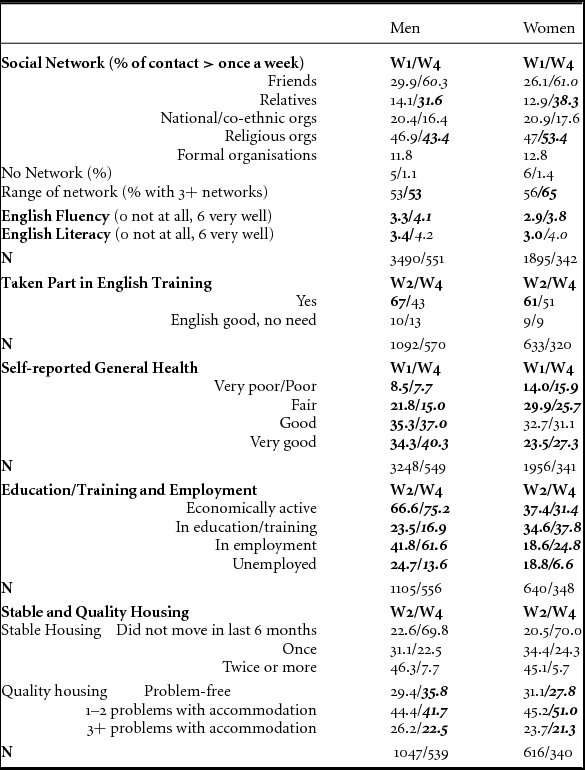
W1, W2 and W4 = Wave 1, Wave 2 and Wave 4. Bold typeface denotes significant gender difference; significant changes over time are italicised at p <.05 level.
There were significant gender differences in language fluency and literacy with men reporting higher scores in both. Improvements in fluency and literacy over time were significant for men and women but the gender difference in literacy disappeared by W4. We also found significant gender differences in participation in language training at W1, with the proportion 6 per cent higher for men. This situation was reversed by W4 with women's rate 8 per cent higher than men. Despite having poorer competency than men, women were less likely to attend classes and did so later. Language is critical to employment access thus such findings have implications for employability and, as we show later, general health.
Women were significantly more likely to report very poor or poor health, a situation which was worsened by W4. Men's propensity to report good, or very good, health increased over time, so that by W4 77 per cent made such a report compared to 58 per cent of women.
Access to employment, education and training also displayed significant gender differences. At W2 a higher proportion of women than men were in education or training (ET), and this increased by W4 with the pattern reversed for men. The biggest gender differences related to those in work, with 23 per cent more men employed than women. While the proportion of both genders employed increased by W4 the improvement is much greater for men with a further 20 per cent in work but only 6 per cent increase for women. The proportions of both men and women unemployed reduced over time with a greater reduction for women, possibly relating to the increase in those attending ET.
Our descriptive analysis (figures not reported) also found that women were significantly more likely than men to be living with dependent children (39 per cent vs. 17 per cent) and to have difficulties in budgeting food and bills (63 per cent vs. 53 per cent at W2 and 57 per cent vs. 48 per cent at W4). A significantly higher proportion of women (85 per cent) were receiving some kind of benefit at W4, compared to 62 per cent of men.
In terms of housing there were no significant gender differences in accessing stable housing with the largest proportions of both genders (c. 46 per cent) moving twice or more in the six months before W2. By W4 high levels of stability were evident for both genders with the largest proportion not having moved (c. 70 per cent). There were significant differences in access to quality housing with a lower proportion of women in problem-free housing by W4. The proportion reporting 1–2 problems with their accommodation was also 9 per cent higher for women. Overall the proportion reporting multiple problems with housing for both genders decreased over time. While both genders were more settled, the proportion of women in problem-free housing actually reduced.
Predicting integration outcomes
Gender and social networks
Our multivariate analyses begin by examining access to social networks (Table 2). The odds ratios presented suggest that, for both genders, English proficiency increased the chance of strengthening personal and formal social networks. For example, male refugees with better English were 1.4 times as likely to have more frequent contacts with friends and relatives compared to their counterparts with a lower level of English proficiency. The corresponding odds were even higher at 1.57 for women. Interestingly, both male and female Muslims were less likely compared to refugees with other or no religion to have frequent contacts with ethno-religious groups. Both genders residing in NASS accommodation at W1 were less likely to have frequent personal contacts, with men more likely to develop a formal network. This highlights some of the concerns expressed that dispersal separates refugees from friends and family, making them dependent on the state (Bakker et al., Reference Bakker, Cheung and Phillimore2016). Supporting Hunt (Reference Hunt2008) we also find that the longer refugees were resident in the UK the more likely they were to have personal networks. Women were more likely to develop networks with formal organisations if they had been in the UK more than two years. We find women with dependent children more likely to make frequent personal contacts but no difference for either gender living with a partner. For men, having secondary or tertiary education increased the chance of developing formal networks. When looking at refugees’ origins, there was little evidence of gender differences. Compared to refugees from Europe and Americas, African and Asian refugees were less likely to develop personal networks, with the opposite being true for ethno-religious networks. African males were also more likely to have access to formal networks. Male refugees from the Middle East were least likely to develop personal networks.
Ordinal Logit Models of Social Networks at Wave 1
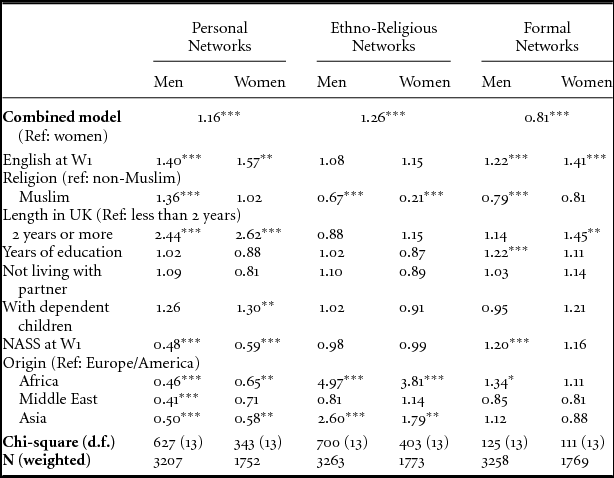
***p < .001, **p < .01, *p < .05. Note: models controlling for age groups at Wave 1.
By W4, there was little evidence of any association between individual and family characteristics and personal and ethno-religious social networks (figures available on request) except for two groups. First, NASS accommodation at W1 was associated with lower levels of personal networks. Second, female Muslims were less likely to have frequent contacts with ethno-religious groups compared with non-Muslims.
Gender and language proficiency
Turning to language proficiency (Table 3), we see that there is a significant gender difference at W1 but not at W4. Male refugees were 1.56 times more likely to report a higher level of language proficiency at W1 with women catching up by W4, probably following participation in language programmes. Language competence for both genders was strongly associated with length of residence as well as years of pre-migration education. Their importance was slightly weaker by W4 but still highly significant. Personal and formal networks both enhanced self-reported proficiency at W1 for both genders but not in W4. Both male and female Muslims reported lower English ability at W1 but this was no longer the case at W4. Similarly, NASS accommodation was negatively associated with English proficiency at W1 but not by W4, indicating that refugees’ language skills are no longer constrained by having lived in NASS housing once they moved out. In terms of origin, both male and female African refugees reported better English proficiency at W1 compared to those from Europe and Americas. This may be due to many African Commonwealth countries, such as Zimbabwe, being ex-British colonies where English is widely spoken. Refugees from countries that do not have a prior colonial relationship were less likely to report high levels of proficiency because they were not native English speakers. By W4, only African males reported better English ability.
Ordinal Logit Models of Language Proficiency at Waves 1 & 4
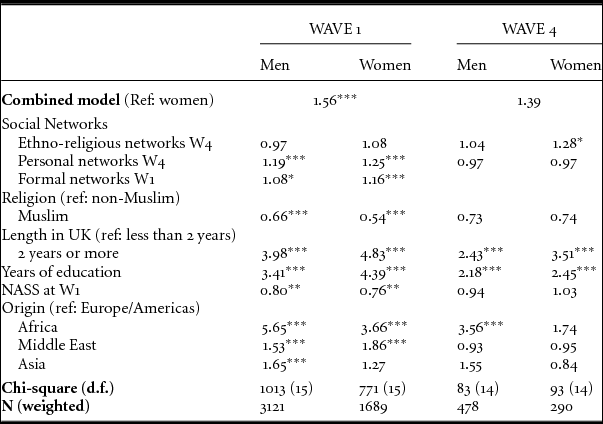
***p < .001, **p < .01, *p < .05. Note: models controlling for age groups, co-residence with spouse and dependent children at Wave 1.
Gender and health
We now progress to examine the factors contributing to self-reported general health status in Wave 4 (Table 4). Some gender differences can be seen. Results from the combined model show a clear male advantage, with men being three times more likely to report better health than women. English proficiency was positively associated with men's health but not women's. NASS accommodation at W1 had a significant lasting negative effect on self-reported health for both genders in W4. Controlling for origin, partner status and dependent children, there was no significant association between social networks and self-reported health status. Years of education were positively associated with women's health but not men's. Living with a partner and dependent children was not associated with subjective health status for either gender.
Ordinal and Binary Logistic Regression for Gendered Health, Housing and Education/Employment at Wave 4

***p < .001, **p < .01, *p < .05. Note: models controlling for age groups and co-residence with spouse at Wave 1.
Housing and gender
Overall there was no significant gender difference in access to quality or stable housing (Table 4). Controlling for age groups, religion, years of education, and origin, we found little evidence of any association between social network and housing outcomes. Interestingly, good English facilitated access to quality housing for men only, with the same true for women in terms of stable housing. Length of residence also improved the odds of accessing stable housing for women. Perhaps slightly worryingly, male refugees with dependent children were less likely to access stable housing. While no discerning gender differences have been identified, our earlier analysis (not reported in Table 4) showed that formal and personal networks at W1 enhanced access to quality housing.
Education, training and employment, and gender
There were significant gender differences in the likelihood of accessing education, training and employment (ETE) (Table 4) with men being twice as likely to be doing so, reinforcing findings in other studies (Dumper, Reference Dumper2002). Language was particularly important for both genders, as was self-reported good health in W3 which had a positive impact on access to ETE. Men's chances of accessing ETE was increased by having more frequent personal networks. However, NASS housing at W1 had the opposite effect. Women refugees with dependent children were significantly less likely to be in ETE reflecting trends in the general population.
Discussion
This paper is the first using a quantitative survey with a large enough dataset to allow for formal statistical testing of gender differences in integration outcomes. Our findings illustrate the importance of undertaking a gender analysis of refugees’ integration outcomes. Our analyses show there are clear gender differences in access to education, training, employment, self-reported general health, difficulty budgeting, housing and language proficiency. While, as Hunt (Reference Hunt2008) suggests, integration processes do evolve over time, some gender discrepancies did not equalise across the duration of the survey. For example, by W4 women were more likely to be in education and training than men but less likely to be in employment. They were also more likely to need and receive English language training. While place of origin on the whole had little impact on gendered outcomes, religion, as Casimini et al. (Reference Casimiro, Hancock and Northcote2007) note for Muslims, shapes outcomes for women while occupation is important for men suggesting that there are intersectional influences upon integration outcomes requiring further investigation.
A number of factors have been shown to predict integration outcomes for both men and women. Access to social networks plays a key role with few gender differences observable and the role of networks positive for both genders. Personal networks were particularly helpful in increasing the likelihood of good English and access to ETE for men. Friends and relative networks aided access to stable housing, possibly important because of the role of word of mouth in assisting new refugees to find housing after they are evicted from their NASS housing (Phillimore et al., Reference Phillimore, Ferrari and Fathi2004). However, these networks become non-significant after controlling for other factors in the models.
Language proficiency is possibly of greatest importance to both genders with men's competency initially significantly better than women's but differences disappearing 21 months later, probably due to women catching up having taken part in language programmes. Although women's language competency is initially poorer, they are more likely to access language classes later than men. Explanations emerging from earlier studies include unaffordable childcare provision, problems fitting classes around school hours, the absence of single sex classes and lack of confidence about enrolling into formal education (Dumper, Reference Dumper2002). We find that language proficiency improves self-reported health which itself is positively affected by levels of education, the extent of formal and personal networks and lengths of residence. With language competency enhancing women's health and access to ETE, facilitating effective language learning should be a policy priority.
Self-reported general health is a further important factor in shaping access to ETE for both genders. The persistence of low self-rated health for women over time is particularly worrying. Delayed onset of PTSD is acknowledged in the psychology literature and observed for refugee men and women who often become unwell after receiving their asylum decision (Pittaway and Bartolemei, Reference Pittaway and Bartolomei2001). Given that SNR respondents were the primary asylum applicants (and 70 per cent male), women respondents would either be single or the main applicant possibly implying a more intense experience of persecution than their partner or family. Other explanations may relate to experiences of gender-based sexual violence which can lead to wide-ranging exclusions (Phillimore, Reference Phillimore2011). Furthermore, women's lower language ability may restrict access to health, or their poorer access to formal networks may leave them lacking knowledge about how to access services. More research is needed to examine why women's health was far worse than men some years after case determination.
Being housed in NASS accommodation as an asylum seeker also affects outcomes. Asylum seekers are dispersed, on a no-choice basis, to poor quality housing (Phillips, Reference Phillips2006) in some of the most deprived parts of the UK where they have to live in close proximity with strangers. Certainly we find that, for both genders, dispersal has a negative impact upon health, a situation that may relate to poor living conditions. The negative impact is also found for language proficiency and access to personal networks – possibly relating to being dispersed away from social networks elsewhere in the UK. The main gender difference in relation to NASS is the negative influence that being dispersed has on male employment. There are a number of possible explanations for this. Living in poor housing can impact upon both physical and psychological health (Phillimore, Reference Phillimore2011). After receiving a positive decision, refugees have a maximum of 28 days to leave their NASS housing. As a low priority for social housing, single refugees often spend considerable periods homeless, sofa-surfing, or renting poor quality housing. Men perhaps experience greater problems because they are less likely to have dependent children which increases entitlement to social housing. Such experiences may impact upon health while the accommodation search will distract from job-seeking.
The longitudinal nature of the SNR enables us to identify that women, especially those with dependent children, progress more slowly than men taking longer to access language classes, and ETE and formal networks. Some gender gaps endure across the 21 months. Women clearly take longer than men to find their feet in a new country, which may relate to traditional gender roles, lack of provision for women and their delayed access to formal networks which could help them to navigate new and complicated institutional cultures. In addition, we demonstrate that influences on integration outcomes are in some domains intersectional with a combination of religion and gender shaping social networks and region of origin, education influencing language ability and employment outcomes.
Given the evidence of women's poor integration outcomes we suggest a number of policy measures which could improve their prospects in key social policy areas. These include reinstating the ESOLFootnote 1 fee remission for all asylum seekers to enable them to develop the language skills needed to access integration domains more quickly. Classes should be provided in community settings with single gender options and childcare provision to improve accessibility (Koyama, Reference Koyama2014). New women refugees might be offered a mentor to help them to navigate the new institutional cultures to which they are exposed more quickly, enabling faster access to housing, language and other classes and to help them to seek employment, perhaps accelerating network development and language acquisition. Further there is a need to measure the outcomes of refugees across social policy areas. While there is a literature which shows that ethnic monitoring and targeting can pathologise particular problems (Vickers et al., Reference Vickers, Craig and Atkin2012), refugees are invisible in monitoring data and thus unlikely to attract any attention. Collecting and analysing such information might provide evidence of the need for institutions, such as Jobcentre PlusFootnote 2 and the NHS, to place greater priority upon refugee integration.
Conclusions
Gender – while neglected in integration theory, policy and practice – has implications for refugees’ integration outcomes and thus for social policy outcomes. We show how gender differences, and to a lesser extent intersectionality, influence, and are influenced, by a wide range of factors which further reinforce the complex, processual and multi-dimensional nature of integration. While recent advances in theorising integration have sought to recognise multi-dimensionality, we suggest they also need to acknowledge that the process is gendered and intersectional (Anthias and Pajnik, Reference Anthias and Pajnik2014). Furthermore, we build upon Bhatia and Ram's (Reference Bhatia and Ram2009) contention that integration can both proceed and reverse by demonstrating empirically for the first time that integration is a set of interacting, gendered, processes shaped by a wide variety of factors which can influence progress even years after individuals gain refugee status. Much more work is needed to explore these intersectional and temporal dimensions and to understand the complex mix of characteristics and influences shaping refugee's social policy outcomes. Given the current refugee crisis in Europe, there is an urgent need to develop nuanced and effective integration policy and practice. Policymakers, practitioners and academics can learn from the UK experience and identify some policy lessons. But, if understanding about the types of policies and practice that are most successful is to increase, then they might look to Europe, where some countries have national refugee integration programmes (Joppke, Reference Joppke2007). Harmonised-EU longitudinal integration surveys would enable work to be done comparing outcomes between states which have integration programmes and those which do not and help us identify the types of programme that reduce gender discrepancies. In addition, qualitative research is needed to develop understanding of why, for example, women report that their health deteriorates over time in their country of refuge.
Integration as a field of study has been neglected in social policy despite the reality that integration outcomes are social policy outcomes (Phillimore, Reference Phillimore2012). Clearly more attention needs to be paid to this significant and growing group of residents. Unlike other migrants, refugees cannot return home. To enable them to build new lives and offer the protection and support ideally associated with refugee status, we need to ensure they can fully participate across all social policy arenas. Given the gendered nature of integration processes, we contend gender-sensitive measures are needed to ensure women and their children become fully included – failure to do so risks the long-term social exclusion of some of the most vulnerable in our societies: those we are morally bound to protect.
Acknowledgement
We are grateful to the Nuffield Foundation for funding this research project on Social Networks, Social Capital and Refugee Integration. (Ref: OPD/40493)



