




Introduction
Hydatidosis is a zoonotic disease caused by the larval stage of E. granulosus, which leads to the formation of hydatid cysts in humans.Reference Gessese1 It is endemic in many regions, particularly where livestock farming is prevalent, including the Mediterranean basin.Reference Dakkak2 The liver (65%) and lungs (25%) are the most frequently affected organs, although hydatid cysts can develop in almost any location.Reference Khuroo3 Cardiac involvement is rare, occurring in only 0.5–2% of all hydatid disease cases.Reference Banisefid, Baghernezhad and Beheshti4 The left ventricle is the most commonly affected site (55–60%), followed by the right ventricle (15–25%), left atrium (8%), interventricular septum (5–9%), pericardium (8–11%), and pulmonary arteries (7%).Reference Kahlfuß, Flieger, Roepke and Yilmaz5,Reference Perez-Gomez, Duran, Tamames, Perrote and Blanes6 Cardiac hydatidosis can result in serious and potentially fatal complications such as cyst rupture, anaphylactic shock, tamponade, embolism, acute coronary syndrome, arrhythmias, and infection.Reference Banisefid, Baghernezhad and Beheshti4,Reference Dursun, Terzibasioglu and Yilmaz7 The disease often remains asymptomatic until the cyst reaches a significant size. In children, clinical presentation is particularly rare due to the slow cyst growth rate—approximately 1 cm per year.Reference Brunetti, Kern and Vuitton8 Symptoms may range from asymptomatic to life-threatening, depending on the cyst’s size and location. Diagnosis is primarily based on echocardiography and CT, although the condition remains diagnostically and therapeutically challenging due to non-specific symptoms and the potential for sudden complications.Reference Kahlfuß, Flieger, Roepke and Yilmaz5,Reference Wadhawa, Shah and Doshi9 Surgical excision remains the mainstay of treatment and is typically combined with antiparasitic therapy. Recurrence after complete surgical removal is uncommon.Reference Lahmidi, Boutaybi, El Ouazzani, Elouafi and Bazid10 Here, we present two rare paediatric cases of interventricular septal hydatid cysts successfully treated surgically. We aim to highlight the clinical presentation, diagnostic approach, and surgical management in a paediatric cardiac surgery centre located in an endemic region.
Case presentation
First case
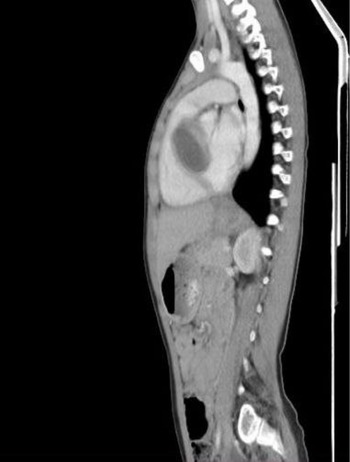
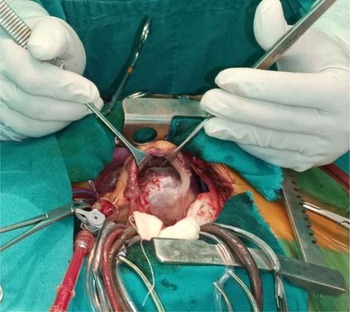
A 5.5-year-old female with a background of animal husbandry was admitted with episodes of sudden-onset loss of consciousness, which had progressively worsened over the past six months, particularly during routine activities. Her clinical examination was unremarkable. Two-dimensional transthoracic echocardiography revealed a 49 × 47 mm cyst located in the mid-cephalic portion of the interventricular septum (Figure 1). The cyst occupied the majority of the right ventricle, causing haemodynamic obstruction of the right ventricle outflow tract (peak gradient: 65 mmHg) and compressing the left ventricle. These findings were confirmed by multislice CT, which provided precise localisation and detailed structural characterisation of the cardiac cyst (Figure 2). After multidisciplinary discussion with the Heart Team, surgical resection of the cyst was indicated. The patient underwent cyst excision under cardiopulmonary bypass. Intraoperatively, the apex of the cyst was found adjacent to the right ventricle inlet, near the tricuspid valve (Figure 3). To prevent contamination of the surrounding tissues, cyst fluid was first aspirated via needle puncture, and the cystic cavity was irrigated repeatedly with hypertonic saline for sterilisation. The cyst was then carefully opened, and the germinative membrane was completely removed. Following excision, a 4 × 5 cm cavity remained in the interventricular septum (Figure 4). Capitonnage was performed by folding and suturing the edges of the cyst wall inward to obliterate the cavity and reduce its size, without causing damage to adjacent cardiac structures.
Two-dimensional echocardiogram demonstrating hydatid cyst within the IVS.

Sagittal chest MSCT showing the approximate dimensions of the cardiac cyst (longitudinal and anteroposterior).

Intraoperative views showing the cyst and postoperative cavity.

Intraoperative views showing the cyst and postoperative cavity.

Second case
A 9-year-old female with no history of dealing with animal husbandry presented with recurrent episodes of palpitations followed by loss of consciousness. The symptoms had a gradual onset and progressively worsened over the course of one month. Clinical examination revealed a holosystolic murmur (grade 3/6), best heard along both sides of the sternal border. The electrocardiogram showed complete heart block (atrioventricular dissociation). 2-dimensional-transthoracic echocardiography revealed a 28 x 27 mm cyst located in the basal interventricular septum, extending into both the right and left ventricular cavities, with more significant protrusion into the right ventricle. Valvular structures were unaffected, and biventricular systolic function was preserved. Multislice CT confirmed the echocardiographic findings and provided precise localisation of the lesion (Figure 5). Under cardiopulmonary bypass, the cyst was punctured, and its contents were aspirated with a needle, then sterilised with hypertonic saline, and the site was washed several times. The cyst was then excised in its entirety (Figure 6), and the cavity was obliterated (Figure 7).
Axial chest MSCT showing the cardiac cyst.

Intraoperative views showing the cyst and postoperative cavity.

Cyst membrane.

Shared clinical course
Both patients had no prior relevant medical history. Comprehensive imaging—including abdominal, thoracic, and cerebral CT—was performed to identify a primary focus of hydatid disease. No other cysts were detected, except for several hepatic cysts in both patients. Laboratory evaluation revealed leukocytosis with eosinophilia and an elevated erythrocyte sedimentation rate. Serological testing using an immunofluorescence assay for E. granulosus was negative in both cases. Histopathological analysis of the excised cysts confirmed the diagnosis of cardiac hydatid disease. Prophylactic antihelminthic therapy with albendazole was initiated preoperatively and continued postoperatively for nine months. The postoperative course was uneventful in both cases. In the second case, the persistence of complete heart block necessitated permanent pacemaker implantation, despite the patient’s clinical stability. Both patients were discharged in excellent clinical condition. Follow-up echocardiography at 12 and 14 months, respectively, revealed no signs of recurrence or complications.
Discussion
Human hydatid disease is caused by infection with the canine tapeworm E. granulosus and is highly endemic in developing countries, including Syria.Reference Gessese1,Reference Dakkak2 One major challenge in these areas is delayed diagnosis due to limited healthcare infrastructure and low public awareness.Reference Khuroo3 While the liver and lungs are the most frequently affected organs, cardiac hydatidosis remains rare, comprising only 0.5–2% of all cases.Reference Banisefid, Baghernezhad and Beheshti4 Cardiac hydatid cysts located in the interventricular septum are typically intramyocardial, in contrast to sub-epicardial left ventricle cysts.Reference Perez-Gomez, Duran, Tamames, Perrote and Blanes6,11 The myocardium is usually infected via haematogenous spread through the coronary arteries, although other routes, such as the thoracic duct, vena cava, or pulmonary veins, have been proposed.Reference Kahlfuß, Flieger, Roepke and Yilmaz5 The left ventricle is the most frequently involved site, followed by the right ventricle, left atrium, pericardium, interventricular septum, and pulmonary arteries.Reference Kahlfuß, Flieger, Roepke and Yilmaz5,Reference Perez-Gomez, Duran, Tamames, Perrote and Blanes6 Sub-epicardial cysts tend to expand towards the pericardial cavity, potentially growing to large sizes, whereas sub-endocardial cysts more often grow intracavitary.Reference Besim, Karayalçin, Hamamci, Güngör, Korkmaz and Tezcaner12 Ventricular wall cysts may expand in either direction. Due to the slow-growing nature of the disease, a long latency period often precedes clinical manifestation. Thus, paediatric cases are exceedingly rare but possible.Reference Brunetti, Kern and Vuitton8,Reference Oueslati, Saïd and Saaidi13 The clinical presentation of cardiac hydatid disease is highly variable and depends on the cyst’s location, size, age, and complications. Because of slow growth, symptoms rarely appear in childhood. Early stages are often asymptomatic or discovered incidentally. When symptoms occur, they may include chest pain, palpitations, dyspnoea, or syncope due to arrhythmia or obstruction, as seen in our patients.Reference Perez-Gomez, Duran, Tamames, Perrote and Blanes6,Reference Oueslati, Saïd and Saaidi13 Other possible symptoms include fever, weight loss, or cough. Life-threatening complications such as cyst rupture, tamponade, embolism, valvular regurgitation, allergic reactions, and sudden death may also occur.Reference Banisefid, Baghernezhad and Beheshti4,Reference Dursun, Terzibasioglu and Yilmaz7,Reference Lahmidi, Boutaybi, El Ouazzani, Elouafi and Bazid10 Septal involvement may lead to conduction block and arrhythmias.Reference Yaliniz, Tokcan, Salih and Ulus14 Cardiac hydatidosis should always be considered in the differential diagnosis of cardiac masses in endemic regions.Reference Banisefid, Baghernezhad and Beheshti4,Reference Kahlfuß, Flieger, Roepke and Yilmaz5 Transthoracic echocardiography is the primary diagnostic tool, providing information about cyst size, number, and location.Reference Dursun, Terzibasioglu and Yilmaz7 However, serological testing has limited value due to high false-negative rates—up to 50% in cardiac cases.Reference Wadhawa, Shah and Doshi9 Electrocardiographic changes are non-specific, including QRS abnormalities, atrioventricular block, or ST elevation due to myocardial compression.Reference Yaliniz, Tokcan, Salih and Ulus14 Cardiac CT and MRI are important complementary tools to confirm the diagnosis and define surgical planning.Reference Dursun, Terzibasioglu and Yilmaz7 In our cases, the diagnosis was established based on clinical symptoms (palpitations, syncope), physical examination (cardiac murmur), echocardiographic and CT findings, hepatic involvement, and the epidemiologic context of an endemic area.Reference Wadhawa, Shah and Doshi9,Reference Oueslati, Saïd and Saaidi13 According to WHO guidelines, surgical excision is the gold standard for treatment, followed by long-term antiparasitic therapy with albendazole for at least two years.Reference Brunetti, Kern and Vuitton8,11 Surgery is necessary because of the high risk of life-threatening complications, with reported cure rates of up to 90% in properly selected cases.Reference Lahmidi, Boutaybi, El Ouazzani, Elouafi and Bazid10 Intraoperative measures to prevent cyst content spillage include the use of scolicidal agents such as 2% formalin, 30% hypertonic saline, 5% cetrimide, or 1% iodine.Reference Besim, Karayalçin, Hamamci, Güngör, Korkmaz and Tezcaner12 The surgical approach depends on the cyst location. Most left or right ventricular cysts can be excised without cardiopulmonary bypass, but interventricular septal cysts are best treated under cardiopulmonary bypass to minimise intraoperative risk.Reference Yaliniz, Tokcan, Salih and Ulus14,Reference Seth, Mishra, Khandekar, Raut, Mohapatra and Ammannaya15 Gentle manipulation of the heart prior to aortic cross-clamping is advised.Reference Lahmidi, Boutaybi, El Ouazzani, Elouafi and Bazid10 Although early postoperative mortality may reach 10%, long-term outcomes are generally favourable, with recurrence rates of approximately 10%—often due to intraoperative spillage.Reference Brunetti, Kern and Vuitton8,Reference Yilmazkaya, Yondem, Gurkahraman, Yukselen, Circi and Tasdemir16 In our patients, no recurrence was observed. Routine echocardiographic and serologic follow-up is essential for at least five years postoperatively.Reference Brunetti, Kern and Vuitton8 Screening programmes in endemic regions may aid in earlier detection.Reference Gessese1
Conclusion
This case series underscores the importance of considering cardiac hydatid disease in the differential diagnosis of patients from endemic regions and performing systematic evaluation of other potential target organs. Early diagnosis during the uncomplicated stages is crucial, and prompt surgical intervention should be pursued, even in asymptomatic patients. These findings align with WHO recommendations advocating combined surgical and medical management, along with long-term follow-up in high-risk populations.
Acknowledgements
None.
Author contributions
Ghaith Hasan (conceptualisation, writing—original draft), and Mohammad Younes (validation, visualisation, supervision, writing—review and editing). All authors have read and approved the final version of the manuscript.
Financial support
None.
Competing interests
None.
Ethical standard
Our institution does not require ethical approval for reporting individual cases or case series.
Informed consent
Written informed consent was obtained from the patient family for their anonymized information to be published in this article.



 Open access

