

Introduction
Panic disorder often begins in adolescence (Solmi et al., Reference Solmi, Radua, Olivola, Croce, Soardo, Salazar de Pablo, Il Shin, Kirkbride, Jones and Kim2022), affecting 1–3% of those aged 11–19 years (Bittner et al., Reference Bittner, Egger, Erkanli, Costello, Foley and Angold2007; Sadler et al., Reference Sadler, Vizard, Ford, Marchesell, Pearce, Mandalia, Davis, Brodie, Forbes and Goodman2018). In adolescence, it has high rates of co-occurrence with other anxiety disorders and depression and is associated with the subsequent onset and persistence of alcohol abuse and dependence (Biederman et al., Reference Biederman, Faraone, Marrs, Moore, Garcia, Ablon, Mick, Gershon and Kearns1997; Kearney et al., Reference Kearney, Albano, Eisen, Allan and Barlow1997; Zimmermann et al., Reference Zimmermann, Wittchen, Höfler, Pfister, Kessler and Lieb2003). Left untreated, it often has a chronic course (Biederman et al., Reference Biederman, Faraone, Marrs, Moore, Garcia, Ablon, Mick, Gershon and Kearns1997), highlighting the need for effective treatment.
Young people face substantial barriers to accessing evidence-based treatments, such as cognitive behaviour therapy (CBT), demonstrated through long waiting times and high proportions of referrals closed without treatment (Children’s Commissioner, 2025). Brief versions of CBT have the potential to reduce significant delays in receiving treatments within services. They can include either low intensity CBT (i.e. 6 hours or less of contact time with a therapist, using self-help materials) and/or brief high intensity CBT (i.e. based on the standard evidence-based CBT treatment, with therapy contact time 50% or less than the full CBT intervention) (Shafran et al., Reference Shafran, Myles-Hooton, Bennett and Öst2021). While brief treatments have been developed and evaluated for pre-adolescent children (Creswell et al., Reference Creswell, Violato, Fairbanks, White, Parkinson, Abitabile, Leidi and Cooper2017), there has been limited research attention on brief interventions for adolescents with anxiety disorders. Of the 16 studies of psychological therapies for adolescents with anxiety disorders (including panic disorder) identified in a recent meta-analysis (Baker et al., Reference Baker, Lawrence, Karalus, Creswell and Waite2021), only one study (Stjerneklar et al., Reference Stjerneklar, Hougaard, McLellan and Thastum2019), involving adolescents with a range of anxiety disorders, fulfilled these definitions of brief CBT.
In the UK, a generic form of CBT appears to be the most widely used treatment approach by clinicians in Child and Adolescent Mental Health Services (CAMHS) to treat young people with panic disorder, although this does not typically follow a panic disorder specific CBT treatment protocol (Baker and Waite, Reference Baker and Waite2020). This contrasts with the treatment of panic disorder in adults which is typically disorder specific. Cognitive therapy (CT) for panic disorder (Clark et al., Reference Clark, Salkovskis, Hackmann, Wells, Ludgate and Gelder1999) is widely used within adult services (such as NHS-based Talking Therapies) and has been shown to be superior to a range of other panic disorder treatments including relaxation therapy, supportive psychotherapy, and medication (Gould et al., Reference Gould, Ott and Pollack1995). Furthermore, a brief version (five sessions and up to two booster sessions; B-CT) was as effective as the full treatment (12 sessions and up to three booster sessions) (Clark et al., Reference Clark, Salkovskis, Hackmann, Wells, Ludgate and Gelder1999) and associated with large effects on panic symptoms (post-treatment d = 2.9; 12-month follow-up d = 3.2).
Given that a brief, high-intensity version of Clark et al.’s CT for panic disorder has been shown to be effective in adults, we adapted the intervention to be suitable for adolescents with panic disorder. The current study is a feasibility randomised controlled trial (RCT) comparing B-CT with a generic form of CBT of equivalent length for adolescents with panic disorder. Using several well-defined criteria, it aims to examine whether a future definitive RCT could be conducted.
Method
Study design
This study was a single centre parallel design feasibility RCT in which adolescents with panic disorder were randomised to either B-CT or a brief generic form of CBT. It is registered on the ISRCTN Registry, https://doi.org/10.1186/ISRCTN14884288 (retrospectively registered on 5 December 2019), and the trial protocol is publicly available: https://doi.org/10.1186/s40814-022-01009-z (Waite, Reference Waite2022).
Feasibility criteria
The following pre-registered progression criteria were specified to support progression to a definitive trial (see Table S1 in the Supplementary material, for the full progression criteria):
-
(1) At least 80% of eligible participants agree to randomisation.
-
(2) A sufficiently large sample can be recruited ( $\geq$
30 participants).
$\geq$
30 participants). -
(3) Treatment drop-out rates are no more than 20% in either arm.
-
(4) At least 80% of participants complete the panic severity measure at post-treatment and 3-month follow-up assessments.
-
(5) Treatment delivered within the B-CT and generic CBT treatment arms is clearly distinct in a manner that indicates therapist adherence to the manuals (with sessions containing less than 20% ‘not-allowable’ features of the treatment).
-
(6) No serious concerns about the acceptability of the treatments and trial procedures, and no serious negative impacts due to participation in the trial (e.g. worsening of symptoms, or significant increase in risk as determined by clinical judgement of the treating clinician).
-
(7) Appropriate clinical outcome and economic measures for a subsequent definitive trial are identified.
-
(8) Exploratory analyses of possible outcomes for the two treatments indicate improvements in anxiety symptoms and impairment, diagnostic status, quality of life, and acceptable use of healthcare resources.

Participants
To be eligible for the study, adolescents were required to be aged 11–18 years, meet DSM-5 diagnostic criteria for panic disorder (American Psychiatric Association, 2013), and have had at least one panic attack in the month prior to assessment. If the young person had a co-occurring medical condition (e.g. asthma), the medical professionals responsible for their care were consulted and must have given the opinion that this would not interfere with treatment delivery. Similarly, if panic disorder was secondary to another anxiety disorder, the young person had to be willing to focus on their panic disorder in treatment and able to engage in the intervention. Participants were required to not be taking psychotropic medication or be willing to be withdrawn from medication before the start of the trial under the supervision of their GP. They had to be able to speak English and be willing to accept random allocation and engage in the treatment. They were not eligible for the study if they had a co-occurring condition that would potentially impact treatment delivery, such as diagnosed autism, learning disabilities, suicidal intent, or recurrent or potentially life-limiting self-harm (i.e. current frequency of at least once per week or self-harm that required medical attention), or if they had been identified by social services as currently ‘at risk’ (due to, for example, child protection concerns). They were also ineligible if they were currently receiving a psychological intervention or had received previous CT or CBT for panic disorder. Once it was established that the adolescent met the inclusion criteria for the study, they were considered eligible. This was prior to the discussion about the study with the research team.
As is typical in feasibility studies, the sample size was not based upon a power calculation (Arain et al., Reference Arain, Campbell, Cooper and Lancaster2010); instead, we aimed to recruit 30–48 participants so we could realistically observe whether any adverse events or significant deterioration occurred, examine recruitment/retention rates, participant flow and treatment integrity (Julious, Reference Julious2005; Lancaster et al., Reference Lancaster, Dodd and Williamson2004; Sim and Lewis, Reference Sim and Lewis2012), and provide an estimate of the variation in outcomes on which to power a definitive trial, if indicated, based on continuous outcomes (i.e. panic disorder severity symptoms). A sub-sample of young people and parents/carers and clinicians delivering the interventions also took part in qualitative interviews following treatment using a purposive maximum variation sampling strategy to provide information rich data (Braun and Clarke, Reference Braun and Clarke2019; Malterud et al., Reference Malterud, Siersma and Guassora2016).
Recruitment
We recruited participants who had been referred to the NHS-commissioned Anxiety and Depression in Young People (AnDY) Research Clinic at Reading University and contacted local schools and primary/secondary care services to advertise the trial and request referrals to the clinic. Recruitment was from October 2019 to November 2021. Potential participants identified through outreach activities completed a screening form and if their responses indicated potential eligibility, the young person and their parent/carer received a telephone triage by the clinical team. As is routine in the clinic, all potential participants completed a structured diagnostic assessment to determine whether they met criteria for panic disorder and/or other anxiety disorders or depression. Adolescents and parents/carers were interviewed separately. Assessments were carried out by honorary assistant psychologists who were trained to reliability and received supervision for every assessment from a Clinical Psychologist (or equivalent) with extensive experience of delivering and supervising diagnostic assessments and proven reliability. If in-person appointments were not possible due to COVID-19 pandemic-related restrictions, assessments were carried out by telephone/video call. Adolescents and their parent/carers were also asked to complete self-report questionnaires, reporting on the adolescent’s symptoms. If eligible for the trial, they were sent information leaflets and then met with a member of the research team to discuss the study further before providing written consent/assent.
Procedure
Following acceptance into the trial, participants were randomised to treatment group using an online randomisation system (https://www.phctrials.ox.ac.uk/software/sortition), with a randomisation ratio of 1:1 and stratification based on panic disorder symptom severity using the total score (‘low’ ≤12 and ‘high’ ≥13) on the Panic Disorder Severity Scale for Children (PDSS-C; Elkins et al., Reference Elkins, Pincus and Comer2014; Shear et al., Reference Shear, Brown, Barlow, Money, Sholomskas, Woods, Gorman and Papp1997). Once randomised, adolescents and parents/carers completed baseline questionnaires and were allocated to a clinician who delivered treatment within only one arm of the trial. Clinicians were all Children’s Wellbeing Practitioners (CWPs). CWPs are graduates in psychology and related disciplines (or with equivalent training and experience) who have completed a one-year training programme to deliver and support, under supervision, brief, outcome-focused, evidence-based psychological interventions for children’s mental health difficulties (NHS Heath Education England, 2025). Following the intervention, adolescents and parents/carers completed measures post-treatment and at 3-month follow-up. At the 3-month follow-up assessment, participants had a further diagnostic assessment with an assessor who did not know which treatment they received. Adolescents were also asked to complete the measure of panic symptom severity at 12-month follow-up (this occurred between 11 July 2021 and 21 April 2023). Qualitative interviews were carried out by three MSc students and a PhD student, all of whom had no other role in the trial. Interviewers were trained in qualitative methodology and supervised by P.W., who has expertise in qualitative research. Participants were reimbursed for the completion of measures and qualitative interviews with shopping vouchers.
Interventions
The interventions are described in detail in the study protocol (Waite, Reference Waite2022). TIDieR (Template for Intervention Description and Replication) Checklists (Hoffmann et al., Reference Hoffmann, Glasziou, Boutron, Milne, Perera, Moher, Altman, Barbour, Macdonald and Johnston2014) can be found in Table S2 of the Supplementary material. Both interventions involved five individual sessions of around 60 minutes, with up to two booster sessions over the following 3 months. Sessions were typically delivered face-to-face but were conducted remotely (i.e. over Microsoft Teams) where pandemic-related restrictions meant in-person sessions were not possible. For both interventions, when delivered in person, early treatment sessions took place at the clinic, but later sessions were commonly carried out off-site where indicated (e.g. at school, in a café, or on public transport). Both interventions involved young people completing home tasks outside sessions and a relapse prevention plan at the end of treatment. Parents/carers in both treatment arms were given written materials to support their understanding of the treatment; their involvement in their adolescent’s sessions was flexible and guided by the needs and preferences of the adolescent. Clinicians also liaised with school staff and other professionals as indicated.
Brief cognitive therapy
B-CT (Clark and Salkovskis, Reference Clark and Salkovskis2009; Clark et al., Reference Clark, Salkovskis, Hackmann, Middleton, Anastasiades and Gelder1994) was adapted for adolescents with the involvement of young people with lived experience (Waite and Clark, Reference Waite and Clark2023). The manual and all materials are available at https://oxcadatresources.com. The treatment is underpinned by Clark’s (Reference Clark1986) cognitive model of panic disorder, which suggests that individuals tend to misinterpret bodily sensations in a catastrophic manner as a sign of an impending physical or mental disaster. The main aim of treatment, therefore, is to correct the person’s negative beliefs around their panic-related bodily sensations. Before each of the first four sessions, the adolescent reads and completes written exercises in the workbook. The focus of the session is on experiential exercises in which bodily sensations and safety behaviours are systematically manipulated to demonstrate their adverse effects, as well as behavioural experiments in which the young person tests pre-specified negative predictions (e.g. ‘I will faint’) while dropping their safety behaviours. Process measures are used in each session to generate meaningful behavioural experiments. It differs from generic CBT in that a habituation rationale is not used, repeated exposure to the same situations is not encouraged, and the young person is not encouraged to develop and use positive self-talk before or during behavioural experiments. Sessions were delivered by two CWPs, trained and supervised by a senior clinician (P.W.). Supervision was delivered as weekly group 1-hour sessions.
Generic CBT
The brief generic CBT intervention was developed following consultation with CWPs within routine services and training providers. Treatment involved anxiety management techniques (e.g. psychoeducation about anxiety, breathing retraining and relaxation), before developing an exposure hierarchy, in which the young person developed an ordered list of feared stimuli according to their anticipated fear reaction. They then progressed through the steps of the hierarchy in sessions, learning that over time their anxiety diminished. As is typical in routine clinical practice, clinicians used worksheets that were freely available on the internet to support the treatment (e.g. Chellingsworth, Reference Chellingsworth2010–Reference Chellingsworth2014). Sessions were delivered by four CWPs who attended regular weekly supervision of up to 90 minutes provided by senior clinicians within the service.
Measures
Details of each measure can be found in the study protocol (Waite, Reference Waite2022). Adolescents’ anxiety diagnoses were determined using the Anxiety Disorders Interview Schedule (ADIS-C/P) for DSM-IV (Silverman and Albano, Reference Silverman and Albano1996) and mood disorder diagnoses were determined using the Kiddie Schedule for Affective Disorders and Schizophrenia. Questions related to panic disorder were revised to ensure they aligned with DSM-5 criteria. Inter-rater agreement was excellent for the presence/absence of panic disorder (pre-treatment kappa = .93; post-treatment kappa = .92) and CSRs (pre-treatment kappa = .95; post-treatment kappa = .94). For all other diagnoses and CSRs, agreement was satisfactory to excellent (diagnoses: pre-treatment kappas = .87–1.00; post-treatment kappas = .73–1.00; CSRs: pre-treatment kappas = .82–1.00; post-treatment kappas = .74–1.00).
Panic symptoms were assessed using the Panic Disorder Severity Scale for Children (PDSS-C; Elkins et al., Reference Elkins, Pincus and Comer2014; Shear et al., Reference Shear, Brown, Barlow, Money, Sholomskas, Woods, Gorman and Papp1997). Participants also completed process measures adapted for use with adolescents following patient and public involvement (PPI) consultation (further information in Waite, Reference Waite2022); fear of bodily sensations was assessed using the adapted Body Sensations Questionnaire (BSQ; Chambless et al., Reference Chambless, Caputo, Bright and Gallagher1984), panic-related cognitions (frequency and belief strength) via the adapted Agoraphobia Cognitions Questionnaire (ACQ; Chambless et al., Reference Chambless, Caputo, Bright and Gallagher1984), modified by Clark and colleagues (Clark et al., Reference Clark, Salkovskis, Hackmann, Middleton, Anastasiades and Gelder1994), safety behaviours via the adapted Safety Behaviours Questionnaire (SBQ; Clark and Salkovskis, Reference Clark and Salkovskis2009) and avoidance using the adapted Mobility Inventory (Chambless et al., Reference Chambless, Caputo, Jasin, Gracely and Williams1985). Anxiety symptoms were assessed using the Revised Child Anxiety and Depression Scale (RCADS; Chorpita et al., Reference Chorpita, Yim, Moffitt, Umemoto and Francis2000). The Child Anxiety Impact Scale (CAIS; Langley et al., Reference Langley, Bergman, McCracken and Piacentini2004) was used to determine the extent to which anxiety interfered in the young person’s life. The Outcome Rating Scale (ORS; Miller et al., Reference Miller, Duncan, Brown, Sparks and Claud2003) assessed functioning across different areas of the young person’s life. Internal consistency for these measures was generally good to excellent across all time points, except for the PDSS-C at baseline which was acceptable (.79) and the SBQ at baseline which was poor (.52; see Table S4 in the Supplementary material). The Clinical Global Impression Scale-Improvement (CGI-I; Guy, Reference Guy1976) was used to assess the young person’s post-treatment changes in global functioning. Inter-rater reliability for the CGI-I was excellent (kappa = .94).
Treatment credibility was assessed prior to treatment through the Credibility and Expectancy for Improvement Scale (Borkovec and Nau, Reference Borkovec and Nau1972). Treatment fidelity was evaluated using a therapist-completed checklist of treatment components after each session that was specifically designed for this study (see Supplementary materials, S5). Treatment satisfaction was assessed using the Experience of Service Questionnaire (ESQ; Astride-Stirling, Reference Astride-Stirling2002).
In relation to health economic outcomes, adolescents’ health-related quality of life (HRQoL) was assessed using the Child Health Utility 9D (CHU-9D; Ratcliffe et al., Reference Ratcliffe, Stevens, Flynn, Brazier and Sawyer2012; Stevens, Reference Stevens2012) (adolescent self-report and parent-report on adolescent) and the EQ-5D-Y-3L (Wille et al., Reference Wille, Badia, Bonsel, Burström, Cavrini, Devlin and Ravens-Sieberer2010; EuroQol Group, 2024) (adolescent self-report). Both are preference-based measures from which quality adjusted life years (QALYs) were derived. A societal perspective for resource used was adopted, and patient level resource use data were collected from parents/carers on an adapted version of the Client Services Receipt Inventory (CSRI) (Beecham, Reference Beecham1999).
Qualitative interviews followed a pre-determined topic guide (see Supplementary material, S6).
Data analysis
Analysis of feasibility and clinical outcomes was conducted with SPSS v29 (IBM Corporation, 2022) and RStudio v.4.4.2 (R Core Team, 2024) and analysis of economic measures using RStudio v.4.4.2 (R Core Team, 2024). Feasibility criteria 1–6 were evaluated via descriptive reporting of rates of recruitment, treatment drop-out, completion of assessments, distinctness of treatment, credibility/expectation of treatment, reliable change and the presence of serious adverse events. Continuous clinical outcomes are summarised with means and standard deviations and minimum and maximum values. Categorical outcomes are summarised with numbers and proportions. For feasibility criterion 7, continuous clinical outcomes were analysed using exploratory linear mixed effects models with restricted maximum likelihood estimation. Time (post-treatment and follow-up), and intervention group plus their interaction were specified as fixed effects, with baseline clinical outcome scores as a fixed covariate and participant as a random effect. As this is a feasibility study, raw score and effect size (Cohen’s d) 95% confidence intervals (CIs), rather than statistical significance, are reported in all analyses. Effect sizes are interpreted according to Cohen’s rules of thumb (d >0.2 = small; >0.5 = medium; >0.8 = large effect) (Cohen, Reference Cohen1988).
For health economic outcomes, CHU-9D utility scores were calculated based on the adolescent-specific scoring algorithm of Ratcliffe et al. (Reference Ratcliffe, Huynh, Chen, Stevens, Swait, Brazier, Sawyer, Roberts and Flynn2016). For the EQ-5D-Y-3L, utility scores were estimated using the UK adult population value set, as a child/adolescent value set for the UK is not currently available. QALYs were then calculated by combining utility values at the three assessment points, i.e. baseline, post-treatment and 3-month follow-up, using the area-under-the-curve method, and compared for both treatment groups to explore how sensitive each measure was to change over time. The proportions of responses in the health outcome measures and the healthcare resource use questions are presented separately for the two arms at each assessment point.
Qualitative data were analysed using reflexive thematic analysis (Braun and Clarke, Reference Braun and Clarke2021). We deductively explored the acceptability of both treatments and taking part in the trial more generally, focusing on constructs in the theoretical framework of acceptability (Sekhon et al., Reference Sekhon, Cartwright and Francis2017).
Results
Criteria 1 and 2: At least 80% of eligible participants will agree to randomisation and a sufficiently large sample can be recruited
( $\geq$
30 more participants
)
$\geq$
30 more participants
)
These criteria were fully met, with 100% of eligible participants agreeing to be randomised and 34 participants recruited to the study. A CONSORT flowchart can be found in Fig. 1 and CONSORT checklist (Eldridge et al., Reference Eldridge, Chan, Campbell, Bond, Hopewell, Thabane and Lancaster2016) in Table S3 of the Supplementary material. Participants’ demographic and clinical characteristics at baseline are presented in Table 1.
CONSORT flow diagram.

Figure 1. Long description
A flowchart illustrating the stages of a clinical trial involving cognitive behavior therapy for adolescents with anxiety disorders. The process begins with identifying 100 patients, with 40 through clinic and 60 through outreach. Five patients are excluded at referral for not meeting inclusion criteria. Ninety patients are screened, with 40 through clinic and 50 through outreach, and five are non-contactable. Thirty patients are excluded at screening for not meeting inclusion criteria. Fifty-seven patients are assessed for diagnosis and inclusion/exclusion criteria, with three not assessed due to lockdown/risk. Twenty-three patients are excluded at assessment for not meeting inclusion criteria or declining to participate. Thirty-four patients are randomized into two groups: 16 for brief cognitive therapy and 18 for generic CBT. Fifteen patients in the brief cognitive therapy group and 17 in the generic CBT group receive allocated intervention. One patient in each group drops out of treatment early. Post-treatment assessments are conducted, with PDSS and secondary analyses performed. Follow-up assessments are conducted at 3 months and 12 months, with some patients lost to follow-up.
Adolescents’ baseline demographic and clinical characteristics across the brief cognitive therapy and generic CBT groups (n = 34)

Table 1. Long description
The table presents baseline demographic and clinical characteristics of adolescents across brief cognitive therapy and generic CBT groups. It has 34 rows and 18 columns. The columns are labeled as Brief cognitive therapy (n = 16), Generic CBT (n = 18), and Full sample (n = 34). The rows include various demographic and clinical characteristics such as Age in years, mean (SD), range; Gender with subcategories Female, Male, Non-binary; Ethnicity with subcategories Any White background, Any mixed, Asian, Black, or other ethnic background; Socio-economic status with subcategories Higher professional, Other employed, Unemployed, Missing; PDSS-C, mean (SD), range; Panic disorder with subcategories As primary disorder, As secondary disorder; Panic disorder CSR, mean (SD), range; Other anxiety disorder diagnoses with subcategories Agoraphobia, Generalised anxiety disorder, Separation anxiety disorder, Social anxiety disorder, Specific phobia; Total number of co-occurring anxiety disorders, mean (SD), range; Presence of other psychiatric disorders with subcategories OCD, PTSD, Major depressive disorder, Other specified depressive disorder; Total number of other psychiatric disorders, mean (SD), range; Psychotropic medication; Adolescent Credibility & Expectation of Treatment; Parent Credibility & Expectation of Treatment; Days from randomisation to first treatment session, mean (SD), range; Total number of sessions completed, mean (SD), range; Dropped out of treatment; Sessions delivered with subcategories In person, Via videoconferencing, Via telephone. Each row provides specific values for each characteristic across the two therapy groups and the full sample.
ADIS, Anxiety Disorders Interview Schedule for DSM-IV; PDSS-C, Panic Disorder Severity Scale-Child version; CSR, Clinician Severity Rating; OCD, obsessive compulsive disorder; PTSD, post-traumatic stress disorder. *Of the four participants with primary disorder that was not panic disorder, three had primary social anxiety disorder and one (receiving brief cognitive therapy) had primary emetophobia.
**Medication was an exclusion criterion for the service where the study took place.
Criterion 3: Treatment drop-out rates will be no more than 20% in either arm
This criterion was met with an overall treatment drop-out rate of 5.88% (n = 2; one in each arm).
Criterion 4: At least 80% of participants will complete the Panic Severity Measure at the post-treatment and 3-month follow-up assessments
This criterion was met, with 88.24% of participants completing the PDSS-C at post-treatment and 94.18% at the 3-month follow-up assessment; 82.35% completed the PDSS-C at the 12-month follow-up assessment.
Criterion 5: Treatment delivered within the brief cognitive therapy and generic CBT treatment arms will be clearly distinct in a manner that indicates therapist adherence to the manuals ( with sessions containing less than 20% ‘not-allowable’ features of the treatment )
Therapists completed Therapy Contents Checklists for 97.37% of all therapy sessions in B-CT and 100% of sessions for generic CBT. The feasibility progression criterion was fully met in the B-CT arm but not the generic CBT arm. For B-CT, of all the items endorsed, only 2.66% (n = 16) were generic CBT items and therefore ‘non-allowable’. In all instances, the endorsed item was ‘use of cross-sectional CBT model (‘hot cross bun’) to explain relationships between thoughts, emotions, sensations and behaviour’. For clinicians in the generic CBT arm, 23.02% (n = 116) of items they endorsed were ‘non-allowable’ CT items. The most common non-allowable feature endorsed was ‘psychoeducation to address beliefs around bodily sensations’ (35.34% of ‘non-allowable’ items endorsed), followed by ‘use of self-report questionnaires and panic diary to guide specific treatment interventions’ (29.31% of ‘non-allowable’ items endorsed) and ‘use of behavioural experiments to explore the effects of safety seeking behaviours’ (8.62% of ‘non-allowable’ items endorsed).
Criterion 6: There are no serious concerns about the acceptability of the treatments and trial procedures, and serious negative impacts do not occur due to participation in the trial
Table 2 provides adolescent and parent/carer responses on measures of acceptability. Prior to treatment, on the Credibility and Expectation Scale, adolescents and parents indicated that they perceived both treatment approaches to be logical and likely to be successful. Following treatment, acceptability assessed through the ESQ indicated that there were good levels of satisfaction with care across both treatment groups for adolescents and parents. At 3-month follow-up, none of the participants in either group showed reliable deterioration (see Table 3).
Descriptive statistics for adolescent and parent-reported clinical and economic outcome measures, and reliable change for adolescent clinical outcome measures for participants who completed assessments

Table 2. Long description
The table presents data on adolescent and parent/carer responses on measures of acceptability and clinical and economic outcome measures. It includes pre-treatment, post-treatment, 3-month follow-up, and 12-month follow-up stages. The table has 16 rows and 10 columns. Column headers include Pre-treatment CT, Pre-treatment Generic CBT, Post-treatment CT, Post-treatment Generic CBT, 3-month follow-up CT, 3-month follow-up Generic CBT, 12-month follow-up CT, and 12-month follow-up Generic CBT. Row labels include various measures such as PDSS-C total score, ADIS-C/P, Panic disorder CSR, Remission of all ADs, Improved on CGI-I, Panic Process Measures, BSQ-adapted, ACQ frequency-adapted, ACQ belief-adapted, ACQ belief-adapted mean item score, SBP-adapted, MI accompanied-adapted, MI alone-adapted, Measures of symptoms, interference and progress, RCADS-C, Anxiety total score, RCADS-C, Total score, RCADS-P, Anxiety total score, RCADS-P, Total score, ORS-C, CAIS-C, CAIS-P, Health economic measures, CHU9D-C Utility Score, CHU9D-P Utility Score, EQ5D-Y-3L Utility Score, Measures of satisfaction, ESQ-C Satisfaction with Care, ESQ-P Satisfaction with Care, ESQ-C Satisfaction with Environment, ESQ-P Satisfaction with Environment. Each row contains mean values and standard deviations for each treatment stage and group. Notable trends include changes in scores and standard deviations across different stages and treatment groups, indicating variations in outcomes and acceptability.
*The COVID-19 pandemic led to national lockdowns and restrictions to activities which is likely to have affected responses on the Mobility Inventory. AD, anxiety disorder; ADIS-C/P, Anxiety Disorder Interview Schedule for DSM-IV child and parent version (anxiety section and common co-morbid disorders); Panic disorder specific measures: ACQ-adapted, Agoraphobia Cognitions Questionnaire (adapted), BSQ-adapted, Body Sensations Questionnaire (adapted), SBQ-adapted, Safety Behaviour Questionnaire (adapted), MI-adapted, Mobility Inventory (adapted); CAIS-C/P, Child Anxiety Impact Scale-child and parent version; CGI-I, Clinical Global Impression-Improvement scale; CHU-9D, Child Health Utility (Paediatric Quality of Life); CSR, Clinician Severity Rating on the Anxiety Disorders Interview Schedule for DSM-IV (ADIS); ORS, Outcome Rating Scale; PDSS-C, Panic Disorder Severity Scale for Adolescents; RCADS-C/P, Revised Child Anxiety and Depression Scale-child and parent versions. CEI, Credibility and Expectancy for Improvement Scale; ESQ, Experience of Service Questionnaire. The possible range of scores for the CEI are 0–30 with higher scores indicating more positive beliefs. The possible range of scores for the ESQ Satisfaction with Care are 9–27 and Satisfaction with Environment are 3–9, with higher scores indicating greater satisfaction. For the EQ5D and CHU9D, utility scores are on a scale from 0 to 1, with higher scores indicating a better state of health.
Within and between mean group difference effect sizes and 95% confidence intervals for adolescent and parent clinical self—report measures for participants who completed assessments

Table 3. Long description
The table compares effect sizes and 95% confidence intervals for adolescent and parent clinical self-report measures. It has 12 rows and 8 columns. The columns are labeled as follows: Within-group pre-post Brief cognitive therapy, Within-group pre-post Generic CBT, Within-group pre-3-month follow-up Brief cognitive therapy, Within-group pre-3-month follow-up Generic CBT, Between-group Post-treatment, Between-group 3-month follow-up, Within-group pre-12-month follow-up Brief cognitive therapy, and Between-group 12-month follow-up. The rows are labeled with different measures: PDSS-C Total Score, Cohen’s d [95% CI], RCADS-C Anxiety Total Score, Cohen’s d [95% CI], RCADS-P Anxiety Total Score, Cohen’s d [95% CI], CAIS-C, Cohen’s d [95% CI], CAIS-P, Cohen’s d [95% CI], and PDSS-C Total Score at 12-month follow-up, Cohen’s d [95% CI]. Each cell contains specific values and confidence intervals for the respective measures and time points.
There were two serious adverse events, one in each arm; both related to significant life events and were assessed to not be directly related to the trial.
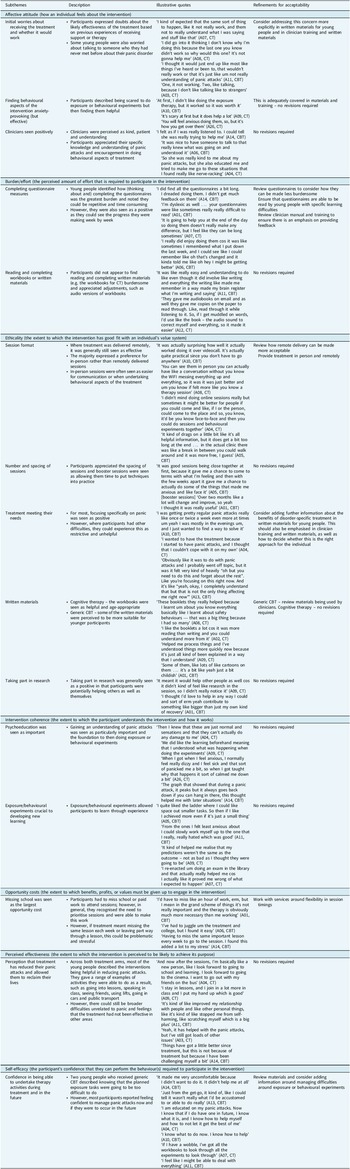
Qualitative findings suggest good acceptability for both interventions. Findings from the adolescent interviews are presented in Table 4 and those from parents, clinicians and the service manager interviews are in Tables S10 and S11 of the Supplementary material. The demographic and clinical characteristics of these participants can be found in Tables S7–9 of the Supplementary material.
Adolescents’ experiences of taking part in the study

Table 4. Long description
The table presents adolescents’ experiences of taking part in a study, focusing on different aspects such as burden, motivation, and emotional responses. It has 12 rows and 4 columns. The columns are labeled ‘Aspect’, ‘Description’, ‘Quotations’, and ‘Recommendations for acceptability’. Each row provides detailed information on specific aspects like feeling behavioral activation, choosing tasks, and completing symptom monitoring. For example, the first row discusses the burden of behavioral activation, describing how participants found it manageable and enjoyable. The table includes specific quotations from participants and recommendations to enhance acceptability, such as providing reminders and offering a variety of tasks. The data highlights the positive and negative experiences, with recommendations aimed at improving the study’s design and participant engagement.
Criterion 7: Appropriate clinical outcome and economic measures for a subsequent definitive trial are identified
The PDSS-C was able to be completed by participants with no or little support at baseline and subsequent time points, and data from the qualitative interviews did not indicate any specific concerns about this measure. Similarly, no problems were identified with other clinical or economic measures in terms of completion, except the CSRI, where completion rates were low (post-treatment: B-CT 56.25%, CBT 55.56%; 3-month follow-up: B-CT 50.00%, CBT 66.67%).
Criterion 8: Exploratory analyses of possible outcomes for the two treatments indicate improvements in anxiety symptoms and impairment, diagnostic status, quality of life, and acceptable use of healthcare resources
Table 2 provides descriptive statistics for all adolescent and parent-reported clinical and economic outcome measures, and reliable change for adolescent clinical outcome measures for those who completed assessments at pre-treatment, post-treatment, and 3-month follow-up. In the B-CT arm, 66.67% showed reliable improvement post-treatment, 100% at 3-month follow-up and 83.33% at 12-month follow-up. In the generic CBT arm, 26.67% showed reliable improvement post-treatment, 52.94% at 3-month follow-up and 68.75% at 12-month follow-up.
Table 3 provides the effect sizes and 95% confidence intervals from pre- to post-treatment and pre- to 3-month follow-up within and between groups for clinical outcome measures for everyone who completed assessments. For both groups, there were large treatment effects on adolescent-reported panic symptoms from pre to post, 3- and 12-month follow-up (B-CT: d = 1.52–2.23; generic CBT d = 0.90–1.30). Exploratory analyses indicated that there were small between-group differences on panic symptoms at post-treatment (d = −0.36) and 3-month follow-up (d = −0.45) favouring B-CT, although this was not maintained at 12-month follow-up (d = −0.04). Assessor-rated remission of panic disorder diagnosis at 3-month follow-up was slightly higher in the generic CBT arm than the B-CT arm (B-CT: 71.43%; generic CBT: 76.47%).
As shown in Supplementary material (S12), reductions in panic symptoms and scores on panic process measures (fear of bodily sensations, panic-related beliefs and safety behaviours) were larger for the B-CT than the generic CBT group over time.
For adolescent and parent-reported measures of anxiety symptoms and impairment at the 3-month follow-up time point, all within-group effect sizes were in the large range for B-CT (d = 1.22–2.23). This was also the case for generic CBT (d = 0.96–1.30), except for adolescent-reported anxiety inference, which was in the medium range (d = 0.68). Remission of all anxiety disorder diagnoses at this time point was higher in the B-CT (28.57%) than the generic CBT group (17.65%).
Health economic outcomes for participants who completed assessments are presented in the Supplementary material; Table S13 shows between-group mean differences for utility scores; both groups showed improvement on measures at each time point, except for the parent-reported CHU-9D which showed a deterioration post-treatment before an improvement at 3-month follow-up. Both groups showed mean QALY gains by 3-month follow-up (B-CT 0.39–0.47; generic CBT 0.32–0.39; see Table S14).
Discussion
This study evaluated the feasibility of an RCT to compare B-CT with a generic form of CBT in 34 adolescents with panic disorder, with treatment delivered by low intensity clinicians in an NHS-commissioned service. The trial met feasibility and acceptability criteria in relation to recruiting participants, and there were no serious concerns about the acceptability of either treatment and trial procedures based on self-report measures, drop-out rates, qualitative data and adverse events. In relation to the distinctiveness of treatment, whilst clinicians in the B-CT treatment arm reported delivering very few ‘non-allowable’ elements, for the generic CBT arm, their reported adherence to the treatment approach fell short of the criteria. For those assessed, both treatments were associated with large effects on panic symptoms at 3- and 12-month follow-up and improvement in health-related quality of life. Reliable change for panic symptoms was greater in the B-CT group than the generic CBT group at 3-month and 12-month follow-up time points. Across all measures, effect sizes were larger in the B-CT group than the generic CBT group and exploratory analyses indicated that at 3-month follow-up, there were small between-group difference for adolescent-reported panic symptoms (although not maintained at 12 months), adolescent and parent-reported anxiety symptoms and adolescent-reported anxiety interference. Both groups showed high rates of panic disorder remission at 3-month follow-up, although with slightly higher remission in the generic CBT group. In contrast, remission rates of all anxiety disorders were higher in the B-CT group.
These findings suggest that a brief cognitively focused treatment is associated with clinically meaningful improvements that persist well beyond the end of treatment, consistent with findings with adults (Clark et al., Reference Clark, Salkovskis, Hackmann, Wells, Ludgate and Gelder1999). Notably, even though the intervention was focused on panic disorder, there were improvements in anxiety symptoms/diagnoses more broadly, in keeping with other studies of disorder-specific cognitive therapy in adolescents (Leigh and Clark, Reference Leigh and Clark2023).
Across measures, there were additional benefits in B-CT compared with a more generic form of CBT, including large differences in reliable improvement rates (100% vs 53% at 3-month follow-up). The exception to this was the slightly lower panic disorder remission rates (71% vs 76%) at 3-month follow-up for the B-CT group than the generic CBT group, reflecting different patterns of improvement across participants in moving from above to below diagnostic thresholds. Typically, categorical measures are less sensitive to change, and we would be cautious in over-interpreting this finding in a sample of this size. At 12-month follow-up, the proportion showing reliable change in panic symptoms continued to be greater in the B-CT; however, the greater variability in scores in this group meant that the between-group effect size no longer reached the ‘small’ threshold.
Acceptability of both interventions was good across all measures. Of note, the B-CT arm had a greater proportion of young people from lower socio-economic backgrounds than the generic CBT arm and so it was encouraging to see that a treatment supported by written materials was effective for a range of young people. In interviews, clinicians in this arm indicated that although there was a lot to learn, they enjoyed delivering the treatment – suggesting that with appropriate training and supervision, a low intensity workforce can successfully deliver cognitive treatments.
In relation to the distinctiveness of generic CBT from B-CT, it is unclear whether the clinicians in the generic CBT arm were indeed off-protocol and delivering a more cognitive treatment (e.g. using psychoeducation to address specific beliefs, such as around fainting or suffocating), or whether this related to an issue with the self-report measure designed for this study. In the qualitative interviews, clinicians mentioned the administrative burden of completing the measure, and it is possible that it was completed quickly, where the subtlety around the wording of items could easily be missed. Notably, the way the adolescents in this arm described their experiences in qualitative interviews appeared consistent with the generic CBT approach that was developed for use in the study (including talking about more broad-spectrum psychoeducation (e.g. looking at graphs to see how anxiety comes down over time) and habituation-based exposure), which would be consistent with the idea that the issue was related to the measure. In the future, reviewing therapy tapes would give a clearer indication of treatment fidelity. It would also be important to consider whether this approach continues to reflect what clinicians are being routinely trained to deliver within services.
Due to the COVID-19 pandemic, around a third of sessions were delivered remotely but this did not appear to adversely affect outcomes. This particularly affected those in the CBT arm; however, of the six young people in this arm who received all/most sessions remotely, five showed reliable improvement in panic symptoms at 3-month follow-up. Nevertheless, most young people, parents and clinicians described a preference for in-person sessions in the interviews, in line with findings from pre-pandemic studies (e.g. Smart et al., Reference Smart, Smith, Karvey and Waite2023).
The symptom and process measures used in the study were well accepted and using the PDSS-C as the main outcome measure for a definitive RCT appears feasible. Process measures were adapted from measures designed for adults and in general, internal consistency for these and other measures was good to excellent. However, the internal consistency of the safety behaviours measure at pre-treatment was poor, reflecting the variability in safety behaviours undertaken by participants prior to treatment. Further psychometric work on the measures for this population is necessary. In addition, while lower rates of completion for resource use questionnaires are common in trials, the CSRI would benefit from further co-design work to reduce burden.
Strengths and limitations
This study is the first to evaluate B-CT for adolescent panic disorder and it is a strength that it was delivered by Children’s Wellbeing Practitioners within an NHS-commissioned service and compared with generic CBT, the intervention typically used within services. It is also a strength that health economics measures were included alongside clinical measures and that measures were generally well accepted. Adolescents were from a broad range of socio-economic backgrounds (particularly in the B-CT group), with a range of co-occurring conditions. In terms of limitations, although the generic CBT reflected what low-intensity clinicians were being trained to deliver in the UK, it may not reflect the CBT approach used in other settings. Boys made up a lower proportion of the sample (around 9%) than expected based on prevalence rates (where it would be expected to be around 22%; Sadler et al., Reference Sadler, Vizard, Ford, Marchesell, Pearce, Mandalia, Davis, Brodie, Forbes and Goodman2018) and young people from black and ethnic minority backgrounds were under-represented. Although outreach work was done to try to identify young people not being referred into services, this did not lead to a more generalisable sample. Therefore, more targeted work will be necessary to identify adolescents from under-represented groups in the future. Young people with diagnosed autism were not included in this study and further research will be necessarily to determine whether interventions can be successfully used without adaptations – or if not, to co-design and develop suitable modifications. Similarly, it was a limitation that there was no external review of therapy video recordings to determine treatment competency/fidelity and further work on the Therapy Contents Checklist is required to ensure that the CBT intervention is distinct. Clinicians also reported high levels of administrative burden, and it will also be important to consider ways to reduce this where possible.
Conclusion
This study provides preliminary evidence that in treating adolescent panic disorder both B-CT and a generic form of CBT are associated with positive outcomes, expectations, and experiences for adolescents, their parents/carers and clinicians. However, there appear to be additional benefits from B-CT that are worthy of evaluation in a future definitive RCT.
Supplementary material
To view supplementary material for this article, please visit https://doi.org/10.1017/S1352465826101349
Data availability statement
Data for this study are available via the UK Data Service.
Acknowledgements
We would like to thank the adolescents and their families who took part in this research as well as the young people, families and stakeholders who provided advice on various aspects of the study. We would like to thank all the staff at the AnDY Research Clinic at the University of Reading, particularly Jenny Abram, Eva Serra Visan, Gaby Wallis, Jasmiina Ryynanen, Amy Lomas, Laura Turpin, Henna Azad, Poppy Elvin and Aqsa Rahman. We would like to acknowledge the support of Hayley Perry in the development of the statistical analysis plan and thank Vicky Harris and Obi Ukoumunne for further statistical advice. We would like to thank Alison Wheeler and Hannah Vickery for advice around CWP CBT training. We would like to thank the Trial Steering Committee – Professor Tamsin Ford, Professor Cathy Creswell, Rosie Hill, Professor Richard Meiser-Stedman and Hiroko Plant. The study was sponsored by the University of Reading, contactable via the corresponding author.
Author contributions
Polly Waite: Conceptualization (Lead), Data curation (Equal), Formal analysis (Equal), Funding acquisition (Lead), Investigation (Lead), Methodology (Lead), Project administration (Equal), Writing - original draft (Lead); Rachel Sutton: Data curation (Equal), Project administration (Equal), Writing - review & editing (Equal); Ray Percy: Methodology (Equal), Project administration (Equal), Writing - review & editing (Equal); David Clark: Conceptualization (Equal), Investigation (Equal), Methodology (Equal), Supervision (Equal), Writing - review & editing (Equal); Laura Maratchi: Formal analysis (Equal), Investigation (Equal), Methodology (Equal), Project administration (Equal), Writing - review & editing (Equal); Mark Jeavons: Formal analysis (Equal), Investigation (Equal), Methodology (Equal), Project administration (Equal), Writing - review & editing (Equal); Lottie Shipp: Formal analysis (Equal), Investigation (Equal), Methodology (Equal), Project administration (Equal), Writing - review & editing (Equal); Mara Violato: Methodology (Equal), Supervision (Equal), Writing - review & editing (Equal).
Financial support
The feasibility trial was funded by an NIHR Postdoctoral Fellowship, awarded to Polly Waite (PDF-2016-09-092). The study was sponsored by the University of Reading. The funder and sponsor had no role in the study design, collection, management, analysis, and interpretation of the data, writing of the final report or the decision to submit the report for publication. Polly Waite and Mara Violato receive funding from the Oxford and Thames Valley National Institute for Health and Care Research (NIHR) Applied Research Collaboration (grant number NIHR200172) and the Oxford Health NIHR Biomedical Research Centre (grant number NIHR203316), as well as the Oxford Centre for Emerging Minds Research. The views expressed are those of the authors and not necessarily those of the NHS, the NIHR or the Department of Health and Social Care. Lottie Shipp is supported by the Oxford-Medical Research Council Doctoral Training Partnership and University College, Oxford.
Competing interests
The author declares that they have no competing interests.
Ethical standards
The PANDA (Treatment of PANic Disorder in Adolescents) trial was given a favourable ethical opinion for conduct from the NHS Health Research Authority (South Central – Berkshire B Research Ethics Committee), REC reference 19/SC/0287, and the University of Reading Research Ethics Committee. Parents/carers provided written consent for themselves and their child to take part in the study and for publication. Young people aged 13–15 years provided written assent and those aged 16–18 years provided written consent to take part and for publication. We abided by the Ethical Principles of Psychologists and Code of Conduct as set out by the BABCP and BPS.




 Open access


Comments
No Comments have been published for this article.