





On 5 August 1916, Siegfried Sassoon finished a poem while recovering from illness in the temporary hospital at Somerville College, Oxford. It was called ‘Christ and the Soldier’ and remained unpublished until 1973.Footnote 1 It takes the form of a dialogue between a soldier and Christ. It concludes with this stanza:
‘Lord Jesus, ain’t you got no more to say?’
Bowed hung that head below the crown of thorns.
The soldier shifted, and picked up his pack,
And slung his gun, and stumbled on his way.
‘O God,’ he groaned, ‘why ever was I born?’ …
The battle boomed, and no reply came back.Footnote 2
Writing about the poem on 28 June 1962 in a letter to the future editor of his collected poems, Dame Felicitas Corrigan, Sassoon commented:
Christ and the Soldier will probably make you say, like Alice, ‘Curiouser and curiouser.’ Proof, anyhow, that I wasn’t pagan-minded in 1916. But how write that and go through the whole war without saying a prayer? My only religion was my vocation as a poet, and my resolve to do my duty bravely. I don’t think I quite knew what I was trying to say. I suppose that behind it was the persistent anti-parson mentality – and it was difficult to swallow their patriotic pietism, which seemed unreal to many of us frontliners.Footnote 3
There was, however, one exception to his distaste for clergymen. When he edited the collected volume, The War Poems, in 1983, Rupert Hart-Davies added a note that Sassoon had appended to the manuscript of ‘Christ and the Soldier’:
I intended [the poem] to be a commentary on the mental condition of the most front-line soldiers, for whom a roadside Calvary was merely a reminder of the inability of religion to cooperate with the carnage and catastrophe they experienced.
The dilemma of an ignorant private is demonstrated. But I was a very incomplete and quite unpractising Christian, and understood little more than he of the meaning of Our Lord’s teaching. Like Wilfred Owen, I was anti-clerical, and the Churches seemed to offer no solution to the demented doings on the Western Front. My carefully contrived attempt at a potent parable certainly wasn’t worth printing. Could anyone – from a fully informed religious understanding – have made a success of the subject? As far as I can remember no one at the Front ever talked to me about religion at all. And the padrés never came near us – except to bury someone. (An exception was Maurice Peel, who was killed with our First Battalion at Bullecourt in April 1917 – a byword for bravery.)Footnote 4
Sassoon had been informed of Peel’s death by a friend, Joe Cottrill,Footnote 5 who wrote:
I am sorry to say that the Padre – the Hon Rev. Peel M.C. [–] got killed. He was with the lads again in the very front line of the fight and got sniped by a Bosche [sic] in the stomach and died immediately. He is a great loss. I have not much room for his crowd as a rule but Peel was the finest parson I have ever known. He leaves two children. He was bound to get killed sooner or later as he was absolutely indifferent to danger – in fact courted it … . Truly a splendid man, one of whom the Church should be proud.Footnote 6
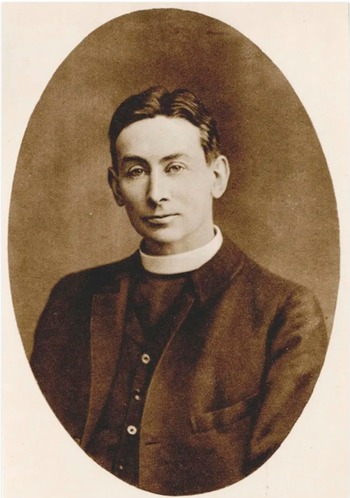
Sassoon, who had himself been awarded a Military Cross for rescuing a wounded man in May 1916,Footnote 7 regarded the Hon. Maurice Berkeley Peel, also a recipient of an MC, as a ‘byword for bravery’ (Figure 1). Indeed, Peel offers a good example of a chaplain who challenges the stereotype of the cowardly, ineffectual padre that was popularized by Robert Graves in his influential Good Bye to All That (1929),Footnote 8 and which seems to have been largely shared by Sassoon. Michael Snape and Edward Madigan, among others, have discussed the role of chaplains in detail, pointing to many acts of bravery as well as a ministry that was often respected by the soldiers and officers alike, but which was often damaged by the post-war image of the padre. As Madigan writes: ‘This overwhelming negative representation is a myth’.Footnote 9 Many chaplains appear to have been willing to expose themselves to danger, which often won them far more respect than did their office.Footnote 10 Furthermore, there does not seem to have been an official order forcing chaplains to stay behind the lines, although this was a matter of contention, especially at the outset of the war.Footnote 11 While there have been many studies of influential Church of England chaplains including Geoffrey Studdert KennedyFootnote 12 and P. T. (‘Tubby’) Clayton,Footnote 13 this article is the first to discuss Maurice Peel in detail.Footnote 14 It is based on an unpublished series of letters that he circulated to his Beckenham parish in the first years of the war.Footnote 15 While the context and audience of the letters remain unclear, it is likely that they were circulated around his parishes, chiefly as a morale-boosting exercise. Given that a few excerpts of the first letter were published in the Beckenham Journal, and mention is made of readers in Bethnal Green,Footnote 16 they were almost certainly intended to be open letters. They contain many interesting personal asides and insights into the faith of the combatants and the developing role of the chaplain.
The Rev. Maurice Peel, frontispiece to Anon., A Hero Saint: A Memoir of the Rev. the Hon. Maurice Berkeley Peel, C.F., M.C. (Beckenham, 1917). Image in the Public Domain.

Peel was born on 23 April 1873 and came from the well-known nineteenth-century political dynasty: he was the fifth and youngest son of Viscount Arthur Wellesley Peel (1829–1912), MP for Warwick and, from 1884 to 1895, Speaker of the House of Commons, who was himself a son of Sir Robert Peel, prime minister from 1834 to 1835, and again from 1841 to 1846. Peel’s mother Adelaide (1839–90) was the daughter of William Stratford Dugdale (1800–71), a Tory MP for Warwickshire from 1830 until 1847. Maurice Peel was educated at Winchester College, entering in January 1887; there he rowed in his house IV and was a member of the Debating Society. He left Winchester in the summer of 1891 and moved on to New College, Oxford, taking his degree in 1894 with second-class Honours in History.Footnote 17 Crucial in terms of his formation – and for his later success as a chaplain – was his next move, to Oxford House at Bethnal Green, which is discussed in more detail below.
Peel was ordained deacon in 1899 and remained in Bethnal Green as curate of St Simon Zelotes, Morpeth Street,Footnote 18 a typical East End church with three curates, a school room and a number of parish visitors. At the same time, he held a commission in the 4th Volunteer Battalion of the Queen’s Royal West Surrey Regiment. He was appointed vicar of Wrestlingworth and the family living of Eyeworth, near Sandy, Bedfordshire, in September 1906, where he remained until 1909.Footnote 19 His father had built Sandy Lodge (now the headquarters of the RSPB). Peel’s ministry in Bedfordshire seems to have been popular but unremarkable, with much time spent with the Church Lads’ Brigade. While there, he married Emily Allington on 29 July 1909. Soon afterwards, he moved to St Paul’s, Beckenham,Footnote 20 where, according to the somewhat adulatory memories gathered together in A Hero Saint (1917), he seems to have been much appreciated for his ‘warm-heartedness, the readiness with which he met friendship half-way, his entire naturalness’.Footnote 21 He is reported to have had a sense of ‘freshness and juvenility, and that keen sense of the humorous which makes all the difference between the half and the whole man’, without any ‘trace of sacerdotalism or even professional aloofness’.Footnote 22 He seems to have had little concern for dogma or church party,Footnote 23 and was always looking out for wider visions of truth.Footnote 24 He was not regarded as a great preacher but came over as intensely sincere.Footnote 25 While at Beckenham, he and Emily had two children, David Arthur Peel (1910–44, a later recipient of an MC who died in combat in Belgium),Footnote 26 and Mary Emily Peel (1912–34). Four days after Mary’s birth, Emily died, on 24 March 1912.
Peel supported the campaigns for enlistment at the outbreak of war, preaching a sermon in St Paul’s, Beckenham, in September 1914 at a service for the Church Lads’ Brigade encouraging young men to volunteer.Footnote 27 Shortly afterwards, for reasons that are not clear, Peel, although a widower with two young children, volunteered his services as chaplain to the Forces Fourth Class and went out to France in October with the 22nd Field Ambulance of the 7th Division. John Reginald Harmer, bishop of Rochester, later reported the conversation he had had with Peel about applying for a chaplaincy: ‘He thought he lacked gifts to impress men … He did not realise that soldiers, like men everywhere, look for character more than eloquence’.Footnote 28 This strength of character, which had been honed in the East End, becomes obvious from the lengthy open letters he began writing to his church, which seem to have been circulated widely in Beckenham. The first letter was dated 12 November 1914: much of it describes daily life in the early months of the war, but it also offers reflections on the role of the chaplain and the lack of clear expectations: as Hanneke Takken notes, the ‘scope and character of the new war demanded improvisation and adaptation’ of chaplains.Footnote 29 Peel wrote:
A Chaplain has to find out for himself what to do, and to discover how best to keep in touch with his Brigade. It is the quality of being in the right place at the right moment – as in the football field – which one needs the most. Sometimes I have felt that I possessed it, sometimes not, but I shall improve as experience teaches me to seize opportunities.Footnote 30
His account reveals a life characterized by frenetic activity. Peel spent a great deal of time either at the front line or in the reserve trenches. Later in the letter he noted:
On Sunday afternoon last, I was holding a little service for a few men, when a shell burst in the next field and killed an Irish guardsman, but we finished our service calmly. That same evening, I had a service in the dark for all that remained of the 22nd Brigade. They were in the reserve trenches. No firing was going on, only a spent bullet plunged into the ground a couple of yards away. I was told last night that the bullets were whizzing during the service, and that a man was hit in the leg just afterwards, but I was blissfully unconscious. I heard later from some of the men that they appreciated the service very much, and that many tears were rolling down their cheeks. ‘It was the most impressive service I have ever heard,’ said a young officer. They were the last of the 7th Division to remain in the trenches, since they could not be spared. … Poor fellows, they suffered here, for they were not supported in the flank as they should have been.Footnote 31
From his own account, it would seem that Peel had no problems communicating with men of all ranks who, he claims, were ‘eager to talk’. As Gary Sheffield notes, those ‘padres who did visit the trenches could form rewarding relationships with rankers’.Footnote 32 After a hospital visit, Peel reported a number of conversations:
One, a Guardsman, who has been the Prince of Wales’ servant: ‘He is a fine little fellow and a good officer, and he is a fine runner. He does a record round Buckingham Palace Gardens.’ Another is an officer who has been partially paralysed by the shock of a Jack JohnsonFootnote 33 bursting above him, and can speak only in a whisper. Another has been shot through the abdomen, and can hardly recover. He lies quite still and pale, and I write a re-assuring postcard for him so that his sweetheart may not be anxious. They love to talk of their experiences in the trenches. ‘It was Hell,’ or ‘It was just slaughter,’ are common expressions.
He also notes that his parish was persevering in its support of the ‘Bethnal Green Scheme’ which raised money for charities associated with his earlier ministry in the East End.Footnote 34
In a second letter a couple of weeks later, Peel revealed his thoughts about the morality of the war. He appears to have shared in the general perception of Germany as a country established on power. He suggests that there was a
perverted ideal of the worship of brute force embodied in the German nation and supported by the most devilish engines of War that science can invent. Before this idol, truth, honour, chivalry, freedom and religion, must bow the head, and on its Moloch altar individual life must be ruthlessly sacrificed.
Well may we pray to the loving Christ with profound confidence that He, in whom we find the true meaning of Divine and human life, may strengthen our Armies with immortal power, and illuminate our leaders with that central light which shines on the Divinely Guided way.Footnote 35
Until his death, Peel never seems to have wavered from the view that God would guide and strengthen the Allied armies, unquestioningly maintaining the inherent rightness of the cause.
It seems strange to long for the death of one’s fellow creatures, but honestly I rejoice when I hear of the slaughter of the Germans, and the heaps of their dead bodies, for owing to the actions of their Government and the teaching of their professors, they have become a horde of wasps which must be stamped out.Footnote 36
In a rather more reflective mood, he suggested that British soldiers were not dying in vain:
Well may we believe as we meditate upon the events of this War, that He and His Angels are with us, and that our beloved have not laid down their lives in vain at the feet of the Crucified. Ah, how deep must be their peace and gladness as they wake up from the shock of death into the great calm of God, and enter through the Gate of Sacrifice into the clearer dawn and the wider prospects, and the deeper unions of the promised land.Footnote 37
Here, as elsewhere in his letters, Peel seems to have retained a very powerful sense of death as the pathway to new life which would be a comfort to the bereaved.
On the whole, however, Peel was more a man of action than a man of reflection. From what he reports, he was constantly moving around the front lines: ‘I have been up to the trenches very often to see the men and have received attention from Fritz as well as other bullets from the German lines.’Footnote 38 In a very matter of fact way, he noted:
On Sunday evening I slipped into the trenches and had about three hours with the men, and I gathered them into little groups as they stood to arms along the parapet and there said a few prayers, the verse of a hymn, and a word out of the Bible, they seemed.to appreciate it. Firing broke out whilst I was there, but it was only for a few minutes and with no result.Footnote 39
Peel also reported on his conversations with the soldiers which had a lasting effect on him: ‘the words of a sympathetic man are treasured and remembered with a simple-hearted gratitude’.Footnote 40 He seems to have had a genuine affection for the ordinary soldier whom, it seems, he preferred to some of the parishioners from solidly middle-class Beckenham. With more than a hint of irony, he noted: ‘the sense of danger is nothing to what I have felt on many an evening in Beckenham when standing on the door step of some parishioner concerning whose desire to see me I have had the gravest doubts.’Footnote 41 As Joe Cottrill noted in his letter to Sassoon reporting Peel’s death (cited above), Peel seems to have had very little sense of fear. It was said that his ‘habitual practice was to bring up the third line to pick up the fallen, and he often made raids into No Man’s Land to bring in the wounded, constantly under the fear of death’.Footnote 42
Peel displays a very realistic appreciation of the religiosity of the soldier: he was certainly not surprised at what he found. Like many of his Oxford contemporaries, Peel had spent time at a settlement house, where volunteers drawn from among the elite schools and universities spent time living and working in ‘settlements’ among the urban working classes. For many, this was a kind of rite of passage, a semi-voyeuristic short-term sojourn among the dispossessed poor that has been called ‘slumming,’Footnote 43 or, more cynically, ‘benevolent picknicking’.Footnote 44 Oxford House had been established by a number of high churchmen associated with Keble College in 1884 as a more explicitly religious competitor to Toynbee Hall.Footnote 45 There was often a deeply patronising attitude. One head of Oxford House wrote: ‘The resident settlers are designed to take the place of the fugitive natural leaders. They ask the East End not to judge the educated classes by the absentees to whom they pay rent and render work, but to accept them as their truer representatives’.Footnote 46 The paternalistic spirit of the settlement movement was well captured by William Walsham How, bishop of Bedford (at the time a suffragan to the bishop of London before the title of the see was redesignated Stepney) in a sonnet of 1885 with the unlikely title of ‘University Settlements in East London’:
THEY come brave-hearted from high learning’s seat,
With wealth of Art and Culture’s gracious lore,
To offer, with free welcome, of their store
To weary toilers in the dismal street
‘These homes,’ they cry, ‘we will make bright and sweet,
‘Into these empty lives our fulness pour;
‘Perchance where love and beauty go before
‘Some path may open for an Angel’s feet’
Yet weary souls scarce lift a listless eye
To scan the proffered boon, and so pass by.
Ah! what if Angel feet best lead the way,
And thoughts of God wake men as from the dead,
Dreams of new beauty visit souls that pray,
And Art but follow whither Faith hath led?Footnote 47
Peel went to Oxford House in 1896 towards the end of Arthur Winnington-Ingram’s time as warden, before his appointment as bishop of Stepney the following year. Edward Madigan has briefly discussed experience in settlements as an influence on chaplains, including such well-known figures as Dick Sheppard and P. B. (‘Tubby’) Clayton, dismissing it as limited because of the short period most students spent among the poor. The influence on Peel, however, seems to have been far more profound than on others.Footnote 48 A colleague at Oxford House commented of Peel that ‘there never was a more popular resident at the House’.Footnote 49 After spending far longer at Oxford House than was usual, he remained in Bethnal Green after ordination in 1899 as a curate at St Simon Zelotes, where it was reported that he ‘entered with great zest upon various branches of its work’, especially the Church Lads’ Brigade, where he was put in charge of a battalion that consisted of three companies.Footnote 50 His method was ‘religion, drill and club’.Footnote 51 The area around the church, which was one of the poorest in Bethnal Green, was ‘practically virgin soil for Christian work’.Footnote 52 Although Peel was ‘very vague in his theological views and still more so in his ideas and understandings of the Church’, he nevertheless displayed a ‘personal devotion’ to Jesus Christ, combined with ‘an enthusiasm for the human being’.Footnote 53 He appears to have lived and worked among the people with little sense of aristocratic entitlement, and was always prepared to take risks. There was, as one contributor to A Hero Saint commented, ‘always an “unaccountableness” in what he did and said, and this surrounded his charming personality with a mysteriousness and a romance which had a peculiar fascination for the terrible living East Enders’.Footnote 54 He had a somewhat ‘reckless personality’, but was also haunted with a ‘distrust in himself’,Footnote 55 a lack of self-confidence that might help explain his success in the unpredictability of war which gave him a clear sense of purpose. At the same time, his long contact and abiding love of East Enders meant that he was free from any romantic notions about the attitudes of the poor.
This experience seems to have prepared Peel well for his work as chaplain.Footnote 56 In one of his early letters, he wrote realistically about the qualities of the British soldier:
I saw an exaggerated estimate of the British soldier in a church paper called ‘The Challenge,’ it declared that he was a Christian soldier in every sense of the word. This is an absurd and emotional view, I know, and Tommy would be the first to say so. There are all sorts in the army and the ordinary language of Tommy where unrestrained is not remarkable for its purity. Not all are saints, not all are heroes.Footnote 57
On this basis, he spent a great deal of his time dispensing tobacco and engaging men in conversation. He also frequently reports sing-songs and games of football, and a general sense of fun among the soldiers.Footnote 58 He also often writes about the risks he took. For instance, on 11 December, he recounted:
One poor fellow was killed by a sniper last Wednesday whilst gathering bricks from a ruined farm. I came up at night and buried him. On the way towards the trench, … a ricochet bullet passed over, and the peculiar moaning sound which it made, as if in anger at the futile flight, lasted for quite two seconds. I had to climb up the bank at the rear of the trench and creep through barbed wire in the dark in order to stand by his grave in the field, and then once more amid the occasional sounds of rifle shots hardly breaking the silence – ‘I heard a voice from Heaven saying unto me, Write, blessed are the dead which die in the Lord: even so, saith the Spirit, for they rest from their labours.’Footnote 59 As we returned over the field by the road to the house which was our Headquarters a bullet made a flash of fire over our heads against it, just as we entered.Footnote 60
Peel continued his correspondence into the second year of the war, in March 1915 writing a lengthy account of his many activities, in three parts, entitled ‘From the Front’. Alongside his frequent descriptions of the sounds of war, he also discussed the ambiguities of the role of chaplain and the complexity of relationships with the different ranks. He drew interesting anthropological comparisons about the outsider status of the chaplain, which also offer an insight into his Bethnal Green ministry and the impact of overseas mission. Chaplains were, after all, neither one thing nor the other:Footnote 61
During the battle I was in the trenches during the day, and with the bearers after dusk. My chief business in the trenches was to chat away cheerfully to the men, either in groups or singly; and I think the officers were glad to see me for a change. As I said to someone last night, ‘The men like to see the Chaplain. – He’s a kind of “freak,” a sort of amphibious beast, an officer yet not an officer, a soldier yet not a soldier, a perpetual zoological and theological curiosity.’ One of them described a fellow-chaplain of mine, who was careering about and holding little services amid shells, as ‘an elderly captain.’ Bethnal Green readers of this letter will remember him as the deliverer of a famous lecture on New Guinea. Those who saw him on that occasion break into a war dance, and heard him burst into a war-whoop on the stage, will not be surprised to hear how adventurous he is. If they also remember how cleverly he transformed some little Bethnal Green boys into little New Guinea boys, they will also understand that he is a man of infinite resource, and fulfils the office of a freak, with far greater distinction than the more sober minded stick-in-the-mud (useful in his way, though, in trench welfare) who writes these pages. However, I do my best, though a quiet dignified life such as that of a canon in a beautiful and resonant Cathedral is more in my line than this noisy, shelly, lunatic existence, in which your moods need a new grammar to record and tabulate them, and your ‘tenses’ become helplessly confused between ‘past’, ‘present’ and ‘future,’ and your cathedral is a muddy trench, and your voice like a nutmeg-grater.Footnote 62
In the second instalment of the same letter, he wrote of the visit of Arthur Foley Winnington-Ingram, bishop of London, with whom he had worked briefly at Oxford House when he was warden, and who became Peel’s bishop as bishop of Stepney. He was enthusiastically received:
‘We are all proud of you,’ he said, ‘and grateful for your coming. You don’t want the old country to be a German province. If it was, your country would soon be another, we won’t have that: we are fighting for freedom, – Cheer that! We are fighting for the Kingdom of Christ. – Cheer that!’ This speech will be chiefly remembered for his interjection ‘Cheer that!’ a command vigorously obeyed.Footnote 63
Seemingly without irony, Peel went on: ‘it is a good thing for a Bishop of London to come over and tell us that it is a crusade which we are fighting’.Footnote 64 In his first Easter of the war, Peel emphasized the importance of the suffering of Christ on Calvary, while at the same time stressing the love of God and the light of Christ that continues to shine through the darkness: ‘Men by themselves seem to themselves but as shadows. They never continue in one stay. But the Son of Man is no shadow. In Him our shadowy life can find its true light; and our restless life its abiding home.’Footnote 65 After Easter, Peel’s life continued with its round of services and stretcher bearing. In the final instalment of the letter on 12 May, he reported that on one occasion he buried another prime minister’s grandson, Lieutenant William Gladstone, ‘while a bullet or two whizzed over as we laid their bodies to rest, and their souls to God with a feeling of their presence there’.Footnote 66
Peel’s final letter, entitled ‘A Week at the Front’, describes his participation in an assault with the Staffordshires at the Battle of Festubert in May 1915:
Our turn came at 3 am. The dawn had already broken, our shells came hurtling over us. How one prayed that these shells whizzing over our heads were doing their work cutting the barbed wire, breaking the enemy’s heart. At last it was over. I went and stood at the left flank of B Company, which was to follow A in the attack. A ladder was ready to climb over when the signal came, just where I stood … The gay reckless spirit of battle was upon them. I should have felt it out of place to say any religious word to them now – it might have depressed them. To be over-thoughtful at such an hour is not good. I was glad that I had given them something for the depths of their hearts during the night.Footnote 67
E. C. Crosse described Peel’s actions before such attacks: ‘he would walk along the assembly trenches with some appropriate text on his lips; or if he couldn’t get along he would pass the word down the line’. ‘Hard-bitten’ soldiers passed the words along ‘with obvious satisfaction’, since there ‘was nothing forced or unnatural in the way Peel did this’.Footnote 68
Crosse notes that although there was some opposition to Peel’s desire to go over the top into battle, it seemed to represent the ‘moral value of a pure volunteer’s presence’.Footnote 69 During the fight, Peel assisted a man who had been blinded, but who was then shot through the arm with the bullet passing through Peel’s finger joints and covering his hand with blood. He lay for some hours before he was rescued by stretcher bearers: ‘Our bearers lost heavily that day. Four or five were killed, and twelve wounded. This shows how willingly they expose themselves to danger when bravely led. I deeply regretted one of the slain, a student at Dorchester Missionary College, and a candidate for Orders’.Footnote 70 He concluded:
I feel thankful for my escape though the bullet made a mighty big hole in my thigh; it came out; it missed everything which might cause serious trouble or give severe pain … The greatest happiness of all is that this attack was not a failure, but a distinct bite of the German cheese, swallowed and digested.Footnote 71
Rumours circulated that Peel had personally led one of the battalions of his brigade to the attack, carrying nothing but a walking stick. Although his letter does not corroborate such rumours, Crosse notes: ‘True to his decision, he accompanied his battalion over the top, walking-stick in hand.’Footnote 72
After he was awarded an MC in 1915,Footnote 73 Peel wrote a letter to Bishop Harmer of Rochester with typical diffidence:
I never expected the Cross or any such distinction. Others in other departments of the Army have faced far greater dangers and hardships than I, and have had nothing. … It is, of course, as a chaplain that I have received it, and this means that the particular way in which I have tried to do my work has been approved. None the less I know that I might have done much better, and that I have missed opportunities. Now I shall hope to be more watchful, and more resolute in trying to bring the sound of the Gospel to individual sufferers and to comfort them. I must improve and live up to this Cross if I can … In this uncertain sort of existence, one feels the need of Divine Help; and I have often felt that I was receiving it, so that I might do what was within my powers, and be led along ways where the gates of opportunity opened. In this I trust.Footnote 74
The bishop noted that he had a ‘sunny disposition, not exuberant so much as humorous, and gently depreciatory of his own powers. … a venturesome spirit, with an almost boyish amusement at danger which covered a serious mind’.Footnote 75
Peel was sent to a convalescent home in Polesden Lacey House in Surrey from 18 June to 17 July 1915. In November 1915, most likely for family reasons,Footnote 76 he became vicar of St Editha’s Church, Tamworth, the largest church in Staffordshire, and near to the ancestral Peel home of Drayton Manor.Footnote 77 In August 1916, however, after only a few months, he spoke to John Kempthorne, bishop of Lichfield, about returning to France. On 10 January 1917, he went back to serve with his old battalion of the First Welch Fusiliers. He did not write any further letters to his parish, but he evidently continued with his gallantry. After the capture of Posiez, he received a bar to his MC. Crosse writes that ‘by this time there was no question of the padre’s right to be in the front line’.Footnote 78 Even though Peel never spoke of his exploits, Crosse went on, his extreme bravery meant that the ‘superstitious began to believe that he bore a charmed life and was invulnerable as air’: ‘he wandered about the outposts and appeared like a guardian angel through the mist, bringing strength and comfort to many a lonely sentry’.Footnote 79
Eventually Peel’s luck gave out, and he was killed by a sniper on 15 May 1917. The battle is reported to have been particularly brutal: ‘So heavy was the fighting that it was literally true to say that the trenches were built partly with bodies of the dead.’Footnote 80 After a long fight, the village remained in allied hands ‘and at the furthest point of all, just in front of the ruins of the church, lay all that was mortal of Maurice Peel. Though he had had many opportunities of coming back he had refused to do so until the last of his wounded were cleared’.Footnote 81 The senior chaplain of the division was Peel’s close friend, Eric Milner-White (who afterwards became dean of King’s College, Cambridge, and later dean of York). After making efforts to discover the circumstances of Peel’s death and the place of his burial, Milner-White wrote:
His brigade were put into [Bullecourt] for 24 hours. In that time, the Germans made three desperate counter-attacks on it, gaining a little each time. It was not clear where the Germans were, and where the English and German snipers crept about. At early dawn on the 15th (the second anniversary of Festubert) he got out of his trench to visit either a wounded man or an isolated post of men. On the way, a sniper’s bullet caught him in the chest; he fell unconscious and died very shortly, one Welch Fusilier officer crawling out and staying with him till the end.
That same night, one of the chaplains, McCalman,Footnote 82 with great courage went up with a cross, hoping to bring in the body and bury it. Arrived within a few yards, he was not allowed to go further, the risk being too great. …
On Ascension Day, the 17th, Mr McCalman and I went up together in daylight. Some men then holding the dreadful line had that morning crept out and buried the body a yard or two from the spot where he fell. We raised a temporary cross upon it, and I said the service over the little grave, using with tragic appropriateness the Collect for Ascension Day, which Maurice always used at his burials.Footnote 83
Crosse relates Peel’s death slightly differently: ‘Getting up in broad daylight to help one of those who had been wounded, he was shot through the stomach, and bled to death where he fell.’Footnote 84 Milner-White regarded Peel as ‘the greatest Chaplain in France, none could be greater.’ Indeed, ‘His own “immortal” Division used to call him “the bravest man in the Army”. He always accompanied his men into the line; whenever a shell burst, he at once ran towards it, lest any man had been hit and he might be of service. The men of course worshipped him’.Footnote 85 He concluded: ‘there is a joy about the grandeur of his life and death in France that will be an inheritance most magnificent to his two children and to you who love him’.Footnote 86 Bishop Gwynne, Deputy Chaplain-General, similarly commented that ‘his work among the troops has been a high watermark pattern and inspiration to our Chaplains and brought great “Kudos” to the Church he loved and cared for so well’.Footnote 87
While many of these assessments of Peel’s career in A Hero Saint are obviously somewhat hagiographical, there are nevertheless a number of consistent themes that emerge from his letters and from the somewhat scanty other evidence that point to Peel’s distinctive character. First, he displayed something of a recklessness which, when combined with a lack of self-confidence, meant he was happy in situations which many from his background might well have found uncomfortable. Secondly, as had already proved the case with his ministry in the East End, Peel’s ministry was undoubtedly improvised and different from some of the patterns established by many of his contemporaries, as Siegfried Sassoon had observed. The chaplain Neville Talbot, son of the bishop of Winchester, who himself became a bishop in 1920, had written in 1917 of the inherent problems for the officer-chaplain:
There is something wrong about the status of chaplains. They belong to … ‘the super-world’ of officers, which as such is separate from the men. As a class we find it hard to penetrate the surface which we can almost see thrust out at us like a shield, in the suddenly assumed rigidity of men as they salute us.Footnote 88
It would seem that Peel was able to overcome some of the class differences with the men he was serving through acts of courageous solidarity which seem to have been inspired by what he had learnt from his extensive experience in Bethnal Green. Another chaplain, Kenneth Kirk, who went on to become bishop of Oxford, noted that the ‘chaplain ceases to be an officer the moment he exhibits himself as a priest … a father, leader, comforter and example to his men’.Footnote 89 This suggests, as Gary Sheffield put it: ‘the most effective padres were those who allied courage and paternalism with the ability to overcome the barriers of rank and class’.Footnote 90 Peel seems to have been less paternalistic than many: lacking in self-confidence, he plunged himself into a precarious ministry. Peel’s personality was in many ways suited to the unprecedented circumstances of trench warfare. His acts of bravery brought him into a relationship with the ordinary soldier that was rare.Footnote 91 What his example reveals is that an unremarkable aristocratic parish priest from a famous political dynasty, but with little theology, modest preaching abilities, and lacking in self-confidence, turned out to be an extraordinarily effective communicator simply by being alongside, laughing with and suffering with his men. Other chaplains may have become much more famous than Peel, but few seem to have had his winning combination of lack of pomposity, modesty and bravery, which so impressed even the sceptical Sigfried Sassoon. A long ministry in the East End had almost certainly taught Peel that the working classes have a very keen eye for priestly cant.

 Open access

