





1. Introduction
Recent environmental assessments (IPBES, Reference O'Brien, Garibaldi and Agrawal2024; IPCC, Reference Shukla, Skea, Slade, Al Khourdajie, Van Diemen, McCollum, Pathak, Some, Vyas, Fradera, Belkacemi, Hasija, Lisboa, Luz and Malley2022; UNEP, 2022) emphasise that sustainability transitions and transformations should accelerate to address problems like climate change and biodiversity loss. The IPCC (Reference Shukla, Skea, Slade, Al Khourdajie, Van Diemen, McCollum, Pathak, Some, Vyas, Fradera, Belkacemi, Hasija, Lisboa, Luz and Malley2022: 31) suggests that: ‘The 2020–2030 decade is critical for accelerating’ and the UNEP (2022: xv) calls for rapid ‘system-wide transformation’ to achieve 45% or 30% emission cuts by 2030 to remain on track for 1.5°C or 2°C climate change, respectively.
Since we are now halfway through the critical 2020s decade, this paper reflects on what works and what does not. It starts with the observation that rapid change is not yet happening for the Sustainable Development Goals (UN, 2025), but that there are some positive developments regarding climate mitigation with at least 18 countries showing ‘sustained GHG emission reductions for longer than 10 years’ (IPCC, Reference Shukla, Skea, Slade, Al Khourdajie, Van Diemen, McCollum, Pathak, Some, Vyas, Fradera, Belkacemi, Hasija, Lisboa, Luz and Malley2022: 9). These reductions partly stem from accelerating deployment of clean energy technologies, with electric vehicles (EVs), for example, reaching 22% of global car sales in 2024, up from less than 5% in 2020 (IEA, 2025), and the percentage of renewables in electricity generation in 2024 reaching 47.3% in Europe, 33.6% in China, and 24.1% in the United States, up from respectively 22.1%, 18.7%, and 10.3% in 2010 (Ritchie et al., Reference Ritchie, Roser and Rosado2025).
This begs the question why acceleration is starting to happen for (some) technical innovations but not for society-wide ‘shifts in views, structures, and practices’ (IPBES, Reference O'Brien, Garibaldi and Agrawal2024: 5) or for transformative social innovations like eco-villages, transition towns, family farming, Slow Food, time banks, ethical banks, or degrowth, which since the 2000s have been advocated by grassroots innovation scholars (Seyfang, Reference Seyfang2010; Seyfang & Smith, Reference Seyfang and Smith2007) and transformative social innovation scholars (Pel et al., Reference Pel, Haxeltine, Avelino, Dumitru, Kemp, Bauler, Kunze, Dorland, Wittmayer and Jørgensen2020, Reference Pel, Wittmayer, Avelino and Bauler2022).
One often-heard answer is that technical innovations diffuse quicker because they suit incumbent interests, whereas transformative social innovations diffuse slower as they threaten incumbent interests. While not entirely wrong, this answer underestimates the degree to which technical innovations (like wind, solar, EVs) were initially resisted by incumbent interests and insufficiently acknowledges how socio-technical change processes over multiple decades changed power structures, ideas, and interests that contributed to accelerated diffusion.
This Intelligence Briefing, therefore, provides a more nuanced answer, arguing that technical innovations benefit from five dynamic mechanisms that can accelerate transitions that do not (to the same degree) drive society-wide transformation and transformative social innovations like those mentioned above. This Briefing also critiques aspects of the transformations literature and suggests that the socio-technical transitions literature offers more relevant insights regarding acceleration.
Although transition and transformation approaches both attempt to understand radical large-scale structural changes needed to address sustainability problems, they also represent different research communities (notably the Sustainability Transitions Research Network (https://www.transitionsnetwork.org) and the Transformations Community (https://transformationscommunity.org) with different intellectual and normative orientations.
The transitions community focuses on provisioning systems that fulfil societal functions (e.g. food, mobility, energy, housing, health) and the role of technologies in (changing these) systems, which is analysed in relation to firms, users, policymakers, and/or civil society actors and the associated economic, political, social, and cultural dynamics, including power struggles (Geels, Reference Geels2024; Köhler et al., Reference Köhler, Geels, Kern, Markard, Onsongo, Wieczorek, Alkemaade, Avelino, Bergek, Boons, Fuenfschilling, Hess, Holtz, Hyysalo, Jenkins, Kivimaa, Martiskainen, McMeekin, Mühlemeier and Wells2019). Scholars use ‘socio-technical’ as a shorthand to acknowledge the multi-dimensionality of transitions, while also following STS-scholars (Bijker & Law, Reference Bijker and Law1992; Callon, Reference Callon, Bijker, Hughes and Pinch1987; Latour, Reference Latour1990) in using technology as an entry point for wider analyses.
The transformations community consist of diverse approaches (Feola, Reference Feola2015; Patterson et al., Reference Patterson, Schulz, Vervoort, Van der Hel, Widerberg, Adler, Hurlbert, Anderton, Sethi and Barau2017) that vary in their system focus (e.g. socio-ecological systems, socio-metabolic systems, the capitalist system, cultural value systems associated with consumer society) and their orientation, with some approaches (e.g. socio-ecological regime shifts, resilience, socio-metabolic transitions) being characterised as ‘analytic-descriptive’ and using ‘theoretically-grounded concepts of transformation’ (Feola, Reference Feola2015: 385), while other approaches (e.g. progressive transformation, deliberate transformation) are characterised as normatively focused on desired (wished-for) futures and ‘lacking a rigorous conceptualization of transformation’ (Feola, Reference Feola2015: 386).
My critiques in this Briefing, which are woven into the discussion of the five dynamic mechanisms, focus on the latter approaches and will specifically identify shortcomings in deep leverage points, the three spheres approach, degrowth, and calls for frugality and sufficiency.
2. Increasing-returns-to-adoption mechanisms
A first reason for differential diffusion speeds is that technical innovations can experience increasing-returns-to-adoption (IRA) mechanisms that reduce cost and increase performance of technical innovations during the diffusion process, thus generating positive techno-economic feedback loops. New technologies initially tend to have high cost and low performance, which is why they first emerge in small peripheral niches (Schot & Geels, Reference Schot and Geels2008). But as technical innovations are deployed in successively larger market niches (often initially supported by policymakers), they can benefit from IRA-mechanisms such as learning-by-doing, scale economies in production, increasing availability of complementary innovations, increasing visibility, and informational returns (Arthur, Reference Arthur1989; Rosenberg, Reference Rosenberg1982; Sovacool et al., Reference Sovacool, Geels, Andersen, Grubb, Jordan, Kern, Kivimaa, Lockwood, Markard, Meadowcroft, Meckling, Moore, Raven, Rogge, Rosenbloom, Schmidt, Schot, Sharp, Stephenson and Yang2025). These IRA-mechanisms make new technologies more appealing and affordable, which enhances adoption, leading to positive self-reinforcing feedback loops that accelerate diffusion.
This mechanism reduced battery pack costs for EVs by 86% between 2013 and 2024 (IEA, 2025) and decreased levelised-cost-of-energy for solar-PV, onshore wind, and offshore wind by, respectively, 90%, 70%, and 62% between 2010 and 2024 (IRENA, 2025), making them ‘the cheapest electricity sources in most markets’ (IEA, 2024a). These IRA-mechanisms are less pertinent for social innovations. Although some learning and informational returns can occur in social innovations, these are more about proponents of a social innovation in one location learning from experiences in another location (Westley et al., Reference Westley, McGowan and Tjörnbo2017) than about significant cost reductions and performance improvements in the diffusing entity.
3. Socio-technical feedbacks between technology, actors, and institutions
A second reason for differential diffusion speeds is that the diffusion of clean technologies may set in train, and benefit from, socio-technical feedback loops that change the beliefs and interests of actors through second-order learning processes (Geels & Ayoub, Reference Geels and Ayoub2023, Reference Geels and Ayoub2025; Sovacool et al., Reference Sovacool, Geels, Andersen, Grubb, Jordan, Kern, Kivimaa, Lockwood, Markard, Meadowcroft, Meckling, Moore, Raven, Rogge, Rosenbloom, Schmidt, Schot, Sharp, Stephenson and Yang2025; Vormedal et al., Reference Vormedal, Bjander, Larsen and Lindberg2023), leading to stronger actions (e.g. more investment, supportive policies, consumer adoption, positive discourses) that further accelerate diffusion. Figure 1 schematically represents the main socio-technical feedback loops for technology and four types of actors (firms, users, wider publics, policymakers).
Schematic representation of seven feedback loops between technology and actors (Geels and Ayoub, Reference Geels and Ayoub2023: 3).

For users, these feedbacks include IRA-mechanisms, learning-by-using mechanisms and the development of new capabilities and perceptions that then drive further adoption (Lie & Sørensen, Reference Lie and Sørensen1996). Many Norwegian households, for example, initially purchased EVs as a ‘second car’ for short trips, but subsequently used it as the preferred ‘first car’ because of positive driving experiences and learning processes (Ryghaug & Toftaker, Reference Ryghaug and Toftaker2014).
For firms, these feedbacks include behavioural and strategic learning processes, in which growing markets and revenues can lead to more positive views of clean technologies and redefined interests (Thomas et al., Reference Thomas, Clark and Gioia1993; Vormedal et al., Reference Vormedal, Bjander, Larsen and Lindberg2023), which then lead to more investments, which improve performance and reduce cost, which stimulate further adoption. This happened empirically in the electricity and automobility sectors, where firms fundamentally changed their views of renewable electricity and EVs in the 2010s, leading them to support low-carbon technologies (Geels & Ayoub, Reference Geels and Ayoub2023).
Policymakers can also change their perceptions and strategic orientation, when initial policies are effective in stimulating clean technology diffusion, which then generate feedbacks via policy learning, positive public debates, and company lobbies, which may strengthen and ratchet-up policy support (Pahle et al., Reference Pahle, Burtraw, Flachsland, Kelsey, Biber, Meckling, Edenhofer and Zysman2018; Schmidt & Sewerin, Reference Schmidt and Sewerin2017; Sewerin et al., Reference Sewerin, Cashore and Howlett2022).
The initial introduction of new technology can thus act as a lever, flywheel, or catalyst for deeper changes, activating co-evolutionary processes and feedback loops that can alter the views, capabilities, interests, and practices of actors. This aligns with findings from innovation sociologists showing that technology and society co-construct each other (Bijker & Law, Reference Bijker and Law1992; Callon, Reference Callon, Bijker, Hughes and Pinch1987; Latour, Reference Latour1990). It also aligns with empirical research showing that many transitions start with ‘shallower’ changes such as new policies or technologies, which then stimulate learning and mobilisation processes that, over time, lead to new coalitions, power balance shifts, stronger policies, new goals, or changes in views and beliefs (Geels & Ayoub, Reference Geels and Ayoub2023, Reference Geels and Ayoub2025; Geels & Turnheim, Reference Geels and Turnheim2022; Hughes, Reference Hughes2004; Pahle et al., Reference Pahle, Burtraw, Flachsland, Kelsey, Biber, Meckling, Edenhofer and Zysman2018).
Positive feedback loops are arguably weaker for transformative social innovations, which by definition require major changes in preferences, beliefs, and practices and therefore immediately encounter socio-cultural and political obstacles related to existing structures and institutions. In the absence of a flywheel or catalyst (like technology) that can gradually increase the momentum of change through positive feedbacks, it often remains unclear how transformative social innovations are supposed to overcome these obstacles. Despite repeated small-scale initiatives and demonstration projects, transformative social innovations therefore typically fail to scale-up or diffuse at speed.
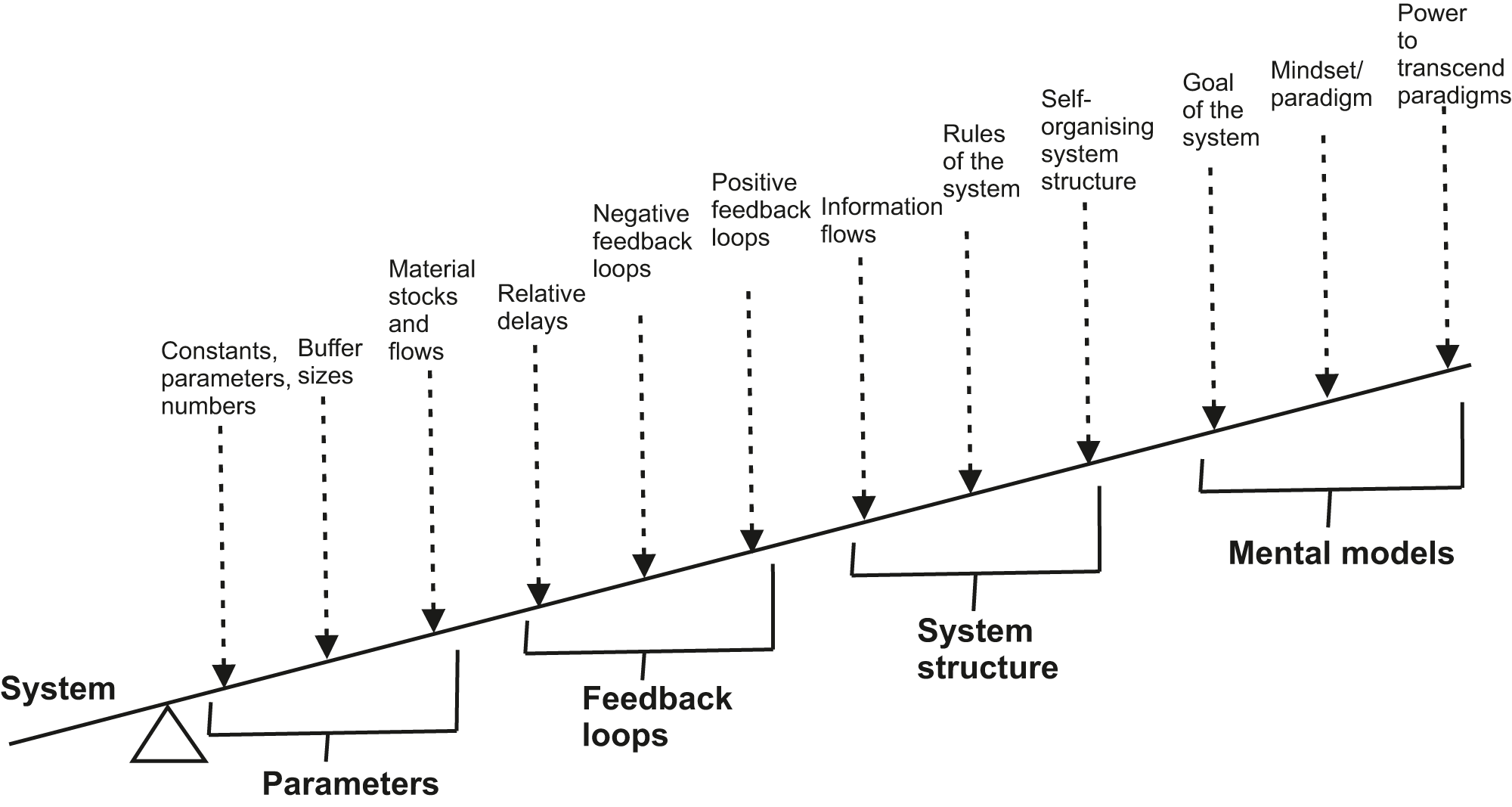
More broadly, this discussion points to shortcomings in influential transformation approaches that see changes in ideas and meanings as drivers of transformation. The three spheres approach (O'Brien, Reference O'Brien2018), for example, sees beliefs, values, and worldviews (‘individual sphere’) as more important drivers of transformation than technologies and behaviours (‘practical sphere’) and institutions and system structures (‘political sphere’). Likewise, the deep leverage points approach (Abson et al., Reference Abson, Fischer, Leventon, Newig, Schomerus, Vilsmaier, von Wehrden, Abernethy, Ives, Jager and Lang2017; Davelaar, Reference Davelaar2021), which builds closely on Meadows (Reference Meadows1999), suggests that cultural-cognitive changes (in mental models, mindset, goals) are the most powerful levers of change, followed by changes in system structure (rules, information flows). Changes in material elements (like technologies) are seen as rather unimportant levers, generating mostly shallow change (Figure 2).
Leverage points for system change (adapted from Meadows, Reference Meadows1999).

One shortcoming is that these approaches do not provide an operational, empirically validated theory of deep cultural-cognitive change. Systematic reviews, for example, find limited empirical evidence for the deep leverage points’ claim that mental model changes are crucial drivers of sustainability transformations (Allen & Malekpour, Reference Allen and Malekpour2023; Dorninger et al., Reference Dorninger, Abson, Apetrei, Derwort, Ives, Klaniecki, Lam, Langsenlehner, Riechers, Spittler and Von Wehrden2020). Salomaa and Juhola’s (Reference Salomaa and Juhola2020: 1) review of sustainability transformations therefore concludes that: ‘The concept was often used only as a metaphor without empirical grounding, and the process of the transformation towards the intended end result – sustainability – was seldom defined’.
Lacking a good theory of change, another shortcoming is the tendency to provide well-intended but non-operational and thus unactionable policy advice (‘let’s change people’s mental models’). An example is key message 12 in the 2024 IPBES report, which asserts that: ‘Shifting dominant societal views and values to recognize and prioritize human-nature interconnectedness is a powerful strategy for transformative change’.
A third shortcoming is that the focus on deep leverage points prevents scholars from appreciating the temporal nature of transformations, in particular, how changes in ‘shallower’ leverage points can trigger co-evolutionary processes that build momentum for deeper change (Allen & Malekpour, Reference Allen and Malekpour2023), as discussed above.
4. Financial reorientation
A third reason for differential diffusion speeds is that private finance sources tend to reorient more towards clean technologies than towards social innovations. Large amounts of money are needed to achieve the SDGs, roughly $5.5–6.4 trillion of additional annual investment (UNCTAD, 2023), and to mitigate climate change, roughly $2.3–3.5 trillion of additional annual investment (IPCC, Reference Shukla, Skea, Slade, Al Khourdajie, Van Diemen, McCollum, Pathak, Some, Vyas, Fradera, Belkacemi, Hasija, Lisboa, Luz and Malley2022; McKinsey, 2022). Significant increases in global investments are already happening in the clean energy transition, where they climbed from $33 billion in 2004 to $2.083 trillion in 2024 (BNEF, 2025), with most money going to solar-PV, wind, EVs, and electricity grids. Investments in social innovations and the SDGs do not show similar sizes.
One explanation for this difference is that clean technologies operate in market economies, while social innovations operate in the social economy driven by ideological principles and social needs (Seyfang & Smith, Reference Seyfang and Smith2007). Big financial actors like commercial banks, hedge funds, pension funds, insurance companies, and central banks, which combined managed more than $400 trillion in financial assets in 2022 (FSB, 2023), are oriented towards the market economy rather than the social economy (for fiduciary duty and other reasons). This means that they may consider investing in clean technologies (when perceived as profitable), but not in social innovations.
A further explanation is that financial actors often perceive social innovations as less investable, because are less oriented towards scaling and diffusion (Seyfang et al., Reference Seyfang, Hielscher, Hargreaves, Martiskainen and Smith2014), often committed to radical values (such as ‘small is beautiful’), frequently lack viable business plans or commercial ambitions (Hossain, Reference Hossain2018), and are often small-scale, which misaligns with commercial investor’s preference for large investment projects (e.g. $100 million) with lower transaction cost.
A third explanation is that policymakers often help commercial investors by reducing investment risks for clean technologies through subsidies, capital grants, or favourable loans. Financial policy support is more limited for social innovations, which thus mostly rely on foundations, philanthropic funders, crowdfunding, or social impact investors (Hossain, Reference Hossain2018; Mulgan, Reference Mulgan2019), who provide smaller amounts of funding that usually support single projects rather than widespread scaling.
For multiple reasons, technical innovations thus find it easier than social innovations to attract significant financial investments (especially when decreasing costs and growing markets make them financially attractive). This could change in the future by fundamentally transforming the financial system (UNEP, 2018), but efforts in that regard have been modest and ineffective (Ameli et al., Reference Ameli, Drummond, Bisaro, Grubb and Chenet2020; Stephens & Sokol, Reference Stephens and Sokol2024), which is unsurprising given the political influence of the financial sector (which is unlikely to change any time soon).
5. Issue linkage to wider political goals
A fourth reason for differential diffusion speeds is that clean technologies can more easily be linked to wider political goals such as economic growth, competitiveness, and security. This can help align the sustainability agenda with powerful political actors like Treasuries, economic and industry ministries (Geels, Reference Geels2024), which can increase support for low-carbon transitions via green industrial policies (including adoption subsidies, deployment mandates, public procurement, R&D or investment grants), which since the late 2010s have become the dominant climate policy strategy (Allan et al., Reference Allan, Lewis and Oarley2021; Meckling & Allan, Reference Meckling and Allan2020).
This alignment has increased in recent years as solar-PV, wind, EVs, and batteries have become part of global innovation races, which are dominated by China, which in 2023 produced 80% of the world’s solar-PV modules, 65% of wind nacelles, 80% of EV batteries, and 55% of electrolysers (IEA, 2024b; RMI, 2024). China’s dominance increased geo-political concerns in Western countries about security risks and competitiveness in future growth sectors, giving rise to the 2022 Inflation Reduction Act, which aimed to boost US manufacturing and deployment of clean technologies. In response, the European Commission introduced the 2023 Net Zero Industry Act with similar ambitions.
While some scholars criticise these developments for focusing on technology and green growth, they arguably constitute an improvement compared to previous decades when sustainability and climate change were the concerns of relatively powerless environmental ministries. Environmental state theorists (Dryzek et al., Reference Dryzek, Downes, Hunold, Schlosberg and Hernes2003; Eckersley, Reference Eckersley2021) argued that ‘sustainability’ was for decades a marginal concern compared to the state’s core functions: provide social order, provide external defence and security, raise revenue, promote economic growth, and offer democratic legitimation. However, recent alignment with economic growth and security has made low-carbon transitions a top-level political issue, leading to more policy support.
Similar alignments with wider political goals and powerful ministries have not happened for social innovations, which helps explain their lower political profile and policy support. Appeals to principles like ‘equity and justice; pluralism and inclusion; and respectful and reciprocal human-nature relationships’ (IPBES, Reference O'Brien, Garibaldi and Agrawal2024: 6) are noble and hard to disagree with, but less effective in mobilising wider political support needed to accelerate transformations. More generally, policy relevance seems to have been of marginal interest for transformations researchers, with a recent special issue editorial concluding that the development of policy tools and frameworks is ‘one of the most urgent yet less developed aspects of the field’ (De Castro et al., Reference De Castro, De Theije, Jain and Adger2025: 4).
6. Societal acceptance
A fifth reason for differential diffusion speeds is that the societal acceptance of clean technologies is higher than for fundamental lifestyle changes. A European survey study, for example, found that most citizens are willing to make small changes such as increasing waste recycling but are unwilling to change lifestyles by giving up cars, abandoning flying, or becoming vegetarian (Dubois et al., Reference Dubois, Sovacool, Aall, Nilsson, Barbier, Herrmann, Bruyere, Andersson, Skold, Nadaud, Dorner, Moberg, Ceron, Fischer, Amelung, Baltruszewicz, Fischer, Benevise, Louis and Sauerborn2019). A UK report by the Centre for Climate Change and Social Transformations (2022: 5) also found that: ‘Public concern about climate change has risen in recent years but has not been matched by a significant corresponding shift in behaviours towards more sustainable lifestyles’. In contrast, positive discourses about wind, solar-PV and EVs stimulated user adoption and societal acceptance in the 2010s, driving rapid diffusion (Bohn & Rogge, Reference Bohn and Rogge2022; Geels & Turnheim, Reference Geels and Turnheim2022; Ruddat, Reference Ruddat2022).
In recent years, however, societal acceptance has become a bigger challenge for sustainability transformation, as the rise of populist politicians and right-wing parties (Haas et al., Reference Haas, Sander, Fünfgeld and Mey2025), misinformation campaigns by incumbent industries (Ekberg et al., Reference Ekberg, Forchtner, Hultman and Jylhä2023), and green backlashes among citizens (Bosetti et al., Reference Bosetti, Colantone, De Vries and Musto2025) have culminated in the propagation of negative discourses about sustainability targets and specific technologies, leading to acceptance challenges and policy weakening.
This new socio-political context has led to calls for a pragmatic reset (Dasgupta, Reference Dasgupta2025; Klein & Thompson, Reference Klein and Thompson2025; Liebreich, Reference Liebreich2025; Ritchie, Reference Ritchie2024, Reference Ritchie2025) that moves away from narratives that frame sustainability transformations in terms of sacrifice, cost, downsizing, and environmental metrics such as carbon reduction towards narratives, solutions, and policies that more directly engage with people’s daily life concerns such as the cost-of-living crisis, jobs, and quality-of-life issues. Clean technologies lend themselves better for such a reset than social innovations and lifestyle changes because solar-PV, wind, EVs, and heat pumps offer near-term potential for lower consumer bills due to continued IRA-mechanisms (Mercure et al., Reference Mercure, Pollitt, Geels and Zenghelis2025). They also contribute to cleaner air (and fewer premature deaths), less noise, and reduced exposure to fluctuating oil/gas prices.
In contrast, calls for frugality, sufficiency, downsizing, or degrowth, which are widespread in the transformations literature, will likely remain unappealing, except perhaps for a minority of deep green citizens and academics (Blühdorn, Reference Blühdorn2013). Furthermore, while it is easy to blame green backlashes on right-wing populist politicians, social scientists (Collier, Reference Collier2018; Crouch, Reference Crouch2004; Goodhart, Reference Goodhart2017; Mair, Reference Mair2013) have identified deeper causes for the underlying resentment, including stagnating wages and worsening job prospects in left-behind regions as well as decades-long neglect by left-wing politicians and condescension by left-wing intellectuals. Fraser (Reference Fraser and Geiselberger2017: 44), for example, notes that US reactionary populism was partly a reaction to ‘progressive moralism, which routinely portrays them [i.e. rural and Rust Belt populations] as culturally backward’. Latour (Reference Latour and Geiselberger2017: 83) similarly diagnoses that political and academic elites abandoned working class people and frequently criticised their ‘narrow-minded vision, their fears, their naïve mistrust of elites, their bad taste in culture, and above all their passion for identity, folklore, archaism and boundaries’.
These deeper societal trends imply that calls for behaviour change and green lifestyle shifts may inadvertently contribute to further backlashes, as many people dislike being lectured by sustainability experts who show little empathy or understanding for their daily life concerns and struggles. In contrast, targeted support for the deployment of home insulation, heat pumps, or solar panels may be more acceptable, especially if lower-income households receive financial support enabling them to install green technologies at low or no cost. These kinds of measures would support families in sustainability transformations rather than telling them to change their behaviour.
7. Concluding remarks
This Intelligence Briefing has discussed five explanations of why sustainability transitions are starting to accelerate for technical innovations but not for social innovations and lifestyle changes. This finding does not imply that social innovations or changing macro-cultural beliefs are unimportant for large-scale transformations, as they were central in historical transformations such as the creation of welfare states, women’s right to vote, or new models of childcare and housing (Mulgan, Reference Mulgan2019; Westley et al., Reference Westley, McGowan and Tjörnbo2017). But the Briefing does suggest that there is little evidence that deep sustainability-oriented changes in lifestyles and social practices are presently diffusing at a significant scale and speed, despite being advocated and trialled for 15–20 years.
Reflecting on historical case studies in the book The Evolution of Social Innovation, Olsson (Reference Olsson, Westley, McGowan and Tjörnbo2017: 70) concludes that ‘large-scale, transformative change can take a long time, sometimes hundreds of years’. Westley (Reference Westley, Westley, McGowan and Tjörnbo2017: 241) therefore warns against wishful thinking about social innovations: ‘The length of time that these innovations took to transform the broader society is a sobering thought for those who seek a quick fix to the pressing problems of our society’. These insights sit uncomfortably with the compressed timelines for achieving significant change, highlighted in the introduction, which imply that we lack the time to wait for social innovations to form and diffuse, for social movements to form and expand, or for capitalism to fundamentally transform.
I therefore conclude that technical innovations offer greater potential than purely social innovations to accelerate sustainability transformations in the next 5–10 years. Acting as a catalyst or flywheel for further changes, the accelerated diffusion of new technologies may also galvanise subsequent transformations in beliefs, institutions, and power structures. This co-evolution of social and technical change is, of course, central in the socio-technical transitions framework (Geels, Reference Geels2024; Geels et al., Reference Geels, Kern and Clark2023; Sovacool et al., Reference Sovacool, Geels, Andersen, Grubb, Jordan, Kern, Kivimaa, Lockwood, Markard, Meadowcroft, Meckling, Moore, Raven, Rogge, Rosenbloom, Schmidt, Schot, Sharp, Stephenson and Yang2025), which has been empirically validated and operationalised in terms of policy strategies and instruments for different transition phases, including acceleration (Geels et al., Reference Geels, Turnheim, Asquith, Kern and Kivimaa2019; Meadowcroft & Rosenbloom, Reference Meadowcroft and Rosenbloom2023; Murphy et al., Reference Murphy, Sharpe, Geels, Lilliestam and Patt2025; Victor et al., Reference Victor, Geels and Sharpe2019).
Ten years ago, Feola (Reference Feola2015: 386) already diagnosed that much of the transformation literature ‘lacks a rigorous conceptualization of transformation’. It is therefore concerning that a recent special issue editorial on sustainability transformation still concludes that the literature does not provide ‘an explicit treatment of temporality of transformation, (….) including an understanding of distinct transition stages and the feedback loops than can either accelerate or hinder progress’ (De Castro et al., Reference De Castro, De Theije, Jain and Adger2025: 3). I therefore suggest that the socio-technical transitions framework seems better suited and more policy relevant for the topic of acceleration than influential approaches in the transformations literature. The socio-technical transitions framework also addresses interactions between social and technical innovations, which is a research topic that scholars could further investigate to reconcile currently divergent research streams.
Acknowledgements
I gratefully acknowledge helpful comments on earlier drafts from Fred Steward, Cameron Allen, and three anonymous reviewers.
Author contributions
FWG did all the work.
Financial statement
Research in this article has not received financial support.
Competing interests
FWG had no conflict of interest in preparing the manuscript.
Research transparency and reproducibility
All the data reported in the paper are publicly available.


 Open access

