

Introduction
The year 2019 proved to be a game changer for politics in Bulgaria in many ways. The year 2018 had ended with Citizens for European Development of Bulgaria/Grazhdani za evropeysko razvitie na Bulgaria (GERB) and Prime Minister Boyko Borissov in a strong position in both Parliament and the executive, having benefited from the positive assessment of the Bulgarian presidency of the Council of the European Union (EU) (January–June 2018). This stability was challenged substantially in 2019 with the party experiencing significant internal earthquakes and public unhappiness with Borissov and his Cabinet mounting.
Election report
European Parliament (EP) elections were held, just as in most of the EU, in May 2019. These were the only national elections in the country during the year and elected 17 members of the EP. A total of 27 parties ran in the election, and five made it to the EP.
The campaign was, as usual for the EP elections, lacklustre, with the main issues reflecting the national political competition: the corrupt practices of the Cabinet, nationalism, protection of minorities and foreign policy orientation. The EP elections are mainly used to estimate the support for the political actors at the time, as there is a general pro‐EU consensus among the political parties in the country, with some very small exceptions.
On the centre‐right, GERB and the Democratic Bulgaria‐Union (Da, Bulgaria & DSB)/Demokratichna Bulgaria‐Obedinenie (Da, Bulgaria & DSB) (DB‐U) coalition, both members of the European People's Party (EPP) ran separately, even though EPP leader Joseph Dole called for an electoral alliance. Several principled disagreements stood in the way, with the most important being foreign policy. While Borissov maintains a two‐pronged foreign policy, balancing between the EU and Russia, democratic Bulgaria maintains a firm pro‐European line. Also on the right, and in a sign of intra‐coalition trouble, one of the Cabinet partners, United Patriots/Obedineni Patrioti (OP), an alliance of two nationalistic parties, failed to run candidates together: its constituent party Internal Macedonian Revolutionary Organization/VMRO‐Bulgarsko Natsionalno Dvizhenie (VMRO) ran on its own. They ran on an openly nationalist and traditionalist position ‘against pseudo‐liberals, multicultural ideologies, against the invasion, against Islamism, for the protection of the Bulgarian interest’ (BTV News 2019).
On the left, the major opposition party since 2015, the Bulgarian Socialist Party BSP for Bulgaria/BSP za Bulgaria (BSP) was itself split on their foreign policy positions and that was most clearly demonstrated at the EP elections. The pro‐EU wing is led by Sergei Stanishev, Chair of the Party of European Socialists, while the pro‐Russian one is led by Kornelia Ninova, Chair of the party. Ninova's wing is dominant within the party and she used this position to try to remove Stanishev from the EP candidate list. Although she failed in this attempt, this clearly demonstrated the split within the party, which continued throughout 2019 (See also Party report). Another point of contention between the BSP and GERB (and their Cabinet partners) was the corruption scandals surrounding the Cabinet (see also Cabinet report). The BSP took the opportunity of the EP election campaign to come out with strong criticism against the Cabinet's alleged corrupt affairs.
Somewhat on the left, the Movement for Rights and Freedoms/Dvizhenie za Prava I Svobodi (DPS), the party of the Turkish minority in the country, campaigned on an anti‐nationalism position in a clear juxtaposition to the VMRO and other nationalists such as Party Attack/ATAKA.
The elections were held on 26 May 2019, 32.64 per cent of the electorate showed up to vote, and the day proceeded without disruptions or irregularities. As Table 1 illustrates, GERB won the plurality of votes, just like the previous time and won six mandates, continuing its 10‐year tradition of being the most popular party in Bulgarian political life. Their major opposition, the Socialist party, yet again failed to provide a strong challenge, but increased its share of EP seats by one, winning 24.3 per cent of the votes. The DPS preserved its share of seats continued its tradition of being overrepresented in the EP compared with their seat share in the Bulgarian National Assembly (17.7 per cent of EP seats compared with 10.5 per cent seats in the National Assembly). The VMRO appears to have won from its bargain to run alone, as it won two seats; in the previous elections it had one MEP as part of an electoral alliance. The Bulgarian nationalist presence in the EP thus increased. Democratic Bulgaria elected one MEP.
Elections to the European Parliament (Evropeiskiyat parlament) in Bulgaria in 2019

Notes: There is an option in the ballot ‘I do not support any of the nominated’, which received 610,29 of the votes (1.05%).
The Reformers’ Bloc did not participate in the 2019 European elections. However, some of their constituent parties did participate as separate entities, but did not manage to win a mandate.
Source: Central Election Commission website, 2019 European Parliamentary Elections (https://results.cik.bg/ep2019/mandati/index.html).
Cabinet report
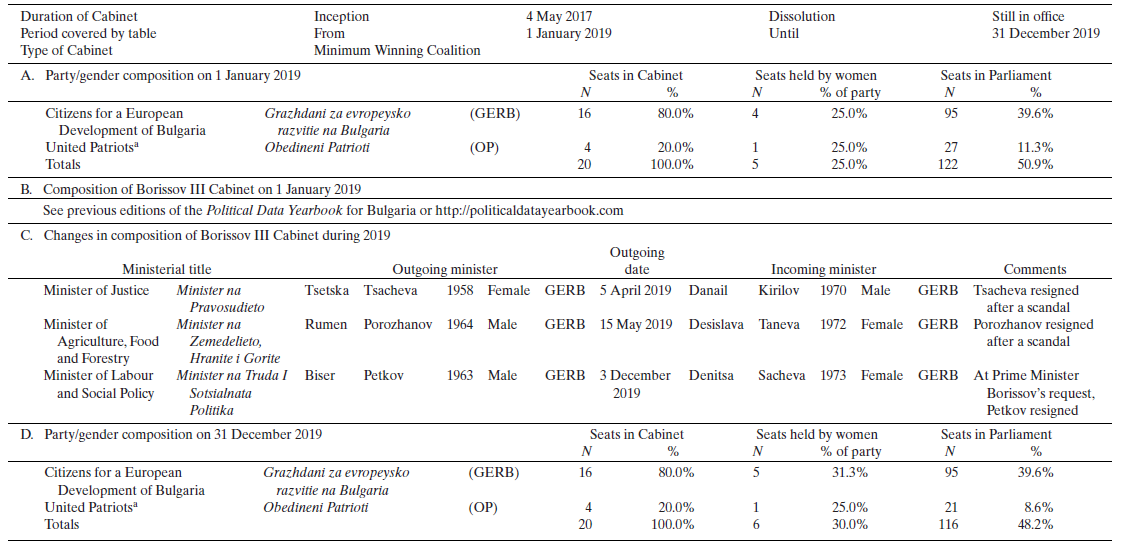
The Borissov III Cabinet is a minimum winning coalition, controlling 50.9 per cent of the seats in Parliament. During 2019, it underwent three personnel changes (Table 2). The personnel changes reflected the growing number of publicly discussed scandals linked to corruption and other abuse of power by Cabinet. In April 2019, for example, GERB Minister of Justice Tsacheva resigned after a scandal about an apartment she had bought for significantly lower than market price from a company known to be affiliated with the GERB. In May, Minister of Agriculture, Food and Forestry Porozhanov resigned after an investigation concerning potential misuse of European funds was initiated by the Prosecutors office. Similarly, in December, Minister Petkov resigned on the request of Prime Minister Borissov because of Petkov's unsatisfactory performance over time. All three ministers were replaced with new ones affiliated with GERB, preserving the party compositions of the Cabinet.
Cabinet composition of Borissov III in Bulgaria in 2019

Notes: aUnited Patriots is a coalition of the VMRO‐NFSB‐ATAKA alliance of the Internal Macedonian Revolutionary Organisation/Vatreshna Makedosnka Revolucionna Organizacia (VMRO), National Front for the Salvation of Bulgaria/Natzionalen Front za Spasenie na Bulgaria (NFSB), and Party Attack/ATAKA. ATAKA was excluded from the alliance on 25 July 2019.
Source: Council of Ministers (http://www.gov.bg/en/Cabinet) (accessed October 2020).
Parliament report
During the year, Parliament maintained an active legislative agenda with 124 laws passed. It did not initiate any votes of no confidence against the Cabinet, but clearly engaged in an institutional struggle with the President of the country over legislation. The support for the Cabinet was maintained with the MPs from GERB, OP and sometime DPS supporting the legislative initiatives of the Cabinet.
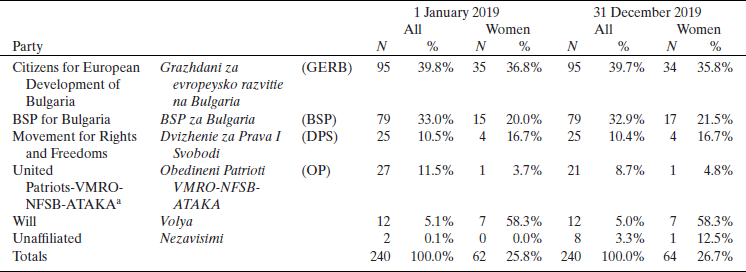
Organizationally, only one parliamentary group – OP – experienced a loss of membership (Table 3). In July, ATAKA leader Siderov was removed from the position of chair of the parliamentary groups of the OP, and subsequently all MPs from ATAKA left the group and joined the parliamentary opposition. Earlier in the year, though, the BSP parliamentary group left Parliament altogether (18 February–29 May). On 17 February the BSP National Council instructed the parliamentary group (PG) of the party to leave the National Assembly. Immediately provoked by a change in the election legislation introduced by the government majority and seen as favouring the governing party, this decision was supported with a statement that while the legislature enjoys only 8 per cent approval among the Bulgarian public, it allows heavy lobbying by companies and oligarchs and behind‐the‐scenes party agreements. Political commentators speculated that the BSP was trying to benefit the most from the political instability in expectation of the EP elections. The socialists returned to Parliament at the end of May 2019.
Party and gender composition of the Parliament (Narodno sabranie) in Bulgaria in 2019

Notes: aUnited Patriots is a coalition of the VMRO‐NFSB‐ATAKA alliance of the Internal Macedonian Revolutionary Organisation/Vatreshna Makedosnka Revolucionna Organizacia(VMRO), National Front for the Salvation of Bulgaria/Natzionalen Front za Spasenie na Bulgaria (NFSB), and Party Attack/ATAKA. ATAKA left the coalition on 25 July 2019, hence their MPs left the parliamentary group of OP and are considered as unaffiliated as of 25 July 2019.
Source: National Assembly of Bulgaria (https://www.parliament.bg/) (accessed October 2020).
During the year, the intensive institutional struggle between the National Assembly and the President continued. Just as in 2018, the President used his veto power seven times to return bills for a reconsideration to Parliament. In all cases, Parliament rejected his veto and the bills became laws (President of the Republic of Bulgaria 2020).
Political party report
While officially no parties experienced major leadership changes, the leadership struggle in the BSP was clearly visible and demonstrated some of the bigger issues facing the country. As already mentioned in the EP election discussion, the BSP continues to be split between pro‐Russian and pro‐EU wings. Having failed to remove Stanishev from the EP candidate lists of the party, Ninova offered to resign, following disappointing EP elections results. Later in June she withdrew her resignation. At the national council meeting she managed to consolidate her position by removing one her opponents from the executive council and installing seven of her candidates as members of the 23‐member executive council. At the end of 2019, her position had strengthened, but the internal struggles within the party and its increasing pro‐Russian position did not allow it to emerge as a strong opponent of the GERB.
Institutional change report
During the year there were no major changes to the constitution, the basic institutional framework or the electoral law. An attempt was made to increase the necessary votes to use the preference possibility at the national and EP elections, but ultimately, the old thresholds were preserved – 7 per cent of the votes in national elections and 5 per cent in the EP elections are enough to allow preferences to have an impact.
In July, in a unusual joint effort by the GERB and opposition DPS and ATAKA, amendments to the Party law allowed private donations to political parties; the law was returned by the President, but the veto rejected. This situation allowed for a stronger impact of economic interests in the political process.
Issues in national politics
The most important issue in national politics besides the already discussed issues of contention in the EP election remained the wheeling and dealing of the governing party and its permissive attitude towards special interests having a say in politics. A clear indication of this was the appointment of Ivan Geshev as Prosecutor‐General for the country, despite major protests against this choice by professional organizations and political actors. As a result of this and similar questionable appointments and decisions that went directly against the publicly expressed preferences, by the end of the year, the stability of the GERB Cabinet began to erode, although mostly outside rather than inside Parliament (Alpha Research 2019). Popular dissatisfaction with Borissov himself mounted and the Borissov III Cabinet's ability to lead the country to regular elections in 2021 was challenged.


 Open access

