


Constitutions become the ultimate tyranny – Paul, Dune Messiah
Introduction
Since the end of the Cold War, and especially the turn of the millennium, processes of autocratization – the ‘substantial de facto decline of core institutional requirements of electoral democracy’ – in democracies appear to have become more common (Lührmann and Lindberg, Reference Lührmann and Lindberg2019: 1096). Increasingly, these challenges to democracy are incumbent-led, as incumbents seeking to stay in power strengthen and concentrate their executive powers, dismantle key institutional checks and balances, and engage in strategic manipulation of elections (Bermeo, Reference Bermeo2016; Levitsky and Ziblatt, Reference Levitsky and Ziblatt2018). Challenges to democracy thus appear to originate mostly from within, as most autocratization processes are initiated by democratically elected governments and leaders, often using legal and incremental means to undermine democracy. Indeed, research has shown that since 1994, 70% of autocratization processes in democracies were incumbent-led (Lührmann and Lindberg, Reference Lührmann and Lindberg2019: 1104), challenging both new and long-established democracies (Svolik, Reference Svolik2015).
In recent years, an ever-growing body of scholarship has developed that documents and analyses these processes of autocratization and democratic backsliding, erosion and recession in the various regimes around the world (Bermeo, Reference Bermeo2016; Lührmann and Lindberg, Reference Lührmann and Lindberg2019; Waldner and Lust, Reference Waldner and Lust2018).Footnote 1 Theoretical work on how to conceptualize these processes of democratic recession has identified a number of commonalities, such as executive aggrandizement (Bermeo, Reference Bermeo2016), curtailing checks and balances (Lührmann and Lindberg, Reference Lührmann and Lindberg2019), and stealth authoritarianism (Luo and Przeworski, Reference Luo and Przeworski2023; Varol, Reference Varol2015); but does not take into account the variety and – arguably – creativity of autocratization ‘on the ground’. In this paper, we aim to unpack the concept of incumbent-led democratic recession into its empirical components: what concrete actions do would-be autocrats take when seeking to roll back democracy?
Such an analysis is important because extant research on democratic recession mostly focuses either on aggregate analyses of regime-level democratic recession (which are comparative, but don’t zoom in on specific autocratic actions), or on in-depth case studies of specific cases of democratic recession (which analyse specific autocratic actions, but are not comparative). Research at the aggregate regime-level uses large-n quantitative data and tends to focus on the structural, societal and international factors that facilitate autocratization, rather than specific autocratic actions. Research at the level of individual regimes uses in-depth qualitative case-studies to analyse processes of autocratization and the agency of specific actors involved. However, as yet, a clear understanding of how these specific actions are comparable or different across cases is still missing. There are a few attempts to categorize and class autocratic actions in a more comparative way (Ahmed, Reference Ahmed2023; Freeman, Reference Freeman2020; Levitsky and Ziblatt, Reference Levitsky and Ziblatt2018; Pirro and Stanley, Reference Pirro and Stanley2022). However, these are based on a limited number of cases and over a limited time period, often including the ‘usual suspects’ of democratic recession such as Hungary, Poland, and Venezuela. While there is a wealth of research studying autocratization processes in specific countries, we lack a systematic overview of what the autocratizing incumbents (whom we will call would-be autocrats as a convenient shorthand) do to undermine and erode democracy in all countries that experience it.
In this paper, we construct ‘the would-be autocrats’ toolkit’ based on an analysis of all 53 cases of incumbent-led democratic recession from 1990 to 2023. Specifically, we analyse peer-reviewed case studies of these cases – spanning all continents and all levels of pre-autocratization democracy – to find and class autocratic actions (which we define as those actions taken with the effect of a substantial de facto decline of core institutional requirements of electoral democracy). Importantly, leveraging in-depth country-expertise, we only include autocratization actions if the author(s) of the included case-studies classify a specific action, plan, or proposal as having contributed to autocratization. Doing so, we expand our knowledge of autocratic actions beyond the usual suspects, while leveraging in-depth country expertise and ensuring theoretical consistency. We inductively find seven overarching modes of autocratization that would-be autocrats employ to recede democracy: evasion, manipulation, infiltration, duplication, restriction, prohibition, and delegitimation. These modes are not only aimed at democratic institutions, but also at influencing the behaviour and values of citizens and actors operating within these institutions. Moreover, modes appear to vary from more covert and ambiguous modes to more overt and unambiguous modes. Furthermore, we show that would-be autocrats selectively use these different modes in varying arenas of democracy to gradually erode democracy: ranging from the legislative and executive arena to the judiciary and society at large. Clearly, would-be autocrats appear to pick and choose between different modes. While it is outside the scope of this paper to do so, our would-be autocrats’ toolkit provides avenues for future research to explore why and when would-be autocrats choose different modes in different contexts. In doing so, it provides a starting point to more systematically study autocratization within and across different cases, enabling the identification of sequencing and diffusion patterns, and helping generate better understanding of when autocratization is successful (or not).
The paper is set up as follows: in the next section we briefly review existing research on the classification of autocratic actions. The subsequent section outlines how we identify the cases where incumbent-led autocratization takes place, how we identify autocratic actions and modes and in which arenas autocratic actions occur. We then present our analysis of autocratic actions and discuss the seven overarching modes of autocratization found. Finally, in the conclusion, we reflect on our findings and provide suggestions for future research.
Autocratic actions as the level of analysis in democratic recession
Autocratization does not occur in a vacuum: there are structural, societal, and international conditions that form the background against which would-be autocrats operate. Comparative research on autocratization processes in democracies has identified a number of such conditions that facilitate autocratization. Chief among these are institutional and economic factors, societal factors, international factors, and crises (Haggard and Kaufman, Reference Haggard and Kaufman2021; Levitsky and Ziblatt, Reference Levitsky and Ziblatt2018; Waldner and Lust, Reference Waldner and Lust2018). Clearly, such facilitating conditions are important to understand under which circumstances autocratization processes are more likely to occur. However, while these circumstances might facilitate autocratic action, they are not immediate causes of democratic recession. For example, changing oil prices in the 1990s in Venezuela were not the driving force behind its decline in democracy. Rather, Chavéz exploited this economic condition to implement policies that harmed democracy (cf. Gamboa, Reference Gamboa2017; García-Guadilla and Mallen, Reference García-Guadilla and Mallen2019). In other words, would-be autocrats have a choice how they react to changing circumstances, can take advantage of them, and misuse them as pretext for autocratic actions. Only looking at facilitating circumstances at the regime-level therefore obscures relevant differences between (failed and successful) autocratization processes.
An emerging literature on the sequences of autocratization instead looks at the meso-level of sub regimes and indicators (Maerz et al., Reference Maerz, Lührmann, Hellmeier, Grahn and Lindberg2020; Sato et al., Reference Sato, Lundsted, Morrison, Boese and Lindberg2022; Wunsch and Blanchard, Reference Wunsch and Blanchard2023), mainly looking at how vertical, horizontal, and diagonal accountability mechanisms (cf. Laebens and Lührmann, Reference Laebens and Lührmann2021) are eroded and in which order. This literature finds some commonalities in the trajectories and sequences that autocratization takes, such as that autocratization appears to start in the non-electoral dimensions of democracy. Beyond that however, findings still diverge. As such, Maerz et al. (Reference Maerz, Lührmann, Hellmeier, Grahn and Lindberg2020) and Wunsch and Blanchard (Reference Wunsch and Blanchard2023) find that autocratization appears to most often start in the diagonal dimension – civil society, civil liberties, media freedoms are the first elements of liberal democracies to be challenged. However, Sato et al. (Reference Sato, Lundsted, Morrison, Boese and Lindberg2022) find that autocratization starts with the erosion of horizontal accountability mechanisms – institutional checks and balances like an independent judiciary. These findings suggest that would-be autocrats make different decisions about what modes of autocratization are likely to be most successful and what actions to take, depending on the specific context in which they seek to erode democracy. Taking an actor-based approach to better understand those modes and actions, should therefore enable us to better understand autocratization processes in democracies.
To understand patterns of democratic recession, therefore, we need to focus on what would-be autocrats do and the actions they implement. We call these ‘autocratic actions’: actions taken with the effect of a substantial de facto decline of core institutional requirements of electoral democracy (cf. Lührmann and Lindberg, Reference Lührmann and Lindberg2019). Several studies have sought to conceptualise autocratic actions in democracies. Ahmed classifies autocratic actions (which Ahmed calls democratic transgressions) as either violating the law, violating democratic norms, violating ideals, or consolidating changes to democratic institutions (Ahmed, Reference Ahmed2023: 968–69). There is clear overlap with Pirro and Stanley’s (Reference Pirro and Stanley2022) categorization of forging, bending, and breaking. Forging, similar to violations of norms and violations of ideals, are changes in line with the letter and the spirit of the law, that nevertheless change moralities, values, and perceptions about core democratic principles and ideals. Levitsky and Ziblatt (Reference Levitsky and Ziblatt2018) place heavy emphasis on this as well: two of the four ‘behavioural warning signs’ of democratic recession that they identify deal with politicians rejecting the values underpinning the rules of the game and denying the legitimacy of political opponents. This is often disguised as a reconceptualization of what democracy is, not as a wholesale rejection of democracy itself. This creates ambiguities around what is and is not democratic and paves the way for further attempts to autocratize. One step up, Pirro and Stanley (Reference Pirro and Stanley2022) describe bending as changes in line with the letter, but not the spirit of the law. These are not yet clear transgressions against democracy, but more akin to Scheppele’s Frankenstate, where ‘perfectly legal and constitutional components are stitched together’ (Scheppele, Reference Scheppele2013: 560), potentially resulting in autocratization. Examples of bending include court-packing: while many constitutions allow incumbents to appoint judges to (high-)courts or even expand the number of judges, it is an often-given example of autocratization (see also below). This overlaps with Ahmed’s power-consolidating changes, which are (often) constitutional and legal, yet challenge democracy from within (Ahmed, Reference Ahmed2023). Breaking, finally, is a clear violation of both the spirit and the letter of the law, akin to Ahmed’s violations of law. Levitsky and Ziblatt (Reference Levitsky and Ziblatt2018) describe how would-be autocrats can tolerate or encourage violence or curtail civil liberties. Freeman (Reference Freeman2020) describes three ways in which would-be autocrats can bend or break democratic rules: colonization (packing state institutions with loyalists), evasion (breaking the chain of accountability), and duplication (creating parallel institutions to overrule already existing ones). Each, depending on its severity, can either bend the rules of the game in favour of the incumbent, or break the democratic game entirely.
These studies provide important insights into the dynamics of incumbent-led autocratization, but they suffer from some empirical and theoretical pitfalls. The most prominent of the empirical pitfalls is that each study relies on a relatively limited sub-sample of cases of democratic recession. Pirro and Stanley (Reference Pirro and Stanley2022) study Hungary and Poland; Freeman (Reference Freeman2020) studies Hungary, Poland, Ecuador, and Venezuela; Levitsky and Ziblatt (Reference Levitsky and Ziblatt2018) and Ahmed (Reference Ahmed2023) study the USA. It is not clear if the tendencies found in these cases – even though they are likely paradigmatic examples –translate to other country and constitutional contexts.
Second, the categories identified in the literature overlap, but also leave significant gaps between them, indicating that no single classification is likely to capture the full range of autocratic actions ‘on the ground’. For example, Levitsky and Ziblatt’s (Reference Levitsky and Ziblatt2018) four behavioural warning signs do not account for Pirro and Stanley’s (Reference Pirro and Stanley2022) bending, and Freeman (Reference Freeman2020) does not appear to include forging and norm-erosion in the categorization of autocratic actions. Ahmed (Reference Ahmed2023) and Pirro and Stanley (Reference Pirro and Stanley2022) employ a wider scope, but it is not always clear when an action goes from forging to bending, or from norms violations to clear transgressions. That is: their categories do enable some classification of autocratic actions, but do not appear to cover the full toolkit of autocratic action.
The empirically narrow focus likely leads to gaps in the classification of autocratic actions. We therefore take an inductive approach and class all autocratic actions that occur in all episodes of incumbent-led democratic recession since 1990. We look beyond the usual suspects and include the entire universe of cases, and build on Freeman, Pirro and Stanley, Levitsky and Ziblatt, and Ahmed to conceptualize seven overarching modes of autocratization. Where an autocratic action is a single action that scholarly experts identify as contributing to democratic recession in a specific country, we take a mode to be a set of actions that have similar consequences for democracy (see Figure 1). As such, autocratic actions are likely to be context-specific and dependent on the countries’ (institutional) rules, regulations, norms, and political culture – and by extension less comparable across time and cases. But modes are comparable across time and cases, because the consequences of those context-dependent autocratic actions are comparable. For example, would-be autocrats in different countries could pack courts or electoral commissions with loyalists, two different autocratization actions. However, both actions entail the mode of infiltration of political institutions, albeit in different arenas.
The ladder of abstraction from autocratization to autocratic actions. Notes: Figure adapted from (Lührmann and Lindberg, Reference Lührmann and Lindberg2019: 1100). Autocratization is the overarching concept. Democratic recession, democratic breakdown, and autocratic consolidation are types of autocratization, depending on the start- and endpoint of the autocratization process. Within democratic recession, we study different modes of autocratization (see ‘Mapping autocratic actions’ below). These modes are comparable across time and cases. Each mode consists of several different autocratic actions, which are context- and country-specific.

In the next section, we describe how we identify cases where autocratization occurs, and how we identify the autocratic actions that ‘made the autocratization happen’. After that, in the subsequent section, we present our findings on autocratic actions and modes, and construct the would-be autocrats’ toolkit.
Measuring autocratic action: identifying cases, actions, and arenas
Identifying cases of incumbent-led democratic recession
We use Varieties of Democracy’s (V-Dem) Episodes of Regime Transformation-dataset to construct episodes of democratic recession (Maerz et al., Reference Maerz, Edgell, Wilson, Hellmeier and Lindberg2024).Footnote 2 Following the procedure outlined by Maerz et al. and Lührmann and Lindberg (Reference Lührmann and Lindberg2019), we measure change in countries’ Electoral Democracy Index (EDI) score over time, and identify as democratic recession episodes when either there was a sharp drop in electoral democracy from one year to the next, after which the country stabilized at a new, lower level of democracy; or when countries’ electoral democracy score gradually and continuously declined over successive years. In both cases, a decline in the EDI larger than 10% is considered to constitute substantial evidence for autocratization (Lührmann and Lindberg, Reference Lührmann and Lindberg2019; Maerz et al., Reference Maerz, Edgell, Wilson, Hellmeier and Lindberg2024; Pelke and Croissant, Reference Pelke and Croissant2021). We subsequently limit our sample to include only episodes of autocratization that started in democracies after 1990, and within those cases, identify the cases where autocratization was incumbent-led.
This leads us to identify a total of 112 episodes of autocratization from 1990 to 2023. Within those autocratization episodes, a total of 70 took place in democracies, and within this set, 53 episodes were incumbent-led (in the other 17 cases democratic recession was caused by challenges from outside the government, such as a military coup d’état or popular uprising).Footnote 3 This leaves us with a total of 53 episodes of incumbent-led democratic recession in the final universe of cases, which have taken place in 46 different countries. Armenia, Burkina Faso, Moldova, North Macedonia, Peru, South Korea, and Ukraine experienced two episodes of autocratization. Almost all episodes (44 out of 53) are included in this analysis.Footnote 4 Figure 2 shows all incumbent-led autocratization episodes starting within democracies.
Episodes of incumbent-led democratic recession since 1990 (based on ERT-data), with V-Dem’s Electoral Democracy Index (EDI). Notes: The dark-shaded time-periods show when democratic recession occurred, but the country remained democratic (EDI >= 0.5). The light-shaded time-periods show when democracies break down into autocracies (EDI < 0.5). The numbers denote the electoral democracy score at the beginning of an episode, in the year of democratic breakdown (when applicable), and at the end of the episode. We include autocratic actions that country-experts say take place in the entire time-period, focussing on the period of recession, but including the breakdown-period. The dotted horizontal lines are presented only to facilitate reading the plot and do not denote anything substantial.

Identifying autocratic actions and modes of autocratization
Turning to the identification of autocratic action, we define autocratic actions as any action taken with the effect of a ‘substantial de facto decline of core institutional requirements of electoral democracy’ (cf. Lührmann and Lindberg, Reference Lührmann and Lindberg2019: 1096). Because we focus on incumbent-led autocratization, we consider only actions by the incumbent, but other actors can of course also contribute to autocratization. The identification of autocratic actions is not an easy task, as actions taken can be ambiguous, covert, and – especially at the onset of autocratization episodes – it is often not clear whether the incumbents’ intention is in fact to erode democracy.
Autocratic actions can be ambiguous when they are legitimated. For example, in Tunisia in 2022, the president justified his overruling of parliament in appointing a new prime-minister by saying it would promote women’s equality (Ridge, Reference Ridge2022: 1540) and justified postponing local elections by saying he prefers direct democracy (Huber and Pisciotta, Reference Huber and Pisciotta2023: 371). Autocratic actions can also be justified by pointing to other, arguably good and beneficial, consequences such as equality, public health, safety, or financial stability. In a crisis, such as the COVID pandemic, public health concerns might – temporarily – trump democratic rights. Legitimations or potential beneficial consequences do not mean, however, that the action itself does not also harm democracy.
Autocratic actions can be covert when they are framed as not having to do with democracy at all. Did the 2019 sedition charges against Indian academics and journalists harm democracy, or was it a simple matter of enforcing the criminal code (Khaitan, Reference Khaitan2020: 87)? Autocratic actions can also be difficult to identify as such when the would-be autocrat claims to support democracy and claims actions are in fact aimed at protecting or strengthening democracy. In Indonesia purges of the electoral commission to get rid of corrupt commissioners appeared to be aimed at protecting democracy in 2004, while the same argumentation was used in the 2010s in the context of democratic recession (Warburton and Aspinall, Reference Warburton and Aspinall2019: 268).
Concretely, this means that actions that can be legitimated or have potential beneficial consequences can still harm democracy. It also implies that whether actors actually intended to undermine democracy with their actions is not relevant for our identification of autocratic actions.Footnote 5
We solve these issues by analysing only those cases in which we know there is incumbent-led autocratization (the universe of cases identified above and shown in Figure 2). Within these cases, we rely on the expert opinion of scholars to classify an action as autocratic, as it requires significant contextual knowledge to identify autocratic action. As such, within the cases in which incumbent-led autocratization occurred, only if a scholarly expert states that a specific action contributed to democratic recession do we include it in our overview. We make the choice to only include peer-reviewed literature, to ensure the quality of the secondary data on which we build our analysis and the theoretical connection to democracy research.Footnote 6
Specifically, for each of the 53 episodes of incumbent-led autocratization in democracies defined above, we looked for peer-reviewed case studies that explain and describe what happened during that period. In each case study, we looked for actions that those authors link to democratic recession. Those actions are coded in our overview. Only the actions that occur within an autocratization episode (country and time period) were included in the overview.Footnote 7 We stopped looking for additional case studies when we reached theoretical saturation and found significant repetition in the actions across different episodes, and when new case studies did not result in new actions found.Footnote 8 This resulted in over 420 autocratic actions (of which about 10% are duplicates: multiple mentions by different authors of the same action).
Finally, we conducted an iterative analysis of all collected actions, systematically grouping them into overarching modes of autocratization. Rather than relying on predefined categories, we adopted an inductive approach, allowing patterns to emerge from the data itself. As we continued collecting autocratic actions, we simultaneously refined our classification, adjusting and expanding the modes to accurately capture recurring actions. This process led to the identification of seven distinct modes of autocratization: duplication, infiltration, manipulation, evasion, prohibition, restriction, and delegitimation. We elaborate on each of these in the next section.
Overall, this methodology enables us to be strict about which cases and which actions we include. The case-selection is based on the electoral democracy index, which biases our findings against democratic recession in the liberal component of democracy, where recession is likely to be even more stealth and hidden. As such, our universe of cases is a minimal universe, where we are confident incumbent-led democratic recession occurred, and where we are confident we only include actions that actually contribute to this: we leave the assessment of unclear cases of democratic recession and unclear autocratic actions to future research. Importantly, the overview of modes of autocratization we construct based on these actions can be a deductive tool in determining whether future cases experience democratic recession.Footnote 9
Identifying arenas of autocratization
Lastly, to ease comparison, we observe autocratic actions and modes of autocratization in four arenas of democracy: the legislature, the executive, the judiciary, and (civil) society (Levitsky and Way, Reference Levitsky and Way2015; Linz and Stepan, Reference Linz and Stepan1996). These arenas are the settings in which would-be autocrats and democratic defenders interact. The legislative arena concerns the workings of parliament and the making of laws. This includes but is not limited to the making (and breaking) of electoral rules, designing (or gerrymandering) electoral districts, preventing (or enabling) electoral misconduct, and organizing election management bodies. The executive arena encompasses the incumbent government and the bureaucracy that implements laws, where the incumbent can engage in executive aggrandizement and co-opt the offices of government that implement the policies passed by the legislature. The judicial arena encompasses both the lower and higher courts, and the implementation of the rule of law, where the would-be autocrat can try to replace hostile judges with more friendly ones. Lastly, the societal arena includes both organized civil society as well as citizens individually. Here, autocratic action is aimed at limiting civil society in effectively engaging with democracy and democratic procedures, as well as co-opting, manipulating, or restricting the media, or influencing public opinion, limiting civic space, and usurping genuine grassroots organizations through astroturfing (cf. Sombatpoonsiri, Reference Sombatpoonsiri2024). We take the different arenas to be a useful analytical tool to analyse where autocratic actions take place.
Mapping autocratic action across all episodes of autocratization: the would-be autocrats’ toolkit
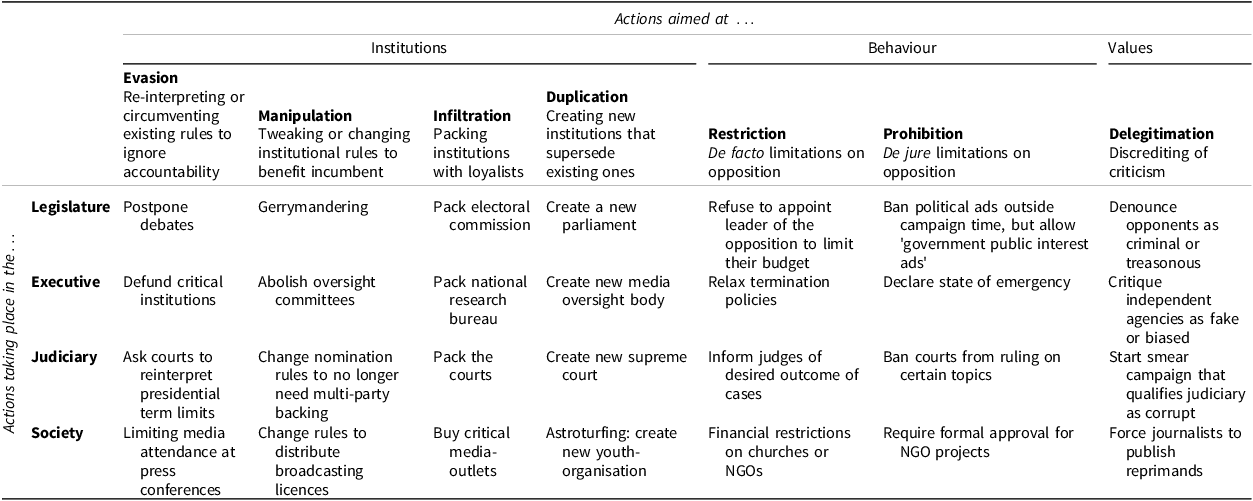
Based on our catalogue of autocratic actions (available in Online Appendix A to this paper), we inductively identify seven overarching modes of autocratization, which we explore in more depth in this section: evasion, manipulation, infiltration, duplication, restriction, prohibition, delegitimation. These seven modes proved sufficient to classify all actions identified in the case study literature as having contributed to autocratization. The modes have different consequences for democracy: evasion, manipulation, infiltration, and duplication affect the working of democratic institutions; restriction and prohibition affect democratic behaviour among elites and citizens; and delegitimation affects democratic norms and commitment among elites and citizens.
The seven overarching modes and the arenas in which the modes occur can be cross-tabulated to build an overview of autocratic action. This results in Table 1, where each cell contains an example of an autocratic action. Below we discuss the different modes in more detail, showing how the modes are aimed at either institutions, behaviour or values, and occur in each arena (legislature, executive, judiciary, society). A full overview of all identified autocratic actions (and the sources) can be found in Online Appendix A.
The would-be autocrats’ toolkit

Note: The modes across the top row encompass a variety of different actions that can take place in different arenas. All actions within a single mode, however, have a similar effect on institutions, behaviour, or values. Examples of specific actions are illustrated in the cells of the table. The arenas down the first column provide a useful analytical tool to compare and contrast how different modes take shape in different arenas of democracy.
Autocratization affecting institutions
The first four modes of autocratization target institutions. Evasion, manipulation, infiltration and duplication primarily affect the institutional set-up of a state and the rules and regulations on how they operate. This limits effective opposition, accountability, and checks on incumbents’ power.
Evasion is the most subtle form of autocratic action aimed at institutions. Here, would-be autocrats do not necessarily change the rules of the game. Instead, they reinterpret already existing rules to evade accountability or make sure (external) checks on their power are limited.Footnote 10 In the legislative arena, for example in India in 2018, an incumbent can postpone debates (with the help of a friendly parliamentary Chair) to more favourable times (Khaitan, Reference Khaitan2020: 67). In Hungary in 2017 the existing parliamentary procedures were reinterpreted to allow for a fast-tracking of legislation, allowing almost no time for debate (Bánkuti et al., Reference Bánkuti, Halmai and Scheppele2012: 141; Enyedi, Reference Enyedi2018: 1068; Kaufman and Haggard, Reference Kaufman and Haggard2019: 421). Evasion in the legislative arena also encompasses ballot-stuffing or keeping independent election observers away from polling stations (as in Benin in 2023, Gyimah-Boadi, Reference Gyimah-Boadi2021: 16) as this circumvents accountability through elections. In the executive arena, in Mexico in 2022, austerity measures due to COVID were used to delay appointments to, among others, a government anti-trust commission, which in turn limited effective oversight from those bodies (Ibarra Del Cueto, Reference Ibarra Del Cueto2023: 310). Evasion in the judiciary can take the form of reassigning cases to other, more favourable courts, or simply ignoring rulings, quoting executive prerogative. This happened in Hungary and Poland all throughout the 2010s (Bakke and Sitter, Reference Bakke and Sitter2022: 28–29; Bánkuti et al., Reference Bánkuti, Halmai and Scheppele2012: 143). Evasion in the societal arena is harder: by its very nature, the societal arena has almost no formal checks and balances or accountability to evade. However, in Ghana in the 2010s, government political parties prevented journalists from attending press conferences, which does evade public scrutiny of their internal debates and proposals (Kwode et al., Reference Kwode, Asekere and Ayelazuno2023: 119), and in Greece in 2016, the government – in line with the letter but arguably not the spirit of the law – reduced the number of media-licenses (Pappas, Reference Pappas2020: 63).
When would-be autocrats manipulate rules, regulations, and procedures, they change the rules of the game in their favour. Note that the changes themselves are often done in accordance with the rules of the game. In the executive arena, would-be autocrats can try to expand or overstep presidential term limits. We name just a few examples here: Venezuela in 2007 and 2009 (Gamboa, Reference Gamboa2017: 464), Burkina Faso in 2014 (Wiebusch and Murray, Reference Wiebusch and Murray2019: 136), or Comoros in 2018 (Wiebusch and Murray, Reference Wiebusch and Murray2019: 137). While this is often approved by parliaments, referenda, or indeed the courts, as happened in Senegal in 2012 (Demarest, Reference Demarest2016: 64), academic research understands the extension or abolishing of presidential term limits as unambiguous autocratization (Corrales and Penfold, Reference Corrales and Penfold2014; Heyl and Llanos, Reference Heyl and Llanos2022; Maltz, Reference Maltz2007). For elections, electoral codes can be changed to benefit the ruling party, see North Macedonia in 2011 (Auerbach and Kartner, Reference Auerbach and Kartner2023: 552), direct elections for regional government heads can be abolished, see Indonesia in 2014 (Aspinall et al., Reference Aspinall, Fossati, Muhtadi and Warburton2020: 509), or electoral districts can be gerrymandered. This affects how the legislature does or does not represent the popular vote, but – again – there are also legitimate reasons to amend electoral rules and regulations. In the societal arena, manipulation is often more covert and ambiguous. In Serbia in 2015, new regulations regarding advertising did not apply to government advertising (Castaldo, Reference Castaldo2020: 1629). These government-paid ads were crucial for the media to maintain advertising income, resulting in opportunities for political pressure on the media. Some laws, for example in Indonesia in 2017, also place extra burdens on community organizations that leave them subject to dissolving by the government, with the effect of limiting civic space (Warburton and Aspinall, Reference Warburton and Aspinall2019: 261). Manipulation leads to democratic recession because the new rules strip away the (opportunity for) checks and balances and un-level the playing field.
Infiltration is the process by which would-be autocrats ‘populate nominally independent institutions with loyal agents’ (Freeman, Reference Freeman2020: 40).Footnote 11 This process can be somewhat ambiguous, because incumbents often have the political prerogative to appoint members of institutions. Yet it is clear some political appointments signal autocratization, for example in the judiciary. One way to exert pressure is to prematurely end the term of a court’s president. In Hungary (Bozóki and Hegedűs, Reference Bozóki and Hegedűs2018: 1177) and Poland (Bakke and Sitter, Reference Bakke and Sitter2022: 28), for example, the age of retirement was lowered so that court presidents and lower judges were forced to resign their posts. These and similar actions result in vacancies that the incumbent can then (legitimately) fill with loyalists. While attacking and packing the courts is a common theme in incumbent-led autocratization, infiltration is not limited to the judiciary. In the executive arena in Slovenia, loyalists were appointed to a formally neutral council that appoints bureaucrats, after which the rules on hiring and firing were changed so that new bureaucrats would need to be approved centrally, by the executive (Bugaric and Kuhelj, Reference Bugaric and Kuhelj2015: 276). Infiltrating the legislature is harder: we have found no examples where an incumbent outright replaces (opposition) parliamentary members.Footnote 12 However, it is clear that would-be autocrats try to tilt the electoral playing field in their favour. In 2010, for example, Orbán created vacancies in the Electoral Commission, by terminating the mandates of elected members, and appointed loyalists to it (Bakke and Sitter, Reference Bakke and Sitter2022: 27). This was mirrored in Poland (Bakke and Sitter, Reference Bakke and Sitter2022: 28) and occurred before in Peru in the 1990s (Levitsky, Reference Levitsky1999: 79). In the societal arena, would-be autocrats often attack the independence of the media: for example, by outright replacing the top management of public broadcasters. This happened in Slovenia between 2004 and 2008 (Bugaric and Kuhelj, Reference Bugaric and Kuhelj2015: 275) and Croatia in 2016 (Čepo, Reference Čepo2020: 148). Clearly, precisely because of the political nature of many appointments in the public sector, infiltration can be somewhat ambiguous as a mode of autocratization. Yet when it becomes a persistent theme that appointments curtail the independent functioning of institutions (for example by limiting judiciary independence or freedom of expression in the media), or when an appointee’s career and livelihood depends entirely on compliance with the incumbent government, we can see how it negatively affects the workings of democratic institutions.
Lastly, for duplication, the game is in the name: would-be autocrats aim to upset the ‘centre of power […] without dissolving’ an already existing institution (Arendt, Reference Arendt1973; Freeman, Reference Freeman2020), by creating an institution with similar or even identical powers, rules, and goals. But this new institution is mostly or completely under the would-be autocrat’s control. Examples in the legislative arena are Chavez’s 1999 constituent assembly taking over powers from the sitting congress (Gamboa, Reference Gamboa2017: 465; García-Guadilla and Mallen, Reference García-Guadilla and Mallen2019: 66). Likewise, Correa in Ecuador created a constituent assembly that slowly took over powers from the regular parliament from 2006 onwards (Freeman, Reference Freeman2020: 43–44). Similarly, for the judiciary, in Hungary Orbán’s government created the National Judicial Office that could overrule constitutional judgements. In the executive arena, an example is India in 2014 creating a new department under the direct auspices of government with the task to control the finances of a formerly independent information commission (Khaitan, Reference Khaitan2020: 80). Lastly, in the societal arena, would-be autocrats create new – and loyal – civil society organizations or apparent grassroots movements that are in fact a front for government-supporters, also called ‘astro-turfing’ (cf. DeMattee, Reference DeMattee2023; Giersdorf and Croissant, Reference Giersdorf and Croissant2011; Lorch and Bunk, Reference Lorch and Bunk2017). An example is the Armenian government-initiated new NGO to syphon off international development aid to undermine the already existing NGOs (Stefes and Paturyan, Reference Stefes and Paturyan2021: 9). And in Croatia in 2015, a new journalist association (Croatian Journalists and Publicists) was set up, ostensibly after it had become clear that the Croatian Journalists’ Association and the Croatian public broadcaster could not be captured or marginalized (Čepo, Reference Čepo2020: 149). Duplication is rather overt because it involves the establishment of new institutions and organizations at times that are opportune for the would-be autocrat. It leads to autocratization because it takes away democratic powers from existing democratic institutions.
Autocratization affecting behaviour
The subsequent two modes of autocratization are aimed at influencing behaviour of political elites or citizens that might oppose the incumbent. Here, would-be autocrats can use restriction to de facto limit challenges to their authority, a more covert mode, or prohibition to de jure limit opposition, a more overt mode.
Restriction occurs when the would-be autocrat aims to increase the cost of behaviours that they deem unacceptable, without formally forbidding it. Would-be autocrats signal to (potential) defectors the cost associated with their behaviours. This behaviour is thus restricted, without being outright prohibited. Here we enter the realm of harassment and intimidation. In the executive arena, for example, Serbia in 2017 required picture proof that state employees voted for the incumbent (Castaldo, Reference Castaldo2020: 1630). This can be combined with the relaxation of termination policies, as in Poland in the 2010s, to increase state employees’ loyalty to the incumbent (Freeman, Reference Freeman2020: 41). In the judicial arena, the judiciary in Belarus was informed by the government via telephone of the desired outcome of cases (Trantidis, Reference Trantidis2022: 128). In the legislative arena, would-be autocrats can harass opposition members, both those critical within their own parties and outside them. In the societal arena, criticism of the government is discouraged. As such, journalists in Niger were imprisoned on charges of inciting hatred (in 2014) and using false citizenship papers (in 2018) after they had reported on government corruption (Elischer and Mueller, Reference Elischer and Mueller2018: 397). New financial regulations on churches in Hungary (Bánkuti et al., Reference Bánkuti, Halmai and Scheppele2012: 145), NGOs in Poland (Przybylski, Reference Przybylski2018: 58), and Sri Lanka (DeVotta, Reference DeVotta2011: 133), or universities in India (Khaitan, Reference Khaitan2020: 87) did not formally prohibit being critical of the government. But when subsidies and funding become politicized, explicit criticism becomes more risky and potentially costly. In many of these cases, there is no evidence of clear, outright prohibition of certain behaviours. However, in the case of Belarusian judges, some were fired after they failed to comply. This threat, no matter how opaque and informal, limits their independence. As such, harassment and intimidation do not de jure restrict the opportunity of free speech or pro-democratic action. But they de facto do have that effect, by spreading fear and self-censorship, restricting opposition.
The difference between restriction and prohibition is that the former does not explicitly forbid critical opposition, but rather aims to increase the costs and risks associated with it. Prohibition occurs when new de jure rules are created or enforced to formally forbid or criminalize certain behaviours of opposition members or critics of the regime. In the societal arena this ranges from banning demonstrations against expanding presidential term limits, as happened in Malawi in 2002 (Rakner, Reference Rakner2021: 104), revoking licenses of critical media, as happened in Venezuela in 2007 (García-Guadilla and Mallen, Reference García-Guadilla and Mallen2019: 69; Kaufman and Haggard, Reference Kaufman and Haggard2019: 422), cancelling a specific television programme because the opposition is too visible in it, in Serbia in 2014 (Castaldo, Reference Castaldo2020: 1628), or forbidding academics from criticizing government policy, see India in 2020 (Khaitan, Reference Khaitan2020: 86). In the legislative arena, we mostly see the banning of parties or party-candidates, in Armenia in 1994 (Stefes and Paturyan, Reference Stefes and Paturyan2021: 9) and in Peru in 2016 (McNulty, Reference McNulty2017: 564) or banning political ads outside campaign-time, but conveniently leaving out government public interest ads, as in Hungary throughout the 2010s (Bakke and Sitter, Reference Bakke and Sitter2022: 28). In the executive arena, would-be autocrats have forbidden state employees from appearing on critical media platforms (Čepo, Reference Čepo2020: 149).
Autocratization affecting values
The last mode of autocratization is aimed at influencing values of political actors or citizens. Here, would-be autocrats can turn to delegitimation of opponents by attacking their (democratic) credentials. In the legislative arena, an Indian Bharatiya Janata Party elite called the opposition treasonous in 2018 (Khaitan, Reference Khaitan2020: 64), and the Fidesz government denounced the opposition as criminal (Herman, Reference Herman2016: 260). In the executive arena, in Serbia in 2015 a smear campaign was started against the ombudsman when they issued a report critical of the government (Castaldo, Reference Castaldo2020: 1630). In Indonesia (in 2009 and the 2010s) both the electoral committee and the anti-corruption committee were called corrupt (Warburton and Aspinall, Reference Warburton and Aspinall2019: 268). In the judicial arena, in Brazil in 2022, the impartiality of the Supreme Court was called into question by the incumbent after an unfavourable judgement (Doctor, Reference Doctor2022: 11). In the societal arena, in Turkey (in 2008) the media was called fake (Somer, Reference Somer2019: 52). And sometimes the incumbent forces the media to self-delegitimize, by having them publish reprimands from a (incumbent-controlled) media council, as in Hungary since 2010 (Herman, Reference Herman2016: 260).
Delegitimation is especially hard to combat, since the incumbent can effectively use pending court cases as evidence, spreading the message through captured or harassed media, and claiming anyone who opposes it is part of the same problem. By calling into question the opposition’s intentions, a would-be autocrat limits their ability to credibly compete for office, even though these actions do not fundamentally change the rules of the game. But they call into question the intention of oppositions, delegitimizing not only their campaign, but also their goals and the opposition-members themselves. By extension, the opposition’s outcry that certain actions are autocratic is automatically suspect as well, thereby also limiting oppositions’ capacity to engage in democratic defence.Footnote 13
General patterns of autocratic action: hypotheses and future questions about incumbent-led democratic recession
The overview of seven overarching modes of autocratization (evasion, manipulation, infiltration, duplication, restriction, prohibition, delegitimation) used in the four different arenas (executive, legislative, judiciary, civil society) leads to a number of important considerations that warrant future research.
First, while many modes occur in several (or all) arenas, there appears to be a tendency to use some modes more in some arenas than in others. It is, by its very nature, hard to pack civil society with loyalists (although it is tried and has succeeded) and difficult to delegitimize the executive (of which the incumbent is part themselves). The arenas therefore provide a useful analytical tool to discern how would-be autocrats play with and adapt to their domestic contexts and target their actions towards the most likely source of opposition. We also see that would-be autocrats use similar modes, either intentionally or by accident. This makes sense: pro-democracy actors learn from each other, so why would would-be autocrats not do the same? It also implies that researchers and policymakers not only can compare cases, but that they also should, and that doing so can shed light on diffusion and learning of autocratization modes.
Second, modes appear to vary from more covert and ambiguous modes (such as restriction, delegitimation and evasion) to more overt and unambiguous modes (such as prohibition, infiltration and duplication). We would expect would-be autocrats as strategic actors to start with modes of autocratization that are relatively more covert and ambiguous, in order to not attract too much attention and opposition to their undermining of democracy. When autocratization progresses, or when more covert techniques are not effective enough, more overt modes might become more likely. Our purpose in this paper was to inductively identify what modes would-be autocrats use when engaging in democratic recession. Building on this, future research on autocratization modes could collect more fine-grained data in terms of precise timing and frequency of actions to analyse the diffusion and sequencing of modes.
Third, ambiguity and legitimation of autocratic actions appear to be key in explaining the would-be autocrats’ success in implementing them. In many cases, would-be autocrats can to a certain extent claim an action is legitimate, either because it follows the letter of the law (though arguably not the spirit) (cf. Pirro and Stanley, Reference Pirro and Stanley2022), or because actions were decided following democratic procedures, or because actions were needed to achieve other ostensibly important outcomes such as security, health or economic growth. Many autocratic actions can therefore be explained as legitimate actions, creating a grey space where would-be autocrats can act. This makes the work of democracy defenders more difficult. Understanding how would-be autocrats use this grey space, and how democracy defenders can respond in such cases, can generate better understanding of when autocratization is successful or not, giving better insight into near misses, as well as the conditions under which democratic defence can be successful.
The fourth implication of the modes becomes clear if we look at what is affected by the modes of autocratization. Evasion, manipulation, infiltration and duplication affect formal institutions (that is, the things with buildings, addresses, and people working there). This is wholly in line with our current understanding of democratic recession: the decline in institutional democratic characteristics. However, we show that would-be autocrats also try to restrict democratic behaviour of others (within and outside of those institutions). And, we see would-be autocrats target democratic values, by delegitimizing opponents, institutions, and broader support for (liberal) democracy. Autocratic actions that are also targeted at constraining the behaviour of opponents, and at delegitimizing those opponents, both undermine the credibility of democratic defenders and further undermine their capacity to act. Successful modes of autocratization thus have the potential to create a vicious circle in which the space to act for democratic defenders is increasingly constrained.
The utility of the toolkit: autocratization in ‘resilient’ democracies?
To show the utility of our toolkit, we now turn briefly to two ‘resilient’ democracies: the Netherlands and the USA. According to our minimal universe of cases, they are not (yet) classed as democracies in decline. Yet, applying our toolkit shows that autocratic actions do occur in both cases.
Democracy in the USA has been under pressure from both incumbents (see among many others Kaufman and Haggard, Reference Kaufman and Haggard2019; Levitsky and Way, Reference Levitsky and Way2025; Levitsky and Ziblatt, Reference Levitsky and Ziblatt2018) and citizens (Carey et al., Reference Carey, Helmke, Sanders and Stokes2019; Graham and Svolik, Reference Graham and Svolik2020). V-Dem, however, still scores it as a high-performing liberal democracy (EDI = 0.90 from 2007 to 2015, to a low point of 0.81 in 2020, and 0.84 in 2024. At this point, V-Dem does not have data for 2025) and does not include it as an ‘episode of autocratization’ (not reaching the 0.1-threshold). While this could signal methodological concerns with the data (cf. Little and Meng, Reference Little and Meng2024), a more fruitful and substantive interpretation is that measuring autocratization in democracies at the aggregate regime-level is fraught with difficulties. A more qualitative approach that understands modes of autocratization and looks at specific autocratic actions allows us to look at what happens ‘on the ground’ and provides a contextual and early warning signal. In the USA most modes have occurred under the second Trump administration (starting in 2025): the delegitimation of media as ‘fake’ and opponents as treasonous; restrictions on academic research, teaching, and speech, and the apparent at-will firing of civil servants; infiltration of the Justice Department, FBI, and IRS; and evasion of accountability by the courts by routinely ignoring judicial rulings, or ruling by executive degree; and manipulation through the gerrymandering of electoral districts. Duplication of (formal) institutions and the outright prohibition of democratic behaviour appear to be absent until now.
The Netherlands arguably provides a stricter case for the utility of our toolkit, where declines in democracy have been less studied and are less pronounced (EDI = 0.88 from 2013 to 2018 and has been slowly declining to 0.82 in 2024). Yet in the Netherlands as well, there has been delegitimation of opponents (judges being called partisan and journalists being called traitors), restrictions on the right to protest, prohibition of the use of the term ‘extreme-right’ in parliament, and debate about changes to the electoral system.
While our toolkit is not intended to provide conclusive proof that the Netherlands and the USA are in an episode of autocratization, applying it to these cases shows similarities with processes in actual episodes. This should at least be taken as a warning sign – both for academics and policymakers. As such, next to enabling more fine-grained comparative research into autocratization processes, the toolkit proves useful in recognizing autocratic actions – and potentially signal early on-set autocratization before a quantitative approach can – in cases that have been deemed ‘resilient’.
Conclusion
In this paper, we set out to construct a systematic overview of incumbent-led autocratization actions. Recent scholarship has uncovered many distant causes and facilitating circumstances that relate to democratic recession, ranging from structural, to societal to international factors. However, as of yet, there has been no systematic analysis of what would-be autocrats actually do when they erode democracy. Are there similarities between cases or are modes of autocratization completely context-specific? Do would-be autocrats employ a small toolkit, or is their toolkit larger? Does autocratization occur in specific arenas of democracy or does it permeate throughout? With the analysis of autocratic actions provided in this paper and especially with the modes we have identified, we provide tools to answer these questions more rigorously in future research.
This paper set out to construct a toolkit that describes incumbent autocratic action in a way that allows future research to compare over time and across cases and study how autocratization processes change and differ. Developing a toolkit of ‘real existing’ (Schmitter, Reference Schmitter2011) threats to democracy based on the full universe of cases, and thereby mapping the would-be autocrats’ toolkit for democratic recession, allows us to better understand present-day autocratization processes and would allow us to develop four strands of future research. First, the toolkit of autocratic action allows future research to compare autocratization between regimes as well as over time, and address questions about authoritarian learning, diffusion, and sequencing in democratic recession. This literature often relies on regime-level data, and as such obscures important variation (both in sequencing and in learning) between cases (see for example Wunsch and Blanchard, Reference Wunsch and Blanchard2023). Second, with the toolkit, future research can more easily identify when modes of autocratization were successful or not, giving better insight into near misses, where democratic recession was attempted, but failed (Ginsburg and Huq, Reference Ginsburg and Huq2018), providing a starting point to better understand the conditions for successful democratic defence (see the discussion on the USA and the Netherlands above). Third, as the toolkit is a coherent, globally applicable, and empirically-based toolkit of autocratic action, it makes it easier to pinpoint autocratization early on, identify the more subtle start of autocratization, and respond before it is too late. Contemporary autocratization often starts with innocuous legal challenges that have an unclear and ambiguous effect on democracy. The toolkit helps to place those actions in a broader context, where we can understand them as early-stage autocratization, enabling swifter democratic defence responses in future cases. Fourth, the toolkit enables researchers to identify potential new cases of democratic recession that are not yet captured by the aggregate democracy indices. We do not claim that any single autocratic action signals autocratization, as there can be legitimate justifications to (temporarily) limit or redesign certain elements of democracy. However, multiple infractions might serve as an early warning sign of autocratization for researchers and policy makers alike.
The would-be autocrat’s toolkit presented in this paper is based on academic literature and a minimal universe of cases. Because of this, the data behind the toolkit are not exhaustive – potentially overlooking important and informative cases. Our data could therefore be complemented by research outside academia (NGOs, policy briefs, election monitoring organizations, et cetera), and data collected through expert surveys. A more complete database of autocratic action provides pro-democracy actors with an even clearer view on when to step in.
Overall however, the case studies and our analysis of them show that would-be autocrats do indeed diversify their portfolio, targeting all parts of society in different ways. Without assuming anything about their intentions and decision-making, they appear to be careful when implementing autocratic actions, varying them from outright rules-violations, -bending and -dodging, to increasing the ‘cost’ of opposition and undermining democratic values. It is clear that would-be autocrats do not only target formal institutions, but also aim to restrict pro-democratic behaviour in others, as well as try to affect democratic values. This has one important consequence for our understanding of democratic recession: we overlook fundamental aspects if we only look at recession within institutions. This paper shows that the institutional focus is too narrow: there are many autocratic actions that clearly affect informal political spaces. We should no longer understand democratic recession only as the move away from democratic institutions. Instead, we should return to a classical conception of democracy: institutions matter, but behaviours, and attitudes matter too (cf. Linz and Stepan, Reference Linz and Stepan1996).
There are three benefits to this observation. One, next to a more empirically valid understanding of democratic recession, this would also allow researchers and policymakers to ‘see’ democratic recession earlier, before it affects institutions in a large, clear, and obvious way – as demonstrated by our brief cases studies of the Netherlands and the USA. Two, we can more clearly study ‘near misses’, where a would-be autocrat attempted, but failed to successfully pull-off an action that would harm democracy. Three, we can more easily study recession in liberal aspects of democracy, rather than (only) in the electoral dimensions. Finally, analysing modes of autocratization from this broader perspective also allows us to gain better understanding of when autocratization becomes a self-reinforcing process: where modes targeted at undermining behaviour and values make democratic defence progressively harder.
Overall, this paper shows that while autocratization is somewhat context-dependent, it is not completely so. We can, and should compare episodes of autocratization, outcomes, interventions (when desired), and risks using the toolkit of autocratic actions and the modes of evasion, manipulation, infiltration, duplication, restriction, prohibition, and delegitimation identified here. The toolkit can guide future research and provide a backdrop to better understand democratic recession, even (especially!) when constitutions and institutions slowly turn into the ultimate tyranny.
Supplementary material
The supplementary material for this article can be found at https://doi.org/10.1017/S1755773925100106.
Data availability statement
Replication files for the selection of the episodes of interests and for Figure 2 are available at https://doi.org/10.7910/DVN/F79XT1.
Acknowledgements
The author’s want to thank the participants of the panel ‘Turning the Tide’ at the 2022 Annual Political Science Workshops of the Low Countries as well as Maurits Meijers and Andrej Zaslove for their helpful comments.
Funding statement
No external funding was provided for this research.
Competing interests
The authors declare none.
Ethics approval statement
N/A.




 Open access

