Introduction
Why did influential countries such as India, South Africa or Viet Nam abstain from the relevant UN resolutions calling on Russia to end its illegal invasion? These questions deserve an answer. When I talk to leaders from those countries, many assure me that they are not questioning the underlying principles of our international order. What they are struggling with is the unequal application of those principles. What they expect is representation on equal terms – and an end to Western double standards.
If there were one and only one justification for writing this Element, it would be this quote from the former German Chancellor Scholtz in a speech at the Berlin Global Solutions Summit on May 15, 2023 in front of several hundred global opinion leaders.
This quote emphasizes one major development in the global system over the last few years: While the world order wobbles, the two great powers (US and China) compete, and a third power (Russia) invades it neighbor, a new group of Global South Middle Powers (GSMPs) have risen. Over the last two decades, they have been striking their own course of action, significantly impacting the battle lines of the global order.
Since Russia’s invasion of Ukraine in February 2022, G7 countries have been working to highlight Russia’s flagrant violation of international law, while the rest of the world has tended to adopt a much more nuanced attitude. Admittedly, very few countries have supported Russia. From this perspective, the votes cast at the UN have yielded clear majorities in support of Ukraine. Simultaneously, most countries in the Global South have rarely gone beyond a formal condemnation. This is where ambivalence starts and ambiguity follows.
Many of the larger GSMPs have, even since 2022, amplified their relations with Moscow, as they have found new opportunities there: “While Washington urges the rest of the world to match G7 restrictions, some countries, such as Brazil and India, are hedging their bets and trying to maintain a nonaligned path, by continuing trade with the Kremlin. In fact, more than two thirds of the world’s population are in countries that have not backed the sanctions against Russia” (Baker Reference Baker2024: 8).
In the face of a major interstate conflict, presented by G7 countries as a question of world order, many states of the Global South have tended to read it foremost as a regional conflict that should not call into question Russia’s integration into the world order.
Initially, In March–May 2022, US and European leaders sought a boycott of Russia in the G20. As of April, it appeared doubtful that the G20 could proceed as usual under such fractious conditions. Yet G20 host Indonesia, along with all Global South members (including India, the following host), refused to eject or boycott Russia. They insisted on a full G20, and even Putin was officially invited, even if he did not show up. Ultimately, all G7 leaders joined the Bali G20, alongside Russian Foreign Minister Sergei Lavrov.
What goals do GSMPs pursue with respect to the global order? Why do they often diverge from US or European visions of that order? We focus on this essential question and take the Sino-American competition as a frame of reference.
A Hybrid Global Order
Broadly, we analyze the impact of GSMPs on the global order transition that started in 2008, intensified in 2017, and accelerated with the war in Ukraine in 2022. The current phase is marked by three concomitant systemic changes: intensifying US–China bipolarization, gradual multipolarization, and eroding global institutions. These forces are leading to a dynamic tripartition of the global order: the Global West, the China–Russia alignment, and the Global South (Ikenberry Reference Ikenberry2024).
Many realist scholars argue that the global system has become bipolar again and is moving toward a new US–China Cold War (Beckley Reference Beckley2023, Christensen Reference Christensen2015, Doshi Reference Doshi2021, Mearsheimer Reference Mearsheimer and John2014, Reference Mearsheimer2021, Niblett Reference Niblett2024, Skylar Mastro Reference Skylar Mastro2024, Tunsjø Reference Tunsjø2018, Westad Reference Westad2024). Rachman captured this dynamic vividly: “The Americans are obsessed by containing Chinese power. The Chinese are obsessed by containing American power” (Rachman Reference Rachman2024). Rudd has demonstrated the extreme global dangers of a US–China conflict and potential reactions (Rudd Reference Rudd2022).
According to that dynamic, the economic and military rise of China has triggered a dangerous logic of hegemonic transition, and a great power response by the US (Allison Reference Allison2017, Gilpin Reference Gilpin1981, Lake Reference Lake2009). This deterministic view has wisely been called into question (Chan Reference Chan2007). Others argue that US dominance still endures (Brooks and Wohlforth Reference 83Brooks and Wohlforth2023).
We do not deny the centrality of Sino-American competition. We fully endorse the idea that the current aggregate power of both the US and China is higher than the aggregate power of the US and the Soviet Union (Lind Reference Lind2024). We argue that the international context in which it takes place is much more fluid and complex than during the Cold War (Paul and Kornprobst Reference Paul and Kornprobst2025, Sanger Reference Sanger2024, Sciutto Reference Sciutto2024).
Actors such India, Brazil, or Saudi Arabia have much more agency today than they used to during the Cold War.Footnote 1 We argue that both bipolarity and multipolarity are at work, making the current order a hybrid order. This configuration may be an enduring one.
In 2025, the Trump 2.0 administration shifted US priorities away from the Biden-era priority of building coalitions of partners directed toward competition with China. The Trump 2.0 administration has focused on reasserting US primacy, extracting tariff revenues from allies and others, and managing China and Russia through high-stakes concert diplomacy reminiscent of the nineteenth century. A lively debate has arisen on the possible return of spheres of influence (Allison Reference Allison2020, Sidore Reference Sidore2025, Toft Reference Toft2025).
This major shift has reduced diplomatic space for all US allies, who are forced to align with the US under threat of tariffs, because of the security constraint.
We argue that this US tactical shift still operates within a hybrid order, in which GSMPs have experienced great increases in power and leverage over two decades (as measured by metrics in Section 2). GSMP’s lack of dependence on US security guarantees, significant heft, and strong national visions make them able and willing to stand for their hedging autonomy, even if the costs are increasing. The willingness of the US to use its dominant position in a global-consensus system to break international norms and institutions and extract concessions through abrupt threats is further convincing GSMPs that hedging is the only way for them to maintain national autonomy.
At the time of writing, however, we do observe three types of responses: accommodation of US demands by Vietnam and Indonesia (due to trade dependency), acquiescence to the huge US financial demands by Gulf States, and resistance to US coercion through hedging toward Russia and China by India, Brazil, and South Africa.
The war in Ukraine provides a crucial case for our analysis because it reveals the true preferences and strategic behaviour of the eight GSMPs in this study. Of course, it is a war between Russia and Ukraine. However, it has also taken on the dimensions of a partial proxy conflict between the US and China, because of US active support for Ukraine and China’s de facto backing of Russia. China itself confirmed the link between the war in Ukraine and the Sino-American competition. Wang Yi, the top Chinese diplomat said to the EU High Representative that Beijing would not benefit from Russia’s defeat in the conflict in Ukraine, “because the United States will then shift all its attention to Beijing.”Footnote 2 A Russian defeat in Ukraine would not serve India’s interests either, as it could usher in a new unipolarity and reduce space for India and other GSMPs.
Research Questions
In this Element, we analyze the long-term repeated strategic hedging behavior of large GSMPs and ask:
1 What motivates sustained active hedging by these large middle powers at a time of global order transition?
2 Why can they get away with it?
3 What is the systemic impact of their strategic hedging behavior?
The Argument in Brief
We offer here a new theoretical lens to analyze the systemic role played by significant GSMPs. We call these GSMPs the Hedgers. At a time of a return to great power politics, the Hedgers exploit the existing space in the power transition to take advantage of the process of bipolarization, while accentuating multipolarization. They are seeking not just to hedge defensively against pressures from dominant powers but also to maximize their strategic autonomy, power, national vision, and economic gains.
In contrast to most existing theories of hedging, we argue that the cumulative active hedging strategies of powerful middle states in a period of global order transition has a significant impact on the system itself.
We make three specific arguments. First, we argue that an order transition opens large space for strategic middle powers, including the opportunity to shape the process of order transition. As a result, they are not just takers of rules made by the superpowers, but also significant players who have the ability to shape outcomes and even incentives for superpowers. We present eight defining criteria for such capability.
Second, we argue that both the diffusion of power since the early 1990s and the historically defined visions defended by the GSMPs allow them to exploit the space available in the system during order transition.
Third, we argue that they have developed active hedging strategies with the goal of maximizing their space, their gains, and the acceleration of multipolarization. They are not just passively navigating turbulence. They are acting strategically with high degrees of agency and having an impact on the payoffs and actions of great powers. We introduce the concepts of hedging agency and hedging power (Section 1).
Implications and Theoretical Contribution
Theoretically, this study makes two contributions. First, the Element argues that structural explanations are limited in their ability to explain outcomes in period of systemic change. We emphasize here the role of agency by both large and mid-sized players in shaping processes and outcomes that affect the transformation of the global order. The trajectory of the global order is shaped by the interactions, choices, and endowments of this mix of players. Bipolarity between the two dominant players alone cannot define outcomes.
Second, we demonstrate the importance of taking an augmented rationality approach. Preferences and choices are influenced by concerns about power and material gains, but also, and very importantly, by long-term ideas and visions rooted in historical trajectories. The choices pursued over time by key players cannot be properly understood or predicted without attention to the ideational and experiential factors that inform national leadership.
In contrast to the realist literature that often considers hedging as a temporary situation which inevitably leads states to align themselves with one of the two great powers, we consider Hedgers as significant players who exert a structural influence on the international system and take advantage of its multidimensional nature. Hedgers have found ways to benefit from American military support while increasing their economic ties with China. As an illustration, both Brazil and India have now developed national digital payment systems that are autonomous from the US, and seek to internationalize them.
While much of the literature sees hedging as purely defensive, we consider Hedgers as actors capable of taking proactive initiatives. They are able to refuse alignment and shift the focus of certain issues to other subjects that they consider more important. They actively criticize modes of organization of the world such as the Security Council and weaken its global legitimacy. They reject political narratives that are imposed on them with criticisms of Western double standards and erode the power of these narratives. The war in Gaza only increased the resistance of Hedgers to align with Europe and the US on Ukraine.
Strategic hedging is more systematically impactful than traditional realist-inspired hedging models (He and Feng Reference He and Feng2023, Koga Reference Koga2018), although we share some features. The two great powers, along with the EU,Footnote 3 are shapers of global rules, but large middle powers in this context of transition have space and options, within a constrained system. They are not spoilers, but active navigators.
While highlighting the active role of Hedgers, this Element does not idealize their importance. That is why, instead of deciding between hedging and post-hedging, we insist on both the strengths and potential limits of hedging. Indeed, we must not forget that Hedgers are not the main producers of the world order. They suffer from it at the same time as they transform it. And we cannot underestimate the impact that the Trump 2.0 administration may have on the hedging power of some of them.
Case Selection: The Eight Hedgers Studied in This Element
In this Element, we do not deal with the Global South (defined broadly as all non-Organisation for Economic Co-operation and Development (OECD) countries) in its entirety because it is too heterogeneous to allow for a rigorous analysis. Instead, we have chosen to select a number of states in the Global South that have a large amount of economic, financial, political and military resources, and therefore have a sufficiently high degree of agency. This power does not only increase their room for maneuver; it allows them to reject an alignment with one of the two superpowers or their respective “allies” (such as Europe for the US). The eight major cases in this Element are endowed with material, symbolic, or military resources that allow them to actively resist any confinement in a bipolar framework.
This Element proposes rigorous metrics to measure the capabilities of the most impactful Hedgers in the international system. We identified eight metrics of hedging power and capacity: trade exposure to the United States and China, global GDP, financial resources, economic integration in global value chains, military capabilities, strategic location, political ambition, and international institutional presence.
In this Element, we focus on significant Hedgers that stand out in terms of capabilities and vision. This does not mean that these eight Hedgers are the only ones that can be qualified as Hedgers. However, the eight cases outlined in this Element have the greatest impact and represent a good range of regional diversity, allowing us to analyze the recent phenomenon of GSMP hedging.
The cases are India, Brazil, Indonesia, Vietnam, Saudi Arabia, and the UAE (due to their dominant positions in GDP, military power, and other core metrics), alongside South Africa (for its regional leadership, G20 and BRICS membership,Footnote 4 and global leadership), and Qatar (for its exceptional diplomatic impact and financial leverage).
The analysis in this Element could also be at least partly applied to other GSMP cases that have a degree of impact in their regional setting: Mexico (constrained), Turkey (with the caveat of NATO membership), Argentina, Singapore, Thailand, the Philippines (with caveats related to high security dependence on the US), Bangladesh, Malaysia,Footnote 5 Pakistan, Egypt, Chile,Footnote 6 Peru, and Kazakhstan, if we focus on top fifty countries, ranked from high to low in terms of nominal GDP in USD in 2025.Footnote 7
The Indo-Pacific theatre is at the heart of this study. The strategies of the GSMPs represent a critical and under-explored dimension of Indo-Pacific security. It will shape the trajectory of the region, alongside Sino-American rivalry.
Methodology
The analysis relies on cross-regional and cross-temporal comparisons among the diverse set of eight significant Hedgers. We also use limited contrasting comparisons to less impactful cases that do not score as high on some of the eight metrics, such as Kuwait in the Gulf, or Argentina in South America.
The study relies on a variety of sources and methods, including the compilation of quantitative data and scorecards, interdisciplinary literature review, participant observations in high-level official meetings, and selected elite interviews around the world. The study also incorporates local sources from most case countries studied.
This Element benefits from unique insights and stories of actual dynamics on the ground, including Asia, Ukraine, and the Middle East. It builds on the experience and access of the authors during the crises of the last five years. One of the authors served as Special Adviser to the EU High Representative of the Union for Foreign Affairs and Security Policy (HRVP) from January 2020 to December 2024 and attended many key summits and ministerial meetings, in the proverbial “rooms where it happens.” The other attended many Track-2 diplomatic meetings in the Indo-Pacific region and interviewed government officials in the region. This Element integrates the findings from such participation at the top level.
Precis of the Element
Section 1 offers the main theoretical argument about the incentives and particular space present in the international system during a period of global order transition. We present our new framework of active hedging strategies in a hybrid order and define concepts of hedging and hedging power. We discuss the possible limits of these strategies.
Section 2 presents comparative overall data on the eight selected significant Hedgers on several key indicators and recent battlefronts. The Section provides metrics that explain the power and special role of the eight Hedgers in world affairs at this juncture. The Section also offers measurements of their behavior in significant global issues. We offer data on their votes and actions in the post-2022 Ukraine war and on Middle East conflicts.
Section 3 focuses on India, as the Master Hedger. We argue here that India is the most impactful and systematic Hedger in the international system. We demonstrate that, following its significant increase of economic and security capabilities, India has transitioned from non-alignment to a strategy of asymptotic alignment with multiple powers.
Section 4 analyzes the strategies and impact of two key BRICS members: Brazil and South Africa. These two countries hold a similar political vision of the world that includes a search for national autonomy and suspicion of Western powers. They have projected their voice through independent diplomacy and BRICS coordination. However, their hedging agency is potentially vulnerable to hardening US–China rivalry and US pressures.
Section 5 focuses on two Hedgers right on the US–China fault line: Indonesia and Vietnam. This section contrasts and compares the respective multi-alignment strategies pursued by Vietnam and Indonesia relative to this growing US–China fault line. Both Vietnam and Indonesia have simultaneously increased their connectivity to China and relations with the US. Vietnam also has strong relations with Russia. Both Hedgers have great impact in Southeast Asia and the Association of South East Asian Nations (ASEAN), and have been pursuing active strategies of autonomy on the security side, and economic connecting strategies on the geoeconomic side.
Section 6 turns to the three GSMPs at the heart of the Middle East: Saudi Arabia, the UAE, and Qatar. The three Middle East Hedgers are unique examples of actors who are confronted with severe security challenges and are using their global leverage to chart an autonomous path. They hedge by making themselves indispensable to different camps. They have become a key financial platform due to the closure of Western markets to Russia. Hedging is a resource of affirmation and protection, as well as competition, with the great powers, but also with each other.
Section 7 offers a short reflection on the future of hedging in the era of Trump 2.0.
1 Global Order Disruption and Hedging Agency
The abundant literature on hedging in international relations initially arose from the school of realism and focused on the dilemma of smaller actors in restraining great powers (Paul Reference Paul2018). These actors must find ways to develop strategies to survive pressures from great powers and conflicts between great powers, while advancing their own priorities. Over time, hedging literature has incorporated important domestic variables and even ideational factors that go way beyond structural realist constraints (Kuik and Nur Shahadah Reference Kuik and Nur Shahadah2024).
Ultimately, much of the literature focuses on defensive actions that such countries can take through various types of soft-balancing and multi-alignment behavior. However, hedging is mostly shown to be conditional on permissive environments and is hard to sustain over time. Hedging is often eroding over time, as conditions change.
We present here our framework of active and impactful hedging strategies by a consequential group of GSMPs at a time of transition in the global order. We explore the mechanisms at play, enabling conditions, and the limits of these strategies.
Power Transition and the Current Hybrid Order
Since about 2015, the global system has entered a period of systemic order transition: The structure of the post-war US-dominated world order is disputed, and the contours of the future order are yet unknown. We argue here that the current situation combines two contradictory forces: pressures toward bipolarization (US–China) and continued diffusion of power leading toward multipolarization.
We define order transition as a critical juncture, during which the structure of the existing order is eroding, due to rapid changes in the balance of power and ensuing competition between established power(s) and rising power(s). This competition includes tit-for-tat dynamics and even self-inflicted damage by the dominant power (Ikenberry Reference Ikenberry2018, Kagan Reference Kagan2018, Mearsheimer Reference Mearsheimer2018, Walt Reference Walt2018). We measure order transition as a period when significant economic power is shifting (~20 percent for global economic power) and significant uncertainty and volatility are present. The process also involves significant consolidation around major powers (the US and China). The simultaneous presence of a technological and industrial revolution intensifies the dynamic.
We define the current hybrid transition as imperfect bipolarization and partial multipolarization: the two great powers are increasingly engaged in an intense period of competition. Their intense rivalry is exerting its gravitational force on the rest of the world. Compared to twenty years ago, global power has diffused widely (with 20 percent of global GDP shifting from OECD countries to Global South countries between 2000 and 2024),Footnote 8 and a group of large GSMPs has emerged with considerable assets and capabilities (alongside a rising China). Their presence and actions constrain the move toward bipolarization. Under such conditions, large middle powers find it rational to remain embedded in the old order with the former hegemon, while actively making claims and marking territory in the new order, along with new powers. The presence of high uncertainty and volatility allows actors to “speculate” on and invest in various possible parallel futures, similarly to Hedgers in finance.
Hybrid Order and Hedging Opportunities
Given the current period of rapid change, uncertainty and volatility in the global order, a debate is raging on the nature of dominant trends.
We do agree that the international system tends to be more bipolar. We also believe that the increase in bipolarity has currently incentivized more actors from the Global South to contain, bypass, or use that bipolarity. The current form of imperfect bipolarity has generated agency for many actors to generate a more multipolar space.
Three main drivers are at play. First, global economic power, control of critical resources (for old and new economy), and financial reserves are currently more diffuse than during the first Cold War. As shown in Section 2, many countries have acquired autonomy through state-building and significant capabilities. Unlike during the 1950s and 1960s, most countries from the Global South do not rely on US food aid or health support. This is why there is a fundamental difference between the multi-alignment type of hedging pursued by GSMPs today and the non-alignment approach of the 1960s.
Second, the US has the ability to compel Japan, Canada, the UK, Australia (and, to a large degree, the European Union, Korea, Mexico, and the Philippines) into obedience. Yet the US has much less ability with India, Indonesia, Saudi Arabia, the UAE, South Africa, the African Union, Brazil, and much of Latin America and Central Asia, especially over a long duration.
Third, as the leading trading partner for 130 countries and the green tech behemoth of the world, China has broad economic influence. However, China does not have the ability to offer security guarantees or to dominate the foreign policy behavior of most countries in the world. Whenever China tried (as in the case of Sri Lanka, the Philippines, and many African countries), it backfired and China-backed rulers lost elections.
In other words, the US–China competition has broad systemic effects and can greatly weaken global institutions and global cooperation. However, this bilateral rivalry alone cannot explain in a deterministic way the behavior of the major countries from the remaining 80 percent of the population of the world. Nor can it alone determine the eventual shape of the global order.
A Current Snapshot of the Global System
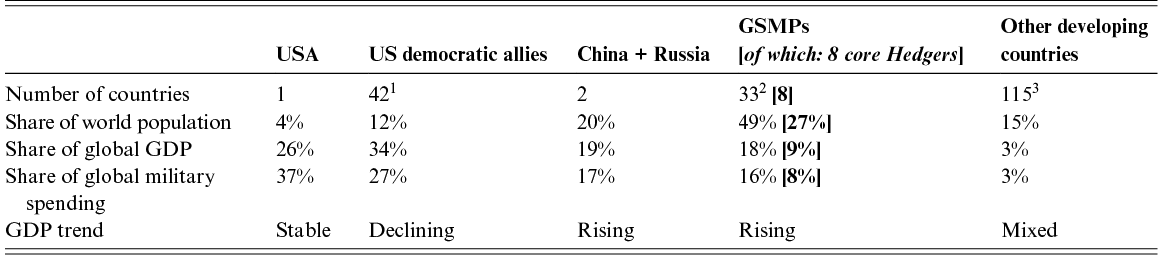
Contrary to the Cold War period, it is not possible to neatly divide the world into two camps. If we take a snapshot of global groupings in 2024, we can structurally divide all states into five groups: the US as the true global power; the group of US democratic allies even if shaken by Trump 2.0; China as the rising global power and increasingly cooperating with Russia; large GSMPs; and smaller countries.
Table 1 shows countries, their global bloc alignment, share of world population, global GDP, and share of global military spending.
| USA | US democratic allies | China + Russia | GSMPs [of which: 8 core Hedgers] | Other developing countries | |
|---|---|---|---|---|---|
| Number of countries | 1 | 42Footnote 1 | 2 | 33Footnote 2 [8] | 115Footnote 3 |
| Share of world population | 4% | 12% | 20% | 49% [27%] | 15% |
| Share of global GDP | 26% | 34% | 19% | 18% [9%] | 3% |
| Share of global military spending | 37% | 27% | 17% | 16% [8%] | 3% |
| GDP trend | Stable | Declining | Rising | Rising | Mixed |
1 This group reflects countries and regions that strategically, economically, or militarily align with the US-led liberal democratic order and form the core of its alliance system. It comprises:
a European Union (EU);
b NATO members (non-EU): United Kingdom, Norway, Iceland, Türkiye, Albania, North Macedonia, Montenegro;
c Asia-Pacific democratic allies (non-EU, non-NATO): Japan, South Korea, Australia, New Zealand, Canada; and
d special additions: Switzerland, Ukraine, and Taiwan (de facto).
2 This group includes countries ranked among the top fifty global economies by GDP but not formally aligned with US security alliances. Members: Algeria, Argentina, Bangladesh, Brazil, Chile, Colombia, Dominican Republic, Ecuador, Egypt, Ethiopia, India, Indonesia, Iran, Iraq, Israel, Kazakhstan, Kenya, Kuwait, Malaysia, Mexico, Morocco, Nigeria, Pakistan, Peru, Philippines (given variations in security arrangements over the last thirty years), Qatar, Saudi Arabia, Singapore, South Africa, Thailand, UAE, Venezuela, and Vietnam.
3 This group consists of lower-income developing countries below the top fifty global GDP economies.
GSMPs collectively represent 18 percent of global nominal GDP in 2024 (9 percent for the eight Hedgers alone).
One key takeaway is that a group effect regarding these Global South Hedgers emerges. If one small country hedges for self-insurance purposes, it is analytically interesting, but without systemic consequences. When a large group of increasingly powerful countries refuse to follow great powers and choose to innovate in various forms of hedging, there is a systemic effect.
Hedging in International Relations
The study of state alignment strategies and choices relative to great powers lies at the heart of international relations. In the face of anarchy and a dangerous international system, structural realists argue that most states must learn to manage threats through balancing (seeking partners to counter perceived threats) or bandwagoning (aligning with a dominant power or threat in order to gain security or profit) (Brooks and Wohlforth Reference Brooks and Wohlforth2008, Schweller Reference Schweller2006, Snyder Reference Snyder1997, Walt Reference Waltz1979, Reference Walt1987). Paul has shown that the post-war period has seen the rise of soft-balancing strategies through international institutions, diplomacy, informal ententes, and tools to restrain great powers (Paul Reference Paul2018: 20).
The post-Cold-War period has seen the rise of more nuanced approaches to middle state options focused on the concept of hedging. Lake sees hedging as an anticipatory behavior in response to uncertainty and risk and involving redundancies. It is “an insurance policy against opportunism” (Lake Reference Lake1996: 15).
In the context of a multipolar system, Goh defines hedging as a middle position that allows states to avoid choosing (Goh Reference Goh2007, Reference Goh2008). For Goh, such strategies involve soft balancing, complex engagement with all big players, and an omni-enmeshment strategy that seeks to embed great powers into norms and institutions. Economic integration is a crucial facilitator for such strategies.
A leading pioneer in the field, Kuik offers a precise definition that focuses on offsetting contradictory policies happening at the same time: hedging is “a behavior in which a country seeks to offset risks by pursuing multiple policy options that are intended to produce mutually counteracting effects under the situation of high-uncertainties and high-stakes” (Kuik Reference Kuik2008: 163). This is a middle strategy between bandwagoning and balancing that seeks to manage risks and bring stability.
Others have correctly argued that hedging involves elements of soft-balancing. Hedgers use their diverse relationships to build leverage and autonomy, while avoiding any hard move that could provoke a coercive response by a great power. It is a dynamic and perpetually adjusting strategy.
A fuller and more recent definition is given as “insurance-seeking behavior under conditions of high-stakes and high-uncertainties to minimize risks, maximize returns, and maintain fallback positions, primarily via adopting active neutrality, inclusive diversification, and prudently adaptive offsets. These defining elements distinguish hedging from balancing and bandwagoning, which are aimed primarily at security-maximizing and profit-maximizing, respectively, both via siding with one power against another” (Kuik and Nur Shahadah Reference Kuik and Nur Shahadah2024: 2–3).
Kuik further argues that the main practice of hedging in Southeast Asia is through active, inclusive, and adaptive multi-alignments, under conditions of high stakes and high uncertainty. The approach includes active neutrality (active signalling of a not-taking-sides stance), inclusive multi-directional diversification (pragmatic cultivation of partnerships with all), and “adaptive offsets (prudent pursuits of opposite, mutually-counteracting measures aimed at keeping options open, creating space for maneuverability, and maintaining fallback position).” Such multi-layered statecraft indicates that hedging is not an indecisive “middle position,” but a precautionary, proactive policy with deliberately opposite positions in the search for a more acceptable, more productive, and more peaceful outcome (Kuik Reference Kuik2024). Kuik also notes that hedging can erode as structural conditions change.
Many scholars question the viability of hedging. Applying the concept to the Indo-Pacific region, and, particularly, Japan in the 2010s, Koga writes: “through hedging, the state conducts a counteracting policy – strengthening economic cooperation while preparing for diplomatic and military confrontation by increasing military capabilities – to temporarily avoid an explicit confrontation with a potentially adversarial state” (Koga Reference Koga2018: 634). Building on Mearsheimer, Koga also sees hedging as “waiting for balancing,” not necessarily a stable long-term choice (Koga Reference Koga2018: 634).
Using a neo-realist approach in the context of international order transition, He and Feng argue that the space for hedging for secondary countries may be shrinking. They conclude: “Hedging is not dying. It largely depends on how the United States and China compete with one another during the period of international order transition. The current status of US–China competition, however, suggests that we might have entered the ‘after-hedging’ era” (He and Feng Reference He and Feng2023: 49).
This vast and growing literature has increasingly demonstrated how states have gone beyond simple bandwagoning and balancing categories, choosing complex menus of options in dealing with larger powers and with international institutional tools. But there is clearly a lack of consensus on three key dimensions:
1. motivations: purely structural external drivers versus domestic interest and ideas;
2. resilience: long-term robustness of such strategies in a context of more assertive great power politics; and
3. impact: the degree of influence on the international system of collective hedging strategies by middle players.
Through our framework, we seek to show how persistent hedging strategies pursued by a group of increasingly powerful middle powers at a time of fluid global order transition can have a significant influence on the international system. Indeed, the last few years have demonstrated that these significant Hedgers have had substantive impact on two conflicts and several major developments. Through this, we push our analysis beyond the excellent recent analysis of active non-alignment strategies of countries in the Global Majority, to unpack mechanisms and impact (Heine, Fortin and Ominami Reference Heine, Fortin and Ominami2025).
A New Approach: Impactful Hedging Agency
Our work builds on the original definition of hedging in finance: “the practice of engaging in offsetting financial transactions to reduce losses” (Merriam Webster). Hedging involves the use of tools such as futures trading and options trading to navigate a risk environment and shape outcomes. In turns, when enough players use these instruments in a similar direction, they can end up influencing the original markets, or making markets, as shown with mortgage-backed securities and credit default swaps in the 2008 Global Financial Crisis.
Realist views of hedging have often focused on weaker states that seek to avoid entrapment or abandonment by great powers and to retain some autonomy, until their time runs out. Instead, we see more potential in the concept of hedging itself, when it is used by larger players and by a large number of players at times of fluid order transition.
Furthermore, our work goes beyond the mere focus on material interests and capabilities. It includes attention to national visons and their origins (Sections 2 and 3–6). Hedging is not just military and economic, but is also a matter of ideas, ambitions, and narratives.
Definitions: Strategic Hedging Behavior and Hedgers
In this Element, we build on existing definitions of hedging (particularly by Kuik), with some new dimensions. First, we focus on long-term sustained hedging strategies by a group of significant Global South countries. What is measured here is not tactical decision-making in one situation or another, but a pattern visible over time and through a diversity of crises.
We refer to strategic hedging behavior as: repeated, diverse, sustained, and complementary actions to engage with all major powers without reaching a formal alliance with any and without restrictions on possible actions with others. Strategic hedging is proactive and includes bilateral strategic action plans, broader institutional arrangements, and active hosting of global forums. It also recoils from exclusive measures, such as sanctions or boycotts toward any great power. This multi-partner engagement openly acknowledges the side goal to socialize great powers into stable relations (Armstrong and Quah Reference Armstrong and Quah2023).
We call Hedgers (in short) countries who have demonstrated a sustained record of strategic hedging over time and across domains, and who have maintained sufficient autonomy and resilience in this choice. In this work, we also refer to their hedging agency, their ability to gain autonomy and impact through long-term hedging strategies.
We recognize that this category encompasses a spectrum of cases and propose a set of metrics to identify the most significant and resilient Hedgers (Section 2). Based on these metrics, we argue that eight countries particularly stand out as resilient and impactful Hedgers: Brazil, India, Indonesia, Qatar, Saudi Arabia, South Africa, the UAE, and Vietnam.
The Concept of Hedging Power
Building again on the original hedging concept in finance, we argue further that sustained and repeated hedging behavior by significant players can confer on those players a certain hedging power.
Hedging power refers to the ability to achieve national goals (such as security and development), as well achieve systemic goals (such as influencing the geo-economic order or the geopolitical order to the benefit of the Hedger) through sustained hedging strategies backed by effective resources and determined leadership. In Section 2, we operationalize the sources of hedging power through the metrics presented.
We also argue that hedging power varies according to those resources and capabilities. India arguably has the most hedging power in our sample, followed by a second group that includes Saudi Arabia and Brazil, and possibly Vietnam.
From Hedging Strategies to Systemic Impact
The key premise in this work is the reading of the current period as one of both structural competition for a future global order and multiple disruptions. Economic alignments and rules are being reshaped. Security is uncertain and disputed. Neither great power has the ability to shape outcomes alone. When a number of significant middle powers move in the same direction, they end up shaping outcomes in ways that dominant powers did not condone or did not anticipate.
A key question relates to the degree of coordination or congruence among the Hedgers themselves. What do they think about each other? We argue here (and show in the empirical sections) that each national hedging strategic is fundamentally national and rooted in long-term interests and cultural dimensions. There are examples of cooperation between some Hedgers such as Saudi Arabia and the UAE on many files, or South Africa and Brazil (Section 5), and of course within ASEAN. The various countries sit together in global climate negotiations (except for oil producers) and in various UN settings (under G77+ China). The expanded BRICS brings many large GSMPs together with China and Russia to coordinate, or at least discuss, a few global priorities, even if collective achievements are limited. Ultimately, the BRICS brings together countries with a core interest in defending their sovereignty above all (Laïdi Reference Laïdi2012b). In sum, we see their cumulative impact more as the result of parallel actions for sometimes different reasons, rather than active cooperation.
With respect to the US–China competition, the connecting choices made by Indonesia, Malaysia, Mexico, and Vietnam, in particular, have turned the initial US–China trade war under President Trump 1.0 into indirect economic interactions with general stability, rather than decoupling. If we include indirect trade through such connector states, US–China trade has mostly remained flat. Meanwhile, India, Indonesia, and Vietnam have used active multi-alignment to thwart pressures from either the US or China toward bipolarity.
In 2025, the priority for Hedgers has been to address US pressures under Trump 2.0, an administration that appears less interested in achieving alignment with the US against China, and more interested in extracting unilateral benefits from Hedgers and allies alike. The Trump 2.0 approach penalizes China on some dimensions but also penalizes valuable allies facing China (cf. Section 7). Some Hedgers have sought to deflect US pressures through early deals (Vietnam, Indonesia), others have enticed the US through massive investments (Gulf countries), while India and Brazil have apparently been resisting US coercive actions.
We observe a general pattern of dealignment, rather than bipolar alignment.
Global South Hedgers versus Traditional Global North Hedgers
The logic of our argument applies to GSMPs alone. Countries that have formal security agreements with the US or high levels of economic dependence are increasingly facing demands from the US to align with its growing containment of China. Being closer to the US pole, they have no ability to escape the gravitational pull of its new strategy.
We agree with He and Feng (Reference He and Feng2023) that the space for middle powers allied with the US to play hedging strategies has shrunk under the tightening US–China rivalry for countries such as Australia, Canada, Japan, and New Zealand. This also broadly applies to Korea (with a bit more space) and somewhat to Singapore and Thailand. The latter two don’t have the same mutual security guarantees as Japan and Canada. Global North countries are forced to bandwagon with the US side, although some may keep a minor hedging component.
Key Drivers and Enabling Variables
Why are GSMPs able to develop such resilient and impactful hedging strategies? What factors have enabled the rise of this new category of “Hedgers”?
We argue here that three novel variables are essential. The first is the structural nature of the ongoing global order transition. The relative open and peaceful liberal international order (Ikenberry Reference Ikenberry2011) has opened up space for significant economic convergence between emerging powers and established powers, at least between 1995 and about 2015.
All GSMPs have taken advantage of globalization and depend on it. They have benefitted from the rise of global governance institutions, including the G20 and the BRICS, and are promoters of both. They also gained from the relative decline of dominant liberal states and their ideological claims. Impactful hedging benefits from the combination of economic interdependence and the reduction of ideological confrontation at the systemic level.
Over 20 percent of global GDP shifted hands during 1995–2015 (Tiberghien Reference Tiberghien, Chu and Zheng2021) and multipolarization has opened up the field. Additionally, the rise of China since 1995 has opened up massive new trade and diplomatic relationships for all GSMPs, as documented in each of the empirical sections. The rise of China has broken historic links of dependence on the US and Europe for most of the GSMPs.
Sustained impactful hedging relies on multipolarity. The strict bipolar nature of the first Cold War thwarted the rise of the Non-Aligned Movement (NAM). A strong unipolar system also limits hedging options. Conversely, a weakening unipolar system (as in the post-2008 period) opens up space. An uncertain hybrid multipolar and imperfectly bipolar system increases arbitrage opportunities for creative Hedgers.
Multipolarity and the rise of China have also stimulated other emerging powers to start imagining a future that would be less dominated by the US and its allies, and where they too could upload domestic ideas and play a role. For GSMPs, the concept of a multiplex or à la carte order became appealing (Acharya Reference Acharya2018). China’s disinterest in regime change or regional intervention has made it a palatable and convenient trading partner.
All significant Hedgers started actively taking claims and actions to mark territory in the new order, working with new players. Because of the systemic level of uncertainty, the new actors gained the opportunity to “speculate” and invest in possible futures, as entrepreneurial investors do in finance.
The subsequent post-2015 tightening of US–China bipolarization has provided an added layer on top of the reality of power diffusion that has already taken place. The net effect of these two trends is imperfect bipolarization, which means that the two great powers are not able to corral all countries into two camps. Instead, the two great powers are all courting the large GSMPs, as indispensable pivotal players.
Second, the sheer diffusion of power since 2000 has meant that all GSMPs have acquired significant resources, funding, strategic leverage, and military resources. India is far from the country that was dependent on US food aid in the 1950s and 1960s.Footnote 11 Section 2 offers data on such changes over time. The Hedgers now have power and money to back their strategic choices.
Third, we also believe that ideational, psychological, and leadership factors matter in shaping and strengthening the behavior of Hedgers. Hedging is not just about defending economic and military interests. It is also about projecting narratives and ideas, and about affirming and confirming global status, and overcoming racial hierarchies (Larson and Shevchenko Reference Larson and Shevchenko2010, Paul Reference Paul2024, Paul, Larson and Wohlforth Reference Paul, Larson and Wohlforth2014). This is measured through our metric 7 in Section 2.
All eight Hedgers studied here have built their current strategies on long historical and civilizational roots that feed into a confident vision for themselves and for the international system. Most of these countries have been actively involved in post-colonial debates on global justice and a better international system. India and Indonesia (along with Ceylon, Burma, and Pakistan) played a leading role in the NAM that emerged from the April 1955 Bandung conference in Indonesia (Tan and Acharya Reference Tan and Acharya2008). Bandung advanced the norm of racial equality and equality of all nations, small and big (Acharya Reference Acharya2025). GSMPs carry that legacy. We cannot understand the role of South Africa without taking into account its fight against apartheid (De Carvalho Reference De Carvalho2025). Simultaneously, we acknowledge the ebbs and flows of domestic politics in shaping foreign strategy and discuss it in the respective empirical sections.
Potential Limits of the Argument
A key question with hedging strategies is how durable they can be (as argued by T. V. Paul), in the context of the unpredictable Trump 2.0 administration and the tightening US–China dynamic. We address the dilemma in Section 7. Still, we argue that the increasingly multipolar nature of power remains, even if global interdependence is affected by US actions. The capabilities and strategic intent of the Hedgers are real and strong. The Trump assault on global institutions and US allies has increased uncertainty and volatility in the global system. They have made bipolarization more imperfect. They may have strengthened the short-term US position, but within a more multipolar and diffuse world. Additionally, the Trump actions have increased the incentives for Hedgers to seek leverage and autonomy through multiple relations.
Given the strong capabilities of GSMPs studied here, we see considerable resilience in their strategy. However, there is an ultimate caveat. Should the US–China rivalry break into a hot war, options will become more limited for countries in the neighborhood, including Northeast Asia, Southeast Asia, Oceania, and probably Central Asia. Short of war, the US and China could increase the costs of dealignment for a number of countries. That said, the dynamic analyzed here was in full swing in the period 2008–2024.
2 The Drivers of Hedging Power
What are key resources needed for impactful hedging? We have selected here a combination of eight factors: material resources (GDP), non-membership in military alliances, regional or global strategic positioning, a central role in the configuration of value chains, political ambition, and, finally, global institutional power (G20, BRICS, regional organizations).
We have also assessed their hedging power in regard to the wars in Ukraine and the Middle East.
Metric 1: Trade Exposure to US and China
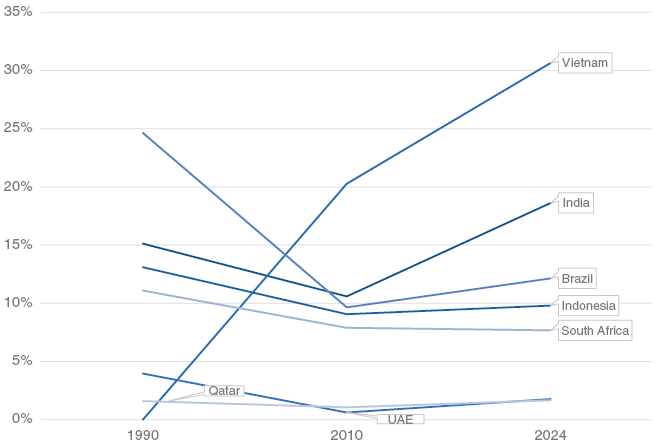
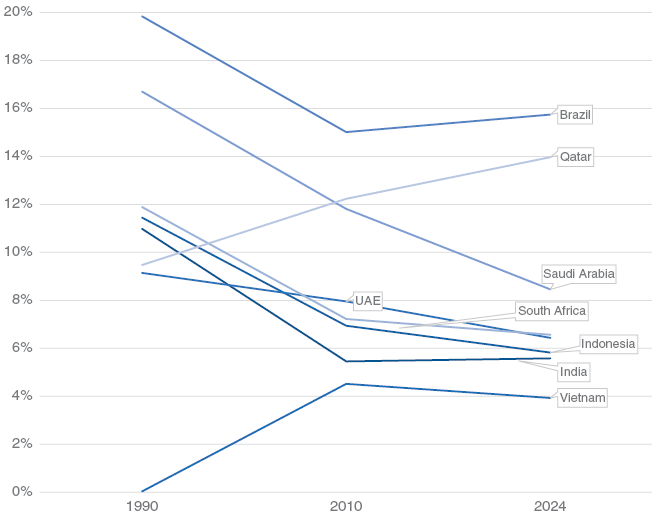
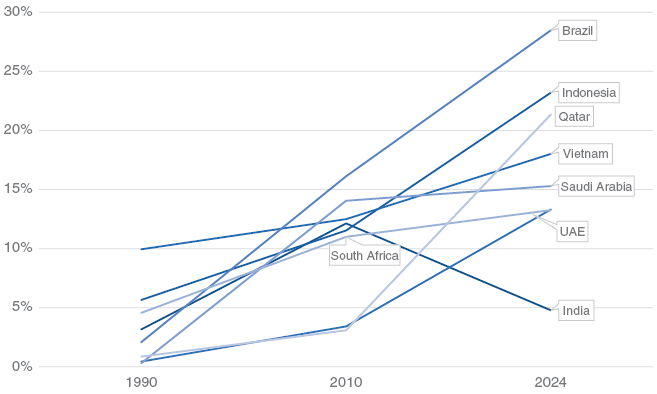
Strategic trade positioning relative to the United States and China, and the changing balance between them indicate positional trading power. All Hedgers have gained space over recent years through their reduced dependence on the US (except for Vietnam and India) and increase in trade with China. In 1990, for example, Saudi Arabia shipped 24 percent of its exports to the United States. This fell to 4 percent in 2024. Out of eight Hedgers, the United States is now a major export market for only two of them (Vietnam, India), an important but second-tier export market for three others (Indonesia, Brazil, and South Africa), and secondary for all the others. These changes increase the incentives for GSMPs to hedge, rather than align with the US. If sustained, the tariff war waged by the Trump administration may amplify this move away from the US.Footnote 12 Figures 1 and 2 map out the changing export and import dependence on the US for the eight Hedgers. In comparison, Figures 3 and 4 present their changing export and importance dependence on China.
Figure 1 illustrates the decreasing weight of the US market for most Hedgers since 1990, except Vietnam and India.
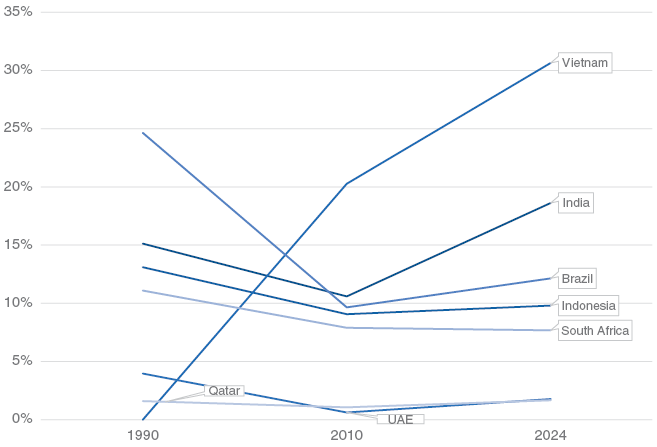
Figure 1 Changing export dependence on the US.
Figure 2 focuses on the changing Hedgers import dependence on the US. On the import side, the United States is no longer a major partner for most of them, except for Brazil and Qatar.
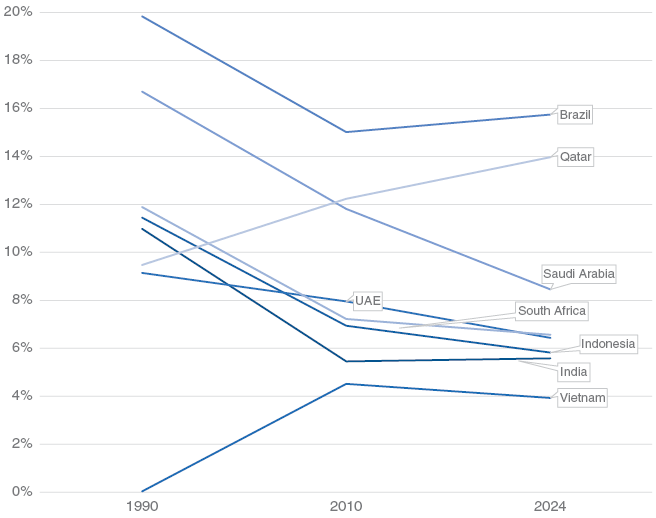
Figure 2 Decreasing import dependence on the US.
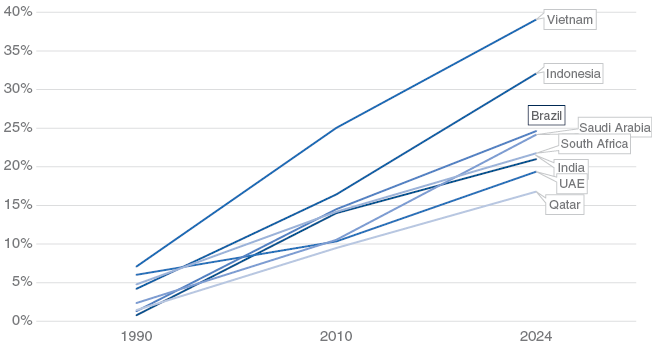
Meanwhile, Figure 3 shows how China has become a significant import and export partner for all countries, with the exception of India. In particular, Brazil now sends a high share of its exports to China (28 percent), a striking development, given that China did not even appear among its export markets in 1990. This is also the case for Saudi Arabia, UAE, and Qatar.
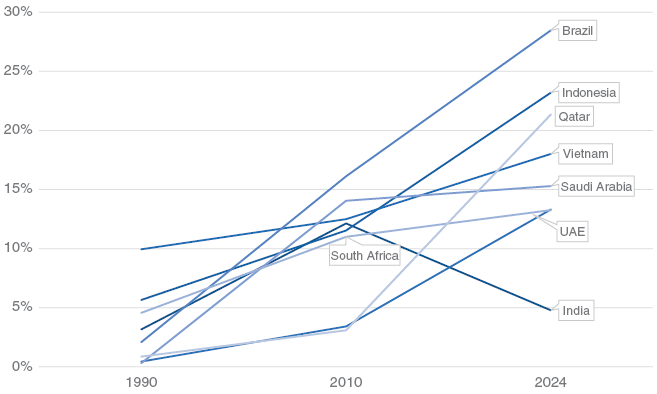
Figure 3 Growing export dependence on China.
Figure 4 illustrates the increasingly important dependence on China. China is now the main source of imports for countries as diverse as Indonesia (32 percent), Vietnam (39 percent), Brazil (25 percent), Saudi Arabia (24 percent), South Africa (22 percent), India (21 percent), and even Qatar (17 percent). Out of eight Hedgers, six import more than 20 percent of their goods from China. The colossal place that China now occupies as a trading partner to the detriment of the United States is striking. Only India is partially resisting this movement. Still, 22 percent of Indian imports came from China in 2024, against 1 percent in 1990. The thaw in Chinese–Indian relations in 2024 was partly the result of Indian business pressures to normalize trade relations: “To boost Indian manufacturing and plug India into the global supply chain, it is inevitable that India plugs itself into China’s supply chain.”Footnote 13
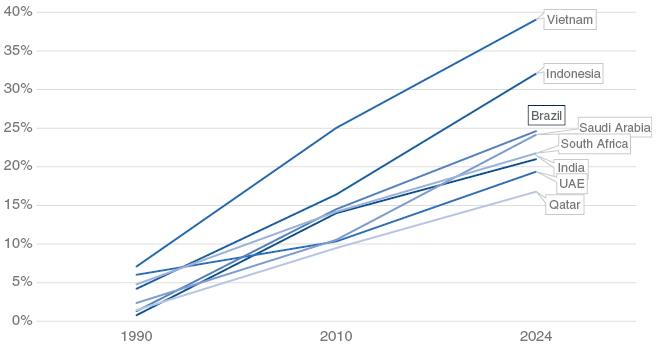
Figure 4 Growing import dependence on China.
The arrival of China broadens the range of options for all Hedgers. This is also the case for Vietnam, which strikes an equal balance between a high dependence on China for its imports and a strong dependence on the United States for these exports.
Simultaneously, when a number of these states become highly dependent on the Chinese market and products, which is now the case for Indonesia, their hedging power vis-à-vis China is limited. Brazil’s heavy dependence on China for its exports offers advantages but has the disadvantage of amplifying the country’s deindustrialization process. The existence of a powerful market such as China’s is likely to facilitate the development of export agribusiness to the detriment of any other development logic (as shown in Sections 4 and 5).
Metric 2: Global Economic Power (Significant GDP Ranking)
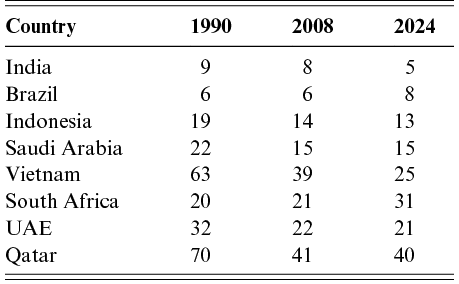
We have selected states whose place in the world economic hierarchy is significant. Table 2 offers the ranked position of Hedgers in global rankings.
Table 2 shows the eight Hedgers’ changes in GDP world rankings for selected countries between 1990 and 2024.
| Country | 1990 | 2008 | 2024 |
|---|---|---|---|
| India | 9 | 8 | 5 |
| Brazil | 6 | 6 | 8 |
| Indonesia | 19 | 14 | 13 |
| Saudi Arabia | 22 | 15 | 15 |
| Vietnam | 63 | 39 | 25 |
| South Africa | 20 | 21 | 31 |
| UAE | 32 | 22 | 21 |
| Qatar | 70 | 41 | 40 |
Note: For the rankings on GDP here and in subsequent tables on sovereign wealth funds, population and military expenditures, the European Union is treated as a single actor, aggregated according to its membership at the relevant point in time (e.g., twelve member states in 1990, twenty-seven in 2008). While this approach notably alters global rankings, it offers a more analytically accurate representation of the EU’s collective capacity.
In nominal terms, the GDPs of seven of the eight Hedgers we have selected are part of the world’s thirty-five largest economic powers. The outlier is Qatar, which ranks fortieth because of its tiny population. However, what seems more decisive is the progression of these states in the ranking: six out of eight have improved their position since 1990. The relative decline of Brazil’s position is not significant. South Africa’s decline is more significant but compensated by other assets. If we take the evolution of the nominal GDP of Hedgers between 1990 and 2024, we can see two spectacular increases in the ranking: Vietnam, which moved from sixty-third to twenty-fifth, and Qatar, which moved from seventieth to fortieth place. India has moved from ninth to fifth place, the UAE from thirty-second to twenty-first place. Indonesia and Saudi Arabia have also ascended.
Metric 3: Substantial Financial Assets
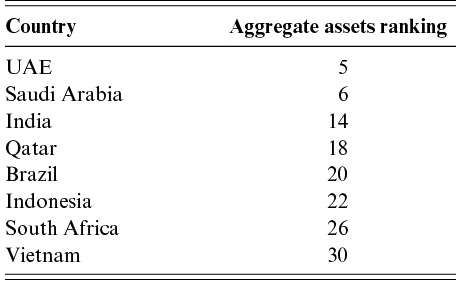
The second metric measures the resources of Hedgers and evaluates their financial power. To this end, we have measured their resources through what are called state-controlled investors, which include three types of resources: Central Bank reserves, sovereign wealth funds (SWF) and pension funds. Table 3 ranks Hedgers’ total assets under management.
| Country | Aggregate assets ranking |
|---|---|
| UAE | 5 |
| Saudi Arabia | 6 |
| India | 14 |
| Qatar | 18 |
| Brazil | 20 |
| Indonesia | 22 |
| South Africa | 26 |
| Vietnam | 30 |
Note: as in Table 2, the EU is aggregated as one single actor.
As Table 3 shows, the financial resources of Hedgers are important points because it is also thanks to these resources that these states have weight in the global game. At a time when AI is becoming one of the main drivers for global competition, the possession of financial resources combined with the possession of energy resources gives the Hedgers with these two resources a growing and sometimes considerable role, as shown by the example of the UAE. The UAE and Saudi Arabia are now, respectively, the fifth and sixth largest holders of financial resources in the world. The Middle East and North Africa (MENA) region alone concentrates 40 percent of SWF resources in the world. The UAE, Saudi Arabia, and Qatar are, respectively, ranked second, fifth, and seventh in the world in terms of SWFs alone. Even if their resources are smaller, other Hedgers are not to be outdone. All eight Hedgers analyzed in this Element are in the top thirty states with significant financial resources. This makes the comparison consistent with the relative ranking in terms of GDP.
Metric 4: Lack of Security Guarantor and Increased Firepower
The Hedgers all come from the Global South and have the characteristic of not being linked to the US, China, or Russia by politico-military alliances such as NATO, the security pact between Australia, the UK, and the US (AUKUS) or bilateral defense agreements including those that bind Korea to the United States, for example. This means that Global South Hedgers face more risks and uncertainty from aggressive powers, but also remain free from the risk of entrapment into alliance-driven conflicts that could be unwanted.
No Hedger has a strong security guarantee comparable to that of NATO’s Article V, except the Philippines, which we do not place in the Hedger camp for this reason. A number of Hedgers such as Qatar, Saudi Arabia, or the UAE are certainly linked to the United States by a number of military arrangements, including through the presence of American military forces. However, these arrangements do not legally guarantee the territorial integrity of these states in the event of an external attack. India is linked to the Australia, Japan, and the US, through the Quadrilateral Security Dialogue (QUAD), but has insisted that it cannot become a military alliance. Instead, Hedgers look to increase their security by diversifying their external partnerships.
The fact that Hedgers do not benefit from external military guarantees forces them to develop their own military capabilities. To measure these capacities, there are several indicators. The most traditional is the measure of military spending in relation to GDP.
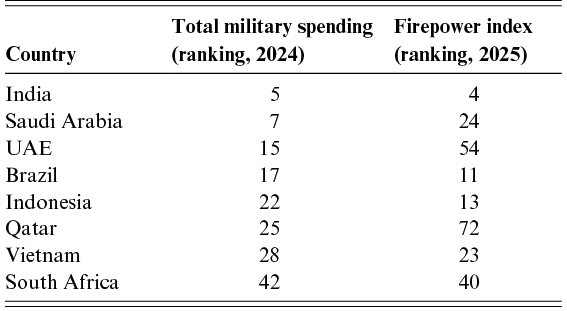
Table 4 globally ranks the eight Hedgers’ military expenditures and firepower index.
| Country | Total military spending (ranking, 2024) | Firepower index (ranking, 2025) |
|---|---|---|
| India | 5 | 4 |
| Saudi Arabia | 7 | 24 |
| UAE | 15 | 54 |
| Brazil | 17 | 11 |
| Indonesia | 22 | 13 |
| Qatar | 25 | 72 |
| Vietnam | 28 | 23 |
| South Africa | 42 | 40 |
Source for Vietnam, Qatar, UAE: IISS, interactive: global defense spending in 2024, accessed July 17, 2025, https://tinyurl.com/yeupb682.
Source for global firepower: Military powers ranked according to Global Firepower. Accessed June 25, 2025, www.globalfirepower.com/global-ranks-previous.php.
Total military spending is indicative of one thing: the degree of threat that weighs on a state and the need to respond to it with a military effort. By this yardstick we see that Saudi Arabia, the UAE, and Qatar devote considerable resources to their defense in relation to their GDP. Indonesia, on the other hand, is much less threatened. As a result, its military effort is relatively modest, relative to its size and GDP.
We complement the raw expenditure data with the global firepower index. It measures war-fighting capabilities.Footnote 15 India ranks fourth. Indonesia, Brazil, and Vietnam also have very significant firepower. Again, out of eight Hedgers, five are in the top thirty for firepower. The UAE and Qatar are in the top thirty for military expenditures. Combining these two factors, the Hedgers are still in the top thirty with the exception of South Africa, which has no military threat nor ambition to project itself militarily given the low hostility of its regional environment.
We observe a striking mismatch between the ranking in military spending and the ranking in firepower regarding the three Gulf countries. This indicates that their military effort is incomplete: they may have purchased modern hardware from the US and others, but still lack manpower and their military strategy is still in progress.
Metric 5: Strategic Geopolitical Location
The fifth factor is the strategic localization of Hedgers. Most significant Hedgers are located in sensitive strategic areas such as the Middle East, between great powers in Eurasia, or the South China Sea. Vietnam, Indonesia, and India have front row seats to the Sino-American rivalry.
Metric 6: Important Role in Global Value Chains and Energy Security
Global value chains (GVCs) refer to international production sharing, a phenomenon whereby production is broken into activities and tasks carried out in different countries.
As G7 countries seek to reduce their dependence on China for key resources or sensitive manufactured goods, some GSMPs have been able to offer lower risk alternative sources, thanks to their cheap labor, quality infrastructure, and education. This is the major asset for India and Vietnam.
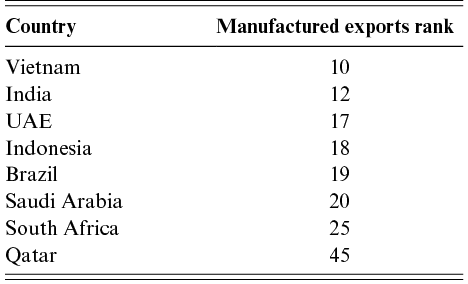
A good proxy to measure the position of countries in manufacturing GVCs is to measure the size of their exports in manufactured goods. Table 5 presents the ranked position of Hedgers on this metric, again counting the EU as one unit. The table demonstrates the growing role of Vietnam in GVCs (ranked right below Taiwan, Singapore, and the UK – and closing in on the latter two). India and the UAE are also featured in good positions, followed closely by Indonesia, Brazil, and South Africa.
Table 5 globally ranks the eight Hedgers’ 2023 exports of manufactured goods.
| Country | Manufactured exports rank |
|---|---|
| Vietnam | 10 |
| India | 12 |
| UAE | 17 |
| Indonesia | 18 |
| Brazil | 19 |
| Saudi Arabia | 20 |
| South Africa | 25 |
| Qatar | 45 |
The World Integrated Trade Solution ranks countries based on their share of GVC output as a share of total output. By that measure, in 2022, Vietnam’s rank is a stunning third.Footnote 16
Going forward, India shows considerable potential for further inclusion in GVCs, because it has the capacity to replace China as a source of manufacturing. In doing so, it helps Western countries reduce their vulnerability to China. However, this advantage is still relative in view of the symmetry that exists in India between the service sector and the industrial sector.
Technological evolution, particularly the explosion of AI, is increasingly shifting countries’ strategic nucleus. It is likely that dynamics may change as a result. This is what the UAE, Qatar, and Saudi Arabia have understood. They believe that the two key future drivers of data centers are money and energy (Allen, Adamson, Heim, and Winter-Levy Reference Allen, Adamson, Heim and Winter-Levy2025). They have these two resources in abundance. This reality has spurred a US U-turn toward Gulf countries: in 2025, the US has lifted its opposition to Chinese investments in the region, in exchange for huge investment from the Gulf countries in the US (Froman Reference Froman2025). The possession of rare earths may also shift the dynamics of GVCs.
Metric 7: Political Ambition
Hedgers are actors with strong political ambitions to exert influence on the international system for their own benefit. Most Hedgers exert a leadership in their respective regions. In this context, the possession of political resources is as important as the utilization of material resources. Ambition and vision, often inherited from a historical past, are essential determinants of the conduct of Hedgers.
South Africa’s role cannot be understood solely in terms of its resources, which are not considerable. For example, theirs are much smaller than Nigeria’s, both demographically and materially. Notably, South Africa has a long political tradition inherited from its fight against apartheid. It seeks to enhance its political capital through significant diplomatic assertiveness, as has been seen recently with regard to Gaza.
India and Indonesia are founders of the NAM. India is also seeing an enhancement of its power and a gradual return to the period before the Industrial Revolution, when China and India were the world’s two leading material powers. They are therefore the heirs of diplomatic traditions that endure (India) or are being reactivated (Indonesia).
The UAE is also another example where wealth does not explain everything. Kuwait is almost as rich as the UAE. Yet their respective weight in the international system is simply incomparable. For example, the UAE is involved politically and militarily largely beyond its borders (Libya, Sudan, Somalia). The UAE has built a “port empire” in seventy-eight countries, in order to use them for political leverage.Footnote 17
The advent of Prince bin Salman in Saudi Arabia has changed the tempo of Saudi’s policy and raised its level of ambition. The quality of the leadership and its determination to act matters a lot. If another dynasty was in power in UAE, the political destiny of the country might have been different. Moreover, the competition with Saudi Arabia is a driver of UAE ambitions. The competition between Saudi Arabia and the UAE is essential to understand the dynamic role played by Qatar in international politics.
In Brazil, Lula has placed his country on an ambitious trajectory dissimilar to his predecessor Bolsonaro even if there are obvious continuities.
In Indonesia, the personalization of power influences the country’s ambition. Prabowo, for example, is very sensitive to foreign policy issues. He is reported to have single-handedly made the decision to join the BRICS in early January 2025.Footnote 18 The transactional character of the international system suits him very well.
Vietnam is less sensitive to personal factors given the Chinese Communist Party (CCP)’s collegial structure. However, ambitious and cautious positioning is intended to ensure Vietnam’s survival between the two superpowers.
This also means that the status of Hedgers is never acquired forever. This can vary over time, including through a change in leadership. However, it is obvious that the more consistent this hedging strategy is over time, the more it becomes in itself a political heritage and an anchored tradition.
Metric 8: Global Institutional Power
In addition to political leadership, there is a final factor concerning the recognition that the Hedgers enjoy at the international level. Recognition is not an easily measurable criterion. Yet we believe that there are perhaps three types of institutions today where this recognition is affirmed: the G20, the BRICS, and the regional organizations.
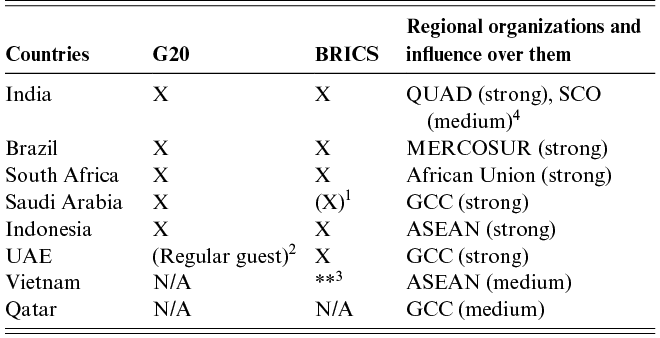
Table 6 shows indicators of global institutional power evaluated by membership in significant international groupings.
| Countries | G20 | BRICS | Regional organizations and influence over them |
|---|---|---|---|
| India | X | X | QUAD (strong), SCO (medium)Footnote 4 |
| Brazil | X | X | MERCOSUR (strong) |
| South Africa | X | X | African Union (strong) |
| Saudi Arabia | X | (X)Footnote 1 | GCC (strong) |
| Indonesia | X | X | ASEAN (strong) |
| UAE | (Regular guest)Footnote 2 | X | GCC (strong) |
| Vietnam | N/A | **Footnote 3 | ASEAN (medium) |
| Qatar | N/A | N/A | GCC (medium) |
1 Saudi Arabia was invited as a new member during the August 2023 Johannesburg Summit, effective January 1, 2024. But, to this day, Saudi Arabia has neither accepted nor turned down the invitation, probably under US pressure.
2 UAE was initially invited as guest when it held the GCC Chair (2011) or during the Saudi G20 (2020). But it has increasingly become a permanent guest due to its influence, with presence in 2022 (Indonesia), 2023 (India), 2024 (Brazil), and 2025 (South Africa).
3 Vietnam has joined the BRICS in July 2025 as a BRICS plus partner, along with nearly a dozen other countries that include Malaysia and Thailand. Vietnam also attended the 2024 BRICS summit in Kazan, Russia, as a guest.
4 SCO, Shanghai Cooperation Organization.
To be a member of the G20 is to belong to a closed club of the most important economies in the world. Out of our eight Hedgers, five are members of the G20, which is a very significant element of recognition and power, and one is increasingly turning into a permanent guest (UAE).
The BRICS meeting is a leader-level summit that enables major GSMPs to discuss, alongside China and Russia, the reform of global governance and collective interests. Beyond the creation of the New Development Bank (NDB) and coordination of position at the G20, the BRICS may not have structurally changed global governance yet. BRICS countries are indeed plagued by significant differences between those like Russia and China who seek significant global change, and others like India and Indonesia who don’t seek opposition to the US or Europe. The BRICS platform is increasingly valued by Global South countries as a discussion platform and incubator of future ideas. Significant enlargement of the BRICS took place in 2024, including the UAE and in 2025 with Indonesia. Saudi Arabia was invited but is still undecided.
Finally, these different actors have impact on their respective regional spaces. Brazil is the leader of Mercosur, South Africa of the African Union, Indonesia of the ASEAN (partially), and Saudi Arabia and the UAE are leaders of the Gulf Cooperation Council.
Vietnam is a member of ASEAN, but it does not play a leading role in it, because its foreign relations are overdetermined by its relations with China, the United States and Russia.
Qatar is less influential than Saudi Arabia and the UAE in the Gulf Cooperation Council. Qatar had huge divergences with its two neighbors on a number of subjects, including support of the Muslim Brotherhood. Nevertheless, Qatar benefits from a powerful lever through al Jazeera in the Arab world. Qatar is also at the origin of many political mediations, whether in Afghanistan, Ukraine, or even the Middle East, between Israel and Hamas (Milton and Elkahlout Reference Milton and Elkahlout2025). It also compensates these difficulties in the sub-region through privileged relations with Turkey.
India considers itself a civilizational state that does not need alliances. It is, however, constrained in its own region by China, which seeks to prevent India from dominating regional networks in South Asia. The only exception is the QUAD grouping, which includes the United States, Japan, and Australia, and which offers India the opportunity to be inserted into a network intended to counterbalance China in the Indo-Pacific. To this day, however, India has refused to let the QUAD become an alliance or to include integrated military coordination, beyond the ad-hoc annual Malabar naval exercises.
Measuring the Positioning and Systemic Impact of Hedger Countries
We now turn to a systematic measurement of the strategic behavior and impact of Hedgers in the global system. We offer an overview, before turning to the analysis of votes at the UN and comparative behavior on two salient conflicts: Ukraine and the Middle East.
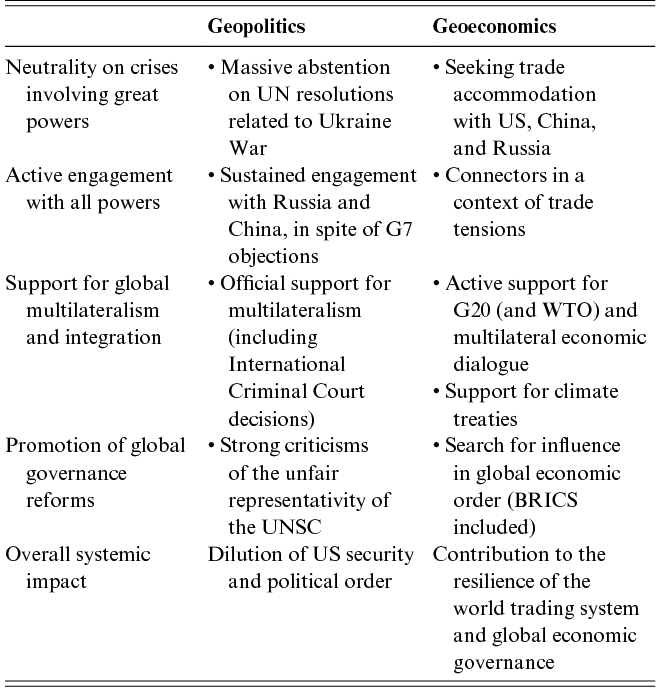
Table 7 proposes an evaluation of the approach and positions taken by Hedgers on key dimensions of geopolitics and geoeconomics.
| Geopolitics | Geoeconomics | |
|---|---|---|
| Neutrality on crises involving great powers |
|
|
| Active engagement with all powers |
|
|
| Support for global multilateralism and integration |
|
|
| Promotion of global governance reforms |
|
|
| Overall systemic impact | Dilution of US security and political order | Contribution to the resilience of the world trading system and global economic governance |
This table shows the range of overall positions taken by the Hedgers, while acknowledging that there are variations among them and that there is often a gap between formal positions and actual diplomacy and policy on the ground. Overall, we note that strategic choices sustained by Hedgers over time have significance for the international system, even if the Hedgers are often forced to adjust and react to counter-moves by great powers.
The War in Ukraine
One key indicator of the performance of Hedgers is their diplomatic positioning during the War in Ukraine.
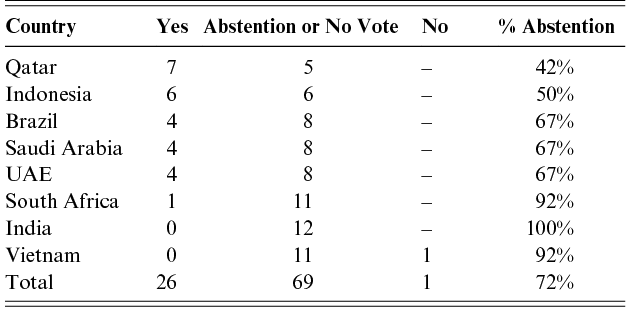
We systematically analyze the voting record of Hedgers at the UN General Assembly with regard to the twelve resolutions on Ukraine that were tabled between 2022 and 2025.
Table 8 shows the aggregate results of the eight Hedgers on the twelve votes at the UN General Assembly related to the War in Ukraine from 2022 to 2025.
| Country | Yes | Abstention or No Vote | No | % Abstention |
|---|---|---|---|---|
| Qatar | 7 | 5 | – | 42% |
| Indonesia | 6 | 6 | – | 50% |
| Brazil | 4 | 8 | – | 67% |
| Saudi Arabia | 4 | 8 | – | 67% |
| UAE | 4 | 8 | – | 67% |
| South Africa | 1 | 11 | – | 92% |
| India | 0 | 12 | – | 100% |
| Vietnam | 0 | 11 | 1 | 92% |
| Total | 26 | 69 | 1 | 72% |
Of these twelve resolutions, any positive vote can be considered as equivalent to support for Ukraine (and conversely, any negative vote as favorable to Moscow). Abstentions fall in the middle but can embed all kinds of calculations and motivations. There are variations among types of resolutions, but ultimately the impact of these variations is minor.Footnote 19
From these results we can deduce the following remarks:
1 There is no Hedger totally aligned with Ukraine since none of them voted yes twelve times. Qatar is the country that voted the most times with Ukraine (seven times), while India and Vietnam largely abstained on these twelve resolutions. Vietnam even voted with Russia to oppose the exclusion of Russia from the Human Rights Council. This is the only case of partial alignment with Moscow among Hedgers. On the exclusion of Russia from the Human Rights Council as well as on the humanitarian situation in the territories occupied by Russia, again, no Hedger voted in favor. The same applies to the resolution on human rights in the occupied territories of Ukraine and Crimea.
2 If we aggregate the votes cast at the UN for the eight Hedgers, we observe that 27 percent of votes cast were in favor of Ukraine (twenty-six out of ninety-six) and 72 percent were abstention votes (sixty-nine out of ninety-six).
The Hedgers Massively Abstained at the UNGA
These initial results show that the balance weighs very heavily in favor of abstention. This tends to prove that the vast majority of Hedgers did not want to choose between the G7 vision of the conflict and the Russian one (partly supported by China). The two most misaligned countries were India and Vietnam. They have systematically abstained on all resolutions except the one concerning the exclusion of Russia from the Human Rights Council, where Vietnam voted with Moscow.
Conversely, the three most formally aligned states were Qatar, Indonesia, and Brazil.
The general level of alignment is very limited and concerns at best only one-third of the Hedgers. However, this indicative measure does not tell the whole story.
In fact, the reality of their conduct shows that their alignment with Europe and the US is more symbolic than real. They chose to stand for the principle of sovereignty and territorial integrity, or to send tactical signals to the US or Europe. Yet none of them questioned their relations with Moscow after 2022. Instead, the opposite has happened. Today, Brazil, Indonesia, and Qatar have seen their relations with Russia develop.
The Conflict in the Middle East
Regarding Gaza, there is massive consensus, far beyond the Hedgers, on the Israeli–Palestinian conflict. On the six main resolutions related to the situation in Gaza and to a peaceful settlement, all Hedgers voted Yes, with the exception of India, which abstained on two resolutions regarded by Delhi as too biased against Israel. India has a close security relationship with Israel and remains by far the most prudent Hedger on the Gaza file.
The same pattern applies more or less to the Israeli–Iranian war of 2025. All Hedgers condemned the Israeli attack, with the exception of India, which expressed “its concern” and called for “restraint” (see Appendices B, C, and D online for detailed tables of positions on both issues).
3 India: The Hedger in Chief
India’s history and morphology confirm that hedging cannot be exclusively defensive. India has revealed an ability to take advantage of the power transition to rise in the hierarchy of nations (Paul Reference Paul2024: 33–39). By early 2025, India had developed an incomparably stronger agency than it enjoyed during the Cold War.
Nonetheless, the Indian discourse envisages multipolarity as the “natural state of the world” (Jaishankar Reference Jaishankar2020: 12), in contrast to a Sino-American bipolarity implicitly judged to be transitory. India’s ambition is constant: do everything to avoid being locked into an exclusive choice.
Even since Independence, India has focused on achieving strategic autonomy. This section argues that India’s strategy has moved from a logic of non-alignment during the Cold War to a logic that it itself qualifies as multi-alignment (Jaishankar Reference Jaishankar2020, Paul Reference Paul2024, Saran Reference Saran2017). This change is more than semantic. Non-alignment corresponded to the first bipolarity (Cold War), while multi-alignment refers to the current context of the second, hybrid polarity.
During the Cold War, the US approach to India depended on its Pakistani policy or the Soviet approach to China. By 2024, India had become a partner in itself, even if the Chinese factor weighs heavily in the calculation of its partners. Hedging is therefore posed in very different terms for India between the first and second bipolarity.
In the first bipolarity, it was necessary to establish an equidistance between East and West for India to craft its autonomous post-colonial development model. Simultaneously, there was already a strategic triangle between China, India, and the US: India was already able to benefit from US–China tension (Madan Reference Madan2020). In the second, it is no longer a question of establishing equidistance, since China is potentially a key adversary for both India and the United States: “an indispensable partner.”Footnote 20 India hedges by intensifying its relations with the United States, while protecting itself against the uncertainties of US policy towards China.
We offer here a new interpretation for India’s self-defined multi-alignment: we redefine it as multi-directional asymptotic alignment. An asymptote is a curve that comes closest to a straight line without ever touching it: this is what India is doing. India came as close as possible security-wise to the United States in 2020–2024, in order to benefit from scarce technological or military resources, while continuing its legacy military relationship with Russia where needed.
Yet India did not align itself with the US, even on important issues such as Ukraine. A marked rapprochement with Washington allows New Delhi to increase its leverage vis-à-vis China, while avoiding identifying itself completely with the United States in the event of a conflict with Beijing. The Chinese response consists of letting New Delhi know that nothing is totally lost unless it fully aligns itself with the US. While the initial escalation around the 2020 border incidents between China and India was driven by national politics and Sino-Indian interactions, the conflict had the effect of leading India toward a rapprochement with the US and a deeper commitment to the QUAD.
In terms of drivers, India’s multi-alignment strategy relies on the three factors identified in Section 1: fluidity in the global order, rapid increase in capabilities, and a resilient national vision rooted in its post-colonial experience and its ancient wisdom (Tharoor Reference Tharoor2025).
The decision by President Trump to move closer to Pakistan after spring 2025, while launching a particularly punishing trade war on India in summer 2025 shocked India and jolted the equilibrium it had reached in recent years. But the crisis only reinforced India’s will to maintain strategic autonomy and triggered a flurry of meetings with Russia, Japan, and China (including Modi’s visit to Tianjin for the Shanghai Cooperation Organization meeting on August 30).
From Defensive to Active Hedging
As early as 1946, Nehru defined what would be the official Indian doctrine for half a century: “we propose as much as possible to stay away from the power politics of groups aligned against each other”(Nehru Reference Nehru1967: 2).
Excluded from the P5, India sought to be the leader of lesser powers rather than a follower of greater powers. From the outset, India refused to be tied to anyone. Despite being an originator of the NAM, India opposed its institutionalization, which was advocated by Beijing. While Nehru was anti-colonialist and anti-imperialist himself, he did not want to be too closely aligned with China. Eventually, China–India relations broke down and the two countries went to war in 1962 over their Himalayan border. This followed the October 1950 annexation of Tibet by the PRC and the 1959 collapse of the Tibetan government led by the Dalai Lama and his escape to India (Menon Reference Menon2021: 51).
Non-alignment became the doctrine of Indian foreign policy (Khilnani, Kumar, Mehta, Menon, Nilekani, Raghavan, Saran and Varadarajan Reference Khilnani, Kumar, Mehta, Menon, Nilekani, Raghavan, Saran and Varadarajan2012: xiv, Nayudu Reference Nayudu2025). Legitimized by the ethical values of Gandhism, it was also an instrument to contain its two neighbors, pro-US Pakistan and Communist China. Conversely, India’s neighbors used the Cold War to establish a better balance of power with them (Riedel Reference 90Riedel2015).
Although it had revealed its weaknesses as early as 1962, the non-alignment nevertheless continued for more than thirty years, for lack of an alternative solution. In 1965, India initially gained the military upper hand over Pakistan, but was stopped by great power intervention (Paul Reference Paul1994). This success did not change India’s strategic situation because its military means remained weak. The 1966 Tashkent Peace signed between India and Pakistan was indeed imposed by the two great powers, without any convincing advantage for Delhi (Jaishankar Reference Jaishankar2020: 82).
Even the 1971 war, which led to the break-up of Pakistan and the independence of Bangladesh, did not really change India’s trajectory. The United States took up Pakistan’s cause, and Kissinger feared that Delhi would stand in the way of his rapprochement with Beijing. Nixon instructed Kissinger to contact the Chinese and urge them to initiate military moves toward the Indian border, and he authorized the movement of a carrier group into the Bay of Bengal.Footnote 21 The Indian-Russo Treaty of 1971, on the other hand, reflected a strong shift in Soviet policy: the USSR now saw Delhi as a counterweight to Beijing, which was moving closer to Washington – but it was not a full alliance (as it imposed only limited obligations on India).
The collapse of the USSR led India to readjust the fundamentals of its international policy. The extreme slowness of this readjustment was due to three factors. First, the United States gave priority to Pakistan, so as to support Afghan Mujahedeen from 1979 until the Soviet withdrawal from Afghanistan. Second, the economic stagnation of the country played a long dampening role: India only really began to emerge from its autarky after the economic reforms of 1991. Third, the persistent conflict with the United States over nuclear power lasted until 1998.
It was not until 2005, with the signing of the American-Indian nuclear agreement, that India’s most important strategic shift since its independence took place (Hamidi Reference Hamidi2022, Pant Reference Pant2007, Paul and Shankar Reference Paul and Shankar2011). The latter was recognized for the first time as a full-fledged nuclear power although it was not a signatory to the Treaty on the Non-Proliferation of Nuclear Weapons (NPT). The affront of 1968 and its procession of sanctions was thus washed away.
In the meantime, 9/11 had profoundly affected the American foreign policy police. The US now saw Delhi as a counterweight to an unreliable Pakistan plagued by Islamist infiltration, even though the US and Pakistan remained formal allies in the war in Afghanistan. The counter-terrorist and anti-Islamist agendas of the two countries became aligned from 2005 onwards.
The 2004 tsunami gave birth to QUAD cooperation between the United States, Australia, India, and Japan around humanitarian relief. The QUAD was formerly established in 2007 with a military mission focused on cooperation in the Malabar naval exercises, even though it was initially short-lived (Tellis Reference 91Tellis and Brands2025a). Presently, the vocation of the QUAD is not military. It is a soft-balancing coalition that is congruent with hedging. Under Trump 1.0, the US administration sought to institutionalize a new military purpose for the QUAD. India’s reluctance to join a military alliance against China led the four countries to reshape the QUAD into a diplomatic platform to mobilize against Chinese threats (Tellis Reference 91Tellis and Brands2025a).
Asymptotic Alignment with All Partners
The Indian strategy can be described as asymptotic alignment with all partners. Close, but never fully aligned: close to the US and close to Russia, but never fully aligned with either. Close to the BRICS, but never fully aligned with the potential anti-US agenda of the group. Close to Europe but not aligned with its anti-Russian agenda. Close to the UAE while enhancing its relationship with Qatar, one of the main regional adversaries of the UAE.
It was the rise of China from 2010 onwards that decisively led Washington to see Delhi as a strategic counterweight to China. Yet the rebuilding of trust between the US and India was a slow process.
Through its engagement with the BRICS, India tried to maintain space to develop a multilateral agenda, move towards the Global South, and counter China (Maiorano and Kaur Reference Maiorano and Kaur2024). The first BRICS summit was held in 2009 at a time when India’s military cooperation with the United States was taking off.
India’s membership in the SCO in 2017 came in the same year as the reactivation of the QUAD. The BRICS allows India to advance its agenda of reforming the world economic order; the SCO to keep an eye on Central Asia, countering Chinese dominance in regional connectivity projects (Pant and Wani Reference Pant and Wani2024). Invariably, India avoids identifying with any one side or cause.
At the 2024 BRICS summit in Kazan, which was perceived as dominated by Russia and China, Jaishankar made it clear that India was not seeking to propose a new world order but to reform the existing one.Footnote 22 “The key therefore lies in the multiplication of partnerships which unlike the Cold War type of alliances, do not band nations to support each other on all strategic issues in all situations” (Tellis Reference Tellis2021). This illustrates Indian asymptotic alignment.
Modi’s rise to power in 2014 lifted India’s last inhibitions. Modi is a populist whose nationalism is based on a deep distrust of Islam and China. His relationship to the world is culturalist and not ideological. He is in favor of a plebiscitary democracy that values the strongman. From this perspective, he is the Indian mirror of Trump, which explains the lack of initial Indian apprehension about the latter’s return to power (Nadadur Reference Nadadur2024). Both Modi and Trump have a transactional vision of international relations that deliberately leaves out some of the traditional irritants of the US–India relationship, such as the issue of human rights.Footnote 23
By late 2024, the US–India strategic and military partnership had become substantial for a partner that is not a member of a formal alliance with the US.Footnote 24 It included important deliveries of weapons: helicopters, transport planes, frigates, or more recently drones.Footnote 25 It also relied on industrial partnerships that should eventually allow India to manufacture its weapons, and not only be the world’s largest arms importer.Footnote 26 Furthermore, the two countries have been engaged in new operational military cooperation that involves a degree of partial interoperability of forces, joint maritime and air maneuvers in all possible areas of confrontation with China, a common desire to understand each other’s strategy, and finally the raising of the level of political consultation through the QUAD. When India found itself militarily confronted by China again in 2020, its situation was much better than in 1962. India used this new crisis with China to further intensify its relations with the United States, Europe, the Gulf, Japan, and Australia.
India’s exclusive military dependence on Russia has been significantly reduced to the benefit of the US, but also countries including France and Israel. In 2020–2024, India imported only 36 percent of its arms from Russia (still its top supplier), compared to 72 percent in 2010–2014.Footnote 27 This is a major achievement of Indian hedging, especially since the intensification of India’s relations with the United States has not altered the solidity of Russian–Indian cooperation. In December 2024, the Indian Chief of Staff declared in Moscow that cooperation with Russia was “higher than the highest mountain and deeper than the deepest sea.”Footnote 28
India’s refusal to be locked into alliances has been confirmed by the war in Ukraine. Delhi has refused to condemn Russia’s invasion of Ukraine at every UN resolution, choosing instead to abstain. These choices were deliberate. India did not want to alienate Russia, a major arms supplier.
The striking fact is that the US did not penalize this choice by Delhi until the summer of 2025.Footnote 29 The US Indo-Pacific Strategy, in which Delhi is seen as a major partner in the region, coincided with the beginning of the war in Ukraine. When in 2023 the situation on the ground seemed very difficult for Moscow, Modi was able to state that “the time was not the time for war,” which was broadly interpreted as a veiled criticism of Russia. In 2024, Modi visited both Russia and Ukraine. India participated in the Summit on Peace in Ukraine in Bürgenstock, Switzerland in June 2024, but refused to sign the final document, deeming it too unfavorable to Russia.Footnote 30
The war has unexpectedly intensified economic relations between India and Russia. The closure of European markets to Russian exports has led to a strong growth in these exports to India. In 2024, India signed a ten-year trade agreement with Russia providing for the delivery of Russian oil on favorable terms. As of May 2025, India was Russia’s second largest trading partner after China and the largest purchaser of Russian oil, ahead of China (Vaid Reference Vaid2025). India has paid for its oil imports in rupees and resells some refined products to Europe. This arrangement was informally agreed upon by the G7 in 2023–2024 as a compromise to reduce Russian oil revenues, while preventing a sharp increase in global oil prices. During the May 2025 India–Pakistan conflict, it was noted in Delhi that Russian S-400 missiles were crucial in protecting India.Footnote 31
The strength of Indian asymptotic alignment is not limited to the United States or Russia alone. It extends to other partners, particularly those in the Gulf.
Long constrained by its pro-Palestinian commitment, India has chosen to leave this issue aside. It does not bring anything in terms of national power. Conversely, India’s ties with Israel have become very important both technologically and militarily. This is why they deliberately separated from the Global South to demand that Israel accept a ceasefire in Gaza.Footnote 32 Delhi seeks to preserve its privileged relations with Israel both bilaterally and regionally.
India’s Hedging Trajectory: Strengths and Weaknesses
Indian hedging was first made possible by the country’s progress since the launch of economic reforms in the 1990s. As shown in Section 2, India is now the most populous country globally, its global GDP is now fourth globally, and its military firepower index is fourth globally. In 2024, its GDP had reached 3.5 percent of global GDP, even though China’s remains 4.8 times larger and the US 7.5 times larger.Footnote 33 India is the largest importer of military equipment. Still, they strive to develop a strong domestic defense industry.
India’s rise is not only the result of its proximity to China, but also because the US cannot deter China alone. The US needs Japan, Korea, and Australia to ensure maritime containment in the event of a conflict over Taiwan. They need India to ensure China’s land containment in the north and its advance in the Indian Ocean. This is an unprecedented change, which enhances India’s posture and bargaining power.
By the summer of 2025, this transaction proved to be fragile. On August 27, the Trump administration imposed a punitive 50 percent tariff rate on India and targeted both its purchases of oil from Russia and its high domestic tariff barriers. In 2024, India’s average tariffs were 16 percent (12 percent for the trade-weighted average), with 37 percent on agriculture.Footnote 34
In response, India stuck to a hedging strategy, adapting it toward improved relations with Russia and China. Trump’s aggressive actions have riled up public opinion and reawakened India’s traditional mistrust of the US.
Limits of Indian Hedging Power
Invariably, active hedging is not without limits. Despite undeniable progress, the Indian economy is facing trends that contradict its partners’ expectations as a counterweight to China. Indeed, since 2018, India has been engaged in a process of returning to protectionism through the implementation of quality processes that affect 26,000 imported products (Anand, Chatterjee, Felman, Subramanian, and Thomas Reference Anand, Chatterjee, Felman, Subramanian and Thomas2025).
These weaknesses naturally have an impact on India’s relations with China. Between 1995 and 2020, China’s share of global production increased from 5 percent to 35 percent, while India’s grew from 1 percent to 3 percent (Baldwin Reference Baldwin2024). The result is an unbalanced economic relation with consequences for the political and strategic relations between the two countries. This explains why, despite a total loss of trust between the two countries following the military incidents of 2020, trade relations between Beijing and India have grown strongly between 2020 and 2024. China remains India’s largest trading partner, running a huge trade surplus of 100 billion US dollars (Sahai and Khurana Reference Sahai and Khurana2025). In Fall 2024, the Indian business community actively lobbied for a return to normal economic relations with Beijing (Aguiar Reference Aguiar2024).
China is taking advantage of its privileged economic and political position, which is superior to India’s, to counter it in the sub-region, and to do everything possible to ensure that India does not acquire a dominant position. In fact, apart from Bhutan, all of India’s neighboring countries have growing relations with China and sometimes difficult relations with India. India is indeed a rarity: a rising global power that is not a real regional power (Happymon Reference Happymon2025).
China remains the major geopolitical obstacle on the path to India’s rise (Gokhale Reference Gokhale2025). But China remains far from the only constraint to the rise of India. The fundamentals are the internal political, economic, and social choices that are largely independent of Chinese constraints (Mehta Reference Mehta2025).
Meanwhile, the EU remains India’s largest trading partner. Faced with America’s strategic abandonment, Europe is currently at a loss. It needs new partners more than ever. India is clearly one of them. Still, there is a gap between expectations and results in Euro–Indian relations, particularly in view of India’s resistance to opening up its protected market. Nevertheless, it is reasonable to think that, in the face of US uncertainties, both Europe and India are naturally inclined to come together for mutual protection (Happymon Reference Happymon2025).
Under Trump 2.0, India is now in a dilemma it encountered before: it must be more wary of the United States and take Pakistan more seriously, while simultaneously trying to normalize its relations with Beijing, preserve the Russian option, and intensify its partnerships with Europe, Japan, and the Gulf States. This transactional multi-directional engagement also exposed India’s lack of true friends when the conflict with Pakistan came in 2025 (Jaffrelot Reference Jaffrelot2025). Israel is one exception.
Summing Up
Over the last three decades, India has experienced a remarkable rise in economic, military, and diplomatic capabilities and has become a prime advocate of a multipolar world order. India sees multipolarity as existential both for “global peace and its own rise” (Tellis Reference Tellis2025b). In parallel to its rising power, India has transitioned from the leader of the NAM to an effective Hedger that engages with all major states. It has also moved from passive hedging to active hedging.
In this section, we redefined India’s strategy as asymptotic alignment with its main partners. By asymptotic alignment, we mean getting closer to many countries, particularly the US, while never fully aligning itself with them. Through these strategies, India has attained significant influence, autonomy, and impact on the world order, spurred by its strong economic growth.
These achievements remain fragile. In the short-term, India must adjust its relations with the US during Trump 2.0, which appears much more difficult than expected on both economic and strategic fronts.
4 Hedgers by Design: Brazil and South Africa
Brazil and South Africa have both benefitted from the onset of the Sino-American competition. They have seen their autonomy and hedging power increase significantly. This contrasts with the Cold War period, during which their hedging agency was virtually non-existent. This section demonstrates the impact of their increasing economic power and of long-term national visions on hedging strategies.
Of very unequal strength, these two nations are part of different regional spaces, but their historical relations during the slave trade are now assumed. This are amplified by Brazil’s oil and mining interests in Africa.Footnote 35 When the BRICS grouping was created in 2011, Brazil pushed for the inclusion of South Africa.
Brazil and South Africa are also young nations that exercise leadership in their respective regions. Both aspire to weigh into the world game to correct its structure, which they consider unequal.Footnote 36 Since the 2003 Iraq War, both have sought to expand their hedging capacity by leveraging China’s rise as a counterbalance to unchecked American power. This gradual process has been amplified since the war in Ukraine, in which they have resisted the efforts by the US and Europe to force their alignment: “we will not participate in any Cold War,” Lula said by way of warning.Footnote 37
Similarly to India and Gulf countries, Brazil has taken advantage of the US and European confrontation with Russia as an opportunity to demonstrate its own autonomy through increased relations with Russia.
The following section recalls the limited influence of Brazil and South Africa during the Cold War. We measure their journeys and respective itineraries, symbolized by the creation of the BRICS. Finally, we show how the war in Ukraine has amplified their hedging power, before highlighting the structural limits of this power.
Brazil’s Long Diplomatic Slumber
Until the early 2000s and the election of Lula in 2003, Brazil played a discreet role on the world stage in view of its morphology. Its independence, acquired in 1822, coincided with the Monroe Doctrine, which was wrongly described as isolationist. It was in fact intended to keep Europe at a distance from the American continent. After 1889, Republican Brazil assumed an “Americanness,” which protected it from a still economically very present Europe in its subcontinent (Milani and Freitas Reference Milani and Almeida Freitas2011). This was followed for nearly fifty years by the establishment of what has been called an “unwritten alliance” with the United States (Burns Reference Burns1966).
During the Cold War, the United States retained tight control over Latin America without providing real resources for its development (Milani and Freitas Reference Milani and Almeida Freitas2011). US tutelage over Brazil appeared only natural. Latin America was considered quasi-permanently leased to the US, and the very conservative local elites did not seem disturbed by that fact.
Only with the Cuban Revolution of 1959 and subsequent decolonization in Africa did Brazil become aware of the evolution of the world situation. Still, it remained modest. For example, Brazil defined itself as predominantly a western it (Quadros Reference Quadros1961), which is now unthinkable. Brazil supported Washington during the Cuban Missile Crisis of 1962 without breaking with Castro.
Brazil’s military coup of 1964, while not instigated by the US, relieved them. This was during the Vietnam War, when the United States was anxious to prevent a Guevarist contagion in Latin America. It is therefore no exaggeration to say that until the end of the Cold War in 1989, Brazil punched below its weight.
South African Alignment with the West Helped the Apartheid Regime to Survive
South Africa has a shorter political history that is in no way comparable to Brazil’s. Its independence came much later, in 1961. In contrast to the emancipation process in most of Africa, South Africa’s independence was secessionist. The British allowed de facto the White minority to use independence as a way to entrench their control over the Black majority through Apartheid. Apartheid legitimized the process of dispossession of the African majority through the establishment of a system of racial discrimination.
It was the Cold War that allowed the exceptionally long survival of this regime, cut off from the non-Western world until its disappearance in 1994. The Apartheid regime supported all the anti-communist policies of the US from Korea to Vietnam, and, of course in southern Africa, in order to win its indulgence (Laïdi Reference Laïdi1990). However, the legacy of Apartheid and the long record of Western complacency toward it have deeply affected South Africa’s diplomatic identity and its reaction toward Russia and Ukraine.Footnote 38
Learning to Hedge with the Invasion of Iraq
When the Cold War ended, Brazil had become a fully democratic state again. It enjoyed political stability and peaceful relations with its neighbors, choosing to engage with globalization directly and through the constructed of an integrated regional space (MERCOSUR). Then-President Henrique Cardoso summarized the strategy this way: “we must maintain good relations with the United States and develop the capacity to organize the Mercosur area in South America” (Vigevani and Fernandes de Oliveira Reference Vigevani and Fernandes de Oliveira2007: 67). At that time, China was outside the Brazilian landscape.
This interlude did not last. September 11 and the corollary 2003 war in Iraq brought Brazil back to a more anxious vision of the world. Brasilia became concerned about US bases in Colombia, seeking to ensure that these bases were not logistical support for possible American military interventions beyond Colombia. Brazilian diplomats constantly refer back to the Iraqi case, especially to justify their country’s refusal to pursue sanctions against Iran. For Brazil, as for other emerging countries, the application of sanctions is but the prelude to war (Laïdi Reference Laïdi2012b).
The summer of 2011 saw the overthrow of Gaddafi’s Libyan regime. Brazil, a leader of the famous United Nations resolution on the responsibility to protect (R2P), asked in November 2011 for its revision in a much more restrictive sense (RwP or Responsibility while Protecting).Footnote 39
Lula was elected as Brazil’s president in 2003. From the ranks of the anti-liberal left, Lula immediately carried a much more critical discourse of the international order than his social democratic predecessor. His ambition was much greater (Zilla Reference Zilla2017). Showing great pragmatism, Lula wanted to decompartmentalize Brazilian politics, orient it towards countries of the south, forge closer ties with emerging powers including China, and criticize an international order that he could clearly see as biased against his country (Amorim Reference Amorim2010).Footnote 40
At Lula’s January 2003 inauguration, South African President Mbeki pitched to his counterpart the idea of creating a group comprising Brazil, South Africa, and India, to engage in dialogue with the G8 countries prior to the June Evian Summit. These three countries had been invited by Jacques Chirac less than two months after the invasion of Iraq. Two topics were on the agenda: the Iraq war and WTO multilateral negotiations. This initiative was very favorably received by both India and Brazil. After the Evian Summit ended, the three countries met again in Brasilia to sign the declaration to create IBSA (India, Brazil, South Africa).Footnote 41 The three countries portrayed themselves as multiethnic, multicultural, and democratic emerging powers.
Trade as an Instrument of Hedging
This new multilateral dynamic initiated by Brazil quickly took shape and allowed Brazil to achieve two political successes.
The first was to oppose the US plan to create a free trade area of the Americas launched by the Bush administration. The second was to block an agreement at the WTO in Cancun in 2003, deemed unfavorable to Brazil and too advantageous for the countries of the north.
Brazil’s breakthrough was to set up a bloc of countries with India. Despite different trade interests, this was a specific moment in time when they shared a common interest in blocking the negotiations.Footnote 42 Brazil then moved to a larger scale. Lula understood that his country had unprecedented room for maneuver that had been underexploited until then. Consequently, Brazilian diplomacy became less inhibited. In 2003, for example, Brazil considered, for the first time, the deforestation of the Amazon as a global public good and no longer a purely Brazilian issue (Kiessling Reference 86Kiessling2018). It is a change that Lula’s successor tried to reverse, provoking a diplomatic crisis with the G7 in 2019, in the lead-up to the G20 in Osaka.Footnote 43
Brazilian Diplomatic Overstretch
With the support of Turkey, Brasilia tried to wrest a nuclear agreement allowing Iran to maintain a civilian program, even if it meant placing abroad the enriched uranium that could have been used to create nuclear weapons. This complex agreement, which Brazil considers credible, was categorically rejected by the Security Council. Brazil was then told that nuclear issues were the sole responsibility of the nuclear powers (Laïdi Reference Laïdi2012b). Ambitious Brazil then discovered the glass ceiling of power.
The Chinese Factor: New Options for Both Brazil and South Africa?
Brazil has always seen the diversification of international circles of belonging as a way for it to diversify its partners and reduce the US dominant influence over its destiny. Consequently, Brazil has welcomed the rise of China as a key trading partner. Brazil has become China’s main source of agricultural imports, particularly soybeans, meat, fruit, and now oil. Trade between the two countries was thirty-seven times higher in 2024 than in 2003.Footnote 44 Beijing now represents 25 percent of Brazil’s foreign trade and 32 percent of Chile’s. China has been Brazil’s number one trade partner since 2009.
For Brazil, agricultural exports are vital. The Chinese market offers the prospect of an almost unlimited market for Brazilian soybeans, especially as US–China relations deteriorate. In the summer of 2025, China massively reduced US soy imports and increased Brazilian supplies, as part of its negotiating strategy with the US (Glauben and Duric Reference Glauben and Duric2024).
China finds two decisive advantages in Latin America: an inexhaustible source of imports of agricultural products from Brazil, but also lithium from Argentina, Bolivia, and especially Chile, which alone has 50 percent of the world’s reserves of lithium – essential for the manufacture of batteries (Berg and Sady-Kennedy Reference Berg and Sady-Kennedy2021). However, trade is only part of the picture. China also has a presence in Brazil’s road, port, and telecommunications infrastructures.
Despite increased economic relations and constant Chinese pressure, Brazil has refused to join the Belt and Road Initiative (BRI). This is an obvious sign of well-thought-out hedging. Brazilian foreign policymakers view the BRI as a Sino-centric initiative in which Beijing’s benefits would far outweigh Brasilia’s. Brazil does not see the BRI bringing any added value to the already sophisticated, high-level, and institutionalized bilateral Sino-Brazil relations (Kuik and Razak Ahmad Reference Kuik and Razak Ahmad2025).
During Xi Jinping’s November 2024 visit to Brasilia, the two countries struck a compromise. They decided to elevate their strategic partnership to the rank of “Community with a Shared Future.” The semantics are significant: “Community with a Shared Future” is a Chinese concept. But, its coexistence with the term “synergy” is a concession made to Brazil, which always ensures that its relations with its partners are strictly equal.Footnote 45
The United States is not unbothered by China’s role in Brazil. Namely, they have tried unsuccessfully to dissuade Brazil from acquiring Chinese 5G. Basically, the United States has limited leverage over Brazil; China’s is probably greater. The US supports the fight against deforestation, which remains a major challenge for Brazil, but financial support remains limited. Another area of potential cooperation between Washington and Brasilia concerns the fight against organized crime in the Amazon, which inhibits deforestation. The Amazon is a strategic location for exporting cocaine to the US, hosting thousands of makeshift airports reclaimed from forests. To counter drug trafficking, security cooperation between Brazil and the United States is necessary. But Brazil is reluctant to engage in this for fear of eroding its sovereignty.
China has also become South Africa’s largest trading partner. Trade between the two countries has increased by more than forty times since 2000. Unlike Brazil, these exchanges remain profoundly imbalanced to Beijing’s advantage. Pretoria is therefore reproducing a classic North–South model where they export unprocessed raw materials while China exports finished products that weaken local industries (Ngundu Reference 89Ngundu2025).
Beyond the bilateral framework, both Brazil and South Africa are relying heavily on the BRICS to enhance their leverage. For Brazil, South Africa, and many other BRICS members and partners, involvement is not about taking sides with or against any power. Institutional involvement is meant to cultivate more options and minimize multiple risks under the conditions of uncertainty.
Brazil and South Africa are playing the multipolarity card. They see this as a cooperative framework between equal actors while reducing the weight of the United States in world affairs (Koenig and Kump Reference Koenig, Kump, Bunde, Eisentraut and Schütte2025). Within the BRICS, Brazil stands beside Russia as the fiercest supporter of de-dollarization, an objective that is not pursued by South Africa, India, Indonesia, or the Gulf countries. Brazil’s agenda remains primarily focused on the challenges of development, food security, and fighting against inequality (Spektor Reference Spektor2024).
The Ukrainian Accelerator
This conflict was a major test for Brazil and South Africa. However, far from coercing or restraining them, it has, conversely, freed them.Footnote 46 It allowed them to hedge more significantly. They realized that the US and Europe needed them. Simultaneously, Russia wanted to prevent them from succumbing to Western pressures. They refused to choose, not without success.
When Russia invaded Ukraine in February 2022, Brazil was still led by the conservative populist Bolsonaro. Despite marked differences between him and his successor Lula on the ideological level, their foreign policies did not diverge radically with regard to the permanence of Brazilian economic interests.
The most powerful economic interest is the agro-industrial lobby, which has two priorities: to constantly expand the scope of exports of Brazilian primary products, and to acquire, at the best price, the fertilizers essential to increase this production. “We must not delude ourselves: Brazilian diplomacy is first and foremost guided by economic interest, in particular by that of the agro-business sector (which represents a quarter of the gross domestic product)”. Lula has not changed that. In power, his foremost goal was to export as many raw materials as possible, despite the consequences.Footnote 47
Bolsonaro was one of the last heads of state to have visited Russia before the invasion of Ukraine. He visited to import more fertilizers and gain greater access to the Russian market for Brazilian products. On the substance of the Ukrainian issue, his ideas border on indifference. He had a real sympathy for Putin, whom he perceives as an authoritarian and a nationalist.Footnote 48
Brazil was the only BRICS member, along with South Africa, to vote at least once against the invasion of Ukraine in February 2022 at the United Nations General Assembly. This vote, intended to satisfy the United States at the lowest cost, had no real impact on Brazil’s relationship with this conflict. Moreover, in all the other resolutions condemning Russia, the Bolsonaro and Lula governments systematically abstain, as they had already done in 2014 at the time of the occupation of Crimea (Marcondes and Ruy de Almeida Silva Reference Marcondes and Ruy de Almeida Silva2023). In doing so, they were in line with the prevailing feeling of a population which is divided about this conflict.
When Lula returned to power in January 2023, he decided, unlike Bolsonaro, to get involved in the settlement of the conflict. This aligns with the Brazilian tradition of seeking peaceful and intermediate solutions, similar to the nuclear crisis with Iran. Lula, like Brazil, is obviously very attached to respect for the territorial integrity of states. As such, Brazil disagreed with Russia. Simultaneously, Brazil refused to vote for sanctions because it feared that it could one day become a victim of sanctions.
Distance between Washington and Brasilia was subsequently increased by the war in Gaza.Footnote 49 Brazil supported South Africa in its petition against Israel at the International Court of Justice (ICJ) and took advantage of this war to denounce the practice of Western double standards.Footnote 50 This feeling amplified as Israeli policy in Gaza became radicalized. Some states such as France have come to admit that “we cannot talk about the war in Ukraine if we do not talk about Gaza.”Footnote 51
Brazil wards off Western criticism by arguing that it has condemned the invasion of Ukraine yet seeks peace. However, this argument has never convinced the Ukrainians, who believe that behind this apparent neutrality, Brazil is playing Russia’s implicit game.Footnote 52
Brazilian prudence is connected to its heavy dependence on fertilizers, which account for 75 percent of imports from Russia and alone cover a third of Brazil’s fertilizer imports.Footnote 53 Fertilizers are essential for agribusiness, which represents one-quarter of its GDP. This dimension of trade with Russia is therefore qualitatively very important for Brazil, which has also benefited from the discounts made by the Russians on both fertilizers and diesel.Footnote 54 The result is that the war in Ukraine has led to a nearly 50 percent increase in trade between the two countries. Brazil’s cautious positioning vis-à-vis Russia can also be explained by very strong economic considerations (Guimarães Reference Guimarães2022).
Politically, Russia has shown itself to be quite clever: it has never sought to drag the Hedgers into supporting its positions. As long as the Hedgers did not fully align themselves with the United States nor Europe and refused sanctions against Russia, Moscow was comfortable with their positioning.Footnote 55 This applies not only to Brazil but to virtually all countries from the Global South. The same pattern is found between South Africa and Russia. Pretoria has also taken advantage of Moscow’s difficulty in selling its hydrocarbons and coal to Europe by buying them at a better price.Footnote 56
However, South Africa also refused to host President Putin at the 2023 BRICS Summit in order to avoid violation of the ICC statute, which would have forced them to arrest Vladimir Putin upon his arrival. This pattern repeats in most countries of the south. It largely explains not only the limited results produced by sanctions against Russia but also the development of economic ties despite them.
Brazil finds comfort in this game because its security is not threatened by any power, giving it more room for action. This is one of the differences with India, for example, which has never wanted to get involved in the search for a solution in Ukraine: India’s top priority is to prevent foreign powers from getting involved in its conflict with Pakistan over Kashmir. India believes that conflicts should be settled between the parties concerned and not by foreign mediators.Footnote 57
The Limits of Hedging
Brazil and South Africa are GSMPs with significant capacity, as shown with the eight metrics presented in Section 2.
It is clear that neither Brazil nor South Africa has alternative solutions when the world game is tense, multilateralism is in retreat, and force tends to prevail. Each time a country like Brazil has tried to take important diplomatic initiatives in the field of security, the results have proved inconclusive.
Concerning Iran, the permanent members of the Security Council rejected the idea that non-nuclear powers including Brazil or Turkey could propose an alternative settlement plan to their own. In Ukraine, the EU and the US considered the Sino-Brazilian plan too biased in favor of Russia.Footnote 58
Brazil, South Africa, and India are not permanent members of the Security Council. This limits their effective room for action and reduces their international status. Consequently, Brazil and South Africa are regularly calling for a reform of the Security Council. Resultingly, the G20 and the BRICS are by default the privileged places of Brazilian multilateral influence, especially since the WTO has been totally paralyzed.
In the 1990s, Brazil relied heavily on Europe to decrease its dependence on the United States and gain autonomy. Today, Europe has lost much of its political value in the eyes of Brazilians and South Africans.
Brazil, South Africa, and other Hedgers are only able to measure Europe’s political autonomy in relation to its autonomy vis-à-vis the United States. Under Cardoso, Europe’s model appeared to be importable in Latin America, because of its ability to peacefully achieve a regional economic integration, potentially useful to Mercosur’s ambition (Vizentini Reference Vizentini2006). Today things have changed: “Europe was a model for Lula, but it’s over. Privately, he says that Europe is like a supernova: from a distance, it shines but up close it is black.”Footnote 59
The Centrality of Sino-American Rivalry
The political absence of Europe and the decline of its economic influence reinforce the character and importance of the Sino-American framework as a global frame of reference in which countries including Brazil and South Africa must situate themselves.
We can argue that China and the US are part of the internal political conversation in Brazil: when Bolsonaro supported his pro-US coalition and turned against China, he faced strong backlash from valuable supporters – the agribusiness. The reverse happened when Lula tried to open up to China, he faced mobilization by the political right and industrial labor. Accordingly, both Left and Right face internal divisions regarding China.
The limits of Brazil’s hedging power are first and foremost to be found in the structure of Brazilian power.
Brazil has become a global agricultural power and is accelerating to become a global energy power. The large agriculture and oil exports from Brazil to China have motivated both to denominate these exchanges in their respective currencies, and not in dollars.Footnote 60 Meanwhile, Brazil has lost significant industrial strength and the share of manufactured goods in its exports has decreased.
This specialization has drawbacks: “catering to Chinese demand has helped Brazil sustain brisk economic growth and a trade surplus, while spurring associated investment. At the same time, the country’s manufacturing industries are stagnating, and the products they once exported to other countries in the region under free trade agreements are being replaced by goods manufactured in China.”Footnote 61 Under Lula, Brazil continues to subsidize agriculture exports, in order to finance welfare programs.Footnote 62 It is still unknown whether the privileged relationship with China can help Brazil escape this trap.
Summing Up
The Cold War’s ending and the rise of Chinese opportunities have dramatically changed the international landscape for Brazil and South Africa. These structural changes have largely increased their hedging power, although Brazil is more endowed than South Africa. Both have also gained from their hedging strategies in the Ukraine conflict.
Nevertheless, a hedging strategy is not a magic wand. Brazil’s economic dependence vis-à-vis China is a potential problem for them as they deindustrialize. Both Hedgers must also consider the extreme volatility of the international context and the brutal degradation of their US relations.
5 Hotspot Hedgers: Indonesia and Vietnam
After recovering their independence in the wake of painful colonial and civil wars in a tense geopolitical environment, both Indonesia and Vietnam have developed versions of autonomous multi-alignment strategies, which are quintessential active hedging strategies.
Under Sukarno, Indonesia adopted the bebas-aktif (independent and active) principle enunciated by Vice-President Hatta, self-identifying as rooted in non-alignment (Laksmana and Alexandra Reference Laksmana and Alexandra2022). While this core strategy was deemphasized under Suharto (1965–1998), it was revived as an anchor point for Indonesia’s foreign policy in the mid-2000s.
Vietnam built on its formative experience and the four core principles of no alliances, no military bases, no siding with one power, and no threat of use of force, to advance its “bamboo diplomacy” in the wake of the 1986 Doi Moi reforms. Vietnam seeks cooperation with all major countries and strict dependence on none. It has developed “strategic partnerships” with at least twelve countries. These include China, India, Japan, Korea, Russia, the US, and major European countries. Like Indonesia, Vietnam espouses the principle of ASEAN centrality.
Both Indonesia’s and Vietnam’s hedging power have increased as a result of growing global multipolarity and Sino-American competition.
This new situation contrasts with the Cold War period, when hedging was peripheral to the war realities faced by Vietnam vis-à-vis France and later the US. Hedging was a fragile effort for Indonesia until the 2000s. Although Jakarta co-initiated the 1955 Bandung conference, it hardly had the means to establish a sustained autonomous policy to implement the Bandung vision. Indonesia was fractured, undeveloped, and largely dependent on foreign aid (Hindley Reference Hindley1963). The United States gradually became hostile towards Sukarno.Footnote 63
The 1965 arrival of military governance closed Sukarno’s neutralist approach ten years after the Bandung conference. Jakarta immediately broke off diplomatic relations with Beijing, which were not renewed until 1990. Simultaneously, North Vietnam, with Chinese aid, entered the US–Vietnam war.
North Vietnam benefited from Chinese aid during the US–Vietnam war and in the ensuing peace talks (Qiang Reference Qiang1999).Footnote 64 In the wake of the 1973 US withdrawal, North Vietnam toppled the Saigon regime in 1975 to reunify Vietnam into the Socialist Republic of Vietnam.
Today, Indonesia and Vietnam have many similarities stemming from their geographical position. First, both hedge with and against China, albeit to different degrees. China’s size, proximity, economic heft, and political influence translate into a huge gravitational power for Vietnam and Indonesia. Both must maintain very close relations with Beijing. It is precisely because of close Chinese relations that both Hedgers need to balance with other partners.
For Vietnam, China is an ideological and political ally, yet simultaneously a threat to its sovereignty. The US is potentially an ideological adversary, but also an important economic partner.Footnote 65 Vietnam’s stability and independence are major strategic interests to both China and the US (French Reference French2017). Conversely, Indonesia is a key ASEAN partner for China not seen as a frontline state by the US in its competition with China.
Hedging power can only be maximized in contexts where the great powers do not have the means to force a state to align itself with them. The increase in Vietnam’s export dependence on the US since 2016 has made it vulnerable to US pressures to reduce links to China, as shown in spring 2025 (cf. data in Section 2). Indonesia, however, faces a lower risk of US pressure (because of lower export dependence on the US) but a greater exposure to possible Chinese pressure, due to increased trade and investment dependence.
Two States Strongly Constrained by the Cold War
With the support of India, China, and other co-sponsoring countries, Sukarno convened the Bandung Conference in 1955 at a time when Sino-Indian relations remained cordial. This diplomatic choice was coupled with internal calculations under high risks (Brands Reference Brands1989).
Sukarno’s search for footholds in Asia was strengthened by the conflict between Indonesia and the United Kingdom over Malaya. The US backed the United Kingdom and strongly opposed Sukarno, leading to a deterioration in relations between Washington and Jakarta.Footnote 66
Although Sukarno did not fully equate the United States with colonial powers, he strongly distrusted them. The US reciprocated equally. They doubted Sukarno’s ability to impose himself in a country subject to secessionist temptations and pressure from the Beijing-backed Indonesian Communist Party.Footnote 67
The 1965 military government sparked a ferocious repression against the Indonesian Communist Party (PKI) (Bunnell Reference Bunnell1990). It led to the political alignment of Indonesia with the United States, despite the rhetoric of non-alignment continuing to guide Indonesian discourse. The US archives verify the loyalty of the Suharto regime to US policy in Vietnam and even Cambodia. This loyalty generated complacency from Washington towards Indonesia.Footnote 68
In 1967, Suharto suspended diplomatic relations with Beijing. This decision was heavily influenced by domestic concerns. It may have involved a strategic calculation to rebalance against the too-close relation developed with China under Sukarno and to improve ties with the US. Consequently, Suharto became concerned from 1972 about the rapprochement between the US and China in the aftermath of Nixon’s trip to Beijing.
The Cold War’s culmination and development of the Sino-American conflict have profoundly reconfigured attitudes. Vietnam and Indonesia are becoming important issues for China and the United States, increasing both Hedgers’ power by symmetry.
The Three Components of Vietnamese Hedging
As the former Vice-President of the Foreign Affairs Commission of Vietnam’s Parliament in 2019 summarized: geography is a constant reality for Vietnam. Consequently, “Vietnam has had for a long time a love-hate relationship with major powers.”Footnote 69 She adds: “Not all countries have had this misfortune. Some are far away and come and go. Others never go due to fate of geography.” The approach developed by Vietnam is dynamic. In her words:
The principle is not equi-distance, but subtle. It can have modular structure. It holds but it is moving … Vietnam’s effort is to remain itself, to resist, and also to engage with major powers. You need to know how. It reflects the ancient principle of ying yang: flexible, subtle, and steadfast at the same time … all the while with prudence and pragmatism.
In practical terms, Vietnamese hedging meets three objectives: ensuring that Hanoi remains the seat of the Communist Party of Vietnamese (CPV), guaranteeing the territorial integrity of the country, and third, to promote economic and social development capable of guaranteeing the social legitimacy of the central government and strengthening Vietnam’s place in the international system.
The first involves close and almost exclusive relations with the CCP, which remains the ideological godfather of the Vietnamese government (Womack Reference Womack2006). When a problem arises, it is first at the level of the two parties that problems are debated, with great discretion.
The inter-party relationship plays the role of a political safety net to regulate Sino-Vietnamese relations, especially in times of tension.Footnote 70 It combines ideological proximity with the remnants of historical tributary relationships between the two countries.Footnote 71 The Vietnamese distinguish between “security regime” and “national sovereignty” (Ha Reference Ha2024). The first involves a proximity to Beijing, the second a distancing from it.Footnote 72
The second objective, guaranteeing the territorial integrity of Vietnam, places the two superpowers in reverse positions. China challenges Vietnam’s territorial integrity in the South China Sea by potentially depriving it of energy resources.Footnote 73 To address this, Vietnam needs international legitimacy and military means. Hence the importance of a third player, Russia.
With the third objective, regarding development, the division between the two superpowers is more balanced and complementary. Vietnam is in great need of Chinese inputs to export to the world. Symmetrically Vietnam needs the American market – exceedingly its largest customer. It alone represents a colossal 30 percent of Vietnam’s GDP.Footnote 74 Hanoi is notably now the tenth largest trading partner of the United States. By comparison, Indonesia only ranks thirty-second.Footnote 75
Vietnamese policy consists of compartmentalizing these three objectives while ensuring their political coherence.
Vietnamese Hedging Put to the Test by the War in Ukraine
When the Ukrainian conflict broke out in February 2022, Vietnam recalibrated its position quickly, especially since its relations with Moscow were particularly good.Footnote 76
Vietnam could not endorse a blatant violation of the sovereignty of an independent state by a “big neighbor.” Given that Vietnam’s territorial integrity has historically been flouted by great powers, this was a notable issue for the country.
Defending Moscow would contradict the four principles of its foreign policy as stated in the 2019 Vietnam National Defense White Paper: not to enter into a military alliance, not take a stand for one side against another, not to accept a foreign base on its soil and finally not to use force in international relations.Footnote 77 These principles were reaffirmed in October 2023.
China’s Political Backing of the Vietnamese Regime
The direct link between the General Secretaries of the CCP and CPV is very important. Vietnam often turns to China to manage global uncertainties, while constantly reaffirming its independent policy. Vietnam views Sino-American antagonism and US-Russian antagonism as two sides of the same coin. Following Xi Jinping’s visit to Hanoi in December 2023, China was upgraded to the rank of “comprehensive strategic partner.” In Vietnamese terminology, this is the highest “rank” of partnerships.Footnote 78
Nevertheless, every time Vietnam takes a step towards China, it takes another step towards its other partners, to avoid overdependence on Beijing. This is why Vietnam has simultaneously upgraded the relations with the US, Japan, Australia, and Korea to a “comprehensive strategic partnership.”
The Importance of the Russian Factor in Vietnamese Hedging
Beijing and Moscow are both vital to Vietnam, even if the nature of their ties is incomparable. The Russian–Vietnamese relationship is ancient and deep. Russia is the only permanent member of the Security Council that Vietnam never had a conflict with. Hanoi benefits from nearly seventy years of continuous Russian military support. Vietnam imports 80 percent of its military equipment from Russia to maneuver overdependence on either the US or China.
Another factor is the implicit Russian political support for Vietnam’s claims in the South China Sea. In 2018, for example, the Russians, through Rosneft Vietnam BV, maintained their drilling activities in the South China Sea in an area that China considers its own, while the Spanish company Repsol, under pressure from Beijing, preferred withdrawal.
Observing such constraints, Vietnam abstained at the United Nations on most of the resolutions concerning Ukraine, except when it came to Russia’s exclusion from the Human Rights Council (see Section 2).
This is bamboo diplomacy: firm on principles but flexible in conduct (Vuving Reference Vuving2025: 105). Hanoi has been scrupulously careful not to violate G7 sanctions against Moscow, hence the halving of trade between both countries since 2022. But like many other countries, Vietnam uses Central Asian countries to export to Russia. This practice is not specifically Vietnamese. European companies are doing the same and Brussels is turning a blind eye.
Washington’s Need to Spare Hanoi
Securing Beijing’s political support and maintaining strong relations with Moscow were concerns for Hanoi as the war in Ukraine began.
Understandably, Hanoi’s objectives had to be compatible with the equally strong imperative to preserve economic and political ties with Washington. Given that the US was already engaged in an increasing competition with Beijing, it aptly understood Vietnam’s dilemma. They knew that the best way to keep Vietnam at a reasonable distance from Beijing was to avoid forcing them to choose.
The imperative of Chinese containment is a major asset in Vietnam’s hands. In September 2023, Hanoi hosted President Biden and elevated US–Vietnamese relations to the level of comprehensive strategic partnership. Significantly, Xi Jinping visited Hanoi three months later and Putin followed in April 2024, demonstrating Vietnam’s geopolitical centrality.
The result is a form of neutralization of Vietnam’s three main partners amongst themselves. China leaves Vietnam a margin against Russia to discourage alignment with America. The US leaves Vietnam a margin against Russia to discourage alignment with China. China leaves Vietnam a margin because it values the maintenance of the Vietnamese Communist Party (VCP). China can accommodate itself to a certain autonomy for Vietnam, knowing that in the end it has powerful levers of pressure on it, from the South China Sea dispute to trade dependence issues.
Even the extent of trade ties between Vietnam and the US does not bother Beijing, because increasing Vietnamese exports to the US closely correlates with increasing Vietnamese imports from China. In this three-way game, Vietnamese hedging largely leaves ASEAN aside, even if Vietnam proclaims ASEAN centrality. When Trump announced his “reciprocal” tariffs, including a punishing 46 percent for Vietnam, VCP Secretary To Lam immediately called President Trump on the evening of April 4, 2025. In so doing, Vietnam unilaterally acted ahead of ASEAN, which was seeking to define a common position. Vietnam was the second fastest country to reach a deal with the US, after the UK. Long-term effects remain to be seen. In 2025, Vietnam has been clearly warned that it must diversify its exports away from the US to retain its autonomy.
Indonesia’s “Independent and Active” Hedging Strategy
Indonesia has considerable demographic and economic potential. It is the fourth most populous state in the world, the most populous Muslim country, and nominally among the fifteen largest economies in the world. It aspires to become a high-income country by 2045.
The original bebas aktif (independent and free) principle of Indonesian foreign policy was enunciated in 1948 by Mohammad Hatta, Indonesia’s first vice president (Hatta Reference 85Hatta1953). This principle built on a metaphor: Mendajung Dua Karang (rowing between two reefs). It indicated the sense of danger perceived by the Sukarno government, and the need to precisely maneuver within a perilous environment (Hatta Reference Hatta1948 (published in 2011)). Hatta insisted that to navigate meant not to align. It involved leveraging their competing interests. It built on the Indonesian traditional concept of jalan Tengah (“the middle way”). For Hatta however, this concept did not mean passive neutrality. Rather, it involved calculated risk-taking.
The Suharto regime took a strong anti-communist lens and tilted toward the US. The elite partly reinterpreted bebas-aktif as bebas dalam sikap (free to act) and focused more on economic development.
Interestingly, the bebas-aktif concept was revived under President Megawati (2001–2004), Sukarno’s daughter. Foreign Minister Hassan Wirajuda played a leading role. In part, as a reaction to the chaotic diplomacy under President Wahid, Megawati chose to return to core principles and to diversify Indonesia’s diplomatic linkages (Anwar Reference Anwar, Soesastro, Smith and Han2002). Today, the principle of active multi-directional engagement lies at the heart of Indonesia’s hedging strategy.
This greatly differs with the Cold War period, when alignment was often clear-cut and bloc-based. Looking at the post-2020 deployment of American policy in Asia, we see that absolute priority has been given to states capable of ensuring China’s geostrategic containment: Australia, India, Japan, Korea, and the Philippines.
Both Indonesia and Malaysia have disputes with Beijing, yet without the same acuity. Indonesia, for example, does not officially recognize that it has a “dispute” over the Natuna area. Jakarta insists there is no overlapping claim, which is a different posture altogether (Irawan and Carnegie Reference Irawan and Carnegie2025). Moreover, they accept the idea of being able to settle claims bilaterally with China, probably because their hedging power in the face of China is limited (Gindarsah Reference Gindarsah2018).
In Indonesia, America’s priority is to prevent overinfluence from Beijing in Jakarta, without trying to push it back. They have neither the means nor the will. Indonesia joined the Indo-Pacific Economic Framework for Prosperity (IPEF) like Vietnam, which the United States had set up to counter Beijing’s economic influence. Indonesia perceived the IPEF to fall short of meeting economic needs, with neither market opening nor inclusion in the US-led green tech industrial policy plans (IRA) (Martinus Reference 88Martinus2025). Additionally, IPEF did not include tariff reductions, which limits its appeal as a trade-enhancing agreement that is needed by most US trading partners in Asia (Aswicahyono and Hill Reference Aswicahyono, Hill, Hutchinson and Basu Das2016).
In Indonesia, extractive industries are given priority. In fact, productivity is very low, skilled labor is scarce, and the quality of products is mediocre (Anggina Reference 82Anggina2024).
The dumping of Chinese products is also a problem. It harms Indonesian products that are much less competitive, raising a certain hostility to the Chinese presence. Conversely, the development of infrastructure projects such as the Jakarta Bandung line are certainly important and financed under the BRI. But again, the Chinese are doing everything, including bringing in their own workforce (Tritto Reference Tritto2020). It is therefore not a given that Indonesia will easily escape the middle-income trap (Aswicahyono and Hill Reference Aswicahyono, Hill, Hutchinson and Basu Das2016).
Faced with a powerful China and a United States reluctant to get heavily involved in Indonesia, Europe appears to be an important diversification option similarly to other ASEAN countries. But the image of the European Union has deteriorated considerably.Footnote 79 Faced with an unavoidable and overpowered China, a less present United States and a more closed Europe, Indonesian options have been constrained. President Jokowi had only been received eight times in ten years by three successive American presidents, while during the same period he had spoken nearly eighteen times with his Chinese counterpart. It is therefore not surprising that Indonesia has finally agreed to join the BRICS, defying President Trump’s threats against those who would join. Saudi Arabia complied, but Indonesia did not.
The Limited Impact of the Ukraine War on Indonesia
The war in Ukraine has had little geopolitical impact on Indonesia because its relations with Moscow, although cordial, have never been essential. Here again, the difference between Vietnam and Indonesia is quite strong. Because Indonesia is less exposed than Vietnam to Russia, the Indonesians have taken a firmer stance than Hanoi. They condemned Russia for its invasion of Ukraine.Footnote 80
This did not leave Indonesia to become more involved in the conflict. In 2022, Indonesia was the Chair of the G20. They deployed a huge amount of diplomacy worldwide and attracted plaudits from diplomats of most major countries for managing to keep the process together and to engage with all players.Footnote 81 It can be argued that Indonesia’s growing centrality played a role in convincing world leaders to show up and support the complex exercise that led to a joint declaration. This was a high point for Indonesia’s multi-partner engagement strategy.
Along with all other Global South Members of the G20, Indonesia refused to exclude Russia, even though Putin did not attend. Still, Indonesia worked strenuously to make the G20 a success. Indonesia managed to deliver a final declaration which explicitly mentioned the UN resolution condemning Russia’s aggression. Yet the statement added that “there were other views and different assessments of the situation and sanctions” and that the G20 was not the forum to resolve security issues.Footnote 82 The final declaration included strong condemnation of the use or threat of nuclear weapons. Indonesian diplomacy may well have saved 2022’s G20.
In June 2023, at the Shangri-la conference, the (now-President) Indonesian Minister of Defense Prabowo made a public proposal based on a ceasefire and the establishment of a demilitarized zone along combat lines. At the time, this solution seemed too advantageous for Russia.Footnote 83
Prabowo made two visits to Russia in the first half year after his election in October 2024. Nuclear and military cooperation are now on the agenda.Footnote 84 For Indonesia, the war in Ukraine is certainly not an issue that challenges the world order, and Trump’s U-turn on this conflict is likely to liberate them.
Compared to Ukraine, the war in Gaza has a much stronger impact in Muslim-majority Indonesia. This conflict and the lack of decisive Western actions with respect to the humanitarian disaster have had a profound impact on Indonesian public opinion and led Indonesia to denounce Western hypocrisy. The 2024 public opinion survey led by the ISEAS – Yusof Ishak Institute revealed a jump of negative views of the US in Indonesia from 50 percent to 70 percent relative to 2023 (Seah et al. Reference Seah, Melinda, Pham Thi Phuong, Indira, Joanne, Kristina and Damon2024).
The Limits of Hedging
The limits of hedging both Indonesia and Vietnam are structural as well as cyclical. Structurally, both countries must significantly grow their economies to be able to influence the global balance of power and decrease overall vulnerabilities. Both countries must upgrade their manufacturing and technological capabilities avoid overdependence on Chinese inputs.
In 2025, Trump’s trade policy hit Vietnam hard, revealing its economic position’s vulnerabilities. Under Trump 1.0, the US desire to counter China had directly benefited Vietnam. Under Trump 2.0, Vietnam immediately faced steep tariffs due to its large trade surplus with the US. Hanoi succeeded in negotiating the tariff rate down from 46 percent to 20 percent in exchange for various concessions, including the promise to cut Chinese transhipments. Vietnam’s economic posture is now delicate. It must reduce exports to the US without falling fully in the Chinese orbit. In April 2025, Xi personally came to Hanoi to warn Vietnam against selling out Chinese interests in its bid to accommodate Trump (Li, Le, Ngeow, and Neak Reference Li, Le, Ngeow and Neak2025).
Summing Up
Indonesia and Vietnam emerged from the Cold War with new space in the international system, new capabilities, and carefully calibrated hedging strategies. These are rooted in their culture, geography, and painful lessons from history.
Vietnam and Indonesia are now on the frontlines of US–China competition, with high stakes, but with variations. Vietnam is a land neighbor and a key target for the US approach to contain to China, while Indonesia is seen as strategically less crucial by the US. This underestimation is often seen as highly debatable. The United States has always struggled to understand Indonesia and to develop deep connections with this emerging giant.
Concerning the War in Ukraine and the US–China competition, both Hedgers have acted through multi-alignment strategies and benefitted, finding new space and new economic gains. The 2022 Bali G20 was a high point for Indonesian “independent and active” foreign policy, with real impact.
Both face risks in the hardening US global trade approach. Vietnam is more exposed than Indonesia because of higher export dependence on the US. Vietnam remains dedicated to multi-directional “bamboo diplomacy” but must adjust its approach in this volatile context. That said, in the context of rising popular anger against US tariffs, neither country sees an alternative to their hedging approach.
6 States Are Not Born Hedgers: The Case of the Gulf Countries
Saudi Arabia, the UAE, and Qatar are new states. They have emerged on the global scene as tremendous Hedgers over the last two decades. Saudi Arabia freed itself from Ottoman control in 1932, while the UAE and Qatar did not gain independence (from the UK) until 1971. Interestingly, both the UAE and Qatar were British protectorates administrated through the Indian Raj until 1947.
Historically fragile, these states have a deep sense of vulnerability in the face of the greed and enmity they arouse regarding their immense wealth or political leadership. Saudi Arabia, for example, feared in the 1940s that its sovereignty would be challenged by the Hashemite monarchy of Jordan, against which it had fought (McFarland Reference McFarland2020). In the 1960s and 1970s, they saw the danger in the Arab nationalists.Footnote 85
Since the beginning of the 1980s, Iran has become their biggest threat. A threat that, with the 2010 Arab revolutions, was combined with the fear of seeing the Muslim Brotherhood coming to power. The latter remain supported by Qatar, its powerful media relay Al Jazeera, and Turkey. For the three Gulf Hedgers, the non-settlement of the Israeli–Palestinian conflict is a major political problem, impacting their respective choices. However, none of them feel threatened by Israel.
These states are overwhelmingly Sunni but geographically located on the historical fault line between Sunnism and Shiism. The UAE and Qatar are monarchies where the national population is an ultra-minority compared to the foreign population.Footnote 86 In contrast, Saudi Arabia’s foreign population remains largely a minority compared to that of these two neighbors.
The three countries have enormous commonalities: immense energy resources and therefore immense financial resources, and very strong tribal structures based on allegiances to the sovereign who concentrates almost all power within their family.Footnote 87 Ultimately, positions of power in these states are exclusively distributed by the sovereign or the reigning dynasties. They are often managed on a personal basis.
Saudi Arabia’s emergence on the world stage began in 1945 when President Roosevelt made an agreement with Saudi Arabia’s King on the American aircraft carrier Quincy.Footnote 88 In exchange for privileged, quasi-exclusive, access to Saudi oil for US oil companies, the US would ensure the military protection of Saudi Arabia and its royal family (Ottaway Reference Ottaway2009).
The independence of Qatar and the UAE in 1971 did not initially change the strategic landscape in the region, as both new states were immediately placed under Saudi protection. The failure of Nasserism, the expulsion of Soviet advisers from Egypt in 1971 and the return of the US to the Middle East initially even increased Saudi Arabia’s security (Daigle Reference Daigle2004).
The Iranian revolution of 1979 shook up the regional and global chessboard. Fundamentally, this gave rise to a deep feeling of insecurity in the Gulf countries stemming from four factors: the historical animosity between Islamic branches (MacMahon Reference MacMahon2023), the revolutionary and transnational character of Iranian messianism,Footnote 89 the existence of territorial conflicts with Tehran, and the dissenting role of Shiite minorities, especially in Saudi Arabia, whose loyalty to the Sunni power in Riyadh is questionable (Jones Reference Jones2006).Footnote 90
By force of circumstance, Saudi Arabia played a more active role than before because it had to fight on several fronts: establishing control over oil production and therefore over its revenues, and strengthening its political and security control in the region (creation of the Gulf Cooperation Council in 1981). It also organized support for Iraq in its war against Iran from 1980 onwards and for nearly a decade. Finally, Saudia Arabia played a major role in financing the Afghan resistance against the Soviets. The country also saw itself as the Muslim champion in the region, competing with Iran.
Ten years later, the collapse of the Berlin Wall exerted its repercussions in the region.
The 1991 Iraqi invasion of Kuwait caused the US to intervene, while Saddam Hussein hardly imagined such an eventuality possible. The dying USSR did not budge. Freed from Soviet constraints, the US then implemented the Wolfowitz Doctrine aimed at guaranteeing US supremacy in the world after the Cold War.Footnote 91 The speed and ease of the United States’ victory was apparent; however, there raised a growing number of objections from the Saudi population and especially from Islamist forces who had returned galvanized by the jihad after soviet withdrawal from Afghanistan (Commins Reference Commins2006).
September 11 revealed these new contradictions as well as the extreme fragility of the regimes in the region. More than ever, the latter need US guarantees because of their inability to defend themselves. Simultaneously, they realize that this dependence places them at odds with public opinion, and even more so with Iran.
The United States measured the fragility of its alliance with Riyadh when it discovered that fifteen of the nineteen 9/11 terrorists were Saudi Arabian nationals. In 2006, President Bush announced the United States’ commitment to reduce its oil dependence on the Middle East and particularly Saudi Arabia by 75 percent by 2025.Footnote 92
Hedging as an Answer to the Security Risks
In different ways, the three Gulf states gradually realized that their alignment with the United States did not reduce their security risks for various reasons. First, the more they aligned with the United States, the more Iran’s threats grew. Second, the US, as a global power, could not base its regional policy solely on the defense of its client states, who were themselves often divided. Finally, because they quickly realized that, beyond Iran, there could be other internal and external sources of political destabilization. Thus, in the absence of collective security mechanisms, and in a region where trust between regional actors is weak, these insecure states gradually and independently define pragmatic national hedging strategies to protect themselves against American risk.
The American risk has three faces: political, geopolitical, and economic. The first risk is political. Obama’s desire to participate in political change in the region, however timidly, so as not to appear to support unpopular regimes is very worrying. The Gulf states are in favor of the status quo. For them, encouraging contestation of Arab regimes leads to the victory of the Muslim Brotherhood, as per Egypt. This problem was the origin of a serious 2017 crisis, pitting Saudi Arabia and the UAE against Qatar, which supports the Muslim Brotherhood.
The second is geopolitical. Obama initiated nuclear negotiations with Iran, aiming for possible normalization of diplomatic ties. Again, the Gulf states, which were largely excluded from these discussions, feared that these negotiations would strengthen Iran’s regional influence. They worried Iran would use alternative means other than nuclear weapons to impose itself in the region. Their concerns were validated when, shortly after the signing of the Joint Comprehensive Plan of Action (JCPOA, commonly called the Iran nuclear deal) in 2015, Iran continued supporting the Houthis in Yemen.
The third risk factor is economic. Beginning in 2012, these states realized that American reluctance to fully shoulder their security risks was partly due to its declining dependence on Middle Eastern energy sources, driven by the domestic boom in US shale gas production. Between 2012 and 2022, American dependence on Saudi Arabia was divided by five to the point of drying up in 2025.Footnote 93
This drastic reduction is generally attributed to US choices, which prefer a turn towards Canada and Mexico. However, this movement was encouraged by Saudi Arabia itself. To reduce its dependence on the US market, which it knows will be lost in the long term, it has voluntarily curbed US purchases of its oil by requiring US refiners to pay a premium of five dollars on each barrel purchased.Footnote 94 If Riyadh is able to act in this way, it must be because it saw other opportunities opening up in Asia, particularly in China, which very quickly replaced the US as the main outlet for Saudi production.Footnote 95 Resultingly, Beijing became the first guarantor of the preservation of Saudi oil market share on the world market. This is a major concept in the equation of the Gulf countries.
While preserving market share is a key priority for any oil producer, it is not the only one. Equally critical is price control. This is where Russia comes in. Russia is a serious competitor of Saudi Arabia on the world oil market. These two states, which are the world’s two largest exporters of crude oil, need each other to maintain a relatively high price level. Saudi Arabia, worried by the 2014 price collapse, took the initiative of a rapprochement with Moscow.Footnote 96 OPEC+ was subsequently created in 2016, bringing together other oil-producing countries, most notably Russia, in addition to the OPEC countries. In OPEC+, the Russians and the Saudis have since exercised a right of veto.
Admittedly, these two states are not always on the same wavelength given their divergent national priorities. However, they find it advantageous to work together to resist pressure from the United States when the latter wants to push prices around (Vakulenko Reference Vakulenko2024). In addition, they share the concern to control or even slow down the global energy transition process.Footnote 97 In less than a decade, Russia and China have become major players in the regional political equation. Russia because it is a valuable ally in guaranteeing price stability; China because it guarantees the maintenance of Saudi market share through the scale of its imports (Gause Reference Gause2024).
Without China and Russia, Saudi Arabia would have found it much more difficult to fully free itself from American tutelage and impose a premium on American refiners. Simultaneously, these states note that their massive increase of military dependence on the US does not generate an equivalent security offer. Contrarily, a whole series of events accentuate their mistrust of the United States. For example, a 2019 drone attack of Iranian origin paralyzed half of Saudi oil production without the United States reacting. In January 2022, a Houthi drone attack on Abu Dhabi again did not provoke any American reaction.Footnote 98 Thus, despite the Trump administration’s denunciation of the JCPOA, the United States no longer appears to be a reliable ally. This appears to be independent from the administration in place.
How the War in Ukraine Has Increased the Hedging Power of the Gulf Countries
When the February 2022 war in Ukraine broke out, the propensity of the Gulf states to practice hedging power was already well underway.
All of them aspired to diversify their economies because they knew that the post-oil era would arrive one day. Saudi Arabia has launched Vision 2030 with the major objective of diversifying its economy.Footnote 99 The UAE is not to be outdone. They want to diversify their economy and also play a decisive role in the technologies of the future, such as artificial intelligence. The UAE aspires to become a true global hub for artificial intelligence.Footnote 100 They see their energy potential as an essential asset, considering its importance in the development of AI.
For these three countries, the war in Ukraine, far from constraining them, had a liberating effect diplomatically, economically, and strategically: “The expected net winners in the region are the six Arab oil-and-gas-producing countries (especially Saudi Arabia). Their value has risen both financially and strategically” (Abdulkhaleq Reference Abdulkhaleq2021).
At the UN, the Gulf countries condemned Russia’s invasion of Ukraine, even if the UAE initially abstained in the Security Council.Footnote 101 For states with disputed borders and fragile security, the refusal to condemn Russia would have gone down badly with the US or Europe. All these states consider the Ukrainian conflict to be a regrettable regional conflict. However, like the Indians, Brazilians, South Africans, and Indonesians, they believe that its solution lies in a political settlement between the parties.
As the October 2023 war in Gaza began, the refusal to condemn Moscow became more pronounced insofar as these states did not see the point of aligning themselves with the West in Ukraine, while being forced to accept their relative inaction in Gaza.
However, and this is worth noting, these states did not lose interest in the conflict. They took an active part in enhancing their position as responsible international actors capable of playing a mediating role. Saudi Arabia, the UAE, and Qatar will be at the heart of prisoner exchanges between Russia and Ukraine.Footnote 102 At the end of 2022, Saudi leader MBS invited Zelensky to come and address the Arab heads of state gathered in Jeddah. The following year, it hosted a global summit on Ukraine, from which Russia was excluded but China participated.
There is clearly a constant pendulum swing that can be summed up as follows; “The Saudi positioning since the Ukraine-Russia war started was that of proactive neutrality. It condemned the invasion, refused to join the anti-Russia coalition, and supported Ukraine. It made sure it never stood against any actor more than siding with a particular actor.”Footnote 103
Ukraine is realistic enough to know that Saudi Arabia has no interest in falling out with Moscow. Zelensky is therefore sensitive to the role that the Gulf countries play as intermediaries between his country and Moscow for prisoner exchanges as well as economic aid from the Gulf. Ukraine received US$400 million from Saudi Arabia the day after the Ukraine conference in Riyadh.Footnote 104
For its part, Russia is very comfortable with the Saudi and UAE positions because they do not harm bilateral cooperation between the two countries. In the autumn of 2022, Saudi Arabia and Russia agreed to reduce oil production in order to keep prices high, despite US President Biden’s objurgations. The latter had visited Jeddah in April 2022 to obtain a drop in oil prices before the mid-term, and to indicate that the US would not leave the field open to Russia and China in the Middle East. However, he failed on both counts.
In December 2022, President Xi visited Riyadh, reviving relations between the two countries. Before that, in October 2022, Saudi Arabia and Russia had agreed to prevent any increase in production. Biden then threatened by declaring that this decision would face “consequences.”Footnote 105 In reality, little changed except the elevation of Qatar to the rank of “non-NATO Ally major,” because it was more accommodating than Riyadh.Footnote 106 In 2024, the US lifted the restrictions on the sale of military equipment and ammunition to Saudi Arabia, introduced in 2017 (Abo El-Kasem Reference Abo El-Kasem2024).
The Gulf countries have found in the war in Ukraine an exceptional opportunity to also enhance their position as energy powerhouses. To this end, they clearly opposed any sanctions against Moscow (Timofte Reference Timofte2022), a major partner in this area. Moreover, they considerably intensified their commercial relations with Russia. Between 2021 and 2024, trade between Russia and the UAE increased from US$4 billion to US$10 billion.Footnote 107 Trade increased from US$1.81 billion to US$3.7 billion with Saudi Arabia between 2021 and 2023.Footnote 108 In absolute terms, these figures remain modest, but they reveal a trend. For example, the UAE and Saudi Arabia have increased their imports of Russian oil since 2022, even though they are already exporters of crude. It is a method to acquire energy at low prices to meet internal needs, while reserving their own production for the Asian and European markets.
While energy plays an essential role in the Gulf’s relationship with Russia, it does not explain everything. The UAE, for example, is no longer just an oil state. Dubai is a major center for sanctions evasion. It allows the Russian elites chased out of Europe to come and continue their business, to benefit from the opacity of the origin and forms of transactions, to recycle funds in real estate, and to offer the many Russian tourists amenities that they are used to in Europe.Footnote 109
Without China, India, and the Gulf countries, Russian resistance to sanctions would have been incomparably weaker, as Russia has understood. Russia now considers the Gulf countries to be part of the first circle of its external partners in the same way as India and China, which shows how important these states are to it.Footnote 110
It is this recognition of the importance played by the Gulf countries in the world today that largely explains the offer made for them to join the BRICS.
The Gulf states aim, through the BRICS, to multiply their partnership and amplify their presence in Asia. Until now they had focused almost exclusively on the United States and Europe. India, China, and Russia are countries that offer enormous potential, which the Gulf countries are determined to exploit in view of their immense resources.
The Limits of Hedging
Financial resources do not allow everything. While the war in Ukraine has accelerated the rise of the Gulf states, it has not resolved their security risk in the face of Iran.
China made a difference when it nudged Saudi Arabia and Iran to restore diplomatic relations in 2023, after seven years of hiatus. China has neither the means nor the will to set itself up as a military protector of the Gulf countries. Even though its influence in Iran has increased given its position as a massive importer of Iranian oil, it is not in a position to dictate all of its choices to Tehran. However, China was able to use its influence with Iran to obtain a reduction in tensions, something that the US could not do.
Chinese leverage therefore indirectly allows the Gulf states to better renegotiate the terms of their relationship with the United States.
Yet the United States is not without levers. In 2024, the US participated in a huge US$1.5 billion UAE artificial intelligence project with Microsoft, conditional on the prior termination of its collaboration with China in this field.Footnote 111
This is part of the constant process of negotiations between the US and Gulf States in which the latter states seek to increase US security presence without accepting all the conditions. For example, the UAE signed the Abraham Accords to normalize their relationship with Israel in order to benefit from American arms sales and Israeli know-how in economic, technological, scientific, and military fields. However, too close a relationship with Israel has real disadvantages, particularly in regard to the Gazan situation. In fact, the UAE, despite their close ties with Israel, have never really succeeded in influencing Israeli policy in Gaza.
This explains why Saudi Arabia is moving more cautiously than the UAE. It accepted the perspective of a normalization of its relations with Israel only on three conditions. That the United States offer Saudi Arabia a formal security guarantee validated by Congress, that the United States give them access to a civilian nuclear program, and finally, that a credible process be initiated to resolve the Israeli–Palestinian conflict.
With the Trump 2.0 administration, such conditions seem more difficult than ever to meet. This is why Saudi Arabia, breaking with a classic strategy of waiting and hedging, took a step forward by directly engaging in April 2025 in a full normalization of its relations with Tehran.
When, in June 2025, both Israel and the US bombed Iran’s nuclear facilities and other core targets, the Gulf countries were ambivalent. They were certainly satisfied with the political and military weakening of Iran by Israel, particularly in Lebanon and Syria.
But the Israeli–American strikes against Tehran did not fully reassure them for three main reasons (Nasr Reference Nasr2025). First, once again, they had not been consulted. Second, they could not be satisfied with an Israeli regional hegemony supported by the United States, especially if the settlement of the Palestinian problem continued to be ignored. Third, the absolute uncertainty that reigns over the ultimate intentions of Israel in both Iran and Gaza is likely to increase the anxiety of the Gulf states and highlight the fragility of their hedging power.
Summing Up
The rise of opportunities with China, but also with Russia following the war in Ukraine, have offered Saudi Arabia, the UAE, and Qatar new opportunities to leverage their resources and positions into influence. They have learnt to hedge between great powers in the pursuit of national interest.
The extension of Sino-American competition to the Middle East, far from reducing the space for maneuver and action of its regional actors, has only amplified it.
7 Hedging under Trump
At first glance, one might think that Trump’s rise to power and the brutal leverage he now exerts on certain states such as India, Vietnam, and Brazil, are likely to call into question our central hypothesis. This is not the case. On the contrary, we believe that the issue of hedging is more relevant than ever, for several reasons.
The first reason is that Trump’s policy does not fit into a recognized pattern of international relations. He was initially thought to be an isolationist, but his territorial and trade claims showed that this was not the case. Likewise, Trump cannot be considered a realist. Categories, such as allies and enemies seem to be turned on their heads. Trump does not spare the interests of his allies any more than those of his adversaries. With the Alaska Summit, Trump also de-ostracized Russia and opened new opportunities for India, Vietnam, and others.
The second reason is that Trump has made unpredictability his preferred method of government. Volatility is currently extremely high in American policy-making. It is therefore by definition not easy to anticipate what could happen in the coming months or years.
The third reason is related to the nature of hedging. Hedging, as defined in this Element, consists precisely in protecting oneself against the volatility and instability of international politics. Hedging integrates the fluidity and volatility of international relations from the outset. This means that when one of the two dominant players in the world system develops an unpredictable policy, hedging becomes even more necessary. As a shrewd Indian former diplomat sharply observes: “Hedging is a bad choice. But the alternative of aligning with anyone is worse. India’s best choice is the bad choice, which is hedging.”Footnote 112
Naturally, the ability to respond to this volatility with more hedging varies considerably from one state to another. This is precisely why we have limited our analysis of meaningful Hedgers to intermediate countries endowed with economic or symbolic resources, making hedging credible and not simply rhetoric (Section 2).
Then another question arises. How could middle-income GSMPs manage to practice hedging effectively, when advanced states are hampered?
The countries most threatened by Trump’s policies are first and foremost the allies that depend on the US for their security. Why? Because these are precisely states over which Washington has the most powerful leverage. Trump is able to exploit that security leverage to demand substantial economic and trade compensations. This explains the lopsided Turnburry agreement between the European Union and the United States in July 2025. It is the result of Europe’s extreme strategic dependence on the United States, particularly in the context of the war in Ukraine. Japan, Korea, and Canada are all in similar situations.
This is much less the case for GSMP Hedgers, which do not depend on the United States or China for their security. Their lower strategic dependence gives them relatively more space in the face of a very volatile American policy.
Another question remains whether the volatility of American politics can allow leaders to resist Washington and get closer to China, even if it means falling under its influence. This hypothesis cannot be excluded. But it is only possible to answer this question by analyzing the situations on a case-by-case basis, as they are each so different from one another.
Interestingly, in 2025, Trump’s policy has been much less determined by the issue of competition with China than the Biden policy. In other words, in early 2025, Trump appeared to be much more indifferent than his predecessor to the GSMPs’ position on China. For example, the Trump administration apparently removed obstacles to the selling of advanced chips to the UAE, while the Biden administration had, in a way, summoned the same UAE to choose between closer cooperation with the United States and the deepening of their ties with China.
Paradoxically, in some situations, at least in 2025, Hedgers were less constrained than under the Biden administration to define their relationship with China. Fundamentally, Trump has seemed personally disinterested in organizing a global coalition to counter a global adversary. In some instances, the bureaucracy, including the Pentagon, has confirmed this attitude – the review of AUKUS is one of them – while in other instances it has continued to pressure allies to reduce technology flows with China.
When Trump imposes 50 percent tariffs in India, he is in no way motivated by the desire to counterbalance China, since the consequence of this policy is the improvement of Sino-Indian relations and the intensification of Russian-Indian relations. What is of particular concern to the Trump administration is access to the Indian market for American products, and an endorsement of Trump by Delhi as a Nobel Prize candidate. To achieve this, he is ready for a real showdown with Washington that Delhi had absolutely not anticipated.
India is not the only victim of Trump’s policy; Qatar is too. In September 2025, the Israeli air force bombed a building where Hamas representatives were meeting. Despite offering Trump a US$400 million jet deal, pledging over a trillion dollars in US investments, and hosting the region’s largest American military base, Qatar received no protection. The US silence exposed the fragility – if not the absence – of its security guarantee. As a result, and despite a subsequent commitment by Trump to prevent any further bombing of Qatar, Doha will likely have to act prudently and pursue partial hedging against Washington. This sentiment could spread across the region.
For Brazil and South Africa, Trump 2.0 in 2025 has triggered tremendous shock, including direct intervention in their domestic politics leveraged by targeted threats. Vietnam was also surprised by the brutality of the American tariff measures which, if they were maintained, would greatly penalize the country. As for the Gulf states, they seemed willing to respond favorably to the Trump request for vast financial capital, given their immense resources. But the quid pro quo they hope to obtain in exchange does not seem clear.
All in all, we provisionally conclude that US unpredictability makes hedging more and more indispensable for GSMPs that seek to navigate the Sino-American competition.
Conclusion
This study has focused on what we called a hybrid order. Over the last decade, as the US and China intensified their competition and saw the world through an increasingly bipolar lens, significant GSMPs gained significant autonomy. Instead of bandwagoning with one global power or joining balancing coalitions against another, they engaged in multi-directional proactive hedging.
Most of the Hedgers have benefitted from the rise of China to balance US influence. However, some of them played the reverse card. They took advantage of the US–China competition to get more attention or support from the US, in order to balance China. All of them have also multiplied their partners beyond the two superpowers. The fact, for example, that France has become the world’s second largest arms supplier behind the United States and ahead of Russia, and that its main customers are now Hedgers (UAE, India, Indonesia) is one sign among others of this diversification, and the refusal to choose a side. Against all expectations, the war in Ukraine has increased and not decreased the power of the Hedgers.
This Element has focused on eight Hedgers, seen as the front line in this process, on the basis of their capabilities across a broad spectrum and their ability to project leadership: Brazil, India, Indonesia, Qatar, Saudi Arabia, South Africa, UAE, and Vietnam.
We argue here that the hedging strategies pursued by these countries have been sustained over time, resilient, and proactive. When enough players move in the same direction and with enough leverage, they have a larger systemic effect. We have introduced the concepts of hedging agency and hedging power to measure those effects and track them over time.
Why are the hedging strategies pursued by the GSMP countries more resilient and more impactful than is usually assumed in the realist literature? We answer this question by introducing three key variables.
First, GSMP countries over the last two decades have been able to take advantage of a moment of global order transition. The current global order is a hybrid one, characterized by fluidity of power and multipolarity, as well as imperfect bipolarity.
Second, the Global South Hedgers are now empowered with real economic, financial, energetic, diplomatic, and military resources that we measured through eight metrics in Section 2 (Mahbubani Reference Mahbubani2013, Spence Reference Spence2011).
Third, Global South Hedgers are also endowed with global leadership capabilities and visions embedded in long histories and civilizations. Their strategic choices are rooted in long-term trajectories and supported by national narratives and ideas, which go beyond short-term economic interests. This makes them resilient and entrenched.
Larger Implications
This study generates a few implications.
First, in contrast to many studies that primarily emphasize either bipolar dynamics or unipolar actions by the US, we demonstrate that the current hybrid order does have a strong multipolar dimension as well. Neither the US nor China have the ability to compel all Hedgers to line up systematically behind them on all occasions and over time. This does not mean, however, that their capacity to coerce is not great. Far from it. It all depends on the issues, the situations, and the countries.
All GSMPs have hyper-connected and educated Generation Z and Millennial generations who have developed a strong sense of national identity. These digitally native citizens are quick to react to perceived foreign insults and to demand a strong national response, as we saw in full display in India over the summer of 2025. The age of quiet backroom diplomatic strategy is over.
Second, in an increasingly multipolar world, the only way to reach a degree of order, stability, trade, and peace at the international level is through negotiation and compromise.
States now face a hybrid world order, where the most powerful actor remains strong enough to block the game, but no longer powerful enough to impose it on all the rules of the game. This preeminent power has become tempted to exit the global public good game and to turn into a free rider focused on extracting resources. The US, under President Trump (1.0 and 2.0) has become a rare case of a hegemon becoming a global public good free rider, turning Olson’s logic on its head (Laïdi Reference Laïdi2018). Building on Acemoglu’s and Robinson’s (Reference Acemoglu and Robinson2012) work, Bertoldi and Buti (Reference Bertoldi and Buti2025) argue that the US has now evolved into an extractive power, ditching any pretense of work for a rules-based order and focusing on leveraging power for zero-sum economic benefit.
The first nine months of 2025 have represented the shock-and-awe phase of the Trump 2.0 administration. The US stunned countries around the world through high-speed and bold moves that broke with the main practice of many decades. States around the world scrambled to limit damage, rather than coordinate with each other to save the rules-based system. US allies found themselves constrained by the necessity of US security guarantees.
What remains to be seen is how and whether these other states respond over the coming years. Along other key players, GSMPs will have a key impact on this process, as they have more degrees of freedom than US allies, more determination, and new capabilities. That is why understanding Hedgers matters more than ever.
Acknowledgments
The trigger for this Element was the war in Ukraine. What struck us was the discrepancy between Western framings of the conflict as a challenge to the world order and interpretations in much of the Global South, where it was largely understood as a regional conflict. Most of these countries condemned the Russian aggression, yet at the same time opposed any form of coercion that might alter their relationships with Russia. The gap, therefore, lay not in substance but in perceptions of the world order. It was this divergence that prompted us to write this Element.
In his role as Special Adviser to the High Representative of the European Union for Foreign Affairs and Security Policy (2020–2024), Zaki attended more than thirty meetings with foreign ministers and heads of states from around the world over five years. He participated in EU efforts to rally a large coalition to defend Ukraine and manage other key crises. He observed the changing preferences and behavior of many Global South Middle Powers and the impact of their choices on world affairs.
Meanwhile, through high-level interviews and academic–diplomatic dialogues across the Indo-Pacific, Europe, and North America, Yves observed similar patterns. The future of the world is not defined solely by US–China competition; other actors matter, and their visions and choices are also shaping the transformation of the world order.
We are both grateful for the insights gained from these meetings. The long conversations between the two of us in two parts of the world distilled these insights into the analysis of this Element. These exchanges built on a long friendship and shared interests in understanding the world as it is, rather than as we might wish it to be.
We acknowledge the wonderful feedback received on conceptual drafts at the McGill International Relations Symposium, Sciences-Po, the University of British Columbia, Taipei School of Economics and Political Science, Tokyo University, and Universiti Kenbangsaan Malaysia (UKM). We are particularly grateful to Professors Cheng-chwee Kuik and T.V. Paul for great and sharp conversations.
The Element benefited greatly from feedback received from the three editors of the Series and two anonymous reviewers. They gave us much homework, and the Element is all the better and sharper for it. We would like to thank the wonderful editing team at Cambridge Elements.
We are very grateful to a wonderful and dynamic diverse team of Research Assistants at the University of British Columbia who worked hard with us over the Summer of 2025, including weekly team meetings and creative discussions.
Othmane Khaled provided insightful and cheerful support for the tables of indicators, the literature review, and the Gulf case studies. Patricia Widianu and Kenny Nayla formed an outstanding team in deepening the Southeast Asia cases – Indonesia and Vietnam – and offered valuable feedback throughout. Sriya Srivastava conducted excellent work on trade data and the Indian case. Julia Gómez-Coronado Domínguez contributed significantly through the preparation of GDP data tables, EU contextual analysis, and support for the overall project.
Moeka Sugiyama tracked Japanese perspectives on key developments and provided valuable insights to the team. Sarah Kwak followed Korean views on the dynamics studied here, as well as on Yves’s broader project on the global order in transition. João Vitor Cerqueira was our Brazilian expert, offering invaluable feedback and resources on Brazil and South Africa. Haibin Yu contributed Chinese data and perspectives for this and related projects. Joel Sawyer brought his characteristic Australian perspective, rigor, and insight in compiling broad contextual data on the trade war and Indo-Pacific strategy.
The dynamics within our summer research team were extraordinary and testified to the joys of teamwork in research, as well as to the productive interaction between research and teaching. Inevitably, we collectively produced more data and text than the Element series could accommodate, but this work lays a strong foundation for future research.
We owe a particular debt of gratitude to Matthew David Walker Jones for his outstanding editorial work on the final manuscript. A gifted author and student of international relations, he has been an inspiration to many classmates and professors alike, even in the face of serious health challenges. Thank you, Matthew!
We acknowledge the research support of the Institute of Asian research at the School of Public Policy and Global Affairs (SPPGA), as well as support for the Work Learn International Undergraduate Research Award Program at UBC.
AI tools were used in the research phase of this project, but not in writing or editing the manuscript.
Kai He
Griffith University
Kai He is Professor of International Relations at Griffith University, Australia. He has authored or co-authored six books and edited or co-edited six volumes. Among his notable works are Institutional Balancing in the Asia Pacific (Routledge, 2009), China’s Crisis Behavior: Political Survival and Foreign Policy (Cambridge, 2016), and After Hedging (Cambridge Elements in International Relations in 2023).
Steve Chan
University of Colorado Boulder
Steve Chan is College Professor of Distinction (Emeritus) at the University of Colorado Boulder. His publications include twenty-five books and about two hundred articles and chapters. His most recent book is Culture, Economic Growth, and Interstate Power Shift: Implications for Competition between China and the United States (Cambridge University Press, 2024).
Rumi Aoyama
Waseda University
Rumi Aoyama is Professor at the Graduate School of Asia-Pacific Studies at Waseda University, and director of Waseda Institute of Contemporary Chinese Studies. Her publications include thirteen books and more than one hundred and fifty articles and chapters. Her book, Contemporary China’s Foreign Policy [Gendai chuugoku no gaikou] was honored with the 24th Masayoshi Ohira Foundation Memorial Prize.
Advisory Board
Amitav Acharya, American University
Dewi Fortuna Anwar, National Research and Innovation Agency (BRIN), Indonesia
Mely Caballero-Anthony, Nanyang Technological University
Rosemary Foot, University of Oxford
Evelyn Goh, Australian National University
Deborah Larson, University of California, Los Angeles
T.V. Paul, McGill University
Yan Xuetong, Tsinghua University
About the Series
Elements in Indo-Pacific Security publishes original and authoritative works on diverse security topics, encompassing not only traditional issues of war and peace but also emerging concerns such as space competition and climate change. It also explores interactions among actors within this region and between them and others beyond it.