




Introduction
Sub-Saharan Africa (SSA) is the one region in the world where per capita food production is falling in the face of rising human populations (Sanchez, Reference Sanchez2010). Despite the availability of improved cultivars and increased use of fertilisers, over the years yields of staple cereals have either stagnated or collapsed in many parts of SSA (Ray et al., Reference Ray, Mueller, West and Foley2013). Therefore, sustainable intensification (SI) of smallholder agriculture is imperative to reduce large food deficits and reverse the current trends of land degradation (Sanchez, Reference Sanchez2010). Tackling the widespread problem of malnutrition in SSA also calls for adoption of crop and soil management practices that increase the nutritional quality of the food produced. Soil micronutrient deficiencies often translate into low micronutrient contents of crops and subsequently low human dietary intake. For example, low zinc (Zn) and selenium (Se) dietary intake in Uganda and Malawi was associated with low availability of these micronutrients in the soil (Chilimba et al., Reference Chilimba, Young, Black, Meacham, Lammel and Broadley2012; Tidemann-Andersen et al., Reference Tidemann-Andersen, Acham, Maage and Malde2011). Application of fertiliser inputs that contain micronutrients to deficient soils is an effective biofortification strategy to enhance the grain content of Zn and Se (Cakmak, Reference Cakmak2002; Chilimba et al., Reference Chilimba, Young, Black, Meacham, Lammel and Broadley2012).
With about 10 million ha of land under production in SSA, wheat is one of the staple cereals in the region. The demand for wheat and food in general has increased in the past 20 years as a result of growing population, changing food preferences and socioeconomics associated with urbanisation (Macauley and Ramadjita, Reference Macauley and Ramadjita2015). In 2013, wheat imports accounted for about 60% of wheat needs in 80% of SSA, thus making this region the world’s biggest wheat importer (Shiferaw et al., Reference Shiferaw, Negassa, Koo, Wood, Sonder, Braun and Payne2011; Mason et al., Reference Mason, Jayne and Shiferaw2012). In Rwanda, wheat is grown on about 35,000 ha in rain-fed agriculture mainly by smallholder farmers (Knoema, 2019). The crop is produced over a wide range of highland agro-ecologies to satisfy the growing demand of more than 200,000 t yr−1 (Macauley and Ramadjita, Reference Macauley and Ramadjita2015). However, most of the wheat consumed in Rwanda is imported, which was 120,000 t in 2019 (Knoema, 2019). Wheat production increased 3.7 times and the land under wheat tripled from 2007 to 2011 (NISR, 2019). This indicates that much of the increase in production is associated with area expansion rather than productivity gains. The average wheat production was 90,684 t in 2011; this has decreased progressively to 68,635 t in 2014 but in 2019 increased again to 80,000 t (Knoema, 2019). The yield decrease is probably related to declining soil fertility associated with nutrient mining, and the increase after 2014 today may be due to use of subsidiary fertiliser promoted by the government of Rwanda (Ndushabandi et al., Reference Ndushabandi, Rutayisire, Mwangi and Bizimana2018).
The smallholder agricultural sector in Rwanda is heavily constrained by declining per capita landholding and loss of soil fertility (Ansoms et al., Reference Ansoms, Verdoodt and Van Ranst2008; Kathiresan, Reference Kathiresan2012). Inadequate or no use of fertiliser inputs has led to soil nutrient mining and declining crop productivity (Nkonya et al., Reference Nkonya, Mirzabaev and Von Braun2016). Inadequate use of fertiliser inputs results in decline in nutrient use efficiency (NUE), stagnation in crop yields and unstable and marginal farm incomes (Qureshi et al., Reference Qureshi, Singh and Pandey2016). To overcome these challenges, the government of Rwanda is promoting land consolidation and increased input use through subsidies (Cantore, Reference Cantore2011). Under such conditions, SI of smallholder agriculture has been recognised as a crucial component of the strategy towards increasing food production on the limited land. SI is defined as producing more output from the same area of land while reducing the negative environmental impacts and, at the same time, increasing contributions to natural capital and the flow of environmental services (Pretty et al., Reference Pretty, Toulmin and Williams2011). Although consumption of mineral fertilisers has increased due to the intensification programme (Mulinga et al., Reference Mulinga, Niyonsaba and Urujeni2016), the use of blanket fertiliser recommendations in different agro-ecological zones may result in low crop response and loss in fertiliser investment (Kathiresan, Reference Kathiresan2011) due to continued depletion of micronutrients.
In Rwanda, the use of fertilisers in wheat production has mainly focused on the primary nutrients – that is, nitrogen (N), phosphorus (P), and potassium (K) – and the role of micronutrients has rarely been considered in fertiliser recommendations. The need for micronutrients is not only justified by their importance in increasing crop productivity (Kihara et al., Reference Kihara, Sileshi, Nziguheba, Kinyua, Zingore and Sommer2017) but also the need to increase micronutrient availability in human diets in SSA (Chilimba et al., Reference Chilimba, Young, Black, Meacham, Lammel and Broadley2012; Tidemann-Andersen et al., Reference Tidemann-Andersen, Acham, Maage and Malde2011). Besides, micronutrients enhance balanced crop nutrition and improve the efficiency with which primary nutrients are used by crops (Malvi, Reference Malvi2011). Previous studies have associated micronutrient deficiencies with continuous cropping and inadequate micronutrient fertilisation (Vanlauwe et al., Reference Vanlauwe, Descheemaeker, Giller, Huising, Merckx, Nziguheba, Wendt and Zingore2015). Nutrient-mapping work in Rwanda shows deficiencies of about 41% Cu, 39% B and 25% Zn (Gonzalez et al., Reference Gonzalez, Kempen, Bindraban, Wolters, Hicintuka, Nibasumba, Nzohabonayo, Wendt, Nduwimana and Veerkamp2015). Therefore, there is a need to test and validate these deficiencies under crop growth to get insights into productivity and profitability gains. Therefore, the objective of this study was to assess the use of combinations of N, P and K, secondary nutrients and micronutrients in wheat production in terms of SI indicators – crop yield, production risk, input use efficiency and economic returns on smallholder farms. We hypothesised that inclusion of micronutrients will increase NUE, reduce production risks and increase returns to investment in fertiliser. One of the most commonly used measures of risk is variability, usually indexed by the coefficient of variation (CV); a larger CV reflects more risk (Smith et al., Reference Smith, Snapp, Chikowo, Thorne, Bekunda and Glover2017).
Materials and Methods
Site description
The study was conducted in the highlands three districts of Rwanda (Burera, Musanze and Nyamagabe) during two cropping seasons: the 2014 short rains (2014B) and the 2015 long rains (2015A). In both highlands, six trial sites were established, two in Burera district, two in Musanze district in northern Rwanda and two in Nyamagabe district in southern Rwanda. These districts were chosen because they represent the main wheat-growing regions in Rwanda.
The study sites lie at an altitude of ≥1900 m asl and receive an average rainfall of 1500 mm per year, distributed over two cropping seasons. Rwanda is characterised by a bimodal annual rainfall cycle with the major rainy season (often called the long rains) and the short rains. The long rainy season starts in September and ends in December (Season A), followed by a short dry season from January to February. The short rainy season starts in March and ends in June (Season B). The total rainfall during 2013–2014 was 1160 mm; a maximum of 188.2 mm was received in September alone. Rainfall received during the growing seasons (2014 SR and 2015 LR) is shown in Figure 1. Total average precipitation of 1750 mm in the 2015A cropping season was higher than the 578 mm in 2014B. The rainy season was shorter in 2014B than in 2015A.
Cumulative rainfall received during the 2014 short rains (2014B) and 2015 long rains (2015A).

The mean maximum temperature ranged from 22.8°C (January 2014) to 23.0°C (February 2013) during 2013–2014. The months of February (23.0°C), July, October and January (22.1°–22.8°C) were the hottest. The minimum temperature ranged from 13.2°C in May to 14.6°C in June and was the same as in November during 2013–2014. The relative humidity ranged from 68.3% in August to 86.6% in April during 2013–2014.
Soils of the study sites
Burera, Musanze and Nyamagabe have contrasting soil types. In Burera and Nyamagabe districts, soils are classified as Acrisols and Ferralsols, respectively, in the World Reference Base system, which are often classified as marginal soils (FAO, 2014). These soils are typically acidic and have reached an ultimate stage of weathering and leaching, but Acrisols are relatively good soil compared with Ferralsols. The soil pH(H2O) ranges 3.6–5.7, is deficient in Ca, Mg and P and is highly weathered with moderate sesquioxide content (Cyamweshi et al., Reference Cyamweshi, StevenTenywa, Ebanyat, Makooma, Mukuralinda and Nduwumuremyi2013).
Musanze district is located in the volcanic highlands of northern Rwanda with soils classified as Andosols (FAO, 2014) and which are generally fertile and suited to a wide range of crops. However, they contain high levels of exchangeable Al3+ and Fe2+ which fix P, thus rendering it unavailable to crops even with deliberate P application (Batjes, Reference Batjes2011). Soil analyses conducted during this study show that soil pH at Nyamagabe was below 5.6, which is known to limit nutrient availability for crops, whereas Burera and Musanze sites had acceptable soil pH. Table 1 summarises the macronutrient, secondary nutrient and micronutrient contents of the soils.
Chemical properties (mean and SE) of soil on the experimental design in Burera, Musanze and Nyamagabe

† Critical values of soil nutrients concentration for cereals.
Values in brackets represent the standard errors of means.
* Note that ideally, Ca, Mg, K and Na need to be presented in cmolc/kg so that these values can compare with critical values in the literature. mg/kg was converted to cmolc/kg using cmolc/kg = (mg/kg)/390. CEC unit was changed to cmolc/kg since cmolc/kg = meq/100g.
** https://www.fao.org/soils-portal/data-hub/soil-classification/numerical-systems/chemical-properties/en/ and https://escholarship.org/uc/item/4h0788h5 consulted on 3rd February 2022
The soil organic carbon concentrations at all sites were significantly higher than 2%, which is considered critical for large changes in the functionality of soils (Musinguzi et al., Reference Musinguzi, Tenywa, Ebanyat, Tenywa, Mubiru, Basamba and Leip2013). The total N concentrations were close to the critical value of 0.2% (or 2 g kg−1) on all sites except at Nyamagabe. Available P concentrations were also significantly higher than the critical value of 11 mg P kg−1 (Hazelton and Murphy, Reference Hazelton and Murphy2016) at Burera and Musanze, whereas the Nyamagabe site had medium to low available P levels. Available S concentrations were significantly higher than the critical level of 5 mg S kg−1 at all sites (Table 1).
At all sites, exchangeable K and Mg concentrations were significantly higher than the critical concentrations of 0.2 cmolc K kg−1 and 2 cmolc Mg kg−1 for a majority of crops. Exchangeable Ca concentrations at Nyamagabe were significantly lower than the critical value of 5 cmolc Ca kg−1, whereas Musanze and Burera had adequate Ca levels in the soil. Soil cation exchange capacity (CEC) levels at the Nyamagabe site were low, whereas Burera and Musanze had moderate to high CEC. Soils with CEC of 6–12 cmolc kg-l are of poor fertility. Available Fe and Mn concentrations in the soils were significantly higher than the critical values of 5 mg kg−1. Available Zn concentrations were also significantly higher than the critical value of 1 mg kg−1 at all sites (Table 1). Across the three sites, available Cu concentrations were moderate (0.21–2 mg kg−1), whereas boron (B) concentrations were moderate (0.5mg kg−1) to low (0.4 mg kg−1).
Trial establishment and experimental design
The study was carried out in multi-locational trials. The field experiment was conducted in a randomised complete block design with varying numbers of the replications based on farmers’ land availability. In 2014 SR, there were eight replications in Burera district, eight in Musanze district and six in Nyamagabe district. In 2015A, treatments were replicated four times in Burera and Nyamagabe districts and eight times in Musanze district. On all sites, the number of replications corresponds to the number of farmers who hosted the experiments. Treatments consisted of different combinations of N, P and K nutrients. The total number of treatments was 16, including a diagnostic treatment that comprised secondary nutrients and micronutrients (Table 2).
Tested treatments during the experimentation

Prior to trial establishment, weeds were slashed before digging with hand hoes. The P, K and half of N fertilisers were applied at planting time. At booting stage, 50% of the urea-N was applied as side dressing. In all cases, the wheat variety EN 161 was sown with 20-cm row spacing in a plot size of 3 × 6 m. This variety was chosen because of its adaptation to a wide variety of agro-ecologies, high yield and good baking quality.
Data Collected
Grain yield
At harvest, plants were cut at ground level, air dried for 2 or 3 days and then threshed in order to determine grain yield. Grain weight was recorded after adjusting for moisture at 14%. For this purpose, a subsample of grains was collected and oven dried.
Resource use efficiency
Input use efficiency is the other commonly proposed indicator of SI (Pretty et al., Reference Pretty, Toulmin and Williams2011). In this analysis, we calculated rainfall water use efficiency (RWUE) and agronomic use efficiency (AE) of applied nutrients. RWUE defined as the ratio of grain yield to cumulative rainfall was calculated and used for water use efficiency. In areas where productivity is limited by rainfall, RWUE is shown to account for rainfall variability and, to some extent, local soil characteristics (Bai et al., Reference Bai, Dent, Olsson and Schaepman2008). RWUE has also been proposed as a robust indicator of productivity and land degradation in moisture-limited cropping systems (Sileshi et al., Reference Sileshi, Akinnifesi, Ajayi and Muys2011). Therefore, RWUE was used in this study as a metric for evaluating water use efficiency.
NUE by wheat was assessed, focusing on the agronomic efficiency of N (AEN) and agronomic efficiency of P (AEP). Agronomic efficiency is as an integrated index of nutrient recovery efficiency and physiological use efficiency (Ladha et al., Reference Ladha, Pathak, Krupnik, Six and van Kessel2005). Therefore, it closely reflects impact of the applied N and P fertiliser. AEN was calculated as a ratio of the increased crop output to the amount of N applied. AEP was calculated in the same manner as AEN.
Profitability
To determine returns to fertiliser use, the value cost ratio (VCR) was used because it is a useful index for assessing the profitability of fertiliser, especially in the absence of data on full production costs. VCR was calculated as a ratio of value of increased crop output to the cost of fertiliser applied + cost of application. The cost of other operations like weeding, harvesting, threshing and winnowing was not considered here because these were uniformly applied to all treatments. A VCR ≥ 2 represents 100% return on the money invested in fertiliser and is sufficient to warrant investment in fertiliser (Kihara et al., Reference Kihara, Huising, Nziguheba, Waswa, Njoroge, Kabambe, Iwuafor, Kibunja, Esilaba and Coulibaly2016). However, African farmers face significant liquidity and risk constraints that limit their uptake of fertiliser unless it is highly profitable (Kelly, 2006). To accommodate price and climatic risks with a satisfactory incentive to farmers, a VCR > 4 was suggested by Morris et al. (Reference Morris, Kelly, Kopicki and Byerlee2007). Therefore, in this analysis a VCR ≥ 4 was considered as a reasonable threshold for risk coverage against investment in fertiliser at the scale of smallholder farms. The farm gate grain prices used in the VCR calculations were Rwanda Francs 400 per kilogram of grain wheat, equivalent to $0.5. In all analyses, means and their 95% confidence intervals (CIs) were used for statistical inference. Means were considered to be significantly different from one another only if their 95% CI was non-overlapping.
Data analysis
Data collected were analysed using R Console 3.1.3 version. Analysis of variance using linear mixed model was conducted to assess the effects between districts, seasons and nutrients applied on grain yield, RWUE, AEN, AEP and CVR considered as response variable Y, which is modelled as (formula 1):
 $${\rm{Y}} = {\rm{XB}} + {\rm{Zb}} + {\rm{e}}$$
where X is the design matrix for the fixed effects coefficients; Z is the design matrix of the random effects coefficients b and e is the vector of random errors. We typically assume that the random effects and errors are independent of each other and both multivariate normally distributed (formula 2),
 $$\left[ {{b \over e}} \right] \sim N\left( {\left[ {{0 \over 0}} \right],\left[ {\matrix{ G 0 \cr 0 R \cr } } \right]} \right)$$
where G and R are the covariance matrices of b and е, respectively.
Results of interaction between season and nutrients applied were presented per district. Seasons and nutrients applied were considered as fixed effects and famer (replication) as random effect for each district. Production risk was estimated using the CV; a larger CV reflects greater production risk (Smith et al., Reference Smith, Snapp, Chikowo, Thorne, Bekunda and Glover2017) and for the CV data of all sites were combined. Where significant differences were detected between means, standard error of differences (SED) values were calculated and used to compare means. In all figures in this paper, error bars represent SED of means.
Results
Grain yield and production risk
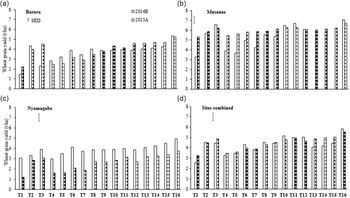
Wheat grain significantly (p < 0.001) affected by districts. Application of mineral fertilisers significantly increased wheat yields (p < 0.001) across all the study sites and seasons (Figure 2). Yield patterns for the seasons in three sites are different. In Burera, the two seasons are almost the same for all treatments across the two seasons. In Musanze, poor treatments performed very low in 2014 but then overtook the other season with increased fertilisation. And in Nyamagabe 2015 season performed more poorly than 2014 across poor and good treatments. In most cases, wheat yields increased with increase in nutrient rates. Single nutrients (N or P) applied alone produced low yields, as compared with combined N and P, and N, P and K applications as well as inclusion of multi-nutrients (the diagnostic treatment).
Grain yield response to nutrients use management across three districts in Rwanda. Error bars represent 95% confidence limits of means. Treatment codes are from T1 to T16 on X axis and correspond, respectively, T1 = Control, T2 = 120N, T3 = 120N + 15P, T4 = 15P, T5 = 30N, T6 = 30N + 15P, T7 = 60N, T8 = 60N + 15P, T9 = 90N, T10 = 90N + 15P, T11 = 90N + 22.5P, T12 = 90N + 7.5P, T13 = 90N + 15P + 10K, T14 = 90N + 15P + 20K, T15 = 90N + 15P + 30K, T16 = 90N + 15P + 20K + 10Mg + 2.5Zn + 0.1B (kg ha −1 ). Treatment 16 is the diagnostic treatment.

Across the two seasons, the highest wheat yield of 5.5 t ha−1 was obtained in the diagnostic treatment (Figure 2d), giving a yield increase of about 2.7 t ha−1 over the control.
When data for all sites and seasons were considered, grain yield and production risk showed opposite trends (Figure 2d); the highest yield with the lowest variability being in the diagnostic treatment. On the other hand, the lowest yield (2.9 t ha−1) with the highest variability (CV = 50.1%) was recorded in the control. The overall yield increase by the diagnostic treatment over the same rates of NPK alone was 10%; however, the reduction in production risk was 19.5%.
Rainfall water use efficiency
Across seasons and sites, significant treatment differences (p < 0.001) were recorded in RWUE (Figure 3). RWUE was higher in the 2014 SR than in the 2015 LR season across all sites (Figure 3a–c). The difference between the seasons was highest at the sites in Musanze district (Figure 3c).
Rain use efficiency (RUE) of wheat under nutrients use management across three districts in Rwanda. Error bars represent 95% confidence limits of means. Treatment codes are from T1 to T16 on X axis and correspond, respectively, T1 = Control, T2 = 120N, T3 = 120N + 15P, T4 = 15P, T5 = 30N, T6 = 30N + 15P, T7 = 60N, T8 = 60N + 15P, T9 = 90N, T10 = 90N + 15P, T11 = 90N + 22.5P, T12 = 90N + 7.5P, T13 = 90N + 15P + 10K, T14 = 90N + 15P + 20K, T15 = 90N + 15P + 30K, T16 = 90N + 15P + 20K + 10Mg + 2.5Zn + 0.1B (kg ha −1 ).

When data were combined across sites and seasons, increasing rates of N up to 90 kg N ha−1 significantly improved RWUE from 3.5 kg−1 mm−1 in the control to 5.4 kg ha−1 mm−1 (Figure 3d). Beyond this rate, no increase in rainfall use efficiency (RUE) was observed. A single application of N or P yielded lower RUE, as compared with treatments where two or three nutrients were combined. The highest RWUE (6.6 kg ha−1 mm−1) was recorded in the diagnostic treatment. As in grain yield, the mean RWUE and its CV showed opposite trends (Figure 3d).
Agronomic use efficiency of N
AEN was higher in the 2014 SR than in the 2015 LR season in Musanze and Burera in northern Rwanda than in Nyamagabe district in southern Rwanda, which offered the highest AEN in 2015A (Figure 4a–c). With sole N application, AEN was highest with application rate of 30 kg N ha−1 and decreased with increased rates of N. AEN tended to increase with increased P rates or increased K rates when N rate was held at 90 kg ha−1. Application of 30 kg N ha−1 + 7.5 kg P ha−1 recorded the highest AEN (41.7 kg of wheat yield increase per kg of applied N), followed by the diagnostic treatment (30.3 kg yield increase per kg of applied N) with the lowest CV (38.1%) (Figure 4d).
Agronomic use efficiency of N (AEN) of wheat (kg grain increase per kg of applied N) under nutrients use management across three districts in Rwanda. Error bars represent 95% confidence limits of means. Treatment codes are from T2 to T16 on X axis and correspond, respectively, to T2 = 120N, T3 = 120N + 15P,, T5 = 30N, T6 = 30N + 15P, T7 = 60N, T8 = 60N + 15P, T9 = 90N, T10 = 90N + 15P, T11 = 90N + 22.5P, T12 = 90N + 7.5P, T13 = 90N + 15P + 10K, T14 = 90N + 15P + 20K, T15 = 90N + 15P + 30K, T16 = 90N + 15P + 20K + 10Mg + 2.5Zn + 0.1B (kg ha −1 ).

Agronomic use efficiency of P
Single application of P recorded the lowest AEP, whereas the combination of P with other nutrients increased AEP significantly (Figure 5). In fact, the highest AEP of 273.6 kg kg−1 was obtained with the low P application of 7.5 kg ha−1 in combination with 90 kg N ha−1. However, this high AEP was associated with high variability (CV = 64.5%), as compared with the diagnostic treatment. Similar to AEN, the second highest value of AEP of 190 kg kg−1 was obtained with the diagnostic treatment.
Agronomic use efficiency of P (AEP) of wheat under nutrients use management across three districts in Rwanda. Error bars represent 95% confidence limits of means. Treatment codes are from T3 to T16 on X axis and correspond, respectively, to T3 = 120N + 15P, T4 = 15P, T6 = 30N + 15P, T8 = 60N + 15P, T10 = 90N + 15P, T11 = 90N + 22.5P, T12 = 90N + 7.5P, T13 = 90N + 15P + 10K, T14 = 90N + 15P + 20K, T15 = 90N + 15P + 30K, T16 = 90N + 15P + 20K + 10Mg + 2.5Zn + 0.1B (kg ha −1 ).

Profitability
Figure 6 presents the profitability of applied nutrients in terms of VCR. All treatments recorded VCR values >4, except the single P treatment of 15 kg P ha−1. The VCR tended to increase with decrease in rates of N. The highest VCR (9.9) obtained with the lowest N rate of 30 kg ha−1, however, also had very high risk (CV = 112%), as compared with the diagnostic treatments (VCR = 5.6; CV = 44.4%) (Figure 6).
Value cost ratios (VCRs) of wheat under nutrients use management across sites in Rwanda. Error bars represent 95% confidence limits of means. Treatment codes are from T2 to T16 on X axis and correspond, respectively, to T2 = 120N, T3 = 120N + 15P, T4 = 15P, T5 = 30N, T6 = 30N + 15P, T7 = 60N, T8 = 60N + 15P, T9 = 90N, T10 = 90N + 15P, T11 = 90N + 22.5P, T12 = 90N + 7.5P, T13 = 90N + 15P + 10K, T14 = 90N + 15P + 20K, T15 = 90N + 15P + 30K, T16 = 90N + 15P + 20K + 10Mg + 2.5Zn + 0.1B (kg ha −1 ).

Discussion
Wheat grain yield was lower in Nyamagabe compared to Burera and Musanze. This is explained by the type of soil in Nyamagabe, which are Ferralsols and classified as marginal soils (FAO, 2014). These soils are typically acidic and have reached an ultimate stage of weathering and leaching compared with Acrisols (Burera) and Andosols in Musanze. As expected, wheat grain yields in the unfertilised plots were low. On the other hand, application of mineral fertilisers resulted in increased yield response, RWUE and profitability on smallholder farms in Rwanda. The analysis also revealed grain yields plateau at 90 kg N ha−1 beyond which any addition of N did not improve wheat grain yield. Combination of 90 kg N ha−1 with different rates of P (7.5, 15 and 22.5) significantly increased wheat grain yield, implying that P is a critical nutrient in different soils of the study sites. The lack of wheat response to K application suggests that the soils of the study sites are mainly depleted in N and P but not in K nutrient, as reported in other studies (Rutunga et al., Reference Rutunga, Gachene, Karanja and Palm2003). Poor yields for some sites in 2015A may be due to heavy rains coupled with poor drainage, especially in Nyamagabe. Overall, the diagnostic treatment resulted in significant yield increases and lower production risks across the study sites. This indicates that secondary and micronutrients are essential for sustainable production of wheat in Rwanda. These findings are in agreement with the results of Chaudry et al. (Reference Chaudry, Timmer, Javed and Siddique2007), who found that application of B along with a basal dose of NPK significantly increased the wheat yield. Similarly, Leghari et al. (Reference Leghari, Laghari, Ansari, Mirjat, Laghari, Leghari, Laghari and Abbasi2016) reported significant increase in growth and yield components of wheat with various combinations of NPK and B in Pakistan. On the other hand, Keram et al. (Reference Keram, Sharma and Sawarkar2012) reported that combined NPK and Zn significantly increased wheat yield, total nutrient uptake and total carbohydrate in India. On the basis of this background, the importance of secondary nutrients and micronutrients needs to be considered in Burera, Musanze and Nyamagabe fertiliser recommendations, together with N-, P- and K-based fertilisers, which are the common inputs used in Rwanda. The diagnostic treatment recorded not only the highest wheat grain yields but also high RWUE, as compared with other treatments. The increase in RUE with successive increments of N rates up to 90 kg N ha−1 is probably because N enhances leaf growth, which in turn intercepts rainwater and reduces water loss by runoff. Also, P helps in root formation, which enhances water infiltration and thus capture by crops. The results are in accordance with Asseng et al. (Reference Asseng, Turner and Keating2001), who reported that N and P fertiliser inputs increased markedly early growth of cereals in water-limited environments with a noticeable effect on crop yield and RWUE.
The AEN values obtained from the diagnostic treatment in our study range from 10 to 30 kg grain increase kg−1 N reported by Dobermann (Reference Dobermann, Kraus, Isherwood and Heffer2007) under good management practices on smallholder farms. The increase in AEN at low rates of N (30 kg N ha−1) with the tendency to decrease with increased N rates suggests that beyond this rate, more supply of N is likely to be lost in the environment. Similar findings were obtained by Chuan et al. (Reference Chuan, He, Zhao, Zheng and Xu2016), who reported a decline in AEN due to higher N levels. According to Mandic et al. (Reference Mandic, Krnjaja, Tomic, Bijelic, Simic, Muslic and Gogic2015), the reduction in AEN in the highest N levels can be attributed to N loss in the ecosystem. Although the highest AEN was obtained at low N rates, its high CV reveals high risks at some sites or during some seasons. The AEN increased with increased of P or K suggests that without other nutrients, the response of N at high level is low. Although the diagnostic treatment recorded the second highest value of AEN across the study sites, its CV was the lowest, indicating lower risk of nutrient loss across sites or seasons. The increase in AEP when P is combined with other nutrients implies that the supply of other nutrients improves P use efficiency by wheat crop in Rwanda. Kihara and Njoroge, (Reference Kihara and Njoroge2013) observed that in western Kenya omission of P resulted in 50% reduction in yield. The highest AEP obtained from the treatment combining 90 kg N with 7.5 kg P suggests low availability of P in the soils in wheat-growing areas of Rwanda. As in AEN, the diagnostic treatment gave the highest AEP with the lowest CV. This confirms the appropriateness of this treatment for SI of wheat production in Rwanda.
Although no studies have been done on the effect of P fertilisers on wheat in Rwanda, various researchers indicated that the soils of the study sites are, respectively, acidic and volcanic and are known to fix P due to the presence of high content of oxides of iron and aluminium (Cyamweshi et al., Reference Cyamweshi, StevenTenywa, Ebanyat, Makooma, Mukuralinda and Nduwumuremyi2013) and can be ranged to less responsive soils according to Vanlauwe et al. (Reference Vanlauwe, Kihara, Chivenge, Pypers, Coe and Six2011). To improve P desorption capacity of such soils, the use of lime on acidic soils as well as tree biomass on both acidic and volcanic soils has been recommended in Rwanda. A VCR > 4 recorded by almost all fertiliser treatments across the study sites reveals the profitability of fertiliser use in wheat production in Rwanda. The diagnostic treatment had a VCR = 5.7 and presented good performance in terms of grain yield and fertiliser use efficiency. In this regard, the diagnostic treatment appears to be the best among the treatments with low production risk and high profitability.
Conclusions and Recommendations
The key conclusion from this study is that a balanced application of NPK fertilisers and micronutrients reduces production risks and increases productivity, NUE and profitability of wheat on smallholder farms. Although other treatments gave comparable wheat yield, some were associated with high production risks, highlighting the need to consider production risks when recommending fertilisers. Therefore, we recommend the diagnostic treatment for sustainable production of wheat in Burera, Musanze and Nyamagabe. Further research should be conducted to establish the extent to which the secondary and micronutrients – including sulphur, Mg, B, Zn and Cu – play a role in improving grain yields and nutritional quality of wheat in Burera, Musanze and Nyamagabe districts of Rwanda.
Acknowledgements
This research was supported by the Bill and Melinda Gates Foundation through the Centre for Agriculture and Bioscience International (CABI) and the Alliance for a Green Revolution in Africa (AGRA) as part of the OFRA project. We also thank the Rwanda Agriculture and Animal Resources Development Board (RAB) for facilitating the implementation of research activities.
Funding Support
This work was supported, in whole or in part, by the Bill & Melinda Gates Foundation [INV-005460]. Under the grant conditions of the Foundation, a Creative Commons Attribution 4.0 Generic License has already been assigned to the Author Accepted Manuscript version that might arise from this submission.




 Open access

