


The mental health of children looked after by the state (e.g. in residential or foster family care) is a priority for both policymakers and practitioners. Reference Ford, Vostanis, Meltzer and Goodman1 Since 2009, the British government has therefore required all local authorities to administer the Strengths and Difficulties Questionnaire (SDQ) Reference Goodman2 annually to the primary carers of all children aged 4–16 who have been looked after for at least 1 year. 3 Local authorities are then required to report the mean score to the Department for Education, with the intention that trends can be monitored over time and/or comparisons made between comparable local authorities.
The parent SDQ is a good screening device for mental disorders in looked after children Reference Marquis and Flynn4,Reference Goodman, Ford, Corbin and Meltzer5 with ‘high’ SDQ scores predicting much greater rates of disorder than ‘low’ scores. If comparisons across local authorities or over time are to be valid, however, more than this is required: it needs to be demonstrated that any difference in mean SDQ scores corresponds (on average) to genuine differences in mental health. This appears to be true in the general British population. In individual-level analyses, each one-point increase in mean symptom SDQ score predicts a higher prevalence of disorder. Reference Goodman and Goodman6 Likewise in population-level analyses, mean SDQ scores predict the prevalence of disorder in an accurate and unbiased manner across subpopulations defined by multiple child, family and area characteristics (such as ethnicity, family type, area deprivation). Reference Goodman and Goodman7 This allowed us to derive and validate UK ‘SDQ prevalence estimators’.
Yet, although encouraging, these general population findings cannot be assumed to apply to looked after children. First, nationally representative British surveys of looked after children report a disorder prevalence of 45%, Reference Ford, Vostanis, Meltzer and Goodman1 which is much higher than the prevalence in the general population (9.4% overall prevalence) or in any of the subpopulations we studied (median 9.8%, interquartile range 7.3–14.5%). Second, the prevalence estimators were derived using data mostly provided by biological parents. By contrast, informants for looked after children are usually foster parents or care workers who may respond differently. This report therefore uses a nationally representative sample to examine whether, among looked after children (a) the parent SDQ is a genuinely dimensional measure of child mental health, and (b) the parent SDQ prevalence estimator equation is accurate.
Method
Sample
We combined data from three nationally representative surveys (one each in England, Scotland and Wales) of looked after children aged 5–17. Reference Ford, Vostanis, Meltzer and Goodman1 In 2002–2003, random samples of looked after children were selected from the relevant databases in each country, and primary carers, teachers and youth over 11 were asked to complete the SDQ and the Development and Well-Being Assessment (DAWBA). Reference Goodman, Ford, Richards, Gatward and Meltzer8 In total, 1391 looked after children (595 females) aged 5–16 provided DAWBA and parent SDQ data (57% participation rate; we excluded 127 children aged over 16 to match the age range monitored by local authorities). We divided these children by placement type: living with natural parents (n = 190); living with kin (n = 165); living with unrelated foster parents (n = 781); or living in residential care, i.e. non-family placements (n = 255).
For comparison, we present data from the 1999 and 2004 British Child and Adolescent Mental Health surveys, two nationally representative surveys of children aged 5–16 in private households. Reference Goodman and Goodman7 In total, 18 205 children (8967 females) provided DAWBA and parent SDQ data (69% participation rate). These were divided into fifths according to small-area deprivation. 9
Measures
The Strengths and Difficulties Questionnaire (SDQ) is a measure of mental health problems in children aged 4–17 that can be administered to parents/carers, teachers and children aged 11 or over. Reference Goodman2 Its 20 items relating to emotional symptoms, conduct problems, hyperactivity and peer problems are summed to create a ‘total difficulty’ symptom score ranging from 0 to 40. We have previously developed and validated UK ‘SDQ prevalence estimators’ that convert a subpopulation's mean symptom score into an estimated prevalence of disorder, adjusting for the subpopulation's age and gender composition Reference Goodman and Goodman7 (see the online supplement for the prevalence estimator equations, and a link to online look-up tables).
The DAWBA is a detailed psychiatric interview for parents/carers and youth, and a briefer questionnaire for teachers. It includes a fully structured section followed by open-ended descriptions by respondents of problem areas. Experienced clinicians then assign diagnoses according to DSM-IV, 10 using both the closed and open DAWBA responses, and triangulating information across informants.
Analysis
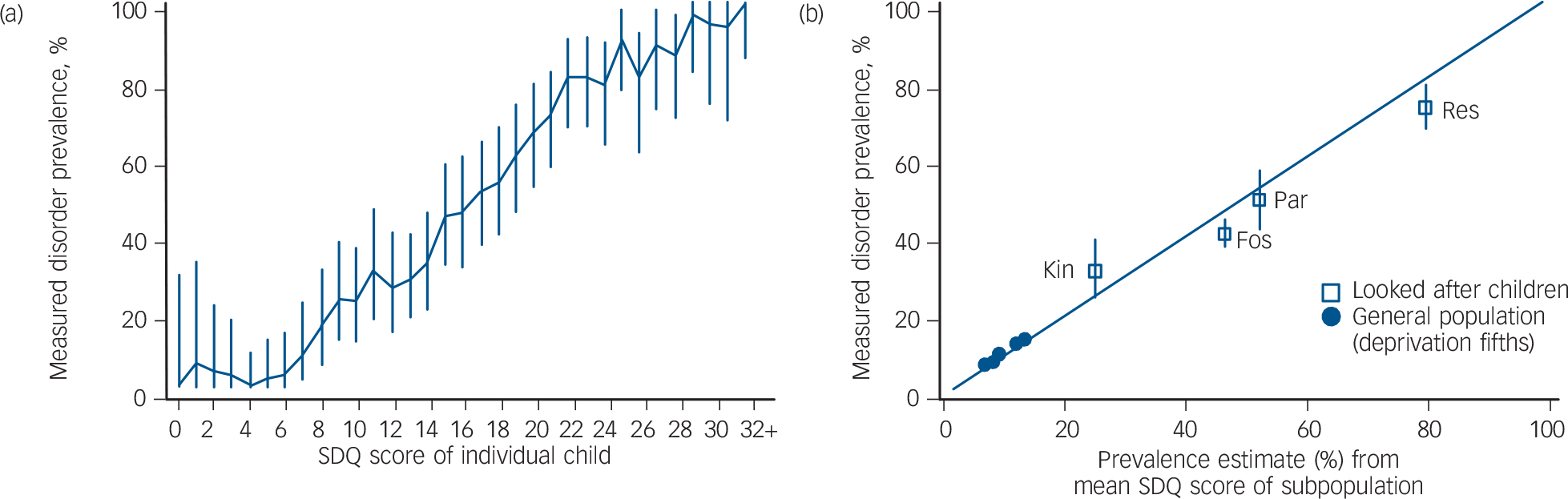
Our individual-level analysis involved taking looked after children with any given SDQ score and plotting this against the measured prevalence of disorder for that SDQ score (disorder defined as receiving at least one DSM-IV DAWBA diagnosis). Our population-level analysis involved calculating the mean parent SDQ score for four subpopulations of looked after children (defined by placement type) and using the SDQ prevalence estimators to estimate disorder prevalence. We then plotted these estimated prevalences against the measured prevalence of disorder in that subpopulation, presenting general population data for comparison. All analyses used Stata12 for Windows 2007.
Using mean parent Strengths and Difficulties Questionnaire (SDQ) scores to predict the percentage prevalence (95% CI) of child mental health disorder among looked after children: performance at the (a) individual and (b) population level.
Par, living with natural parents; Kin, living with kin; Fos, living with foster parents; Res, residential care. See online Table DS1 for tabulated population-level data. In individual-level analysis, SDQ points were grouped once the number of individuals fell to below 10.
Results
Each one-point increase in SDQ score among looked after children generally corresponded to an increased prevalence of clinical disorder (Fig. 1(a)). The only possible exception was for very low scores (0–4); given that such low scores were rare in this sample this could reflect regression to the mean or simply the small sample sizes at this low end. The parent SDQ prevalence estimator also performed well in our population-level analysis (Fig. 1(b)). Subpopulations of looked after children with higher mean SDQ scores also had a higher prevalence of disorder, and the SDQ prevalence estimators provided good approximate estimates of these (discrepancies 3–7% across our four subpopulations, in the context of measured prevalences of 31–73%).
Discussion
Our findings demonstrate that the parent SDQ provides a genuinely dimensional measure of mental health in looked after children, despite their having a much higher prevalence of disorder than the general population. Thus, any difference between groups of looked after children in their mean SDQ score will, on average, reflect real differences in their mental health. This supports the use of mean SDQ scores to compare local authorities and monitor trends over time. Moreover, mean parent SDQ scores also generated good estimates of disorder prevalence using the SDQ prevalence estimators. Reference Goodman and Goodman7 This may be useful when seeking to translate findings for local policy-makers and practitioners, as one can turn non-intuitive mean scores into intuitive caseness rates.
Our findings therefore support the British government's current use of mean parent SDQ symptom scores to monitor the mental health of looked after children. Given that the parent SDQ is also a valid screening measure for psychiatric disorder in looked after children Reference Marquis and Flynn4,Reference Goodman, Ford, Corbin and Meltzer5 the parent SDQs collected could additionally be used to identify high-risk individuals who warrant more detailed assessment. We therefore hope the recent requirement placed on local authorities to administer the parent SDQ to looked after children will permit monitoring and screening programmes that can inform both public health and clinical interventions. Beyond Britain, the SDQ has been validated for screening looked after children in Canada, Reference Marquis and Flynn4 and other countries may also wish to examine its utility.




eLetters
No eLetters have been published for this article.