

Early diagnosis of mobility problems in dairy cows is crucial for keeping the animals healthy and productive, thereby supporting a sustainable production system. When a cow becomes lame, it can lead to weight loss and poor body condition (Huxley, Reference Huxley2013), pain, and discomfort (Shearer et al., Reference Shearer, Stock, Van Amstel and Coetzee2013). If treatment is delayed, it can result in lower milk production, poor fertility, higher culling rates, greater greenhouse gas emissions intensity per unit of milk produced, and increased veterinary costs for farmers (Green et al., Reference Green, Hedges, Schukken, Blowey and Packington2002; Amory et al. Reference Amory, Barker, Wright, Mason, Blowey and Green2008; Mostert et al., Reference Mostert, Van Middelaar, De Boer and Bokkers2018; Omontese et al., Reference Omontese, Bellet-Elias, Molinero, Catandi, Casagrande, Rodriguez, Bisinotto and Cramer2020). Early detection of lameness in dairy animals allows for prompt action, preventing the development of more complex issues.
With technological advancement, interest in automating lameness detection is growing. Radar, computer vision, and other sensor technologies-based systems are expected to provide more precise and consistent evaluations compared to traditional approaches (Schlageter-Tello et al., Reference Schlageter-Tello, Bokkers, Koerkamp, Van Hertem, Viazzi, Romanini, Halachmi, Bahr, Berckmans and Lokhorst2014; Busin et al., Reference Busin, Viora, King, Tomlinson, LeKernec, Jonsson and Fioranelli2019; Nektarios et al., Reference Nektarios, Joseph, Robert and Georgios2024). Computer-based systems provide the capability for continuous, real-time observation of animals with very little human interaction, cutting costs and subjectivity that come with manual visual observations. Nevertheless, these systems still face challenges related to data reliability, particularly because they often rely on manually labelled data as the ground truth for training the associated machine learning models (Busin et al., Reference Busin, Viora, King, Tomlinson, LeKernec, Jonsson and Fioranelli2019).
Currently, lameness detection relies on visual mobility scoring systems, like the AHDB 4-level mobility system (Agriculture and Horticulture Development Board, 2025). In this system, trained assessors visually appraise animals and assign a lameness score. Although such methods are widely used, they are also subjective and inconsistent (Engel et al., Reference Engel, Bruin, Andre and Buist2003; Nielsen et al., Reference Nielsen, Angelucci, Scalvenzi, Forkman, Fusi, Tuyttens, Houe, Blokhuis, Tind Sørensen, Rothmann, Matthews, Mounier, Bertocchi, Marie-Madeleine, Donati, Per Peetz, Salini, de Graaf, Hild, Messori, Nielsen, Lorenzi, Boivin and Thomsen2014; Schlageter-Tello et al., Reference Schlageter-Tello, Bokkers, Koerkamp, Van Hertem, Viazzi, Romanini, Halachmi, Bahr, Berckmans and Lokhorst2014). The variation between different assessors (inter-assessor), and between the same assessor at different times (intra-assessor), can add significant noise to the data (Kahneman et al., Reference Kahneman, Rosenfield, Gandhi and Blaser2016), undermining the reliability of visual scoring as a basis for training algorithms.
The subjective and unreliable nature of visual scoring has prompted us to investigate how best to use human-labelled data to train machine learning models. Particularly, we wished to assess the homogeneity of such labels and whether variables such as the experience of the assessor, the method used for scoring (live or video), and data quality in general influenced automated system performance. This study aims to evaluate these factors, and their impact on the quality of labels that are employed to train ML models for early signs of lameness detection.
Materials and methods
This study complied with the University of Glasgow's ethical guidelines and received approval from the local ethics committee (licence EA06 19), although it did not involve any procedures regulated under the Animals (Scientific Procedures) Act 1986 (UK Public General Acts, 1986).
Due to COVID-19 restrictions, we utilised live and video methods for mobility scoring and could not maintain the same group of assessors. Consequently, we adapted our experimental design to collect data while managing limited farm access (Table 1).
Study design for two farms (A and B), including the number of visits, cows assessed, scoring methods (on-site and video), number of assessors, scoring systems and modes used, and types of metadata collected during video-based assessments

Table 1 Long description
The table compares study procedures for Farm A and Farm B, including visits, cows scored, scoring methods, assessor counts, scoring approach, and video metadata. Farm A had two visits, scoring 49 cows in visit one and 52 cows in visit two. Farm A used on-site scoring in both visits and video scoring only in visit one. Farm B had one visit scoring 69 cows, with no on-site scoring and video scoring used. Assessor numbers differed by method: Farm A had 6 on-site assessors and 7 video assessors in visit one, and 5 assessors in visit two; Farm B had 8 assessors. Both farms used the AHDB scoring system with post hoc modifications and used individual scoring mode. Video-related metadata included assessor experience for both farms, plus assessor confidence and number of video views where video scoring occurred; Farm A collected confidence and video views for video scoring, and Farm B collected experience, confidence, and video views. Comparisons should be interpreted with caution because Farm A includes two visits with mixed scoring methods, while Farm B reflects a single video-only visit.
Farm A – live and video-based scoring
In this study, five and seven assessors scored 49 cows on-site during Visit 1 and 52 cows during Visit 2 using the AHDB mobility scoring system. The scores were later re-analysed using a modified version of the system in post hoc analysis. Farm A is a commercial dairy farm in Scotland, with Holstein–Friesian cows housed in a free-stall barn and walked regularly on concrete floors and rubber-matted alleyways at the milking parlour and its exit.
Cows were walked along their everyday routine alley, and assessors evaluated each animal's gait from a lateral vantage point, standing approximately 5 m away from the walking cows. All assessors were positioned in the same area, with an unobstructed lateral view of the animals as they walked on the same surface and under identical environmental conditions. The AHDB scoring system included four ordinal categories (0: sound, 1: imperfect mobility, 2: impaired mobility, 3: severely impaired mobility), and all assessors received brief refresher instructions before the session, and they scored six to eight videos together.
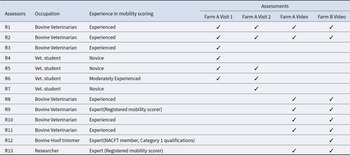
Assessor experience levels varied (Table 2): from experts, who were accredited registered mobility scorers (RoMS) assessing mobility routinely as part of their professional work, to experienced assessors, who were veterinarians with over 10 years of experience and who regularly included mobility scoring as part of farm visits (not RoMS-accredited). Moderately experienced assessors had experience in mobility assessments through research or farm work but did not perform them routinely. Novice assessors who participated in the study had limited or no previous experience with mobility assessment. Video recordings were taken during Visit 1 only to allow further video-based scoring in follow-up studies.
Thirteen assessors with differences in experience and occupation scored the animals in the studies. Only two assessors (R1 and R2) participated in all four evaluations, and another five assessed the videos from both Farm A and Farm B

Table 2 Long description
The table lists 13 assessors, their occupation, their mobility-scoring experience level, and which of four assessments they completed (Farm A Visit 1, Farm A Visit 2, Farm A Video, Farm B Video). Two experienced bovine veterinarians, R1 and R2, are the only assessors who participated in all four assessments. Farm A Visit 1 was scored by six people (R1 to R6), while Farm A Visit 2 was scored by five (R1, R2, R5, R6, R7). The Farm A Video and Farm B Video were each scored by six people; five of these video scorers overlap across both farms (R1, R2, R8, R9, R10, R11, R13), with Farm B Video having one additional scorer (R12) and Farm A Video having one additional scorer (R11). On-farm visits were scored mainly by veterinary students plus two veterinarians, whereas video scoring was dominated by veterinarians and included expert scorers such as registered mobility scorers and a qualified hoof trimmer. Because assessor participation differs by assessment type and farm, comparisons across assessments may reflect differences in who scored as well as differences in the animals or setting.
Video recordings were shared with six assessors (Table 2) for independent scoring using the AHDB mobility scoring system. Each assessor reviewed the videos independently, with no limit imposed on the number of times a video could be watched. Along with the scores, metadata were collected, including self-reported confidence in each score (Yes/No), comments regarding any potential obstructions to scoring (such as unclear video footage), and how many times each video was viewed before making a decision. This study enabled the exploration of scoring consistency in a remote, asynchronous setting.
Farm B – remote video-based scoring with metadata collection
A separate set of Holstein–Friesian cows (n = 69) was scored using video recordings obtained from Farm B, a commercial dairy farm in central Scotland. Videos were recorded from the lateral view as cows walked through a designated passageway. No live on-site scoring was conducted. Eight assessors independently scored the videos using the same AHDB mobility scoring system as in Farm A. The same metadata (confidence, obstructions, number of views) as in Farm A were also collected.
Data processing
Lameness scores from all studies were dichotomised post hoc into two categories: not-lame (sound) (0) and lame (1). Cows classified as “sound” had scores of 0 or 1, while cows classified as “lame” had scores of 2 or 3, following the AHDB scoring system. Each individual score was treated as an independent data point.
Inter-assessor agreement for all datasets (AHDB & dichotimised AHDB) was assessed using weighted kappa (κw) to evaluate consistency across assessors. Intra-assessor agreement was also calculated for repeated scoring to compare the scores collected on-site with those recorded on video. Assessors' self-reported confidence levels were examined alongside the number of video views they took before finalising their scores. Descriptive statistics were used to summarise confidence and number of views, and correlations between these variables and scoring consistency were explored.
To investigate factors potentially influencing agreement, descriptive statistics were used to summarise assessors' confidence levels and viewing behaviours. We examined whether assessor experience level (Novice, Moderate, Experienced, Expert) was associated with differences in inter-assessor agreement. Agreement scores (weighted kappa values) were compared between experience groups for each dataset (Farm A Visit 1, Visit 2, Farm A Video, and Farm B Video) using Kruskal–Wallis rank-sum tests. Where we found differences, we carried out post hoc pairwise comparisons and adjusted the results using Bonferroni correction to account for multiple tests.
We used a generalized linear mixed-effects model (GLMM) to see if average confidence and viewing frequency could predict how often assessors agreed. The outcome was whether assessors agreed (1 = agreement, 0 = disagreement) while scoring the same video. We included the average certainty score (binary, 0 = uncertain, 1 = certain) and the average number of views per video (continuous) as fixed effects. To account for differences in individual scoring behaviour, we added assessor identity as a random intercept. We applied a binomial distribution with a logit link function for the model.
To further explore how qualitative comments related to scoring behaviour, we fitted a proportional odds logistic regression model with the AHDB mobility score as the ordinal outcome. Thematic categories derived from assessor comments (Speed Issues, Posture and Gait Observations, Visibility/Video Issues, Uncertainty in Diagnosis, External Physical Condition, and Other Technical or Personal Notes) were included as fixed predictors to examine whether specific types of comments were associated with higher or lower mobility scores.
All analyses were conducted in R (version 4.3.2), using the packages ‘irr', ‘stats' and ‘lme4' (Bates et al., Reference Bates, Mächler, Bolker and Walker2015; Gamer et al., Reference Gamer, Lemon, Fellows and Singh2019; R Core Team, 2024).
Results
Inter-assessor variation in live scoring
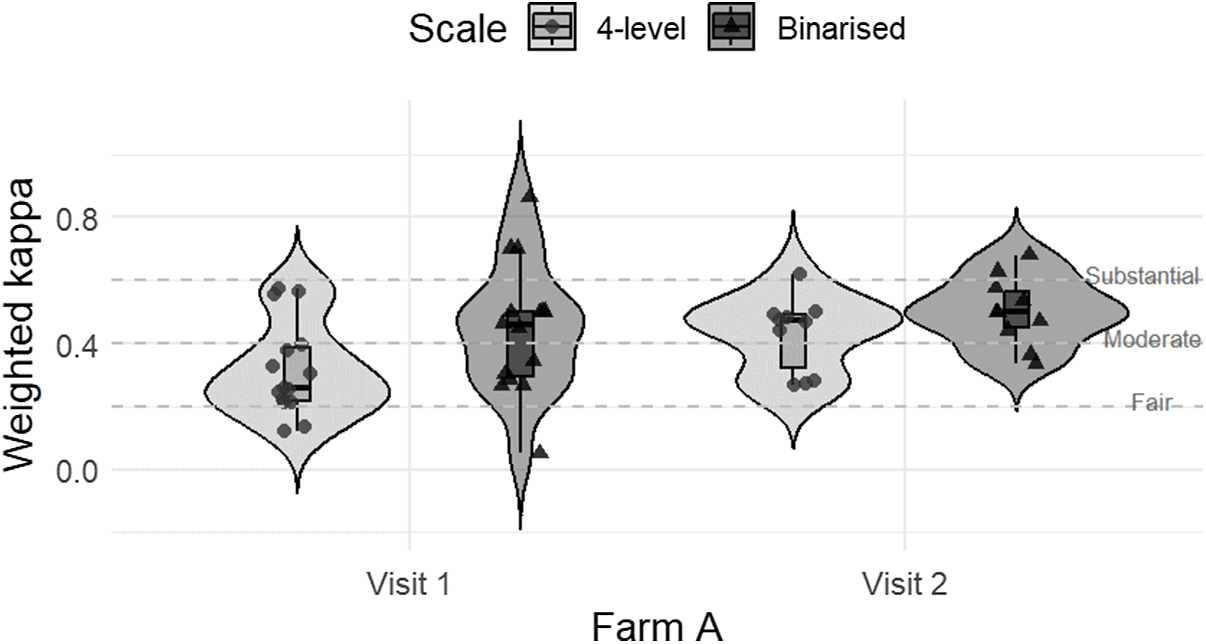
Inter-assessor agreement was examined for live (on-site) scoring sessions at Farm A during Visit 1 (49 cows) and Visit 2 (52 cows), using both the original 4-point AHDB mobility scale and a post-hoc dichotomised version (sound: 0–1, lame: 2–3). During Visit 1, six assessors (R1–R6) scored each cow individually. Pairwise weighted kappa values ranged from 0.12 to 0.58 (mean = 0.32, SD = 0.15; bootstrap 95% CI: 0.03–0.79), indicating slight to moderate agreement (Fig. 1). Most discrepancies occurred between scores 0 and 1, suggesting inconsistent interpretation of mild mobility changes. Agreement improved markedly when scores were dichotomised (weighted kappa range 0.052–0.86, mean = 0.45, SD = 0.21, 95% CI: –0.14 to 1.00), reflecting a simplification that removed much of the ambiguity surrounding mild mobility problems. Apparent prevalence (the proportion of cows scored as lame by each assessor – scores 2 and 3) in Visit 1 ranged from 6.1% to 22.4% among assessors (mean = 16.0% ± 5.5%, 95% CI: 10.2–21.8%).
Distribution of inter-assessor agreement (weighted kappa values) during live mobility scoring sessions on the two Farm A visits using the original four-level AHDB scale and a dichotomised version (sound: 0–1, lame: 2–3). Each violin plot shows the distribution of pairwise kappa values between assessors for Visit 1 (n = 15 pairs) and Visit 2 (n = 10 pairs). Boxplots within violins indicate the median and interquartile range, while individual data points are overlaid. Dashed lines represent kappa interpretation thresholds according to Landis & Koch (Fair: 0.21, Moderate: 0.41, Substantial: 0.61).

Figure 1 Long description
Scale 4-level Binarised A violin plot chart with two grouped categories labeled Visit 1 and Visit 2 along the horizontal axis. The horizontal axis title is Farm A. The vertical axis is labeled Weighted kappa, with tick labels at 0.0, 0.4 and 0.8. A legend at the top shows two entries: 4-level and Binarised. For Visit 1, two violins are shown side by side. The left violin corresponds to 4-level and contains multiple overlaid circular points and an internal boxplot. The right violin corresponds to Binarised and contains multiple overlaid circular points and an internal boxplot. For Visit 2, two violins are shown side by side. The left violin corresponds to 4-level and contains multiple overlaid circular points and an internal boxplot. The right violin corresponds to Binarised and contains multiple overlaid circular points and an internal boxplot. Three dashed horizontal reference lines cross the plot. Text labels near the right side align with these dashed lines and read Substantial, Moderate and Fair.
During visit 2 five assessors mobility scored cows independently under the same conditions. Pairwise weighted kappa values ranged from 0.27 to 0.62 (mean = 0.43, SD = 0.18; 95% CI: 0.09–0.87), reflecting fair to substantial agreement (Fig. 1). As in Visit 1, disagreements were most pronounced between scores 0 and 1, reinforcing the difficulty in consistently identifying subtle or early-stage lameness. Dichotomising the scores led to a slight increase in agreement (weighted kappa ranged from 0.34 to 0.68, mean = 0.50, SD = 0.11; 95% CI: 0.05–0.85), with a higher proportion of exact matches on all assessor pairs. Apparent prevalence of lameness in Visit 2 ranged from 17.0% to 30.2% among assessors (mean = 26.4% ± 5.3%, 95% CI: 19.8–33.0%).
Intra-assessor consistency between video and live scoring in farm a
The weighted Cohen's kappa for the first assessor was 0.332 (95% CI: 0.046–0.573), indicating fair agreement between video and live scoring. The percentage of exact matches was 49%. Similarly, the second assessor's video and live scores showed a weighted Cohen's kappa of 0.334 (95% CI: 0.010–0.574), also reflecting fair agreement, with a percentage agreement of 46.94%. These results suggest moderate intra-assessor consistency in different scoring modalities with just under half of the scores being different.
When scores were dichotomised (sound: 0–1, lame: 2–3), agreement between video and live assessments improved. For the first assessor, the weighted kappa increased to 0.557 (95% CI: 0.153–0.874), with exact matches in 89.8% of cases. For the second assessor, dichotomisation resulted in a weighted kappa of 0.264 (95% CI: 0.009–0.511) and a percentage agreement of 69.39%.
Inter-assessor variation in video scoring
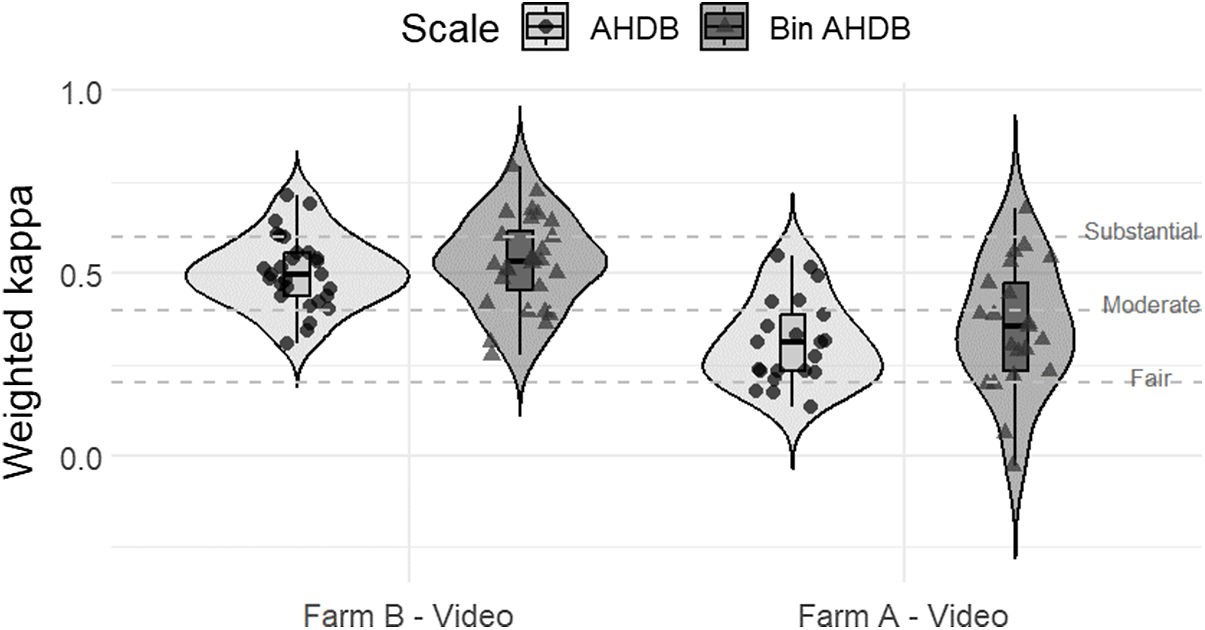
Inter-assessor agreement for Farm A's video scoring was based on scores from seven independent assessors on 49 cows, using the AHDB mobility scoring system. Pairwise weighted kappa values ranged from 0.13 to 0.55 (mean = 0.31, SD = 0.12, 95% CI: 0.06–0.83), indicating slight to moderate agreement (Fig. 2). After the dichotomisation of scores, weighted kappa ranged from −0.027 to 0.68 (mean = 0.35, SD = 0.18, 95% CI: – 0.03–0.68), indicating a wider range of agreement from poor to substantial. Disagreements were found in all levels of the scores except score 3 as the dataset was not balanced and therefore there was not an equal number of cows with severely impaired mobility.
Distribution of weighted kappa agreement scores for assessor pairwise comparisons in Farm A and Farm B video scoring. Violin plots illustrate the density of agreement values, with overlaid boxplots showing median and interquartile ranges, and jittered points representing individual pairwise scores. Colours differentiate the scoring scales (AHDB and dichotomised). Horizontal dashed lines indicate agreement strength thresholds according to Landis & Koch interpretation (Fair = 0.21, Moderate = 0.41, Substantial = 0.61).

Figure 2 Long description
Scale AHDB Bin AHDB A grouped violin plot with overlaid boxplots and jittered points. The y-axis is labeled Weighted Kappa, ranging from 0.0 to 1.0. The x-axis has two category labels: Farm B - Video and Farm A - Video. Each farm category contains two violins corresponding to the legend entries AHDB and Bin AHDB. Three horizontal dashed reference lines run across the plot and are labeled at the right: Substantial, Moderate and Fair. Farm B - Video: The AHDB violin spans roughly from about 0.2 up to about 0.7, with most points clustered around the mid range near the Moderate line. The Bin AHDB violin spans roughly from about 0.1 up to about 0.8, with points spread across the mid range and several points above the Substantial line. Farm A - Video: The AHDB violin spans roughly from about 0.1 up to about 0.6, with most points below the Substantial line and many around the Fair to Moderate region. The Bin AHDB violin spans roughly from about 0.0 up to about 0.8, with points distributed from near the bottom of the axis up through the mid range and some points above the Substantial line.
On Farm B eight assessors scored 69 cows via video using the AHDB mobility scoring system. Pairwise-weighted kappa values ranged from 0.31 to 0.71(mean = 0.50, SD = 0.1, 95% CIs ranged from 0.27 to 0.90), indicating fair to substantial agreement. After dichotomisation the agreement remained between fair and substantial, and the weighted kappa values ranged from 0.28 to 0.79 (mean = 0.53, SD = 0.12, 95% CIs: 0.05–0.87).
Assessor experience vs. agreement levels
We examined whether assessor experience was associated with differences in agreement levels in all datasets. For both Farm A onsite visits, no differences in the distribution of scores were found between the different experience groups (Visit 1: Kruskal–Wallis χ2 = 6.55, P = 0.162; Visit 2: Kruskal–Wallis χ2 = 2.74, P = 0.602). In the Farm A video assessment, the distribution of scores differed slightly (Kruskal–Wallis χ2 = 7.04, P = 0.030), although the magnitude of this difference was similar to that observed in Visit 1. We did not apply a multiple comparison correction due to the small number of pre-planned tests; no differences were statistically significant in the Farm B video assessments (Kruskal–Wallis χ2 = 2.49, P = 0.288), though expert assessors tended to show higher agreement.
Confidence level and number of views vs. score agreements
A generalized linear mixed-effects model was fitted to assess factors influencing pairwise agreement between assessors using the original AHDB scores. The model included average assessor certainty (mean of the two assessors' binary certainty scores for the same cow/video pair) and average number of views per video as fixed effects, with assessor included as a random effect to account for individual-level variation. Results for Farm A indicated a significant negative association between the average number of views and agreement probability (odds ratio = 0.61, 95% CI: 0.42–0.87, P = 0.005), indicating that each additional view was associated with a 39% reduction in the odds of agreement. Average certainty was negatively associated with agreement, although this effect did not reach statistical significance (odds ratio = 0.61, 95% CI: 0.35–1.05, P = 0.08). The model included random intercepts for assessors to account for individual differences. These results suggest that higher certainty may be associated with lower agreement, but the evidence is inconclusive.
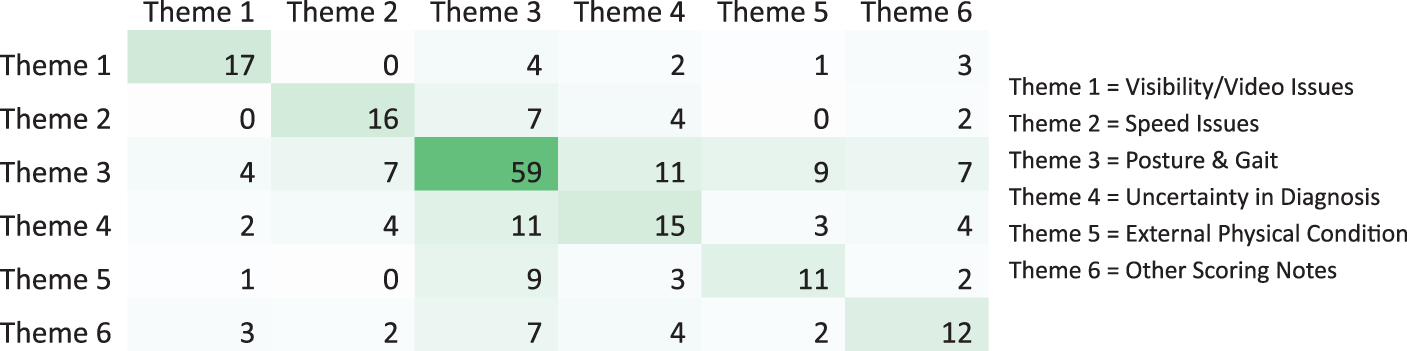
Associations between assessor comments and mobility scores
To investigate whether comments on the video scoring were associated with mobility scores, we fitted a proportional odds logistic regression model using thematic comment categories as predictors (Fig. 3). The outcome variable was the ordinal AHDB mobility score. The proportional odds assumption was assessed using the Brant test, which did not indicate any violation. However, several combinations of comment categories and mobility scores were not observed in the dataset, which may reduce the reliability of the test. From all the comment themes, only comments related to Speed Issues showed a statistically significant association with the mobility scores (OR = 0.15, 95% CI: 0.04–0.59, P = 0.007), which indicates that when assessors commented on speed (e.g., ‘cow moving too fast/running’), they were more likely to assign lower lameness scores. No other comment category was significantly associated with the scores: Posture and Gait Observations (OR = 1.27, 95% CI: 0.45–3.61, P = 0.70), Visibility/Video Issues (OR = 0.47, 95% CI: 0.13–1.70, P = 0.28), Uncertainty in Diagnosis (OR = 0.76, 95% CI: 0.30–1.92, P = 0.65), External Physical Condition (OR = 0.50, 95% CI: 0.15–1.66, P = 0.28), and Other Technical or Personal Notes (OR = 0.52, 95% CI: 0.16–1.68, P = 0.30). The confidence intervals of all themes are wide and include values corresponding to both increases and decreases in odds of higher mobility scores, which means that the data provide limited guidance on the likely effect of these comment types.
Heat-map of pairwise co-occurrence of assessor comment themes (N = 77 comments). Each cell shows the number of comments in which the two themes were mentioned together; darker colours indicate more frequent co-occurrence. Diagonal cells (theme with itself) give the total frequency of that theme in the dataset.

Figure 3 Long description
Heat-map of pairwise co-occurrence of assessor comment themes ( = 77 comments). A square heatmap table with column labels: Theme 1, Theme 2, Theme 3, Theme 4, Theme 5, Theme 6. Row labels: Theme 1, Theme 2, Theme 3, Theme 4, Theme 5, Theme 6. Each cell contains a number. Row Theme 1 values across Theme 1 to Theme 6: 17, 0, 4, 2, 1, 3. Row Theme 2 values across Theme 1 to Theme 6: 0, 16, 7, 4, 0, 2. Row Theme 3 values across Theme 1 to Theme 6: 4, 7, 59, 11, 9, 7. Row Theme 4 values across Theme 1 to Theme 6: 2, 4, 11, 15, 3, 4. Row Theme 5 values across Theme 1 to Theme 6: 1, 0, 9, 3, 11, 2. Row Theme 6 values across Theme 1 to Theme 6: 3, 2, 7, 4, 2, 12. Key text at right: Theme 1 equals Visibility slash Video Issues. Theme 2 equals Speed Issues. Theme 3 equals Posture and Gait. Theme 4 equals Uncertainty in Diagnosis. Theme 5 equals External Physical Condition. Theme 6 equals Other Scoring Notes.
Discussion
This study highlights the substantial subjectivity and variability inherent in human visual mobility scoring in dairy cattle. The relatively moderate inter-assessor agreement in this situation, where various individuals employed the same system of scores, illustrates the noise introduced by the human factors such as individual interpretation, experience, and surrounding environment. Although the most commonly used system in the UK (AHDB and post hoc modifications) was used, the assessors varied in their consistency of classifying cows' mobility, as reflected by the moderate weighted kappa values. This inconsistency is undesirable for research that relies on human-generated labels as ground truth for training ML algorithms. While subjectivity is a basic issue in human scoring, it also underscores the need for improvement of training methods and standardised systems to reduce variance and improve the robustness of manual assessment. The inconsistency in mobility scoring also points to the importance of identifying more objective approaches to assess animal welfare.
We found no significant differences in scores from video assessments compared to live evaluations. While this suggests that video scoring can be as reliable as live scoring, provided that the videos are recorded under conditions comparable to live observation such as similar perspective, visibility, and environmental context, the data do not rule out the possibility of meaningful differences. Effect sizes (i.e., odds ratios or log odds) would provide a more meaningful measure than P-values alone, but the sample size and score distribution in this study limited the precision of such estimates. Previous studies showed that assessors are the primary factor influencing mobility scoring outcomes, and that video-based scoring, despite potential limitations in video quality or viewpoint, is an acceptable method (Schlageter-Tello et al., Reference Schlageter-Tello, Bokkers, Groot Koerkamp, Van Hertem, Viazzi, Romanini, Halachmi, Bahr, Berckmans and Lokhorst2015). In this study, scores and agreement metrics were broadly similar between live and video assessments, which could be an indication that the scoring system and the human components (i.e., assessor experience and training) play potentially a more important role in the agreement than the method of assessment itself (live vs. video). However, the wide range of plausible effects indicated by confidence intervals for video-related predictors emphasises that conclusions about equivalence should be made cautiously. With proper video calibration and assessor training, video-based scoring can be a feasible alternative to live scoring in future studies, but further research using larger datasets and analyses capable of assessing both statistical and biological equivalence is required before firm conclusions can be drawn.
Although the assessors in our study had mostly strong confidence in their mobility scores, their overall agreement was low. This discrepancy shows the main problem with visual mobility scoring; confidence does not necessarily translate to accuracy or consistency. Even experienced assessors had differences between their scores, further testifying to the complexity of mobility scoring in dairy cattle. While training and calibration are commonly recommended to improve reliability (March et al., Reference March, Brinkmann and Winkler2007), our data indicate that such measures alone may not fully overcome variability, especially when applied in larger groups of assessors. Previous studies have demonstrated that experience plays no significant role in the outcome (Bokkers et al., Reference Bokkers, de Vries, Antonissen and de Boer2012; Garcia et al., Reference Garcia, König, Allesen-Holm, Klaas, Amigo, Bro and Enevoldsen2015). These results suggest that confidence in assessors' scoring decisions might be more a function of their task experience than the quality or consistency of their ratings, and therefore, the self-assessed confidence should not be the sole indicator of scoring reliability when training programs are being developed, or machine learning algorithms are being set for automated systems.
The variation in the human-generated labels (mobility scores) makes building robust automated systems challenging. Human-labelled data are typically used as the ground truth when training algorithms, but as the work of this paper shows, these labels are not always reliable, even for experts. Because machine learning algorithms are only as good as the data used to train them (Bakaev and Khvorostov, Reference Bakaev and Khvorostov2023), the variation in visual scoring can undermine the development of effective, reliable algorithms for detecting mobility issues in cows. To resolve this issue, we need to make improvements to the credibility of mobility scoring and enable the development of automated systems. We need standardised scoring protocols, which must be well-defined, explicit and exhaustive to ensure consistency across different assessors and sessions.
However, these recommendations might not be enough. Human scoring continues to be an important means of detecting mobility impairments, but the variability inherent in the method means that it cannot be the sole basis for detection, particularly of early mobility impairment. Alternative non-invasive technologies that can offer more objective, continuous monitoring of cow mobility should be investigated in future studies. Combining these technologies with full physical examinations of the animals in a hybrid system could potentially enhance early detection of mobility problems.
Conclusion
This study highlights the variation in visual mobility scoring among and between human assessors. Despite high self-reported confidence, inter-assessor agreement was modest, reflecting the subjectivity and variability in current scoring methods. Without standardised protocols, visual scores are not robust enough to serve as a solid ground truth for machine learning algorithms. The findings challenge conventional use of human-derived labels during the training of automatic lameness identification systems. In the interests of optimising accuracy and dependability, the next steps would have to outline substitute ground truth methodologies such as consensus scores, objective sensor-derived scores, or longitudinal clinical outcome evaluation.
Author contributions
K.L.: Conceptualisation, Data curation, Formal analysis, Investigation, Methodology, Project administration, Visualisation, Writing – original draft, Writing – review & editing. N.J.: Conceptualisation, Investigation, Methodology, Supervision, Visualisation, Writing – review & editing. L.V.: Investigation, Methodology, Supervision. G.K.: Investigation. J.K.: Supervision. F.F.: Supervision. Farmers, farm staff, and participating scorers: Investigation, Data curation, Resources.
Competing interests
K.L., L.V., and J.K. are involved in a prospective University of Glasgow spinout related to mobility monitoring. This work is independent of that effort. The authors declare no other competing interests.


 Open access

