

Clarence’s Conservative Constitutionalism
In the spring of 1966, Marilyn Manion—an undergraduate student at St. Mary’s College in South Bend, Indiana—appeared on a local radio station to discuss her political views. The daughter of Clarence E. Manion, the dean of the University of Notre Dame College of Law between 1941 and 1952, her appearance caught the attention of the university’s student-run magazine, The Notre Dame Scholastic. Not unlike her “rightist” father, the Scholastic observed, Marilyn Manion brought her “cool, clipped, hard-cored conservatism” to the radio waves during the much-anticipated Sunday night broadcast.Footnote 1
In its reporting on this radio appearance, this Scholastic summarized Marilyn Manion’s response to a series of questions about Young Americans for Freedom (YAF). Founded by the conservative essayist William F. Buckley, Jr. in 1960, YAF was a leading force in American conservatism that would boast nearly fifty thousand members by the end of the decade.Footnote 2 Amidst criticisms of the Great Society and the federal government’s intervention “in the area of civil rights,” Marilyn Manion articulated the “major principles” of YAF for her radio audience: “‘a belief in God, morality, the natural law, and the Ten Commandments,’ and a belief that the functions of the federal government consist of ‘maintaining law and order and protecting national sovereignty.’”Footnote 3
By virtue of her father’s conservative credentials, Marilyn Manion’s assessment of YAF was authoritative. Just one month after her interview, in fact, Clarence Manion invited YAF’s president to appear on his own radio program to discuss the organization’s outreach to conservative college students.Footnote 4 Aside from the fact that her father’s personal relationship with YAF leaders offered her particularly reliable insight into the organization, Marilyn Manion’s reflections on YAF’s organizing principles were also indebted to her father because of his outsized influence on the genre of constitutional conservatism that YAF embraced during the Cold War.
As the Scholastic observed after Clarence Manion’s retirement from Notre Dame in 1952, one of his primary accomplishments as dean of the College of Law was his founding of the Natural Law Institute (NLI).Footnote 5 According to the Scholastic, the NLI emphasized that “the Natural Law … [i]s the basis of democracy and the American way of life” and urged a “return to the Natural Law principles by the nation’s legal profession.”Footnote 6 Beginning in 1947 and concluding in 1951, the NLI convened annually on Notre Dame’s campus in South Bend, Indiana, to facilitate dialogue about natural law jurisprudence with lawyers, philosophers, theologians, elected officials, journalists, and even the president of the United Nations. Consequently, Marilyn Manion’s conviction that natural law was among YAF’s “major” organizing principles would have come as no surprise to observers of American conservatism in 1966, and likewise should come as no surprise to scholars of twentieth-century American conservatism today—even if recent scholarship on conservative constitutionalism struggles to understand natural law’s twentieth-century history.Footnote 7
Although the NLI’s affiliates shared an interest in reviving the founding generation’s appreciation for natural law philosophy, they were not especially interested in the “original public meaning” of constitutional provisions or the “original intent” of the Constitution’s framers in the way that conservatives only a few decades later would be.Footnote 8 Indeed, before conservatives widely turned to originalism in the 1980s to counter the perceived threats of an unrestrained judiciary, the history of the NLI demonstrates that some influential conservatives employed a very different interpretive philosophy to counter a very different perceived threat.Footnote 9
This article reconstructs the history of a conservative legal movement that predated “the” conservative legal movement about which scholars of twentieth-century American legal history and political development have written at length. To do so, this article uncovers the Cold War-era history of the NLI—an academic initiative of Clarence Manion’s design that helped conservatives to confront the elite legal academy’s seemingly morally foundationless positivism by offering a reputable forum in which conservatives could produce arguments about the natural law’s relationship to the American legal tradition that would be accessible to judges, lawyers, and laypeople alike. And, just as some conservatives approached civil rights through the lens of Cold War anti-communism, so too, this article illustrates, did the distinctive context of the Cold War shape how conservatives understood the philosophical fabric of the American legal tradition.Footnote 10
Drawing on arguments that were first developed in response to legal realism about the inextricable relationship between law and morality, this article reveals why and how the NLI forged a network of conservative natural lawyers to parallel the network of Ivy League-educated legal scholars whose positivism had captured the American legal establishment by mid-century. Although this earlier conservative legal movement failed to influence the legal profession as decisively as its originalist successor, it nevertheless generated ideas with consequences. As the prominent journalist and “[conservative] spokesman” George Sokolsky wrote to Notre Dame President Theodore M. Hesburgh in 1953, the NLI “made a profound impression upon the country, much greater I feel than you at Notre Dame realize.”Footnote 11
Conservative Constitutionalism in Historiographical Perspective
The NLI’s emergence as a central organizing force in American conservatism during the Cold War cannot be understood apart from what the legal historian Stuart Banner has recently described as the “decline of natural law” in American jurisprudence. As the practical and philosophical efficacy of natural-law reasoning became increasingly questioned at the turn of the twentieth century, legal realists began to popularize the positivist notion that “general legal principles [should] be ascertained purely by induction from examining court opinions.”Footnote 12 Given positivism’s widespread influence on the elite legal academy during the first few decades of the twentieth century, proponents of natural law jurisprudence—and especially Catholic legal scholars at Catholic law schools—claimed that legal realists’ divorcing of law and morality imperiled the legitimacy of the American constitutional tradition.Footnote 13
During the interwar period and World War II, the theoretical concerns that natural lawyers first raised in the 1920s in response to legal realists’ divorcing of law and morality seemed to be prophetically fulfilled.Footnote 14 In 1941, for instance, the Catholic priest and Georgetown University law professor Francis E. Lucey argued that natural law was “the antithesis of all [dictators] stand for,” whereas legal realism was equivalent to the “views of state supremacy and dominant force[.]”Footnote 15 The following year, John C. Ford—a Catholic priest and part-time law professor at Boston College—likewise claimed that, according to Oliver Wendell Holmes and his realist acolytes, “the essence of law is physical force.”Footnote 16 In 1943, Lucey and Ford’s contemporary at Creighton University, Paul L. Gregg, similarly posited that legal philosophies which spurn natural law take as their justification “simply the power of the dominant group to compel obedience by force.”Footnote 17 In short, these natural lawyers concluded that legal realists’ positivist philosophical orientation—one which quickly displaced natural law from the legal academy’s mainstream—was motivated by the conviction that law need not be morally justified because “might makes right.”Footnote 18
After World War II’s conclusion, natural lawyers continued to associate legal realism in particular and legal positivism in general with the threat of government overreach and political persecution. In 1945, for example, Minnesota lawyer Ben W. Palmer published a high-profile article in the American Bar Association Journal—tellingly entitled “Hobbes, Holmes, and Hitler”—that attempted to link the German dictator to Hobbesian political philosophy and Holmesian jurisprudence. Footnote 19 For decades following its publication, Palmer’s article was cited as a prominent expression of the natural lawyer’s belief that realists would legally sanction a political majority’s use of coercive force against a political minority. Footnote 20 During the Cold War, therefore, the natural lawyers who first emerged in the 1920s and 1930s to counter ascendant realist methods in New York and New Haven were poised to exert decisive control over mainstream conservative constitutional thought—so long as they could, in some way, organize themselves as their liberal contemporaries were.Footnote 21 In this organizational void, the NLI emerged as a means of countering the liberal “generation of New Deal lawyers, informed by legal realism and experienced in government” who had become “an integral part of America’s legal elite.”Footnote 22 By sponsoring conventions, publications, radio broadcasts, and mailing campaigns, the NLI served for Cold War conservative constitutionalists many of the same purposes that “support structures” served for liberals during the “rights revolution.”Footnote 23
To date, there exists no focused scholarly treatment of how the mid-to-late twentieth-century revival of natural law jurisprudence contributed to the making of conservative constitutionalism in the United States. For instance, Patrick Allitt’s influential studies of American conservatism during the Cold War merely mention natural law in passing or suggest that intra-denominational debates about the meaning of natural law—especially among Catholics—prevented natural law from having much long-term influence.Footnote 24 Likewise, Ken Kersch and D. G. Hart’s otherwise incisive treatments of American conservatism focus near-exclusively on invocations of natural law by the Catholic political theorists John Courtney Murray (c. 1960s) and Russell Kirk (c. 1980s), thereby overlooking the intellectual currents that were fomented in the decade that followed the Paris Peace Conference.Footnote 25 This is not also to mention the complete omission of natural law from Steven Teles’s standard-bearing study of the conservative legal movement, nor Ann Southworth’s sole passing reference to natural law in the conclusion of her otherwise influential Lawyers of the Right.Footnote 26 And, while the NLI is mentioned briefly in Stuart Banner’s The Decline of Natural Law, his narrative devotes rather little attention to the twentieth century and does not seek to intervene into historiographical debates over American conservatism.Footnote 27 Even if for different reasons, the most recent studies of conservative legal thought and political mobilizing moreover struggle to make sense of natural law’s influence on the making of twentieth-century conservative constitutionalism.Footnote 28
There are various reasons for which natural law occupies a relatively minor place in the scholarship on conservative constitutionalism in the United States. At least one contributing factor, however, is clear: scholars often devote their attention to legal movements that explicitly influence jurisprudence in the federal courts of appeals and at the U.S. Supreme Court. Perhaps most demonstrative in this vein is the political scientist Amanda Hollis-Brusky’s 2015 study of the Federalist Society, Ideas with Consequences. As Hollis-Brusky implies in the preface to Ideas with Consequences’s 2019 edition, studying the Federalist Society—a conservative law and public policy organization widely recognized for popularizing originalist interpretive methods—is particularly valuable because conservative litigators, judges, and justices now-ascendant in the federal judiciary “need academics or scholars committed to this work operating outside of the courts to help them justify radical or revolutionary changes in constitutional meaning or development.”Footnote 29
Considering twentieth-century natural lawyers’ failure to capture the white marble building on One First Street (or even the elite legal academy, as positivists, contrastingly, did), scholars of twentieth-century American legal history and political development have assumed that the mid-century revival of natural law jurisprudence had few, if any, long-term consequences. Despite the fact that “natural law” did not begin to appear on the Supreme Court’s docket after the NLI’s establishment, however, this article reveals that the revival of natural law jurisprudence that the NLI helped to organize produced intellectual capital that meaningfully contributed to the making of conservative constitutionalism during the Cold War.
To shape how conservatives “imagin[ed] constitutional restoration in the heyday of American liberalism,” this article uncovers the complex ideological and organizational dynamics that led to the NLI’s establishment in 1947 and informed its earliest years of operation.Footnote 30 Having been largely exiled from elite legal and political institutions during conservatism’s “wilderness” years, the NLI’s affiliates, this article particularly demonstrates, framed natural law jurisprudence as a bulwark of individual liberty against the encroachments of legal realists, World War II-era totalitarians, and Cold War communists.Footnote 31 In so doing, this article illustrates that the NLI forged what Hollis-Brusky has termed a “political epistemic network”: “an interconnected network of experts with policy-relevant knowledge who share certain beliefs and work actively to transmit those beliefs into policy.”Footnote 32 As Clarence Manion once remarked, by doing so, natural lawyers of his political disposition seemed poised to ensure that the United States could remain the one “country on earth where the individual may protect his God-given rights against his own government and everybody else.”Footnote 33
Natural Law at Notre Dame: Establishing the NLI’s Network
Founded in 1842 by French Catholic missionaries, the University of Notre Dame has long held a somewhat peculiar position in the landscape of American higher education. Initially catapulted into the national consciousness because of the success of its football team, Notre Dame overcame nativist skepticism about its predominantly Irish-Catholic student body and emerged as a “serious national academic institution” by the beginning of World War II.Footnote 34 Characteristically, the foundations of Notre Dame’s prestigious academic reputation were connected to natural law philosophy. As the historian Mark Massa has noted, for instance, Notre Dame during the wartime and postwar periods “sponsored the frequent presence on campus of the two greatest neo-Thomists in the Catholic world, Etienne Gilson and Jacques Maritain,” and relied on “Thomistic philosophers and theologians” to effectuate university-wide curricular revisions.Footnote 35 A reference to the school of natural law philosophy informed by Thomas Aquinas’s re-interpretation of Aristotle, Thomistic natural law philosophy has been a pervasive theme in Notre Dame’s near-two-hundred-year history.Footnote 36
As early as 1869, Notre Dame’s legal program of study was described as “embrac[ing] all the branches of a Legal Education—from the first principles of the Supreme and Natural Law, anterior to all human institutions, to the termination of an action in the last resort.”Footnote 37 When the College of Law established its official legal journal, the Notre Dame Lawyer, in 1925, the motto selected for the Lawyer—“Law is the perfection of human reason”—reflected the traditional Thomistic view that “each person must use his or her reason to discover what accords with ‘right reason’ in any particular situation, and ‘right reason’ always conforms to the order inscribed by the Creator in nature.”Footnote 38 Unsurprisingly, the Lawyer’s editorial board celebrated the journal’s twenty-fifth anniversary in 1949 by expressing hope that it could continue “appraising the justice of our court decisions in the light of the immutable principles of the Natural Law.”Footnote 39 Likewise, when the College of Law’s new building was dedicated in 1930, New York’s Catholic archbishop, Patrick Joseph Hayes, posited that “[a] law which violates a natural law is an attack upon the natural law.”Footnote 40
As these disparate scenes in the College of Law’s history reflect, natural law circumscribed legal education in South Bend from the time of the college’s establishment through the mid-twentieth century. Natural law’s consistent presence in Notre Dame’s classrooms of legal instruction during this period notwithstanding, it was after World War II that the university generally, and the College of Law in particular, turned to natural law in ways that would position Notre Dame to concretely contribute to the making of conservative constitutionalism during the Cold War. Crucially, this renewed attention to natural law after World War II extended from the upper echelons of the university’s leadership all the way down to the day-to-day lives of Notre Dame students.
During the university’s May 1945 celebration of Victory Day in Europe, Notre Dame President J. Hugh O’Donnell remarked that the postwar order would fail if it did not “recognize God and the natural law.”Footnote 41 The following year, O’Donnell similarly observed that the American constitutional tradition recognizes a “natural law which has its source in God the Supreme Lawgiver.”Footnote 42 Two months later, O’Donnell continued to emphasize natural law’s postwar necessity by describing a “battle” between “those who accept the natural law and recognize natural rights flowing from that law” and “the forces of atheism and secularism which believe that man exists for the state, and not the state for man as the protector of his God-given rights.”Footnote 43 Around the same time, an undergraduate pre-medical society likewise sponsored a lecture on how “medical ethics are based on Natural Law” and a student made a presentation to his peers about “Spiritual Resources for Peace” in which he discussed how “the natural law should be adhered to.”Footnote 44 Though often initially informed by the memory of World War II, these emphases on natural law were too evidently set over and against the fear of atheistic communism that would quickly become a defining feature of Cold War conservatism.Footnote 45
Amidst this period of campus-wide emphasis on natural law, Clarence Manion approached Roger Kiley, a state judge in Illinois, and John J. Cavanaugh, a one-time business executive turned Catholic priest who would, in 1946, be named president of Notre Dame, to initiate a series of “Great Books” seminars in which students and scholars alike could engage with foundational texts in the natural law tradition, including Aquinas’s Treatise on Law.Footnote 46 Most details about this initiative remain obscure in the extant archival record, but Manion’s establishment of these seminars in 1945 presaged his launching, a short two years later, of the NLI. With the institutional support of a new president, Manion was well-positioned to leverage Notre Dame’s national profile to contribute to the revival of natural law jurisprudence and the making of Cold Warriors’ conservative constitutionalism.
On December 5, 1947, Notre Dame’s director of public information, John Hinkel, announced the first-ever convening of the NLI in a university press release.Footnote 47 Citing President Cavanaugh, the release observed that the “alternative to Natural law is chaos” and that the NLI would “validate the connection between the Positive Law and the Natural Law, and between the Natural Law and the Eternal Law of God.”Footnote 48 As the Scholastic noted in its reporting on the NLI, featured speakers were to include Manion, University of Chicago philosopher Mortimer Adler, San Francisco attorney Harold McKinnon, University of Minnesota law professor Benjamin Palmer, and Notre Dame canon lawyer William Doheny.Footnote 49 In the days that elapsed between this release and the NLI’s actual convening on December 12, news about the NLI was published in Our Sunday Visitor, a nationally syndicated Catholic magazine.Footnote 50
The NLI’s 1947 convening began with an invocation from John F. O’Hara, a Catholic priest then-serving in his second year as bishop of Buffalo, New York. During his invocation, O’Hara succinctly articulated the impetus for and importance of the NLI. Describing the initiative as a “religious and patriotic endeavor,” O’Hara asserted that the NLI sought to “restore the fundamental philosophy of Law upon which the founders of our country rested the rights of our citizens.”Footnote 51 In concluding, O’Hara suggested that realist legal philosophy had “taken hold of our schools of law and our courts” and threatened to leave “no liberty for us to defend.”Footnote 52
Recognizing that natural law jurisprudence had typically been shrouded in abstraction, the 1947 NLI’s lecturers were tasked with presenting natural law to the “vast majority of American students” who had, to that point, “never been adequately presented” with its meaning.Footnote 53 Contrary to the “positivism” of Oliver Wendell Holmes and his realist disciples, the NLI’s featured speakers shared a conviction that “the controlling principles of law never change.”Footnote 54 Indeed, Manion’s 1947 address proposed that issues in American constitutional law could not, from the perspective of the founding generation, be divorced from an understanding of the natural law’s eternal precepts.Footnote 55 Likewise, Palmer asserted that realists’ “pragmatic” legal philosophy would sanction the use of “arbitrary force” against political minorities because public opinion, unlike natural law, changes. Implicitly referencing World War II’s perceived relationship to morally foundationless majoritarianism, Palmer warned his audience that the “clamorous majority in a vast continental democracy” could not be trusted to respect natural law, “the one sure basis of constitutional liberty in America [or] in any land.”Footnote 56
The speakers selected for the 1947 NLI reflected the initiative’s cross-professional audience. By featuring legal practitioners and scholars, the NLI sought to make natural law jurisprudence accessible to the bench, bar, and academy, therefore positioning natural lawyers to mount a response to legal realism—or, more particularly, realism’s positivist philosophical orientation—in courtrooms and classrooms. Furthermore, because attorneys, judges, students, and academics were invited to South Bend to listen to NLI addresses and dialogue with other attendees, the 1947 NLI began to establish a like-minded network that could presumably facilitate natural law’s reception in various corners of the legal profession.
The NLI began to construct a natural law-oriented political epistemic network through its lectures and networking opportunities in South Bend, but it also attempted to engage with (and influence) those not physically on Notre Dame’s campus. Perhaps the most concrete way in which the NLI undertook this outreach was through the annual publication of its Proceedings—allowing practitioners and scholars, it was thought, to cite published NLI addresses in their work. Equally importantly, however, the NLI also undertook significant publicity efforts to bring NLI-sanctioned ideas to everyday Americans. Like the publication of the NLI’s Proceedings, this popular outreach began in 1947, later grew in scope, and proved integral to effectuating the NLI’s goals.
Throughout the NLI’s half-decade history, Notre Dame consistently generated popular interest in natural law by publishing press releases about NLI addresses. A December 13, 1947, press release, for example, summarized Manion’s lecture on the Constitution’s framers and extolled Harold McKinnon for confronting legal realists: “[McKinnon] declared that in spite of efforts by legal realists to exclude moral values from laws, Natural Law has served because men naturally think in terms of it.”Footnote 57 The following day, Hinkel penned another release emphasizing the NLI’s being “attended by hundreds.”Footnote 58 In this release, Hinkel also highlighted O’Hara’s claim that “mankind, as a whole, must return to the Natural Law or lose all concept of the God-given rights of man.”Footnote 59 “Such a catastrophe as loss of this concept,” Hinkel continued, “would give rise to more dictators like Stalin and Hitler who would enslave and degrade the entire world.”Footnote 60
The 1947 NLI’s publicity efforts were a moderate success as compared to those of the NLI’s later instantiations. Indeed, reporting on the 1947 NLI appeared in some popular venues, such as the South Bend Tribune; St. Louis Review; and Erie, Pennsylvania, Lake Shore Visitor-Register.Footnote 61 This relatively limited popular reach notwithstanding, the ideas discussed at the 1947 NLI began to immediately find some welcome reception. For instance, McKinnon’s NLI address, published in the Notre Dame Lawyer before it appeared in the NLI’s Proceedings, was cited in a February 1948 article in the Scholastic.Footnote 62 The following week, a student took to the pages of the Scholastic to argue, citing the newspaper’s NLI reporting, that a prominent piece of federal labor relations legislation was unconstitutional because it is impossible “to have in this country a law that is constitutional and at the same time basically immoral.”Footnote 63 Likewise, in April, the influential American Bar Association Journal featured information about the NLI’s establishment in its pages, and an Ohio attorney cited the NLI in a book review for the Journal.Footnote 64
The NLI began to perform two constitutive functions of a political epistemic network from its very establishment: first, inculcating certain legal ideas within network members, and second, creating opportunities for network members to demonstrate their loyalty to those ideas.Footnote 65 In other words, the NLI created a forum in which lawyers, law students, and everyday laypeople could earn an unwritten credential that reflected their ability to effectuate the NLI’s ideological goals in professional settings. Importantly, these two functions were mutually reinforcing, as demonstrated by Notre Dame students who appear to have been singled out for professional recommendations on the basis of their interest in natural law. Only months after the 1947 NLI concluded, for example, Clarence Manion asked U.S. Attorney General Thomas C. Clark to offer a job interview to third-year law student William Bentley Ball.Footnote 66 This decision to recommend Ball to Clark was almost certainly informed by Ball’s contributions to the College of Law’s natural law initiatives: not only did Ball lead the Notre Dame Lawyer’s masthead when McKinnon’s NLI address was re-published, but Ball also published articles on natural law jurisprudence by 1947 NLI lecturer Benjamin Palmer and noted natural law scholar Miriam Theresa Rooney during his editorship.Footnote 67
Later in life, Ball became a prominent First Amendment attorney who wrote widely about natural law’s relevance to constitutional interpretation.Footnote 68 As late as 1995, Ball delivered a lecture on “Unnatural Law” in which he described Roe v. Wade as a “radical deviation from the proper and expected course of American law” and critiqued other self-professed “conservative” lawyers for rejecting natural law’s centrality to the American legal tradition.Footnote 69 In this way, Manion’s personal recommendation of Ball and Ball’s later natural law scholarship suggest that the NLI effectively inculcated conservative legal ideas within students and professionally positioned them to leverage these ideas in practice. Indeed, Ball’s response to the Supreme Court’s abortion jurisprudence indicates that even the NLI’s comparatively parochial first convening supplied conservatives in its epistemic network with intellectual capital on which they, in fact, relied. Recalling Cold Warriors’ opposition to abortion and the federal government’s intervention in economic affairs, Ball and the aforementioned student in the Scholastic (who cited the NLI to critique the federal government’s involvement in labor relations) exemplify how the NLI contributed to the “imagining” of two pillars of conservative constitutionalism during the Cold War: the restoration of the Constitution’s restraint on immorality and protection of economic liberty.
A National Natural Law: Expanding the NLI’s Network in 1948
Notre Dame’s senior leadership found the 1947 NLI to be a successful proof-of-concept exercise. Nevertheless, Manion and his colleagues appear to have been unsatisfied with the extent of the 1947 NLI’s reach, thus necessitating increasingly focused attention to publicity. Consequently, a systematic plan to nationalize the NLI’s network began to take shape at least two months before the NLI’s 1948 convening. At President Cavanaugh’s direction, in fact, Manion established a committee of alumni, law professors, and public relations staff to organize the 1948 NLI in October.Footnote 70 With funding from Alvin A. Gould, a Cincinnati businessman, the 1948 NLI was to feature a “greatly extended” list of participants and “more distinguished visitors” than its predecessor.Footnote 71
On the same day that Manion established the NLI’s organizing committee, Notre Dame’s public information department issued a press release announcing that the 1948 NLI would address such questions as whether “the individual man [has] rights,” where “these rights come from,” and if “man does have an imperishable, created nature which is governed and protected by created natural laws.”Footnote 72 Echoing claims made at the 1947 NLI about the potential for government actors to abuse political authority, the 1948 NLI was also to address if “the rightness of all governmental action [is] to be tested by what a majority of the people desire the government do from time to time,” and, “[i]f this is true, what was wrong about Hitler’s government[.]”Footnote 73
Notre Dame effectively disseminated news of the 1948 NLI across the United States. By publishing almost-weekly announcements about various aspects of the NLI, information about the convening reached everyday Americans from New Jersey to California, Indiana to Arizona, and Missouri to Oklahoma and Michigan.Footnote 74 This increase in local attention to the NLI was a product of Notre Dame’s intuition that contributing to the revival of natural law jurisprudence would require the creation of a epistemic network that encompassed not only practitioners and scholars, but also everyday Americans. Under John Hinkel’s leadership, an extensive plan was therefore developed to enable Notre Dame alumni to share information about natural law with their local communities. This plan involved pre-drafting newspaper editorials and radio scripts about the NLI, mailing these editorials and scripts to Notre Dame alumni associations around the country, and asking the chairmen of these associations to publish the editorials and recite the scripts themselves. Importantly, these efforts suggest that the NLI’s organizers understood what Amanda Hollis-Brusky has observed as the “subtle but always important ways that actors outside the Supreme Court (and, indeed, outside government altogether) can help bring about and shape constitutional revolutions.”Footnote 75
On November 30, Hinkel began to execute his plan: in a memorandum to Notre Dame alumni association leaders (known as “Club Presidents”), Hinkel asked if the university’s alumni would be willing to help the NLI “preserv[e] the American way of life” by, presumably, adhering to natural law and rejecting the overreaching authority of totalitarian and communist governments.Footnote 76 To contribute to this goal, Hinkel requested that each alumnus “get free time on one of your local radio stations, as a public service presentation, to broadcast the enclosed script [about the NLI] or your own adaptation of this script.”Footnote 77 The following day, Hinkel also supplied each alumnus with a “suggested” editorial about the NLI that could be mailed to “each newspaper in your city.”Footnote 78
The suggested radio script and editorial that Hinkel authored in collaboration with Clarence Manion reveal the principal messages that the NLI hoped to communicate to everyday Americans who were likely unfamiliar with nuanced debates about legal realism or positivism, but might be sympathetic to natural law jurisprudence if framed as a means of securing American liberty against encroachment by German totalitarians and Soviet communists. Consider, for instance, these excerpts from the suggested 1948 script:
First Speaker: We’re living in an age when a concept of natural law isn’t exactly popular in many parts of the world. By natural law we mean those unchanging principles of law that come from God, and which cannot be changed by the whims of man …
Second Speaker: Of course we don’t mean that the law that got you that parking ticket is God-given. This and a thousand and one other regulations naturally come from men meeting and agreeing that certain laws must be established for the welfare of the community. What we are talking about are the fundamental laws.
First Speaker: Take this for example: Suppose a large group banned together to promote euthanasia, or mercy-killing. They’d start a propaganda campaign. After all, they’d say, a man isn’t of much use to society after he reaches the age of 70 and yet he continues to require aid from society. So, they’d urge, let’s pass a law that will let us kill all the old. Now this isn’t pure speculation either. Hitler did it. A group in New York tried recently to legalize euthanasia for the seriously ill. But our point is that such a law could never really be a valid law …Footnote 79
Over the course of the next thirteen minutes, the NLI’s alumni representatives were to encourage their neighbors to attend the NLI themselves and to “join with us of Notre Dame in the effort to establish direction to law in the nation.”Footnote 80 Similarly, in their editorials, the NLI’s representatives were to praise Notre Dame’s efforts to confront “college professors [who] teach that [Americans’] rights are as changeable as the weather” and to defend the traditional belief that the only “safeguard for our Constitutional rights is the attitude that those rights are founded on unchangeable principles [that] constitute the Natural Law.”Footnote 81 “The [NLI] deserve[s] the close attention of all Americans,” the editorial continued, “who cherish their great freedoms, and especially of those Americans who are interested in finding the source of those freedoms.”Footnote 82 Though lacking explicit rhetorical appeals to the Cold War, the NLI’s invoking of “freedom” and unique “Constitutional rights” was certainly aimed at inspiring anti-communist Cold Warriors to contribute to the NLI’s domestic agenda.
Per John Hinkel’s request, Notre Dame alumni across the country became natural law evangelists on the airwaves and in the pages of their local newspapers. In Aurora, Illinois, the local WBNU-FM radio station permitted two alumni to read Hinkel’s script before a basketball game.Footnote 83 Alumni in Berrien, Michigan, successfully appeared on the local WHFB radio station to retell the “story of natural law,” and the WHGB radio station in Harrisburg, Pennsylvania, hosted a primetime discussion on the NLI with alumnus E. R. Eckenrode (who also published Hinkel’s editorial in the Harrisburg News).Footnote 84 Fort Lauderdale’s WFTL station likewise carried Hinkel’s radio program for Floridians and Washington’s WMAL station for residents of the nation’s capital.Footnote 85 As Edward Sweeney, an alumnus from upstate New York, wrote to Hinkel about the reaction to his scripted discussion on WIBX, listeners gave the station “many favorable comments” about natural law.Footnote 86
In Vincennes, Indiana, James McQuaid, the chairman of the local Notre Dame alumni association, published Hinkel’s editorial under his own name in the town’s Sun-Commercial newspaper, not unlike fellow alumni in Massachusetts, New Jersey, Connecticut, Rhode Island, and Ohio.Footnote 87 In Georgia, alumnus William Schroder effectively lobbied the editor of the Atlanta Journal to include news of the NLI in its December 7 issue, reaching an estimated “200,000 [or] 300,000” readers.Footnote 88 In a letter thanking Schroder for his efforts vis-á-vis the Journal, Hinkel noted that Schroder’s use of the radio script would moreover “publicize the fact that the Natural Law is the basis of our democracy.”Footnote 89 These products of Hinkel’s plan are not also to mention other traditional newspaper reports on the NLI that appeared in Massachusetts, Illinois, Wisconsin, Indiana, and Ohio, among other states.Footnote 90
While Hinkel was successfully leveraging radio and print media to expand the NLI’s network, Manion was working to frame the NLI not as an obscure academic exercise, but rather as a mainstream effort to defend American liberty against the encroachment of atheistic communists at home and abroad.Footnote 91 To do so, Manion wrote to Attorney General Clark. “[The 1948 NLI] will trace the persisting legal claims for the inalienable rights of man from Aristotle to Cicero, from Thomas Aquinas to John Locke, and from the American Declaration of Independence to the present discussions of the United States,” Manion noted.Footnote 92 “It would greatly lift the prestige of this Institute,” he continued, “if we could have a wire or a letter from the attorney general and the president now commending its purpose and wishing it well.”Footnote 93 Five days later, Clark provided the requested statement, writing:
It is gratifying and a most healthy sign of the times to note that the College of law of the University of Notre Dame has for the second successive year deemed it worthy to conduct the Natural Law Institute, an ideal that became a reality last year. You are to be greatly commended for teaching and upholding the dignity of man and the sacredness of his personality by such a symposium. Men of ill will who would deny the common man his God given rights will dismally fail in their purpose when men like you stand guard at freedom’s rampart. My sincerest wishes for the success of this noble undertaking by men of good will.Footnote 94
Shortly after receiving Clark’s message, Notre Dame published it in full.Footnote 95
Like his efforts to use the NLI as an educative credentialing mechanism, so too was Manion’s intervention with Clark integral to the functioning of the NLI’s political epistemic network. As Amanda Hollis-Brusky has observed, claims to legal knowledge developed by a political epistemic network “depend more on the authority and power of the speakers and their institutional positions than they do on the persuasiveness or objective truth of the knowledge itself.”Footnote 96 It should thus come as no surprise that Manion sought the endorsement of “powerful and influential” figures who seemed well-positioned to move his institute’s legal arguments “from the ‘positively loony’ to the ‘positively thinkable,’ and ultimately to something entirely consistent with ‘good legal craft.’”Footnote 97
The intellectual capital generated at the 1948 NLI reverberated across the country. As William J. Kenealy, the dean of the Boston College Law School, remarked in a radio broadcast during the 1948 NLI, “[f]ortunely, these days, there is a re-awakening [about natural law], and Notre Dame has done a great job of pointing to country’s attention to the neglect which the philosophy of the Natural law has suffered.”Footnote 98 In the weeks that followed, reporting on natural law jurisprudence appeared in local newspapers from New York to New Mexico.Footnote 99 With the help of the New York Times and Chicago Tribune, millions of Americans learned that a non-Catholic federal judge presented at the 1948 NLI on the dangers of “ignoring the Natural Law,” and that a Catholic archbishop asserted that “the basis of law comes from God.”Footnote 100
After the 1948 NLI, John Hinkel continued to author press releases praising the convening’s success. At the same time, legal scholars brought intellectual capital generated at the NLI to leading academic journals where other scholars and practitioners could engage themselves with natural law jurisprudence. In the spring of 1949, for instance, Benjamin Palmer published an article in the American Bar Association Journal in which he cited from published NLI addresses; Robert Wilkin, a federal judge, re-published his 1948 NLI remarks in the Journal; and Alfred Scanlan, the editor of the 1947 NLI Proceedings, published an article in the Journal of Legal Education extolling Notre Dame’s efforts to “emphasize[] the historical roots” of natural law.Footnote 101 Additionally, reviews of the NLI’s Proceedings began to appear in such important venues as the Harvard Law Review.Footnote 102 Reflecting the popular appeal of even some academic scholarship, Clarence Manion’s June 1949 American Bar Association Journal article on the founding fathers was re-published as a pamphlet and distributed across the country by a Notre Dame-affiliated publisher.Footnote 103 Alongside Hinkel’s popular efforts, these scholarly undertakings offer prominent examples of how the NLI contributed to the “imaging of constitutional restoration in the heyday of American liberalism.”
Leveraging the Network: NLI Conservatism, 1949-1951
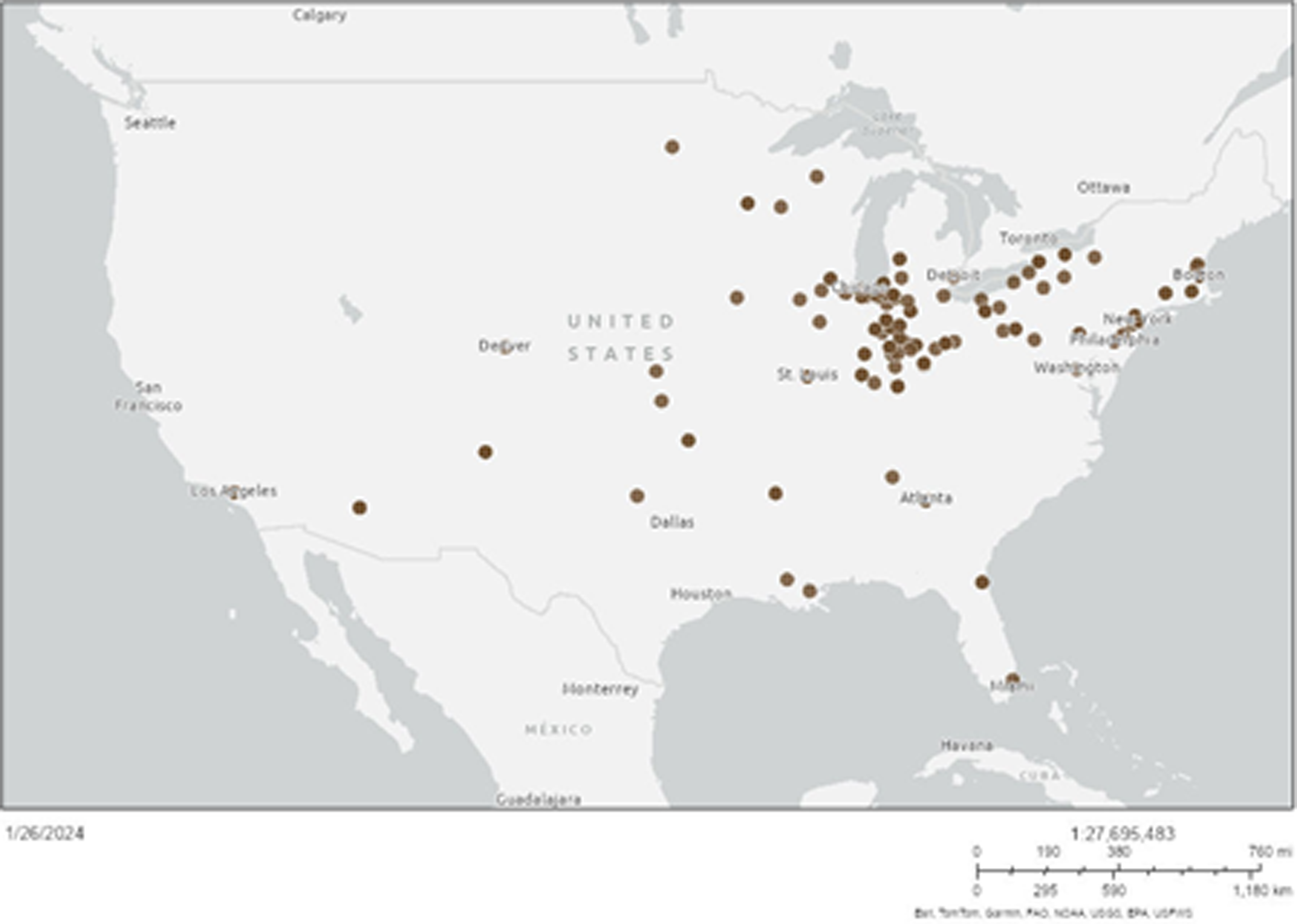
By the summer of 1949, the NLI’s political epistemic network—once geographically circumscribed by South Bend—had expanded to encompass a nationwide cohort of scholars, practitioners, and everyday Americans concerned about the moral foundations of their nation’s legal system (Figure 1). Consistently reminded of the horrors of World War II and dangers posed to the United States by Cold War ideologies, the NLI’s conservative affiliates were motivated to leverage this network to imagine a new politico-legal order circumscribed by the natural law’s moral dictates. To increase the tenor of its domestic response to legal liberalism—which, by this time, was seen as sympathetic to New Deal-style administrative centralization in the mold of disfavored European nations—the NLI therefore frequently turned its attention to global realities after 1948.Footnote 104 In fact, upon receiving word that the NLI had inspired the inauguration of a similar institute in Germany, it appears that Notre Dame’s leaders began to believe that highlighting natural law jurisprudence’s global influence could aid the NLI in the achievement of its principally domestic goals.Footnote 105 As President Cavanaugh wrote to George Sokolsky in the fall of 1949, an “idealistic, God-fearing outlook on life” was needed “in a world of too many skeptics and materialists.”Footnote 106
Visual representation of the 230+ instances in which news about the NLI was featured in local newspapers and/or on radio programs according to messages from Notre Dame alumni to NLI organizers (c. 1947–1951). Credit: Geospatial Analysis and Learning Lab, University of Notre Dame.

At the beginning of October, President Cavanaugh announced that the third annual convening of the NLI would be “devoted to an exposition of the current conditions of the natural law philosophy in American jurisprudence,” but feature lectures on, among other topics, “The Natural Law and International Law.”Footnote 107 In the weeks that followed, Raymond Donovan, Notre Dame’s new public information director, continued the tradition that his predecessor had begun of staggering the publication of NLI press releases to increase popular reporting on the NLI. Indeed, between October 21 and November 4, Donovan penned no less than three separate announcements that scholars with professional experience in Britain, the United States, and Italy would address the 1949 NLI.Footnote 108 And, on November 11, Donovan likewise announced that Carlos Romulo, the president of the United Nations’ General Assembly, would speak at the last session of the 1949 NLI.Footnote 109 As in previous years, news of these lecturers’ selection would be published from Arizona to Michigan and New Jersey.Footnote 110
Romulo’s keynote address—which was recorded and later aired on the Columbia Broadcasting System (CBS)—was one of two globally focused vehicles that the NLI leveraged to pursue its conservative domestic goals.Footnote 111 As the New York Times observed in its reporting on Romulo’s address, the thrust of his message was that “recognizing no higher sanction than the authority of state” would produce “total tyranny in lieu of freedom,” as recent wartime history had shown.Footnote 112 Anticipating this line of argumentation, Donovan asserted the month prior that the 1949 NLI would “emphasize the Natural Law as a moral restraint upon the growing claims of ‘big government’ all over the world.”Footnote 113 In this way, the NLI invoked the global experience of wartime to confirm a central tenet of Cold War conservative constitutionalism: that the scope of government activities must be constrained by higher moral principles.
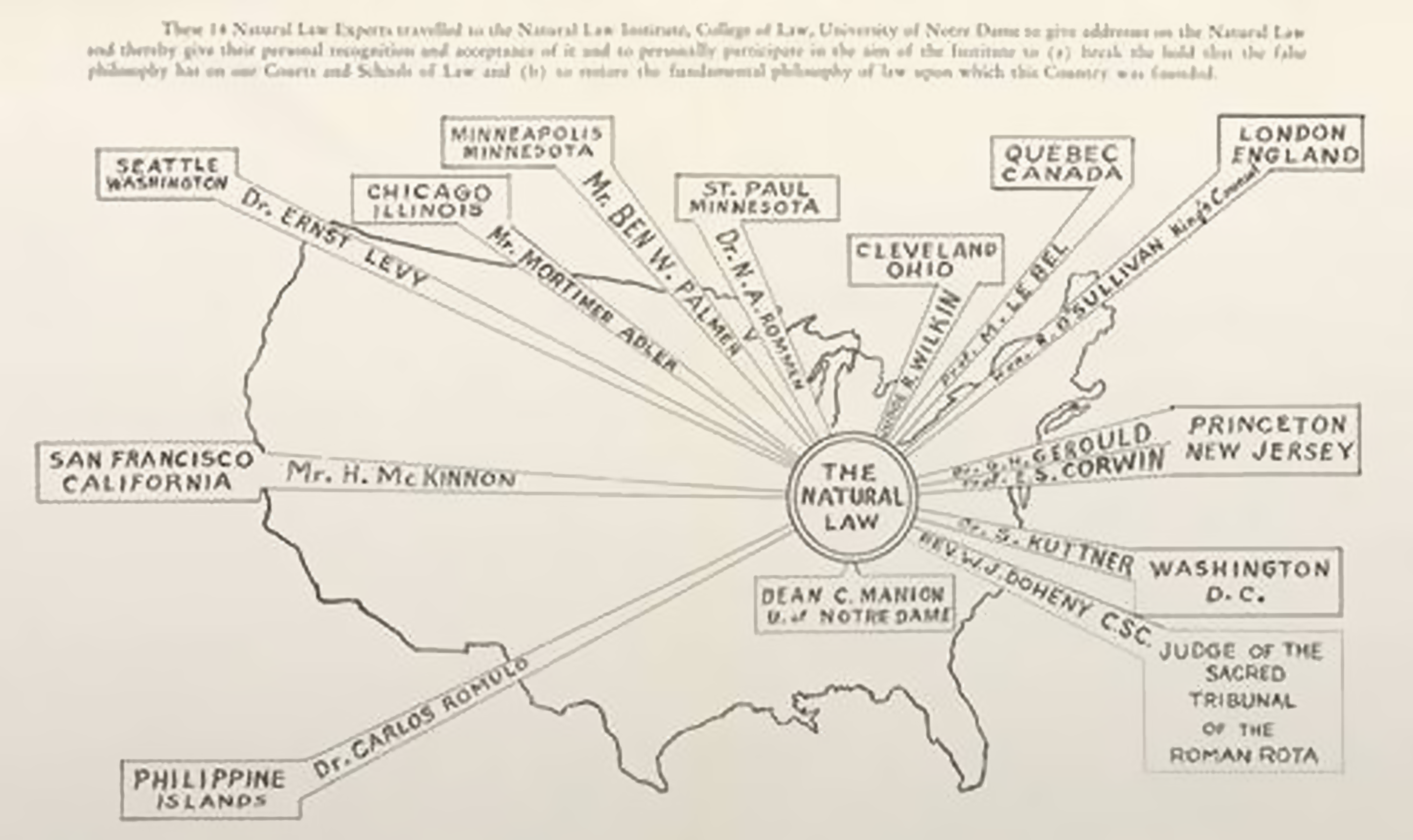
Map depicting the NLI as the center of a global movement to restore natural law jurisprudence. See Eddie Duggan to Notre Dame Alumni, November 8, 1949, UDIS 020/03, UNDA.

The second means by which the 1949 NLI leveraged its global scope to pursue conservatives’ domestic goals was through new language in its publicity campaigns. In a four-page pamphlet prepared by Notre Dame’s public information department and mailed under the imprimatur of 1926 alumnus “Eddie” Duggan, the NLI was framed—both in words and images—as the center of a movement to revive natural law jurisprudence that even extended beyond the borders of the United States (Figure 2). In so doing, the NLI implicitly communicated that the existence of global consensus on natural law must motivate Americans to “break the hold that the false philosophy [of realism] has on our Courts and Schools of Law.”Footnote 114 Though not immediately evident in Duggan’s pamphlet, the conservative domestic goals around which these global appeals were connected are abundantly clear in the radio script that Notre Dame again asked alumni to read before the 1949 NLI. Indeed, the revised script not only referenced the threat of World War II-era totalitarianism in Germany, but also Cold War-era communism in Eastern Europe:
The Natural Law doctrine thus embodied in the Declaration of Independence is the great characteristic of a free America, which distinguishes us from the totalitarian states. Nazi Germany repudiated the Natural Law Doctrine. Communist Russia does so today. Can a free nation like ours afford to follow their example in the teaching of law in its law schools, in the making of laws in its legislature, or in the interpretation and application of laws in its courts?Footnote 115
After positing that a rejection of natural law jurisprudence might expose the United States to totalitarianism and communism, the suggested script continued to emphasize that “Natural law knows no boundaries based on creed or nationality.”Footnote 116 Consequently, it is clear that the 1949 NLI’s publicity campaign leveraged the global specter of totalitarianism and communism to serve one of conservatives’ principal domestic goals during the Cold War—the constraining of government authority. As Donovan wrote in a December memorandum to Notre Dame alumni, the source of these limiting principles that could alone preserve “the American way of life” was known as “natural law.”Footnote 117 And, crucially, this message about how natural law could alone limit government incursions into the realm of personal liberty came to mark public engagement with the 1949 NLI in such high-profile outlets as the New York Times.Footnote 118
If the 1949 NLI suggests how global appeals to natural law could be leveraged to advance conservative ideas about the nature and limited scope of government, the 1950 NLI offers concrete evidence of how these invocations of natural law were, in fact, repeatedly employed by conservative public figures and scholars to serve ideologically agreeable domestic ends. Unsurprisingly, this move was anticipated by the publicity efforts that Notre Dame designed for the 1950 NLI. In the suggested 1950 radio script, for example, the featured lecturers were described as men “intensively interested in the revived acceptance of Natural Law,” unlike “totalitarian[s]” and “Communists” who allegedly believed that “all rights are derived from the State.”Footnote 119 “If the State decides to confiscate property, or imprison its opponents, or prohibit free speech, it’s all quite acceptable to the Reds’ codes of ethics,” the script continued.Footnote 120 In response to this anti-American philosophy, Joseph Hutcheson, a federal judge once known to be sympathetic to legal realism, delivered an address on “The Natural Law and the Right to Property.”Footnote 121
At Clarence Manion’s direction, George Sokolsky—whose New York Post columns enjoyed weekly readership of over twenty million—was invited to deliver an address on “The Source of Human Rights” at the 1950 NLI.Footnote 122 “I do not need to tell you,” Manion wrote in his invitation to Sokolsky, “that this subject begs the whole question concerning the existence and force of the Natural Law.”Footnote 123 Alongside the Catholic theologian and contraception opponent John Ford, Sokolsky’s address to the 1950 NLI sharply critiqued the decline of the American “family system” as indicated by “[t]oo many divorces, too many broken homes, too much comparative morality, [and] too great uncertainty[.]”Footnote 124 Considering these modern ills, Sokolsky proposed that there is nothing more “practical in everyday application than the guidance of God, as expressed in Natural Law, the abandonment of which produces chaos and confusion.”Footnote 125
Whether in the context of property law, family law, or otherwise, the presenters invited to address the 1950 NLI illustrated that “Natural Law [is] the true basis of the rights you and I call ‘fundamental,’” as the NLI’s 1950 suggested editorial predicted.Footnote 126 By facilitating dialogue about how human rights and civil liberties could alone be secured by natural law, the NLI generated intellectual capital that the constitutive members of the NLI’s political epistemic network could then present to broader audiences. As the New York Times reported, for instance, one NLI lecturer’s opposition to the welfare state was predicated on his understanding of the comparatively limited role of positive law vis-á-vis natural law.Footnote 127 Moreover, the Times observed, this lecturer asserted that self-expression is a “contingent right” determined by natural law, including for communists.Footnote 128
Between 1947 and 1950, the NLI recruited progressively more high-profile public figures, scholars, and practitioners as featured lecturers, thus expanding the NLI’s national profile and improving its ability to transmit ideas to policy makers. Months after the 1950 NLI, for instance, the conservative Ohio senator and New Deal opponent John Bricker praised the NLI and “pleaded for a return to the Natural Law philosophy of the founding fathers as the only hope of defeating Communism.”Footnote 129 Even setting aside those who, like Bricker, were not formally affiliated with the NLI but who nevertheless benefitted from the intellectual capital developed thereby, core members of the NLI’s network were themselves sometimes in government or government-adjacent positions through which they could employ the NLI’s intellectual resources in concrete circumstances.
Core members of the NLI’s network who served in government(-adjacent) positions were positioned to serve as what Amanda Hollis-Brusky, following the political scientist Peter Haas, has dubbed “cognitive baggage handlers”—individuals who have access to “channels through which new ideas circulate from [political epistemic networks] to governments.”Footnote 130 Perhaps the most influential of the NLI’s “cognitive baggage handlers” was Clarence Manion, who served on the American Bar Association’s Special Committee to Study Communist Tactics and Objectives between 1950 and 1951 and used this position to connect NLI affiliates with government leaders and public figures.Footnote 131 Moreover, as the chairman of a congressional federalism commission, the evidence suggests that Manion came under scrutiny for his rabid anti-communism and opposition to federal social programs.Footnote 132 Like other core members of the NLI’s epistemic network who attempted to undermine the welfare state on the basis of natural law, so too did Manion evidently leverage intellectual capital developed by the NLI to pursue conservatives’ domestic goals. Somewhat paradoxically, however, scholars who have studied Manion’s role in opposing the New Deal have heretofore neglected to mention that Manion’s first foray into conservative political and legal organizing came during his time at Notre Dame (and not, contrastingly, after he became a full-time radio personality).Footnote 133
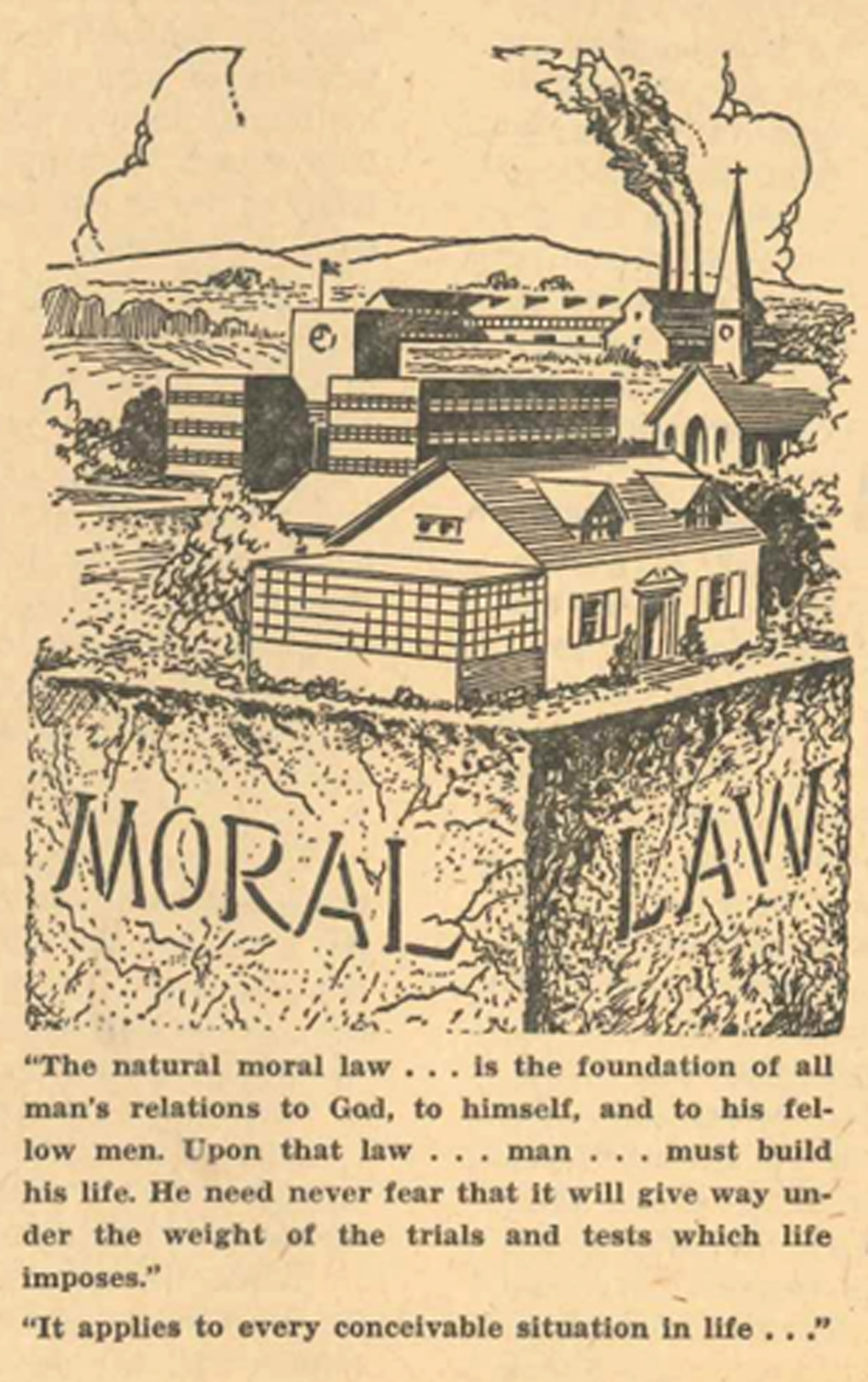
In light of the NLI’s continued growth after 1947, its focus turned increasingly to practical issues. In one sense, this focus on natural law’s practical relevance was aimed at dispelling the misconception that natural law was merely an impracticable theory, as had been noted in 1947. At President Cavanaugh’s direction, the 1951 NLI confronted the question of practicality by exploring how members of all the world’s major religious traditions could accept natural law precepts.Footnote 134 Considering the United States’ ever-growing religious plurality at mid-century, the 1951 NLI sought to demonstrate natural law’s supra-denominational character, one that appeared to make natural law jurisprudence a vehicle for uniting Americans of all religious dispositions against secular legal realists at home and totalitarians and communists abroad. As recent historical scholarship on the creation of a multi-confessional “nation under God” at mid-century would seem to suggest, the 1951 NLI was an effort to demonstrate that Americans of all religious dispositions could be part of a nation under God … and God’s natural law.Footnote 135 Indeed, even the Catholic bishops of the United States released a statement on “God’s Law” in 1951 that depicted the “natural moral law” as the “foundation of all man’s relations to God, to himself, and to his fellow men” (Figure 3).Footnote 136
Image included in the American Catholic bishops’ 1951 statement on “God’s Law” depicting the “natural moral law” as the “foundation of all man’s relations to God, to himself, and to his fellow men.” See Catholic Bishops of the United States, God’s Law: The Measure of Man’s Conduct (Huntington, IN: Our Sunday Visitor Press, 1951).

As in previous iterations of the NLI, the 1951 suggested editorial reveals how the NLI’s intellectual capital served Cold Warriors’ domestic goals—especially their desire to emphasize limits on government authority. The editorial, for example, framed the Declaration of Independence’s discussion of the “Laws of Nature and of Nature’s God” as the paradigmatic expression of the American constitutional tradition’s reliance upon natural law: “We began as a nation by declaring to the world that our Creator has endowed Man with certain ‘unalienable’ rights,” the editorial remarked.Footnote 137 After sharply criticizing “most American law schools” for removing natural law from their curricula, the editorial contrasted the traditional American philosophy of the “‘Eternal Law’ of God” with the God-rejecting realist and atheist philosophy of “metaphysicians on a holiday from reality.”Footnote 138 In fact, the “Secularism,” of these individuals had, according to the editorial, drawn “down its own iron curtain between God and the State.”Footnote 139 In the editorial’s concluding paragraphs, the NLI’s alumni representatives were to further assert that the “Totalitarian State[s]” of World War II embarrassed “Secularists” and “Materialists” descended from the likes of “Justice Holmes” who could not identify a “rock-bottom foundation” for human rights.Footnote 140
With representatives of Confucianism, Judaism, Islam, Buddhism, and Hinduism, the 1951 NLI was presented as a means of showing how universal acceptance of natural law was the only sure way to secure individual liberties and human rights against the incursions of overbearing governments. In the New York Times’s reporting on the 1951 NLI, this emphasis on natural law’s universality was front and center: “The universality of natural law … as the fundamental basis of man’s conduct and experience was portrayed today by five representatives of the non-Christian tradition[s] in the final session of [the NLI],” the Times’s article began.Footnote 141 “[D]edicated to the search for an understanding of the universality of man’s basic guidance in religious, moral, and social conduct,” the NLI, the Times implied, framed God and natural law against “atheism” and “the spread of morality rooted in force, the omnipotent state.”Footnote 142 As such, it is clear that the NLI sought to highlight global, multi-religious acceptance of natural law for the express purpose of influencing domestic jurisprudence.
As President Cavanaugh wrote in his foreword to the 1951 NLI’s published Proceedings, “[t]he Natural Law must become a living force in the thinking and practice of American lawyers and judges.”Footnote 143 Described as the “basis for the Declaration of Independence and clearly implied in the Ninth Amendment to the Constitution,” only natural law jurisprudence, Cavanaugh thought, could offer the “firm foundation for the future” that would preserve personal liberties.Footnote 144 Whether through invocations of the “iron curtain,” “atheism,” “omnipotent state,” or otherwise, the NLI self-consciously set its domestic constitutional project over and against global threats that appeared to be especially persuasive to everyday Americans in the context of the Cold War.
The NLI’s Idea (with Consequences)
In his reflections on the five-year anniversary of the NLI’s founding, President Cavanaugh expressed his gratification at the “second spring” of natural law that the NLI had initiated in American jurisprudence.Footnote 145 “As Mr. Justice Frankfurter says,” Cavanaugh remarked, “the Natural Law Institute of Notre Dame University is now an established institution in our legal world.”Footnote 146 Despite the fact that the NLI ceased convening annually in 1951, Frankfurter and Cavanaugh were right to imply that the NLI had earned itself a position of influence over a relatively short period of time. And, this was a position that allowed ideas about natural law jurisprudence to continue to shape Cold Warriors’ conservative constitutionalism even after the suspension of the NLI’s annual convenings. For example, Clarence Manion’s retirement from Notre Dame only months after the 1951 NLI and establishment of his popular conservative radio program, the Manion Forum of Opinion, was enabled by the NLI’s raising not only the College of Law’s academic profile, but also Manion’s personal profile. As Manion took to the airwaves during the 1960s and 1970s to continue to popularize many of the ideas that the NLI earlier helped to articulate, so too did another core member of the NLI’s political epistemic network—George Sokolsky—bring ideas that he encountered at the NLI to tens of millions of newspaper readers.
In the years that immediately followed the 1951 NLI, Manion and Sokolsky were perhaps the most high-profile of the NLI’s “cognitive baggage handlers.” Even setting aside their NLI-informed contributions to Cold War conservative constitutionalism, however, so too did the NLI continue to exert influence on the making of American conservatism after 1951 through Notre Dame’s NLI-adjacent efforts. For instance, Notre Dame established a new academic journal, the Natural Law Forum, in 1952 to replace the NLI’s annual convenings.Footnote 147 As recently appointed Notre Dame President Theodore Hesburgh wrote to Sokolsky in July of the following year, the Forum served as a more consistent way to demonstrate natural law jurisprudence’s “application to the day-to-day work of the practicing lawyer.”Footnote 148 Under Hesburgh’s careful watch, the Forum became a leading venue for scholarly discussion about natural law in the United States, even featuring on its editorial board such influential legal philosophers as Harvard’s Lon L. Fuller, Yale’s F.S.C. Northrop, and the University of Chicago’s Leo Strauss.Footnote 149 Though a detailed study of how Fuller’s involvement with the Forum shaped his more well-known natural law scholarship is outside the scope of this article, even a cursory review of the evidence indicates that Fuller relied on the Forum’s intellectual capital when engaging with conservative contemporaries. For example, Fuller cited scholarship published in the Forum when he was asked by the Rockefeller Foundation in 1959 to review applications for research funding prepared by Strauss’s graduate students in political theory.Footnote 150 Less than a decade after its establishment, the Forum had grown to such prominence that even the new (and not particularly conservative) dean of the Boston College Law School, Robert F. Drinan, remarked that “[i]t would be an understatement to say that with its first two issues [the Forum] has already taken its place with the very top American scholarly journals.”Footnote 151
As this article has shown, the individuals whom the NLI credentialed and the academic and popular products it generated helped to shape the making of conservative constitutionalism during the Cold War. As newspaper articles, mailing campaigns, radio addresses, and published academic scholarship brought ideas about natural law to progressively larger audiences under the imprimatur of a progressively more reputable university and through the work of progressively more high-profile figures, the NLI provided an invaluable service to conservatives during their institutional “wilderness” years by providing a forum in which conservatives could “imagin[e] constitutional restoration in the heyday of American liberalism.” Though most conservative constitutionalists by the 1980s abandoned natural law jurisprudence in favor of originalist interpretive methods, many of the outcomes that both natural lawyers and originalists sought—especially in the area of morals regulation—appear to have shared important resonances.
Conservatives’ methodological shift from natural law during the Cold War to originalism during the Reagan Revolution should prompt scholars of American legal history and political development to inquire into the relationship between this earlier conservative legal movement and “the” conservative legal movement of Edwin Meese III and the Federalist Society. So too, however, should recovering this forgotten history also prompt novel scholarly interest in how the natural law jurisprudence of mid-century conservative constitutionalists might (or might not) bear a relationship to the contemporary revival of natural law in influential corners of the legal academy. As the conservative natural law theorist Adrian Vermeule himself remarked at the conclusion of a recent conference on his scholarship, “The discussions we have had today are iterations, with appropriate variation, of discussions that happened in and during the last revival of classical legal theory, in the United States and Europe in the 1950s and 1960s in the shadow of Nuremberg, when legal positivism for a time seemed patently inadequate.”Footnote 152 By uncovering the (dis)continuities in these “discussions,” perhaps historians and political scientists will begin recognizing, contrary to the implicit scholarly consensus, that natural law has indeed been an idea with consequences.
Acknowledgements
Thanks to Victoria Basulto, Peter Cajka, Barry Cushman, Darren Dochuk, Christopher Hamlin, Katie Heatherly, Nicholas Herrud, Ken Kersch, Stephen Koeth, C.S.C., John McGreevy, Wilson Miscamble, C.S.C., Kushal Nandwani, Linda Przybyszewski, and Jack Young for helpful comments on earlier drafts of this article. Thanks also to the University of Notre Dame’s Cushwa Center for the Study of American Catholicism for its financial support of this research, and to Daniel Keough, Hannah Kaufman, Danielle Sigler, Joe Smith, and Randy Sowell for their archival support.

 Open access

