


Take-Home Points
-
1. Suboptimal treatment responses are common in psychopharmacology.
-
2. Most psychopharmacologic treatment guidelines emphasize first-line therapy selection, and not what to do when several options are not effective or are not tolerated.
-
3. Best practice for drug selection for treatment-resistant patients in the absence of randomized controlled trials is shifting from trial-and-error approaches informed by “personalized” clinical data from a specific individual to incorporating as well the results of “precision medicine” using an individual’s own biomarkers.
-
4. Pharmacogenomic “precision” testing can increasingly inform drug selection in treatment-resistant patients and currently includes state-of-the-art pharmacokinetic and pharmacodynamic genomic markers, with epigenetic and other biomarkers poised to enter clinical practice as well.
Introduction
Psychiatric pharmacogenomics and biomarkers are on the cutting edge between research and clinical practice, where the action can be quite turbulent and even controversial.Reference Stahl 1 – Reference Niculescu, Levey, Le-Niculescu, Niculescu, Kurian and Salomon 13 Payors who do not want to reimburse useful if expensive tests are accused of being greedy or Luddites; laboratories are accused of profit mongering with tests that do not alter clinical practice or patient outcomes; clinicians are accused of over-interpreting test results. So, what is the truth? Should we just stick with the classical model of mental health practice (Table 1)? Maybe the truth is actually a bit of all the above. Here we will take a quick inventory of the state of the art of “precision medicine” for mental health practices.
Classical model of psychiatric practice

Genomics to Diagnose?
Currently, it is not at all clear what role genomics and biomarkers have in the diagnosis of mental illnesses, or in risk for mental illnesses.Reference Braff and Freedman 4 , Reference Perlis 11 , Reference Niculescu, Levey, Le-Niculescu, Niculescu, Kurian and Salomon 13 Application of new tests for clinical diagnoses of mental illnesses is proving problematic, not least because diagnosis in mental health is undergoing a paradigm shift from categorical (DSM, Diagnostic and Statistical Manual) to dimensional (symptom domains that cut across numerous psychiatric disorders).Reference Stahl 14 We really do not have diseases in mental health practice, so much as diagnoses that are collections of diseases. Thus, it already seems clear there will not be a single test for any diagnosis, and that at best a portfolio of numerous biomarkers may become useful for potentially identifying many genetic or biological expressions of the same diagnosis. So, biomarkers for diagnosis do not appear to be ready now for “prime time” in clinical practice.
Genomics for Initial Drug Selection?
Much of the effort in the development of biomarkers has been dedicated to finding tests that would tell us what drug to prescribe or what drug not to prescribe, in order to find a drug with efficacy but not side effects for an individual patient. So, where are we in the process of integrating such “precision medicine” into drug selection in mental health practices? One thing is already clear from pharmacogenomics in psychiatry: Tests do not select drugs. Prescribers do.
That is, it is highly unlikely that any single test will ever dictate what drug to prescribe or not to prescribe in most cases. There is no known single gene for any major psychiatric disorder nor for any drug response to a psychiatric disorder, nor is one ever likely to be found, since genes do not code for psychiatric disorders, nor for psychiatric symptoms, nor for drug responses to psychiatric symptoms (Table 2).Reference Stahl 14 Instead, genes code for proteins and epigenetic factors that regulate the efficiency of information processing in brain circuits, and that can be increasingly visualized with neuroimaging techniques.Reference Stahl 14 , Reference Stahl 15 Rather than looking for a single gene that regulates drug response, psychiatric research is instead currently attempting to link treatment response to a portfolio of genes that regulate brain circuits that are the substrates of various psychiatric symptoms (Table 2).Reference Stahl 14 , Reference Stahl 15
Genes and responses to psychotropic drugs

Such a portfolio of biomarkers will hopefully show which drugs will be somewhat more likely to work or to cause a side effect in a given patient. Right now, however, it is not clear that the available genomic tests add substantial value proportionate to their cost for selection of first-line treatments of mental disorders.Reference Stahl 1 – Reference Niculescu, Levey, Le-Niculescu, Niculescu, Kurian and Salomon 13 For selection of a first-line therapy, current treatment guidelines alone may be most cost effective. If there is a place for current pharmacogenomic testing, it may be in the selection of drugs for patients who are treatment-resistant or treatment-intolerant to trials of evidence-based therapies (Tables 3 and 4), particularly when these test results are augmented with therapeutic drug-level monitoring combined with classical approaches to selecting treatments (Table 1).Reference Stahl 1 – Reference Winner, Carhart, Altar, Allen and Dechairo 24
Pharmacogenomic testing in modern psychiatric practice

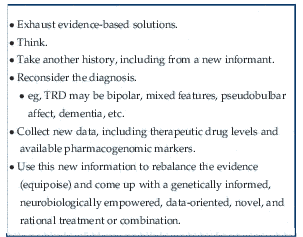
Proposal for a modern model of psychiatric practice for treatment resistance
Genomics for Drug Selection in Treatment Resistance/Intolerance?
One of the most daunting tasks for a modern mental health professional is selecting treatment for a patient who has failed to tolerate or respond adequately to numerous evidence-based treatments. Because large, randomized, controlled trials of these so-called treatment-resistant or treatment-intolerant patients are few, it leaves such patients and their prescribers to ponder, “What do you do when there is no evidence?”
As mentioned above, the answer in the past has been the classical model of best practices for such patients (Table 1). The question now is whether pharmacogenomic testing has advanced sufficiently such that the information obtained is worth its cost for the treatment-resistant patient. If so, this would mean combining the classical approach of empiric case-based evidence from use of drugs that have a pharmacologic rationale for an individual patient, including a specific patient’s unique information (personal symptom profile, prior clinical response or nonresponse to other agents, particular side effects experienced, family history, and preferences), with information from genotyping (both pharmacokinetic and pharmacodynamic markers; phenotyping therapeutic drug levels; and obtaining results from various epigenetic, proteomic, and neuroimaging biomarkers as well). Such an approach seeks to employ the best of the art of psychopharmacology with the best of available science for mental health patients who are most in need of effective, tolerable treatments. So far, the empiric evidence is that this approach might “work” for the treatment-resistant patient, especially therapeutic blood monitoring for treatment-resistant psychosis with violence in forensic settings,Reference Morrissette and Stahl 16 , Reference Stahl, Morrissette and Cummings 17 and pharmacokinetic/pharmacodynamic genomic markers for treatment-resistant depression.Reference Ruaño, Szarek and Villagra 18 – Reference Winner, Carhart, Altar, Allen and Dechairo 24 “Work” in this context means symptom improvement, better tolerance to medication, and cost savings.
It’s the Strategy, Not the Test Result
So far, therefore, there have been some surprises from pharmacogenomic testing as it enters mental health practice (Table 3). First, as mentioned above, we now know that no single test will tell us what to prescribe or what not to prescribe for a given patient. It is clear that each test result only “biases” us a small amount for or against a given drug choice, and that information must be balanced (ie, with equipoise) with other personal information from that unique patient. Second, perhaps the most important outcome from pharmacogenomic testing is not necessarily the specific test result, but how this testing leads to drug selection that improves outcomes and reduces costs.Reference Ruaño, Szarek and Villagra 18 – Reference Winner, Carhart, Altar, Allen and Dechairo 24 That is, interpreting pharmacogenomic test results orients the advanced prescriber’s thinking along a neurobiological perspective in order to select treatments that are biologically plausible, rather than just utilizing intuition, habit, or trial and error. This appears to have the potential to improve drug selection.Reference Ruaño, Szarek and Villagra 18 – Reference Winner, Carhart, Altar, Allen and Dechairo 24 Third, we now know that how one utilizes pharmacogenomic test results is not that different from how one utilizes any other personalized clinical information from a given patient. That is, each bit of information from a specific patient, whether clinical or pharmacogenomic testing, contributes at best a very small amount to the variance explaining why someone responds or fails to respond, or tolerates or fails to tolerate a given drug or drug class. Having more information from pharmacogenomic test results provides additional individualized data for a given patient to help weigh the many factors in favor or against prescribing any given drug.
Some skeptics conclude from all of this that no biomarker or genomic test is valuable enough to be part of the standard of psychiatric care, nor useful enough to be reimbursed. Integrating new technologies into clinical practice has always been a messy affair as we learn whether clinical outcomes are better when the test results are utilized than when they are not. Early adopters strive to discover the best utility of new information, while nay-sayers and especially payors remain doubtful. Some practitioners may be more comfortable at the present time using the time-honored classical approach (Table 1). On the other hand, early initiators of new technology who study the literature and learn how to properly interpret evolving test results may prefer a more cutting-edge, if controversial, approach (Table 4). That approach is not to take a classical trial-and-error approach to selecting treatments, but instead to put the results of pharmacogenomic testing into the decision-making formula by pursuing a genetically informed, neurobiologically empowered, data-oriented, novel, and rational approach to selecting a treatment or combination that is already showing signs of yielding better symptomatic outcomes, better dosing, and reduced cost of treatment (Table 4).Reference Ruaño, Szarek and Villagra 18 – Reference Winner, Carhart, Altar, Allen and Dechairo 24



