





1. Introduction
The increase in both maritime traffic density and ship sizes over recent decades has increased the threat to existing maritime infrastructure. The demand for Offshore Wind Farms (OWFs) is growing exponentially, which also increases the risk of allisions (Rawson and Brito, Reference Rawson and Brito2022; Yu et al., Reference Yu, Liu, Teixeira and Soares2020). This paper uses the term ‘allision’ to describe accidents in which a moving object strikes a stationary object, to differentiate such events from collision accidents involving two moving objects (Thieme et al., Reference Thieme, Utne and Haugen2018).
Ship allision risk is an important consideration for bridges which cross or are located close to busy waterways. Since World War II, at least 23 bridges in the world have been severely damaged or collapsed due to ship impacts, leading to the deaths of at least 349 people (AASHTO, 2009). Many more bridges have been damaged by allisions, often leading to disruption of traffic; one recent example is the Francis Scott Key Bridge in the USA, which was struck by a large container vessel and collapsed (Kalia, Reference Kalia2024).
The probability of ship allisions can be estimated using (Fujii and Shiobara, Reference Fujii and Shiobara1971; Macduff, Reference Macduff1974)
 $$N = {N_g} \times {P_c}$$
where N is the number of accidents, P c is the causation factor and N g is the number of geometrical candidates. Geometrical candidates are the number of ships multiplied by a geometrical overlap probability defined by the ship outline and locations along the bridge which result in an allision. Pedersen (Reference Pedersen1995) extended the research on this front, and his equations are commonly used for ship allision risk for bridges and other fixed objects (Čorić et al., Reference Čorić, Mandžuka, Gudelj and Lušić2021). Pedersen’s (Reference Pedersen1995) theory and equations are implemented in several software, ranging from IALA’s commercially available IWRAP Mk II (Engberg, Reference Engberg2017) to the in-house software ShipRisk (Rasmussen et al., Reference Rasmussen, Glibbery, Melchild, Hansen, Jensen, Lehn-Schiøler and Randrup-Thomsen2012) to the open-source OMRAT (Hörteborn, Reference Hörteborn2024).
Pedersen (Reference Pedersen1995) characterises four different accident scenarios for how ships may hit structures or run aground, which are illustrated in Figure 1. The first scenario describes ships that follow a planned route with a large offset. The second scenario describes ships that miss a turning point and continue straight ahead. The third scenario is rare, but describes the situation in which a ship takes an evasive action to avoid a collision and instead hits a structure. The fourth scenario is meant to include all track patterns in which the ship is not following the planned route (Pedersen, Reference Pedersen1995). Pedersen et al. (Reference Pedersen, Chen and Zhu2020) introduced some modifications to the method originally proposed (Pedersen, Reference Pedersen1995), such as interchanging categories III and IV. However, this article uses the category nomenclature from Pedersen (Reference Pedersen1995) due to its frequent citation in the literature.
Graphical illustration of the four accident categories by Pedersen (Reference Pedersen1995), including three structures A, B and C.

The fourth scenario could be further divided into drifting ships and ships off-course (Pedersen, Reference Pedersen1995). The behaviour of drifting ships and how they move with the environment has been studied and implemented in different manners (Friis-Hansen, Reference Friis-Hansen2008; Hörteborn and Ringsberg, Reference Hörteborn and Ringsberg2021; Kulendorf et al., Reference Kulendorf and Van der Tak2019), but the behaviour and modelling of ships off-course have not been implemented and must be modelled separately. In this article, ships off-course is understood as active navigational error; this term is preferred because it more precisely describes the cause of the failure, rather than its consequence.
Navigational error has been studied by many, in terms of both surveillance and abnormal behaviour detection in real time. Laxhammar (Reference Laxhammar2008) used a combination of multivariate Gaussian Mixture Model and Expectation-Maximisation algorithm to detect anomalies in real time. Kowalska and Peel (Reference Kowalska and Peel2012) presented a similar model comprising an active learning model to detect smuggling and terrorism. However, these types of models are set up to alert an operator of an anomaly: they are not defined to estimate the probability of such rare events. The occurrence of accidents in the US related to human error between 1975 and 2017 was investigated, and it was concluded that lack of trip planning or manoeuvre planning was the root cause of 18% of all cargo and passenger ship accidents (Sánchez-Beaskoetxea et al., Reference Sánchez-Beaskoetxea, Basterretxea-Iribar, Sotés and Machado2021). Other research has studied accident probability by comparing global accident databases containing fleet data, but this type of research has not investigated the failure mode with enough granularity to determine the probability of navigational error (Antão et al., Reference Antão, Sun, Teixeira and Soares2023; Dugan and Utne, Reference Dugan and Utne2023).
The probability and the behaviour of the type of navigational error described by Pedersen (Reference Pedersen1995) has only been studied briefly by Pyman et al. (Reference Pyman, Austin and Lyon1983) and Karlsson et al. (Reference Karlsson, Rasmussen, Frisk and Ennemark1998), who suggested that the probability of navigational errors was 1%–5% and 2%, respectively, of all ships. These suggestions were based on engineering judgement: Pyman et al. (Reference Pyman, Austin and Lyon1983) suggested that these ships navigated completely outside normal behaviour; and Karlsson et al. (Reference Karlsson, Rasmussen, Frisk and Ennemark1998) suggested that the 2% navigational errors could be approximated to a uniform distribution.
No quantitative research was found that supports the expert judgement of using a 2% uniform distribution to describe the risk contribution from navigational errors. Nevertheless, the 2% uniform distribution, applied together with a low causation factor, was developed and chosen to be used in the Öresund and Great Belt projects (Karlsson et al., Reference Karlsson, Rasmussen, Frisk and Ennemark1998). Pedersen et al. (Reference Pedersen, Chen and Zhu2020) mentioned that this uniform distribution is often in the interval of 1%–2%. However, the research by Pyman et al. (Reference Pyman, Austin and Lyon1983) and Karlsson et al. (Reference Karlsson, Rasmussen, Frisk and Ennemark1998) predates the introduction of Automatic Identification System (AIS) data in the early 2000s. The AIS data have enabled the possibility to quantify maritime risk (Itoh, Reference Itoh2022; Silveira et al., Reference Silveira, Teixeira and Soares2013; Svanberg et al., Reference Svanberg, Santén, Hörteborn, Holm and Finnsgård2019).
The aim of this paper is to document occurrences and to develop a new method for estimating the frequentist probability of active navigational error. This method is meant to further develop the current modelling practice for this type of navigational errors by investigating three aspects: first, the assertion that 2% of all ship traffic can be regarded as navigational error; second, the premise that these failures have an equal probability of hitting the bridge uniformly; third, the proposal to apply the same causation factor for this type of incidents as for other types of incidents, such as missed turn.
The next chapter introduces the methodology for identifying the navigational errors – first based on accidents, then based on incidents and finally on AIS data alone. Chapter 3 presents a case study in which the methodology is applied to several bridges in Norway, Sweden and Denmark. Chapter 4 discusses the findings from this paper and Chapter 5 concludes the main findings.
2. Methodology
This research proposes a new methodology for quantifying the frequency of the active navigational errors in Pedersen’s (Reference Pedersen1995) fourth scenario. Since no comparable research has been found in the literature, this new method has been developed specifically for the purpose of identifying and quantifying ship–bridge allision candidates that stem from active navigational errors. The proposed methodology uses AIS data to study the historical paths of ships that were involved in accidents and incidents. These findings are later used to identify candidates solely through historical paths. Since these events are rare, the scope of this paper is limited to quantifying the probability and duration of these events. The methodology uses a two-step learning process to identify these failures, illustrated in Figure 2. In short, the methodology relies on accident statistics and incident reports to develop pattern recognition with AIS data. In the first learning step, AIS data from known accidents are studied, and in the second step, AIS data from incident reports are studied. Finally, the failure pattern that has been identified is applied to the AIS data to identify unreported failures.
Graphical overview of the two-step learning model.

This paper uses AIS data from Norway (Kystverket), Denmark (DMA) and Sweden (SMA). DMA and Kystverket have historical AIS data since 2006, and RISE stores AIS from SMA since 2011. The three Scandinavian countries were chosen due to the high availability of AIS data, the relatively high numbers of relevant bridges and similar maritime safety cultures. The AIS input data used in this research looks slightly different depending on from where it originates; however, the same principle is used with all AIS data in this study. Raw standardised National Marine Electronics Association (NMEA) data are decoded into readable messages and categorised into dynamic (message types 1, 2, 3) and static (message type 5) messages. The dynamic messages are used both as point data and as a source for generating vectors. The point data are translated into ship contours using the static messages with regards to the antenna position and the ship’s heading. The vectors are generated based on each ship’s subsequent dynamic messages; ships with similar course and speed over ground are connected into a vector, and when the course or speed over ground changes, a new vector is created. When the ship is travelling in open sea with a constant course and speed, each vector can represent hundreds of points (Hörteborn, Reference Hörteborn2021).
Based on previous research by Hörteborn and Ringsberg (Reference Hörteborn and Ringsberg2021) and studied ship paths prior to accidents/incidents, causes could be classified into five categories:
-
blackout, passive failure
-
sharp turning, passive failure
-
missing turning point, passive failure
-
setting the Wrong Course at a Turning point (WCT), active navigational error
-
making a Turn at the Wrong Location (TWL), active navigational error
The probability of missing a turning point and a WCT error are events that are connected to a defined turning point and are therefore estimated in units per turn, while the rest are estimated per hour. Figure 3 illustrates these five failure categories; each failure starts with a ship that follows the normal route, but then deviates from the normal pattern.
Examples of a sailing fairway, passing one island and three structures (A, B and C). To illustrate the five potential failures that could result in allisions, five failure paths are included.

The missing turning point corresponds to Pedersen’s second scenario, while the others mostly fit into Pedersen’s (Reference Pedersen1995) fourth scenario. The first three – blackout, sharp turning and missing turning point – are defined by Hörteborn and Ringsberg (Reference Hörteborn and Ringsberg2021), and they are considered passive failures. The last two failures – WCT and TWL – are regarded as active navigational errors that have not previously been quantified through data and are defined here. The WCT error is defined as a ship making a turn at a location where many ships are turning, but the new course does not follow the normal pattern and might result in an accident if the course is maintained. Ships that hit a structure on this course, and those that discover that they are on the wrong course and navigate back to the normal pattern are both included in this category. The TWL error is defined as a ship making a turn where it is unusual to turn, putting the ship on a new course which may result in an accident.
The weather situation was not focused on in this study; however, the difference between course over ground and heading are observed, which gives some guidance on the environment effects at the time of the incident.
2.1. Lessons learnt from accidents
In this research, the authors reviewed accidents in the databases IHS Fairplay (2023), EMCIP (2023), Sjøfartsdirektoratet (2023) and GISIS (2023). However, no ship–bridge allision accidents were found among the contact accidents in Scandinavia in the GISIS database after 2006. The databases do not separate ship–bridge allision accidents into a separate accident type; instead, for this research, the accident location was used to distinguish ship–bridge allision accidents from other types of accidents. With relatively few bridges around Denmark and Sweden, accidents occurring after 2006 and 2011 (respectively) were manually investigated for these countries (the years are selected based on the availability of AIS data). Due to the large number of bridges in Norway, an automatic spatial filter was applied to identify accidents occurring after 2006 located less than 500 metres from a bridge; these accidents were then manually investigated to find relevant cases. Using the spatial location of the datasets has the drawback of missing accidents with incorrect locations; nevertheless, this seems to be the best option, as searching for ‘bridge’ in any free text field often returns accidents involving the bridge of the ship.
The accidents identified as ship–bridge allisions were further investigated using AIS data. All AIS positions that were spatiotemporally close (i.e. close in both time and space) were converted into ship contours and coloured depending on the ship’s speed. This was done to visually ensure that the accident occurred close to a bridge (and not a quay, etc.) and that the heading or the speed were affected by the allision. The AIS tracks were used in this manner to classify the accident type and to learn where and how to find potential near-misses in other locations.
2.2. Lessons learnt from incidents
The accidents and their respective AIS paths provided the authors with valuable information on the appearance of these paths. Fortunately, allision accidents are rare; therefore, incidents are also included in the study to increase the number of learning cases. Although incidents occur more frequently, finding historical records of these events is difficult. In this study, Vessel Traffic Service (VTS) reports have been used as incidents.
These incident reports describe the minute-by-minute communication between the VTS operator and the responsible person onboard the ship. The reports also include some print-screens from the VTS operators illustrating parts of the ships’ journeys; however, these print-screens only illustrated a limited history of the ship paths. Consequently, the authors added AIS contours to the analysis. Each incident was analysed to classify it and to further learn how to identify the different types of failures.
2.3. Identification based solely on AIS data
Based on the AIS patterns learned from identifying the accidents and incidents, the authors constructed a failure search model for historical AIS data alone. The active navigational errors are found using two modules: the first is an automatic script that finds potential candidates and the second is a manual study of those candidates (see Figure 4).
Overview of the two modules used to capture the probability of active navigational errors.

To efficiently analyse AIS data spatially, the authors used the AIS trajectories. Several months of AIS trajectories were manually observed for each bridge, to identify the normal traffic pattern in the area. For bridges with a navigational sailing span, the turn prior to the bridge crossing was studied to detect WCT errors; for bridges without a navigational span, TWL errors were studied among the ship traffic passing outside the bridge. A set of lines was defined based on the normal traffic in each area and the lessons learned from accidents and incidents; these lines aimed to capture deviating behaviour of ships in the area close to the bridge. Since the geographical conditions differ from location to location, there is more than one way to set up the lines and polygons. In some cases, the potential candidate needed to cross one or more lines – like in the example in Figure 6, where the ship needed to pass two lines. In other cases – like the example in Figure 7 – a ship would be a potential candidate if it crossed two lines, but not if it passed one of the other lines or if the journey started or ended inside the polygon, whereby the ship would be excluded as a candidate.
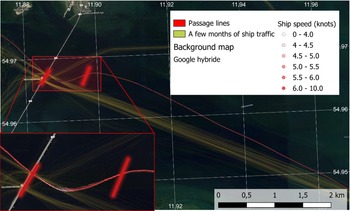
Passing lines and one active navigational error for the Storstrømsbron.

Passing lines, areas not start/stop and two active navigational errors (one of which resulted in an accident) for the Bergsøysund Bridge.

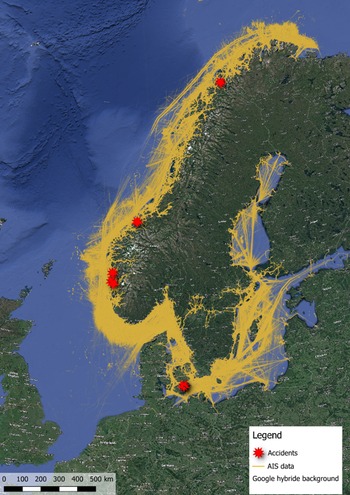
Accident locations in Scandinavia with AIS data.

As mentioned above, each area is unique: some areas have multiple lines that candidates need to pass, while other areas have multiple lines excluding candidates. The order in which the ship passes the different lines is also important for identification. All ship trajectories that comply with the defined lines are treated as candidates in Module 1. This is an iterative process: if the filter identifies too many false positives or too few candidates, the lines and areas are adjusted accordingly. The number of lines and their coordinates as used in this paper are listed in Appendix A.
The candidates’ paths and their spatiotemporal neighbours’ paths are investigated further in Module 2. The positions of the original AIS data are converted into polygons using the AIS antenna position onboard the ship and its heading, in the same way as in the investigation of accidents and incidents. To analyse the candidates with respect to spatiotemporal distance, the QGIS software and the timeManager plugin were used to replay the situations. Ships involved in search-and-rescue operations and fishing ships travelling back and forth are typically excluded as failure candidates. Finally, the paths are judged using the knowledge gathered from the accident and incidents study, to assess if the scenario should be classified as an active navigational failure.
Figures 5 and 6 illustrate examples of two areas where WCT and TWL failures were studied. Figure 5 illustrates the water east of the Storstrømsbron and the two passage lines that candidates need to cross. The line to the left covers the bridge span (which all ships should pass) and the line to the right is designed to identify the candidates. The right line is placed as south and east as it can be without capturing ‘normal’ traffic. To become a candidate, the ship needs to cross both lines as well as the right line before the left line.
The passing lines, area and failures for the Bergsøysund Bridge are illustrated in Figure 6. In this figure, the candidates need to cross the two green lines, cannot cross the blue line and cannot stop within the blue grid. The red line represents the path of a ship that recently struck the bridge, and the orange line represents the path of a ship that made a similar TWL error but recovered before any accident.
3. Results
The results in this paper are split in a similar manner as the methodology was presented; first based on accidents, second based on incidents, third based on solely AIS data. A final subchapter is also included to present the duration of the failures.
3.1. Accident probabilities
From the investigated databases and AIS tracks from Scandinavia between 2006 and 2023, 11 allision accidents were found (see Figure 7) and classified (see Table 1).
Allisions in Scandinavia where AIS tracks have been identified, based on accident records from IHS Fairplay (IHS), EMCIP and SjøfartsDirektoratet (SD)

*Yearly passages refer to the average in 2018–2022; for Masnedsundbruen and Bergsøysundbrua (bridges not intended to have ships passing underneath), the traffic passing outside is quantified instead
In short, the failures behind these allisions are 1 blackout, 2 missed turn, 6 active navigational errors and 2 unknown. The two allisions classified as ‘unknown’ involved a search-and-rescue ship and a tugboat; based on their AIS data, it was not possible to put them into one of the accident categories.
Defining accident frequency based on the data in this study is problematic, because bridges may have experienced more accidents than found here and because the ship traffic volume has increased since the bridges were built. Eidem et al. (Reference Eidem, Sha, Moen and Flage2023) exemplifies this with the Nordhordlandsbrua, where the ship traffic has increased and thus the probability of an allision greater than 25 Megajoules is 10 times higher today than it was in 1992, when the bridge was completed.
In estimating the probability of active navigational error, the total traffic volume needs to be accounted for. The assumption is made that all accidents during this period have been accounted for and that the traffic volume has been the same for the last 15 years. For TWL accidents, this results in 16,485 passages and one accident outside the Bergsøysundbrua. To estimate this failure per hour, it is first estimated that the critical passage period takes 10 minutes, which yields 2,750 hours; from this, we can conclude that the frequency of TWL errors is 3.6 × 10⁻⁴ per hour for this bridge. If we instead consider the 31-year period starting from 1992 when the bridge was built, and a 5% yearly traffic increase, the passing ships would have spent 3,300 hours in the critical area, making the frequency 3.0 × 10⁻⁴ per hour. No accident has been found for the years prior to when the AIS data were available (Eidem et al., Reference Eidem, Sha, Moen and Flage2023) and, because this bridge spans the entire strait, any undetected navigational error will lead to an allision with the bridge.
For the five accidents that were classified as WCT errors, the number of ship passages for the last 15 years varies from 25,575 to 172,320, according to Table 1. Based on these passage numbers, the frequency of a WCT error ranges from 5.8 × 10⁻⁶ to 3.9 × 10⁻⁵ per turn, or 0.26 × 10⁻⁴ on average.
The limited number of accidents, unique layout, traffic situation and Aids to Navigation (AtN) of each bridge prevents general claims with respect to estimating failure probability solely from these accidents. However, tracking the path of the ships involved in the reported accidents has provided valuable insights into how to adjust searches for anomalies in AIS data at other locations. Figure 8 illustrates an allision against the Andøybrua, where the ship set the wrong course, failed to correct it and collided with the bridge.
Ship tracks of the ship that struck the Andøybrua, including the normal traffic paths in the area.

Figure 8 also pinpoints one of the challenges for the failure classification. Using the definition of Pedersen (Reference Pedersen1995), this failure would be classified either as a scenario 1 failure, where the ship is traveling in the outer part of the distribution, or as a scenario 2 failure, where the ship fails to turn (see Figure 1). However, with the suggested methodology, this is classified as a WCT failure, since the ship is travelling on a different course from the normal pattern (therefore, not a scenario 1 failure) and the waypoint would have been too close to the bridge (therefore, not a scenario 2 failure).
3.2. Incident frequencies
The ship traffic in the Great Belt is surveyed by the Danish Navy in the Great Belt VTS. Incidents of a civil nature are reported to the Danish Maritime Authority, DMA. Between 1 September 2021 and 31 March 2023, the VTS issued 87 incident reports; of these, 56 were available for this study, while the remaining 31 incident reports were unavailable for legal reasons.
Table 2 summarises the categorisation of the causes of the 56 available VTS reports. The probability in the table is estimated by dividing the number of events by the total number of hours that ships spent in the area, which is estimated based on AIS data. Accordingly, commercial traffic spent approximate 150,000 hours in the VTS area during 1 September 2021–31 March 2023. The frequency of the events is expressed per hour in Table 2, but Missing turning point and WCT are expressed per turn. The number of turns per hour a ship is required to perform while transiting the VTS area depends on which route the ship intends to follow, the ship speed, etc., but it can roughly be approximated as 2 turns per hour.
Summary of VTS reports. The failure frequency is the number of reports/total number of hours

During the period covered by the VTS incident reports, no accidents were found in the Great Belt VTS area. However, according to the VTS reports, numerous accidents were avoided thanks to the guidance of the VTS, although some of these might have remained as near-misses (i.e. not progressed to accident) without VTS guidance. It can also be assumed that further accidents were avoided simply due to the increased awareness associated with mandatory reporting to the VTS (Lehn-Schiøler et al., Reference Lehn-Schiøler, Hansen, Melchild, Jensen, Randrup-Thomsen, Glibbery, Rasmussen and Ennemark2013).
3.3. AIS-identified failure frequencies
Ten bridges were studied in this case study and traffic in both directions was studied for two of them (see Table 3). The selection of bridges and directions includes the bridges that have experienced allisions due to active navigational errors and similar bridge layouts. The AIS data used in this case study spans from 1 January 2017 to 31 March 2023.
Identification of active navigational errors close to bridges in Scandinavia

*The total number of passages refers to the number of ships travelling between 2017-01-01 and 2023-04-01. ** The number of allisions that happened before 2017 are within parentheses. *** The allision at the Norhorlandsbrua was classified as missing turning point
The TWL error was searched at four bridges (and at one in both directions). Among the nearly 40,000 passages at these bridges, four AIS tracks were identified as TWL errors, resulting in a frequency of 1 × 10⁻⁴ per passage. However, this failure type is assumed to occur per hour: thus, assuming that a passage takes 10 minutes, this results in a probability of 1.5 × 10⁻⁴ per hour.
The WCT error was searched for at six bridges (and at one in both directions). In total, approximately 130,000 turns were included in this study and, of these, 13 AIS tracks were identified as WCT navigational errors, resulting in a frequency of 0.69 × 10⁻⁴ per turn. The course failure in these cases was between 1 and 6 degrees offset compared with the ‘normal course’. The difference between heading and course over ground was also studied for these 13 failures; in eight of these cases, the difference corresponded to the drifting angle. This indicates that the ship failed to account for the drift angle.
3.4. Failure duration
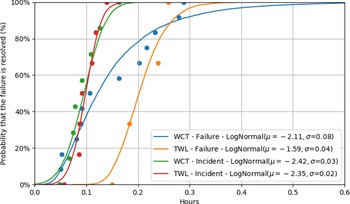
The duration of the failures – the time from when the turn occurred to when it was corrected – was also measured for the incidents and failures. The scatter plot in Figure 9 sorts the failure duration from the fastest to the slowest detection of failure, whereby a probability over time can be defined. The figure also contains a lognormal distribution representing each scatter plot, and the legend contains these distributions μ and σ. The lognormal distribution used is illustrated as (Limpert et al., Reference Limpert, Stahel and Abbt2001)
 $$p\left( x \right) = {1 \over {{\rm{\sigma x}}\sqrt {2\pi } }}{e^{\left( { - {{{{\left( {\ln \left( x \right) - {\rm{\mu }}} \right)}^2}} \over {2{{\rm{\sigma }}^2}}}} \right)}}$$
where μ is the mean and σ is the standard deviation of the normally distributed logarithm of the variable.
Scatter plot with WCT and TWL failures, including a lognormal distribution.

The number of failures is too few to make any strong claims regarding failure duration. However, the figure indicates that the area under surveillance by the VTS tends to correct courses faster compared with the failures identified solely by AIS. Most of the observed incidents and failures were resolved between 5 and 15 minutes. The WCT failure has the longest duration, probably because a small deviation from the normal behaviour is more difficult to detect than a large deviation.
4. Discussion
Active navigational errors were quantified using three different approaches: historical accidents, reported incidents and the proposed methodology using only AIS data to identify failures. These three methods yielded comparable probabilities; however, the results vary greatly across the different locations. For example, Table 1 depicts a large difference in accident probability across different bridges, from 8.7 × 10⁻⁵ to 7.8 × 10⁻² allisions per passage. Some bridges are located in waters surveyed by VTS and some are not; some have multiple physical markers indicating the fairway and some have no physical markers. Furthermore, most bridges in Scandinavia have not experienced any ship allisions, resulting in a probability of zero allisions per passage. Therefore, using historical data on allision accidents does not offer good guidance for the estimated probability of active navigational errors.
Adding VTS reports to incidents from the Great Belt VTS area to this study expanded the failure statistics. Given these incidents, the failure frequency ranged from 1.3 × 10⁻⁵ to 5.3 × 10⁻⁵ per hour for the five failure types. The event frequencies in Table 2 should be regarded as a lower limit, since 31 of the 87 reports were not available for this study to categorise. Furthermore, there is no guarantee that all events are reported and it is assumed that some events were resolved before any incident report was created. The failure probability is also reduced by the increased awareness aboard the ship due to VTS reporting and many ships using pilots. Nevertheless, the paths of the ships involved in historical accidents and of the ships guided by the Great Belt VTS provided valuable insights for the setting up of the AIS-based methodology.
In the final study, the historical frequency of failure per bridge ranged from 0 to 1 × 10⁻³ failures per passage. Again, this indicates that the failure probability is sensitive to the local geography of the bridge site. Neither the TWL nor the WCT showed an even distribution of failures across the studied bridges. Specifically, in analyses of TWL failures, an accident and failures were found only at the Bergsøysundbrua, which reinforces that local conditions surrounding the bridge are of great importance. Separating out the data per bridge would increase the frequency of failure to 16 × 10−4 failures per hour at the Bergsøysundbrua and decrease the frequency of failure at the other bridges to 0. The number of TWL errors has been translated into failures/hour, although in some cases, it might be more appropriate to measure and use this failure in terms of failures per passage. Comparing statistics of accidents and incidents caused by a WCT or TWL with those of failures are unbalanced, since a ship on an erroneous course may miss the bridge or pass under the bridge at a different location than intended if the ship height is lower than the bridge deck and the distance between the pylons are large enough.
The number of years for the time period in which the traffic volume was measured differ between Tables 1 and 3. Furthermore, the total number of passages for the Bergsøysundbrua comprises ships that pass outside the bridge and also pass under the Gjemnessundbrua. The frequencies of the active navigational errors from the three studies are summarised in Table 4.
Summary of the frequency of accidents, incidents and failure identified by AIS data. The accident and failure rates for the TWL error corresponds to the Bergsøysundbrua location

Comparing the failure frequency and the accident frequency in Table 4 enables a calculation of the causation factor. Even if many weak assumptions are used to estimate the probability based on accidents, a causation factor of approximately 0.2 might be appropriate for these types of failures.
The methodology presented in this paper requires historical AIS data and can be applied anywhere in the world. However, the number of lines and their exact locations must be tailored separately for each location. The results of the case study indicate that the probability of this type of active navigational error is highly dependent on the local geographical situation and natural sailing routes, as some geographical situations might be misunderstood by the navigator. Clear AtNs and a VTS seem to have a major effect on decreasing accident frequency: based on the incident reports from the Great Belt VTS area, it seems likely that the VTS prevented many failures from turning into accidents. While the scope of this study was not to quantify the effects of VTS, the findings are consistent with those from Lehn-Schiøler et al. (Reference Lehn-Schiøler, Hansen, Melchild, Jensen, Randrup-Thomsen, Glibbery, Rasmussen and Ennemark2013), who demonstrated that the VTS reduces the accident frequency by 60%–90%. Since multiple failures were found and no accidents are listed in the accident databases, a 90% reduction of accidents due to VTS guidance seems more reasonable than a 60% reduction.
This study has focused on Scandinavia, with relatively few accidents on inland waterways. Due to a higher percentage of Danish waters having VTS coverage compared with Norwegian and Swedish waters (in addition to other differences), the three countries are not as comparable as initially thought. This shows that the estimated probabilities from one country might not be applicable to another country, even a neighbouring one.
As illustrated in Figure 8, it is sometimes difficult to distinguish between the failures of WCT and missing turning point, as sometimes only small adjustments close to the bridge are needed to avoid an accident. As WCT failures can be mistaken for scenario 1 failures or for missing turning point, it is important to not include the same tracks several times when making failure statistics.
The offset of +/− 6 degrees from the normal course, which was common for WCT failures, is a small deviation that is hard to detect over a short distance. However, after 1 nautical mile, a 6-degree offset places the ship 193 meters from of the intended track, which in many locations is sufficient to strike a bridge. The further away from the bridge the turn is located, the larger the spread of possible locations to strike, but also the larger the probability that the failure is detected and an accident is avoided. A change from uniform distribution to a fan spread around the centre line of the route decreases the accident probability, since a ship slightly off-course may still pass the bridge line without contact.
The methodology, to quantify WCT and TWL errors, is not limited to ship–bridge allisions, but could also be used in other risk assessments of maritime infrastructure projects such as OWFs. The WCT and TWL errors may, for example, explain some of low Minimum Passing Distance that was found by Yu et al. (Reference Yu, Liu, Teixeira and Soares2020).
Comparing the results from this study with the accident probability of 3.2 × 10⁻⁶ per passage generated by the 2% uniform distribution and a causation factor of 1.6 × 10⁻⁴ is difficult. Because they are defined in different units, the geometrical factor is included in different manners, and the WCT and the TWL have duration functions connected to them that the 2% traffic does not have. As previously indicated, most bridges in Scandinavia have not experienced any allisions. Further studies are needed to investigate how to model these failures in future risk analyses. For example, which additional parameters could be added to better describe TWL errors, and in what types of geographical landscapes or situations are these types of failure found? Furthermore, we also recommend that future studies define these failure types even clearer, to avoid any potential overlaps between the different failure categories.
4.1. Extended analysis
This methodology for detecting active navigational failures was developed based on Scandinavian waters; however, it can also be applied elsewhere. Failures near the Sunshine Skyway Bridge and the central passage of the Chesapeake Bay Bridge-Tunnel in the USA (see Figure 10) have been investigated. For this subsection, AIS data from 1 January 2019 to 31 December 2023, retrieved from NOAA (2025a), were pre-processed using the method presented by Hörteborn (Reference Hörteborn2021). Each location is unique and local knowledge – such as identifying which ships are involved in maintenance work – is important for excluding these ships from the analysis, as they often manoeuvre differently. Furthermore, these locations in the US are very busy and several candidates were disregarded due to the traffic performing collision-avoidance manoeuvres.
One example from the Sunshine Skyway Bridge (left) and one from the Chesapeake Bay Bridge-Tunnel (right). To understand the local characteristics, sea charts of the areas were obtained from NOAA (2025b).

Accident data from IHS Fairplay (2023) for these locations were studied and one suspected blackout was identified south of the inlet to the Chesapeake Bay Bridge-Tunnel area. Using the methodology from Hörteborn and Ringsberg (Reference Hörteborn and Ringsberg2021), to detect this kind of failure, another blackout was also identified. Regarding active navigational failures, two turns near the Sunshine Skyway Bridge were investigated and one WCT failure was identified, corresponding to a probability of 0.6 × 10⁻⁴ per turn. At the Chesapeake Bay Bridge-Tunnel, the turn south of the northern tunnel was examined and one WCT failure was also found, corresponding to a probability of 1 × 10⁻⁴ per turn.
5. Conclusion
Risk assessments of ship–bridge allisions include several types of risks. The aim of this paper was to investigate current practices of modelling active navigational errors, both in terms of the behaviour and its probability. The active navigational error was further divided into Wrong Course at a Turning point (WCT) and making a Turn at the Wrong Location (TWL). This research indicates that the standard assumption of a uniform distribution of active navigational failures of 2% of total traffic volume does not provide an accurate estimation. Instead, based on the studied areas surrounding selected bridges in Norway, Sweden and Denmark, the frequency of active navigational errors is closer to 0.01% per passage.
The accident probability due to these failures – apart from the event probability – was also investigated. For converting the errors into accidents, a causation factor of approximately 0.2 is suggested, compared with the current causation factor of 1.6 × 10⁻⁴. This combination of reducing the event probability and increasing the causation factor keeps the accident probability within the same range as current practice, but provides a more realistic representation of the situation.
The research also highlights that the probability of this type of incident varies greatly from bridge to bridge, depending on the geometrical layout of the routes and the locations of bridges with respect to the routes. However, in an extended analysis, two bridges in the USA were studied and the failure probability of WCT seemed to be in line with the results from Scandinavia. In this extended study, no TWL failures were found, probably due to the restricted water depth outside these fairways. Vessel Traffic Services and Aids to Navigation are important factors decreasing accident and failure rates. Areas with islands that could mislead the navigator increase the probability of incidents. The current practice seems to be unreasonably conservative for most bridges and there is a potential for cost savings on many new bridges by designing them according to the correct risk level.
When performing risk assessments for allisions, it is recommended to tailor both the failure probability and the causation factor with respect to the local characteristics, since each area is unique. Further research is recommended to define different types of failure even more clearly to avoid any potential overlaps between different failure categories. Another recommendation includes investigating more bridges, all around the world, so that it is easier to find suitable estimates for probabilities during the planning and design of new bridges. Finally, it is also recommended to investigate the importance of accident frequencies and the duration of failures in a risk assessment.
Acknowledgement
The authors want to express their gratitude to their supervisors and Preben Tendrup Pedersen for their feedback on the manuscript.
Competing interests
The authors declare that they have no known competing financial interests or personal relationships that could have appeared to influence the work reported in this paper.
Author contributions
Axel Hörteborn: Conceptualisation, Methodology, Software, Formal analysis, Resources, Writing – Original Draft, Visualisation. Mathias Egeland Eidem: Conceptualisation, Resources, Writing – Original Draft.
Appendix A
-
1. Bergsøysund Bridge North
-
1.1 Must pass:
LINESTRING(7.85767623 62.9979744, 7.87784036 63.00189007)
LINESTRING(7.7717087 62.9667978, 7.78530577 62.97433222)
-
1.2 Cannot pass:
LINESTRING(7.85467564 62.98854102, 7.8550577 62.99703355)
-
1.3 Cannot end or start in:
Polygon((7.8352712 62.99654648, 7.86219545 62.97067655, 7.9131502 62.99357618, 7.89224485 63.00699209, 7.8352712 62.99654648))
-
-
2 Bergsøysund Bridge South
-
2.1 Must pass:
LINESTRING(7.96747887 62.98713089, 7.87987959 62.9766836)
LINESTRING(7.7717087 62.9667978, 7.78530577 62.97433222)
-
2.2 Cannot pass:
LINESTRING(7.86890413 62.98263256, 7.87060542 62.98461753)
LINESTRING(7.96182023 62.99254852, 7.94934565 62.99900163)
-
2.3 Cannot end or start in:
Polygon((7.8352712 62.99654648, 7.86219545 62.97067655, 7.9131502 62.99357618, 7.89224485 63.00699209, 7.8352712 62.99654648))
-
-
3 Nordhordland Bridge
-
3.1 Must pass:
LINESTRING(5.29632052 60.53738674, 5.30769923 60.53388718)
LINESTRING(5.27075141 60.52345048, 5.27237147 60.52205349)
LINESTRING(5.27300912 60.52020672, 5.27053009 60.52111416)
-
3.2 Cannot pass:
LINESTRING(5.26988008 60.52109899, 5.25838969 60.52949004)
-
3.3 Cannot end or start in:
'Polygon((5.24369935 60.52449397, 5.28421081 60.51113756, 5.29755881 60.52420694, 5.27155725 60.53941871, 5.24369935 60.52449397))
-
-
4 Sandhornøy Bridge
-
4.1 Must pass:
LINESTRING(14.23286877 67.06478253, 14.23466642 67.06932396)
-
4.2 Cannot pass:
LINESTRING(14.24280314 67.06213337, 14.25543399 67.06274835)
-
-
5 Sundklakk Bridge
-
5.1 Must pass:
LINESTRING(14.16490367 68.24011781, 14.21845676 68.25862999)
LINESTRING(14.25565771 68.27826538, 14.27584184 68.27094864)
-
5.2 Cannot pass:
LINESTRING(14.15135011 68.26871251, 14.1619285 68.26871251)
-
-
6 Tromsø Bridge North
-
6.1 Must pass:
LINESTRING(18.98432124 69.65630547, 18.97817694 69.65811273)
LINESTRING(18.97981592 69.65091366, 18.97785652 69.65134703)
-
6.2 Cannot pass:
LINESTRING(18.97030936 69.65443597, 18.98203812 69.66306656)
LINESTRING(18.97389622 69.65254572, 18.97684685 69.66078904)
LINESTRING(18.98045215 69.65408558, 18.98030462 69.65982087)
-
6.3 Cannot start or end in:
Polygon((18.96108971 69.6538511, 18.98764431 69.68283578, 19.03441178 69.66218137, 18.98728811 69.64659343, 18.96108971 69.6538511))
-
-
7 Tromsø Bridge South
-
7.1 Must pass:
LINESTRING(18.97421719 69.64955505, 18.97001098 69.65085202)
LINESTRING(18.97981592 69.65091366, 18.97785652 69.65134703)
-
7.2 Cannot pass:
LINESTRING(18.97001098 69.65085202, 18.95865211 69.64358979)
-
7.3 Cannot start or end in:
Polygon((18.96108971 69.6538511, 18.98764431 69.68283578, 19.03441178 69.66218137, 18.98728811 69.64659343, 18.96108971 69.6538511))
-
-
8 Great Belt Bridge
-
8.1 Must pass:
LINESTRING(10.99998742 55.38056102, 10.80949379 55.39700711)
LINESTRING(11.02687243 55.34078876, 11.04563254 55.34326807)
-
8.2 Cannot pass:
LINESTRING(10.8521844 55.29928099, 10.93978668 55.31746259)
LINESTRING(10.78304782 55.3606439, 10.78734529 55.50841076)
-
-
9 Farø Bridge
-
9.1 Must pass:
LINESTRING(11.97908369 54.94271162, 11.98122086 54.94433137)
LINESTRING(11.9732796 54.94255415, 11.97636162 54.94446635)
-
-
10 Storestrøms Bridge
-
10.1 Must pass:
LINESTRING(11.89578686 54.96578355, 11.89780853 54.96831286)
LINESTRING(11.88438758 54.96610587, 11.88666929 54.96813417)
-
-
11 Öresunds Bridge
-
11.1 Must pass:
LINESTRING(12.87903036 55.613139, 12.82117515 55.62194856)
LINESTRING(12.81722786 55.57731676, 12.8500241 55.57041735)
-
11.2 Cannot pass:
LINESTRING(12.80476675 55.58235635, 12.82159525 55.62199131)
-
11.3 Cannot start or end in
Polygon((12.76754237 55.55611409, 12.85151991 55.53278295, 12.93297461 55.5896768, 12.90709518 55.64295592, 12.76754237 55.55611409))
-
-
12 Ölands Bridge
-
12.1 Must pass:
(LINESTRING(16.39908282 56.68280616, 16.40370144 56.68181608)
OR LINESTRING(16.39797342 56.68312164, 16.39389082 56.68380739))
AND LINESTRING(16.39473408 56.67908068, 16.39594198 56.67885266)
-
12.2 Cannot pass:
LINESTRING(16.4119858 56.68905936, 16.41683171 56.68597995)
LINESTRING(10.78304782 55.3606439, 10.78734529 55.50841076)
-







 Open access

