

Following the Second World War, the United States experienced economic prosperity and, at the same time, turned away from its general policy of isolationism to one more focused on international engagement. The letter Peter wrote to his mother in 1948, before emigrating to the United States, was prescient. As noted in Chapter 6, Peter had written about his concerns over a New York Times article implying that America was already preparing and ready to enter another war, and had said, “I hope not.” In 1949, the United States rejected its prior policy of having no military alliances in peacetime by forming the North Atlantic Treaty Organization (NATO) in response to the growing tensions between the United States and the Soviet Union. The first post-war US military engagement started shortly after Peter’s US citizenship was confirmed. Else was relieved to have her sons in the US, but the concerns Richard and Else had written about were valid. Peter, as a US citizen, would be drafted into military service in the United States.
However, as a physician, Peter was eligible for the “Doctor Draft,” which began at the outbreak of the Korean War and continued through the Vietnam War (1950–1973), allowing physicians to fulfill their military service obligations while doing medical research. The National Institutes of Health (NIH) was part of the Public Health Service and provided an alternative form of service for trained physicians. An option for fulfilling this commitment included performing research in the NIH Associate Training Program (ATP), the so-called “Yellow Berets.” This break from clinical duties to focus on research allowed for physicians to train in science and bring a critical translational perspective of clinical relevance to basic biomedical research. The program was highly effective and succeeded in training many of the next generation of physician scientists and physician leaders [Reference Khot, Park and Longstreth1]. Unlike current MD/PhD training programs in the United States that were developed in the 1980s, the NIH training occurred after completing medical school and/or part of residency training. Peter started in the NIH program in 1958 after completing his internship in internal medicine at Peter Bent Brigham and Women’s Hospital in Boston, but before his clinical pediatric neurology training.
Peter was excited to embark upon basic neuroscience research. He had developed an interest in understanding how the electrical activity of the brain changed during sleep and wakefulness. For his research training, he selected the laboratory of a talented and energetic young physician scientist and psychiatrist, Ed Evarts, at the National Institutes of Mental Health (NIMH). Ed Evarts had been stationed on torpedo boats in the Navy during the Second World War but was subsequently taken out of the Navy to start his medical training at Harvard Medical School. He graduated from medical school in 1948 and then started an independent research program at the NIH using electrophysiology to understand changes in the activity of brain cells in the cortical regions of the brain under different conditions. Evarts had pioneered the methods to record the electrical activity (measured in voltage or current) in single cortical neurons in cats and monkeys. These recordings detect changes in electrical activity or electrical impulses that mediate communication between neurons. A large transient electrical signal, referred to as an action potential, travels along axons of the presynaptic neurons. This electrical activity triggers the release of a neurotransmitter at the synapse, where it affects the activity of the responding (post-synaptic) neuron, and can be detected by the electrophysiology methods that Evarts developed.
Evarts recruited several “Yellow Berets” into his research group, including Peter and a young psychiatrist, Irwin Feinberg, who later was the first person to propose that synaptic pruning is aberrant in schizophrenia. When interviewed in May 2022, Feinberg described the research environment in the Evarts laboratory as “terrific” and highly dynamic. Evarts was a meticulous scientist with a “fanatical attention to detail,” but also with an openness to new ideas and the broad interests of his trainees. As Feinberg said, Evarts allowed them to do “whatever they wanted to do in the lab.” Peter and Irwin did not work together on a project but were always friendly and supported each other. Feinberg said that Peter had “an instinct or judgement for what was important in a scientific problem – he showed that early on in Ed’s lab. It was early years of sleep research, shortly after the discovery of REM sleep – and there were lots of nuggets to be picked up.” He also recounted that “Peter first observed neural discharges during REM sleep, and his paper was incisive. Peter focused on a major issue and was not distracted – it was easy to get distracted in the early years of sleep research.” Furthermore, Feinberg said: “Peter did an amazing study – it is still very important to sleep research – this work has deserved more attention than it has gotten.”
Peter delved into laboratory research by recording the electrical activity of single cortical neurons in cats during both sleep and wakefulness. Before the 1950s, sleep was thought to be a passive state, like the brain’s response to general anesthesia, where brain activity is dormant. However, in 1953, Aserinsky and Kleitman reported in a short letter to Science that eye movements increase in humans during sleep [Reference Aserinsky and Kleitman2]. These authors elegantly recorded and quantified eye movements using an “electrooculogram” used to pick up eye movements during sleep. They found that detailed dreaming was associated with increased eye movements, or “ocular motility,” later referred to as the REM phase of sleep.
Peter found something surprising in his recordings of single cortical neurons in sleeping cats. The “single unit activity” in some parts of the brain was higher during sleep than during waking. This study, published in Science in 1962, was the first to show that the electrical activity in the brain is higher during certain phases of sleep [Reference Evarts, Fleming and Huttenlocher3]. He found that during waking, there was more variance in the activity of individual neurons than during sleep. Neurons that fired rapidly during wakefulness tended to fire less rapidly during sleep. However, neurons with generally lower discharge rates tended to fire more during sleep than during waking. Altogether, Peter found that there was a generally higher neuronal discharge rate during sleep than during waking. The findings showed that there was a general change in the pattern of electrical activity in the brain during sleep, and that sleep did not represent a quiescent phase of the brain’s electrical activity. Sleep is an active electrical state. In contrast to the unresponsive state of a patient under anesthesia, like the “Ether Dome” patient (with relatively constant brain waves), they found that sleep is entirely different, with cycles of more and less brain activity.
As Peter’s long-time friend and Nobel Prize winner Eric Kandel said in a message for Peter’s memorial service, in September 2013, “What is less often considered is Peter was outstanding from the very beginning of his career.” Eric continued:
His first two articles were extraordinary. In his work with Ed Evarts at NIH, he was one of the first people to record electrical activity in the brain from living animals. He recorded from the visual system of animals. He discovered that the firing patterns changed with different periods of sleep and wakefulness. And this was one of the first precursors to the insight that sleep is not uniform – that there are periods of greater activity and periods of less activity. And as it later turned out, periods of greater activity are associated with REM sleep, with dreaming sleep. Peter was one of the precursors of appreciating the different phases of sleep. This was a fabulous contribution.
Making an important finding can be transformative for a junior scientist, and Peter’s findings with Ed Evarts changed thinking about brain dormancy and sleep. However, as was often the case with Peter, as Feinberg said, “he was humble and quiet about his accomplishments.” He did not bring attention to his work and he was not comfortable being the “salesman.” Feinberg recalled that Peter was sometimes “unbending – he was a hard man in some respects” and did not “suffer fools gladly.” Also, “Peter had a harsh opinion of people getting a lot of attention in science – the showy people in science.” Feinberg said that Peter shared this disdain with Ed Evarts and, together, the three of them would make fun of the big shots at NIH – people who spoke eloquently but did not have much substance with their science. This hesitancy on the part of Peter for showmanship surely hindered his science, especially later in his career. He struggled at times with NIH funding and hesitated to advertise his discovery of synaptic pruning. Indeed, it was not until the early 2000s when someone else told me that my father had discovered synaptic pruning that I realized the magnitude of his work. It is certainly possible that, if he had had more of a flare for promotion, others would have grasped the importance of synaptic pruning earlier and it would have expedited further discovery in the field. He might have run a large laboratory group and followed up his findings in more diverse ways. It is also possible that acceptance of his new findings simply required time, and corroboration by other scientists. But what was clear early on is that Peter knew how to go after the important questions in science. Feinberg said, “Peter did not waste his time on trivial projects just to get papers published – other people did this to beef up their CVs. Peter quietly focused and discerned and knew how to choose a problem worth working on – Peter was a genius at that.” During the years in the Evarts laboratory, Peter’s thinking about science was transformed. Even after years of clinical work that distracted Peter from science, Peter continued in the ways of his mentor Ed Evarts, and throughout his career approached science with a similar “fanatical attention to detail.”
In addition to the science, Peter and Janellen enjoyed an active social life with the neuroscience community at NIH. Feinberg recalled that “Janellen was wonderful – brilliant and charming. She had a great relationship with Peter and he respected her, and he respected her independence.” Janellen was the more outgoing of the pair – and formed close friendships with some of the career-oriented wives of the “Yellow Berets.” Ed Evarts’ wife, Josephine, was a colorful scientist from the south, who was unconventional and outspoken. Janellen, who went on to become an internationally recognized cognitive psychologist, formed a close and lifelong friendship with Denise Kandel, a social scientist and wife of Eric Kandel. Both Janellen and Denise were completing their PhDs remotely as their husbands worked at NIH. As Feinberg said about Eric Kandel, “Eric was ambitious, more ambitious than I realized then, but very congenial. At the time he was a clinically oriented neuroscientist – charming and a jokester.” And as Irwin happily understated, “it all turned out very well for him.” Eric Kandel, together with Arvid Carlsson and Paul Greengard, won the Nobel Prize in Physiology or Medicine for his discoveries related to memory and signal transduction in the nervous system of a simple model organism, the sea slug Aplysia.
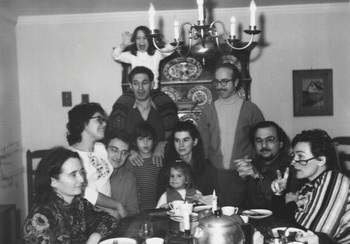
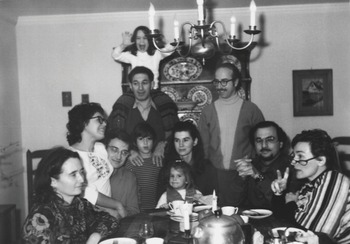
Like Peter, both Eric and Denise Kandel were immigrants from Europe, and they formed an immediate connection that – together with their interests in neuroscience, music and art – led to a close friendship as they raised their families together in Washington, DC, then Boston, and then the New York area (Figure 9.1). They also developed a shared interest in expressionist art and explored remote art galleries in the search of new art. Each family still owns copies of the same Max Beckman print, of a lady with an askance gaze and a pearl necklace. German expressionist art reflected the angst in Germany before and during the war and stimulated an obsessive interest of Peter’s throughout his life – the raw human emotion and hidden angst that he rarely spoke about. Although each of their stories were different, Peter, Eric and Denise all shared this angst having grown up in Europe during the war. Unlike Peter, both Eric and Denise came from Jewish families. Eric was born in Vienna and fled the country when he was nine with his older brother, to join his uncle in New York City where they were later joined by his parents. But Denise, like Peter, spent all of her childhood in Europe during the war. Denise was raised in a secular Jewish family in France before the war and was placed in a convent for safety during the war. The nuns of Sainte-Jeanne d’Arc of Cahors safeguarded Denise and raised her as a Catholic. Denise later said (February 14, 2022) that she knew “more about Catholicism than the Jewish faith,” and even took her first communion in the convent. Denise’s father survived his years in an internment camp south of Paris and Denise reunited with her family after the war, then immigrated to the United States in 1949, arriving there around the time that Peter did. During these years Peter rarely spoke about his childhood experiences in Germany, to his friends or even to Janellen. As a Kriegskind (war child), Peter responded as a classic post-Second World War stoic. His friends Denise and Eric were more forthcoming about their pasts. Peter worked to forget, or at least to not tell. It was not until many years later that he began to share stories from his childhood.
During the NIH years, Peter and Janellen welcomed their first child. The story of his arrival became an oft-told tale that reflected the quirky humor of both Peter and Janellen. Janellen went into labor in the middle of a hot summer’s night in Washington, DC. Peter did not know where the hospital was but drove forth anyway, in their dilapidated vehicle with broken headlights. Janellen described Peter nervously driving to the hospital, uncertain of where he was going but unwilling to pull over and ask directions. It was difficult to navigate the darker streets without headlights. Janellen, grimacing in labor, shined a flashlight out of the front window of the car as they maneuvered their way. As they approached what they thought was the hospital they were greeted by “large guards with massive machine guns,” who promptly turned them away. They had arrived at the Pentagon! Flustered and confused, and suppressing his lifelong disdain of authority, Peter turned around, unsure of where to go. They were pleasantly surprised when a nearby police officer took pity on the young couple and escorted them to the hospital. Their joint retelling of the story was classic Peter and Janellen: cheerful deprecation, enjoyment of slapstick comedy. They both loved the weekly US 1960s comedy show Rowan and Martin’s Laugh-In and the family rarely missed an episode. Peter would laugh uproariously during the hour-long shows riddled with “ridiculous” political and social commentary. Laugh-In was the source of a punch-line they injected at the end of stories for rest of their lives, whether discussing people or science: “And that’s the truth.”