


Introduction
Illegal logging, or illegal harvest of logs, often refers to extracting logs by violating regulations or legislations (Tacconi Reference Tacconi and Tacconi2007). Illegal logging is an umbrella concept which covers a wide variety of unlawful activities within environmental conservation, forestry management and timber production. In order to specify the illegal activities of interest in this study, we use the term ‘tree poaching’, which has a narrower definition specifically referring to taking of single trees by individuals or small groups (Pendleton Reference Pendleton and Tacconi2007), instead of illegal logging. Pendleton (Reference Pendleton and Tacconi2007) considered three types of tree theft found in North America, namely timber trespass (Type I), timber theft (Type II) and tree poaching (Type III), where tree poaching is the ‘highest in manifest deviance and lowest in legitimate affiliation’.
Taking a social interactionist perspective, Pendleton (Reference Pendleton and Tacconi2007) considered ‘tree theft’, compared with ‘tree poaching’, to be less labelled by the community. In fact, the community might be involved in its ‘participation, knowledge, acceptance and support’ of most of the tree theft related activities, as in the case of Gunung Palung National Park in Indonesia, where nearly half of the households relied on illegal logging during the late 1990s (Hiller et al. Reference Hiller, Jarvis, Lisa, Paulson, Pollard and Stanley2004). Use of ‘timber trespass’ might downplay illegality as this can result from accidentally cutting trees as part of legitimate commercial timber logging, which was what happened in the Peruvian Amazon (Finer et al. Reference Finer, Jenkins, Sky and Pine2014). Neither tree theft nor timber trespass fits the illegal logging phenomenon in Taiwan. Therefore we adopt ‘tree poaching’ or sometimes ‘illegal logging’ to refer to illegal forestry activities and ‘tree poachers’ to refer to people who committed actions of Forestry Act violation.
Tree poaching in Taiwan: the problem
Among the highly forested areas where illegal logging prevails, Asia is widely studied as it has suffered disproportionate forest loss (Rosander Reference Rosander2008, Yasmi et al. Reference Yasmi, Broadhead, Enters and Genge2010, Felbab-Brown Reference Felbab-Brown2011). Taiwan is also among the cases where high-value timber is endangered. Over 60% of the land in Taiwan is covered by forest, of which 69% are reserved areas owned by the state (Forestry Bureau 2017). High-value timber in remote forests is often targeted by poachers, who are commonly referred to in Mandarin as shan lao shu (‘mountain rats’). Likewise, Pendleton (Reference Pendleton and Tacconi2007) uses ‘shake rats’ to describe tree poachers. Individual or small group poachers who are least accommodated by communities are often the primary focus of forestry law enforcement (Felbab-Brown Reference Felbab-Brown2011, Linkie et al. Reference Linkie, Sloan, Kasia, Kiswayadi and Azmi2014).
Although most of the detected cases in Taiwan can be categorized as tree poaching, they have various forms of practice. To name a few, the current common typologies of illegal forestry practices in state-owned forests in Taiwan include (Jhang Reference Jhang2006, Leu Reference Leu2011, Forestry Bureau 2019): (1) extraction of burl wood of high-value species, such as Taiwan yellow cypress (Chamaecyparis obtuse var. formosana) and Taiwan red cypress (C. formosensis); (2) felling and transporting wood of high-value species; (3) extraction of the fruiting bodies of the parasitic fungi, Antrodia cinnamomea and A. salmonea, by extracting dead stout camphor trees (Cinnamomum kanehirae) or, sometimes, logging standing live stout camphor trees; and (4) felling and taking stout camphor trees in order to grow and extract the fungus inside. In Taiwan, the theft of stout camphor trees has escalated to become one of the major tree poaching activities in recent years (Li Reference Li2013). Antrodia cinnamomea, which has been used by native Taiwanese as an ethnomedicine, was recently found to confer ‘antioxidant and anticancer effects’ (Yang et al. Reference Yang, Chen, Chang, Lu, Lai, Chen and Hse2006). In order to cultivate A. cinnamomea, an underground market of stout camphor trees has therefore proliferated.
Tree poaching and law enforcement
Although tree poaching is a common problem faced by governments around the world, responses vary. Three major approaches have been adopted to combat the problem, namely: demand-oriented, supply-oriented, and control of the trade (Brack Reference Brack2003). The last three decades have witnessed a trend of control of the illegal timber trade by focusing on criminalization of illegal logging in the name of forestry conservation (Pendleton Reference Pendleton1997, Kaimowitz Reference Kaimowitz2003, Yasmi et al. Reference Yasmi, Broadhead, Enters and Genge2010, Sikor & To Reference Sikor and To2011). To show the government’s determination to fight against tree poaching, Taiwan has been through different stages of Forestry Act enforcement since installing a blanket logging ban in 1991 (Liao Reference Liao2017).
From 1991 to 2003, the Forestry Act was largely under-enforced because the forestry department was heavily under-staffed. Tree poaching became prevalent and intertwined with local livelihoods in rural mountainous areas. As a response to public criticism of the under-enforcement of the law, the Taiwanese government in 2004 formed a centralized Forest and Natural Reservation Task Force under the Council of Agriculture, with 178 police dispatched to eight local bases to specifically tackle illegal logging. After 2014, the task force was integrated into the Seventh Special Police Corps of the National Police Agency under the Ministry of Interior. In 2015, stiffer sentences with a minimum of six months in prison were also introduced by revising the Forestry Act (Liao Reference Liao2017).
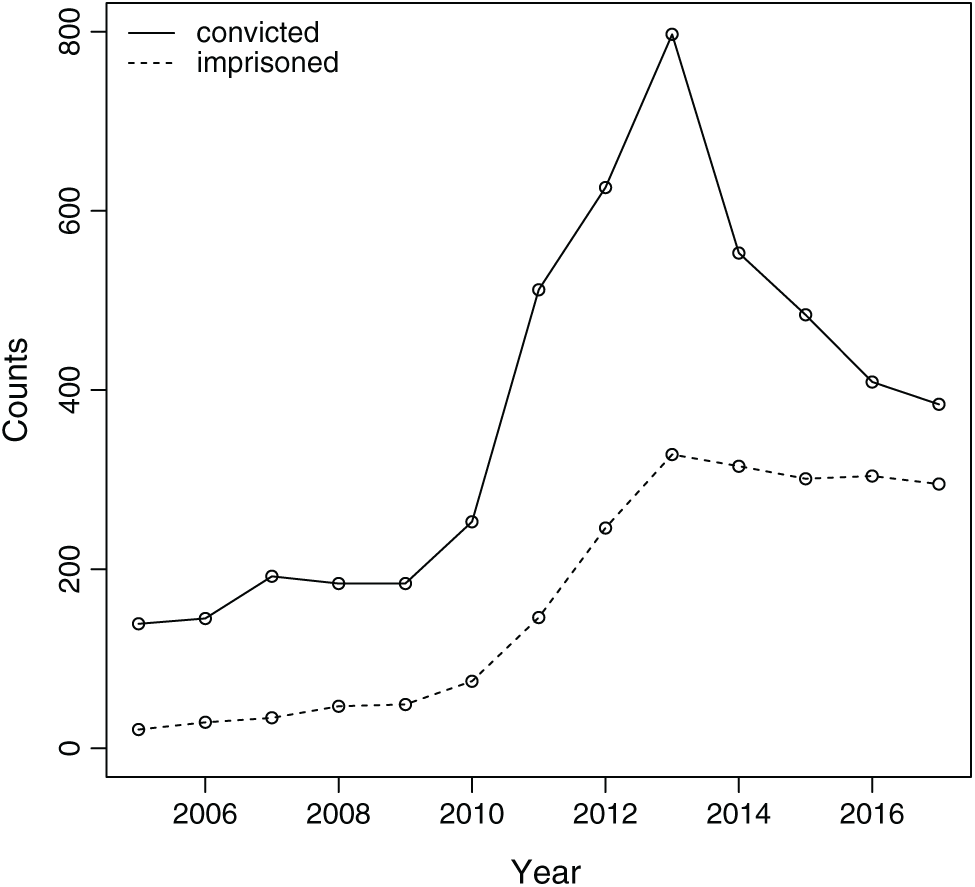
Figure 1 shows the trend of convicted offenders and imprisoned inmates for Forestry Act violations from 2005 to 2017 in Taiwan. Although the number of convictions for Forestry Act violations decreased after a 2013 peak, the number of imprisoned inmates remained steady at ∼300 persons every year (Ministry of Justice 2019). Almost every convicted tree poacher ends up in prison; 95% of offenders receive incarceration sentences (Ministry of Justice 2019). Although it is suspected that the reoffending rate is high, official statistics are not available. A study on 79 offenders (2006–2009) found 13.9% had previous Forestry Act conviction records (Hung Reference Hung2009). Thus the official data show that a greater level of law enforcement seems to have a limited deterrence effect, which raises several questions. What will make the tree poachers consider giving up poaching? If the tree poachers realize that they will get prison time when they reoffend, will they stop tree poaching? What are the reasons behind their decision to continue tree poaching?
Trends in Forestry Act convicted offenders and imprisoned inmates in Taiwan (2005–2017).
Because empirical studies on tree poachers are few, we decide to draw lessons from a broader literature on conservation and human behaviour, such as the social-psychological model of conservation behaviour (St John et al. Reference St John, Edwards-Jones and Jones2011a, Reference St John, Keane, Milner-Gulland, MacDonald and Wills2013). Enforcing the law is only one of the conservation interventions aimed at changing human behaviour by negative incentives; this ‘sticks’ strategy has been criticized (Duffy et al. Reference Duffy, St John, Büscher and Brockington2016). Cerutti and Tacconi (Reference Cerutti and Tacconi2008) also warned that without considering deliberate marginalization of rural communities, law enforcement alone could lead to further victimization of vulnerable rural groups.
Scholars have called for studies of the motivations behind illegal hunting and poaching to develop a more comprehensive policy (Duffy et al. Reference Duffy, St John, Büscher and Brockington2016). They also challenged the legitimacy of legislation and stressed that regulation, rather than blanket bans, might be the answer to the problem. In Honduras and Nicaragua, several legal and institutional constraints, such as unclear and complex regulations and overlapping government responsibilities, have been recognized as preventing people from logging legally (Richards et al. Reference Richards, Wells, Gatto, Contreras-Hermosilla and Pommier2003). In Cameroon, a large-scale illegal log harvest occurred during 1999–2006 due to an illicit ministerial regulation which suspended all small-scale logging titles (Cerutti & Tacconi Reference Cerutti and Tacconi2008). Since the forestry regulations and laws regarding forestry control in many countries are often set by elite groups without involvement of community members, there is serious doubt over the legitimacy of law enforcement (Rosander Reference Rosander2008; Alemagi & Kozak Reference Alemagi and Kozak2010).
Increasing law compliance behaviour
In addition to deterring unlawful timber activities, it is equally important from an environmental conservation perspective, if not more so, to encourage law compliance behaviour. In Haiti, five factors conducive to conservation behaviour were: information on benefits of forests, increasing annual income, improving education, strengthening organizational memberships and increasing women’s involvement (Dolisca et al. Reference Dolisca, McDaniel, Shannon and Jolly2009). In Nepal, forestry practices were lenient and forestry rules were less emphasized than the application of conservation measures, because forest crimes were rarely committed for personal gain (Chhetri et al. Reference Chhetri, Larsen and Smith-Hall2012). The Nepalese District Forest Office and the District Court recorded only 27 forest crimes in 22 years (Chhetri et al. Reference Chhetri, Larsen and Smith-Hall2012). Similarly, Hirakuri (Reference Hirakuri and Tacconi2007) proposed the concept of ‘forestry culture’ as the key to Finland’s lifestyle after comparing sustainable forest management in Brazil and Finland. With the forestry culture in Finland, people are closely connected to forestry in their daily lives and strict forestry sanctions, such as fines and prison sentences, are rarely applied. Instead of harsh punishment, Finnish Forestry Act violators are often sanctioned with day fines or restraining orders to restore the degraded forests (Hirakuri Reference Hirakuri2003, Reference Hirakuri and Tacconi2007). In summary, criminalization, law enforcement and tougher sanctions draw mainly from economic theory and rational choice. However, considering the complexities of human behaviour, a strategy to increase conservation behaviour has to consider social-psychological theories addressing how attitude, subjective norms and perceived degree of control shape intentions and behaviour (Duffy et al. Reference Duffy, St John, Büscher and Brockington2016).
Problem statement: individual decisions in context
The rule of law, including greater law enforcement by capacity building, is repeatedly emphasized as the key to tackling illegal logging (Felbab-Brown Reference Felbab-Brown2011, Stewart Reference Stewart, Spapens, White and Kluin2014). If forestry law is expected to serve its purpose of deterrence, more needs to be known about those people whom the legal changes target and affect. Some efforts have been devoted to addressing the influences of forestry law on rural livelihoods, but empirical evidence remains limited (Cerutti & Tacconi Reference Cerutti and Tacconi2008, Sikor & To Reference Sikor and To2011, Chhetri et al. Reference Chhetri, Larsen and Smith-Hall2012, Cerutti et al. Reference Cerutti, Tacconi, Lescuyer and Nasi2013, Linkie et al. Reference Linkie, Sloan, Kasia, Kiswayadi and Azmi2014). At the local level, more studies have investigated the causes of engaging in illegal logging (Dudley Reference Dudley2004), rather than reasons for complying with the law. Few researchers have tried to answer what makes existing tree poachers stop illegal forestry activities. To echo the call for understanding human behaviours in conservation, we need more empirical studies in different areas. In the current research, we draw from the theories of reasoned action and planned behaviour to assess existing evidence (St John et al. Reference St John, Keane, Milner-Gulland, MacDonald and Wills2013).
First of all, if people believe that they will gain benefits from tree poaching, they are more likely to engage in illegal forestry behaviour. Previous literature which explores the reasons behind tree poaching suggests that economic factors matter (Mir & Fraser Reference Mir and Fraser2003, Yonariza & Webb Reference Yonariza and Webb2007). A comparison of 1488 rural households in Indonesia’s Gunung Palung National Park with loggers and without loggers showed that loggers were more likely to be long-term residents who owned less land or livestock than non-loggers (Hiller et al. Reference Hiller, Jarvis, Lisa, Paulson, Pollard and Stanley2004). Second, people would have higher motives to offend if they felt social pressure, such as needing to support their families, to engage in tree poaching. Pendleton’s (Reference Pendleton and Tacconi2007) analysis indicates that illegal logging involves a social learning process in a wood-based economy. If the community accepts tree poaching as a means of living, people are more likely to follow the social norm. Third, if people are confident that they can practise the illegal behaviour, they are more likely to be involved in tree poaching.
Since Taiwan has long been on the path of strengthening law enforcement and imposing tougher sanctions, it is worthwhile to better understand those who are mostly affected by the government’s sweeping actions on illegal logging. Whether the social-psychological model of conservation behaviour could be applied to explain the tree poachers’ decisions in Taiwan remains an empirical question. Drawing from the previous poaching studies on the relationship between attitude and behaviour, we are interested in exploring Forestry Act inmates’ intention of stopping tree poaching, which could be a significant indicator for their behaviour after release. We take a behavioural analysis perspective to improve knowledge of the decisions of tree poachers. We admit that intention to give up tree poaching might not translate into behaviour because, first, people tend to give answers which are socially acceptable and, second, the risk of reoffending is affected by factors other than personal will. We view the answers as providing an important indicator of reoffending decision which should be evaluated along with other risk factors.
Methods
Data collection
The current study aims to explore the factors influencing the decision to give up or not by face-to-face interviews with 65 tree poachers. During the data collecting process, around 300 persons were imprisoned for Forestry Act offences in 25 correction facilities in Taiwan. We approached 10 correction facilities where Forestry Act inmates concentrate. These facilities helped us recruit voluntary inmate participants. We were able to talk to 69 inmates during April 2015 and April 2016. After excluding four Vietnamese inmates who would be deported after release, a total of 65 individuals (#1∼#65) were used for the current analysis.
Face-to-face interviews took place in classrooms or meeting rooms inside the correction facilities and each interview lasted 60–90 minutes. The interviews had eight sections, including: birth place and residence; livelihood; opinions on logging ban; the involvement in tree theft; perception and feelings of offending behaviour; interactions with law enforcers; perceptions of harm; and attitudes towards conservation and environmental laws. These conversations were recorded and transcribed for qualitative and quantitative analysis.
Dataset summary
Demographic characteristics
The age of the 65 interviewees, ranging from 22 to 70 years old, is symmetrically distributed with an average of 42 years old and standard deviation of 10 years. The other demographic characteristics are listed in Table 1. In terms of ethnicity, 44.6% self-identified as aboriginals. Over 60% of them are single or divorced/widowed. More than two-thirds have children. Around three-quarters have completed high school education (see Table 1).
Demographic characteristics of the 65 interviewees

Offence characteristics
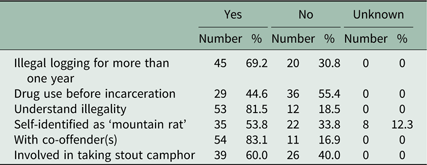
In terms of criminal activities, 69.2% had been illegally logging for more than one year. Nearly half (46.2%) can be categorized as independent log producers who personally owned chainsaws and transportation, and who performed small-scale logging independently. Other roles included helper (18.5%), driver (10.8%), entrepreneur log producer (9.2%), buyer (7.7%), log collector (6.2%) and hired log producer (day labourers) (1.5%). More than half (55.4%) were not drug users before they were arrested. The majority (81.5%) understood that tree theft is illegal before their arrest. As to their perception of their behaviour, 53.8% identified themselves as so-called ‘mountain rats’, 33.8% disagreed on this label, and 12.3% did not respond to the question on this. The majority (83.1%) had co-offenders. Sixty per cent were involved in taking stout camphor trees as part of their offence (see Table 2).
Offence characteristics (N = 65)
Punishment characteristics
In terms of punishment, sentences ranged from 7 to 268 months, with an average of 44 months incarceration (Fig. 2). Fines ranged from NT$0 to NT$26 000 000, with an average of NT$480 000 (NT1 = US$0.033, November 2019) (Fig. 3). More than 60% did not have previous Forestry Act convictions (40 out of 65). For nearly half (47.4%) of them, this was their first imprisonment experience (31 out of 65). Finally, when asked about their plans after release, 81.5% of the sample expressed their intention to give up tree poaching (53 out of 65).
Frequency of jail terms (months) of the 65 interviewees.

Frequency of magnitude of fines in NT Dollars of the 65 interviewees.

Statistics justification
We aimed to explain the answers to the question as the dependent variable (intention to give up poaching) using answers to the other 16 questions as explanatory variables using logistic regression modelling. To select candidate explanatory variables, we ran a univariate logistic regression on each of the 16 explanatory variables, retaining only the variables whose coefficient p-values were less than 0.15. Only four variables survived this selection: marriage, education, length of illegal logging and involvement in stout camphor tree theft. We tested collinearity among the selected four variables by calculating their correlation matrix. Only stout camphor tree theft and marriage (Spearman correlation coefficient = −0.14), and stout camphor tree theft and education (Spearman correlation coefficient = 0.17) showed weak correlation, suggesting adequate independence of the selected variables.
Based on the literature review, we hypothesized that people who are single or more educated are less stressed by economic pressure, thus more likely to give up tree poaching. We also hypothesized that people with no experience of stout camphor tree theft before or having involvement in illegal logging for less than one year might be more likely to give it up. It is supposed that people who have logged stout camphor trees or become involved in illegal logging for more than one year are more likely to overestimate the prevalence of tree poaching and normalize the illegal behaviour, thus reinforcing their motivation to reoffend.
The research was undertaken through logistic regression modelling and qualitative narratives. Quantitative data were used to test whether measurable and objective characteristics of the tree poachers could predict their intention to stop. The qualitative narratives are presented to explore the subjective rationales behind their decisions.
Results
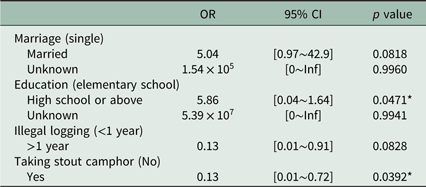
A logistic regression model identified two independent explanatory factors predicting the intention to stop tree poaching among offenders, namely education and experience of taking stout camphor trees. Specifically, if the poachers had high school education or above, they were more likely to stop than their counterparts with elementary school education. Furthermore, experience of taking stout camphor trees was associated with a decrease in willingness to give up poaching. The findings support the hypotheses that education and experience of stout camphor tree poaching predict economic motivation. Neither marriage nor length of time involved in illegal logging were significant in explaining the likelihood of stopping (see Table 3).
Logistic Regression model of stopping tree poaching (* = p < 0.05)
Fifty-three poachers who intended to stop had a diversity of reasons for doing so. We group their reasons as attitudes, subjective norm and perceived behavioural control. First, 16 said that they would not reoffend because they were terrified by their incarceration experience, which changed their beliefs in tree poaching. Interviewees’ comments included: ‘No. I won’t. One time (in jail) is enough’ (respondent 1); ‘Those who have no family, wife, kids are not terrified by imprisonment. But I am.’ (respondent 12); ‘We are terrified because of facing long sentence’ (respondent 16); I will never touch the logs ever. Since the first day I got caught, I lost desire for the logs’ (respondent 17); ‘No, I won’t even if you kill me. Never’ (respondents 9, 18, 27); ‘I don’t know about others, but I personally won’t (do it)’ (respondent 20); ‘I dare not from now on’ (respondent 27); ‘I don’t even want to stay in the mountains’ (respondent 34); ‘I got caught the first time doing it (tree poaching) and I will never do it again’ (respondent 42); ‘Never. Won’t reoffend’ (respondent 5); ‘I am thinking about stopping getting involved in these things. Scared’ (respondent 52); ‘Not a chance’ (respondent 54); ‘Won’t get involved in illegal logs. Really. I quit’ (respondent 69); and ‘This time (imprisonment) really terrified me’ (respondent 8).
The change of attitude might also result from the change of context, thus making tree poaching not a reasonable action anymore. Interviewees stated as follows: ‘I quit not out of fear but because I do not have to support my family. I lost my wife and kid. I have nothing’ (respondent 14); and ‘I am now thinking about giving up because I have some money. I have a lot more options after release’ (respondent 46). Another two would stop because they felt frustrated by the experience. The following accounts suggest that poachers re-evaluate the cost–benefit according to their criminal justice experiences: ‘I won’t do it after release because I have no one who I trust. This society has changed and no one can be trusted’ (respondent 39); and ‘They promised money to my family, they promised lawyer, but nothing in the end of the day. I have been fooled once but never again’ (respondent 43).
Six other people had decided to give up after calculating the cost and benefit of tree poaching, implying a change of outcome evaluation of tree poaching: ‘Considering the labour, the money is not so much because it is really hard work. Imagine carrying 80 kilograms and walk for three kilometres every day. You will jeopardize your health’ (respondent 21); ‘No. This is not fun at all because it is heavy. Not worth it’ (respondent 29); ‘Got into prison because of doing this is not worth it. Better behave ourselves’ (respondent 4); ‘Even you got caught every ten times, you still lose. No use. Thinking about the fines you have to pay. I think it is even’ (respondent 45); ‘In fact, we don’t earn that much, plus the cost of going to jail’ (respondent 55); and ‘Now the sentence is stiffer’ (respondent 56).
Another 10 interviewees planned a future legitimate career as a gesture of willingness to comply with social norms: ‘Go back to work for my elder brother’ (respondent 15); ‘Go back tofishing’ (respondent 2); ‘Maybe find a job in a cleaning company’ (respondent 23); ‘After exit, I will grow vegetables and maybe grow some high-mountain valuable medical use plants which I have been studying in prison’ (respondent 26); ‘I have got a job offer after release. I am going to be released soon’ (respondent 30); ‘I will do fine without this (tree poaching) … maybe I will have two jobs and work more time with my wife’ (respondent 31); ‘Going out? Just work hard’ (respondent 47); ‘Just find a job outside’ (respondent 48); ‘Going back to growing tea tree first and look for a better, stable job’ (respondent 49); and ‘Continue growing trees and saplings after release’ (respondent 57).
Three of the interviewees, who already had a legitimate job before imprisonment, would stick to the legitimate logging business: ‘I will only get involved in legal logging without crossing the line’ (respondent 10); ‘I will study how to reuse and produce new value out of the abandoned woods’ (respondent 40); and ‘I will only bid on legal work, which is allowed, but nothing else’ (respondent 6).
Some considered stopping because they would be physically unfit, due to age or health, to continue tree poaching after release (9 persons), suggesting that imprisonment had lessened their perceived physical capacity to tree poach: ‘No logging because I grow older. It is too tiring’ (respondent 19); ‘I won’t. Thinking about my age’ (respondent 37); ‘Not possible because of my age’ (respondent 38); ‘I am not young anymore. I expect only 10 years left to live’ (respondent 41); ‘I have been six months inside now and I suffer from facial paralysis’ (respondent 50); ‘I am not as fit as I used to be’ (respondent 58); ‘Not physically fit (for tree poaching). Just want to work hard and earn some money while I could’ (respondent 62); ‘Too old to do that’ (respondent 65); and ‘I am now too old for that. Not in my forties anymore’ (respondent 7).
Twelve poachers who would not stop illegal logging had failed to shape a new attitude toward tree poaching. Some of them would not give up poaching because they considered themselves to have few alternatives to survive. Only two stated that they were without a doubt going back to the tree poaching business after release, however: ‘If get caught, come here (prison) again. Makes no difference’ (respondent 3); ‘If I say I won’t would be a lie. To be honest, I might still go from time to time’ (respondent 63).
Another two were inclined to reoffend after a cost–benefit analysis, stating: ‘Say I am now sixty and if I keep going for a year, I get enough money for the rest of my life, even for my next generation. Therefore I will. You got me?’ (respondent 32); and ‘Because in the place where I live, I earn 20 to 30 thousand NT dollars per month. You know, normal job. But you earn much more for doing this (tree poaching)’ (respondent 32).
One said that he had no living skills since being socialized within the tree poaching gangsters, who were the only family he had had and poaching had become the only means of making a living: ‘I have spent more than a decade in this organization. Now being on my own, I have to adjust and a lot of problems. I don’t know whether or not I can cope. I really don’t know’ (respondent 11).
Others were undecided (three), were saving the options for bad days (two) or avoided giving definite answers (two): ‘Not decided. Maybe’ (respondents 25, 59); ‘It depends’ (respondent 53); ‘Hard to say. If running out of money, I will’ (respondent 33); ‘If life is hard, I will, for surviving’ (respondent 35); ‘Just getting by’ (respondent 13); and ‘Don’t know’ (respondent 64).
Discussion
We found that 81.5% of tree poachers reported that they would give up poaching. Drawing from the social-psychological model explanations, we identified qualitative and quantitative evidence supporting the influence of attitude, subjective norm and perceived behavioural control on their intentions to stop poaching. First of all, criminal sanctions might change poachers’ attitudes since imprisonment weakening the belief in poaching was areasoned and/or cost–benefit favoured action. The logistic regression model shows that higher educated poachers were more likely to stop illegal behaviour. The result is consistent with the hypothesis that education expands an individual’s job options and facilitates their attitude change through cost–benefit analysis. None of the punishment related factors could predict their decisions; once imprisoned, neither longer sentences nor greater fines further deter reoffending. This finding coincides with the view that it is the perceived probability of detection rather than an increase in penalty that improves compliance with the law (St John et al. Reference St John, Keane, Milner-Gulland, MacDonald and Wills2013).
Second, the logistic regression model indicates that prior experience of stout camphor tree theft will reduce the likelihood of stopping poaching. The qualitative data and previous research (Jhang Reference Jhang2006, Leu Reference Leu2011) provide several explanations. First of all, stout camphor tree theft has its peculiarities; in particular, it often involves more participants. This is because the demand for and profits from the wood are high, making poachers more likely to depend on the income for their livelihood. From the stout camphor tree trade point of view, a single law enforcement is unlikely to destroy the stout camphor tree underground economy because the poachers are merely ‘pawns in a much larger game’ (Ravenel & Granoff Reference Ravenel and Granoff2004). The poachers are less likely to give up also because they realize that other people will replace them in the game and that stout camphor tree poaching will continue even though they choose to give up.
In addition, we suspect that stout camphor poachers have a greater potential to estimate a large proportion of illegal loggers than other types of poachers. The overestimate maintains and justifies their choice of continuing illegal logging. In other words, they are more likely to have a ‘herd-mentality incentive’ than other poachers because of their belief that other people are doing the same thing; their attitude toward tree poaching is reminiscent of the cognitive tendencies of a ‘false consensus effect’ (Ross et al. Reference Ross, Greene and House1977) or ‘descriptive norms’ (St John et al. Reference St John, Mai and Pei2015). The hypothesis that belief influences behaviour has been tested by empirical studies such as with farmers in South Africa and rural households of Taiwan on carnivore killing (St John et al. Reference St John, Keane, Edwards-Jones, Jones, Yarnell and Jones2011b, Reference St John, Mai and Pei2015), but not on illegal loggers. It will be interesting to explore whether the ‘false consensus effect’ can be used to explain the attitude and behaviour of tree poachers.
The present study fills a knowledge gap by providing poachers’ views of their decisions after sanction. In short, it might be too optimistic to assume that government investment in forestry law enforcement and efforts to put poachers in prison (controlling the trade) can stop illegal logging and reduce unlawful activities. Once the rural subculture of tree poaching is established and passed on to the next generation through intergenerational socialization, the problem becomes more complicated. Controlling the trade is necessary, but it should not overwhelm other demand- and supply-oriented strategies, such as encouraging forestry conservation activities, reducing wood demand, and developing rural economies to create more job opportunities (Li Reference Li2014). ‘Controlling the trade’ might in the long run increase the costs of criminal justice and the social costs.
In addition to demand-, supply- and control- oriented approaches, a restorative justice approach is also possible (Preston Reference Preston2011). Instead of viewing tree poaching as the sole responsibility of the offenders who need rehabilitation, restorative justice views tree poaching as a harmful behaviour which causes damage to the poachers, the community and natural resources. By involving the victims, restorative justice practices help the poachers broaden their considerations beyond cost and benefit calculations and help them think about the feelings of the potential victims of their crime, such as aboriginal and community people whose life, health, property or amenities are affected (Preston Reference Preston2011). The major objectives of restorative justice practices are recognizing the harm done, forming agreements or amendments to repair the harm and preventing future crimes through shared norms (Braithwaite Reference Braithwaite1989). Specifically, for the tree poachers who are first-time offenders or living in a highly cohesive community, restorative justice practices might be an alternative to punishment. For other tree poachers, the restorative justice approach can be used in addition to traditional criminal justice responses (Peters Reference Peters2000).
We recommend that governments provide restorative justice practices for Forestry Act violators either as an alternative or as a complementary measure. It may not work for every tree poacher, but might help some offenders to realize the impacts of their behaviours on the local community and the environment in which they reside. Surrounding the tree poacher with the community members, including people who he or she cares about, might also hopefully reduce the possibility of the offender’s overestimating the prevalence of poaching.
In Taitung (Taiwan) restorative justice practice was initiated by a tree poacher himself. He was found guilty of stealing from his neighbouring aboriginal tribe an old stout camphor tree, which was more than 700 years old, and viewed by the local Bunun people as a precious natural resource (Wang Reference Wang2017). To show his remorse and respect for the Bunun culture, the poacher killed a wild boar and shared the meat with the local residents as a tribal ritual of apology. The Bunun elders took this opportunity to educate children and the youth about the importance of nature conservation and tree protection.
An earlier example of restorative justice involved collaboration among the forestry bureau, police, the prosecutor and local aborigines in Hsinchu (Taiwan), in returning a stolen piece of Taiwan red cypress back to the original tree (Lu Reference Lu2014). These restorative justice practices are participatory and the problem-solving efforts are to break the vicious cycle of a poaching subculture passing from generation to generation. Through symbolic rituals combined with aboriginal wisdom of sustainability and law enforcement, restorative justice practices might provide a promising fourth approach to forestry conservation.
Financial support
This work was supported by the Ministry of Science and Technology (Taiwan) under Grant MOST103-2410-H-305-026-MY2.
Conflict of interest
The authors have declared that no conflict of interest exists.
Ethical standards
This study was approved by the Research Ethics Committee of National Taiwan University (201404ES016) on 25 July 2014. All of the interviewees agreed to participate with a signed consent form.


 Open access

