

The transition to democracy in Chile occurred under the rules established in the 1980 constitution imposed by the military dictatorship. The market-friendly economic model imposed by the dictatorship and kept in place after the restoration of 1990 was enshrined in the 1980 constitution. After 1990, the party system aligned along an authoritarian/democratic divide that emerged during the transition to democracy. In the next three decades, there has been an intense academic debate on the relevance of that divide and on the strength of democratic values among rightwing parties and voters. In late 2019, massive social riots against the rightwing government paralyzed the country and led ruling rightwing and leftwing opposition parties to agree on a constitution writing process. That process reignited the debate on the presence of authoritarian/democratic values divide. While most of those who identified with the opposition to Pinochet supported the new constitution in the 2022 plebiscite, most those who supported Pinochet in the 1988 plebiscite opposed the new constitutional draft.
On March 14, 2022, explaining his support for the leftwing majority in the constitutional convention, President Gabriel Boric, the leader of the ruling leftwing coalition, declared that any text written by the convention would be better than one written by four generals, referring to the text imposed by the Augusto Pinochet dictatorship. In the campaign for the Approve vote before the plebiscite, Boric and other leftwing leaders often typecast political leaders opposed to the new text as embracing the legacy of the dictatorship and lacking democratic values. Presented as the last nail on the coffin for the authoritarian legacy, the new constitution was rejected by 61.9% of the vote on September 4, 2022.
Since many of those who voted Reject identified as opponents of the Pinochet legacy, to what extent did the democratic/authoritarian divide impact vote choice in the plebiscite? Did the rejection of the proposed constitution signal support for the authoritarian legacy represented by the old constitution? We leverage the vote choice determinants in the plebiscite to explore if the democratic/authoritarian divide remained relevant to account for electoral preferences in the 2022 constitutional plebiscite in Chile.
In what follows, we discuss the longstanding debate over the authoritarian/democratic divide and democratic values on the evolution of the party system and electoral preferences in Chile. Based on that discussion, we explore the association between democratic and authoritarian values with the vote choice in the 2022 plebiscite. We then explain our methodology, present the data, and discuss the results of the models. We conclude by discussing the implications of our findings for the larger debate on the survival of the democratic/authoritarian divide and democratic values in Chile.
Democratic Values
Prior literature links democratic values and attitudes with people’s prior socialization processes. Individuals, through political, economic, and social experiences, develop views and values about the political system, political institutions, and the legitimacy of political power (Almond and Verba Reference Almond and Verba1963). More recently, democratic aspirations have become a universal value regardless of prior experience people might have had with democratic rule (Norris Reference Norris2011). The literature distinguishes between diffuse support for democracy, associated with long-term predispositions, and specific support for democracy, which is linked to individual evaluation of certain policies, actions, or demands, and how these are processed by the authorities (Easton Reference Easton1975, Reference Easton1965; Klingemann Reference Klingemann1999; Inglehart and Baker Reference Inglehart, Baker, Robert, Shapiro, José, Cambridge and Press2003; Torcal and Magalhães Reference Torcal and Magalhães2022). As performance fluctuates, diffuse support persists over time, as it is based on matters of principle (Mattes and Bratton Reference Mattes and Bratton2007, 201).
Operationalizations of support for democracy distinguish between explicit and implicit support (Carlin Reference Carlin2018). The explicit form focuses on approval of democracy compared to other regimes while the implicit form focuses on support for democratic values. Traditionally, studies on support for democracy use questions that refer to explicit support, such as the Latinobarómetro question: democracy is preferable to any other form of government. Studies on implicit support for democracy focus on adherence to specific aspects of democracy without mentioning the regime as such. Carlin and Singer (Reference Carlin and Singer2011) measure agreement with the principles associated with Dahl’s polyarchy, while others ask about approval of the regime and the rejection of authoritarian alternatives (Rose and Mishler Reference Rose and Mishler2002; Schedler and Sarsfield Reference Schedler and Sarsfield2007).
A Democratic/Authoritarian Political Divide in Chile?
There has been an ongoing debate on whether democratic values have shaped the party system and electoral preferences in Chile since the transition to democracy in the 1990s.
The military dictatorship (1973–90) enacted a constitution in 1980 that imposed a market-friendly economic model and established a pathway to a limited democratic system. After eight years of General Augusto Pinochet’s (1981–89) presidency, Chileans voted in a plebiscite in October of 1988 for the return of democratic rule. A new government took office after elections were held in late 1989 and democracy was restored in 1990. But the 1980 constitution remained in place, with several authoritarian enclaves that represented hurdles for democratic consolidation (Garretón Reference Garretón2003; Huneeus Reference Huneeus2007). Democracy was founded upon an authoritarian constitution imposed by a military dictatorship (Loveman Reference Loveman1991; Drake and Jaksic Reference Drake and Jaksic1999).
Although the party system in existence before 1973 survived after 1990 (Valenzuela and Scully Reference Valenzuela and Scully1997; Angell Reference Angell2003; Montes et al. Reference Montes, Mainwaring and Ortega2000; Torcal and Mainwaring Reference Torcal and Mainwaring2003), the 1980 constitution impacted electoral alignments through electoral rules that provided for two-round presidential elections and that established two-seat districts elected by proportional representation that fostered the formation of multiparty coalitions (Siavelis Reference Siavelis1997; Magar et al. Reference Magar, Rosenblum and Samuels1998; Navia Reference Navia2005; Cabezas and Navia Reference Cabezas and Navia2005; Alemán et al. Reference Alemán, Cabezas and Calvo2021; Zucco Reference Zucco2007).
Drawing on Lipset and Rokkan, Tironi and Agüero (Reference Tironi and Agüero1999) argued that an authoritarian-democratic cleavage formed before the 1988 plebiscite and rearranged the party system into a center-left and a rightwing divide. They support their claim pointing to the breakdown of the party system caused by the coup of 1973, the effect of 17 years of military rule that influenced the formation of two sides in the 1988 plebiscite, the presence of authoritarian constitutional enclaves, and the legacy of human rights violations committed by the dictatorship that marked the first years of the new democracy. The programmatic proximity between center and leftwing parties, resulting from the fall of the Berlin Wall that weakened the revolutionary left, helped consolidate a two-way divide between a pro-democratic center-left multiparty coalition, the Concertación, a rightwing coalition that supported the military dictatorship in the 1988 plebiscite and opposed the elimination of authoritarian enclaves in the early 1990s. Minimizing the impact of electoral rules on the party system, Tironi and Aguero suggest that “the identities of the coalitions are already crystalized” (Tironi and Agüero Reference Tironi and Agüero1999, 163). Valenzuela (Reference Valenzuela1999) correctly criticized their improper use of Lipset and Rokkan’s (Reference Lipset and Rokkan1967) definition of cleavage and warned that the two-way divide in the party system responded to strategic decisions by parties, was not deeply rooted in society, and depended on the electoral rules and on rightwing parties not showing a strong commitment to democratic rule (Valenzuela Reference Valenzuela1999, 299).
The post-1990 debate on the evolution of the Chilean party system centered on the survival of the pre-1973 three-way left-center-right alignment (Valenzuela and Scully Reference Valenzuela and Scully1997; Munck and Bosworth Reference Munck and Bosworth1998). Several studies sought to test the relevance of the democratic/authoritarian divide. Tironi, Agüero, and Valenzuela (Reference Tironi, Agüero and Valenzuela2001) and López (Reference López2004) reported that social class, an important determinant of partisanship before 1973, remained a strong vote predictor after 1990. Navia and Osorio (Reference Navia and Osorio2019) found similarly strong support for democracy before and after the military dictatorship.
Torcal and Mainwaring (Reference Torcal and Mainwaring2003) found that the authoritarian/democracy divide redefined political identities and social conflicts. Using polling data, Ortega Frei (Reference Ortega Frei2003) did not find evidence of a new social cleavage. Montes, Mainwaring, and Ortega (Reference Montes, Mainwaring and Ortega2000) argue that the traditional three-way divide was not evident in voting behavior before 1973 or after 1990. Toro (Reference Toro2008) reports a generational difference in electoral preferences and political behavior between those who voted in the 1988 plebiscite and those who turned 18 after the return of democracy. Using polling data and estimating spatial models, Bonilla et al. (Reference Bonilla, Carlin, Love and Silva Méndez2011) found evidence in support of the survival of an authoritarian democratic divide. Relying on historical polling evidence since 1990 Huneeus (Reference Huneeus2003) finds a strong effect of the authoritarian legacy on the ideological divides in Chile.
López and Morales (Reference López and Morales2005) and Morales (Reference Morales2014) find that a left-right attachment explains pre-1973 and post-1990 electoral preferences. Others point to the business cycle (Cerda and Vergara Reference Cerda and Vergara2008, Reference Cerda and Vergara2007; Corvalan et al. Reference Corvalan, Cox and Osorio2018), the economic vote (Navia and Soto Castro Reference Navia and Osorio2015; Cabezas and Navia Reference Cabezas and Navia2019; Morales Reference Morales2008), the declining identification with the PDC, the Christian Democratic Party, in the post-1990 periods (Navia and Osorio Reference Navia and Osorio2015). Using Deegan-Krausse (Reference Deegan-Krausse, Russel and Klingemann2007)’s concept of something less than a cleavage, Aubry and Dockendorff (Reference Aubry and Dockendorff2014) identify an authoritarian/democratic divide in political attitudes reported in public opinion polls and in the structure of the party system.
More recently, other texts have also shown that the party system three decades after the restoration of democracy continues to be aligned along the divide formed during the transition to democracy (Valenzuela et al. Reference Valenzuela, Somma and Scully2018). But voters are not as likely to align along the same lines as the parties that comprise the party system (Luna and Altman Reference Luna and Altman2011). As people age, they become less likely to identify with a party, but younger generations are less likely to identify with a party than older generations were in comparable age cohorts (Bargsted and Maldonado Reference Bargsted and Maldonado2018). Chileans are less likely to express partisan alignments that respond to ideological preferences, religion or democratic values (Bargsted and Somma Reference Bargsted and Somma2016). In fact, the decreasing relevance of the authoritarian/democratic divide might be associated with declining partisanship among Chileans (De La Cerda Reference De La Cerda2022).
The evolution of the party system was also observed in election results. After 20 years of center-left Concertación governments, the rightwing Alianza coalition (also known as Chile Vamos) reached power democratically. The election of Sebastián Piñera in 2009 constituted the first alternation in power since the end of the dictatorship. Since then, there has been alternation between the leftwing and rightwing coalitions in every election. Yet, although the rightwing coalition distanced itself from the authoritarian legacy (Alenda Reference Alenda2020), the party system continued to align along the same two-way divide that formed during the transition to democracy. In every presidential contest since 1999, there has been a runoff election where a candidate associated with the parties that opposed Pinochet faced a candidate of the parties that supported Pinochet in the 1988 plebiscite. In 2013, the left returned to power with Michelle Bachelet as president and in 2017, the right won the election with Piñera as president. Although an electoral reform introduced more proportionality to the electoral system (Gamboa and Morales Reference Gamboa and Morales2016; Alemán et al. Reference Alemán, Cabezas and Calvo2021), the political party system remained mostly aligned around two coalitions.
Under the second Piñera administration (2018–22), a social upheaval of October 2019 challenged the political equilibrium that characterized the previous three decades of democratic rule. The magnitude and political consequences of the estallido social have generated a vast body of literature in multiple disciplines in the social sciences and humanities—for a comprehensive review of the texts, see Joignant and Garrido-Vergara (Reference Joignant and Garrido-Vergara2025). In the political dimension, social discontent was associated, for many in the left, with the longstanding discontent with the market-friendly economic model enshrined in the 1980 authoritarian era constitution and identified in prior works (Atria et al. Reference Atria, Larraín, Benavente, Couso and ´Joignant2013; Mayol Reference Mayol2012; Moulián Reference Moulián1997; Garretón Reference Garretón2016). Although the 1980 constitution had been reformed several times (Heiss and Navia Reference Heiss and Navia2007; Fuentes Reference Fuentes2015), it became an increasingly contentious battlefield for those who expressed discontent with the economic model and the way democracy worked (Atria Reference Atria2013; Fuentes Saavedra Reference Fuentes Saavedra2018; Huneeus Reference Huneeus2014; Navia Reference Navia2018; Verdugo and Contesse Reference Verdugo and Contesse2018).
The short-term causes of the social discontent were associated with low presidential approval, corruptions scandals, and a badly handled marginal increase in public transportation fares (Waissbluth Reference Waissbluth2020; Morales Quiroga Reference Morales Quiroga2020). But a generalized discontent and malaise with democracy, which had been brewing for years (Joignant et al. Reference Joignant, Morales and Fuentes2017), became evident during the protests (Somma et al. Reference Somma, Bargsted, Disi Pavlic and Medel2021; Navarrete and Tricot Reference Navarrete and Tricot2021). People were discontented with a political system that did not appropriately respond to their demands and with political elites that were perceived as too comfortable with the status quo (Peña and Silva Reference Peña and Silva2022; Somma et al. Reference Somma, Bargsted, Disi Pavlic and Medel2021; Heiss Reference Heiss2021).
As a result of the violence in the riots, in November 2019, all major political parties agreed on starting a constitution writing process to replace the authoritarian-era constitution. The replacement of the 1980 constitution had been a longstanding demand among leftwing parties and social organizations since the 2009 presidential election campaign (González-Ocantos and Meléndez Reference González-Ocantos and Meléndez2024, 222), the 2013 presidential election (Larrain et al. Reference Larrain, Negretto and Voigt2023, 235) and was widely justified by several leftwing intellectuals who favored drafting a new text under democratic rules (Atria et al. Reference Atria, Larraín, Benavente, Couso and ´Joignant2013; Heiss Reference Heiss2020).
The constitution writing process was supported by 78.3% of voters in a plebiscite in October 2020. The campaign in favor of starting the constitution writing process focused on burying the legacy of the dictatorship (Meléndez et al. Reference Meléndez, Rovira Kaltwasser and Sajuria2021). The victory of the Yes vote to start a constitution writing process was widely interpreted as the last nail in the coffin for the authoritarian legacy (Montes Reference Montes2020; Meléndez et al. Reference Meléndez, Rovira Kaltwasser and Sajuria2021).
The Boric administration, former president Bachelet, and all leftwing parties that comprised the government coalition supported the new text written by the democratically elected constitutional convention. As leftwing president Gabriel Boric put it on March 14, 2022, a few days after taking office and when the convention was drafting the text, “any constitution written by the convention would be better than one written by four generals [under military rule].” Piscopo and Siavelis summarized the feelings of those in favor of replacing the old constitution as follows: “the night Chileans voted to draft a new constitution, supporters in downtown Santiago unfurled a banner aimed at Pinochet’s 1980 charter that read: Undoing your legacy will be our legacy.” (Piscopo and Siavelis Reference Piscopo and Siavelis2023, 144).
Very much aware that opposing the new constitution drafted by the convention was equated among many voters with defending the Pinochet-era constitution, the Reject campaign made an evident effort to recruit opponents of the Pinochet dictatorship as spokespersons. Precisely because voters were inclined to believe that opposing the new text was equivalent to supporting the Pinochet era constitution—and, by extension, being sympathetic to the authoritarian legacy—the Reject vote made a very public effort to show that many opponents of the Pinochet regime also opposed the constitution drafted by the convention.
The center-left Christian Democratic Party, a former leading member of the center-left coalition that governed Chile since the transition to democracy until 2010, split between the official party apparatus that supported the text and some legislators and historic party leaders—including former President Frei (1994–2000)—who opposed it. Other leftwing leaders—like former President Ricardo Lagos (2000–6), a member of the Social Democratic Party for Democracy—abstained from expressing their views but signaled their opposition to the text. In turn, all rightwing opposition parties and leaders, including former President Sebastián Piñera (2010–14, 2018–22) and 2021 presidential election runner up, José Kast, campaigned against the proposed constitution. Thus, the left-right divide observed in all presidential elections between 1989 and 2021 was replicated in the campaign for the plebiscite at the political party level, with leftwing parties in favor of replacing the Pinochet-era constitution and rightwing parties opposing the new text and, thus, tacitly supporting the 1980 constitution. But the alignment that formed in the late 1980s was not fully replicated among voters and even among some party leaders. The centrist PDC, one of the founding members of the Concertación in the 1980s and the largest party in Chile in the 1990s, also campaigned for the Approve vote. But notable PDC members joined the Reject campaign and some even resigned from the party and have since formed new centrist parties. So, while most of those voting Approve considered themselves as part of those who rejected Pinochet in 1988, some of those voting Reject in the 2022 plebiscite were also strongly identified with the opposition to Pinochet in the plebiscite that sanctioned the transition to democracy.
On September 6, the Reject option received 62% of the vote. Since voting was mandatory, a change from previous elections where voting was optional, there was some uncertainty about the possible turnout. Participation was higher than anticipated, at 85.9%.
The 2022 constitutional plebiscite inevitably reignited the debate over the legacy of the Pinochet era constitution (Garretón Reference Garretón2021), and, thus, the relevance of the authoritarian/democratic divide. The subtle presence of the democratic/authoritarian divide in the political arena during the constitution writing process was also made evident when the second constitutional convention proposed its own text. Those who previously advocated in favor of the first constitutional draft argued that it was a way to bury the Pinochet-era constitution for good. But in the campaign for the second constitutional plebiscite, those opposed to the draft written by the second convention, where rightwing parties had an overwhelming majority, argued that the current constitution should be attributed to President Lagos—the leftwing president who presided over a major set of constitutional reforms in 2005—and not to Pinochet, who initially imposed the original version of the constitution in 1980. For those in favor of the first constitutional draft, a promotional argument to support the text was that it would bury the Pinochet constitution. For that same group, which opposed the second constitutional draft, the selling point was that voting against it would leave President Lagos’s constitution in place.
Among the multiple explanations offered for the victory of the reject vote in the plebiscite (González-Ocantos and Meléndez Reference González-Ocantos and Meléndez2024; Heiss and Suárez-Cao Reference Heiss and Suárez-Cao2024; Larrain et al. Reference Larrain, Negretto and Voigt2023; Alemán and Navia Reference Alemán and Navia2023; Berg Bilbao and Navia Reference Berg Bilbao and Navia2025; Keefer and Negretto Reference Keefer and Negretto2024; Morales Reference Morales2024), some have underlined the importance of the left-right divide, and the alleged lack of democratic values in the right: “Chile faces a right-wing movement willing to sacrifice democratic norms in order to keep political and social power away from those who traditionally lack it” (Piscopo and Siavelis Reference Piscopo and Siavelis2023, 141–42). As a result of the 2022 plebiscite, “Chilean elites have now returned to the debates of the post-Pinochet transition” (Piscopo and Siavelis Reference Piscopo and Siavelis2023, 154).
While the wide margin of victory for the Reject vote in 2022 suggests that other issues might have also been at play when Chileans made their choice of vote, most political parties took positions on the constitutional plebiscite in a way that resembled the two-way divide that characterized Chilean politics since the 1988 plebiscite. For that reason, we explore the determinants of the vote choice in the 2022 plebiscite to ascertain the relevance of the democratic/authoritarian debate in the minds of voters.
Methodology
We rely on an online poll conducted by the Media, Public Opinion and Politics (MEPOP) Millennium Nucleus—an academic entity that receives competitive funding from the National Research and Development Agency (ANID)—in Chile.Footnote 1 The online poll was commissioned to Netquest and used a sample of 2,117 individuals. The poll was conducted in late August 2022, one week before the September 4 plebiscite. Netquest polls have been used to study intergroup trust across ethnic groups (Carlin et al. Reference Carlin, González, Love, Andres Miranda and Navia2022), ideational populism (Aguilar and Carlin Reference Aguilar and Carlin2017), and the vote determinants for the 2022 constitutional plebiscite in Chile (Berg Bilbao and Navia Reference Berg Bilbao and Navia2025).
We estimate multinomial logit models. The dependent variable is the vote intention. We use three categories: Approve, Reject, and Undecided/Not voting/No Answer. In the supplementary material, we also include a logit model where we exclude the third category (undecided/not voting/no answer) and estimate the determinants for those who vote Approve against those who vote Reject. In the plebiscite, 38.1% of voters approved. In the poll, 31.3% of respondents indicated that they would approve. When we exclude the third category, 43% of respondents indicated they would approve.
The independent variable is the expression of democratic values. We expect that stronger support for democratic values would be positively associated with support for the new constitution, while weaker support for democratic values is positively associated with the Reject vote in the plebiscite.
Studies on democratic values include questions that capture different dimensions of democratic values and support for democracy, such as diffuse and specific support and explicit and implicit support for democracy. The survey included questions that are normally included in studies on democratic values and support for democracy. Many surveys that explore democratic values normally include a question that requires respondents to indicate their support for the statement “democracy might have problems, but it is better than any other form of government.” That statement associates an abstract assessment of democracy with democratic values (Diamond Reference Diamond1999). Yet using explicit indicators might not be the most appropriate way to assess democratic values (Carlin and Singer Reference Carlin and Singer2011). Respondents might be biased or might confound their support for the regime, political system or specific leaders with their abstract support for democracy (Carlin Reference Carlin2018). People might express support for democracy even when they live in non-democratic regimes (Inglehart Reference Inglehart2003) or when they espouse authoritarian values (Rose and Mishler Reference Rose and Mishler2002). Since people attribute different meanings to the word democracy, questions about abstract support might blur differences across countries or over time (Ariely Reference Ariely2013, 2). To get around those problems, polls often use multiple questions that assess different dimensions of democratic regimes (Inglehart Reference Inglehart2003).
The MEPOP poll also included questions on implicit and explicit indicators of support for democracy. There were two questions on implicit indicators: “on a 1–5 scale, how good is it for the country to have a strong leader not concerned with congress or elections?” and “on a 1–5 scale, how good is it for the country to have a military government?” On explicit indicators, one question was “in a 1–5 scale, how good is it for the country to have a democratic political system?” Another question on an explicit indicator offered respondents three choices: democracy is always preferable to any form of government; in some circumstances, an authoritarian government might be preferable; and, for people like me, it does not matter whether there is a democratic or non-democratic regime. We created three indicators for this question, one for each option. These indicators are weakly correlated. Thus, we do not have multicollinearity problems as the indicators capture different dimensions of democratic values.
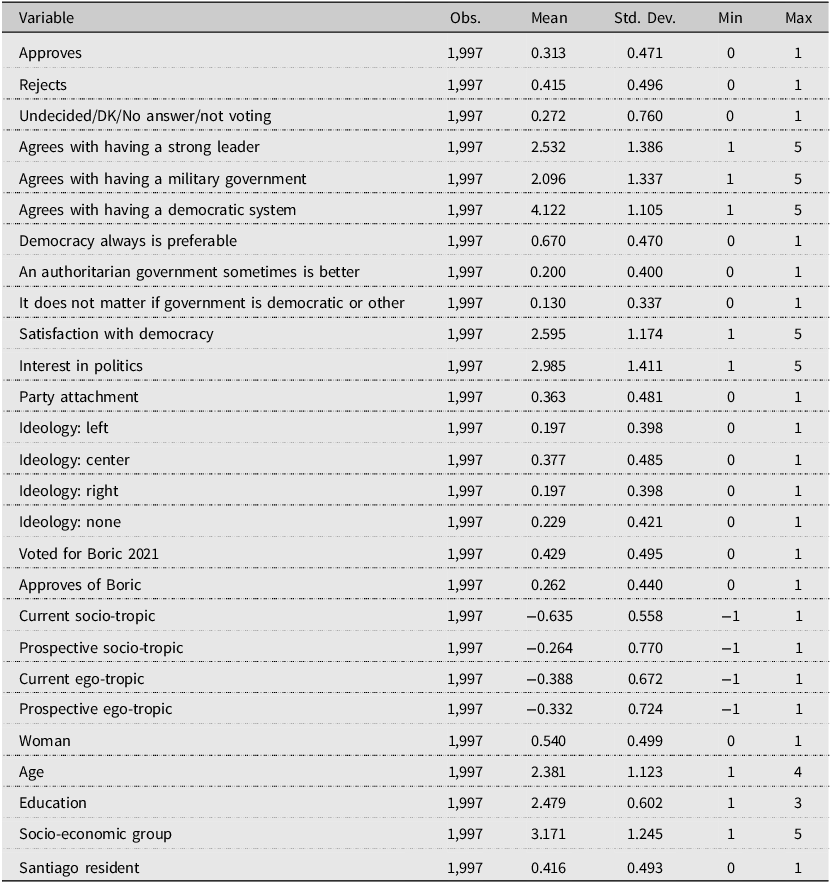
We include control variables. The poll asked a question on satisfaction with democracy—with answers ranging from 1–5 scale, very unsatisfied to very satisfied. We also control by interest in politics (1 to 5, nothing to very interested), for partisan attachment (regardless of what political party the respondent mentions), and for ideological identification. We coded responses to a question on self-placement on the 0–10 left–right scale into 4 categories: left (0–3), center (4–6), right (7–10) and none (those choosing not to identify on the scale). We control by four questions on current socio-tropic, prospective socio-tropic, current ego-tropic and prospect socio-tropic perceptions. Following Erikson, MacKuen, and Stimpson (Reference Erikson, MacKuen and Stimpson2002), we recoded negative, neutral, and positive views as −1, 0, and 1, respectively. Following the logic of the vote-popularity function (Nannestad and Paldam Reference Nannestad and Paldam1994, Reference Nannestad and Paldam1997), we use indicators for those who voted for leftwing candidate Gabriel Boric, and for those who approved of Boric as president. We control for women respondents, age (18–34, 35–44, 45–59, and 60 and over), education (primary, secondary, and tertiary), socio-economic status (SES from high to low: ABC1, C2, C3, D, and E), and for those who reside in the capital city of Santiago (as opposed to those residing elsewhere). Table 1 shows the descriptive statistics for the variables used in the models.
Descriptive Statistics for the Dependent and Independent Variables

Source: Authors with data from MEPOP pre-electoral poll (see methodology section).
The 2022 Constitutional Plebiscite
Several explanations have been advanced to account for why Chilean voters rejected the new constitution. Some underline first-order considerations, like misinformation disseminated by rightwing parties about the content of the constitution (Piscopo and Siavelis Reference Piscopo and Siavelis2023), the divergence between the preferences of the median voter and those of the majority of the members of the constitutional convention (Alemán and Navia Reference Alemán and Navia2023), divisive provisions included in the text (Larrain et al. Reference Larrain, Negretto and Voigt2023), the impact of fake news in the campaign (Saldaña et al. Reference Saldaña, Orchard, Rivera and Bustamante-Pavez2024), the entry of new voters under mandatory rule (Segovia Reference Segovia and Giansante2023) and the impact of the perception of crime and insecurity (Berg Bilbao and Navia Reference Berg Bilbao and Navia2025). Others have focused on second-order considerations, like the content of the articles in the proposed constitution (González-Ocantos and Meléndez Reference González-Ocantos and Meléndez2024) or indigenous issues addressed in the text (Pavlic Reference Pavlic2024).
As Figure 1 shows, public opinion polls in the months before the plebiscite indicated declining support for the Approve option. Since Boric took office, the vote intention for the Approve option moved together with presidential approval. When the final draft of the proposed constitution was finalized, around June 2022, the distance between the Approve and Reject vote intention began to widen. Although it was expected, the victory of the reject vote is puzzling given that Chileans had overwhelmingly voted to replace the authoritarian-era constitution two years earlier.
Pre-plebiscite Poll Trends, Chile: January–September 2022. Source: Authors with data from Plaza Pública CADEM polls https://cadem.cl/plaza-publica/.

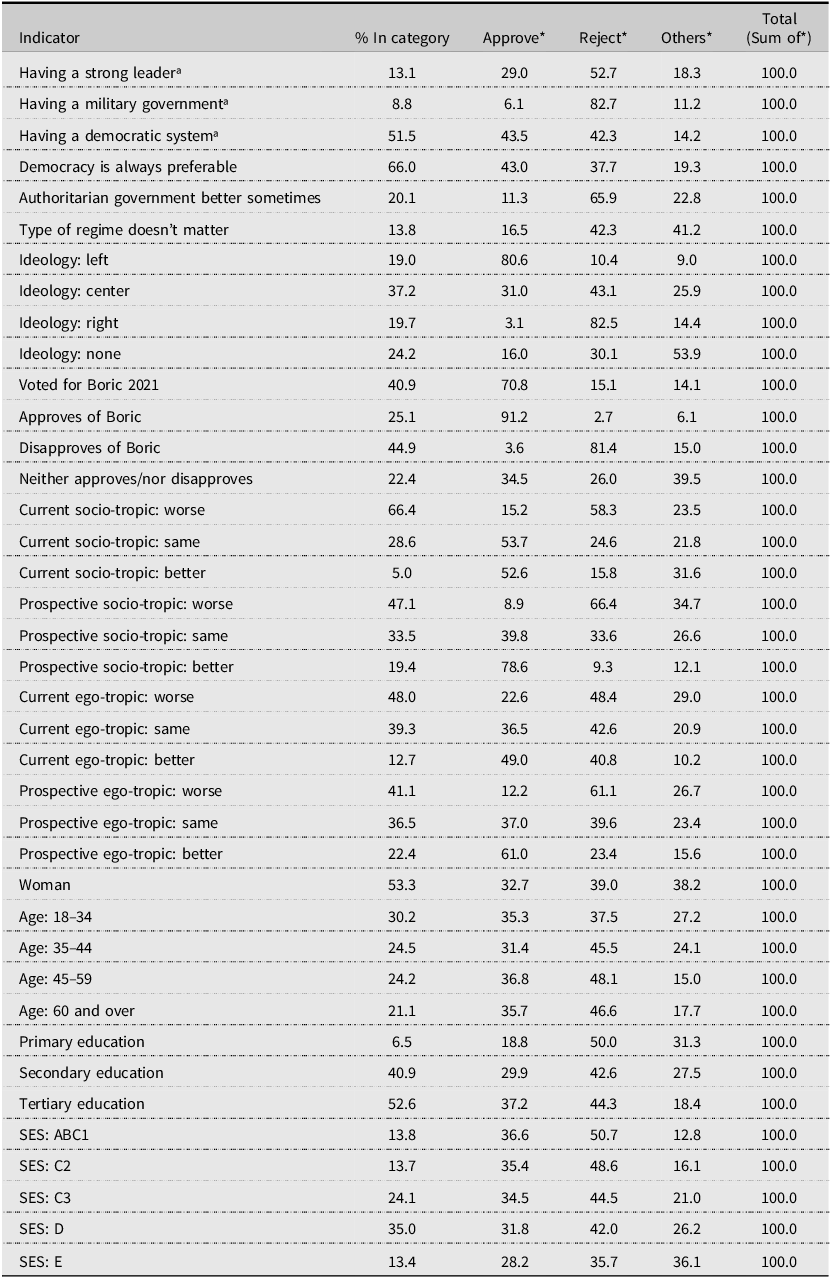
Table 2 shows voter intention in the pre-electoral poll by different respondents’ categories and attributes. Among the 8.8% who believed that having a military government was very good, 82.7% voted against the text drafted to replace the constitution enacted in 1980 under authoritarian rule. In turn, among those who believed that it was very good to have a democratic system (51%), there was a tie between those who approved (43.5%) and those who rejected (42.3%) the new constitution.
Vote Intention in Plebiscite According to Selected Categories

ª Vote intention among those who answered “very good” to that question (5 in a 1–5 scale). We exclude those reporting that they would not vote. N=1997
Source: Authors with data from MEPOP pre-electoral poll (see methodology section).
Leftists were more inclined to Approve, but centrists and rightists were more inclined to Reject. Among those with no ideological views, Reject was favored by a 2 to 1 margin. Among those who voted for Boric and those who approved of President Boric, there was strong support for the Approve. Those with more negative economic views were more likely to Reject. Among sociodemographic indicators, older people, those with higher levels of education, and those of higher socio-economic status were also more likely to Reject.
Results
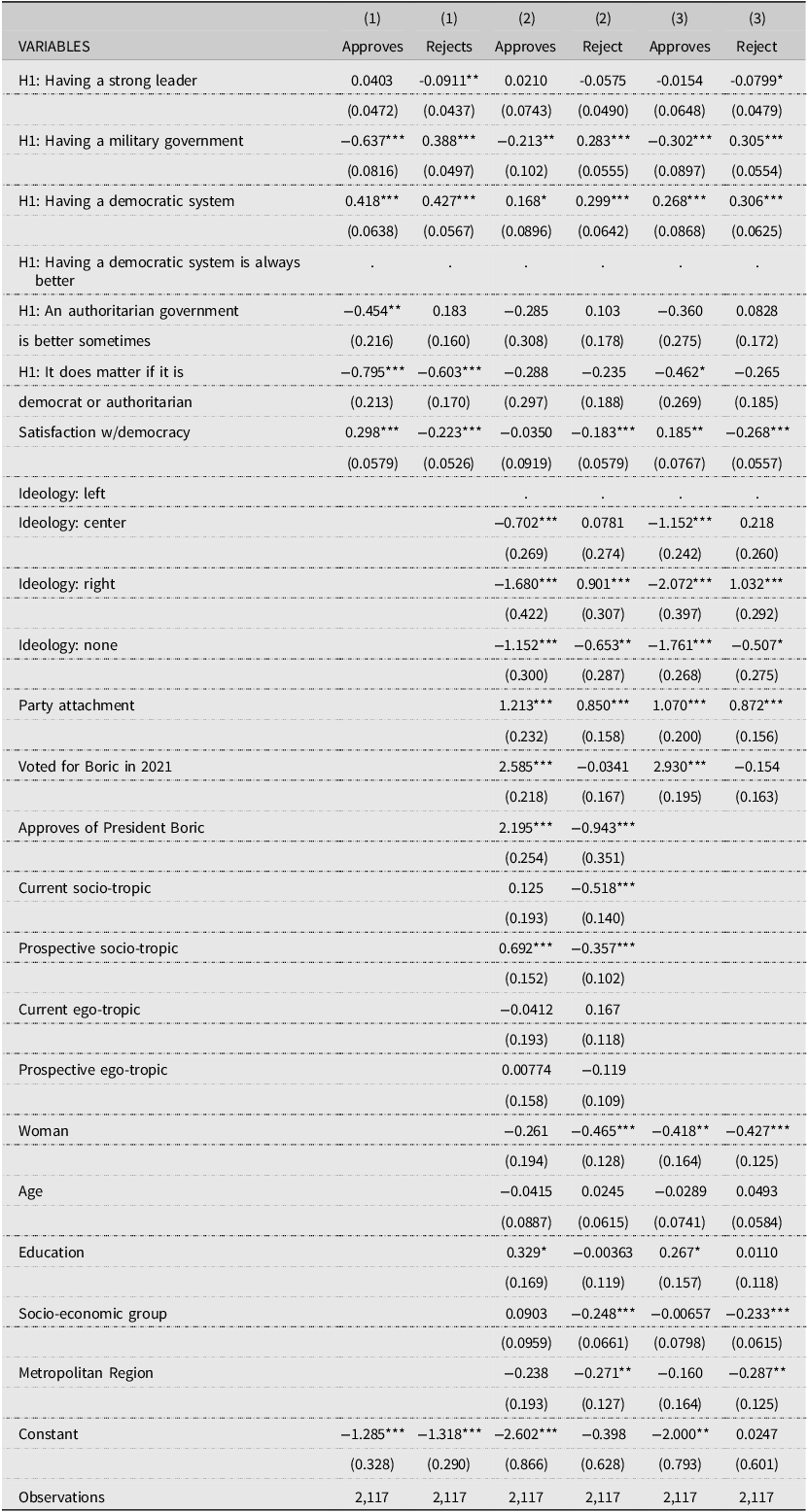
To explore whether the vote choice in the 2022 plebiscite reflects the persistence of an autohoritarian/democratic divide among voters, we estimated multinomial logit models. Table 3 shows those results. The reference category is respondents who were undecided or not voting (27.2%). We expect that those who express democratic values are more likely to vote Approve while those who express non-democratic values are more likely to vote Reject. The models in Table 3 show results that are, in general, consistent with those expectations but only for those voting Approve.
Multinominal Logit Models on the Vote Choice in the 2022 Constitutional Plebiscite in Chile

The reference category for the dependent variable is Not voting/Don’t Know/No answer.
Robust standard errors in parentheses *** p<0.01, ** p<0.05, * p<0.1
Source: Authors with data from MEPOP pre-electoral poll (see methodology section).
Supporting a strong leader who might not care about elections or about the legislature is an indicator of weak democratic values. The models in Table 3 show that those in favor of that assertion were less likely to vote Reject and not more or less likely to vote Approve than the reference category (those undecided or not voting). This suggests that authoritarian values are not associated with those voting Reject, at least in this dimension. Those in favor of an authoritarian leader who does not care about elections were less likely to vote Reject than those in the reference category.
A second indicator of weak democratic values is support for a military government. Those in favor of a military government were less likely to vote Approve and more likely to vote Reject. In Chile, the association between support for a military government and vote choice in the plebiscite has come to epitomize the authoritarian/democratic divide first identified in the 1990s. Since democracy was restored, those supportive of the Pinochet dictatorship have been strongly associated with rightwing ideological views. Not surprisingly, those who express support for a military government were more strongly inclined to vote Reject. Thus, while the absence of democratic values might have not tilted the balance in favor of the Reject victory in the plebiscite—as the percentage of people holding those values was low—the results show that holding those values, at least in the dimension of support for a military government, were likely to vote Reject and less likely to vote approve in the 2022 plebiscite.
A third indicator of democratic values is support for having a democratic system. The models in Table 3 show that those in favor of a democratic system were more likely to vote Approve and more likely to vote Reject than to not vote or to be undecided. Those with weaker democratic values were less likely to participate in the plebiscite or more likely to be undecided. This suggests that support for a democratic system is strong across the board among those people who are more likely to participate in elections. Those holding undemocratic values in the dimension of weak support for a democratic system are more likely to abstain from participating in elections. If the authoritarian/democratic divide identified in the 1990s was associated with having opposite views about the Pinochet dictatorship, in the 2022 plebiscite, the difference between both sides of the presumptive divide is no longer associated with opposite views on supporting a democratic system. Those with weak democratic values were more likely to abstain in the plebiscite than to vote Reject.
The fourth indicator for democratic values is a question that presents respondents with three alternatives: democracy is always preferable, an authoritarian government is better sometimes, and it does not matter if the country has a democratic or an authoritarian regime. In the models in Table 3, those who believe that an authoritarian government is better sometimes and those who believe that it does matter if there is a democratic or an authoritarian regime were less likely to vote Approve than the reference category (those not voting). People who believe that it does not matter if the country has a democratic or authoritarian regime were less likely to vote Reject than to abstain or not vote. That suggests that those who don’t care much about the type of regime were less likely to opt for either option in the plebiscite. The models also show that those who believe that an authoritarian government is sometimes better were not less likely to vote Reject than the reference category. That suggests that democratic values in this dimension were stronger among those voting Approve than among those voting Reject.
The significance of the coefficients in this 3-part question about democratic values declines when we include ideological identification and other control variables. Those who were satisfied with democracy—a dimension associated with specific support for democracy rather than diffuse support for democracy—were more likely to vote Approve and less likely to vote Reject than the reference category. That suggests that Chileans who thought the country was on the right track were more likely to approve the new constitutional draft.
In the models that include ideological identification, the effects of the democratic values variables lose significance. Rightwing voters were less likely to vote Approve and more likely to vote Reject than leftwing voters. Centrists were also less likely to vote Approve, but not more likely to vote Reject than leftist voters. Those who do not identify on the ideological scale were less likely to vote Approve and Reject, signaling again that they are less likely to be engaged in the political process. Not surprisingly, those who voted for Boric in the 2021 election and those who approved of his presidency were more likely to Approve and less likely to Reject. As Figure 1 shows, the vote intention for Approve moved closely with presidential approval in the weeks leading to the plebiscite.
The effect of economic vote variables is also consistent with what has been identified elsewhere. Those with a more positive current and prospective socio-tropic outlooks were more likely to Approve and less likely to Reject. However, the significance of the marginal effects of ego-tropic perceptions are weaker. Those with positive prospective ego-tropic perceptions were more likely to Approve. In turn, those with more positive current ego-tropic perceptions were more likely to Reject. As the constitutional draft was widely seen as drastically transforming the status quo, these findings should not be surprising. Those that were doing well under the status quo were more likely to Reject, while those who expected to do better under the new constitution were more likely to Approve.
Among the socio-demographic variables, women were less likely to Reject, but also less likely to Approve. Age did not have an impact on the vote choice. Those with higher levels of education were marginally more likely to Approve, while those from a lower socio-economic status were less likely to Reject. Santiago residents were less likely to Reject but not more likely to Approve.
The models show that those with democratic values were in general more likely to Approve and less likely to Reject. But the Reject vote is strongly explained by weak democratic values. Those with centrist and rightwing views, those who did not vote for Boric and who disapproved of his work as president were also more likely to Reject. Economic perceptions are also associated with the vote choice, and their marginal effects were stronger than the marginal effect of other variables.
Thus, while those with strong democratic values were more likely to vote Approve, the victory of the Reject vote cannot be attributed to the impact of those with weaker democratic values. In that sense, the authoritarian/democratic cleavage identified in Chile in the 1990s failed to play a decisive role in the vote choice in the 2022 plebiscite. Thus, paraphrasing Deegan-Krausse, the authoritarian/democratic divide is something far less than a cleavage in Chile today.
In the appendix, in Table A1, we include a logit estimation where we exclude those not voting and the undecided and pit those voting Approve against those voting Reject. The results are largely consistent with the results reported here in Table 3.
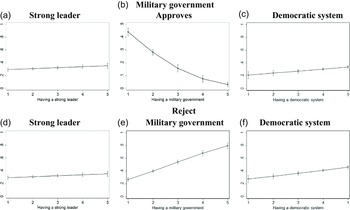
We also plotted predictive probabilities based on model 2 in Table 3 for the effect on vote choice of selected indicators of democratic values. As Figure 2 shows, those who favor a military government were far more likely to Reject and far less likely to Approve. But support for a democratic regime was also positively associated with voting Approve or Reject. Since an overwhelming majority of people support having a democratic system, this indicator is not very useful to identify those who embrace authoritarian values but refrain from publicly expressing unpopular views, like support for a non-democratic regime.
Predicted Probabilities for Effect of Democratic Values on the Approve and Reject Vote in the 2022 Plebiscite in Chile. Source: Authors with data from MEPOP pre-electoral poll.

In turn, more support for a strong leader is also weakly associated with Approve and Reject. Thus, although those in favor of a military government were more likely to cast a Reject vote, there is not enough evidence to claim that those with democratic values were more in favor of the Approve vote and less in favor of rejecting the new constitution. In one dimension—support for a military government—expressing authoritarian values was positively associated with the Reject vote. In another dimension—having a strong leader—expressing authoritarian values was negatively associated with the Reject. In the third dimension, having a democratic system, the association was positive with the Approve and the Reject vote. Thus, the authoritarian/democratic something less than a cleavage divide was not decisive in the vote choice in the plebiscite.
Discussion and Conclusion
The way in which the transition to democracy took place in Chile in the late 1980s led many scholars to claim, since the mid-1990s, that a democratic/authoritarian divide defined the party system and informed electoral preferences. There was an intense debate on the suitability of using the concept of social cleavage to describe the democratic/authoritarian divide that existed in the years immediately after the transition to democracy for several years in Chile. Eventually, democratic consolidation issues became more central to the political divide between left and rightwing parties in Chile.
Two decades later, when the constitution writing process that began after the riots in late 2019 sought to replace the authoritarian-era text with a new constitution written under democratic rules, the 2022 constitutional plebiscite reignited the democratic/authoritarian divide. Those in support of the new text underlined the importance of replacing the authoritarian era constitution and putting the last nail in the coffin of the legacy of the military dictatorship. For many in the left, voting against the new constitution was associated with expressing authoritarian values.
We used a pre-electoral online poll to assess the degree to which democratic values explained vote in the constitutional plebiscite. While we find evidence that those with authoritarian values—in the dimension of supporting a military government—were more likely to Reject the new document drafted to replace the Pinochet-era constitution, democratic values did not decisively account for vote choice. In fact, those who were in favor of a strong leader who is not concerned with congress or elections were less likely to vote Reject—which signals that one dimension of authoritarian values was not negatively associated with the Approve vote.
The overwhelming support for democratic values in Chile renders the authoritarian/democratic divide useless to account for the vote choice in the 2022 plebiscite. Only 13.1% of respondents agreed with having a strong leader, and 8.8% agreed with having a military government. In turn, 51.5% agreed with the statement that democracy is the best form of government. While some who still embrace the legacy of the Pinochet dictatorship opposed the new text, the decisive victory of the Reject vote is not explained by a lack of democratic values among those who voted to reject the new text. Those who believe that democracy is the best form of government were equally likely to vote for and against the new constitution in the 2022 plebiscite.
The debate on the survival of the democratic/authoritarian divide that characterized the transition to democracy has been present among the academic community for almost three decades. Some of the evidence about the survival of that divide remains undecisive, at least on some fronts. But the constitution writing process that took place in Chile between 2019 and 2023 did not envisage the rise of an authoritarian/democratic divide as a significant determinant of vote choice. While the political debate centered very much around the opportunity to replace the 1980 constitution, the most symbolic of all the legacies of the Pinochet dictatorship, electoral preferences in the 2022 plebiscite were not primarily informed by a democratic/authoritarian divide. In other dimensions, and certainly in the academic debate, the relevance of the authoritarian democratic divide remains a contentious issue. But in the minds of voters, other issues proved more decisive in informing the vote choice in the 2022 constitutional plebiscite.
Supplementary material
To view supplementary material for this article, please visit https://doi.org/10.1017/lap.2025.10023



 Open access

