Monozygotic Twins of Different Religions: Causes and Consequences
Young Twins Raised Together: Unusual Case of Religious Rearing
Twins, who recently participated in one of my ongoing studies of twin relationships, are part of a 12-year-old monozygotic (MZ) male pair — John and Charles. Nothing unusual about their rearing was found until their mother mentioned that her sons were being raised in different faiths, namely those of her husband, and herself — her husband is Jewish and she is Lutheran. She indicated that she and her husband, who were married by both a minister and a rabbi, hold common attitudes and values regarding religion, and respect- each other’s beliefs. They also agreed that if the twins later chose the same religion that would be agreeable to them.
Interestingly, the first-born twin, John, is being raised in the Jewish faith. In Judaism, first-born sons are considered special, as described in the Torah, the first five books that set forth the laws and principles of Jewish guidance and instruction. Aside from continuing the family line, it has been a tradition that first-born sons receive a double portion of their father’s inheritance, assuming they conduct their family’s affairs once their father has passed. Currently, this practice is not followed except in very religious families; however, the celebrated quality of the first-born son still lingers (Dickow, Reference Dickow2010; Klirs, Reference Klirs2022; Rosenfeld, Reference Rosenfeld2016). Whether or not the twins’ father is also a first-born son is unknown. It is known that John will not have a bar mitzvah, the traditional ceremony acknowledging the coming of age of 13-year-old boys.
This situation poses several significant issues. First, it creates differences between the twins from an early age. Aside from the different religious practices and beliefs to which each twin is exposed, each becomes part of a community conducive to separate friendships and experiences. Second, the situation ‘reverses’ the equal environments assumption (EEA) that some critics of twin research have raised. The EEA expresses the importance of affirming that MZ and dizygotic (DZ) twins experience similar trait-relevant environments — it is fundamental to the validity of the findings. More specifically, some critics claim that MZ twins are alike because people treat them alike, whereas people do not treat DZ twins alike. However, most studies have upheld the EEA — and, in fact, MZ twins usually are treated alike, but it is because they evoke similar responses from those around them, due to their shared genes. It is only when parents and others purposely treat MZ twins alike that the assumption falls short (Segal, Reference Segal2012). In the case of the twins I studied, the twins are purposely treated; it would, therefore, be revealing to study the religious values and beliefs of such twins as they mature.
In summary, early studies of reared-together identical twins did not find genetic effects on religiosity. However, the samples included studies of young twins who were under the guidance of their parents, so MZ and DZ twins did not differ in religious resemblance (Loehlin & Nichols, Reference Loehlin and Nichols1976). Their study of 850 high school twins reported intraclass correlations of .56 (MZ) and 0.67 (DZ) for belief in God, and .60 (MZ) and .58 (DZ) for involvement in religious affairs.
Older Twins Raised Together and Apart: Religiosity Results Reversed
When later studies included older twins, especially adult twins reared apart from birth, genetic effects emerged. Waller et al. (Reference Waller, Kojetin, Bouchard, Lykken and Tellegen1990; see also Segal, Reference Segal2012) analyzed data on MZ and DZ twins reared both together and apart. The MZ reared-apart (MZA) twins completed five different scales that variously assessed religious leisure time, occupational interests, activities, leisure time interests, and values; the reared-together twins completed two of the scales (leisure time and occupational interests). The MZA pairs showed greater resemblance than the DZ twins reared together (DZT) twins across all scales, while the MZ twins reared together (MZT) showed greater resemblance than the DZT twins on the two scales they completed. It seems that when twins become adults they are not constrained by their parents’ guidance and can freely choose the religious activities and interests they prefer. Subsequent to that study, other investigators have reported similar results. A University of Minnesota graduate student studied the retrospective childhood religiosity of reared-together twins, comparing it to their current religiosity. She failed to find genetic effects on the former, but she did on the latter, consistent with the idea of greater freedom to pursue one’s special interests during adulthood (Koenig et al., Reference Koenig, McGue, Krueger and Bouchard2005). Other twin research was reported in a special issue of this journal, dedicated to twin studies of religiosity (Eaves et al., Reference Eaves, D’Onofrio and Russell1999).
Twins Raised Apart: Research Findings and Illustrative Examples
Provided below are selected examples of MZA twins who held similar religious values, despite being raised in different religions or in the same religion, but in families with different degrees of practice and investment. Some examples of pairs who differed in religiosity are also included; see Segal (Reference Segal2012) unless otherwise indicated,
Sharon and Debbie. Sharon and Debbie were reunited at age 45. They met at the Hartford, Connecticut airport not far from Debbie’s residence; Sharon flew in from Kentucky. Debbie had been raised in a Jewish home, while Sharon had been raised in a Christian home. Both twins were deeply religious, unlike the unrelated siblings with whom they were raised. The twins understood each other’s commitment to their respective faiths.
Mary and Elaine. British twins, Mary and Elaine, were both raised Catholic; however, Mary’s family was considerably more religious than Elaine’s family. As they matured, both twins tried to reconcile their belief in genetics with their belief in God. Mary eventually turned away from her religion, whereas Elaine did not — Mary wondered if Elaine’s adherence to her faith reflected the more relaxed religious climate in Elaine’s home during her growing up years. Interestingly, both twins knew that their biological mother was Jewish, knowledge that Mary felt deeply during a visit to Israel, while this news meant little to her twin sister at the time; also see Holmes (Reference Holmes2008).
Mark and Jerry. Mark and Jerry met at the age of 31. Both twins had been raised by different Jewish families and had had a bar mitzvah. However, neither twin showed interest in religion as they grew up.
Oskar and Jack. Oskar and Jack may have been raised in the most extremely different environments among reared-apart MZA twins. Oskar was raised in the Catholic faith by his mother and grandmother in Nazi Germany, while Jack was raised in the Jewish faith by his father in Trinidad. The twins’ different religious and cultural backgrounds understandably impeded their conversations about politics and history, but they maintained close social ties, despite these differences — the twins alternated between loving and angering one another.
Betty and Alice. Betty was strongly attracted to religion, whereas Alice mostly abandoned any religious beliefs. It is difficult to know the source of their different religious commitments. This difference prompted them to seek counseling to try to repair their twin relationship.
Tony and Roger, Steve and Tom, and Tamara and Adriana. Roger and Tamara were raised in Jewish homes, while their cotwins, Tony and Adriana, were raised in Catholic homes. Steve was raised by a Buddhist family, while Tom was raised in a Christian family (Neer, Reference Neer2026). In contrast with Oskar and Jack whose backgrounds often caused tension, all these twins grew close to one another — that may be because their environments did not differ to the same extent as those of Oskar and Jack.
Note that on November 15, 2003, I appeared on the CBS program 48 Hours, hosted by Lesley Stahl. The program, which focused on identical twins reared-apart, included five sets, four of whom I have discussed here — Tony and Roger, Steve and Tom, Tamara and Adriana, and Sharon and Debbie. The fifth set, British twins Barbara and Daphne, were also included, but religious differences were not raised in their case. A photograph of the twins with Lesley Stahl appears in my book, Born Together-Reared Apart: The Landmark Minnesota Twin Study (Segal, Reference Segal2012), and is displayed in Figure 1.
Five reared-apart identical twins with host Lesley Stahl. Take on the CBS set of 48 Hours on November 15, 2003. Photo credit: John P. Filo.

There is another pair of MZ male twins whose religious lives differed dramatically, twice in opposite directions. These twins were never studied formally, but their life story is documented in a fascinating book, In My Brother’s Image: Twin Brothers Separated by Faith After the Holocaust (Pogany, Reference Pogany2000). Eugene Pogany, the son of one of the twins, reveals that his father, Miklos, and uncle Gyorgy, once very close brothers, grew distant as their religious lives diverged.
The twins were born in 1913, in Hungary to a Jewish couple, but were raised Catholic due to the persecution of Jews after World War I; other Jewish families did this for acceptance and acculturation. When the twins were university students, Miklos considered joining a Christian group, content to be a Catholic, but aware of his Jewish roots. He felt that Gyorgy was abandoning his Catholicism. Then Gyorgy gained a certain insight and joined the priesthood, surviving World War II in Italy. In contrast and despite his Catholicism, Miklos was taken by officers to Bergen-Belsen, a concentration camp in Germany — there he understood and acknowledged his Jewish roots, celebrating Jewish holidays with fellow prisoners. The twins remained apart for many years, reuniting in 1956, when both were in America. Their meeting did not go well — the twins stayed estranged from one another even though they lived just miles apart. Unlike Oskar and Jack, Miklos and Gyorgy could not see past their differences, even though they had been very close as children and as young adults. Perhaps the difference is that Oskar and Jack’s rearing was a matter of circumstance for which they were not responsible — in contrast, Gyorgy made a conscious decision to surrender his Jewish roots, while his twin brother suffered horribly in the camp — had Gyorgy remained in Hungary he would have experienced the same fate as his twin.
In 2001, I invited the author, Eugene L. Pogany, to deliver a seminar at California State University, Fullerton and he agreed. The talk was hosted jointly by the Departments of Psychology and History. The event was memorable.
Twin Research Reviews
Language Development of Dizygotic (DZ) Female Twins
Human ethological studies, in which behavior is observed and/or recorded in naturalistic settings and without intervention, are excellent supplements to experimental data gathered by questionnaire or other standard means. Lang et al. (Reference Lang, Marschik, Laudańska, Wilken, Schaaf, Hahn, Kulvicius, Sigafoos, Bölte, Poustka, Neul and Zhang2025) presented findings on language development in a female DZ twin pair, based on viewings of multiple home videos produced by their parents during the twins first two years of life — filming took place at months 3, 5, 6, 7, 8, 9,12, 18, 2t, 23, and 24. The second-born twin was diagnosed with Rett syndrome at the age of 3 years, 7 months.
Rett syndrome is observed more frequently among girls and women, than boys and men, with a prevalence of 5−10/100,000 cases. Most occurrences are associated with a de novo MECP2 mutation, found on the paternally derived X-chromosome and thought to arise spontaneously during spermatogenesis (Trappe et al., Reference Trappe, Laccone, Cobilanschi, Meins, Huppke, Hanefeld and Engel2001). A minority of cases are linked to a MECP2 variant transmitted to a child by an unaffected mother who is a germline mosaic (Amir et al., Reference Amir, Van den Veyver, Wan, Tran, Francke and Zoghbi1999). Symptoms of Rett syndrome include, but are not limited to, loss of manual skills, abnormal walking, and regression of acquired language. The twins’ parents noted that the second-born twin was unusually quiet and showed motor development delay; her slower progress, relative to her twin, was observed at age 6 months and beyond, but Rett syndrome was not diagnosed until she was 3 years, 7 months of age. Her language delays during the second year included a greater number of voiced vocalizations, fixed signals (laughter, cries, coughs), and uncategorizable sounds.
Two caveats need mentioning. First, the method by which twins were classified as DZ was not provided. Second, the research regarded this case as an opportunity to disentangle genetic and environmental influences on language development, that is, a type of cotwin control. Had the twins been MZ, this would have been possible — differential X inactivation might have triggered the condition in just one twin. However, DZ twins differ due to both genes and environments, preventing separation of causal effects.
Second Case of MZ Twins With Hallermann-Streiff Syndrome
The second case of MZ twins with Hallermann-Streiff syndrome (HSs) was evaluated by a team of American investigators from Washington state and Arizona (D. T. Sims et al., Reference Sims, Mattson, Huang, Lee, Bly, Gallagher, Baran and Cabrera2023). HSs is a rare congenital disease that involves impaired vision and hearing, facial deformities, short stature, and breathing difficulties. Its estimated frequency is 200 cases worldwide and its cause is unknown. The MZ female twins under study were referred at 4 weeks of age for possible retinopathy of prematurity, following their early birth at 32 weeks’ gestation. Both twins had cataracts, whereas only one twin had corneal perforation; neither twin showed chromosomal abnormalities. By way of treatment, a variety of surgical procedures were performed and various therapies were introduced to reduce visual complications. The twins also showed improvement in their gross motor skills but experienced delays in their expressive and receptive language skills.
The researchers stressed the importance of early intervention and the recording of family histories in such cases. Unfortunately, the twins’ parents declined genetic testing. It is also unfortunate that the method used to classify the twins as MZ was not provided as this would affect the interpretation and application of the findings.
Digital Twin and Asthma Research
Medical practice is becoming increasingly assisted by electronic monitoring devices and asthma is no exception (Drummond et al., Reference Drummond, Roukema and Pijnenburg2023). Recent advances can assess inhalation quality and identify asthma attack triggers. Unfortunately, home monitoring is not yet possible, but the introduction of digital twins promises to substantially further future research and practice in this area. The researchers explain that the digital twin system consists of three parts: the physical object, (the patient) and the communication channel between the physical and virtual representation communication channel between them. In short, moving asthma research ahead in this way would usher in what the researchers call a ‘new era’ in asthma management.
Twin studies confirm a genetic contribution to asthma. The MZ and DZ concordance rates, based on Danish Twin Registry self-reported data, are .53 and .28, respectively (Thomsen, Reference Thomsen2014). Interestingly, twins have a somewhat lower rate of hospital admission than nontwins (Huovinen & Kaprio, Reference Huovinen and Kaprio2001). The authors noted that mothers of twins are often older than mothers of nontwins. (Of course, this only applies to mothers of DZ twins.) They reasoned that the mothers’ experiences with their children’s medical events could reduce her likelihood of seeking medical help when a second twin develops asthma, given her familiarity with the situation. I suspect that twins’ frequency rates for asthma are better explained by cross-study differences in participant age and sex, assessment methods, and definitions.
Parents’ Responses to Twin Children’s Zygosity Misdiagnosis
On December 4, 2025, I received an email message (‘a note of appreciation and mild embarrassment’) from a mother who had watched my appearance on Armchair Expert, a video podcast hosted by actor Dax Shepard. Based on what I said, her husband began wondering whether their 12-year-old daughters — whom the couple believed were fraternal twins — might be identical. ‘My husband couldn’t let it go. He kept pointing out all the things that made him suspicious after listening to you.’ A DNA test was arranged and showed that the twins were truly MZ. The twins’ mother, still in denial, noted that none of their six different pediatricians had ever questioned the twins’ zygosity.
Much has been written about the importance of twins’ and parents’ knowledge of twin type. Such information brings understanding to cotwins’ similarities and differences in behavioral development, educational performance, disease susceptibility, and social relationship skills (Segal, Reference Segalin press). Hopefully, DNA testing of newborn same-sex twins will become a standard procedure in the near future.
Human Interest
Pen that Saved Nontwin Holocaust Children
There is a pen that became a ‘weapon in the fight for survival’ at Auschwitz-Birkenau, the ghastly Nazi death camp, in Poland (Ruane, Reference Ruane2025). On May 28, 1944, 29-year-old Zvi Spiegel and his twin sister Magda arrived at Auschwitz from their home in Hungary. They were forced to immediately surrender their belongings, but being a twin was central to their survival because physician Josef Mengele used the captive twins in a series of horrific medical experiments. When Mengele informed Spiegel that Spiegel would be take charge of the twin boys in Barrack 14, Spiegel insisted that he needed his pen to keep records — surprisingly, Mengele allowed him to retrieve the pen he had been forced to give up when he arrived at the camp. It was also surprising the he was able to find it among the confiscated items taken from other prisoners. Spiegel used that pen to alter the birthdays of several near-in-age nontwin brothers and unrelated boys who were mistaken for twins — by doing so, Spiegel saved their lives (Ruane, Reference Ruane2025; see also Segal, Reference Segal1985). Of course, many twins in the camp died from the procedures performed on them, as well as from hunger, illness, and cold, but being a twin kept them alive a little longer. In December 2025, Spiegel’s pen was donated to the United States Holocaust Museum, in Washington, D.C., where it will be on display.
I met Zvi Spiegel in February 1985, when I attended the 3-day mock trial of Josef Mengele in Jerusalem. I took several pictures of him, as well as related photographs, that appear with annotation, in my recent book, The Twin Children of the Holocaust: Stolen Childhood and the Will to Survive (Segal, Reference Segal2023). Spiegel is shown in Figure 2.
Zvi Spigel, at the February 1985 three-day mock trial on Josef Mengele’s war crimes. The setting is Yad Vashem, Israel’s Holocaust Research and Memorial Institute, in Jerusalem. Photo Credit: Dr. Nancy L. Segal.
Identical Twin ‘Jeopardy’ Winners
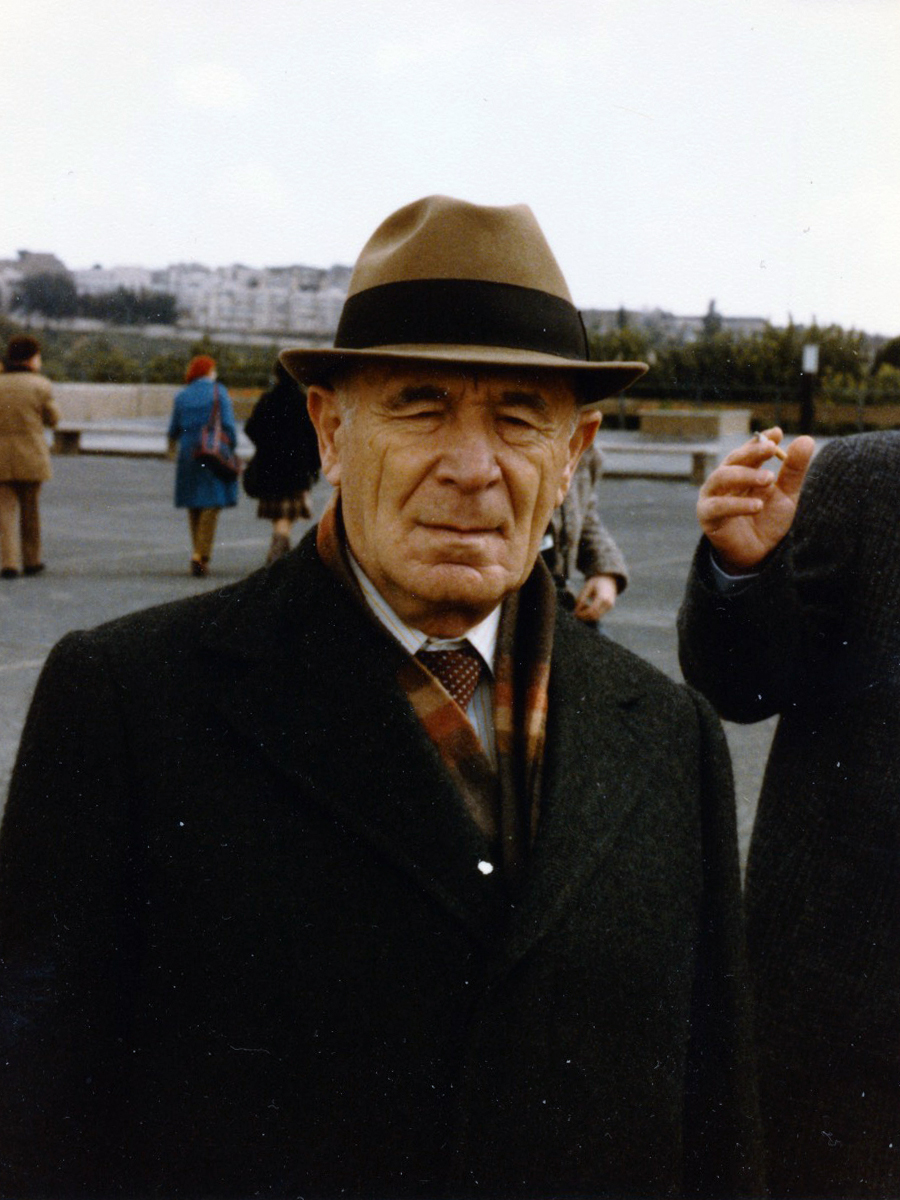
Canadian identical twins, Ray and Ron Lalonde, are famous for their stellar performances on ABC’s popular game show, Jeopardy (B. Sims, Reference Sims2025a, Reference Sims2025b). Ray played first, starting in December 2022, winning 13 games until January 2023 when his 14th appearance ended his winning streak. However, he qualified for the Tournament of Champions, losing out in the quarter finals. His twin brother, Ron, became a Jeopardy contestant in December 2025, winning three games in a row before losing his fourth in a double jeopardy question. Ray is a scenic artist, while Ron is a medical physicist.
The Lalondes are not the only twins to have competed on Jeopardy. Kara and Caitlin Peruccio, who appear to be identical twin based on inspection of their photographs, competed 12 years apart — Caitlin did so first, in 2013, coming in second, so did not compete further (B. Sims, Reference Sims2025b). Kara won her first game, returned for another, then came in second (Ledford, Reference Ledford2025). Genetic influences on general intelligence, special mental abilities, and information-processing help explain why identical twin brothers and sisters were both chosen from a competitive field to appear on this program — they both did what so few others can accomplish (Segal, Reference Segal2012). Then host Ken Jennings told Kara that selection for Jeopardy was harder than getting admitted to an ivy league college (Harsa, Reference Harsa2025).
I am also a twin (fraternal) with a personal connection to Jeopardy. In 2014, my book Born-Together-Reared Apart: The Landmark Minnesota Twin Study (Segal, Reference Segal2012), was a question on Jeopardy, posed to contestants by the late host Alex Trebek. The statement, in the category ‘Lectures’, was: ‘Born Together-Reared Apart is a lecture by Nancy Segal about these people.’ The answer: ‘Identical twins.’ Of course, Born Together-Reared Apart is a book, not a lecture, and the response should also have referenced fraternal twins.
Twin Hostages Freed from Gaza
In 2023, before their capture by Hamas and transfer to a Gaza prison, identical Israeli twins, Gali and Zivi Berman, gave their mother a simultaneous birthday kiss — one twin on each cheek. After their long-awaited release on October 23, 2025, at age 28, the twins and their mother posed in a joyous re-enactment of that happy occasion. Their mother was not captured, but she could not return to her home at Kibbutz Kfar Gaza until that moment (Facebook post, 2025). A male twin from an opposite-sex pair, Nimrod Cohen, was released along with the Berman brothers (BBC, 2025). A pair of young identical female twins and their parents were also taken, but the mother and twins were part of an early release; their father was freed with the final group of prisoners, in 2025. The young twins’ experience has seriously affected their behavior, as it has for all young children in Israel and in Gaza (Knafo-Noam & Segal, Reference Knafo-Noam and Segal2025; Kingsley & Shbair, Reference Kingsley and Shbair2025).
Loss of a Twin Son
An acclaimed Nigerian novelist and speaker, Chimamanda Ngozi Adichie, has accused the private Euracare Hospital, in Lagos, for the death of her 21-month-old twin son (Searcey & Auwal, Reference Searcey and Auwal2026). The infant entered the hospital with an unspecified infection that required sedation for magnetic resonance imaging. Adichie is holding the anesthesiologist responsible for the death, based on evidence that the dosage of propofol he received was too high. The death occurred on January 6, just one day before he was to be flown to Johns Hopkins Hospital, in. Baltimore, Maryland, for treatment. In a family chat that was leaked to the public, Adichie wrote, ‘Suddenly, our beautiful little boy was gone forever. It is like living your worst nightmare. I will never survive the loss of my child.’
In my interviews with bereaved parents, several mothers mentioned the insensitivity of hospital staff who believe that their living twin compensates for the loss of the cotwin. However, grief-related measures do not differ between parents who lose one twin and parents who lose a non-twin child — one child does not compensate for the loss of another (Wilson et al., Reference Wilson, Fenton, Stevens and Soule1982).
Fraternal Twin Mountaineers
Fraternal twins, Eric and Matthew Gilbertson, are mechanical engineers and mountain climbers (Scoles, Reference Scoles2025). They discovered that peak elevations around the world are incorrect and have made it their mission is to correct them. This quest began when Eric climbed the one hundred highest mountains in Colorado and sensed a discrepancy between his experience at Creston Peak and data published by the United States Geological Survey — he believed that the data made the mountain pointier (and taller) than what he saw during his climb. He decided to take a new measurement and found he was right. He went on to co-author a paper with his twin brother, documenting new altitudes in five countries. The twins now aim to measure the highest peaks in every country of the world, a project they have titled ‘Country Highpoints. They emphasize that the land changes on a continual basis, requiring updated measurements.
Twins in the Sydney to Hobart Yacht Race
The annual Rolex Sydney Hobart Yacht Race is a 628-nautical mile journey from Sydney Harbor to Hobart, Tasmania, in Australia. The last race, the 80th competition, began on December 26, 2025 (Dong & Holmes, Reference Dong and Holmes2025; Schmidt, Reference Schmidt2025). Among the competitors were mothers, fathers, sons, daughters — and identical twins, Marc and Louis Ryckmans — the twins’ first race was in 2004, but they have never won. Their rituals and reflections on competing together are emblematic of the social closeness characterizing most identical twins. They begin each race with a silent handshake, affirming their respect for Mother Nature for keeping them safe. When the waves become frightening the twins are good at keeping each other calm. And according to Marc: ‘It’s that shared experience that you sort of relish and sort of understand without having to communicate it to each other.’ The 2025 race was won by Min River after a protest over a sailing rule.
Twin Patron Saints of Cobblers
Shoemaking remains a thriving profession in Northampton, England (Regensdorf, Reference Regensdorf2025). It began in the Middle Ages, largely due to the fertile land suitable for raising cattle and the rivers that provided water and tannins for producing leather. After the Industrial Revolution, many streets in Northampton and in nearby places were named in honor of St. Crispin. There is a story that, in the third century, twin brothers, Crispin and Crispinian, fled to France to escape Roman persecution. There, they preached Christianity and made shoes for a living. Every October 25, the shoemakers of Northampton celebrate St. Crispin’s Day — in recognition of the patron saint of cobblers and those working with leather.