

Introduction
The ability to freely debate political issues is fundamental to the role of political representatives. It underpins opinion formation, informs voters about candidates’ perspectives, and fosters citizens’ sense of representation within a democratic system. Recent years have seen growing awareness of the democratic costs of political violence in Western democracies (Armaly and Enders Reference Armaly and Enders2024; Collignon and Rüdig Reference Collignon and Rüdig2021; Håkansson Reference Håkansson2024b; Håkansson and Lajevardi Reference Håkansson and Lajevardi2025; Herrick and Franklin Reference Herrick and Franklin2019; Herrick and Thomas Reference Herrick and Thomas2023b; Kalmoe and Mason Reference Kalmoe and Mason2022). Studies show that among Members of Parliaments (MPs), mayors, and parliamentary candidates, experiencing psychological violence such as harassment and threats is more common than not (Collignon and Rüdig Reference Collignon and Rüdig2020; Håkansson Reference Håkansson2021; Herrick and Thomas Reference Herrick and Thomas2022,Reference Herrick and Thomas2023b; Kosiara-Pedersen Reference Kosiara-Pedersen2023). A cause for concern is that violence makes politicians withdraw from public policy debates, and, alarmingly, this seems to apply more to politicians from already politically marginalized groups (Erikson et a;. Reference Erikson, Håkansson and Josefsson2023; Håkansson Reference Håkansson2024b; Krook and Sanín Reference Krook and Sanín2020). As a result, political violence risks reinforcing the dominance of the historically privileged political class – hegemonic men, meaning higher-class men from majority ethnic groups.
Previous research has primarily examined the prevalence of violence against politicians and how attacks differ when targeting women and men or ethnic minority and majority politicians (Bjarnegård Reference Bjarnegård2018a; Bjarnegård et al. Reference Bjarnegård, Håkansson and Zetterberg2022; Gorrell et al. Reference Gorrell, Bakir, Roberts, Greenwood and Bontcheva2020; Håkansson Reference Håkansson2021; Håkansson and Lajevardi Reference Håkansson and Lajevardi2025; Herrick et al. Reference Herrick, Thomas, Franklin, Godwin, Gnabasik and Schroedel2021; Herrick and Thomas Reference Herrick and Thomas2023b; Kosiara-Pedersen Reference Kosiara-Pedersen2023; Kuperberg Reference Kuperberg2021; Mechkova and Wilson Reference Mechkova and Wilson2021). While a few studies investigate the impacts of violence on political ambition and recruitment (Bjarnegård et al. Reference Bjarnegård, Håkansson and Zetterberg2022; Erikson et al. Reference Erikson, Håkansson and Josefsson2023; Håkansson and Lajevardi Reference Håkansson and Lajevardi2025; Herrick et al. Reference Herrick, Thomas, Franklin, Godwin, Gnabasik and Schroedel2021; Herrick and Franklin Reference Herrick and Franklin2019; Wagner Reference Wagner2022), far less is known about how violence in politics affects the substantive aspects of policy making.
This study examines how violence affects participation in policy debates and whether it disproportionately silences women and politicians with an immigrant background. While violence can influence many aspects of political work, such as ambition, campaign activity, or formal decision-making, we focus specifically on participation in public debates. Debate participation is the most immediate channel through which violence can distort policy making, as it may shape which ideas and perspectives enter the public arena. If violence makes politically marginalized groups retreat from public debates, this skews constituents’ perceptions of policy makers’ opinions and reinforces the image of politics as an exclusive sphere for hegemonic men.
Drawing on scholarship on political representation, we theorize that violence distorts policy debates in two ways: (1) by reducing the participation of politically marginalized groups in general (for example, women and immigrant-background politicians), and (2) by suppressing their voices specifically in debates that challenge hegemonic men’s interests and directly pertain to their own group’s experiences and rights (for example, gender equality and immigration).
To test these expectations, we examine the case of Sweden. While Sweden has long been a frontrunner in women’s political representation, citizens with immigrant backgrounds remain significantly underrepresented among elected officials. However, immigrants appear more integrated into the Swedish political system than in many other European countries (Bloemraad and Schönwälder Reference Bloemraad and Schönwälder2013). Thus, we view Sweden as a least-likely case for finding differences between women and men, as well as between politicians with and without immigrant backgrounds. At the same time, it may be considered a most-likely case for finding that violence silences politicians at all. In contexts where politicians are much more exposed to violence, they may not react as strongly.
We analyze five waves of survey data covering Swedish politicians at both the national and local levels (N = 43,000). Respondents report their experiences of physical and psychological political violence, whether they have avoided debating certain issues due to fear of violence, and if so, which issues they avoided. These measures capture a broad spectrum of behaviors – from a single occasion of opting out of a public statement to more sustained withdrawal from public debate. While we cannot observe the magnitude or platform of disengagement, these measures provide valuable insight into politicians’ self-perceived behavioral changes in response to violence. Even isolated instances of opting out of debate participation due to fear of violence signal that the threat environment shapes democratic discourse. If a large share of politicians report such behavior – even if the intensity varies – this suggests that violence affects which issues politicians feel able to engage with.
Our study makes several empirical contributions. Women and politicians with an immigrant background are significantly more likely than their counterparts to report being silenced by violence in politics. Free-text responses reveal that both these historically marginalized groups are silenced on a broader range of topics than other politicians. Women are disproportionately silenced in debates that challenge male dominance – debates on gender equality. While immigration is the most common policy debate that politicians withdraw from due to violence, politicians with immigrant backgrounds are not more likely than others to be silenced in such debates.
Our study highlights how violence against politicians undermines the most fundamental function of political representation: substantive representation, or the acting on behalf of the represented (Mansbridge Reference Mansbridge1999; Pitkin Reference Pitkin1967). By silencing politicians who would otherwise contribute with their perspectives, violence distorts political debates, hinders opinion formation, and disrupts policy-making processes. These chilling effects disproportionately affect women and politicians with an immigrant background, which diminishes their ability to fulfill their roles as political representatives. If persistent, such patterns may reinforce the long-term dominance of hegemonic men in political debates.
Obstacles to Equality in Political Representation
Extensive empirical research supports the theoretical claim that historically marginalized groups, such as women and ethnic minorities, are better positioned and more likely to advance the political interests of their group members (Mansbridge Reference Mansbridge1999; Phillips Reference Phillips1995; Young Reference Young2000). Women politicians are more likely to share women citizens’ political priorities (Clayton et al. Reference Clayton, Josefsson, Mattes and Mozaffar2019), advocate for women’s rights in parliament (Clayton et al. Reference Clayton, Josefsson and Wang2017; Franceschet and Piscopo Reference Franceschet and Piscopo2008; Lippmann Reference Lippmann2022), and advance policy outcomes reflecting women’s shared interests (Bhalotra and Clots-Figueras Reference Bhalotra and Clots-Figueras2014; Catalano Weeks Reference Catalano Weeks2022; Chattopadhyay and Duflo Reference Chattopadhyay and Duflo2004; Clayton and Zetterberg Reference Clayton and Zetterberg2018). Similarly, political representatives from ethnic minorities and with immigrant backgrounds share lived experiences and a sense of responsibility towards minority voters (Sobolewska et al. Reference Sobolewska, Mckee and Campbell2018). They are more likely than majority-group politicians to highlight their group’s rights and address migration-related issues (Bird et al. Reference Bird, Thomas and Wüst2010; Lajevardi et al. Reference Lajevardi, Mårtensson and Vernby2024b; Minta Reference Minta2009; Saalfeld and Bischof Reference Saalfeld and Bischof2013; Wüst Reference Wüst2014). While issues directly related to the rights of historically marginalized groups are critical, the substantive representation of these groups extends across all policy areas.
Equality in political representation requires that individuals of all different genders and backgrounds have equal opportunities to be elected, perform their duties as representatives, and influence political debates and policy outcomes. Using Pitkin’s (Reference Pitkin1967) terminology, this entails equality in both descriptive representation – to mirror the socio-demographic characteristics of the represented – and substantive representation – to act for the represented. Yet, in most political systems, hegemonic men enjoy systemic advantages, raising serious concerns about democratic quality (Bjarnegård Reference Bjarnegård2018b; Bloemraad Reference Bloemraad2013; Carnes Reference Carnes2016; Celis and Childs Reference Celis and Childs2020; Childs and Hughes Reference Childs and Hughes2018; Dancygier et al. Reference Dancygier, Lindgren, Nyman and Vernby2021; Folke and Rickne Reference Folke and Rickne2025; Murray Reference Murray2023).
Parliaments and political parties are often described as male-dominated organizations imbued with a male culture (Lovenduski Reference Lovenduski2005) and an institutional norm of whiteness (Hawkesworth Reference Hawkesworth2003; Kantola et al. Reference Kantola, Elomäki, Gaweda, Miller, Ahrens and Berthet2023; Puwar Reference Puwar2004). Consequently, the rules, norms, and practices that guide behavior and decision- making in these fora tend to better suit hegemonic men and the representation of such men’s interests (Bjarnegård and Murray Reference Bjarnegård and Murray2018; Erikson and Verge Reference Erikson and Verge2022; Franceschet Reference Franceschet, Krook and Mackay2011; Mackay Reference Mackay2014). In contrast, politicians from historically marginalized groups and the issues they prioritize are often viewed as exceptions that break with the established rules of the game and challenge elite male political dominance (Puwar Reference Puwar2004; Hawkesworth Reference Hawkesworth2003). Moreover, issues prioritized by historically marginalized groups, such as women’s rights, often transcend traditional class-based cleavages, making parties across the left–right spectrum hesitant to include them on their agendas (Catalano Weeks Reference Catalano Weeks2022). Many male political elites within parties and legislatures also consciously and strategically resist policies that challenge their dominance, actively working to exclude marginalized groups and their priorities (Josefsson Reference Josefsson2024).
As a consequence, women, ethnic minorities, and immigrants remain politically underrepresented, largely due to discrimination in political recruitment (Bjarnegård Reference Bjarnegård2013; Culhane Reference Culhane and Waylen2017; Dancygier et al. Reference Dancygier, Lindgren, Nyman and Vernby2021; Kenny Reference Kenny2013; Norris and Lovenduski Reference Norris and Lovenduski1995; Portmann Reference Portmann2022; Soininen Reference Soininen, Bird, Saalfeld and Wüst2011). When parties do select candidates from marginalized groups, they often prioritize loyal individuals who are unlikely to challenge the hegemonic party doctrine and advocate strongly for their group’s rights (Clayton and Zetterberg Reference Clayton and Zetterberg2021; see however Grahn and Thisell Reference Grahn and Thisell2025). Once elected, women and politicians with an immigrant background continue to face persistent obstacles. Women are frequently excluded from politically influential roles and committees (Baumann et al. Reference Baumann, Bäck and Davidsson2019; Heath et al. Reference Heath, Schwindt-Bayer and Taylor-Robinson2005; Krook and O’Brien Reference Krook and O’Brien2012) and informal networks (Bjarnegård Reference Bjarnegård2013), and are subjected to microaggressions such as belittlement and othering (Erikson and Josefsson Reference Erikson and Josefsson2019; Puwar Reference Puwar2004). Although research on the challenges faced by politicians with immigrant backgrounds is limited, it has identified similar patterns – ethnic minority politicians face extensive marginalization and harassment in the course of their work (Brown and Gershon Reference Brown and Sarah2023; Herrick and Thomas Reference Herrick and Thomas2023a; Salehi et al. Reference Salehi, Pakzad, Lajevardi and Asad2023). In sum, politicians from historically marginalized groups face significant barriers which undermine their ability to both descriptively and substantively represent their group members, perpetuating inequalities in political representation.
A rapidly growing body of research has pointed to political violence as an obstacle to marginalized groups’ ability to represent their constituents in both democratic and non-democratic contexts (Bjarnegård and Zetterberg Reference Bjarnegård and Zetterberg2023a). Much of this research focuses on the gendered nature of political violence. While findings are mixed regarding whether women politicians face more violence overall than men, women are consistently found to be more exposed to gendered forms of violence and identity-based attacks (Bardall Reference Bardall2013; Bjarnegård et al. Reference Bjarnegård, Håkansson and Zetterberg2022; Erikson et al. Reference Erikson, Håkansson and Josefsson2023; Gorrell et al. Reference Gorrell, Bakir, Roberts, Greenwood and Bontcheva2020; Kosiara-Pedersen Reference Kosiara-Pedersen2023; Krook Reference Krook2020; Ward and McLoughlin Reference Ward and McLoughlin2020). Publicly visible women are particularly exposed to violence (Håkansson Reference Håkansson2021; Rheault et al. Reference Rheault, Rayment and Musulan2019), and women are more prone to being attacked when they challenge male hegemony in politics, either numerically (Daniele et al. Reference Daniele, Dipoppa and Pulejo2023) or substantively (Biroli Reference Biroli2018; Håkansson Reference Håkansson2024b). At the same time, Håkansson (Reference Håkansson2024a) finds that citizens prefer to direct their complaints to women policy makers over men in both male-coded and female-coded policy areas. While less research has attended to the amount and type of violence targeting ethnic minority and immigrant politicians, recent research finds that representatives with an immigrant background and ethnic minority identities experience more violence, both online and offline, in comparison to their counterparts from majority groups (Håkansson and Lajevardi Reference Håkansson and Lajevardi2025; Herrick and Thomas Reference Herrick and Thomas2023a). Ethnic minority politicians also frequently encounter attacks of a racialized and racist character (Akhtar, et al. Reference Akhtar, Jenichen and Intezar2024; Erikson et al. Reference Erikson, Håkansson and Josefsson2023; Gorrell et al. Reference Gorrell, Bakir, Roberts, Greenwood and Bontcheva2020; Kuperberg Reference Kuperberg2021; Salehi et al. Reference Salehi, Pakzad, Lajevardi and Asad2023; Sampaio Reference Sampaio2024).
Research investigating the consequences of violence in politics highlights that it harms targets’ mental health (Herrick and Franklin Reference Herrick and Franklin2019; Sampaio Reference Sampaio2024), affects how candidates carry out political campaigns (Collignon and Rüdig Reference Collignon and Rüdig2021; Håkansson Reference Håkansson2024b), and sometimes decreases political ambition (Anlar Reference Anlar2022; Håkansson Reference Håkansson2024b; Håkansson and Lajevardi Reference Håkansson and Lajevardi2025; Herrick et al. Reference Herrick, Thomas, Franklin, Godwin, Gnabasik and Schroedel2021; Wagner Reference Wagner2022). Furthermore, violence, and not least gendered, sexualized, and racialized forms of violence, can effectively tarnish politicians’ public image and, as such, serve to delegitimize candidates from historically marginalized groups (Bjarnegård Reference Bjarnegård2023; Krook and Sanín Reference Krook and Sanín2020).
However, few studies to date have analyzed how violence affects political debates and the substantive representation of historically marginalized groups’ interests. Politicians interviewed in qualitative research (women and men) mention that topics such as immigration, gender equality, men’s violence against women, and LGBTQ+ rights tend to spur extensive violence (Erikson et al. Reference Erikson, Håkansson and Josefsson2023; Håkansson Reference Håkansson2024b; Krook Reference Krook2020; Sanín Reference Sanín2020). Håkansson (Reference Håkansson2024b) provides a framework for understanding how political violence undermines women’s descriptive, substantive, and symbolic representation. She identifies two main mechanisms through which violence affects the substantive representation of women and/or gender equality: first, violence discourages politicians from proposing and debating feminist policy, endangering both women’s and men’s advocacy for such agendas; and second, violence makes women withdraw from policy debates in general, reducing their influence on policy making regardless of their priorities and interests. Building on this framework, we argue that it is crucial to examine whether political violence impedes the substantive representation of historically marginalized groups and diminishes their overall policy influence.
Expectations on Violence Silencing Politically Marginalized Groups
Following the literature on political violence, we consider violence as having both physical (for example, bodily violence) and psychological (for example, threats, hate speech) forms (see, for example, Birch et al. Reference Birch, Daxecker and Höglund2020; Bjarnegård and Zetterberg Reference Bjarnegård, Zetterberg, Bjarnegård and Zetterberg2023b; Herrick et al. Reference Herrick, Thomas, Franklin, Godwin, Gnabasik and Schroedel2021; Krook and Sanín Reference Krook and Sanín2020). Given the numerous obstacles that representatives from historically marginalized groups face in politics, it is reasonable to expect that they will be silenced by violence to a greater extent than their counterparts from the dominant political class. Three main factors contribute to this: the quantity, quality, and effects of violence. First, experiencing a greater volume of violence could lead to marginalized groups becoming more silenced by violence than those who experience less violence. However, existing empirical research offers limited support for this mechanism. Second, the qualitatively distinct nature of the violence experienced by women and immigrants, compared to the violence faced by hegemonic men, suggests that its consequences may be more severe for these groups. Previous research has consistently shown, in various contexts, that men mostly face attacks linked to their policy positions or political competence. In contrast, women and minoritized politicians are more often targeted with attacks that focus on their personal characteristics, such as gender, sexuality, or ethnicity/race. While policy-related attacks may cause discomfort, they can also motivate individuals to continue debating the issue at hand and sometimes even grant status among peers (Håkansson Reference Håkansson2024b). In contrast, threats of sexual violence, hate-based insults, and derogatory comments about one’s identity are often considered more harmful than attacks on one’s intelligence, political competence, or ideology (Chen et al. Reference Chen, Pain, Chen, Mekelburg, Springer and Troger2020; Erikson et al. Reference Erikson, Håkansson and Josefsson2023). The gendered and racialized nature of violence suggests that women and immigrant-background politicians are more likely to be silenced by violence compared to their counterparts.
Third, the effects of violence may be amplified for marginalized groups. Bardall et al. (Reference Bardall, Bjarnegård and Piscopo2020) point out that the consequences of violence in politics may be gendered even if women do not experience distinct forms or more extensive violence than men. In line with this reasoning, we argue that the hostile environment that politics often represents for marginalized groups can amplify the impact of violence, making it more damaging than it would be in a more welcoming context. Women politicians and politicians with an immigrant background experience extensive discrimination and negative treatment in politics. As a result, they may be more likely to reduce their participation in public debates after experiencing violence. In contrast, hegemonic men often have greater access to resources such as elite networks, career-advancing opportunities, and the privilege of being perceived as legitimate politicians at face value (Bauer Reference Bauer2020; Bjarnegård Reference Bjarnegård2018b; Fisher et al. Reference Fisher, Heath, Sanders and Sobolewska2015; Lajevardi et al. Reference Lajevardi, Mårtensson and Vernby2024a; Murray Reference Murray2015; Portmann Reference Portmann2022; Verge and Claveria Reference Verge and Claveria2018). Considering the impact of experiencing violence in the context of larger structures of privilege and marginalization in politics, violence likely hampers the political representation of already marginalized politicians more severely. Moreover, marginalized politicians are often aware of attacks on their peers of the same identity and may decrease their political activities in order to protect themselves from similar attacks (Håkansson Reference Håkansson2024b; Krook Reference Krook2020). Hence, larger groups of politicians with marginalized identities may be deterred than the direct targets of violence.
For these reasons, we expect that violence silences women politicians and politicians with an immigrant background more than it silences their counterparts. Further specifying the empirical manifestations of this expectation, we hypothesize that:
H1a: Relative to men, a larger share of women politicians will be silenced by violence.
H1b: Relative to politicians without an immigrant background, a larger share of politicians with an immigrant background will be silenced by violence.
Furthermore, we also expect women politicians and politicians with an immigrant background to be silenced on a larger number of topics than men and politicians without an immigrant background:
H1c: Relative to men, women will be silenced on a larger number of topics.
H1d: Relative to politicians without an immigrant background, politicians with an immigrant background will be silenced on a larger number of topics.
While the above hypotheses focus on the silencing effects of violence across different groups of representatives, regardless of the topic discussed, we also expect the debate topic to matter. In particular, we expect women politicians and politicians with an immigrant background to be more likely to be attacked when they seek to substantively represent their group’s interests and, thus, more likely to refrain from speaking up on such issues due to violence. By forwarding their group’s perspectives and experiences on issues that are of particular relevance to the group and promoting group rights, they challenge majority men’s hegemony in politics.
By seeking to advance women’s rights and gender equality, women explicitly challenge male hegemony in society, which will likely provoke resistance and backlash. Previous research has documented how women are particularly likely to face resistance, including in the form of violent attacks, when they advance gender equality (Biroli Reference Biroli2018; Josefsson Reference Josefsson2024; Mansbridge and Shames Reference Mansbridge and Shames2008; Sanín Reference Sanín2020). Consequently, we expect the following:
H2a: Women politicians are more silenced by violence than men on issues pertaining to gender equality.
We expect similar dynamics for politicians with an immigrant background. No previous research has, to our knowledge, tested whether politicians with an immigration background are particularly prone to face violence when debating immigration-related topics. However, there are several reasons why this could be expected. German MPs with an immigrant background prioritize immigration-related issues more in their parliamentary work (Wüst Reference Wüst2014). Furthermore, research from the United States (Becker Reference Becker2019) and across Western Europe (Just and Anderson Reference Just and Anderson2015; Neureiter and Schulte Reference Neureiter and Schulte2024) shows that immigrants are more supportive of immigration than natives without an immigrant background, likely due to feelings of kinship and solidarity stemming from shared migration experiences. Thus, when politicians with an immigrant background speak on issues related to migration and integration, they are more likely to support immigration, thereby challenging native hegemonic perspectives on these issues. Furthermore, debating migration-related topics could make a politician’s immigrant background salient to perpetrators who harbor prejudice and antipathy to immigrants as a group. This could make migration-related topics particularly sensitive for politicians with an immigrant background. It follows that:
H2b: Relative to politicians without an immigrant background, politicians with an immigrant background are more silenced by violence on issues pertaining to immigration.
While our core expectations apply to both national- and local-level politicians, the political environments in which representatives operate could lead to differences in the extent and nature of silencing. National-level politicians may be more exposed to violence because of their higher visibility and involvement in contentious policy debates at the national level, potentially amplifying group-based disparities. Conversely, local-level politicians work in closer proximity to constituents and often have fewer institutional resources, which could make threats more personal and harder to avoid. Given these competing considerations, we do not advance a directional hypothesis and instead explore empirically whether levels and group gaps in silencing differ between national- and local-level politicians.
The Swedish Case
Sweden has a proportional representation (PR) system with eight main parties and direct elections for 349 Members of Parliament (MPs) and approximately 12,000 Members of Municipal Councils (MCs).Footnote 1 A significant share of Swedish politicians experience harassment and threats in their work (Håkansson Reference Håkansson2021). In interviews, both women and men MPs describe avoiding publicly debating issues like gender equality, men’s violence against women, immigration, and racism due to fear of violence (Erikson et al. Reference Erikson, Håkansson and Josefsson2023; Håkansson Reference Håkansson2024b). At the same time, Sweden has relatively low levels of affective polarization (Reiljan Reference Reiljan2020), and violence is arguably less normalized and expected in politics compared to contexts marked by more widespread physical violence and more frequent use of violent rhetoric in political debates. Politicians may therefore react more strongly to political violence in contexts like Sweden, where violence constitutes a clear deviation from conventional politics.
While Swedish politicians may potentially react more strongly to violence than their counterparts in more violent contexts, differences along gender and immigration lines in politicians’ responses to violence are likely not greater in Sweden than elsewhere. Egalitarianism and inclusion are widely endorsed ideals in Swedish politics, with all mainstream political parties emphasizing the importance of socio-demographic descriptive representation (Folke et al. Reference Folke, Freidenvall and Rickne2015; Freidenvall Reference Freidenvall2016). Sweden has a long history of high representation of women in politics; since the mid-1990s, women have held more than 40 per cent of the seats in the national parliament and local councils, as well as half of the cabinet minister posts. The country has made significant strides in achieving gender equality in the labor market, along with gender-friendly policies such as generous childcare policies and legal abortion. While gender equality issues, such as reproductive rights, have sparked contentious policy debates and widespread protests in many Western democracies in recent years, this has not been the case in Sweden. Although the Swedish political debate in our study period was influenced by the MeToo movement and discussions around a sexual consent law, gender-related issues have not been as polarizing as in other contexts. Thus, the propensity to refrain from making statements on gender policy to avoid violence is likely more common in contexts where gender debates are more polarized.
Immigrants in Sweden face discrimination in both economic and social spheres (Vernby and Dancygier 2019). Despite efforts to promote political inclusion among immigrants (Aggeborn et al. Reference Aggeborn, Andersson, Dehdari and Lindgren2024; Folke et al. Reference Folke, Freidenvall and Rickne2015), individuals with immigrant backgrounds remain underrepresented among elected officials at both the national and local levels. While approximately 20 per cent of Sweden’s population is foreign-born and about one-third has an immigrant background – either having immigrated themselves or having immigrant parents – only about 8 per cent of elected officials at the local and national levels are foreign-born (Statistics Sweden 2020). The largest group of foreign-born individuals in Sweden originates from Syria, followed by Iraq, Finland, Poland, Iran, Somalia, Afghanistan, former Yugoslavia, Bosnia and Herzegovina, and India (Statistics Sweden, available online).Footnote 2 These immigration patterns are similar to those in other European countries, such as Germany. Among foreign-born municipal politicians, approximately 30 per cent come from another Nordic country, 22 per cent from Northern Africa or the Middle East, and 11 per cent from the Western Balkans (Håkansson and Lajevardi Reference Håkansson and Lajevardi2025). Discrimination in candidate selection and career opportunities and failure to recruit individuals with immigrant backgrounds as party members have been identified as key factors behind their political underrepresentation (Dancygier et al. Reference Dancygier, Lindgren, Oskarsson and Vernby2015,Reference Dancygier, Lindgren, Nyman and Vernby2021; Lajevardi, Mårtensson, and Vernby Reference Lajevardi, Mårtensson and Vernby2024a; Rodrigo Blomqvist Reference Rodrigo Blomqvist2005; Soininen Reference Soininen, Bird, Saalfeld and Wüst2011; Soininen and Qvist Reference Soininen and Qvist2021).
For many years, Sweden stood out in Europe for having no radical right-wing party in parliament and a low political salience of immigration issues. However, this changed with the Sweden Democrats’ entry into parliament in 2010 (Rydgren and van der Meiden Reference Rydgren and van der Meiden2019). Since then, this populist radical-right party, which primarily mobilizes around anti-immigration sentiments, has become one of Sweden’s three largest parties and a formal partner in the government coalition since 2022. Simultaneously, voter concern over integration and immigration has grown significantly. This concern peaked in 2015 when a majority (53 per cent) of surveyed citizens identified integration and immigration as one of the three most important social problems (SOM Institute 2023). Since then, support for stricter immigration policies has increased, with 56 per cent of Swedes approving of policies to receive fewer refugees in 2023 (SOM Institute 2023).
Given the discrimination against immigrants and widespread anti-immigration attitudes, Sweden is likely to have high levels of harassment directed at those who engage in immigration debates, as well as a high likelihood of politicians refraining from discussing immigration policy to avoid violence. However, there are comparatively strong efforts in Sweden to include immigrant-background populations politically, such as enfranchising non-citizens in local elections and adopting recommendations for recruiting candidates with an immigrant background (Aggeborn et al. Reference Aggeborn, Andersson, Dehdari and Lindgren2024; Folke, et al. Reference Folke, Freidenvall and Rickne2015; Soininen Reference Soininen, Bird, Saalfeld and Wüst2011). Discrimination against immigrants in Swedish politics does not appear to be more severe than in other comparable contexts (Bloemraad and Schönwälder Reference Bloemraad and Schönwälder2013). Therefore, we do not expect political violence to have a greater impact on immigrants’ substantive representation in Sweden than in other cases with similar migration patterns.
Methods
We use six waves of survey data (2012–2022) to analyze patterns in politicians refraining from participating in public debates because of violence in politics. The Politicians’ Safety Survey (Politikernas Trygghetsundersökning, PTU) is conducted by the Swedish National Council for Crime Prevention. It is distributed biannually to all members of elected bodies at the local and national levels.Footnote 3 Response rates have ranged between 59 per cent and 65 per cent, yielding approximately 8,000 observations per wave. Descriptive statistics on respondents, presented in Appendix Table A1, show that each survey wave includes samples of politicians from all major political parties, both sexes, and individuals with immigration backgrounds, which aligns well with the general group of politicians in Sweden. The respondents closely mirror the general population of MCs regarding gender, immigration background, and party. The MP sample is slightly skewed in terms of party identity.Footnote 4
The survey uses Statistics Sweden’s administrative records to determine respondents’ sex. Immigrant background is measured through a survey question where respondents indicate whether they or their parents were born in Sweden or abroad. Thus, this measure does not identify the country of birth; only whether it is outside Sweden or not. As noted in the description of the Swedish context, at least half of foreign-born Swedish politicians are visible minorities in appearance and/or name. Even though we do not know whether our sample mirrors this composition of immigrant backgrounds perfectly, we can reasonably assume that a significant share of the survey respondents with an immigrant background are visible minorities. Nonetheless, our measure includes all immigrant-background politicians, regardless of whether their background is from, for example, another Nordic country or the Middle East. Since we can assume that race-based attacks and discrimination particularly affect visible minorities, our measure is much more likely to underestimate than overestimate the impact of having an immigrant background.
The survey includes detailed information on exposure to various incidents that align with established definitions of physical and psychological political violence (Bjarnegård and Zetterberg Reference Bjarnegård and Zetterberg2023a).Footnote 5 On average, 25 per cent of MCs and 64 per cent of MPs report having experienced some form of violence during the previous year in each wave, with most incidents being psychological rather than physical (see Table A2). The most common form of violence is threats or attacks on social media. After questions about exposure to violence and crime, the survey asks about security measures, and, lastly, a series of questions about the consequences of experiencing or being concerned about such events. Our dependent variable is the survey item: ‘Have you at any point during the previous year, due to exposure and/or concern, avoided engagement in or making statements about a certain issue?’ The questions about the consequences of violence are asked to all respondents, regardless of whether they have reported experiencing violence or not. Table A3 presents descriptive statistics on the share of politicians reporting each consequence, demonstrating that the most common consequence is avoiding making public statements. Across the full sample, 15 per cent of respondents report being silenced by violence, meaning that they have refrained from making public statements because they have experienced or been concerned about violence. This percentage has increased over time, from approximately 12 per cent in 2012 to around 16 per cent in every wave since 2018. Among politicians who have experienced violence in the past year, an average of 28 per cent report being silenced in each wave. While significantly fewer respondents report changing a decision as a consequence of violence (∼2 per cent), violence clearly distorts public debate in Sweden. Substantial shares of politicians who otherwise would contribute with their views on policy issues keep silent because of violence.
In practice, such disengagement may involve avoiding certain topics in social media posts, media appearances, parliamentary debates, or public speeches. Some respondents who answer affirmatively to this question may have avoided making a public statement on one single occasion, while others may have reduced their participation in public debates more repeatedly. This heterogeneity means that the measure captures a broad range of disengagement. Even so, each instance in which a politician remains silent about their policy views due to concerns about violence signals how the threat environment can shape the boundaries of political participation. This constitutes a clear infringement on the policy-making process, since debates across different fora are crucial to developing proposals and voting on them.
In five of the PTU survey waves (2014–2022), respondents were asked to specify which topics they avoided debating due to violence. Respondents who reported avoiding public statements due to violence are asked: ‘You indicated that you have refrained from engaging in or making statements on a specific issue during the past year [year specified] due to exposure and/or concern. What type of issue did this relate to?’ Responses are given in free text (see Appendices B and G for further details). Approximately 66 per cent of those who report being silenced by violence also specify the topic(s) they have avoided discussing. Women and men are equally likely to provide a free-text response, with 66 per cent of both groups responding. Similarly, 66 per cent of politicians, regardless of immigrant background, provide details in free text. While the likelihood of specifying a topic varies slightly by party, the differences are not substantial. Across all parties, between 64 per cent and 72 per cent of those who report being silenced also describe the topic(s) they avoided discussing.
We coded these free-text survey responses into categories representing different political issue areas using quantitative textual analysis. First, we cleaned the data by removing stop words and other extraneous words. Next, we identified the most frequent themes in the responses through a combination of inductive and deductive coding steps. In the initial stage, we created a list of all words that appeared in at least ten free-text responses. Based on these words, we developed topic categories with several associated keywords (or keyword stems). For each topic, we created a binary variable (1 if the statement included relevant keywords, 0 otherwise). For example, statements mentioning migration, immigration, integration, asylum, or refugees were grouped into the topic ‘Immigration’. Similarly, statements referencing traffic, trains, or city development were grouped into the topic ‘Infrastructure’. We also created a distinct category, ‘General’, for statements explicitly indicating avoiding all debates, regardless of topic, or refraining from making public statements altogether. To ensure consistency and accuracy, we conducted a quality check by sampling up to one hundred original responses from each category to confirm correct classification. A list of topics, the keywords associated with them, and sampled responses can be found in Appendix B.
It is important to note that the same survey response could be coded into multiple categories. For instance, one respondent stated, ‘Closing down health centers, train interruptions, and changes to the school bus service’. This response includes keywords matched with three different topics: the word ‘health’ is matched with ‘Welfare’, ‘bus’ and ‘train’ are matched with ‘Infrastructure’, and ‘school’ is matched with ‘Education’. To ensure the validity of this multi-category coding, we sampled one hundred responses coded into more than one topic and verified their accuracy. Additionally, we manually checked all statements coded into four or more topics.
Statements not matching any thematic category were grouped into ‘Other’. To reduce this category, we read all responses coded as ‘Other’ to identify additional themes. This process led to three new topics: ‘Minorities’, ‘Foreign Policy’, and ‘Welfare’. We then applied these new categories to the full set of survey responses, recoding any statements – whether originally coded as ‘Other’ or as any of the thematic categories – that contained relevant keywords corresponding to the newly created topics. In total, we defined seventeen thematic categoriesFootnote 6 and one ‘General’ category. All statements that did not match any of the topics were coded in the ‘Other’ category. This category is large, encompassing 28 per cent of all statements, but the statements within it are diverse and not easily categorized into larger themes. For example, many statements in this category relate to a specific political decision in a municipality where the politician is active. This can, for example, relate to closing down a sports facility, permits for trading areas, or financial support to an association. When we analyze the number of topics politicians avoid, we exclude the ‘General’ and ‘Other’ categories, as they do not constitute distinct topics.
Since we use self-reported data, we cannot fully exclude the possibility that the likelihood of reporting being affected by violence differs between women and men, or between politicians with and without an immigrant background. Nevertheless, strength and resilience are core ideal traits for political candidates, largely endorsed by both women and men (Hargrave and Blumenau Reference Hargrave and Blumenau2022; Karl and Cormack Reference Karl and Cormack2023; Schneider and Bos Reference Schneider and Bos2014). Admitting that violence has made elected representatives compromise their role as such is likely difficult for all politicians, regardless of their identities. Previous research has found that ethnic minority individuals underreport their exposure to violence and crime more than their ethnic majority counterparts (Menjívar and Bejarano Reference Menjívar and Bejarano2004; Traunmüller et al. Reference Traunmüller, Kijewski and Freitag2019), and that both women and men MPs perceive it as stigmatizing to admit that political violence affects them (Håkansson Reference Håkansson2024b). This suggests that if we find that marginalized politicians report withdrawing from public debates to a higher extent than their hegemonic counterparts, this likely is not entirely attributable to a systematic bias in reporting.
Description of Topics Avoided Because of Violence
First, we analyze which topics respondents refrain from discussing, in Figure 1. It is immediately evident that immigration is the most frequently mentioned theme. In total, 1,541 respondents – on average 308 per year – report avoiding public debates on immigration due to the risk of violence. This category accounts for 33 per cent of all categorized statements.

Figure 1. Descriptive statistics on topics politicians refrain from debating.
As with immigration, several topics that many voters consider most important are avoided by politicians in public discussions. These include education, environmental issues, law and order/crime, and gender equality. It is expected that issues of high public importance generate heated debates, strong emotions, and even harassment or threats. A consequence observed here is that such hostility discourages policy makers from participating in these critical discussions, ultimately limiting the diversity of voices in public debate. While we can only speculate about which opinions and perspectives are silenced, it is possible that only those willing to endure high levels of abuse remain active in these debates. For example, individuals who use polarizing and denigrating language themselves may feel more comfortable engaging in contentious discussions and may be less deterred by similar attacks directed at them.
Notably, one political party – the Sweden Democrats – emerges as a topic that a comparatively large share of politicians report avoiding. To ensure that we did not overlook mentions of other parties, we searched for all party names and abbreviations in the dataset. While some other parties are mentioned, none reach the threshold of appearing at least ten times in the corpus. In total, 102 respondents – on average 20 per year – report refraining from debating the Sweden Democrats in public due to fears of violence.
Analysis
Violence Exposure Across Groups of Swedish Politicians
We first examine patterns of violence exposure across gender and immigrant background. Table C1, which pools data from all six survey waves, shows that, on average, women and politicians with an immigrant background experience more violence at the municipal level than men and politicians without an immigrant background. At the MP level, politicians with an immigrant background also face significantly higher levels of violence than their native-background counterparts. However, there is no statistically significant difference in the frequency of violence exposure between women and men MPs. These results align with previous research. Our primary interest in this study, however, is not concerned with politicians’ experiences of violence but the consequences of violence in politics.
Are Marginalized Groups More Likely to Be Silenced by Violence?
Turning to our first set of hypotheses, we investigate whether women and politicians with an immigrant background are more likely than their hegemonic counterparts to be silenced by violence. Table 1 presents analyses pooling all six waves of data, with fixed effects for years, parties and – when analyzing municipal-level politicians – fixed effects for municipalities. The results show that violence makes women refrain from making public statements more than men, particularly at the national level (Models 1–3). Here, women are 16 percentage points more likely than men to report that they have been silenced by violence. Considering that the baseline for men is 20 per cent (Model 1), this represents a substantial gap. At the municipal level, the baseline for men is 13 per cent silenced by violence, and women are about 5 percentage points more likely to report being silenced. The same pattern holds when restricting the sample to those who experienced violence in the past year (Models 4 and 8), where gender differences are even more pronounced. Overall, national-level politicians are more likely to report being silenced by violence than local-level politicians, and the gender gap is larger at the national level – consistent with our theoretical discussion that higher visibility and engagement in national policy debates may amplify the silencing effect for certain groups.
Table 1. The propensity to avoid making statements because of violence

Note: data from PTU 2012, 2014, 2016, 2018, 2020, and 2022. Survey item: ‘Have you at any point during the previous year, due to exposure and/or worrying avoided engagement in or making statements about a certain issue?’ Robust standard errors, clustered at party and year, in parentheses. *** p < 0.01, ** p < 0.05, * p < 0.1.
Similarly, MPs with an immigrant background are 10 percentage points more likely to report being silenced by violence compared to native-background MPs (the baseline for MPs without an immigrant background is 26 per cent; see Model 2). Among MCs, the baseline for politicians without an immigrant background is 13 per cent, and those with an immigrant background are about four percentage points more likely to report being silenced. This indicates that, as with gender, the gap between immigrant-background and other politicians is larger at the national level. For MPs exposed to violence, the difference is statistically uncertain (Model 4). This uncertainty is partly due to the small number of MPs with an immigrant background – on average, twenty-two per wave – of whom approximately 74 per cent report experiencing violence. Among MCs exposed to violence, however, the immigrant-background gap remains and is statistically significant (Model 8). As with the gender patterns, both the overall prevalence of silencing and the size of the gap relative to other politicians are greater at the national level. This again aligns with our theoretical discussion that the dynamics of national-level politics may make violence more consequential for marginalized groups.
We also analyzed differences across gender and immigration background among politicians who were not exposed to violence in the previous year. The results (see Table E3) consistently show positive estimates for women and immigrant-background politicians, but only statistically significant results at the MC level – likely due to the small samples of non-violence-exposed MPs. These results indicate that larger segments of marginalized groups than those directly affected by violence avoid participation in public debates. Furthermore, Figure C1 shows no significant differences across survey waves.Footnote 7
Taken together, the results support H1a and H1b: relative to men and politicians without an immigrant background, women and immigrant-background politicians are more likely to be silenced by violence. This pattern holds even among those who have not personally experienced violence, indicating that knowledge of violence targeting peers can deter debate participation. Personal experiences of violence exacerbate this effect, but belonging to a norm-deviant group seems to generate a broader hesitancy about participating in public debates and attracting the attention of potential antagonists. These findings align with our theory that politically marginalized groups experience violence in politics not as isolated incidents, but as part of a broader pattern of discrimination and exclusion.
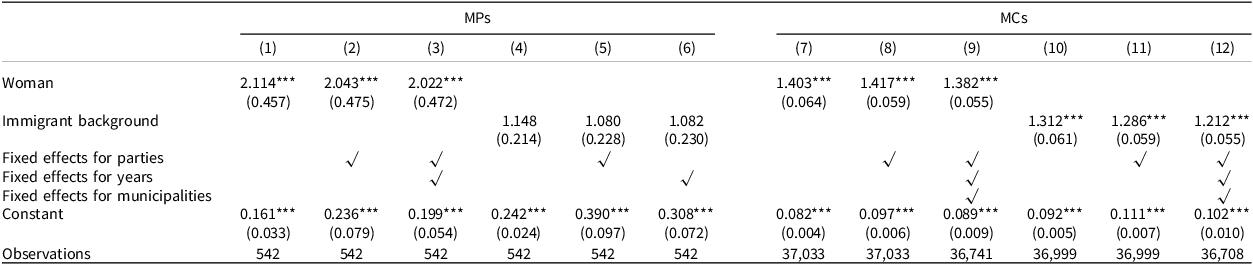
Our next analyses show that politicians from historically marginalized groups are silenced on a greater number of topics compared to their counterparts. In Table 2, we use a Poisson regression approach to examine how many topics politicians refrain from debating. These models include the full sample of survey respondents 2014–2022. Those who did not report that they have avoided public debate because of violence are coded as being silenced on 0 topics. As a conservative approach, those who did not specify which topic they were silenced on, those coded as ‘General’, and those coded as ‘Other’ are also coded as 0. Those who specified the topic(s) they were silenced on are assigned a count value equal to the number of thematic topics they specified. This approach takes into account the propensity to be silenced at all, as well as the number of topics a politician was silenced on. The results are reported as incidence rate ratios. Models 1–6 focus on MPs, and Models 7–12 on MCs.
Table 2. The number of topics politicians are silenced on

Note: data from PTU 2014, 2016, 2018, 2020, and 2022. Survey item: ‘You indicated that you have refrained from engaging in or making statements on a specific issue during the past year [year specified] because of exposure and/or worrying. What type of issue did this relate to?’ Free-text answers coded as described in the methods section. The issues are grouped together in the following seventeen categories: Abortion; Animal Policy; Crime; Economy; Education; Energy; Environment; Foreign Policy; Gender Equality; Immigration; Infrastructure; Minorities; Muslims; Racism; Religion; Sweden Democrats; Welfare. Estimates report Poisson regressions as incidence rate ratios. Party-year clustered standard errors in parentheses. *** p < 0.01, ** p < 0.05, * p < 0.10.
In Models 1–3 and 7–9, we examine differences between men and women (with men as the reference category). The baseline indicates that, on average, men MPs report being silenced on 0.16 topics (Model 1) and men MCs on 0.08 topics (Model 7). The coefficient for Woman is positive and statistically significant, indicating that women MPs, on average, are silenced on about twice as many topics as men MPs (Models 1–3), and about 40 per cent more topics at the MC level (Models 7–9). The results remain the same when we include controls for the respondent’s political party (M2/M8) and political party and year (M3/M9). As with the previous analyses, the gap between women and men is considerably larger among national-level politicians.
In Models 4–6 and 10–12, we explore differences between politicians with and without an immigrant background (with native-background politicians as the reference category). Although the estimate for immigrant background is consistently positive and of a similar size across models, it is statistically significant only for MCs. These results suggest that MCs with an immigrant background are silenced on approximately 30 per cent more topics than their non-immigrant counterparts. However, for MPs, the results are uncertain. Here, it is important to note that only twenty-two MPs with an immigrant background provided a free-text response, specifying which issues they have avoided discussing.
We test the robustness of these findings in three main ways. First, we find that negative binomial, zero-inflated negative binomial, and OLS regressions (see Tables D1–D3) produce similar results to the Poisson estimates.Footnote 8 Second, our analysis in Table 2 categorizes free-text responses into seventeen themes, as described in the methods section. To test the sensitivity of the results to this categorization, we also examine alternative categorizations that merge related topics into larger themesFootnote 9 (see Table D4). The results remain largely unchanged when using eleven instead of seventeen topics: women are silenced on nearly twice as many topics as men among MPs, and 40 per cent more topics among MCs. Politicians with an immigrant background are silenced on about 30 per cent more topics than non-immigrant politicians at the MC level. The coefficient for immigrant background is positive but non-significant for MPs. Lastly, we restrict our sample to respondents who have been categorized into at least one of our seventeen topics in Table D5. The results must be interpreted with more caution here, given the substantially smaller sample of ninety-four MPs, but the coefficients for women point in the same direction as our main results. The differences between politicians with and without an immigrant background are not significant in these analyses, but point in the same direction as the results in Table 2.
As an extension, we interact gender with immigrant background in Tables C2 and C3, to examine their combined impact on the propensity to be silenced by violence. The results show no significant interaction effect – neither in the likelihood of being silenced at all (Table C2) nor in the number of topics silenced on (Table C3). This indicates that women with an immigrant background are not significantly more affected than their men counterparts. Gender and immigrant background instead appear to function as independent factors that each increase the likelihood of being silenced by political violence, suggesting that their effects are additive rather than multiplicative. While intersectional disadvantage can be conceptualized as either additive or multiplicative (see McCall Reference McCall2005), the non-significant interaction term suggests that in this case the empirical pattern aligns with an additive rather than a multiplicative structure.
In sum, our findings indicate that, relative to their counterparts, women and politicians with an immigrant background are silenced on a broader range of topics. For gender, this effect is notably larger at the national level, again consistent with the possibility that the stakes and visibility of national politics may amplify silencing for certain groups. For immigrant background, the pattern is less clear at the national level, likely due to the small sample size of immigrant-background MPs. These patterns offer support for hypotheses H1c and H1d, suggesting that the higher likelihood of marginalized politicians being silenced by political violence extends across multiple policy areas and to more than one policy debate. In other words, the impact on marginalized politicians’ substantive participation in political discourse is amplified.
Are Marginalized Groups More Silenced on Gender Equality and Immigration?
Next, we analyze silencing on specific debate topics. We expected that women and politicians with an immigrant background face harsher attacks when advocating for their group’s interests, as it challenges hegemonic men’s dominance in politics. It follows that marginalized groups may be particularly targeted with violence when discussing such issues and, therefore, more likely to refrain from speaking out on them.
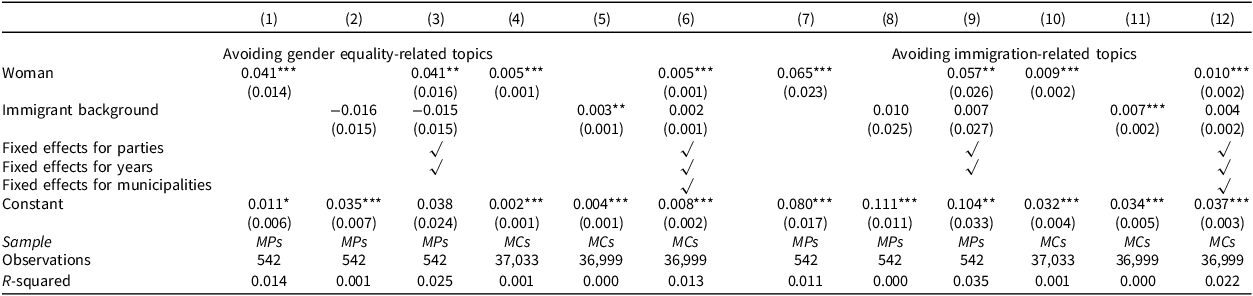
Table 3 shows that women are more likely than men to refrain from debating gender equality because of the risk of violence (Models 1, 3, 4, and 6). This effect is especially pronounced among national-level politicians: women MPs are about 4 percentage points (33 per cent) more likely than men MPs to withdraw from debates on gender equality (Models 1 and 3). While this difference is also statistically significant among MCs, it is much smaller (Models 4 and 6). This mirrors our earlier finding that silencing gaps tend to be larger at the national level, where higher visibility and greater media attention may heighten the risks of engaging in contentious debates. These findings support H2a but suggest that the pattern is primarily driven by MPs, where women MPs clearly avoid public debate on gender equality due to concerns about violence.
Table 3. The propensity to avoid debating gender equality and immigration

Note: data and survey items as in Table 2. See Appendix B for a description of how we coded responses into topics (including Gender Equality and Immigration). The table reports results of OLS estimations with robust standard errors, clustered at party and year, in parentheses. *** p < 0.01, ** p < 0.05, * p < 0.1.
One possible explanation for this gap is that women are more likely to debate issues related to gender and gender equality in the first place. However, even if perpetrators do not specifically target women more than men in gender equality debates, it is normatively important that women politicians can advocate for gender equality and women’s rights without fear of violence. That women are disproportionately silenced on this issue signals a democratic deficit.
The findings on group differences in avoiding immigration-related debates (Models 7–12 in Table 3) are less conclusive. Politicians with immigrant backgrounds may be more likely to be silenced on this topic than their non-immigrant counterparts, but the effects are small and only statistically significant at the MC level. Overall, there are no substantively meaningful differences between the two groups, neither among MPs nor among MCs, in their likelihood of withdrawing from immigration debates due to violence. While immigration is the most frequently avoided topic among all politicians regardless of identity, we find no support for H2b.
Notably, women are more likely than men to refrain from discussing immigration due to violence. Around 8 per cent of men MPs and 3 per cent of men MCs avoid making public statements on immigration, compared with 15 per cent of women MPs and 4 per cent of women MCs (see Models 7 and 10). Again, the gap is larger at the national level, reinforcing the pattern that silencing effects are amplified in national political arenas. This suggests that violence not only suppresses debate on this topic overall but disproportionately discourages women’s participation. Previous research has identified a gender gap in attitudes towards immigration policy in Sweden in recent years, with women expressing more favorable views on immigration than men (Oskarson and Ahlbom Reference Oskarson and Ahlbom2021).Footnote 10 Our findings indicate that men politicians may dominate this debate more than they otherwise would, due to how violence makes women more reluctant to speak publicly on the issue. While we can only speculate on how this shapes the broader discourse, it is possible that voices advocating for more inclusive immigration policies are particularly silenced by violence.
We also analyzed group differences in the propensity to avoid debating each of the seventeen topics presented in Figure 1 as well as the ‘General’ and ‘Other’ categories (see Appendix E). Overall, there are few differences between women and men in the topics they report avoiding due to violence, with less than a one-percentage-point difference for most topics. This suggests that women and men are equally likely to experience silencing across most topics, except for gender equality and immigration.Footnote 11
These findings can be considered in relation to gender segregation in policy areas and committee assignments in Swedish politics. For instance, women are significantly underrepresented in committees on construction, infrastructure, and technical policy. Yet they are just as likely as men to report withdrawing from debates on such topics due to violence. Moreover, we find no evidence that men are more likely than women to avoid any particular topic. While women may be more inclined to debate gender equality and simultaneously more likely to avoid it due to violence, there is no equivalent pattern for men. This could indicate that the topics men are more likely to debate do not attract as much violence, or that men, as a group, may feel more comfortable engaging in debates despite the risk of violence.Footnote 12
There are no significant differences between politicians with and without an immigrant background in the likelihood of avoiding any specific topic due to violence. While immigrant-background politicians are more likely to be silenced overall – and possibly across a greater number of topics – there is no clear pattern indicating that they are disproportionately silenced in particular policy areas compared to other politicians. This suggests that the silencing effect they experience is diffuse, rather than being concentrated in specific debates.
Conclusion
This study demonstrates how political violence exacerbates democratic inequalities by disproportionately silencing historically marginalized groups in politics, thereby undermining their visibility and substantive influence. Echoing concerns outlined in the introduction, violence may disrupt the democratic function of political debates and risk reinforcing the dominance of hegemonic men in political representation. Focusing on Sweden and leveraging extensive survey data with local- and national-level politicians, we find that violence disproportionately silences marginalized groups – women and politicians with immigrant backgrounds – across a broad range of topics, limiting their ability to contribute meaningfully to policy debates. Importantly, our measure captures a wide spectrum of disengagement, from isolated incidents of avoidance to more sustained withdrawal, which means that our findings speak to politicians’ self-perceived changes in debate participation rather than the precise magnitude or form of disengagement. Even so, these patterns indicate that violence constrains the voices heard in public debate.
These differences are most striking at the national level, where overall rates of silencing are higher, and the gaps between marginalized and dominant groups are larger than at the local level. While approximately 20 per cent of men MPs are silenced by violence each year, 36 per cent of women MPs experience the same; among non-immigrants, the figure averages 26 per cent, compared to 36 per cent for MPs with immigrant backgrounds. Moreover, although men and women politicians avoid many of the same topics due to violence, women report withdrawing from debating a greater number of issues overall. Similarly, politicians with immigrant backgrounds appear to be silenced on more topics than their non-immigrant counterparts. While the intensity of disengagement likely varies within these groups, the breadth of topics affected shows how violence can narrow the range of perspectives present in public debate.
Our study advances understanding of how violence shapes inequalities in political participation. Some previous studies from Western democracies find that women experience more violence than men in politics (Collignon and Rüdig Reference Collignon and Rüdig2021; Daniele, et al. Reference Daniele, Dipoppa and Pulejo2023; Håkansson Reference Håkansson2021; Herrick et al. Reference Herrick, Thomas, Franklin, Godwin, Gnabasik and Schroedel2021), and that the same applies to minoritized politicians (Håkansson and Lajevardi Reference Håkansson and Lajevardi2025; Herrick and Thomas Reference Herrick and Thomas2023a). Our findings demonstrate that both women and immigrant-background politicians protect themselves from exposure to violence by avoiding public debates. This suggests that previous research might underestimate the degree to which political violence is gendered and ethnically biased in consolidated democracies, as marginalized politicians’ avoidance behavior might suppress these groups’ higher exposure to violence (c.f. coping strategies against sexual harassment, see Cortina and Wasti Reference Cortina and Wasti2005; Knapp et al., Reference Knapp, Faley, Ekeberg and Dubois1997).
A crucial finding is that women are particularly silenced in debates about gender equality – a policy area where men’s and women’s political interests, priorities, and attitudes often diverge. Women’s participation in these debates is essential for advancing gender-inclusive policy making and addressing systemic inequalities. Additionally, women are disproportionately silenced in immigration debates, which is another area where men’s and women’s political attitudes differ significantly in Sweden. The disproportionate silencing of women on these topics is especially troubling given the growing salience of immigration in Swedish political debates, driven in part by the increasing influence of the radical right. Thus, women’s voices are particularly crucial in debates around both gender equality and immigration, as they provide perspectives that challenge hegemonic male dominance and ensure that policy making reflects the lived experiences and priorities of diverse constituencies. In this context, the exclusion of women’s voices on such pivotal issues risks distorting policy making, deepening democratic inequalities, and reinforcing exclusionary narratives.
In contrast, while immigration is the overall most commonly avoided topic due to violence, immigrant-background politicians are not disproportionately silenced by violence in these debates compared to native-background politicians. This may reflect Sweden’s political context, where women’s organizations and caucuses historically have provided a basis for mobilization, reinforced a shared identity, and ensured some structural support to counteract exclusionary pressures, but where similar structures for immigrant-background politicians are lacking. Unlike some other cases, ethnic or immigration-based political mobilization has not been a significant political force in Sweden.
While this study is grounded in the Swedish context, its findings have broader implications. Sweden provides a valuable case for understanding how political violence shapes substantive representation because it combines high levels of gender equality and greater political inclusion than comparable cases, without extreme levels of affective polarization. While gender-related debates in Sweden have been less polarized than in other contexts, the silencing of women in debates around gender equality may be even more pronounced in societies where such issues are highly contested. Likewise, given that discrimination against immigrants in Sweden appears slightly less severe than in comparable democracies, these findings may be generalizable to other countries with similar migration patterns and political structures. Future research should explore whether similar patterns emerge in other contexts, particularly those with greater levels of affective polarization, more widespread political violence, and weaker institutional protections against violence.
Taken together, our findings carry significant implications for the substantive representation of historically marginalized groups. When violence silences these politicians, it not only distorts the policy agenda but also reduces the diversity of perspectives in public debate. This dynamic risks further alienating these groups from political participation, compounding democratic inequalities. While our focus is on debate participation, our findings also raise questions about downstream effects on political decision-making. In party-disciplined systems such as Sweden’s, individual legislators have limited autonomy in roll-call voting, which may constrain direct effects on final votes. However, political decisions are preceded by deliberation, agenda-setting, and issue framing. If violence chills participation in these debates – whether in committees, parliamentary discussions, or public fora – it plausibly shapes which perspectives are voiced during the policy-making process and thus influences policy outcomes indirectly. Such mechanisms are particularly relevant for non-hegemonic representatives, whose legislative actions are particularly constrained by their parties (Cha et al. Reference Cha, Gest and Wong2025) – making their contributions to agenda-setting and deliberation essential for substantive representation.
The silencing of women on issues like gender equality and immigration has particularly clear policy implications, given the gender gap in interests, priorities, and attitudes on these topics. Our results also underscore that the problem is especially acute at the national level, where the higher visibility and political stakes of debates appear to amplify the silencing effect and widen the gaps between marginalized and dominant groups. Efforts to combat political violence must prioritize creating a safer environment where all representatives can contribute freely to debates. Ensuring that marginalized voices are not only present but also heard is essential to upholding democratic representation, protecting the integrity of policy-making processes, and fostering a more equitable political system.
Supplementary material
The supplementary material for this article can be found at https://doi.org/10.1017/S0007123426101380.
Data availability statement
As described in the Supplementary Material, the data used in this study is individual-level information obtained from The Swedish National Council for Crime Prevention (https://bra.se/bra-in-english/home/publications/archive/publications/2021-10-28-the-politicians-safety-survey-2021.html). Due to the sensitive nature of the topic of political violence in the survey questions, and given that some information in the survey comes from administrative registers, we are under strict contractual obligation not to disseminate these raw data to other individuals. Interested readers can apply for permission to purchase the data directly from the National Council for Crime Prevention (https://bra.se/bra-in-english/home/about-bra.html), and be granted permission from the Swedish Ethical Review Authority (see https://etikprovningsmyndigheten.se/en/).
Acknowledgements
The authors gratefully acknowledge helpful comments from Olle Folke, participants of the 2025 UCLS Political Inequality Workshop, and three anonymous reviewers.
Financial support
This research received funding from the Swedish Research Council (grant number VR-2022-02231); and the Knut and Alice Wallenberg Foundation (grant number KAW-2024.0232).
Competing interests
The authors declare no competing interests.




 Open access

