


Responsibility attribution is an important component of democratic accountability: to hold government officials accountable for public affairs, the public must first identify which actors are responsible for which changes. Political science research has shown that responsibility attributions are malleable, and that they can affect important outcomes such as evaluations of government officials, vote choice, and political mobilization (e.g., Rudolph Reference Rudolph2003b; Arceneaux and Stein Reference Arceneaux and Stein2006; Malhotra Reference Malhotra2008; SoRelle Reference SoRelle2022). Scholars have explored the dynamics of responsibility attribution in the fractured and decentralized U.S. political system, but relatively little research has examined responsibility attribution for Supreme Court decisions (c.f., Grosskopf and Frye Reference Grosskopf and Frye2012; SoRelle and Laws Reference SoRelle and Laws2024). This is an important lacuna, as federal courts in the U.S. wield tremendous authority compared to other advanced democracies (Taylor et al. Reference Taylor, Shugart, Lijphart and Grofman2014), regularly shaping public policy (e.g., Frymer Reference Frymer2003; Snead Reference Snead2023; Hackett Reference Hackett2024) and the broader political landscape (e.g., Zackin Reference Zackin2008; Bailey et al. Reference Bailey, Collins, Rhodes and Rice2025).
This article explores whether and how political messaging can affect responsibility attribution for policy outcomes from Supreme Court decisions, as well as related attitudes, among the mass public. Since public policy in the U.S. is made and implemented across several governing institutions, we theorize that political actors can engage in strategic communication to shape the public’s understanding of which actors are responsible for policy outcomes. For Supreme Court decisions, the opportunity to shape responsibility attribution may be particularly acute due to the Court’s ambiguous relationship to other political actors: while it has visible linkages with partisan actors in the elected branches, it is routinely seen as less “political” than other institutions (Gibson, Caldeira, and Spence Reference Gibson, Caldeira and Spence2003; Gibson and Caldeira Reference Gibson and Caldeira2009a).
To test this proposition, we draw on framing theory, a robust interdisciplinary literature that investigates how frames (i.e., associative links between constructs presented in messages) affect cognitions and attitudes. We theorize that the aforementioned ambiguity enables strategic communication that emphasizes or de-emphasizes the Court’s political linkages. Messages about Court decisions may draw associative links between the Court and political constructs (what we term a “politicization” frame) or between the Court and apolitical constructs (a “depoliticization” frame). Politicization frames highlight the influence of partisan actors on judicial decisions through the appointment process or other linkages, while depoliticization frames highlight the Court’s use of legal considerations (as opposed to partisan or ideological ones) in decision-making. The associative links in each frame shape message recipients’ understanding of cause-and-effect in the outcomes of Court decisions.
How the public attributes responsibility for Court decisions has important stakes for political conflict and democratic accountability. Responsibility attribution could affect attitudes toward public officials perceived to be tied to Court decisions, with potential electoral implications (see SoRelle and Laws Reference SoRelle and Laws2024). It could also more broadly affect attitudes toward political parties and coalitions in which these officials are embedded. It may shape attitudes toward the Court and other political institutions (such as perceived Supreme Court legitimacy) and toward the political system generally (such as openness to Court reforms). Indeed, strategic communication that politicizes or depoliticizes the Court is a real-world phenomenon, suggesting that political actors do perceive that responsibility attribution for Court decisions has meaningful stakes.
For instance, following the controversial Trump v. United States (2024) decision expanding presidential immunity from criminal prosecution, prominent Democrats worked to tie the Court’s decision directly to Trump himself. Sen. Elizabeth Warren (D-MA) highlighted the president’s appointment of Justices when describing the decision: “An extremist Supreme Court stacked by Donald Trump has ruled that the President is above the law. Six right-wing Justices have given the president free rein to abuse the power of the presidency …” (Warren Reference Warren2024). Sen. Lindsey Graham (R-SC), on the other hand, praised the ruling by emphasizing the Court’s use of legal considerations: “Presidents have specific designated constitutional authorities and responsibilities … These core constitutional authorities specifically granted to the presidency must come with absolute immunity …” (Graham Reference Graham2024). Given the relative unpopularity of the decision (see, e.g., Santhanam Reference Santhanam2024; Jotzke Reference Jotzke2024), Warren likely perceived political advantages to tying the Court’s ruling—which she opposed—to the actions of President Trump. Graham, a supporter of the decision and a co-partisan of President Trump, instead focused on the legal underpinnings of the decision.
As illustrated in the above example, political actors often strategically claim, divert, or otherwise assign responsibility for the Court’s actions. Despite this, we know relatively little about whether and how such messaging shapes public perceptions. Does the public generally view Court decisions as political outcomes, or as decisions made by an independent legal authority insulated from partisan politics? To what extent can message frames that politicize or depoliticize Court decisions successfully change responsibility attribution toward the Court and partisan elected officials? What downstream effects do any such changes have on the public’s attitudes or behaviors? Our article investigates these questions, shedding light on a real-world phenomenon and identifying avenues for future research. We do so with a survey experiment testing pre-registered hypotheses about the effects of politicization and depoliticization frames on responsibility attribution for the high-profile Supreme Court case Dobbs v. Jackson Women’s Health Organization (2022). We additionally test whether framing effects are conditioned by party cues (i.e., congruence between the partisanship of the messenger and respondent). As an initial exploration of the downstream consequences of responsibility attribution, we explore effects on sentiment toward the president and the Justices and on perceptions of Supreme Court legitimacy.
We find evidence that both politicization and depoliticization frames are effective in shaping responsibility attribution for Supreme Court decisions. Politicization messages increase responsibility attribution to President Trump for the Dobbs decision while depoliticization messages decrease it, relative to both a control condition and the alternate frame. In line with expectations from the responsibility attribution literature, party cues condition this effect: the effect of a politicization message relative to a depoliticization message is greater when coming from a co-partisan or non-partisan speaker rather than an out-party speaker. Interestingly, we do not find an effect of frames on responsibility attribution to the Court. Taken together, these findings suggest that the public’s attribution of responsibility for Court decisions to other political actors is indeed malleable to framing, though it acts in addition to (rather than substituting for) attribution to the Court itself.
However, our exploration of the downstream consequences of responsibility attribution is inconclusive: we find no effects of the frames on individuals’ sentiment toward the relevant actors or perceptions of Supreme Court legitimacy. Reflecting on these null findings, we consider explanations including the stickiness of sentiment in a polarized environment and the potential robustness of Court legitimacy even in the face of politicization. Although we cannot conclusively distinguish between possible explanations for these null findings, we offer suggestions on how future research can assess other possible downstream consequences of changes in responsibility attribution. At the end of the article, we discuss the implications of our findings for interbranch dynamics and democratic accountability.
Theory and hypotheses
In democracies that disperse political authority across an array of governing institutions, it can be difficult for the public to attribute responsibility for policy outcomes and hold governing actors accountable. This is especially true in the United States, whose government includes federal and state governments, a bicameral national legislature, a separately elected executive, and an abnormally powerful judicial branch (Rudolph Reference Rudolph2003a; Arceneaux Reference Arceneaux2005; Reference Arceneaux2006; Jin et al. Reference Jin, Cloudt, Choi, Jia and Klar2023). Studies find that while the public does attribute responsibility partly based on the formal roles of public officials and control of government, responsibility attribution is malleable and conditioned by partisanship and available information (Peffley and Williams Reference Peffley and Williams1985; Rudolph Reference Rudolph2003a; Reference Rudolph2003b; Reference Rudolph2006; Arceneaux and Stein Reference Arceneaux and Stein2006; Malhotra Reference Malhotra2008; Malhotra and Kuo Reference Malhotra and Kuo2008; Sirin and Villalobos Reference Sirin and Villalobos2011; Grosskopf and Frye Reference Grosskopf and Frye2012; Bisgaard Reference Bisgaard2019; SoRelle Reference SoRelle2022; Jin et al. Reference Jin, Cloudt, Choi, Jia and Klar2023; SoRelle and Laws Reference SoRelle and Laws2024). Many argue that variation in responsibility attribution has consequences for democratic politics by shaping outcomes like evaluations of elected officials (e.g., Rudolph Reference Rudolph2003a; Reference Rudolph2003b; Grosskopf and Frye Reference Grosskopf and Frye2012) and political mobilization (e.g., SoRelle Reference SoRelle2022).
However, only a few studies of responsibility attribution have focused on the U.S. Supreme Court. These studies explore antecedents and consequences of holding the Court responsible for societal problems (Grosskopf and Frye Reference Grosskopf and Frye2012) or examine the effects of assigning responsibility for Court decisions to individual Justices or the Court as a whole (Boddery, Moyer, and Yates Reference Boddery, Moyer and Yates2019). In a recent study, SoRelle and Laws (Reference SoRelle and Laws2024) examine the student loan crisis, finding that frames describing the Court’s role in policy change increase attribution of responsibility for the crisis to both the Court and congressional Republicans. In contrast to these studies, we turn our focus to whether and how non-Court actors are held responsible for specific Court decisions, which has important implications for whether actors involved in influencing a Court decision face accountability.
The public’s perception of whether the Supreme Court is susceptible to external influence is ambiguous.Footnote 1 On one hand, the institutional design of the Court gives the public reason to view it as insulated from, and even “above,” electoral politics. The Justices are not elected and do not identify as partisans on the bench. Their life terms make their tenure distinctively secure.Footnote 2 Prominent actors at the Constitutional Convention defended these features as an “excellent barrier to the encroachments and oppressions of the representative body” (Hamilton Reference Hamilton1788). Justices often emphasize their putatively apolitical role, as Chief Justice Roberts did when saying, “We do not have Obama judges or Trump judges … What we have is an extraordinary group of dedicated judges doing their level best to do equal right to those appearing before them” (Williams Reference Williams2018). The idea that the Court is distinctively apolitical is reinforced by symbols and norms such as black robes, the ornate Supreme Court building, and the use of legalese (Gibson, Caldeira, and Spence Reference Gibson, Caldeira and Spence2003; Gibson and Caldeira Reference Gibson and Caldeira2009a; Gibson and Nelson Reference Gibson and Nelson2014).
On the other hand, the structure and function of the Supreme Court are highly political, and there is evidence that the public does recognize this. Partisan elected officials have influenced the Court by shaping its size, jurisdiction, and authority (Gillman Reference Gillman2002; Whittington Reference Whittington2007; Clark Reference Clark2009), weighing in on pending cases through legal briefs and public statements (Corley Reference Corley2008; Collins and Eshbaugh-Soha Reference Collins and Eshbaugh-Soha2019), and inviting it to address issues that split party coalitions, involve entrenched opposition, or otherwise pose undesirable risks (Graber Reference Graber1993; Whittington Reference Whittington2005; Tushnet Reference Tushnet, Kahn and Kersch2006). The clearest linkage between the Court and explicitly “political” actors is the appointment process, in which the president nominates Justices who are confirmed or rejected by the Senate. In recent decades, the appointment process has become increasingly partisan (Cameron and Kastellec Reference Cameron and Kastellec2023; McMahon Reference McMahon2024). Surveys show the public is relatively knowledgeable about the appointment process compared to other aspects of the judiciary (Kritzer Reference Kritzer2001; Gibson and Caldeira Reference Gibson and Caldeira2009b), especially amid heavy media coverage of contentious appointments in recent decades (Gibson and Caldeira Reference Gibson and Caldeira2009a).
We argue that ambiguity in public perceptions of the Court’s relationship to the elected branches allows it to be characterized as political or apolitical, depending on which dimensions of the Court’s design and roles are emphasized. This malleability creates opportunities for strategic communication to tell different causal stories about responsibility for Court decisions and who should receive credit or blame for the resulting policy outcomes.
Shaping responsibility attributions with politicization and depoliticization frames
To investigate how political messaging might affect responsibility attribution for Court decisions, we draw on framing theory. The extensive interdisciplinary literature on framing explores how variations in messaging affect the constructs and linkages that organize knowledge within individuals’ memories (for reviews, see Chong and Druckman Reference Chong and Druckman2007; Baden and Lecheler Reference Baden and Lecheler2012; Lecheler and de Vreese Reference Lecheler and de Vreese2018).Footnote 3 Messaging may vary both information, which pertains to the constructs that populate memory, and frames, which are associative links drawn between constructs that give the information meaning (Tewksbury and Scheufele Reference Tewksbury, Scheufele, Oliver, Raney and Bryant2019). Framing theory is typically applied in political science to study messaging that selectively emphasizes some associative links over others when portraying political events, objects, and issues.Footnote 4 Because the political world is so complex and information about it is so vast and contested, such frames help people make sense of politics, shaping how they define political issues and understand their causes, implications, and most important essence (Gamson and Modigliani Reference Gamson and Modigliani1989; Entman Reference Entman1993). Consequently, political elites use frames in strategic communication to shape public opinion (Druckman Reference Druckman and Gideon2011; Klar, Robison, and Druckman Reference Klar, Robison, Druckman and Ridout2013).
Frames that link causes with political outcomes can affect responsibility attribution for those outcomes (e.g., Iyengar Reference Iyengar1994). Here, we examine how such frames shape public understanding of the causes of Supreme Court decisions, and therefore, where to attribute responsibility for resulting policy changes. In particular, we theorize that ambiguity in public perceptions of the Court’s relationship to the elected branches suggests that interpretations of Court decisions may be sensitive to frames that “politicize” or “depoliticize” them.
A politicization frame presents an associative link between the Court and elected branches, emphasizing the ways in which the Court is institutionally connected to partisan political actors and can be influenced by these actors. As discussed above, the clearest linkage is the nomination and confirmation process, through which the president and Senate have important roles in shaping Court membership and decision-making. We expect that a politicization frame emphasizing this connection between the Court and the president will guide the public toward attributing responsibility for Court decisions to the president(s) who appointed the deciding Justices. While we focus on the president here, this theory is also applicable to associative links with other actors, like members of Congress.
In contrast, a depoliticization frame presents an associative link between the Court and a purportedly apolitical construct: legal decision-making, as opposed to decision-making based on political or ideological considerations (see, e.g., Segal and Spaeth Reference Segal and Spaeth2002). This image of the Court as an apolitical entity that makes decisions based on law is what Chief Justice Roberts evoked during his confirmation hearing when he described the Court’s role as “calling balls and strikes.” It is buttressed by the Court’s independence from the other branches, its distinctive institutional design (e.g., life tenure, high bar for removal), and its privileged role in interpreting the Constitution. By emphasizing the Court’s use of legal considerations, we expect that a depoliticization frame will lead individuals to attribute responsibility for Court decisions more heavily to the Court.
This leads to two predictions about framing effects on responsibility attribution to the president (Hypothesis 1) and the Court itself (Hypothesis 2) for Supreme Court decisions.
Hypothesis 1: A politicization message will increase responsibility attribution to the appointing president, relative to control.
Hypothesis 2: A depoliticization message will increase responsibility attribution to judicial actors, relative to control.
Here, we present separate hypotheses for each actor because we conceptualize responsibility attribution to each actor as independent of responsibility attribution to other actors, and we are primarily interested in the effect of each frame on its targeted outcome relative to baseline, i.e., the politicization frame targets responsibility attribution to the president, while the depoliticization frame targets responsibility attribution to the Court.
Beyond these main hypotheses, we can also address two further questions of interest. First, as a secondary question, we can explore the relative effects of the politicization and depoliticization frames on each outcome.Footnote 5 This is of some real-world interest, as it juxtaposes two competing frames of Supreme Court decision-making that are commonly used by political actors and news media. Importantly, however, these frames draw two distinct kinds of associative links and therefore should not be conceptualized as inverses of each other (see Experimental Manipulations section for more discussion). As such, our primary question remains comparing the effect of each frame to the control.
Second, as an exploratory question, we can assess whether responsibility attribution for different actors is indeed independent. If raising the responsibility of one actor simultaneously relieves other actors of responsibility (e.g., a depoliticization frame simultaneously raises the Court’s responsibility and reduces the president’s responsibility relative to baseline, while a politicization frame simultaneously raises the president’s responsibility and reduces the Court’s responsibility relative to baseline), then this indicates that responsibility can be “shifted” from one actor to another.
The conditioning effect of party cues
Strategically (de)politicizing the Court allows political actors to advance their political goals: Depoliticization, by emphasizing judicial independence, draws attention away from use of the Court to advance controversial positions. Politicization, by emphasizing the role of allied or opposed political coalitions in influencing a Court decision, allows for claiming credit or assigning blame.
For instance, Southern Democrats who opposed Brown v. Board of Education (1954) connected the decision to the Republican incumbent in the executive branch. Senator Richard Russell (D-GA) deplored it as “a flagrant abuse … to impose the purposes of the executive branch of the government upon the sovereign states of the nation,” and argued that it “demonstrates that the Supreme Court is a mere political arm of the executive branch of government” (emphasis added).Footnote 6 In the north, where the decision was more popular, Republican strategists emphasized the role of the Eisenhower-appointed Chief Justice when claiming credit for the outcome, while northern Democrats instead emphasized “the point that eight of the nine present members of the Court had been appointed by Democratic presidents” (White Reference White1954).
As the above example illustrates, partisan messengers can use (de)politicization frames strategically toward partisan ends. Therefore, party cues may moderate the effects of these frames, such that the partisanship of the messenger, in relation to the partisanship of the message recipient, gives an important signal about whether to accept the frame. Partisans may rely on party cues, especially from recognizable party elites, to determine if the frame is an in-party interpretation of the Court decision.
The effects of party cues on cognitions and attitudes are well-documented. People consistently support issue positions and political candidates that are linked to their own political party at higher rates (e.g., Arceneaux Reference Arceneaux2005; Reference Arceneaux2006; Slothuus and de Vreese Reference Slothuus and de Vreese2010; Boudreau and MacKenzie Reference Boudreau and MacKenzie2014; Kirkland and Coppock Reference Kirkland and Coppock2018). Studies of responsibility attribution have consistently found that partisans selectively attribute responsibility and blame to favor their own party (Graham and Singh Reference Graham and Singh2024). Studies of political communication show that attitudes are more responsive to messages from co-partisans than from out-party speakers across many domains, including foreign policy (Berinsky Reference Berinsky2007; Baum and Groeling Reference Baum and Groeling2009), welfare (Cohen Reference Cohen2003), and public health (Druckman Reference Druckman2001; Bokemper et al. Reference Bokemper, Huber, Gerber, James and Omer2021). Framing effects are larger when they come from in-party sources or alongside in-party endorsement, especially on issues central to party conflict (Slothuus and de Vreese Reference Slothuus and de Vreese2010) or in contexts described as polarized by party (Druckman, Peterson, and Slothuus Reference Druckman, Peterson and Slothuus2013).
This leads to two predictions about how the alignment of the speaker’s partisanship and message recipient’s partisanship will generate a party cue that conditions the effects of frames on responsibility attribution to the president (Hypothesis 3) and the Court (Hypothesis 4). Specifically, we expect the strongest effects when the message is delivered by an in-party elite, and weakest or reversed effects when the message is delivered by an out-party elite, relative to a non-partisan speaker.
Hypothesis 3: There will be an interaction between message and speaker partisanship on responsibility attribution to the appointing president, such that message effects will vary by whether the message speaker is an in-party, out-party, or non-partisan political elite for the recipient.
Hypothesis 4: There will be an interaction between message and speaker partisanship on responsibility attribution to judicial actors, such that message effects will vary by whether the message speaker is an in-party, out-party, or non-partisan political elite for the recipient.
Effects on sentiment
As noted in the introduction, frames that change responsibility attribution for Court decisions may have downstream consequences of interest. One such consequence is public attitudes toward the actor(s) held responsible. Framing effects that alter an individual’s aggregate attitude toward a political figure are consistent with framing theory (Lecheler and de Vreese Reference Lecheler and de Vreese2018).Footnote 7 In the current study, a politicization frame may impact evaluations of an appointing president because it connects that president to a Court decision about which individuals may have pre-existing views. While this connection is only one of many considerations that may contribute to individuals’ overall evaluation of the president, it will be weighted more heavily than it would be in the absence of the frame. The direction of attitude change depends on whether individuals evaluate this consideration, i.e., the Court decision, positively or negatively.
We can test this expectation by examining how individuals’ policy attitudes condition the effect of (de)politicization frames on their sentiment toward relevant actors. A politicization frame that presents a political actor, such as the president, as responsible for a Court decision should result in more favorable sentiment toward that actor among individuals who support the subsequent policy outcome, and less favorable sentiment among individuals who oppose it. Analogously, a depoliticization frame that presents the Court as responsible should result in more favorable sentiment toward the Court among individuals who support the outcome, and less favorable sentiment among individuals who oppose it. This leads to the following hypotheses:
Hypothesis 5: There will be an interaction between message and policy attitude on sentiment toward the appointing president, such that a politicization message will make sentiment toward the actor warmer in those who hold a supportive attitude and cooler in those who hold an opposing attitude.
Hypothesis 6: There will be an interaction between message and policy attitude on sentiment toward judicial actors, such that a depoliticization message will make sentiment toward the Court warmer in those who hold a supportive attitude and cooler in those who hold an opposing attitude.
Legitimacy perceptions
Another potential downstream consequence pertains to public perceptions of Supreme Court legitimacy. Decades of research have demonstrated how perceptions of Supreme Court legitimacy are largely durable, even when there is an ideological incongruence between the Court and the public (Gibson and Nelson Reference Gibson and Nelson2017) and when judicial decision-making is described through a prism of legal realism (Gibson and Caldeira Reference Gibson and Caldeira2011). The durability of Court legitimacy is often ascribed to an underlying idea that the Supreme Court is “different” and “less political” than other governing institutions, such as the presidency and Congress (for a review, see Gibson and Nelson Reference Gibson and Nelson2014). Recent research has challenged assertions that Court legitimacy is insulated from ideological incongruence (Bartels and Johnston Reference Bartels and Johnston2013; Gibson Reference Gibson2024) and has probed how Court legitimacy may be imperiled by politicization (Clark and Kastellec Reference Clark and Kastellec2015).
Drawing on insights from this scholarship, we expect that a politicization message will decrease perceptions of Supreme Court legitimacy by highlighting political linkages between the Court and political actors and eroding the perception of impartiality and “difference.” Indeed, as Gibson and Caldeira (Reference Gibson and Caldeira2009a, 2) note, the “assumption is that whenever Americans are exposed to the politics that has always provided a backdrop for the judiciary, the respect accorded to courts diminishes.” This leads to the following hypothesis:
Hypothesis 7: A politicization message will decrease perceptions of court legitimacy, relative to control.Footnote 8
Study design
To test our hypotheses, we conducted a survey experiment on a quota-based sample of 3,003 adults in the United States in July 2024.Footnote 9 The study design, hypotheses, and analysis plan were pre-registered in June 2024, prior to data collection (AsPredicted #178360; see https://aspredicted.org/3fxy-gghf.pdf). Below, we describe our case selection, study participants and procedures, and measures.
Case selection
We test our hypotheses in the context of the Supreme Court’s decision in Dobbs v. Jackson Women’s Health (2022). We selected this case for two reasons. First, it aligns with our theoretical argument: it is a case with significant policy consequences, where real-world political actors have adopted frames that politicize or depoliticize the Court’s decision as part of partisan strategies. The case transformed abortion rights in the United States, overturning past cases (Roe v. Wade 1973; Planned Parenthood v. Casey 1992) and giving states more authority to ban abortion access. The significance, salience, and unpopularityFootnote 10 of the decision incentivized partisan actors to shape public perceptions of who was responsible. On the one hand, Republicans had incentives to claim credit for the decision to curry favor among socially conservative Republican voters and powerful interest groups in the party coalition. On the other hand, when facing a national electorate where the decision was more unpopular, Republicans had incentives to divert responsibility from themselves, while Democrats had incentives to tie the decision to their Republican opponents.
Indeed, President Trump has adopted both approaches at different times. In May 2023, during his primary campaign, he said on TruthSocial, a social media platform with a largely right-wing user base: “After 50 years of failure, with nobody coming even close, I was able to kill Roe v. Wade …” (Trump Reference Trump2023). In a campaign speech the next month, he claimed credit by invoking his role in the appointment process: “I withstood vicious attacks to confirm three great Supreme Court Justices. … Exactly one year ago today, those justices were the pivotal votes for the Supreme Court’s landmark decision ending the constitutional atrocity known as Roe v. Wade. … I got it done, and nobody thought it was even a possibly” (C-SPAN 2023). In contrast, as the presumptive Republican presidential nominee in the general election, Trump later muted his credit-claiming by emphasizing the Justices “having the courage to allow this long-term, hard-fought battle to finally end” (C-SPAN 2024). These statements demonstrate how elected Republicans can—and do—strategically frame their messaging about the Dobbs decision.
Meanwhile, Democrats have consistently assigned responsibility for Dobbs toward Republican officials, especially President Trump. On the second anniversary of Dobbs, Vice President Kamala Harris argued, “we know how this all came about and who’s to blame … Donald Trump handpicked three members of the United States Supreme Court with the intention they would undo the protections of Roe …” (Williams Reference Williams2024). Similarly, President Biden stated, “Donald Trump’s Supreme Court majority ripped away the fundamental freedom for women to access the health care they need and deserve” (Saenz Reference Saenz2024).
Our second reason for selecting Dobbs is that it presents an especially challenging test for our theory. Abortion is a highly salient issue on which most Americans have crystallized views (Jackson, Mendez, and Feldman Reference Jackson, Mendez and Feldman2023; Murray Reference Murray2023). Given the unusually high salience of the issue and the Dobbs decision, it is likely that many will already have opinions on who is responsible for the decision. Therefore, we expect that the bar to successfully changing responsibility attribution will be uniquely high in the case of Dobbs. Notably, this choice diverges from most framing studies, which focus on emerging or low salience issues where interpreting framing effects is more straightforward. In contrast, because Dobbs is a highly salient case decided two years prior to our study, participants will vary greatly in their prior knowledge and exposure to the case. While we deemed this tradeoff worthwhile, we elaborate on the implications in the Discussion.
Participants and procedures
The study was an experiment embedded into a survey of U.S. adults (n = 3,003). The sample was solicited from a panel maintained by the survey research firm Bovitz and balanced by partisanship across Democrats, Republicans, and Independents, with individuals who leaned toward a party counted as partisans. Bovitz samples are quota-based and constructed to be nationally representative for gender, age, region, race, and ethnicity. Full sample demographics and national benchmarks for comparison are provided in Appendix A.
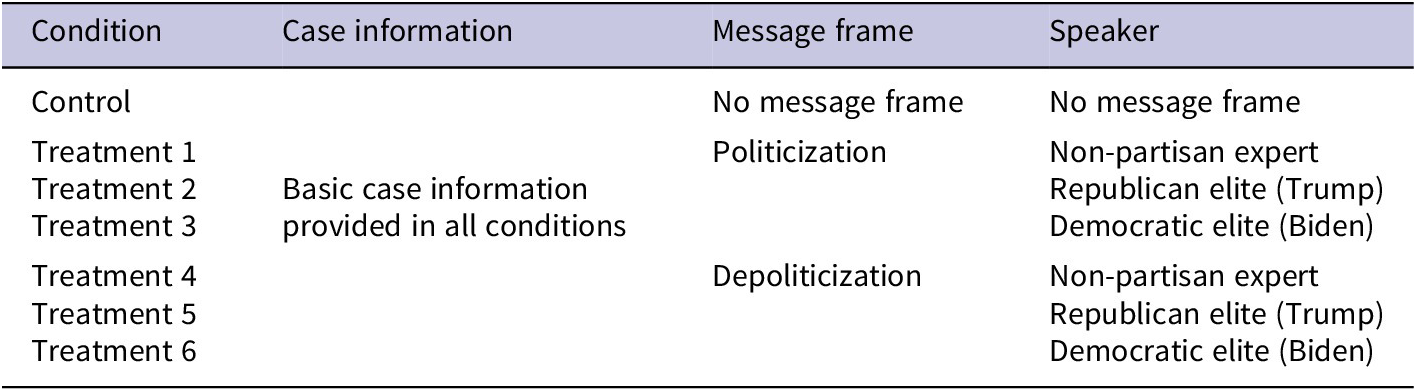
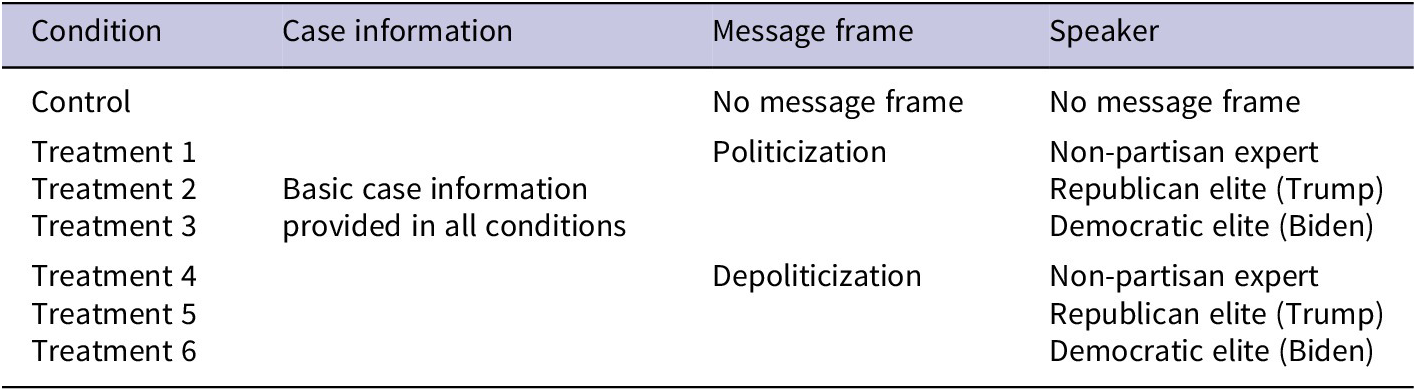
Participants consented to enter a survey about everyday Americans’ attitudes on recent Supreme Court decisions, the Supreme Court justices, and other parts of the government. They first answered measures of demographics and pre-treatment attitude on abortion access. Then, they were randomly assigned to one of seven experimental conditions: a control condition and six treatment conditions that varied across two dimensions, Speaker Partisanship and Message Frame, in a 3 (Speaker Partisanship: Non-partisan expert/Republican elite/Democrat elite) by 2 (Message Frame: Politicization/Depoliticization) factorial design (Table 1). Each condition corresponded with a stimulus message constructed by the research team to resemble a news article discussing the two-year anniversary of the Supreme Court’s decision in Dobbs v. Jackson Women’s Health (2022).
Experimental Conditions
After participants received the stimulus corresponding to their assigned experimental condition, they then answered dependent variable measures.
Experimental manipulations
The control condition included only basic information about the case to ensure that respondents had enough familiarity with Dobbs to give meaningful answers to dependent variable measures. Meanwhile, all treatment conditions included the same basic information about the case plus additional treatment text that varied both speaker partisanship and message frame, as described below. The full text for all conditions is available in Appendix B.
To manipulate speaker partisanship, the treatments varied the partisanship of the person quoted in the article. Specifically, the speaker was either a fictional nonpartisan expert (“Edgar Smith, director of the Bipartisan Legal Center”; treatments 1 and 4), a Republican party elite (“Former president Donald Trump”; treatments 2 and 5), or a Democrat party elite (“President Joe Biden”; treatments 3 and 6).
To manipulate the message frame, the treatments varied whether the speaker emphasized the president’s role in the Court’s decision through the nomination process (politicization frame) or the legal basis of the Court’s decision-making (depoliticization frame).
The politicization frame (treatments 1–3) discussed President Trump’s role in nominating three Supreme Court justices who voted in the Dobbs majority with the following language: “[Speaker] commented on the pivotal role that former President Donald Trump played in this Supreme Court ruling. He noted that Trump appointed three of the five Justices that overturned Roe. ‘For nearly 50 years, many people were trying to end the constitutional right to access abortion. Donald Trump did it. And he’s proud to have done it.’” To further reinforce the institutional linkage, we also included a photograph of President Trump with Justice Barrett on the day she was nominated to the Court.
In contrast, the depoliticization frame (treatments 4–6) discussed the legal basis of the Court’s decision-making with the following language: “[Speaker] commented on the pivotal role that the Supreme Court played in addressing a longstanding constitutional debate. ‘For nearly 50 years, many people were trying to end the constitutional right to access abortion. The Supreme Court has the final say on matters of constitutional law, and it made a difficult legal decision in this case.’” We also included a photograph of the ornate Supreme Court building, which has been shown to emphasize the Court’s legal role and distinctiveness from the other branches (Gibson and Nelson Reference Gibson and Nelson2016; Gibson, Lodge, and Woodson Reference Gibson, Lodge and Woodson2014).
These treatments were constructed from real statements about Dobbs made by relevant actors. Notably, this design choice invokes a well-recognized challenge of framing studies in political science and beyond: messages that present an associative link between constructs usually include information about the constructs themselves, thereby manipulating frames and supporting information simultaneously (Cacciatore, Scheufele, and Iyengar Reference Cacciatore, Scheufele and Iyengar2016; Lecheler and de Vreese Reference Lecheler and de Vreese2018). This results in a trade-off between ecological validity on the one hand (i.e., treatments resemble how the public actually receives frames in political messaging) and construct validity (i.e., treatments manipulate only the intended frame) as well as internal validity (i.e., differences in treatment effects can be attributed only to the frames, not other differences) on the other (Tewksbury and Scheufele Reference Tewksbury, Scheufele, Oliver, Raney and Bryant2019).
We join other framing scholars in recognizing that this trade-off is worthwhile for examining messages that resemble those found in real-world political communication. Yet, it also has two notable implications for interpreting our results. First, the total treatment effect will include both the effect of the frame and its supporting information; our level of analysis does not allow us to parse these two effects (Tewksbury and Scheufele Reference Tewksbury, Scheufele, Oliver, Raney and Bryant2019). We elaborate on this point in the Discussion.
Second, as noted above, the politicization and depoliticization frames are not exact inverses of each other and therefore should be compared with caution. Each frame seeks to establish a different associative link between constructs (i.e., between the Court and the presidency in the politicization frame and between the Court and legal considerations in the depoliticization frame) and contains different supportive information. This approach is typical in emphasis framing research, particularly in political science, where it is not always possible to highlight different dimensions of the same political object in narrowly equivalent ways (Borah Reference Borah2011). To minimize differences, treatments included only the frame and supporting information deemed necessary. Then, to acknowledge the remaining asymmetry, we primarily assess the effects of each frame independently relative to control and directly compare them to each other only as a secondary analysis.
Measures
Abortion access attitude (pre-treatment). The item read, “To what extent do you oppose or support this statement: The right to access abortion should be federally protected in the United States” and was measured on a 7-point scale from Completely Oppose (1) to Completely Support (7).
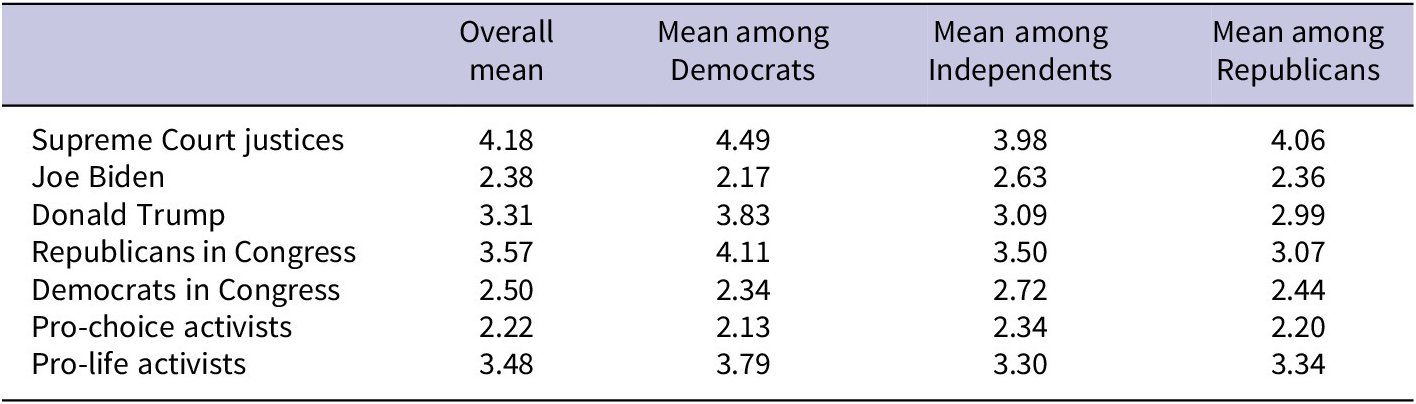
Responsibility attribution. The question stem read, “In your view, how responsible are the following people or groups for ending the constitutional right to abortion access?” and was measured on a 5-point scale from Not at All Responsible (1) to A Great Deal Responsible (5). Participants answered for the following actors, presented in a randomized order: Supreme Court justices, Joe Biden, Donald Trump, Republicans in Congress, Democrats in Congress, “Pro-choice” activists, and “Pro-life” activists.
Sentiment toward relevant actors. The question stem read, “Next, please rate how warm or cold you feel toward the following people or groups on a scale from 0 to 100. Ratings between 50 and 100 mean that you feel favorable and warm toward them. Ratings between 0 and 50 mean you don’t feel favorable toward them and that you don’t care too much for them” and was measured on a feeling thermometer slider from 0 (Cold/Not Favorable) to 100 (Warm/Favorable). Participants again answered for all the actors listed above, presented in a randomized order.
Supreme Court legitimacy perceptions. This was measured using a three-item battery typical in the literature (e.g., Gibson Reference Gibson2024). Participants indicated their agreement or disagreement on a 5-point scale from Strongly Disagree (1) to Strongly Agree (5) with three statements: “If the U.S. Supreme Court started making a lot of decisions that most people disagree with, it might be better to do away with the Supreme Court altogether,” “Justices on the U.S. Supreme Court who consistently make unpopular decisions should be removed from their position as Justice,” and “The U.S. Supreme Court ought to be made less independent so that it listens a lot more to what the people want.”Footnote 11
Full survey question wording and order are provided in Appendix C.
Results
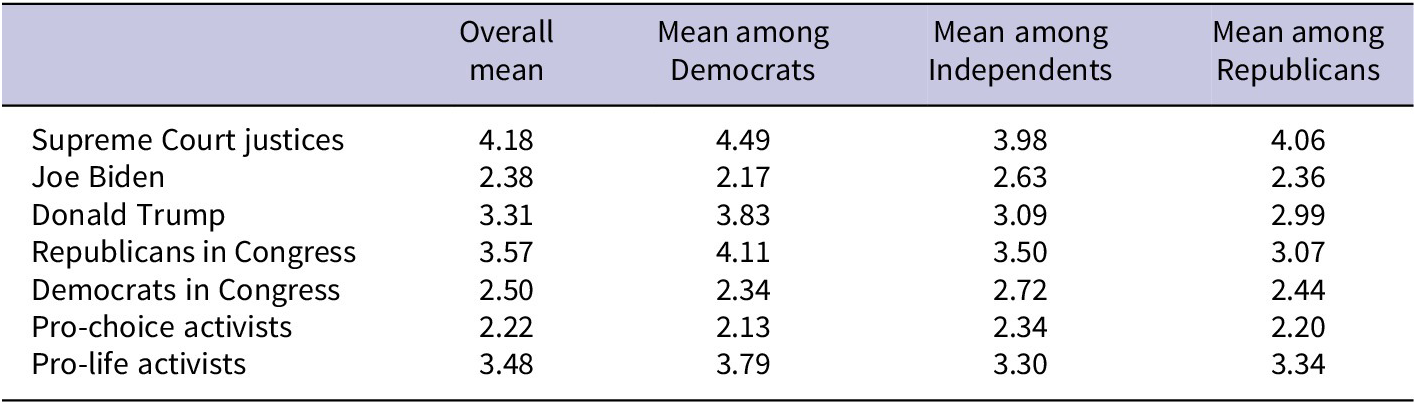
We begin with baseline descriptive statistics of public responsibility attribution for the Dobbs decision to various actors. Table 2 shows mean scores in the control condition, with higher scores indicating greater responsibility. Notably, in the absence of any frames, President Trump’s responsibility ranked relatively low, fourth of seven actors. Although Democrats on average viewed Trump as more responsible than Republicans and Independents, all three partisan subgroups viewed him as less responsible than the Supreme Court, congressional Republicans, and pro-life activists. As we explore further in the Discussion, this finding that the public holds Trump less responsible than the Court and other conservative actors raises normative concerns.
Mean Responsibility Attribution Scores in Control Condition (1 = Not at All Responsible; 5 = Great Deal Responsible)
Hypotheses 1 and 2: Responsibility attribution
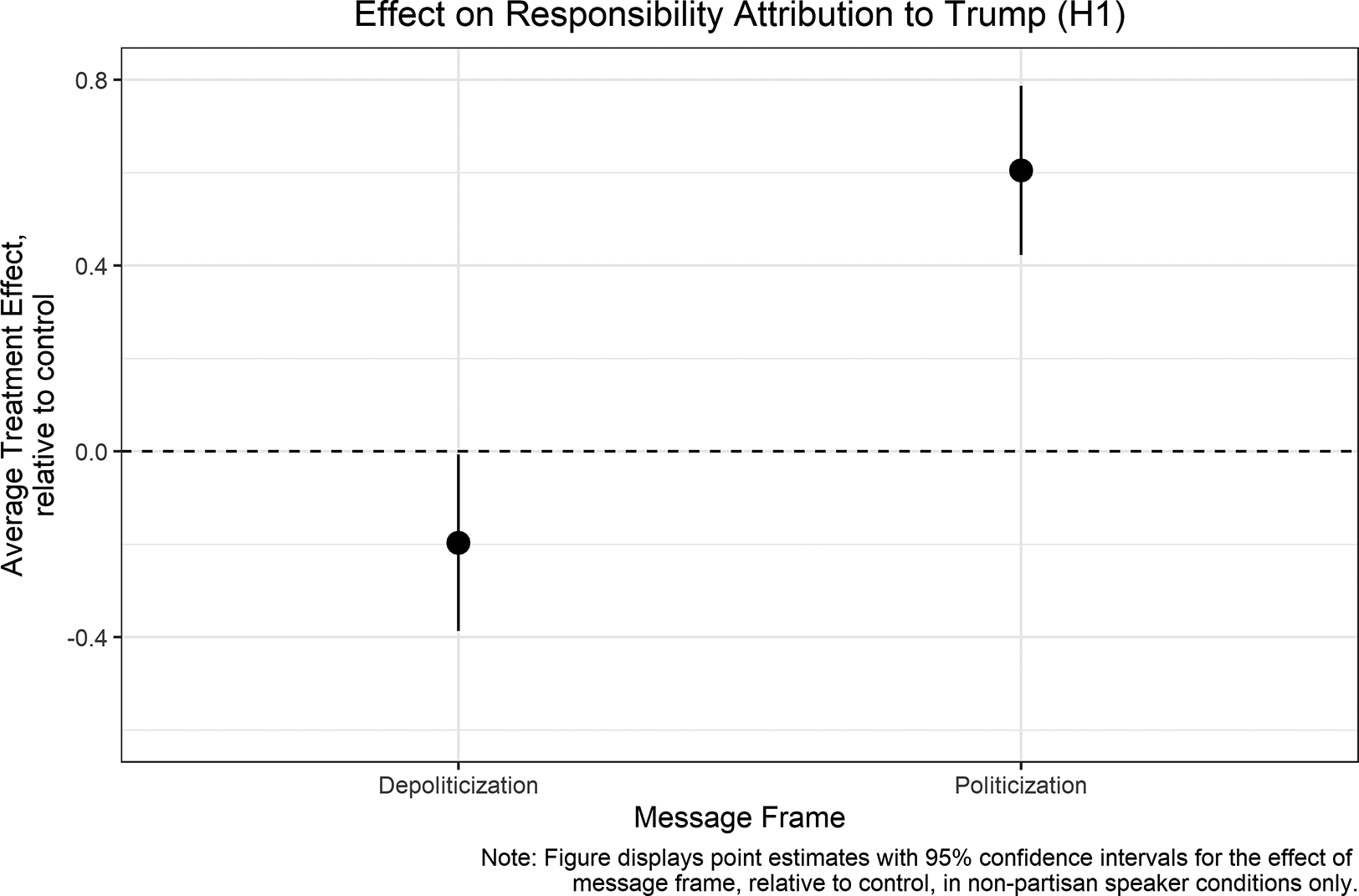
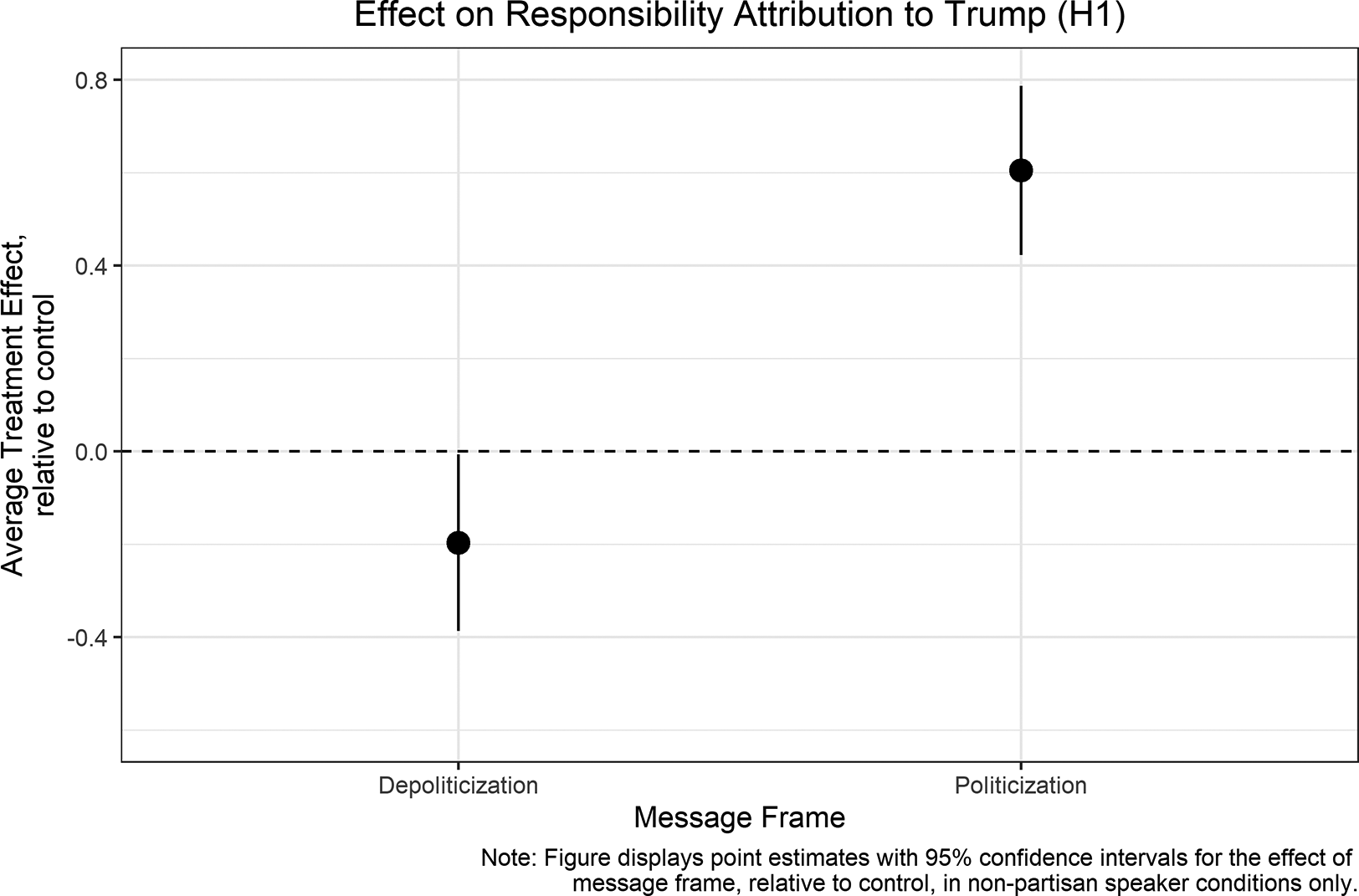
Next, we turn to Hypotheses 1 and 2 about the main effects of frame on responsibility attribution. Hypothesis 1 posits that a politicization message will increase responsibility attribution to a political actor, i.e., President Trump in the context of this study, relative to the control. Following preregistered procedures, we compared mean responsibility attribution to Trump between the control and politicization groups with the non-partisan speaker only, to avoid confounding with speaker partisanship. As predicted, the politicization frame increased responsibility attribution to Trump relative to control (b = 0.60, t(815) = 6.51, p < 0.001). This is a moderate effect (Cohen’s d = −0.45) and represents a change of 0.6 steps on a 4-step scale, or 15% of the full theoretical range of the variable. Therefore, Hypothesis 1 is strongly supported. Results are summarized in Figure 1.
Effect on Responsibility Attribution to Trump (H1).
As a secondary analysis, we compared the frames and found that, as expected, the politicization frame also increased responsibility to Trump relative to the depoliticization frame (b = 0.80, t(864) = 8.77, p < 0.001) with a moderate effect size (Cohen’s d = −0.60) that represents a change of 20% of the full theoretical range of the variable. Yet because these treatments provide different information and vary on multiple dimensions, we caution against drawing strong conclusions based on this direct comparison.
Finally, as an exploratory analysis, we investigated the possibility that responsibility can be “shifted” between actors, such that the depoliticization frame may have relieved Trump of responsibility relative to baseline, despite not mentioning the presidency. We indeed found that the depoliticization treatment decreased responsibility attribution to Trump relative to control (b = −0.20, t(887) = −2.03, p = 0.04). While the effect was small (Cohen’s d = 0.14), representing a change of 5% of the full theoretical range of the variable, it suggests that simply framing the Court as an apolitical actor can reduce perceptions of political influence on Court decisions.
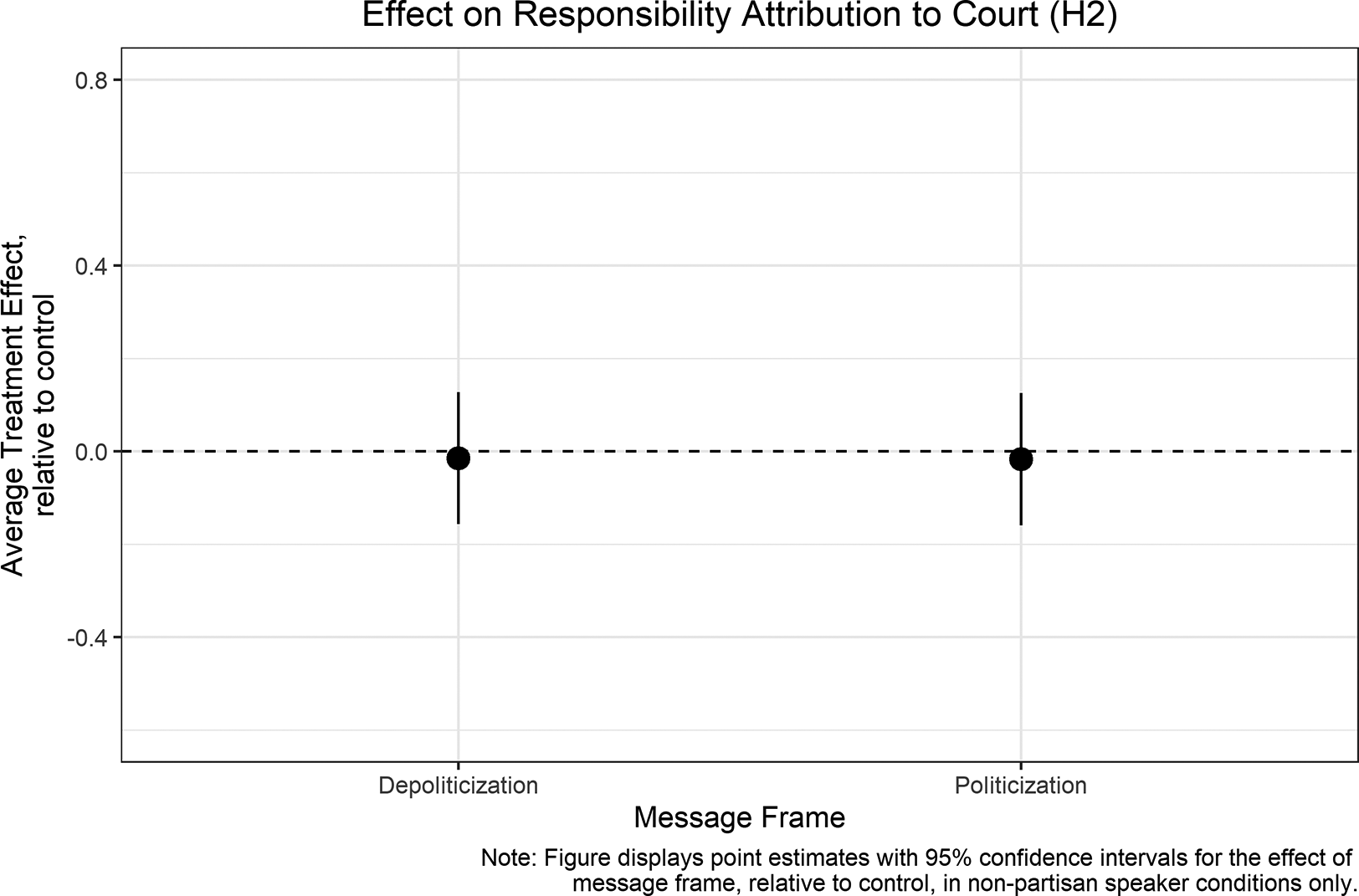
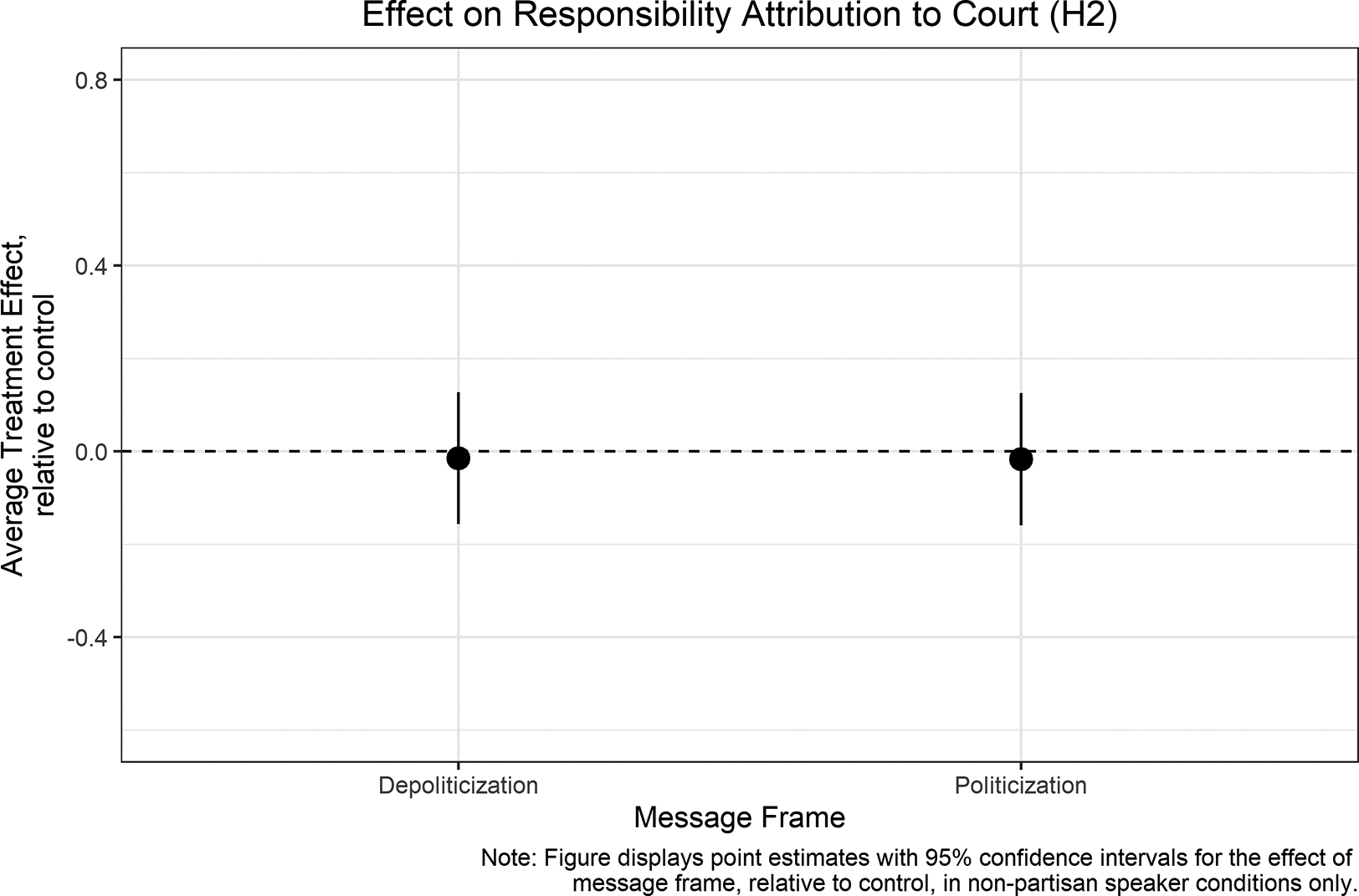
Analogously, Hypothesis 2 posits that a depoliticization message will increase responsibility attribution to the Supreme Court, relative to the control. We compared mean responsibility attribution to the Supreme Court Justices between the control group and the depoliticization group, again with the non-partisan speaker only, but found no evidence that the two groups differed (b = −0.01, t(887) = −0.20, p = 0.84). As such, Hypothesis 2 is not supported. Results are summarized in Figure 2.
Effect on Responsibility Attribution to Court (H2).
As a secondary analysis, we compared the frames to each other and, again contrary to expectations, found that the depoliticization and politicization groups did not differ in mean responsibility attribution to the Court (b = 0.00, t(864) = 0.04, p = 0.97).
Finally, as an exploratory analysis, we again investigated “shifting,” such that the politicization message may have relieved the Court of responsibility by increasing perceptions of Trump’s responsibility. We found no evidence of shifting, as the politicization message had no effect relative to control (b = −0.02, t(815) = −0.24, p = 0.81). These null results suggest that linking the Court to political actors is not effective for relieving the Justices of responsibility for controversial decisions, as the Court retains the same level of responsibility in the public eye even when its politicizing linkages are emphasized.
Hypotheses 3 and 4: The conditioning effect of party cues
Next, we turn to Hypotheses 3 and 4 regarding how party cues condition the effects of message frames on responsibility attribution.
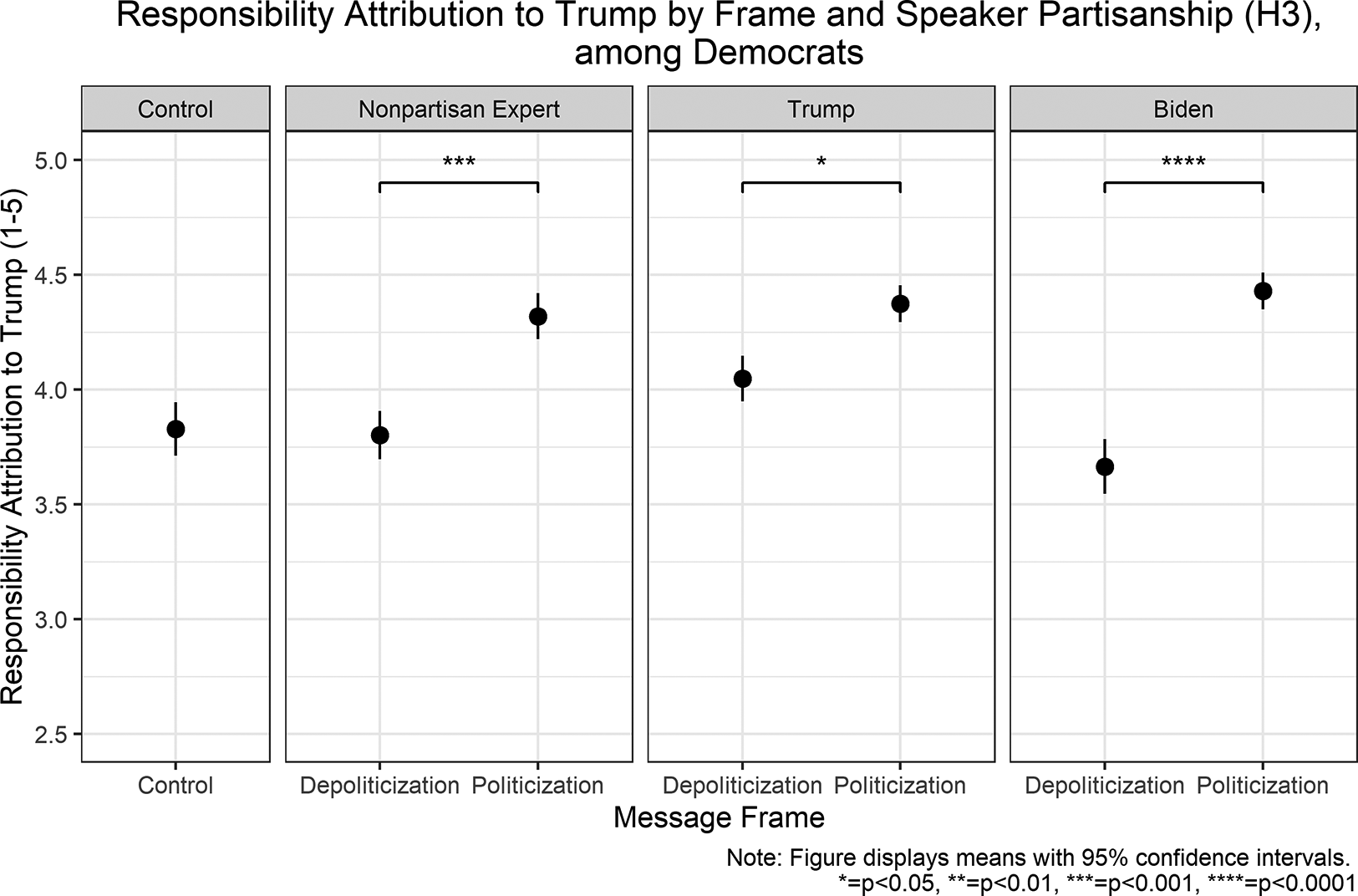
Hypothesis 3 predicts an interaction between the effect of message framing and party cue, i.e., the match between the partisanship of the message speaker and the message recipient, on responsibility attribution to Trump. Following pre-registered procedures, to simplify interpretation, we first subset the sample by those who identified as Democrats and as Republicans, and then conduct separate two-way ANOVAs on each subset to analyze the effect of Message Frame and Speaker Partisanship on the outcome.Footnote 12
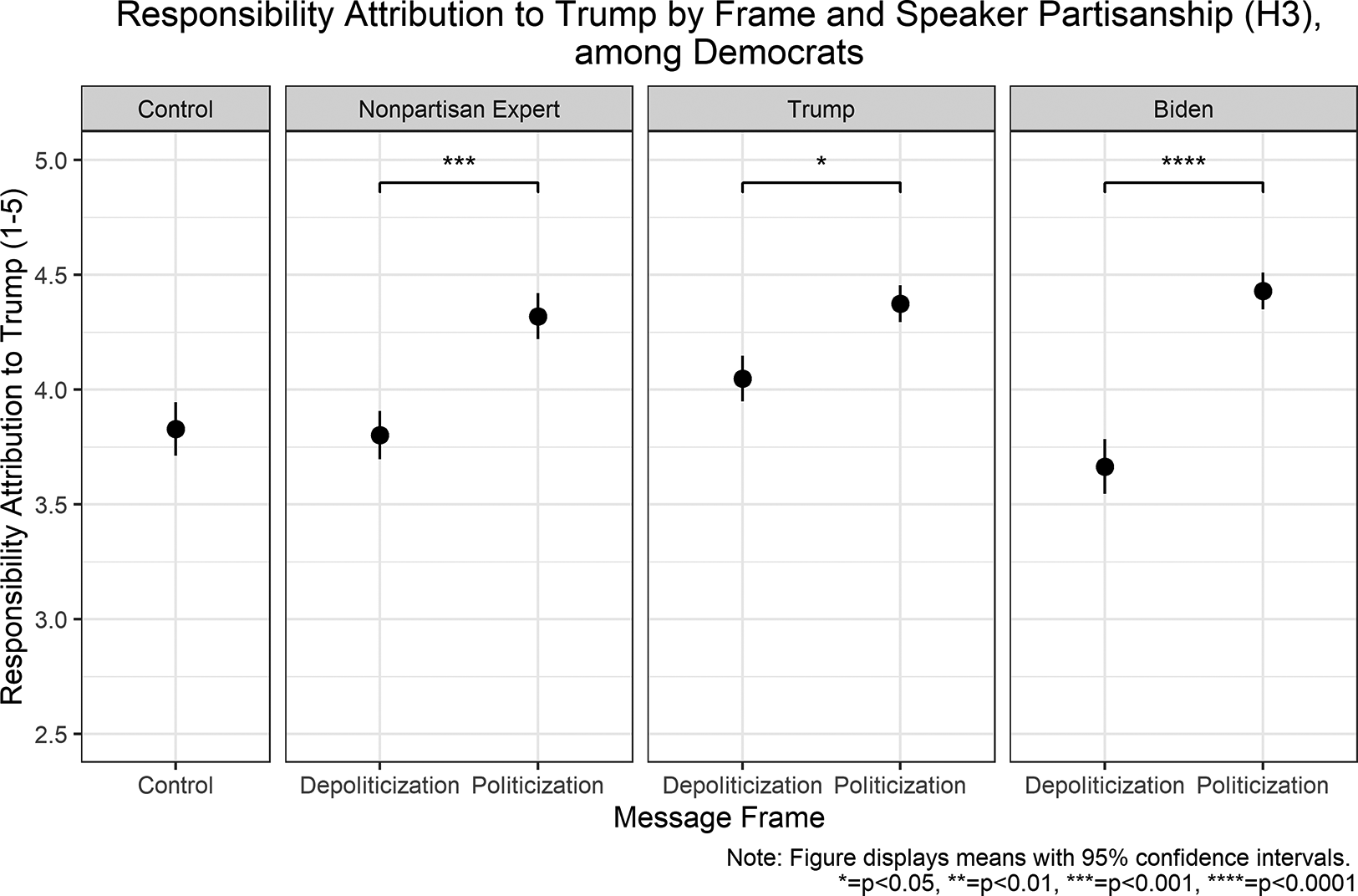
Among Democrats, the interaction between Message Frame and Speaker Partisanship was marginally significant (F(2,853) = 2.49, p = 0.08), indicating that the effect of message frames on Democrats may vary depending on the speaker. Post-hoc analyses reveal that the politicization frame significantly boosted perceptions of Trump’s responsibility relative to the depoliticization frame across all three speakers, suggesting that Democrats are eager enough to attribute responsibility for Dobbs to Trump regardless of the partisanship of the speaker. However, there are some signs of party cue effects, such that the difference between frames is largest and most significant for the in-party speaker, i.e., Biden, medium for the non-partisan speaker, and smallest for the out-party speaker, i.e., Trump. These results are summarized in Figure 3.
Responsibility Attribution to Trump by Frame and Speaker Partisanship (H3), among Democrats.
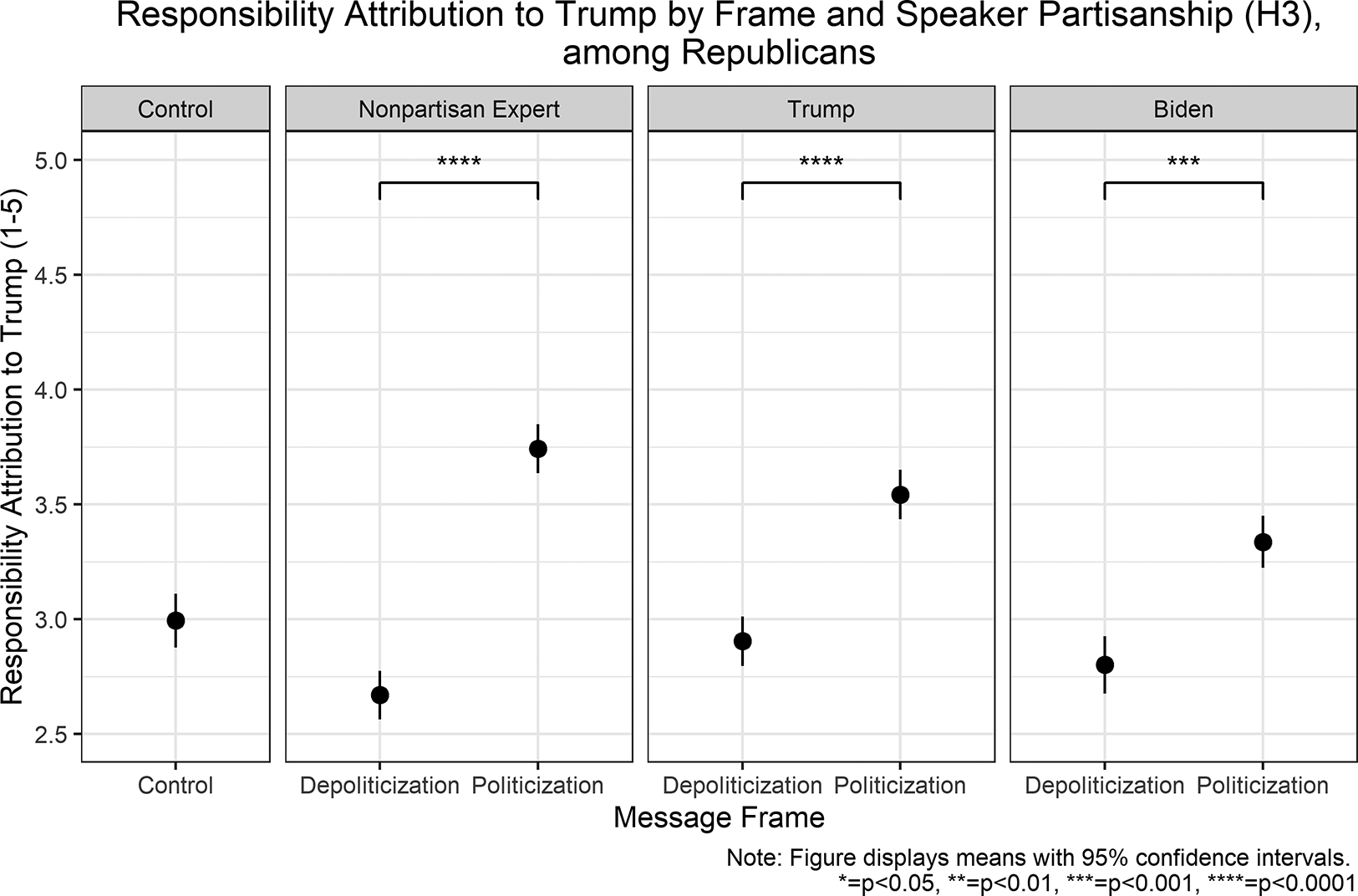
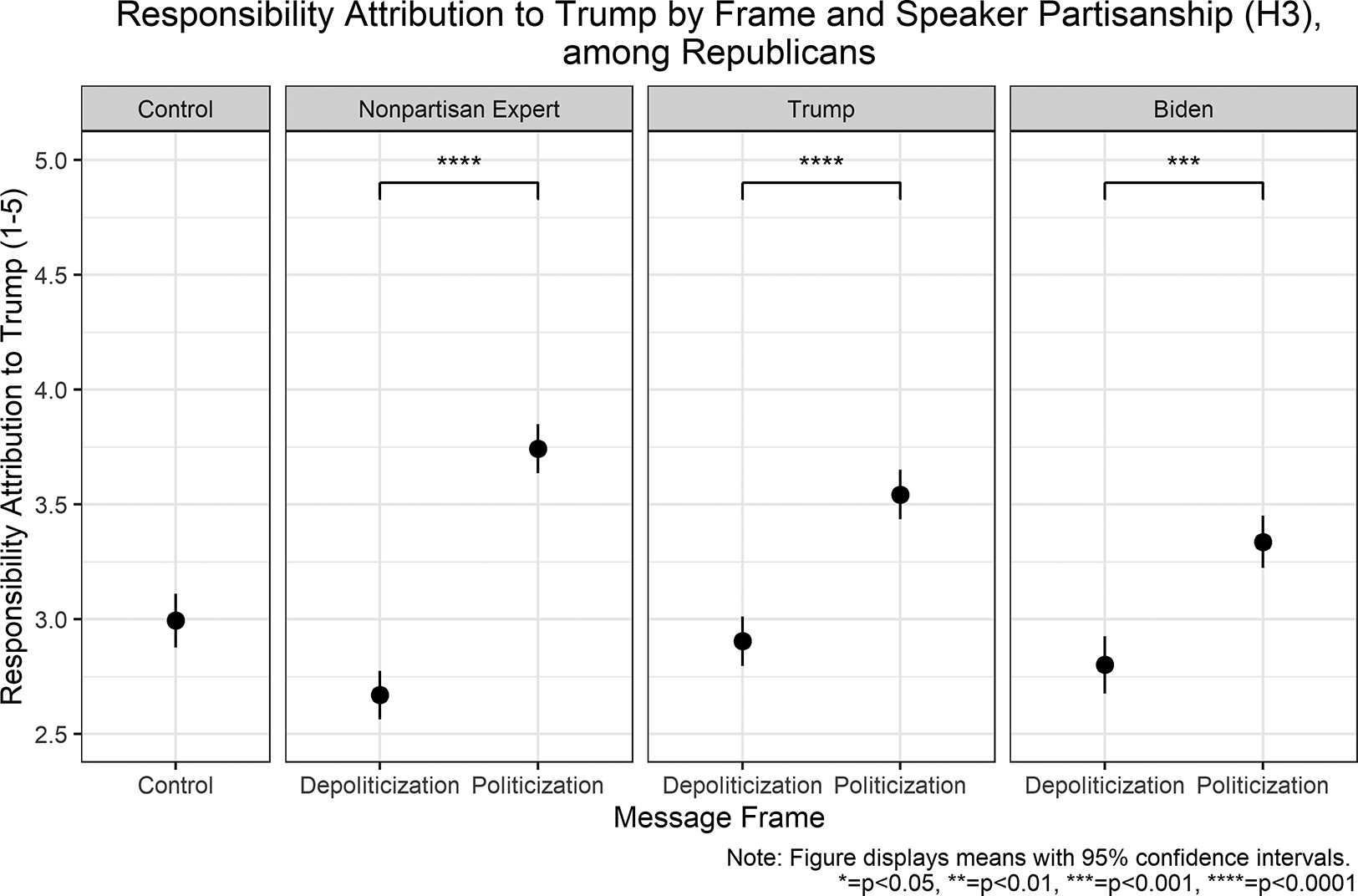
Meanwhile, among Republicans, the interaction between Message Frame and Speaker Partisanship was significant (F(2,858) = 3.26, p = 0.04), indicating that the effect of message frames on Republicans did vary depending on the speaker. Post-hoc analyses revealed that the politicization frame again significantly boosted perceptions of Trump’s responsibility relative to the depoliticization frame across all three speakers, suggesting that Republicans are also eager enough to attribute responsibility for Dobbs to Trump regardless of the partisanship of the speaker. However, somewhat unexpectedly, the difference between frames is largest and most significant for the non-partisan expert speaker, perhaps indicating a Republican preference for a non-partisan source to lend credibility to the message. Meanwhile, as expected, the second largest effects occurred when Trump was the speaker, and the effects were smallest when Biden was the speaker. These results are summarized in Figure 4. In summary, Hypothesis 3 was marginally supported among Democrats and supported among Republicans.
Responsibility Attribution to Trump by Frame and Speaker Partisanship (H3), among Republicans.
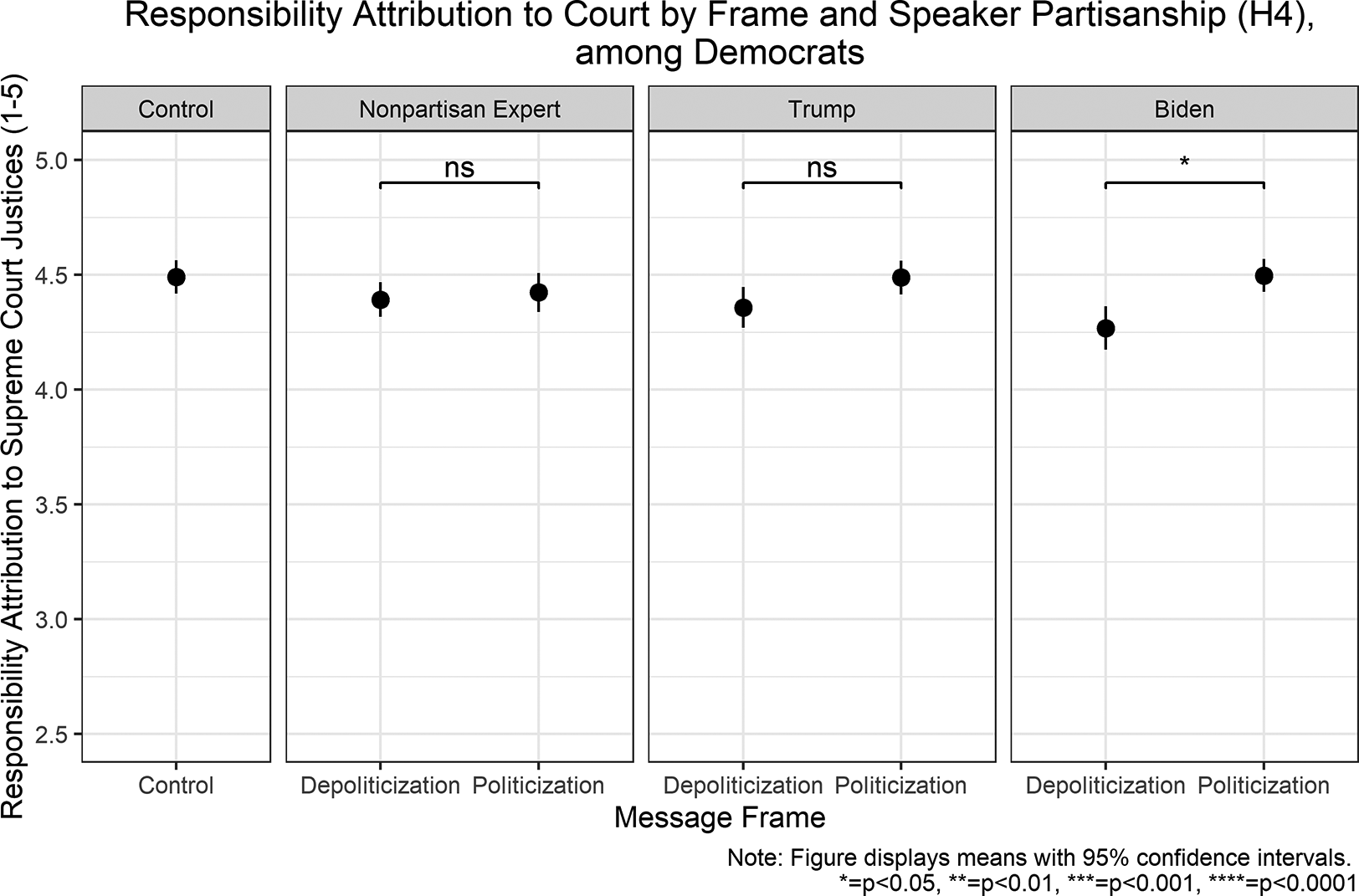
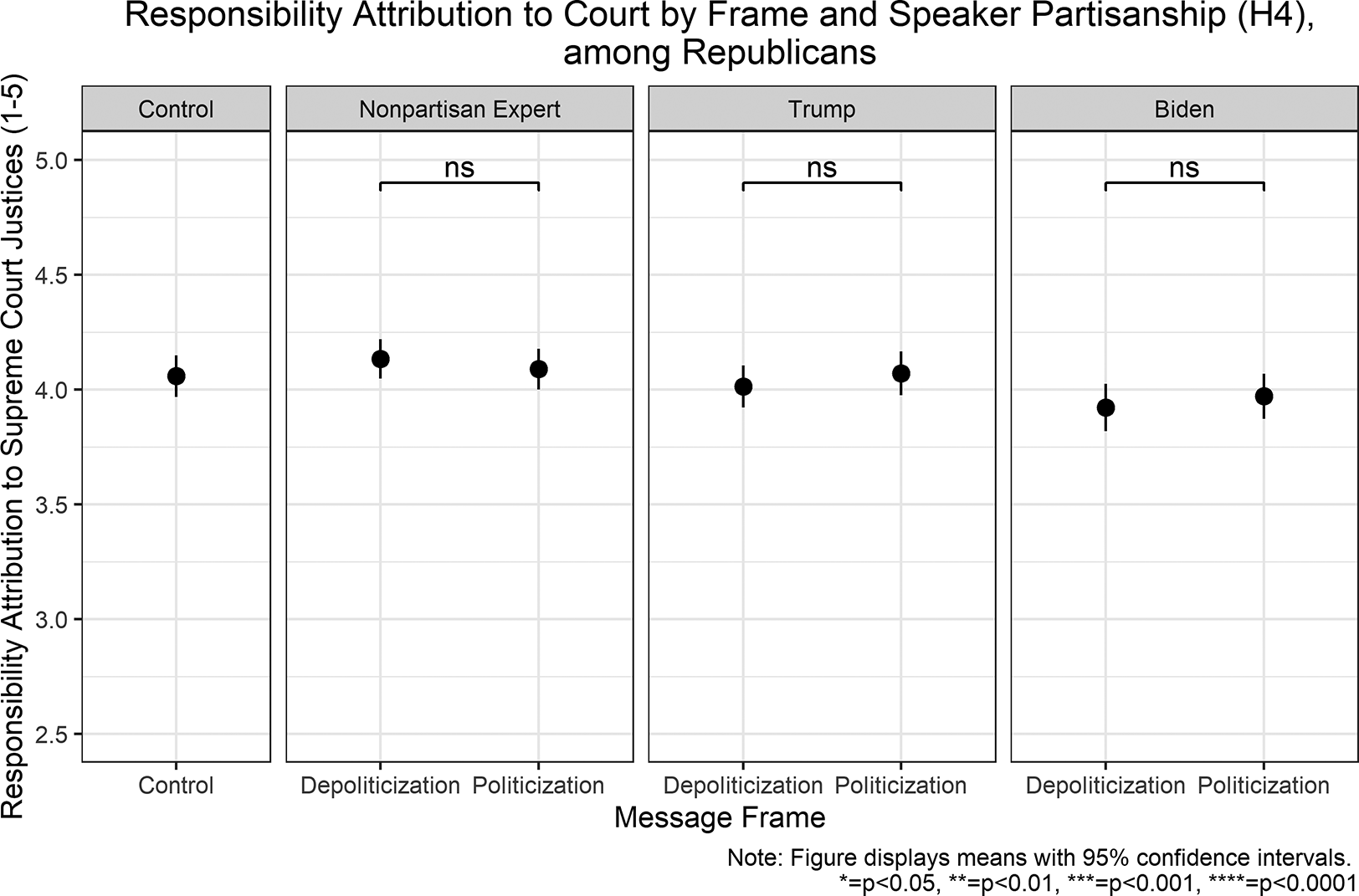
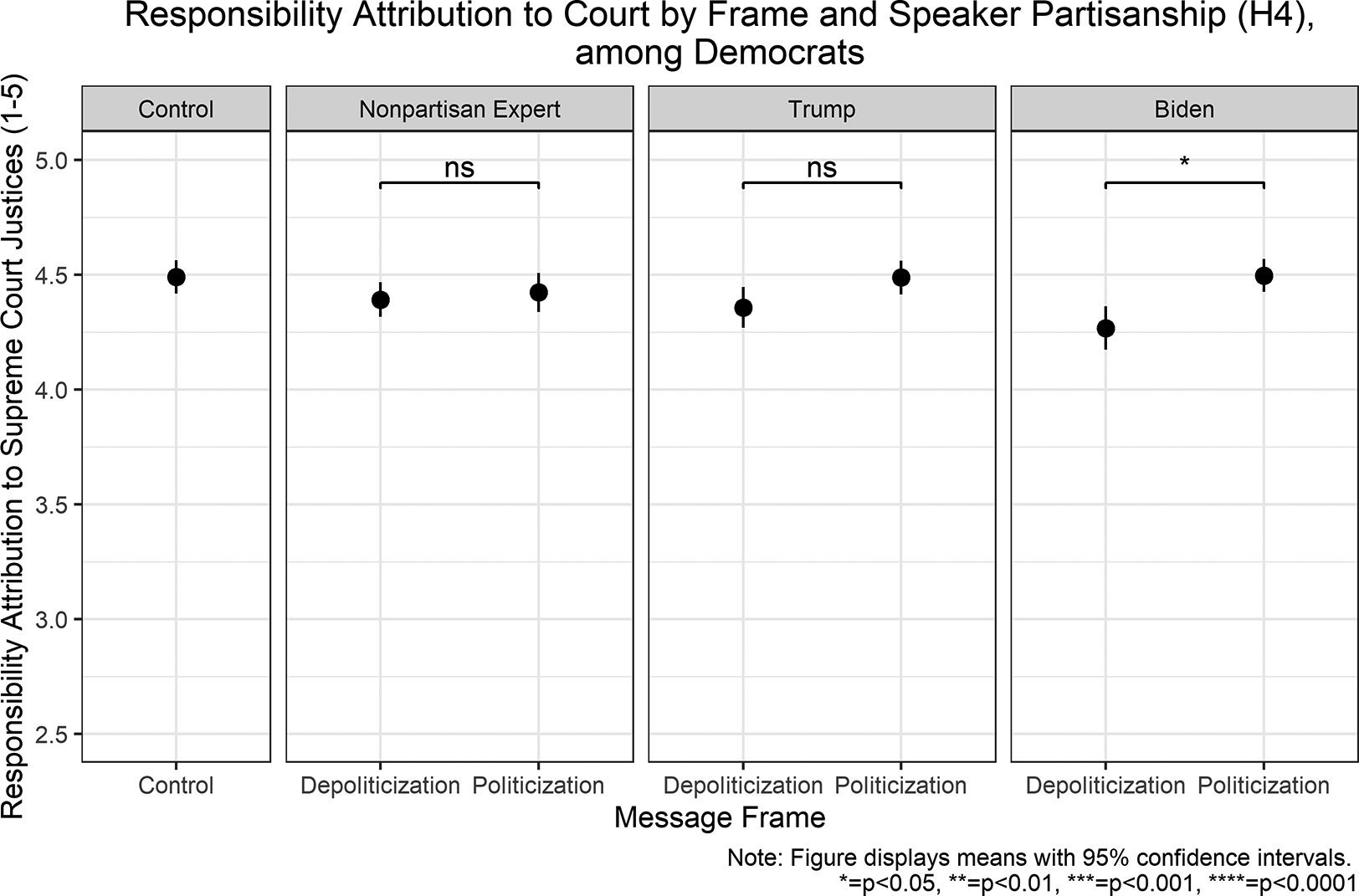
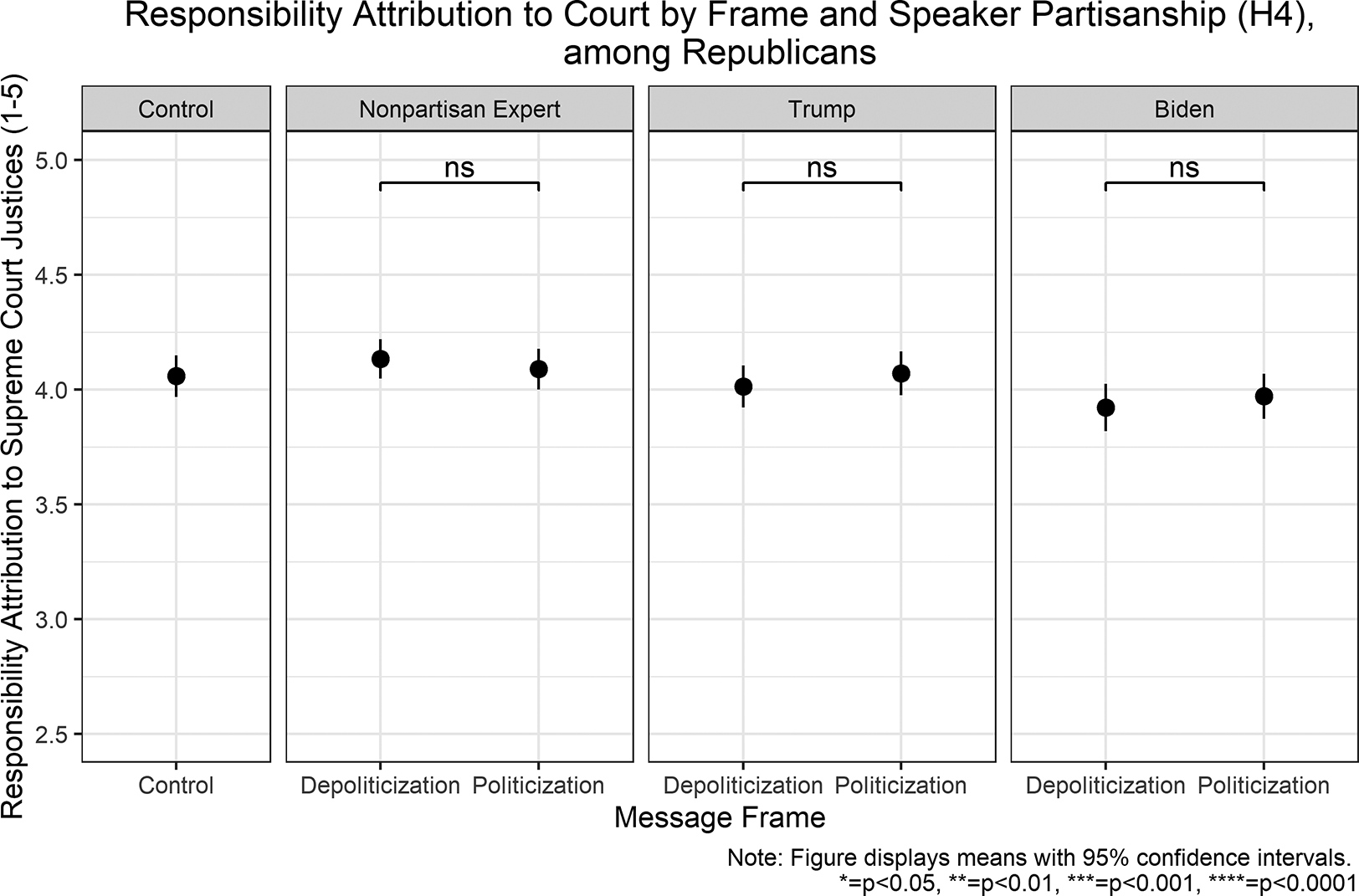
We used the same approach to assess Hypothesis 4, which predicts an interaction between the effect of message framing and party cues on responsibility attribution to the Court. However, we find no support for this hypothesis, as the interaction between Message Frame and Speaker Partisanship is not significant for Democrats (F(2,853) = 0.74, p = 0.48) or Republicans (F(2,858) = 0.19, p = 0.83). Results of post-hoc analyses are summarized in Figures 5 and 6, showing no difference in how either group responded to message frames depending on the speaker, other than the politicization frame moving Democrats to attribute more responsibility to the Court when delivered by Biden, a finding opposite of what was expected (p = 0.04). Therefore, consistent with the null findings in Hypothesis 2 indicating the difficulty of moving perceptions of Court responsibility, Hypothesis 4 was not supported.
Responsibility Attribution to the Court by Frame and Speaker Partisanship (H4), among Democrats.
Responsibility Attribution to the Court by Frame and Speaker Partisanship (H4), among Republicans.
Hypotheses 5 and 6: Effects on sentiment
Next, we turn to Hypotheses 5 and 6, regarding effects on public sentiment toward relevant actors, i.e., the president and Supreme Court justices. We predicted an interaction between message frame and an individual’s attitude regarding the policy impact of the Court decision, such that those who support it would become warmer/more favorable, and those who oppose it would become cooler/less favorable, toward the actors framed as responsible.
Specifically, Hypothesis 5 predicts that the politicization message would cause participants who oppose a constitutional right to abortion access to become warmer toward Trump and participants who support a constitutional right to abortion access to become cooler toward Trump, relative to control. Following pre-registered procedures, we regressed the feeling thermometer measure of sentiment toward Trump on the interaction between experimental condition and participants’ pre-treatment attitude toward abortion access.
Surprisingly, this interaction was not significant (b = −1.08, t(1672) = −1.24, p = 0.21). Results of a secondary analysis with the depoliticization message as the reference category were similar (b = −0.61, t(2579) = −1.02, p = 0.31). This indicates that the frame had similar effects on sentiment toward Trump, regardless of attitude toward abortion access. Specifically, message frames had uniformly no effect on Trump sentiment for opponents or supporters of abortion access.Footnote 13 Therefore, Hypothesis 5 was not supported.
We used the same approach to assess Hypothesis 6, which predicts that the depoliticization message would cause participants who oppose a constitutional right to abortion access to become warmer toward the Justices and participants who support a constitutional right to abortion access to become cooler toward them, relative to control. This interaction was not significant (b = 0.56, t(1743) = 0.79, p = 0.43). Results of a secondary analysis with the politicization message as the reference category were also not significant (b = 0.77, t(2579) = 1.55, p = 0.12). This indicates that the frame also had similar effects on sentiment toward the Justices, regardless of attitude toward abortion access. Specifically, once again, message frames uniformly had no effect for opponents or supporters of abortion access.Footnote 14 Therefore, Hypothesis 6 was not supported.
Hypothesis 7: Court legitimacy
Our final hypothesis posited that the politicization frame would decrease perceptions of Supreme Court legitimacy, relative to control. Following pre-registered procedures, we compared mean legitimacy perceptions between the control group and the politicization group with the non-partisan speaker only and found no evidence that the two groups differed (b = 0.11, t(815) = 1.34, p = 0.18). As a secondary analysis, we compared the frames relative to each other and again found no difference (b = 0.01, t(864) = 0.14, p = 0.89). Therefore, Hypothesis 7 was not supported.
Discussion
This article builds on nascent research incorporating the Supreme Court into the study of responsibility attribution for policy change (e.g., SoRelle and Laws Reference SoRelle and Laws2024). As federal policymaking is increasingly concentrated in the Supreme Court (Mettler Reference Mettler2016; Pierson and Schickler Reference Pierson and Schickler2024; Ramanathan and Snead Reference Ramanathan and Snead2025), it is critical to understand how the public assigns responsibility for policy change wrought by the Court. We approach this topic with a survey experiment that investigates whether and how strategic communication shapes responsibility attribution for Court decisions, using Dobbs v. Jackson Women’s Health as our case study.
Our study finds that baseline responsibility attribution for Dobbs is low for President Trump relative to other actors, and that political communication can effectively change this. A message that President Trump nominated three of the Justices in the Dobbs majority (politicization frame) increases perceptions of his responsibility, while a message about the Court’s use of legal considerations in reaching the decision (depoliticization frame) decreases it. Consistent with the scholarship on party cues, effects are strongest for partisan respondents when the message comes from a co-partisan or non-partisan speaker rather than an out-party speaker. Neither frame, however, changed high baseline responsibility attribution to the Court itself. Finally, as an initial exploration of the downstream consequences of changes in responsibility attribution, we examined sentiment toward public officials and perceptions of Supreme Court legitimacy but found no effects of framing on these outcomes.
These findings have important implications for understanding the role of the Supreme Court in democratic politics. Our baseline data indicate that the public holds President Trump notably less responsible for the outcome of Dobbs than the Supreme Court and other actors such as interest groups, despite his role in nominating three Justices in the Dobbs majority. While we do not claim that Trump suffered no negative ramifications from Dobbs, these results suggest more broadly that pursuing policy goals through judicial action may help insulate elected officials from perceived responsibility for policy outcomes. For less salient issues, where public exposure to information about Court cases or politicization frames is low, elected officials may be held even less responsible for decisions made by a Court they have appointed and influenced. This generates a troubling incentive for political actors to use the Court to pursue unpopular policy goals while evading democratic accountability.
Our experimental findings show that political actors can contest baseline levels of responsibility attribution through strategic communication. Frames highlighting the Court’s political linkages can direct the public to assign more responsibility toward partisan elected officials. Tellingly, a depoliticization frame also reduced responsibility attribution toward the president, suggesting that framing the Court as apolitical can enable elected officials to mitigate their perceived responsibility, even if they played a clear—albeit indirect—role in the outcome.
Meanwhile, neither frame affected responsibility attribution to the Court itself. One possible interpretation of these null results is that the depoliticization frame was simply too weak a treatment; yet, as stated, it was strong enough to reduce responsibility attribution to other actors, such as Trump.Footnote 15 Furthermore, depoliticization did not uniformly alleviate responsibility to all actors by, for example, portraying the decision as an inevitable reading of the Constitution,Footnote 16 as perceptions of Court responsibility remained high. Taken collectively, these results suggest that perceptions of the Court’s responsibility are not as movable as those of other actors.
Central to the stakes of responsibility attribution for Court decisions are its downstream consequences for other attitudes and behaviors. As an initial exploration of framing effects on downstream consequences, we examined two outcomes—attitudes toward public officials and Supreme Court legitimacy—but found no effects on either. Yet, we caution against a premature conclusion that responsibility attribution is inconsequential. In the case of attitudes toward Trump and the Justices, our null findings may reflect a polarized political environment in which sentiment toward these actors has crystallized. This is consistent with research that framing is less likely to change attitudes in highly salient contexts or toward constructs of high personal importance (Lecheler, de Vreese, and Slothuus Reference Lecheler, de Vreese and Slothuus2009; Bechtel et al. Reference Bechtel, Hainmueller, Hangartner and Helbling2015). Therefore, the barriers to changing sentiment toward President Trump, an extremely well-known and polarizing figure, should be substantial.Footnote 17 Sentiment toward the Justices may also be crystallizing due to salient decisions, ethics scandals, and contentious confirmations. As such, we suggest future exploration of downstream consequences to examine other attitudes or behaviors that may be less crystallized, such as willingness to take political action.
Meanwhile, we initially hypothesized that politicization would decrease the Court’s legitimacy, since legitimacy partly rests on the institution being perceived as “less political” and “different” from the elected branches. Our findings instead suggest that legitimacy remains robust even when a message effectively politicizes the Court. One possible interpretation is that Dobbs may be a particularly hard case for finding effects of politicization on legitimacy. Abortion law is a domain in which many people have strong normative beliefs that guide attitude formation (Cope Reference Cope2023) and where research has found that disagreement with the policy outcome has reduced perceptions of Court legitimacy (Gibson Reference Gibson2024).Footnote 18 Thus, in this issue area, the effects of agreement with the decision may eclipse any effect of politicizing that decision. Another interpretation is that politicization affects legitimacy only indirectly or not at all, regardless of issue area. This would align with scholarship finding that Court legitimacy is largely stable (Gibson and Nelson Reference Gibson and Nelson2014) and difficult for other elites to imperil through rhetoric (Collins and Eshbaugh-Soha Reference Collins and Eshbaugh-Soha2019; Montgomery, Rogol, and Kingsland Reference Montgomery, Rogol and Kingsland2019). If this were the case, it would reinforce incentives for partisan actors aligned with the Court to pursue policy change through the judiciary. For partisans who are opposed to the Court, it would suggest that politicization may be insufficient to build public support for efforts to challenge judicial authority.Footnote 19 Applying our theory to other cases would help adjudicate between these interpretations.
In interpreting our findings, we acknowledge two limitations of our approach that are typical of framing experiments. First, as noted above, designing treatments to resemble real-world messages required defining “frame” expansively to include both a message frame and its supporting information. Consequently, we cannot parse the contribution of information (e.g., creating new beliefs about Dobbs and Trump’s appointment of Justices) from pure framing (e.g., drawing a link between such beliefs regarding the cause of the Dobbs decision). While not ideal for construct and internal validity, this may be necessary for conceptualizing frames in a way most applicable to analyzing political communication (see Lecheler and de Vreese Reference Lecheler and de Vreese2018, 5–6).
Second, and relatedly, this study does not attempt to disentangle the mechanisms behind framing. While a more granular approach assessing mechanisms is rare,Footnote 20 this would add valuable context about how long and among whom we can expect framing effects to persist, e.g., by distinguishing learning from more fleeting priming.Footnote 21 However, predicting durability is not straightforward and depends not only on mechanism but also processing style and attributes of each individual’s preexisting knowledge structure (Matthes Reference Matthes2007; Baden and Lecheler Reference Baden and Lecheler2012). The latter, in our case, is particularly difficult to speculate about. While experimental randomization alleviates any concern about causal inference, the two-year lag between the Dobbs decision and our study, as well as the prevalence of political communication about Dobbs, creates higher variation in pre-existing knowledge and pre-treatment exposure among participants than an emerging or low salience case.Footnote 22 Further, implications of pre-treatment exposure depend on additional individual-level factors that drive processing style, like attitude strength (Druckman and Leeper Reference Druckman and Leeper2012).Footnote 23
Therefore, our study should be taken as an initial foray into an area rich in opportunities for future research. We have shown that (de)politicization frames have at least a short-term effect on responsibility attribution for Court decisions, using a case that presents a hard test for our hypotheses. Future studies should examine other cases to assess generalizability,Footnote 24 evaluate mechanisms or durability (e.g., with panel data), and distinguish relevant subgroups that deepen our understanding of framing effects on responsibility attribution. Given the inconclusive findings on downstream consequences here, it is also important to explore other outcomes, such as intended political behavior or support for judicial reforms. Finally, we especially invite scholars to explore the dynamics of responsibility attribution among both the mass public and political elites through other research methods such as historical research, interviews, or focus groups.
We close by stressing the normative implications of our findings for democratic accountability. National political coalitions have long incorporated judicial action into their policymaking strategy (Gillman Reference Gillman, Caldeira, Kelemen and Whittington2008), and party leaders have sought to appoint Justices who will reliably advance legal agendas in line with their own policy agendas (Hollis-Brusky and Parry Reference Hollis-Brusky and Parry2021; Cameron and Kastellec Reference Cameron and Kastellec2023). But while past eras of U.S. politics featured Courts aligned with dominant regimes in the elected branches, our contemporary period features persistently close electoral competition (Snead and Ramanathan Reference Snead and Ramanathan2026). In this context, political coalitions facing headwinds in the legislative process but aligned with the Court may turn to judicial action to implement unpopular policy changes while insulating themselves from perceived responsibility.
We argue that this characterizes the politics of Dobbs. For decades, key parts of the Republican Party coalition sought more restrictive abortion rights policy. However, Roe maintained durable majority support in national public opinion, heightening the political risk of a legislative strategy. As such, national Republicans relied on federal courts to curtail abortion access, specifically choosing judges who would take a more restrictive stance (Cameron and Kastellec Reference Cameron and Kastellec2023). This enables Republicans to have their cake and eat it too: when politically advantageous, they can tout their role in appointing pro-life judges, but when it is risky to do so, they can downplay their role and frame the Court as an apolitical arbiter of the law. Importantly, however, our study shows that opposing coalitions do have some capacity to counteract such a strategy by highlighting the Court’s political linkages.
Debates over judicial power often center around the decision-making of the Supreme Court itself. While the Supreme Court may be “the least dangerous branch” when it comes to explicit constitutional authority, our study suggests it can indeed be quite a dangerous tool for strategic political actors.
Supplementary material
The supplementary material for this article can be found at http://doi.org/10.1017/jlc.2026.10014.
Data availability statement
Replication materials for this article are available at the Journal of Law and Courts. Dataverse archive at https://doi.org/10.7910/DVN/IBUDGR.
Acknowledgements
We thank Laurel Harbridge-Yong, Ethan Busby, Nathan Kalmoe, Chris Krewson, Jonathan Schulman, Daniel Laurison, Ella Foster-Molina, and attendees of the 2024 SPSA Annual Meeting for their feedback on this project. We thank Nicholas Fu for his research assistance. This research was supported by Rowan University and Swarthmore College. Rowan University and Swarthmore College did not have a role in the design, execution, analysis, or interpretation of the data. Nor did they play any role in writing this manuscript. The authors are unaware of any potential conflicts of interest


 Open access

