


Impact statement
Dryland environments have undergone significant change during the Quaternary Period (2.58 Ma), offering a crucial long-term perspective on the climatic, environmental and ecological conditions observed today. This period is also central to understanding the large-scale impact of dryland climatic change on hominins, including the drivers for migration and evidence for adaption to aridity. This review paper presents an overview of the approaches taken to reconstruct environmental conditions and to simulate climatic changes. The paper uses three key examples that exemplify advancements in the field, which illustrate evolving interpretations, significant developments in thought, and areas where uncertainty persists. The paper emphasizes the complexity and variability of dryland changes – both across different regions and within individual landscapes – evident in both reconstructions and model simulations. In its final section, the review explores recent progress in understanding how hominins responded to climatic and environmental shifts in drylands during the Quaternary. The interplay between environmental change and hominin adaptation, migration, and evolution is currently revitalizing this area of dryland research.
Introduction
Reconstructing the past in drylands is important for three key reasons. First, geomorphological processes operating today are influenced by the landscape features inherited from the past, including the Quaternary past (~2.58 Ma). For example, the emplacement and migration of dunes during the Quaternary influence modern-day surface hydrology, such as dune damming during flash-flooding as well as groundwater-fed interdune lakes (Al-Masrahy and Moutney, Reference Al-Masrahy and Moutney2015; Liu and Coulthard, Reference Liu and Coulthard2015), with recent dramatic examples recently observed in southeast Morocco (Egbejule, Reference Egbejule2024). Second, it helps us to understand the range of climatic and environmental conditions drylands can (or have) experience(d), which provides important context for the post-industrial period and changes predicted for the future. Reconstructions using landforms and sediments progress alongside numerical model simulations, which are valuable for exploring the influence of driving forces of past climate change in drylands, although model performance is evaluated using palaeoenvironmental data from reconstructions, reminding us of the need to examine their ability to simulate past climates realistically (e.g. Otto-Bliesner et al., Reference Otto-Bliesner, Braconnot, Harrison, Lunt, Abe-Ouchi, Albani, Bartlein, Capron, Carlson, Dutton, Fischer, Goelzer, Govin, Haywood, Joos, LeGrande, Lipscomb, Lohmann, Mahowald, Nehrbass-Ahles, Pausata, Peterschmitt, Phipps, Renssen and Zhang2017). Thirdly, spatio-temporal changes to aridity are central to endeavours to understand hominin evolutionary transitions (e.g. Timmerman et al., Reference Timmerman, Yun, Raia, Ruan, Mondanar, Zeller, Zolikofer, Ponce de León, Lemmon, Willeit and Ganopolsji2022), particularly abilities to tolerate dry conditions. Climate-induced changes to habitat can be simulated in order to test hypotheses about hominin evolution and migration across dryland regions.
Quaternary dryland research is a major sub-topic within dryland science, and this review aims to outline the approaches taken to reconstruct the past. In doing so, it aims to provide some critique of the current state of knowledge production and set out key areas of progress and continued debate, rather than attempt a comprehensive review of Quaternary environmental change for all major dryland regions, which would require an extensive treatment beyond the scope of a short overview. The paper briefly outlines: (1) the range of environmental data used within those reconstructions and some key numerical models used to simulate the past and (2) the dominant frameworks for global climatic change during the Quaternary. These frameworks are organised into different timescales that inherently reflect the climatic drivers, such as periodic variations in the Earth’s orbit around the sun and the behaviour of the global cryosphere. I then (3) use illustrative examples to explore the status of understanding of Quaternary dryland environments, which also helps demonstrate how #2 has guided interpretations. A combination of conceptual frameworks, proxy data and model simulations is used by researchers to construct arguments, and therein, whilst we can see examples where some consensus is emerging, interpretations and reasoning often get complicated, and debates remain. The final section (4) examines a major motivation for current Quaternary dryland research, concerned with aridity as a factor likely to constrict hominin migration and/or influence adaptability.
Sources of evidence and numerical climate model simulations
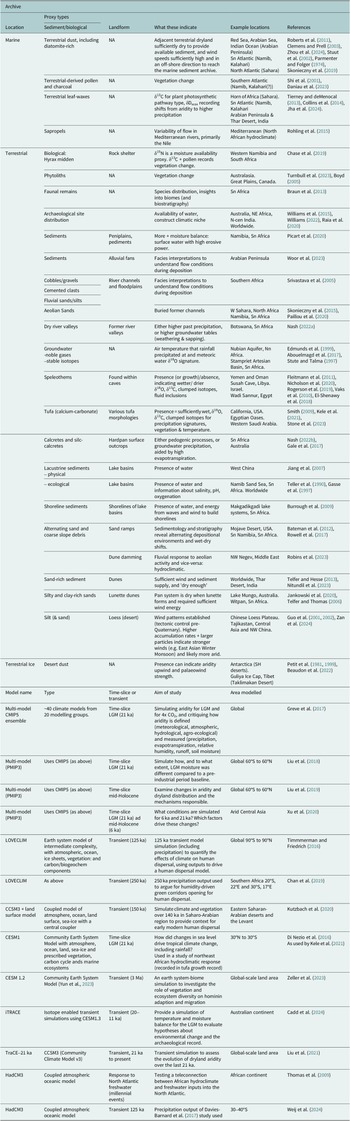
To appreciate where our understanding of Quaternary environmental change in drylands comes from, we must acknowledge a range of archives (such as marine basin sediments and a range of terrestrial settings) and proxies (sedimentary, chemical and biological properties that have recorded a response to past environmental conditions) (Table 1). Environmental reconstruction uses abductive reasoning (Inkpen and Wilson, Reference Inkpen and Wilson2009), looking at changes in that proxy record through time to infer the past conditions under which it formed. This process is inherently imperfect, and whilst some signals can be statistically transformed into quantitative estimates of temperature, precipitation and salinity etc., many give qualitative information about warmer or colder, or higher or lower moisture availability.
Archives and their proxies for past climatic and environmental conditions in drylands, giving an overview of archives and their proxies for past climatic and environmental conditions in drylands, and key modelling simulations from which changes in dryland aridity can be inferred. (abbreviations are used: N – north, N-cen – north central, NW – northwest, S – south, Sn – southern, W – West, Wn – western, Kal – Kalahari)

The study of Quaternary climatic change in drylands is not solely proxy-data driven, with ideas generated from conceptualising how variations in global-scale temperature and circulation patterns may have driven the hydroclimatic conditions in drylands. For example, Jamieson (Reference Jamieson1863), Passarge (Reference Passarge1904) and Flint (Reference Flint1959) argued for dryland ‘pluvial’ conditions during glaciations, based partly on lower temperatures favouring a higher moisture balance, whilst Sarnthein (Reference Sarnthein1977) argued that lower sea-surface temperatures during glacials drove continental aridity, alongside the wind patterns tending to outflow from continental surfaces (Manabe and Hahn, Reference Manabe and Hahn1977).
Numerical modelling simulations also advance our understanding of Quaternary dryland dynamics, allowing us to explore how drylands respond to a range of climatic drivers, or boundary conditions, such as the orbital parameters that control Earth’s receipt of insolation, greenhouse gas concentrations, global terrestrial ice cover, sea-level and meltwater fluxes. This includes simulations of global aridity (e.g. Greve et al., Reference Greve, Roderick and Seneviratne2017) and targeted simulations of dryland regions (e.g. Liu et al., Reference Liu, Jiang and Lang2021). These may be conducted for individual time-slices, such as the global LGM or the mid-Holocene, undertaken as transient simulations through time, or targeted to explore potential climatic teleconnections to a known discrete forcing event (see Table 1).
Frameworks of Quaternary climatic change
Orbital cycles
The influence of changes to Earth’s orbit on glacial–interglacial cycles of the Quaternary, linked predominantly to the cryosphere in the Northern Hemisphere (NH), is well established (e.g. Milankovitch, Reference Milankovitch1920; Hays et al., Reference Hays, Imbrie and Shackleton1976; Ruddiman, Reference Ruddiman2006). The varying eccentricity of the elliptical-shaped orbit influences total solar insolation receipt with quasi-regular cycles of ~400 ka and ~100 ka. The other two cycles relate to seasonality of the receipt of insolation: (i) the change in the degree of the title of the Earth (obliquity) influences the intensity of season in both hemispheres (~41 ka), whilst (ii) the direction the Earth’s axis points in space, combined with the rotation of the elliptical orbit around the Sun, influences the relative strength of seasons in each hemisphere via the precession of the equinoxes (~23 ka). The pacing of global glacial–interglacial cycles, inferred from marine oxygen isotope stratigraphy (MIS), starts as ~41 ka cyclicity (e.g. Pisias and Moore, Reference Pisias and Moore1981; Ruddiman et al., Reference Ruddiman, Raymo and McIntyre1986; Raymo et al., Reference Raymo, Rind and Ruddiman1990), transitioning during 1.25–0.7 Ma to ~100 ka cyclicity. In MIS, even numbers are glacials and odd numbers are interglacials (Figure 2A). The ~41 ka cyclicity is thought to relate to direct obliquity forcing, involving feedbacks with atmospheric greenhouse gases, whilst the ~100 ka cyclicity cannot be accounted for by the small total insolation variations related to eccentricity (Ruddiman, Reference Ruddiman2006). Notwithstanding the debates about the nature of the forcing-cryosphere response, and the role of internal forcing and ocean-atmospheric reorganisations in the climate system (e.g. Broecker and Denton, Reference Broecker and Denton1989; Berger, Reference Berger2013), the large change to the Earth’s climatic state during these glacial–interglacial cycles is likely to have influenced the terrestrial dryland regions.
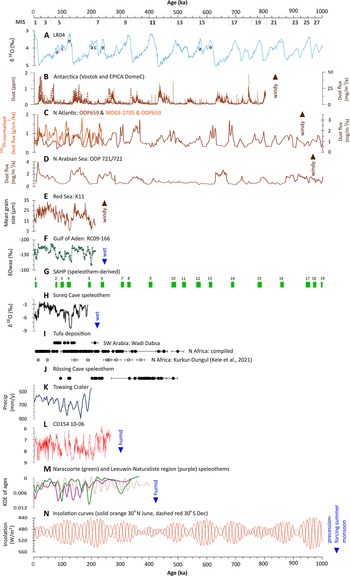
The way conditions in drylands have been conceptualised over global glacial–interglacial periods has gone through large changes in thought. There was a widespread shift in the idea of dryland pluvials during glacial periods to dryland aridity, aided by the advent of chronological control for some proxies (e.g. Williams, Reference Williams1975; Sarnthein, Reference Sarnthein1977). This ‘glacial aridity paradigm’ was lent support by the timing of higher volumes of dust volumes in the Antarctic ice cores such as Vostok during glacials, and larger particles in the LGM layers (Petit et al., Reference Petit, Jouzel, Raynaud, Barkov, Barnola, Basile, Bender, Chappellaz, Davis, Delaygue, Delmotte, Kotlyakov, Legrand, Lipenkov, Lorius, Pepin, Ritz, Saltzman and Stiévenard1999), and back to 800 ka in EPICA DomeC (Lambert et al., Reference Lambert, Bigler, Steffensen, Hutterli and Fischer2012) (Figure 2B), and marine sediments (Figure 1, s1, Figure 2C). However, higher dust concentrations do not necessarily require an expansion of drylands, being wind-driven (more turbulent atmospheric circulation) and because of a potential reduction in wet-deposition of dust owing to a globally averaged lower moisture content during cooler glacials. The marine archives also represent an average of terrestrial material received from a wide spatial area, so that spatial heterogeneity within dryland regions will not be recorded. Therefore, whilst the dryland-derived dust proxy in ice core and marine sediment archives remains an appealing record for terrestrial drylands because they cover a long timescale, capturing multiple glacial–interglacial cycles, they are insufficient for reconstructing conditions in the drylands themselves. This requires terrestrial archives and proxies.
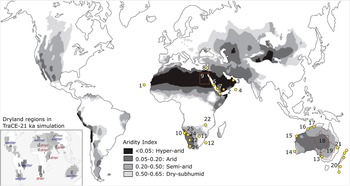
Map of current global dryland distribution, alongside the locations of the major proxy records explored in the three key examples in this paper and an inset of the TraCE-21 ka simulation for the LGM from Liu et al. (Reference Liu, Jiang and Lang2021) demonstrating which dryland regions are simulated to be wetter-than-present, or drier-than-present. Site numbers (s) are referred to in the text, and (1) North Atlantic dust records, ODP659 (deMenocal, Reference deMenocal1995), MD03–2705 and ODP659 (Skonieczny et al., Reference Skonieczny, McGee, Winckler, Bory, Bradtmiller, Kinsley, Polissar, De Pol-Holz, Rossignol and Malaize2019), (2) Mukalla Cave (Nicholson et al., Reference Nicholson, Pike, Hosffeld, Roberts, Sahy, Woodhead, Cheng, Edwards, Affolter and Leuenberger2020), (3) Hoti Cave (Nicholson et al., Reference Nicholson, Pike, Hosffeld, Roberts, Sahy, Woodhead, Cheng, Edwards, Affolter and Leuenberger2020), (4) North Arabian Sea dust record ODP721/722 (deMencoal, 1995), (5) Red Sea dust record K11 (Ehrmann et al., Reference Ehrmann, Wilson, Arz, Shulz and Schmiedl2024), (6) Gulf of Aden RC09–166 (Tierney et al., Reference Tierney, deMenocal and Zander2017), (7) Wadi Dabsa tufa record (Stone et al., Reference Stone, Inglis, Candy, Sahy, Jourdan, Barfod and Alsharekh2023), (8) Soreq Cave (Bar-Matthews et al., Reference Bar-Matthews, Ayaloin and Kaufman1997), (9) Egyptian tufa growth (Kele et al., Reference Kele, Sallam, Capezzuoli, Rogerson, Wanas, Shen, Lone, Yu, Schauer and Huntington2021), (10) Rössing Cave, Namibia (Geyh and Heine, Reference Geyh and Heine2014), (11) Tswaing Crater (Partridge et al., Reference Partridge, deMenocal, Lorentz, Paiker and Vogel1997), (12) CD15410–06 (Simon et al., Reference Simon, Ziegler, Bosmans, Barker, Reason and Hall2015), (13) Naracoorte Caves (Weij et al., Reference Weij, Sniderman, Woodhead, Hellstrom, Brown, Drysdale, Reed, Bourne and Gordon2024), (14) Leeuwin-Naturaliste-region caves (Weij et al., Reference Weij, Sniderman, Woodhead, Hellstrom, Brown, Drysdale, Reed, Bourne and Gordon2024), (15–17) speleothems on the northwest seaboard of Australia (Denniston et al., Reference Denniston, Polyak, Wanamaker, Ummenhofer, Humphreys, Cugley, Woods and Lucker2017), (18) Kati Thanda-Lake Eyre Basin, (19) Murray Darling Basin, (20) Tasman Sea dust record (Hesse, Reference Hesse1994), (21) Native Companion Lagoon, eastern Australia (Petherick et al., Reference Petherick, McGowan and Moss2008), (22) Lake Chilwa, Malawi (Thomas et al., Reference Thomas, Bailey, Shaw, Durcan and Singarayer2009), (23) Pella hydrax midden (Chase et al., Reference Chase, Niedermeyer, Boom, Carr, Chevalier, He, Meadows, Ogle and Reimer2019), (24) Zizou hyrax midden (Chase et al., Reference Chase, Niedermeyer, Boom, Carr, Chevalier, He, Meadows, Ogle and Reimer2019), (25) Spitzkoppe midden (Chase et al., Reference Chase, Niedermeyer, Boom, Carr, Chevalier, He, Meadows, Ogle and Reimer2019), (26) De Rif hyrax midden (Chase et al., Reference Chase, Quick, Meadows, Scott, Thomas and Reimer2011).

Key proxy records globally and for drylands, where: (A) the LR04 oxygen isotope record, with Marine Oxygen Isotope Stages (MIS) above (Lisiecki and Raymo, Reference Lisiecki and Raymo2005), (B) Antarctica Vostok (Petit et al., Reference Petit, Jouzel, Raynaud, Barkov, Barnola, Basile, Bender, Chappellaz, Davis, Delaygue, Delmotte, Kotlyakov, Legrand, Lipenkov, Lorius, Pepin, Ritz, Saltzman and Stiévenard1999) and EPICA DomeC (Lambert et al., Reference Lambert, Bigler, Steffensen, Hutterli and Fischer2012) dust records, (C) North Atlantic dust records, ODP659 (deMenocal, Reference deMenocal1995) and 230Th corrected MD03–2705 and ODP659 (Skonieczny et al., Reference Skonieczny, McGee, Winckler, Bory, Bradtmiller, Kinsley, Polissar, De Pol-Holz, Rossignol and Malaize2019) (sites near 1), (D) North Arabian Sea dust record ODP721/722 (deMencoal, 1995) (site 4), (E) Red Sea dust record K11 (Ehrmann et al., Reference Ehrmann, Wilson, Arz, Shulz and Schmiedl2024) (site 5), (F) Gulf of Aden RC09–166 terrestrial leaf wax δD (Tierney et al., Reference Tierney, deMenocal and Zander2017) (site 6), (G) speleothem-growth record derived South Arabian Humid Periods (SAHPS) (Nicholson et al., Reference Nicholson, Pike, Hosffeld, Roberts, Sahy, Woodhead, Cheng, Edwards, Affolter and Leuenberger2020) (sites 2 and 3), (H) Soreq Cave δ18O record (Bar-Matthews et al., Reference Bar-Matthews, Ayaloin and Kaufman1997) (site 8), (I) Tufa growth records from Wadi Dabsa, SW Arabia (Stone et al., Reference Stone, Inglis, Candy, Sahy, Jourdan, Barfod and Alsharekh2023) (site 7) and N Africa (summarised in Kele et al., Reference Kele, Sallam, Capezzuoli, Rogerson, Wanas, Shen, Lone, Yu, Schauer and Huntington2021) (within box 9), (J) Rössing Cave speleothem growth record (Geyh and Heine, Reference Geyh and Heine2014) (site 10), (K) Tswaing Crater rainfall proxy (Partridge et al., Reference Partridge, deMenocal, Lorentz, Paiker and Vogel1997) (site 11), (L) CD154–10-06P southwest Africa humidity record derived from Fe/K ratios for highly eroded terrestrial sediment (Simon et al., Reference Simon, Ziegler, Bosmans, Barker, Reason and Hall2015) (site 12), (M) KDE (Kernel Density Estimates) for speleothem U-Th ages using 5 ka bandwidth for Naracoorte (east) (site 13) and Leeuwin-Naturliste region (west) (site 14) speleothems in southern Australia (Weij et al., Reference Weij, Sniderman, Woodhead, Hellstrom, Brown, Drysdale, Reed, Bourne and Gordon2024), and (N) insolation curves for summer in each hemisphere to demonstrate precession-paced forcing, where solid orange line is 30°N June and dashed red line is 30°S December (from Laskar et al., Reference Laskar, Robutel, Joutel, Gastineau, Correia and Levrard2004).

Variations to the global monsoon system (Wang and Ding, Reference Wang and Ding2008) on ~23 ka (precession) cyclicity are also well established (e.g. Kutzbach, Reference Kutzbach1981; Cheng et al., Reference Cheng, Li, Sha, Sinha, Shi, Yin, Lu, Zhao, Cai, Hu, Hao, Tian, Kathayat, Cong, Zhoa and Zhang2022). This global-scale system includes the Asian Monsoon, North African Monsoon, North American Monsoon, the Indonesian-Australian Monsoon, South African Monsoon and South American Monsoon (Wang et al., Reference Wang, Wang, Cheng, Fasullo, Gui, Kiefer and Liu2017), with a strong influence on the hydroclimate of neighbouring dryland regions. For example, the well-established influence of the North African Monsoon on the hydroclimatic of the Sahara, including recent ‘greening’ during the North African Humid Period (see deMenocal and Tierney (Reference deMenocal and Tierney2012) for a brief overview). The global-scale influence of ~23 ka (precession) forcing of insolation is complicated by its occurring in antiphase between Earth’s two hemispheres. This owes to the hemisphere tilting towards the Earth (experiencing summer) moving in a cycle from a short pass to a long pass around the Sun in Earth’s elliptical orbit, such that for any year with a NH summer at short pass, the SH summer is at long pass, and vice versa. Therefore, insolation forcing is calculated and plotted for the hemisphere from which the monsoon-related response is being considered (Figure 2N shows a NH and SH summer insolation curve).
Millennial-scale variability
Climatic variability with millennial-timescale pacing was initially detected in the ice core proxies covering the last glacial (Dansgaard et al., Reference Dansgaard, Johnsen, Clausen and Langway1972, Reference Dansgaard, Clausen, Gundestrup, Hammer, Johnsen, Kristinsdottir and Reeh1982, Reference Dansgaard, Johnsen, Clausen, Dahl-Jensen, Gundestrup, Hammer, Hvidberg, Steffense, Sveinbjörnsdottir, Jouzel and Bond1993) as well as ice-rafted detritus in marine sediment cores in the North Atlantic (e.g. Heinrich, Reference Heinrich1988), with the noticeable coincidence in timing set out by Bond et al. (Reference Bond, Broecker, Johnsen, McManus, Labeyrie, Jouzel and Bonani1993) and Broecker (Reference Broecker1994). Hemming (Reference Hemming2004) considered evidence for a global climate imprint of these events and started to consider whether a connection (or teleconnection) between events had a physical basis, via ocean and atmospheric circulation. The 21 warming events from 87 to 12 ka have a quasi-periodic spacing of <2,000 years and last for 50–100 years (Wolff et al., Reference Wolff, Chappellaz, Blunier, Rasmussen and Svensson2010; Rousseau et al., Reference Rousseau, Boers, Sima, Svensson, Bigler, Lagroix, Taylor and Antoine2017). Millennial events with a similar 1470 ± 500-year cyclicity have also been observed in the Holocene (11.7 ka) in the North Atlantic (Bond et al., Reference Bond, Showers, Cheseby, Lotti, Almasi, deMenocal, Priore, Cullen, Hajdas and Bonani1997), although the magnitude of the variations is higher with larger ice sheets. The ‘agitation’ to the climate system provided by millennial-scale variability may have a role in glacial–interglacial transitions (e.g. Hodell and Channell, Reference Hodell and Channell2016). In order to explore potential teleconnections between NH high-latitude driven millennial events and low-latitude dryland climatic responses, numerical climate model simulations can be used.
Example 1: the timing of dryland speleothem (and tufa) growth.
Speleothem and tufa growth in drylands are good indicators for reductions in aridity (Table 1), with uranium-series dating allowing scientists to constrain their growth records over multiple 100 ka cycles. This makes them a useful archive to explore both glacial–interglacial cycles and precession forcing of the monsoon as drivers of Quaternary climate change in drylands.
On the Arabian Peninsula, the discontinuous Mukalla and Hoti Cave speleothems (14.917°N, 48.590°E and 23.083°N, 57.350°E) (Figure 1, s2,3) cover 1.1 Ma, with growth phases only occurring during peak interglacial and warm sub-stages during interglacials, and no growth during glacials (Nicholson et al., Reference Nicholson, Pike, Hosffeld, Roberts, Sahy, Woodhead, Cheng, Edwards, Affolter and Leuenberger2020). The record is used to delimit South Arabian Humid Periods (SAHPS) (Figure 2G), which show correspondence with other proxy records for humidity in the region (Nicholson et al., Reference Nicholson, Pike, Hosffeld, Roberts, Sahy, Woodhead, Cheng, Edwards, Affolter and Leuenberger2020) (Figure 1, s4–6, Figure 2D–F), and MIS 7 and MIS 5 interglacial tufa deposition at Wadi Dabsa (18.307°N, 41.564°) (Stone et al., Reference Stone, Inglis, Candy, Sahy, Jourdan, Barfod and Alsharekh2023) (Figure 1, s7, Figure 2I). The conceptual explanation for the absence of speleothem growth during glacial periods is that glacial boundary conditions ‘dampen’ monsoon strength. More specifically, large NH high-latitude ice sheets influenced atmospheric circulation, preventing on-land penetration of the summer monsoon (Burns et al., Reference Burns, Fleitmann, Matter, Neff and Mangini2001; Fleitmann et al., Reference Fleitmann, Burns, Pekala, Mangini, Al-Subbary, Al-Aowah, Kramers and Matter2011). A role for precession-forcing seems less conclusive – there is not a SAHP for every peak in insolation (at 15°N) even during an interglacial (the non-dampened state) (Nicholson et al., Reference Nicholson, Pike, Hosffeld, Roberts, Sahy, Woodhead, Cheng, Edwards, Affolter and Leuenberger2020).
Records of speleothem growth in the Negev Desert, adjacent to the Arabian Peninsula, do not align strictly with interglacials, suggesting glacial–interglacial forcing of aridity-humidity may not be widespread across NH drylands. The ~200 ka Soreq Cave (31.754°N, 35.021°E) δ18O record (Bar-Matthews et al., Reference Bar-Matthews, Ayaloin and Kaufman1997) (Figure 1, s8, Figure 2H), along with dated fragments across seven other caves, indicates four Negev Humid Periods (NHPs) (Vaks et al., Reference Vaks, Bar-Matthews, Matthews, Ayalon and Frumkin2010), which do not align strictly with interglacials: NHP-4 (MIS 10 into MIS 9), NHP-3 (MIS 8), NHP-2 (MIS 7), and NHP-1 (late MIS 6 into MIS 5). In examining a role for precession-paced forcing, Vaks et al. (Reference Vaks, Bar-Matthews, Matthews, Ayalon and Frumkin2010) find NHPs lead NH insolation peaks by several 1,000 years, with no clear explanation. The conceptual mechanism to explain monsoon-forcing of NHPs is complicated, involving a Mediterranean Sea moisture source from synoptic cyclones and an Atlantic moisture source. For the latter, a sea-surface temperature-driven reduction of the Azores High pressure system might allow the North African Summer Monsoon (Atlantic-source) to reach as far east as the Negev (deMenocal, Reference deMenocal1995, Reference deMenocal2004; Bar Matthews et al., Reference Bar-Matthews, Ayaloin and Kaufman1997).
Further west into northeast Africa, Egyptian tufa growth records also indicate deposition in glacial periods (MIS 2 to MIS 12), in addition to peak interglacials, but not with precession-pacing (Kele et al., Reference Kele, Sallam, Capezzuoli, Rogerson, Wanas, Shen, Lone, Yu, Schauer and Huntington2021) (Figure 1, s9, Figure 2I). Kele et al. (Reference Kele, Sallam, Capezzuoli, Rogerson, Wanas, Shen, Lone, Yu, Schauer and Huntington2021) propose a mechanism for ‘glacial enhancement’ of moisture in Egypt rather than the ‘dampening’ experienced in southern Arabia. When the Sunda and Sahul shelves (Indonesia and north of Australia) are exposed as landmass during glacial lowering of sea level, reduced oceanic Indonesian throughflow leads to atmospheric circulation changes that increase rainfall over East Africa. However, whilst Kele et al. (Reference Kele, Sallam, Capezzuoli, Rogerson, Wanas, Shen, Lone, Yu, Schauer and Huntington2021) draw on the CESM1 simulation of response to that glacial sea level change to support this idea (Di Nezio et al., Reference Di Nezio and Timmermann2016), the simulation only demonstrates an increase in rainfall over eastern equatorial Africa, not over Egypt.
In the SH, stalagmite and flowstone growth records from Rössing Cave, Namibia (22.531°S, 14.798°) (Figure 1, s10) date to interglacials MIS 5e, MIS 7 and MIS 11, but also extend through the MIS 10 glacial (Geyh and Heine, Reference Geyh and Heine2014) (Figure 2J). The proposed moisture source is an expansion of summer rainfall over to the west coast of southern Africa, bringing Indian Ocean Monsoon moisture, although it is not clear why Geyh and Heine (Reference Geyh and Heine2014) do not consider precession-paced forcing. Two key long proxy records for eastern southern Africa do reveal some precession-pacing: (i) Tswaing Crater sedimentary proxy record (25.416°S, 28.101°E) (Figure 1 s11, Figure 2K) (Partridge et al., Reference Partridge, deMenocal, Lorentz, Paiker and Vogel1997) and (ii) CD15410–06 (31.177°S, 32.159°E) (Figure 1, s12) humidity proxy based on Fe/K ratios for highly-weathered terrestrial sediment delivered to the ocean (Figure 2L) (Simon et al., Reference Simon, Ziegler, Bosmans, Barker, Reason and Hall2015). This example clearly illustrates the practice of different authors with respect to using the frameworks for Quaternary climatic change – Geyh and Heine (Reference Geyh and Heine2014, p. 381) frame their study by asking ‘whether the speleothems of the cave formed during glacial or interglacial periods.’
In Australia, speleothem growth records covering ~350 ka for Naracoorte Caves (~36.95°S, 140.75°E) (Figure 1, s13) and Leeuwin–Naturaliste region caves (~33.54°S, 115.02°E) (Figure 1, s14) in the southern dryland margin, are derived from speleothem ‘rubble’ pieces combined into an age-frequency plot smoothed with a kernel density estimator (KDE) (Weij et al., Reference Weij, Sniderman, Woodhead, Hellstrom, Brown, Drysdale, Reed, Bourne and Gordon2024) (Figure 2M). The KDE plots demonstrate a precessional rhythm of speleothem deposition for both caves, with good coherence with the 30°S summer (Dec 21st) insolation curve (Weij et al., Reference Weij, Sniderman, Woodhead, Hellstrom, Brown, Drysdale, Reed, Bourne and Gordon2024). The absence of growth peaks in the warmest part of the last three interglacials interrupts the precession-paced pattern, which leads Weij et al. (Reference Weij, Sniderman, Woodhead, Hellstrom, Brown, Drysdale, Reed, Bourne and Gordon2024) to suggest that a threshold of warmth might be crossed during peak interglacials, leading to a drop in moisture availability. We could term this an ‘interglacial dampening’ of moisture availability, in contrast to the ‘glacial dampening’ observed in the southern Arabian Peninsula. However, there is an absence of large KDE peaks in some of the glacial periods (e.g. during the two precession peaks later in MIS 8 and the final precession peak in late MIS 6 for Naracoorte and all of the precession peaks in MIS 8 for Leeuwin-Naturaliste) (Figure 2M), which requires further explanation.
Overall, the speleothem and tufa records from drylands and their margins do not straightforwardly show an anti-phased NH and SH moisture availability response predicted from precession-paced forcing of monsoons. Feasible mediating roles have emerged for either glacial or interglacial, end-member boundary conditions, with: a glacial dampening in southern Arabia, a glacial enhancement in north-east Africa and an interglacial dampening in Australia.
Example 2: (Re)assessing Last Glacial Maximum (LGM) aridity.
The Australian dryland margin speleothem record (Weij et al., Reference Weij, Sniderman, Woodhead, Hellstrom, Brown, Drysdale, Reed, Bourne and Gordon2024) is one line of evidence that challenges the ‘glacial aridity paradigm’ for the continent (e.g. Hesse, Reference Hesse1994; Miller et al., Reference Miller, Magee and Jull1997; Magee and Miller, Reference Magee and Miller1998). Alongside other speleothems on the northwest seaboard (Denniston et al., Reference Denniston, Polyak, Wanamaker, Ummenhofer, Humphreys, Cugley, Woods and Lucker2017) (Figure 1, s15–17), and proxy evidence in the Kati Thanda-Lake Eyre and Murray Darling Basins (LEB Figure 1, s18 and MDB Figure 1, s19), a continental-wide picture of an LGM without a substantial decrease in moisture balance emerges (Cadd et al., Reference Cadd, Williams, Saktura, Cohen, Mooney, He, Otto-Bliesner and Turney2024). Earlier LGM proxy data syntheses have variably excluded the arid interior in their treatment (e.g. Petherick et al.’s (Reference Petherick, Bostock, Cohen, Fitzsimmons, Tibby, Fletcher, Moss, Reeves, Mooney, Barrows, Kemp, Jansen, Nanson and Dosseto2013) temperate zone review), included it (e.g. De Deckker et al., Reference De Deckker, Moros, Perner, Blanz, Wacker, Schneider, Barrows, O’Loingsigh and Jansen2020), or focussed solely on it (e.g. Fitzsimmons et al., Reference Fitzsimmons, Cohen, Hesse, Jansen, Nanson, May, Barrows, Haberlah, Hilgers, Kelly, Larsen, Lomax and Treble2013), demonstrating different conceptualizations of spatial heterogeneity from the point of synthesis design. Key records from which arid (and cool) conditions have been inferred include: (i) low lake levels (e.g. Harrison, Reference Harrison1993), (ii) wind-derived terrestrial sediment in the Tasman Sea (Hesse, Reference Hesse1994) (Figure 1, s20) and in lagoonal sediments (Petherick et al., Reference Petherick, McGowan and Moss2008) (Figure 1, s21), (iii) an increased rate of dune accumulation across major desert dunefields (Hesse, Reference Hesse2016) and (iv) shifts in vegetation from trees to herbs and grasses (e.g. Dodson, Reference Dodson1975; Harle, Reference Harle1997; Colhoun et al., Reference Colhoun, Pola, Barton and Heijnis1999). The emerging consensus for a positive moisture balance during the LGM (De Deckker et al., Reference De Deckker, Moros, Perner, Blanz, Wacker, Schneider, Barrows, O’Loingsigh and Jansen2020; Weij et al., Reference Weij, Sniderman, Woodhead, Hellstrom, Brown, Drysdale, Reed, Bourne and Gordon2024; Cadd et al., Reference Cadd, Williams, Saktura, Cohen, Mooney, He, Otto-Bliesner and Turney2024) is motivation to re-examine these proxies and their interpretative frameworks.
Terrestrial dust has been critiqued as an aridity indicator (see Section title “Introduction”). For the LGM dune accumulation record, even before questioning whether a definitive link to aridity (and not primarily to windiness), there is a notable lack of spatial homogeneity. Whilst LGM accumulation rates are increased the Malee (Lomax et al., Reference Lomax, Hilgers and Radtke2011), the wider Simpson-Strzelecki contains mixed rates, suggesting “a mosaic of bare patches of sand… and large areas of vegetated, stable surface” (Hesse, Reference Hesse2016, p. 26). In the case of the vegetation records, there is a growing argument that lower CO2 during the LGM had a greater influence than any inferred changes in moisture availability (e.g. Prentice et al., Reference Prentice, Villegas-Diaz and Harrison2022; Scheff et al., Reference Scheff, Seager, Liu and Coats2017). The lake and fluvial geomorphic records remain more enigmatic. First, there are potential spatial contrasts. In the LEB region, shorelines and basin floor sediment from Lake Callabonna-Frome and Kati Thanda-Lake Eyre indicate low or desiccated conditions, respectively, in contrast to oscillating-or-full lake conditions in the MDB region (see review by Fitzsimmons et al., Reference Fitzsimmons, Cohen, Hesse, Jansen, Nanson, May, Barrows, Haberlah, Hilgers, Kelly, Larsen, Lomax and Treble2013). Furthermore, LEB fluvial proxies (dated channel sediments and overbank sediments) yield a different hydrological record than the lake shorelines, with no discernible decrease in hydrological activity during the LGM observed in a KDE probability density curve (see Cadd et al., Reference Cadd, Williams, Saktura, Cohen, Mooney, He, Otto-Bliesner and Turney2024). It is, however, sensible to apply caution to using probability density estimates on age databases from discontinuous sedimentary archives, particularly when they are not sampled using the same vertical resolution across space (e.g. Stone and Larsen, Reference Stone and Larsen2011). Cadd et al. (Reference Cadd, Williams, Saktura, Cohen, Mooney, He, Otto-Bliesner and Turney2024) also explore precipitation minus evaporation in the transient iTRACE simulation (21 to 11 ka), which shows LGM conditions had at least as great (or greater) moisture availability than the Holocene across the whole continent. This simulation contrasts with the Fast Ocean Atmospheric Model (FOAM) time-slice simulation of reduced strength Indo-Australian summer monsoon during the LGM (Marshall and Lynch, Reference Marshall and Lynch2006) but is similar to the transient TraCE-21 ka simulation of a wetter LGM (~30% reduction in the aridity index) at the continental scale (Liu et al., Reference Liu, Jiang and Lang2021).
The ‘glacial aridity paradigm’ is also challenged in southern Africa. Two proxy syntheses indicate an area wetter than present west of ~27°E and south of ~17°S (covering the Namib Desert and most of the Kalahari), whilst the rest of the subcontinent was drier, including the eastern fringes of the Kalahari (Chase and Meadows, Reference Chase and Meadows2007; Gasse et al., Reference Gasse, Chalie, Vincens, Williams and Williamson2008). There is no clear peak in Kalahari dune building at the LGM for any part of the last ~120 ka (Stone and Thomas, Reference Stone and Thomas2008), and southern Africa is the testing ground for a strong critique of dune accumulation as a proxy for inferring dryland aridity (Chase, Reference Chase2009). Model simulations of LGM precipitation over southern Africa are variable and indicate either drier or wetter conditions (e.g. see Stone’s (Reference Stone2014) discussion of outputs from HadAM3, UGAMP and PMIP2 ensemble mean and NCAR-CCM3). TraCE-21 ka simulates an ~8% higher LGM aridity index than pre-industrial conditions for Southern Africa (Liu et al., Reference Liu, Jiang and Lang2021). In contrast, LOVECLIM transient simulations reveals a spatial contrast, with wetter-than-present conditions in the southwest (30°S, 17°E) and drier-than-present conditions in the central-Kalahari (20°S, 22°E), which is similar in nature, but not spatial boundaries, to the proxy syntheses.
The TraCE-21 ka model provides a global-scale perspective on dryland LGM conditions, simulating wetter conditions (16% lower aridity index) compared to present, as driven by lower gas concentrations (GHG) (Liu et al., Reference Liu, Jiang and Lang2021). However, there is spatial heterogeneity in the simulations: (i) wetter-than present in northern American drylands, The Mediterranean, inner Asia, northeast Brazil, southern South America and Australia, and (ii) drier-than-present in eastern Africa, the Sahel, (very slightly in north Africa), west and south Asia and southern Africa (Figure 1 inset). By separating out driving factors (orbitally-driven insolation (ORB), GHG, global ice-sheets (ICE) and meltwater forcing) using multiple simulation runs (Liu et al., Reference Liu, Jiang and Lang2021), explanations for the regional trends can be extracted: (1) NH mid-latitude drylands (northern America, inner Asia, the Mediterranean) respond most strongly to GHG and ICE; (2) NH subtropics respond mostly to ORB (the Sahel, north Africa, west and south Asia), with LGM-dryness roughly one precession-cycle ago; (3) SH mid-latitudes (Australia, southern South America) are in tandem with the NH mid-latitudes and only increase in aridity post-LGM with reduced ICE and (4) tropical drylands (eastern Africa, northeast Brazil) are also largely driven by ICE, with lower sensitivity to ORB. Southern Africa stands out from the rest of the SH in terms of a drier LGM, and with no dominant driver. Liu et al.’s (Reference Liu, Jiang and Lang2021) study is also a good demonstration of our current limitations in palaeomodel-proxy data comparisons. There are just 17 available hydroclimate proxies for (within, or near) 9 of the 11 dryland regions, with a maximum of two per region, and none for Australia. This greatly limits the conclusions we can draw from model-data comparisons and masks the spatial heterogeneity that is revealed in more complete proxy-data syntheses (e.g. Thomas and Burrough, Reference Thomas and Burrough2012; Stone, Reference Stone2021).
Overall, this example demonstrates a revision of the LGM aridity paradigm for both Australia and southern Africa back, although this is not necessarily a reversion to the idea of pluvial conditions, but rather conditions as wet, or slightly wetter than present. It also reveals complications and contradictions within the proxy record and between model simulations. Quaternary scientists approach these contradictions in different ways. For some, this represents a motivation to re-examine how some of the proxy records are interpreted in terms of the abductive reasoning back to climatic conditions (e.g. Chase and Meadows, Reference Chase and Meadows2007; Cadd et al., Reference Cadd, Williams, Saktura, Cohen, Mooney, He, Otto-Bliesner and Turney2024). For others, the conclusion is that the LGM was spatially heterogeneous within dryland regions (e.g. Thomas and Burrough, Reference Thomas and Burrough2012; Fitzsimmons et al., Reference Fitzsimmons, Cohen, Hesse, Jansen, Nanson, May, Barrows, Haberlah, Hilgers, Kelly, Larsen, Lomax and Treble2013; Stone, Reference Stone2014, Reference Stone2021).
Example 3: millennial-scale hydroclimatic shifts in African drylands.
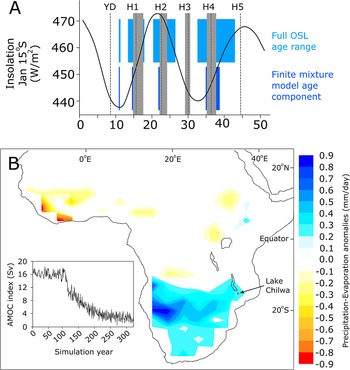
Luminescence-dated shorelines of Lake Chilwa in the savannah to semi-arid climatic region of Malawi, ~15°30′S (Figure 1, s22), revealed lake highstands at 38.4–35.5, 24.3–22.3, 16.2–15.1, 13.5–12.7, 11.01 ± 0.76 and 8.52 ± 0.56 ka, (Thomas et al., Reference Thomas, Bailey, Shaw, Durcan and Singarayer2009) (Figure 3A). The first three have a coincidence of timing with North Atlantic Heinrich Events/Stadials (HS) 4, 2 and 1, and the ~11 ka highstand with the Younger Dryas (Figure 3A). A HadCM3 climate model simulation was used to explore a potential teleconnection. It showed that a reduction of the Atlantic meridional overturning circulation in response to a North Atlantic Heinrich iceberg discharge event has atmospheric teleconnections, with increases the moisture balance at Lake Chilwa (Thomas et al., Reference Thomas, Bailey, Shaw, Durcan and Singarayer2009) (Figure 3B). The spatial pattern in the simulation is for increased moisture balance over much of southern Africa (south of 15°S) but drier conditions north of the equator (Figure 3B). This invites future model-proxy comparisons for the African continent in response to millennial-scale climatic forcing.
(A) Timing of highstands of Lake Chilwa from luminescence dating of shorelines, compared to the timing of Heinrich Events, (B) HadCM3 simulation of terrestrial moisture balance over Africa caused by a ‘freshwater hosing’ 50–70°N to simulate a North Atlantic Heinrich Event, displayed as an anomaly (modelled years 275–300 minus the average of 0–100 years), where the inset shows modelled reduction in Atlantic Meridional Overturning Circulation (modified from Thomas et al., Reference Thomas, Bailey, Shaw, Durcan and Singarayer2009).

Millennial-timescale change can also be examined using high-resolution (~20–30 μm/y) banded hyraceum (fossilised urine) in hyrax middens on the western margin of southern Africa. The midden record composite δ15N from three dryland-zone middens (Pella, South Africa: 29.00°S, 19.14°E; Zizou: 24.07°S, 15.97°E and Spitzkoppe: 21.83°S, 15.20°E, Namibia) (Figure 1, s23–25) contains evidence of phases of increased humidity, which Chase et al. (Reference Chase, Niedermeyer, Boom, Carr, Chevalier, He, Meadows, Ogle and Reimer2019) correlate with HS3, 2 and 1. De Rif midden, just south of the current dryland zone (32.446°S, 19.221°E) (Figure 1, s26), is also characterised by humid conditions during HS1 (Chase et al., Reference Chase, Quick, Meadows, Scott, Thomas and Reimer2011). Although not considered using a simulation experiment, the driving mechanism explored is an oceanic teleconnection with NH millennial events, via their influence on the southern Atlantic (Benguela upwelling zone) sea-surface temperatures (SST), and in turn the influence SSTs have on rainfall over Southern Africa’s western margin. This draws on the good temporal correspondence between SST records in the South Atlantic Benguela upwelling zone (Farmer et al., Reference Farmer, deMenocal and Marchitto2005; Kim and Schneider, Reference Kim and Schneider2003) and the hyrax aridity proxies (Chase et al., Reference Chase, Quick, Meadows, Scott, Thomas and Reimer2011). However, unlike for the Chilwa Lake example, the hydroclimatic response of the De Rif midden during the YD (which also involves a North Atlantic meltwater event) is markedly different than for the HS events, with an abrupt drying signal. Chase et al. (Reference Chase, Quick, Meadows, Scott, Thomas and Reimer2011) invoke an immediate atmospheric interhemispheric teleconnection, as opposed to the oceanic teleconnection with Benguela SST-driven hydroclimatic control for the HS events. These nuances are complex, and a paucity of continuous and high-resolution terrestrial proxies in African drylands restricts the possibility to test and refine these interpretations, although transient numerical model simulations for discrete spatial locations may provide further insights.
Approaches to understanding hominin response to Quaternary climate change
Understanding Quaternary climatic conditions in drylands is central to ongoing debates around which species in the Homo genus first possessed the adaptive capabilities to occupy hyper-arid regions. For example, Mercader et al.’s (Reference Mercader, Akuku, Boivin, Camacho, Carter, Clarke, Temprana, Favreau, Galloway, Hernando, Haung, Hubbard, Kaplan, Larter, Magohe, Mohamed, Mwanbwiga, Oladele, Petraglia, Roberts, Saladi, Shikoni, Silva, Soto, Stricklin, Mekonnen, Zhao and Durkin2025) assertion that H. erectus adapted to a steppe-desert environment in Tanzania by utilising fluvial resources, challenging the dominant narrative that only H. sapiens were capable of sustained adaptations (e.g. Roberts and Stewart, Reference Roberts and Stewart2018). Assessing the large-scale impact of dryland climatic change on hominins is made challenging by the spatially patchy and temporally punctuated nature of both the archaeological record and the terrestrial palaeoenvironmental record. Improving our understanding requires continued efforts to provide environmental reconstructions with robust chronological control at the site of the archaeological evidence, in order to provide the local environmental context for those finds. Model simulations of past climates also offer an opportunity to revolutionise understanding (Timmerman et al., Reference Timmerman, Raia, Mondanaro, Zollikofer, de León, Zeller and Yun2024). Early simulation attempts used multiple snapshot simulations. For example, Eriksson et al. (Reference Eriksson, Betti, Friend, Lycett, SIngarayer, von Cramon-Taubadel, Valdes, Ballouz and Manica2012) used intervals increasing from 1 to 4 ka through the last 120 ka using the Hadley Centre model (HadCM3) to relate to the record of genetic variation in modern human populations. Increases in computational power now enable transient simulations for 120 ka (e.g. Timmerman and Friedrich (Reference Timmerman and Friedrich2016) using the Earth system model LOVECLIMv1.1) and even through to 3 Ma (e.g. Zeller et al. (Reference Zeller, Timmerman, K-S, Raia, Stein and Ruan2023) using the Community Earth System Model v1.2 (CESM1.2)) (Table 1).
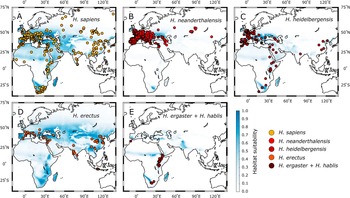
Timmerman et al. (Reference Timmerman, Yun, Raia, Ruan, Mondanar, Zeller, Zolikofer, Ponce de León, Lemmon, Willeit and Ganopolsji2022) use the CESM1.2 transient model simulation of the last 2 Ma, linked to a climate envelope model (CEM), to explore how changes in temperature (annual mean), precipitation (annual means and minimums) and terrestrial net primary productivity influenced the species distributions we observe in the fossil record. The CEM used topographically downscaled (1°×1°grid) average climate data for 1,000-year time windows and a species database of dated hominin fossils and lithic records (from Raia et al. (Reference Raia, Mondanaro, Melchionna, Di Febbraro and Diniz-Filho2020) and Mondanara et al. (Reference Mondanara, Melchionna, Di Febbraro, Castiglione, Holden, Edwards, Carotenuto, Mairana, Modafferi, Serio, Diniz-Filho, Rangel, Rook, O’Higgins, Spikins, Profico and Raia2020)), from which species-presence locations and their associated ages were extracted. The second step derived a habitat suitability model for each species (H. ergaster + H. habilis, H. erectus, H. heidelbergensis, H. neanderthalensis and H. sapiens) (Figure 4), employing the Mahalonobis distance (a statistical approach applicable to a correlation matrix of data for the climatic variables chosen here, rather than pairs of climatic variables (Farber and Kadmon, Reference Farber and Kadmon2003)).
Hominin species distributions, expressed as time-averaged habitat suitability (intensity of blue shading) over 2 million years from Timmerman et al. (Reference Timmerman, Yun, Raia, Ruan, Mondanar, Zeller, Zolikofer, Ponce de León, Lemmon, Willeit and Ganopolsji2022), also showing (with coloured circles) the locations of fossil and/or archaeological artefact evidence associated with each of the five hominin groups, collated by Timmerman et al. (Reference Timmerman, Yun, Raia, Ruan, Mondanar, Zeller, Zolikofer, Ponce de León, Lemmon, Willeit and Ganopolsji2022).

The habitat suitability model reveals ‘patchworks of habitable areas’ (Timmerman et al., Reference Timmerman, Yun, Raia, Ruan, Mondanar, Zeller, Zolikofer, Ponce de León, Lemmon, Willeit and Ganopolsji2022, p. 500) within Earth’s drylands and demonstrates that H. sapiens is the most tolerant species, or ‘best equipped to cope with dry conditions’ (p. 497) (Figure 4). This supports the idea that H. sapiens migrated along ‘green corridors’ in the dryland Saharo-Arabian belt (Larrasoaña et al., Reference Larrasoaña, Roberts and Rohling2013; Breeze et al., Reference Breeze, Groucutt, Drake, White, Jennings and Petraglia2016; Beyer et al., Reference Beyer, Krapp, Eriksson and Manica2021; Groucutt et al., Reference Groucutt2021) and supports the idea of a multi-regional, or polycentric, origin for H. sapiens (Scerri et al., Reference Scerri, Thomas, Manica, Gunz, Stock and Stringer2018). Furthermore, these habitable areas appear likely to have been long-term refugia for a variety of hominins within Africa (Timmerman et al., Reference Timmerman, Yun, Raia, Ruan, Mondanar, Zeller, Zolikofer, Ponce de León, Lemmon, Willeit and Ganopolsji2022), and their locations include dryland regions in both the south and north of the continent (Figure 4). Timmerman et al. (Reference Timmerman, Yun, Raia, Ruan, Mondanar, Zeller, Zolikofer, Ponce de León, Lemmon, Willeit and Ganopolsji2022) also observe an orbital-timescale shift in the position of these refugia, which supports the idea that orbital forcing of the global climate was a major driving factor for hominin species distributions, and therefore also dispersal and likely also speciation (e.g. Hua and Wiens, Reference Hua and Wiens2013). Climatic change can also be investigated as a driver of Homo species extinction, for example Raia et al. (Reference Raia, Mondanaro, Melchionna, Di Febbraro and Diniz-Filho2020), use a statistical approach for the quantification of species vulnerability to climate change (climatic niche factor analysis), based on using the Planet Simulator–Grid-enabled Integrated Earth system model emulator (PALEO-PGEM) of Holden et al. (Reference Holden, Edwards, Rangel, Pereira, Tran and Wilkinson2019). Their niche analysis demonstrates a significant reduction in climatic niche space just before extinction (disappearance in the fossil record).
Conclusions
Reconstructing Quaternary conditions in drylands allows us to understand how these environments change in response to climatic forcing over a range of timescales, from the changes to Earth’s orbit around the sun to the more abrupt millennial-scale cryosphere-oceanic reorganizations. This major sub-topic in dryland science progresses via environmental reconstruction and model simulation approaches, both of which are guided by conceptual frameworks for global climatic change during the Quaternary. In the former, proxy records are interpreted within the frameworks of: (i) comparing hydroclimatic conditions during glacials and interglacials, (ii) looking for precession-pacing in responses and (iii) examining any coincidences in timing with millennial-scale events that originate in the North Atlantic region along with potential teleconnections. Model simulation experiments are set up to explore the role of orbital forcing, long and short-term changes to the Earth’s cryosphere with associated changes to sea levels and oceanic circulation, as well as greenhouse gas concentrations. A major motivation for Quaternary dryland research is the desire to understand how environmental changes in drylands relate to habitability limits for hominins and likely routes for migration and dispersal. After setting out approaches taken in reconstructing the Quaternary past in drylands, this review used three key examples to examine and critique progress in understanding, before outlining current and future prospects for understanding the hominin response(s) to Quaternary dryland changes.
The first example of dryland speleothem (and tufa) growth, reveals records of moisture availability that are more complicated than a precession-paced (~23 ka) control on summer monsoon rainfall, which would be antiphased between the NH and SH. Instead, there is strong glacial–interglacial overprinting with regional contrasts in its nature. In the NH, southern Arabia experienced glacial dampening of monsoon rainfall from the Indian Ocean, whilst north-east Africa experienced enhanced rainfall during glacials. In the SH, the southern Australian speleothems record is of reduced moisture availability in interglacials, likely representing a temperature threshold, whilst the Namibian record on the west coast of southern Africa shows higher moisture balance during interglacials. In the second example, a combination of proxy data (reconstructions) and model simulations demonstrates a revision of the paradigm of high aridity during the LGM in drylands. The LGM is shown to be wet, or wetter-than-present, across Australia and the west of southern Africa. However, a global-scale simulation reveals heterogeneity across space with six dryland regions wetter-than-present at the LGM, and five drier. Potential explanations for the simulated spatial patterns include different strengths of response to different climatic forcing factors (orbital parameters, the size of the global cryosphere, concentrations of greenhouse gases) in different regions, although southern Africa emerges as an outlier without a dominant driver. The LGM example also reveals that when environmental reconstructions at many sites are considered, spatial heterogeneity of environmental change within that dryland emerges. This requires us to question the usefulness of model-proxy comparisons that are based upon only one or two records of environmental change. The spatial patterns within that heterogeneity require more investigation. For example, the contrast between moisture availability in north-east Africa and Arabia over glacial–interglacial timescales and the reason for the west–east pattern of wetter versus drier for the LGM in southern Africa. It is also important to continue to critique the hydroclimatic inferences that can be made from proxies. For example, deposited dust and dune accumulation relate as much to (or more to) wind regime as they do to moisture balance. The third example of millennial-scale hydroclimatic shifts in high-resolution archives in southern Africa provides an excellent demonstration of the likely teleconnections between dryland climates and the North Atlantic during high magnitude changes to the cryosphere-ocean–atmosphere system.
All three examples demonstrate a complexity of regional and local patterns of Quaternary environmental change within drylands, of which many details remain to be fully understood. The heterogeneity revealed across space from terrestrial proxy records is a reminder of the importance of moving beyond marine archives for terrestrial dryland environmental conditions that accumulate a spatially-averaged record of sediments derived from the neighbouring continental land mass. Therefore, site-specific studies of past environmental conditions are central to refining our understanding and importantly are at the heart of understanding the environmental conditions experienced by hominins in the landscapes they were inhabiting. Approaches to understanding hominin interactions with dryland environmental change are also driven forward by model simulation approaches, including simulations of habitat suitability. These suggest that it is likely H. sapiens were the most tolerant to dry conditions and able to utilise patchworks of habitable areas, with some habitable areas operating as long-term refugia and others as shorter-lived ‘green corridors’ for migration and dispersal (Timmerman et al., Reference Timmerman, Yun, Raia, Ruan, Mondanar, Zeller, Zolikofer, Ponce de León, Lemmon, Willeit and Ganopolsji2022). However, recent environmental reconstructions in Tanzania suggest that earlier members of the Homo genus may have also possessed ecological flexibility, such as H. erectus utilising dryland water sources and demonstrating adaption to steppe-desert conditions (Mercader et al., Reference Mercader, Akuku, Boivin, Camacho, Carter, Clarke, Temprana, Favreau, Galloway, Hernando, Haung, Hubbard, Kaplan, Larter, Magohe, Mohamed, Mwanbwiga, Oladele, Petraglia, Roberts, Saladi, Shikoni, Silva, Soto, Stricklin, Mekonnen, Zhao and Durkin2025). Quaternary dryland research has both a rich history and an exciting future.
Acknowledgements
Thank you to Cambridge Prisms: Drylands for the invitation to write a review article, and funding from the University of Manchester for a Manchester-Melbourne Research Fund Grant ‘A Southern Hemisphere perspective on human-environment relations along desert margins,’ which provided time on a research trip to Melbourne to develop the basis for this review. Also thanks a wide range of colleagues in Quaternary Drylands for informative and supportive discussions about these themes over the years and to three anonymous reviewers for their insightful critiques, which greatly improved the overall message, structure and scope of this review.
Financial support
Funding that facilitated time on a research trip to develop the basis for this review was provided by a Universities of Manchester and Melbourne Research Fund Grant ‘A Southern Hemisphere perspective on human-environment relations along desert margins.’
Competing interests
The authors declare none.

 Open access


Comments
Dear Professors David Eldrdige and Osvaldo Sala
Please find the manuscript “Quaternary Dryland Dynamics: perspectives and prospects” (of 5,000 words), and with 1 table and 3 figures for consideration for peer review for your journal. It is designed as a Review (Stand Review) article type.
This is written in response to the invitation in September 2024 from Laetitia Beck (Senior Editorial Assistant, Open Access, STM Journals, Academic) on behalf of Professors Osvaldo Sala and David Eldridge “to author a commissioned article for the journal on a topic of your choice. Drylands provides a home for high-impact, globally relevant reviews and original research on all topics associated with the natural sciences, engineering, social sciences, and management of global drylands.”, which was confirmed on 20-Dec-2024 by Kim Marello (Cambridge Prisms: Drylands Editorial Office) “Dear Dr. Stone,
Thank you for agreeing to submit the manuscript with the working title “” to the Cambridge Prisms: Drylands…”
In identifying Key Words and Topics on the online system, I note there is not anything labelled as “Quaternary” or “Past Climate” and this might be beneficial as additional fields for the journal in the future, in order to encourage engagement with the journal from the palaeo-Drylands community.
Yours sincerely
Dr Abigail (Abi) Stone
Reader in Physical Geography