




Introduction
Traditionally, paediatric patients requiring cardiac pacing had to choose between epicardial or transvenous pacemakers. Reference Silvetti, Colonna and Gabbarini1 The former is predominantly used in infants and smaller children, particularly those undergoing surgery for CHD. However, epicardial leads are associated with failure rates approaching 28% at 4 years. Reference Silvetti, Colonna and Gabbarini1 Older and heavier (above 40 kg) children, close to adult sizes, are appropriate for either transvenous or leadless pacing. A subgroup of paediatric patients who are typically pre-adolescent (less than 13 years old) and weighing less than 30 kg poses a clinical dilemma. Whilst they can receive transvenous pacing, the presence of transvenous leads can predispose to venous occlusion, infections, tricuspid regurgitation, and lead failure due to patient’s somatic growth. Furthermore, chronic transvenous leads can be challenging to extract when necessary. Thus, leadless pacemakers may provide a better pacing solution for this patient subgroup. We present the case of an 8-year-old patient, weighing 24 kg, who received a retrievable leadless pacemaker for congenital heart block. In addition, a systematic review of the literature was conducted to evaluate procedural success and the safety of leadless pacing in preadolescents (below 13 years old) weighing less than 30 kg.
Case presentation
An 8-year-old girl weighing 24 kg was diagnosed with congenital heart block since she was 5 years old. Echocardiography confirmed a structurally normal heart with a normal left ventricular ejection fraction. In the past 12 months, she reported infrequent episodes of dizziness and exertional chest discomfort for the first time. Holter monitoring revealed atrioventricular dissociation throughout the recording, with an average, minimum, and maximum ventricular rate of 46, 29, and 77 beats per minute, respectively. Given her symptomatic bradycardia, all 3 pacing options were discussed with the patient and family, namely epicardial, transvenous, and leadless pacing. They elected to undergo implantation of a retrievable leadless pacemaker for all the above-mentioned benefits and greater battery longevity to minimise lifetime replacement procedures. Pre-procedural ultrasonography revealed the right internal jugular vein to measure 11 mm, which was larger than the 9 mm right femoral vein. On transthoracic echocardiography, the right ventricle measured 61 mm long in the four-chamber apical view, sufficient to accommodate a 38 mm long Aveir VR pacemaker (Abbott, MN, USA). The procedure was performed in a fasted state under general anaesthesia. Right internal jugular venous access was attained using ultrasonic guidance and a micropuncture access kit. A stiff guidewire was passed from the right internal jugular vein, via the superior vena cava, into the inferior vena cava, over which progressively larger dilators were introduced to dilate the vein until it could accommodate a 25 Fr introducer. A right ventricular angiogram was performed (Figure 1). An Aveir VR was implanted at the right ventricular mid-septum with good electrical parameters achieved (impedance 640 ohms, R wave of 8.2 mV, threshold of 1.0 V at 0.4 ms pulse width), Manual compression was achieved for haemostasis, and the patient was discharged the following day without any complications. At 1 month’s follow-up, she was 90% ventricularly paced and was asymptomatic. Projected battery longevity was more than 18 years.
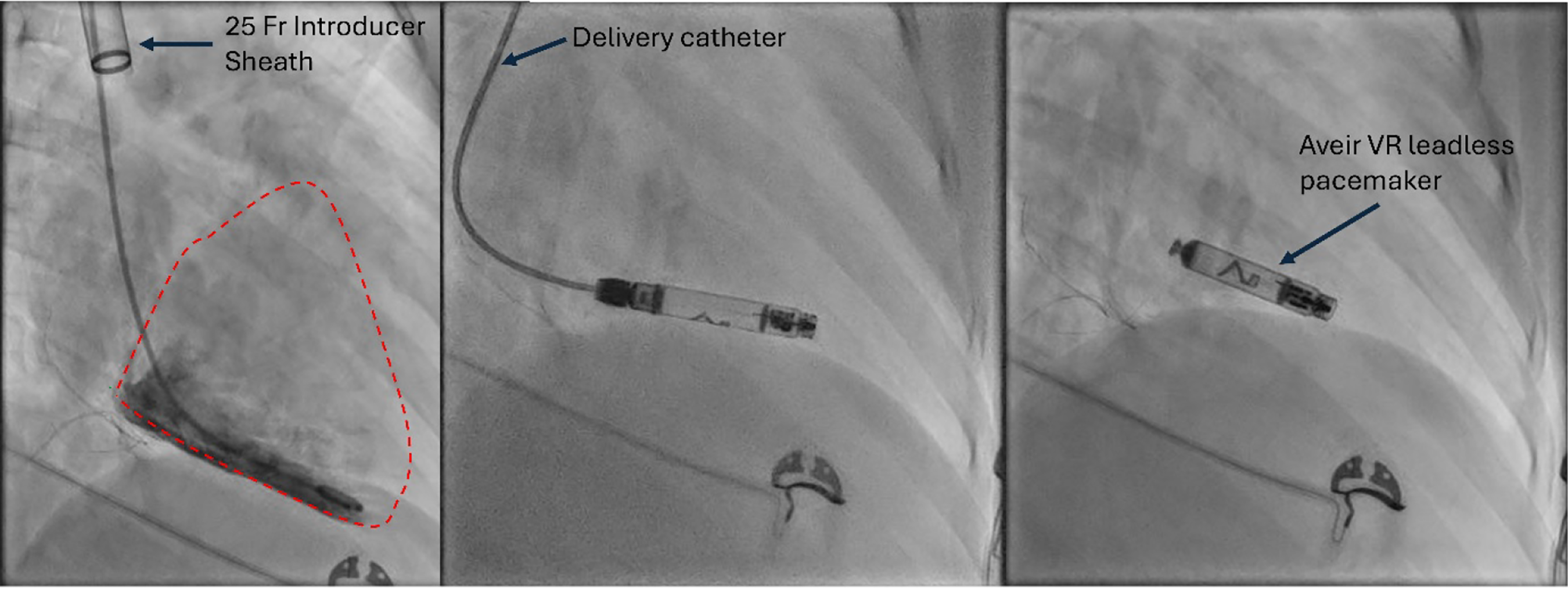
Figure 1. Fluoroscopic images all in right anterior oblique projection. Left panel – right ventricular contrast angiography performed via a 6Fr pigtail catheter inserted via the 25Fr introducer sheath. The outline of the right ventricular is marked by the red dotted line. Middle panel – delivery catheter is used to position the retrievable leadless pacemaker (Aveir VR, Abbott, MN, USA) into the right ventricular mid-septum. Right panel – the final position of the pacemaker after detachment from the delivery catheter.
Systematic review
A systematic search of PubMed, EMBASE, and Cochrane databases was conducted following Preferred Reporting Items for Systematic Reviews and Meta-Analyses criteria and the keywords “leadless,” “Micra,” “Aveir,” “pacing,” “pacemaker,” “child” and “paediatric.” Data, including implant success, pacing indications, access sites, and major complications, were extracted using a structured template.
As of 16th January 2026, 112 articles were identified and screened by title and abstract. Eighty-six articles were excluded as they studied adults only, animal models, or did not contain any primary data. (Figure 2) Twenty-six studies were retrieved of which 13 were excluded as they did not study patients below 13 years old and weighed less than 30 kg. Thirteen studies (9 case reports, 2 single-centre series, and 1 multi-centre series), which reported outcomes of 22 unique patients, were included Reference Gallotti, Biniwale and Shannon2–Reference Zhou, Xu and He13 (Supplementary Table 1). Seventeen patients had received a non-retrievable leadless pacemaker (Micra, Medtronic, MN, USA), whilst 5 had received a retrievable leadless pacemaker. Acute procedural success was achieved in all patients, and there was no procedural-related mortality. The smallest patient was a 2-year-old, weighing 10.9 kg, who received a Micra pacemaker. The internal jugular vein was used for venous access in 86.3% (19/22) of cases. In 2 (9.0%) cases, operators deemed surgical venotomy to be necessary for better post-operative haemostasis. Reference Gallotti, Biniwale and Shannon2,Reference Kumthekar, Augostini and Kamp5 The pacing indication was heart block in 90.9% (20/22) of cases. All Aveir devices implanted were VR models and programmed in VVI mode. Four out of 17 (23.5%) Micra implants were Micra AV devices capable of far-field atrial sensing to allow for VDD pacing, of which 1 had failure of atrial sensing. Reference Kumthekar, Augostini and Kamp5 Thus, 19 out of 22 patients were receiving asynchronous right ventricular pacing. All but one patient had normal systemic ventricular function. Two serious complications (2 out of 22, 9.0%) were reported: 1 pericardial effusion requiring drainage and 1 femoral venous thrombosis requiring anticoagulation. Reference Mahendran, Bussey and Chang6,Reference Siddeek, Alabsi and Wong10 The longest duration of follow-up was 43 months. Reference Siddeek, Alabsi and Wong10

Figure 2. PRISMA (Preferred Reporting Items for Systematic Reviews and Meta-Analyses) flow diagram.
Discussion
Our case and the systematic review illustrate the feasibility and safety of leadless pacemaker implantation in paediatric patients below 13 years of age and weighing less than 30 kg.
The benefits of leadless pacemakers have been established in adults, affording protection against lead failure, device infection, pacemaker revision, tricuspid valve impairment, and venous occlusions. Reference Saleem-Talib, Hoevenaars and Molitor14 In addition, the newer retrievable leadless pacemaker is uniquely designed to allow for future retrievability and has a larger battery capacity, resulting in longer device longevity. These 2 features are important considerations for young pacemaker recipients. Reference Siddeek, Alabsi and Wong10 Currently, leadless pacemaker implantation in paediatric patients is considered off-label use.
Whilst preliminary data appear encouraging, there are several aspects that require long-term data. Most patients reported in the literature are paced without AV and interventricular synchrony and may be at risk of pacemaker-mediated cardiomyopathy. Perhaps due to these concerns, all but 1 patient had a normal left ventricular ejection fraction. Most patients (20 out of 22) identified in the review had atrioventricular block, and right ventricular pacing burden was mostly unreported. Single-chamber right ventricular pacing is the least physiological form of cardiac pacing. Patients, especially those who are pacing-dependent and require long-term pacing, are at risk of pacemaker syndrome and pacemaker-mediated cardiomyopathy during extended follow-up. Whilst atrioventricular synchrony could be provided by far-field atrial sensing in a non-retrievable leadless pacemaker (Micra AV) or a concomitant atrial leadless implant (Aveir DR), battery longevity is significantly reduced by the use of such techniques to maintain atrioventricular synchrony. Dual chamber leadless pacing with separate atrial and ventricular devices has been reported to be feasible in a 13-year-old, weighing 65 kg and 165 cm tall. The safety of atrial leadless pacing in smaller children requires further studies. Reference Cortez15 Furthermore, current leadless pacing cannot provide interventricular synchrony as afforded by biventricular or conduction system pacing. Therefore, whilst leadless pacing affords unique advantages, careful patient selection is crucial. All but 1 leadless pacemaker recipients identified in our review had normal LV function. The risk–benefit ratio of leadless pacing in patients with LV impairment and high ventricular pacing requirements, features that increase susceptibility to pacemaker-mediated cardiomyopathy, warrants further investigations.
A previous iteration of the retrievable leadless pacemaker (Nanostim) was recalled due to premature battery depletion. Reference Saleem-Talib, Hoevenaars and Molitor14 85% of Nanostim retrieval attempts in adults with a mean implant dwell time of 4.3 years (longest dwell time 6.1 years) were successful and uncomplicated. Data about whether extraction would be similarly successful for more chronic implants and in paediatric patients is lacking. Therefore, it is possible that some of these pacemakers, whilst designed to be retrievable, may not be extractable. The possibility of publication bias should be mentioned, as unsuccessful attempts at leadless pacing may not be reported.
The vast majority of adult and paediatric leadless pacemaker implantations are performed via the femoral veins. Reference Shah, Borquez and Cortez9,Reference Saleem-Talib, Hoevenaars and Molitor14 Uniquely in preadolescents weighing 30 kg or less, 86.3% of leadless implants were performed via the internal jugular vein, and internal jugular vein dimensions appear larger than femoral veins when reported. The smallest internal jugular vein and femoral vein diameters accessed were 6 and 7 mm, respectively. Whilst these dimensions are smaller than the 9 mm external diameter of the introducer sheaths, significant venous distensibility exists and can be demonstrated by ultrasonography combined with Valsalva manoeuvres. The superior approach has the additional advantage of allowing the delivery catheter to cross the tricuspid valve more easily compared to the inferior approach, due to the small right atrial size in children and much less catheter deflection needed.
Supplementary material
The supplementary material for this article can be found at https://doi.org/10.1017/S1047951126112104.
Acknowledgements
None.
Financial support
This research received no specific grant from any funding agency, commercial or not-for-profit sectors.
Competing interests
All co-authors do not have conflicts of interest to declare.
Ethical standard
The authors assert that all procedures contributing to this work comply with the Helsinki Declaration of 1975, as revised in 2008, and have been approved by our local ethics committees (Parkway Independent Ethics Committee, PIEC/2025/025).


 Open access

