

Introduction
In 2007, an archaeological survey was carried out on the plain of Izeh in north-eastern Khuzistan (south-western Iran) in order to increase our understanding of Stone Age sites in the area and analyse their spatial distributions. The majority of the stone artefacts collected during the survey belong to an Epipalaeolithic-Protoneolithic industry. The Epipalaeolithic is best known in two major regions of the Near East, in the Levant (see for example Reference Goring-morrisGoring-Morris 1987; Reference HenryHenry 1989; Reference Belfer-cohenBelfer-Cohen 1991; Reference Bar-yosefBar-Yosef 1998) and in the Zagros Mountains. In the latter, the typical Epipalaeolithic industry is known by the name of 'Zarzi' after a cave excavated by Dorothy Garrod (Reference GarrodGarrod 1930).
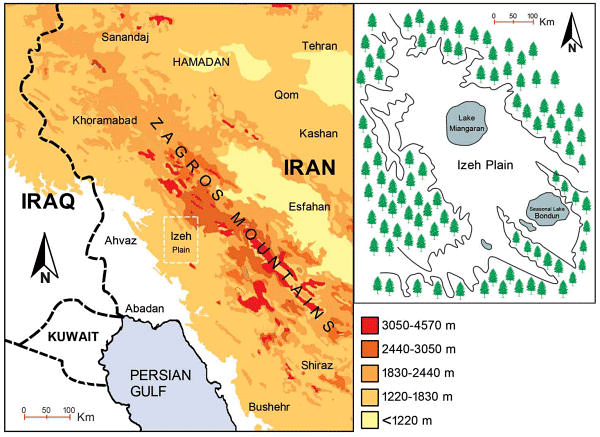
Izeh is an alluvial plain (N 31 54 - 31 47 and E 50 00 - 49 47), on average 750m above sea level, located in the north-east of the province of Khuzistan in Iran (Figure 1). It is internally drained and two lakes, Miangaran in the central part of Izeh and Bondun in the south-east, play a key role in the ecology of the plain.
Map of south-western Iran showing the location of Izeh.

The plain of Izeh was first surveyed by a joint team of archaeologists led by Henry T. Wright in the 1970s (Wright 1979). Wright mentions in his report that he surveyed only 30 per cent of the foothills and was not able to find any kind of 'settlement pattern' for the 18 Epipalaeolithic sites he discovered. It is worth mentioning that Epipalaeolithic sites such as Dashte Gol (Reference WrightWright 1979) are also found beyond the plain of Izeh.
New archaeological survey on Izeh Plain
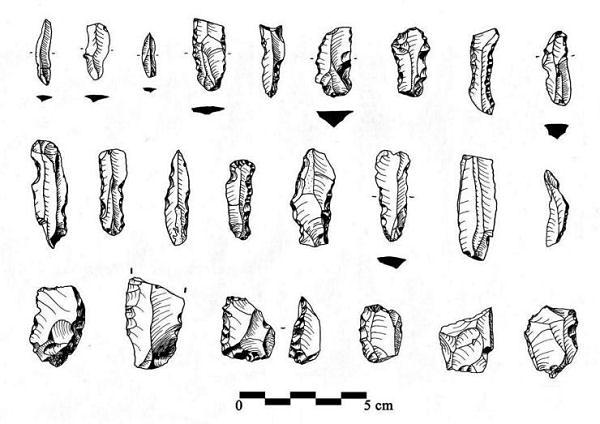
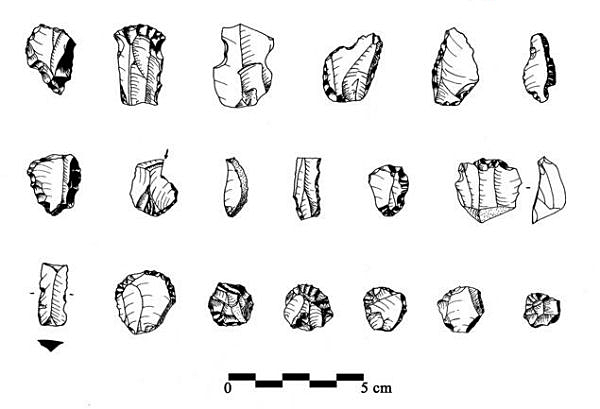
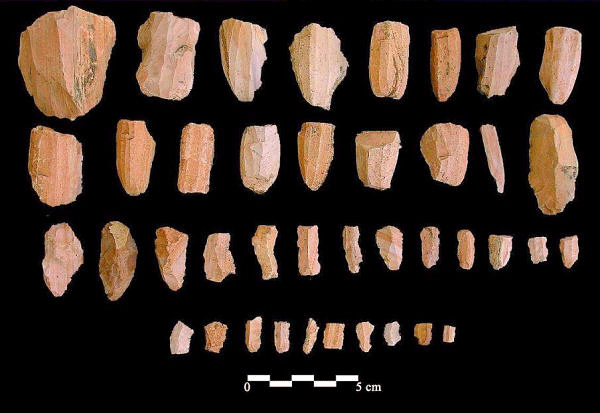
In 2007, about 125 km2 of the Izeh Plain, including lowlands, foothills and those parts of plain which do not suffer from floods, industrial constructions and husbandry, were surveyed: 54 sites were discovered and, on the basis of the typology of the stone artefacts (Figures 2 and 3), were assigned to the Epipalaeolithic-Protoneolithic periods. Some of the sites were already known from Wright's survey, but many were recorded for the first time. The sites are mostly eshkafts (shallow caves; from the local language of the Baxtiary nomads of Izeh) and rockshelters, but there are also caves and open-air sites.
Epipalaeolithic-Early Neolithic stone tools from the Izeh Plain.

Epipalaeolithic-Early Neolithic stone tools from the Izeh Plain.

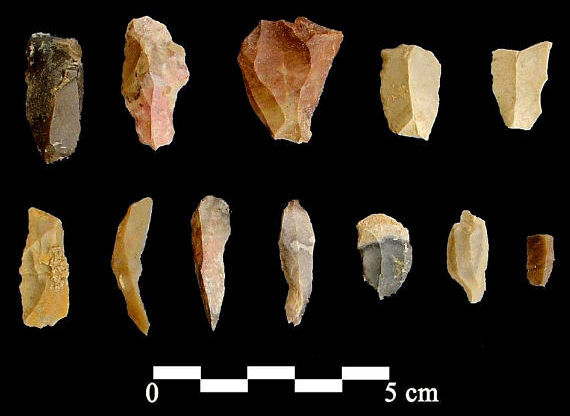
The stone industry is mostly based on the production of bladelets reduced from bladelet cores. Tools (Figure 4) include small end scrapers, thumbnail scrapers, small borers, small burins (not 'microburins'; these were not found in the assemblage), backed blades and bladelets, with no geometric microliths except for some probable lunates. The majority of the tools are retouched bladelets (Figure 2). There are also different types of bladelet cores such as conical microblade cores and some bullet cores which probably indicate a Neolithic presence (Figure 5). It seems that the whole assemblage shows an Epipalaeolithic industry (although geometric microliths are rare) as well as an Early Neolithic one, the latter documented by the few bullet cores and the many bladelets which are the products of pressure technique (full details are in Reference JayezJayez 2008).
Stone implements from Eshkaft-e Kohbad 3 (IZ37).

Stone implements from Tepe Imamzadeh Mahmoud (IZ17).

Conclusions
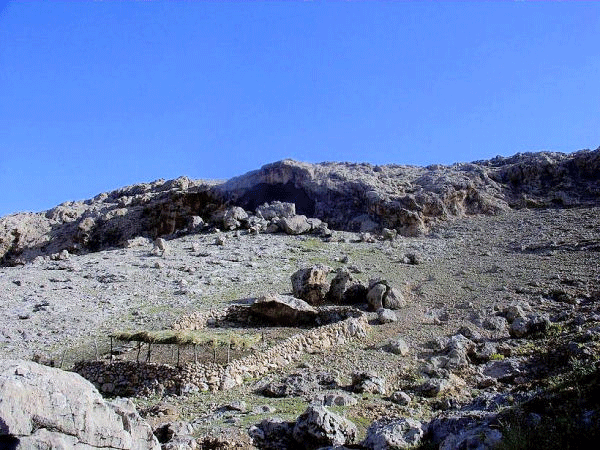
The plain of Izeh is a geomorphologically and ecologically homogeneous landscape which could be the reason for the almost uniform distribution of sites. Two seasonal lakes and geological characteristics which led to the formation of many caves, eshkafts and rock shelters (many of which are still in use as folds, as shown in Figure 6) provided the potential for hunter-gatherers to extended ways of collecting and producing food. The site distribution shows that different functional sites are distributed randomly and at short distances from each other. Many heavily retouched tools and exhausted cores indicate that there was scant access to raw material.
Eshkaft-e Gap (IZ19) used as a fold.

Whilst significant data have been gathered during the past decades, much information about the Epipalaeolithic remains to be collected, and the specifics of human behaviour and activities remain to be addressed. Future research must include establishing firm chronologies and reconstructing past environments, technological patterns and human activities across time and space. This will require the implementation of focused and long-term multidisciplinary projects, employing systematic surveys over wide areas and careful excavations in sound contexts.
Acknowledgements
We thank J. Mehrkian (Moderator of Izeh Cultural Heritage Center) for his kind permission to study the area. We also thank M. Faraji for his collaboration in the fieldwork, and F. Biglari and A. Dashtizadeh for their contributions to the study of the stone artefacts. We gratefully acknowledge the assistance of Mr Mohammadreza Abdolali for providing Figure 1.