


1. Introduction
The term Venture Clienting (VCL) – also loosely referred to as startup partnering or startup supplier program – is a corporate venturing approach in which companies act as early customers of startup solutions rather than equity investors (Reference Gimmy, Kanbach, Stubner, König and EndersGimmy et al., 2017; Reference Haarmann, Machon, Rabe, Asmar and DumitrescuHaarmann et al., 2023). Originally introduced by BMW in 2015, this model fosters corporate innovation in a “strategic”, “external”, “outside-in”, and “equity-free” manner (Reference Gimmy, Kanbach, Stubner, König and EndersGimmy et al., 2017; Reference Mais, Weiss and KanbachMais et al., 2023). Through corporate venturing, companies can tap into cutting-edge innovations, while startups gain real-world validation and access to strategic assets (Reference ChesbroughChesbrough, 2006). Unlike traditional corporate venturing models, VCL reconfigures risks by eliminating equity investments, accelerates technology adoption through fast integration, and enables scalable deployment of emerging technologies (Reference Gimmy, Kanbach, Stubner, König and EndersGimmy et al., 2017). Recent research highlights that, in contrast to exploratory approaches like corporate venture capital, VCL tends to enable corporations to exploit external innovations for immediate operational improvements, reinforcing its role as a more exploitative, integration-driven venturing mode (Reference Heiduk, Frey, Weiss and KanbachHeiduk et al., 2025).
Although VCL is gaining traction in corporate innovation, its strategic implications remain largely unexplored in academic research (Reference Gimmy, Kanbach, Stubner, König and EndersGimmy et al., 2017; Reference Gutmann and LangGutmann & Lang, 2022; Reference Kurpjuweit and WagnerKurpjuweit & Wagner, 2020; Reference Mais, Weiss and KanbachMais et al., 2023; Reference Weiblen and ChesbroughWeiblen & Chesbrough, 2015). Many companies struggle to leverage VCL for strategic goals, often due to a lack of clear frameworks and best practices (Reference Weiss and KanbachWeiss & Kanbach, 2023). Furthermore, the key components of a Venture Clienting Strategy (VCLS) remain undefined (Reference Haarmann, Machon, Rabe, Asmar and DumitrescuHaarmann et al., 2023). Scholars emphasize the need for further empirical research on strategic VCL, its role in strategic renewal, and the core elements of an effective VCLS (Reference Haarmann, Machon, Rabe, Asmar and DumitrescuHaarmann et al., 2023; Reference Mais, Weiss and KanbachMais et al., 2023).
Literature lacks a precise definition for VCLS, but different studies discuss fundamental aspects relevant to it. Vision and objective are emphasized in the literature as critical factors in corporate venturing strategy (Reference Faria, V. B., Silva, Vieira and GomesFaria et al., 2018; Reference Gutmann and LangGutmann & Lang, 2022). Also, strategic considerations for implementing a VCLS include multiple dimensions such as “type of innovation”, “search fields”, “business impact”, “branding”, “engagement approach (pull or push)”, and “operational structure” (Reference Gutmann and LangGutmann & Lang, 2022; Reference Haarmann, Machon, Rabe, Asmar and DumitrescuHaarmann et al., 2023; Reference Kurpjuweit and WagnerKurpjuweit & Wagner, 2020; Reference Moschner, Fink, Kurpjuweit, Wagner and HerstattMoschner et al., 2019).
Therefore, this study tries to identify and synthesize the key elements of VCLS into a structured framework supporting operational and strategic alignment. For this purpose, the paper employed the Action Design Research (ADR) methodology. ADR is ideal for this study as it allows us to address real-world challenges while advancing academic knowledge in organizational research. Insights into the key elements of the VCLS derived from the case studies are structured into a VCLS Canvas, a visual tool that maps out the elements of VCLS. The canvas helps companies analyze, design, and implement an effective VCLS by translating complex information into a clear, actionable framework.
The subsequent sections of this paper are organized as follows. Section 2 describes the research methodology employed in this study. Section 3 presents the results, including the development of the VCLS Canvas and its constituent components. Section 4 illustrates two practical applications demonstrating the implementation of the canvas. Section 5 offers a discussion of the findings, addresses the study’s limitations, and suggests directions for future research. Finally, Section 6 concludes the paper with a summary of the main contributions and their practical implications.
2. Methodology
To ensure that the developed solutions are both practical and effective in real-world settings, we adopted the ADR methodology according to Reference Sein, Henfridsson, Purao, Rossi and LindgrenSein and colleagues (2011). ADR is an approach that integrates the design of innovative solutions with iterative learning from real-world interventions. Researchers commonly use it to develop new tools, frameworks, software, or organizational processes while simultaneously refining both the solution and the underlying theoretical knowledge. The ADR process is structured into four key stages, each contributing to a deeper understanding of the problem and its resolution (Reference Sein, Henfridsson, Purao, Rossi and LindgrenSein et al., 2011):
-
1. Problem Formulation: This stage involves identifying and articulating the real-world problem or opportunity that motivates the research. Preliminary investigation and scoping narrow the focus to a manageable and researchable challenge.
-
2. Building, Intervention, and Evaluation (BIE): In this iterative stage, the research team designs and develops the artifact while intervening in organizational contexts to deploy the artifact and evaluate its effectiveness. Practitioner and expert collaboration is crucial, facilitating refinement based on practical feedback.
-
3. Reflection and Learning: Systematic reflection on outcomes, feedback, and observations occurs here to glean insights and to iteratively improve both the artifact and the emerging theoretical knowledge.
-
4. Formalization of Learning: The final stage generalizes the findings by formulating design principles and a structured framework that others can adapt and apply in similar contexts.
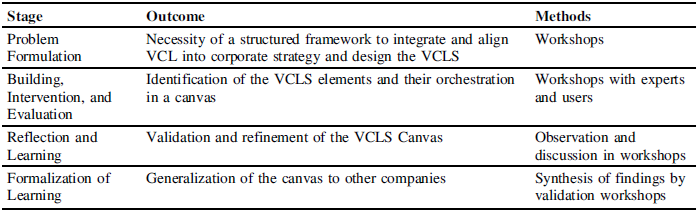
Table 1 shows the methods we used and the outcomes resulting from each phase. Below each phase is described in detail. The ADR team consisted of researchers from two institutions, members of a VCL initiative, and VCL specialists from two companies. During the different stages data was collected via workshop notes, interview transcripts, and written feedback from the practitioners. The material was analyzed using thematic clustering guided by a seminal framework. Recurring decision themes were consolidated into candidate elements. Those were retained if they were relevant for both practical cases and/or were supported by literature. The guiding questions were derived inductively from practitioner problem statements and deductively from literature. Table 2 gives an overview of the companies.
Instantiation of the ADR approach in this paper

Participating companies

2.1. Problem formulation
In the Problem Formulation stage, the ADR team identified the need for a structured framework to integrate and align VCL into corporate strategy and design the VCLS. This gap was recognized through ongoing collaboration with the corporate partners and experiences from the startup initiative, which revealed the absence of coherent strategic guidance for VCL practices. To elicit the key research questions guiding the subsequent development, the ADR team conducted a series of workshops – two online and two in person. They revealed the following questions:
-
• How can the VCLS be effectively designed?
-
• What are the essential elements comprising the VCLS?
-
• How can these elements be orchestrated within a structured framework?
2.2. Building, intervention, and evaluation
During the BIE stage, the ADR team addressed the research questions through two researcher workshops aimed at identifying the essential elements of the VCLS and co-designing the framework. The activities were guided by the seminal strategic management model of Reference Wheelen, Hunger, Hoffman and BamfordWheelen and colleagues (2014) alongside corporate venturing practices. This combined approach laid the foundation for identifying key VCLS elements and their orchestration within the canvas. Recognizing that VCL unit employees are primarily responsible for shaping and implementing the VCLS (Reference Gutmann and LangGutmann & Lang, 2022), the initial canvas was introduced to VCL experts from two companies during an online workshop. The goal was to validate the canvas’s structure and incorporate additional elements based on their operational perspective. Following feedback, the ADR team refined the canvas by integrating new elements and methods to answer respective questions. To evaluate canvas’s applicability, two additional online workshops were conducted with the participating companies, guiding them in using the canvas to design and align their VCLS. The insights gathered during these interventions culminated in the consolidation of findings and the completion of the VCLS canvas as the research artifact.
2.3. Reflection and learning
During the Reflection and Learning stage, the ADR team systematically analyzed the feedback gathered from the implementation phase regarding canvas. This critical examination revealed necessary modifications to improve the framework’s clarity, adaptability, and strategic relevance. Guided by these insights, the team refined the canvas to better meet corporate VCL needs. Notably, VCL experts preferred flexibility in defining the strategy implementation blocks rather than strict prescriptions. They aligned these blocks with the strategy formulation elements and with respect to the unique internal processes and organizational structures of each company, enabling customization across varied corporate contexts. Initially, the ADR team considered incorporating a VCLS Balanced Scorecard to design the programs layer. However, this approach proved overly detailed and resource-intensive, requiring companies to duplicate efforts. As a result, the experts opted for a more adaptable definition of the strategy implementation blocks, enabling companies to tailor the framework to their unique operational and strategic environments.
2.4. Formalization of learning
Finally, in the Formalization of Learning stage, the revised canvas was further validated through practical implementation by the participating companies, which indicates its perceived suitability for designing and aligning their VCL strategies. This consolidation led to establishing the final version of the canvas as the research artifact – a structured, adaptable framework that may be adapted by other organizations facing similar strategic challenges. The final feedback from the involved practitioners supports the canvas’s utility (e.g., by prioritizing search fields), usability (e.g., by being applied without expert facilitation), and clarity (e.g., by reducing ambiguity between stakeholders).
3. VCLS Canvas
The VCLS Canvas serves as a visual tool that describes a company’s VCLS, outlining the necessary guidelines and key elements for each layer. By mapping out these elements, the canvas simplifies VCLS into a clear, actionable framework that enables organizations to analyze, design, and implement their VCLS effectively. Furthermore, it facilitates communication and alignment among stakeholders within the company, enhancing collaboration and shared understanding. Figure 1 illustrates the VCLS Canvas, showing the two sections, their respective layers, and the corresponding blocks within each layer.
VCLS Canvas

3.1. Sections and layers of the VCLS Canvas
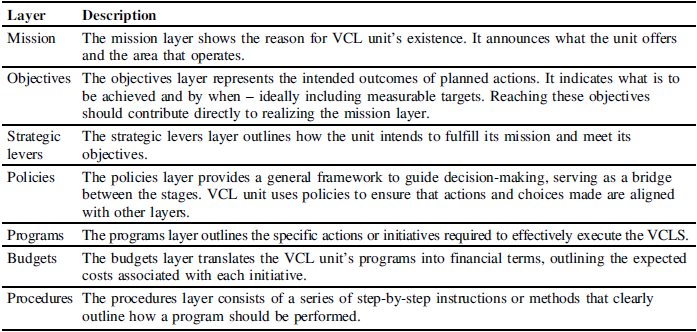
Building on the seminal framework from Reference Wheelen, Hunger, Hoffman and BamfordWheelen and colleagues (2014), the VCLS Canvas consists of two main sections: strategy formulation and strategy implementation. The strategy formulation section provides guidance on exploration, analysis, and strategic decision-making, enabling the VCL unit to define and contribute to competitive advantage. This section typically encompasses the definition of the unit’s mission (the mission layer), the establishment of clear and realistic objectives (the objectives layer), the articulation of its strategic levers (the strategic levers layer), and the development of guiding policies (the policies layer) to support their attainment. The strategy implementation section serves as a structural guide for translating strategic plans and policies into concrete actions by developing appropriate programs (the programs layer), allocating budgets (the budgets layer), and establishing procedures (the procedures layer). The layers of the VCLS Canvas are as follows in Table 3:
Layers of the VCLS Canvas (adopted from Reference Wheelen, Hunger, Hoffman and BamfordWheelen et al., 2014)

3.2. Blocks of the VCLS Canvas
The blocks of the strategy formulation section are summarized in Table 4. For each block, we provide guiding questions designed to facilitate strategic reflection and decision-making, along with recommended methods and tools that practitioners can use to develop or assess each element. This structured approach helps organizations systematically design and implement an effective VCLS by breaking down the complex strategy formulation section into manageable, actionable components.
VCLS formulation blocks

4. Application
In the next two sections the use of the VCLS is demonstrated for company A and B (Table 2). The case and the resulting canvas are described. Some aspects are alienated or omitted for confidentiality reasons.
4.1. Company A
Company A is a leading industrial automation and electrical connection provider headquartered in Germany. The company has previously explored various corporate–startup collaboration models and identified VCL as an effective framework for rapidly and seamlessly testing startup solutions and accelerate innovation within the organization. The completed VCLS Canvas by Company A provides a structured representation of its strategic approach to VCL (Figure 2).
Company A’s VCLS Canvas

In the Strategy Formulation section, the company defines a vision centered on creating significant added value for both internal and external customers while positioning itself for the future. This vision is supported by a mission comprising six key themes: fostering innovation, building partnerships, strengthening market position, using resources efficiently, driving cultural change, and increasing visibility for VCL. The Objectives Layer translates these priorities into measurable goals, including conducting PoCs in product and process innovation, publishing VCL-related posts monthly, performing trend research studies, exploring new startup ecosystems, and expanding collaboration to more departments through collecting requests. These objectives demonstrate a structured effort to institutionalize VCL and integrate it into diverse business areas. Within the Strategic Levers Layer, the company focuses on startups operating in both core and adjacent business areas, pursuing innovation through a combined pull and push approach. The object of innovation encompasses both product and process domains, with internal clients primarily located at sites in Germany. The company’s value proposition emphasizes the rapid adoption of startup innovations to solve challenges efficiently and cost-effectively. Internal competencies are defined across technical, analytical, digital, interpersonal, and entrepreneurial dimensions, while key resources span organizational, human, and relational categories. The identified search fields highlight a strong technological orientation, including Smart Home & Building, Human-to-X Interface, Green Tech, AI & Advanced Computing, and Industry 4.0. The Policies Layer specifies relevant internal stakeholders such as management, innovation, IT, legal, and procurement departments, supported by a culture of openness to experimentation and risk-taking. Company A targets startups with a Technology Readiness Level (TRL) of 4–6 and maintains an international scope for its scouting activities.
In the Strategy Implementation section, the company operationalizes its approach through defined programs, including internal innovation events, ecosystem journeys, innovation culture projects with startups, communication initiatives, and workshops. Budgetary allocations are managed jointly through the VCL and business-unit budgets, reflecting a coordinated financial structure. Procedures guide the execution of these programs—for instance, planning internal innovation events, evaluating startups during ecosystem journeys, running innovation culture pilots, and conducting workshops to prioritize and analyze innovation challenges. Together, these procedures illustrate how Company A translates strategic intent into tangible actions embedded in its day-to-day operations.
After completing the canvas, Company A reported that the structured framework primarily facilitated strategic alignment of VCL activities with broader corporate objectives. The visual format of the canvas played a central role in enabling engagement from multiple departments, encouraging cross-functional collaboration in the strategy development process. This collaborative use led the company to refine its startup engagement model, making it more systematic, goal-oriented, and scalable across different units.
4.2. Company B
Company B is a global leader in premium home appliances, which applied the VCLS Canvas through its dedicated VCL unit. The unit is responsible for scouting and integrating innovative startup solutions to enhance the company’s technological capabilities and market competitiveness. Company B’s completed VCLS Canvas reflects a strategic effort to integrate VCL into its innovation processes, with a clear alignment to internal R&D and technology development goals (Figure 3).
Company B’s VCLS Canvas

In the Strategy Formulation section, the company articulates its vision as leveraging external technologies and startup cooperation to enrich internal innovation. This is supported by a mission focused on knowledge acquisition, opportunity recognition, and enhancing VCL’s visibility. To implement this mission, the company defines a set of strategic goals tied to various innovation activities, such as developing product and process PoCs, scouting startups for emerging R&D teams, and distributing internal VCL-related materials. Additionally, the company sets goals such as collecting problem statements, conducting scouting for awareness-building, and contributing to regional innovation programs. These goals show an effort to establish VCL as both a strategic tool and an operational process within multiple teams to implement the mission. In the Strategic Levers Layer, the company positions its startup focus close to the core business, indicating that VCL is not used for exploratory innovation but rather for addressing well-defined internal needs. It combines both push and pull innovation, with a clear emphasis on product-oriented outcomes. The target clients for VCL projects are primarily business units, including R&D, cooking, and laundry teams, which form a narrow but functionally integrated client base. The value proposition focuses on faster development and better support for R&D-specific challenges. The company identifies search fields related to key industry and technology trends, such as sustainability, connectivity, automation, and well-being, suggesting alignment with broader corporate technology roadmaps. The Policies Layer supports these strategies through a mindset oriented toward openness and the adoption of new technologies in place of traditional internal processes. Stakeholders include R&D, management, legal, and procurement units, indicating cross-functional involvement. The company focuses on startups with a TRL of 4 to 6 and maintains an international scope for scouting.
In the Strategy Implementation section, the company does not follow a standardized model but instead organizes its programs under three categories: communication, scouting, and piloting. The budget is split between a centralized VCL unit and business units’ specific resources, indicating a hybrid funding approach. The procedures vary by program. Scouting includes steps, such as field analysis, startup searches, and prioritization. Communication focuses on internal awareness and knowledge sharing through deep dives, newsletters, and event content. Piloting procedures outline phases from opportunity definition to adoption. This modular approach reflects Company B’s reliance on internal routines and suggests that flexibility in implementation is preferred over a standardized process.
Company B used the VCLS Canvas primarily to optimize and structure its existing VCL operations. Rather than initiating new collaborations, the company leveraged the canvas to streamline internal processes within its VCL unit. The framework provided clearer criteria for evaluating startup opportunities, supported more informed strategic decision-making, and improved coordination across departments involved in the VCL workflow. This operational focus helped ensure that startup engagements were consistently aligned with broader innovation and business objectives.
5. Discussion
VCL has become an increasing trend in corporate innovation. However, VCL’s strategic approach often lacks a cohesive structure in both research and practice, leading to challenges in successful implementation. The paper at hand introduces the VCLS Canvas, a framework that visualizes the key elements of a VCLS and their interconnections. The canvas serves as a practical tool for designing, refining, and communicating VCL strategies. Its structured, layered design organizes strategic elements into clusters, following a logical sequence based on the strategic management model, according to Reference Wheelen, Hunger, Hoffman and BamfordWheelen and colleagues (2014). These results align with recent research positioning VCL as tending towards an exploitative mode of external venturing, underscoring the importance of tight integration with core business activities and the need for practical frameworks that support rapid piloting and implementation (Reference Heiduk, Frey, Weiss and KanbachHeiduk et al., 2025).
Past studies highlight the necessity of further empirical research on the strategic approach of VCL (Reference Haarmann, Machon, Rabe, Asmar and DumitrescuHaarmann et al., 2023; Reference Mais, Weiss and KanbachMais et al., 2023). Various authors (Reference Faria, V. B., Silva, Vieira and GomesFaria et al., 2018; Reference Gutmann and LangGutmann & Lang, 2022; Reference Haarmann, Machon, Rabe, Asmar and DumitrescuHaarmann et al., 2023; Reference Kurpjuweit and WagnerKurpjuweit & Wagner, 2020) discuss individual elements relevant to a VCLS. However, these contributions tend to address components in isolation, without collectively offering a comprehensive and coherent strategic framework. In contrast, the VCLS Canvas introduced here offers a visual map that covers the key elements, including ones from past studies, and simplifies them into a clear, actionable framework. Compared to more generic instruments our approach focuses on the specific questions and ambiguities the companies face using the VCL model. It does not classify strategic configurations of venture client units but rather operationalizes their design and provides internal strategic governance.
The piloting of the VCLS Canvas revealed several strategic and operational benefits for organizations applying VCL. The structured, visual format of the canvas facilitates clearer alignment between VCL activities and broader corporate goals, enhancing strategic focus and decision-making. It fosters cross-departmental collaboration and improves stakeholder engagement by making the strategy development process more transparent and accessible. Additionally, the canvas helps streamline internal processes, clarify roles and responsibilities, and establish consistent evaluation criteria for engaging startups.
Despite these contributions, this study has limitations. The piloting was conducted within a limited number of companies and industries, which may affect the generalizability of the findings. The exploratory nature of the workshops suggests a need for further validation through larger, diverse samples and empirical testing across varied organizational contexts. Moreover, the users involved in this study were primarily employees within the VCL units rather than top-level executives or senior management of the respective companies. Although the users provided valuable operational insights and practical feedback on the canvas, their perspectives may not fully capture the strategic considerations and decision-making priorities of executive leadership. The evaluation is also limited to the opinion of the involved practitioners and longitudinal evidence on outcomes is not yet available.
While this study contributes to the growing body of knowledge on VCL, further empirical research is needed to explore how the canvas can be applied across different industries and geographies. Future studies could also investigate the impact of VCL on long-term corporate performance and how it evolves in response to rapidly changing market dynamics. Additionally, it would be valuable to assess the applicability and usability of the canvas from the perspective of top-level executives, as they are key decision-makers and potential end users alongside the VCL unit employees. Finally, scholars could work toward establishing a clear theoretical definition of VCLS, which would support its integration into strategic innovation management frameworks.
6. Conclusion
This paper presents a structured framework for developing a venture clienting strategy covering strategic direction and implementation, hence allowing to better align VCL with corporate strategies. By identifying and organizing the key elements of VCLS, the canvas provides a clear visual representation that supports strategic alignment, facilitates decision-making, and enhances collaboration with startups. Through the application of ADR, the study not only contributes to the development of this tool but also provides insights into the process of designing and implementing VCLS in real-world settings. The use cases demonstrate the canvas’s utility in streamlining internal processes, improving coordination among stakeholders, and refining innovation practices. In conclusion, the VCLS Canvas enables companies to systematically embed VCL into their core operations, supporting their ambitions towards long-term competitiveness and growth.
Acknowledgement
This contribution was developed as part of the research project “inno.venture – Innovationsmanagement mit Hilfe des Venture Client Modells”. It is conducted by Paderborn University and four partners. The project is funded by the Ministry of Economic Affairs, Industry, Climate Action and Energy, of the State of North Rhine-Westphalia (MWIKE) as part of the Leading-Edge-Cluster “Intelligente Technische Systeme OstWestfalenLippe” (it’s OWL). It is supervised by the project administration in Jülich (PtJ).




 Open access

