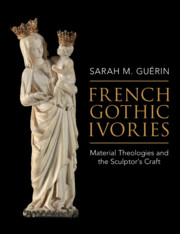

This volume is the first to consider the golden century of Gothic ivory sculpture (1230-1330) in its material, theological, and artistic contexts. Providing a range of new sources and interpretations, Sarah Guérin charts the progressive development and deepening of material resonances expressed in these small-scale carvings. Guérin traces the journey of ivory tusks, from the intercontinental trade routes that delivered ivory tusks to northern Europe, to the workbenches of specialist artisans in medieval Paris, and, ultimately, the altars and private chapels in which these objects were venerated. She also studies the rich social lives and uses of a diverse range of art works fashioned from ivory, including standalone statuettes, diptychs, tabernacles, and altarpieces. Offering new insights into the resonances that ivory sculpture held for their makers and viewers, Guérin's study contributes to our understanding of the history of materials, craft, and later medieval devotional practices.
‘In addition to the importance of the material and the biography of the objects, including the craftsmanship, the results regarding the response of the ivories to the artists and buyers of the time and the changing devotional practices are of great interest. Guérin's work provides a scientific as well as methodological foundation upon which future ivory research must build.’
Manuela Studer-Karlen Source: Sehepunkte (translated from German)
‘Guérin should be commended for her sensitivity to methods of making across such a large and far-flung corpus. She beautifully conveys how compositions emerge from carved tusks, a difficult conceptual task more often achieved in studies of wood and stone sculpture.… [the book’s] evidence, methods, and prose inspire us to apply its lessons to underexplored scholarly territories. The future of ivory studies is bright indeed.’
Nicole Pulichene Source: Speculum: A Journal of Medieval Studies
Loading metrics...
* Views captured on Cambridge Core between #date#. This data will be updated every 24 hours.
Usage data cannot currently be displayed.
This section outlines the accessibility features of this content - including support for screen readers, full keyboard navigation and high-contrast display options. This may not be relevant for you.
Accessibility compliance for the PDF of this book is currently unknown and may be updated in the future.
