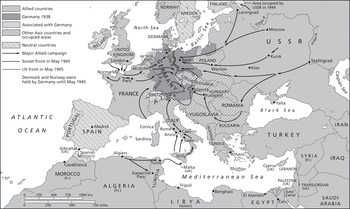


The political and ideological roots of the world’s Cold War division after World War II date back to the final years of the previous world war, when Soviet Russia and the United States emerged as promoters of competing visions for reordering a world that was still dominated by imperial powers, particularly the United Kingdom. But the parallel Soviet–American retreat from international relations during the 1920s allowed the imperialist world order to flourish one last time. During the interwar period, London, Paris, and Rome increased their influence in the larger Middle Eastern region and Africa, and Tokyo did the same in East Asia. In 1945, the joint British–Soviet–American defeat of German, Italian, and Japanese aggression in World War II provided the United Kingdom, the Soviet Union, and the United States with unparalleled but shared political, military, and moral clout. No other country could rival them in terms of political and military power. Germany, Italy, and Japan all were defeated, China was weak, and France re-emerged humiliated by occupation. Yet the Big Three could not have been more different from each other. The United Kingdom emerged bankrupt from the war and under pressure to withdraw from its colonies in South Asia but not yet from the rest of its empire. The Soviet Union had survived a brutal and devastating attack by Germany. World War II caused massive destruction in its western territories, and hence forced Moscow to pursue a cautious imperial-revolutionary policy first at its European periphery and then in East Asia. And the United States emerged as an internationalist economic and military power that stood ready to decolonize the world and restore peace, stability, and prosperity on a global scale.
The world’s Cold War division between the Soviet Union and the two Western great powers unfolded over roughly a dozen years after 1945. It was not predetermined, but was the collective result of ideological clashes, unilateral decisions, political disagreements, and misperceptions. It did not evolve along a steady path, but in fits and starts – with 1945 and 1950 as key years. In the years after World War II, the three great powers particularly clashed over their former enemies Germany and Japan. Soviet behavior in Eastern Europe and the resumption of the Chinese Civil War by the official government of China – a US associate in the emerging Cold War – further complicated the situation. Without the outbreak of the Korean War – a local clash at the world’s periphery – in 1950, the Soviet–Western conflict probably would have remained confined to Europe and East Asia. Convinced that the Soviet Union was intrinsically expansionist, the United States used the Korean War to implement a new containment strategy of linked defensive alliances surrounding the communist world. And in 1956, another local conflict – the Suez Crisis, which the imperialist United Kingdom helped to spark – tentatively invited the Cold War into the Middle East.
By early 1957, the structural foundations of the global Cold War had been put in place. The Soviet Union and its partners – the Eastern European satellites and a few voluntary allies like Albania, China, and North Vietnam – formed an almost contiguous bloc of revolutionary regimes on the Eurasian landmass. In the wake of the Korean War, the United States had established a network of alliances that spanned from Europe across the Middle East to Asia and was designed to contain the so-called Soviet bloc. During the same time, however, the British Empire declined as a global power. By the end of World War II, only South Asia had been on the course to independence, while London still commanded a global empire that reached from Africa across the Middle East to Southeast Asia and beyond. Yet, within a dozen years, it had lost most of its influence in the Arab world, the region crucial to holding together the empire, and thereby much of its sway over its former and remaining colonies around the Indian Ocean. Moreover, the emergence of the Cold War in the period after World War II sowed the seeds for structural changes in the following quarter of a century, as numerous later chapters reveal. For example, India and Egypt refused to take sides in the Cold War; Germany’s division eventually convinced West Germany to pursue policies of engagement with the eastern half of the country; and the United Kingdom transformed itself from an imperial power into a European player.
Conflicting Visions for a Post-Imperial World, 1917–45
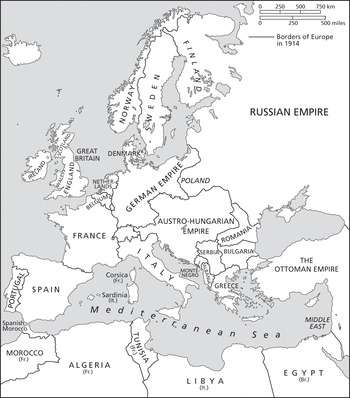
At the eve of World War I, the international system of states looked markedly different from today. Although historical maps show recognizable outlines for the mostly independent countries of the American double continent, the borders and names of many territories in Europe, Asia, the Middle East, and Africa appear unfamiliar. Germany extended beyond today’s southwestern and northeastern borders, the Austro–Hungarian Empire included territories from twelve present-day countries, Poland did not exist, and much of the Russian borderlands were part of the Tsarist Empire. Many parts of the Middle East belonged to the Ottoman Empire, though Egypt was under British suzerainty, Libya under Italian control, and Tunisia, Algeria, and Morocco under French and Spanish rule. Apart from Siam (Thailand) and the Empire of Japan, almost all Asian countries were either colonies or protectorates of imperial powers. China was disintegrating into an ever-changing system of feuding warlords after the anti-Qing revolution in 1911/12, and South Asia was divided into multiple, mainly British, colonial possessions and hundreds of princely states. With the exception of Ethiopia, all of sub-Saharan Africa was under British, French, Belgian, German, or Portuguese imperial rule.
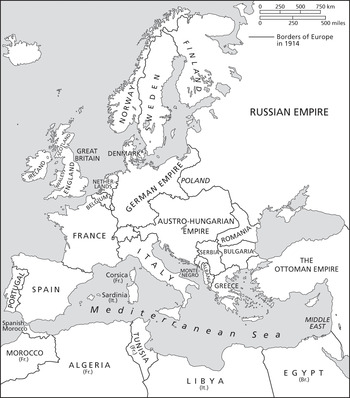
Even if World War I undermined the political strength of imperialism, it did not trigger outright decolonization in Asia, the Middle East, or Africa. The United Kingdom remained the dominant power in international relations, controlling large parts in three world regions. After World War I, Germany’s colonies in China, the Western Pacific, and Africa were simply transferred to the United Kingdom, Portugal, Japan, or the mandate system of the newly established League of Nations. The Arab parts of the Ottoman Empire – Iraq, Transjordan (today’s Jordan), Palestine, Syria, and Lebanon – fell under British and French mandate rule. To make matters worse, imperialism seemed to gather renewed momentum in the 1930s when Japan increased its colonial holdings on the Asian mainland, and Italy took Ethiopia.
In 1918, a quarter of the world’s population of 1.7 billion lived under British rule. World War I had not undercut the economic and military domination of the world by the United Kingdom, even if it had helped to undermine the country’s ability to maintain this exalted position in the long term. The war had devastated world trade, which hit the free-trading and credit-granting imperial power particularly hard. International trade did not return to pre-World War I levels during the 1920s, while the United Kingdom spent vast resources on restoring the pound to the prestigious rank of the world’s lead currency. But even if the financial and economic resources were less plentiful than before World War I, they were still sufficient for the United Kingdom to outrank all other aspiring great powers – with the exception of the United States. But the Great Depression, which started with the stock market crash in New York in 1929, removed that potential rival from the international scene, and then let world trade collapse once more.1
During the interwar years, the United Kingdom followed divergent policies toward two of its imperial domains that are of interest to this book: South Asia and the Middle East. The period between the world wars witnessed a general weakening of economic integration between the United Kingdom and the British Raj because competitors – European countries, the United States, and Japan – managed to enter the South Asian market. In parallel, the British grip on political control subsided as well. As promised during World War I, London devolved power toward self-rule twice – in 1919 and 1935 – even if conservative politicians in the United Kingdom, like the Westminster backbencher Winston Churchill, opposed this development. In any case, South Asians increasingly manned the Indian Civil Service, Mahatma Gandhi’s and Jawaharlal Nehru’s non-sectarian Indian Congress and Muhammad Ali Jinnah’s Muslim League worked for independence, and British forces lost de facto control outside the Raj’s urban and economic centers over the course of the 1930s. By World War II, Indian independence was in the offing, though before 1945 even the anti-imperialist Labour Party saw this only as a long-term possibility.2
In the Middle East, London’s imperial interests focused on the British–French-built Suez Canal in Egypt and the formerly Ottoman territories to the east. The canal was the crucial link to the Raj, imperial possessions in East Asia and eastern Africa, and the dominions of Australia and New Zealand. With Italian imperial designs growing in Ethiopia and Japanese pretensions arising in the Western Pacific by the mid 1930s, the Suez Canal acquired additional strategic importance. Thus, British troops in Egypt did not shy away from suppressing political unrest after World War I with military force, but ultimately the United Kingdom gave in to popular Egyptian pressure by making a deal with King Faruq in 1936 that included troop withdrawals from Egypt proper in exchange for occupation rights of the canal zone for another twenty years. In the rest of the Middle East, British imperialists dreamed of the development of a new empire on the basis of the mandate territories in Palestine, Transjordan, and Iraq, which the United Kingdom had acquired from the collapsing Ottoman Empire after World War I. The goal was to create a secure land corridor in the east of the Suez Canal to the Persian Gulf, where the United Kingdom had imperial and oil interests. Although fears about Soviet expansion played a role in this new imperial project, the greatest threat to its success was Arab nationalism, which the new British presence and the increasing Zionist immigration was sparking. Though the United Kingdom agreed with collaborationist King Faisal to provide Iraq with formal independence in 1932, the British-administered mandate thereby simply turned into a close ally under British patronage. But in 1936–39, the United Kingdom resorted to outright military force in Palestine to suppress the Arab rebellion.3
Against the background of this seemingly robust imperialist world system in the interwar period, two challengers of colonialism – Soviet Russia and the United States – emerged. Vladimir I. Lenin’s government had pursued revolutionary change in the world since the Bolshevik Revolution in November 1917. By February 1919, the future Soviet dictator Iosif V. Stalin described the world as being divided into “two camps” – the American–British–French–Japanese imperialist–capitalist camp and the socialist camp headed by revolutionary Russia. A month later, the Soviet government established the Comintern (the Third International), which one historian considered a response to the creation of the League of Nations during the concurrent Paris Peace Conference. Centrally run from Moscow by the Russian Communist (Bolshevik) Party, this “league of parties” was designed to establish and then guide fraternal outfits in other countries toward global revolution. When revolution in the advanced industrial countries of Europe failed to occur, Lenin called on the Comintern to use national liberation movements in the colonized world as vehicles to overthrow governments in imperialist–capitalist countries. Unsurprisingly, the victorious powers of World War I did not invite the new Russian government to the Paris Peace Conference. In any case, Lenin would have rejected a summons to a gathering that he considered a desperate attempt by the doomed global order to extend its life. From the beginning, Lenin’s Soviet Russia was an outcast in international relations, not only of its own volition but also due to the outside reaction to its revolutionary pretensions.4
Yet the revolutionary zeal of the new Soviet government soon abated. A long civil war left the country’s economy in tatters, and the attempt to export the revolution by military means into Europe failed due to the resistance of the newly recreated Polish state. In 1921, Lenin himself introduced the New Economic Policy (NEP), which marked the abandonment of communist ideas. After his death in 1924, his successor Stalin also retreated from the emphasis on promoting world revolution in exchange for building a strong socialist state in the Union of Soviet Socialist Republics (USSR) first. Given the rise of right-wing and militarist regimes in Germany and Japan in the 1930s, his Soviet Union even engaged with the hitherto despised bourgeois international order by acceding to the League of Nations and establishing relations with the United States. In that vein, the last Comintern congress in 1935 called for the establishment of anti-fascist popular fronts, which included non-leftist parties, as the organization’s primary goal. But Stalin still did not completely abandon support for world revolution. He tried to influence domestic politics through Comintern-created communist parties in Germany in 1932–33 and in Spain in the second half of the decade. But the results turned out to be the opposite of his original expectations, as his policies had helped the rightists Adolf Hitler and Francisco Franco to gain power instead. In the Middle East and Asia, Soviet influence on local communist parties decreased as well, both as the result of changes in Comintern strategy and local reversals of fortune.5
Stalin’s foreign policy immediately before and during World War II followed a mix of pragmatism and ideology. Weakened by its self-inflicted internal convulsions, the Soviet Union faced the possibility of a two-front war. In the east, Japan was building an empire on the Asian mainland that was supposed to include parts of Siberia. In the west, Hitler’s Germany announced its designs to expand into Eastern Europe and the USSR. Stalin thus wanted to prevent, or at least delay, a two-front war on the Eurasian continent through diplomatic means. In 1939, he concluded a deal with Hitler, who for his own reasons temporarily wanted to avoid a two-front war in Europe. The agreement divided the northern part of Eastern Europe into Soviet and German buffer zones. And in April of 1941, Stalin signed a five-year non-aggression treaty with Japan. Whether or not any other Soviet policy could have prevented Germany’s attack two months later is still debated among historians. But the German invasion and the resulting massive destruction of the western USSR, where most of the Soviet population lived, pressed home the country’s vulnerability at its exposed western borders. That Moscow, after the end of World War II, would follow a pragmatic policy of searching for some form of a security arrangement through a buffer zone at its periphery thus was plausible. However, during the war, Stalin had already prepared small groups of exiled communists from Eastern Europe and Germany for the task of seizing power and imposing revolutionary regimes in Soviet occupied territories in the immediate post-war period.6
The United States, too, emerged as a great power during the final two years of World War I. Unlike the Soviet Union, it saw itself not as a revolutionary force that aimed at overthrowing the existing international order, but as a reformer. Some historians have suggested that Woodrow Wilson’s Fourteen Points of early 1918 were a direct response to Lenin’s Bolshevik Revolution in late 1917. Like Lenin, Wilson envisioned a reordering of the world’s imperialist core in Europe. Eight of his Fourteen Points addressed the redrawing of the continent’s borders, five the need to prevent renewed war, and one the creation of an international organization that would transform the world’s anarchic state system into one governed by rules. His visions were about remaking the world in the image of the United States – a successful and self-determined nation state that had emerged from nothing in just one and a half centuries.7
Yet the predominantly European focus of Wilson’s proposals, particularly with regard to national self-determination, reflected the shortcomings of his own thinking. Wilson spent as little thought on the decolonization of Asia, the Middle East, and Africa as he did on embracing the end of racial discrimination in the United States. Even if he had instrumental reasons not to alienate the allied British and French empires at the Paris Peace Conference, his agreement to the transfer of German and Ottoman possessions to other imperial powers and the establishment of the League’s mandate system conformed with the American policy of putting non-white people – like the Filipinos since 1898 – under long-term paternalist tutelage. But the universal applicability of his rhetoric on national self-determination attracted the attention of many anti-imperialist leaders from Asia, the Middle East, and Africa. Wilson’s refusal even to give their appeals a hearing at the Paris Peace Conference left them disappointed. It convinced some, like the Vietnamese Nguyen Ai Quoc (Ho Chi Minh), that Leninism provided the answers which Wilsonianism refused to give.8
Wilson’s ultimate failure in reordering Europe and the world had both substantial short-term and political long-term consequences. After World War I, the US government did not believe that it should make a formal economic or even military commitment to international stability, particularly to European countries that suffered from economic and political crises in the post-war period. Wilson’s United States even withdrew from the world entirely of its own volition, unlike Lenin’s Russia. Still, the White House did not completely retreat even if the US Congress tried to bind the hands of the president in foreign affairs as much as possible. Under Wilson’s successor, Warren G. Harding, the country took the lead in establishing the Washington treaty system (1921–22), which aimed at keeping the Japanese Empire contained and the internally fragmented Republic of China safe from an imperial race for colonies. The next president, Calvin Coolidge, collaborated with Wall Street banks in 1924 in reordering the financial system in Europe. The resulting Dawes Plan helped to end the economic crisis in Germany and to bring Europe a semi-decade of prosperity. But the stock market crash in New York in 1929, particularly the subsequent American shifting of its economic burden onto foreign debtors on all continents, heralded the global Great Depression. By the mid 1930s, nationalist legislation and politicized congressional investigations into the reasons for the US entry into World War I had pushed the country into a stridently isolationist position.9
By the late 1930s, President Franklin D. Roosevelt understood that his country could not stay perpetually aloof from the world in the face of German, Italian, and Japanese militarism. In August 1941, while the United States was still a non-belligerent in World War II, the president and British Prime Minister Churchill drafted the Atlantic Charter, which later became the seminal statement of war aims for all Allied powers, including Stalin’s Soviet Union. The document contained many of Wilson’s Fourteen Points – national self-determination, free trade, global cooperation for the sake of peace and prosperity, disarmament of aggressors, and a renunciation of the use of force in international relations – but it also included a non-transfer principle for territories, and the right of every nation to free and democratic choice of government. The charter thereby re-emphasized, expanded, and universalized the reformist ideas of Wilson’s Fourteen Points, even if the conservative Churchill, and later France’s equally conservative Charles de Gaulle, hoped to limit its applicability in order to protect their countries’ imperial possessions in Asia, the Middle East, and Africa. But unlike Wilson, Roosevelt abhorred imperialism – out of principle and pragmatism. Colonialism was not only a moral wrong, but the failure to decolonize, he feared, would also develop into a renewed threat to world peace. Still, in negotiations with Stalin during World War II, he was willing to make territorial compromises in Eastern Europe and Northeast Asia, which contradicted his own non-transfer principle but which he felt were necessary to keep the war alliance together. And his principled rejection of colonialism also did not mean that he had shed all of Wilson’s racialist and paternalist ideas toward colonized people either. While he believed that the United States should bring independence to “1,100,000,000 brown people … [who] are ruled by a handful of whites,” he still advocated the idea of temporary tutelage for some countries – Korea and Indochina, for example – because they supposedly needed time and assistance to prepare for self-rule.10
From the Atlantic Charter emerged the United Nations (UN) system and the Bretton Woods agreements on the International Monetary Fund (IMF) and the World Bank. Originally, the United Nations included just the allies fighting Germany, Italy, and Japan, but by 1945 it had turned into Roosevelt’s reformed and pragmatic reincarnation of the League of Nations. The United Nations Organization was supposed to ensure international peace through cooperation among the great powers while providing the appearance of collaboration among all nations. Of course, Roosevelt counted the United States, the Soviet Union, and the United Kingdom among the great powers by default. Yet, as a pragmatic politician, he also included the weak Republic of China (ROC) and humiliated France as permanent members of the Security Council to flank Stalin’s revolutionary Soviet Union. For its part, the Bretton Woods system incorporated the lessons learned from the American oversights from the immediate post-World War I world – the failure of the economically most powerful country to make a commitment to international stability after the war, the quick fix of Europe’s financial problems in the mid 1920s, and the collapse of the world economy during the Great Depression. Toward the end of World War II, Roosevelt spent much personal capital convincing Congress and the American people of the need for the United States to make a political and economic commitment to the world in order to avoid another global collapse and possibly World War III.11
The Dawn of a New World Order, 1945–50
World War II ended in 1945 with the unparalleled Soviet–American–British military control of vast parts of the world. Tsar Alexander I, whose armies had marched to Paris in 1814 to defeat French Emperor Napoleon and restore the pre-revolutionary Bourbon monarchy, would have been stunned by the degree of territorial control which Stalin exercised in Eastern Europe by mid 1945. And Queen Victoria would have gasped at how quickly the United States had equaled British naval control in the Pacific and the Atlantic, thereby gaining domination of the Western Pacific islands, Japan, Korea, North Africa, and Western Europe. Even if the United Kingdom with its global empire appeared to be a diminished great power, it still controlled much of eastern Africa, the Middle East, South Asia, and Malaya (today’s Malaysia). Nevertheless, London continued to believe that the United Kingdom was still a great power at the helm of a worldwide colonial empire. Giving up all of the colonial possessions was not on the agenda at all. Discussions in London during World War II revolved primarily around preserving and reforming the global empire, including the possibility of trimming it in some places while extending it elsewhere.12
The victorious Big Three had experienced the war in fundamentally different ways. As mentioned above, the German attack on the USSR had caused large-scale destruction and death while it reinforced Stalin’s will to seek security through territorial control beyond his country’s borders. In comparison, the United States did not experience foreign occupation, physical destruction, or a high rate of war-related deaths. On the contrary, its geographical isolation from Europe and Asia had kept it secure, while the war had helped finally overcome the Great Depression, put the country back on track toward prosperity, and extend American power far beyond the country’s shores. Like the United States, the United Kingdom benefited from its island position away from the continental battlegrounds in Europe, but it experienced destruction due to German aerial bombardment. Its loss was mostly in global financial health, but the United Kingdom still was in a much better economic state than the semi-destroyed Soviet Union.13 In 1945, the USSR could claim the moral high ground because it had defeated the bulk of German troops in a long and brutal war. But the United States could equally do so because it had defeated Japan almost single-handedly, had fought together with the United Kingdom to defeat Hitler’s Germany and Benito Mussolini’s Italy, and had provided unparalleled and massive material aid to its fighting Allies in the process.
Unilateral decisions, ideological preconceptions, and misperceptions undermined the possibility of the Soviet–American–British war alliance transforming itself into a lasting arrangement for global peace. Stalin’s imposition of communist-dominated regimes in Poland, Romania, Bulgaria, and the Soviet occupation zone of Germany in 1944–45 not only went beyond justified security needs but also contradicted the principle of democratic choice of national governments, as promulgated in the Atlantic Charter. Soviet attempts to extract territorial and oil concessions from Turkey and Iran in 1945–46 and the island-grabbing in Northeast Asia even after formal Japanese surrender on September 2, 1945, all irritated the United States. Harry S. Truman’s ascent to the presidency after Roosevelt’s death in April 1945 may have changed the style of American policy toward the Soviet Union, though it initially did not alter the US proclivity for multilateral cooperation. But Stalin’s long-held ideological belief in the inevitability of war in international relations induced him to reject multilateral solutions once World War II was over. The self-perception of weakness in relation to the capitalist United States caused him to forego economic cooperation, and instead to erect a facade of strength in order to disguise his country’s fragility and thereby delay the outbreak of a World War III, which Leninist–Stalinist ideology foresaw as inevitable. At the same time, however, he also believed that Anglo–American cooperation, which emerged in response to his actions at the Soviet periphery, would not last because, as Marxism–Leninism promulgated, capitalist–imperialist powers were incapable of cooperating with each other in the long term. Instead, he hoped that US–British disagreements would lead to cooperation between Moscow and London against Washington. Thus, relations among the Big Three, or so Stalin hoped, would change to the benefit of his Soviet Union. Finally, the American use of nuclear weapons to defeat Japan in August 1945 convinced both the United States and the USSR – erroneously – of the war-terminating capabilities of such arms. As a result, the great dictator quickly ordered the Soviet A-bomb program into high gear at the expense of the country’s reconstruction. The temporary US application of veiled nuclear threats in negotiations with the USSR in the fall of 1945, i.e. after the defeat of Japan, further undermined much of the remaining good will among the Big Three.14
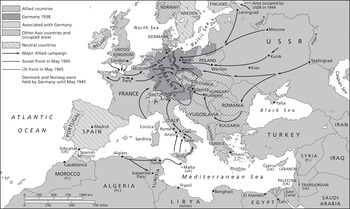
The collapse of wartime trust hence created a tit-for-tat retaliatory system that dominated the relations among the Big Three as early as at the turn of 1945/46. Soviet demands for territorial aggrandizement in Iran, Turkey, and Japan, as well as the American refusal to grant the USSR occupation rights in Italy and Japan, marked only the beginning. By early 1946, the Big Three were also at loggerheads over how to deal with Germany, which had been divided into several occupation zones among the three and France. Still, at the Paris Conference from July to October 1946, they were able to come to agreement with regard to the smaller enemy states Italy, Hungary, Bulgaria, Romania, and Finland.15
If the Soviet Union had contributed much to the deterioration of relations before early 1946, it was the United States that took the lead in dividing Europe, and eventually the world, afterward. Based on George Frost Kennan’s famous Long Telegram from the US embassy in Moscow, Washington had come to believe that Stalin’s Soviet Union was historically, ideologically, and pathologically expansionist. But Kennan did not endorse a comprehensive American military reaction to the perceived Soviet threat, because he was convinced that the USSR was internally weak and thus acting cautiously. Instead, he advocated a calculated policy of actively denying crucial West German and Japanese human and industrial resources to the Soviet Union while harnessing them for the restoration of economic stability in both world regions. Kennan’s idea of creating strong points of economic self-defense at either end of the Soviet Union generated the so-called Marshall Plan for Europe in mid 1947 and a similar economic recovery scheme for Japan a year later.16
By early 1947, the intersection of decolonization with the emerging Cold War forced Truman to go beyond Kennan’s targeted policy of encountering Soviet pressure exclusively at crucial points. British Prime Minister Clement Attlee had decided to start the process of imperial withdrawal from South Asia two months after his ascent to power in July 1945. His decision did not amount to a fundamental renunciation of imperialism, but was related to long-time political developments in that particular world region. Faced with severe financial problems in the wake of World War II, London also reviewed other commitments. By February 1947, Attlee announced the reduction of the British economic and military commitment to the Greek government, which struggled with a communist insurgency sponsored by Yugoslavia and the Soviet Union. In view of past Soviet pressure on Turkey, President Truman called on Congress to grant funds to provide military and economic aid to either country in order to strengthen resistance to communist subversion and outside threats. The Truman Doctrine was born.17
By mid 1947, American economic and military commitments to non-communist Europe had de facto divided the continent, forcing Stalin to respond. Faced with sole responsibility for the reconstruction of Soviet-occupied Eastern Europe in competition with Marshall Plan aid to the continent’s western half, Stalin increased political, military, and economic control over his dominion there. This included the Stalinization of Poland, Romania, Bulgaria, Hungary, and the Soviet zone of occupation in East Germany, but also the successful pro-Soviet coup in relatively independent Czechoslovakia in February 1948. Yet he concurrently failed at bringing the Yugoslav, Italian, and French communist parties to heel, and he also launched the politically self-defeating blockade of West Berlin in June 1948. Stalin’s attempt to starve half of Germany’s capital into submission over the duration of almost one year convinced the three Western Allies – the United States, the United Kingdom, and France – to create a West German state and a European defensive alliance, the North Atlantic Treaty (later North Atlantic Treaty Organization; NATO). The prospect of a deepening division of Europe eventually persuaded Stalin to end the blockade in May 1949, but his sudden change of mind failed to undo the damage.18
At least, in 1949, Stalin could record two successes, even if one was not of his own making. By August, Moscow tested its first nuclear device, which allowed the Soviet Union to catch up with American atomic preponderance in the long term. However, the communist victory in the Chinese civil war only two months later fell into his lap unexpectedly. This internal conflict pre-dated the Cold War, though the Comintern had established the victorious Chinese Communist Party (CCP) in 1921. But unlike in Eastern Europe, where Stalin imposed communist regimes in 1945, his support for the Chinese communists had been insignificant since the early 1930s. And it was the governing Guomindang (Nationalist Party) – not the CCP – that provoked the resumption of the civil war in 1946, in the hope of receiving increased US military and economic aid in the context of the unfolding Cold War in Europe. Yet the United States chose to withdraw support from the internationally recognized Chinese government in 1948/49, in the expectation that the USSR would be drawn into the quagmire, overextend its limited resources, and thereby weaken itself in Europe. Just as the United States decided to retreat, Stalin re-established closer contacts with the CCP. After the foundation of the People’s Republic of China (PRC) on October 1, the Chinese communist leader Mao Zedong traveled to Moscow with the desire to establish a friendship and alliance treaty.19
The Korean War as Watershed, 1950–55
Few events in the Cold War had such a far-reaching impact on the division of the world as the Korean War. The North Korean attack on the southern half of the peninsular country in mid 1950 occurred at a time of great fluidity in East–West relations. The Soviet A-bomb test and Chinese communist victory had created an inflated sense of vulnerability in the United States. Due to increasing policy disagreements with the Truman administration, Kennan decided to leave his position as the main strategic adviser by the end of 1949. His successor, Paul H. Nitze, advocated in the national security paper NSC-68 of April 1950 the military containment of an inherently expansionist communist world system at all points of its periphery, no matter how important to US or international security. President Truman shared this bleak threat assessment but did not act on the recommendations for massive rearmament because he disliked the associated enormous budget and tax increases.20
Concurrent with the change in Washington’s threat perception in early 1950, the Cold War formally arrived in East Asia. During Mao’s stay in Moscow, the PRC and the Soviet Union recognized the government of the Vietnamese communists who were fighting against colonial France, and then signed a bilateral friendship and military assistance treaty, aimed at the supposedly imperialist United States. The start of the Korean War on June 25, 1950, hence occurred in the context of raised American strategic anxieties and increased communist activity in East Asia. However, the Korean War was primarily a local conflict. The northern leader, Kim Il-sung, certainly did not expect the domestic conflict to grow into a crisis that would reshape the global Cold War.21
Korea’s division into two mutually hostile and ideologically antagonistic regimes had been an unintended byproduct of the emerging Cold War. During World War II, Roosevelt had believed that the Japanese colony was not ready for self-rule, and hence he persuaded Stalin of the need for a joint military occupation and temporary UN tutelage to prepare the country for independence. In the end, two competing regimes emerged in the two Korean zones of Soviet–American occupation after August 1945. Since both claimed exclusive representation of the whole country, they increasingly engaged in propaganda and sabre rattling to that end. At the turn of 1949/50, Kim Il-sung concluded that time for unification under his leadership was running out. Through diplomatic maneuvers between Stalin and Mao, including the provision of embellished reports about the revolutionary situation in South Korea, he managed to convince the new Sino–Soviet allies to provide political backing and military aid. Stalin and Mao had their own, mutually incompatible reasons to endorse Kim’s plans, though both also entertained reservations about the planned military operation. Without a doubt, the massive military attack in late June was well prepared and rapidly executed. Within weeks, North Korean troops had occupied much of the south except for the harbor city of Busan, where American and South Korean troops offered determined resistance.22
The Truman administration placed the local Korean conflict within the context of the exaggerated threat assessments of NSC-68. It believed not only that the aggression was merely a diversionary attack designed to mask Soviet preparations for creating trouble in Europe, but also that a lack of American reaction would undermine US credibility on a global scale. The president faced little resistance in Congress in obtaining approval for a massive increase of the defense budget as envisioned by NSC-68. The United States also easily received international support for military action against North Korea, exploiting the Soviet boycott of the United Nations over the continued exclusion of the PRC. By mid September, American and UN troops had expelled North Korean troops from the south. Using the momentum of their counterattack, US forces soon crossed the former line of division and pushed toward the Chinese border, particularly after the UN General Assembly approved the move with 47 to 5 votes in a legally non-binding poll that endorsed the reunification of Korea. The PRC intervened of its own volition in late October – out of both fear of an attack on Manchuria and an ideological commitment to a fellow communist regime. By early 1951, the frontline had stabilized around the former line of division where it stayed until armistice in mid 1953 and where it marks the de facto border of the two Koreas today.23
Apart from destroying a country that had escaped World War II virtually unscathed, the Korean War had a long-term impact on the global Cold War. Parallel to its military intervention, the United States implemented the exaggerated defense recommendations of NSC-68 in the following five years. Truman and his successor Dwight D. Eisenhower broadened the policy of containing the communist world. Since mid 1950, it included the militarization of the North Atlantic Treaty (NATO) with an integrated command system and the alliance’s geographical inclusion of two previous Cold War hot spots – Turkey and Greece. Equally important was the decision to rearm West Germany because of its frontline status in Europe. In order to avoid popular resistance in Europe to such a development so soon after the end of World War II, France proposed the establishment of an integrated army, the European Defense Community (EDC), within which West Germany would be allowed to get access to weapons.24
Washington followed similar containment strategies in East Asia. Immediately after the start of the Korean War, the United States made unilateral defense commitments to both embattled South Korea and the Republic of China, which was still ruled by the Guomindang after its flight from the mainland to Taiwan in 1949. The originally hesitant American policy toward Japan, the former World War II enemy, changed as well; in September 1951, the United States and its Cold War allies signed a peace treaty, followed by a bilateral defensive alliance. However, Washington ultimately decided to establish an East Asian “hub and spokes” network of alliances with Australia and New Zealand, the Philippines, South Korea, and the ROC. On the one hand, the pro-Western countries in the region were unwilling to enter into a NATO-style multilateral alliance with their past war enemy Japan. On the other hand, the United States also did not trust the authoritarian impulses of some of these countries, and thus opted mostly for bilateral alliances that maximized US influence in each case. In the context of US containment in Asia, however, strategic imperatives trumped Roosevelt’s vocal commitment to decolonization. Although Washington in the late 1940s had grown dissatisfied with French foot dragging toward decolonization of Indochina, the Sino–Soviet treaty and, particularly, the outbreak of the Korean War in 1950 triggered an American military commitment to colonial France in its fight against Vietnamese communism. However, the United States continued to be displeased with France’s stubborn unwillingness to decolonize, which it considered one of the causes of conflict in Indochina.25
Exaggerated assessments of the Soviet threat to the Middle East fed American alliance policies there, too, but the United States could rely on pre-existing regional anti-communism. In view of Soviet meddling in Kurdish territories in 1945, Turkey and Iraq had signed a bilateral treaty of friendship in March the following year. In the fall, Turkey announced its intention to conclude alliances with all Arab states, but only Transjordan (today’s Jordan), which was just emerging from British mandate rule, agreed to join. By the spring of 1947, these three countries had established a rudimentary anti-Soviet bloc – despite resistance from Syria, Egypt, and Saudi Arabia. However, the multilateral defensive pact, which the Arab League eventually signed just a week before the outbreak of the Korean War, was directed against Israel, not the Soviet Union. In the context of Turkey’s accession to NATO in 1952, the Truman administration proposed the creation of the Middle Eastern Defense Organization (MEDO), which was supposed to link NATO’s southeastern member with Iran and Pakistan in the defense of the Middle East and the Suez Canal. MEDO never saw the light of day due to a lack of interest among Arab states. But Eisenhower proposed to the imperially minded Churchill, who had been re-elected as UK prime minister in 1951, to use British influence in the Middle East to implement MEDO in the form of the UK-led Baghdad Pact that included Pakistan, Iran, Turkey, and one Arab state – Iraq.26
The pact’s creation paralleled, and was partially influenced by, events in Indochina in 1954. Despite Washington’s substantial commitment to Paris – made in the wake of the outbreak of the Korean War – for the fight against Vietnamese communism, the United States grew dissatisfied with France’s lack of military success and continued unwillingness to transfer power. Given the increasingly dire French military situation in Vietnam in the spring of 1954, the Eisenhower administration decided not to intervene unilaterally but to call for multilateral military action to stop communist aggression in Indochina. However, neither France nor the United Kingdom was willing to act multilaterally until other means of ending the war, including negotiations, had been exhausted. While the Geneva Conference in mid 1954 failed to solve the parallel Korean problem, it at least produced a compromise agreement on the temporary division of Vietnam and the neutralization of Laos and Cambodia. As a non-belligerent, the United States stayed aloof from the Indochina negotiations in order to keep all options open for future action. Appalled by the supposed concessions which France and the United Kingdom had made at Geneva to the communist world – the Soviet Union, the PRC, and the Vietnamese communists – the United States established the Southeast Asia Treaty Organization (SEATO) on September 8, 1954. This new alliance brought together the Philippines, Thailand, Pakistan, Australia, New Zealand, France, the United Kingdom, and the United States in defense of Indochina against communist expansion.27
The analogous foundation of the British-led Baghdad Pact and American-led SEATO in 1954–55 closed the semi-ring of Western anti-communist alliances, which reached from Norway across Europe, the Middle East, South Asia, and Southeast Asia to the East Asian rim. Its completion, however, occurred shortly after Stalin’s death in March 1953, just as the new Soviet leadership tried to reduce Cold War tensions. Nikita S. Khrushchev and his fellow leaders in the Kremlin understood that Stalin’s confrontational policies were co-responsible for the economic problems at home and the military encirclement abroad. Moscow thus sought negotiations with Washington to resolve some of the accumulated problems. While the German issue eluded any solution for unrelated reasons, as described further below, the Soviet Union and the PRC cooperated closely at Geneva to eliminate the Indochina conflict by means of a compromise agreement. Even if they pressured a recalcitrant communist Vietnam to agree to the division of the country and the neutralization of Laos and Cambodia, the resulting Geneva Accords still did not satisfy American security needs. Similarly ephemeral was Khrushchev’s attempt in 1955 to repair relations with Yugoslavia, which Stalin had expelled from the socialist world in 1948 for its refusal to submit to his dictates. At least, the new Kremlin leaders succeeded in abandoning Stalin’s disinterest in the Afro–Asian world, particularly in one of its most important emerging representatives – India.28
At the time of Soviet attempts to relax international tensions, two crucial non-communist countries rejected the dark American perception of the threat supposedly emanating from the USSR, as expressed in NSC-68. To India, US alliance building brought the Cold War unnecessarily to South Asia. American containment policies turned its Muslim neighbor Pakistan into the most allied American ally in the Cold War – once through a bilateral agreement and twice through multilateral alliances – and, in the process, into a military threat to India. Indeed, SEATO’s creation in September 1954 convinced Prime Minister Jawaharlal Nehru to rescind his vociferous opposition to an Indonesian proposal to convene an Asian–African Conference. Later that year, Nehru took the lead in preparing what would become the Bandung Conference in April 1955, insisted on inviting the PRC, and convinced Yugoslav President Josip Broz Tito to join his non-aligned stance in international affairs. Concurrently, Nehru also accepted an invitation to visit Moscow in mid 1955 in an exercise of even-handedness between the Cold War blocs. By the same token, Egypt’s Gamal Abdel Nasser had opposed the creation of MEDO and the Baghdad Pact. He was convinced that the United States and the United Kingdom were using the pretext of an exaggerated Soviet threat to fortify Britain’s imperialist position in the region while simultaneously provoking the projection of Soviet influence into it. In the run-up to the Bandung Conference, Nasser committed his country to the Asian–African Movement and afterward even to Nehru’s non-alignment.29
Furthermore, the Geneva Conference in mid 1954 had an impact on Europe. The traumatic loss of its colonial possessions in Indochina shook France’s identity to the core. As a reaction to the self-perceived decrease in its international standing, the National Assembly was loath to integrate France into the supranational structure of the European Defense Community (EDC). Its refusal in late August 1954 to ratify the EDC treaty, which it had proposed four years earlier, reopened the debate about West German armament. But even if France’s parliament demolished the outcome of four years of international negotiations, the country’s government was unwilling to compromise its other anti-Soviet commitments. Paris not only agreed to join SEATO the following month, but, in October, also approved West Germany’s direct membership in NATO and rearmament within it.30
The prospect of West Germany joining the American-led alliance system in Western Europe predictably triggered Soviet misgivings. The USSR proposed a pan-European security conference, which two decades later would become the Conference on Security and Cooperation (CSCE). A conference of the European socialist states in Moscow decided in December of 1954 to create a counter-NATO – the Warsaw Pact – and approved the right of communist East Germany to arm itself against the supposed resurgence of (West) German militarism. The creation of the Warsaw Pact formally occurred in mid May 1955, a week after West Germany’s accession to NATO. On the surface a reaction to these developments, the pact was in reality a Soviet ploy designed to gain leverage in negotiations with the United States on the parallel dissolution of both alliances. However, the Geneva Summit of the World War II Allies in the summer of 1955, the first major conference of that sort in a decade, did not reverse Europe’s division into two hostile alliances, even if Moscow had hoped it would at least reduce Cold War tensions.31
American and Soviet alliance systems in Europe, 1955

The clarifications of Cold War fault lines in Europe by mid 1945 allowed Western and Eastern European countries to test the limits of independence within their respective blocs. Pro-American West Germany sought rapprochement with the Soviet Union in the fall of 1955, and Poland and Hungary sought political autonomy in the wake of Nikita Khrushchev’s Secret Speech the following February. However, the parallel political crises in Warsaw and Budapest in October 1956 revealed that Moscow was only willing to allow some limited form of domestic autonomy but definitely not neutrality in the Cold War. Similarly, Washington’s castigation of Paris and London in the concurrent Suez Crisis, to which we turn now, reminded the declining great power United Kingdom and the resurgent France that they had become dependent on American economic good will and military protection. Hence, in the wake of the Korean War, the events in late 1956 further cemented the division of Europe into antagonistic spheres of Soviet and Western influence.32
The Suez Crisis, 1956
The Suez Crisis in 1956 marked simultaneously the endpoint of British global pretensions and an important step in the Cold War’s subsequent, though slow and hesitant, entry into the Middle East. Stalin’s attempts to get territorial concessions from Iran and Turkey had undermined the Soviet–American–British World War II alliance in 1945–46, but afterward the great powers did not engage for some time in any competition in this world region. On the contrary, Washington and Moscow both supported the creation of the state of Israel at the expense of Palestinians in 1947–48. Truman aimed at ensuring that the new state would not fall under Soviet influence, and Stalin hoped to diminish the British hold in the Middle East. Subsequently, Washington and London tried to sponsor a peace process between the Jewish state and its Arab neighbors, but this happened largely outside the Cold War context. The two Western powers and France also imposed on themselves a ban of weapons deliveries to the Middle East in order to prevent an arms race and the expansion of the Cold War into the region. Stalin’s USSR respected the ban, mostly because it had no specific interests in the Middle East at that time.33 Yet American–British alliance building in the wake of the Korean War, as described above, brought the Cold War for the first time to the Middle East, even if Egypt refused to participate in the alliance building, joined the Asian–African Movement, and subscribed to Nehru’s non-alignment. After an Israeli incursion into Egyptian-held Gaza in late February 1955, Nasser used his meeting with Nehru and Chinese Prime Minister Zhou Enlai on his way to the Bandung Conference of Asian–African nations to ask for weapons deliveries. Ultimately, Khrushchev supported Egypt with weapons in the Soviet–Czechoslovak arms deal that broke the Western arms embargo in September 1955. In mid May 1956, Nasser’s Egypt even recognized the PRC – the only major power excluded from the United Nations – in an attempt both to emphasize his commitment to Asian–African Internationalism and to undermine a complete arms embargo against the Middle East that was under discussion in the UN General Assembly.34
The Suez Crisis itself started two months later, on July 26, 1956, with the Egyptian nationalization of the Canal Company. This surprise step was triggered by American demands for Egypt to commit itself to the West in the global Cold War in exchange for loans to build the Aswan Dam at the upper Nile. Incensed by this disrespect for Egypt’s sovereignty and non-aligned stance, Nasser decided to forego US aid dollars and, instead, nationalize the foreign-owned company. While he portrayed the event as the final act of his country’s decolonization, he also had a sober reason to nationalize – it allowed him to tap into the company’s annual income and massive financial assets to bankroll the construction of the dam. Cairo’s daring maneuver enraged London and Paris, because British and French citizens were the main shareholders in the canal company. But the Eisenhower administration calmly indicated to the British government that it would not endorse the use of force, or threats thereof, as long as Nasser did not infringe on the right of passage through the canal. London and Paris, however, were convinced that Nasser’s decision to nationalize the company meant “that NATO and Western Europe were at the mercy of one irresponsible and faithless individual.” In the end, Israel, France, and the United Kingdom clandestinely prepared a joint military intervention in Egypt with the goal of seizing the canal and possibly overthrowing the supposedly dangerous Nasser.35
The Israeli–French–British intervention on October 29–30 forced the USSR and the United States once more onto the same side, even if they did not agree on anything else with regard to the Middle East. Unlike in 1947/48, however, Washington and Moscow in 1956 supported the Arab side. The United States was exasperated that its NATO allies had acted covertly behind its back. Through economic and diplomatic means, it strong-armed the three aggressors out of Egypt. Washington not only feared that the intervention would alienate Cairo even more, but it was also irritated that this unnecessary crisis had redirected the world’s attention from the ongoing anti-Soviet revolution in Budapest. Ultimately, the crisis cost the United States much standing in the Middle East due to the implicit American association with the aggressors – despite its forceful actions against them. The Soviet Union, in comparison, used the unexpected opportunity to suppress the Hungarian Revolution with military force while drawing close to Nasser’s Egypt by portraying itself as the true anti-imperialist defender of Arab interests.36 Poignantly, American containment policy that was supposed to keep the Soviet Union out of the Middle East had created a situation that allowed the USSR to enter it.
In the wake of the Suez Crisis, the United States faced a heap of shards in the Middle East. Its own heavy-handed Cold War policy toward Nasser had triggered a chain of events that led to the American association, at least in Arab minds, with Israeli and European imperialism. Furthermore, British participation in the intervention discredited the United Kingdom as an American partner to contain Soviet influence in the Middle East. In its tendency to see the Cold War mainly as a zero-sum game, Washington concluded that it had lost Cairo to Moscow, and thus tried to establish close cooperation with conservative Arab monarchies to contain the spread of Nasser’s supposedly pro-Soviet nationalism throughout the region. While the establishment of formal alliances did not materialize, the United States could still enlist Saudi Arabia and Jordan as informal, and eventually long-term, Cold War partners. In turn, such American policies once more drove Nasser closer to the Soviet side. By the spring of 1958, the charismatic Egyptian president went on his first visit to Moscow. And some months later, by mid 1958, the anti-monarchical revolution in Iraq led to an existential crisis in the British-led Baghdad Pact. By 1959, Iraq withdrew, and the alliance moved its headquarters to Turkey, renamed itself the Central Treaty Organization (CENTO), and made the United States an associate member.37
Conclusion
In the dozen years after the end of World War II, the international system witnessed the ascent of the two great powers to global pre-eminence, at the expense of the imperialist United Kingdom. The Soviet Union was an ideologically committed world revolutionary and anti-imperialist agent that established communist hegemony in Eastern Europe while showing little interest in the colonized Afro–Asian world. The United States was a reformist but pragmatic internationalist power that, as soon as the Cold War unfolded, struggled with its own anti-colonial commitments. Ideological clashes, political disagreements, unilateral decisions, and misperceptions triggered the bilateral confrontation. In the late 1940s, the Cold War division of the world was still confined to Europe and, to a lesser degree, East Asia. The rupture of the war alliance among the Big Three had started with disagreements over Europe and the Middle East in 1945–46, helped to harden the Korean division, influenced the Chinese Civil War, and eventually was completed during Stalin’s Berlin Blockade in 1948–49.
Following the outbreak of the Korean War in mid 1950, American containment policies extended the Cold War division to regions at the whole periphery of the communist world. The Soviet Union itself had contributed to East Asia’s division both by signing the friendship and alliance treaty with the PRC and by providing support for North Korean war plans in early 1950. The exaggerated US reaction to the local conflict on the Korean peninsula put the Soviet Union on the defensive while it alienated countries in the Afro–Asian world – particularly India and Egypt. The communist world hoped to decrease Cold War tensions through negotiating a compromise deal on Indochina in 1954, but France’s loss of its colonies caused Washington to extend its alliance building into Southeast Asia while it caused Paris to complicate the Cold War in Europe. The Soviet Union reacted to West German membership in NATO by creating the Warsaw Pact in 1955, followed by the establishment of friendly relations with India, and entered the Middle East on the coattails of the Suez Crisis.
Yet the seemingly deep division of the Eurasian world by the mid 1950s into two antagonistic blocs turned out to be more brittle than expected, as the next three chapters reveal. The rash and improvised bloc formation had produced shoddy and unsound construction on all sides. In 1958, the pro-Western Iraqi monarchy fell in a coup that undermined the Baghdad Pact, while the supposedly pro-Soviet Nasser turned against the Soviet Union by persecuting Arab communists in Egypt and Syria. Under de Gaulle’s leadership, France implemented, starting in the same year, a policy of independence from the United States that would lead to his country’s withdrawal from the military organization of NATO. And starting in the early 1960s, the socialist world suffered from the consecutive defection of Albania, the PRC, and Romania.