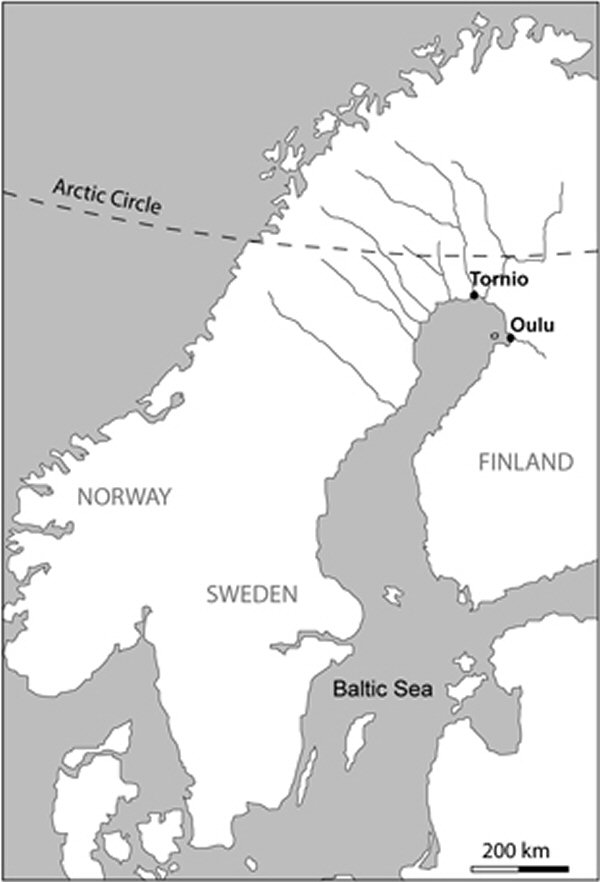


This project, initiated and funded by the University of Oulu, explores the long-term material roots of modernisation and the development of urbanisation in the circumpolar region. Research focuses on the towns of Oulu and Tornio, which lie 170km, and 70km south of the Arctic Circle (Figure 1). The towns are located in modern Finland, but were originally part of Sweden, and were subsequently part of the Grand Duchy of Russia (1809—1917). In the first half of the seventeenth century Swedish imperial ambitions led to an unprecedented level of town-building in the Nordic region, and no fewer than eight towns were founded on the north coast of the Gulf of Bothnia. Many of these new towns, including Oulu and Tornio, were laid out close to ancient trading sites, at the mouths of rivers. Oulu and Tornio were established within two decades of one another, but developed in very different ways. Oulu, founded in 1605, grew to have a population of more than 3000 by the end of eighteenth century (Reference HalilaHalila 1953). In contrast, Tornio, founded in 1621, remained small, with no more than 700 residents throughout the seventeenth and eighteenth centuries (Mäntylä 1971).
Map showing the location of Oulu and Tornio in northern Finland.

Several rescue excavations have been carried out in Oulu and Tornio since the 1960s. The development of urban space and the impact of modernisation have been studied through an analysis of artefactual assemblages, and an examination of changes in domestic architecture. The process of urbanisation in Tornio can be divided into two phases. In the seventeenth century urban space was open and village-like rather than closed, with houses located in the inner parts of plots; this, along with such features as the incorporation of fields within the urban space, appear to reflect the persistence of pre-urban ways of life. Also, little effort was invested in the elaboration of the built environment. The wooden walls of domestic buildings were placed directly upon the ground, and only the town hall and the church had proper stone footings. In the seventeenth century these public buildings were also distinguished from domestic dwellings by their exterior coating of red ochre paint.
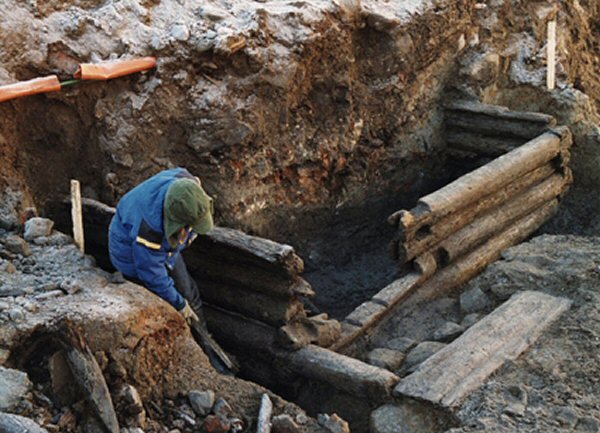
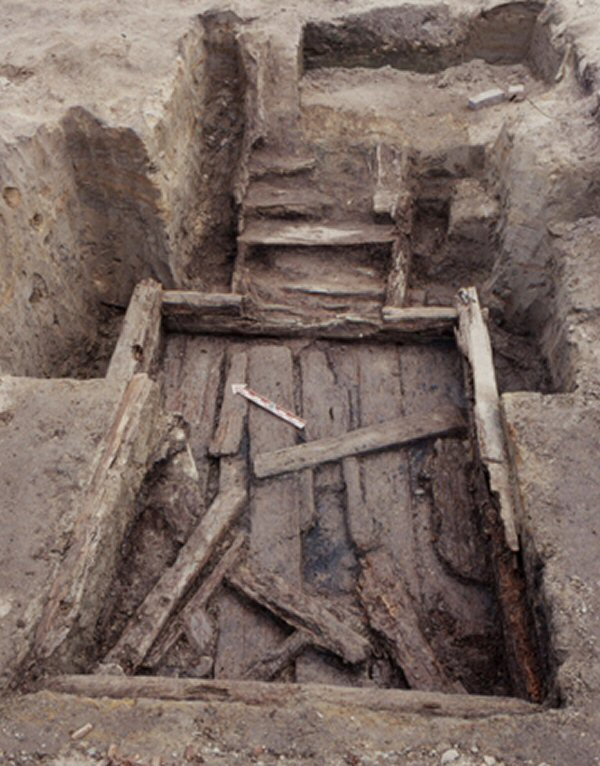
During the second phase of development, in the first half of the eighteenth century, the use of stone foundations became more common in ordinary houses, and domestic dwellings were painted for the first time (Reference YlimaunuYlimaunu 2006). Changes in the organisation of the urban space are also evident after the end of the Great Nordic War (1700—1721), during which Tornio was badly devastated. Urban space within Tornio became enclosed, and the residents of Tornio started to build their houses along the streets, with outbuildings arranged around and enclosing an inner courtyard. This would suggest that residents were creating private individual spaces and began to adopt a 'geometric' rather than 'organic' understanding of the surrounding world. The development was slow, however, and the poorest town residents only had enclosed inner yards at the end of the eighteenth century. Despite this move to enclosed space, some medieval features, such as pre-urban warehouses and narrow blocks, survived within the later grid pattern and were still visible in the plan of the town at the end of the twentieth century (Reference YlimaunuYlimaunu 2006). Building techniques differed in the town of Oulu. Here, stone foundations were placed beneath domestic buildings from the beginning of the seventeenth century. Oulu residents also made far more use of stone cellars than their neighbours in Tornio (Figures 2-3).
Strikingly well-preserved remains of a probable late eighteenth-century smithy excavated in Tornio in 1999.
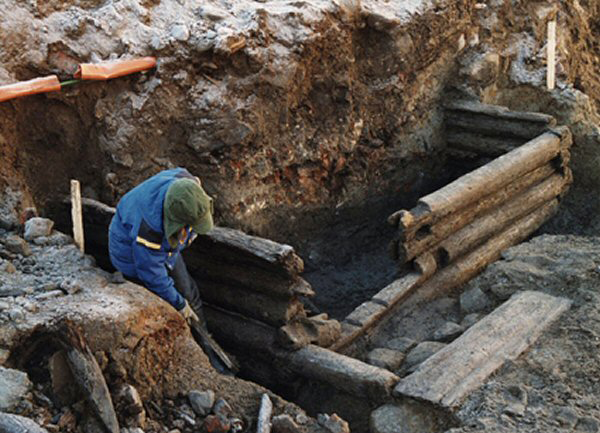
Late eighteenth-century wooden cellar excavated in Tornio during the 2002 campaign.

The townscape of Oulu was greatly influenced by several extensive fires between the seventeenth and nineteenth centuries. These destructive incidents destroyed a great number of residential buildings in many parts of the town as well as merchants' granaries that were located in the harbour area near the river bank. The irregular building code of the early seventeenth century was then (after 1649) gradually moved to a more regular square town plan. Wet areas also characterise the Oulu townscape, as is indicated by the wooden pavements revealed in archaeological fieldwork. Furthermore, large timber posts were found under buildings near wet areas. The purpose of posts, apparently, was to support the buildings erected above them.
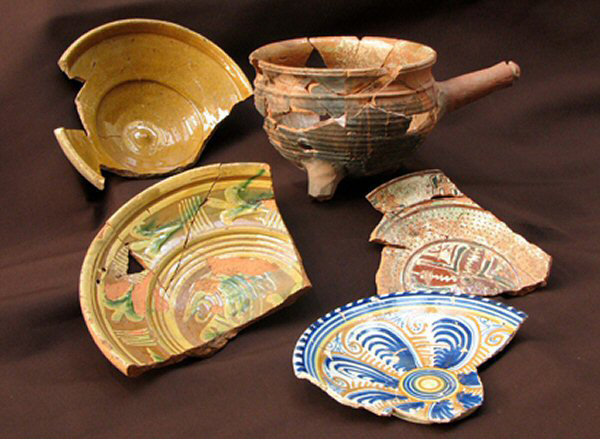
Excavations have revealed a wealth of portable material culture from both towns (Figures 4—5). Imported Chinese and European-made porcelain, Majolica, red and whitewares and Rhenish stone wares have been found in quantity in seventeenth- and eighteenth-century contexts. Fine glassware for the table and clay tobacco pipes were also present in both towns from the first half of the seventeenth century. The oldest examples of porcelain recovered date from the first half of the eighteenth century; however porcelain tea cups and pans became far more common after c. 1750. There is evidence to suggest that the consumption of coffee and tea was linked to ritualised displays of wealth and status among the emerging merchant classes of Oulu and Tornio. This reminds us that the common tendency within historical archaeology to regard artefacts primarily as economic commodities can neglect other significant aspects of their use and severely misrepresent the ways in which people actually related to objects (Herva & Reference YlimaunuYlimaunu 2006).
Redware and Majolica from seventeenth-century contexts in Tornio. The cooking pot derives from a foundation deposit associated with a seventeenth-century house.

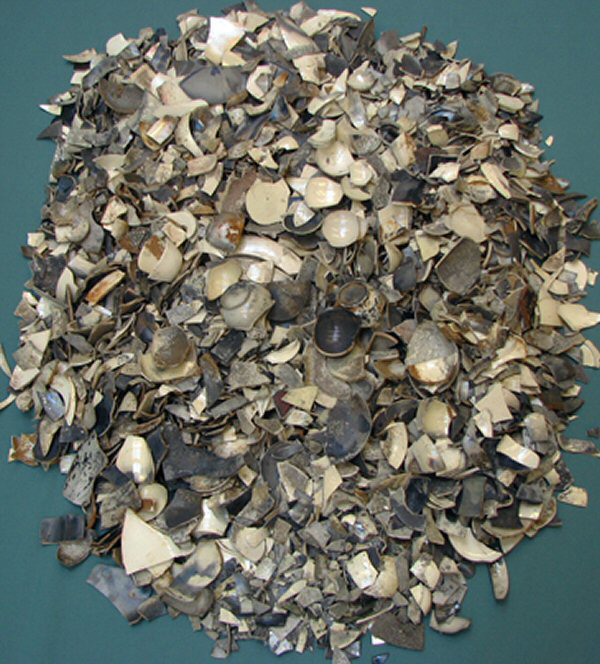
Part of an exceptionally large (c. 300kg) deposit of burnt creamware from Oulu. The deposit was confined within the remains of a log building and dates from the early nineteenth century.

The post-excavation study of finds from Tornio and Oulu is ongoing, and there are plans to undertake additional excavations in Tornio in future years. The significance of the work to date is twofold. In the first instance it provides a closely-dated corpus of artefactual and architectural material from a European setting to contrast with evidence from more well-known early seventeenth-century sites in the New World (e.g. Jamestown, founded 1607). Secondly, the examination of Oulu and Tornio, two of the most northerly towns in the seventeenth-century world, has allowed ideas of marginality to be critically re-assessed. Although it is all too easy to regard such geographically peripheral communities as being economically and culturally backward, the strategic location of these towns, at the head of two major rivers on the coast, ensured that they were fully integrated into European and global trade routes from an early date, a fact that is reflected to varying degrees in the wide range of exotic goods that were actively consumed by the townsfolk.