


Impact statement
This article explores China’s geopolitical strategy and its impact on other countries. Specifically, we argue that China leverages energy transition – particularly increased electrification – to advance its geopolitical goals. However, this strategy influences the production of critical minerals, national energy transitions and consumption patterns, creating a chain reaction in the global landscape. We demonstrate that China and other countries are interconnected through critical mineral, energy and consumption markets. China’s actions can affect individuals and companies, leading to broader economic consequences. Finally, we show that China’s exports of electric goods complement the energy matrix of other economies, facilitating their shift toward renewable and low-carbon energy sources. Consequently, China’s geopolitical ambitions may contribute to the global energy transition.
Introduction
What are the global economic and geopolitical consequences of China’s strategic dominance over both upstream and downstream segments of the global electricity supply chain? How do China’s geopolitical strategies – including military posturing and other state-led maneuvers – reinforce its leadership in the production of critical minerals and electric goods? These are the central questions addressed in this article.
A recent article in The Economist asked: “Can Australia break China’s monopoly on critical minerals?” (The Economist, 2023). Critical minerals are essential to the transition from fossil fuels to electrification. The April 2024 World Economic Forum White Paper, Energy Transition and Geopolitics: Are Critical Minerals the New Oil?, poses a similarly pressing question: “How likely is it that the clean energy transition… could replace dependence on oil with dependence on critical minerals?” (World Economic Forum, 2024, p. 4). While the White Paper offers an optimistic view – citing anticipated reductions in market manipulation (outside of China), technological advancements in mining and improvements in recycling and efficiency – it does not consider (i) China’s strategic decisions to expand its control over the electricity supply chain or (ii) the global economic and geopolitical impacts arising from this dominance. This study seeks to fill those gaps through theoretical and empirical analysis.
A dynamic differential game is constructed to model China’s dominant position and strategies. In this framework, China acts as the leader in a two-player game involving the rest of the world (ROW). Chinese geopolitical efforts influence the global supply of critical minerals, with the assumption that consumption and production of electric goods evolve intertemporally through habit formation in the ROW. This habit formation generates long-run interdependencies between critical mineral supply and demand. The model shows that geopolitical risk, mineral production and electrification are jointly essential in advancing the energy transition. Comparative statics highlight key parameter sensitivities, although the system’s nonlinear nature limits generalizability without empirical support.
Three hypotheses emerge from the theoretical model: (1) Chinese geopolitical risk influences global consumption of electrical goods, (2) it affects national energy matrices (renewables share) and (3) it alters production and pricing of critical minerals. These hypotheses are tested econometrically using a Global Vector Autoregressive (GVAR) model. By incorporating trade linkages and foreign variables, the GVAR framework captures how Chinese exports of electric goods and geopolitical risk propagate across borders, with a focus on major players like Australia and the United States. The model also accounts for China’s substantial subsidies in sectors such as electric vehicles (Kawase, Reference Kawase2023).
China’s energy strategy appears to influence global consumption patterns, critical mineral markets and the pace of renewable energy deployment. Exports of electric goods create dependencies, while China’s near-monopoly in critical minerals, especially rare earth elements, enables it to shape both supply and price. Lithium and rare earths are examined as case studies, given their centrality to national energy transitions – defined here as the share of renewables in total energy production. These transitions are increasingly shaped by Chinese policy decisions.
The econometric model uses variance decomposition to identify the primary drivers of consumption, production and transition dynamics across 12 economies (2012–2019). The model links Chinese exports, geopolitical risk, lithium and rare earth production and China’s own energy transition to changes observed in other countries’ consumption and production patterns. This allows for robust identification of spillover effects and interdependencies.
Following Blondeel et al. (Reference Blondeel, Price, Bradshwaw, Pye, Dodds, Kuzemko and Bridge2024), who argues for integrating geopolitics into energy system modeling, this article extends the literature by assessing how Chinese electric goods exports affect lithium and rare earth markets, oil prices and national energy matrices. The results suggest that rising Chinese exports lead to increased dependency among trade partners, altering both energy production structures and critical mineral outputs.
The GVAR model is uniquely suited to this task, as it estimates country-specific dynamics while allowing for international spillovers. This is particularly relevant for capturing China’s impact on oil and mineral prices, as well as on domestic energy transitions. Country-specific modeling reveals heterogeneities: China’s actions influence global consumption of electric goods and mineral production, while oil prices exert a disproportionate influence in the US case.
Critical mineral dynamics are further analyzed through two dedicated models: one focusing on Australia (lithium) and another on China (rare earths). These minerals exhibit localized effects based on each country’s strategic position in the global supply chain. For the United States, oil prices remain a key driver of its energy matrix, distinguishing it from other economies.
To aid nontechnical readers, the modeling framework is conceptually linked to global trade: countries influence one another through imports and exports. When China exports electric goods or critical minerals, the model quantifies the ripple effects on consumption, production and energy systems elsewhere. This mirrors real-world interdependencies and illustrates China’s systemic influence.
Energy transitions are increasingly central to policymaking. Scholars such as Leach (Reference Leach1992), Chang et al. (Reference Chang, Thellufsen, Zakeri, Pickering, Pfenninger, Lund and Østergaard2021) and York and Bell (Reference York and Bell2019) note that transitions rarely displace old energy forms but instead add to them. This study incorporates both legacy energy sources (e.g., oil) and emerging inputs (e.g., critical minerals), modeling their complex interactions. In doing so, the analysis contributes to debates on international cooperation and geopolitical risks, in line with Su et al. (Reference Su, Khan, Umar and Zhang2021), who argue that the energy transition may reduce geopolitical tensions.
In contrast to panel-data studies like Su et al. (Reference Su, Khan, Umar and Zhang2021) and, which offer useful insights but average effects across countries, the GVAR framework enables a disaggregated analysis. This allows for the identification of country-specific sensitivities to global shocks. Complementing Considine et al. (2023), this article disaggregates the critical mineral index, incorporates energy matrices and adds a geopolitical dimension to export policy analysis.
The study also builds on Attílio et al. (Reference Attílio, Faria and Silva2024), who found that US fossil fuel production hinders the energy transition, with China responding passively through increased electric goods exports. In contrast, this study assigns China an active role, explicitly modeling its geopolitical influence and integrating lithium and rare earth production. The concept of habit formation is used to explain how Chinese exports foster long-term dependencies.
Finally, this article responds to studies highlighting Europe’s vulnerability to mineral supply disruptions (Mateus and Martins, Reference Mateus and Martins2021; Rokicki et al., Reference Rokicki, Bórawski, Bełdycka-Bórawska, Żak and Koszela2021). While these works emphasize risks and benefits, they do not quantify how China’s strategy affects global consumption, production and transitions. This study fills that gap by showing how China’s electrification agenda generates measurable international spillovers.
Thus, there is a research gap in connecting the effects of increasing Chinese electrification on critical minerals, energy transition and consumption patterns. Additionally, there is a lack of empirical models that capture these international spillover effects. This is the gap this study addresses.
By positioning China as an active agent in the global shift to electrification, this study provides both theoretical and empirical evidence of its pivotal role in shaping the energy future. The following section presents the theoretical model. The third section details the data and methodology. The fourth section discusses the results. The last section provides the conclusions.
Theoretical model
Although our theoretical model does not yield testable hypotheses between endogenous and exogenous variables, it yields two testable behavioral hypotheses, which we test in our empirical model. We do not directly observe China’s geopolitical effort. The statistical Chinese geopolitical risk, however, is an increasing function of China’s geopolitical effort. Hence, the testable hypotheses are (see the theoretical model derivation in the appendices):
-
1) There is a positive relationship between the amount of Chinese geopolitical risk and the amount of electric goods consumed.
-
2) There is a positive relationship between the amount of Chinese geopolitical risk and the quantity of critical minerals produced. We use the quantities of lithium and rare earths to capture the influence of geopolitical risk on critical minerals.
Since there is a positive relationship between the demanded quantity of electric goods and the supply of renewable energy needed to satisfy the demand, we also test the following hypothesis:
-
3) There is a positive relationship between Chinese geopolitical risk and the fraction of renewable energy to total energy produced (i.e., the energy transition rate).
Methodology and data
Since the research goal is to evaluate the influence of China’s energy strategy on other countries, Vector Autoregressive (VAR), Vector Error Correction Model (VECM) and Structural Vector Autoregressive (SVAR) models could be considered. These models identify shocks and analyze their chain reactions. However, they primarily focus on a single economy, limiting their ability to capture spillover effects from China. Another limitation is that they do not provide individual responses for different economies, meaning they fail to account for heterogeneities.
An alternative approach is panel data analysis. Unlike the models above, panel data combines long-term temporal analysis with multiple economies. One advantage is that it enables causality analysis using instrumental variables. However, it has two limitations. First, it provides a single coefficient for the entire sample, without distinguishing how each country responds. Second, its ability to capture spillover effects is limited since it does not model the propagation of shocks across economies.
Given these considerations, the GVAR model is a more suitable choice. GVAR constructs individual models for each country, capturing their specific responses to Chinese shocks and accounting for heterogeneities. By linking these models through proxies of the external environment and bilateral trade, GVAR integrates trade dynamics, enhancing the accuracy of its estimates. This feature allows the modeler to capture spillover effects. Ultimately, GVAR enables an assessment of how global and domestic factors influence other economies, aligning with the research objective.
Equation (1) presents a VAR with foreign variables (VARX) for region i at time t with k lags.
 $$ {x}_{it}={a}_{i0}+{a}_{i1}t+{\varPhi}_i{x}_{i,t-k}+{\varLambda}_{i0}{x}_{it}^{\ast }+{\varLambda}_{i1}{x}_{i,t-k}^{\ast }+{\varepsilon}_{it}. $$
On the left side, $ {x}_{it} $
is the vector of domestic variables for region i at time t. On the right side,
$ {x}_{it} $
is the vector of domestic variables for region i at time t. On the right side, $ {a}_{i0} $
is the constant,
$ {a}_{i0} $
is the constant, $ {a}_{i1}t $
is the trend,
$ {a}_{i1}t $
is the trend, $ {x}_{i,t-k} $
is the vector of domestic variables lagged by k periods,
$ {x}_{i,t-k} $
is the vector of domestic variables lagged by k periods, $ {x}_{it}^{\ast } $
is the vector of foreign variables,
$ {x}_{it}^{\ast } $
is the vector of foreign variables, $ {x}_{i,t-k}^{\ast } $
is the vector of foreign variables lagged by k periods and
$ {x}_{i,t-k}^{\ast } $
is the vector of foreign variables lagged by k periods and $ {\varepsilon}_{it} $
is the vector of idiosyncratic shocks.
$ {\varepsilon}_{it} $
is the vector of idiosyncratic shocks.
Equation (2) shows how we construct foreign variables. We use the term $ {w}_{ij} $
, which corresponds to bilateral trade (or another proxy of economic integration) between regions i and j. In this context, the foreign variables vector,
$ {w}_{ij} $
, which corresponds to bilateral trade (or another proxy of economic integration) between regions i and j. In this context, the foreign variables vector, $ {x}_{it}^{\ast } $
, simulates the world economy and the vulnerability of region i to external shocks. Bilateral trade (or bilateral financial flow, depending on the study) plays a crucial role in establishing channels of influence among countries. Since the GVAR consists of a collection of individual VARX models, global shocks can impact countries through the linkages that connect them. In the GVAR framework, one such linkage is bilateral trade. Another interpretation of bilateral trade within this context is that it reflects mutual vulnerability between countries. Theoretically, a higher share of bilateral trade indicates greater exposure to shocks originating from the trade partner.
$ {x}_{it}^{\ast } $
, simulates the world economy and the vulnerability of region i to external shocks. Bilateral trade (or bilateral financial flow, depending on the study) plays a crucial role in establishing channels of influence among countries. Since the GVAR consists of a collection of individual VARX models, global shocks can impact countries through the linkages that connect them. In the GVAR framework, one such linkage is bilateral trade. Another interpretation of bilateral trade within this context is that it reflects mutual vulnerability between countries. Theoretically, a higher share of bilateral trade indicates greater exposure to shocks originating from the trade partner.
 $$ {x}_{it}^{\ast }=\sum \limits_{j=0}^N{w}_{ij}{x}_{jt} $$
Table 1 presents the variables, definitions and sources. We construct the energy matrix (energy) through the ratio of renewable energy production to total energy production, where total energy production includes fossil fuel production (petroleum, natural gas and coal). An increase in the energy ratio signifies an ongoing energy transition toward greener sources. The data were collected from the US Energy Information Administration (EIA) via the International Portal.
Variables and sources

We represent Chinese exports of electrical goods to the world using sections 778.1 and 716 of the United Nations Commodity Trade Statistics Database (UN Comtrade, SITC). These goods incorporate relevant components and materials for the energy transition, such as batteries. We transformed this time series into an index (2007 = 100) and deflated it using the Chinese Consumer price index (CPI). The imports from China adopt the same definition, incorporating relevant electrical components. Finally, we sourced oil prices from the Primary Commodity Prices of the International Monetary Fund (IMF) and deflated the oil price using the US CPI.
Figure 1 illustrates the Chinese exports of electric goods to the global economy. The exports have shown a gradual increase over the years, with a notable acceleration since 2020.
Chinese exports of electric goods.
Note: Nominal values are shown on the left axis, while the right axis displays the index of real Chinese exports of electric goods.

Figure 2 displays the imports of electrical goods from China by Argentina (ARG), Australia (AUS), Brazil (BRA), Chile (CHL), India (IND), Malaysia (MAL), Portugal (PRT), Russia (RUS), Thailand (THA), the United States, Vietnam (VIT) and Zimbabwe (ZIM). Similar to Figure 1, the imports showed a gradual increase over time, reaching a peak in the last few years.
Imports of electric goods from China (in US dollars).

Our investigation employs three models covering the period from July 2012 to December 2019. We initiated the analysis in 2012M7 due to the time series on lithium and rare earth prices. The analysis concludes in 2019M12 to align with the availability of time series on lithium and rare earth production. Recognizing the potential challenge of a limited number of observations, we applied the Denton procedure to convert the frequency of variables from annual to monthly, resulting in 90 observations for each variable.
Our sample consists of 12 economies: ARG, AUS, BRA, CHL, CHN, IND, MAL, PRT, RUS, THA, the United States and ZIM. The selection of these economies was based on data availability regarding lithium and rare earth production. We conducted seasonal adjustments for lithium, rare earth and oil prices. Additionally, we aggregated ARG, BRA, CHL, IND, MAL, PRT, RUS, THA and ZIM to form a region labeled REST. This aggregation enables us to focus the analysis on Australia, a country with an almost monopolistic position in lithium production, China (which holds a dominant position in rare earth production), and the United States. Furthermore, by reducing the number of regions, the estimation of the model is facilitated.
Equation (3) presents the vectors of Model 1:
 $$ {\displaystyle \begin{array}{c}{x}_{it}=\left({imp}_{it},{gpr}_{it},{energy}_{it}\right)\\ {}{x}_{it}^{\ast }=\left({energy}_{it}^{\ast },{china}_{it}^{\ast },{plit}_{it}^{\ast },{prare}_{it}^{\ast },{oil}_{it}^{\ast}\right),\mathrm{for}\ \mathrm{REST}\\ {}{x}_{it}=\left({gpr}_{it,}{energy}_{it},{china}_{it},{prare}_{it}\right)\\ {}{x}_{it}^{\ast }=\left({energy}_{it}^{\ast },{plit}_{it}^{\ast },{oil}_{it}^{\ast}\right),\mathrm{for}\ \mathrm{China}\\ {}{x}_{it}=\left({imp}_{it},{gpr}_{it,}{energy}_{it},{plit}_{it}\right)\\ {}{x}_{it}^{\ast }=\left({energy}_{it}^{\ast },{china}_{it}^{\ast },{prare}_{it}^{\ast },{oil}_{it}^{\ast}\right),\mathrm{for}\ \mathrm{Australia}\\ {}{x}_{it}=\left({imp}_{it},{gpr}_{it},{energy}_{it},{oil}_{it}\right)\\ {}{x}_{it}^{\ast }=\left({energy}_{it}^{\ast },{china}_{it}^{\ast },{plit}_{it}^{\ast },{prare}_{it}^{\ast}\right),\mathrm{for}\ \mathrm{the}\;\mathrm{U}.\mathrm{S}.\end{array}} $$
The terms imp, gpr, energy, china, plit, prare and oil denote imports of electric goods from China, geopolitical risk, energy matrix, Chinese exports of electrical goods, lithium prices, rare earth prices and oil prices.
We adapt the model to the key characteristics of the sample economies. The variable prare is included as a domestic variable in the Chinese model because of its prominence in rare earth production (see Figure 3). Similarly, for Australia, we included plit as a domestic variable due to its almost monopolistic position in lithium production (see Figure 4). For the United States, we followed studies that treat the oil price as a domestic variable in their model (Dees et al., Reference Dees, Mauro, Pesaran and Smith2007). We treated the energy matrix as a foreign variable in all models to capture the influence of the world energy matrix on the domestic equilibrium of economies. Finally, we treat Chinese exports (china) as a domestic variable in the Chinese model, a configuration we adopt in all models.
Rare earth production (in tons).

Lithium production (in tons).

Model 2 focuses on the lithium market. Equation (4) shows the vectors of this model:
 $$ {\displaystyle \begin{array}{c}{x}_{it}=\left({lithium}_{it},{gpr}_{it},{energy}_{it}\right)\\ {}{x}_{it}^{\ast }=\left({energy}_{it}^{\ast },{china}_{it}^{\ast },{plit}_{it}^{\ast },{oil}_{it}^{\ast}\right),\mathrm{for}\ \mathrm{REST}\\ {}{x}_{it}=\left({lithium}_{it},{gpr}_{it},{energy}_{it},{china}_{it}\right)\\ {}{x}_{it}^{\ast }=\left({energy}_{it}^{\ast },{plit}_{it}^{\ast },{oil}_{it}^{\ast}\right),\mathrm{for}\ \mathrm{China}\\ {}{x}_{it}=\left({lithium}_{it},{gpr}_{it},{energy}_{it},{plit}_{it}\right)\\ {}{x}_{it}^{\ast }=\left({energy}_{it}^{\ast },{china}_{it}^{\ast },{oil}_{it}^{\ast}\right),\mathrm{for}\ \mathrm{Australia}\\ {}{x}_{it}=\left({lithium}_{it},{gpr}_{it},{energy}_{it},{oil}_{it}\right)\\ {}{x}_{it}^{\ast }=\left({energy}_{it}^{\ast },{china}_{it}^{\ast },{plit}_{it}^{\ast}\right),\mathrm{for}\ \mathrm{the}\;\mathrm{U}.\mathrm{S}.\end{array}} $$
The main difference between Models 1 and 2 is that we replace the variable imports (imp) for lithium production (lithium) and exclude the variable rare earth price (prare). Figure 4 shows the world’s production of lithium, where Australia is the largest producer.
While Figure 4 presents the data used in the empirical model, Figure 5 displays projections for lithium production through 2030. As shown, lithium production is expected to rise steadily over the coming years. This suggests that the upward trend observed in Figure 4 is likely to persist, assuming the projections prove accurate.
Lithium production (projections).
Source: Mining Technology. https://www.mining-technology.com/analyst-comment/global-lithium-production-rise-cagr/?utm_source=chatgpt.com&cf-view&cf-closed.

Model 3 analyzes the rare earth market. Equation (5) presents the vectors:
 $$ {\displaystyle \begin{array}{c}{x}_{it}=\left({rare}_{it},{gpr}_{it},{energy}_{it}\right)\\ {}{x}_{it}^{\ast }=\left({energy}_{it}^{\ast },{china}_{it}^{\ast },{prare}_{it}^{\ast },{oil}_{it}^{\ast}\right),\mathrm{for}\ \mathrm{REST}\ \mathrm{and}\ \mathrm{Australia}\\ {}{x}_{it}=\left({rare}_{it},{gpr}_{it},{energy}_{it},{china}_{it},{prare}_{it}^{\ast}\right)\\ {}{x}_{it}^{\ast }=\left({energy}_{it}^{\ast },{prare}_{it}^{\ast },{oil}_{it}^{\ast}\right),\mathrm{for}\ \mathrm{China}\\ {}{x}_{it}=\left({rare}_{it},{gpr}_{it},{energy}_{it},{oil}_{it}\right)\\ {}{x}_{it}^{\ast }=\left({energy}_{it}^{\ast },{china}_{it}^{\ast },{prare}_{it}^{\ast}\right),\mathrm{for}\ \mathrm{the}\;\mathrm{U}.\mathrm{S}.\end{array}} $$
The differences between Models 2 and 3 are as follows. We replace the variables lithium production (lithium) with rare earth production (rare) and lithium price (plit) with rare earth price (prare). The models for Australia and REST are similar. We include rare earth prices in the Chinese model as a domestic variable due to its almost monopolistic position (see Figure 3). In Figure 3, China is the major producer of rare earth, followed by the United States and Australia.
Figure 6 displays the time series of lithium and rare earth real prices. Since 2016, lithium prices have risen to a higher level than in the initial months, while rare earth prices have declined over time. Both prices surged after the coronavirus disease 2019 (COVID-19) pandemic: lithium prices reached 224 thousand dollars, and rare earth prices reached 5 thousand dollars in 2023M5. However, our model does not encompass these periods due to the considerations we made (see Figure A1 in the Appendix, where Figure 6 is extended to 2023M4. As observed, the increase in lithium and rare earth prices is so large that the previous data lost significance on the figure’s scale. Another potential issue is that such an increase could bias the estimates of the empirical model). One advantage of excluding the post-COVID-19 period is to avoid structural breaks in the time series. The linear correlation between lithium and rare earth prices from 2012M6 to 2019M12 is -0.46 (and 0.95 between 2012M6 and 2023M5).
Lithium and rare earth real prices (in US Dollars).
Note: Lithium prices are on the left axis, and rare earth prices are on the right axis.

Thus, besides the availability of lithium and rare earth production data, another reason for ending the period before major global events – such as COVID-19, supply chain disruptions and the Russia–Ukraine conflict – is that these events (which we refer to as shocks) could potentially bias the results and create estimation issues. As observed in Figure A1 in the Appendix, the sharp increase in lithium and rare earth prices during these shocks is so significant that, given the limited number of observations, the model would likely produce unreliable estimates.
One advantage of analyzing data before these events is that we can argue our results are not influenced or distorted by global shocks. In this sense, the period under examination remains relatively “pure” or “clean” from the effects of such disruptions.
We employ two tools to enhance our analysis. The first is the Generalized Impulse Response Function (GIRF), which illustrates how all regions respond to a local shock. In our case, we examine how regions react to a shock in Chinese exports. Consequently, GIRFs suggest potential transmission channels of shocks and indicate spillover effects. However, GIRFs do not identify the sources of shocks. The primary advantage of the GIRF is that it captures how the entire system of economies and variables responds to a shock. We calculate 90% confidence intervals for the GIRFs using bootstrap, where the shocks correspond to 1 standard deviation.
To better understand the dissemination of Chinese shocks, we use the Generalized Forecast Error Variance Decomposition (GFEVD). The GFEVD reveals the influence of domestic and external factors in explaining the future values of a given variable. Consequently, it provides a quantitative measure of the spillover effects of the Chinese economy on domestic regions by illustrating China’s influence on other economies. We normalize each row of the GFEVD to sum to 100%.
One limitation of the GVAR is that the GIRF does not identify shocks, which may hinder the interpretation of their effects. However, we mitigate this issue by using the GFEVD, which allows us to focus on the influence of Chinese variables. In this regard, the GFEVD helps identify the channels through which China affects other economies. Another potential limitation is the risk of overfitting when incorporating multiple variables to represent China’s global influence and its impact on other countries. To address this, we summarize these dynamics using the Geopolitical risk (GPR) variable, which captures key aspects of strategic actions taken by countries.
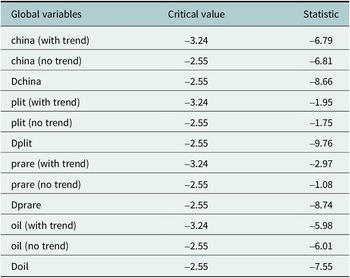
In the appendices, Tables A5–A7 present unit root tests for domestic, foreign and global variables. Most variables exhibit stationarity in first differences but are nonstationary in levels. Table A8 displays the lags of the VARXs in the three models and the number of cointegrating relationships. Since Models 1–3 demonstrate nonstationarity in levels and cointegrating relationships, we adopt the GVAR in the error correction form (see Pesaran et al., 2004). Table A9 indicates that the weak-exogeneity test only rejects a few variables, supporting the configuration described in Equations (3)–(5).
Results
Habit formation and persistence
In this section, we explore how the exports of electrical goods from China affect the electrical imports of Australia, REST and the United States. Figure 7 presents the responses of imports to a positive shock in Chinese exports.
GIRF of a Chinese export shock and responses of imports.
Note: The dashed lines represent the confidence intervals, while the solid lines indicate the average estimates. The vertical axis shows import values, and the horizontal axis represents time periods. Estimates are statistically significant only when both dashed lines (confidence intervals) lie within the same quadrant.

We find that Chinese exports impact the imports of Australia. The responses from REST and the United States are statistically nonsignificant, as the estimates fall within the middle of the confidence intervals, encompassing positive and negative areas. Australian imports increased in response to the shock.
Another tool to capture the influence of China’s electric exports is the GFEVD, which decomposes the values of imports (Table 2). Table 2 shows that, in the first period, Australian imports are explained as follows: 76% by itself, 0.05% by the energy matrix and 12% by Australian GPR. These are the domestic factors affecting the imports of Australia. The second block in Table 2 measures the Chinese influence. Chinese GPR affects Australian imports by 0.3%, while Chinese exports impact imports by 7%. The third block shows the influence of international prices. Lithium prices affect imports by 1%, rare earth prices by 0.9% and oil prices by 0.4%. These values change over time. Of particular interest is that, in the last period, Chinese geopolitical risk affects the consumption of electric goods in Australia by 6%, and Chinese exports affect Australian imports by 31%. Consequently, our model shows that China affects Australian consumption through geopolitical risk and exports of electric goods.
GFEVD of imports

We captured the influence of Chinese GPR and exports on the ROW and the United States, although the values are lower than in the Australian case. Hence, these results validate the first hypothesis from the theoretical model, which affirms that Chinese geopolitical risk affects the consumption of electric goods. Furthermore, we also demonstrated that Chinese exports of electric goods provoke changes in the consumption patterns of other economies. While analysts and policymakers typically seek to influence consumer behavior through financial incentives, such as tax breaks, our findings highlight an alternative driver: external influences. Our results demonstrate that by exporting electric components, China can contribute to shifts in consumption patterns, steering demand toward renewable and low-carbon energy goods.
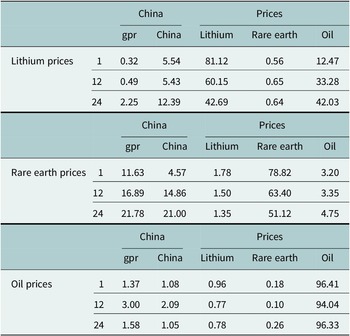
Table 3 presents the GFEVD of lithium prices, rare earth prices and oil prices. In each panel, we display the variance decomposition of a specific price. For instance, the first part illustrates the influence of variables on the future values of lithium prices. In the last period, Chinese exports impacted lithium prices at 12%, rare earth prices at 21% and oil prices at 1%. Chinese geopolitical risk affects lithium prices by 2%, rare earth prices by 21% and oil prices by 1%. Chinese exports and geopolitical risk have a higher influence on rare earth prices, reinforcing China’s dominant position in this market. Since Table 2 demonstrates that these prices affect domestic imports, and now that we observe that Chinese exports and geopolitical risk influence these prices, we can connect Tables 2 and 3 and argue that, indirectly, Chinese exports and GPR affect domestic imports by influencing the prices of critical minerals.
GFEVD of lithium, rare earth and oil prices

One possible rationale for these results is that economies import electric goods from China to advance and facilitate their transition to clean energy. However, as these transactions commence, there is a subsequent increase in dependence on Chinese electric goods. Given that the energy transition requires an escalating utilization of critical minerals and electric components (Islam et al., Reference Islam, Sohag and Alam2022; Zhu et al., Reference Zhu, Ding and Chen2022), economies procure these materials from China. In response, China strategically invests in these markets to enhance its global position and influence (Wang et al., Reference Wang, Zhang and Li2024).
Dong et al. (Reference Dong, Ren and Zhao2021) showed that the structure of the energy transition in China affects its energy poverty, and Wang et al. (Reference Wang, Tang, Du and Song2020) demonstrated that Chinese trade impacts pollution in other economies. Our results follow the same vein: Chinese exports of electrical goods provoke changes in other economies. Similar to Wang et al. (Reference Wang, Tang, Du and Song2020), we captured the spillover effects of Chinese exports.
Regarding the influence of Chinese geopolitical risk, the estimates suggest that Chinese geopolitical efforts impact the markets for critical minerals, oil prices and imports from other regions. Since the Chinese GPR is constructed based on China’s actions in areas such as war threats and military buildup, the results indicate connections between these actions and changes in international consumption and prices. The geopolitical tensions caused by China lead to changes in other markets and countries, as other nations observe and respond to Chinese movements. In essence, we demonstrate that the Chinese geopolitical component affects other countries. This finding extends to other areas, such as energy transition and the production of critical minerals, as we demonstrate throughout the article. Further evidence of the impact of the Chinese GPR is presented in Figure 8, which shows the effects of a shock on the Chinese GPR and the responses of energy matrices, national GPRs and global prices.
GIRF of a Chinese GPR shock and responses of energy matrices, GPR and global prices.
Note: The dashed lines represent the confidence intervals, while the solid lines indicate the average estimates. The first part of the figure displays energy values (vertical axis), the second part presents GPR values (vertical axis) and the third part shows lithium prices, rare earth prices and oil prices (vertical axis). These estimates represent the forecast for the variables over 24 months (horizontal axis).

Figure 8 shows that an increase in Chinese geopolitical risk corresponds to a reduction in Australia’s energy transition and an increase in the US energy transition. The second part of Figure 8 indicates that all geopolitical risks increase as a result of the Chinese GPR shock. Regarding global prices, the final part of Figure 8 illustrates that rare earth prices rise while oil prices decline. As discussed, China influences other regions through its geopolitical risk. The responses of these regions to higher Chinese GPR extend to various aspects of their economies, including energy transitions and the production of critical minerals. We argue that Chinese GPR has both direct and indirect effects on economies. These avenues of Chinese influence are explored further in the remainder of the article.
Lithium model
We adopt the lithium model to analyze the impact of Chinese exports of electrical goods on domestic lithium production, energy matrices, lithium price and oil price. Figure 9 presents the Chinese shock and the responses of Australia, China, REST and the United States.
GIRF of a Chinese export shock (lithium model).
Note: The dashed lines represent the confidence intervals, while the solid lines indicate the average estimates. The first part of the figure displays production values (vertical axis), the second part presents energy values (vertical axis) and the third part shows lithium and oil prices (vertical axis). These estimates represent the forecast for the variables over 24 months (horizontal axis).

In China, there is a rapid increase and subsequent decrease in lithium production, but it loses statistical significance. In Australia, the REST and the United States, the estimates fail to reach statistical significance. China exhibits a similar pattern in its energy matrix, with fluctuations at the beginning of the shock. While lithium prices increase, the oil price remains statistically nonsignificant.
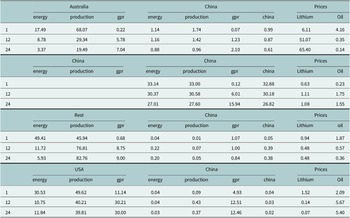
Tables 4–6 present the GFEVD of lithium production, energy matrices and GPR, respectively. In each table, we analyze Chinese influence in four spheres: energy matrix (energy), lithium production (production), GPR and exports of electrical goods (exports). Table 4 shows that Chinese geopolitical risk affects domestic lithium production by 2% in Australia, 0.8% in other regions and 12% in the United States in the last period. The significant influence of Chinese geopolitical risk on the United States is a consistent finding across all tables. In Table 5, which presents the variance decomposition of the energy matrices, Chinese geopolitical risk affects all regions, particularly the United States, by 18% in the last period. Table 6 presents the GFEVD of domestic geopolitical risk. Again, the estimates reflect the influence of Chinese geopolitical risk across all regions. Chinese exports of electric goods had a minor influence on all tables.
GFEVD of lithium production

GFEVD of energy matrices

GFEVD of geopolitical risk

These results suggest that Chinese exports and GPR affect lithium production and energy transition. We can hypothesize that China uses lithium in the production of its electric goods, subsequently exporting these final products. Other economies, such as Australia, may use Chinese goods to complement their domestic supply of electric materials. These interactions can lead to changes in lithium prices (see Figure 9). Shao and Jin (Reference Shao and Jin2020) and Qiao et al. (Reference Qiao, Wang, Gao, Wen and Dai2021) demonstrated that changes in demand influence lithium supply. Our results reinforce this finding by indicating that Chinese exports induce changes in lithium production and prices.
These results imply the existence of potential geopolitical tensions involving energy transition and the production of critical minerals due to the increasing Chinese exports of electric goods. Islam et al. (Reference Islam, Sohag and Alam2022) and Su et al. (Reference Su, Shao, Jia, Nepal, Umar and Qin2023) show that the demand for lithium can lead to changes in the energy transition process. Our estimates support this conclusion, demonstrating that China can influence the production and prices of lithium, thereby causing subsequent changes in energy transition.
These results validate hypotheses 2 and 3 from the theoretical model. We found that Chinese geopolitical risk affects the production of renewable energy and lithium. Tables 4 and 5 also highlight indirect channels of influence between the Chinese GPR and renewable energy. For example, Table 4 shows that domestic energy matrices affect the domestic production of lithium, and Table 5 demonstrates that Chinese GPR affects the energy matrices of economies. By connecting Tables 4 and 5, we can argue that, indirectly, Chinese GPR affects the domestic production of lithium by causing changes in domestic energy matrices. Similarly, this reasoning could indicate indirect channels between Chinese GPR and domestic energy matrices.
Rare earth model
A similar analysis is conducted using rare earth elements instead of lithium. The results of the rare earth model are presented in the Appendix, in Figure A2 and Tables A1–A3. As with the lithium model, the analysis confirms the hypotheses proposed in the theoretical model. Hypotheses 2 and 3 were validated, as the empirical model shows that Chinese geopolitical risk affects both renewable energy and rare earth production.
Discussion of the results
The starting point of this investigation is that China is seeking global leadership through increasing electrification. To achieve this, China influences consumption, the production of critical minerals and the energy transition of other countries. The evidence described in this article establishes linkages between China and other nations, especially through the geopolitical risk channel.
As documented by Attílio et al. (Reference Attílio, Faria and Silva2024), the Chinese economy may influence critical mineral markets through its exports of electric goods in response to US fossil fuel production. A limitation of their study, however, is that China is assigned only a passive role. The present investigation extends this perspective by incorporating at least four additional channels through which China affects critical mineral markets: (i) the energy transition, (ii) the production of critical minerals, (iii) geopolitical risk (capturing China’s geopolitical movements) and (iv) habit formation.
Individuals consume different goods throughout their lives. The empirical model shows that as China increases its exports of electric goods, individuals absorb part of this production. Thus, China’s exports of electric goods serve as a channel for changing consumption patterns in other economies. This flow of goods is beneficial, as it complements domestic supply and expands consumers’ consumption baskets. The rationale is that China is supporting other countries in their energy transition by influencing demand, given that the consumption of electric components is associated with renewable and low-carbon energy.
The other two channels are related to the supply side. China’s production of critical minerals impacts both the global energy transition and the worldwide supply of these minerals. As a major producer, China holds an almost monopolistic position in certain markets, such as rare earth elements. This dominance allows China to exert direct control over both prices and production levels. Typically, a monopoly influences the entire global economy through its actions, and the empirical model captured this effect in the rare earth and lithium markets.
China’s production of these minerals can affect other countries in different ways. One possibility is through direct exports. Another is the geopolitical dimension—where the mere perception of China’s dominance in these markets triggers reactions from other nations. By advancing its global position through electrification, China’s critical mineral production may be seen as a strategic move in this direction.
Laurenceson (Reference Laurenceson2025) showed that Australia is responding to China’s dominance in certain critical minerals. The Australian government has been implementing policies aimed at strengthening economic security and upgrading its industrial sector. A component of this strategy is restricting China’s participation in these markets. While the study advocates for co-participation in the exploration of critical minerals, it ultimately underscores the tensions that characterize these markets.
The definition of energy transition used in this study focuses solely on the supply side. Thus, China indirectly influences the global energy transition by exporting electric goods and increasing its production of critical minerals. Countries may import these inputs from China to support their own energy transition efforts.
Dou et al. (Reference Dou, Xu, Zhu and Keenan2023) and Attílio (Reference Attílio2025) demonstrated the importance of critical minerals for the energy transition. Both studies found that the pace of the transition is constrained by the availability of these resources, underscoring the close link between critical mineral production and progress in clean energy. The empirical model further confirmed these connections, showing that China exerts significant influence on the energy transition through its position in the rare earth and lithium markets. In this sense, the present article reinforces the geopolitical dimension of the relationship between critical minerals and the energy transition.
As discussed in the conclusion, our findings strongly support trade integration and the flow of goods between nations. Countries can import critical minerals from China to produce renewable and low-carbon energy. Alternatively, they may import electric goods to shift consumption patterns toward clean energy. In both cases, China facilitates the energy transition through trade.
Zheng et al. (Reference Zheng, Zhou, Tan, Liu, Hu and Yuan2023), Srivastava (Reference Srivastava2023) and Stepanov et al. (Reference Stepanov, Teschner, Zemah-Shamir and Parag2024) highlighted the importance of trade for the energy transition. Given the scarcity of critical minerals, international trade can play a key role in accelerating the transition and preventing bottlenecks in clean energy production. This article contributes to this discussion by proposing a policy response: trade integration with China, aimed at expanding the flows of renewable goods and critical minerals.
Trade integration with China, however, may be difficult to implement due to geopolitics, protectionism and diplomatic constraints. For instance, tariff wars can disrupt and reduce the flow of electric goods between China and other countries, which subsequently lowers production and exchange of critical minerals, weakening progress in the global energy transition.
Conclusion
Regarding the limitations, this article points to two main directions for future research. The first concerns the implied heterogeneity within the REST group created in the empirical model. This group combines countries from different continents, each with particular characteristics. Future studies could investigate these countries individually to obtain more detailed insights.
The second limitation is the macroeconomic approach adopted here. While this perspective is useful for analyzing global patterns and trends, it neglects microeconomic factors at the firm and individual levels. Companies, in particular, respond to changes in the Chinese economy, and incorporating these responses could enrich and complement our findings.
This article makes two main contributions to the literature. First, it provides a differential game to capture China’s dominant position and its strategies in the upstream and downstream electricity supply chain. Second, we estimate important global impacts caused by China’s actions, both economic and geopolitical ones. For example, our article considers the impacts caused by China’s significant control of exports of electric goods and China’s geopolitical risk on domestic energy transitions, critical mineral production and prices, and oil prices. The theoretical model yields testable hypotheses, which are verified in the empirical model.
We contribute to the literature by establishing connections between Chinese exports and geopolitical risk, critical minerals and the energy transition within a system of open economies. In doing so, we capture the spillover effects of the Chinese economy on the international energy transition. In terms of critical minerals, we focus on impacts on lithium and rare earth prices. We analyze lithium and rare earth production; however, future work should also consider other critical minerals, such as graphite, cobalt and nickel. Our findings demonstrate that there is a greater Chinese influence in the rare earth market than in the lithium market. As explorations of other critical minerals evolve around the world, China’s dominant position in the upstream supply chain will tend to reduce. The diversification of the upstream supply chain is a process that the world should welcome and provide significant policy incentives for. As the White Paper discussed in the introduction proposes, there should also be policies targeted to increase the critical minerals’ utilization efficiency and recycling.
China influences national policies through its geopolitical risk. In other words, as countries perceive Chinese actions on the geopolitical stage, they respond accordingly. The increase in national GPRs in response to the Chinese GPR indicates co-movements among them, reflecting close relationships. In practical terms, China can exert influence on other countries through its energy policies. We argue that GPR is one channel through which China impacts the world energy transition. Therefore, our results indicate that China plays a leading (or prominent) role in the world energy transition. Our point is that China can influence the energy transition trajectory of other countries through its GPR.
Zhang et al. (Reference Zhang, Shinwari, Zhao and Dagestani2023) and Yang et al. (Reference Yang, Xia and Qian2023) argued that geopolitics is an inherent component of the energy transition. Our findings, which link Chinese geopolitical movements to fluctuations in both the energy transition and critical mineral markets, reinforce this perspective. In this sense, the energy transition must also be understood as a geopolitical process.
In addition to the economic implications, our results suggest the potential for geopolitical tensions among Australia, China and the United States. Given the significance of critical minerals, these economies and others may formulate national policies to ensure incentives for increased exploration of these minerals. As history has shown with oil conflicts (Yergin, Reference Yergin2011), armed disputes can emerge from differences among nations. Therefore, our article serves as a cautionary call regarding the potential for geopolitical conflicts.
Our results suggest that international cooperation is the most effective way to prevent geopolitical conflicts and tensions. One form of cooperation is increasing trade flows between partner countries. In the context of the energy transition, facilitating the exchange of lithium and rare earth elements could accelerate national energy transitions. Additionally, as economic theory suggests, greater trade integration leads to higher production and lower prices. A higher flow of critical minerals would increase their availability and reduce costs. Policies to promote international cooperation include reducing tariffs, establishing multilateral agreements and eliminating bureaucratic barriers to the export and import of critical minerals.
Hainsch et al. (Reference Hainsch, Löffler, Burandt, Auer, Del Granado, Pisciella and Zwickl-Bernhard2022) and Kilinc-Ata and Proskuryakova (Reference Kilinc-Ata and Proskuryakova2024) discussed a range of policies to advance the energy transition. Building on this debate, our conclusion that increasing trade with China facilitates the energy transition adds a new dimension to the policy discussion. As emphasized in economics, international trade tends to lower prices and increase production. Applied to critical minerals, this implies greater availability and reduced costs of acquisition, both of which can accelerate the energy transition.
Since Chinese geopolitical risk is closely linked to broader global uncertainties, there is a scenario in which China’s energy strategy could heighten economic instability. One way to mitigate this risk is to align China’s energy strategy with the global push for energy transitions, framing China’s geopolitical efforts as beneficial for other nations. Once again, trade cooperation emerges as a key solution, as countries can benefit from China’s electric goods and critical minerals.
A more pessimistic scenario is one where China achieves a monopolistic position in critical mineral markets and uses it to extract economic rents – either by raising prices or restricting supply. In this case, China’s geopolitical ambitions could materialize at the expense of other nations, slowing down their energy transitions due to limited access to critical minerals. However, proactive policies could help prevent this outcome by fostering collaboration rather than confrontation. Treating China as a strategic partner in the global energy transition, rather than as an adversary, would be more effective. Consequently, trade wars and retaliatory measures – such as restrictions on Chinese electric vehicles – should be avoided. Enhancing trade integration remains the best path forward.
Finally, as anticipated in the previous section, geopolitics may hinder the design of policies aimed at increasing critical mineral production, expanding trade flows and accelerating the global energy transition. Geopolitical concerns can give rise to policies that work against these objectives. For example, trade wars and national energy security strategies may disrupt trade integration, thereby reducing both the exchange and availability of critical minerals.
Open peer review
To view the open peer review materials for this article, please visit https://doi.org/10.1017/etr.2025.10005.
Supplementary material
The supplementary material for this article can be found at httpx://doi.org/10.1017/etr.2025.10005.
Author contribution
Luccas Assis Attílio: Data collection; methodology; software; writing; investigation. João Ricardo Faria: Writing; investigation; theoretical model. Emilson Silva: Writing; investigation; theoretical model.
Competing interests
The authors declare none.
Appendix
Lithium and rare earth real prices (including Covid-19 period).

GIRF of a Chinese export shock (rare earth model).
Note: The dashed lines represent the confidence intervals, while the solid lines indicate the average estimates. The first part of the figure displays production values (vertical axis), the second part presents energy values (vertical axis) and the third part shows rare earth and oil prices (vertical axis). These estimates represent the forecast for the variables over 24 months (horizontal axis).

GFEVD of rare earth production

GFEVD of energy matrices

GFEVD of GPR

Descriptive statistics

Unit root test (weighted symmetric) for domestic variables at 5% of statistical significance

Unit root test (weighted symmetric) for foreign variables at 5% of statistical significance

Unit root test (weighted symmetric) for global variables at 5% of statistical significance

VARX order and number of cointegrating relationships

Weak exogeneity test at 5% of statistical significance








 Open access


Comments
No accompanying comment.