Puzzle
Mexico transitioned from authoritarian rule to democracy in 2000, after seven decades of one-party rule. Six years later, much to the surprise of the international community, Mexico experienced waves of large-scale criminal violence that turned the country into one of the world’s deadliest democracies. Large-scale violence broke out when the federal government declared war on the country’s largest drug cartels and deployed the armed forces to seize their leaders and recover control over subnational territories, triggering multiple and protracted inter-cartel wars (Calderón et al. Reference Calderón, Robles, Díaz-Cayeros and Magaloni2015; Flores-Macías Reference Flores-Macías2018). Between 2006 and 2018, the homicide rate dramatically increased from 9 to 29 murders per 100,000 people, and state–cartel and inter-cartel wars resulted in 150,000 murders. This death toll is seven times greater than the median death count of all civil wars in the second half of the twentieth century (N = 19,000) (Trejo and Ley Reference Trejo and Ley2020). Beyond homicides, criminal wars in Mexico have produced various forms of violence, victimization, and gross human rights violations. By 2018, over 60,000 people had disappeared (RNPDNO 2020), more than 350,000 had been internally displaced (CMDPDH 2019), and hundreds of mayors, local party candidates, journalists, human rights defenders, social leaders, Catholic clergy, and businesspeople had been murdered.Footnote 1 In 2019, the Mexican government acknowledged the existence of over 3,000 clandestine mass graves containing thousands of unidentified corpses (Guillén, Torres, and Turati Reference Guillén, Torres and Turati2018; Sheridan Reference Sheridan2019). Mexico’s transition from one-party rule to multiparty democracy, in other words, has not ushered in a period of peaceful political renewal but instead unfolded alongside a surge in systemic violence – challenging the assumption that democratization inevitably promotes peace and stability.
Peru transitioned from authoritarian rule to democracy in 2000, after a decade under the tight grip of Alberto Fujimori’s elected autocracy and following a long history of intermittent military rule throughout the twentieth century. Contrary to the gloomy prognoses of many international observers, the Peruvian transition did not lead to the large-scale criminal violence and criminal wars that Mexico experienced. During the first two decades of democratic rule, Peru’s homicide rate ranged between 3 and 11 murders per 100,000 people. While robbery and other forms of ordinary crime are widespread in Peru, today’s high levels of lethal violence in Mexico belong to Peru’s past. The two-decade civil war (1980–2000) between the Shining Path (and other smaller rebel groups) and the Peruvian state resulted in 70,000 murders, over 22,000 forced disappearances, and more than 15,000 bodies buried in 4,000 clandestine mass graves (CVR 2003; González Reference González, Roht-Arriaza and Mariezcurrena2006). After 2000, however, Peru recorded murder rates similar to those of countries like Lithuania and Uruguay; more significantly, the gross and widespread human rights violations that were part of Peru’s recent history – and remain an everyday reality in post-authoritarian Mexico – are exceptionally rare. More than two decades of democratic rule has shown that Peru’s pathway from personalistic dictatorship to democracy has been surprisingly peaceful, despite one recent, unusually repressive, episode.Footnote 2
Peru’s low levels of criminal violence and relatively peaceful development in its first two decades of democracy are particularly puzzling. The country is the world’s second-largest producer of coca leaf – the main input for the production of cocaine, one of the most in-demand illicit drugs (Muse Reference Muse2020). It is a relatively poor and unequal society, where the state has a weak and uneven presence across subnational regions. The country also has a long history of military dictatorship and political instability, including coups and civil war. In the 1990s, under Fujimori’s rule, Peru’s chief of secret service – working with high-ranking members of the military and death squads – ended a decade-long civil war through a brutal counterinsurgency campaign. The concerted resistance of rural Indigenous communities decisively contributed to the Shining Path’s defeat (Starn Reference Starn1999; González Reference González, Roht-Arriaza and Mariezcurrena2006). After the incarceration of the Shining Path leadership, the civilian and military leaders of the civil war’s security apparatus used their unique access to information and weapons – and their guaranteed impunity under a blanket amnesty law – to partner with Pablo Escobar and the Medellín Cartel, becoming deeply involved in the transshipment of cocaine from the Andes into Panama and eventually into the United States and Western Europe (Burt Reference Burt2009). Given this context, most theories of crime and criminal violence would have predicted post-authoritarian Peru to exhibit levels of violence on par with – or exceeding – Mexico’s. Yet after democratization, Peru entered a trajectory of relatively peaceful development.
The contrasting post-authoritarian trajectories of Mexico and Peru are not isolated or unusual cases; they are, in fact, representative of broader trends among Third Wave democracies – countries that transitioned from authoritarian rule to democracy between 1974 and 2005. As scholars of crime in new democracies have noted (Arias and Goldstein Reference Arias and Goldstein2010; Cruz Reference Cruz2011; Yashar Reference Yashar2018; Trejo and Ley Reference Trejo and Ley2020), one of the most significant developments in the wave of democratization that swept the world in the last quarter of the twentieth century is that a number of new democracies now experience uncommonly high levels of criminal violence and intense criminal wars – like Mexico – while others have undergone relatively peaceful transitions – like Peru.
Homicide rates provide a useful metric for grouping Third Wave democracies by levels of violence. We distinguish three clusters: (1) countries facing manageable violent crime; (2) those facing epidemics of criminal violence; and (3) those experiencing criminal wars and large-scale violence. The United Nations (UN) uses a threshold of 10 murders per 100,000 people to differentiate countries with manageable levels of violent crime (below 10; e.g., Peru) from those experiencing epidemics of criminal violence (above 10; e.g., Panama) (UNODC 2014). In Latin America – where the mean homicide rate in the first decade of the twenty-first century was 17 murders per 100,000 – countries with homicide rates above 20 (e.g., Mexico) are typically trapped in protracted criminal wars, in which state security forces declare war and deploy the military to fight organized criminal groups (OCGs) – including drug cartels, street gangs, and private militias – while OCGs engage in militarized turf wars to control subnational territories, local governments, towns, villages, and local societies. As Lessing (Reference Lessing2017) correctly suggests, distinguishing countries experiencing epidemics of criminal violence from those experiencing criminal wars is crucial, because the actors, dynamics, and logic of conflict differ significantly.
The clustering of Third Wave democracies by levels of criminal violence and types of conflict raises important questions, because many of the countries grouped together share few obvious similarities. A few decades after democratization, countries such as Brazil, El Salvador, Honduras, the Philippines, and South Africa face homicide rates between 30 and 65 murders per 100,000, and their cities, neighborhoods, and rural towns have become the stage of deadly criminal wars – similar to Mexico’s. In contrast, average homicide rates in Argentina, Bolivia, Chile, and Uruguay remain under 10 murders per 100,000, criminal wars are rare, and widespread gross human rights violations – such as massacres, forced disappearances, forced internal displacement, and the existence of clandestine mass graves – are largely a thing of the past, as in Peru. To be sure, these Southern Cone countries are not free from crime; high levels of property crime, theft, and localized spikes in homicides still pose significant social concern.Footnote 3 Indeed, public opinion surveys indicate that citizens in countries like Argentina and Chile frequently identify crime victimization as one of their societies’ most pressing problems (LAPOP 2016/2017). Beyond these perceptions, however, the criminal landscapes and the reality of victimization in Argentina and Chile are dramatically different from the daily atrocities unfolding in Mexico, Brazil, Honduras, and El Salvador.
Questions
Why did new democracies such as Brazil, El Salvador, Honduras, and Mexico experience the outbreak of deadly criminal wars and large-scale criminal violence a few decades after democratization, while countries such as Argentina, Chile, and Peru experienced no wars and have homicide rates similar to those of European nations? Why have some Third Wave democracies been trapped in protracted criminal wars for decades, while others have followed paths of relatively peaceful development? Why has “democracy” in Mexico produced more disappearances than any Southern Cone military dictatorship during the Cold War? And why are disappearances and clandestine mass graves no longer a problem in Argentina and Chile, despite citizens’ concerns about crime?
Dominant explanations in the social sciences propose that socioeconomic factors related to community cohesion and opportunities for economic mobility explain differences in crime and violence across cities and countries. Sociologists, for example, argue that a high proportion of single-parent (mono-parental) households, lack of educational opportunities, youth unemployment, and income inequality can give rise to criminal gangs and account for variations in homicide rates across US cities (Sampson Reference Sampson and Wilson1993). Economists conclude that increases in income inequality drive the poor to steal from the rich and explain differences in homicide and property theft across nations (Fajnzylber, Lederman, and Loayza Reference Fajnzylber, Lederman and Loayza2002). Political economists suggest that criminal violence emerges in countries with underfunded states possessing weak bureaucratic capacities and uneven territorial presence, where OCGs compete to control illicit markets in ungoverned spaces (Skaperdas Reference Skaperdas2001).
While socioeconomic factors may be important drivers of variation in criminal violence, they alone are insufficient to account for the widely differing experiences of criminal violence in Third Wave post-authoritarian regimes. Consider, again, the Mexico–Peru comparison. Since transitioning to democracy in 2000, both countries have had fairly similar socioeconomic trajectories: between 2000 and 2015, both had comparable scores on the Human Development Index (rising from 0.69 to 0.76), similar mean years of schooling (14.3 in Mexico and 13.8 in Peru), and similar levels of inequality (both declining from 0.5 to 0.4).Footnote 4 Both are major producers of illegal drugs and key geographic sites in the global chains of drug-trafficking operations – whereas Peru is strategic for illicit drugs moving out of the Andes into the United States, Europe, and the Southern Cone, Mexico is strategic for smuggling drugs into the United States. Both have histories of civil conflict, although Peru’s civil war (1980–2000) was far bloodier than Mexico’s guerrilla uprisings of the 1970s and its Indigenous armed rebellions of the 1990s. By most indicators of state infrastructural capacity, both countries have an uneven state presence across subnational jurisdictions (Luna and Soifer Reference Luna and Soifer2017), yet the Mexican state actually scores higher in capacity than the Peruvian state (Luna and Maureira Reference Luna and Maureira2014). Despite these similarities, Mexico and Peru experienced dramatically different trajectories of criminal violence after democratization. And even if we account for differences in their histories of civil conflict and state capacity, most theoretical accounts would have predicted Peru to experience significantly higher levels of criminal violence than Mexico. The opposite occurred.
In exploring an alternative to traditional socioeconomic explanations of criminal violence, we follow cross-national quantitative studies (Neumayer Reference Neumayer2003), comparative historical analyses (Cruz Reference Cruz2011; Yashar Reference Yashar2018), and subnational studies (Trejo and Ley Reference Trejo and Ley2020) that highlight often neglected factors: politics and the nature of regime transitions. While much of the literature on political transitions focuses on whether democratization is led from above (through elite pacts),Footnote 5 from below (through nonviolent protest, revolutionary collective action, or elections),Footnote 6 or simply results from authoritarian collapse, here we concentrate on how new democratic elites transform and regulate authoritarian state coercive power – the formal institutional actors and agents once charged with repressing political dissidents under autocracy (including the armed forces, police, and secret service), as well as informal, shadowy groups such as pro-government militias and clandestine death squads. Paraphrasing Cruz (Reference Cruz2011), we seek to shift attention from socioeconomic structural factors to the security, justice, and human rights policies that new democratic elites adopt, which may contribute to either the survival or the demise of the “violent state.”
Argument
Our central claim is that a crucial factor distinguishing new democracies that experience exceptionally high levels of criminal violence and protracted criminal wars from those experiencing more peaceful development is the presence – or absence – of robust transitional justice (TJ) processes at the time of transition. In other words, do newly elected democratic elites confront a history of repression and gross human rights violations, or do they ignore a repressive past? We suggest that when post-authoritarian elites adopt robust TJ processes – combining truth commissions and domestic criminal trials – to expose, prosecute, and sentence perpetrators of gross human rights violations from the authoritarian era, their countries become significantly less likely to experience large-scale criminal violence and criminal wars than those that fail to act on a repressive history. We contend that the adoption of ambitious TJ processes in the early years of democracy set countries such as Argentina, Chile, and Peru on a very different path of post-authoritarian development from that of Brazil, Guatemala, El Salvador, Honduras, and Mexico. By breaking state impunity and redefining the rules of state coercion, robust TJ processes can prevent the outbreak of major criminal wars and make new democracies less vulnerable to large-scale criminal violence – even when socioeconomic conditions that favor such violence are present, as the surprising case of Peru attests.
We build our central theoretical proposition on an empirical observation: Students of organized crime have noted that formal and informal security forces – members of the armed forces, the secret service, and the police, along with pro-government militias and death squads – often play a leading role in the development of criminal industries under autocracy and in the production of criminal violence after democratization.Footnote 7 As Trejo and Ley (Reference Trejo and Ley2020) suggest, autocratic rulers typically secure the loyalty of these “specialists in violence” – charged with repressing political dissidents – by allowing them to profit from the criminal underworld.Footnote 8 Formal and informal security forces are thus often permitted to use their positions of power to regulate illicit economies, develop extensive informal protection networks for OCGs, or even lead illicit economies themselves. When countries transition to democracy, whether these actors – and their repressive and corrupt practices – survive marks a critical inflection point in the trajectory of emerging democracies. Their survival means that authoritarian specialists in violence and state–criminal structures become key players in the production of criminal violence under democracy. Whether these specialists stay in government and fight crime through militarized “iron-fist” policies drawn from the authoritarian playbook (Tiscornia Reference Tiscornia2019; González Reference González2020; Flores-Macías and Zarkin Reference Flores-Macías and Zarkin2021), protect criminals using their positions of state power (Snyder and Durán-Martínez Reference Snyder and Durán-Martínez2009), or defect to organized crime to serve as armed enforcers in turf wars (Trejo and Ley Reference Trejo and Ley2018), they are often associated with the outbreaks of criminal wars and large-scale criminal violence that typically follow the collapse of authoritarian regimes.Footnote 9
Drawing on accountability arguments in the TJ literature (Acuña and Smulovitz Reference Acuña, Smulovitz and McAdams1997; Méndez Reference Méndez1997; Roht-Arriaza Reference Roht-Arriaza, Roht-Arriaza and Mariezcurrena2006a; Sikkink Reference Sikkink2011; Trejo, Albarracín, and Tiscornia Reference Trejo, Albarracín and Tiscornia2018; Dancy et al. Reference Dancy, Marchesi, Olsen, Payne, Reiter and Sikkink2019; González-Ocantos Reference González-Ocantos2020; Trejo and Nieto-Matiz Reference Trejo and Nieto-Matiz2023), we argue that the adoption of robust truth commissions and human rights trials can change a country’s post-authoritarian trajectory by greatly reducing the likelihood of major outbreaks of large-scale criminal violence and criminal wars. Truth and justice activate a powerful “accountability shock,” in which the exposure of systematic state abuse – and the sanctioning and removal of authoritarian specialists in violence – becomes a strong deterrent that prevents state agents from taking actions contributing to the onset of criminal wars and large-scale violence.
By providing systematic and undeniable evidence of atrocities, victims, perpetrators, and their modus operandi, robust truth commissions expose the systemic abuse of state power under autocracy, as well as the politico-judicial institutional configuration that guarantee impunity for repressive actions. By investigating, prosecuting, and sentencing authoritarian state specialists in violence through criminal trials, new democratic elites remove potential advocates of iron-fist policies or potential state allies of criminal groups, preventing them from becoming key players in the production of criminal violence.
We suggest that the joint pursuit of truth and justice sends a powerful signal to all state actors: impunity for the abuse of coercive power will no longer be tolerated in a democracy and any extralegal use of the state’s monopoly on force will be legally sanctioned. To the extent that this message compels authoritarian military and police forces to update their beliefs about the new rules of democratic accountability, an accountability shock can fundamentally contribute to dismantling the authoritarian “violent state.” It can dissuade state specialists in violence from: (1) relying on militarized iron-fist policies to fight crime through lethal and unlawful means (e.g., Wars on Drugs, Wars on Gangs, Wars on Crime); (2) developing informal protection networks for OCGs in their armed conflicts against the state and rival groups; or (3) defecting to the criminal underworld to lead OCGs’ private armies in turf wars. In doing so, the joint pursuit of truth and justice can serve as a powerful deterrent, preventing security officers from taking actions that expand the criminal underworld, spark criminal wars and large-scale violence, and drive up murder rates and human rights atrocities.
This new set of incentives, which curtails the widespread and systematic abuse of state coercive power, becomes self-sustaining only when the accountability shock is institutionalized in state policy and grounded in a societal consensus – an outcome that also requires the adoption of other TJ mechanisms to fulfill victims’ rights to truth, memory, justice, reparations, and institutional reforms that prevent the repetition of harm. This institutionalization occurs when truth seeking and criminal prosecution for atrocities become standard practices; when states adopt comprehensive restorative policies for victims, including material and symbolic reparations; when they implement significant reforms of the military, security, and judicial sectors to prevent future abuses; and when they engage in active memorialization in schools and public spaces, so that human rights become an integral part of the social contract. When these extraordinary TJ mechanisms inform and permeate ordinary state institutions, practices, and everyday social interactions, countries enter a peaceful, self-sustaining democratic equilibrium.
A medical analogy may help clarify our main argument. We conceptualize the adoption of an accountability shock after a transition to democracy as the functional equivalent of a “vaccine” protecting society from a deadly virus. In our view, a vaccine that shields society from epidemics of violence, criminal wars, and large-scale criminal violence must combine truth and justice. One element alone will not suffice; an effective vaccine requires the joint effect of robust truth and justice. However, because a vaccine’s effect wears off over time, the accountability shock requires “boosters” – fresh doses of truth and justice – to prevent violence relapses over the course of a society’s development. Moreover, to offer even stronger protection against violence epidemics and criminal wars, societies need more holistic changes, including memory policies, extensive human rights education, and major institutional reforms of the military, security forces, and judiciary, all of which help consolidate peace as a self-sustaining democratic equilibrium.
Objectives
In this book, we explore why and how TJ can critically help prevent the outbreak of major criminal wars and contain large-scale criminal violence in new democracies. We assess the impact of TJ processes on criminal violence in every country that transitioned from authoritarian rule to democracy between 1974 and 2005. In particular, we focus on establishing the likely causal impact of three accountability mechanisms on criminal violence: truth commissions, criminal trials, and amnesty laws.Footnote 10 We recognize the powerful potential for accountability inherent in truth seeking (Hayner Reference Hayner2001) and criminal justice (Méndez Reference Méndez1997; Sikkink Reference Sikkink2011) procedures and acknowledge the ambivalent nature of amnesty laws (Olsen, Payne, and Reiter Reference Olsen, Payne and Reiter2010), including their potential to become mechanisms of impunity (Sikkink Reference Sikkink2011).
Although multiple mechanisms exist in the TJ ecosystem – truth commissions, criminal trials, lustration and vetting,Footnote 11 reparations, memorialization, and institutional reforms to prevent repetition – our primary focus is on truth, criminal justice, and amnesties. These three mechanisms most directly affect the security sector and the use of coercive power in public security and anti-crime policies. Rather than analyze these mechanisms in isolation, we view them as components of an ecosystem of extraordinary justice. We therefore pay special attention to how the joint use – whether simultaneous or sequential – of truth, criminal justice, and amnesty laws may influence post-authoritarian dynamics of criminal violence.
This book seeks to explain why the combined adoption of robust truth commissions and meaningful criminal trials can trigger an “accountability shock,” leading to significant behavioral changes and modifications in institutional practices concerning the use of state coercion – and thereby helping prevent large-scale criminal violence and criminal wars in new democracies. Drawing on victims’ testimonies and archival evidence of state repressive practices, truth commissions systematically document “who did what to whom, why, and how” (Hayner Reference Hayner2001). They introduce new evidence and narratives about perpetrators of gross human rights violations, their motivations, and their modus operandi. Truth commissions also often assess whether such violations were isolated or systematic and widespread – and thus potentially qualify as international crimes, such as crimes against humanity, war crimes, or genocide (Sikkink Reference Sikkink2011). In doing so, they expose and explain how authoritarian judicial institutions enabled “specialists in violence” to repress political dissidents with impunity (Roht-Arriaza Reference Roht-Arriaza, Roht-Arriaza and Mariezcurrena2006a). When prosecutors pursue criminal cases, they can draw on the historical record compiled by truth commissions to investigate the entire chain of command responsible for atrocities, rather than focusing solely on direct perpetrators. Under robust TJ processes, prosecutors and judges involved in criminal trials investigate both material and intellectual authors of atrocities, bringing high-ranking state security agents and informal repressive actors to justice. If truth commissions demonstrate that these crimes were systemic or generalized, prosecutors can charge perpetrators with international crimes and judges can sentence them accordingly.
We are particularly interested in how the joint pursuit of truth and criminal justice may deter state security agents from (1) using coercive power to fight OCGs through militarized “iron-fist” policies, (2) protecting OCGs by exploiting their positions of state power, or (3) defecting to the criminal underworld as members of private militias. We aim to show how, by dismantling state impunity and breaking authoritarian coercive legacies, TJ processes can incentivize state specialists in violence to confront OCGs – rather than protect or collude with them – using intelligence and judicial strategies instead of the unlawful counterinsurgency methods (massacres, extrajudicial executions, forced disappearances, and torture) developed under authoritarian regimes or in civil war contexts.
We also examine why the adoption of amnesty laws – particularly, though not exclusively, blanket amnesties – often indicates the persistence of impunity and the survival of the violent state. Such laws signal to repressive state agents that there will be no legal consequences (Sikkink Reference Sikkink2011) for killing people or colluding with criminals, thereby encouraging authoritarian specialists in violence to remain central actors in the post-authoritarian production of violence. As a mechanism that can perpetuate impunity for authoritarian state specialists under democracy, amnesty laws facilitate the survival of repressive actors and practices, effectively transforming counterinsurgency measures (aimed at eliminating rebels) into militarized iron-fist policies (aimed at eliminating street gang or drug cartel members) with little regard for human rights or due process. Amnesty laws also assure those who would use state power to protect criminal networks – or even defect from the armed forces or police to join the criminal underworld – that the state will not punish their unlawful actions.
In making our theoretical case for the likely causal impact of TJ on criminal violence in new democracies, we face two interrelated theoretical and practical challenges. At the theoretical level, prevailing perspectives in the social sciences and criminology have traditionally viewed crime primarily as a socioeconomic phenomenon, portraying OCGs as private, apolitical actors whose resort to violence is explained by factors such as lack of social cohesion (push factors), economic opportunity and weak law enforcement (pull factors), or major socioeconomic crises (triggering factors). From this perspective, criminal violence stems from socioeconomic forces and preventing it calls for rebuilding social bonds, developing social capital, fostering economic growth, expanding labor opportunities for young people, implementing targeted social policies in underserved communities, and enhancing state policing capabilities.
At the practical level, TJ scholars and practitioners, often operating under the assumption that crime is a private issue, have largely overlooked the systematic commission of major violations by OCGs. Because TJ practices focus on atrocities committed by the state or ideologically motivated armed groups seeking control of the state, privately motivated criminal violence has generally remained outside the TJ sphere.Footnote 12 In the dominant view, TJ serves only as an accountability mechanism for atrocities by state agents and politically motivated actors, typically in authoritarian regimes or civil wars. Consequently, atrocities stemming from criminal wars in countries like Brazil, El Salvador, Honduras, or Mexico do not figure prominently in TJ discussions.
To open a meaningful conversation between the TJ field and criminology, we draw on foundational work and present alternative conceptualizations of organized crime, large-scale criminal violence, and criminal wars – conceptualizations that highlight the role of state agents not just as repressive law enforcement actors but also as members or partners of OCGs and central players in state–criminal networks. Equipped with this broader, more political conception of crime and criminal violence, we can then explore why robust TJ processes can be a powerful deterrent to the emergence of large-scale criminal violence, criminal wars, and widespread human rights violations in new democracies.Footnote 13
A New Conceptual Framework
Organized Crime and Criminal Violence as Political Phenomena
In the most widely accepted definition, OCGs are understood as private illicit enterprises that seek to dominate illicit economies (Reuter Reference Reuter2009). In this view, states and OCGs engage in zero-sum relations: criminal actors and illicit economies tend to expand in ungoverned spaces where the state is absent, while strong and capable states leave little room for OCGs and criminal industries to develop.
Following Max Weber’s ([1918] Reference Weber, Garth and Mills1994) classic definition of the state as the human association whose agents seek to monopolize the legitimate use of force within a given territory, criminologists have traditionally regarded states as unified and homogeneous actors and police forces as perfect agents of state power. In Becker’s (Reference Becker1968) influential economic approach to crime, one key determinant of a person’s propensity to engage in criminal behavior is the probability of being caught and punished – that is, the capacity of state law enforcement. Whether police forces have the resources and authority to apprehend and incarcerate criminals is assumed to strongly deter criminal behavior. Yet Becker’s model – like many sociological analyses – does not address the conditions under which police might deviate from their role as law enforcement officers and instead collude with criminal groups. Criminology often takes for granted that police forces naturally seek to help the state realize its monopoly on force.
The central proposition of Accountability Shock builds on a paradigm shift in the study of crime and violence: the emergence of a political science of organized crime and criminal violence, often referred to as “criminal politics” (Barnes Reference Barnes2017). Specifically, we draw on a new characterization of organized crime and criminal violence as political phenomena in which state actors play a pivotal role. We also draw on new theoretical insights and empirical findings showing how political regimes shape the criminal underworld and how regime change alters incentives for peace or violence among OCGs.
One of the most significant developments in recent crime theory is the influential proposition that state and criminal actors do not always operate in strictly separate spheres with opposing interests (Arias Reference Arias2006; Snyder and Durán-Martínez Reference Snyder and Durán-Martínez2009; Barnes Reference Barnes2017; Yashar Reference Yashar2018; Trejo and Ley Reference Trejo and Ley2020). In fact, criminals require some level of state protection to form OCGs and effectively control illicit economies. State specialists in violence – military, police, and secret service personnel – often provide informal protection and may even lead state–criminal structures. Because state agents play such an intimate role in the rise and operation of illicit economies, organized crime is not purely a private venture. As new scholarship on organized crime in Latin America suggests, it emerges in a “gray zone” of criminality where state and criminal spheres intersect (Trejo and Ley Reference Trejo and Ley2020). This represents a major ontological shift: rather than viewing organized crime strictly as a private phenomenon, we see it as a hybrid activity involving both private and state actors (Jaffe Reference Jaffe2013; Auyero and Sobering Reference Auyero and Sobering2019; Albarracín and Barnes Reference Albarracín and Barnes2020).
In this reformulation of organized crime as a network of state–criminal actors, scholars have highlighted the crucial role that political regimes play in the formation of OCGs and in determining whether the criminal underworld remains relatively peaceful or descends into war. While state–criminal networks exist in both autocracies and democracies, several authors suggest these linkages are more likely to emerge under authoritarian regimes (Astorga Reference Astorga2005; Snyder and Durán-Martínez Reference Snyder and Durán-Martínez2009), where state specialists in violence play a leading role in preserving authoritarian power structures. A common feature of authoritarian rule is that formal, informal, and clandestine security agents are granted impunity – often including control over illicit economies – in exchange for their unwavering loyalty to the authoritarian elite (Trejo and Ley Reference Trejo and Ley2020).
A second major development in crime theory suggests that transitions from authoritarian rule to democracy can destabilize incentives for peace and violence in the gray zone of criminality. Cross-national studies indicate that homicide rates tend to be higher in countries transitioning from authoritarianism to either competitive authoritarianism or democracy (Neumayer Reference Neumayer2003; Fox and Hoelscher Reference Fox and Hoelscher2015; Rivera Reference Rivera2016). Probing deeper, Trejo and Ley (Reference Trejo and Ley2018, Reference Trejo and Ley2020) show that the alternation of political parties in Mexican subnational regions – where state attorneys and police had long provided informal protection to drug cartels under one-party rule – introduced considerable uncertainty into criminal networks. As newly elected opposition governors took office and replaced attorneys and police chiefs, drug lords found themselves without protection and reacted by creating their own private armies, recruiting former authoritarian specialists in violence – ex-police and ex-military personnel.
A third development concerns the multiple channels through which state agents contribute to large-scale criminal violence in new democracies. Scholars of criminal wars have shown that former members of the armed forces and police frequently drive the formation of private militias and armed groups working for OCGs, serving as professional enforcers who battle state crackdowns or wage turf wars against rival gangs (Arias Reference Arias2006; Lessing Reference Lessing2017; Trejo and Ley Reference Trejo and Ley2020). Other researchers emphasize that OCGs depend heavily on the informal protection of military, police, and penitentiary personnel, as well as judicial officials, to safeguard illicit enterprises and defend their turf (Snyder and Durán-Martínez Reference Snyder and Durán-Martínez2009; Auyero and Sobering Reference Auyero and Sobering2019; Trejo and Ley Reference Trejo and Ley2020). Still others highlight the role of security forces that once defended authoritarian regimes in the formulation of militarized “iron-fist” policies to combat OCGs in democracies (Lessing Reference Lessing2017; González Reference González2020; Flores-Macías and Zarkin Reference Flores-Macías and Zarkin2021).
The conceptual reformulation of organized crime as state–criminal networks – and recognizing the pivotal role that authoritarian specialists in violence can play in criminal wars and large-scale criminal violence – has important implications for peace and justice in the criminal underworld. If state–criminal networks often develop under autocracy and if authoritarian state specialists in violence become central to large-scale criminal violence in new democracies, then the fate of these security forces after the collapse of authoritarian rule becomes a decisive factor that distinguishes countries that enter into trajectories of relatively peaceful development from those that experience major outbreaks of criminal wars and large-scale criminal violence. Whether authoritarian specialists in violence survive or are held accountable depends on how post-authoritarian elites address a repressive past. Robust TJ processes that uncover, prosecute, and sentence authoritarian specialists in violence for atrocities committed under autocracy can substantially weaken state–criminal linkages and reduce the likelihood that these actors will shape large-scale criminal violence in democracy.
Expanding the Frontiers of Transitional Justice
In his influential 2019 Mignone Lecture, “The Future of the Past,” Pablo de Greiff,Footnote 14 the first United Nations Rapporteur for Transitional Justice, took stock of the TJ field’s history and eloquently identified new frontiers in the struggle against impunity. One such frontier is the relevance of TJ in addressing atrocities committed by “nonstate actors,” including OCGs. As a Colombian who lived through atrocities committed by drug cartels in the 1980s, de Greiff noted he was particularly sensitive to this lacuna in the TJ field. In the first document issued by Fabián Salvioli (Reference Salvioli2018) – de Greiff’s successor at the UN – the new Transitional Justice Rapporteur similarly identified expanding the TJ agenda to include gross human rights violations by “nonstate actors” as a top priority. With a critical tone, Salvioli argued that the international legal framework has long been primarily focused on the state at the expense of nonstate actors. Both de Greiff and Salvioli independently observed that international law and international human rights law have remained largely silent about nonstate actors, and that the time has come to break this silence.
In this book, we welcome de Greiff’s and Salvioli’s challenge. However, it should be clear by now that how we expand the TJ frontiers to include atrocities committed by OCGs depends greatly on how we conceptualize OCGs and understand the actors and processes behind criminal violence. If we adhere to the traditional view of OCGs as private, illegal enterprises, TJ may seem irrelevant – or, as de Greiff and Salvioli suggest, we might need to reject the dominant state-centric view of international law and human rights law to include private actors. But if OCGs are instead conceived as hybrid networks of state–criminal collusion – in which formal and informal state security forces are intimately involved in running illicit economies and producing criminal violence – then TJ tools may be far more applicable to addressing atrocities committed by OCGs than previously recognized.
Our central proposition holds that because state specialists in violence – members of the armed forces, the police, pro-government militias, and death squads – play such a crucial role both in repressing political dissidents and in sustaining illicit economies under autocracies, TJ mechanisms that expose and punish past gross human rights violations can have a major effect on the criminal underworld and the production of criminal violence in democracy. Even if truth commission reports focus primarily on gross human rights violations and seldom explicitly reveal the involvement of state security forces in illicit economies, the act of exposing and prosecuting these agents for authoritarian-era atrocities can still have a meaningful and, at times, unintended impact on the criminal underworld. Similarly, even if criminal prosecutions and trials punish state specialists in violence only for gross human rights violations (and not for their participation in illicit economies), removing repressive elements from the security forces can undermine state–criminal structures and deter the unlawful use of coercive power.
Building on de Greiff’s notion of “the future of the past,” this book explores how the adoption of ambitious TJ processes to address a repressive history can prevent authoritarian specialists in violence from morphing into the criminal underworld under democracy – and from carrying forward repressive institutional practices forged in autocracy into public security strategies in democracy. By dismantling impunity, accountability mechanisms introduced in the early phases of democratization can decisively deter the use of state coercive power for criminal purposes and influence whether state agents choose to fight crime, protect it, or defect to criminal networks.
Research Design
We adopt a mixed-methods approach to test the book’s main theoretical propositions regarding the likely causal impact of TJ processes on post-authoritarian criminal violence. Our multicausal inference analysis rests on four methods:
1. Time-series cross-sectional (TSCS) statistical analysis to establish the broad association between TJ mechanisms and post-authoritarian criminal violence across countries in different world regions.
2. Within-case analyses and process tracing of six Latin American cases, using multiple primary and secondary sources to identify the causal chain that connects TJ with criminal violence.
3. Three paired comparisons of the six cases, paired with counterfactual reasoning to bolster the causal nature of our argument.
4. Cross-case comparisons of all six cases to strengthen our inferential ability (Slater and Ziblatt Reference Slater and Ziblatt2013), ensuring that our theory is internally and externally valid.
Although our causal claim rests on the complementary use of these four methods, “the use of case studies to explore the causal mechanisms at the heart of our theory” provides the backbone of our causal inference strategy (Goertz Reference Goertz2017). Building on the correlational statistical analysis – which establishes an association between TJ and criminal violence – we use the case studies to systematically explore the causal mechanisms that link the accountability shock for past atrocities (or lack thereof) to violence reduction (or outbreaks of violence) in democracy. We provide a more detailed discussion of our research design and qualitative evidence in Appendix A.
In our analyses, we use countries as the units of analysis because TJ mechanisms and processes are typically implemented as national state policies. We recognize that certain key socioeconomic and political drivers of criminal violence and criminal wars operate at subnational and local levels, and we are aware that criminal violence can result from multiple layers of influence – from global to national to local. By focusing on the impact of national-level anti-impunity mechanisms, we do not intend to neglect global forces or subnational dynamics; rather, we aim to assess the impact of an important macro-level phenomenon: accountability for the unlawful use of state coercion.
Quantitative Analysis
To statistically assess the likely effect of TJ on criminal violence, we examine the universe of all countries (N = 76) that transitioned from authoritarian rule to democracy between 1974 and 2005, as part of the Third Wave of democratization. Because homicide data represent the only systematic and reliable metric across these countries during this period, we use the homicide rate as our dependent variable. Drawing on public and original data, we first conduct extensive quantitative tests of the association between TJ mechanisms and homicide rates across three decades and multiple world regions. We then replicate these tests in eighteen Latin American countries. These TSCS analyses allow us to gauge, at the macro-systemic level, whether individual TJ mechanisms and joint processes of truth and justice (the accountability shock) correlate with homicide rates. We also use quasi-experimental techniques (e.g., matching and dose-response functions) to probe the plausibility of our theoretical propositions.
Data and Methods
In these statistical tests, we focus on the homicide rate as our outcome variable to gauge the intensity of criminal violence. We acknowledge that transitions from authoritarian rule to democracy can trigger multiple forms of violence and gross human rights violations; however, disaggregated human rights indicators (e.g., massacres, extrajudicial executions, forced disappearances, and torture) are available only for a few countries and time periods in our sample. To address this data gap and expand our focus beyond homicides, in the case studies we use additional quantitative and qualitative indicators of other forms of violence and human rights abuses.
We rely on the World Health Organization (WHO) as our main source of homicide data, supplementing it with data from the United Nations Office on Drugs and Crime (UNODC), the World Bank, and the Igarapé Institute for Latin America. The WHO maintains collaborative agreements with health authorities in most countries to collect homicide statistics, which, although unevenly covered across regions, are relatively consistent over time, especially in Europe and Latin America. The largest information gaps persist in African and Asian countries. These gaps pose challenges for our statistical analyses, which is one reason we incorporate alternative data sources and zoom in on Latin America.
We use the Transitional Justice Research Collaborative (TJRC) dataset (Dancy et al. Reference Dancy, Marchesi, Olsen, Payne, Reiter and Sikkink2019) to test our propositions regarding TJ mechanisms. The TJRC dataset disaggregates each TJ mechanism into multiple dimensions, allowing for more nuanced indicators. For example, by capturing seven dimensions of truth commissions, the dataset distinguishes among highly ambitious cases (e.g., Peru), more limited ones (e.g., Bolivia), and sham commissions (e.g., Honduras). Because our primary interest lies in accountability mechanisms, the TJRC dataset’s detailed information on truth commissions, trials, and amnesty laws is especially valuable.Footnote 15 We take advantage of its disaggregated nature not only to build meaningful measures for individual mechanisms but also to test interactions and long-term effects of TJ processes. As Roht-Arriaza (Reference Roht-Arriaza, Roht-Arriaza and Mariezcurrena2006a) argues, the TJ field functions like an ecosystem of interrelated anti-impunity mechanisms whose cumulative impact should be measured jointly.
We employ Ordinary Least Squares (OLS) models with fixed effects to analyze both cross-sectional and temporal variation in the impact of TJ mechanisms and processes on homicide rates. We estimate these models for our entire sample and for a subsample of Latin American countries. We then use matching models to address potential self-selection biases (e.g., the possibility that TJ emerges only in countries with particular features) and conduct sensitivity analyses to assess the robustness of our results against omitted confounders. Finally, we rely on dose-response function models to examine the efficacy of accountability shocks over time and to identify their expiration date.
We are mindful of the limitations imposed by information gaps in homicide data, the lack of disaggregated, systematic data on gross human rights violations, and the intrinsic challenges of analyzing these complex phenomena. To partially mitigate these issues and to explore the mechanisms by which TJ (or its absence) influences levels and types of criminal violence, we conduct a series of in-depth case studies.
Qualitative Analysis
To delve deeper into the causal chain connecting the presence or absence of TJ processes with post-authoritarian trajectories of peace and violence, we conduct within-case analyses of six Latin American countries. We select cases where our main treatment and mechanisms were present (cases in which Truth and Trials constituted an accountability shock) and where our treatment and mechanisms were absent (cases in which No Truth and No Trials allowed impunity to prevail). These cases enable us to observe empirically the causal processes – exposure, removal, and deterrence (or their absence) – unfolding more clearly (Goertz Reference Goertz2017). In each case study, as we discuss later, we seek to discover how an accountability shock (or persistent impunity) may have shaped decisions by state specialists in violence and how those decisions affected (1) state anti-crime policy, and (2) dynamics of peace or violence in the criminal underworld.
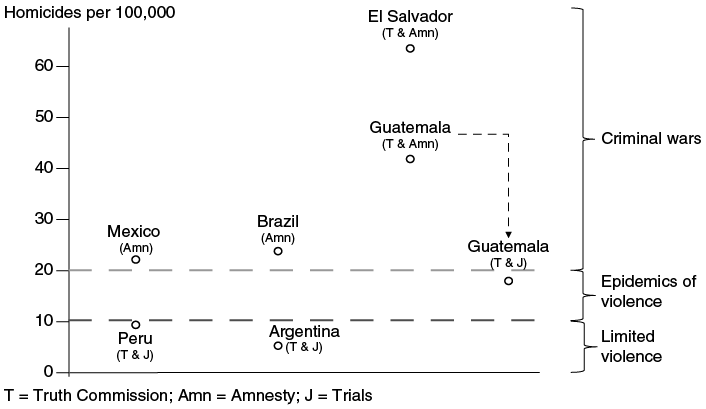
Figure I.1 maps the countries selected for the case studies by their different levels of homicidal violence. On the vertical axis, the figure distinguishes three thresholds of homicide rates (hr): (1) limited violence (hr < 10 murders per 100,000 population); (2) epidemics of violence (10 < hr < 20 murders per 100,000 population); and (3) criminal wars (hr > 20 murders per 100,000 population). Most advanced capitalist democracies experience limited violence – that is, murders associated with ordinary crime, community fractures, and intra-family violence. Countries with rates above 10 murders per 100,000 population are cases in which organized crime is widely present and OCGs occasionally engage in violent conflict with rival groups. When countries experience outbreaks of violence that can be rapidly contained and do not surpass the 20 murders per 100,000 population threshold, we classify them as cases of epidemics of violence. However, when violence is more systemic and often involves states deploying the military against OCGs, and when OCGs have developed their own private armies to resist the state and to wage turf wars against rival groups, violence tends to exceed 20 murders per 100,000. These are cases of criminal wars – protracted armed conflicts marked by large-scale violence, extensive civilian victimization, and gross human rights violations. As scholars have documented, criminal wars can be more lethal than civil wars (Lessing Reference Lessing2017; Trejo and Ley Reference Trejo and Ley2020).
Countries selected for case studies.
Note: Mean homicide rates for 2010–2015 period.
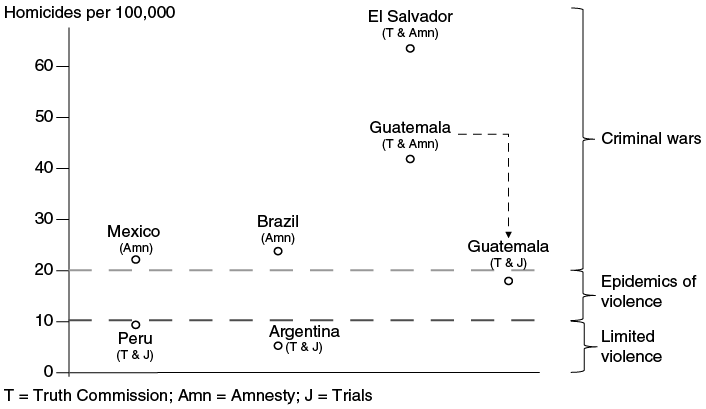
As Figure I.1 shows, we select two countries (Peru and Argentina) in which our key treatments and mechanisms are present (robust TJ) and levels of criminal violence remain limited, and two countries (Mexico and Brazil) in which robust TJ is weak or absent and large-scale criminal violence and criminal wars are present. We also select two cases that cannot be unequivocally classified. El Salvador’s initial attempt at truth seeking through a UN-sponsored truth commission was derailed by an amnesty law, and later the country faced exorbitant levels of criminal violence. Guatemala, initially a case of truth without justice and large-scale criminal violence, subsequently underwent a dramatic violence reduction after adopting an ambitious process of internationalized prosecution. Exploring these latter cases is crucial because they might have provided evidence against our argument – but do not.
In Chapter 6, we offer a brief discussion of Third Wave democracies that have experienced post-authoritarian trajectories of low criminal violence and no criminal wars despite failing to adopt robust TJ processes (Uruguay) or high-scale criminal violence despite adopting initially robust TJ mechanisms (South Africa). Discussing these outliers is important because they reveal different pathways (e.g., Uruguay’s relatively strong welfare state) that can prevent the outbreak of criminal wars and large-scale criminal violence.
Data and Methods
For our within-case analyses, we strategically pair countries that shared similar pre-transition features but adopted different strategies for addressing a repressive past (robust TJ vs. no TJ). Although the statistical analyses do address existing and rival explanations, this pairing of case studies allows us to establish more direct controls for specific cases. Our comparisons follow a most-similar design logic (Gerring Reference Gerring2017): the country pairs exhibit similar, theoretically relevant background conditions that would lead one to expect similar outcomes in terms of criminal violence – yet this was not the case. Because background factors are similar, we can discount them as alternative explanations for diverging outcomes. Following this design, we identify TJ processes as the factor that differs across the cases and thus as the likely cause of the varying outcomes. We further bolster this analysis at the end of each case-study chapter by engaging in counterfactual reasoning that uses the positive and negative cases under examination. Combined with our statistical analyses and detailed within-case analyses, these cross-case comparisons allow us to assess our theory against rival explanations and increase confidence in our causal argument.
Because quantitative data on gross human rights violations are available for our six case studies, we expand our thematic focus in the within-case analyses from criminal violence to gross human rights violations. We also extend our temporal scope, covering the period from the 1960s to 2020, and draw on multiple sources of qualitative evidence, including:
1. In-depth interviews we conducted with former members of truth commissions, public prosecutors, judges, human rights defenders, and security analysts.
2. Publicly available conference proceedings and broadcast interviews with truth commissioners, prosecutors, and judges.
3. Nine multivolume truth commission reports.
4. Specialized country reports by state agencies, international investigations by United Nations Special Rapporteurs, reports by the Inter-American Commission on Human Rights, and judgments by the Inter-American Court of Human Rights.
5. Specialized country-specific human rights reports by domestic and international nongovernmental organizations (NGOs), including Amnesty International and Human Rights Watch.
6. International and national journalistic investigations and new revisionist historiographical literatures on Cold War–era state repression in each of the six countries.
As we discuss in Appendix A, while gathering qualitative data we prioritized quality over quantity and focused on the proximity of evidence sources to the phenomenon of interest. In Appendix A, we explain how our engagement as human rights defenders and TJ practitioners in our own countries (Mexico) or as human rights policy advocates (Uruguay and Colombia) brought us into close dialogue and cooperation with key players in the “justice cascade” (Sikkink Reference Sikkink2011).
Using these materials, we first establish a common baseline in the within-case analyses for each country, reconstructing the architecture and dynamics of repression under authoritarian rule and examining how authoritarian specialists in violence capitalized on state impunity to develop a gray zone of criminality. We consider the first post-authoritarian (or post-conflict) administration a critical juncture (Collier and Munck Reference Collier and Munck2022) in which political elites decide whether to confront or ignore their repressive past. Decisions made during these momentous historical periods about a repressive history and the adoption of TJ processes have long-term consequences for post-authoritarian trajectories of peace and violence. We trace this legacy by analyzing how the presence or absence of robust truth commissions and trials influenced the career choices of state specialists in violence, and how these choices – to remain in government, protect OCGs, or defect to the criminal underworld – shaped peace and violence in the new democracy. In the positive cases, we use multiple sources of evidence to show how exposing, sanctioning, and removing authoritarian specialists in violence – and dismantling the violent state – prevented the outbreak of criminal wars and resulted in low levels of criminal violence and rare human rights atrocities. In the negative cases, we show how impunity and the persistence of the violent state led to the outbreak of criminal wars, large-scale criminal violence, and exponential growth in human rights atrocities. Our within-case analyses thus allow us to evaluate whether macro-level changes affect the behavior of state specialists in violence in the ways our theory predicts.
Building on these fine-grained data and within-case analyses, we cluster the three positive and three negative cases for a comparative historical analysis, aiming to uncover broader historical patterns. This comparative approach adds nuance to the statistical findings and complements the TSCS analysis by capturing processes for which we did not have quantitative data in our seventy-six-case sample. Rather than address alternative explanations case by case, we also use these cross-national historical findings to test our results against competing accounts.
A Note on Our Sample: The Significance of Studying Transitional Justice in Third Wave Democracies
Studying the impact of TJ on post-authoritarian trajectories of violence among Third Wave democracies entails three specific features that we need to keep in mind for analytic and interpretative purposes.
First, it is crucial for this investigation that TJ as a practical and theoretical field developed during the Third Wave (Teitel Reference Teitel2000; Sikkink Reference Sikkink2011). Although only one-quarter of Third Wave democracies adopted robust TJ processes (see discussion in Chapter 2), those that did address their repressive past influenced the TJ landscape in fundamental ways. In fact, starting with the Greek and Portuguese transitions in the 1970s, every new transition in the Third Wave thereafter presented new democratic elites with dilemmas and lessons from previous experiences of reckoning with a repressive history. As Acuña and Smulovitz (Reference Acuña, Smulovitz and McAdams1997), Méndez (Reference Méndez1997), Teitel (Reference Teitel2000), Sikkink (Reference Sikkink2011), and González-Ocantos (Reference González-Ocantos2016) eloquently argue, the pioneering Argentine experience in the 1980s was pivotal in prompting the field to seriously consider the centrality of criminal trials in the TJ tool kit. As Hayner (Reference Hayner2001), Roht-Arriaza (Reference Roht-Arriaza, Roht-Arriaza and Mariezcurrena2006a), and González (Reference González, Roht-Arriaza and Mariezcurrena2006) suggest, the Argentine, Chilean, South African, Salvadoran, Guatemalan, and Peruvian experiences revealed the centrality of victims in truth-seeking processes as the basis for the entire TJ corpus. While blanket amnesties were frequently used during the early phases of the Third Wave to insulate authoritarian specialists in violence from criminal justice and to prevent them from becoming democratic spoilers, after the South African TJ process, countries have used partial and conditional amnesties to incentivize authoritarian state specialists in violence to provide meaningful information about victims in exchange for reduced sentences or no jail time at all (Olsen, Payne, and Reiter Reference Olsen, Payne and Reiter2010).
Every transition is unique, and the adoption of TJ mechanisms varied in significant ways from one case to another, from one transition to another. Experiences ranged from no TJ at all to the isolated adoption of one mechanism (e.g., a truth commission or a few trials) to different combinations of truth commissions, trials, and amnesty laws. There were also significant differences in the mandates, scope, and temporality of truth commissions, as well as in the ranking of the officials brought to trial and the outcome of the trials. This wide variety of experiences and combinations of mechanisms allows for a more fruitful assessment of the differential impact of TJ processes on the post-authoritarian trajectories of criminal violence.
Second, while the main selection criterion for our sample was whether countries transitioned from authoritarian rule to democracy as part of the Third Wave, several of our cases experienced civil war in autocracy, and in a few, the TJ process was part of a peace agreement to end the war. Recognizing this reality, in the statistical analyses we assess the likely impact of a history of civil conflict on the evolution of homicide rates, and in the case studies we intentionally included three transitions that involved civil wars.
Finally, for purposes of historical interpretation of the statistical output and the case studies, it is crucial that the Third Wave entailed the democratization of authoritarian regimes that were either forged during or deeply influenced by the Cold War. As we extensively discuss in the case studies, the greatest impact of the Cold War in the Latin American cases was the development of counterinsurgent states by right-wing dictatorships to fight armed and unarmed political dissidents and anyone whose lifestyle, ideas, cultural practices, or norms challenged a conservative order.
Empirical Findings: The Violence-Reduction Effect of Accountability Shocks
Findings from our statistical analyses and case studies strongly support the claim that adopting ambitious TJ processes in new democracies – combining robust truth commissions with trials of authoritarian specialists in violence that lead to meaningful sentences – can prevent the outbreak of large-scale criminal violence and criminal wars, save thousands of lives, and set countries on paths of relatively peaceful development. However, our results also show that not all TJ mechanisms have the same effect or work in the same direction: some are powerful deterrents of large-scale criminal violence (truth commissions), others (criminal trials) are effective only when combined with additional measures (truth commissions), and still others (amnesty laws) have independent negative effects. A key finding is that how TJ mechanisms are combined into different “ecosystems of accountability” has different consequences for peace and violence. Some combinations lead to a breakdown of state impunity and lower levels of violence, while others actually stimulate violence. Crucially, our statistical analyses suggest that adopting robust truth commissions and meaningful trials can create a powerful accountability shock that dampens criminal violence. In contrast, combining amnesty laws with any other mechanism represents the persistence of state impunity, neutralizing the overall effect of TJ and contributing to the intensification of criminal violence.
Quantitative Evidence
Our statistical results clearly show the significant impact that anti-impunity measures can have on levels of post-authoritarian criminal violence. Controlling for the leading explanatory factors in the cross-national literature on violent crime, our models for the world sample indicate that adopting robust truth commissions to identify and expose human rights violators from the authoritarian period is associated with lower murder rates. We find evidence of both an immediate and a stronger cumulative effect of truth-seeking processes on a country’s homicide rate. Our findings reveal that trials of repressive officials resulting in guilty verdicts have a deterrent effect on criminal violence only when jointly implemented with a robust truth commission as part of a broader TJ process. Trials in which prosecutors and judges can draw on evidence of systematic and generalized gross human rights violations – produced by a robust truth commission – can lead to sentencing perpetrators for crimes against humanity and other international crimes, rather than lesser charges for ordinary offenses. We also find that the violence-reduction effect of truth and justice expires after ten years. Finally, our findings show that the adoption of amnesty laws – through which states provide guarantees of no prosecution for specific crimes (Freeman Reference Freeman2009) – is associated with higher homicide rates. Importantly, when truth commissions are combined with amnesty laws instead of meaningful trials, the amnesty effect prevails and neutralizes the deterrent effect that truth commissions would otherwise have.
Our findings are particularly robust for Latin America, the region with the highest homicide rates and the greatest number of truth commissions and criminal trials. The results show that adopting robust truth commissions and meaningful trials to expose and punish a repressive history distinguishes less violent countries such as Argentina, Bolivia, Chile, and Peru from the most violent ones such as Brazil, El Salvador, Honduras, and Mexico. The violence-reduction effects of individual accountability mechanisms – and of the joint impact of truth and justice (the accountability shock) – are significantly stronger in Latin America than in the rest of the world. However, as the Peruvian case attests, they tend to expire after a decade.
Qualitative Evidence
Within-Case Historical Analyses
We first pair Peru and Mexico. Both countries were major sites of wholesale drug production and transnational trafficking prior to transitioning to democracy in 2000. In both countries, authoritarian regimes developed powerful counterinsurgent states and top members of the authoritarian security apparatus – charged with eliminating political dissidents and fighting armed rebel groups – were allowed to use their comparative advantage in information and violence to regulate or lead their countries’ drug-trafficking industries. In both cases, state authorities granted authoritarian state specialists in violence de jure (Peru) or de facto (Mexico) immunity to kill and to absorb extraordinary illicit rents from the criminal underworld.
At the time of the transition to democracy, however, Peru adopted an ambitious TJ process, combining a robust truth commission and extensive judicial prosecution of the president, the head of military intelligence, top military leadership, and death squads responsible for mass atrocities, while Mexico ignored its repressive history. We trace the linkages connecting the survival of state authoritarian specialists in violence and the prevalence of state impunity to a major expansion of the gray zone of criminality in democracy, culminating in the outbreak of state–cartel and inter-cartel wars in Mexico. We also trace how the exposure of atrocities and the removal and punishment of these specialists deterred Peruvian authoritarian actors from engaging in militarized anti-drug policy or playing a key role in the gray zone of criminality. Rather, their absence from the country’s security apparatus and from the gray zone explains why Peru’s transition to democracy did not result in state–cartel or inter-cartel wars and why post-authoritarian criminal violence remains at European levels. At the end of the chapter, we discuss what Mexico’s post-authoritarian trajectory might have looked like had the country adopted a Peruvian-style accountability shock and what Peru’s fate might have been had systemic impunity prevailed (as it did in Mexico).
We then pair Argentina and Brazil. Both countries exhibit relatively high demand for illicit drugs and are cases of significant retail domestic drug sales. In both countries, military regimes developed powerful counterinsurgent states to crush armed and nonarmed dissident groups by means of state terror, and in both cases the military regimes issued blanket amnesties for perpetrators at the end of the most repressive periods. In both countries, members of the security apparatus charged with eliminating political dissidents became involved in organized criminal activities.
Shortly after transitioning to democracy, Argentina embarked on a protracted TJ process that included a pioneering truth commission to expose the horrors of mass disappearance and state terror; a significant number of criminal prosecutions and trials of high-ranking members of the military juntas, who were sentenced and sent to prison for gross human rights violations; and an ambitious program of reparations for victims. Although amnesty laws were abrogated and then reissued, Argentine victims’ organizations and their lawyers learned to circumvent the national law by, for example, appealing to the Inter-American Human Rights System. Argentina’s multiple episodes of truth and criminal justice paved the way for TJ to expand and become a state policy and for human rights to become a societal consensus. Through these processes, Argentina dismantled the counterinsurgent state and redefined the boundaries of state coercion, turning the abuse of state coercive power into a taboo.
In contrast, Brazil transitioned without adopting a truth commission and its blanket amnesty was never successfully challenged; it served as a guarantee against the judicial prosecution of military personnel for atrocities committed in the 1960s and 1970s. Under the shadow of impunity, after democratization Brazilian militarized security forces and their defectors became central actors in protracted, localized criminal wars and in the intensification of large-scale criminal violence. We trace the outbreak of criminal wars in Brazil to this path of impunity and Argentina’s low-violence equilibrium to its robust TJ process. We then engage in a counterfactual exercise to assess Brazil’s likely post-authoritarian trajectory had it adopted an ambitious TJ process (as Argentina did) and Argentina’s likely democratic trajectory had it failed to engage in a four-decade-long TJ process (as Brazil did).
Finally, we group El Salvador and Guatemala. Both countries have extensive illicit economies – including transnational trafficking of drugs, arms, cars, and other goods, as well as human trafficking – and both experienced long periods of military rule prior to democratization. Both also endured bitter civil wars in which military juntas developed powerful counterinsurgent states. The international community played a crucial role in ending these armed conflicts and facilitating regime transitions in both countries. Under strong international scrutiny, El Salvador and Guatemala adopted innovative truth commissions to expose atrocities committed during their wars. However, different types of amnesty laws set them on divergent TJ trajectories. El Salvador’s blanket amnesty prevented any judicial prosecution, deflected serious security sector reform, and enabled the survival of the counterinsurgent state. Protected by de jure impunity, members of the military, the police, and death squads quickly became leading actors in criminal wars and in the production of large-scale criminal violence. El Salvador became the world’s most deadly country after the adoption of iron-fist policies against street gangs ignited bloody state–gang and inter-gang militarized conflicts.
In contrast, with direct assistance from the UN (via the International Commission against Impunity in Guatemala / Comisión Internacional Contra la Impunidad en Guatemala, CICIG), Guatemala built on the findings of two truth commissions and engaged in a major process of internationalized prosecution of former members of the civil war military establishment, former presidents and incumbents, ministers, police chiefs, mayors, and congressional leaders who had exploited state power to infiltrate the criminal underworld. By sentencing hundreds of these political-business-criminal actors to prison, a reformed Guatemalan law enforcement dismantled more than seventy state–criminal structures and achieved a major reduction in criminal violence. We trace how a protracted TJ process, combining truth and justice, eventually allowed Guatemala to escape entrenched criminal wars. We close the chapter with a counterfactual analysis, assessing El Salvador’s likely postwar criminal dynamics had it adopted a CICIG-type model and exploring Guatemala’s likely future had it never engaged in international prosecution through the CICIG.
Note that El Salvador and Guatemala are crucial cases for our theory. Crucial cases are those in which we should not observe a given outcome, and yet we do. Such cases are central to generating new theories, as existing explanations fail to account for the outcomes we observe. Given the deep-rooted poverty and income and wealth inequalities in El Salvador and Guatemala, the long shadow of their militaries, institutional weakness, and a long history of conflict and violence, we should not expect declining levels of violence post-conflict. And yet, starting in 2010, Guatemala experienced a sharp and sustained decline in murder rates after combining truth with justice through internationalized prosecution, UN assistance, and the enactment of a powerful accountability shock. The crucial case of Guatemala thus highlights a novel mechanism: active partnership between international organizations and domestic law enforcement to dismantle criminal structures decades after transitioning to democracy or signing a peace agreement.
Cross-National Historical Analysis
Our case studies reveal that, during the Cold War and in the aftermath of the 1959 Cuban Revolution, authoritarian regimes in all six countries developed counterinsurgent states and adopted policies of state terror to confront major waves of dissident nonviolent mobilization and the outbreak of armed insurgency in urban metropolitan centers and rural areas. Although the contours of these counterinsurgency states varied across countries, they all shared seven features.
First, in all cases, authoritarian regimes entrusted the armed forces with the development of a counterinsurgent state and, at different points between 1960 and 1990, all countries experienced the widespread militarization of public security. Second, they drew on the US National Security Doctrine – a Cold War doctrine asserting that countries had to equip themselves to “annihilate” homegrown communism, identified as the “internal enemy.” Third, to identify this “internal enemy,” authoritarian regimes developed powerful military intelligence sectors. Fourth, to fight the internal enemy, the military created elite forces and rapid-reaction elite units, most of which were trained in the School of the Americas (SOA) to defeat the “internal enemy” psychologically, politically, and militarily through counterinsurgency strategies that relied on both selective and indiscriminate violence, targeting armed and unarmed groups and communities alike. Fifth, the military intelligence sector promoted the development of clandestine death squads that worked closely with these elite forces. Sixth, authoritarian regimes created dozens of subnational military zones to coordinate counterinsurgency operations on the ground and to reclaim subnational territorial control. These military zones became focal points for the development of complex systems of clandestine prisons, where dissidents were interrogated, tortured, killed, and disappeared. Finally, in all cases, perpetrators were protected from criminal prosecution.
Our six case studies show that new authoritarian “specialists in violence” emerging across autocracies during the Cold War played a key role in developing the gray zone of criminality and multiple illicit economies. The evidence indicates that leaders of military intelligence, elite military forces, and clandestine death squads – working closely with military zone commanders and militarized police forces – became key players in the rise of various illicit industries: from drug cultivation and transnational drug trafficking to murder-for-hire operations, baby theft, kidnapping for ransom, extortion, land grabs and property dispossession, and street gambling. Autocrats granted these authoritarian state specialists in violence, and the clandestine forces working with them, the opportunity to gain extraordinary illicit rents to ensure their loyalty. Drawing on (1) intelligence information and their direct control of customs and international borders, (2) the international linkages forged at the SOA, and (3) their subnational presence and territorial control, these forces – charged with destroying the “internal enemy” – became central players in expanding illicit economies and in transforming small smuggler family clans into transnational drug cartels and criminal organizations.
The case studies further indicate that the first administration following a long period of authoritarian rule and/or a protracted civil war represents a critical juncture in which structural constraints loosen and agency matters. In deciding whether to reckon with a history of repression or ignore it, the cases suggest that the normative convictions of the first democratic president toward human rights were crucial in determining whether accountability or impunity would prevail – and whether the counterinsurgent state would survive.Footnote 16 All cases also reveal that a robust TJ process was possible in countries that had previously developed a powerful human rights movement with a clear agenda for truth and justice, along with strong links to international human rights NGOs (e.g., Amnesty International) and institutions (e.g., the Inter-American Human Rights System). Regardless of whether the previous authoritarian regime collapsed or key authoritarian institutions remained active, the cases suggest that a newly elected democratic president with strong human rights convictions – together with a powerful human rights movement and its allies – formed a potent anti-impunity coalition that made an accountability shock viable.
The countries’ narratives show how certain authoritarian specialists in violence – particularly members of the armed forces, the intelligence service, elite military units, and death squads – can be exposed, sentenced, and removed through robust processes of truth and justice, and how such accountability shocks can deter other state specialists in violence from joining or protecting the criminal underworld or from fighting crime through militarized, iron-fist policies.
The positive cases of Peru, Argentina, and post-2008 Guatemala show that dismantling the counterinsurgent state – and removing the military to the barracks and away from politics and policy – is a key element in developing post-authoritarian societies with relatively low levels of criminal violence. This meant that special military forces and the death squads that had led counterinsurgency operations under dictatorship or in civil war were removed from the gray zone of criminality and from positions of influence within the democratic security apparatus. Practically, they could no longer serve as private militias for OCGs or encourage militarized iron-fist policies to fight crime through war. The cases show that, by constraining the armed forces’ power, robust TJ processes lead to the demilitarization of public security and decisively contribute to deflating the gray zone, thereby preventing large-scale violence in that gray zone of criminality. They also reveal that, by limiting state–cartel and inter-cartel wars, human rights violations are significantly reduced.
In contrast, the negative cases of Mexico, Brazil, and El Salvador demonstrate how, in countries that ignored a repressive past and failed to adopt a meaningful TJ process, the counterinsurgent state survived. In these contexts, the armed forces, elite military units, and death squads became key actors in producing large-scale criminal violence and in the unfolding of criminal wars under democracy. These cases reveal that the unwillingness of post-authoritarian elites to expose and punish authoritarian military, police, and clandestine forces for gross human rights violations – along with the adoption of blanket amnesty laws – enabled authoritarian specialists in violence to morph into the criminal underworld or to play a central role in crafting militarized, iron-fist security policies under democracy. Because these specialists in violence continued to employ the counterinsurgency strategies they had once used to subdue enemies under autocracy, post-authoritarian violence became especially bloody. The failure to address a repressive history not only facilitated the post-authoritarian growth of the gray zone of criminality but also made it more likely that this hybrid zone would become the theater for multiple criminal wars, large-scale criminal violence, and mass atrocities.
Comparative Lessons for Dismantling Impunity Regimes: Transitional Justice Beyond Transitions
One of our central findings in this book is that persistent impunity sets countries on a path of violent development, while accountability shocks put countries on a relatively peaceful trajectory. However, the latter’s positive initial effect wanes if countries fail to both extend and institutionalize policies of accountability. We group the cases into two clusters: the accountability cases (Argentina, Guatemala, and Peru) and the impunity cases (Mexico, Brazil, and El Salvador). We use the comparative evidence to identify (1) what the field of TJ can still offer to countries that adopted an accountability shock of truth and criminal justice after transitioning to democracy but are beginning to experience unusual outbreaks of criminal violence two decades after the initial adoption of a robust TJ process (e.g., Peru); and (2) what TJ may offer to those that initially ignored a repressive history and, as a result, are tragically trapped in deadly political–criminal conflict.
For the positive cases, we discuss the importance of institutionalizing and expanding the initial accountability shock (through “boosters”) and of adopting additional TJ mechanisms beyond truth and justice (e.g., memorialization programs and institutional reforms in the armed forces, the police, and the judiciary to prevent repetition). Drawing on the Argentine example, we suggest that when the abuse of state coercive power for repressive and criminal purposes becomes taboo and gives rise to a societal consensus about the limits of state coercive power, societies enter into self-sustaining, peaceful, democratic equilibria.
For the negative cases, we discuss the need to rethink the TJ toolbox to address societies with persistent impunity, in which the survival of the authoritarian counterinsurgent state led to new waves of violence and exponentially higher gross human rights violations under democracy. Using the Guatemalan example, we explore the importance of applying extraordinary mechanisms of justice in nontransitional times and how TJ mechanisms must be adapted to new realities of political–criminal violence in violent democracies.
Book Structure
The main body of this book is divided into four parts and six chapters.
Part I presents a theory of TJ and criminal violence. In Chapter 1, “A Theory of Transitional Justice and Criminal Wars in New Democracies: Breaking State Impunity to Craft Peaceful Democracies,” we introduce a new conception of organized crime and criminal violence that places authoritarian state specialists in violence at the center, and then discuss the implications of this new conceptualization for a theory of TJ and criminal violence. We explain why and how robust truth commissions and meaningful trials of authoritarian specialists in violence constitute an “accountability shock” that can prevent the outbreak of criminal wars and help guide countries toward self-sustaining, low levels of criminal violence. We also show why, by perpetuating state impunity, amnesty laws stimulate large-scale violence.
Part II presents the statistical tests of our central propositions. In Chapter 2, “Preventing Large-Scale Criminal Violence in New Democracies: A Quantitative Analysis of the Impact of TJ on Homicide Rates,” we discuss the sample of seventy-six Third Wave democracies used to test our theory, explain why we use the homicide rate as our measure of criminal violence, and detail the various indices created to capture the multiple dimensions of truth commissions, trials, and amnesty laws. We then examine the statistical results regarding the immediate and cumulative impacts of truth commissions, trials, and amnesty laws, as well as their joint effects. We report findings from OLS panel models with fixed effects and dose-response models, and discuss these results for both our full sample and our Latin American subsample.
Part III presents the case studies, illustrating why and how robust TJ processes – or their absence – help explain post-authoritarian trajectories of criminal conflict and violence. Each chapter examines how the adoption of accountability shocks, or the persistence of state impunity, yields very different anti-crime strategies in democracy, including states waging counterinsurgency wars against drug cartels, gangs, and crime, often at the expense of due process and human rights, versus states relying on judicial investigations and prosecutions to dismantle criminal structures through the rule of law. We trace, within each country’s recent history, the consequences of these divergent approaches for conflict or peace in the criminal underworld, and for the occurrence or prevention of large-scale violence and human rights atrocities. This section includes three chapters: Chapter 3, “Mexico and Peru: How TJ Prevents the Transformation of Counterinsurgency Wars into Drug Wars”; Chapter 4, “Brazil and Argentina: How TJ Prevents the Outbreak of Criminal Wars in Marginalized Urban Peripheries”; and Chapter 5, “El Salvador and Guatemala: Why TJ Can Be an Effective Alternative to Militarized Iron-Fist Policies.”
Part IV presents a comparative historical analysis. In Chapter 6, “It Was the State” – Demise and Persistence of the Counterinsurgent State: Comparative Lessons on the Development of Peaceful Democracies by Means of Justice” we identify broad historical patterns of peace and violence in the Latin American countries that successfully dismantled their authoritarian counterinsurgent states and those that did not. We also draw comparative lessons and assess what TJ can offer to countries that initially adopted an accountability shock at the time of transition yet are experiencing renewed violence, as well as what TJ may offer to post-authoritarian countries that ignored a repressive past and thus remain trapped in illiberal democracies plagued by widespread impunity, extensive gray zones of criminality, large-scale violence, and criminal wars.
In the Conclusion, we discuss how large-scale criminal violence and the outbreak of bloody criminal wars in many young democracies across Latin America, Africa, and Asia – along with the spread of mass atrocities – call for a significant rethinking of the frontiers of TJ and force us to reevaluate the nature of transitions from authoritarian rule to democracy. While scholars of democratization forty years ago often advised elites and societies to abandon demands for accountability for past atrocities to avoid a military backlash that might endanger democratic prospects, this book offers a sobering lesson: Failing to confront a repressive past paves the way for a future marked by large-scale criminal violence, criminal wars, and gross human rights violations under a “democratic” veneer. We close with a strong call to recognize accountability as the cornerstone of sustainable democracies.