


The renewal and resurgence of the right is part of a global phenomenon to which Latin American democracies are no longer an exception. The main characteristic of this process is the fragmentation of this political camp into a mainstream right and a far right, with the emergence of new leaders and parties that had previously been marginal in the region. In recent years, these actors have challenged the established political systems, obtaining favorable electoral results. At the same time, they are also recognized for their radical political positions and their ambivalent relationship with democracy.
Jair Bolsonaro in Brazil, Nayib Bukele in El Salvador, and Javier Milei in Argentina are emblematic cases of successful far-right leaders in the region. Even in contexts where the electoral support of the far right is not so high, these actors have increasingly gained ground, installing their ideas and defending their interests in the electoral and political competition. Other examples are José Antonio Kast and the Republican Party in Chile and Rafael López Aliaga and Popular Renewal in Peru (see Rovira Kaltwasser, Reference Rovira Kaltwasser2023).
The arrival of the far right in Uruguay was an important indicator of the reception of these ideas in the region. The country has the longest history of democratic regimes and the oldest political parties in Latin America. It is also considered a “full democracy” by the Democracy IndexFootnote 1 and an example of political rights and civil liberties by Freedom House.Footnote 2 The background of Uruguay’s progress is considerable for a region marked by political and democratic instability.
During the twentieth century, Uruguay suffered only two institutional ruptures – the first in 1933, and the second in 1973. The last one established a military dictatorship that lasted from 1973 to 1985 and is inscribed in a regional context of democratic breakdowns. Additionally, this was the only period in the twentieth and twenty-first centuries in which electoral and political competition ceased in the country (Chasquetti & Buquet, Reference Chasquetti and Buquet2004).
The two parties currently representatives of the mainstream right – the National Party (blancos) and the Colorado Party (colorados) – were founded in 1836 and dominated the electoral and political competition in a bipartisan model that ended only in 1994. That year, the mainstream left party, the Broad Front, broke with the hegemony of blancos and colorados and made Uruguay “the country of the three-thirds” (Moreira, Reference Moreira2004). From then until 2019, elections were structured between two large coalitions: a center-right coalition, led by blancos and colorados, and a center-left coalition, led by the Broad Front. With the return to democracy, the center-right coalition governed between 1985 and 2005, and the center-left coalition governed between 2005 and 2020.
The uniqueness of Uruguay compared to the rest of Latin America derives not only from its political and democratic stability but also because of the parties’ capacity to process and mediate social conflicts in a democracy commonly referred to as a “consensus particracy” (Chasquetti & Buquet, Reference Chasquetti and Buquet2004). The distinguishing features of this context are the openness to dialogue and the appreciation of democracy by both of the country’s political coalitions.
However, this “consensus particracy” was challenged in the 2019 elections with the emergence of the far right as the fourth political force in the country, represented by the party Cabildo Abierto with Guido Manini Ríos as its leader. In these elections, the far right differentiated itself from the mainstream right by questioning the programmatic convergence of the traditional parties – on the left and the right – and by adopting more radical-right positions (Queirolo, Reference Queirolo2020).
Cabildo Abierto and Manini Ríos adopted a strong nationalist and traditionalist discourse of restoring order and recovering the past. In this context, their program focused mainly on punitivism and moral conservatism, similar to other far-right regional actors. However, as will be seen throughout this chapter, these ideas are more attenuated in the country. Cabildo Abierto was the furthest to the right that could emerge from a social and political dynamic like that of Uruguay.
In discussing the most stable country in a markedly unstable region, this chapter seeks to answer several critical questions: What enabled the far right’s emergence in Uruguay? What ideas does it favor? How does it put pressure on democracy? This chapter aims to understand the rise of the far right through the ideas and discourses presented by Cabildo Abierto and Guido Manini Ríos. Furthermore, it will explore the limits of this political project, particularly considering the sharp decline the far right experienced in subsequent elections. This decline suggests that its initial appeal may have been more reactive than durable and ultimately constrained by the institutional and political culture of Uruguayan democracy. Nevertheless, the Uruguayan case reveals that, even if this specific project has faced setbacks, there is political and social space for far-right forces to emerge and influence public debate within the country’s democratic framework.
The chapter is structured as follows. The first section will provide a brief context of the right-wing in Uruguay. The second section will analyze the 2019 elections and the emergence of the far right in Uruguay. The third section will present the far-right programmatic offer in the context of Uruguay. The fourth section will examine the relationship between Cabildo Abierto and the Armed Forces, and how this relationship impacts democracy. The fifth section will show the articulation of populist and (neo)patriotic ideas in Cabildo Abierto. The sixth section will scrutinize the party’s performance in a coalition government. The final remarks will summarize the main findings of this chapter and future steps for further analysis of the far right in Uruguay, including a reflection on the factors that led to its electoral decline.
7.1 A Brief Overview of the Political Right in Uruguay
From a historical point of view, the right-wing in Uruguay was organized around two parties: the Colorado Party as the representative of the urban groups – with a more liberal tendency – and the National Party as the representative of the agrarian groups – with a more conservative tendency. These trends varied over time and, due to the prevalence of a bipartisan model of political competition, these parties had factions within them from the left, the center, and the right (Monestier, Reference Monestier, Broquetas and Caetano2023).
The foundation of the Broad Front in 1971 gradually changed this dynamic by establishing a left-wing coalition that would later also become a left-wing party. The Broad Front is the result of the unification of trade unions, grassroots organizations, left-wing parties, and independent leaders, and it has brought together the majority of leftist actors in Uruguay. This structure favored the social and political unity of the left, which held even during the military dictatorship. The Broad Front continued to establish itself during the political transition, entering democracy under conditions favorable to its political and electoral growth (Pérez Betancur et al., 2019).
After the end of the military dictatorship and the party system’s restoration to its main characteristics prior to the 1973 coup d’état, the electoral and political competition was structured on a left–right axis (Caetano & Rilla, Reference Caetano and Rilla1987). In this context, the programmatic offer and voters’ demands were organized as follows: the Broad Front represented the left, the National Party and the Colorado Party represented the right, and the center was divided between these three options (Monestier, Reference Monestier, Broquetas and Caetano2023, p. 31). Table 7.1 summarizes the presidents and governing coalitions in Uruguay over the last four decades:
| Party | President | Government coalition | Term |
|---|---|---|---|
| Colorado Party | Julio Maria Sanguinetti | Mainstream right | 1985–1990 |
| National Party | Luis Alberto Lacalle | Mainstream right | 1990–1995 |
| Colorado Party | Julio Maria Sanguinetti | Mainstream right | 1995–2000 |
| Colorado Party | Jorge Batlle | Mainstream right | 2000–2005 |
| Broad Front | Tabaré Vázquez | Mainstream left | 2005–2010 |
| Broad Front | José “Pepe” Mujica | Mainstream left | 2010–2015 |
| Broad Front | Tabaré Vázquez | Mainstream left | 2015–2020 |
| National Party | Luis Lacalle Pou | Mainstream right + far right | 2020–2025 |
| Broad Front | Yamandú Orsi | Mainstream left | 2025– |
Concerning the political camp of the right, blancos and colorados made a double move. First, they carried out ideological convergence based on adopting more right-wing programmatic positions. Secondly, they moved strategically toward the center of the party system. This process is made up of four periods (Monestier, Reference Monestier, Broquetas and Caetano2023).
The first period, the transition to democracy, is recognized by the defeat of the factions close to authoritarianism in the 1984 national elections in both parties. The Colorado Party started to adopt more socioeconomically right-wing positions in favor of reducing the state and deregulating the market. By contrast, the National Party adopted more left-wing positions in favor of developmentalism and state regulation. Despite these differences, blancos and colorados were closer to each other than to the Broad Front. During the government of Julio Maria Sanguinetti of the Colorado Party between 1985 and 1990, the National Party supported the government in various votes, such as approving the law that prevented the trial of military personnel accused of human rights violations. In the meantime, the Broad Front consolidated its position in the opposition (Monestier, Reference Monestier, Broquetas and Caetano2023, pp. 34–35).
The second period, from 1989 to 2005, is characterized by ideological convergence and political divergence between the two parties. In the socioeconomic dimension, blancos and colorados promoted market reforms and economic liberalization in line with the neoliberal consensus of the time. After one National Party and two Colorado Party governments, both parties lost their internal heterogeneity, allowing the Broad Front to capture leaders and voters from their former left-wing factions. An agreement between the National Party and the Colorado Party led to a series of reforms of fiscal adjustment, privatization of public companies, social security, and deregulation of the labor market.Footnote 3 The disputes in these years revolved around which party would lead the right-wing coalition. However, this cycle ended with the fatigue of the years of government and a severe economic crisis. In 2004, the Broad Front won the presidential elections at the head of a government with no parliamentary support and only a 10 percent positive rating (Monestier, Reference Monestier, Broquetas and Caetano2023, pp. 35–38).
The third period, from 2005 to 2020, is marked by the cycle of fifteen years of left-wing governments and the consolidation of the movement to the right of the National Party and the Colorado Party. The arrival of the Broad Front in the presidency ended 175 years of hegemony of blancos, colorados, or military dictatorships in the country (Broquetas & Caetano, Reference Broquetas and Caetano2023). The right-wing parties were challenged to balance cooperation, competition, and differentiation while acting together as the opposition coalition. In the socioeconomic dimension, there was a common criticism of the expansion of state functions, increases in public spending, changes in tax policy, and the new labor policy. In the sociocultural dimension, both parties started to emphasize the punitivist agenda in the context of increasing violence and criminality. Regarding moral conservatism, the responses were mixed. Blancos and colorados opposed the Law on Voluntary Interruption of Pregnancy (2012) but supported the Law on Equal Marriage (2013) and were divided in the Law for Trans People (2018) (Monestier, Reference Monestier, Broquetas and Caetano2023, pp. 44–46). The governments of the Broad Front changed the map of the right. They initiated a process of political and ideological hegemony of the National Party, with a clear approach in opposition to the Broad Front and its progressive policies (Monestier, Reference Monestier, Broquetas and Caetano2023, pp. 44–46).
Finally, the fourth and most recent period began with the 2019 elections, which saw the consolidation of the leadership of the National Party in the political camp of the right. The blancos then held the presidency and had the largest right-wing bloc in the parliament. In these elections, three outsiders competed within the right: Juan Sartori in the primaries of the National Party, Edgardo Novick with the People’s Party, and Manini Ríos with Cabildo Abierto. While the first two were defeated, the latter was relatively successful in a process marked by the emergence of the far right and the reconfiguration of the political camp of the right.
This process of the National Party’s leadership consolidation continued into the 2024 elections. However, the party was defeated by the Broad Front and, although it remains the main right-wing force, it now finds itself in opposition. At the same time, the far right experienced a significant decline, revealing the structural limits of its political project and raising questions about its long-term viability in the Uruguayan context. The loss of momentum by Cabildo Abierto and Manini Ríos suggests that, while there is space for far-right appeals, sustaining such a platform over time remains a major challenge within Uruguay’s resilient institutional order and longstanding political traditions.
7.2 The 2019 Elections and the Rise of the Far Right in Uruguay
The 2019 national elections in Uruguay took place in an unusual context of crisis for the country’s political standards. Between 2015 and 2018, there was a slow but sustained fall in indicators for support and satisfaction with democracy and for confidence in parties and representative institutions. The period was also marked by a sharp decline in the image of progress and the evaluation of the president’s performance, and the public security agenda became the main problem for citizens (Caetano et al., Reference Caetano, Selios and Nieto2019). At the same time, the context was characterized by the end of fifteen years of Broad Front governments in the face of an unfavorable economic situation and at a time when conservative sectors were reacting to the advances of center-left governments in terms of the “new” agenda of rights (González, Reference González2023).
Similarly to other Latin American countries, such as Chile, which for a long time also distinguished itself along with Uruguay for its political stability, this scenario was propitious to the appearance of the far right.
Cabildo Abierto was founded on March 10, 2019. Its name refers to an institution of Hispanic origin from colonial times, consisting of public meetings to discuss and decide matters of local public importance. The original name requested by the party was Artiguista Social Movement, a political group created on November 29, 2019. Following a restriction on mentioning José Gervasio Artigas in Uruguay, the name was changed to Cabildo Abierto. José Gervasio Artigas was a national hero and leader of the movement for independence in Uruguay. Artigas is recognized as the founder of orientalFootnote 4 nationalism. He has been the object of significant politicization and manipulation by both the left and the right in the political system. In the context of the far right, Cabildo Abierto used the artiguismo to allude to the foundational character of nationality and homeland, valuing order and tradition (Fraga, Reference Fraga, Broquetas and Caetano2023).
Cabildo Abierto is commonly associated with the leadership of Guido Manini Ríos. Its founding coincided with his dismissal as commander-in-chief of the army on March 12, 2019 by the then-president, Tabaré Vázquez. The decision followed a series of controversies between the Executive and the Armed Forces. It was finally taken after a pronouncement by Manini Ríos on the actions of the state in the trial of military officers convicted of human rights violations during the military dictatorship in Uruguay. On that occasion, Manini Ríos affirmed that “military personnel who are summoned for questioning by the Justice are often found guilty even before being trailed”Footnote 5 and “condemned based on inadmissible conjecture or convictions without reliable, forged or invented evidence.”Footnote 6 For the Executive branch, “in a democratic republican system of government there is the separation of powers and respect for decisions must be a fundamental premise,” which is why the attitude of Manini Ríos was “absolutely incompatible with the position he held.”Footnote 7
Manini Ríos is a member of a family of agricultural producers with a distinguished conservative tradition in Uruguay. His grandfather, Pedro Manini Ríos (1879–1958), was leader of the conservative faction of the Colorado Party known as riverismo and founder of the newspaper La Mañana. His father, Alberto Manini Ríos (1908–1971), was a member of parliament for the Reformist Democratic Union and president of the Uruguayan Publishing Society,Footnote 8 which owned La Mañana and El Diario. His brother, Hugo Manini Ríos (1943–2023), was a member of the Uruguayan Youth on Foot,Footnote 9 a traditionalist and right-wing student organization that brought together the right between 1970 and 1974. Manini Ríos studied History at the Catholic University of Uruguay and opted for a military career, not choosing politics (González, Reference González2023).
After several invitations from its founders, Manini Ríos joined Cabildo Abierto on April 3, 2019. On the same day, the party officially launched its presidential candidacy. On that occasion, the then-presidential candidate declared: “Our aim is to give hope to those who have lost it,” and “this that begins today is the beginning of a new era, it is a new wind, an intrepid wind, a wind that will shake up old flags.”Footnote 10
In the 2019 presidential elections, Manini Ríos obtained 11.46 percent of the votes, coming fourth in the first round with only 1.34 percent fewer votes than the third most voted for, Ernesto Talvi of the Colorado Party. Cabildo Abierto elected three senators and eleven deputies in the legislative elections, only one senator and two deputies fewer than the colorados. The comparatively good electoral results of the far right surprised a country used to the hegemony of the traditional parties. Cabildo Abierto achieved the best electoral result for a new party since the return to democracy (Monestier et al., Reference Monestier, Nocetto, Rosenblatt, Moraes and Pérez Bentancur2021) and was indispensable for the narrow electoral victory of the political camp of the right in the second round of the presidential elections. On that occasion, the party was part of the winning Multicolor Coalition, led by the mainstream right candidate, Luis Alberto Lacalle Pou, which ended fifteen years of Broad Front governments in the country. Table 7.2 summarizes the results of the 2019 presidential elections.
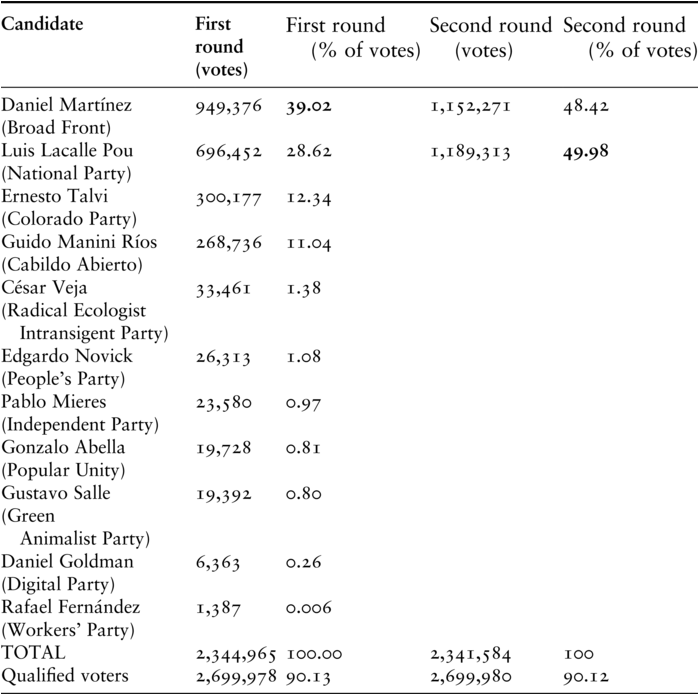
Table 7.2 Long description
The table has five columns titled Candidate. First round, votes. First round, percent of votes, Second round, votes. Second round, percent of votes. The data presented are as follows.
Row 1 column 1 reads. Daniel Martínez, Broad Front.
Row 1 column 2 reads. 949.376.
Row 1 column 3 reads. 39,02.
Row 1 column 4 reads. 1.152.271.
Row 1 column 5 reads. 48,42.
Row 2 column 1 reads. Luis Lacalle Pou, National Party.
Row 2 column 2 reads. 696.452.
Row 2 column 3 reads. 28,62.
Row 2 column 4 reads. 1.189.313.
Row 2 column 5 reads. 49,98.
Row 3 column 1 reads. Ernesto Talvi, Colorado Party.
Row 3 column 2 reads. 300.177.
Row 3 column 3 reads. 12,34.
Row 3 column 4 reads. Blank.
Row 3 column 5 reads. Blank.
Row 4 column 1 reads. Guido Manini Ríos, Cabildo Abierto.
Row 4 column 2 reads. 268.736.
Row 4 column 3 reads. 11,04.
Row 4 column 4 reads. Blank.
Row 4 column 5 reads. Blank.
Row 5 column 1 reads. Cesar Veja, Radical Ecologist Intransigent Party.
Row 5 column 2 reads. 33.461.
Row 5 column 3 reads. 1,38.
Row 5 column 4 reads. Blank.
Row 5 column 5 reads. Blank.
Row 6 column 1 reads. Edgardo Novick, People’s Party.
Row 6 column 2 reads. 26.313.
Row 6 column 3 reads. 1,08.
Row 6 column 4 reads. Blank.
Row 6 column 5 reads. Blank.
Row 7 column 1 reads. Pablo Mieres, Independent Party.
Row 7 column 2 reads. 23.580.
Row 7 column 3 reads. 0.97.
Row 7 column 4 reads. Blank.
Row 7 column 5 reads. Blank.
Row 8 column 1 reads. Gonzalo Abella, Popular Unity.
Row 8 column 2 reads. 19.728.
Row 8 column 3 reads. 0,81.
Row 8 column 4 reads. Blank.
Row 8 column 5 reads. Blank.
Row 9 column 1 reads. Gustavo Salle, Green Animalist Party.
Row 9 column 2 reads. 19.392.
Row 9 column 3 reads. 0,80.
Row 9 column 4 reads. Blank.
Row 9 column 5 reads. Blank.
Row 10 column 1 reads. Daniel Goldman, Digital Party.
Row 10 column 2 reads. 6.363.
Row 10 column 3 reads. 0,26.
Row 10 column 4 reads. Blank.
Row 10 column 5 reads. Blank.
Row 11 column 1 reads. Rafael Fernandez, Workers’ Party.
Row 11 column 2 reads. 1.387.
Row 11 column 3 reads. 0,006.
Row 11 column 4 reads. Blank.
Row 11 column 5 reads. Blank.
Row 12 column 1 reads. Total.
Row 12 column 2 reads. 2.344.965.
Row 12 column 3 reads. 100.00.
Row 12 column 4 reads. 2.341.584.
Row 12 column 5 reads. 100.
Row 13 column 1 reads. Qualified Voters.
Row 13 column 2 reads. 2.699.978.
Row 13 column 3 reads. 90,13.
Row 13 column 4 reads. 2.699.980.
Row 13 column 5 reads. 90,12.
The note below reads. Source: Own elaboration based on data from the Electoral Court.
In this sense, Cabildo Abierto was responsible for realigning the party system into two large coalitions during 2020 and 2025: one that brought together the mainstream right and the far right, the Multicolor Coalition, and another that brought together the mainstream left, still led by the Broad Front. During Lacalle Pou’s presidential term, Manini Ríos’ party held the ministries of Public Health and Housing, among other government positions, and was essential in ensuring the stability of Lacalle Pou’s administration.
In the 2024 presidential election, Cabildo Abierto and its leader, Guido Manini Ríos, failed to improve upon or even maintain their previous electoral performance. In fact, they experienced a significant decline. Manini Ríos received only 2.47 percent of the vote, placing fifth, and the party failed to elect any senators. Its representation in the legislature plummeted from eleven to just two deputies. This suggests that Cabildo Abierto was more of a reactive force that capitalized on exhaustion with fifteen years of Broad Front governments than a lasting political project. Once politics stabilized around the competition between the traditional parties, Cabildo Abierto struggled to remain relevant or offer a distinctive message. Its position as a junior partner in the governing coalition exacerbated this issue, making it difficult for the party to distinguish itself from other right-wing groups, as has been observed in similar cases elsewhere.
Nevertheless, the rise and decline of the far right in Uruguay is not a closed chapter to be dismissed. The emergence of Cabildo Abierto reflects a latent dissatisfaction with established parties and with democracy itself – albeit in a more subdued form than we see with other far-right forces around the world. This dissatisfaction is partly fueled by the politicization of sociocultural issues by the Broad Front, which opens space for far-right appeals. Given Uruguay’s highly secular and liberal society, this space remains limited, but it still represents a niche that Cabildo Abierto (or another actor) could exploit – particularly around debates on sexuality policies (Smith & Boas, Reference Smith and Boas2024). In the next section, I will examine more closely how Cabildo Abierto has centered its platform on these sociocultural issues, treating them as a key arena for future political contests. Sustaining such a platform over the long term seems difficult in Uruguay’s political system, given its strong institutional framework and enduring political traditions. Still, the ideas promoted by Manini Ríos and Cabildo Abierto suggest that there is space for far-right appeals in the country – similar to those seen elsewhere in Latin America. Perhaps not through Manini Ríos or his party directly, but the groundwork may have been laid for another force to step into that space in the future.
7.3 Cabildo Abierto: A Far-Right Party?
Cabildo Abierto was the party furthest to the right that is able to succeed in the context of Uruguay. Even if a more extreme right-wing offer were to emerge in the country, it would be somewhat mitigated in the Southern Cone, where leaders such as Jair Bolsonaro in Brazil, José Antonio Kast in Chile, and Javier Milei in Argentina have presented the most radical version of a far-right program in both the socioeconomic and sociocultural dimensions.
The far right in Uruguay emerged in a period of ideological convergence and movement to the center of the political camp of the right. In this context, there was no room in the mainstream right for the existence of more radical factions, with the conservative forces being articulated outside the party system. A few examples include the Freedom and Concord Forum and A Single Uruguay and the participation in far-right transnational networks such as UnoAmerica. Cabildo Abierto was a totally new party created without the contribution of factions or key leaders from other parties (Monestier et al., Reference Monestier, Nocetto, Rosenblatt, Moraes and Pérez Bentancur2021). As in other countries in the region, the Uruguayan far-right emphasized the sociocultural dimension of inequality, with a strong discourse of restoration and recovery of the past, emerging in a context of three consecutive terms of center-left governments led by the Broad Front.
The Broad Front governments have received worldwide attention for promoting the so-called new agenda of rights, focused on gender and LGBTQ+ equality, notably the laws mentioned above on the voluntary interruption of pregnancy, on equal marriage, and for trans people. This period was characterized by the progressive ideological convergence between parties of the mainstream right and the mainstream left around this “new” agenda of rights, in a process similar to that which took place in Chile throughout the twenty-first century (Madariaga & Rovira Kaltwasser, Reference Rovira Kaltwasser2020; Nocetto et al., Reference Nocetto, Piñeiro and Rosenblatt2020).
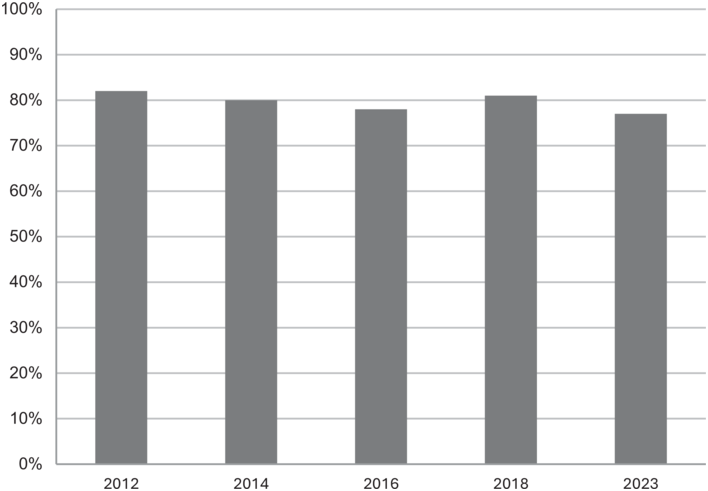
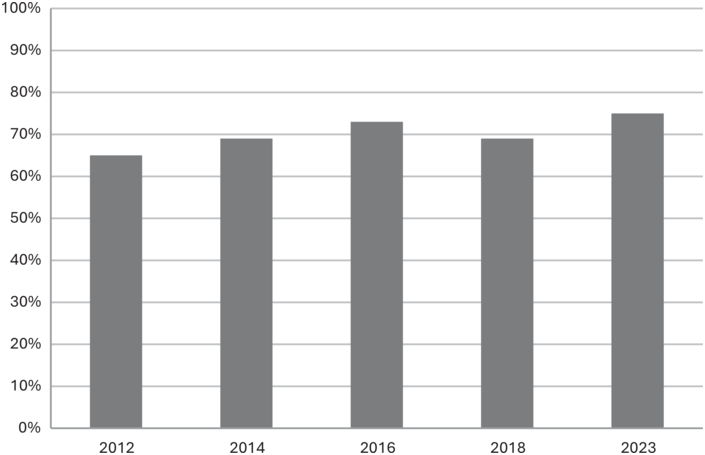
In contrast, in terms of moral conservatism, Cabildo Abierto emerged rejecting these policies of the Broad Front on gender and LGBTQ+ equality. For example, in its Letter of Principles, the party affirms: “We conceive the family as a pillar and a fundamental factor of social cohesion, which is in the first line of defense of life and plays an indispensable role in the initial formation of human values and the demographic horizon of the country.”Footnote 11It is important to note that there was no reaction in public opinion regarding these policies, even after the promulgation of these laws. Concerning the voluntary interruption of pregnancy, there was a small variation over time in support for abortion in cases where the mother’s health is at risk (see Figure 7.1). There is also no significant variation in support for equal marriage, which remains very high among Uruguayan citizens (see Figure 7.2). In this sense, in 2019 there was no cultural reaction regarding the sociocultural dimension of inequalities, but rather a politicization of this agenda by the far right to attract a moral conservative constituency that was no longer represented by any of the mainstream right parties in the country.
Approval of abortion in case the mother’s health is at risk in Uruguay (in %).
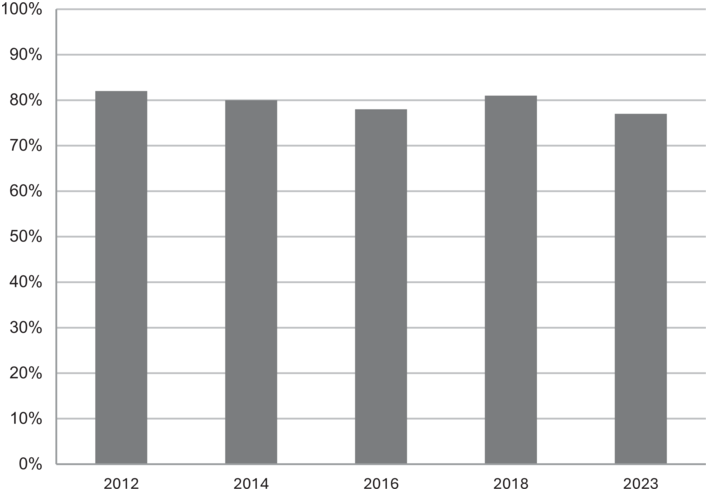
Figure 7.1 Long description
The data for the bar chart, sourced from LAPOP surveys, is measured on a scale from 0 to 1, representing the proportion of the population that supports this specific circumstance for abortion. The chart reveals remarkably high and stable public support for this issue over the eleven-year span. Approval begins at an already high level in 2012, maintaining consistently above 0.8 (80%) throughout the entire period. The trend line shows minimal fluctuation, indicating a solid and enduring consensus among the Uruguayan population regarding a woman's access to abortion when her health is endangered. The stability of these approval ratings suggests this is a settled issue in Uruguayan society rather than a subject of ongoing political debate.
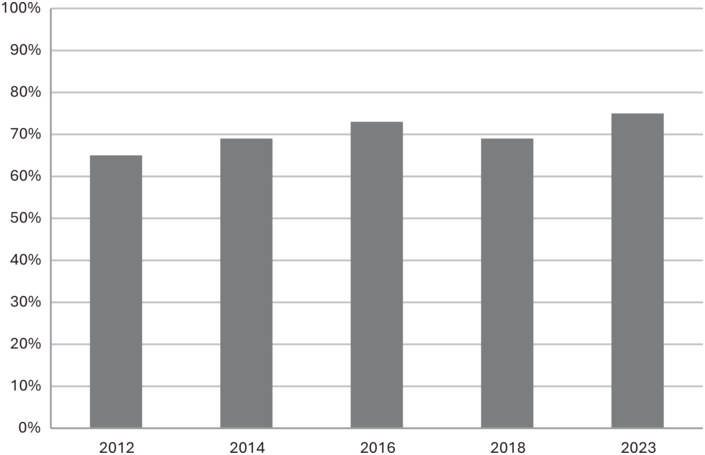
Figure 7.2 Long description
The bar chart is based on LAPOP survey data. The vertical axis measures approval on a scale from 0 to 1, representing the proportion of the population supporting marriage equality, while the horizontal axis tracks the years of measurement. The data reveals a clear and consistent upward trajectory in public support for same-sex marriage. Beginning at a moderate level in 2012, the approval rating shows steady growth across each measurement point. The trend line climbs progressively from 2012 through 2014, 2016, 2018, and finally to 2023, demonstrating uninterrupted expansion of public acceptance. By 2023, approval for equal marriage reached nearly 0.9 (90%), indicating that support transformed from moderate to overwhelming majority consensus over the eleven-year span. The sustained growth pattern suggests this represents a permanent shift in social attitudes rather than temporary fluctuation.
In the 2019 presidential elections, Cabildo Abierto strongly opposed these policies, sustaining its ties with the Catholic and Evangelical churches. Manini Ríos was the only candidate who openly voted in favor of a popular consultation to call a referendum to derogate the Law for Trans People,Footnote 12 and the party has several times expressed its opposition to the Law on Voluntary Interruption of Pregnancy and the Law on Equal Marriage. On that occasion, Manini Ríos stated in his Twitter account (now “X”) that “we do not agree with the gender ideology that they want to impose on our society.”Footnote 13 When asked by a journalist on TV Ciudad about the meaning of gender ideology, Manini Ríos had the following responses:
Manini Rios: “Who denies that there is a gender ideology?”
Journalist: “A lot of people.”
Manini Ríos: “Well, then they are oblivious to reality.”
Journalist: “What would gender ideology be?”
Manini Ríos: “An ideology is a tool to change people’s opinion about things that are true or not true, elaborated, structured on the basis of certain parameters. The gender ideology, in particular, is an ideology that seeks, using the term gender, to confront the man with the woman, the son with the mother. In this sense, we are against it.”Footnote 14
The party focused its campaign on the defense of the “Uruguayan family” in opposition to the idea of “gender ideology.” In its electoral manifesto, the party proposed to revise “the programs and texts of initial and primary education that contain concepts of gender ideology and the guides for sexual education.”Footnote 15 Until the arrival of Cabildo Abierto in the legislature, no party had so openly challenged the feminist movement, becoming the most visible political actor against the gender equality and LGBTQ+ rights agenda in the country (Abracinskas et al., Reference Abracinskas, Álvarez, Puyol and Correa2022).
In terms of penal punitivism, the slogan used by the party since the 2019 elections was “playtime is over.” The phrase again alluded to the end of the fifteen-year cycle of leftist governments and to a time of the recovery of values and restoration of order. The theme was highlighted in Cabildo Abierto’s Letter of Principles, in which the party stated: “We reaffirm the primordial action to recover public order and authority at different levels, to combat delinquency and dismantle organized crime, as well as to ensure the proper functioning of the judicial and prison systems.”Footnote 16
Like other far-right leaders and parties in Latin America, such as Bolsonaro in Brazil, the defense of “iron fist” policies on public security occupied the largest space in the electoral manifesto of Cabildo Abierto, with proposals such as “establishing the Legitimate Presumed Defense for police officers in the exercise of their duties and for all citizens within the limits of their property”; “enabling the police to request the corresponding identification of persons when circumstances so warrant”; limiting “the application of prosecution without imprisonment, provisional and early release, conditional suspension of the sentence, temporary releases, pardon and reduction of sentence for study”; and facilitating permission to “acquire and possess weapons for legitimate self-defense in a legal manner.”Footnote 17
Cabildo Abierto’s emphasis on issues related to moral conservatism and punitivism differentiated the party in the 2019 elections. Lacalle Pou, for example, based his campaign on two axes: reducing the fiscal deficit without raising taxes and maintaining the main social policies of the Broad Front (Pérez Betancur et al., 2019). In the sociocultural dimension of inequalities Cabildo Abierto positioned itself to the right of the mainstream right. This differentiation was also reproduced within the ruling coalition. However, the sociocultural dimension was not salient in the political and electoral competition during Lacalle Pou’s government or in the following presidential elections. On the contrary, the debate centered on the socioeconomic dimension, traditionally framed around the redistributive question that has long structured the dispute between traditional parties. This shift left Cabildo Abierto unable to operate in the terrain where it was best equipped to compete and highlights the broader challenges faced by the far right when the political agenda is dominated by issues they cannot effectively own.
Finally, it should be noted that Cabildo Abierto embraced some aspects of the pro-market agenda that were not emphasized in its participation in the Uruguayan public debate. In the first chapter of its 2019 electoral manifesto, called “Productive Country and Economy,” the macroeconomic objectives of the party were growth, stability, and employment; the fundamentals are fiscal discipline, trade openness, and inclusive competitive development; while some of the basic guidelines are “the generalized respect for private property” and “the gradual and selective reduction of public spending.”Footnote 18
There are two plausible hypotheses as to why the socioeconomic dimension was less emphasized in the Cabildo Abierto agenda. The first hypothesis is that there is little support in Uruguay for the “hardcore” neoliberal agenda, and therefore Cabildo Abierto preferred not to politicize this issue. The second hypothesis is that the issue of liberalism and the market economy did not differentiate Cabildo Abierto from other right-wing parties and therefore did not need to be emphasized.
7.4 Populism and (Neo)Patriotism in the Uruguayan Far Right
Although there were some populistFootnote 19 elements, together with those of (neo)patriotism, these seem to be the most relevant ideas in the discourses of Manini Ríos and Cabildo Abierto. Both attributes are articulated through the recovery of the figure of José Gervasio Artigas and in the vindication of the “foundational values” of the nation, which have been lost in the country’s recent history (Moreno Barreneche, Reference Moreno Barreneche2021). According to the Letter of Principles of Cabildo Abierto, artiguismo is “a conception of man, a conception of social economy and a conception of community life,”Footnote 20 which would entail, for Manini Ríos, “a recovery of the roots of our nationality.”Footnote 21
Cabildo Abierto recovered the political use made of the figure of Artigas by the right in other periods of Uruguayan history. Particularly during the military dictatorship, Artigas’ use was based, within the framework of the National Security Doctrine, on the values of nationality and the persecution of the internal enemy, in which all those who opposed these foundational values of nationality were considered traitors. Mainstream right-wing parties had not made this use, and Cabildo Abierto knew how to differentiate itself from blancos and colorados. It is important to note that Artigas’ claim is also part of the conservative tradition of the Manini Ríos family since Pedro Manini Ríos and the defense of the countryside, embedded in a populist nationalist discourse with a strong traditionalist and Catholic tone (Fraga, Reference Fraga, Broquetas and Caetano2023).
This ideal of the nation was the opposite of the current one, the product of a culture lacking in values, ruined by fifteen years of Frente Amplio governments (Fraga, Reference Fraga2021). In this sense, artiguismo constituted the possibility of rescuing the customs of a society undergoing rapid transformations, defending a monocultural nation centered on family and order.
Populism arose from a dichotomous perception of a society divided into two antagonistic groups, “the pure people” and “the corrupt elite,” in which politicians must express the “general will” of the people (Mudde, Reference Mudde2004). The populist rhetoric was manifested in a clear anti-establishment positioning, in the revaluation of the homeland and the army, and in the questioning of the political system as a whole (González, Reference González2023).
First, the degradation of Uruguay carried out by the Frente Amplio occurred with the connivance of the mainstream right parties concerning the “new” agenda of rights. Second, transnational elites’ (alleged) interference in Uruguay also involved the connivance of traditional political leaders. In this context, the figure of Artigas was rehabilitated as someone who fought for the people, and a strong anti-elite discourse was developed in which the national and transnational elites were corrupting the Uruguayan nation. The populist leader capable of saving the country from this situation? Manini Ríos. As Domenech pointed out: “Cabildo Abierto is inspired by the ideological legacy of Artigas. For 200 years, we lacked a leader with true national spirit. However, God has sent us Manini Ríos, and we have a new general to lead the artiguistas … If Artigas entered history, Guido Manini Ríos will make history.”Footnote 22
However, the main difference is that (neo)patriotism, unlike populism, emphasizes the state. This ideology opposes cosmopolitanism to nationalism and globalism to anti-globalism and seeks to question the values, norms, and institutions of the international liberal order. In this context, Cabildo Abierto emerged as a defender of peoples’ autonomy in the face of transnational elites who are enemies of tradition and national sovereignty (Sanahuja et al., Reference Sanahuja, López Burian, Vitelli, Pinheiro Machado and Vargas Maia2023). In its electoral manifesto, the party stated: “Uruguay’s international insertion and sovereign decisions cannot be subordinated to any foreign geo-strategy.”Footnote 23
(Neo)patriotism appeared in various forms in the ideas and discourses of the Uruguayan far right. First, in the defense of the rural sector, as pointed out by Domenech: “During these fifteen years, we have seen how multinational companies have acquired enormous extensions of land. Uruguay has fourteen million hectares and these companies have been given permission to buy up to seven million hectares … How many [small and medium landowners] have been expelled by this flow?”Footnote 24 Second, in the attack on international foundations, Manini Ríos criticized the left, “which I call sorista, for following the guidelines of that white-collar criminal called George Soros [founder of the Open Society Foundations], who with his policies is constantly dividing Uruguayans.”Footnote 25 Third, he criticized the institutions of the multilateral system, such as the United Nations, which he often accused of trying to undermine national sovereignty.Footnote 26 In one of his many declarations criticizing these spaces, Manini Ríos stated in his “X” account: “It is not coherent to talk about artiguismo and quietly comply with the decisions of international organizations.”
In synthesis, in the political rhetoric of Cabildo Abierto there was a constant opposition between the “elite” and the “people.” The Armed Forces would be the state institutions capable of safeguarding the nation’s true interests. Hence, the military’s centrality in the party’s life and the leadership of Manini Ríos in the Uruguayan far right.
7.5 The Far Right and Democracy in Uruguay
The far right in the Southern Cone has as a distinguishing feature its relationship with the military and with the legacy of military dictatorships, as the cases of Brazil, Chile, and, more recently, Argentina demonstrate.Footnote 27 This relationship is crucial to understanding Cabildo Abierto’s ambiguous attitude toward democracy, typical of the regional far right.
As noted earlier, the emergence of Cabildo Abierto was related to the reactions generated among the active and reserve military to the opening of judicial proceedings against those responsible for human rights violations perpetrated during the military dictatorship in Uruguay. The party’s electoral manifesto included several demands from military personnel and their families. The party’s links with the Armed Forces, their welfare services, and other military social organizations have been fundamental in Cabildo Abierto’s party-building process. The “military vote” was also a key factor in the party’s good results, and there was a correlation between the concentration of military personnel in the territory and votes for Cabildo Abierto in 2019Footnote 28 (Monestier et al., Reference Monestier, Nocetto, Rosenblatt, Moraes and Pérez Bentancur2021).
On the eve of the second round of the 2019 presidential elections, a controversial video of Manini Ríos appeared in which he asked the military personnel not to vote for the Broad Front candidate, Daniel Martínez.Footnote 29 The Military Center also publicly spoke out against the Broad Front in the electoral process, stating that “this Sunday will culminate the process of redemption of the rights and values of the Oriental people, wounded, undermined, scorned by fifteen years of Broad Front uprising.”Footnote 30 In 2020, already as part of the Multicolor Coalition and after Manini Ríos declared that the imprisonment of military personnel for crimes committed during the military dictatorship would be a “violation of human rights,”Footnote 31 the president of the Military Center, Carlos Silva, affirmed that Manini Ríos’ expressions were a “happy coincidence,” that “Cabildo and the Military Center com[ing] out to say the same thing means that our feelings are identical,” and that Cabildo Abierto “is the culmination of a favorable position of the Uruguayan population toward the Armed Forces.”Footnote 32
Given Uruguay’s democratic tradition, the far right could not make explicit declarations of support for the coup d’état or the legacy of the military dictatorship. For this reason, the counterpoint to the Broad Front was functional for Cabildo Abierto to carry out “historical revisionism” about the causes of the democratic breakdown and the country’s military takeover. In this sense, the far right installed a narrative that the coup d’état was the last alternative used to stop the armed ideological groups – the guerrillas – that were operating in the country. The main organization was the National Liberation Movement – Tupamaros (MLN-T), predecessors of the Popular Participation Movement (MPP), founded in democracy, led by the former president, José “Pepe” Mujica, and currently the principal faction of the Broad Front.
In this regard, the president of Cabildo Abierto, Guillermo Domenech, declared on his “X” account: “It is curious how a crowd of mourning compatriots remember the crimes caused by the dictatorship and ignore olympically those perpetrated by their own party or their partners on the road in the previous years.”Footnote 33
In 2022, at a ceremony held in the legislature for the fiftieth anniversary of the declaration of a state of internal war by the parliament in Uruguay, an act that preceded the coup d’état, Manini Ríos gave a speech in which he declared that: “Our police forces had to face this criminal action with their historical scarcity of material and human resources, added to the lack of knowledge of something new in our country, a criminal organization formed to seize power.”Footnote 34
In August 2023, Cabildo Abierto approved a law that compensates the victims of ideological armed groups – las guerrillas – between 1962 and 1976, in a clear dispute over the narrative about the causes of the breakdown of the democratic system in Uruguay.Footnote 35
There is a common understanding in Cabildo Abierto of the importance of the Armed Forces’ involvement in the country’s development. In its electoral manifesto, for example, the party proposed the creation of military colleges in the east and west to diversify the educational offer for young people in the countryside.Footnote 36 This interaction between politics and the Armed Forces strained the democratic political system in Uruguay (Sanahuja et al., Reference Sanahuja, López Burian, Vitelli, Pinheiro Machado and Vargas Maia2023). First, because the conflicts with the state over the judicial processes related to the military dictatorship weaken the basic norms and procedures of a (liberal) democracy. By questioning the judiciary’s role in these investigations, Manini Ríos and Cabildo Abierto went against the separation of powers and the rule of law. Secondly, because the rescue of nationalism and traditionalism that place the question of order at the center of their ideas and discourses is allied with the ideological elements of the far right opposed to the diffusion of cosmopolitan and multicultural values of “cultural revolution” (Zanotti & Roberts, Reference Zanotti and Roberts2021).
On November 13, 2023, Manini Ríos acknowledged having been responsible (a key factor) in creating the Cabildo Abierto party when he was still commander-in-chief of the army. In his own words: “The name Movimiento Social Artiguista was my idea. The initial proposal of the name was given by me when I was active, and I chose the first flag of Artigas to represent us.”Footnote 37
Finally, it is worth noting that the importance of the Armed Forces for the far right is not exclusive to Uruguay. The weakening of democratic rule based on the relationship between the far right and the Armed Forces has been observed throughout the region, with the paradigmatic case of Brazil, where at least a sector of the military personnel was complicit in the attacks of January 8, 2023, and the attempted coup d’état in the country.Footnote 38
7.6 A Price for Belonging: Cabildo Abierto in the Multicolor Coalition
The mainstreaming and normalization of far-right ideas have also resulted in the participation of these leaders and parties in government coalitions (Mudde, Reference Mudde2019). In Europe in particular, where the rise of the far right occurred much earlier compared to Latin America, the electoral success of the far right has raised questions about the impact of these actors on policy formulations (see Afonso, 2015; Akkerman, Reference Akkerman2012; Röth et al., Reference Röth, Afonso and Spies2017).
While the far right has a programmatic offer and an electoral demand focused on the sociocultural dimension, these actors also affect socioeconomic policies. Röth and colleagues (Reference Röth, Afonso and Spies2017), in their study of government coalitions composed by the far right in Western Europe, argue that the far right has incentives to support market deregulation and privatization but not to support welfare retrenchment. However, little is known about how these actors interact and impact other government coalitions worldwide.
Cabildo Abierto was the first case in Latin America where the far right officially participated in a government coalition led by the mainstream right. The Multicolor Coalition was an electoral agreement between five right-wing parties that had defined themselves as supporters of Lacalle Pou and opponents of the Broad Front in the second round of the 2019 presidential elections: the National Party, the Colorado Party, the Independent Party, the People’s Party, and Cabildo Abierto. The agreement included the programmatic document called Commitment for the Country, which aimed to “offer a parliamentary majority that will allow us to govern smoothly, and a variety of approaches and sensibilities that will help us to provide better responses to the diversity of needs and aspirations of Uruguayans.”Footnote 39
The Multicolor Coalition introduced a new pattern of right-wing alliances in Uruguay, which, until then, consisted only of blancos and colorados. On the one hand, the integration of Cabildo Abierto into the governing coalition demonstrated the party’s remarkable ability to adapt to Uruguay’s increasingly competitive political landscape structured around two programmatic coalitions – one on the left and one on the right – and favored its integration into the party system. On the other hand, Cabildo Abierto’s participation in the Executive Branch also allowed the mainstream right to organize the political right more effectively. In this sense, Lacalle Pou and the National Party created stronger incentives for stability and continuity than for rupture and abandonment (Rilla, Reference Rilla, Broquetas and Caetano2023).
However, joining a governing coalition in the year of its formation placed significant constraints on Cabildo Abierto’s development as a distinct political force. From the beginning, the party was subordinated to the government’s logic and President Lacalle Pou’s leadership. The president’s high popularity left little room for dissent or differentiation. As a minority partner, Cabildo Abierto lacked the leverage to shape the coalition’s agenda and was compelled to align with broader government positions. This limited its capacity to articulate a distinctive programmatic identity and undermined its efforts to consolidate as a lasting presence in the party system. Ultimately, its office-seeking strategy secured short-term visibility but weakened its autonomy and long-term viability.
Between 2020 and 2022, Cabildo Abierto presented forty bills but only managed to pass the law that compensates the victims of the armed groups between 1962 and 1976 in August 2023. On the occasion the law was approved, Domenech declared: “The victims of the armed movements of political character caused numerous material damages and particularly the loss of lives of about a hundred people, which inexplicably our society has not repaired materially or morally in almost forty years of restored democracy.”Footnote 40
Despite its early attempts to carve out a distinct space through a platform centered on moral conservatism and penal punitivism, Cabildo Abierto struggled to gain traction on these issues during the Lacalle Pou administration. On the one side, the COVID-19 pandemic dominated much of the government’s agenda, redirecting public debate toward health policy and economic recovery, and thereby marginalizing the party’s core themes. On the other side, in the opposition, the Broad Front largely avoided engaging with these topics, leaving Cabildo Abierto without a clear ideological adversary against which it could define its identity and sharpen its message.
On the eve of the 2024 national elections, Cabildo Abierto sought to broaden its appeal by engaging with socioeconomic issues. The party launched a campaign to collect signatures for a plebiscite on a bill aimed at restructuring individuals’ debts – an initiative strategically timed to coincide with the local elections in May 2025. This move targeted a large segment of the electorate, as 657,000 people were classified as irrecoverable debtors by the Central Bank of Uruguay.Footnote 41 It represented a clear effort to reposition the party within the dominant agenda of the electoral cycle, shifting away from its traditional focus on moral conservatism and penal punitivism. However, the strategy failed to gain institutional traction: the signatures were not validated by the Electoral Court, and the plebiscite was ultimately rejected. This outcome marked a significant setback for Cabildo Abierto, underscoring its limited ability to politicize socioeconomic issues and to build visibility beyond its original ideological niche.Footnote 42
Despite this electoral and programmatic frustration, Cabildo Abierto remained formally integrated into the Multicolor Coalition. The government alliance, for the most part, held together, passing key legislative initiatives such as the Urgent Consideration Law and the Budget Law (Vairo & Antia, Reference Vairo and Antia2023). The members of the coalition also showed commitment to Cabildo Abierto, voting in favor of Manini Ríos continuing to enjoy parliamentary immunity (a privileged status) in the context of an investigation and judicial process accusing him of failing to report human rights violations committed during the military dictatorship (Rossel & Monestier, Reference Rossel and Monestier2021). According to opposition senators, the support of members of the Multicolor Coalition for this bill was in exchange for a vote on the pension reform (Vairo & Antia, Reference Vairo and Antia2023). Additionally, potential tensions in the coalition were not limited to Cabildo Abierto and also occurred between different government actors. One example is the bill to create a media law. After two years of negotiations, the bill failed to advance due to opposition from the Colorado Party and Cabildo Abierto.
Even while formally aligned with the government, Cabildo Abierto repeatedly sought to differentiate itself from Lacalle Pou’s leadership, criticizing what it labeled a “presidentialist and personalist model,”Footnote 43 or through ideological conflicts with the other parties in the coalition. In response to statements by Fatima Singhateh, UN Special Rapporteur on the sale and sexual exploitation of children, the president of Cabildo Abierto said that her comments were “out of place” and that they responded to “an absolute disregard for our national sovereignty,” “something that is becoming a habit” (Barrios, 2023).Footnote 44 On another occasion, Domenech criticized a gender parity bill by National Party Senator Gloria Rodríguez as a “fascist proposal.”Footnote 45 In May 2023, following a conflict that led to the resignation of Housing Minister Irene Moreira, wife of Manini Ríos, the party questioned its permanence in government, eventually deciding to remain in the coalition.Footnote 46
In this context, the scope for Cabildo Abierto to act was limited, either due to Lacalle Pou’s high popularity, as with the National Party, or due to its right-wing tradition, as with the Colorado Party (Rilla, Reference Rilla, Broquetas and Caetano2023). These parties wanted to win back part of the electorate lost to Cabildo Abierto in the 2019 elections, an aim that seems to have been achieved in 2024 by all the traditional parties together. At the same time, it was easier for the Broad Front to confront its traditional opponents on socioeconomic issues than engage in the moral and punitivism issues that defined Cabildo Abierto’s agenda. In this way, taking into account Uruguay’s historical bipartisan model, and that there has been no escalation of conflicts in the country until now, it is possible to think that the Cabildo Abierto may be neutralized in the coming years, as it was in the 2024 elections.
7.7 Conclusion: The Future of the Far Right in Uruguay
This chapter offered an analytical approach to the emergence of the far right in Uruguay. The case study helped illuminate how far-right actors seek to establish a programmatic offer in a context marked by a stable democracy and institutionalized parties. The following reflections summarize the peculiarities of the Uruguayan case and its limitations and potentialities.
Cabildo Abierto represented a unique political experiment in Latin America: a far-right party that attempted to build an institutionalized and lasting political project from the ground up. Unlike the personalist projects of Bolsonaro in Brazil, Bukele in El Salvador, or Milei in Argentina – and unlike Chile’s Republican Party, which emerged as a splinter from the mainstream right – Cabildo Abierto was neither centered on a single charismatic figure nor rooted in pre-existing party structures. In this sense, it stood out as a potential model for far-right party-building in the region. However, this attempt seems to have faltered. The party failed to consolidate its position in the party system and could not sustain its initial electoral momentum. At least for now, Cabildo Abierto appears to be a “negative case”: an example of the structural and strategic limitations that far-right forces face in political contexts with strong democratic institutions and entrenched partisan traditions.
Cabildo Abierto was classified as far right primarily due to its positions on the sociocultural dimension, especially its defense of conservative values and punitivist policies. These positions were particularly effective in the 2019 election, when the party presented itself in stark opposition to the Broad Front’s long-standing rule. However, this strategy proved less effective in 2024, as the national debate shifted. At the same time, the party’s positions on the socioeconomic dimension remained ambiguous. Its legislative behavior and official discourse often aligned with the leadership of President Lacalle Pou, making it difficult to identify a independent stance on economic matters. So far, Cabildo Abierto’s programmatic identity appeared more reactive than proactive – shaped by opposition to the left rather than by a coherent alternative project.
One of the most distinctive features of Cabildo Abierto was its appeal to the past. Terms such as “recovery” and “restoration” frequently appeared in the party’s rhetoric, expressing a nationalist and traditionalist vision that had been largely absent from the mainstream right in Uruguay. This allowed the party to differentiate itself discursively by strongly opposing the legacy of left-wing governments and positioning itself as the defender of values perceived as eroded over time.
The idea of “family,” whether “military” or “Uruguayan,” played a central role in Cabildo Abierto’s political message, helping the party resonate with both military circles and religious voters. This close relationship with the Armed Forces, as well as with Catholic and Evangelical churches, reinforces the classification of Cabildo Abierto as a far-right party. This connection manifests not only through the party’s willingness to challenge liberal-democratic norms but also through its embrace of order, hierarchy, and resistance to cosmopolitanism and multiculturalism.
In light of Cabildo Abierto’s sharp decline, two questions stand out for future research. First, how has participation in the ruling coalition as a junior partner affected the party’s political and electoral performance? Second, to what extent has the party’s constant opposition to the Broad Front prevented it from building a broader identity that might have given it greater resilience in the long term? Cabildo Abierto’s trajectory thus offers valuable insights into the challenges faced by far-right parties seeking to institutionalize themselves within stable democratic systems.
Finally, the Uruguayan case invites further reflection on the role of institutional strength and political culture in shaping the trajectory of far-right forces. Uruguay may serve as a crucial example of the limitations faced by far-right political projects in highly institutionalized party systems. Uruguay is the most secular country in Latin America, with the highest proportion of people without religious affiliation, which limits the space for religiously motivated far-right actors. Nonetheless, the emergence of Cabildo Abierto highlights that even in a highly institutionalized and secular context, there is room – albeit limited – for far-right ideas and actors to surface. Cabildo Abierto may ultimately be a reactive and short-lived phenomenon, but its rise points to the possibility of a more enduring far-right force in the future. Will Cabildo Abierto reemerge as an autonomous right-wing party? Will it disappear altogether? Or will a new far-right actor learn from this experience and find a more sustainable path forward? The future of the far right in Uruguay remains uncertain – in a country historically unaccustomed to abrupt changes in its democratic political landscape.

 Open access