1 Introduction
Research, in education and beyond, is not neutral. Very little, if any, research can be truly value-free (Carr, Reference Carr2000). A researcher’s onto-epistemic assumptions – their knowledge system, beliefs, and the relationships they hold with participants – inherently shape the research methodology, its design, and its execution. These assumptions influence which knowledge systems are privileged, which stories are told, which questions are asked, and how data are analysed and interpreted (Chiblow, Reference Chiblow2021; Smith, Reference Smith2021).
Historically, education research has been dominated by positivist paradigms that assume objectivity and neutrality are both possible and desirable (Colorado, Reference Colorado1988; Denzin & Lincoln, Reference Denzin and Lincoln2018; Ermine et al., Reference Ermine, Sinclair and Jeffery2004; Leonard, Reference Leonard2017; Smith, Reference Smith2021; Tuck & Yang, Reference Tuck and Yang2012). These traditions favour quantitative methodologies, such as standardised assessments, large-scale surveys, and controlled experiments, aimed at producing generalisable knowledge and objective measurements of learning outcomes (Shavelson & Towne, Reference Shavelson and Towne2002).
However, these approaches face increasing critique for their reductionist tendencies and for failing to account for the complex, dynamic, and context-dependent nature of educational processes (Berliner, Reference Berliner2002). Guba and Lincoln (Reference Guba, Lincoln, Denzin and Lincoln1994) argue that positivist paradigms and rigid methodological structures often overlook the rich qualitative dimensions of educational settings. Similarly, Cohen, Manion, and Morrison (Reference Cohen, Manion and Morrison2017) caution that methodological simplification undermines ecological validity: that is, findings may not adequately represent the lived experiences of learners and educators, particularly those from non-dominant, Indigenous, and minoritised groups (Battiste, Reference Battiste2013).
Contemporary qualitative research has increasingly begun to acknowledge shortcomings in educational settings and no longer supports the myth of a neutral researcher. For example, research methods grounded in naturalistic inquiry (Lincoln & Guba, Reference Lincoln and Guba1985) and postqualitative frameworks (St. Pierre, Reference St. Pierre, Denzin and Lincoln2011) position the researcher as a situated, reflexive, and co-constitutive presence. Despite this, binary divides between quantitative and qualitative research methods in education persist, often overlooking colonial legacies, Indigenous kincentric and relational ethics, or land-based accountability (Meighan, Reference Meighan2022a; Smith, Reference Smith2021). Dominant, mainstream conceptualisations of education – typically synonymous with formal schooling – have been shaped and conducted through Eurocentric, ethnocentric knowledge systems, methods, and values (Creswell, Reference Creswell2013; Dutton, Reference Dutton and Steinmetz2005; Liu, Reference Liu, Denzin and Lincoln2011; Meighan, Reference Meighan and Chapelle2025a). This framing excludes alternative understandings of education, such as Indigenous education, where landFootnote 1 is considered the first teacher (McGregor et al., Reference McGregor, Restoule and Johnston2018).
This Element therefore examines how mainstream education research can be redesigned – from conceptualisation through dissemination – to enact kincentric and relational methodologies that address colonial legacies, centre Indigenous worldviews, uphold data sovereignty, and sustain land-based accountability.
1.1 Colonial Legacies in Education Research
Education research has often perpetuated colonial legacies, and education has been – and continues to be – weaponised as a key tool of colonisation (Battiste, Reference Battiste2013; Meighan, Reference Meighan and Chapelle2025a; Smith, Reference Smith2021). Colonisation is the practice of domination and can be defined as ‘the action or process of establishing a colony or colonies in a place, especially as part of an effort (typically by a foreign state) to appropriate the area settled and to assert political control over any Indigenous inhabitants’ (Oxford English Dictionary, 2025).
An early English usage captures this colonial logic. One of the first recorded uses of the word colonisation in English occurs in a book by Samuel Boyse (Reference Boyse1747), written in the aftermath of the 1745 Jacobite Rising in Scotland and the ensuing subjugation of Indigenous Gaels in the Gàidhealtachd (Gaeldom, the Scottish Highlands and Islands):
Something seems yet further wanting to compleat this great Work, which may be the Glory of his Majesty’s Reign. This is the Colonization of the new depopulated parts of the Highlands by an industrious Set of People, who, by intermixing with the Natives [Scottish Gaels], may teach them the inestimable Advantages arising from Diligence and Commerce.
The Care of the Society for propagating Christian Knowledge in the Highlands, may in Time greatly contribute to the desirable End of reforming and improving the Highlands, by erecting Schools for introducing the Use of the English Language, and diffusing the true Knowledge of the Gospel through those Regions for long benighted by Ignorance and Superstition.
This rhetoric exemplifies how education was explicitly weaponised to ‘reform and improve’ the Highlands by erasing language, culture, and traditional governance. Mainstream education worldwide has likewise sought to ‘“erase and replace” linguistically encoded knowledges and cultural identifications with those associated with dominant-class ideologies, values, and practices’ (McCarty, Reference McCarty, Tollefson and Pérez-Milans2018, p. 356). As Indigenous (Māori) scholar Smith (Reference Smith2021) elaborates, ‘the coloniser did not simply design an education system. They designed an education especially to destroy Indigenous cultures, value systems and appearance. Those systems were called Indian boarding schools, residential schools, village day schools’ (p. 22). Today, Indigenous educational practices – such as land-based learning, transmission of cultural and ecological knowledge, and storytelling – continue to be marginalised and afforded little ideological and implementational space within mainstream education (Archibald, Reference Archibald2008; Battiste, Reference Battiste2013; Hornberger, Reference Hornberger2005).
In research, Indigenous peoples have frequently been positioned as ‘subjects’ or ‘objects of study’, with little regard for the social realities they face or the impact of research on their well-being (Assembly of First Nations, 2009; Cajete, Reference Cajete2000; Deloria, Reference Deloria1991; Gilchrist, Reference Gilchrist1997). Research has historically been carried out on, rather than in collaboration with, Indigenous peoples and minoritised groups worldwide (McGregor et al., Reference McGregor, Restoule and Johnston2018; Meighan, Reference Meighan2023). Smith (Reference Smith2021) explains, ‘“research” is inextricably linked to European imperialism and colonialism … [It] is probably one of the dirtiest words in the Indigenous world’s vocabulary … it stirs up silence, it conjures up bad memories, it raises a smile that is knowing and distrustful’ (p. 1).
Decolonisation can be defined as ‘the process of eliminating the effects or influence of colonisation or colonialism on attitudes, assumptions, power structures, institutions, etc.’ (Oxford English Dictionary, 2025). This Element on decolonising research practices in education therefore seeks to put this process into action, replacing extraction with relationship and control with community governance. The following subsection turns to positionality and self-location as the ethical foundation for that work.
1.2 Researcher Positionality and Reflexivity
To counteract colonial legacies and harmful education research practices, Indigenous scholars emphasise the necessity of researcher positionality – sometimes referred to as ‘self-location’ (Absolon, Reference Absolon2011) – before embarking on research, especially with Indigenous and minoritised communities (Kovach, Reference Kovach2009; McGregor et al., Reference McGregor, Restoule and Johnston2018; Riddell et al., Reference Riddell, Salamanca, Pepler, Cardinal and McIvor2017). These practices are particularly essential when engaging with Indigenous and minoritised communities beyond one’s own, to avoid perpetuating colonial harms.
1.2.1 The Role of Positionality and Self-Location
Positionality acknowledges that the researcher’s social, historical, and political location fundamentally shapes their orientation to the research; they are not separate from the social processes they study (Darwin Holmes, Reference Darwin Holmes2020; Fitzpatrick & May, Reference Fitzpatrick and May2022). Authentic self-location is complex, as every researcher brings unique worldviews, assumptions, and interpretations of knowledge and reality to their work. For novice researchers, articulating positionality can be particularly challenging. Many have never been required to position themselves or have lacked guidance on how to do so (Darwin Holmes, Reference Darwin Holmes2020; Meighan, Reference Meighan2022a). As Darwin Holmes (Reference Darwin Holmes2020) explains, ‘for new researchers doing this can be a complex, difficult, and sometimes extremely time-consuming process. Yet, it is essential to do so’ (p. 20).
1.2.2 Reflexivity as a Foundation for Ethical Research
Positionality and self-location require reflexivity: an ongoing examination of the researcher’s relationship to their research and participants. This is not optional; it is essential for equitable, trustworthy, and transformative research in education (Absolon & Willett, Reference Absolon, Willett, Brown and Strega2005; Held, Reference Held2019; Lavallée, Reference Lavallée2009; Marom & Rattray, Reference Marom and Rattray2019). As Absolon (Reference Absolon2011) reminds us, ‘location does matter. People want to know who you are, what you are doing, and why’ (p. 73).
When engaging with Indigenous and decolonising research – and given the harmful impacts of Eurocentric research on Indigenous communities worldwide – positionality requires researchers to examine their own intersections with colonialism and undertake a process of self-decolonisation (Geniusz, Reference Geniusz2009; Meighan, Reference Meighan2022a). Positionality enables researchers to be transparent about their intentions, avoid perpetuating extractive research practices, and build trust with Indigenous peoples and communities, enabling them to decide whether to consent, or refuse, participation in any research collaboration (McGregor et al., Reference McGregor, Restoule and Johnston2018).
Researcher reflexivity informs positionality by foregrounding the researcher’s ‘origins, biography, locality, and intellectual bias’ (Blackman, Reference Blackman2007, p. 700; Consoli & Ganassin, Reference Consoli and Ganassin2023). While positionality involves recognising one’s onto-epistemic standpoint and influences, reflexivity involves actively reflecting on, documenting, and openly addressing these influences in the research process. As Malterud (Reference Malterud2001) describes,
Reflexivity starts by identifying preconceptions brought into the project by the researcher, representing previous personal and professional experiences, pre-study beliefs about how things are and what is to be investigated, motivation and qualifications for exploration of the field, and perspectives and theoretical foundations related to education and interests.
In essence, reflexivity exposes power dynamics and fosters transparency and trust with research participants. Stegra and Brown (Reference Stegra, Brown, Strega and Brown2015) state, ‘reflexivity – a recognition that the researcher is not separate from but exists in relationship with what s/he is trying to understand – is a core component of ethical research practice’ (p. 8). Reflexivity, and the explicit disclosure of positionality, is therefore understood not as a performance, but as an ethical and onto-epistemic necessity, guiding knowledge creation with integrity rather than distancing objectivity. Here, I introduce myself, my positionality, and self-location as a researcher committed to ethical and relational research practice, particularly in educational contexts.
1.2.3 Cò Leis a Tha Mi? | Who am I?
Is mise Pòl Miadhachàin-Chiblow. Pòl Mac Angusina Doileig Aonghais ’ill Easbaig ’ic Aonghais ’ic Eòghainn ’ic Iain. ’S e Gàidheal a th’ annam. Rugadh agus thogadh mi ann an Glaschu, Alba, agus ’s ann à Uibhist a Deas a tha mo theaghlach. My name is Paul Meighan-Chiblow. Paul, son of Angusina, daughter of Dolina, daughter of Angus, son of Archiebald, son of Angus, son of Ewen, son of John. I am Gael, Indigenous to the Scottish Highlands and Islands. I was born and raised in Glasgow, Scotland.
My work and research in education are informed by my experiences as a Gael and a first-generation scholar. I was raised in Glasgow, in a council housing scheme and socio-economically deprived neighbourhood, by my late mother from the Isle of South Uist, heartlands of Scottish Gaelic. South Uist is community-owned, a Key Biodiversity Area at the frontlines of the climate crisis, and highly vulnerable to rising seawater levels. Gaelic is an endangered Indigenous language in Scotland. I remember hearing Gaelic all the time around my late grandmother, who was the core of our family. However, Gaelic was not available to me in the British, English-medium educational system, and when I asked my grandmother to teach me, she said no, I did not need Gaelic. I did not understand at the time, but now, as an adult, I understand more.
Over the centuries, Gaelic language and culture was almost destroyed due to many reasons, such as legislation and policy that made education mandatory in Latin (Education Act, 1496) and then in English (e.g., the Iona Statutes, 1609; School Establishment Act, 1616; Education (Scotland) Act, 1872); projects to ‘civilise’ the Gàidhealtachd, such as the Fife Adventurers in 1598 and English schools run by the Society for the Propagation of Christian Knowledge (1709); the destruction of Gaelic clan-based society after the Battle of Culloden in 1746 by British and imperial forces; and the Highland Clearances (1785–1886), when Scottish Gaels were forcefully evicted from their homes and traditional territories.
In 1816, Patrick Sellar described Gaelic as the ‘barbarous jargon of the times when Europe was possessed by savages’, and John Pinkerton wrote about the Gaels in 1794, ‘had all these Celtic cattle emigrated five centuries ago, how happy had it been for the country! All we can do now is plant colonies among them; and by this, and encouraging their emigration, try to get rid of the breed’ (as cited in MacKinnon, Reference MacKinnon2017, pp. 35–38).
After the Education Act (Scotland) of 1872, education and English became synonymous, with zero provision for Gaelic. The educational system transmitted to Gaels and Gaelic speakers a colonised mentality and an internalised deficit ideology, such as ‘a deep and subtle feeling that English must be superior to Gaelic’ (Smith, Reference Smith1982). And, today, members of my family and older generations remember physical and mental violence, such as being beaten for speaking Gaelic in classrooms. These destructive and discriminatory educational processes are not unique to me nor the Gaelic context alone, but rather illustrate how colonialism and imperialism are nuanced global phenomena with dimensions internal and external to ‘modern’ nation–states, like what is now known as the United Kingdom. They also demonstrate how education has been, and continues to be, weaponised as a colonising tool (Section 1.1; Meighan, Reference Meighan and Chapelle2025a).
Today, I continue on a Gaelic reclamation journey alongside my work and research towards addressing ongoing education inequities, such as colonialingualism, which I have defined as the privileging of dominant colonial languages, knowledges, and neoliberal valorisations of diversity in education and policy (Meighan, Reference Meighan2022b). While I am Indigenous to the Scottish Highlands and Islands, I am also queer and racialised as white, living within systems that advantage those positioned as white and often erase my Indigenous identity. My motivation for equitable multilingual and multicultural education that addresses racial, epistemic, and linguistic hierarchies has continued to grow since meeting my Indigenous (Anishinaabe Ojibwe) husband in Glasgow in 2015 and after immigrating to be with him in Turtle Island in 2016 (also known as North and Central America). I have learned more about the devastating impacts of colonialism, such as Canadian residential schools, on the Indigenous Peoples of Turtle Island from discussions with my Anishinaabe family (see also Truth and Reconciliation Commission of Canada, 2015). These critical discussions have been transformational for my learning and have further informed my current research as a guest on lands to which I am not Indigenous.
1.2.4 Note on Terminology and Recognition
Scottish Gaelic is often addressed in law and policy through minority language frameworks rather than through United Nations (UN) Indigenous rights instruments (e.g., May, Reference May2025), reflecting prevailing governance pathways rather than a definitive indicator of Indigeneity. UN human rights guidance notes that there is ‘no singularly authoritative definition of Indigenous peoples under international law and policy’ and centres Indigenous peoples’ right of self-determination (Office of the UN High Commissioner for Human Rights, n.d.). The UK Government has historically taken the position that there are no Indigenous peoples within the UK (UK Parliament, 2007), which helps explain why Gaelic is more often routed through minority language regimes. Scottish Government materials for the Scottish Languages Bill – now the Scottish Languages Act (2025) – nonetheless refer to Gaelic (and Scots) as ‘Scotland’s Indigenous languages’ (Scottish Government, 2024), and the Act itself sets out place-based provisions such as ‘areas of linguistic significance’ for Gaelic communities (Scottish Parliament, 2025). In this Element, Gaelic Indigeneity is understood as relational and place-based, grounded in long-standing, intergenerational responsibilities to ancestral lands, kin, and communities that predate modern nation–state boundaries. This Element therefore notes a recognition asymmetry: policy can recognise an ‘Indigenous language’ and map its historical territories without fully recognising – or adequately resourcing – the self-determining Indigenous communities themselves who transmit and sustain the language and culture.
1.3 The Methodological Gap in Mainstream Educational Research
Indigenous research methodologies centre decoloniality through Indigenous worldviews (Smith, Reference Smith2021), relational accountability (Wilson, Reference Wilson2001), and kinship with human and more-than-human relations (McGregor et al., Reference McGregor, Restoule and Johnston2018). However, mainstream educational research has yet to fully operationalise these principles within methodological frameworks. A significant gap remains in translating these principles into actionable research practices within dominant research traditions.
Before entering a research context – particularly within Indigenous and minoritised communities – begin with positionality and self-location. Pause before entering a community context and ask:
(1) Who am I in relation to this community?
(2) What responsibilities do I hold?
(3) How can I ensure that research relationships remain reciprocal, respectful, and sustaining?
Share who you are, where you come from, and what responsibilities you hold. This transparency builds trust, provides participants with agency to consent or decline participation, and demonstrates that you approach research as a relational process rather than an extractive act. Practical tools may include reflexive journaling, storywork (Archibald, Reference Archibald2008), or a sloinneadh (Gaelic word for community lineage and relationships) to share who you are in relation, always undertaken with respect to community protocols and cultural expectations.
1.4 Introducing Dùthchas as a Kincentric, Relational Methodology
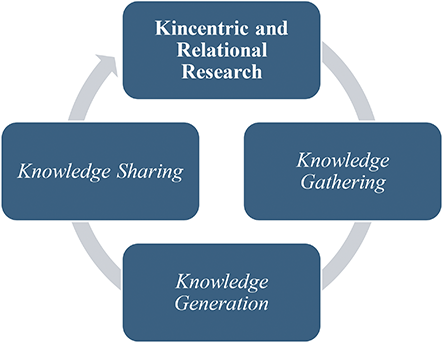
In response to this methodological gap, this Element introduces Dùthchas, a millennia-old Indigenous Gaelic concept, embodying kinship, responsibility to land, and place-based belonging (Meighan, Reference Meighan2022a). I operationalise Dùthchas as a kincentric and relational methodology that fosters ethical, community-centred educational research. Throughout this Element, kincentric and relational methodologies are understood as being rooted in relationships. By kincentric, I mean methodologies premised on reciprocal and accountable relations among people, land, and more-than-human kin that inform how knowledge is gathered, generated, and shared. Researchers are embedded, accountable participants, moving from data collection to knowledge gathering, data analysis to knowledge generation, and findings/dissemination to knowledge sharing (see Sections 3–6). Offered from my perspective as an Indigenous Gael, this orientation is situated and non-prescriptive, to be adapted under local protocols, community leadership, and consent.
1.4.1 What Is Dùthchas?
Dùthchas is an intrinsic part of the sealladh a’ Ghàidheil (Gaelic worldview) and is derived from the Gaelic root word ‘dú/dùth’, meaning ‘earth’ or ‘land’ (MacKinnon & Brennan, Reference MacKinnon and Brennan2012). Dùthchas can have several meanings, both internal and external dimensions, such as hereditary right or claim, birthright, heritage, native or ancestral home, kindred affection, or innate quality (McQuillan, Reference McQuillan2004). The word exists both as Dùthchas in Gàidhlig (Scottish Gaelic) and as Dúchas in Gaeilge (Irish). As a Gaelic onto-epistemology and methodology, Dùthchas emphasises the interconnectedness of people, land, culture, and an ecological balance among all entities, human and more than human (Meighan, Reference Meighan2022a). Importantly, Dùthchas, as a dynamic, fluid ontology and praxis, goes beyond a mere ‘feeling’ of identification with place and community to tangible conduct and action motivated by a sense of ethics, respect, and responsibility for said place and community to maintain ecological balance (Meighan, Reference Meighan2022a, p. 5). Oliver (Reference Oliver, Nicolson and Meikle2021) adds,
Dùthchas is that ontological dynamic of embodied experience and emplacement (‘on the ground’), and complex entanglement (‘in the mind’) with relationships of belonging and dwelling, heritage and inheritance, a human ecology with ‘place’ (including, where relevant, land) … This sense of belonging and responsibility, when conceived of as praxis, as emplaced ethical relations, ‘is political, social and cultural imagination in action’.
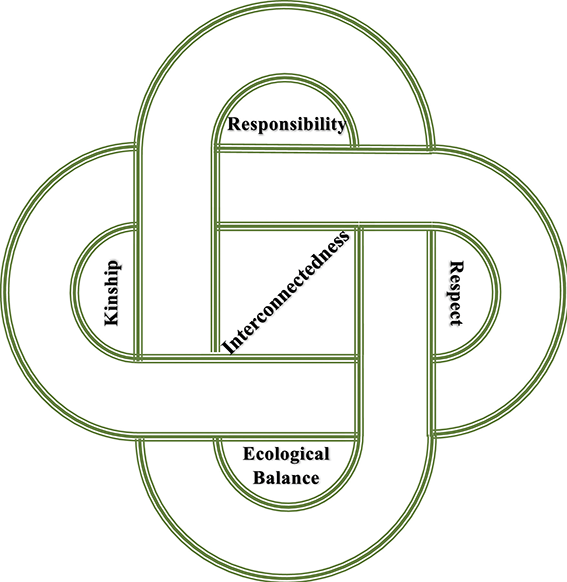
As such, Dùthchas prioritises kinship, relationality, respect, and responsibility, serving as a guiding principle for emplaced ethical relations, community-led research, and self-decolonisation practices. Drawing on Indigenous Gaelic scholarship and my own worldview as an Indigenous Gael, I operationalise Dùthchas as a kincentric and relational research methodology, composed of five core principles (Figure 1; Meighan, Reference Meighan2022a):
(1) Interconnectedness: Recognising dynamic, holistic relationships within the research context.
(2) Responsibility: Commitment to ethical processes and accountability to the land, place, relationships, and more than humans encountered during the research.
(3) Respect: Beyond institutional ethics board approvals, answerability to the local community and community-specific knowledge and cultural protocols.
(4) Ecological Balance: Prioritising sustainable relationships with lands, waters, and communities to minimise the environmental impact of research.
(5) Kinship: Viewing participants relationally as extended family and kin networks rather than research subjects.
Gaelic knot representing Dùthchas principles.

Thus, Dùthchas, as a kincentric, relational methodology centres Indigenous knowledge systems; researcher positionality and self-location (Absolon, Reference Absolon2011); researcher reflexivity (Consoli & Ganassin, Reference Consoli and Ganassin2023); relational accountability and reciprocity (McGregor et al., Reference McGregor, Restoule and Johnston2018; Wilson, Reference Wilson2001); and emplaced ethical relations (Oliver, Reference Oliver, Nicolson and Meikle2021). Dùthchas as kincentric praxis and research-in-relation means that when you are collaborating with a community that is not your own, culturally- and community- specific protocols and procedures known best by community members themselves must be followed. The goal is not to tell the community’s stories or enforce a research framework, but rather to empower the community’s voice, their knowledge, and their expertise (Lambert, Reference Lambert2014).
1.5 Focus and Structure of this Element
This Element explores how kincentric and relational methodologies can decolonise research practices in education. Drawing on empirical research with participants from an Indigenous Anishinaabe community in Canada, an Indigenous Gaelic community in Scotland, and broader scholarship advancing Indigenous and decolonising methodologies (Absolon, Reference Absolon2011; Kovach, Reference Kovach2009; Smith, Reference Smith2021), this Element examines how researchers – particularly those researchers who are not Indigenous to the lands on which they work – can ethically and reciprocally engage with Indigenous and minoritised communities.
It critiques dominant educational research paradigms, including positivist, post-positivist, and neoliberal approaches, that prioritise standardisation, economic utility, and ‘best practices’ (Grimmet, Reference Grimmett2019; Ramirez et al., Reference Ramirez, Meyer, Lerch, Mundy, Green, Lingard and Verger2016). In contrast, this Element foregrounds Indigenous, kincentric, and relational methodologies that prioritise community-led knowledge gathering and knowledge generation (Chiblow, Reference Chiblow2021; McGregor et al., Reference McGregor, Restoule and Johnston2018), relational accountability (Wilson, Reference Wilson2001), and researcher reflexivity (Consoli & Ganassin, Reference Consoli and Ganassin2023).
1.5.1 Language Reclamation as Decolonising Educational Praxis
This Element draws upon a comparative study of Indigenous language education and reclamation processes in two distinct communities: Anishinaabemowin learners and speakers in Canada and Scottish Gaelic speakers in Scotland (Meighan, Reference Meighan2023, Reference Meighan2025c). In both contexts, language education and learning were not isolated academic exercises but relational, land-based educational practices fostering healing, cultural reconnection, and strengthened community identity. This research demonstrates that language reclamation is an educational process deeply rooted in Indigenous knowledge systems and a vital site for decolonising education research. These contexts are not treated as equivalent; they sit within different recognition regimes and colonial histories (see Section 1.2.4), and are placed in relation here to clarify methodological commitments rather than to collapse distinct Indigenous realities.
1.5.2 Structure of This Element
Key sections of this Element include:
(1) Onto-epistemic foundations of kincentric and relational research
(2) Participatory, community-led data collection methods
(3) Indigenous-centred approaches to data analysis, including:
(i) Anishinaabe Bizindam (Deep Listening) (Chiblow, Reference Chiblow2021)
(ii) Two-Eyed Seeing (Bartlett et al., Reference Bartlett, Marshall and Marshall2012)
(iii) Dùthchas and Càirdeas (Gaelic Kinship) (Meighan, Reference Meighan2022a)
This Element moves from extractive ‘data’ towards relational knowledge practices in a cyclical (not linear) arc.
(1) Section 1: Introduction – Establishes that research is not neutral, traces colonial legacies, and introduces the Indigenous Gaelic concept of Dùthchas, grounding kincentric and relational methodologies in positionality and reflexivity as ethical foundations.
(2) Section 2: Planning Stage and Onto-Epistemic Assumptions – Challenges dominant paradigms and reframes concepts such as ‘validity’ and ‘generalisability’ through Indigenous principles, including relationality, community coherence, and cultural credibility. It grounds research design in place, language, and kinship.
(3) Section 3: From Data Collection to Knowledge Gathering – Repositions ‘data collection’ as knowledge gathering shaped by cultural protocols, reciprocity, and kinship, illustrated through Anishinaabemowin (TEK-nology project) and Gaelic (South Uist Oral Tradition) case studies.
(4) Section 4: From Data Analysis to Knowledge Generation – Operationalises the Dùthchas principle of Càirdeas (Kinship) and Anishinaabe Bizindam (Deep Listening) as Two-Eyed Seeing analytic lenses for knowledge generation. It pairs Indigenous analysis with reflexive thematic approaches accountable to land, language, and community.
(5) Section 5: Reflexivity and Ethical Responsibilities – Deepens reflexivity as ongoing relational accountability (not a one-off statement), and discusses insider/outsider nuance beyond binaries, community governance, Indigenous data sovereignty, and navigating misalignments with institutional ethics.
(6) Section 6: From ‘Findings’ to Knowledge Sharing – Reframes dissemination as relational knowledge sharing – community-first, open access where appropriate, bilingual/multimodal formats – and articulates relational technology accountable to community protocols and Indigenous data sovereignty.
(7) Section 7: Conclusion with Practical Guide and Glossary – Synthesises the kincentric and relational framework and compiles a Practical Guide (Section 7.7) to support implementation across design, analysis, and sharing. A glossary of terms used in this Element is also included for easy reference (Section 7.8).
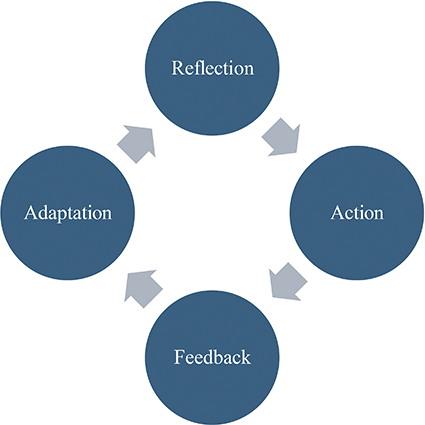
These sections are interconnected movements that repeatedly return to kinship, relational accountability, and Indigenous data sovereignty. Knowledge gathering → knowledge generation → knowledge sharing operates as a cyclical methodology aligned with kincentric worldviews.
Beyond theoretical critique, this Element provides a step-by-step framework for applying kincentric and relational methodologies in education research. By centring these approaches, it contributes directly to decolonising education research. It provides practical guidance for embedding relational accountability, ethical reflexivity, and Indigenous knowledge systems into research design, analysis, and dissemination. It concludes with a discussion of ethical responsibilities, researcher positionality and reflexivity, and the importance of dissemination strategies that respect and uphold Indigenous data sovereignty.
Overall, this Element serves as both a theoretical foundation and a practical resource for Indigenous and non-Indigenous researchers seeking to conduct ethical, community-led, and relational research. By bridging Indigenous and non-Indigenous research traditions, it offers a pathway towards more equitable, ethical, and decolonising research practices in education.
Note on Scope and Stance – This Element is not intended to be universalising or prescriptive. It is written from my perspective as an Indigenous Gael, and it does not speak for all knowledge and belief systems or all Indigenous peoples. This Element is also not intended as exhaustive, drawing on real-life praxis beyond theory alone. Concepts such as Dùthchas, Càirdeas, and Bizindam are offered as situated methodological anchors to be adapted – where appropriate – through local cultural protocols, community leadership, and consent, with accountability to the lands, languages, and relationships in which research is embedded. The case studies and focused treatment of Dùthchas are included to avoid monolithic assumptions and to keep practice grounded in context-specific, community-led decision-making. Practical grounding of theory in real-world contexts is crucial.
Too often, the word ‘decolonising’ is invoked rhetorically or as an abstract metaphor (Tuck & Yang, Reference Tuck and Yang2012) and remains under-specified in practice. While not prescriptive, this Element directly addresses that gap by stressing the importance of context and community autonomy. Each section includes Practical Notes and Key Takeaways, and the Element closes with a consolidated Practical Guide (Section 7.7) and Glossary (Section 7.8). These resources are designed to support scholars, educators, and students in implementing kincentric and relational methodologies in their own research practice. This Element provides both the theoretical grounding and the practical strategies for conducting research that is accountable to communities, land, and more-than-human kin. In these ways, this Element extends the field of decolonising educational research by offering a framework that is contextual in research scope, rigorous in scholarship, and practical in application. It is intended not only for researchers and students but also for Indigenous and non-Indigenous communities seeking to engage with research as a relational and ethical practice. For non-Indigenous researchers, this is not a ‘one-size-fits-all’ toolkit: adaptation requires invitation and relationship, adherence to specific cultural protocols, and accountability to community governance (see Section 7.7 for guidance on preventing extractive practice).
1.6 Key Takeaways
(1) Research is never neutral: researchers’ assumptions and positionality shape every stage of inquiry.
(2) Colonial legacies in education research have marginalised Indigenous knowledge systems and continue to influence mainstream methodologies.
(3) Positionality and reflexivity are essential practices for ethical and decolonising research.
(4) Dùthchas, as an Indigenous Gaelic methodology, offers a kincentric and relational framework grounded in interconnectedness, responsibility, respect, ecological balance, and kinship.
(5) Situated, not prescriptive: the framework is rooted in an Indigenous Gaelic perspective and is offered for adaptation under local protocols and community governance, not as a universal blueprint.
(6) From theory to praxis: decolonising research requires community-led, land-based, and relational approaches to education research.
2 Planning Stage and Onto-Epistemic Assumptions
As an Indigenous Gael and sociolinguist working within language reclamation and revitalisation, both in formal educational contexts and my own community, I recognise the vital relevance of kincentric and relational research methodologies. These approaches are essential not only for Indigenous contexts but for other minoritised and place-basedFootnote 2 knowledge systems, including Scottish Gaelic and other endangered Indigenous languages.
This work draws upon Indigenous scholarship and my ongoing research collaborations with Indigenous communities to argue that decolonising education research requires a fundamental paradigm shift towards approaches grounded in land, language,Footnote 3 kinship, and reciprocal relationships (McGregor et al., Reference McGregor, Restoule and Johnston2018). The next subsection situates that shift by outlining dominant paradigms shaping mainstream educational research and translating critiques into concrete design choices and evaluative criteria following kincentric and relational alternatives.
2.1 Dominant Paradigms in Educational Research
Educational research has been historically shaped and influenced by dominant positivist, post-positivist, and neoliberal paradigms that emphasise measurement, efficiency, and outcomes aligned with economic productivity (Bourassa, Reference Bourassa2021; Grimmett, Reference Grimmett2019; May & Sleeter, Reference May and Sleeter2010). These frameworks often privilege ‘best practices’ ideologies (Ramirez et al., Reference Ramirez, Meyer, Lerch, Mundy, Green, Lingard and Verger2016) that reinforce human capital theory and neoliberal multiculturalism, reducing education to market-driven outputs rather than relational, community-led and community-centred processes. As a result, many scholars and policymakers frame education through the lens of ‘academic capitalism’, reducing pedagogy and teaching practices to standardised assessments and exams that contribute to nation–state economic growth (Laininen, Reference Laininen and Cook2019).
Mainstream education research is also characterised by the ‘epistemological error’ (Bateson, Reference Bateson1972) in dominant (Western) thought (Meighan, Reference Meighan2025b). The epistemological error is the flawed belief that humans are separate from their environment, leading to exploitative actions that harm both humanity and the ecosystems on which we depend. As Bateson (Reference Bateson1972) noted, ‘we are most of us governed by epistemologies that we know to be wrong’ (p. 485) and ‘the creature that wins against its environment destroys itself’ (p. 493). The positivist, ‘objective’ view of the human as ‘superior’ to the rest of nature and the ‘other’ has led to social, linguistic, and environmental injustices; ‘epistemicide’ (knowledge death; Santos, Reference Santos2016); an empiricism that uncritically replicates models and data collection and analysis tools emerging from the epistemological error, and an ‘arrogant elitism’ in education research (Macedo, Reference Macedo2019).
The neoliberal, individualistic worldview characteristic of dominant educational onto-epistemologies starkly contrasts with more ecocentric, earth-centred, and time-tested sustainable onto-epistemologies, such as Indigenous lifeways and worldviews. Indigenous worldviews across the globe view language, culture, and the land as inseparable (Chiblow & Meighan, Reference Meighan2021, Reference Chiblow and Meighan2023). Land is also considered to be an animate, spiritual entity and a teacher (McGregor et al., Reference McGregor, Restoule and Johnston2018). The understanding that land is animate and a teacher dissolves the human–nature dichotomy and human (cognitive) exceptionalism and superiority characteristic of the hegemonic Western worldview (Battiste, Reference Battiste2013; Plumwood, Reference Plumwood2002). According to Sterling (Reference Sterling2003), there is a disconnect between the mainstream dominant Western, binary, mechanistic worldview (decontextual separation) and the alternative holistic worldview (co-creation in context). Sterling suggested an ecological worldview as a way forward for a new sustainable education paradigm. Sterling (Reference Sterling2010) elaborated, ‘not only do current ways of thinking, perceiving and doing need to change in response to critical systemic conditions of uncertainty, complexity and unsustainability, but old paradigms are the root of these conditions’ (p. 19). This change could involve epistemic (transformative) learning, which involves (un)learning to transform ‘understanding and conceptions about the interdependence of humans and nature, the essence of humanity, fundamentals of wellbeing, and the role of economy in our world … education for a sustainable future must have a strong reflective value dimension added’ (Laininen, Reference Laininen and Cook2019, p. 180). Laininen (Reference Laininen and Cook2019) continued by saying that, ‘they [schools] reflect deeply our Western worldview which is the underlying cause for the sustainability crisis (…) [and] the main goal of education would be to give future generations tools for thinking and seeing the world differently, constructing their own worldviews, and acting to create a sustainable future’ (pp. 186–187).
In education, therefore, we must enact alternative and relational ways to overcome ‘monocultural approaches to knowledges’ (Icaza & Vazquez, Reference Icaza, Vazquez, Bhambra, Gebrial and Nisancioglu2018, p. 117), essentialist and monolithic views of culture and identity, and ‘decolonise our minds’ (wa Thiong’o, Reference wa Thiong’o1986). While debates in mainstream education research continue around objectivity, neutrality, and researcher detachment, decolonial and Indigenous scholars stress that all research is inherently political. For sustainable and relational futures, research methodologies must therefore be evaluated based on their relational accountability to the communities and ecosystems with which they engage (Kovach, Reference Kovach2009; Wilson, Reference Wilson2008).
2.2 Towards Kincentric and Relational Alternatives
Recognising these limitations of dominant paradigms, this Element aligns with Indigenous and decolonising critiques, offering a kincentric and relational alternative grounded in Indigenous worldviews and decolonising practices. Decolonising education research requires interrogating not only methods but also the onto-epistemic assumptions that shape research itself. This does not mean a blanket rejection of dominant paradigms. Tranepistemic dialogue across knowledge systems is important for transformative education, bridging worldviews, and (un)learning processes (Meighan, Reference Meighan2025b). As Smith (Reference Smith2021) reminds us, ‘decolonisation … does not mean and has not meant a total rejection of all theory or research or Western knowledge. Rather, it is about centering our [Indigenous] concerns and world views and then coming to know and understand theory and research from our own perspectives and for our own purposes’ (p. 43).
Central concepts such as validity, reliability, and generalisability – cornerstones of positivist traditions – must be reconsidered through Indigenous knowledge systems. Dominant education research remains heavily shaped by positivist traditions, where validity is defined by objectivity, measurement, and replicability. This paradigm assumes knowledge is detached from the knower, that reality is fixed and observable, and that research can be separated from culture, land, language, and relationships.
In contrast, Indigenous research is grounded in fundamentally different onto-epistemic assumptions (McGregor et al., Reference McGregor, Restoule and Johnston2018; Smith, Reference Smith2021). Knowledge is relational, land-based, and inseparable from identity, language, and community. The criteria for empirical validity – and indeed the very notion of valid knowledge – depart significantly from Western norms (Table 1).
| Dimension | Qualitative and quantitative | Kincentric and relational |
|---|---|---|
| Researcher stance | Traditionally: detached observer (quantitative) or neutral interpreter (qualitative); contemporary qualitative research: reflexive, positioned | Always embedded, accountable, in relationship with human and more-than-human kin |
| Origin and epistemology | Euro-Western empiricism, Enlightenment science (mind dominant over nature) | Indigenous knowledge systems and science, place-based epistemologies |
| Ethics | Procedural ethics (Institutional Review Board) | Ongoing relational accountability, land-based ethics |
Indigenous research validity is not measured by replication, neutrality, or generalisation; it is grounded instead in relationality, community coherence, and cultural continuity. While these principles emerge from Indigenous contexts, they also hold relevance for other minoritised and place-based knowledge systems globally. Section 2.3 articulates these Indigenous validity principles explicitly.
2.3 Principles of Indigenous Research Validity
Indigenous research reframes validity through several interconnected principles, as exemplified non-exhaustively below.
(1) Relational Validity
Knowledge is valid when it arises within respectful relationships – between researchers, participants, land, language, and more-than-human kin.
(2) Cultural Credibility
Does the research make sense to the community? Can Elders or knowledge holders affirm that it reflects their truths?
(3) Communal Coherence
Are the findings in alignment with the community’s lived experience, teachings, and stories?
(4) Reflexive Accountability
The researcher’s integrity and positionality are transparent, responsive, and documented.
(5) Story-as-Knowledge
Validity is not in abstraction but in the coherence and resonance of oral tradition and storywork. If a story is honoured by the community, its truth is valid.
From this perspective, knowledge and decolonising research practices cannot be divorced from place, people, and more-than-human relationships. Research is not extractive; it is grounded in relationship, responsibility, healing, and cultural continuity. Shifts in how research quality is assessed in kincentric and relational methodologies are synthesised in Table 2, Section 2.5. The next subsection grounds these principles through applied examples from Anishinaabemowin and Gaelic contexts.
| Concept | Dominant research | Kincentric and relational research |
|---|---|---|
| Construct validity | Measures accuracy of predefined concepts | Reflects community knowledge, protocols, values, languages, and worldviews |
| Reliability | Replicability under controlled conditions | Consistency with lived experience and cultural context |
| Internal validity | Establishes causal relationships | Represents kincentric, holistic relationships among people, land, knowledge, and language |
| External validity (Generalisability) | Generalises to wider populations | Insights are transferable, with cultural integrity, to similar community contexts |
| Objectivity | Researcher detachment ensures neutrality | Researcher is relationally accountable; reflexivity replaces detachment |
2.4 Applied Examples: Language Reclamation as Relational Practice
My research with Anishinaabemowin language speakers and learners from Ketegaunseebee (Garden River First Nation) in Canada reflects Indigenous research validity principles (Meighan, Reference Meighan2023). Through a community-led, digital language reclamation project, participants included Traditional Ecological Knowledge (TEK) and language learning grounded in land, community, and cultural continuity. Language was not framed as merely a technical skill nor separate from education, but as a pathway to healing, positive identity formation, and relationship-building – educational outcomes often excluded from or disregarded in dominant research paradigms.
Similarly, my research with Scottish Gaelic speakers (Meighan, Reference Meighan2025c) illustrates how language learning, oral tradition, and land-based practices challenge assumptions that education must be institutionally delivered. Gaelic language reclamation is deeply tied to kincentric and relational education processes, where learning, healing, land connection, and community wellbeing are inseparable. With these illustrations in view, Section 2.5 reframes conventional research standards through a kincentric and relational lens.
2.5 Reframing Research Standards: Reliability, Validity, and generalisability
Kincentric and relational methodologies centre ethical relationality, place-based knowledges, cultural protocols, and community-led approaches to knowledge generation (see Section 3). They expose the limitations of dominant research frameworks that assume neutrality, objectivity, and detachment are unquestioned standards (Kovach, Reference Kovach2009; Wilson, Reference Wilson2008). Building on Sections 2.2 and 2.3, Table 2 reframes conventional research standards through a kincentric and relational lens.
Table 2 can be viewed as ‘translation work’ for institutional ethics and quality rubrics (e.g., IRB, peer review, tenure metrics). Where institutions ask for ‘validity’, ‘reliability’, and ‘generalisability’, this Section offers a multiple and additive justification: the institutional term is met but specified through kincentric and relational criteria such as relational accountability, cultural integrity, and community validation and benefit. In practice, this can support researchers in explaining why standard procedural compliance is insufficient on its own, while still demonstrating rigour in terms institutions recognise.
When conceptualising kincentric and relational methodologies:
(1) Generalisability is reframed as Transferability, respecting cultural protocols and specificity while offering insights applicable to other contexts globally
(2) Reliability emphasises trustworthiness, consistency, and depth, not merely replication under lab conditions
(3) Validity reflects cultural appropriateness, community leadership, and Indigenous knowledge systems
In Indigenous science (Cajete, Reference Cajete2000; Chiblow & Meighan, Reference Chiblow, Meighan, Wall and Buell2026; Stewart, Reference Stewart2019), validity and reliability emerge from relationship, community accountability, and lived experience, not standardisation nor quantification. Reliability and trustworthiness come from coherence across community voices and enduring knowledge of place. Storytelling (Drawson et al., Reference Drawson, Toombs and Mushquash2017; Iseke, Reference Iseke2013; Lee-Morgan, Reference Lee-Morgan, Archibald, Lee-Morgan and Santolo2019) and storywork (Archibald, Reference Archibald2008) are thus paramount; stories embody evidence, such as TEK and medicinal knowledge, when rooted in relationship and cultural integrity. Validity comes from using culturally appropriate, community-led methods, such as following cultural protocols that reflect Indigenous knowledge systems.
Western science often equates detachment with objectivity; Indigenous science recognises relationship and multiple ways of knowing as essential pathways to truth. Both are rigorous but serve different goals (Chiblow & Meighan, Reference Chiblow, Meighan, Wall and Buell2026; Smith, Reference Smith2021). Kincentric and relational education research is accountable not to abstract measurement tools, but to the people, languages, and lands it aims to serve.
While some scholars have embraced the ‘weaving’ or ‘braiding’ of Indigenous and Western knowledge systems (Kimmerer, Reference Kimmerer2014), dominant discourses often marginalise Indigenous science as ‘folklore’ or social knowledge, excluding it from the natural sciences (Chiblow & Meighan, Reference Chiblow, Meighan, Wall and Buell2026). Yet, the English word ‘science’ itself derives from the Latin ‘scientia’, meaning knowledge. This raises a critical question: whose knowledge counts as valid science in education research, and whose knowledge is dismissed? This imbalance presents both a gap and an opportunity to recognise Indigenous science as sophisticated, observational, place-based, and time-tested knowledge systems on par with Western scientific traditions (Chiblow & Meighan, Reference Chiblow, Meighan, Wall and Buell2026).
When designing research projects within Indigenous and minoritised contexts, researchers should pause to critically reflect on the onto-epistemic assumptions underpinning their methodology. Ask:
(1) Am I privileging measurement, efficiency, or ‘best practices’ over relationality and reciprocity?
(2) Whose priorities define the research questions, the community’s or external funders’?
(3) Does this study sustain kinship ties, languages, and cultural continuity, or does it disrupt them?
A practical way forward is to discuss and co-create the research framework with community members at the planning stage. This means developing shared criteria of quality and success, rooted in Indigenous and relational values rather than external or imposed academic standards.
2.6 Conclusion: Kincentric and Relational Research
Kincentric and relational methodologies in education follow Indigenous ways of knowing and being, where validity and reliability are relational, not merely statistical. Trust is earned through community connection, cultural coherence, and respectful representation, not replication or detachment. As Indigenous (Cree) scholar Shawn Wilson (Reference Wilson2001) states, ‘an Indigenous paradigm comes from the fundamental belief that knowledge is relational, shared with all creation, and therefore cannot be owned or discovered’. This relational understanding fundamentally departs from the extractive tendencies of conventional research.
Kincentric and relational methodologies are inseparable from Indigenous onto-epistemologies, which are often incompatible with dominant Western paradigms (Smith, Reference Smith2021). Knowledge is not detached nor value-free but is generated through relationship, land, language, and collective memory. Storytelling, language, and lived experience are valid – and necessary – forms of knowledge transmission. As summarised in Table 2, Section 2.5, validity and reliability in Indigenous education research – and by extension, in kincentric and relational approaches – are grounded in relationship, accountability, and cultural integrity (Chilisa, Reference Chilisa2012; Wilson, Reference Wilson2008). In essence, recognising Indigenous knowledge systems requires moving beyond metrics towards relational, land-based, and community-led research and learning. In this way, education research can foster accountability, cultural continuity, and epistemic, linguistic, and racial justice.
2.7 Key Takeaways
(1) Dominant paradigms in education research are shaped by positivist, post-positivist, and neoliberal frameworks that prioritise efficiency, measurement, and economic productivity.
(2) Dominant paradigms marginalise Indigenous knowledge systems, often reducing education to standardised outputs.
(3) Decolonising research requires a fundamental shift towards approaches grounded in place, kinship, language, and reciprocity.
(4) Researchers must critically examine their onto-epistemic assumptions at the planning stage.
(5) Practical strategies include co-developing research frameworks with communities and using evaluation criteria that prioritise relational accountability and Indigenous data sovereignty.
3 Data Collection
Data collection within kincentric and relational research methodologies diverges significantly from dominant educational research models. Drawing on decolonising and Indigenous methodologies, such as those articulated by Indigenous scholars Chiblow (Reference Chiblow2021), McGregor et al. (Reference McGregor, Restoule and Johnston2018), Smith (1999), Wilson (Reference Wilson2001), and Kovach (Reference Kovach2009), it situates cultural protocols, reciprocity, and accountability at the heart of ethical research. Aligning with the 5 R’s of Indigenous research (McGregor et al., Reference McGregor, Restoule and Johnston2018) – Respect, Relevance, Reciprocity, Responsibility, and Relationship – this section reframes ‘data collection’ as knowledge gathering: a relational, ethical, and situated process grounded in responsibility to communities, land, and more-than-human kin.
Despite the growing body of literature on Indigenous research methodologies in social science fields (Lopez & Cuasialpud-Canchala, Reference Lopez and Cuasialpud-Canchala2025; Pidgeon & Riley, Reference Pidgeon and Riley2021; Wright et al., Reference Wright, Wahoush, Ballantyne, Gabel and Jack2016), there remains a striking scarcity of studies that focus specifically on data collection methods grounded in kincentric and relational epistemologies within education. Systematic reviews show that education studies rarely articulate Indigenous methodological frameworks in detail, and often engage Indigenous researchers only partially in data collection and analysis processes (Kennedy et al., Reference Kennedy, Maddox and Booth2022; Williams & Shipley, Reference Williams and Shipley2023). This limited methodological presence in education is compounded by the dominance of Western paradigms, which tend to relegate relational, land-based, and narrative methods to the margins (see also Sections 1 and 2).
Addressing this gap, the kincentric and relational approaches presented here offer education-specific, culturally grounded alternatives that are both methodologically rigorous and responsive to community-defined priorities. They take a strengths-based approach to education, as articulated in frameworks such as the First Nations Information Governance Centre’s Strengths-Based Approach (FNIGC, 2020), shifting focus from deficits to assets and building on existing community strengths – language fluency, cultural continuity, and land-based practices – as the foundation for research design and dissemination.
To illustrate how this operates in context and practice, I outline the kincentric and relational methodological framework I applied in research with Indigenous (Anishinaabe and Gaelic) communities in Turtle Island (Canada) and Scotland. Methods are rooted in story, place, relationship, reciprocity, and accountability, centring participants as knowledge holders rather than data subjects. These methods uphold self-decolonisation processes, land-specific cultural protocols, community-defined priorities, and ethical responsibilities, including Indigenous data sovereignty (Kukutai & Taylor, Reference Kukutai and Taylor2016; Walter et al., Reference Walter, Kukutai, Carroll and Rodriguez-Lonebear2021). Similar insights from kincentric and relational research practices in the Māori context in Aotearoa (New Zealand) are also referenced.
Specifically, this section focuses on two case studies:
(1) TEK-nology (Traditional Ecological Knowledge and technology): Anishinaabemowin language reclamation in Ketegaunseebee (Garden River First Nation, Ontario, Canada) (Meighan, Reference Meighan2023)
(2) Gaelic oral tradition fieldwork: Uibhist a Deas (Isle of South Uist, Scottish Highlands and Islands) (Meighan, Reference Meighan2025c)
In both, I operationalised Dùthchas, an Indigenous Gaelic concept, to enact and embody a kincentric and relational methodology rooted in the principles of interconnectedness, ecological balance, responsibility, respect, and kinship (Meighan, Reference Meighan2022a; see Section 1.4). Dùthchas shapes how research is conceptualised, how relationships are maintained, and how knowledge is gathered and honoured. Dùthchas functions as both an onto-epistemic stance and methodological driver. My approach was also deeply informed by Biskaabiiyang (“Return to Ourselves”), an Anishinaabe decolonising and participatory framework that centres community protocols and the need for researchers to undertake self-decolonisation for meaningful research with Indigenous communities (Geniusz, Reference Geniusz2009). These self-decolonisation processes involve recognising one’s own positionality and reflecting on accountability within colonial systems and structures (see Sections 1.1 and 1.2).
Aligned with broader calls within Indigenous and decolonising education scholarship, this section demonstrates how researchers can move away from extractive data collection methods towards relational accountability (Wilson, Reference Wilson2001), reflexive practices (Consoli & Ganassin, Reference Consoli and Ganassin2023), and culturally responsive methodologies that uphold Indigenous self-determination (Smith, Reference Smith2021). Concise methodological snapshots from the case studies illustrate how kincentric and relational methodologies have been applied in diverse contexts. Finally, I explain how these methodological choices shape knowledge generation and discuss implications for future education scholarship.
3.1 From Data Collection to Knowledge Gathering
Mainstream education research often employs data collection tools like mass-scale surveys, large-scale classroom-based assessments or interventions, structured interviews, and standardised instruments. These methods tend to prioritise large data sets, objectivity, replicability, and statistical measurability – features aligned with positivist and neoliberal paradigms – over context, relationality, and meaning-making (Battiste, Reference Battiste2013; Grimmett, Reference Grimmett2019; see also Sections 1 and 2).
Within these data collection models, participants are often anonymised, decontextualised, and knowledge is reduced to quantifiable outputs. This tendency towards abstraction is widely critiqued within Indigenous research scholarship, which calls for approaches grounded in community-defined protocols, relationships, and reciprocity (Drawson et al., Reference Drawson, Toombs and Mushquash2017; McGregor et al., Reference McGregor, Restoule and Johnston2018; Wright et al., Reference Wright, Wahoush, Ballantyne, Gabel and Jack2016).
Kincentric and relational methodologies depart from abstraction fundamentally and reframe data collection as knowledge gathering. They begin with the premise that knowledge is inherently situated, co-generated, and relational. This approach:
(1) Considers the researcher an integral part of the research process, not separate from it
(2) Positions participants as knowledge holders, not data points
(3) Emphasises long-term relationship-building and community co-design
(4) Recognises story, land, and ceremony as valid knowledge sources
(5) Treats knowledge as emplaced, ethical, and inseparable from kinship relations
Knowledge gathering is shaped by land, language, and the relationships among people, more-than-human entities, and place. Specifically, a kincentric and relational approach to knowledge generation respects existing familial, kinship, and community relationships and deepens understanding of educational processes, such as language revitalisation and cultural reclamation, beyond formal schooling and dominant structures and institutions. Rather than treating data as extractable content, these methodologies recognise the act of knowledge gathering as an ethical, reciprocal, and pedagogical process.
3.1.1 Toolkit Insight: Practical Shifts for Education Practitioners and Researchers
(1) Begin with existing relationships and community trust
(2) Generate or co-develop research questions after building relationships
(3) Prioritise conversation, story, and lived experience over extractive interviews
(4) Include land, the community language, ceremony, and community-specific values in research processes
(5) Journal reflexively throughout to track accountability and learning
In such education research, gathering knowledge is not a neutral act, but one that demands care, humility, reflexivity, and relational accountability. Participants are not passive respondents, but active collaborators and knowledge holders. The process centres shared dialogue, story, cultural practice, and lived experience as legitimate forms of evidence. This co-generation of knowledge honours Indigenous ways of knowing and being and resists the extractive tendencies of dominant research paradigms. In a kincentric and relational paradigm, knowledge is not extracted, it is shared. These shifts are echoed across diverse Indigenous research contexts, where methods such as storytelling, talking and sharing circles, symbol-based reflection, and photovoice have been shown to meet rigorous ethical and methodological standards when used in collaboration with communities (Wright et al., Reference Wright, Wahoush, Ballantyne, Gabel and Jack2016). Case studies in Section 3.2 show how knowledge gathering operates in practice.
3.2 Knowledge Gathering: Examples
Practical examples from two distinct case study contexts – Anishinaabe (Section 3.2.1) and Gaelic (Section 3.2.2) – illustrate kincentric and relational knowledge gathering in action.
3.2.1 Anishinaabe Context
In the TEK-nology project – a community-led, digital language reclamation initiative with participants from Ketegaunseebee (Garden River First Nation) – knowledge gathering unfolded through kincentric and relational practices. The project was rooted in an Anishinaabe paradigm, Mino-bimaadiziwin (The Good Life; McGregor et al., Reference McGregor, Restoule and Johnston2018), to be responsive and in-relation to the Anishinaabeg community – my husband’s community – where the research was taking place. I followed an Anishinaabe community-led, decolonising participatory framework, Biskaabiiyang (“Return to Ourselves”; Geniusz, Reference Geniusz2009), which starts with the researcher decolonising themselves to conduct meaningful research with the Indigenous community.
My self-decolonisation process was guided by Dùthchas (see Section 1.4), the Gaelic concept denoting land-based responsibility, kindship, and ecological balance. Before beginning the project, I began reclaiming my endangered Indigenous language (Scottish Gaelic), participated in ceremony in my family’s Anishinaabe community, and completed an Anishinaabemowin language course taught by Elder and Anishinaabek Nation Language Commissioner Barbara Nolan, who later joined the project.
Dùthchas and Biskaabiiyang together grounded me in a respectful, accountable, and non-appropriative approach, deeply informed by my lived experience. As Wilson (Reference Wilson2001) reminds us, we must be ‘answerable to all your relations when you are doing research’ (p. 177). In keeping with this, Anishinaabe Bizindam (deep listening; Chiblow, Reference Chiblow2021) and Gaelic Càirdeas (kinship and friendship; Meighan, Reference Meighan2022a) were foundational to knowledge gathering.
The research questions, formulated after having established relationships in the community, were:
(1) (How) can technology rooted in Indigenous worldviews and knowledge systems support community-based language revitalisation and cultural reclamation?
(2) How can we co-create a culturally, emotionally and environmentally responsive Indigenous language acquisition pedagogy with TEK-nology?
(3) How do community learners and Elders demonstrate engagement and learning with TEK-nology, and what are the implications for decolonising language education?
Kincentric and Relational Participant Selection
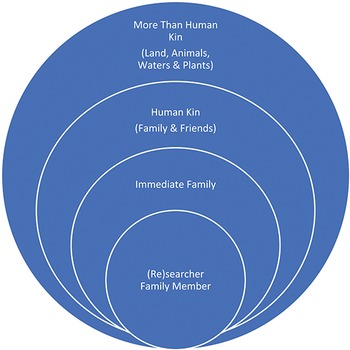
Guided by Dùthchas as emplaced ethical relations (Oliver, Reference Oliver, Nicolson and Meikle2021) and Biskaabiiyang as a decolonising, participatory framework (Geniusz, Reference Geniusz2009), I implemented a kincentric and relational method (Figure 2) for participant selection. Participants (N = 8) were selected through purposive and snowball sampling (Patton, Reference Patton2015), beginning with family and extended kin, such as family and family friends.
Kincentric and relational approach to sampling.
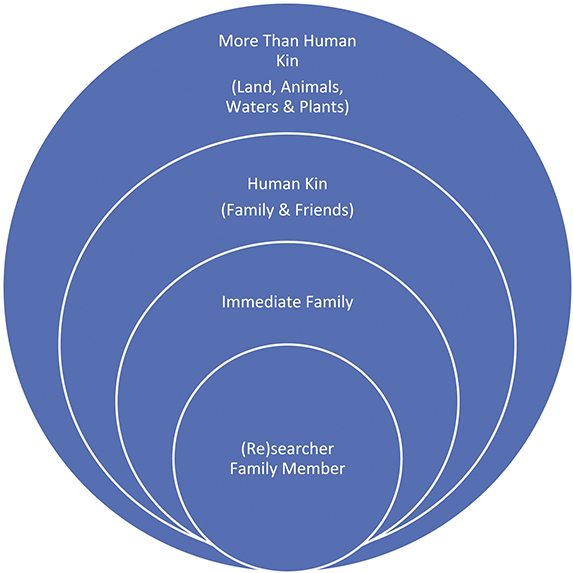
For those new to the community, begin with trusted partners – such as Elders, kin networks, or language advocates – to ensure that participant selection is grounded in relationship and reciprocity.
The rationale for this approach is well described by Wilson and Hughes (Reference Wilson, Hughes, Wilson, Breen and Dubre2019), ‘as researchers, we are not separate from the process, but rather participate in a relationship with what we are learning’ (p. 9). Johnston et al. (Reference Johnston, McGregor, Restoule, McGregor, Restoule and Johnston2018) elaborate:
The researcher is nested in concentric circles of relationships. The researcher must consider their relationship with self, with family, with those that provide guidance in carrying out the research, with the research participants, with the broader community, with the ancestors and future generations, with the environment and land, and with the Creator.
As such, this kincentric and relational method enabled:
(1) Acknowledgement of my positionality and ‘self-in-relation’ (Graveline, Reference Graveline1998) as a Gael researcher
(2) Respect for existing relationships in my married family’s Indigenous community
(3) Deeper insight into nuanced factors that may influence intergenerational language transmission
(4) Recognition of the land as co-researcher and interlocutor (Engman & Hermes, Reference Engman and Hermes2021)
Knowledge Gathering Methods
Knowledge was gathered using digital and online technologies over thirteen weeks (September–December 2021) and included:
(1) A reflexive online self-decolonisation journal
(2) Offering Asemaa (Tobacco) to the land and ancestors in gratitude
(3) Individual semi-structured conversations with participants, who later formed a Language Revitalisation Committee (LRC)
(4) One LRC sharing group to share thoughts on decolonising education
(5) Three LRC focus groups to co-develop content for three TEK-nology language videos
(6) A final online community screening and feedback survey
The LRC, formed collaboratively, consisted of participants and myself, the researcher. I practised Miigwetchiwin (prayer and gratitude; Reo, Reference Reo2019), Anishinaabe Bwaajwewin (nurturing relationships; Reo, Reference Reo2019) and Gaelic Càirdeas (kinship and friendship) throughout. Using Kovach’s (Reference Kovach2010) Conversational Method as inspiration, I activated relational dialogue and Bizindam (Chiblow, Reference Chiblow2021) to gather knowledge as shared story. Bizindam is further explored as an interpretive framework in Section 4.
The three LRC focus groups generated ideas and themes to generate content for language learning videos, such as the relationships between the Anishinaabemowin language and the local land. The sharing group reflected on healing and strength-based education in the community. The resulting videos – filmed by LRC members – are hosted on a public LRC YouTube channel with participant consent.
Digital tools such as Zoom, collaborative documents, and community-curated YouTube channels can support relational research when co-designed with participants and aligned with community protocols (See section 6.2.4 on ‘Relational technology’; see also Meighan, Reference Meighan2021, Reference Meighan2022c).
At the end of the project, the videos were shown to participants at a TEK-nology video screening on Zoom. Participants were invited to respond to an anonymised online survey for feedback on the pilot project and the co-creation process.
Reflexive Self-Decolonising Journal Excerpt
I kept a reflexive self-decolonising journal (Moeke-Pickering et al., Reference Moeke-Pickering, Hardy and Manitowabi2006) to document my research journey. I wrote about things such as what decolonisation and decolonising education research mean to me; challenges and tensions; and my language learning journey in Anishinaabemowin and reclamation journey in Scottish Gaelic. This journal helps me activate inward knowledge, a key component of knowledge gathering and generation (Kovach, Reference Kovach2009). Below is an excerpt from my first entry:
Today, I’m at the point where I’m about to send out invitations to potential Language Revitalization Committee (LRC) and TEK-nology video participants. I’m very mindful that I would like to embark on this project in my married family’s community in the most relational way possible, and I think a good way of doing that is by starting with myself and radiating outwards.
Me.
Close immediate family.
Extended family.
Relational human kin (close family friends that I know or who have been recommended to me).
Relational more than human kin (the land).
I’m imagining this working like a concentric circle (insert image when I get to drafting it) … It is my sincere hope that I can embark on this project in a good way … I’mnot from the community where I will be working myself, so I would like to start with people I know, to include people who are close to my immediate relations in the project. I want to centre the people who know the land and their community and the process of reclaiming their language at the heart. They will guide the process … I think the thing I would like most is to be transparent to myself and also to anyone else going forward. And this journal will be helpful (I hope) in tracking that journey and the experiences I have.
Taken together, the LRC process and journal reflexivity model the shift from extractive data collection to kincentric and relational knowledge gathering, centring reciprocity, accountability, and collective responsibility.
3.2.2 Gaelic Context
Knowledge gathering in Uibhist a Deas (Isle of South Uist, Scottish Highlands and Islands) followed a similarly kincentric and relational approach. Guided by Dùthchas principles (see section 1.4), I conducted online fieldwork in the Scottish Gaelic language with three Gaelic speakers who hold either lived or studied experience of Gaelic oral tradition.
This fieldwork involved semi-structured conversations in a form of a brief Cèilidh (Scottish Gaelic word for ‘visit’ or ‘gathering’). Cèilidhs are traditionally story- and song-rich gatherings, rooted in Gaelic tradition. In this fieldwork case, although brief, the Cèilidhs illuminated community memory, land-based practices, and ancestral knowledge. Participants were treated as Elders, knowledge co-creators, and cultural holders – as kin, friends, and family – not ‘subjects’.
The research questions, after relationships were established in the community, were:
(1) What does oral tradition mean to you?
(2) What does the concept Dùthchas mean to you?
(3) To what extent are oral tradition and cultural concepts like Dùthchas important to the language and culture of the Gaels?
To adapt Cèilidh as method for other contexts, (1) replace structured interviews with informal, culturally grounded visits rooted in Càirdeas (kinship and friendship); (2) emphasise mutual exchange and shared cultural knowledge; and (3) be humble, listen, and be flexible with time and space, allow the rhythm of conversation and memory to guide the discussion.
Kincentric and Relational Participant Selection
Guided again by Dùthchas as emplaced ethical relations (Oliver, Reference Oliver, Nicolson and Meikle2021), I took a kincentric and relational approach to participant selection. Participants (N = 3) were selected through purposive and snowball sampling (Patton, Reference Patton2015), beginning with family and extended kin, such as family and family friends. As in the Anishinaabe context, this approach respected relational entry into community knowledge spaces.
In kinship-based societies, like in traditional Gaelic clanFootnote 4-based society, starting with trusted relational pathways – such as relatives, friends, long-time neighbours, or language advocates – helps build the trust and cultural familiarity needed for meaningful engagement.
This method helped gather knowledge on:
(1) What oral tradition means to people originally from South Uist and those living in the community
(2) What factors may influence the traditions and culture of the Indigenous Gaels
Knowledge Gathering Methods
Knowledge was gathered using digital and online technologies (November 2024) and included:
(1) A reflexive online self-decolonisation journal
(2) An individual online Cèilidh in Scottish Gaelic with participants
The knowledge gathered with the participants in South Uist emphasised the centrality of oral tradition and the concept of Dùthchas itself as forms of intergenerational cultural education and ethical belonging.
Knowledge Gathering and Dùthchas
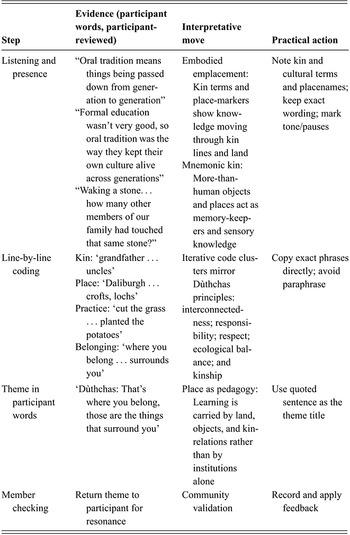
The Cèilidhs reflected and affirmed Dùthchas as an onto-epistemology: not merely a theory, but a way of living and knowing, a methodological praxis grounded in land, kin, and memory. As my mother’s cousin and participant, Ailig O’Henley, sharedFootnote 5:
Tha beul-aithris a’ ciallachadh rudan a thighinn a-nuas bho ghinealach gu ginealach…cha robh foghlam foirmeil cho math ri sin, mar sin ’s e beul-aithris an dòigh a bh’ aca [muinntir na coimhearsnachd] air an cultar fhèin a chumail beò bho ghinealach gu ginealach …bàrdachd, òran, abairtean, dòighean-cainnt, seanfhaclan, a h-uile sìon a’ tighinn a-nuas.
Tha Dùthchas…a’ tighinn bho dùthaich, ach tha e nas bunasaiche na sin…tha e mun cuairt ort, tha e san àrainneachd. An-uiridh, bha mi ann an Dalabrog aig taigh mo sheanair, do shinn-sheanair-sa [Aonghas ’ill Easbaig]. Bha mi a’ toirt clach am bàrr a bha air a dhol fon talamh…’s e a’ dùsgadh clach a chanadh na seann fheadhainn ris an sin. Bha mi a’ smaointinn an uair a thug mi a’ chlach sin am bàrr, cia mheud duin’ eile dhen teaghlach againn a bha air a’ chlach sin a làimhseachadh? Cò an làmh mu dheireadh a bh’ oirre? Bràithrean mo mhàthair, mo sheanair, nas fhaide air ais na sin? Tha sin mar phàirt dhen Dùthchas agad cuideachd, an t-àite dham buin thu, na rudan a tha gad chuartachadh. Mar sin tha Dùthchas gu math farsaing, [co-cheangailte] ris an àite is ris na daoine bhon d’ thàinig thu. Tha e gad chuartachadh air na cruitean, air na lochan, far an robh ar sinnsearan a’ coiseachd, far an robh iad ag obair, a’ gearradh an fheòir, a’ cur a’ bhuntàta, sin Dùthchas dhòmhsa…tha thu mar gum biodh a’ leantail sna lorgan aca.
Oral tradition means things being passed down from generation to generation… formal education wasn’t very good, so oral tradition was the way [community members] kept their own culture alive across generations—poetry, song, expressions, ways of speaking, proverbs…
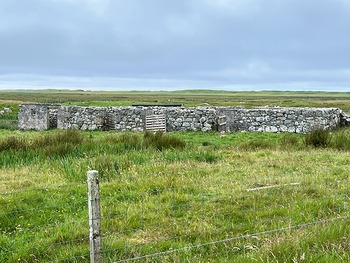
Dùthchas…comes from dùthaich [homeland], but it’s more fundamental than that…it surrounds you, it’s in the environment. Last year, I was in Daliburgh at my grandfather’s house [Figure 3], your great-grandfather’s [Angus Walker]. I was lifting a stone that had sunk into the ground…the old people would have called that “waking a stone”. I was thinking, when I lifted that stone, how many other members of our family had touched that same stone? Whose hand had last been on it? My uncles, my grandfather, further back than that? That, too, is part of your Dùthchas—where you belong, the things that surround you. So Dùthchas is very broad, [connected] to the place and the people you come from. It surrounds you in the crofts, the lochs, where our ancestors walked, where they worked, cut the grass, planted the potatoes—that’s Dùthchas to me…it is as though you are following in their footsteps. (Ailig O’Henley, individual conversation, November 2024)
The old family croft in Daliburgh, Isle of South Uist.
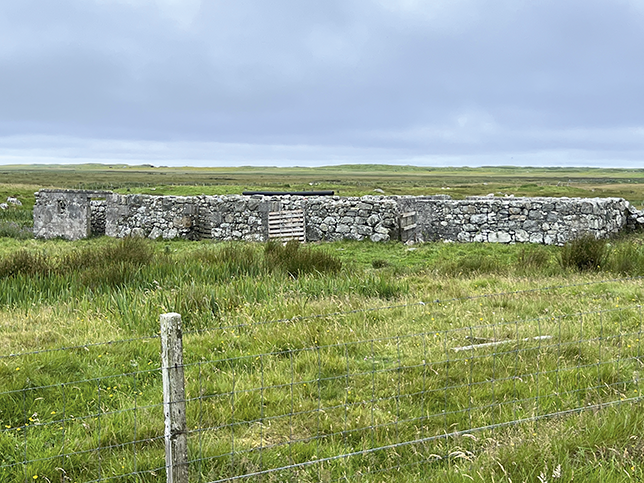
This example continues to influence my researcher reflexivity and evolving understanding of Dùthchas as a kincentric and relational methodology. It also highlights how knowledge gathering, even through digital and online means, can remain rooted in land, kin, memory, and cultural continuity when guided by ethical relations. This Gaelic case echoes the Anishinaabe emphasis on kinship, language, and place, which is also reflected in Māori research frameworks.
3.2.3 Māori Context
In Aotearoa (New Zealand), culturally grounded knowledge gathering has emerged through kincentric and relational methodologies such as Kaupapa Māori and Whānau Research (e.g., Bishop, Reference Bishop, Ward and Delamont2020; Fitzpatrick & May, Reference Fitzpatrick and May2022). These approaches, as reviewed by Drawson et al. (Reference Drawson, Toombs and Mushquash2017), are not merely Indigenous adaptations of qualitative methods but constitute full frameworks centred on Māori epistemologies, genealogies (whakapapa), and relational accountability.
For example, Tomlins-Jahnke and Gillies (Reference Tomlins Jahnke and Gillies2012) describe a whānau research method where extended family members and human kin serve as both participants and data co-constructors. Transcriptions of conversations are collaboratively interpreted with community members and Elders. This process – relational, iterative, and ethically grounded – demonstrates how knowledge is gathered not by extraction but through collective meaning-making. Such approaches affirm this section’s emphasis on co-generation, storytelling, and kinship as central tenets of kincentric and relational research.
Kaupapa Māori provides an example of a methodology that, like Dùthchas or Biskaabiiyang, insists that research benefit the community and honour Indigenous sovereignty from design through dissemination. Across these contexts, kincentric and relational methods are transferable – when led by community – and Section 3.3 distils key common practices.
3.3 Kincentric and Relational Knowledge Gathering: Key Practices
Kincentric and relational knowledge gathering methods prioritise story, land, ceremony, and cultural protocols over extraction, anonymity, and detachment. In both the Anishinaabemowin and Gaelic research contexts (Section 3.2), these practices were grounded in Indigenous concepts and frameworks like Dùthchas, Cèilidh, Biskaabiiyaang, and Bizindam.
Education research, and the kincentric and relational methodologies therein, aim not just to generate knowledge but to support cultural continuity, community wellbeing, and relational healing.
Key practices include:
(1) Relational Entry
Relationships begin before formal research activities. For example, in the Anishinaabemowin and Gaelic cases (Section 3.2), I connected first with close kin, then extended family, then community Elders. This ensures trust and reciprocity from the outset.
1.08Practical Note – Attend community gatherings, speak with Elders, and listen before designing any instruments or tools. Where appropriate, consider ceremony or cultural protocols to begin your engagement.
(2) Conversational Methods
Participants engage in conversations or Cèilidhs (Section 3.2.2), rather than structured interviews, to gather community knowledge authentically and enable personal and communal storytelling and co-learning. For instance, these could follow the Dùthchas principles (Section 1.4) and Bizindam listening protocols (Chiblow, Reference Chiblow2021).
(3) Community-led Committees
Participants form committees that co-create research and, where applicable, educational content, such as video resources, to ensure community ownership and active participation throughout the research process. In Ketegaunseebee, the LRC co-created content, shaped goals, and evaluated results (Section 3.2.1). The process encouraged collective responsibility.
(4) Storywork and Land-based Teachings
Elders and language or knowledge holders share local knowledge, oral traditions, and place-based teachings, both in the Indigenous language and informed by the land. These are forms of pedagogy as well as ‘data’ (Archibald, Reference Archibald2008).
(5) Digital Co-Creation
In the digital age, participant control and agency are paramount. In the TEK-nology project, participants filmed their own language videos, supported by community-led editing with the researcher and consent processes (Section 3.2.1).
(6) Iterative Consent
Consent is not a one-time checkbox. Participants are engaged throughout the process. They have the right to revise, pause, or withdraw their contributions. Ongoing consent is maintained, with feedback loops and member-checking part of the research process.
In Table 3, knowledge gathering techniques are described with an example and a practical adaptation that researchers can implement in their own work.
| Technique | Description | Example | Practical adaptation |
|---|---|---|---|
| Reflexive journaling | Researcher reflections and positionality documented for accountability and transparency | Researcher journal and fieldnotes | Journal before, during, and after interactions to support reflexivity |
| Conversational sessions | Knowledge gathered through relational dialogue | Cèilidhs (Gaelic visits); storytelling sessions | Use open-ended questions in relaxed, informal settings |
| Research co-creation | Educational materials created with community | TEK-nology videos on language and land | Invite participants to choose topics and formats |
| Feedback loops | Surveys and check-ins ensure community approval guides research | Participant-led committees, feedback forms, and screening sessions | Build in feedback windows at multiple points |
| Ceremony and gratitude | Following cultural protocols specific to each context | Offering of Asemaa (Tobacco) | Use culturally appropriate gifts (songs, food, prayer, etc.) |
These techniques are not just methodological; they are pedagogical acts that support researchers and participants’ own learning journeys and knowledge transmission beyond the project itself.
3.4 Kincentric Methodological Framework
Table 4 summarises six interconnected and interrelated phases that inform a kincentric and relational approach to knowledge gathering and the practical actions involved. This framework affirms the interdependence of methodology and worldview. These are not linear checkpoints, nor exhaustive, but signal overlapping cycles of reciprocal enactment.
| Phase | Indigenous concept or principle | Practical action |
|---|---|---|
| Relational entry | Dùthchas (Belonging and responsibility) | Build trust, enter with humility, acknowledge land and ancestors |
| Community-led design | Bizindam (Listening with respect) | Co-create research; centre community-defined priorities and avoid research-centred framing |
| Land-based engagement | Kinship (All relations) | Include land, language, and more-than-human world in the research design and knowledge generation |
| Holistic knowledge generation | Storywork and oral tradition | Use storytelling, Cèilidhs, memory-work, and cultural ceremony as legitimate forms of research practices and data |
| Reflexive Accountability | Relational ethics | Maintain reflexivity through journaling and community feedback; honour community authority and self-determination |
| Cultural continuity and healing | Reclamation as research outcome | Support identity, belonging, and language and cultural renewal through and beyond the research |
Every phase foregrounds responsibility, not just method. Each action stems from relational ethics and a recognition that research is an ongoing relationship, not a one-time event.
3.5 Ethical Considerations and Data Sovereignty
Integral to kincentric and relational research are robust ethical frameworks, including Indigenous data sovereignty (Kukutai & Taylor, Reference Kukutai and Taylor2016; Walter et al., Reference Walter, Kukutai, Carroll and Rodriguez-Lonebear2021). These ensure that knowledge is not just gathered ethically, but stays with the people and communities who shared it originally.
Both case studies in Section 3.2 adhered to sovereignty protocols, including:
(1) OCAP® in Canada (Ownership, Control, Access, and Possession)
(2) Global CARE principles (Collective benefit, Authority to control, Responsibility, and Ethics)
Ensure participants always have access to and authority over the knowledge they share. Consent should be renewed regularly, especially before publication, sharing, or archiving materials.
All digital content (e.g., language videos) remains under the control of the participants, for use in cultural learning, ceremony, local education, and future reclamation endeavours. In the TEK-nology case study (Section 3.2.1), the language video recordings were:
(1) Subject to participant member-checking
(2) Revised where requested
(3) Stored in community-led and freely accessible repositories (e.g., LRC YouTube channel)
This approach ensured that knowledge remained relational, contextual, and ethically co-owned, not extracted, anonymised, or externally controlled.
Steps for Upholding Data Sovereignty
(1) Create a shared agreement with participants about how data will be used.
(2) Use digital tools (e.g., shared drives, consent forms) that allow participants to review and revise.
(3) Avoid storing materials solely in university or institutional servers; prioritise community-controlled platforms.
3.6 Methodological Distinctions and Relational Rigour
Kincentric and relational methodologies diverge from dominant educational research not only in tools but in worldview (Table 5). Knowledge is gathered and co-generated in relationship, accountable to community, land, and more-than-human kin. This section summarises how these approaches differ and how rigour is established.
| Dominant practice | Kincentric and relational alternative |
|---|---|
| Mass surveys, standardised tests | Conversational methods, storywork, Cèilidh |
| Researcher-designed instruments | Co-design with community committees |
| Brief, extractive engagements | Long-term relationship-building and follow-up collaboration |
| Detached objectivity | Reflexivity and accountability to cultural protocols |
| Aggregated, decontextualised data | Contextualised, named (with consent), culturally situated knowledge |
These contrasts do not imply that quantitative or structured methods are inherently unethical, but rather that in Indigenous and relational contexts, methodological alignment with community priorities and cultural values is paramount.
3.6.1 Story-as-Knowledge and Relational Learning
In kincentric and relational methodologies, story, ceremony, and lived experience are knowledge and research evidence, not only anecdotes. A Cèilidh, a sharing circle, or a language video is knowledge in action, both pedagogy and research at once. Kovach (Reference Kovach2009) and Smith (Reference Smith2021) remind us that in Indigenous research, knowledge gathering is itself a form of education. When a participant shares a story or an Elder co-creates a language video, they are teaching, guiding, and reframing the researcher’s worldview.
Similarly, symbol-based reflection and photovoice – as practised in Indigenous contexts in Canada (Wright et al., Reference Wright, Wahoush, Ballantyne, Gabel and Jack2016) – illustrate how creative arts and visual storytelling are not ancillary but central to Indigenous pedagogies. These methods enable participants to communicate meaning through culturally resonant symbols, photographs, and metaphors, facilitating deep relational engagement and story-based analysis.
Researchers and practitioners should treat story as knowledge. This process includes: (1) listen with intention; (2) record only with consent; (3) story is not illustrative, it is instructive; (4) honour the knowledge embedded in tone, rhythm, gesture, silence, and language.
3.6.2 Relational Rigour
In dominant education research, rigour is often judged by replicability, objectivity, and statistical validity (see also Section 2). In kincentric and relational research, rigour is evidenced not by replicability in the positivist sense, but by the degree to which research honours community protocols, ensures mutual benefit, and validates knowledge through relational processes (Wright et al., Reference Wright, Wahoush, Ballantyne, Gabel and Jack2016).
Kincentric and relational standards of rigour include:
(1) Trustworthiness – Built through sustained, reciprocal engagement with the community
(2) Cultural integrity – Ensuring research methods are grounded in community protocols and ways of knowing
(3) Community validation – Participant confirmation that stories were honoured, not distorted or misinterpreted out of context
(4) Reflexivity – Researcher self-awareness and visible accountability audit trail (journals, memos, decisions)
(5) Data sovereignty in practice – OCAP®/CARE; shared agreements on storage, access, licensing
Keep documentation of your evolving relationships, tensions, and learnings (see Section 3.2.1). This forms part of your audit trail of accountability. Reliability in this context is not about producing the same result twice, but about the consistency of ethical conduct, commitment to cultural coherence, and alignment with community priorities. This audit trail will be discussed further in Section 5.
3.7 Implications for Educational Research
The methods and frameworks described in this section carry implications well beyond the specific case studies. They invite a transformative rethinking of what educational research and data collection reframed as knowledge gathering can look like, particularly in Indigenous and minoritised contexts.
Key implications include:
(1) Methodological innovation – Treat story, ceremony, land, and community memory as valid and rigorous research methods
(2) Ethical practice – Centre data sovereignty frameworks such as OCAP® and CARE, ensuring knowledge remains with its rightful holders
(3) Pedagogy-research interconnections – Treat knowledge gathering as a reciprocal educational process, where projects are designed to create usable learning resources
(4) Transferability (not generalisability) – Kincentric methods can be adapted to other education contexts, if done with cultural specificity, humility, and relational care
Whether you are working in Indigenous, migrant, diasporic, urban, or rural education contexts, these principles – relationship, responsibility, and reciprocity – can guide your approach, even as the practices themselves shift. These implications align with the reframing of validity and reliability in Section 2.5.
3.8 Conclusion
This section has reframed data collection as knowledge gathering: a deeply relational, ethical, and situated process grounded in Indigenous concepts like Dùthchas and Biskaabiiyang. These concepts centre story, land, kinship, and community-defined priorities, moving away from extraction and towards co-creation, cultural continuity, and self-determination.
The TEK-nology project and South Uist oral tradition fieldwork demonstrated how kincentric and relational methods are not abstract ideals but practical, grounded approaches. They generated knowledge held in story, community, and ceremony: knowledge that lives on in memory, digital repositories, and ongoing language reclamation.
Participants were not data points; they were co-educators, cultural holders, language and knowledge keepers, and guides. As a researcher, I was also a learner, family member, and participant in a broader cycle of responsibility.
By rejecting positivist norms of neutrality and extraction, kincentric and relational methodology reclaims education research as a practice of epistemic justice, healing, and ethical belonging. These approaches are not just possible, they are necessary for research that genuinely supports Indigenous resurgence, cultural renewal, and futures led by community-defined visions.
3.9 Key Takeaways
(1) Data collection within kincentric and relational methodologies is reframed as knowledge gathering, guided by the 5 R’s of Indigenous research.
(2) Relational knowledge gathering sustains cultural continuity and community well-being, while also deepening the researcher’s accountability and reflexivity.
(3) Story, land, ceremony, and language are forms of knowledge and research evidence, not just anecdotes.
(4) Practical knowledge gathering strategies include following cultural protocols; practising Bizindam (Anishinaabe deep listening); enacting Càirdeas (Gaelic kinship), and upholding Indigenous data sovereignty (OCAP®, CARE).
(5) Kincentric and relational rigour is rooted in reciprocity, protocol adherence, community validation, reflexivity, and data sovereignty in practice.
(6) Design for community benefit first, and keep an audit trail of decisions and how community feedback informs the research.
4 Data Analysis
4.1 Relational and Kincentric Approaches
This section turns attention to data analysis as a crucial site of epistemic power and (in)justice within decolonising research practices. A fundamental shift is needed in education research, moving away from conventional data analysis – often defined by extraction, categorisation, and abstraction – towards knowledge generation, which is grounded in relationship, meaning-making, story, and accountability to people, place, and purpose. This shift is not merely terminological nor cosmetic re-labelling; it reorients the goals, processes, and ethical foundations of research itself.
Where dominant qualitative and quantitative methods have provided useful insights for many in educational research, they frequently privilege abstraction and generalisability in ways that can overlook the importance of context, relationality, and land-based knowledge systems (see also Section 3). In contrast, Indigenous concepts and frameworks – such as Gaelic Dùthchas, Anishinaabe Bizindam, and Mi’kmaq Etuaptmumk (Two-Eyed Seeing, a balanced inclusion of Indigenous and Western knowledge systems; Bartlett et al., Reference Bartlett, Marshall and Marshall2012) – offer complementary analytic paradigms that centre ethical, reciprocal relationships and context-specific interpretation. These frameworks call for iterative, community-led meaning-making processes that honour, rather than abstract, knowledge from the cycles of relation within which it was gathered.
This section, therefore, focuses on analytical approaches that seek an in-depth understanding of social phenomena and lived experience through story and conversation. It extends Dùthchas and Bizindam (see Section 3) as interpretive lenses that guide how knowledge is generated, validated, and situated within cycles of relational accountability. Here, land and kinship are not only contextual factors; they are integral determinants of interpretive validity and active co-participants in knowledge generation.
Importantly, this section does not seek to dismiss the utility of some dominant or popular analytic approaches. Reflexive thematic analysis (RTA; Braun & Clarke, Reference Braun and Clarke2021), for instance, can offer a valuable framework for researchers engaging in self-aware, context-sensitive inquiry. However, this section contends that such approaches must be expanded to include Indigenous onto-epistemologies that foreground responsibilities to community, land, and more-than-human kin. In this way, it advocates for a more inclusive and relational approach to data analysis that honours multiple knowledge systems.
Despite growing interest in decolonising research practices, a significant gap persists in the literature concerning Indigenous-specific analytic methods, especially pronounced in educational research contexts. Sivertsen et al. (Reference Sivertsen, Johnson and Smith2025), reviewing over 190 articles, found that only Kaupapa Māori (Aotearoa/New Zealand) and Yarning (Australia) were widely used as analytic methods, with limited examples from Canada, the US, and Europe. This highlights the urgent need to document, validate, and further develop analytic practices rooted in relationship, kinship, community, and land.
In response, this section provides both scholarly critique and practical guidance. It outlines kincentric and relational approaches to knowledge generation, drawing from Indigenous traditions in Canada and Scotland, and demonstrates how Dùthchas and Bizindam function not only as worldviews but as robust analytic lenses that shape interpretation, relational accountability, and research validity. This section particularly supports non-Indigenous researchers who seek to work with Indigenous and minoritised communities, emphasising relational accountability not as an ethical add-on, but as a central analytic principle.
Specifically, this section will:
(1) Critique the limitations of dominant educational data analysis approaches.
(2) Present Indigenous analytical frameworks – such as Bizindam, Dùthchas, and Two-Eyed Seeing – as viable and rigorous alternatives for kincentric and relational knowledge generation.
(3) Offer practical guidance and comparative tools for researchers, particularly those who are not Indigenous nor working within their own communities, to undertake relational and kincentric knowledge generation with integrity and accountability.
To make these methodologies accessible to non-Indigenous scholars and applicable in mainstream educational contexts, this section contrasts dominant with kincentric-relational approaches across onto-epistemic foundations, analytic techniques, reflexivity, and ethical responsibilities. The case studies in Section 4.2 show how frameworks such as Dùthchas and Bizindam generate lived, relational insights aligned with Indigenous understandings of education, and how these lenses operate in analysis – reframed here as knowledge generation.
4.2 Knowledge Generation: Towards Kincentric and Relational Analytical Frameworks
Kincentric and relational research methodologies call for analytic approaches that align with Indigenous ways of knowing and being. This section illustrates how Bizindam and Dùthchas – initially introduced in Section 3 as knowledgegathering methods – can be extended as frameworks for knowledge generation, interpretation, and relational accountability. It also introduces Two-Eyed Seeing as an analytic lens that enables relational bridging between Indigenous and dominant knowledge systems without subordinating one to the other.
Bizindam – deep, ethical, relational listening (Chiblow, Reference Chiblow2021; Section 3) – guides researchers to analyse through reciprocal attentiveness and contextual accountability. Dùthchas frames meaning-meaning and interpretation through principles of kinship, ecological balance, responsibility, and land-rooted belonging (Meighan, Reference Meighan2022a; Section 3). Meanwhile, Two-Eyed Seeing, articulated by Mi’kmaq Elder Albert Marshall, promotes relational co-interpretation, inviting researchers to ‘see from one eye with the strengths of Indigenous knowledges, and from the other eye with the strengths of Western knowledges’ (Bartlett et al., Reference Bartlett, Marshall and Marshall2012). Crucially, Two-Eyed Seeing supports ethical knowledge bridging rather than epistemic assimilation, preserving the distinctiveness of each knowledge system while encouraging dialogue and relational accountability (Muir et al., Reference Muir, Duncan and Almack2023).
Dominant analytical models often fall short when interpreting Indigenous knowledges because they tend to overlook context, relationships, and cultural protocols. While not dismissing mainstream methods entirely (see also Smith, Reference Smith2021), this section advocates for analytical approaches explicitly including and accommodating Indigenous, kincentric and relational frameworks. For example, reflexive thematic analysis (Braun & Clarke, Reference Braun and Clarke2021) can beneficially intersect with qualitative Anishinaabek analysis (Chiblow, Reference Chiblow2021) and be guided ethically by Two-Eyed Seeing or Dùthchas principles (Meighan, Reference Meighan2022a), thereby producing research accountable both to Indigenous and academic communities.
Mainstream education research typically rests on positivist or post-positivist paradigms, assuming a separation between researcher and data (Creswell & Poth, Reference Creswell and Poth2018; see also Sections 1 and 2). In contrast, Indigenous frameworks reject such separability, asserting instead that knowledge is shared relationally, deeply embedded within human and more-than-human relationships. As discussed in Section 3, knowledge is not extracted or ‘collected’, but rather gathered relationally and generated through sustained responsibilities to people, land, and ancestors (Chiblow, Reference Chiblow2021; Kovach, Reference Kovach2009; Meighan, Reference Meighan2022a, Reference Meighan2023; Wilson, Reference Wilson2008).
Kincentric and relational approaches thus fundamentally reframe analysis as knowledge generation. This is not a shift from one method to another, but a fundamental repositioning of analysis itself – not as categorisation but as relational meaning-making embedded in story, land, kinship, spirit,Footnote 6 and ethical responsibility. Sivertsen et al.’s (Reference Sivertsen, Johnson and Smith2025) systematic review of Indigenous analytic methods supports this view, noting that few studies genuinely operationalise Indigenous frameworks despite frequent references to Indigenous worldviews. Those that do – such as Kaupapa Māori, Yarning, Talking Circles, and Cree NAKPA (Nanâtawihowin Âcimowina Kika-Môsahkinikêhk Papiskîci-Itascikêwin Astâcikowin- translates very loosely to medicine/healing stories) – consistently emphasise cultural protocol, spiritual aspects such as ceremony, and community validation. For instance, Marriott et al. (Reference Marriott, Reibel and Coffin2019) used Yarning circles not only as a methodological tool but as an onto-epistemic stance requiring culturally embedded reciprocal listening practices resonant with Bizindam. From the Indigenous Gaelic perspective, interpretation through Dùthchas similarly prioritises relationality and embodied belonging. Instead of using predetermined codes, meaning is generated through Cèilidh (a visit; see also Section 3.2.2), ancestral memory, and land-based practices. These methods resist abstraction, compelling researchers to remain accountable to land, community, and relationships throughout knowledge generation. Section 4.2.1 concretely illustrates these kincentric and relational principles through specific examples in Anishinaabe, Gaelic, and additional Indigenous contexts. These cases practically demonstrate how frameworks, such as Bizindam, Dùthchas, and Two-Eyed Seeing, function as rigorous analytical methods in their own right, maintaining ethical consistency and interpretive validity across diverse epistemic traditions.
4.2.1 Case Study Applications
TEK-nology Project, Canada (Meighan, Reference Meighan2022c)
In the TEK-nology project, conducted collaboratively with kin from my Anishinaabe family’s community, knowledge generation was inherently relational, guided by Bizindam, Dùthchas, and Miigwetchiwin (gratitude) (see also Section 3.2.1). The LRC played a central role in collective interpretation, involving iterative conversations, stories, reciprocal feedback loops, and community-led reflections on digital educational resources. Rather than following a linear progression from transcript to code, themes were generated through relationship and reflection. These themes were not abstracted away from context; they informed the co-creation of culturally responsive language learning materials that reflected the interconnectedness of Anishinaabemowin, land, and community life. Stories were held in relationship and interpreted and understood as expressions of healing and strength-based education within the community.
To interpret both my ‘internal’ researcher reflections and ‘external’ knowledge (Kovach, Reference Kovach2009), I drew on qualitative Anishinaabek data analysis (Chiblow, Reference Chiblow2021) alongside Reflexive Thematic Analysis (RTA) (Braun & Clarke, Reference Braun and Clarke2021). Qualitative Anishinaabek analysis involves interconnected phases:
(1) Bizindaage (I listen to someone)
(2) Ozhibii’igi (I wrote things down)
(3) Naanaagadawendam (I consider, notice, reflect)
(4) Nisidotaagwad (It is understood)
This sequence reflects a relational and iterative approach to knowledge generation, grounded in the ethical responsibilities of listening, writing, reflecting, and understanding.
RTA, while rooted in Western qualitative traditions, offers a flexible approach that ‘emphasises the importance of the researcher’s subjectivity as analytic resource, and their reflexive engagement with theory, data and interpretation’ (Braun & Clarke, Reference Braun and Clarke2021, p. 330). Its six phases – data familiarisation, systematic coding, theme generation, theme development and review, theme naming, and writing – can be adapted to support deeper reflexivity and cultural accountability. In this case, RTA was used in dialogue with Anishinaabek analysis, not to standardise or systematise interpretation, but to scaffold transparency and coherence for broader audiences.
Throughout the knowledge generation process, Dùthchas informed my lens as a Gael researcher, guiding interpretation through interconnectedness, responsibility, respect, ecological balance, and kinship (see also Section 1.4). These principles shaped how I situated insights within broader networks of kin and land-based belonging. Namely, I sought to respectfully and responsibly listen (Bizindam) to the interconnectedness in the participants’ stories and maintain balance by heeding our kinship and friendship (Càirdeas) (Meighan, Reference Meighan2022a). Codes were not predetermined or deductively imposed but interpreted through Dùthchas and a process of relational meaning-making that remained open to the complexity and specificity of participants’ lived experience and their stories.
In practice, the knowledge generation process included the following iterative steps:
(1) Bizindaage and data familiarisation: I manually transcribed approximately eleven hours of conversations, sharing, and focus groups.
(2) Ozhibii’igi and theme generation: I coded transcripts line-by-line, highlighting words or phrases – such as ‘language’, ‘gikendaaswin (knowledge)’, and ‘spirit’ – that reflected cultural meaning and community insight.
(3) Naanaagadawendam and developing themes: Reflecting on relationships among the preliminary 196 codes, such as ‘Western education’ and ‘Indigenous education’, I identified salient and recurrent initial themes I felt could shed light on the research questions.
(4) Nisidotaagwad: Finally, I reviewed the codes and themes iteratively for alignment with community insights, naming them using participants’ words as much as possible (Table 6).
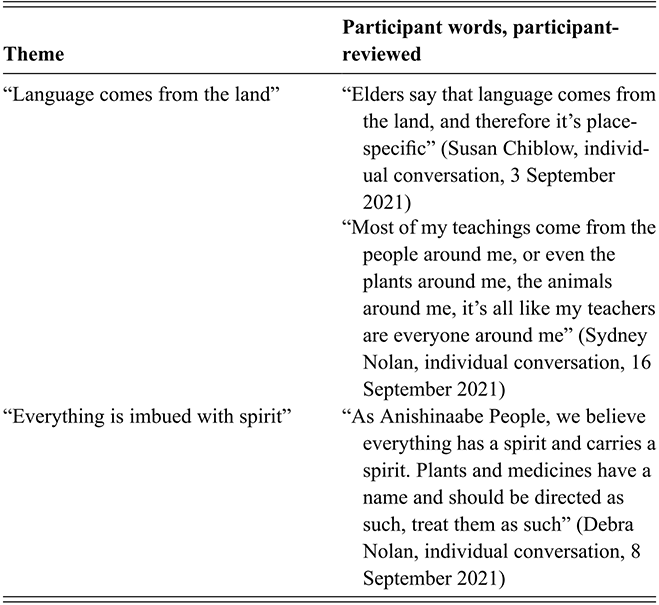
Table 6 Long description
The table has two columns: Theme, and Participant words, participant-reviewed. The first theme is Language comes from the land. Two participant quotations are listed under this theme. The first states: Elders say that language comes from the land, and therefore it’s place-specific (Susan Chiblow, individual conversation, September 3, 2021). The second states: Most of my teachings come from the people around me, or even the plants around me, the animals around me, it’s all like my teachers are everyone around me (Sydney Nolan, individual conversation, September 16, 2021). The second theme is Everything is imbued with spirit. One participant quotation is listed: As Anishinaabe People, we believe everything has a spirit and carries a spirit. Plants and medicines have a name and should be directed as such, treat them as such (Debra Nolan, individual conversation, September 8, 2021). The table shows how themes were generated directly from participant language, linking land, place, plants, animals, and spirit to knowledge and relationality.
RTA acknowledges diverse guiding theories and paradigms (Braun & Clarke, Reference Braun and Clarke2021), enabling it to be informed by Indigenous worldviews, such as Dùthchas and Bizindam. While RTA emphasises researcher reflexivity, Indigenous analytic frameworks further centre land, kinship, ceremony, and community protocol (Chiblow Reference Chiblow2021; Meighan, Reference Meighan2022a). Used together, these frameworks help ensure interpretive validity and accountability to both Indigenous and academic communities. This process echoes Two-Eyed Seeing principles (Bartlett et al., Reference Bartlett, Marshall and Marshall2012) to ethically bridge frameworks, ensuring neither tradition is subordinated to the other. Instead, each maintained its distinctiveness while complementing the interpretive process.
The combined use of Anishinaabek analysis, Dùthchas, and inductive RTA did not aim to integrate knowledge systems into a single unified model. Rather, it honoured the distinctiveness of each while allowing for a transepistemic and transdisciplinary dialogue (Meighan, Reference Meighan2023) between them. This approach to knowledge generation ‘is not calling for an integration of … knowledge systems but rather recognizes there are multiple ways of gathering [and generating] knowledge’ (Chiblow, Reference Chiblow2021, p. 7).
South Uist Gaelic Oral Tradition Project, Scotland (Meighan, Reference Meighan2025c)
Similar principles informed knowledge generation and my interpretive process in the South Uist Gaelic oral tradition project. Here, Cèilidhs (conversational visits) were interpreted through Dùthchas, with Càirdeas (kinship/friendship) guiding presence and listening, coding, theme generation, and member-checking processes (Table 7).
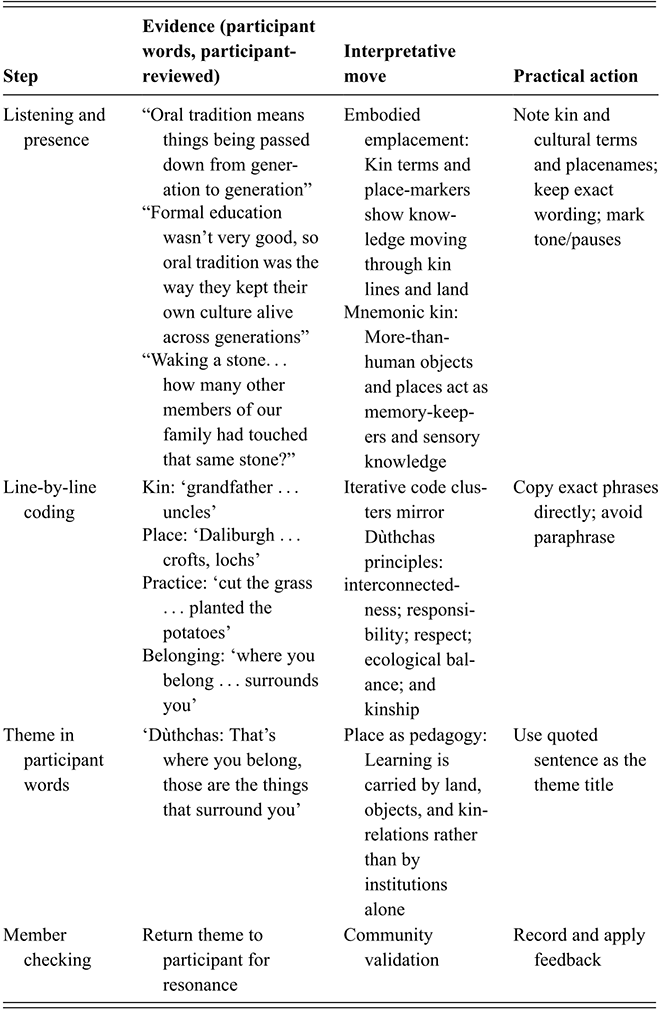
Table 7 Long description
The table has four columns: Step, Evidence (participant words, participant-reviewed), Interpretative move, and Practical action. The first row is Listening and presence. Evidence includes three quotations: Oral tradition means things being passed down from generation to generation; Formal education wasn’t very good, so oral tradition was the way they kept their own culture alive across generations; and Waking a stone… how many other members of our family had touched that same stone? The interpretative move is that kin terms and place-markers show knowledge moving through kin lines and land, and that more-than-human objects and places act as memory-keepers and sensory knowledge. The practical action is to note kin and cultural terms and placenames, keep exact wording, and mark tone and pauses. The second row is Line-by-line coding. Evidence is grouped as Kin: grandfather…uncles; Place: Daliburgh… crofts, lochs; Practice: cut the grass… planted the potatoes; and Belonging: where you belong… surrounds you. The interpretative move is that iterative code clusters mirror Dùthchas principles: interconnectedness, responsibility, respect, ecological balance, and kinship. The practical action is to copy exact phrases directly and avoid paraphrase. The third row is Theme in participant words. Evidence is the quotation: Dùthchas: That’s where you belong, those are the things that surround you. The interpretative move is Place as pedagogy, meaning learning is carried by land, objects, and kin-relations rather than by institutions alone. The practical action is to use the quoted sentence as the theme title. The fourth row is Member checking. Evidence is Return theme to participant for resonance. The interpretative move is community validation. The practical action is to record and apply feedback. Overall, the table illustrates a relational analytic process in which participant words are preserved, interpreted through Dùthchas, and validated with participants.
Participants were viewed as cultural knowledge holders and kin, not as abstract ‘data sources’. Stories were honoured as part of a shared and living Gaelic knowledge system. Acts such as returning to communal ancestral places (e.g., ‘waking’ the family croft stone) and reflecting collectively on intergenerational memory were themselves forms of knowledge generation, embedded in cultural practice and land-based epistemology (see full knowledge gathering example in Section 3.2.2).
Across both case studies, knowledge generation and interpretation remain inseparable from land, kinship, ceremony, and reciprocal community engagement. In a kincentric and relational methodology, knowledge is not extracted; it is co-generated, witnessed, and carried in relation. In these examples, Dùthchas orients ethical emplacement, Bizindam guides deep listening, and Càirdeas sustains the kin-relational cycles through which knowledge is generated and returned.
Indigenous Contexts Worldwide
The approaches in the Anishinaabe and Gaelic contexts resonate with a growing body of research documenting Indigenous-led methods of relational knowledge generation:
(1) Kaupapa Māori frameworks in Aotearoa/New Zealand – Raerino et al. (Reference Raerino, Macmillan, Field and Hoskins2021) used Kaupapa Māori (Māori principles) to guide theme development. Initial deductive codes were refined through iterative group reflection among Māori researchers, illustrating that rigour can emerge from Indigenous worldview alignment, not external analytical models.
(2) Yarning circles in Australia – Marriott et al. (Reference Marriott, Reibel and Coffin2019) used collective coding between Aboriginal and non-Aboriginal teams, followed by group yarning. Listening shaped coding decisions, surfacing themes such as ‘cultural security’ that might otherwise have been missed.
(3) Talking Circles among Secwépemc professionals in Canada – Bourque Bearskin et al. (Reference Bourque Bearskin, Seymour and Melnyk2025) facilitated ceremonial circles where transcripts were collaboratively coded. Themes like ‘sociopolitical contexts of Aboriginal nursing’ were generated through relational dialogue, intergenerational teaching, and cultural protocol, not predefined codes.
(4) NAKPA (Cree ‘medicine/healing stories’) in Canada – McIlduff et al. (Reference McIlduff, Acharibasam, Starr and Chapados2022) convened panels of Elders, participants, and researchers to interpret participant stories collectively. Themes were not imposed, but were generated through healing discourse, ceremony, and community leadership.
Across these examples, several principles hold:
(1) Collaborative interpretation enhances cultural integrity – Interpretation is not only the task of the individual researcher alone but is grounded in collective reflection with kin, such as Elders, knowledge holders, and communities.
(2) Themes are iterative and community-validated – Themes were not researcher-imposed, but were generated through group reflection and community validation.
(3) Interpretive authority is rebalanced – In each case, researchers assumed listening roles, acknowledging Indigenous researchers and participants as epistemic experts and cultural interpreters.
These practices resonate deeply with the knowledge generation principles underlying the TEK-nology and Gaelic oral tradition projects. Themes did not arise from predefined coding frameworks; they were generated through kinship, listening, dialogue, protocols, and culturally embedded knowledge generation processes guided by Bizindam and Dùthchas.
Table 8 succinctly, though non-exhaustively, summarises key contrasts between dominant and kincentric-relational analytical paradigms, providing researchers with practical tools to begin conceptualising their own knowledge generation framework.
| Dimension | Dominant analytical approaches | Kincentric-relational approaches |
|---|---|---|
| Onto-epistemic basis | Positivist, post-positivist | Relational, land-based, kinship-centred |
| Relationship to participants | Detached, objective observer | Co-creators, relatives, community members |
| Validity | Reliability, replicability, generalisability | Community validation, relational accountability, cultural coherence |
| Reflexivity | External analyser | Relational participant, self-reflective and accountable |
| Analytic methods | Deductive coding; statistical modelling; AI/algorithmic analysis | Storywork, ceremony, collective interpretation (Bizindam, Càirdeas) |
| Methods | Thematic coding, statistical modelling | Bizindam, Dùthchas, Yarning, Cèilidh, NAKPA |
| Ethical accountability | Institutional ethics review | Indigenous data sovereignty, cultural protocols |
Kincentric and relational approaches – rooted in Indigenous worldviews and frameworks such as Dùthchas, Bizindam, and Two-Eyed Seeing – challenge educational researchers to reimagine analysis not as a detached or mechanical task, but as a practice of knowledge generation. These frameworks do not reject all dominant analytical methods outright. Rather, they invite us to expand our epistemic horizons, to ask whose knowledges are valued, and to reflect on how meaning and knowledge are relationally generated through accountability to community, land, and ancestral responsibilities.
Such approaches offer not only alternative methods but an alternative stance that is grounded in humility, co-creation, and ethical engagement with more-than-human kin. For researchers working outside their own communities or within Indigenous and minoritised contexts, kincentric and relational methods thus provide rigorous, community-led ways to co-generate knowledge that is valid, relational, transformative, and rooted firmly in relational accountability.
Section 4.3 and 4.4 provide practical guidance and strategies for applying these principles within research design and interpretation, offering concrete examples from the aforementioned case studies as models of relational knowledge generation integrity and culturally congruent research.
4.3 Practical Implications and Researcher Responsibilities
The implications from kincentric and relational knowledge generation frameworks are significant:
(1) Knowledge generation as an ethical site – It is not enough to gather stories relationally if they are then analysed through extractive or technocratic models. Kincentric and relational knowledge generation requires ethical alignment between knowledge gathering (Section 3) and generation (Section 4), ensuring consistency and foregrounding Indigenous relational worldviews throughout the research lifecycle.
(2) Themes as generative and situated – In kincentric and relational knowledge generation, themes are not imposed or predetermined; rather, they are generated within specific cultural contexts and are validated collaboratively by community knowledge holders. This approach aligns with principles of Indigenous data sovereignty and community authority, reaffirming the authority of Indigenous communities to define and interpret their own knowledge (Leonard, Reference Leonard2017).
(3) Reflexivity beyond the individual – While reflexivity is essential, relational frameworks demand that researchers go beyond personal reflection to actively engage in ongoing consent, collective interpretation, and shared knowledge generation processes. It is critical that researchers consistently create spaces for Indigenous analytical leadership throughout knowledge generation, ensuring interpretive processes also reflect collective, rather than only individual, understandings.
(4) Balancing epistemic authority and methodological pluralism – Frameworks like Two-Eyed Seeing (Bartlett et al., Reference Bartlett, Marshall and Marshall2012; Muir et al., Reference Muir, Duncan and Almack2023) offer practical ways to ethically bridge distinct knowledge systems. Crucially, however, methodological pluralism must not lead to epistemic hierarchies, where Indigenous frameworks become subordinated within Western analytic scaffolds. Instead, Two-Eyed Seeing serves as a guiding ethical stance, promoting coexistence, respectful dialogue, and relational balance between Indigenous and dominant analytic traditions without compromising their distinctiveness.
Together, these considerations frame knowledge generation not as the endpoint of research, but as a continuation of relational, land-based accountability.
Researchers – particularly those not Indigenous to the communities or lands where they work – must therefore engage in sustained relational and reflexive practice. Several practical strategies facilitate relational knowledge generation integrity and culturally congruent research:
(1) Prioritising relationships – spend substantial time within communities, establishing genuine relationships before generating knowledge. Relational trust is foundational, supporting meaningful co-interpretation rather than unilateral extraction.
(2) Begin with the self – engaging critically with positionality, privilege, and personal research motivations (Geniusz, Reference Geniusz2009; Kovach, Reference Kovach2009) deepens reflexive accountability, situating the researcher ethically within relational networks.
(3) Collaborative meaning-making – actively inviting community members, Elders, and knowledge holders into processes of interpretation ensures that knowledge generation insights remain accountable, community-validated, and culturally congruent.
(4) Utilising cultural protocols and concepts – prioritise Indigenous languages, ceremony, cultural concepts, and storytelling as integral components guiding interpretation, thereby embedding knowledge generation processes within meaningful cultural contexts.
(5) Rejecting universalising, ‘one-size-fits-all’ coding schemes – adhering to community-defined values, practices, and relational worldviews to shape analytic procedures directly counters reductive, one-size-fits-all coding schemas, ensuring knowledge generation reflects lived relational realities.
Furthermore, Two-Eyed Seeing explicitly addresses scenarios where methodological bridging is necessary, especially within institutional or mixed-method contexts. Practically, this might involve strategically integrating or ‘triangulating’ methods such as automated thematic clustering or statistical modelling – perhaps useful for structural or logistical insights – with subsequent community-led interpretation sessions firmly anchored in Indigenous relational protocols and storytelling. Two-Eyed Seeing can thus become a practical analytical commitment to ethical synergy rather than a convenient methodological supplementation.
This relational and ethical integration must be undertaken carefully, maintaining the distinctiveness of each analytic tradition, preserving cultural integrity, and ensuring epistemic balance. Such methodological bridging should always uphold relational principles of humility, patience, and cultural responsiveness (Muir et al., Reference Muir, Duncan and Almack2023). As Muir et al. (Reference Muir, Duncan and Almack2023) note, this principle supports ethical integration rather than assimilation. Two-Eyed Seeing offers a dialogue across epistemic systems – for example, initial Western-style coding for structural insight, followed by rigorous Indigenous group review to provide cultural and relational richness and to approve coding and themes generated.
Together, these implications and responsibilities reframe analysis as relational knowledge generation and a land-based continuation of research accountability rather than as an endpoint. Researchers engaging relationally and kincentrically must commit to sustained reflexive practice, ongoing relational consent, and ethical dialogue, with clear recognition of community-defined analytic authority.
The subsequent section further provides practical guidance and concrete tools for effectively implementing these responsibilities within research contexts, reinforcing kincentric and relational knowledge generation as ethically rigorous, relationally accountable, and culturally transformative practices.
4.4 Kincentric Tools and Reflexive Strategies for Researchers
To operationalise kincentric and relational knowledge generation rigorously, several practical strategies support ethical and culturally congruent interpretation processes. These strategies, drawing on the relational frameworks of Bizindam, Dùthchas, and Two-Eyed Seeing, provide researchers with concrete tools for embedding relational accountability throughout analysis:
(1) Adopt a cyclical iterative process – approach knowledge generation cyclically rather than linearly. Continuously revisit, reinterpret, and collaboratively validate meanings through sustained conversations with participants and community members. Such iterative cycles of reflection ensure that interpretations remain dynamic, relationally accountable, and contextually grounded.
(2) Centre ceremony and storytelling – include Indigenous ceremonies where appropriate and consensual, storytelling, and culturally meaningful metaphors, anchoring knowledge generation firmly within cultural, historical, and land-based contexts. Rather than abstracting meanings, interpretation emerges relationally through culturally resonant narrative frameworks.
(3) Co-create interpretation with Elders, language keepers, and knowledge keepers – actively co-create interpretive meanings. Presenting themes back to communities for further review and reinterpretation helps maintain cultural integrity and prevents unilateral, researcher-imposed meanings.
(4) Document reflexive processes transparently – use fieldnotes, audio memos, or online journals to transparently document analytic decisions and shifts in understanding over time. Make explicit how Indigenous epistemologies shape interpretive processes, methodological accountability, and analytic integrity.
(5) Embrace plurivocality and ambiguity – remain open to multiple, even contradictory voices and perspectives. Rather than forcing themes into rigid typologies or binary categories, allow thematic insights to remain dynamic, plurivocal, and responsive to relational complexities.
Beyond these individual practices, researchers can adopt systemic methods to deepen relational accountability, uphold Indigenous analytic leadership, and respect Indigenous data sovereignty. Practical tools include:
(1) Forming community-based advisory committees early – Establishing educational committees or analytic advisory panels early in research design – such as the LRC (see Section 3) – ensures that interpretive protocols remain guided explicitly by Indigenous expertise, leadership, and relational principles.
(2) Hosting relational gathering events – Regularly convening community dissemination sessions, Cèilidhs, talking circles, or story-sharing events – whether online or in-person – provides structured yet relational spaces for shared interpretation, collective validation, and mutual reflection. These gatherings significantly reduce the risk of reductive coding or interpretive unilateralism.
(3) Tracing Indigenous epistemologies in knowledge generation – Researchers should systematically document how Indigenous epistemologies and relational practices shape each interpretive step. Such explicit tracing – comparable to Marriott et al.’s (Reference Marriott, Reibel and Coffin2019) collective coding, Raerino et al.’s (Reference Raerino, Macmillan, Field and Hoskins2021) kaupapa-guided memory reflections, the reflective journal from the TEK-nology project (see Section 3), or the knowledge generation example (Table 7, Section 4.2.1) – clarifies the relational basis for analytic decisions, reinforcing community transparency, methodological coherence, and ethical accountability.
Collectively, these tools ensure that kincentric and relational knowledge generation remains deeply embedded in ethical relationships and ongoing reciprocal learning rather than becoming isolated as technical practices. Relational knowledge generation thereby becomes a sustained commitment to community-centred meaning-making, relational accountability, and ethical responsibility, both within and beyond academic contexts.
When generating knowledge (“analysing data”) within kincentric and relational frameworks, researchers should remain attuned to the following practices:
(1) Allow meaning to be generated through relational listening (such as Bizindam) and dialogue with community partners rather than rushing to produce categories or codes.
(2) Balance Indigenous and dominant/Western frameworks: approaches such as Two-Eyed Seeing help keep insights grounded in both Indigenous knowledge systems and broader academic traditions.
(3) Engage in iterative checking-in: return to participants and communities with preliminary interpretations, inviting co-analysis and ensuring accountability.
(4) Respect land and more-than-human kin: treat stories and knowledges tied to place as active participants in the analysis, not as neutral data points.
(5) Maintain reflexivity: situate yourself as a researcher, continually questioning how your positionality shapes interpretation.
These practices underscore that analysis is never neutral but always an ethical, relational act.
4.5 Conclusion: Knowledge Generation as Ethical, Relational Practice
This section has demonstrated that kincentric and relational knowledge generation – grounded in Indigenous frameworks such as Bizindam, Dùthchas, and Two-Eyed Seeing – are theoretically rigorous, ethically grounded, and culturally generative alternatives to dominant analytic practices. Relational knowledge generation resists abstraction and instead situates interpretation within land, kinship, spirit, and ongoing relational accountability. Such analysis is rooted fundamentally in ethical responsibility, not only to knowledge holders, but also to land, ancestors, and future generations.
Educational researchers, especially those working within Indigenous or minoritised contexts, must recognise that analytic practices are never neutral. Rather, they embody deep assumptions regarding knowledge validity, legitimacy, and epistemic authority. Kincentric and relational frameworks explicitly challenge these assumptions, prompting researchers to reimagine how interpretation occurs – not merely as technical data processing, but as ethical, reciprocal acts of meaning-making and knowledge generation deeply embedded in relational networks. Ultimately, knowledge generation is not only a method; it is a stance, a responsibility, and a pathway towards more just, land-honouring, and community-rooted research futures.
Kincentric and relational methodologies thus represent not simply alternative analytic techniques, but profound epistemic stances grounded in humility, reciprocity, ethical co-creation, and sustained engagement with human and more-than-human kin. Particularly for researchers working with communities that are not their own, these frameworks offer rigorous pathways towards community-led, culturally congruent knowledge generation, emphasising reflexivity, reciprocity, and sustained accountability throughout the research lifecycle.
Ultimately, relational knowledge generation offers a transformative shift in educational research practice, moving from detached categorisation towards relational accountability, from isolated interpretation towards collective co-generation of meaning and knowledge, and from methodological dominance towards epistemic pluralism. This shift is critical as education research continues to embrace genuinely decolonising practices that honour the inherent rights of Indigenous peoples to define their own analytic traditions, interpretive protocols, and relational epistemologies.
Looking forward, ongoing research must continue to explore how kincentric, digital, land-based, and community-led analytic frameworks can further support Indigenous resurgence, uphold data sovereignty, and sustain culturally rooted forms of relational knowledge generation. Through sustained relational commitment, humility, and reciprocal learning, researchers can contribute meaningfully towards more just, ethical, sustainable, and community-centred research futures.
4.6 Key Takeaways
(1) Data analysis in kincentric and relational methodologies shifts from extraction to knowledge generation rooted in responsibility and reciprocity.
(2) Conventional analytic practices risk abstraction and erasure of relational and land-based contexts.
(3) Indigenous frameworks such as Dùthchas, Bizindam, and Etuaptmumk provide guidance for relational knowledge generation.
(4) Practical strategies include slowing down, co-analysis with communities, iterative feedback, and recognising land as a knowledge-holder.
(5) Analysis is itself a site of accountability, requiring reflexivity and ethical responsibility.
5 Reflexivity and Ethical Responsibilities
Researcher reflexivity is essential in decolonising research practices, requiring scholars to critically examine their positionality, responsibilities, and the relational dynamics of their work (see Section 1). Reflexivity can be understood as an ongoing, dialogic process in which the researcher and the research influence and shape each other. It involves sustained self-inquiry and critical examination of one’s own positionality, recognising and making visible how one’s identity, values, cultural background, knowledge, and lived experiences intersect with and inform the research process and its outcomes (Section 1; see also Bailey, Reference Baily2025).
In kincentric and relational methodologies, researchers are not separate from the research process but deeply embedded within it. This means that reflexivity is not a discrete stage; it is an ongoing negotiation of ethical commitments, accountability, and relationality with communities either directly or indirectly involved with the research. In education research, reflexivity shifts the researcher’s role from passive observer to active participant, ethical collaborator, and relational partner. It demands sustained attention to how one’s identity, worldview, and institutional location shape every aspect of the research, from conceptualisation to dissemination.
This section explores how these kincentric and relational methodologies shape researcher reflexivity in education research, moving beyond passive observation towards active participation, ethical accountability, and reciprocal engagement. It integrates examples from my own research – conducted as a Scottish Gael working in Anishinaabe and Gaelic contexts (Sections 3 and 4) – and from global education studies to illustrate how reflexivity is enacted in diverse contexts. It also addresses cross-cultural and geographic boundary work, ‘insider–outsider’ dynamics, institutional expectations, and the ethical challenges of navigating Institutional Review Boards (IRBs) that are often misaligned with Indigenous data sovereignty and community-led decision-making.
5.1 Reflexivity in Education Research: Gaps and Necessity
While reflexivity is widely discussed in qualitative methodology, explicit and sustained reflexivity in education research using Indigenous, kincentric, and relational methodologies remains limited. A recent review of Yarning – a conversational method rooted in Aboriginal Australian traditions and protocols (see also Section 4.2.1) – found that, across numerous education and health-related studies, only half of the publications involved Aboriginal and Torres Strait Islander researchers in data collection, and less than a quarter in analysis. Crucially, most of those studies failed to report researcher positionality or reflexive practice – even when using Indigenous methods (Kennedy et al., Reference Kennedy, Maddox and Booth2022). This gap underscores how critical reflexivity is in educational research contexts and reaffirms the necessity of a kincentric and relational approach where researcher positioning is explicitly acknowledged and negotiated.
Addressing this gap matters. Without reflexivity, researchers risk replicating extractive dynamics under the guise of participatory or culturally responsive methods. In education contexts – whether schools, universities, or Indigenous and minoritised community spaces – reflexivity can function as a bridge between methodological intent and ethical practice. In Section 3, for instance, I included member-checking with the LRC, and community screenings – all reflexive practices that aligned interpretation with community priorities rather than academic timelines alone.
5.2 Reflexivity in Kincentric and Relational Methodologies
Reflexivity within kincentric frameworks extends beyond personal awareness. It is a relational act, requiring the researcher to position themselves in webs of kinship, land, and community responsibility. This approach rejects the detached, ‘objective’ observer-researcher dynamic and instead foregrounds a commitment to:
(1) Accountability to all relations (human and more-than-human) (Wilson, Reference Wilson2001, Reference Wilson2008)
(2) Recognition of self-in-relation to the research context (Graveline, Reference Graveline1998)
(3) Reciprocity in the knowledge exchange process
(4) Humility and willingness to be transformed by the research journey
In kincentric and relational approaches, reflexivity is not a one-off ‘positionality statement’ in a methodology section – it is a continuous cycle of reflection, action, feedback, and adaptation that actively informs and is integral to the research process (Figure 4).
Kincentric and relational reflexivity cycle.
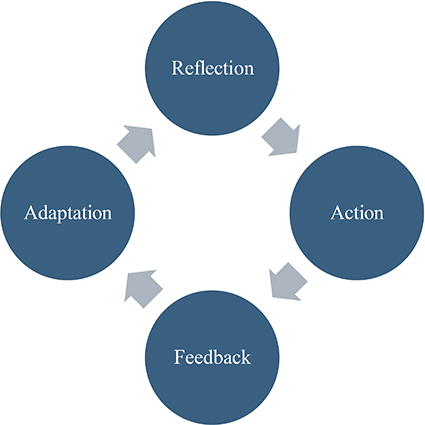
In Section 4, the cycle in Figure 4 was visible in how Bizindam (deep listening) guided my knowledge generation (data analysis) phase in the TEK-nology project (Bizindaage → Ozhibii’igi → Naanaagadawendam → Nisidotaagwad) and ethical bridging with Reflexive Thematic Analysis. This cycle was further informed by Dùthchas, Càirdeas, and emplaced ethical relations (Oliver, Reference Oliver, Nicolson and Meikle2021) for the Gaelic Oral Tradition project, serving as accountability to human and more-than-human kin, such as the land.
5.3 Navigating Positionality: A Gael Researcher in an Anishinaabe Context
Drawing on my own research experiences, I reflect on navigating my positionality as a Scottish Gael – Indigenous to the Scottish Highlands and Islands – conducting research with participants from an Anishinaabe community in Canada. I am not Indigenous to Turtle Island (also known as North and Central America), and my role in this context required careful consideration of ‘insider–outsider’ dynamics, cultural and community protocols, and my own responsibilities to self, family, ancestors, and more-than-human relations (see Sections 1 and 2; Wilson, Reference Wilson2001).
My reflexive process was shaped by:
(1) Shared histories and understandings of language loss and reclamation between Scottish Gaelic and Anishinaabemowin, which strengthened kinship and ethical relations but did not erase difference.
(2) Participation in ceremony and language learning, such as an Anishinaabemowin course with Elder Barbara Nolan, prior to formal research.
(3) Engagement with Biskaabiiyang (“Return to Ourselves”; Geniusz, Reference Geniusz2009) as a framework for self-decolonisation
(4) Operationalising Dùthchas as both an ethical stance and methodology
5.3.1 Research Example
In the TEK-nology project, I began participant recruitment through existing kin networks (my married family’s community), rather than anonymous calls for participation, understanding that trust is earned through relationships, not institutional credentials (McGregor et al., Reference McGregor, Restoule and Johnston2018). The LRC co-led decisions, shaped themes, and curated digital outputs. This honoured community authority, mitigated extractive risk, and positioned me as a guest–relative and research co-participant, not ‘expert owner’.
5.3.2 ‘Insider–Outsider’ Nuance
In the South Uist project (Sections 3 and 4), while I was linguistically and culturally ‘inside’, I still practised consent, story sovereignty, and the Dùthchas principles. In Garden River, I was linguistically and culturally ‘outside’ and also related through marriage; here I deferred to community leadership and adopted Bizindam (active listening) protocols, reporting back frequently and publicly. Responsibilities and relational obligations exist throughout the fluid spectrum of ‘insider–outsider’ dynamics, which are not binary in themselves and will be further discussed in Section 5.4.
5.4 Ethical Challenges in Kincentric and Relational Education Research
In the field of Indigenous education, reflexivity is increasingly recognised as core to ethical method design (e.g., Fitzpatrick & May, Reference Fitzpatrick and May2022). For instance, reflexive autoethnographic researchers studying positionality in First Nations contexts in Canada have emphasised that researchers carry their subjective, cultural ‘traces’ into the field. By reflecting on these traces, they not only recognised biases but also repositioned themselves within relational obligations (Evans, Reference Evans2023). Similarly, research on navigating ‘insider–outsider’ roles in education emphasises that positionality and reflexivity are not optional; it is essential for maintaining ethical clarity and validity, where insider-outsider positions are fluid and context-bound rather than binary (Katyal & King, Reference Katyal and King2014; Yip, Reference Yip2024).
Conducting research when you are not Indigenous to the communities and the lands on which you work brings important ethical challenges and considerations:
(1) Power dynamics between researcher and community
(2) The expectations of academic institutions compared to community needs
(3) Misalignment between dominant Western IRB protocols and Indigenous ethical frameworks
(4) Risks of extractive knowledge production
For example, IRB processes may often focus on individual consent forms alone, while Indigenous ethics prioritise collective consent, data sovereignty, and relational accountability. Negotiating these differences requires both advocacy within institutional structures and a commitment to community-led decision-making.
(1) Co-develop ethical protocols by consulting on cultural protocols with community leaders and members before submitting ethics applications.
(2) Check if there are pre-existing ethics protocols in the Indigenous community.
(3) Include provisions for iterative consent in IRB documentation.
(4) Advocate for Indigenous data governance and assert community control over research outputs, such as control over the LRC YouTube channel in the TEK-nology project (Section 3).
(5) Provide a clear rationale detailing the importance of adhering to Indigenous practices and cultural protocols to ethics boards.
(6) Use CARE principles (Collective benefit, Authority to control, Responsibility, Ethics) alongside OCAP® in Canada to safeguard community authority.
(7) Leverage emerging policy frameworks, such as TCPS2 Section 9 in Canada and the AIATSIS Code of Ethics in Australia, to advocate for culturally grounded dissemination and community control over knowledge.
5.5 Reflexivity as Long-Term Commitment
Reflexivity is inseparable from long-term relational accountability (Wilson, Reference Wilson2001). In kincentric and relational research, relationships extend beyond the project timeline; the researcher remains connected to the community through follow-up, continued knowledge exchange, and supporting community goals.
5.5.1 Research Example
In South Uist oral tradition research, I continued sharing resources and translations with participants after knowledge gathering (data collection) was completed, ensuring they retained agency over how their contributions were represented. In the TEK-nology project in Garden River, I have continued to collaborate with LRC members on co-creating and archiving language resources, such as my invitation to be a collaborator on another language revitalisation project titled ‘Daapnandaa Anishinaabe Aadiziwin: Seasonal Anishinaabemowin videos based on traditional activities’ and funded by the Government of Canada Indigenous Languages and Cultures Program.
(1) Schedule follow-up visits or virtual meetings after project completion
(2) Share drafts and final outputs with participants for feedback before publication
(3) Ask communities how they want to be acknowledged, how work should be archived and cited, and how the work can continue to serve them
5.6 Reflexivity Tools for Education Researchers
To translate these principles into concrete action, researchers can draw upon a set of adaptable reflexivity tools. Table 9 below summarises a non-exhaustive range of approaches – from personal journaling to community-led feedback loops – that embed reflexivity as a living practice throughout the research process. These tools are not prescriptive checklists but adaptable prompts that can be reshaped according to cultural protocols, community expectations, and the evolving context of the work.
| Tool | Purpose | Example | Practical adaptation |
|---|---|---|---|
| Reflexive journaling | Track evolving positionality, tensions, learning | TEK-nology self-decolonisation journal | Journal before/after community interactions, note decisions, emotions |
| Feedback loops | Ongoing participant review | LRC member-checking; community committees | Build review points into timelines and grants |
| Ethical mapping | Visualise relationships and responsibilities | Map kin, land, and institutional connections | Revisit at key milestones; use as planning and accountability tool |
| Critical dialogues | Peer/community challenge and care | Regular check-ins with Elder or knowledge holder and academic mentor | Document how feedback changed decisions |
| “Uncomfortable reflexivity” (Pillow, Reference Pillow2003) | Resist essentialist binaries and cultural, racial assumptions | Sit with discomfort, active listening | Journal and share dialogue with research participants |
| Four-perspectives lens | Onto-epistemic, socio-historical, socio-cultural, political (Zembylas, Reference Zembylas2025) | Autobiographical lenses (personal and professional identities) to unpack how perspectives shaped research (Bailey, Reference Baily2025) | Use diaries or journals, guided by personal life history, identity, and community roles, to deepen reflexivity over time |
| Storying positionality | Share narrative of identity and relational commitments | Personal language and culture histories | Start research reports or presentations with a positionality story |
One way to evidence and strengthen reflexivity is to maintain an audit trail that documents how positionality, decision-making, and ethical commitments evolved over time (see also Section 3.6.2). Table 10 below offers an example from the TEK-nology project (Section 3), illustrating how each action was informed by community guidance, grounded in specific protocols, and linked to tangible community benefits. While each research context will differ, researchers can adapt this trail to their own contexts and circumstances.
| Action | Who advised | Example protocol referenced | Effect on community benefit |
|---|---|---|---|
| Offer Asemaa (Tobacco) before speaking with participants | Anishinaabe Elder and Knowledge Keeper (Dr Susan Chiblow) | Ceremonial protocol | Follow culturally specific protocols and embody respect |
| Share video ideas at every stage and draft videos with participants before YouTube release | LRC Committee | OCAP®: Access & Control | Participants chose which segments to keep and share, protecting sensitive cultural material |
| Add Anishinaabemowin subtitles | LRC Committee | CARE: Collective Benefit | Increased language visibility; resource for school learners |
5.7 Reflexivity and Rigour as a Kincentric Practice
Kincentric reflexivity means being accountable to:
(1) All relations: human, more-than-human, and land-based
(2) Community-defined priorities: research serves community goals, not only academic ones
(3) Intergenerational responsibility: today’s choices affect future biocultural continuity
This reframes reflexivity as a relational act rather than a purely self-reflective one. In kincentric approaches, and drawing from the studies and examples in Sections 2, 3, and 4, reflexive rigour in education research is not about reproducibility; it is grounded in:
(1) Trustworthiness: built through sustained engagement (such as repeated LRC reviews)
(2) Cultural integrity: adherence to protocol (Asemaa; talking circles; Cèilidh)
(3) Community validation: findings checked by those who shared the stories
(4) Reflexive transparency: an auditable trail of positionality shifts and decisions
(5) Ethical embedding: whose knowledge is centred, who benefits, who decides?
(6) Ongoing reflexivity: how did the researcher change, and how is that visible?
(7) Data sovereignty in practice: OCAP®/CARE honoured.
In this framing, reproducibility yields to relational coherence; neutrality yields to answerability.
To practice reflexivity within decolonising, kincentric, and relational frameworks, researchers should consider:
(1) Journaling and self-inquiry throughout the project, documenting not only observations but how one’s own positionality is shifting in relation to the work.
(2) Dialogic reflexivity by engaging in open conversations with mentors, peers, and community members about assumptions, positionalities, and ethical dilemmas.
(3) Embedding accountability mechanisms, such as advisory circles, committees, or community check-ins, to ensure responsibility is not only self-determined but relationally grounded.
(4) Ethical humility: recognising when one’s knowledge or authority should be stepped back in favour of community voices and Indigenous epistemologies.
These strategies ensure reflexivity is not reduced to a checklist or token gesture, but a sustained, relational practice.
5.8 Closing Reflections
As a Gael sociolinguist working in partnership with Anishinaabe communities, my reflexivity was informed by my own experiences of language loss and cultural reclamation. The parallels, and differences, between the Anishinaabemowin and Gàidhlig (Scottish Gaelic) contexts deepened my awareness of how decolonising research in education must prioritise land, language, and community-defined outcomes. My positionality demanded accountability, not only to academic conventions, but to the communities and knowledge systems I am part of. Reflexivity in kincentric and relational education research is not optional; it is the ethical foundation on which the entire project rests.
Reflexivity is profoundly relational and rooted in self-location, historical consciousness, humility, and a commitment to decolonial praxis. Integrated across design, knowledge gathering, knowledge generation, and knowledge sharing (see Sections 3, 4, and 6), reflexivity honours Indigenous sovereignty, sustains long-term relationships, and ensures that educational research is a site of learning, reciprocity, and cultural continuity, rather than extraction.
5.9 Key Takeaways
(1) Reflexivity is an ongoing, dialogic process where the researcher and research mutually shape each other.
(2) In kincentric and relational methodologies, the researcher is embedded within the research and accountable to more-than-human and community relations.
(3) Reflexivity requires constant attention to how identity, worldview, and institutional position influence all stages of the research.
(4) Practical strategies include journaling, dialogic reflection, community accountability, and ethical humility.
(5) Reflexivity is inseparable from ethical responsibility; it sustains decolonising research as a relational and accountable practice.
6 Reporting and Dissemination of Findings
6.1 Reframing ‘Findings’ as Relational Knowledge Sharing
Mainstream dissemination channels, such as journal articles, conference presentations, and academic libraries or repositories, tend to privilege Western structures of authority. Search engines often relegate Indigenous knowledges to ‘folklore’ (Meighan, Reference Meighan2021), and those most deeply implicated in the research – the communities themselves – are frequently excluded. Such approaches perpetuate extractive dynamics in which people and communities are treated as research ‘subjects’, not co-curators or co-creators of knowledge (Section 1).
In many Western and positivist research traditions, ‘findings’ are framed as discrete results or objects ‘discovered’ in the field, analysed, and then disseminated for academic consumption (Wilson, Reference Wilson2001). This language mirrors the extractive logics of colonial resource mining – in both physical and digital settings – in which something is ‘found’, removed from its relational context, and ‘owned’ by the finder. As Indigenous (Māori) scholar Smith (Reference Smith2021) reminds us, research has often been ‘one of the dirtiest words in the Indigenous world’s vocabulary’ (p. 1) because of its deep entanglement with colonial extraction and exploitation.
From a kincentric and relational perspective, the very idea of ‘finding’ is problematic. Knowledge does not lie inert, waiting for ‘discovery’. Knowledge is alive, dynamic, and bound in relationships among peoples, lands, waters, and more-than-human kin. Indigenous (Cree) scholar Wilson (Reference Wilson2001) states, ‘an Indigenous paradigm comes from the fundamental belief that knowledge is relational, shared with all creation, and therefore cannot be owned or discovered’. This section therefore reframes ‘findings’, a term common in academic discourse, as knowledge sharing. This reframing aligns with previous sections, which have positioned data collection as knowledge gathering and data analysis as knowledge generation (Figure 5).
Kincentric and relational research cycle.
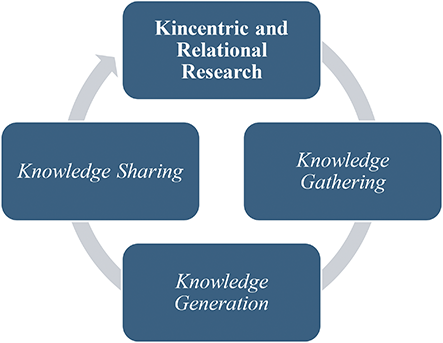
Kincentric and relational methodologies require dissemination that honours Indigenous knowledge systems, community protocols, and long-term relational accountability. This means centring formats that are accessible, culturally grounded, and community-controlled, aligned with principles of data sovereignty, reciprocity, and kinship.
While much discourse on research with Indigenous and marginalised communities rightly focuses on the harms of extraction, a strengths-based approach also reframes knowledge sharing as an act that builds on existing capacities, resilience, and cultural pride. In the First Nations Information Governance Centre’s (FNIGC, 2020) Strengths-Based Approach framework, community assets – such as language fluency, cultural continuity, and land-based practices – are seen as the foundation for research design, reporting, and application. In relational knowledge sharing, this means asking not only ‘How can we avoid harm?’ but also ‘How can we amplify what is already thriving?’ This aligns with kincentric ethics, ensuring dissemination reinforces intergenerational strengths and supports futures envisioned by the community itself.
The shift is not only semantic, but it is ethical and practical:
(1) From extraction to reciprocity – knowledge is shared and received through trust and respect.
(2) From ownership to stewardship – knowledge remains embedded in its community of origin.
(3) From product to process – knowledge sharing is part of an ongoing cycle of learning, teaching, and relationship-building.
If the community consents, open access is therefore an important practice for relational knowledge sharing. If knowledge is locked behind paywalls or in subscription-only databases, the very communities that shaped it may be excluded. Open access publications, community-controlled repositories, and freely accessible archives – whether digital or physical – are critical to ensuring that knowledge remains with, and usable by, its community of origin. Public libraries, local learning centres, and community media platforms can also serve as dissemination hubs, bypassing barriers imposed by commercial publishers.
Relational reframing also aligns with the Five R’s of Indigenous Research (McGregor et al., Reference McGregor, Restoule and Johnston2018) – Respect, Relevance, Reciprocity, Responsibility, and Relationship – which emphasise that dissemination must benefit the community, not just the academy (see also Section 3). Indigenous data governance frameworks such as the Collective Benefit, Authority to Control, Responsibility, Ethics Principles (CARE) affirm that communities must approve and control how knowledge is stored, shared, and applied. Knowledge sharing is never automatic nor assumed; research participants decide whether and how it occurs. This is particularly important to prevent further data mining and extraction from Indigenous and minoritised peoples and their communities.
This section will therefore explore how research can be shared in ways that honour Indigenous knowledge systems, kin, existing relationships, and promote community impact. It will propose alternative models of knowledge sharing, including community reports, oral presentations, accessible online open education resources, and digital storytelling. Drawing on case studies in this Element and other examples from education research, it will share tools and insights that support kincentric and relational approaches to knowledge sharing.
6.1.1 Why Language Matters in Knowledge Sharing
Language shapes our onto-epistemic commitments. In Western qualitative or quantitative paradigms, ‘findings’ are often presented in written form, removed from the contexts and relationships that brought them into being. This can unintentionally reinforce:
(1) The myth of researcher neutrality – even with positionality statements, reporting formats may suggest knowledge is separable from the researcher’s relationships.
(2) Institutional control over knowledge – when dissemination is only oriented to peer-reviewed publications and conference papers, the community of origin may not see, access, or benefit from the work.
(3) Decontextualisation – removing oral histories or stories from their lived contexts can reduce and violate cultural protocols.
Kincentric and relational knowledge sharing resists these patterns by asking:
(1) Who is the primary audience?
(2) How can the process of sharing be as reciprocal as the process of gathering?
(3) What cultural protocols govern the sharing of this knowledge?
(4) Who decides where and how the knowledge lives after the research is done?
Before choosing a knowledge sharing (dissemination) format(s), ask community partners these four questions. Document the answers and return to them when making any new sharing decisions.
6.2 Relational Knowledge Sharing: Applications and Examples
Indigenous and relational knowledge sharing and mobilisation research emphasise context, transparency, and mutually beneficial processes and outcomes. Hutchinson et al. (Reference Hutchinson, McIlduff and Legare2023) provide a framework for making knowledge visible on a community’s own terms, acknowledging that these terms differ among Indigenous peoples, and embedding accountability and relational ethics throughout. Context is vital, and they caution against ‘the colonial practice of adopting a pan-Indigenous approach’, which ignores heterogeneity and silences individual voices (p. 911). In the Inuit context, Pufall et al. (Reference Pufall, Jones and McEwen2011) found that culturally preferred forms of knowledge sharing, such as story circles, community workshops, and visually rich presentations, produced deeper engagement than conventional academic products.
6.2.1 Towards Decolonising Media: Digital Storytelling and Knowledge Co-Creation
Digital storytelling is not only a method but a transmission mode rooted in memory, culture, and collective meaning-making. Examples include:
(1) Rieger et al. (Reference Rieger, Bennett and Martin2021) show how participatory storytelling in research can support healing, intergenerational transmission, and cultural validation.
(2) Iseke and Moore (Reference Iseke and Moore2011) demonstrate that involving Elders and community members in creating and editing digital stories honours oral tradition and resists colonial textual dominance.
(3) In the Anishinaabe context, Manuelito’s (Reference Manuelito2015) nDigiStorytelling projects illustrate how digital media can be vehicles for healing, survivance, and resurgence while remaining embedded in cultural meaning and community agency.
(4) Poitras Pratt’s (Reference Poitras Pratt2019) ethnography of Métis digital storytelling reveals how communities use media to subvert colonial narratives, practice intergenerational pedagogy, and sustain cultural memory through collective authorship.
(5) In the Scottish Gaelic context, Guthan nan Eilean and Tobar an Dualchais make oral heritage – song, story, poetry, local history – freely accessible in bilingual (Gaelic/English) online archives, strengthening culturally grounded learning and education research.
Digital and online technologies, however, are not neutral; they can perpetuate colonial logics (Meighan, Reference Meighan2021). Their use for knowledge sharing and dissemination must remain accountable to the communities and peoples – especially language and knowledge keepers – who first shared the knowledge.
When using digital media, include member and community checking before publishing. Does this platform or tool allow the community to determine access, context, and future use? If not, choose another method.
6.2.2 Case Study: The TEK-nology Project
In the TEK-nology project (see also Sections 3, 4, and 5), knowledge sharing and co-creation were not peripheral ‘outputs’ but central acts of community-led education and language revitalisation. The Anishinaabemowin videos co-created with the LRC were not simply project documentation; they were online, free-to-access teaching tools designed for learners of all ages – especially youth – at home, school, and beyond.
Relational control and cultural integrity shaped the process:
(1) Control – The LRC decided which videos were made public.
(2) Form – Videos were language-immersive, conversational, multimodal (featuring emojis, visual cues, and transcriptions), and embedded in a cultural context, ensuring accessibility for both speakers and learners.
(3) Infographics – Knowledge was also shared through visually engaging, jargon-free infographics on social media, expanding reach to community members and broader audiences beyond academia.
(4) Academic dissemination – The project also generated peer-reviewed journal articles, conference presentations, and webinars. All were made open access, with project funding covering publication costs.Footnote 7 This alignment between funding priorities, relational ethics, and open access removed paywalls and ensured Anishinaabe community members – and the wider public – could freely engage with the work.
Knowledge sharing in the TEK-nology project was therefore multi-layered: a culturally grounded educational resource, a vehicle for language revitalisation, and a model for including open access with community control. Relationships built through the project were sustained beyond its formal end; following its conclusion, the Elder and community members invited me to collaborate on a new multimedia education initiative, extending the research partnership beyond a single grant cycle.
6.2.3 Case Study: Gaelic Oral Tradition in South Uist
In the South Uist project (see also Sections 3, 4, and 5), knowledge sharing was similarly a form of community education and language reclamation. The methodology was relational from the outset, grounded in Cèilidh-style conversations, a culturally embedded practice of gathering, storytelling, and exchange, and conducted bilingually in Scottish Gaelic and English.
Ethical reciprocity and iterative consent shaped the dissemination process:
(1) Knowledge sharing – Manuscripts from the knowledge gathering and generation stages were shared with participants first so they could approve, amend, or withhold material.
(2) Use – A Gaelic-language presentation, created to share knowledge from the project, was shared with participants before being made public. This was later adapted into bilingual Open Educational Resources (OERs) with Gaelic and English subtitles, which I personally transcribed.
(3) Infographics – As in TEK-nology, infographics provided a jargon-free, visually accessible format on social media for both community members and wider audiences.
(4) Academic dissemination – The project also generated papers, conference presentations, and online presentations, all published open access. This ensured Gaelic and English-speaking audiences – including those outside academic institutions – could freely engage with the work.
Open access was critical since access to academic resources is often mediated by geography, infrastructure, and institutional barriers. By removing paywalls, the project aligned with the principle that knowledge should circulate back to, and remain in the hands of, those who shared it in the first place.
When sharing in multiple languages, budget extra time for transcription, translation, and community review. These are not ‘add-ons’ but central to ethical and accessible dissemination.
Taken together, the TEK-nology project and the South Uist Gaelic oral tradition work illustrate how relational knowledge sharing can manifest differently across cultural and linguistic contexts while maintaining shared ethical commitments. Both prioritised community control over content, open access to ensure equitable reach, and formats rooted in cultural practice, whether through immersive Anishinaabemowin language videos or Cèilidh-style bilingual storytelling.
In each case, dissemination was not a one-way transfer of ‘findings’ but an iterative, reciprocal process, shaped by community priorities and grounded in long-term relationships. The role of technology in these projects – digital video platforms, social media infographics, online archives – was never neutral; rather, it was adapted into relational technology that served the community’s goals, safeguarded cultural integrity, and strengthened collective capacity for future knowledge sharing.
6.2.4 Relational Technology
Building on the approaches in both case studies, I use the term relational technology (Meighan, Reference Meighan2022c) to describe digital processes that remain accountable to, and/or are led by, the Indigenous community in accordance with their values, goals, and protocols. In both the TEK-nology and South Uist projects, technology was not treated as a neutral tool but as a medium that had to be adapted to uphold cultural integrity, data sovereignty, and relational ethics.
Key principles of relational technology include:
(1) Community control over what is shared publicly and how it is contextualised.
(2) Protection of knowledge keepers and traditions in line with Indigenous Data Sovereignty principles (Kukutai & Taylor, Reference Kukutai and Taylor2016).
(3) Avoidance of extractive digital practices that serve commercial or institutional interests without community benefit.
In both projects, relational technology transformed dissemination and knowledge sharing into a continuation of relational ethics, repurposing research outputs into reciprocal, generative community learning.
In practice, this meant:
(1) Hosting video content on platforms chosen or approved by the community.
(2) Producing subtitles in both Indigenous and dominant languages to maximise accessibility without compromising cultural meaning.
(3) Designing infographics and other visual resources for channels that reached audiences both within and beyond academic spaces.
(4) Ensuring all digital outputs were freely available, open access, and controlled locally.
Rather than simply ‘disseminating’ outputs, relational technology allowed each project’s resources to function as living, adaptable repositories, material that communities could update, reinterpret, and reuse after the formal research phase ended. In this way, the digital dimension of these projects was not an endpoint but an extension of the relationship, enabling knowledge to remain active, relevant, and under community stewardship.
6.3 Models and Strategies for Relational Knowledge Sharing
Table 11 presents dissemination modes and strategies as acts of relational knowledge sharing rather than mere academic ‘outputs’. These approaches emerged both from my own projects and from wider Indigenous and community-based research practice. They are non-exhaustive; each community will have its own preferred and culturally grounded forms of sharing. The aim is not to prescribe but to provide adaptable models that can be combined, modified, or expanded, depending on the research context, community priorities, and cultural protocols.
| Mode and strategy | Description | Relational importance |
|---|---|---|
| Community reports | Co-written with community members, using accessible language, visuals, and local languages | Returns knowledge locally, supports decision-making, affirms stewardship |
| Oral presentations and storywork | Gatherings (in-person or virtual) where knowledge is shared as story, often with ceremony, song, or discussion | Maintains oral tradition, strengthens intergenerational ties, situates knowledge culturally |
| Open Educational Resources (OERs) | Digital booklets, posters, videos, audio that communities can host and adapt | Broadens access, respects protocols, enables local leadership. |
| Digital storytelling | Co-produced videos, podcasts, animations, or photo essays with community voices | Blends technology with tradition, creating living archives that teach, inspire, and connect across generations |
| Collaborative archiving | Community-controlled repositories (digital or physical) with access determined locally | Preserves knowledge in culturally appropriate ways; resists loss or appropriation by external institutions |
| School-based engagement | Embedding resources in local curricula and community learning programs | Ensures that knowledge benefits future generations directly and locally |
| Co-created products | Involving community members in designing outputs (e.g., videos, workshops) | Ensures relevance, accessibility, and alignment with local ethics and priorities |
| Accessible formats | Multilingual, visual, and oral formats (art, story, performances, infographics) | Broadens participation and understanding, meets diverse needs and literacies |
| Community data sovereignty | Hosting outputs on community-controlled platforms | Prevents appropriation; strengthens autonomy and long-term stewardship |
| Sustained engagement | Post-project events, updates, and resource renewal | Keeps knowledge alive beyond project timelines |
| Media-based education | Films, oral traditions, digital stories as curriculum | Integrates research into everyday learning |
Invite communities to choose preferred modes and strategies before any knowledge is gathered or shared. This ensures that outputs are relevant, ethical, and meaningful from the outset.
6.4 Knowledge Sharing as Ongoing Relationship
Relational knowledge sharing is not the ‘final stage’ of research. In kincentric and relational methodologies, it is an ongoing cycle that often begins before formal knowledge gathering and continues long after the project’s close. In this approach, knowledge sharing is inseparable from the relationships that sustain it.
In practice, this can mean:
(1) Regular feedback loops – sharing drafts, media, or early findings for community review.
(2) Iterative consent – checking at each stage if certain knowledge can be made public or should remain within the community.
(3) Co-authorship and co-presentation – inviting community members to present at conferences or be named authors on publications, ensuring recognition is shared.
(4) Embedded exchange – Treating knowledge sharing as part of everyday interactions, whether at community gatherings, school events, or cultural ceremonies, so that it remains woven into local life.
This approach reframes dissemination as reciprocal rather than transactional, not a handover of ‘results’ but a continued dialogue that allows knowledge to live, adapt, and grow with the community.
Plan for multiple knowledge-sharing and co-creation meetings with participants from the beginning. This avoids the sense of a ‘one-off project’ and keeps relationships active beyond the research.
6.5 Navigating Institutional Expectations
Relational knowledge sharing often sits uneasily alongside the performance metrics and output requirements of academic institutions. Universities, funders, and publishers frequently prioritise peer-reviewed articles, high-impact journals, and quantitative measures (citations, downloads) over community-defined impact. This can create tension when community protocols call for slower timelines, non-conventional academic formats, or restrictions on public release.
Common tensions include:
(1) Access versus prestige – Journals with high prestige may be paywalled, excluding the very communities that shaped the research.
(2) Control versus Intellectual Property (IP) frameworks – University IP policies may assume that the institution ‘owns’ outputs, conflicting with Indigenous data sovereignty.
(3) Speed versus relationship – Institutional timelines for ‘deliverables’ often conflict with the slower, consent-based pace of relational work.
Possible strategies to navigate these tensions include:
(1) Advocate early – In ethics applications and funding proposals, clearly state that non-conventional academic artefacts – such as infographics, community videos, podcasts, or bilingual OERs – are legitimate and essential forms of dissemination.
(2) Reframe ‘impact’ – Position community benefit (e.g., language revitalisation, cultural continuity, strengthened kinship ties) as a primary measure of success, alongside conventional metrics.
(3) Pair outputs – Publish academic articles alongside companion materials – such as community reports, open-access videos, or in-person workshops – so both institutional and community needs are met.
(4) Negotiate IP clauses – Work with legal and research offices to ensure contracts recognise community ownership and stewardship of knowledge.
By building these strategies into project proposals and budgets, researchers can create space for community-prioritised dissemination and knowledge sharing while still fulfilling institutional requirements.
In some contexts, communities choose to ‘braid’ or bridge Indigenous and Western knowledge systems to meet diverse audience needs without diluting cultural integrity, such as through Two-Eyed Seeing (Bartlett et al., Reference Bartlett, Marshall and Marshall2012; see also Section 2.5). This ‘braiding’ is not a merging into a single strand, but a respectful intertwining where each knowledge system retains its identity and authority (Chiblow, Reference Chiblow2021). For example, a bilingual report might embed traditional stories alongside statistical analyses, allowing each to stand on its own terms while informing the other. Such approaches can be reinforced by aligning with emerging policy frameworks, such as the Tri-Council Policy Statement: Ethical Conduct for Research Involving Humans (TCPS2) Section 9 in Canada, the AIATSIS Code of Ethics in Australia, or the CARE Principles internationally, that mandate community control, consent, and culturally grounded dissemination. Positioning relational knowledge sharing within these policy shifts strengthens its legitimacy within institutional settings while keeping it firmly rooted in community priorities.
6.6 Reflecting Long-Term Accountability in Practice and Reporting
Relational knowledge sharing is not completed when a paper is published or a resource is uploaded. In kincentric and relational research, accountability continues beyond the life of a grant or project. This long-term responsibility means planning for the care, renewal, and governance of shared knowledge, so it remains alive and relevant to the community that shaped it.
Barriers to sustaining accountability can include:
(1) Limited digital infrastructure in communities for hosting and maintaining resources.
(2) Funding models that focus on short-term deliverables rather than ongoing stewardship.
(3) Researcher mobility – when project leads move institutions or regions, relationships can stall if no continuity plan exists.
Strategies for long-term accountability include:
(1) Build intergenerational relationships – Engage youth, Elders, language speakers, and knowledge keepers so knowledge sharing remains rooted in multiple generations.
(2) Embed training and protocols – Equip community members with skills and tools to update and adapt materials independently, from editing subtitles to uploading new recordings.
(3) Design for low-barrier access – Offer offline formats (e.g., printed storyboards, USB drives, local screenings) alongside online materials to overcome connectivity gaps.
(4) Plan for resource renewal – Schedule updates as language, education needs, or cultural contexts change. This may mean returning annually to share adaptations or co-create new content.
(5) Support local community capacity – Invest in equipment, software, and training so communities maintain agency over its knowledge and control their own media production, archiving, and educational dissemination.
Reporting itself becomes a relational act when:
(1) Reflexive narratives centring community voices and acknowledging their decision-making roles.
(2) Transparent documentation of how dissemination decisions were made (e.g., audit trails, accountability journals as discussed in Section 5).
(3) Evidence of relational transformation – Sharing not just ‘outputs’ but how the dissemination process reshaped relationships, responsibilities, and mutual trust.
Include a Relational Accountability Plan in final reports. This could outline who will continue stewarding the knowledge, how updates will be managed, and how the community can decide on future uses. When disseminating research grounded in kincentric and relational methodologies, researchers should:
(1) Prioritise community access – ensure findings are first and foremost returned to participants and communities in culturally appropriate forms (e.g., storytelling circles, visual art, oral histories, community gatherings).
(2) Diversify dissemination channels – balance academic publications with community-led formats, digital storytelling, or creative forms that respect Indigenous protocols.
(3) Respect Indigenous data sovereignty – establish agreements around ownership, control, and future use of knowledge before dissemination.
(4) Acknowledge land and kinship – include the more-than-human world in dissemination practices, for example, through land acknowledgements, ceremony, environmental protection, and ecological reciprocity.
(5) Emphasise relational authorship – foreground community voices and ensure co-authorship or co-presentation where appropriate.
These practices shift dissemination from extractive reporting to reciprocal and accountable knowledge sharing.
6.7 Closing Reflections
Reframing dissemination from ‘reporting findings’ to relational knowledge sharing changes not only the language of research but its ethics, priorities, and practices. It affirms that:
(1) Knowledge belongs with, and remains accountable to, its community of origin and those who shared or informed it in the first place.
(2) The process of sharing is inseparable from the process of building and sustaining relationships.
(3) The most meaningful ‘impact’ is measured not in academic recognition but in community benefit, cultural continuity, and strengthened kinship ties.
In kincentric and relational research, dissemination becomes a living practice, designed not only to inform but to teach, connect, and sustain. This means:
(1) Co-designing with communities so outputs reflect their priorities, languages, and worldviews.
(2) Ensuring accessibility through open access, multilingual formats, and culturally grounded presentation styles.
(3) Recognising technology as relational, capable of strengthening cultural sovereignty when used accountably, or perpetuating harm when deployed without consent and context.
Emerging technologies – such as digital storytelling, interactive media, and Artificial intelligence (AI) – offer powerful ways to create embodied, land-rooted forms of sharing. But these tools must always be shaped by community governance, not institutional convenience, ensuring they are accountable to the peoples and lands from which the knowledge comes.
In both the TEK-nology project and the South Uist Gaelic oral tradition research, knowledge sharing and dissemination are a form of education, rooted in language, culture, and relationships. Co-created videos, oral narratives, infographics, and bilingual OERs were not merely outputs in the conventional academic sense; they were living practices that continued to teach, inspire, and connect. In this way, knowledge sharing is not the end of the story; it is an ongoing conversation carried forward by those with whom we share responsibility, moving beyond traditional academic dissemination towards relational, culturally sustaining practices that remain accountable to kinship networks.
6.8 Key Takeaways
(1) Dissemination framed as ‘findings’ risks perpetuating extractive logics rooted in colonial traditions.
(2) A kincentric and relational approach reframes dissemination as knowledge sharing, recognising knowledge as embedded in relationships.
(3) Mainstream academic channels privilege Western authority; decolonising dissemination requires diverse, community-centred pathways.
(4) Practical strategies include prioritising community access, respecting Indigenous data sovereignty, and balancing academic with creative and community-led formats.
(5) Dissemination is not the end of research but part of an ongoing cycle of relationship, accountability, and reciprocity.
7 Conclusion
7.1 Decolonising Education Research as Relational Praxis
This Element has introduced and illustrated the possibilities of kincentric and relational methodologies for decolonising research practices in education. Across six sections, it has demonstrated how Indigenous concepts – such as Gaelic Dùthchas (land-based belonging and ethical responsibility) and Càirdeas (kinship), Anishinaabe Bizindam (deep listening), and Mi’kmaq Etuaptmumk (Two-Eyed Seeing) – provide not only theoretical insights but also practical frameworks for reshaping how research is designed, conducted, and shared. The Element shows how Indigenous worldviews function as methodological anchors for ethical practice. These are not add-ons to mainstream research; they are foundational to community-led education.
Section 1 grounds the work in self-location and reflexivity; Section 2 reorients planning through Indigenous criteria of ‘quality’; Section 3 reframes ‘data collection’ as knowledge gathering within protocol and reciprocity; Section 4 advances knowledge generation through Dùthchas, Bizindam, and Two-Eyed Seeing; Section 5 deepens reflexivity as relational accountability and data sovereignty; Section 6 repositions findings as knowledge sharing led by community priorities and relational technology.
A consistent theme throughout the Element is that research cannot be reduced to a technical process of extraction, analysis, and reporting. Rather, it is an ongoing, ethical, and relational practice situated in webs of kinship with peoples, lands, knowledges, languages, and more-than-human relations. By grounding research in relational accountability, reflexivity, and Indigenous knowledge sovereignty – and aligning with the Five R’s (Respect, Relevance, Reciprocity, Responsibility, Relationship) – this Element argues for more just, inclusive, and community-led practices. By bridging Indigenous and non-Indigenous research traditions, it calls for a future where educational research is accountable, relational, and life-affirming. A key contribution is the reframing of conventional mainstream research stages into kincentric and relational practices (Figure 5):
(1) Data collection → Knowledge gathering
(2) Data analysis → Knowledge generation
(3) Research ‘findings’ and dissemination → Knowledge sharing
Additional contributions include:
(1) Foregrounding Indigenous epistemologies and methodologies: not supplementary to mainstream approaches but essential alternatives that shift the centre of educational research.
(2) Reframing data and analysis: Bizindam and Dùthchas demonstrate that knowledge is dynamic, contextual, and ethically entangled.
(3) Emphasising researcher reflexivity and ethical responsibilities: Positionality is not an afterthought but a constant negotiation of accountability, evidenced through audit trails and member-checking.
(4) Reimagining dissemination: Sharing knowledge is not merely about producing ‘findings’ but returning, co-curating, and sustaining knowledge in ways that honour community protocols and data sovereignty.
Together, these insights offer a framework that is simultaneously theoretical and practical. For scholars and practitioners, the invitation is to approach educational research as a kincentric practice and as an enactment of relationality and ethical responsibility across human and more-than-human worlds.
This Element contributes to the growing embodiment of decolonising methodologies in education by operationalising kincentric and relational approaches in practical ways. It offers a methodological pathway – especially for researchers who are not Indigenous to the lands on which they work – to engage ethically, relationally, and accountably with Indigenous and minoritised communities. Across the Element, the argument is consistent: decolonising educational research is not merely a change in methods; it is a centring of Indigenous philosophies of education and a re-making of relationships among researchers, communities, lands, languages, and more-than-human kin.
7.2 Methodological Contributions
This Element complements existing decolonising scholarship by detailing how to enact kincentric and relational methodologies in education:
(1) It shows research in practice through Anishinaabe (TEK-nology) and Gaelic (South Uist) case studies.
(2) It demonstrates how knowledge gathering, generation, and sharing replace extractive logics of ‘collect–analyse–publish’ and ‘publish or perish’.
(3) It centres relational accountability – to communities, lands, and more-than-human kin – as a criterion of rigour.
7.2.1 Kincentric and Relational Approaches
Kinship reframes research from extraction to relationship. The researcher shifts from observer to relative and co-learner, guided by humility, patience, and protocol. Dùthchas, Bizindam, and Càirdeas exemplify how listening, care, and emplaced ethical relations become ongoing commitments, not ‘one-off’ techniques. Table 12 below summarises, non-exhaustively, aspects of kincentric and relational educational research.
| Aspect | Mainstream educational research | Kincentric and relational educational research |
|---|---|---|
| Knowledge sources | Texts, measurable outcomes, abstract theory | Stories, land-based practices, oral traditions, kinship networks |
| Researcher role | Detached expert, knowledge extractor | Relative, co-learner, accountable participant |
| Research purpose | Generalisable knowledge, academic advancement | Strengthening community education, sustaining relationships |
| Rigour | Validity, reliability, replicability | Relational accountability, cultural integrity, community benefit |
| Dissemination | Journal articles, conferences, paywalled publications | Co-created outputs, community reports, open access, digital tools |
| Institutional framing | Individual researcher success, metrics, competitive funding | Collective benefit, reciprocity, long-term partnerships |
7.2.2 Indigenous Data Sovereignty and Knowledge Stewardship
Indigenous data sovereignty in this Element reorients ‘ownership’ to stewardship: knowledge remains embedded in community, governed by local priorities and protocols. In TEK-nology, language videos were co-created and community-controlled; in South Uist, oral narratives and bilingual resources were reviewed and approved locally. Dissemination becomes education when knowledge returns to – and lives with – its community.
7.2.3 Relational Technology
Technologies are not neutral; they are extensions of knowledge and belief systems. Within relational technology, digital storytelling, language-learning videos, and open resources operate as pedagogical spaces, accountable to community ethics and sovereignty. This resists ‘traditional vs. modern’ binaries and positions digital tools as sites of resurgence when governed relationally.
7.3 Implications for Educational Research
7.3.1 Rethinking Rigour
Beyond validity, reliability, and generalisation, kincentric and relational methodological rigour includes whether relationships were honoured, cultural protocols respected, and benefits realised by communities. This deepens, rather than lowers, standards by expanding accountability to those most impacted by the research and by documenting decisions through transparent audit trails.
7.3.2 Education as Research, Research as Education
In kincentric practice, research is pedagogy. Co-created videos, bilingual resources, infographics, sharing and story circles, and gatherings are not ‘add-ons’; they are living educational tools that sustain language, culture, and knowledge transmission beyond a project timeframe.
7.3.3 Positioning the Researcher
Positionality extends to responsibility. Roles are shaped by community governance (e.g., Language Revitalisation Committee), iterative consent, and long-term relationships. Teacher education and researcher preparation must move beyond ‘one-off’ reflexivity statements towards relational capacity and community accountability.
7.3.4 Resisting Appropriation
Terms like ‘relational’ or ‘kincentric’ must not be detached from protocol, place, and consent. Non-Indigenous scholars should engage when invited, credit intellectual leadership appropriately, and avoid universalising situated practices.
7.3.5 Structural Changes
Kincentric and relational methodologies advocate for changes beyond methods alone to include structures:
(1) From extraction to reciprocity in research design and outcomes.
(2) From formal classroom-based schooling as delivery to education as a relationship (story, community, land, language, and intergenerational learning).
(3) From individual metrics to collective benefit in institutional policy (ethics, funding, promotion, open access).
Illustrative institutional and structural shifts include recognising community review in dissemination; funding open access and community-preferred formats; and supporting long-term partnerships over project-based extractivism.
7.4 Policy, Practice, and Future Research
7.4.1 Teacher Education and Professional Learning
Embed storytelling, Bizindam, land-based learning, and Càirdeas in teacher preparation to cultivate relational classrooms and culturally sustaining pedagogy.
7.4.2 Curriculum and Educational Policy
Design curricula rooted in place, language, and community relationships; treat Indigenous languages as everyday mediums, not electives; recognise land as teacher.
7.4.3 Institutional Ethics and Governance
Move from procedural compliance to transformative ethics: community control over knowledge, iterative consent, local protocols in review, and support for community-led knowledge mobilisation (e.g., aligning with OCAP®, CARE, TCPS2 Section 9, AIATSIS).
7.4.4 Digital Futures
Develop digital kinship spaces governed by community (access, context, re-use). Balance openness with protection; resource translation, transcription, and bilingual access as central, not peripheral.
7.4.5 Directions for Research
Pursue comparative (without collapsing difference), transdisciplinary, and reflexive projects that extend kincentric methods across contexts while remaining locally governed. Evaluate transferability rather than generalisability.
7.4.6 Situated Scope and Limitations
This Element is situated, not universal. Written from my perspective as an Indigenous Gael, it does not speak for all Indigenous nations or knowledge systems. The case studies (TEK-nology; Gaelic Oral Tradition) are context-specific; practices presented here should be adapted under local protocols, community leadership, and consent. Future work should extend comparative, community-led studies across diverse lands and languages without collapsing differences.
7.5 Final Reflections: Towards Kincentric and Relational Futures
Decolonising education research is an iterative, relational journey, not an ‘end point’. To be decolonising, research must centre Indigenous philosophies of education and be accountable to ongoing relationships with communities, lands, languages, and future generations. By foregrounding the importance of Indigenous frameworks, this Element offers a methodological pathway for more ethical, relational, and accountable research. By reframing inquiry as kinship work, we make space for futures where Indigenous knowledge systems are central to collective flourishing for all humans and more-than-humans.
The pathways offered herein are situated and contextual. Adapt them under local leadership and protocol, with care and respect for the lands, waters, peoples, languages, cultures, and relations in which research is embedded. Educational research must listen deeply and act humbly and respectfully, treating knowledge not as property to own but as kin to care for.
The pathways illustrate that: (1) decolonising research practice is not an ‘add-on’ ethic; it is a shift from extractive knowledge production to kincentric, land-accountable relational praxis; and (2) research ‘rigour’ is respecified and reimagined through community-grounded credibility, relational accountability, and governance over knowledge gathering, generation, and sharing.
7.6 Key Takeaways from Element
(1) Research as relationship: Centre kinship, reciprocity, and accountability over extraction or abstraction.
(2) From ‘data’ to knowledge: Practice knowledge gathering, knowledge generation, and knowledge sharing in place of collect/analyse/findings.
(3) Indigenous concepts and knowledges as central: Dùthchas, Càirdeas, and Bizindam show knowledge as living and relational; Two-Eyed-Seeing supports ethical bridging.
(4) Rigour redefined: Evaluate by relational accountability, cultural integrity, community validation and benefit.
(5) Ethical researcher positionality: Reflexivity and accountability are essential to decolonising research practices, evidenced through audit trails and member-checking.
(6) Sovereignty and stewardship: Honour Indigenous data sovereignty; treat dissemination as pedagogy that returns to, and remains in community (open access where consented).
(7) Bridging knowledge systems: Valuing Indigenous and non-Indigenous knowledge traditions in dialogue, without assimilation or hierarchy.
(8) Relational technology: Use digital tools as accountable, community-governed pedagogies, not as neutral.
(9) Situated, not universal: This framework is offered from an Indigenous Gaelic perspective for context-specific adaptation, not as a universal blueprint.
(10) Transforming education: Education as a practice that is accountable to communities, lands, and more-than-human kin.
7.7 Practical Guide: Implementing Kincentric and Relational Methodologies
This guide synthesises the Practical Notes from each section into an accessible framework. It is intended to support researchers, educators, and community partners in applying kincentric and relational methodologies in practice. It is situated and non-prescriptive and must be adapted to adhere to local cultural protocols, community needs, and community leadership.
7.7.1 How to Implement This Guide
Work as a cycle, not a checklist: Design and Engagement → Knowledge Gathering → Knowledge Generation → Knowledge Sharing → Return and Sustain.
Section 1: Self-Location & Ethics of Relation (Start Here)
Aim: Begin with relationship and honesty about who you are.
(1) Lead with a relationship to build trust: Spend time in place and with people. Ask how to ask; meet Elders/knowledge keepers before proposing any project.
(2) Self-location: Share who you are, where you are from, your responsibilities, and why you are here. Keep this visible throughout.
(3) Protocols first: Learn (by invitation) local protocols, language, seasonality, and offerings.
(4) Continuous reflexivity: Keep a brief journal of positionality shifts and decisions shaped by them (see also audit trails in Sections 5 and 6).
Section 2: Planning & Onto-Epistemic Assumptions (Design & Engagement)
Aim: Plan with the community, guided by Indigenous concepts such as Dùthchas (Gaelic belonging and responsibility) and similar.
(1) Co-governance: Create an advisory circle with community members to co-design goals, methods, timelines, and decision-making.
(2) Community-led agenda: Align questions with community priorities (not just funder or institutional needs).
(3) Relational rigour: Co-define what ‘good research’ looks like, such as protocol adherence, community benefit, accountability, transferability over generalisability.
(4) Data sovereignty in design: Draft a Relational Data Agreement following OCAP®/CARE or a local equivalent (who owns/controls/keeps/uses knowledge; what knowledge can/cannot travel).
(5) Resource what matters: Budget for honoraria, translation, accessibility, food/transport, child/Elder care, open-access fees, and time for iterative consent.
(6) Accessibility and language: Plan bi-multilingual/plain-language outputs from the start.
Section 3: Knowledge Gathering (“Data Collection”)
Aim: Gather knowledge through relationship, not extraction.
(1) Kincentric invitations: Invite participants through existing relationships and recommendations (enable people to say who should be there).
(2) Cultural forms, expressions, and lifeways as valid methods: Storywork, song, Cèilidh, land-based walks, making/doing co-facilitated by community.
(3) Bizindam and Càirdeas: Practise deep listening (Anishinaabe Bizindam) and kinship (Gaelic Càirdeas): slow down, be present.
(4) Consent is a process: Re-confirm before/after sessions; allow off-record sharing.
(5) Recording rules: Follow community decisions on if/when/how to record.
(6) Protect what must be protected: Store copies where the community wants; mark sensitive materials.
(7) Flexibility: Participants can shape the process according to cultural protocols and community rhythms.
Section 4: Knowledge Generation (“Data Analysis”)
Aim: Generate interpretation, meaning, and knowledge with community; stay accountable to land, language, and kin.
(1) Co-analysis circles: Share early patterns; invite correction; document what must not be analysed or shared.
(2) Two-Eyed Seeing: Hold Indigenous and Western lenses in dialogue, not hierarchy.
(3) Keep context alive: Name place, season, language, and relationships, such as who shared the knowledge, in interpretations; avoid abstraction.
(4) Dùthchas and Bizindam in analysis: Let belonging/responsibility and deep listening guide interpretation.
(5) Knowledge access: Ask what should be open, shared, or restricted.
(6) Reflexivity in action: Keep a short reflexivity audit trail linking decisions to positionality shifts.
Section 5: Reflexivity & Ethical Responsibilities
Aim: Make accountability tangible.
(1) Structures of care: Schedule advisory circle check-ins and meetings; plan after-session debriefs and supports; practise self-care.
(2) Power awareness: Track insider and outsider dynamics using reflexivity audit trail; adjust your role as guided locally.
(3) Ethics beyond forms: Ensure institutional approvals reflect community governance, iterative consent, and data sovereignty.
(4) Collective benefit: Align recognition, timelines, and outputs with community benefit before personal metrics.
(5) Finalise data agreements: clarify governance, control, and future use of knowledge before collection and analysis.
(6) Respect Indigenous governance and protocols in decisions about how knowledge is stored, shared, and preserved.
Section 6: Knowledge Sharing (“Findings” and Dissemination)
Aim: Share knowledge as relationship, not as product.
(1) Reframe ‘findings’ as relational knowledge sharing, resisting extractive academic models.
(2) Community first: Hold a community review/return gathering before any public release (member-checking).
(3) Culturally meaningful forms: Storytelling circles, oral histories, visual arts, Cèilidh gatherings.
(4) Multimodal and multilingual formats: Audio/video, visual pamphlets, teaching packs, infographics; open access where appropriate and consented.
(5) Relational technology: Use platform(s) approved by the community and with community governance.
(6) Digital/AI caution: If using automated transcription, translation, or AI tools, obtain explicit consent; avoid uploading sensitive content to third-party systems; prefer community-controlled infrastructure; audit outputs with Elders/knowledge holders.
(7) Authorship and licensing together: Decide authorship order/naming, licences/embargoes, and reuse conditions with the community.
(8) Stewardship and maintenance: Agree who maintains/updates, support local training to support ongoing work, resource updates, translations, and reprints.
(9) Balance academic publishing with community-led dissemination channels, ensuring multiple audiences are respected.
Relational Rigour (Use for Planning and Reflection)
(1) Relationships honoured.
(2) Protocols followed (offerings, language, ceremonies, seasonality).
(3) Sovereignty respected (community decides storage/access/licensing/timing).
(4) Community benefit realised (resources used locally; language/culture strengthened).
(5) Consent iterative (changes logged; withdrawals honoured).
(6) Accessibility and linguistic justice (materials in community accessible and multilingual formats).
(7) Reflexivity visible (journalling and decisions linked to positionality; audit trail kept).
(8) Knowledge sharing (community stewardship protected; open access when consented).
Pause and Recalibrate (Red Flags)
(1) Protocols treated as a checkbox or bypassed for deadlines.
(2) Consent treated as one-time; no space to change/no ‘off-record’.
(3) ‘Open data’ assumed by default; no sovereignty agreement.
(4) Outputs designed for CVs first, community second.
(5) No plan (or budget) for translation, accessibility, or maintenance.
(6) Automated tools, such as AI, used without consent, governance, or cultural review.
Micro-Prompts (Use anytime)
(1) Opening: ‘How would you like me to ask, and who should I ask first?’
(2) Consent revisit: ‘Before we begin, what should remain just between us today?’
(3) Co-analysis invite: ‘Here’s what I think I’m hearing – what’s missing or misread?’
(4) Sharing check: ‘Who should receive this first, and in what form?’
(5) Licensing: ‘What uses should be allowed, and which should be restricted or time-limited?’
(6) Maintenance: ‘Who will steward this after the project, and what support is needed?’
7.7.2 Closing Note
This framework is offered from an Indigenous Gaelic perspective and is not universal or prescriptive. Adapt it under local protocols and community leadership. Used cyclically – gathering → generation → sharing → return & sustain – it supports research that honours kinship, land, language, and more-than-human relations while strengthening community sovereignty and educational practice.
7.8 Glossary
- Anishinaabemowin:
The Anishinaabe language
- Bizindam (Anishinaabe):
Deep listening (Chiblow, Reference Chiblow2021); an interpretive stance of reciprocal attentiveness and contextual accountability during knowledge gathering and analysis.
- Bizindaage / Ozhibii’igi / Naanaagadawendam / Nisidotaagwad (Anishinaabemowin) – ‘I listen / I write / I consider-reflect / It is understood’:
iterative phases of qualitative Anishinaabek analysis (Chiblow, Reference Chiblow2021) used alongside reflexive thematic analysis.
- Biskaabiiyang (Anishinaabe):
‘Return to ourselves’ (Geniusz, Reference Geniusz2009): a decolonising, participatory framework that begins with researcher self-decolonisation and alignment with community protocols.
- CARE Principles:
Collective benefit, Authority to control, Responsibility, Ethics: global Indigenous data governance standards complementing FAIR/open science.
- Càirdeas (Gaelic):
Kinship/friendship; the ethic of relational presence, hospitality, and mutual care shaping collaboration and interpretation.
- Cèilidh (Gaelic):
A visit/gathering; used here as a conversational, story-rich method for co-generating knowledge.
- Dùthchas (Gaelic):
Land-rooted belonging, kinship, responsibility, and ecological balance (Meighan, Reference Meighan2022a); used here as both onto-epistemology and methodology guiding ethical relations.
- Etuaptmumk (Two-Eyed Seeing) (Mi’kmaq):
Seeing with the strengths of Indigenous and Western knowledges together, without assimilating one into the other (Bartlett et al., Reference Bartlett, Marshall and Marshall2012); an ethical bridge for co-interpretation.
- Gàidhlig:
The Gaelic language.
- Indigenous data sovereignty:
The right of Indigenous Peoples to govern how data/knowledge are collected, stored, accessed, interpreted, and shared.
- Kincentric:
A worldview and method that treats humans, land, waters, and more-than-human beings as interrelated kin; research proceeds through those relations.
- Knowledge gathering (in place of ‘data collection’):
Relational, ethical, situated co-creation of knowledge shaped by land, language, story, ceremony, and community priorities.
- Knowledge generation (in place of ‘data analysis’):
Relational meaning-making through storywork, dialogue, and protocol-guided interpretation; context is preserved rather than abstracted.
- Knowledge sharing (in place of ‘findings/dissemination’):
Community-led, culturally grounded circulation of knowledge (e.g., OER, oral presentations, screenings) that returns benefits and sustains relationships.
- Land:
From an Indigenous perspective, includes lands, waters, and spirits. Not an inanimate commodity but a living, spiritual entity encompassing humans, non-humans, and more-than-humans; a relation and teacher.
- Land-based (learning/practice):
Education/research undertaken with land as a living relation and teacher, guided by local protocols and ecologies rather than treating land as a neutral site.
- Language:
Not merely a decontextualised tool for communication; a vital transmitter of culture and specialised place-based knowledge (e.g., medicinal knowledge).
- Mino-bimaadiziwin (Anishinaabe):
‘The Good Life’ (McGregor et al., Reference McGregor, Restoule and Johnston2018): orienting research towards respectful, balanced living in relation to community and place.
- More-than-human:
Beings other than humans (e.g., animals, plants, waters, lands, spirits, ancestors) recognised as relations and knowledge-holders within research.
- OCAP® (Canada):
Ownership, Control, Access, Possession: First Nations principles guiding data governance and community authority.
- Place-based (learning/practice):
Grounded in a specific geographic place/space with its own cultural, social, and ecological dimensions (e.g., knowledge of a particular ecosystem in a particular place).
- Reflexivity:
Ongoing, dialogic self-location and accountability: tracking how identity, power, and relationships shape decisions; evidenced via journals, audit trails, and community feedback.
- Relational accountability:
Being answerable to all relations (human and more-than-human) (Wilson, Reference Wilson2001) across design, gathering, interpretation, and sharing; requires reciprocity, consent, and ongoing care.
- Relational technology:
Digital processes and platforms adapted to community protocols (control, consent, context, access), used to co-create, host, and steward knowledge (Meighan, Reference Meighan2022c).
Acknowledgements
The TEK-nology project research was funded by The International Research Foundation for English Language Education (TIRF) and the Social Sciences and Humanities Research Council of Canada (Grant Number 767-2020-2826). Gchi miigwetch (thank you so much) to Elder Barbara Nolan, Dr Susan Bell Chiblow, Chief Karen Bell, Joseph Belleau, Jayce Chiblow, Debra Nolan, Sydney Nolan and Phoenix Bell for participating in the TEK-nology project and for sharing your expertise and knowledge with me. Ceud mìle taing (thank you so much) to Bòrd na Gàidhlig Chair Màiri MacInnes, Cnoc Soilleir Director and Cèolas Board Member Ailig O’Henley, and PhD Student Liam Alastair Crouse for participating in the Gaelic Oral Tradition Project and for sharing your expertise and knowledge with me. Thank you to my husband and my family in Alba (Scotland) and Turtle Island (Canada), friends, mentors, and funders (DISE-McGill, SSHRC, AAAL, and TIRF) for all their support on this lifelong learning journey. Miigwetch and tapadh leibh (thank you) to the lands, waters, peoples, animals, plants, and spirits of Turtle Island. Paul is grateful to currently live with his husband in T’karonto (Toronto), the traditional lands and territory of many Nations, including the Mississaugas of the Credit, the Anishinaabeg, the Chippewa, the Haudenosaunee and the Wendat Peoples and now home to many diverse First Nations, Inuit and Métis Peoples.
Funding
The TEK-nology project was funded by The International Research Foundation for English Language Education (TIRF) and the Social Sciences and Humanities Research Council of Canada, Grant Number 767-2020-2826.
University of Edinburgh
Dr Sal Consoli is an Assistant Professor in Language Education and Director of Research Methods in Education at the University of Edinburgh. He is also Research Fellow at KTH Royal Institute of Technology, Sweden and Advisory Board member of the Research Center for International and Global Higher Education at Khazar University, Azerbaijan. His research interests include the psychology of language education and internationalisation of education. His work has appeared in international journals such as System, Higher Education, TESOL Quarterly, Language Teaching Research, RELC, Applied Linguistics Review, and Journal of English for Academic Purposes. His research has been funded by the Economic and Social Research Council, the Hong Kong UGC, and the Leverhulme Trust. He has developed the concept of life capital for language education research, and this is now being used in various sub-domains of mainstream education. Dr Consoli has an active interest in researcher reflexivity, and he is Co-Editor of Reflexivity in Applied Linguistics (Routledge, 2023). He is also Associate Editor of the journal Research Methods in Applied Linguistics (Elsevier). He serves on the committees of several learned societies such as the British Association of Applied Linguistics and he is also a Fellow of the Royal Society of Arts (UK).
University of Bath
Samantha Curle (DPhil, FRSA, FHEA) is a Reader in Education (Applied Linguistics), Director of all MRes programmes (Faculty of Humanities and Social Sciences), and Institutional Academic Lead for the South-West Doctoral Training Partnership (SWDTP) at the University of Bath. She is also Adjunct Professor at Khazar University (Azerbaijan) and an Associate Member of the English Medium Instruction (EMI) Oxford Research Group. Dr. Curle’s research interest lies in factors affecting academic achievement in EMI in higher education, such as English proficiency and psychological constructs. She has published seven edited books on EMI (three forthcoming), led a global comparative EMI report for the British Council, and her EMI-related research has been published in journals such as Language Teaching, Applied Linguistics Review, Studies in Higher Education, Journal of Engineering Education, Journal for the Psychology of Language Learning, and Journal of English for Academic Purposes. Her research spans across four continents (Africa, Asia, Europe, South America), and has been funded by the European Commission, the National Research Councils in Hong Kong, Spain and Turkey, the British Academy Newton Fund, as well as the British Council. Dr. Curle has been ranked top scholar in the world for research output on EMI by SciVal. She is also a Fellow of the Higher Education Academy and the Royal Society of Arts (UK).
About the series
The Cambridge Elements in Research Methods in Education series offers a ground-breaking approach to educational research, providing cutting-edge methodologies tailored to today’s dynamic, multicultural, and technology-driven educational settings. Readers can expect in-depth, evidence-based guidance on specific methods designed to enhance both traditional and emerging research practices. Each Elementwill delve into a particular approach, offering readers clear, practical guidance that balances rigour with flexibility. By clustering content around key themes—such as reflexivity, digital innovation, and diverse ontological perspectives—this series offers a comprehensive toolkit that responds to the complex challenges educational researchers and students face in the contemporary research arena.
Each Element showcases cutting-edge research and builds upon established literature, while also opening new avenues for underexplored and interdisciplinary topics, from decolonising research methods to digital education. This series provides a rich resource for educational researchers, undergraduate and graduate students alike. This is with the aim of creating a platform where innovative research practices and practical solutions converge to push the boundaries of educational inquiry in a way that’s accessible, adaptable, creative, and impactful.