





Introduction: legal opportunity structures and mobilization for human rights
New legal opportunity structures in international criminal law include the adaptation of the Rome Statute of 1998 into domestic criminal codes, increased uses of universal jurisdiction proceedings, the establishment of specialized policing and prosecutorial units, and more frequent charges for crimes against humanity as well as structural investigations (Berlin and Dancy Reference Berlin and Dancy2017; Jeβberger Reference Jeβberger and Bohlander2018; Langer and Eason Reference Langer and Eason2019). In combination with increased refugee streams, such legal changes provide fertile ground for the establishment of immigrant and refugee-based civil society organizations and their engagement in litigation against massive human rights violations in their home countries (Ragab and Katbeh Reference Ragab and Katbeh2018; Stokke and Wiebelhaus-Brahm Reference Stokke and Wiebelhaus-Brahm2019, Reference Stokke and Wiebelhaus-Brahm2022). They join previously established nongovernmental organizations (NGOs), including international NGOs (INGOs), to advance prosecutions against regime offenders (Dancy and Michel Reference Dancy and Michel2015).Footnote 1 Germany, on which this article focuses, is an excellent example of changes in legal opportunity structures and an influx of refugees (Aboueldahab and Langmack Reference Aboueldahab and Langmack2022; Jeβberger Reference Jeβberger and Bohlander2018, Reference Jeβberger, Kaleck and Kroker2023), but other countries, especially across Europe, have experienced similar trends (ECCHR [European Center for Constitutional and Human Rights] 2023b).
The co-occurrence of legal and societal change opens new opportunity structures for legal mobilization, especially against actors of the regimes from which refugees fled (on legal opportunity structures, see Hilson Reference Hilson2002; Vanhala Reference Vanhala2012; Wilson and Carlos Rodríguez Cordero Reference Wilson and Carlos Rodríguez Cordero2006). This article asks how (I)NGOs contribute to universal jurisdiction prosecutions and the production of knowledge about violations of human rights. We explore how, in these new contexts, (I)NGOs play increasingly important roles, as they compile vast archives documenting human rights abuses, conduct research and write reports charting the systemic nature of state crimes, and as they leverage personal identities and existing networks to build trust with witnesses before channeling them to the prosecutorial process. Prosecutors, across national boundaries, use these critical pieces of evidence, and (I)NGOs consequently play a notable role in shaping trial narratives both through their evidentiary contributions and by retelling and reframing those narratives in media interviews and on their websites and blogs (Burgis-Kasthala Reference Burgis-Kasthala2020, Reference Burgis-Kasthala2021; Stokke and Wiebelhaus-Brahm Reference Stokke and Wiebelhaus-Brahm2019, Reference Stokke and Wiebelhaus-Brahm2022).
We show how this new step in transnational legal ordering (Halliday and Shaffer Reference Halliday and Shaffer2015; Shaffer and Aaronson Reference Shaffer and Aaronson2020) gives rise to, what we call, a Prosecutorial-NGO (P-NGO) Complex, a network of prosecutorial agencies and (I)NGOs, joining in efforts to carry out universal jurisdiction cases across Europe (see also Beku 2915; Nelaeva Reference Nelaeva2010). We develop theoretical arguments through the empirical examination of the P-NGO Complex unfolding in the context of universal jurisdiction proceedings in Europe against representatives of Syria’s Bashar al-Assad regime before the regime fell in December 2024. Specifically, we zoom in on the P-NGO Complex surrounding the al-Khatib trial in Germany, the first universal jurisdiction trial against representatives of the Syrian regime that carried charges of crimes against humanity and resulted in convictions (ECCHR [European Center for Constitutional and Human Rights] 2023a). We also show how this case is part of a broader European pattern of (I)NGO-supported prosecutions.
In short, we demonstrate how new legal opportunity structures created avenues for increased (I)NGO involvement in universal jurisdiction trials. We further show how (I)NGOs seize those opportunities and thus contribute to establishing a P-NGO Complex, a highly collaborative network of (I)NGOs and prosecutorial agencies that share information and resources to mobilize against perpetrators of core international crimes. They resemble transnational activist networks (Keck and Sikkink Reference Keck and Sikkink1998), but – different from them – (I)NGOs in the P-NGO context target actors not in the political but in the judicial field. While (I)NGOs, specifically those constituted by the Syrian diaspora are presumed to occupy a distinct role from international human rights lawyers and prosecutorial agencies, they actually engage in collaborative boundary work, explored elsewhere for civil-criminal law collaboration in the United States (Weiss Reference Weiss2025), often playing to each of their strengths, in order to pursue justice through universal jurisdiction proceedings. We thus argue that the P-NGO Complex illustrates the cooperative nature that characterizes legal mobilization in this new transnational legal ordering.
Literature review: new transnational legal ordering and the role of (I)NGOs in trials
Legal opportunity structures are one crucial contributive factor to explaining legal mobilization (Hilson Reference Hilson2002). In fact, “scholars have noted, with near unanimity, that the extent of access significantly shapes the emergence and progress of legal action” (Vanhala Reference Vanhala2012: 526-7). Simply put, changes in laws, legal processes, and societal structures can create opportunities for legal mobilization and progressive judicial reasoning. At times, they in fact shape social movement strategies (Lake Reference Lake2018: 9). For example, institutional changes such as new judicial rules that reduced costs and increased access to courts, enabled marginalized Costa Rican groups to advocate for their rights, ultimately shaping policy outcomes (Wilson and Carlos Rodríguez Cordero Reference Wilson and Carlos Rodríguez Cordero2006). Further, the opening of legal opportunity structures is not confined to national borders. Interactions between litigation, legislation, and legal mobilization can create institutional change at the supranational level. For example, as Cichowski (Reference Cichowski2013) demonstrates, rights and laws in the European Union served as legal opportunity structures for transnational women’s rights activists.
For the area of international criminal law, Michel and Sikkink (Reference Michel and Sikkink2013) identify opportunities for private prosecution as a key causal mechanism determining whether social actors influence human rights prosecutions. Michel (Reference Michel2018) finds that private prosecutions for human rights abuses in Latin America are only possible due to domestic legal opportunity structures. In the Democratic Republic of the Congo, state fragility created opportunities for (I)NGOs to oversee and implement human rights law and policy in local courts (Lake Reference Lake2018). Thus, openings in the legal structure create new opportunities for non-state actors to intervene and play a critical role in trials.
Specifically, Kathryn Sikkink (Reference Sikkink2011) notes that central to the “justice cascade” of the late 20th and beginning 21st centuries is the growing incorporation of international criminal law norms into domestic law. One such example is universal jurisdiction, which refers to criminal jurisdiction over a person accused of serious violations against human rights (war crimes, crimes against humanity, genocide – torture can be charged as a war crime or crime against humanity), regardless of where the alleged crime was committed and irrespective of the accused’s nationality or country of residence (see Princeton Principles of Universal Jurisdiction 2001). The birth of universal jurisdiction is often attributed to the International Military Tribunal and the subsequent Nuremberg Trials, even if some scholars link its early conception to the fight against piracy (see Kraytman Reference Kraytman2005). Although not new, universal jurisdiction has grown as a basis for criminal prosecutions of offenders of grave human rights violations. Langer and Eason document and attribute this expansion to:
the adoption of International Criminal Court implementing statutes, the creation of specialized international crimes units by states, institutional learning by states and non-governmental organizations (NGOs), technological changes, new migration and refugee waves to universal jurisdiction states, criticisms of international criminal law as neo-colonial and the search of new venues by human rights NGOs. (Reference Langer and Eason2019: 779)
The growth and spread of criminal proceedings under universal jurisdiction are thus part of a broader trend toward the development of legal tools to control and respond to mass atrocity crimes. Universal jurisdiction constitutes one aspect of transnational, albeit not global,Footnote 2 legal ordering in the realm of criminal law (Shaffer and Aaronson Reference Shaffer and Aaronson2020). It further illustrates the recursivity of law as it is shaped by global norm making, nation-level norm making, and interactions between the two (Halliday Reference Halliday2009). Specifically, the Rome Statute of (1998), forged through intense negotiations at the global level, motivated the incorporation of international criminal law norms into domestic codes. In fact, as of 2016, 80 countries have adopted domestic statutes against crimes against humanity, which lowers legal barriers to prosecution and thus facilitates criminal legal intervention (Berlin and Dancy Reference Berlin and Dancy2017).
Alongside the expanding opportunities for judiciaries to prosecute crimes against humanity domestically, national prosecutors’ offices and police authorities have begun to create new, specialized investigatory and prosecutorial war crimes units. As of 2020, “more than a dozen national war crimes units … have been established across the world” (Baker et al. Reference Baker, Hakki, Jacovides, Steinmetz, Stover, Tang and Unser-Nad2020: 595). Further, these specialized units are increasingly engaged in structural investigations, seeking to understand and document the structure of repression so that – should individual suspects be identified – their actions can be immediately placed in the overall pattern of systematic or widespread perpetration.Footnote 3 Structural investigations thus take into consideration systemic forces rather than focusing solely on the liability of individual suspects.
These new enforcement mechanisms and the expansion of universal jurisdiction have created increased opportunities for transnational civil society participation. Indeed, NGOs are beginning to serve as intermediaries between victims/witnesses and public authorities. “It is an incontrovertible fact that [NGOs] have become key players in the field of criminal justice” (Van Der Wilt Reference Van Der Wilt2015: 237). LeFranc, reflecting on the ways in which universal jurisdiction creates a transnational judicial space, argues that “[t]he strengthening of links between states, international tribunals, and private actors such as non-governmental organizations (NGOs) and the unification of legal standards and categories seem to be inventing a legal system without borders, making an inescapable global justice possible” (Reference Lefranc2021: 574).
(I)NGOs in a changed legal environment
(I)NGOs have long been a driving force in the human rights movement (Dezalay and Garth Reference Dezalay and Garth2006). Consider Aryeh Neier, himself a central contributor to this movement, and his description of the role of actors in this movement, and how it shaped human rights law and practice:
[T]he international human rights movement is made up of men and women who gather information on rights abuses, lawyers and others who advocate for the protection of rights, medical personnel who specialize in the treatment and care of victims, and the much larger number of persons who support these efforts financially and, often, by such means as circulating human rights information, writing letters, taking part in demonstrations, and forming, joining, and managing human rights organizations… [The movement’s means include, and this is crucial for the case discussed in this article, the] gathering and dissemination of detailed and reliable information. (2012: 2–3)
Important for our analysis is the turn within the human rights movement toward compliance with the laws of armed conflict and accountability for officials who bear responsibility for crimes against humanity (i.e., the criminal turn in international human rights law) (see Alston Reference Alston2023). Human Rights Watch (HRW), for example, became innovative by focusing on humanitarian law violations, stressing the issue of legal accountability, including in Argentina in 1983 and in the 1992 creation of the International Criminal Tribunal for the Former Yugoslavia (ICTY). HRW further examines abuses in the context of regular law enforcement and imprisonment.
Levy and Sznaider (Reference Levy and Sznaider2010) also show how, after WWII, legal language began to dominate human rights discourses. They cite the UN Charter (1945), the London Agreement (Charter of the International Military Tribunal, Reference London Agreement1945), the Nuremberg Tribunal (1945), and the Universal Declaration of Human Rights (1948) as illustrations of the use of legal language by the human rights movement. In line with Neir’s (Reference Neir2012) account, Levy and Sznaider argue that even the Cold War era advanced human rights ideas – propagated against the fear (and memory) of totalitarianism – and institutionalized in numerous conventions, the Helsinki Accords (Final Act of the Conference on Security and Cooperation in Europe 1975), and in the rise of an unprecedented INGO movement. With the weakening of the Cold War, new opportunities and spaces for new norms emerged (Dezalay and Garth Reference Dezalay and Garth2006). How, then, does the growing engagement of the human rights movement affect political and legal decision-makers?
(I)NGO networks and strategies
Margaret Keck and Kathryn Sikkink (Reference Keck and Sikkink1998) spell out movement strategies for influencing political and legal decision-makers. Like Neier, Keck and Sikkink place actors center stage (see also Sanjeev et al. Reference Sanjeev, Riker and Sikkink2002). They add to our understanding by explicitly situating these actors in the context of the networks they form, specifically transnational advocacy networks (TANs). A TAN consists of non-state actors, interacting with each other, with states, and with international organizations. Keck and Sikkink (Reference Keck and Sikkink1998) see these actors as bound together by shared values and ideas and a dense exchange of services and information. Having expanded massively in recent decades, TANs are most effective when issues involve bodily harm to vulnerable populations (for related insights from empirical criminological research, see Schrager and Short Reference Schrager, Short, Geis and Stotland1980), when responsibility can be attached to specific actors, and when networks are dense, involving many actors and providing reliable information flow.
While TANs often employ coercion or manipulation to achieve direct norm diffusion, they may also use indirect coercion. “If states do not comply with an international norm, [TANs] and sympathetic domestic actors can go around the state, or at least around the ordinary executive and legislative process to engage the judicial branch” (Novak Reference Novak2020: 22). Keck and Sikkink’s (Reference Keck and Sikkink1998) core arguments indeed also apply at the level of nation-states, and when the target of (I)NGO action is not politicians but the judiciary.
Recent scholarship has charted the myriad ways in which (I)NGOs have become involved in fighting human rights abuses. As Bekou writes,
It should not be forgotten that NGOs played a vital role in the negotiations of the ICC Statute both prior to and during the Rome Conference. Their contribution can be categorized within the traditional realm in which NGOs operate, namely raising awareness, lobbying and networking, but can also be extended to providing expertise and information, authoring and distributing reports of the proceedings, convening seminars and conferences. (Reference Bekou2015: 222)
In addition to such actions and the launching of shaming campaigns (Durham Reference Durham, Thakur and Malcontent2004; Lessa Reference Lessa2022), (I)NGOs may compile – in the context of criminal trials – victim testimonies to garner public attention and draft amicus curiae briefs. Specifically, across the Syrian diaspora, many of these (I)NGOs are themselves constituted by victims of the Assad regime who now act as advocates and witnesses. This applies to many of the organizations listed in Table 1 (e.g., CFA, SCM, SCLSR, SJAC, VDC). (I)NGOs may also shape the charges brought by prosecutors. For example, during the proceedings of the International Criminal Tribunal for Rwanda, NGOs played a significant role in collecting evidence on sexual violence (Nelaeva Reference Nelaeva2010; see also, for universal jurisdiction cases, Bekou Reference Bekou2015).
Organizations analyzed (alphabetical order)

Much (I)NGO engagement in human rights trials unfolds with innovative means in the context of transnational networks. Consider observations by Davis (Reference Davis2014) on how advocates filed Freedom of Information Act requests to obtain US governmental documents detailing human rights abuses in Latin American trials. Similarly, Lessa (Reference Lessa2021) and Weld (Reference Weld2014) show how archival materials, including NGO documents, may serve as crucial sources of evidence in trials abroad. Most relevant for our argument, Durham (Reference Durham, Thakur and Malcontent2004) attributes such use to the fact that NGOs often have access to networks and information that is out of reach for prosecutors or courts due to their jurisdictional constraints.
Typically, the relationship between state institutions and (I)NGOs is adversarial. While private prosecutors may occur alongside the public prosecutor (Michel and Sikkink Reference Michel and Sikkink2013), they often work autonomously, particularly in cases where states lack political will or are unable to prosecute. Dancy and Michel (Reference Dancy and Michel2015), charting the rise of private prosecution in Latin America and Europe, find that the rising number of litigation-oriented NGOs available to assist victims increased the likelihood that perpetrators would be brought to court. Other literature links this type of adversarial litigation to the flow and solidification of knowledge about human rights violations. For example, Meili (Reference Meili, Sarat and Scheingold2001) depicts private prosecution, or “cause-lawyering networks,” as a hybrid between TANs and epistemic communities, characterized by their knowledge-sharing function (Haas Reference Haas1992). Similarly, Langer (Reference Langer2007) coined the term “activist expert networks.” Shared by much of this literature is the understanding of a contentious relationship between (I)NGOs and the state.
However, in the case of the P-NGO Complex, we explore the increasingly collaborative (I)NGO engagement with prosecutorial agencies in the context of universal jurisdiction. We do so for the case of (I)NGO work in legal challenges against Syrian regime actors in Germany, especially after 2015, the year in which close to one million Syrians sought refuge in this country. Here comes to bear what Stein aptly writes: “The sum is greater than its parts and what matters is what the network collectively does” (Reference Stein and Kahler2009: 151). Relatedly, Weiss (Reference Weiss2025) explores how plaintiff’s attorneys and criminal prosecutors engage in collaborative boundary work that results in criminal–civil hybridity in the American legal system, suggesting the phenomenon we describe can be studied at different scales and in different contexts.
Applied to our cases, an examination of the P-NGO network structure of collaborative and communicative ties demonstrates how (I)NGOs contribute to and support individual and structural investigations and are integral to the successful prosecution of universal jurisdiction cases. Furthermore, we demonstrate how (I)NGOs not only advance prosecutions and trials but also diffuse knowledge about these trials directly through their own channels (websites and blogs) and indirectly through mass media. Ultimately, we argue that the P-NGO Complex results in narrative consolidation. In other words, the newly emerging network between prosecutorial agencies and (I)NGOs, a product of legal change and subsequent legal mobilization, constitutes a collectivity that shares, mutually acknowledges, and reinforces the framing of state violence in Assad’s Syria as a form of legally certified criminal violence.
Case background
We selected Germany for our case analysis because it took a leading role in universal jurisdiction prosecutions against Syrian regime actors (Aboueldahab and Langmack Reference Aboueldahab and Langmack2022; Weinke Reference Weinke2021). The al-Khatib trial at the Higher Regional Court (Oberlandesgericht) in Koblenz achieved the first conviction and life sentence of a significant actor of Syria’s Assad regime. Germany’s special role is not accidental, as the country is host to a large Syrian refugee population of almost one million. Out of this population emerged a substantial civil society that mobilized for justice through universal jurisdiction (Ragab and Katbeh Reference Ragab and Katbeh2018; Stokke and Wiebelhaus-Brahm Reference Stokke and Wiebelhaus-Brahm2019, Reference Stokke and Wiebelhaus-Brahm2022). The German case is also significant, because – following the initiation of cases in Germany – other European countries have now initiated similar prosecutions (Jeβberger Reference Jeβberger and Bohlander2018; Stokke and Wiebelhaus-Brahm Reference Stokke and Wiebelhaus-Brahm2022). In the following, while zooming in on the German case, we occasionally zoom out to show the spread and relevance of these networks across other European countries.
Some background information on the German context and the Syrian case is required. In Germany, the Holocaust and other mass atrocity crimes were historically prosecuted as cases of murder, rape, or other crimes traditionally covered by the German criminal code (Pendas Reference Pendas2006). Apart from Germany’s 1954 ratification of the Genocide Convention (United Nations 1948), important changes occurred only in 1998, when Germany ratified the Rome Statute (1998), the foundation of the first International Criminal Court (ICC), then again in 2002, when the German legislature passed the domestic Völkerstrafgesetzbuch (Code of Crimes against International Law [CCAIL]) (2002). As a result, war crimes, crimes against humanity, torture, and later also the crime of aggression (2013) became incorporated into German criminal law. The interpretation of this law was broad: “In contrast to the previously applicable restrictive case law by the [German] Federal Court of Justice, it is not a prerequisite for prosecution that the offense bear any relation to Germany” (Jeβberger Reference Jeβberger, Kaleck and Kroker2023:141).
Yet law on the books moved toward serious implementation only hesitantly (Jeβberger Reference Jeβberger, Kaleck and Kroker2023). A first phase, preceding the passage of the CCAIL in 2002, witnessed the filing of criminal complaints by various (I)NGOs against prominent political actors such as Donald Rumsfeld or Recep Tayyib Erdoğan, reflecting a turn within human rights advocacy toward anti-impunity mobilization and criminal accountability (Engle Reference Engle2015). These efforts, however, did not result in any prosecutorial action – indicative of the political constraints of criminal law against high-level perpetrators of human rights offenses (see Jeremy and Lerner Reference Jeremy and Lerner2022). A second phase, unfolding in the first decade of the 2000s, entailed the establishment of the “No Safe Haven” doctrine by the Federal Prosecutor’s Office. According to this doctrine, it was deemed unacceptable that perpetrators against international criminal law norms could live in Germany in a state of impunity. A third phase, the implementation phase, took off in the 2010s. In 2015, the Higher Regional Court of Stuttgart convicted and sentenced two Rwandan militia leaders for war crimes and crimes against humanity committed in the Democratic Republic of the Congo. Yet, since the crimes had been committed before 2002, the trial had to be held based on traditional German criminal law, resulting in substantial procedural complications (see Studzinsky and Kather Reference Studzinsky and Kather2021).
Only the period after 2017 saw substantial change. Since that year, more than 300 investigations, observations, and structural investigations got underway in Germany, enabled by the new CCAIL (Jeβberger Reference Jeβberger and Bohlander2018, Reference Jeβberger, Kaleck and Kroker2023). For the case of Syria, prior to the fall of Bashar al-Assad in December of 2024, convictions, initially achieved for war crimes, increasingly targeted crimes against humanity, including sexual crimes, with which agents of the Syrian regime were charged. Universal jurisdiction became the dominant judicial mechanism for crimes committed by the Syrian regime and its agents, in Germany and subsequently in other European countries (ECCHR [European Center for Constitutional and Human Rights] 2023b). After all, ICC interventions did not come to bear because Syria is not part of the Rome Statute (1998) and Russia (itself a key player in Syria’s proxy-civil war) and China blocked attempts to refer the case of Syria to the ICC by the UN Security Council (SC/11407).
While universal jurisdiction became a central legal tool in the prosecution of Syrian regime actors, this new legal form would not have sufficed, in line with the legal realism school’s early recognition that “the life of the law is in its enforcement” (Pound Reference Pound1917). Yet legal innovation was accompanied by new enforcement mechanisms. In Germany, beginning in the 2010s, personnel resources at the Bundesanwaltschaft (Federal Prosecutor’s Office) expanded substantially. The Office was equipped with a specialized unit (“war crimes unit”) and supported by a specialized department within the Bundeskriminalamt, the German equivalent of the FBI. On the procedural side, the Federal Prosecutor’s Office introduced structural investigations (Strukturermittlungsverfahren), through which evidence is collected regarding patterns of human rights abuses, even before specific suspects have been identified (in the case of Syria, beginning in 2011) (Duerr Reference Duerr2019 and prosecutor interview).
In this legal and enforcement context, the case of Syria fared prominently. Most remarkable among prosecutions against Syrian regime officials was the 2019–21 al-Khatib trial against Anwar Raslan before the Higher Regional Court (Oberlandesgericht) of Koblenz (see a summary of 108 court sessions and core legal documents in ECCHR (European Center for Constitutional and Human Rights) (2023b). Raslan was a former Colonel in the Syrian Intelligence Services and head of the Interrogation Unit of the al-Khatib (also Branch 251) detention facility in Damascus, Syria. The al-Khatib trial against Raslan was the first prosecution by a German court, resulting in a conviction, on charges of crimes against humanity, and specifically torture, committed by a high-ranking official of Bashar al-Assad’s regime.
Raslan defected from the al-Assad regime in 2012, shortly after the Syrian government committed a massacre in his hometown of Houla. He eventually migrated to Germany, where he was granted political asylum (ECCHR [European Center for Constitutional and Human Rights] 2023b). Fearing repercussions from the Syrian regime, Raslan approached the Berlin police, explained his involvement in the Syrian intelligence apparatus, and asked for special security protection. The police did not grant his request. On another occasion, Raslan spoke to the (city of) Stuttgart police during investigations into another Syrian officer. He, again, provided information on his role as part of the General Intelligence Services. This time, the information he shared about violence and murder in Syria piqued the suspicion of the police. The Stuttgart police alerted the Federal Criminal Police Office (Bundeskriminalamt), prompting that agency to open an investigation. As part of the investigation, several Syrians, with the help of human rights organizations, filed criminal complaints against Raslan. Raslan was arrested in February 2019 and prosecuted alongside his co-defendant Eyad al-Gharib, a low-level officer in Branch 251 (ECCHR [European Center for Constitutional and Human Rights] 2023b).
This and other universal jurisdiction cases unfolded against the background of two structural investigations into Syria (Büngener Reference Büngener2017).Footnote 4 The Federal Prosecutor’s Office initiated the first investigation in 2011, beginning with the massive repression of the Syrian revolution by Bashar al-Assad’s regime. Related violations of human rights continued throughout the fourteen-year proxy-civil war until Assad’s fall in 2024. They caused at least 306,887 civilian deaths (UNHRC (United Nations Human Rights Council) 2022), 7.2 million internally displaced people (IDMC (Internal Displaced Monitoring Centre) 2023), 6 million refugees (UNHCR (United Nations High Commissioner for Refugees) 2025), and widespread enforced disappearances, as well as suffering and death in the torture cells of the regime’s detention centers (Baker and Ümit Üngör Reference Baker and Ümit Üngör2023; Le Caisne Reference Le Caisne2018).
The structural investigation focused on various conflicting parties, with particular attention to the Caesar files, a collection of photographs of corpses of detained Syrians, along with their prisoner number, security branch number, and date. These photographs were taken by a Syrian police military photographer who smuggled them out of Syria, hoping for their use in holding regime officials accountable (Le Caisne Reference Le Caisne2018).
In the case of Raslan, the defendant was charged with crimes against humanity committed between April 2011 and September 2012, including 4,000 cases of torture, 58 murders, as well as several cases of rape and sexual assault. The Higher Regional Court in Koblenz recognized the crimes committed by Raslan as part of “widespread and systematic attacks on the civilian population” by the Syrian government and thus sentenced him to life imprisonment in January 2022 for crimes against humanity (ECCHR [European Center for Constitutional and Human Rights] 2023b:11, 97; for the prosecutor’s closing statement see pp. 99–138). In the words of the court’s press release on January 13, 2022, the day of sentencing, Raslan committed a crime against humanity
in the form of killing, torture, serious unlawful detention, rape and sexual assault in a unity of crime with murder in 27 cases, grievous bodily harm in 25 cases, especially grievous rape and sexual assault in two cases, false imprisonment lasting one week in 14 cases, the taking of hostages in two cases and the sexual abuse of prisoners in three cases. (ECCHR [European Center for Constitutional and Human Rights] 2023b:139)
Upon appeal by the defense to the highest German court for matters of criminal law, the appeals court (Bundesgerichtshof) confirmed the original judgment.
Research procedure and data
As we seek to explore the al-Khatib prosecution and the involvement of (I)NGOs, we applied a multi-method approach, using qualitative and quantitative data derived from the websites of 19 (I)NGOs involved in universal jurisdiction trials against the Syrian regime (see Table 1), 54 media reports, and 22 interviews with actors directly or indirectly involved in the al-Khatib trial. We compiled a list of (I)NGOs involved in universal jurisdiction trials against the Syrian regime in any capacity, including those providing information and witnesses, representing plaintiffs, and writing trial reports. This list was compiled iteratively, based on information provided to us by our interviewees, website analysis of (I)NGOs, and media analysis of Syrian universal jurisdiction trials.
We analyzed the websites of each organization along a set of analytic dimensions. Part I of the analytic scheme lists features of the (I)NGOs, including the national origin of their leadership, their host country, and network ties with other organizations ([I]NGOs or agencies of the criminal legal system) as noted on their websites. Part II of the coding scheme lays out analytic categories that capture (a) the representation of the mass violence in Syria, including its causation, responsible actors, victims, forms of victimization, and framing of the violence (importantly, as potentially a form of criminal violence), and (b) the mode of diffusion of the narrative by the (I)NGO to media and a broader public.
The website analysis allowed us to build matrices of collaborative and exchange relations. We entered all ties noted on the websites of the 19 (I)NGOs into a matrix with all organizations on one dimension (naming) and all on the other (named). Doing so enabled us to identify the pattern of ties between the various (I)NGOs that work on Syrian regime crimes, specifically the al-Khatib case. We thus gained insights into the nature of networks within which information flows and collaborations occur, such as the joint filing of criminal complaints. Additionally, we incorporated the data from the website analysis into these matrices and analyzed them using the network analysis program, UCINET. This included block partition models that examined patterns among actors based on the attribute data (the coding scheme used in Parts I and II).
Additionally, we conducted 22 semi-structured interviews with trial observers (N = 5), (I)NGO-actors (N = 16), and prosecutorial personnel (N = 1) involved in the al-Khatib trial.Footnote 5 We identified interlocutors through a variety of methods, including the listings in official court documents and (I)NGO websites, as well as through snowball sampling. We contacted them through email and phone calls. Given the sensitive nature of communication within the networks and cases at stake, we depended in several cases on recommendations from actors whom the respondents trusted. We assured interviewees of confidentiality and anonymity when including potentially sensitive information in future publications (which constrains what we can reveal in the results section below). Most interviews were conducted in person in the respondents’ offices; a few were conducted via Zoom. They lasted between half an hour and three hours, with a mean duration of about one hour.
In these interviews, we inquired into the role of universal jurisdiction and structural investigations, especially as they pertain to (1) the initiation of the case; (2) the role of respondents in proceedings; (3) concerns with the history writing function of law; (4) their understanding of actions with which Raslan was charged; (5) the context in which the defendant was embedded; (6) decisive (and missing) evidence; (7) issues of interpretation and translation (Arabic-German); and (8) the flow of information and evidence from (I)NGOs to prosecutorial agencies and the court. Interview data confirmed the basic network structure derived from website analysis, while simultaneously documenting a yet higher density of network ties. We recorded and transcribed the interviews. We read them multiple times, highlighting statements that spoke to the eight analytic dimensions outlined above.
We finally analyzed 54 media reports of the trials from seven different international news outlets. The majority (n = 36) of these articles were obtained through a ProQuest International Newsstream search using the terms “Koblenz + Anwar.”Footnote 6 The remaining articles (n = 18) were acquired using the same search parameters through the online databases of The Guardian (one of the most prominent British news outlets with a major focus on foreign affairs) and Al Jazeera (one of the most prominent news outlets in the Middle East and North Africa). We deductively analyzed the articles we identified with a specific focus on the acknowledgment of victimization (crimes against humanity, sexual assault, torture, rape, deprivation of liberty, enforced disappearances), responsible actors (Anwar R., Eyad A., Bashar al-Assad, or Syrian Regime), sources cited, and level of (I)NGO involvement.
P-NGO Complex: (I)NGO mobilization and contribution to prosecutions
As we examine the increasingly prominent role of (I)NGOs in judicial proceedings against perpetrators of human rights violations in Europe, we refer to recent developments as the rise of the P-NGO Complex. By this we mean a transnational network of (I)NGOs that mobilize witnesses and share critical information with prosecutorial agencies and courts. They do so to shape trial proceedings, narratives, and outcomes. They subsequently diffuse narratives and outcomes of prosecutions to a broad audience. The concept of a P-NGO Complex recognizes that organizations involved do not contribute to prosecutions and the spread of court narratives in isolation, but as part of a complex and structured transnational network. To illustrate its functioning, we now explore this complex with a focus on the al-Khatib trial against representatives of the Syrian regime before the Higher Regional Court (Oberlandesgericht) of Koblenz in Germany.
Initial interviews already provided us with basic insights into the structure of the P-NGO Complex (see details and a graphic depiction in Appendix 1), Channels of communication lead from (I)NGOs and international bodies to the German Federal Prosecutor’s Office, from there to the Koblenz court, and from the trial – mediated by (I)NGOs – to the public. Relationships between interacting organizations were both cooperative and, at times, conflictual,Footnote 7 and the content flowing between units varied, from providing legal aid or consultation, documentary evidence, witnesses, to observation-based reporting, as we illustrate below.
Recipients of this information flow are criminal legal institutions involved in proceedings such as the al-Khatib prosecution and trial. Their growing weight in the investigation and prosecution of international crimes is confirmed in an interview with staff from the war crimes unit of the German federal prosecutor’s office:
[This is] a relatively new field – international criminal law; the law was enacted exactly one day before the Rome Statute went into force. Much is still being built. We first had one unit …, and then, because of the increasing work, also the increasing successes, we grew, also because political interest in International Criminal Law [ICL] grew substantially, so that we now […] have three ICL units.… It makes sense to specialize, and that’s why a Central Agency for the Fight against War Crimes and other Crimes according to the International Criminal Code [ZSKV, Zentralstelle für die Bekämpfung von Kriegsverbrechen und anderen Straftaten nach dem Völkerstafgesetzbuch] was established at the BKA [Federal Police] […] about the same time as our unit, about 2009… Back then, there was one colleague here who worked on that, but who also worked on other issues. Only since 2009 has there been a separate unit for Völkerstrafrecht […] [W]hen we initiate an investigation, then we request that the police do the investigatory work, at the BKA, not however only the BKA alone. We have so many proceedings by now that the BKA cannot manage them all, so that we also request support from the LKAs [Landeskriminalämter; state-level criminal police]; and there too we have been able to build specialized units in recent years. (interview, federal prosecutor [anonymized], June 17, 2024, p. 3)Footnote 8
The federal prosecutor’s office is further linked to inter- and supranational actors, joint investigation teams that operate across national boundaries, and the Genocide Network, a biannual gathering of police and prosecutors (plus, for part of the time, [I]NGO representatives) within Eurojust, the European Criminal Justice coordinating agency.
In the following sections, we engage in detail with each element of this P-NGO Complex. We first illustrate the network ties of (I)NGOs that collaborate in finding witnesses, collecting evidence, and filing joint legal complaints. Next, we show how (I)NGOs work closely with prosecutorial agencies to feed witnesses and evidence into trial proceedings. Finally, we demonstrate how (I)NGOs play a dominant role in diffusing trial outcomes and narratives to a broader public audience, and how the network structure shapes this transmission.
(I)NGO collaborations and network ties
The first level of the P-NGO Complex includes European and Syrian-led (I)NGOs, supplemented by two UN bodies. To understand the structure of this network and the nature of the ties within it, we created a matrix of exchange relations using information gathered from the (I)NGO websites (see the data and methods section above for details). The matrix depicts all relationships between the organizations we identified as direct (providing input to the prosecution and court) and indirect (providing information to other organizations that provided input to the prosecutor and court) contributors to the al-Khatib trial. An analysis of this matrix depicts collaborations beyond the Koblenz trial, extending our analysis to exchange relations among (I)NGOs for all Syria-related prosecutorial and universal jurisdiction activities in and beyond Germany. Reflecting the relationships between (I)NGOs involved in Syria-related universal jurisdiction prosecutions, both Syrian and non-Syrian-led, Figure 1 depicts the binary nondirected network: it graphs (I)NGOs that indicated a relationship on their website with another organization. Put simply, the lines connecting (I)NGOs indicate that an organization is collaborating with another. Such relationships may take the form of funding, sharing data, collaboratively writing reports, or jointly filing criminal complaints.
Binary nondirected network ties among Syrian-run (I)NGOs and non-Syrian-run (I)NGOs involved in Syria-related prosecutorial activities.

The graph shows the high centrality of the European Center for Constitutional and Human Rights (ECCHR), the Syrian Center for Legal Studies and Research (SCLSR), both headquartered in Berlin, and the Syrian Center for Media and Freedom of Expression (SCM), headquartered in Paris, within the network, meaning that these NGOs share the most ties with other organizations. Note that the higher an organization’s degree of centrality, the greater the potential for resources and information that flow through it to reach other units. Capable of controlling the flow of information, these organizations hold positions of epistemic power and thereby the ability to influence and amplify trial narratives (Laumann and Pappi Reference Laumann and Pappi1976; Luhmann Reference Luhmann1991). The lesson is crucial. In cases such as the al-Khatib prosecutions, not all participating (I)NGOs are equal. While information flow and collaboration connect multiple (I)NGOs across national boundaries, some are better suited than others to affect the legal proceedings.
Note further the substantial representation and weight of organizations founded by Syrian actors in the diaspora (marked red). The central position of an organization such as SCLSR can partially be attributed to the prominent role of its founder and director, Anwar al-Bunni. As a Syrian human rights lawyer and a victim of Syria’s repression, al-Bunni fought for democratic reform and defended political dissidents, including members of his own family and other victims of Bashar al-Assad’s torture centers (interviews in 2022 and 2024; information confirmed in interviews with multiple other NGO leaders). In 2006, the Syrian government shut down his Syria-based legal and educational organization and detained him for his political work. He was beaten, tortured, and endured difficult prison conditions until his release in 2011. Shortly after his release, al-Bunni left Syria and eventually sought political asylum in Germany. In Berlin, he re-established SCLSR, the core purpose of which is the advancement of legal accountability (see SCLSR website).
Anwar al-Bunni’s reputation and extensive networks facilitated his organization’s capacity to identify victims, vet them, and refer them to ECCHR to pursue legal accountability on their behalf.Footnote 9 The SCLSR initially identified and mobilized witnesses through al-Bunni’s Facebook page, which connects him with thousands of exiled Syrians (interview, Anwar al-Bunni, July 23, 2024). Now he no longer depends on this mechanism. In al-Bunni’s words:
Now people come to me. So, we listen to the witnesses, the victims; and if there is a chance of building a case, we try to look for others.… We look for the area, how much we know people from the area, ask them if they know about this guy or this event. And we have more witnesses, look for the pictures sometimes, on Facebook, sometimes for a report about this case or this event in this area. (interview, Anwar al-Bunni, July 23, 2024, pp. 2f)
A particularly close collaboration developed between al-Bunni’s SCLSR (Syrian-led) and the ECCHR (European-led), a non-profit legal and educational organization in Berlin that plays a prominent role in several universal jurisdiction cases against actors of the al-Assad regime, including the al-Khatib trial. Reflecting on collaborations with Syrian diaspora organizations, a respondent from ECCHR, at that time a member of its “international crimes team,” reported in an interview that:
We have a very broad network, developed over the years. We started with one or two partner organizations, but the Syrians have now organized very well in Germany, no, in Europe, in the diaspora. So, we diversified our network, made sure we are inclusive… What we did after 2017 – together with Syrian partner organizations, initially Anwar al-Bunni – … first here in Germany, was to file criminal complaints. They had the network [of survivors], knowing what was important to them as Syrians, … and we had the knowledge and experience, already back then, on how to write and file criminal complaints so they will be heard, and also the connections to the authorities.… So, we had a network and experience…, and then we filed criminal complaints together with those organizations. (interview, Antonia Klein, August 3, 2022, p. 6)
The above analysis provides core insights into the structure of collaborative and communicative ties. Inspired by the response from ECCHR quoted above, we further analyzed the total set of references to joint legal actions mentioned by (I)NGO websites. Such collaborative legal actions took the form of supporting trial proceedings, filing a joint criminal complaint, and/or providing data to prosecutors through other organizations. Based on our analysis of the websites, Figure 2 depicts (I)NGOs that engaged in at least one of these legal actions in collaboration with another actor in the al-Khatib proceedings and beyond. Unlike Figure 1, this graph provides additional information, as it is directed, meaning that arrowheads indicate which organizations identify which others as collaborators.
Network of collaborative legal actions mentioned on the (I)NGO websites.

(I)NGOs collaborated in filing legal complaints. Exemplary beyond Germany and the al-Khatib trial, is a Swedish case, where – in February 2019 – nine torture survivors submitted a criminal complaint against senior officials in the Syrian government. Importantly, they did so jointly with various (I)NGOs constituted by Syrian and European lawyers and human rights actors. These organizations include ECCHR in Berlin, SCLSR in Berlin, SCM in Paris, the Caesar Files Group (a group responsible for smuggling photographs of torture victims and murdered detainees out of Syria), and Civil Rights Defenders (CRD) in Sweden. CRD and ECCHR, whose legal research and analysis form the basis of the criminal complaint, collaborated closely with the complainants (interviews with ECCHR and CRD). Cases in Austria and Norway unfolded similarly (see Ragab and Katbeh Reference Ragab and Katbeh2018).Footnote 10
Importantly, Figure 2 confirms, but it also nuances, the findings depicted in Figure 1 in several ways. It confirms the central positions of ECCHR, SCM, and SCLSR in the al-Khatib prosecution. In addition, it suggests the crossing of several structural holes, indicating that non-redundant information or resources are being shared among actors. For example, according to website-based information, ECCHR is in a position to share information and resources gathered from the Syrian Network for Human Rights (SNHR), which would otherwise be disconnected from the network. SCLSR similarly connects both (French) Sherpa and (international) HRW to the network, sharing information and resources gleaned from these actors in its collaborations with other organizations.
In addition to identifying witnesses and joint legal action, (I)NGOs also collaborate in amassing large repositories of information and building atrocity archives as a path toward justice. For instance, the Syria Justice and Accountability Centre (SJAC), SCM, Syrian Archive, and the Commission for International Justice and Accountability (CIJA) gathered and preserved evidence of atrocities in Syria (see Burgis-Kasthala Reference Burgis-Kasthala2020). SJAC, a Syrian human rights organization based in Washington, DC, for example, has collected, verified, and preserved nearly two million pieces of open-source information, which are – by special permission – accessible for data analysis through Bayanat (“data” in Arabic). As stated on their website, SJAC was originally “imagined as a central repository for documentation,” but has since grown to also “engage with justice mechanisms and policymakers” (SJAC n.d.-a..). Here they collaborated closely with another NGO, CIJA, in acquiring hundreds of thousands of documents from the Free Syrian Army (FSA), which the FSA had acquisitioned from government offices in regions it controlled early in the war.
Bayanat emphasizes the significance of new technologies in facilitating the creation of this archive and its utility for justice-seeking efforts. Highlighting the use of technology in human rights, the SJAC website states the following (SJAC -n.d.-b.):
The Syrian conflict is the first time human-rights focused technology has been used and engineered by individual activists and NGOs to collect, analyze, and share documentation of crimes against humanity during an active conflict. New technologies are changing the work of activists and have broad implications for current and future justice and accountability efforts… Based upon its large repository of evidence collected from hundreds of detailed witness interviews, primary documents from Syria, and more than one million open-source videos, SJAC has provided data and expertise to a number of justice efforts.
Many (I)NGOs, including SJAC, CIJA, and Syrian Archive, pass on their data to the International, Impartial and Independent Mechanism-Syria (IIIM). The UN General Assembly established the IIIM in December 2016 to assist in the investigation and prosecution of persons responsible for the most serious crimes under International Law committed in the Syrian Arab Republic since March 2011 (IIIM website). The tasks their website lists, in addition to writing legal briefs, establishing incident timelines, and conducting geolocation analysis, include identifying and locating witnesses. The organization’s website highlights the collaborative nature of this process: “The IIIM collects evidence from a broad range of sources relevant to its work. This includes international and regional organisations, UN entities…, States, CSOs, foundations and individuals” (IIIM n.d.).
Like the Washington-based SJAC, the Paris-based SCM, and the Berlin-based Syrian Archive, the Geneva-based IIIM also secures potential evidence in large repositories. Again, quoting from the IIIM website, “All information and evidence gathered is stored in a dedicated Central Repository of Information and Evidence governed by strict confidentiality rules and rigorous information security measures. The Central Repository is separate from the IIIM’s other computer network and access is carefully controlled, even within the IIIM” (IIIM n.d.).
In short, (I)NGOs, in interaction with international bodies, form networks of collaboration to gather witnesses, collate evidence, and engage in legal action. Notably, we find that (I)NGOs that provide evidence to prosecutorial authorities, have the greatest density of ties, meaning connectedness to other organizations (indicator of .224), compared to those that did not (.000). Furthermore, the density of ties is greatest (.367) for (I)NGOs that filed criminal complaints compared to those that did not (.097). Put simply, (I)NGOs that play an active role in collecting, collating, and sharing evidence with prosecutorial authorities were most intensely interconnected. As we will show next, through these networks, (I)NGOs feed information and witnesses into the prosecutorial process.
(I)NGO collaborations with prosecutorial agencies and their role in trial proceedings
Our network analysis reveals the need to add the P-NGO Complex into efforts toward understanding the role of both Syrian and European-led organizations in trial proceedings. In the following, we highlight some of these roles, focusing on collaborations between (I)NGOs and prosecutorial agencies. Specifically, we show how (I)NGOs play a significant role by establishing trust and feeding witnesses and information to prosecutorial agencies, enhancing collaboration with prosecutors, contributing significantly to structural investigations, using (and being used by) international bodies, and ultimately shaping court outcomes.
Establishing trust with witnesses: (I)NGOs, especially Syrian-led NGOs, such as Mazen Darwish’s Paris-based SCM and Anwar al-Bunni’s Berlin-based SCLSR, have a major advantage over prosecutorial agencies and courts. They are ideally suited to build trust with witnesses before directing them into the legal process. As mentioned above, al-Bunni’s SCLSR identified and channeled core victim-witnesses to the ECCHR, which then helped prepare these witnesses for their day in court and supplied them with attorneys, allowing them to participate in the trial as private prosecutors. In the words of an ECCHR official, “Yes … proof in the form of victim-witnesses… Then, as we typically come with an orientation toward survivors, we try to secure a good position for these persons in the proceedings, by supporting them legally [and] socially…; there we arrange connections…” (interview, Patrick Kroker, July 2, 2024).
Witness testimonies are arguably crucial pieces of trial evidence. Additionally, feeding private prosecutors into the trial also meant that (I)NGOs could ensure that their perspectives were centrally presented in court. As Mazen Darwish of SCM writes in Time magazine, “These would have been merely abstract legal proceedings. But now we could build a vivid, legal narrative of torture and extrajudicial killings, which were, still are, pillars upon which Syria’s brutal regime has remained in power for more than five decades” (Darwish Reference Darwish2022).
Prosecutors indeed recognize the value of these witness testimonies and the role of (I)NGOs in providing them. As one prosecutorial authority stated,
The NGOs are so important for us because they can establish contacts, and they can also communicate that we do serious law enforcement… when the Syrian regime [witnesses] ask, “What is this about?” “Why should I testify as a witness? Assad will remain as President. Nothing else will happen.” And when we had first convictions, and here the Koblenz trial was very, very important, word spread in the Syrian community that we do serious law enforcement… And, again, the NGOs are extremely important mediators between civil society, potential witnesses, and us. And in the past, they often brought them to us. ECCHR brought many witnesses to us. (interview, federal prosecutor, June 17, 2024)
Collaboration with prosecutors: Our interview with Anwar al-Bunni further speaks to the close collaboration and division of labor among (I)NGOs and prosecutorial agencies. He recognizes the demand side when he speaks about the Federal Prosecutor’s Office: “When … the prosecutor finds it slow to start an official investigation, he says to the BKA [federal police], ‘what do you have on this case? We sent to the IIIM, … we sent to the CIJA.’ They provide him [with information].” Al-Bunni then speaks to what his own organization contributes through collaboration with other (I)NGOs: “And we ask Syrian Archive, the SNHR [Syrian Network for Human Rights], if they have anything to provide the prosecutor with… So, when we find it, we send it to the prosecutor” (interview, Anwar al-Bunni, July 23, 2024).
Al-Bunni’s words speak to the intense exchange relations among various (I)NGOs and between them and the German Federal Prosecutor’s Office. They further attest to the collaborative and transnational character of these network ties. As prosecutorial units build cases, they often, as al-Bunni remarks, solicit information from (I)NGOs. This is confirmed in an interview with a German prosecutor who remarked, “[Anonymized NGO] is definitely also very important. [They] approach us, telling us that [they have] evidence, or [they] have a lead to an offender, a person in Germany, so we see each other regularly” (interview, federal prosecutor, June 17, 2024, p. 8). Thus, networks between (I)NGOs and prosecutors work much more symbiotically than previously understood.
(I)NGO contributions to identifying structures of repression: Beyond evidence on specific cases, (I)NGOs also provide broader information to prosecutorial agencies when the latter seek to charge “crimes against humanity,” that is, systematic or widespread assaults on civilian populations. Here, the new instrument of structural investigations becomes relevant. Structural investigations yield new informational needs in prosecutorial agencies. The demand for such information then generates a new opportunity for (I)NGO involvement. An excellent example is the work of the Commission for International Justice and Accountability (CIJA), equipping the German prosecutors with substantial evidence and thus allowing them to document the bureaucratic nature of the crime and to charge (successfully) “crimes against humanity” (Al Jazeera 2022; Burgis-Kasthala Reference Burgis-Kasthala2021). As CIJA reported, the judgment of al-Khatib “referred extensively to the evidence, analysis and testimony provided by CIJA, particularly in establishing the individual responsibility of the accused as well as the widespread and systematic nature of the crimes under examination” (CIJA 2022).
Additionally, prosecutorial authorities stated that they commonly use reports written by HRW and Amnesty International in their structural investigations and court proceedings. These INGOs typically do not engage in individual prosecutions but focus on the development of the international legal system and research and write reports on structural situations and patterns of offending.
NGO collaboration with international bodies: Further, like the (I)NGOs – and closely networked with them – the International, Independent and Impartial Mechanism (IIIM), as an international body, also contributes directly to prosecutions, particularly by conducting targeted investigations. In addition, IIIM translates some (I)NGO-provided information into acceptable legal evidence, fulfilling a crucial mediating function between (I)NGOs and the courts. According to the organization’s website:
[The IIIM] shares material it collects and produces with competent jurisdictions, in response to requests for assistance (RFAs) – or proactively, when evidence in the Central Repository or analytical work produced is identified as being relevant to ongoing investigations. The material it shares may be a mix of raw information and evidence collected, analytical products and case files developed by the IIIM. Analytical products and case files are prepared to a legal standard that enables jurisdictions to include them in their criminal case files. The IIIM only shares with competent jurisdictions that meet the required human rights standards and do not apply the death penalty for the offences under consideration. (IIIM n.d.)
Both IIIM and CIJA note that information alone was not sufficient and that it had to be transformed into evidence to withstand the evidentiary rules of law. The IIIM website further states, “Collection of evidence is in accordance with international criminal law standards.” Similarly, a representative from CIJA remarked in an interview, “At the end of the day, what you collect in the field is information, [and] it’s transforming the evidence through analytical processes against the requirements of international offenses. We used to prepare a lot of case briefs [on the Syrian Regime] for police and prosecutors” (interview, Bill Wiley, November 28, 2024, p. 14). Specifically on the al-Khatib trial, Bill Wiley, co-director of CIJA confirms,
So, Raslan, first credit goes to the German authorities… It’s their case. CIJA gave, obviously, some key material, but Mazen Darwish [of SCM], he testified very, very well at that trial… ECCHR and Al-Bunni [SCLSR] did a very good job finding witnesses, crime-based witnesses, victims, in Germany, around Europe, but principally in Germany who’d been incarcerated in the facilities. (interview, Bill Wiley, November 28, 2024, pp. 31f)
Further enhancing the inter-organizational ties across national agencies and between prosecutorial and (I)NGO actors are new institutions introduced above, such as the French-German Investigatory Unit or the Genocide Network within Eurojust. In the words of the coordinator of the Genocide Network:
So, you work with, on one side, national authorities, national investigators, prosecutors, on the other side with NGOs, with international bodies, UN mechanisms, to some degree diplomatic issues as well, also with high-level ministers or diplomats. So, it’s a focus on international law and delivering justice, but it’s actually a very broad landscape to work with.… We have two meetings per year, in spring and in autumn. It’s specific thematic discussions, so one day specific thematic discussions, the other day more operational. And that’s always vibrant, something you can really contribute to the work, and you see the result as well. (interview, Matevź Pezdirc, July 9, 2024, p. 1)
One caveat is in order: Our documentation of (I)NGO-prosecutorial collaboration does not mean that relationships between (I)NGOs and prosecutorial agencies are always harmonious. In fact, at times, (I)NGOs representing victims push for steps prosecutors hesitate to take. Consider the ECCHR, which – along with Urnammu and Syrian Women’s Network – filed complaints with the German Federal Public Prosecutor to recognize and prosecute crimes of rape and sexual assault as crimes against humanity rather than isolated acts under German law (ECCHR [European Center for Constitutional and Human Rights] 2020 and interview). Witnesses shared testimonies of their experiences of sexual violence in al-Khatib, including rape, verbal abuse, and routine body cavity searches (see SJAC (Syria Justice & Accountability Centre) 2020, 2021a, 2021b). Prosecutors had been hesitant to include these patterns in their charges. Ultimately, however, they yielded, and the court found Raslan guilty of several cases of rape and sexual assault as crimes against humanity. Similarly, plaintiffs filed a motion to consider enforced disappearances as crimes against humanity. Here, however, the court ultimately ruled against their motion (ECCHR [European Center for Constitutional and Human Rights] 2021). The decision to include sexual violence and exclude enforced disappearances in charges of crimes against humanity significantly affected media reporting by independent Syrian newspapers (Savelsberg and Philips Reference Savelsberg and Philips2022).
In short, we here document the structure of the network and the nature of evidence and witnesses that flow between its nodes. The structure of the network is characterized by a high level of collaboration, involving (I)NGOs, prosecutorial agencies, international bodies, and European agencies, enhancing the transnational legal ordering of the criminal legal process in international criminal law. The flow of information between the nodes of the network varies depending on the interacting organizations, but it includes witnesses, legal expertise, archived information, and coordination of legal action, such as the filing of criminal complaints. Importantly, (I)NGOs feed information and evidence into the legal process without which prosecutors and courts could hardly establish guilt, arrive at judgments, and tell the story of perpetration and the surrounding structural context on which convictions – including convictions for crimes against humanity – are based. This is particularly true when violations are at stake that unfold in repressive countries to which authorities do not have direct access.
(I)NGOs and the diffusion of court narratives
In addition to playing an integral role in the trial process, (I)NGOs contribute to knowledge about mass atrocities in a second way. They diffuse court narratives to a public audience. They do so through encounters with journalists, publishing trial reports, and engaging with other forms of multimedia. In the German context, this is especially important given that the German legal system did little to ensure that the public had access to the al-Khatib trial; the court did not offer simultaneous Arabic translations to Syrians in attendance, it generally does not audio or video record trials for public record, and the German legal system does not permit public access to official court transcripts. In the absence of any public outreach and access, (I)NGOs played a crucial role in diffusing court narratives to a broader audience through various channels.
First, (I)NGOs and their staff contributed substantially to journalistic accounts before, during, and after the trial. In addition to providing journalists with facts and figures regarding the scope of violence, (I)NGO directors and attorneys themselves painted a picture of the systemic violence perpetrated by the Assad regime and offered commentary on the importance of the al-Khatib Trial. For example, Patrick Kroker, the senior legal advisor at ECCHR, is quoted in The Independent explaining the significance of trial findings that focus on the structural context of these crimes.
Two-thirds of the reasoning in the case dealt with the overall situation, going from the very broad to the level of the individuals involved.… These findings will be coming into the record. These are findings that there are crimes against humanity in Syria. And this is something that will be of much use in other courts, certainly in Germany, but in other countries as well. (Daragahi Reference Daragahi2021)
Patrick Kroker or Wolfgang Kaleck, the founder of ECCHR, provided quotes to every news outlet we examined, and nearly every news article drew upon quotes or information provided by ECCHR or other (I)NGOs (e.g., Daragahi Reference Daragahi2021; Hubbard and Bennhold Reference Hubbard and Bennhold2022; Schaer Reference Schaer2020). While media such as the Asia News Monitor often drew their source material from HRW and Amnesty International, most outlets relied heavily on ECCHR. Thus, ECCHR is not only a central actor in the P-NGO Complex but it also significantly contributed to media narratives of the al-Khatib Trial and the spread of judicial narratives on human rights more broadly.
Both (I)NGOs founded by Europeans (such as ECCHR) and Syrians (such as SCLSR and SCM) play a core role in media reporting. Organizational resources here merged with their founders’ expertise as lawyers, as well as their personal stories of surviving al-Assad’s regime. Al-Bunni (SCLSR), for example, is quoted in many media reports, including Time magazine, the New York Times, The Guardian, and Al Jazeera. Similarly, Darwish (SCM) is cited in several media reports, and he published an article in Time magazine detailing his victimization by the Syrian Regime and efforts to hold it accountable (Darwish Reference Darwish2022). In fact, both al-Bunni and Darwish were named in Time magazine’s 100 most influential people in 2022.
Second, reprinting web-based trial reports in a recent volume, ECCHR makes reports about the trial and official documents available to journalists and a broad public (published in English, German, and Arabic), at times quoting from official court statements (ECCHR [European Center for Constitutional and Human Rights] 2023b). Pages 11–96 of ECCHR’s volume, for example, summarize each of the 108 trial days, culminating in the judgment on January 13, 2021:
[T]he court found Anwar R guilty as a co-perpetrator in crimes against humanity in the form of killing, torture, severe deprivation of liberty, rape and sexual coercion, as defined in the German Code of Crimes against International Law (CCAIL) – in concurrence with the offenses of murder; dangerous bodily harm, especially severe rape and sexual coercion; deprivation of liberty extending beyond a week; hostage-taking and sexual abuse of prisoners, according to the German Criminal Code. (ECCHR [European Center for Constitutional and Human Rights] 2023b: 94)
(I)NGOs also published trial reports that detailed legal arguments, proceedings, evidence presented, witness statements, and legal outcomes on their websites. Publishing in German and translating into English and Arabic, they seek to reach a broader audience, including Syrian victim groups. This, too, was conducted collaboratively. For example, SJAC cooperated with a war crimes institute at a German university (Marburg) in the writing of trial reports (interview with the institute’s director, July 25, 2022) and then published them on their website.
Third, some diaspora organizations produced multimedia outputs, such as podcasts, to transmit information about the trials. SJAC, for example, produced a bi-weekly Arabic podcast called “Adaleti,” which translates to “my justice,” to cover news about court cases across Europe (see Al-Amer Reference Al-Amer2021 – Reference Al-Amer2022). Luna Watfa, herself a refugee from Syria and trial observer in Koblenz on behalf of SCLSR, frequently visited the Branch 251 podcast (Streiff and Kawakibi Reference Streiff and Kawakibi2020 – Reference Streiff and Kawakibi2024) – a series that provided updates on the trial in both Arabic and English. In addition, she produced a documentary film (with German and English versions), titled “The Journalist and her Jailers” (Tondowski Films), which received a major award at a documentary film festival and was shown on one of the two leading national German public TV channels.
Irrespective of the various paths through which (I)NGOs reach a broad audience, the P-NGO Complex in which they are embedded contributes to narrative consolidation. We find that (I)NGOs were largely consistent in how they narrate the violence in Syria. For example, nearly all organizations that provided information on their websites list war crimes, the use of chemical weapons, torture, sexual violence, and forced disappearances (e.g., Amnesty International, Caesar Families Association, ECCHR, and SCLSR). We also found consistency regarding the attribution of responsibility: the actors charged in court up to the highest level of the al-Assad regime. For instance, ECCHR writes,
Under the leadership of President Bashar al-Assad, the Syrian government has tortured hundreds of thousands and killed tens of thousands of people.… Anwar R, whose presence guaranteed that commands from the highest authorities were carried out, was one of the officers convicted. He was not merely a subordinate who received orders; he assumed an independent role, even though he denied this. Yet, we have known since the Nuremberg trials that this excuse will not stand. The ultimate goal must be to bring the highest-ranking criminal, Assad, to trial. (2020, 4)
Thus, it seems as though the sharing of information and repeated interactions between actors in the P-NGO Complex have contributed to narrative consolidation, the reinforcement of a shared framing of the regime’s violence as a form of criminal violence.
In short, (I)NGOs do not just contribute to trial accounts of mass atrocities by providing witnesses and evidence. They also advance the diffusion of trial narratives through various channels. This means – given the charges of crimes against humanity – that they situate, for a broad public, the charges against the defendants within a broader structural context of systemic regime repression. Yet they do more than provide literal accounts of court narratives. They filter judicial accounts in line with their organizations’ agendas and – in the case of refugee organizations – the personal experiences of their founders. Yet again, they do not do so in isolation. (I)NGOs and prosecutors, as part of the P-NGO Complex, share information and collaborate throughout the prosecutorial process, and as our network analysis illustrates, the P-NGO Complex produces an impressively consistent trial narrative.
Discussion and conclusions
The expansion of universal jurisdiction (Langer and Eason Reference Langer and Eason2019), the institutionalization of crimes against humanity into domestic law, new law enforcement mechanisms, including new federal prosecutorial and policing units, and the innovative use of structural investigations (Jeßberger Reference Jeβberger, Kaleck and Kroker2023) created new opportunities for legal mobilization. Such opportunities arose in Germany in the early 2000s and subsequently in several other European countries. After 2011, and intensified after 2015, a substantial influx of refugees from Syria and civil society organizations within the Syrian refugee population generated demand for legal intervention against agents of the Syrian Assad regime. Together with established European (I)NGOs and international bodies, new Syrian NGOs formed a reliable interorganizational network. Members of this network, often jointly, increasingly supplied prosecutorial agencies with witnesses and evidence, resulting in trials and an early conviction of members of the Assad regime in the al-Khatib trial at the higher regional court at Koblenz (Burgis-Kasthala Reference Burgis-Kasthala2020, Reference Burgis-Kasthala2021; Stokke and Wiebelhaus-Brahm Reference Stokke and Wiebelhaus-Brahm2019, Reference Stokke and Wiebelhaus-Brahm2022). In intense interactions with prosecutorial units, they formed a P-NGO Complex, an organizational form that plays an essential role in domestic and international contexts alike.
Several mechanisms are at work. First, (I)NGOs accumulate substantial data banks, some consisting of hundreds of thousands of files, with evidence regarding patterns of perpetration, and they supply prosecutors with such evidence. Second, (I)NGOs recruit potential witnesses and private prosecutors to feed them into prosecutorial efforts and trials. Here, refugee-based (I)NGOs play a particular role in identifying victims and channeling them into the accountability process. Third, (I)NGOs collaboratively file joint legal actions, including criminal complaints. Fourth, they observe trial proceedings, report them on their websites, through blogs and podcasts. Finally, they become major sources for journalists who report on these trials.
Globally, these strategies are not new; scholars have detailed numerous ways (I)NGOs support court proceedings and advocate for criminal-legal outcomes. They engage in amassing archives of potential evidence (Lessa Reference Lessa2021; Weld Reference Weld2014), play a role in litigation (Bekou Reference Bekou2015; Michel Reference Michel2018), and work transnationally (Davis Reference Davis2014; Lessa Reference Lessa2021). Dancy and Michel (Reference Dancy and Michel2015) and Michel (Reference Michel2018) have written about such organizations’ legal mobilization in reference to Latin America, where private prosecution offered legal opportunities. Similar processes now unfold in Germany (and other European countries), illustrated in this article for the Berlin-based ECCHR and its collaboration with NGOs growing out of the Syrian refugee population, such as Paris-based SCM or the Berlin-based SCLSR and Syrian Archive.
These (I)NGO-networks resemble in many ways TANs that have been discussed by Keck and Sikkink, but unlike TANs, they primarily cooperate with prosecutorial agencies. With these prosecutorial agencies they form a collaborative network, even if tensions over differences in goals become evident at times. We extend existing literature, demonstrating that these (I)NGOs do not work in isolation. They are tied together in international networks of (I)NGOs and prosecutorial agencies, which themselves are interconnected, partly through initiatives of international agencies such as Eurojust and the Genocide Network. Together, they form the P-NGO Complex.
Thus, in line with existing literature on legal opportunity structures (Cichowski Reference Cichowski2013; Lake Reference Lake2018; Michel and Sikkink Reference Michel and Sikkink2013; Wilson and Carlos Rodríguez Cordero Reference Wilson and Carlos Rodríguez Cordero2006), we find that recent changes in law and law enforcement created opportunities for legal mobilization, specifically increased transnational civil society engagement. These changes not only empowered (I)NGOs to engage in universal jurisdiction trials but also fostered collaboration among (I)NGOs and prosecutorial authorities as they mobilized against perpetrators of core international crimes. (I)NGOs’ ability to leverage existing networks of trust and care, skirt jurisdictional constraints in gathering robust data archives, and document the systematic nature of Syrian regime crimes made these non-state actors attractive partners to judicial actors in their quest for accountability.
Findings thus confirm the role of legal mobilization in the human rights realm (Levy and Sznaider Reference Levy and Sznaider2010; Neir Reference Neir2012; Sikkink Reference Sikkink2011). They also confirm Keck and Sikkink’s assessment that human rights actors are especially effective under three conditions: first, when they document bodily harm to vulnerable populations – as occurred in the al-Khatib trial, especially in the form of the Caesar files, photos of emaciated and tortured corpses from Syria’s prisons and morgues (Le Caisne Reference Le Caisne2018); second, when they can attach responsibility to specific actors; and thirdly when networks consist of many interconnected actors and provide reliable information flow.
In the case of universal jurisdiction, legal mobilization affects national court proceedings, and it does so most effectively under the three conditions spelled out in the previous paragraph. Yet court actors, especially prosecutors, operate with international legal rules that national legislatures, motivated by the Rome Statute (1998), incorporated into domestic law. Like prosecutorial agencies in pursuit of grave violations of human rights, (I)NGOs, even if incorporated in specific countries, operate in transnational organizational networks. We thus find here another example of transnational legal ordering (Halliday Reference Halliday2009; Halliday and Shaffer Reference Halliday and Shaffer2015; Shaffer and Aaronson Reference Shaffer and Aaronson2020).
While the network we analyzed is transnational, we focused on one German trial, the al-Khatib trial before the Higher Regional Court at Koblenz. While embedded in a transnational legal order, national context still matters, and future work should explore comparatively the relevance of national laws, procedures, and societal conditions, even in the context of transnational legal ordering (Halliday and Shaffer Reference Halliday and Shaffer2015). The iterative nature of international and domestic norm making is well captured by Halliday’s (Reference Halliday2009) notion of recursivity. The process studied here displays all the elements Halliday diagnoses as parts of global norm making: the politics of the legal complex, the constitutive power of legal norms, the structure and dynamics of international regulatory institutions (e.g., the Genocide Network within Eurojust), and the role of the formal properties of global, here international, law with its focus on crimes against humanity.
Further, the expanding use of universal jurisdiction and the accompanying new enforcement mechanisms, in which the P-NGO Complex operates, give rise to new conditions of knowledge and collective memories about violence – a topic for future research. A growing body of literature shows how trials against perpetrators of mass atrocity crimes affect public knowledge and, eventually, collective memories of such perpetration (Douglas Reference Douglas2001; Marrus Reference Marrus, Heberer and Matthäus2008; Osiel Reference Osiel1997; Pendas Reference Pendas2006; Savelsberg Reference Savelsberg2015; Reference Savelsberg, Bergsmo, Klamberg, Lohne and Mahony2020; Savelsberg and Brehm Reference Savelsberg and Brehm2015; Savelsberg and Chambers Reference Savelsberg and Chambers2023; Savelsberg and King Reference Savelsberg and King2007, Reference Savelsberg and King2011; Wenjie and Savelsberg Reference Wenjie, Savelsberg and Sebald2023). Yet representations of mass violence through the legal field are subject to constraints caused by the institutional logic of criminal law: its focus on a few individuals (rather than structural conditions), its focus on a short time span (rather than the long historical durée), its simplifying binary logic of guilty versus not guilty, and its specific rules of evidence (Douglas Reference Douglas2001; Marrus Reference Marrus, Heberer and Matthäus2008; Pendas Reference Pendas2006; Savelsberg and King Reference Savelsberg and King2011).
Here, the current contribution also intervenes and suggests future investigations. First, the growing institutionalization of the legal category of “crimes against humanity” requires proof of systematic or widespread abuse of civilians (Article 7 of the 1998 Rome Statute). With this shift, individual offending is now judicially understood as part of a broader pattern, highlighting systems and regimes of oppression (for the ICTY, see Hagan Reference Hagan2003). Second, the creation and spread of judicial institutions, including universal jurisdiction proceedings, provide new and expanded opportunities to prosecute crimes against humanity (Langer and Eason Reference Langer and Eason2019). Third, new prosecutorial units and practices, such as structural investigations, give the necessary teeth to prosecutions against perpetrators of crimes against humanity (Jeβberger Reference Jeβberger, Kaleck and Kroker2023). Finally, structural investigations involve the gathering of evidence about broader criminal patterns, mapping structures of power, and identifying actors, even before any individual perpetrators are identified. No longer constricted by law’s short-term horizon or a narrow focus on individuals, they instead provide historical, cultural, and structural insights into violent conflict (Kaleck and Krocker Reference Kaleck and Krocker2023). Future research should chart how these new legal developments and the P-NGO Complex have transformed public knowledge about mass violence, and how they eventually affect collective memories.
Acknowledgements
We thank LSR editors and reviewers for helpful critiques of earlier drafts and for productive suggestions.
Funding statement
Research for this paper was supported by a grant from the National Science Foundation, Law and Science Program (SES 2314061) and by additional support from the Arsham and Charlotte Ohanessian Chair.
Conflict(s) of interest
None of the co-authors faces any conflict of interest.
Appendix 1. Schematic depiction of P-NGO Complex
Informed by interview data, we identified and depict in Figure 1A, a first and schematic overview of the structure of the P-NGO Complex, specifically the channels of information leading to the German Federal Prosecutor’s Office, from there to the al-Khatib trial, and from the trial – mediated by (I)NGOs – to the public. We note that the graph is not complete. It is simply meant to depict the basic structure of the P-NGO network at work in the al-Khatib trial. The third line depicts (I)NGOs, international bodies, and a university institute involved in the collection and sharing of information. The second line shows policing and prosecutorial agencies and the court as core actors of the criminal legal system. The top line depicts inter- and supranational actors, joint investigation teams that operate across national boundaries, and the Genocide Network, a biannual gathering of police and prosecutors (plus, for part of the time, [I]NGO representatives) within Eurojust, the European Criminal Justice coordinating agency. The bottom lines represent the diffusion of court narratives, in part through the websites of NGOs.
Information streams in networks of prosecutorial units, the Koblenz court, international bodies, and (I)NGOs and from (I)NGOs to the public (for the al-Khatib trial).

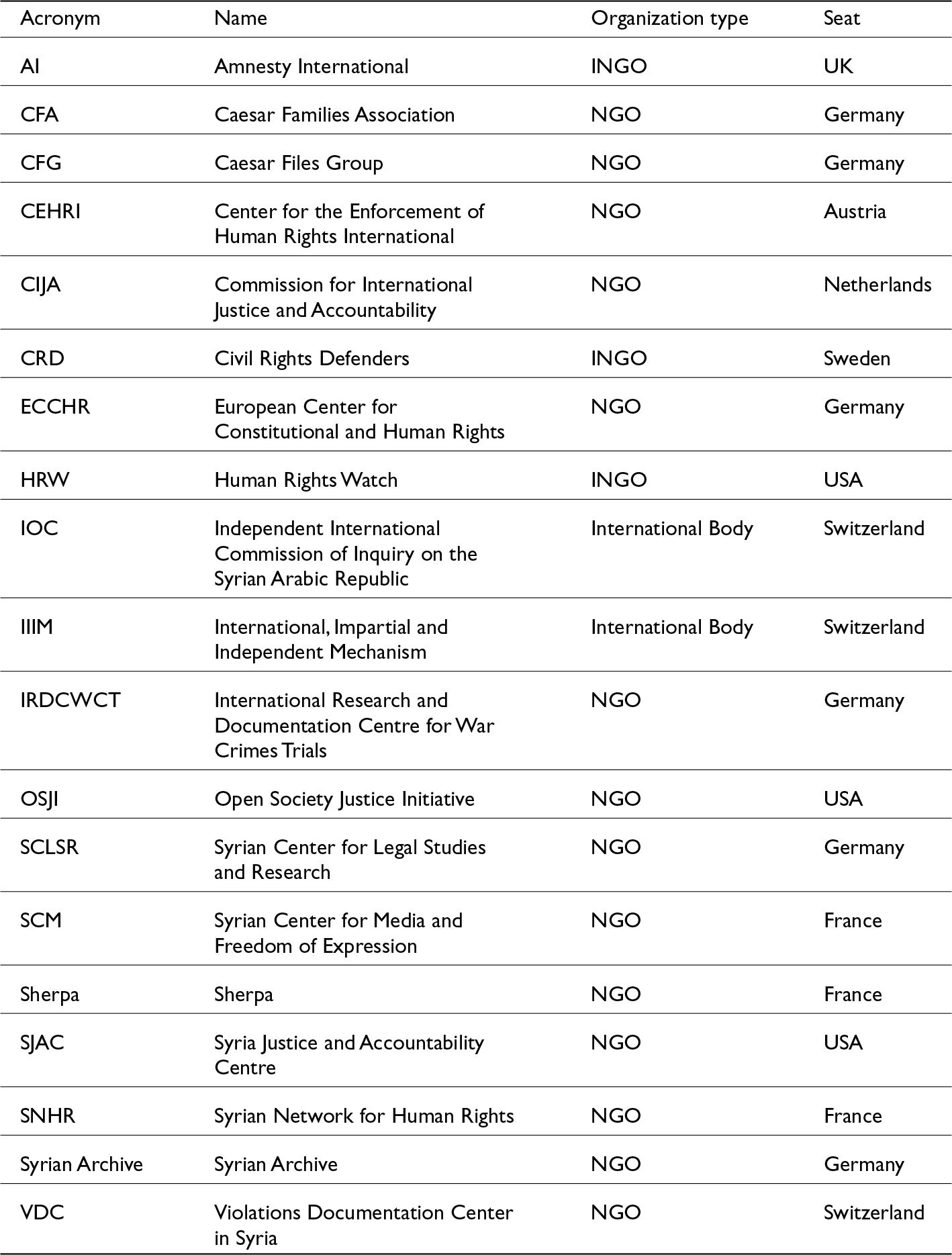
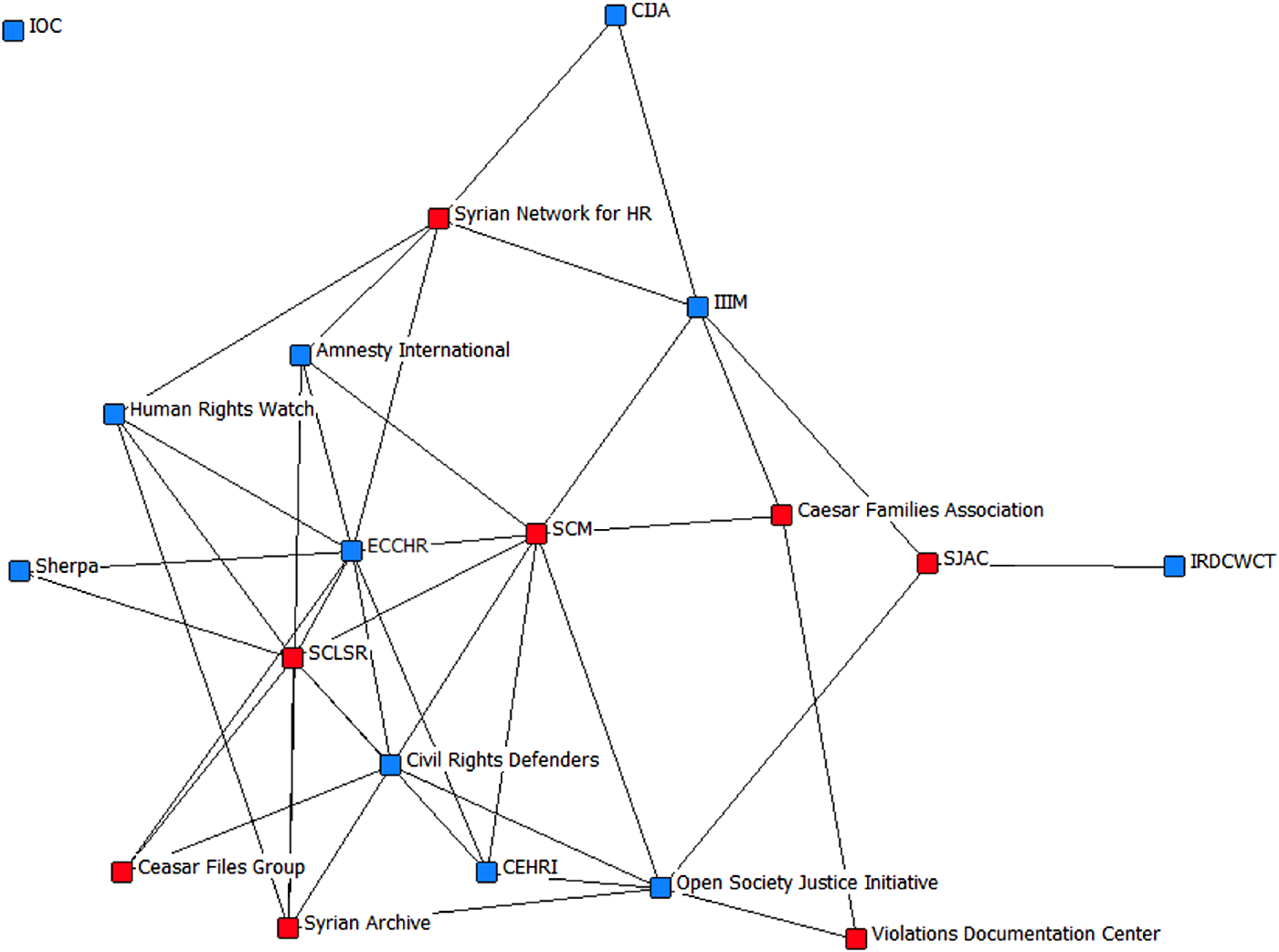
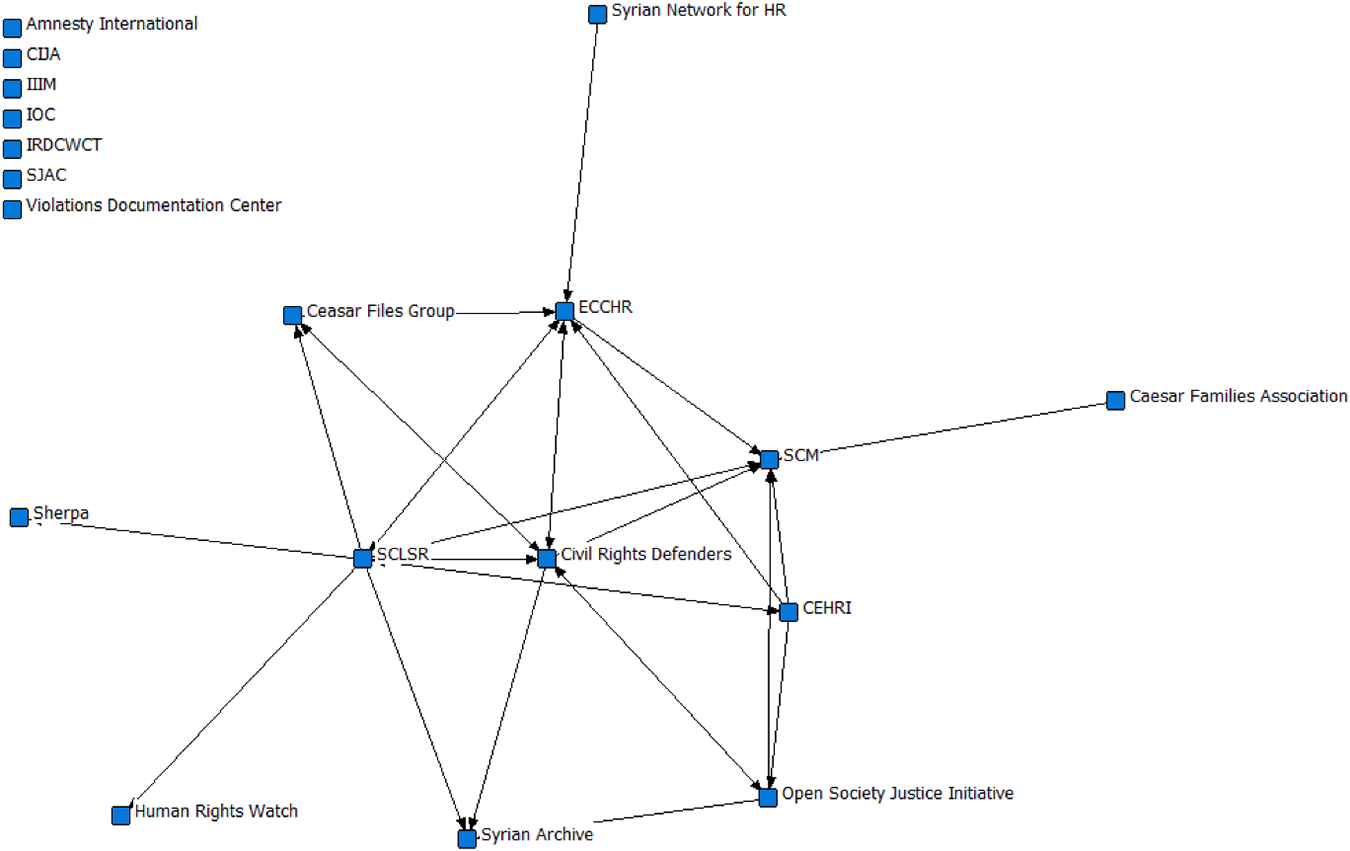
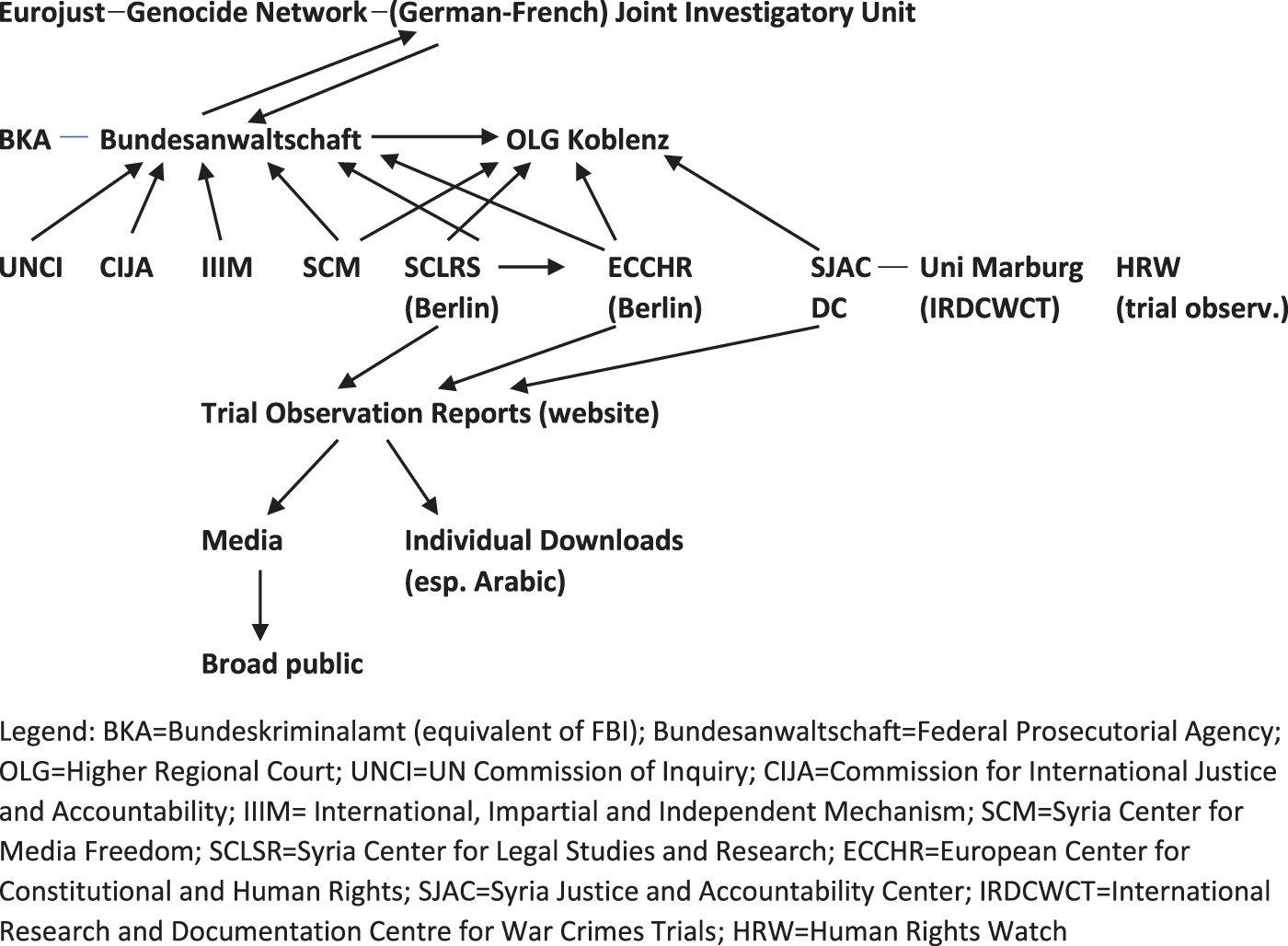

 Open access

