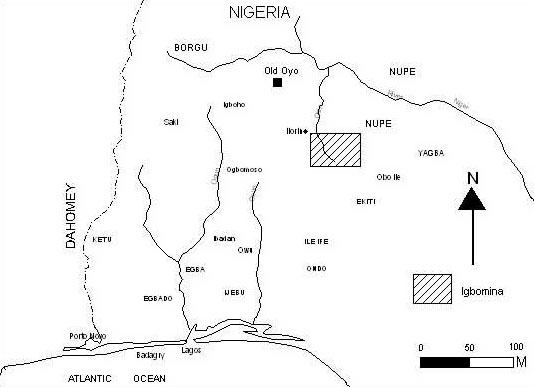

The Igbominaland forms a part of Yorubaland that is sometimes referred to as north central Yoruba. It is today divided into the Irepodun, Ifelodun, and Isin local government areas of Kwara State, Nigeria (figure 1). In 1933, H. G. Ramshaw, the CMS School Inspector for the Oro area, informed the public of the presence of stone figures in the area. Over 800 pieces of carved stone, mostly representing human figures, are located at Esie in western Igbomina. Smaller numbers of stone carvings have also been reported at Ijara and Ofaro villages. The sculptures have attracted wide scholarly interest (Reference AdepegbaAdepegba 1982; Reference AllisonAllison 1963; Reference ClarkeClarke 1938; Reference FaggFagg 1959; Reference GillonGillon 1984; Stevens 1978; Reference WilletWillet 1967).
Map of Yorubaland showing the area of Igbomina

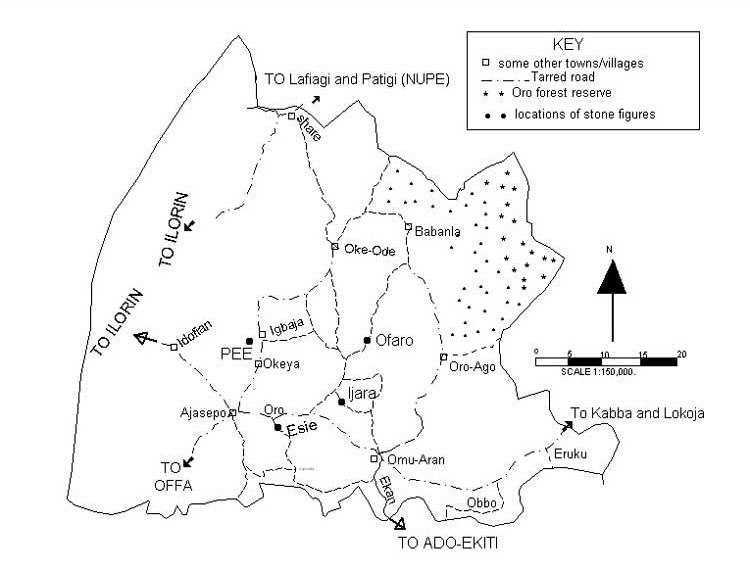
Pee is a former habitation site in Igbomina, located about 18 km NW of Esie along Igbaja-Memudu road (Figure 2). The site, investigated in 1995 and 2003 as part of the regional archaeological research in northern Yoruba, has provided latest evidence of stone figures. Investigations at the site involved limited archaeological survey and surface collection. No excavation has yet taken place due to a rift in the local community over the use of the site. Since Pee was abandoned in the late 18th century, farmers from nearby Igbaja town have cultivated it despite objection from its neighbour, Okeya. The discovery of stone sculptures at Pee obviously shed more light on the mysteries surrounding stone art tradition in Igbomina. The presence of unfinished head and unmodified pieces of steatite at Pee raises questions on the provenance of stone carving in northern Yoruba (Figure 3).
Igbomina area and important sites mentioned in the text

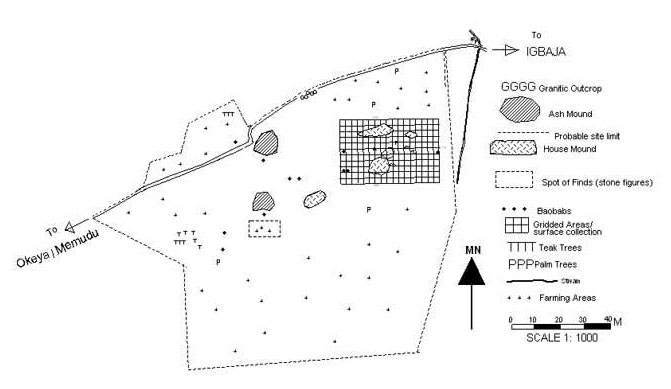
Pee site limits and find spot

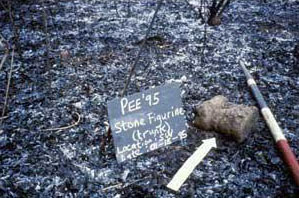
Nine stone sculptures, representing fragments of probably three or more complete figures, were found at Pee. These include three trunks/torsos, three heads, one partial figure with a strand of necklace, and two unidentified pieces. Most of the objects were recovered from the surface of an old farm recently cleared for cultivation, while some near the trunk of a large baobab tree overlooking the farming area. The yearly burning of vegetation and farming has exposed the sculptures and may have displaced them from their original positions. To the untrained eyes the pieces could easily pass for ordinary stones, and probably why none has been reported since years of farming at the site (Figure 4).
Fragment of a stone sculpture exposed by grass burning.

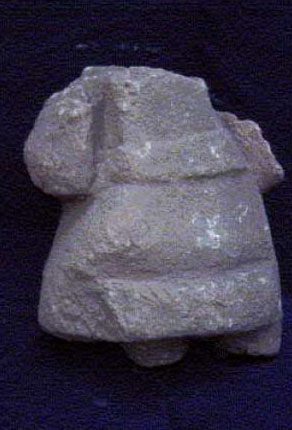
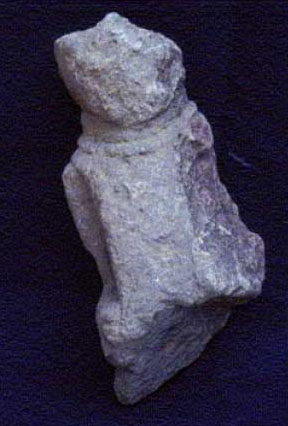
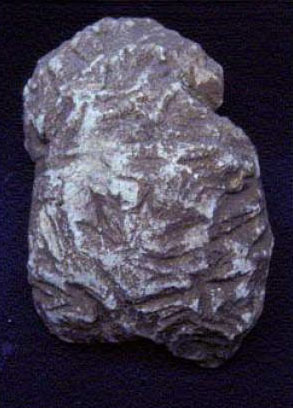
Even in their fragmentary condition, with a closer view one may be able to identify some important carved patterns. For example, in a torso/trunk fragment there is a feature of arm resting on the leg, while the groove lines on back of the figure may represent pattern of dress (Figure 5). Another fragment, which I identified as a partial figure, may be wearing a single strand of necklace (Figure 6). One of the three head sculptures from Pee is 'unfinished'. This is a small head, about 16 cm long, 11 cm wide, and 1.7 kg in weight. The left side of the head had been worked so that the ear, eye, chin, nose, and conical cap on the side are visible (Figure 7a). On the right side of the head there are no facial features. Instead, a bulgy, unmodified lump of rock stood in place (Figure 7b). There are what appear to be knife marks on this side of the head probably indicating the early stage of the carving.
Back view of a sculpture fragment (torso/trunk) showing a pattern, probably costume

Fragment of a stone sculpture wearing a strand of necklace

a: An 'unfinished' head fragment showing the carved side

The fragmentation of Pee sculptures makes comparison with the Esie carvings at times difficult. However, the geographical proximity of Esie and Pee, similarity in the physical characteristic of the sculptures, and in the stone material used, suggest derivation from the same carving tradition that took place at different locations in Igbomina. Oral tradition, principally from Okeya, Ajase, and Eggi villages in Igbomina, suggests that the Okeya people settled at Pee in the 17th century. However, the tradition is silent on any link with the stone carving, or whether the Okeya group met some people at Pee when they arrived. It is agreed in several studies that the expansion of Old Oyo Empire in northern Yorubaland from the 16th century led to large displacement or partial absorption of original population (Reference ObayemiObayemi 1976; Reference UsmanUsman 2001). Thermoluminiscent dating of terracotta associated with Esie stone sculptures gave a date of 1100 A.D. (Stevens 1978). No date is yet available for the Pee materials. But it is likely that the Pee sculptures are contemporaneous with Esie, and therefore much older than the present population in the area (e.g., Igbaja, Okeya).
The nature of Pee stone figures is quite informative when compared with Esie and Ijara-Isin sculptures. Most importantly, the evidence of 'unfinished' sculpture raises questions on the contexts of stone figures. Are the objects carved at Pee? Did the carvers live at the site? While the single unfinished head may not sufficiently prove the existence of a workshop or the carver at the site, the unmodified pieces of steatite found along with the carved stone at the site may offer some important clues. The Pee site might be located not far away from a production (workshop) centre. It is also possible that pieces of steatite were obtained from a nearby outcrop and then brought to the settlement to be carved, while the finished product went elsewhere.
Clearly, the stone figures from Pee and elsewhere in Yorubaland constitute a very intriguing and fascinating data set that has implication for our understanding of various larger regional issues. Among these issues is the fluidity and changing political boundaries on the northern frontiers of Yorubaland, which corresponds to the Igbomina area of today. We may note the tradition of the Igbomina people concerning Nupe militarism in the period before 1800 AD (Reference ObayemiObayemi 1980), which apparently resulted in the destruction of many Igbomina settlements. Such unsettled periods must have created a considerable historical gap that will be very difficult to fill in the history of the people of the area. Just like the people, the stone sculptures may have changed hands considerably over the years before their eventual deposition and recovery.
Excavation will be our next important research agenda at Pee. It seems obvious to me that the site might possess two or more occupational phases with definite breaks. The earlier occupation may belong to group(s) responsible for the carving of the stone figures. Excavations are needed to expose the occupation deposits at the site in order to understand the cultural development of the site. Also, there is need for more ethnohistorical studies in Igbominaland. There was a lot of movement of people in Yorubaland in general in the past three centuries, and those responsible for the production of the stone figures probably moved to neighbouring areas.