


Introduction; Initial Data
The detailed and systematic measurements of mass balance (b), accumulation (Ak), and ablation (Ab) that cover the whole areas of glaciers are unique information. There are only a few similar glaciers in the U.S.S.R., Switzerland, U.S.A., Austria, Canada, and Sweden.
Both the total and mean values of Ak, Ab, and b, applicable to the whole area of a glacier can be estimated reliably and precisely by using these data. These measurements are also used as basic information for the analysis of a glacier’s evolution and for the mathematical simulation of glacier dynamics. The long-term hydrological regime of individual glacier; and their grouping are also closely related (Reference KonovalovKonovalov, 1985) to the annual mass balance and its calculation.
In this connection, of some urgency is elaboration of the methodology for calculating ak(z), ab(z), and b(z) distributions based on the minimum of appropriate measurements. This problem has been considered further for a glacier’s annual mass-balance distribution described analytically as a function of absolute altitude (z).
To analyse and solve this problem, the long-term data from detailed measurements of annual mass balance at five glaciers have been used. Some information about these objects is given in Table 1.
Table 1. Some Characteristics of Glaciers Where Measurements of Annual Mass Balance are Being Carried Out*

Formulation of the Problem and its General Solution
Let us state the general expressions for the total B t and mean B m for glacier annual mass balances in the altitude range between the glacier’s upper limit, z u, and its snout, z s:


where

is the area of a glacier within the altitude range z s ÷ z u, f(z) is the differential function of a glacier’s area distribution, and b(z) is the specific annual mass balance of a glacier at an altitude z.
Having applied the well-known theorem on mean product of two functions to the sub-integral expressions in Equations (1) and (2), we obtain


where  is the specific mass balance at a certain altitude
  within the range of z
s÷ z
u which provides equality between the appropriate parts of Equations (1), (4), and (2), (5).
within the range of z
s÷ z
u which provides equality between the appropriate parts of Equations (1), (4), and (2), (5).
Thus, to obtain one of the major characteristics of a glacier’s regime, its annual mass balance, it is sufficient to make the appropriate measurements only at the altitude  . It is possible to determine the value of
  if an analytical form of the function b(z) is known. So, in the linear relation
 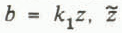 is a mean weighted altitude of a glacier, because

or

If b(z) is a non-linear function of the form

where b(z 0) is the value of mass balance at some altitude point z 0 on a glacier, and k 2, k 3 are the empirical coefficients, then, according to Reference Borovikova, Borovikova, Denisov, Trofimova and ShentsisBorovikova and others (1972), the mean value of mass balance for the whole glacier can be defined by the formulae:

or

where o2 z is the variance of a glacier’s altitudes.
The next methodological conclusion is the result of previous analyses: the measurement of b (specific annual mass balance) at the mean weighted altitude of a glacier ensures the determination of both the total and mean values of annual mass balance on condition that the distribution of b(z) has a quasi-linear form. This conclusion, first, allows considerable simplification of quite laborious measurements of the mass-balance components and commends it as a routine practice; secondly, it is a methodological substantiation of the application of remote-sensing platforms (helicopters, aircraft, and satellites) for evaluating annual values of Ak, Ab, and b.
Together with measuring the integral characteristics of the regime, it is undoubtedly of fundamental and applied scientific significance to calculate the distribution of ak(z), ab(z), and b(z) for the whole area of a glacier. It is obvious that the above-mentioned distributions could be easily computed for any year, if the empirical coefficients k 2, k 3 in Equation (7) are known a priori. Furthermore, we should consider how to find the values of k 2, k 3, if one has a long-term series of annual mass-balance measurements in the respective altitude zones of a glacier.
Annual Mass Balance as a Function of Altitude
The graphical analysis of the annual mass-balance distribution for different years (Fig. 1) at Abramova glacier, Limmerngletscher, Peyto Glacier, and Hintereisferner has revealed the following:
-
(1) Distributions of b(z) for these glaciers are non-linear functions.
-
(2) It is possible to use linear relationships for the satisfactory approximation of b(z) distribution separately in ablation and accumulation areas.

Fig. 1. (Dependence of annual mass balance (b, m) on absolute altitude (z, km) for a number of glaciers. A, Abramova Glacier; B, Hintereisferner; C, Silvretta Glacier; D, Limmerngletscher; E, White Glacier; F. Gries Glacier.
These conclusions are probably of a general character and were used to simplify the methods of definition and calculation of the integral and differential values for glacier mass balances by using a limited amount of data. In particular, from the linearity of b(z) in the range of zs ÷ zf and zf ÷ zu, it follows that, to obtain mean or total values for annual mass balance in both the tongue and the nourishment areas of glaciers, it is sufficient to make measurements only at the mean weighted altitudes of those two parts of a glacier.
The analytical description of the b(z) relationships for each year has been made on the basis of the long-term data for Abramova glacier, Limmerngletscher, Peyto Glacier, White Glacier, and Hintereisferner. In all cases, it was found that the second-order polynomial provided the appropriate quality for b(z) approximation. Thus, for Limmerngletscher, it was defined that in the period 1948–77 the correlation ratio of the b(z) relationship exceeded 0.92 in 23 cases and in five cases it was in the range of 0.800.90; for Hintereisferner, the correlation ratio was greater than 0.99 in all cases during 1964–75; for Abramova glacier, this ratio was only once lower than 0.97. The same closeness of relationships was found for both Peyto and White Glaciers.
Equation (7) is the most suitable for calculation of the annual b(z) distribution, because the actual data for mass balance at the altitude z 0 are used in it. The above conclusions about the form of the empirical function b(z) for these glaciers serve as a basis for selecting one or several z 0 altitudes.
Calculation of the b(z) Distribution and its Assessment
One of the main stages in the method for b(z) calculation is the a priori determination of the k 2, k 3 coefficients in Equation (7). This should be done by describing k 2, k 3 as those functions most easily determined. With this objective, and according to the recommendations of Reference Borovikova, Borovikova, Denisov, Trofimova and ShentsisBorovikova and others (1972), the long-term series of k 2, k 3 coefficients was derived both for the mean weighted altitudes of ablation and accumulation areas, and for the glacier as a whole. Such coefficients were derived for all the glaciers considered here.
Then, multi-variate equations of linear regression were selected in order to calculate the k 2, k 3 coefficients for each glacier. A combination of arguments minimizing the root-mean-square error in the calculations was defined by using a step-wise selection procedure. The initial set of independent variables included;
-
(1) Annual mass balances at the mean weighted altitudes (z 0) of ablation and accumulation areas of a glacier, and mean altitude of the firn line.
-
(2) Maximum altitude of the snow line.
-
(3) Mean air temperature for the periods October–September, May–September, and June–August.
-
(4) Precipitation totals for the period June-August, and for a whole year.
-
(5) Annual run-off.
Examples of the working formulae for calculation of the k 2, k 3 coefficients and some features of these equations are given in Table II. To define a priori the k 2, k 3 coefficients in Equation (7), it is sufficient to have data on mass balance at one point on a glacier in addition to the easily measured meteorological features (air temperature and precipitation). After k 2, k 3 have been determined, it is not difficult to calculate the distribution for b(z) in a given year.
Table II. Empirical Equations for the Determination of the k 2 and k 3 Coefficients used in the Calculation of B(z) Distributions by Equation (7)

A qualitative estimate was made for the annual mass- balance distribution calculated from Equation (7). As the points for z
0, where values of b(z
0) were assumed to be known,  were tested successively at the above glaciers. Figure 2 gives the histograms for the relative deviations ∆b(z) of the calculated annual mass-balance values from the measurement data in the altitude zones at Abramova glacier. Graphs for ∆b(z) distributions at the other four glaciers are of a similar character.

Fig. 2. Histograms for the relative errors in the calculation of b(z) for Abramova glacier for the period 1968–83, Notations: 1, based on  data and a priori values of the k
2, k
3, coefficients; 2, the same for
data and a priori values of the k
2, k
3, coefficients; 2, the same for  altitude; 3, based on data on the numerical simulation of remote-sensing measurements of
  and zmax.
An analysis of these data allows us to reach the following conclusions, which are of methodological significance:
-
(1) In the majority of cases, the distribution of deviations has a symmetrical character relative to Δb(z) = 0.
-
(2) The prevailing number of deviations does not exceed ±10%, indicating quite a sufficiently high quality for the b(z) calculation for all the prescribed values of b(z 0).
-
(3) Data on annual mass balance at the mean weighted altitude of the ablation area, and a priori values of the k 2, k 3. parameters, provide sufficient information for the simple estimation of b(z) at all altitude zones of a glacier.
Method of Remote-Sensing Measurement for a Glacier Mass Balance and an Example of its Numerical Simulation
The methodological approach described above may be used to simplify and modify the estimation of b(z) in all those cases when sufficiently long data series of b(z) measurements are available. It is expedient to eliminate this initial condition without any loss in the quality of calculation. This is especially important for the mass-scale measurement of b(z) by means of remote-sensing methods.
Let us use the quasi-linearity of the b(z) distribution in the ranges of z s ÷ z f and z f ÷ z u (see Fig. 1). For the linear function


where k is the parameter with long-term variability. It is not difficult to define k for every single year, if we rewrite Equation (10) in the form

where z max is the maximum height of the snow line of a given glacier; b(z max) = 0, according to the definition of this line; and b(z 0) is the measured value of annual mass balance.
Any remote-sensing method is suitable for the mass- scale determination of mapping of based on aerial and visual observations, aerial photosurveys, and satellite photography. The latter technique is the most accurate and effective. As to the b(z 0) measurements, it gives more scope for the application of remote-sensing methods for measurements; for example, fixing from a helicopter the melted-out parts of stakes at the end of the ablation season. These stakes must be drilled into the ice at z 0 altitude in advance. The position of z max on a glacier is also determined during the ablation period.
The simplest and easiest way is to install stakes with an appropriate vertical scale for visual reading of stake length from a helicopter flying at a low altitude. Photographing the stakes using the same camera with a telephoto lens increases the Quality of such data. This method of measuring the seasonal snow-cover depth in the mountains has been used successfully in more than 33 river basins of Central Asia (Reference KonovalovKonovalov, 1977). Space photography with a high-resolution image can provide information for the determination of b(z 0), z max, and b(z) on the basis of satellite data alone.
The long-term series of b(z) and z
max data for Abramova glacier and Limmerngletscher have been used to simulate the definition of b(z) by remote-sensing measurements of  and the calculation of k using Equation (12). The histograms for relative errors (see Fig. 2) show the quality of estimates determined in the usual way: Δb(z) = b(z)m - b(z)c/b(z)m where b(z)m and b(z)c are respectively the measured and calculated values of (bz).
A comparison of the three histograms in Figure 2 shows that the Δb(z) distributions, obtained to assess the method of remote-sensing measurement and calculation of b(z), possess the same features found after an analysis of the errors.
The simulation of remote-sensing measurements of  and z
max has revealed less accuracy in b(z) determinations only in the upper parts of an accumulation area. A similar conclusion was confirmed by the data for “remote-sensing measurements” of
and z
max has revealed less accuracy in b(z) determinations only in the upper parts of an accumulation area. A similar conclusion was confirmed by the data for “remote-sensing measurements” of  and z
max at Limmerngletscher. Therefore, a small loss in the quality of the calculations is completely compensated by simplification of the method of b(z) determination based on the mass-scale remote-sensing measurements of
and z
max at Limmerngletscher. Therefore, a small loss in the quality of the calculations is completely compensated by simplification of the method of b(z) determination based on the mass-scale remote-sensing measurements of  and z
max
and z
max
Conclusions and Recommendations
As a result of our investigation, the following are the conclusions and recommendations.
-
1. For the determination of total or mean values of a glacier’s annual mass balance, it is sufficient to measure specific balance at the mean weighted altitudes of the ablation and accumulation areas.
-
2. The one-dimensional distribution of annual mass balance is quite well described by the quadratic function in Equation (7) of altitude using k 2, k 3 coefficients which are defined for a z 0 point.
-
3. A priori calculation of k 2, k 3 is made by using empirical formulae, the arguments for which are standard meteorological features (air temperature and precipitation).
-
4. Measurement of
 or and the a priori determination of k, k
3 provide a sufficiently high quality for calculation of the annual mass-balance distribution according to the altitude zones of a glacier.
or and the a priori determination of k, k
3 provide a sufficiently high quality for calculation of the annual mass-balance distribution according to the altitude zones of a glacier. -
5. In many cases, the b(z) function has a quasi-linear form for both ablation and accumulation areas of a glacier.
-
6. The method of calculating b(z) has been expanded for wide application. Input information for this method is the remote-sensing measurements of annual mass balance at the mean weighted altitude of the ablation area and the maximum snow-line altitude z max.
-
7. The reliability of a simple method for determining b(z) is confirmed by the low relative errors inherent in b(z) calculations and by the histograms obtained after numerical simulation of remote-sensing measurements of
and z
max for specific glaciers.
 or
or  and the a priori determination of k, k
3 provide a sufficiently high quality for calculation of the annual mass-balance distribution according to the altitude zones of a glacier.
and the a priori determination of k, k
3 provide a sufficiently high quality for calculation of the annual mass-balance distribution according to the altitude zones of a glacier. and z
max for specific glaciers.
and z
max for specific glaciers.



