


1 Introduction
Nudges, proposed and popularized by Reference Thaler and SunsteinThaler and Sunstein (2008), are defined as “… any aspect of the choice architecture that alters people’s behavior in a predictable way without forbidding any options or significantly changing their economic incentives.” In recent years, nudges have been used to solve a wide range of problems, such as increasing retirement savings (Reference Bernatzi and ThalerBernatzi & Thaler 1999; Reference Madrian and SheaMadrian & Shea 2001; Reference Choi, Laibson, Madrian and MetrickChoi et al. 2002; Reference Choi, Laibson, Madrian and MetrickChoi et al. 2004), organ donations (Reference Johnson and GoldsteinJohnson & Goldstein 2003), charitable giving (Reference Abadie and GayAbadie & Gay 2006; Reference McKenzie, Liersch and FinkelsteinMcKenzie et al. 2006), and consumer health (Reference BushmanBushman 1998; Reference Roberto, Larsen, Agnew, Baik and BrownellRoberto et al. 2010; Reference Wisdom, Downs and LoewensteinWisdom et al. 2010; Reference Schwartz, Riis, Elbel and ArielySchwartz et al. 2012; Reference CohenCohen 2013; Reference Fitzsimons and LehmannJohnson et al. 2013; Reference HartmanHartman 2014; Reference Griffith and SmithGriffith et al. 2014).
Nudges have two major appeals. First, they preserve autonomy because they make some actions easier to select without restricting anything (Reference SunsteinSunstein 2012; Reference SunsteinSunstein 2014). Second, nudges reduce errors and biases by encouraging people to make better decisions “as judged by themselves” (Thaler & Sunstein 2009, p. 5). That is, nudges help people do what they would otherwise do if they had put more time and energy into their choices. The nudge should push them in the direction that is “right” for them. According to Thaler and Sunstein, the decision of what is “right” or “wrong” should be transparent. They state that the government “should not be secretive about what it is doing…they should be happy to reveal both their methods and their motives” (p. 245).
These advantages explain why Reference Sunstein and ThalerSunstein and Thaler (2003) refer to nudging as libertarian paternalism. Libertarians applaud freedom of choice, and paternalists view government as having the responsibility to improve the choices of citizens. Reference Sunstein and ThalerSunstein and Thaler (2003) state, “Libertarian paternalists are those who attempt to steer people’s choices in welfare-promoting directions without eliminating freedom of choice” (p. 1).
The differential effect of world-views and thinking styles on acceptance and autonomy suggests that concept of “one-nudge-fits-all” is not tenable. Instead, people judge the acceptability of nudges and the moral implications of behavioral interventions in a variety of ways. In this paper, we investigate factors that shape attitudes toward nudges. The first is a top-down framework for categorizing nudges. The second is individual dispositions in personality traits and political views that may be associated with support or opposition for nudges. The third is perceptions of nudges that may help explain the relationship between nudge categories and individual dispositions. Finally, the fourth factor is the persuasive framing of nudges which might change attitudes of those with different individual dispositions. Careful consideration of the interplay among these factors is necessary to better understand how a representative sample of U.S citizens think about nudges and what determines their support and opposition for such initiatives.
1.1 Nudges
We selected our nudges from a book called Simpler (Reference Sunstein and ThalerSunstein 2013, p. 10). They were either prototypical nudges (the order of food in cafeteria lines and retirement savings plans) or those that were frequently discussed in the media. Of course, the results of our studies depend on the nudges we examine, and there are no guarantees that they will generalize to other nudges, a boundary condition on all nudge research. Others have selected nudges on the basis of appeals to liberals and/or conservatives and have found evidence of a partisan nudge bias (Tannenbaum, Fox & Rogers, 2014). Attitudes toward nudges depended on the policymaker implementing the nudge or the political objective associated with the nudge. Nudges were viewed less favorably when the policy objectives or policymakers were opposed. Partisan differences disappeared when nudges were described without mention of a policy objective or associated policymaker. Nudges may not be perceived as inherently partisan, but once again, this result depends on the nudges used in the experimental tests. We have not selected nudges in the context of political objectives, so it is an open empirical question whether political perspectives will correlate with support for nudges.
1.2 Types of nudges
Much of the past research on nudges has focused on the effectiveness of nudge interventions. Recent work has examined attitudes toward nudges, and to help explain those attitudes, researchers have made several distinctions. One is based on features of the nudge. Reference Felsen, Castelo and ReinerFelsen, Castelo and Reiner (2013) categorized nudges as overt and conscious or covert and subconscious. Not surprisingly, overt nudges had greater appeal, and those who perceived the nudge as more overt believed their decisions were more “authentic”. In a similar vein, Hansen and Jensen (2013) categorized nudges as transparent or nontransparent. With transparent nudges, individuals understand the expected behavioral change and the means by which it is likely to occur. With non-transparent nudges, individuals are less likely to recognize the possibility of behavioral change, and they cannot reconstruct the means by which changes could occur.
A second distinction is based on the target of the nudge. Hagman, Andersson, Västfjäll and Tinghög (Reference Hagman, Andersson, Vastfjall and Tinghog2015) distinguished between pro-self nudges (e.g., smoking cessation or weight loss) and pro-social nudges (e.g., recycling or default settings for charitable giving). People preferred pro-self nudges over pro-social ones. This result could vary, of course, depending on who does the nudging (Tannenbaum et al., 2014).
A third distinction focuses on the cognitive mechanisms by which nudges operate. Hansen and Jensen (2013) differentiated nudges based on two methods of thinking known as System 1 and System 2 (Reference Ganzach and KarsahiKahneman, 2011). System 1 uses automatic cognitive processing, whereas System 2 uses to more deliberative processing. Sunstein (Reference Sunstein2014; 2015) also used this distinction and found empirical evidence that System 2 nudges were preferred to System 1 nudges.
We further examine the distinction between System 1 and System 2 nudges. Although not essential, System 1 nudges are more likely to operate without the awareness of the decision maker by relying on implicit defaults and status quo options (Reference Dinner, Johnson, Goldstein and LiuDinner et al. 2011; Reference Dhingra, Gorn, Kerner and DanaDhingra et al. 2012). In this sense, System 1 nudges can be more automatic. Examples include automatic enrollment into savings programs, smaller servings of meals, and changes in the order of food in cafeteria lines or grocery store displays. System 1 nudges operate less directly on cognition and more directly on behavior. In contrast, System 2 processing is more effortful and more transparent. System 2 nudges include warning signs, calorie labels, and nutritional charts. These nudges provide information (and possibly education) that may make people more aware and presumably more thoughtful about their decisions. Not all informational nudges are processed using System 2. Lurid cigarette warnings, for example, may be processed automatically with System 1. System 2 nudging should, in principle, help people make better choices both now and in the future. This leads to our first hypothesis:
H1: System 2 nudges will receive greater support than System 1 nudges.
1.3 Individual dispositions
If policy makers knew what types of people viewed nudges favorably or unfavorably, they could use that information to decide which groups of people should be targeted for persuasive appeals when selecting or implementing initiatives. Only one study to date has examined individual differences in attitudes toward nudges. Hagman et al. (Reference Hagman, Andersson, Vastfjall and Tinghog2015) showed that Swedes supported nudges more than U.S. citizens, communitarians supported nudges more than individualists, and those with analytical mindsets supported nudges more than those with intuitive mindsets.
Who else might be more supportive of nudges? Nudge interventions are designed to improve human welfare, so people with greater empathy might be more likely to promote the general well-being of society. Following Davis (Reference Davis1983), we define empathy as a cluster of emotions that includes compassion, sympathy, and tenderness elicited by the observed experiences of others. We measure empathy using the empathic concern subscale of the Interpersonal Reactivity Scale (Reference DavisDavis, 1983), with typical items being “I would describe myself as a pretty soft-hearted person,” “When I see someone being taken advantage of, I feel kind of protective towards them,” and “When I see someone being treated unfairly, I sometimes don’t feel very much pity for them (reverse-scored).” Our second hypothesis states:
H2: People with greater empathetic concern will be more supportive of nudges.
Following the work of Hagman et al. (Reference Hagman, Andersson, Vastfjall and Tinghog2015), we explore attitudes toward nudges among individualists. Individualists promote the rights of people to purse their own goals. They value independence and self-reliance. Individualists have much in common with libertarians. Libertarianism affirms the rights of individuals to personal freedom and considers the protection of these rights the primary role for government. Kahan et al. (Reference Kahan, Braman, Slovic, Gastil and Cohen2009) and Kahan, Jenkins-Smith and Braman (Reference Kahan, Jenkins-Smith and Braman2011) devised a test to measure individualism, the Cultural Cognition scale. Individualists believe that people should secure their own welfare, whereas communitarians believe that government should ensure the collective welfare. Examples of individualist items are, “The government interferes far too much in our everyday lives,” “It’s not the government’s business to try to protect people from themselves,” and “Government should put limits on the choices individuals can make so they don’t get in the way of what’s good for society (reverse scored).” Our next hypothesis states:
H3: Individualists will be more likely than communitarians to oppose nudges.
Another variable likely to be associated with nudge support is political orientation. Relative to liberals, conservatives place greater emphasis on maintaining social stability and existing institutions (Pykett & Whitehead, 2010). They prefer gradual development over abrupt change and espouse the view that less government is better government. Conservatives have a greater need for closure (Van Hiel, Pandelaere & Duriez, 2004), and a stronger desire for control (Eisenman & Sirgo, 1991). They might oppose nudges on the grounds that government should not be involved in personal choices. Our fourth hypothesis states:
H4: Conservatives will oppose nudges more than liberals.
Those with a strong desire for control may also be more opposed to nudges. The desire for control is a personality trait defined in terms of a need to take charge of one’s life. To measure this trait, we used a self-control scale constructed by Reference Burger and CooperBurger and Cooper (1979) and Burger and Atkin (Reference Burger and Arkin1980). Items included statements such as, “I prefer a job where I have a lot of control over what I do and when I do it”, “I try to avoid situations where someone else tells me what to do”, and “When it comes to orders, I would rather give them than receive them.” We hypothesize:
H5: Those with a stronger desire for control will be more opposed to nudges than those with a weaker desire.
A related, though not identical, variable is reactance. Reactance is a behavioral counter-response of someone who believes that someone or something is being restricted or taken away. Reactant individuals are annoyed or angry when someone else imposes goals on them (Reference Brehm, Stires, Sensnig and ShabanBrehm 1966; Reference Clee and WicklundClee & Wicklund 1980; Reference FitzsimonsFitzsimons 2000; Reference Fitzsimons and LehmannFitzsimons & Lehmann 2004; Reference Chartrand, Dalton and FitzsimonsChartrand et al., 2007). Reactance can even cause a person to adopt an attitude or make a choice that is objectively worse than other options if the reactant person thinks his or her choices are being restricted. We capture this motivational state using a scale developed by Reference Hong and PageHong & Page (1989) with items such as “I become frustrated when I am unable to make free and independent decisions”, “When someone forces me to do something, I feel like doing the opposite”, and “I resist the attempts of others to influence me.” This source of opposition is our sixth hypothesis:
H6: Reactant individuals will be more likely than less reactant ones to oppose nudges.
1.4 Perceptions of nudges: System 1 and System 2
System 1 nudges may be perceived as more calculating, more manipulative, and less likely to facilitate “freedom of choice” (Hansen & Jensen, 2013; Wilkinson, 2013). Yet despite this criticism, System 1 nudges, such as defaults, have often been shown to be more effective than System 2 nudges at changing behavior (Reference Wisdom, Downs and LoewensteinWisdom et al. 2010; Reference Felsen, Castelo and ReinerFelsen et al. 2013) and beliefs (Reference Nisbett and StanleyNisbett & Stanley 1966; Reference Nisbett and WilsonNisbett & Wilson 1977). Thus, we hypothesize:
H7: System 1 nudges will be viewed as more threatening, more paternalistic, more effective for making better decisions, and more necessary for changing behavior. System 2 nudges are more likely to be perceived as sending the “right” message (that people can make good decisions) and more likely to be viewed as suggesting the “right” kinds of goals.
Perceptions of nudges may help explain individual differences in attitudes. We will examine correlations between individual dispositions and perceptions to see whether perceptions mediate the relationships between individual differences and nudge support.
1.5 Framing of nudges
Attitudes toward nudges might be altered with different frames. Here, we consider two dimensions of framing. First, nudge appeals can target the individual or society. Hagman, et al. (Reference Hagman, Andersson, Vastfjall and Tinghog2015) distinguished between pro-self nudges or pro-social nudges and found that pro-self nudges were viewed more favorably. Note that Hagman et al. used this distinction to categorize nudges, rather than to vary the framing of nudges, as we will do in Study 2.
Reference Cornwell and KrantzCornwell and Krantz (2014) showed that people were more supportive of nudges when the frame or the rationale for the policy targeted “people in general” rather than “you” (p. 433). We agree that frames targeting society are more likely to be effective than frames targeting individuals in many cases (e.g., Vietri et al. Reference Vietri, Li, Galvani and Chapman2012). A utilitarian, for example, would find a nudge more justifiable as the number of beneficiaries increases.
Second, frames can highlight costs of rejecting nudges or benefits of accepting them. The literature on persuasion shows that, at least in some situations, negative frames are more effective than positive frames (Reference Block and KellerBlock & Keller 1995; Reference Cox and CoxCox & Cox 2001). For example, Ganzach & Karashi (Reference Ganzach and Karsahi1995) studied customers of a credit card company who had not used their cards for at least three months. The company sent messages that were framed as either benefits that customers could obtain by using their cards or losses they could suffer from not using them. Over the next two months after the messages, loss frames had greater impact than benefit frames.
Our final hypothesis states:
H8: Frames that highlight societal benefits of nudges (without externalities) will increase support more than frames those highlighting personal benefits. In addition, frames highlighting the costs of rejection will increase support more than frames highlighting the benefits of acceptance.
1.6 Framing and individual dispositions
Framing could be a powerful tool for attitude change; those who oppose nudging might be more sympathetic if nudges were presented in a particular frame that reflects their individual dispositions. We will examine whether and how framing influences attitudes toward nudges among those with different dispositions. More empathetic people may be more likely to support nudges framed in terms of societal effects. Individualists may be unresponsive to all forms of framing based on principles; nudging is simply not the purview of the government. Conservatives might be unresponsive to any form of framing based on their beliefs that nudging reduces personal responsibility. Finally, reactant people and those with a strong desire for control might oppose nudges more if frames highlight restrictions on their personal freedoms.
2 Method
We present two studies. The first was designed to test the first seven hypotheses, and the second was designed to test the eighth. But the second study also gave us a second look at the first seven hypotheses. Therefore, in our discussions of these hypotheses, we will primarily focus on effects that hold in both studies. Any effects that are significant in one study, but not the other, will be referred to as trends. To summarize the eight hypotheses, we predict that people will prefer System 2 nudges over System 1 nudges. Empathetic people should be more supportive of nudges, while individualists, conservatives, reactant people, and those with a greater desire for control should be more opposed to nudges. System 1 nudges will be perceived as more threatening and more paternalistic, but also more effective for good decision making and more necessary for changing behavior. System 2 nudges will be perceived as the “right” kinds of goals to adopt and the “right” kinds of messages to send to people about their capacity to make their own decisions. Finally, nudges will be viewed more favorably when framed in terms of societal effects than personal effects. Support will also increase when framing highlights the costs of rejection rather than the benefits of acceptance.
In Study 1, we examined 13 nudges which included both types. In Study 2, we attempted to “match” System 1 and System 2 nudges by devising five more closely related pairs. Although comparability was not exact, these pairs provided a more focused look at System 1 versus System 2 nudges. Study 2 also examined the effects of framing on support for nudges by manipulating the target of the nudge (i.e., individuals versus society) and the implicit reference point (i.e., costs versus benefits). Frames highlighting society will increase nudge support, and frames highlighting the costs of rejection will receive greater support.
2.1 Subjects and designs
In Study 1, 250 U.S. subjects were recruited from a representative Qualtrics panel and selected to match U.S population percentages (based on 2010 U.S. census data) on income, age, and sex. Subjects completed an online survey and were paid $6.50. See Table 1 for the variables used in subject selection and the percentages in both studies. In Study 1, each subject evaluated the 13 nudges. Study 2 was similar to Study 1 except 800 subjects were recruited and paid $5 for their participation. They evaluated 10 nudges 2 (Type of Nudge) x 5 (Domain) in a within subject design. Each nudge was presented in one of four between-subject framing conditions. The four framing conditions were constructed from a 2 (Personal vs Societal) x 2 (Cost vs Benefit) factorial design.

2.2 Procedures
In Study 1, nine policies (1–9) were classified as System 1 nudges and four policies (10–13) were called System 2 nudges. Subjects were asked:
Would you support a policy of….?
1. Automatic enrollment into a medical plan with basic coverage at colleges and universities (unless students choose to opt out)
2. Default settings on social network websites that post information and photos to friends and not the public at large (unless people choose to opt out)
3. Automatic enrollment into a retirement savings plan (unless employees choose to opt out)
4. Default initiative that people obtaining drivers licenses will become organ donors under hopeless medical conditions (unless they choose to opt out)
5. Default food orderings in school cafeterias with salads and lower calorie foods coming first to promote healthy choices
6. Default displays in grocery stores that make healthy foods especially conspicuous and easier to reach
7. Use of increasingly narrower white lines on roadways that create the visual illusions of speeding up to control vehicle speeding
8. Use of one-click opportunities to solicit charitable donations when checking out at the grocery store
9. Use of graphic warnings with photographs of the effects of smoking on cigarette packages
10. Government-based websites that allow people to track their energy usage, credit card bills, health care expenditures, cell phone bills, and more
11. Regulations stating that credit card companies must provide customers with spending alerts if they are close to a spending limit (via mail, email, or text message)
12. Notifications sent to voters by mail, email announcements, or text messages right before elections to tell them exactly how to get to the polls
13. Regulations stating that retirement programs must provide customers with clear information about their projected monthly income (under a set of reasonable assumptions) at specified ages of retirement
Responses were given as “Yes,” “No,” or “Maybe – it depends on the details”. Subjects who selected “Yes” rated the degree of their support for the initiative using a scale from 0 = “Not Sure” to 3 = “Certain to Support”. Those who selected “No” rated their opposition using a scale from –3 = “Certain Not to Support” to 0 = “Not Sure”. Lastly, those who selected “Maybe” were asked to explain why, and their answers were coded as 0.
Subjects then rated their perceptions of each nudge in terms of paternalism, threat to autonomy, effectiveness for making better decisions necessity for changing behavior, the extent to which the nudge was the “right” goal to have, and the degree to which the nudges sent the right message that the decision maker was capable of making his or her own decisions. Each subject made 78 ratings (13 nudges x 6 variables) on a 7-point scale (0 = “Not at all” to 6 = “Extremely”).
Finally, subjects completed a series of personality scales, including reactance, desire for control, individualism-communitarianism, and empathy. Conservatism was assessed using a measure of political orientation from 1 = “Very Liberal” to 7 = “Very Conservative.” The order of scales was randomized for each subject. At the end of the survey, subjects reported their education, region of residency (Northeast, South, West, Midwest), religion, whether they were familiar with the concept of “nudge” or “libertarianism,” and whether they identified with libertarians (for those who indicated that they understood the term).
In Study 2, frames were manipulated with short written appeals that explained the benefits of accepting a nudge or the costs of rejecting the nudge to either the individual or society. The four frames for each of the System 1 and System 2 nudges are summarized below (Personal vs Societal) x (Benefit vs Cost):
1. Medical Coverage
System 1. Suppose that when (you / people) start a new job at a company, the government requires the company to select a default policy that makes it easier to enroll in a basic medical plan. (You / People) have other options, but (you / they) need to select different options to implement them. The plan will help (you / all members of society) (enjoy the benefits of good health / avoid the costs of poor health) over the long term.
System 2. Suppose that when (you / people) start a new job at a company, the government requires the company to provide information that makes it easier to understand the benefits of enrolling in a basic medical plan. The information encourages (you / people) to enroll by explaining why the plan is designed to help (you / all members of society) (enjoy the benefits of good health / avoid the costs of poor health) over the long term.
2. Retirement Savings
System 1.. Suppose that when (you / people) start a new job at a company, the government requires the company to select a default policy that makes it easier to enroll in a basic retirement savings plan. (You / people) have other options, but (you / they) need to select different options to implement them. The plan helps (you / all members of society) (enjoy a comfortable life style and financial security / avoid an uncomfortable life style and financial insecurity) when (you / they) stop working.
System 2. Suppose that when (you / people) start a new job at a company, the government requires the company to provide information that makes it easy to understand the benefits of enrolling in a basic retirement savings plan. The information encourages (you / people) to enroll in the basic plan by explaining how the plan will help (you / all members of society) (enjoy a comfortable life style and financial security / avoid an uncomfortable life style and financial insecurity) when (you / they) stop working.
3. Credit Cards
System 1.. Suppose that when (you / people) pay their credit card bills online, the government requires the credit card companies to select the default payment option of full payment. (You / People) can pay other amounts, but (you / they) need to specify those by selecting different options. The default policy is designed to help (you / all members of society) (enjoy the benefits of no interest fees and good credit/ avoid the costs of excessive interest fees and poor credit) scores.
System 2. Suppose that when (you / people) pay their credit card bills online, the government requires the credit card companies to provide information that makes it easy to understand the benefits of paying the total amount due. The information encourages (you / people) to pay the entire bill by telling (you / them) that full payment helps (you / all members of society) (enjoy the benefits of no interest fees and good credit / avoid the costs of excessive interest fees and poor credit) scores.
4. Organ Donation
System 1.. Suppose that when (you / people) apply for or renew your driver’s license, the government selects a default policy that makes it easy to become an organ donor. (You / People) have other options, but (you / they) need to select those to indicate a different set of preferences. The default policy is designed to help (you / all members of society) (save / prevent the loss of) lives.
System 2. Suppose that when (you / people) apply for or renew your driver’s license, the government requires that (you / people) are given information that makes it easy to understand the benefits of becoming an organ donor. (You / People) are encouraged to take part and told that the plan is designed to help (you / all members of society] (save/prevent the loss of) lives.
5. Water Conservation
System 1. Suppose that when (you / people) are at a hotel, the government requires the hotel to select a default policy of “environment-friendly rooms” in which towels left on the racks are not washed. If (you / people) want their towels washed, (you / people) must place them on the floor. The plan helps (you / all members of society) (save water and build a more / avoid water waste and that leads to a less) sustainable environment.
System 2. Suppose that when (you / people) are at a hotel, the government requires the hotel to provide (you / them) with information about “environment-friendly” policy in which towels left on the racks are not washed. To get towels washed, (you / people) must place them on the floor. The information makes it easier to understand how to participate in the water conservation program. (You / People) are encouraged to take part and told that the policy is designed to help (you / all members of society) (save water and build a more / avoid water waste and that results in a less) sustainable environment.
Order of nudge type was counter-balanced using a Latin-square design. Support scales were the same as in Study 1, but in Study 2, we also measured the extent to which subjects liked the companies that implemented the nudges on a 7-point scale (-3 = “Dislike Very Much” to 3 = “Like Very Much”). Perception ratings and individual dispositional scales were also the same as those in Study 1.
For complete details see Study 1 materials and Study 2 materials.
3 Results
3.1 Type of nudge
In both studies, the key dependent variable was the degree of support for nudges. We examined support for the System 1-System 2 distinction using a factor analyses performed on support ratings. In both studies, analyses revealed two factors, very close to the predicted structure with a few exceptions. The most important exception was Track Spending in Study 1 (a government website that tracked energy usage, credit card spending, phone bills, etc.), a System 2 nudge that loaded more heavily on the System 1 factor. Comments indicated that Track Spending created privacy concerns. Others stated they did not want the government to track their expenses because they did not trust the government with their information.
Figure 1 shows mean support ratings for the 13 nudges in Study 1. In Figure 1, all ratings differed significantly from zero (“Not Sure”), except the Medical Default Plan. Most nudges were supported: grocery store orderings, cafeteria orders, retirement savings default settings, graphic cigarette warnings, retirement savings information, credit card spending alerts, and election information. Three nudges were opposed: organ donation defaults, speed control using increasingly narrower white lines that created the illusion of speed, and one-click donations in grocery stores. We suspect the negative attitudes had to do with mistrust of government, a sense of deception or obtrusiveness, and inference with personal affairs (Sunstein, 2015).
Mean support for nudges in Study 1.

Figure 2 shows results from Study 2. Once again, the vast majority of nudges were supported (i.e., means differed significantly from “Not Sure”), and two were opposed. Those that were viewed unfavorably included credit card companies defaulting to full payment when bills were paid online and the government using an organ donor default (opt-out form) during application for or renewal of drivers’ licenses.
Mean support for nudges in Study 2.

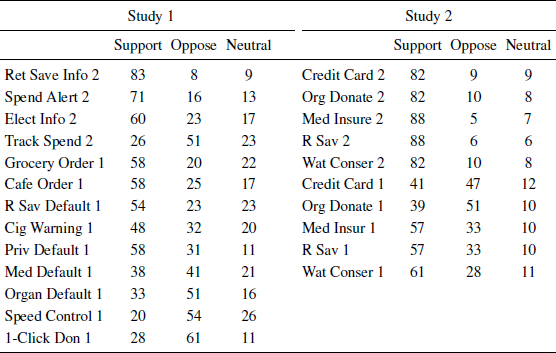
Means are informative, but they may not reflect the percentages of individuals who supported or opposed nudges. Table 2 shows these percentages for Studies 1 and 2. In both studies, System 2 nudges were viewed more favorably than System 1 nudges. In addition, fewer subjects were neutral toward System 2 nudges than System 1 nudges. The effect of nudge type on support was again significant. To test this hypothesis, we used a linear mixed effects model (fit with lmer, see Bates et al., Reference Bates, Maechler, Bolker and Walker2015), with nudge type and subjects as random effects and frame as a fixed effect (t(8) = 7.15, p < 0.001, by the Kenward-Roger approach). Results were consistent with Hypothesis 1.
3.2 Individual dispositions
We predicted that those with greater empathy would show greater support, whereas individualists, conservatives, those with a stronger desire for control, and reactant people would show greater opposition. Table 3 presents correlations between individual dispositions and support for both System 1 and System 2 nudges.

Note: a means correlation is significant at p<.05.
If results were not significant across both studies but were in the same direction, we refer to the findings as an effect that “tends” to occur. Empathetic people tended to support both types of nudges (i.e., System 1 nudges were supported in Study 1, and System 2 nudges were supported in Study 2). Individualists opposed System 1 and System 2 nudges in both studies, and conservatives tended to oppose both types (i.e., they opposed System 1 and 2 nudges in Study 1, but results did not reach significance in Study 2). Those with a strong desire for control and reactant people disliked System 1 nudges, but System 2 nudges did not differ significantly from zero.
Empathetic people supported 9 nudges out of 23 across both studies, and individualists opposed 18 of them. Conservatives opposed 12 nudges, reactant people opposed 13 nudges, and those with a strong desire for control opposed 12 nudges.
3.3 Perceptions of nudges
Average perceptions of System 1 and System 2 nudges for the studies are shown in Table 4. System 1 nudges were perceived as more paternalistic and more threatening to autonomy than System 2 nudges. Contrary to our predictions, System 2 nudges were viewed as more effective for changing behavior and more necessary for making better decisions. Finally, System 2 nudges were perceived as more likely to be the “right” kind of goal to adopt and more likely to send the “right” kind of message to the decision maker.

Note: a means that the perception of the column system of nudges was stronger than that of the other system in both studies. The rating scale went from 0 to 6.
Next, we conducted mediation analyses with Study 2 data to observe the role of perceptions in the relationship between nudge type and nudge support. Effects of nudge type on support were mediated by three perceptual variables. Support for System 1 nudges was mediated by perceptions of threat to one’s autonomy. Support for System 2 nudges was mediated by perceptions that these nudges were effective for good decision making and necessary for changing behavior. All significance tests of the mediations were done using a Monte Carlo Method of Assessing Mediation (MCMAM) (Reference Preacher and SeligPreacher & Selig 2010).
Table 5 displays the results. Path a represents the effects of type of nudge on each of the mediator variables (in this case perceptions). Path b represents the residual effect of the mediator variable on support for nudges after controlling for the direct effect of nudge type on support. Path c is the direct effect of nudge-type on support for nudges after controlling for the effect of the mediator.

Note: For all three perceptions, the product of Path a and Path b (a*b) and was statistically significant at the .05 alpha level, and the confidence intervals were significantly different from zero.
Next, we examined how individuals with different personality and political dispositions viewed nudges. Table 6 shows correlations between individual dispositions and nudge perceptions. Empathetic people perceived nudges are the right kinds of goals to have. Individualists viewed nudges as unnecessary, sending the wrong message, and being the wrong goals to adopt. Conservatives and reactant people perceived nudges as more threatening to autonomy. Last but not least, those with a strong desire for control perceived nudges as more paternalistic.

Note: a means the correlation was significantly different from zero.
Figure 3 summaries individual dispositions, perceptions of nudges, and attitudes toward nudges. Empathetic people viewed nudges as the “right” goals to have and tended to support both types. They exemplify an important reason that U.S. citizens support nudges; they care about those who are less fortunate and believe that nudges are a useful way for the government to help people make better decisions. Individualists opposed nudges for multiple reasons. They perceived nudges as unnecessary, the wrong message to send to people about their capacity to make their own decisions, and the wrong types of goals to adopt. The multitude of reasons suggests individualists may oppose nudges on grounds of principle.
Summary of individual dispositions, perceptions, and support for nudges.

Conservatives also tended to oppose both types of nudges, although their perceptions differed from those of individualists. They viewed nudges as threatening to their autonomy. Reactant people and those with a strong desire for control opposed System 1 nudges, but not System 2 nudges. Reactant people viewed nudges as threatening, while those with a greater need for control viewed them as paternalistic.
We think there are two general reasons that U.S. citizens oppose nudges. The first is captured by individualists who believe the government has neither the right nor the responsibility to interfere with individual welfare. Nudging is intrusive. The second is the view adopted by conservatives and reactant people that nudges threaten personal autonomy. Conservatives tend to oppose both types of nudges, while reactant people oppose System 1 nudges. The opposition may be associated with the fact that System 1 nudges tend to operate at a more automatic level and are often less transparent.
3.4 Framing and individual dispositions
Overall support for nudges was unaffected by the framing manipulations that focused on targets and reference points, inconsistent with Hypotheses 8. Table 7 shows mean ratings of support for System 1 and System 2 nudges across the four frames. There were no main effects or interactions between targets or reference points. Yet frames had differential effects on individual dispositions.
People with greater empathy were more likely to support nudges that were framed as having societal effects. We used a linear mixed-effects model with domain and subjects as random effects, as described earlier. The interaction term between empathetic concern and Personal vs. Societal frames (1 = Societal, 0 = Personal) was statistically significant (t(797) = –2.32, p < 0.01). Empathetic people liked nudges more when framing focused on others.

Individualists opposed nudges in all frames (Personal/Benefit: r= –0.17, t(198) = –2.78, p < 0.01; Personal/Cost: r = –0.39, t(198) = –5.93, p < 0.001, Societal/Benefit: r = –0.31, t(198) = –4.59, p < 0.001; Societal/Cost: r = –0.31, t(198) = –4.58, p < 0.001). Tests of pairwise correlations and a linear mixed effects model showed that frames did not significantly change individualists’ support for nudges. Results were similar for conservatives and those with a stronger desire for control.
Reactant people were more opposed to nudges when frames highlighted the individual costs of rejection. Nudges in these frames could have been more annoying and seemingly more restrictive. We tested this notion again with Personal frames only. In the Personal frames, reactant people resisted nudges associated with Costs more than Benefits. The interaction between reactance and the Personal/Cost frame was statistically significant (t(396) = –1.94, p = 0.05) in a linear mixed effects model where Cost (1 = Cost, 0 = Benefit), with domain (fixed effects) and subjects (random effects). With all four frames, we conducted a linear mixed effects regression that predicted support for nudges from reactance, Personal/Cost (1 = Personal/Cost frames, 0 = Personal/Benefit, Societal/Cost, Societal/Benefit), and the interaction between reactance and Personal/Cost. Although in the expected direction, that interaction did not reach statistical significance (t(197) = 1.82, p = 0.16).
In sum, we found interactions between framing and individual dispositions. People with greater empathy were more supportive of nudges that highlighted societal effects. Individualists opposed nudges regardless of the frame, and reactant people were more resistant to nudges when frames highlighted the personal costs of nudge rejection.
3.5 Attitudes toward company policies
In Study 2, we also examined the judged likability of companies that implemented nudges. First, we computed the average support for the nudge and the average likability of the company implementing the nudge for each subject, collapsing over domain, and correlated these averages. Likability was highly correlated with support (r = 0.70, t(798) = 27.83, p < 0.001). Next, we used t-tests that compared the average likability of companies that implemented System 2 nudges with those of that implemented System 1 nudges. People liked companies that implemented System 2 nudges more than those implementing System 1 nudges (M(diff) = 0.61, t(199) = 16.53, p < 0.001).
Attitudes toward companies differed across individual dispositions. People with greater empathy were more likely to approve of companies that implemented nudge policies (r = 0.15, t(798) = 4.24, p < 0.001). In addition, people who were more reactant and more individualistic were more likely to disapprove of companies that implemented nudge policies (r = –0.18, t(798) = -5.21, p < 0.001, r = –0.22 t(798)= –6.36, p < 0.001, respectively). Thus, support or opposition for nudges in general spilled over to the companies that implemented those nudges.
4 General discussion
Using a representative sample of U.S citizens, Studies 1 and 2 found that most of the nudges were viewed favorably. People distinguished between System 1 and System 2 nudges and prefer System 2 nudges with informational reminders and educational opportunities over System 1 nudges with defaults and sequential ordering. System 2 nudges were perceived as more effective for making good decisions and more necessary for changing behavior. In contrast, System 1 nudges were perceived as more autonomy-threatening.
Five individual dispositions were correlated with support for nudges in one or both studies, and perceptual variables helped explain these attitudes. Empathetic people tended to support both types of nudges and viewed them as the “right” kinds of goals to adopt. Individualists resisted both types of nudges, perhaps based on their beliefs that government should not interfere (regardless of the method). Their resistance could stem from an inherent suspicion about government in general and people (or companies) in particular (i.e., who, in fact, is nudging the nudgers?). To individualists, nudges were unnecessary, sent the wrong message to individuals about their capacity to make their own decisions, and were the wrong types of goals to adopt. Conservatives tended to oppose both types of nudges. Reactant people and those who wanted more control opposed System 1 nudges. To more reactant people, nudges were perceived as more autonomy-threatening, and to those who wanted more control, nudges were perceived as more paternalistic.
Different framing had effects on individual dispositions. Empathetic people perceived nudges more favorably when they were framed as influencing society at large. Individualists and conservatives were unaffected by framing. Finally, reactant people were even more opposed to nudges when framing highlighted the personal costs of rejecting the nudge.
Our results suggest a few approaches for changing attitudes about nudges. One is to alter perceptions of the threat of the nudge, especially among conservatives and reactant people. Threat might be reduced with greater transparency or the announcement of a politically neutral source behind the implementation. Tannebaum, Fox and Rogers (2014) showed that, when liberals were told that the Bush administration was implementing the nudge, they opposed the efforts. Similarly, when conservatives were told that the Obama administration was implementing the nudge, they registered opposition. When nudges were attached to a generic policymaker, there were no political differences in attitudes toward nudges.
Another approach is to alter perceptions of effectiveness. Ironically, although subjects in both studies perceived System 2 nudges as more effective than System 1 nudges, System 1 nudges such as smaller meal portions tend to be more effective than System 2 nudges such as calorie labels (Reference Harnack, French, Oakes, Story, Robert and RydellHarnack et al. 2008; Reference Roberto, Larsen, Agnew, Baik and BrownellRoberto et al. 2010; Reference Wisdom, Downs and LoewensteinWisdom et al. 2010; Reference Schwartz, Riis, Elbel and ArielySchwartz et al. 2012). If people wanted to change their behavior, they might be more willing to accept System 1 nudges if they understood the relative effectiveness. Whether an increase in perceived effectiveness would increase the perceived threat of System 1 nudges is an open empirical question.
A third approach to attitude change is the personalization of nudges. See Sunstein (Reference Sunstein2012, November; 2014, April) for a detailed discussion of how the acceptability of personalized nudges depends on individual heterogeneity. Nudges might be more appealing if they were personalized based on individual preferences and beliefs. But personalization may have risks. In a study using an undergraduate population, we asked subjects whether they would react negatively to nudges if they become aware that they were being nudged. Reactant undergraduates were more likely to report that they would do exactly the opposite of what was intended by the nudge.
In conclusion, the majority of U.S citizens in a representative sample tended to favor most of the nudges we examined. Support is associated with perceptions that nudges are the “right” kind of goals to have. Opposition appears to take two forms. Individualists reject nudges based on ideas about the role of the government in personal welfare. Conservatives and reactant people oppose nudges because they view them as autonomy-threatening. Perceptions might be easier to change than principles, depending on the circumstances.
We should consider and use greater transparency in nudging and take advantage of informational, System 2, nudges that might be more effective in long term behavioral change. Psychological insights about people, their beliefs, and their perceptions may ultimately help policymakers avoid nudges that are met with indifference, rejection, or even outrage.


 Open access

