

Introduction
Socotra Cormorant Phalacrocorax nigrogularis (Ogilvie-Grant & Forbes Reference Ogilvie-Grant and Forbes1899) is a marine endemic species of the Arabian Gulf, Gulf of Oman and southern Arabia (Gallagher et al. Reference Gallagher, Scott, Ormond, Connor, Jennings, Croxall, Evans and Schreiber1984, Chiozzi et al. Reference Chiozzi, De Marchi and Semere2007, Jennings Reference Jennings2010, BirdLife International 2017, Orta Reference Orta, Christie, Jutglar, Garcia, Kirwan, del Hoyo, Elliott, Sargatal, Christie and de Juana2017) with a global population estimated to be < 500,000 individuals (Jennings Reference Jennings2010). The Arabian Gulf holds nearly 95% of the breeding population (Aspinall Reference Aspinall1996a) where the species breeds on undisturbed islands from September to April in cooler weather in colonies holding thousands of nesting pairs (Jennings Reference Jennings2010, Aspinall Reference Aspinall1996b, Wilson Reference Wilson2012, Orta Reference Orta, Christie, Jutglar, Garcia, Kirwan, del Hoyo, Elliott, Sargatal, Christie and de Juana2017). Decreasing population and permanent loss of some breeding colonies (Symens et al. Reference Symens, Kinzelbach, Suhaibani and Werner1993, Aspinall Reference Aspinall1996b, Jennings Reference Jennings2010) resulted in the species being listed as ‘Vulnerable’ (VU) (IUCN 2017, Symes et al. Reference Symes, Taylor, Mallon, Porter, Simms and Budd2015).
The first coordinated assessment of nesting populations in the Arabian Gulf in the mid-1990s estimated 220,000 nesting pairs at 12 breeding colonies (Aspinall Reference Aspinall1995, Hornby and Aspinall Reference Hornby and Aspinall1997) which declined to only 110,000 pairs a decade later in 2006 (Jennings Reference Jennings2010). While the global nesting populations declined by 50%, the overall nesting population in United Arab Emirates (UAE) remained stable with a slight increase from 32,000–34,000 nesting pairs in the 1990s (Aspinall, Reference Aspinall1996b) to 37,000–39,000 pairs in the same period (Jennings Reference Jennings2010). In UAE, all the remaining breeding colonies are in Abu Dhabi Emirate except one colony on Siniya Island in the Emirate of Umm Al Qaiwain.
In the UAE, the species is widespread and birds are frequently observed feeding offshore in large numbers (Aspinall Reference Aspinal2010). As nesting season approaches, birds start to gather at the breeding colonies (Muzaffar et al. Reference Muzaffar, Clarke, Whelan, Gubiani and Cook2017b). The status and suitability of breeding colonies and nesting population depend upon the prevailing disturbance levels and food availability. Short distance migration from colonies post-breeding in search of food allows intermixing with birds from other colonies in Abu Dhabi waters (Muzaffar et al. Reference Muzaffar, Clarke, Whelan, Gubiani and Cook2017b). Although legally protected in UAE, the species has previously suffered from large-scale egg collection and disturbance from recreational activities such as fishing and camping near the colonies, in addition to changes in land use, development (oil industrialisation, habitation) and introduced predators at breeding colonies, that all led to reduced nesting or abandonment of breeding colonies and relocation (Symens et al. Reference Symens, Kinzelbach, Suhaibani and Werner1993, Symens and Suhaibani Reference Symens and Suhaibani1993, Aspinall Reference Aspinall1995, Aspinall Reference Aspinall1996a, Khan et al. Reference Khan, Javed, Shah, Ditta, Hammadi and Hammadi2009, Jennings Reference Jennings2010, Croxall et al. Reference Croxall, Butchart, Lascelles, Stattersfield, Sullivan, Symes and Taylor2012, Wilson Reference Wilson2012). Persecution at some breeding and roosting colonies in UAE includes active displacement, scaring and killing (Aspinall, Reference Aspinall1996a, Khan et al. Reference Khan, Javed, Shah, Ditta, Hammadi and Hammadi2009), and oil spills are a constant threat that can have severe effects on the species’ numbers (Symens and Suhaibani Reference Symens and Suhaibani1993).
Socotra Cormorant is considered a competitor for local fish, thereby lacks appropriate conservation attention in the region (Aspinall Reference Aspinall1996b). Lately, many islands important for Socotra Cormorant in Abu Dhabi have continued to undergo permanent change due to altered land use and inhabitation (Aspinall Reference Aspinall1996b, Javed and Khan Reference Javed and Khan2003). Under such circumstances, it is important to have updated spatial and temporal information of breeding colonies and nesting population to formulate better polices for species conservation. In this paper we present the results of our decade- long monitoring of Socotra Cormorant breeding in Abu Dhabi Emirate. We also discuss the ability of the species to relocate breeding to safer areas and the challenges faced by the species for long-term conservation.
Study area and methods
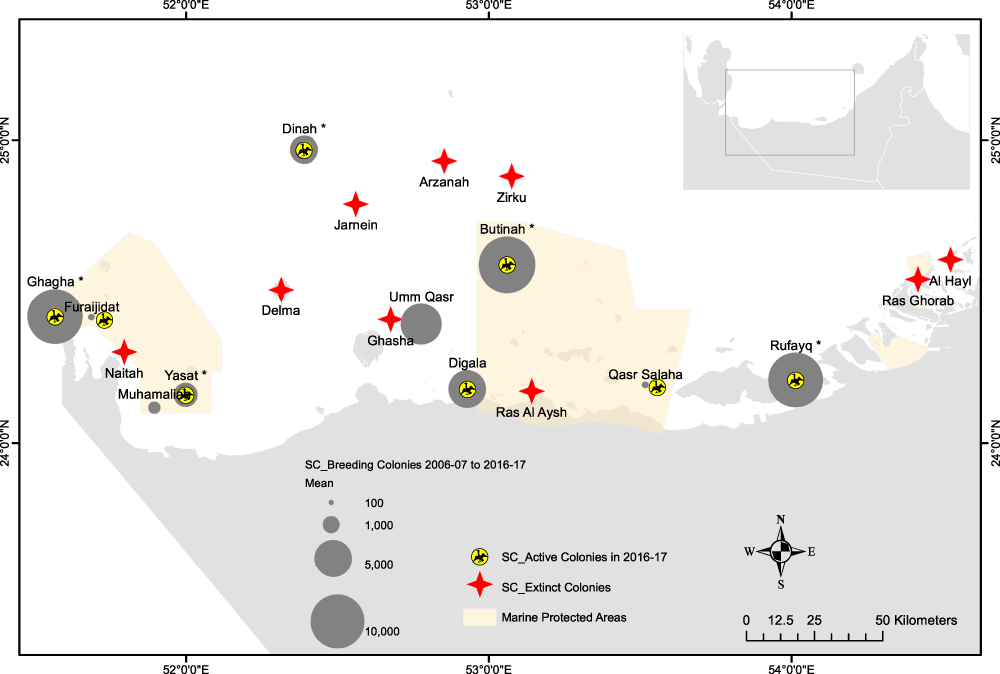
This study was carried out in Abu Dhabi Emirate (22°–26°N and 51°–55° E), which is one of the seven emirates that form the UAE confederation. It has nearly 40 near-shore and offshore islands (Figure 1) of different sizes which are mostly low-lying sand shoals, volcanic salt domes and limestone, usually only a few metres above mean sea level with large shallow areas surrounding them (Al Abdessalaam Reference Al Abdessalaam2008). These islands were surveyed regularly to monitor breeding cormorants (Figure 1). In Abu Dhabi Emirate, breeding colonies are found on flat sandy islands, rocky outcrops adjoining larger islands or rocky islands with gentle slopes. Many of these islands are uninhabited, undisturbed, free from any predators and devoid of vegetation, and represent suitable breeding habitat for cormorants (BirdLife International 2017). Most of the breeding colonies are part of protected areas while several sites have restricted access due to private ownership, having oil and other sensitive infrastructure, or being close to the international border. All the regular breeding colonies have been designated as IBAs (Important Bird and Biodiversity Areas; BirdLife International 2018).
Location of Socotra Cormorant breeding colonies in Abu Dhabi Emirate showing the mean nesting population at active colonies during 2006–2007 to 2016–2017 (* restricted access areas).
Methods
All the old and current Socotra Cormorant breeding colonies in Abu Dhabi Emirate were listed based on information available from published literature and field surveys. To understand changes in the status of these colonies, they were categorised as: a) active - if breeding was recorded during our field surveys, b) inactive - if breeding had occurred within the previous 10 years and c) extinct - if no breeding was reported in last 30 years respectively. Based on ease of access and disturbance, colonies were also categorised as: a) restricted access and b) open access. Restricted access colonies experienced negligible or no disturbance whereas open access colonies were highly disturbed from human activities. All colonies were mapped to understand changes in range and distribution.
We surveyed all breeding colonies for 11 consecutive years from 2006–2007 to 2016–2017 to understand the dynamics of Socotra Cormorant breeding populations as recommended by Aspinall (Reference Aspinal2010). Complete counts of breeding cormorants were conducted during peak nesting period in October/November when most of the birds are incubating (Ewins et al. Reference Ewins, Weseloh and Blokpoel1995, Seefelt Reference Seefelt2012, Wilson Reference Wilson2012). Total counts of birds on nest were performed from a distance using telescopes to avoid disturbance and possible predation of eggs from gulls. Each incubating bird represented a nesting pair. Small groups of birds or colonies nesting on slopes were easier to count whereas large groups were divided into blocks which were counted from different vantage points, if needed, usually by the same observer to avoid overlap. These colonies were revisited in January/February to investigate any sequential nesting as different groups of birds occupying the same colony are known to lay at different times (Symens et al. Reference Symens, Kinzelbach, Suhaibani and Werner1993, Aspinall Reference Aspinall1996a, Wilson Reference Wilson2012).
Average annual nesting population for a colony was calculated using data from years when breeding occurred; these were presented graphically on a map using ArcGIS. A Kruskal-Wallis test was used to identify differences in nesting populations across years and across sites. A decadal snapshot using 10-year interval data to understand long-term trends (Seefelt Reference Seefelt2012) was used to understand changes in status of breeding colonies and nesting population over long term compared to yearly changes. Data from 1996, 2006–2007 and 2016–2017 was used for this analysis and included all the active colonies in these years.
Results
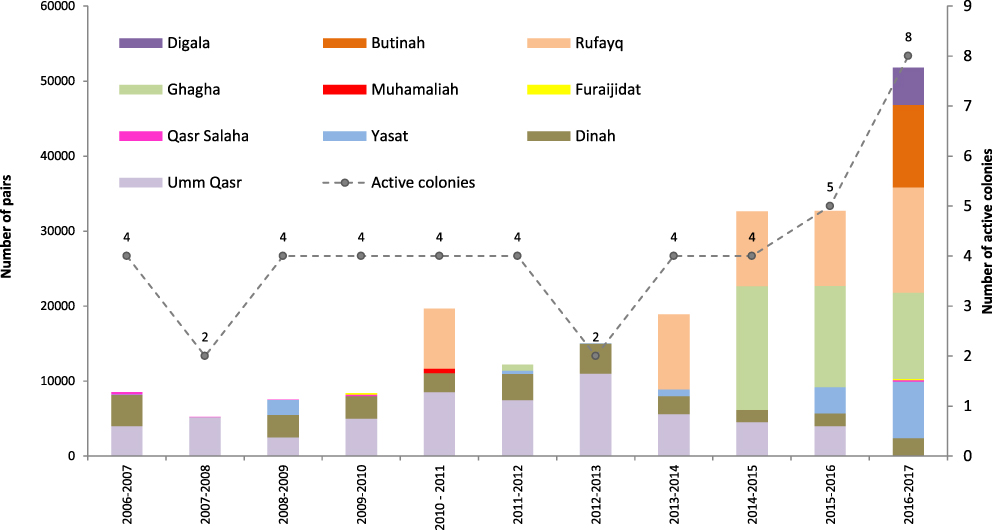
In Abu Dhabi Emirate, 10 different breeding colonies were active intermittently during the last decade; many of these colonies are in the western region on near-shore and off-shore islands. In addition, nine colonies were extinct (permanently abandoned) and are unlikely to be recolonised due to extensive development and habitation (Figure 1). An average of four (± 1.3 SD) colonies were active annually and the number of active colonies varied from a minimum of two in 2012–2013 to the highest of eight in 2016–2017 (Figure 2). Two new breeding colonies were established on Butinah and Digala and previously inactive colonies of Ghagah, Furaijjidat and Muhamaliah were recolonised. Breeding was erratic at most of the colonies, whereas old breeding colonies at Dinah and Umm Qasr recorded regular breeding for a maximum of 11 and 10 years, respectively. Colonies at Yasat and Rufayq recorded breeding for more than five years, while other colonies had fewer breeding events (Figure 1, Table 1). All these colonies were safe from predators.
Number of Socotra Cormorant breeding pairs and breeding colonies recorded during 2006–2007 to 2016–2017 in Abu Dhabi Emirate.
List of Socotra Cormorant breeding sites in Abu Dhabi Emirate and their status in 2016-17, 2006-07 and 1996 (numbers indicate breeding pairs).
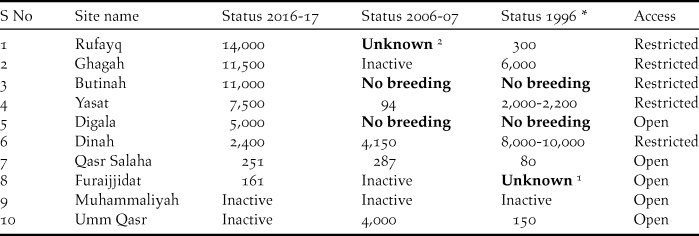
* Information in Aspinall (Reference Aspinall1996b);1 breeding recorded but number not known,2 Not visited
During our monitoring, the nesting population of Socotra Cormorant increased 10-fold in Abu Dhabi Emirate. After an initial decline in 2006–2007, it increased from 5,219 nesting pairs in 2007–2008 and peaked at 51,812 nesting pairs in 2016–2017. Since 2014–2015, more than 30,000 nesting pairs were continuously recorded in the emirate and most of these were recorded from three colonies; Rufayq, Ghagah and Butinah (Figures 1, 2). In 2016–2017, each of these three colonies had more than 10,000 nesting pairs.
There were large variations in nesting populations at breeding colonies in different years. The highest number of nesting pairs at any colony was 16,500 recorded at Ghagah in 2014–2015 followed by 14,000 nesting pairs at Rufayq in 2016–2017 (Figure 2). Dinah and Umm Qasr witnessed a gradual decline in the nesting population after 2013–2014, with the latter finally abandoned in 2016–2017. The nesting population on Yasat was the most irregular, as the number of breeding birds varied from 94 in 2006–2007 to 7,500 in 2016–2017. Breeding at smaller colonies such as Furaijjidat, Muhamaliah and Qasr Salaha was occasional with less than 600 nesting pairs recorded when breeding occurred. A Kruskal-Wallis test indicated that the total number of nesting pairs was not significantly different across years, (H = 8.43, P = 0.586, df = 10), whereas, it was highly significantly different across colonies, (H = 32.57, P = 0.000, df = 9).
Recently, breeding was mostly observed at colonies with restricted access and low disturbance. In 2016–2017, 62.5% sites holding 90% of nesting population had restricted access (Table 1). Half the breeding colonies (50%) active in various years of the decadal assessment had restricted access; these had 92% and 49% nesting populations during 1996 and 2006–2007 respectively. The decadal snapshot census revealed a 57% decrease in nesting population in the first decade from 20,068 pairs to 8,531 pairs, whereas during the subsequent decade it increased by 84% to 51,812 pairs (Table 1).
Discussion
Islands in the Arabian Gulf are important for many species of colonial breeding seabirds (Gallagher et al. Reference Gallagher, Scott, Ormond, Connor, Jennings, Croxall, Evans and Schreiber1984, Javed & Khan Reference Javed and Khan2003) a group of birds affected by human activities (Carney and Sydeman Reference Carney and Sydeman1999). Several of these islands in Abu Dhabi Emirate have breeding colonies of Socotra Cormorant which are of global significance (Javed et al. Reference Javed, Khan, Othman, Newby, Launay, Boere, Galbraith and Stroud2006). These colonies are highly vulnerable and are affected by disturbance and changes in suitability conditions (Seymens et al. Reference Symens, Kinzelbach, Suhaibani and Werner1993, Jennings Reference Jennings2010, Seefelt Reference Seefelt2012). In the last five decades, there has been a nearly 50% contraction in the breeding range of Socotra Cormorant in Abu Dhabi due to loss of some large breeding colonies resulting in significant reduction in nesting numbers (Aspinall Reference Aspinall1996b, Jennings Reference Jennings2010) and recolonisation of these sites is impossible (Aspinall Reference Aspinall1995). Habitation reduces chances of breeding due to increased disturbance and facilitating access to predators such as cats and rodents which deter nesting.
The global population of Socotra Cormorant is declining with continued loss of breeding sites (BirdLife International 2017), however, in Abu Dhabi Emirate, the number of breeding colonies increased in the last decade. Such an increase is significant, emphasising the possibility of restoring a larger sustainable breeding population in future. The return of Socotra Cormorant to previously inactive colonies highlighted the importance of protecting suitable sites for possible colonisation and recolonisation (Jennings Reference Jennings2010). At the same time, abandonment of the traditional breeding colony of Umm Qasr underlines the need of controlling human disturbance. Birds tracked from Siniya moved to western Abu Dhabi (Muzaffar et al. Reference Muzaffar, Clarke, Whelan, Gubiani and Cook2017b) which is known to hold nearly half of UAE roosting numbers (Aspinall Reference Aspinall1995). This post-breeding intermixing of birds from all UAE colonies particularly at roosting sites may result in switching of colonies, recolonisation and increased nesting in other colonies. Gagha and Butinah regularly held large roosting populations of more than 40,000 birds (Khan et al. Reference Khan, Javed, Shah, Ditta, Hammadi and Hammadi2009) before recolonisation.
The nesting population of Socotra Cormorant in Abu Dhabi witnessed a 10-fold increase in the last decade to nearly 52,000 pairs due to increases in nesting numbers at some breeding colonies. The nesting population at Ghagah increased from 800 pairs in 2011–2012 when it was recolonised to 16,500 pairs in 2014–2015. In addition, since persecution and eviction stopped at Yasat, cormorants made a comeback, with 7,500 nesting pairs in 2016–2017. The increase in nesting numbers at Ghagah and Yasat is assumed to be from breeding birds from other UAE colonies or it may be due to relocation of breeding birds displaced from colonies to the east of Qatar, though arrival of birds from the Gulf of Salwa seems unlikely and cannot be confirmed without ringing or tracking data. Interestingly, nesting numbers at Siniya in Umm Al Qawain also increased from 15,500 in the 1990s (Aspinall Reference Aspinall1995) to more than 40,000 pairs in 2014 and stabilised in the last decade (Muzaffar et al. Reference Muzaffar, Whelan, Clarke, Gubiani and Benjamin2017a). Based on these numbers (using 2014 data for all UAE colonies), the overall nesting population for UAE is estimated to be between 60,000 pairs to 70,000 pairs, which is more than 50% of global breeding population of 110,000 pairs. This is a significant increase in UAE nesting population from earlier reported proportion of 15% (Aspinall Reference Aspinall1995) and 30% (Jennings Reference Jennings2010) of the Arabian Gulf breeding population of 220,000 and 110,000 pairs respectively. Along with recent information on the breeding population of UAE, updated information from other Gulf colonies is necessary to reassess the changes in nesting population in the Arabian Gulf (Symens et al. Reference Symens, Kinzelbach, Suhaibani and Werner1993, Khan et al. Reference Khan, Javed, Shah, Ditta, Hammadi and Hammadi2009, Muzaffar et al. Reference Muzaffar, Whelan, Clarke, Gubiani and Benjamin2017a).
Current large breeding numbers can be sustained in the long-term if colonies remain undisturbed with no development, inhabitation or invasive predators. Successful breeding largely depends on suitable conditions from the time when prospecting breeding birds gather at the colony until chicks fledge. Over the past decade, threats to open access colonies have increased, mostly in the form of egg collection, frequent recreational visits and overnight camping. Umm Qasr, an open access colony, with over 11,000 nesting pairs in 2012–2013, witnessed a gradual decline and then abandonment in 2016–2017, due to large-scale egg-stealing and increased recreational activities (Khan et al. Reference Khan, Javed, Shah, Ditta, Hammadi and Hammadi2009, Wilson Reference Wilson2012). Breeding at Qasr Salaha, a small open access colony, failed due to egg-stealing leading to abandonment and sporadic nesting. Under threat, Socotra Cormorant respond by relocating to safer colonies (Muzaffar et al. Reference Muzaffar, Clarke, Whelan, Gubiani and Cook2017b) and recent changes and the current distribution of breeding colonies is the result of such rearrangement. In the last decade, breeding has gradually shifted to sites having restricted access, minimum disturbance and no predators; at present all colonies with large nesting populations (> 5,000 pairs) are closed to the public. It is suspected that birds from Umm Qasr relocated to Butinah and Digala, the two nearest islands offering safety; tracking data also showed regular movement of roosting birds between Umm Qasr and Butinah in previous years (Muzaffar et al. Reference Muzaffar, Clarke, Whelan, Gubiani and Cook2017b). In 2016–2017, five breeding colonies (62.5%) were in restricted areas, including one new breeding colony at Butinah a protected site. During the last three years, more than 30,000 nesting birds have been recorded at colonies in restricted areas. Rufayq, although a restricted access area, has witnessed large scale industrial development around the colony and future monitoring will reveal any effect on nesting numbers. Digala is the only open access colony with a significant nesting population; any threat may result in abandonment of this newly established colony.
Socotra Cormorant nesting populations are known for fluctuations that are not properly understood (Jennings Reference Jennings2010) and periodic cycles of high and low numbers are recorded at sites with regular annual breeding (Muzaffar et al. Reference Muzaffar, Whelan, Clarke, Gubiani and Benjamin2017a) which might depend upon water quality conditions within the Gulf that influence food availability (Aspinall Reference Aspinall1995) and disturbance levels at breeding colonies. In order to monitor Socotra Cormorant breeding over its entire range for a long period of time, decadal census can be a useful tool to understand changes in status of breeding colonies and changes in nesting populations. However, it is not useful as an alert for immediate interventions needed in case of sudden changes that may end breeding at a colony. Seefelt (Reference Seefelt2012) had similar observations for long-term decadal census of the Double-crested Cormorant Phalacrocorax auritus in the Great Lakes region and more frequent surveys were proposed. Yearly monitoring is necessary in order to understand changes in annual population and distribution of breeding colonies. Some colonies with sporadic breeding (Jennings Reference Jennings2010) might be missed in a decadal census; e.g. Muhammaliyah was recorded as inactive during all the three years considered for the census.
Due to perceived competition with commercial fisheries there is lack of support for conservation of the species locally. Although it is known that Socotra Cormorant are important for the cycling of nutrients which is vital for the maintenance of pelagic communities including fish stock (Aspinall Reference Aspinall1995), the public perception of the species as a competitor remains unchanged. The species is known to consume sardine Sardinella longiceps (Aspinall Reference Aspinall1995) but recent studies from UAE has shown that seven species of fish that are consumed do not overlap with the commercial fisheries (Muzaffar et al. Reference Muzaffar, Gubiani, Benjamin, AlShihi, Al-Romithi and Al Kaabi2015). Creating awareness of this misconception about the species being a competitor, and its importance in maintaining a healthy ecosystem and benefits for fisheries, is crucial.
The current number of breeding colonies with high nesting population can be sustained for a long period as breeding at restricted access colonies is safe from disturbance and no egg and chick collection takes place, most of these colonies are also free from predators which cause significant declines. Conservation of Socotra Cormorants depends upon the conservation of breeding and roosting areas, and all stakeholders have to work closely together to ensure that all sites are protected.
Acknowledgements
We wish to thank the management of Environment Agency-Abu Dhabi for their support and encouragement. We thank the owners and management of privately-owned islands especially Jarnein for providing access, help and logistics. Marine protected Areas of EAD are appreciated for their immense help during fieldwork. UAE coastguard/ navy are especially thanked for their support and cooperation. We also thank the anonymous reviewers for their advice on improving the manuscript. This study was funded by Environment Agency-Abu Dhabi (EAD) as an internal project to study key breeding bird species.



