




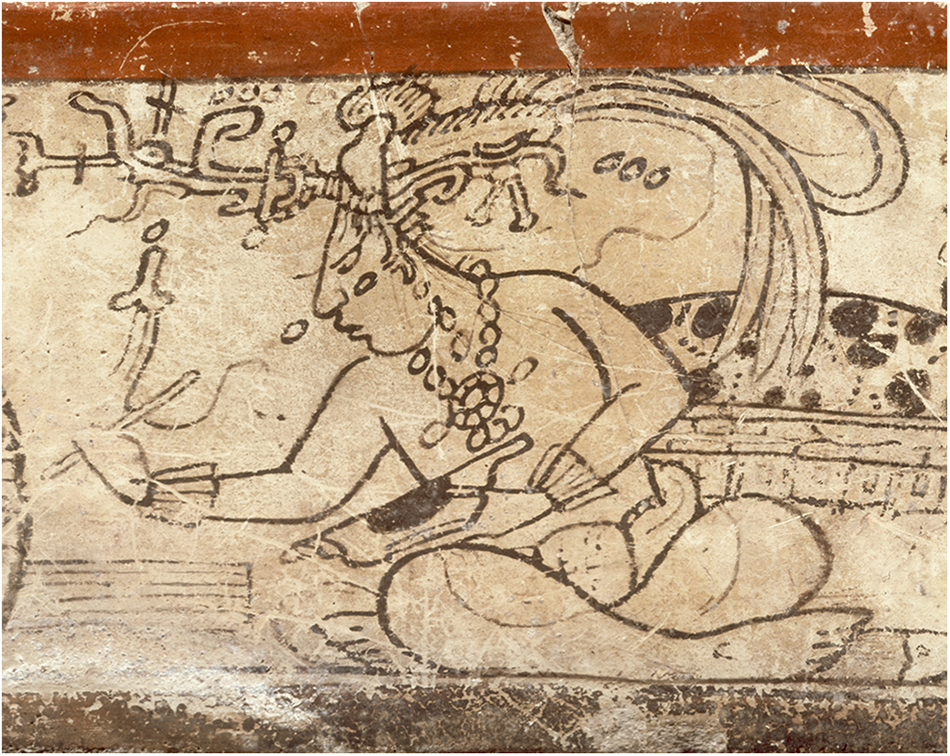
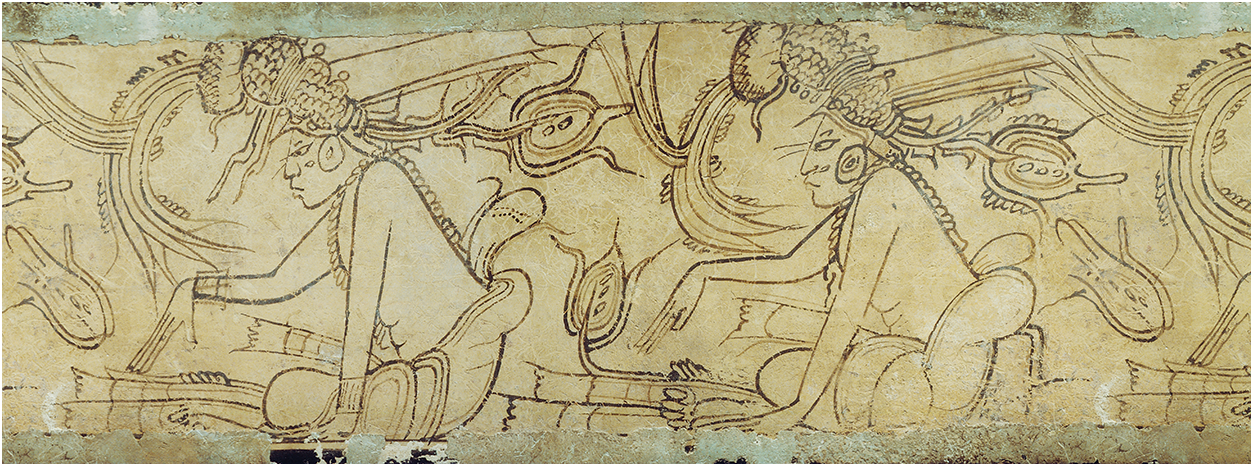
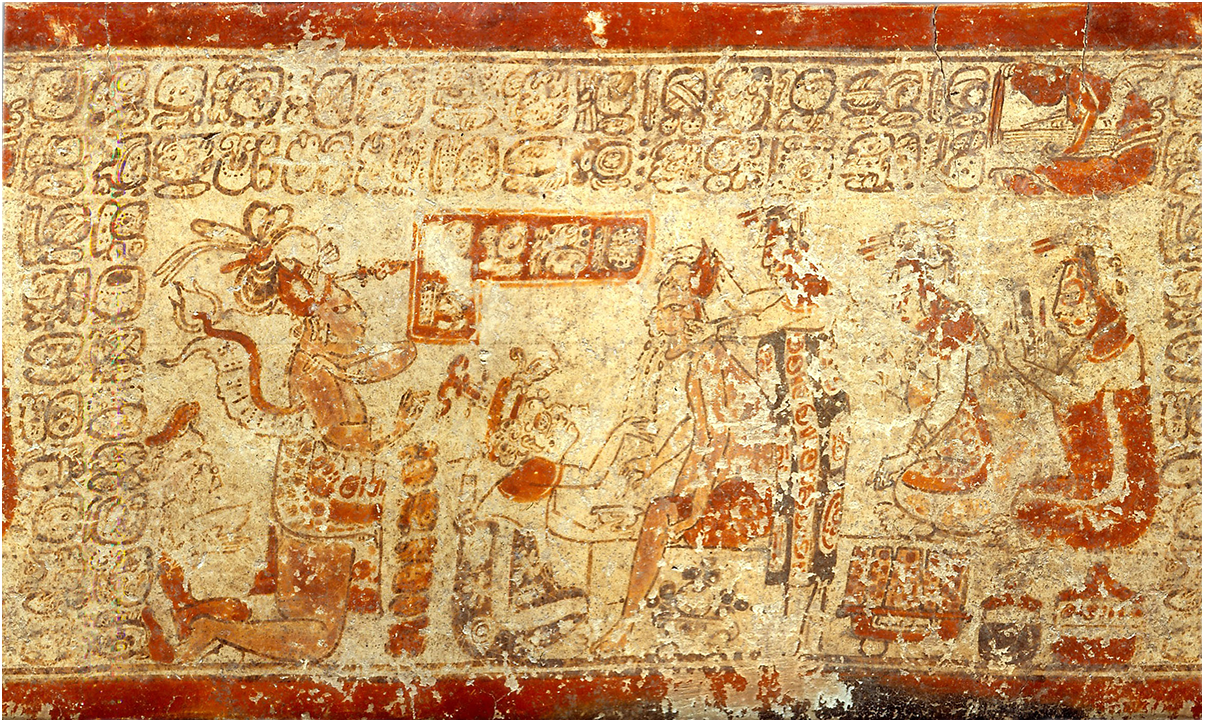
What is the relationship between reading and writing? Does the existence of a text necessarily imply the existence of a trained reader or interpreter? These are questions with cross-cultural significance, but they are particularly relevant to the study of the Classic Maya (a.d. 250–900). The Maya developed a complex logo-syllabic writing system that was unique in the ancient Americas, and they depicted the act of writing in a variety of artistic media (Figure 1), providing rare insights into ancient indigenous notions of art and aesthetics. As a result, a large body of prior scholarship has explored the role of “scribes” and artists in Maya society. However, while the Maya took a keen interest in the producers of texts and images, a fact which the existence of various artists’ signatures makes clear (Houston Reference Houston and Costin2016; Stuart Reference Stuart1989), they also placed an equal if not greater emphasis on the performance of texts. In fact, many of the images that are traditionally glossed as “scribes” within the iconographic literature (a term which, with its root in the Latin scribere—to write—implicitly privileges the production of texts) actually show the oral interpretation of manuscripts. The fact that the Maya represented the act of reading has been noted before (Coe Reference Coe and Hammond1977:333; Stone and Zender Reference Stone and Zender2011:111), but rarely, if ever, quantified. With this in mind, this paper reassesses one specific “scribal” motif, the image of a seated figure in front of a painted book, to more firmly establish the role of reading as a prominent subject of representation. In these images, spoken performances take precedence over textual production, and a range of additional iconographic features reinforces the distinction between the two acts.
An example of the “book interpreter” motif: the Maize God as a scribe writing in a book. Justin Kerr photograph collection, K1185, Dumbarton Oaks, Trustees for Harvard University, Washington, DC.

This paper necessarily engages with the robust existing literature on the Maya scribe. Beginning with the work of Michael Coe in the 1970s, in which he suggested that Maya scribes and artists were functionally the same (Coe Reference Coe1973:8), a number of studies examined Maya scribal imagery in depth. These commented on the deities, costumes, and tools associated with artistic production (Coe Reference Coe1973, Reference Coe and Hammond1977; Coe and Kerr Reference Coe and Kerr1998; Reents-Budet Reference Reents-Budet1994; Robicsek and Hales Reference Robicsek and Hales1981). This research was complemented by epigraphic breakthroughs, such as David Stuart’s identification of the glyphic term tz’ihb (painting and writing) in the 1980s (Stuart Reference Stuart1989). Stuart determined that this term occasionally appeared in Maya scribal signatures, thereby laying the groundwork for future work on Maya conceptions of authorship (Houston Reference Houston and Costin2016; Stuart Reference Stuart1989). Subsequent studies of tz’ihb have also revealed that this term has a more capacious meaning beyond writing and painting; instead, the concept may be better understood as a broader visual category related to calligraphic linework (Herring Reference Herring2005:7–8).
The fact that some Maya artists signed their works suggests that they held a privileged role in Maya society. This theory is supported by the archaeological association between artistic production and elite spaces at sites such as Aguateca and Motul de San José, as well as the depictions of scribal figures on elite residential structures such as the House of the Bacabs at Copán, Honduras (Fash Reference Fash and Webster1989; Halperin and Foias Reference Halperin and Foias2010; Inomata Reference Inomata2001). There is also evidence that scribes were occasionally captured in battle, indicating their centrality to the political workings of Late Classic (a.d. 600–900) city-states (Houston Reference Houston2019:235–237; Johnston Reference Johnston2001; Schele and Miller Reference Schele and Miller1986:219–220).
However, epigraphic studies emphasize that Maya scribes and artists were far from a monolithic group. Instead, there were a variety of titles associated with artistic production in the Maya world, including aj tz’ihb (“He of the writing”) and its’aat (“sage”), both first identified by Stuart (Reference Stuart1989). Other more poorly understood epithets with possible scribal connotations include the aj k’uhuun title (recently reconceptualized as “he of the holy paper,” “one who obeys, venerates” or “one who keeps”), anaab, and taaj (literally “obsidian”) (Coe and Kerr Reference Coe and Kerr1998; Jackson and Stuart Reference Jackson and Stuart2001; Rossi Reference Rossi2021). Moreover, the roles of scribes and ritual specialists (sometimes dubbed “priests”) likely overlapped in Maya society, as the two groups are often hard to differentiate visually (Zender Reference Zender2004:147). As a result, when used to refer to the Maya, the term “scribe” should be understood as little more than an imperfect approximation that encompasses a wide variety of titles and offices. Recent studies have therefore stressed the importance of “being specific” when referring to Maya literate elites (Rossi Reference Rossi2021).
The material matrix of a text was also highly salient to Maya writers, and a similar range of terms was used to refer to writing itself. Tz’ihb, or two-dimensional painting and writing, is one of the best understood concepts (Matsumoto Reference Matsumoto2022:52–53), and painted texts may have been granted a certain primacy if they were used to sketch out carved texts, as has sometimes been suggested (Coe and Kerr Reference Coe and Kerr1998:132–133). Yet the Maya also employed several additional terms to refer to texts in different media. In his foundational study of artists’ signatures, Stuart identified a still poorly understood term, spelled with a “bat-head” glyph, that corresponded to carved or incised texts (Stuart Reference Stuart1989:31). According to a reading by Nikolai Grube, this phrase possibly refers to uxul or “carving,” and it often appears in a possessed form in sculptors’ signatures (Grube Reference Grube, Robertson and Fields1991:228; Houston Reference Houston and Costin2016:393; Matsumoto Reference Matsumoto2022:53–54; Stuart Reference Stuart1989:41). While less common, another term, woj, could also be used to refer to glyphs across a variety of media, though this was most often used to describe carved texts (Matsumoto Reference Matsumoto2022:64; Stuart Reference Stuart1990:220, Reference Stuart2016). The existence of several different emic classifications for writing does suggest that the Maya took a keen interest in both the mode and medium of textual production, and the producers and users of Maya writing would enter into distinct forms of social relationships with each type of text (Matsumoto Reference Matsumoto2022).
This complexity notwithstanding, the term “scribe” continues to function as a shorthand within the literature for the ancient authors of diverse texts and images, as well as a wide array of figures in Maya imagery. Representations of Maya artists occasionally bear a striking resemblance to scribal iconography from other cultures, which may partially explain the enduring appeal of this label (seated sculptures of Egyptian scribes offer a ready, even uncanny, parallel; on these see Peck Reference Peck1978; Schäfer Reference Schäfer1986:251–253). However, this terminology, and the implicit associations it evokes, potentially obscures the evidence for other types of literate acts such as reading in Maya imagery. There is an implicit risk here of imposing modern Western assumptions about artistic production onto the material output of other cultures—a common danger within the archaeology and art history of the ancient Americas (Cummins Reference Cummins2019; Dean Reference Dean2006).
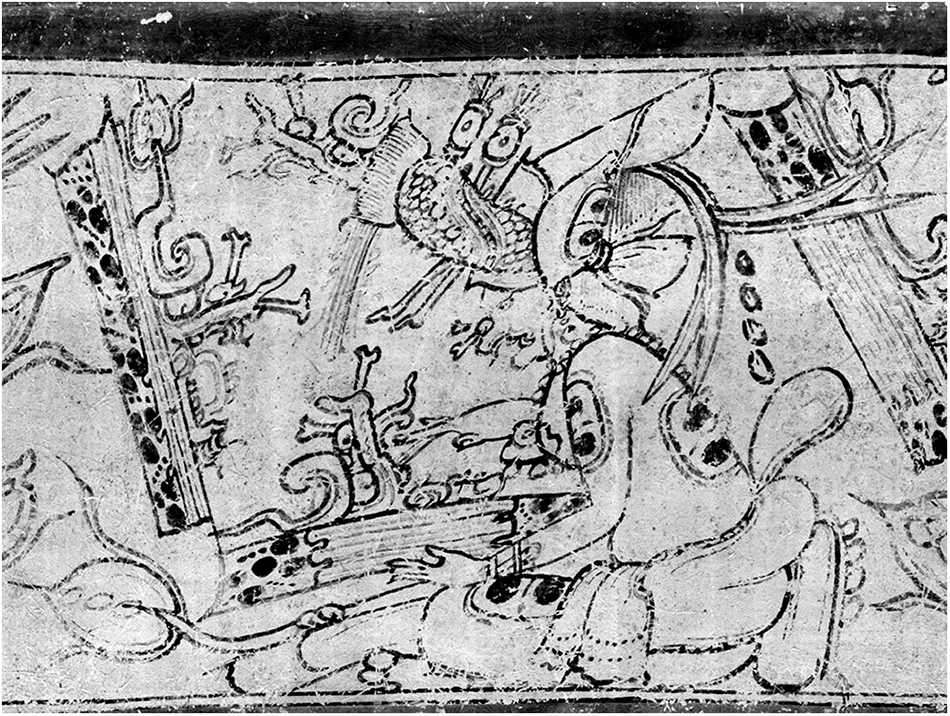
To fully understand Maya “scribal” imagery, one must instead approach these representations on their own terms. As a result, this paper closely examines one specific iconographic theme, dubbed the “book interpreter” motif here, to demonstrate the value of analyzing these images through the lens of orality. This motif may take several forms, but in its most essential state it consists of a seated figure who sits and looks leftwards over a codex book bound in jaguar skin (Figures 1 and 2). Typically, the text opens away from the figure almost like a modern-day laptop, although this is a visual convention aimed at clarifying the nature of the object rather than a reflection of actual reading practices (Stone and Zender Reference Stone and Zender2011:111). A few sheets of paper may occasionally take the place of a full book, and both would be referred to as hu’n in Mayan. The actual contents of the pages are almost never visible except in one unusual case where the “text” is rendered highly schematically (Houston Reference Houston2018b). In most cases, these figures appear in groups of two with minimal accompanying imagery, though they may also be embedded within larger scenes.
A Monkey Scribe gesturing to a codex book. Justin Kerr photograph collection, K760, Dumbarton Oaks, Trustees for Harvard University, Washington, DC.

Nearly all surviving instances of the book interpreter motif occur on drinking vessels from the Late Classic period. As such, these painted vessels form the basis of the present analysis, though other objects such as ceramic figurines are considered where relevant. More broadly, representations of both reading and writing are largely absent from monumental sculpture (though as has been noted elsewhere [Coe and Kerr Reference Coe and Kerr1998:145], a notable exception occurs on the Emiliano Zapata panel, where a carving scene is depicted). While largely outside the scope of the present paper, this is a suggestive trend: representations of both textual reception and production seem to have focused on one material context (books) and were shown in a restricted range of media (i.e. painted ceramics). Literate engagements with other materials such as stone were only very rarely represented.
Within the corpus of “book interpreter” imagery, the trends are instructive. On rare occasions these figures hold brushes or pens in their hands and engage in the acts of writing or painting (Figure 1). However, these writers are the exception rather than the rule. By contrast, a much larger group of figures gesture to their texts, often opening their mouths to indicate that they are performing the contents of the page (Figure 2). Readers and writers also don distinct costumes and are associated with separate deities; many readers resemble the so-called “Monkey Scribes” of the Popol Vuh or nonspecific humanoid deities, whereas writers most typically resemble the Maize God. These scenes therefore emphasize the oral elaboration of manuscripts in conjunction with the act of Maya tz’ihb and encode an important hierarchy between the producers and interpreters of texts and images.
Methods
The present paper is primarily based on vase paintings that appear in the Kerr archive of rollout photographs, as well as prior publications and museum catalogues. With the goal of examining book interpreters as exhaustively as possible, 53 individual instances of the motif were identified across 35 distinct ceramic vessels. (A list was also compiled of more tentative instances; this includes 29 further figures on 16 vessels.) To better recognize patterns across this corpus, several key traits were tracked across each image such as the type of activity each figure engages in, whether or not they can be identified as a specific deity, and the presence or absence of several key types of regalia. The full dataset is available in the supplement to this article. In an effort to circumvent potential disagreements over identifications (an inevitable issue given the fluid nature of Maya divinity), emphasis was placed upon specificity and consistency. For instance, for the purposes of this study, “monkeys” are figures with simian faces, or better yet, fully articulated animal features. Additionally, though most scribal figures are divinities, the terms “human” or “humanoid” are used to refer to anthropomorphic figures who lack any clear supernatural identifiers, especially the plaque-like “god-markers” typically used to designate gods or the distinctive head and wispy hair of the Maize God. These classifications provide a useful starting point for analysis; if one understands these labels as provisional, but nonetheless, practical, groupings, certain clear trends emerge. Above all, attention is given to visual patterns; as shall be demonstrated below, reading and writing are clearly associated with distinctive suites of iconographic attributes, which reinforces the hypothesis that these represent separable, albeit related, acts.
One other necessary limitation of the present study (and most scholarship on Maya vase paintings) is that the vast majority of Maya vessels have been looted from their original contexts (presumably tombs). This creates irreparable damage to the archaeological record and frustrates any attempts to associate a particular vessel with a specific site or provenience. Overpainting and forgeries only complicate this issue (Kelker and Bruhns Reference Kelker and Bruhns2009). Style can sometimes serve as a proxy for contextual information, and a large number of the vases analyzed here were painted in the codex style, which is mostly associated with the Mirador Basin in northern Guatemala and the Kaanu’l dynasty of Calakmul, Mexico (Reents-Budet et al. Reference Reents-Budet, Landais, Carrillo, Bishop and Blackman2010). Most also date to the eighth century a.d., which indicates that representations of literacy were a temporally restricted phenomenon. Still, a great deal of information on production and circulation is lost. Even if this context cannot be recovered though, it is important to emphasize that many of the images discussed below should not be conceptualized as static, two-dimensional representations. Instead, they were handled and exchanged in elite feasts that cemented alliances in the Classic Maya world (Halperin Reference Halperin2014; Halperin and Foias Reference Halperin and Foias2010; Just Reference Just2012:74; LeCount Reference LeCount1999; Reents-Budet Reference Reents-Budet1994:88–92, 1998). To borrow a term from the literature on Greek drinking vessels, the material “vehicles” of Maya imagery should not be overlooked (Lissarrague Reference Lissarrague and Szegdy-Maszak2014:11); imagery on drinking vessels would have been physically manipulated and discussed out loud, granting it a fundamentally active quality.
An Abundance of Readers
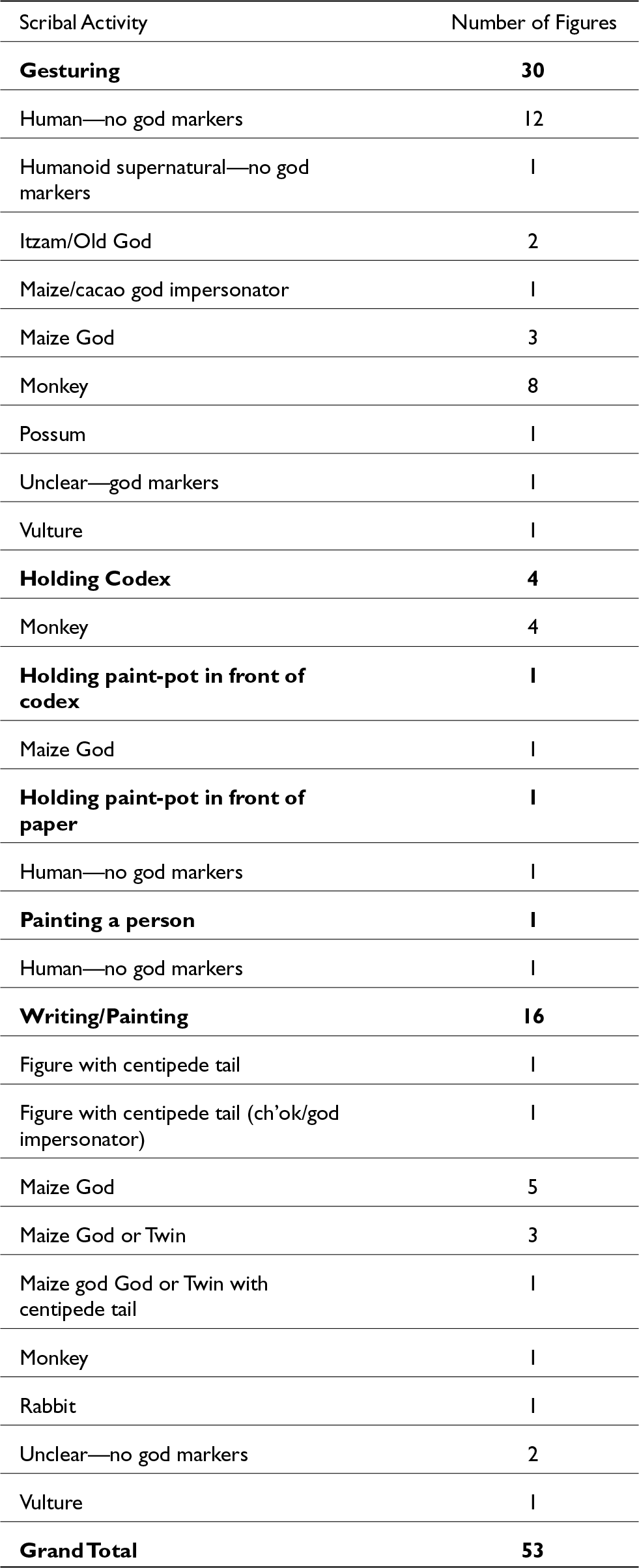
A systematic review of Maya “book interpreter” imagery reveals several clear trends. First, the majority of these scenes do not emphasize the production of text and image (Table 1). Instead, only 16 out of the 53 figures who appear with a book hold writing tools (30 percent). These writers appear on just 12 separate vases. By contrast, 30 figures (or roughly 57 percent of the sample) gesture to books with their hands or, in three cases, probable pointing tools (these typically fail to make direct contact with the page and are held differently from brushes at angles that would make painting impractical). These “readers” are depicted on 20 distinct vases. Four similar figures (on two additional vases) hold codices in their laps and are likely also engaged in some form of textual interpretation. Reading scenes are also afforded a privileged place in iconography across various painting styles, which suggests that beliefs about the relationship between orality and writing were shared across a wide part of the Maya region.
Breakdown of the different activities performed with books, organized by the action and type of figure involved

If one expands this sample to include the more tentative cases of the book interpreter motif, the number of gesturing figures increases to outnumber writers by a ratio of nearly three to one. Many of these images have nonetheless been treated as “scribes” in prior studies (Boot Reference Boot2003; Robicsek and Hales Reference Robicsek and Hales1981), and specific information on each image can be found in the attached supplement. In this count, which contains 82 figures from across 50 vessels, 54 figures gesture (roughly 66 percent of the sample), compared to a scant 17 writers (only one additional writer is added to the sample). For the sake of clarity and in order to avoid overstating the prevalence of reading scenes, the following analyses draw upon the more conservative counts. Nevertheless, it is worth underscoring that in both datasets, gesturing scenes are more common than writing. This trend only becomes more dramatic with the inclusion of the more ambiguous cases. These observations also align with prior quantitative work on scribal imagery by Erik Boot (Reference Boot2003). He noted the rarity of artistic tools in a larger sample of scribal images that included mask-making scenes and representations of figures holding paint pots. Although Boot’s focus was “left- and right-handedness” in scenes of artistic production, he observed that only 42 of the 121 figures in his sample held painting implements (Boot Reference Boot2003:13). Writing and painting tools are therefore an anomaly by all accounts.
Forms of Reading
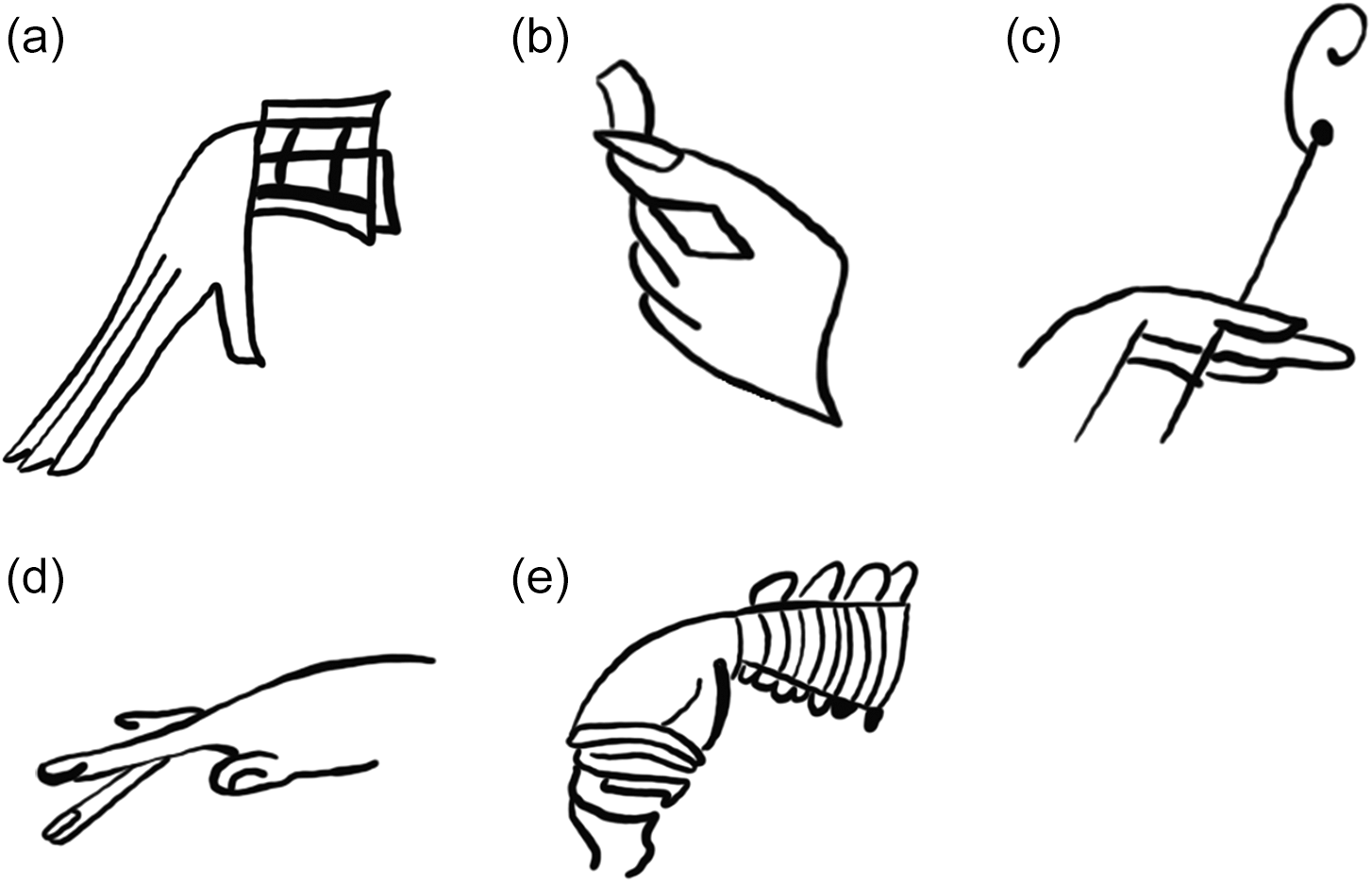
The scarcity of pens and brushes in scenes with books suggests that the Maya emphasized other ways of interacting with codices beyond tz’ihb. It is much more common for a figure to gesture to a book, and many gesturing figures are also shown with open or partly open mouths (12 out of 30 figures, or 40 percent), which suggests that they are vocalizing the texts on the pages in front of them. (A roughly equivalent percentage of writers—7 out of 16, or 44 percent—open their mouths, which could indicate a link between spoken and written composition.) Gesturing figures make a wide variety of motions towards the pages they read (Figure 3). Each of these gestures probably encodes a specific form of Maya oral performance, even in the absence of other independent markers of speech such as an open mouth.
A selection of the various gestures made to codex books. (a) K1220, (b) K2095, (c) K3413, (d) K760, (e) K1225. Drawings by the author after photographs in the Justin Kerr photograph collection.

Several prior studies of Maya art have suggested that hand gestures may form part of a sophisticated symbolic language in which different motions convey specific meanings or even stand for distinct forms of discourse (Ancona-Ha et al. Reference Ancona-Ha, de Lara, Van Stone and Kerr2000; Benson Reference Benson and Robertson1974; Bishop and Cartmill Reference Bishop and Cartmill2020:279; Ciura Reference Ciura2015; Herring Reference Herring2005:80). Gestures can also be directly tied to speech acts in Maya imagery, as on the so-called Tablet of the Orator from Palenque. On this carving, a figure with a speech scroll angles his palm upwards in front of his face as if to direct the sound (Ciura Reference Ciura2015:29). Moreover, studies of orality in cultures across the world note the close links between gesture and speech, often emphasizing the mnemonic role of bodily motions in oral performance (Havelock Reference Havelock1963:149; Haviland Reference Haviland1999, Reference Haviland and McNeil2000; Ong Reference Ong1982:67; Peabody Reference Peabody1975:197). In keeping with this, contemporary Maya groups also make use of gestures as a supplement to oral narrations; the modern Chol Maya mark “peak events” in folktales with “body movements or gestures” (Hopkins and Josserand Reference Hopkins, Josserand, Hull and Carrasco2012:28). As a result, it is highly probable that the motions made to books in Classic imagery record a sophisticated variety of speech acts.
Even so, it is hard to establish the exact nature of these performances, since the images themselves are obviously silent. Modern English terms like “reading,” “interpretation,” or “oral performance” can only offer rough descriptors. If the surviving codices from the Postclassic period may be taken as an indicator of the content of earlier books from the Classic period, then it is likely that most texts were “liturgical” or religious in content (Zender Reference Zender2004:84–85), though genealogies and history were surely recorded as well, based on the evidence of other Mesoamerican cultures. Most of these texts were probably not “read” in a literal word-for-word sense but rather interpreted and expounded upon to deliver specific prophecies and auguries. There is also some evidence that the act of interpreting a text out loud in ancient Mesoamerica could have a transformative or immersive power, “insinuating” the reader into the very contents of their performance (Cummins Reference Cummins2015). Texts such as the K’iche’ Popol Vuh were referred to as ilb’al or an “instrument of sight,” a term also attested in other languages such as Kaqchikel (Solano Reference Solano1856:164), and the use of the present progressive tense in the opening passage of the epic suggests that “the narrator sees it before him as he writes” (Christenson Reference Christenson2007:11). Performing a text out loud was therefore a highly charged act, laden with the potential to reconfigure the speaker’s very experience of reality. As such, though the word “reading” is employed here for simplicity’s sake, the terms “interpretation” or “performance” may be more accurate, and it must be emphasized that Maya notions of orality do not necessarily correspond directly to modern Western conceptions.
Some further specificity may also be attained by considering the terms for reading recorded in Maya languages. A full exploration of this vocabulary would fall outside the scope of this article, but it should be noted that contemporary Maya languages recognize several forms of reading, which probably reflect the varied contexts of Maya oral performance (Brown Reference Brown1991:Table 1; Houston and Stuart Reference Houston and Stuart1992:591; Tedlock Reference Tedlock1992:217). Dennis Tedlock divides these words into three broad groups: terms for speaking or shouting, words that have to do with counting, and phrases that translate to “look at paper” (Reference Tedlock1992:216–217). It is unclear if similar categorizations existed during the Classic period (Tedlock Reference Tedlock1992:217), and with the possible exception of a term for “seeing,” references to reading in the inscriptions are scant (Houston and Stuart Reference Houston and Stuart1992:591). Still, Classic-period vase paintings may tentatively exhibit a similar typology of reading forms. The gaping mouths of many figures (Figure 2) suggest a form of loud vocalization or “shouting” (Houston Reference Houston2019:230), while other readers “look at paper” intently as if to evoke the pregnant moment before an oral performance (Figure 4). Still others appear with numerical utterances (Figure 5) or what Michael Coe dubbed the “computer print-out” (Reference Coe and Hammond1977:331), a numbered strip of paper which may indicate they are counting. This may also rest upon a deeper distinction between written text and numerical notation (Houston Reference Houston2000:148), which would be performed in distinct ways. A more musical form of performance, perhaps more adequately understood as “cantillation,” could also be at play in some images (Stephen Houston, personal communication, 2025), as Aztec poems and ethnohistorical accounts make it clear that some Mesoamerican books were “sung” out loud (León-Portilla Reference León-Portilla1992).
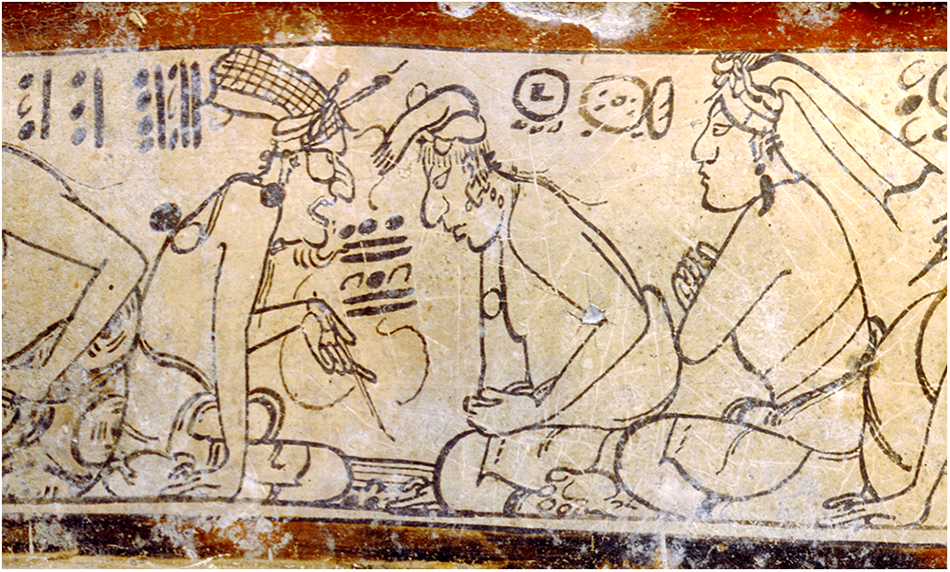
Two humanoid readers: the first “looks at paper” intently while the second looks up. Justin Kerr photograph collection, K1220, Dumbarton Oaks, Trustees for Harvard University, Washington, DC.

An Itzam instructs younger anthropomorphic figures. Justin Kerr photograph collection, K1196, Dumbarton Oaks, Trustees for Harvard University, Washington, DC.

A closer analysis of the specific motions attested in the iconographic corpus reveals further nuances. Of the various gestures made to books, a motion which consists of a slanted, downturned palm is by far the most common (Figure 3a), and the connection between this gesture and reading has been noted previously (Ciura Reference Ciura2015:28). At least nine figures perform this motion on six separate vessels, and it may have served a deictic function since the readers’ fingers tend to hover just above the page as if they are tracking specific lines of text. This gesture is especially common on codex-style vessels (four out of six of the vessels in question are painted in this style), which could also indicate that it corresponds to a particular regional variant of reading practices. In addition to this, readers tend to make this motion to a few sheets of paper rather than a full codex, which suggests that the material form of the text determined the particular bodily motions required to perform it. There is also a sequential element to some of these scenes which would be accented by the act of turning a vessel; for instance, one image shows two highly similar figures, and while the first looks at the text in front of him, the second looks up (Figure 4). This progression may be meant to convey the sense that the painted performance was unfolding in time.
Other gestures appear less frequently but may also be tentatively tied to specific reading contexts. On at least two vessels, readers hold their hands over the pages in front of them in a cupped position (Figure 3b); in a third example (K5184), a reader holds his palm upwards in what is likely a related act. The meaning of this gesture is unclear, but it is sometimes performed by a humanoid figure in front of an attentive listener, which may suggest a form of socially situated reading such as divination. A number of additional gestures appear to be more restricted in their usage. In two cases, readers point to the texts with their fingers (Figure 3c), probably to isolate specific passages. This also recalls the broader Mesoamerican convention whereby an extended index finger may stand for speech (Houston et al. Reference Houston, Stuart and Taube2006:250), and therefore directly evokes the orality of the text.
Some hand motions are more enigmatic. In several cases, a reader delicately splays their fingers above a text (Figure 3d) in a gesture that recalls a poorly understood motion most frequently made by deities (Ancona-Ha et al. Reference Ancona-Ha, de Lara, Van Stone and Kerr2000:1082; Ciura Reference Ciura2015:18). In one particularly striking example (Figure 2), a monkey performs this gesture as the head of the “Jester God,” a personified form of paper (Stuart Reference Stuart, Houston, Golden and Skidmore2012), emerges from the pages in front of him. This being’s mouth hangs wide open on the upper panel of the book to confront the monkey, almost as if he is supervising or commenting on the reader’s speech. As Sarah Jackson has remarked, the text may literally be “speaking to” its reader and it is clearly “not static on the page” (Jackson Reference Jackson2020:621); instead, the contents of the text seem to enter into the “here and now” of the reader (Cummins Reference Cummins2015). There is a sense that the text is materially and spiritually activated by the physical act of reading, and the monkey’s fingers almost tickle the mouth of this supernatural being, suggesting that the reading shown here entails a process of give and take between reader and text. This potentially transformative power of reading may also be conveyed by another puzzling gesture (Figure 3e). In this case, a monkey dangles what should be his right hand above a text, but the hand is twisted at an unnatural angle so that it appears to be his left, and the fingers disappear into wispy tendrils. It has sometimes been suggested that this monkey is “pointing” to the text or “writing frantically” (Miller Reference Miller2014:94, 201), but though his companion may be writing, no pen is visible here. These gestures reveal the potentially supernatural power of Maya reading, and though their meanings are likely esoteric, they may be further elucidated with future research.
While some gestures confound an easy explanation, in exceptional cases, the content of a performance is made explicit by the inclusion of “speech scroll,” a more widespread Mesoamerican convention for rendering utterances in visible form. In one especially informative image, an aged deity, likely a version of the god Itzam, gestures to a book with a pointing tool as a wispy tendril with bar and dot numerals emerges from his mouth (Figure 5). This makes it clear that the emphasis in this scene is on reading of a numerical sort, and the implement in his hand serves as a pointing tool rather than a brush or pen. There is some archaeological evidence for this type of artifact, such as the bone pointers excavated from Burial 116 at Tikal, several of which take the form of a pointing hand (Stephen Houston, personal communication, 2024). This probably indicates that the Maya had an object akin to the Jewish yad, which is used for reading the Torah (Boot 2014, 30; Stephen Houston, personal communication, 2024). As in Judaism, some texts may have been too sacred to touch directly. In the instructional scene, the tool also appears to serve a deictic role, and these pointers probably aided readers as they parsed and explained the details of particularly dense glyphic passages.
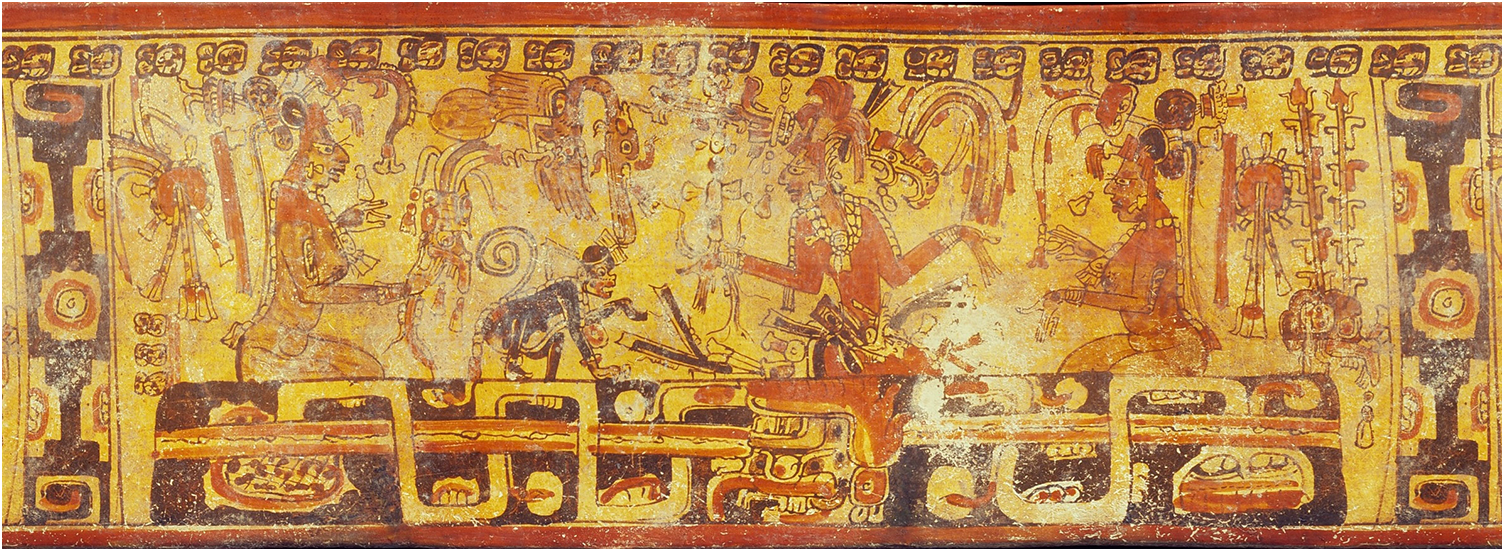
A small number of readers are also situated within larger scenes, which may offer more direct clues about the content of their vocalizations. As was previously mentioned, most book interpreters appear in paired sets with minimal accompanying imagery, but on at least five vessels, readers participate in larger supernatural courts or narratives (Figures 6–7; see also K501, K3413, and the “God D court vessel” in Boot Reference Boot2008). In many of these images, the scribes appear oblivious to the events transpiring around them and stare at their books as if meticulously consulting their records. For instance, on one vessel, a small spider monkey opens his mouth to read from a book in front of the Maize God and his two female consorts; these figures look towards the reader as if awaiting a favorable prognostication (Figure 6). Divine recitations appear to serve a similar sanctioning function in a scene that shows the emergence of the first humans from a cave (Houston et al. Reference Houston, Stuart and Taube2006:53), where a loud Monkey Scribe reads from a book while accompanying the principal action.
A small spider monkey reads a book in front of the Maize God. Justin Kerr photograph collection, K626, Dumbarton Oaks, Trustees for Harvard University, Washington, DC.

Supernatural healing scene with a small reader embedded in the rim text. Justin Kerr photograph collection, K6020, Dumbarton Oaks, Trustees for Harvard University, Washington, DC.

In another case (Figure 7), the placement of a small reader within the rim text of a vessel could indicate that the preceding glyphic narrative should be understood as his utterance. This impression is furthered by the use of the quotative cheheen in the preceding passage (Boot Reference Boot2014a:30), though this could also refer to the speech of other figures mentioned in the text (Marc Zender, personal communication, 2020). This raises the intriguing possibility that in many of the scenes where a small reader is set apart from the surrounding action, they may represent a sort of embedded narrator who called the scene into existence—this would accord well with the potentially immersive power of Mesoamerican reading (Cummins Reference Cummins2015). This possibility aside, a few readers also appear in scenes that appear to be more related to record keeping. This occurs on the God D court vessel (Tokovinine Reference Tokovinine, Masson, Freidel and Demarest2020:276), as well as on another vase that shows two Monkey Scribes who are surrounded by animals bearing food and drink (Figure 8a). There is an economic undertone to these images, which suggests that the readers’ engagement with their texts could serve to validate and affirm acts of tribute or gift-giving.
A selection of Monkey Scribes who gesture to texts. (a) K3413, (b) K1225, (c) K954, Justin Kerr photograph collection, Dumbarton Oaks, Trustees for Harvard University, Washington, DC.

Even if the exact content of these textual performances is impossible to extract, the broader emphasis on reading and performance in scribal imagery deserves underscoring. These images give visual form to the inextricable connection between texts and orality in Mesoamerica, a topic which has been well-treated in prior literature (Boone Reference Boone, Boone and Mignolo1994; Boone and Mignolo Reference Boone, Boone and Mignolo1994; Cummins Reference Cummins2015; Houston Reference Houston, Boone and Mignolo1994; Houston and Stuart Reference Houston and Stuart1992; Hull and Carrasco Reference Hull and Carrasco2012; León-Portilla Reference León-Portilla1992, Reference León-Portilla2015; Monaghan Reference Monaghan1990; Severi Reference Severi2019). Mesoamerican notions of orality are exemplified by an Aztec poem recorded in the Cantares Mexicanos that describes how a performer “sing[s] the pictures of the books” and “make[s] the books speak” (León-Portilla Reference León-Portilla1992:5). Most Mesoamerican texts were probably meant to be activated in this manner (Houston et al. Reference Houston, Stuart and Taube2006:138). The material component of reading was also important, as another sixteenth-century source, Sahagún’s Coloquios y doctrina cristiana, refers to how Mexica tlamatinime (sages) “noisily turn” the pages of painted books (León-Portilla Reference León-Portilla1992:16; Cummins Reference Cummins2015:79–80). The diverse hand gestures attested in the Maya corpus may attest to this physical component of reading. Closer to the Maya area, some textual sources also place a similar emphasis on the reception of writing as opposed to its production. For instance, the K’iche’ Popol Vuh refers to its authors in terms of vision rather than creation and describes them as “witnesses” or “those who ponder” (Christenson Reference Christenson2007:54). This suggests that the emphasis on interpreting texts extended into the Maya area and the Guatemalan highlands.
Amongst the Classic Maya, it is likely that glyphic texts were supplemented by memorized oral formulas in a “a system of ‘recitation literacy’” (Houston and Stuart Reference Houston and Stuart1992:590), and painted images would have elicited vocal commentaries alongside their glyphic counterparts (Stone and Zender Reference Stone and Zender2011:15). Some Maya texts also forefront this orality through the use of the quotative cheheen, possibly meaning “it is said” or “he, she, or it says,” which can be used to attribute speech to an object or claim authorship for a painted composition (Clark Reference Clark2025; Grube Reference Grube, Dedenbach-Salazar Sáenz, Hoffmann, König and Prümers1998; Houston Reference Houston and Costin2016:393). Maya writing and imagery is therefore intrinsically oral, and representations of book interpreters emphasize this point—writing is not complete without reading, in its many varied forms.
Who Reads? Who Writes?
These data make it clear that a significant proportion of Maya book interpreters perform their texts and it is likely that several distinct forms of vocal performance are recorded iconographically. Yet crucially, gesturing figures also differ from their writer and painter counterparts in several other ways beyond their choice of activity. Most readers resemble the Monkey Scribes or nonspecific, anthropomorphic deities, and they wear the regalia of ritual specialists. By contrast, the majority of writers resemble the Maize God or Hero Twins and often sport the Jester God headdress of royalty. This indicates that the visual separation between these two tasks cannot be explained as a mere accident but rather represents a salient distinction within Maya society. Thus, although some “reading” and “writing” scenes might appear similar at first glance, which may indicate a general connection between the two activities, upon closer examination an entire suite of features comes into focus that further distinguishes gesturing figures from writers.
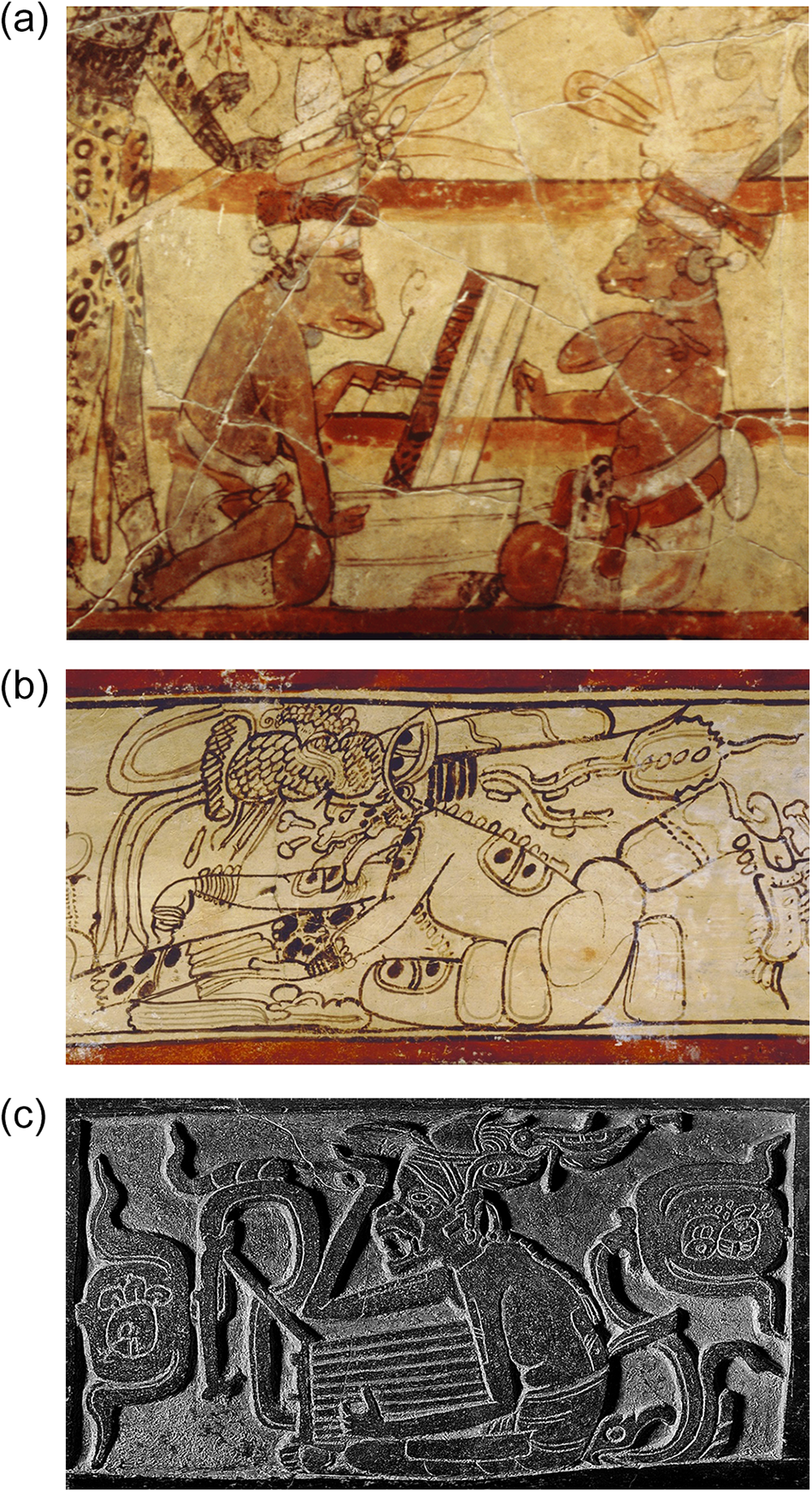
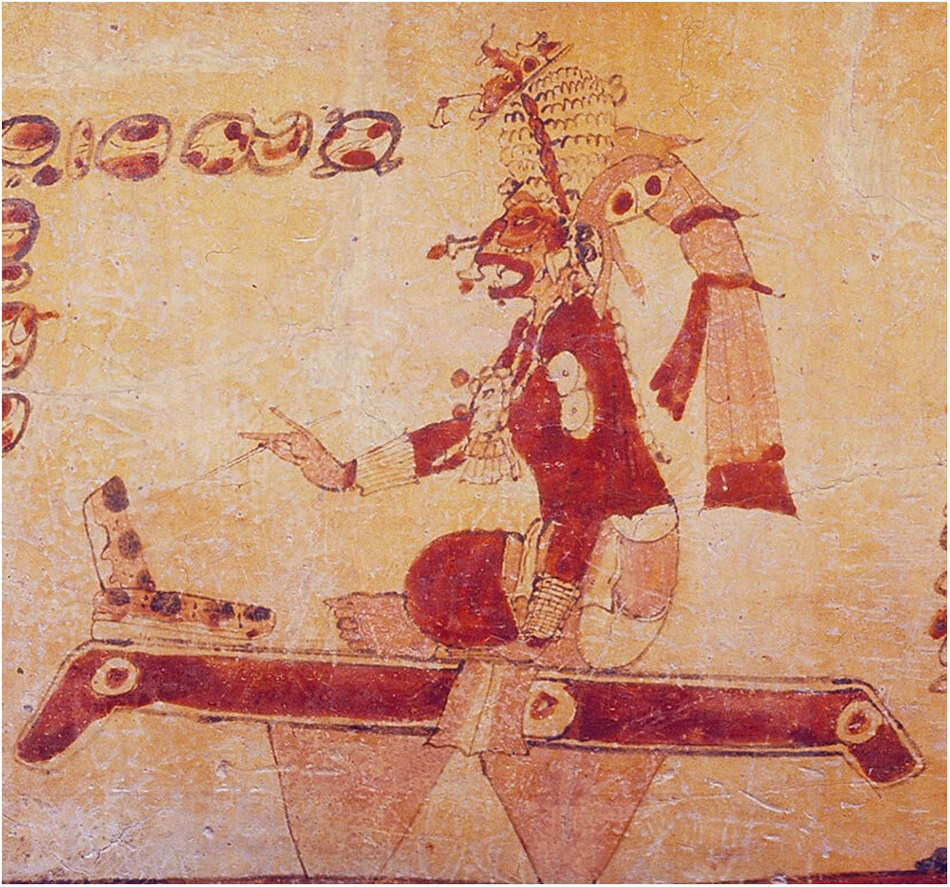
One of the largest groups of gesturing figures is made up of monkeys (eight out of 30 readers) (Figures 2, 6, and 8). An additional four monkeys hold codices but do not gesture to them. As Michael Coe argued long ago, these figures recall the Monkey Scribes, Hun Batz and Hun Choeun, of the K’iche’ Maya Popol Vuh (Coe Reference Coe and Hammond1977). These supernatural figures were originally human but were transformed into spider monkeys by their younger brothers the Hero Twins, though in Classic-period imagery they are primarily represented as howler monkeys (Coe Reference Coe and Hammond1977:346; Rice and South Reference Rice and Katherine2015:286). Based on their role in this epic, as well as comparison to other Mesoamerican sources, Coe (Reference Coe and Hammond1977) suggested that monkeys were “patrons of artists,” a view which is now widespread within the scholarly literature. Yet the monkeys’ reputation as scribes notwithstanding, very few of these figures actually write. There is only one clear example of a figure with a simian face who holds a brush in front of a book (Figure 9). A select number of writers also display monkey-like attributes, such as the so-called “centipede tail,”(K1523 and K8425; Houston Reference Houston2019:237, Figure 9b; Newman et al. Reference Newman, Houston, Garrison, Román, Houston, Newman, Román and Garrison2015:89) but their faces are decidedly human. An important distinction appears to be at play here: while these scribes could represent “were-monkeys” in a state of transformation (Coe Reference Coe and Hammond1977:337; Robicsek and Hales Reference Robicsek and Hales1981:125), figures with fully simian heads or bodies are almost never shown in the act of writing.
A rare example of a Monkey Scribe who clearly writes. Justin Kerr photograph collection, K1836, Dumbarton Oaks, Trustees for Harvard University, Washington, DC.

This is an important illustration of the limitations of drawing direct comparisons between Classic-period imagery and the colonial-era Popol Vuh, a tendency seen cautiously by many specialists (Chinchilla Mazariegos Reference Chinchilla Mazariegos2017). Moreover, it is worth noting that while the Popol Vuh identifies the Monkey Twins as “writers and carvers,” they are also associated with musical pursuits and are referred to as “sages” (Christenson Reference Christenson2007:100, 126). For the Maya of the Classic period, these latter roles appear to have taken precedence, a point which finds a glyphic expression in the head-variant form of the term itz’aat (“sage”), which is monkey-shaped (Stuart Reference Stuart1989:19). The monkey’s mythic associations shifted over time, and it seems that their links to divination (Braakhuis Reference Braakhuis1987:34) took precedence in the Classic period. Rather than focusing on the monkeys’ roles as writers, surviving images show them as singers and sages—roles which complement, but are nonetheless separate from their more “scribal” functions. One incised vase may even make the connection between monkey deities and orality more explicit through a glyphic caption that references its owner, an itz’aat k’ayoom or “master singer,” next to an image of a vocalizing simian god (Figure 8c; Houston Reference Houston2018a:77–78).
A second subset of gesturing figures in this corpus consists of humanoid figures who lack clear supernatural attributes like the “god-markers” used to designate deities (Figures 4 and 10). At least 12 out of 30 readers fall into this group, and, as was mentioned above, several of these figures interpret texts for an audience (Figure 10c). Some of these images may show specific historical performances or encode more widespread courtly reading practices. The contexts are not all clearly mythological, and it is likely that the literate elites who produced these images also identified to a certain extent with the figures they represented. Moreover, although some humanoid writers have previously been interpreted as the Monkey Twins in their original human state (Robicsek and Hales Reference Robicsek and Hales1981:125), this conclusion is premature in the lack of any clear simian identifiers. The omission of any obvious supernatural markers represents an intentional choice on the part of the vase painter (Dorie Reents-Budet, personal communication, 2021) and one that distinguishes them clearly from other figures that write. Most of these humanoid readers also lack the so-called “Jester God headdress,” a garment associated with Maya royalty (Stuart Reference Stuart, Houston, Golden and Skidmore2012), which further sets them apart from similar figures who write.
Humanoid figures that gesture to texts. (a) K1787, (b) K9184, (c) K5184 (Denver Museum of Art, 1969.283), Justin Kerr photograph collection, Dumbarton Oaks, Trustees for Harvard University, Washington, DC.

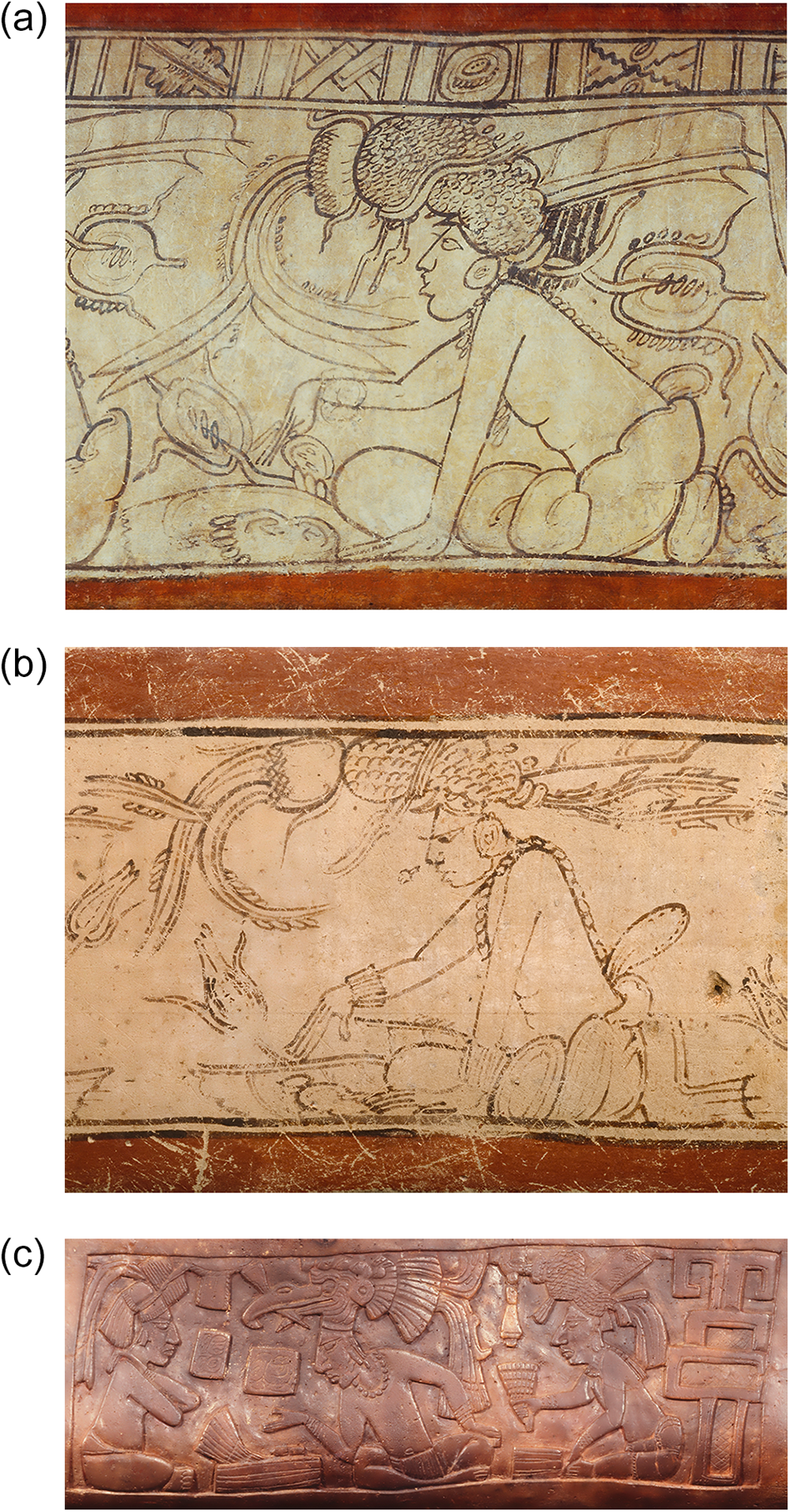
Readers of all types also wear similar costumes. This consists of what Marc Zender, in his study of the Maya priesthood, dubbed a “miter” (previously labeled a “headcloth” by Michael Coe) and a “hipcloth” (or “sarong” in Coe’s terminology—a flowing garment worn around the waist) (Coe and Kerr Reference Coe and Kerr1998:92; Zender Reference Zender2004). Readers don this regalia with few exceptions (20 out of 30 readers wear the miter and 23 out of 30 wear the hipcloth). It is difficult to associate these garments with one specific activity within the Maya court, but the miter and hipcloth do appear with special frequency in religious or ritual contexts (Stone Reference Stone1995:134; Zender Reference Zender2004). These garments may therefore mark the sacred nature of the performances that readers engage in, which would fit neatly with the idea that some priestly and scribal roles overlapped (Zender Reference Zender2004:147). By contrast, miters and hipcloths are far less common in writing scenes: very few writers wear the miter in particular (three clear examples). Furthermore, unlike readers, more than half of writers (nine out of 16 figures) display attributes of the Maize God, a deity with connections to the arts and dance (Taube Reference Taube, Robertson and Fields1985:175), or the Hero Twins of the Popol Vuh. In particular, many writers sport the Maize God’s elongated head and wispy corn-like hair (Figures 1 and 11). Both the Maize God and Hero Twins were associated with Maya rulership, and accordingly, these writers also wear the Jester God headdress, which readers almost never wear.
Writers with attributes of the Maize God (including an elongated head) and the Jester God headdress of royalty. (a) K1257, (b) K5824, (c) K1565, Justin Kerr photograph collection, Dumbarton Oaks, Trustees for Harvard University, Washington, DC.

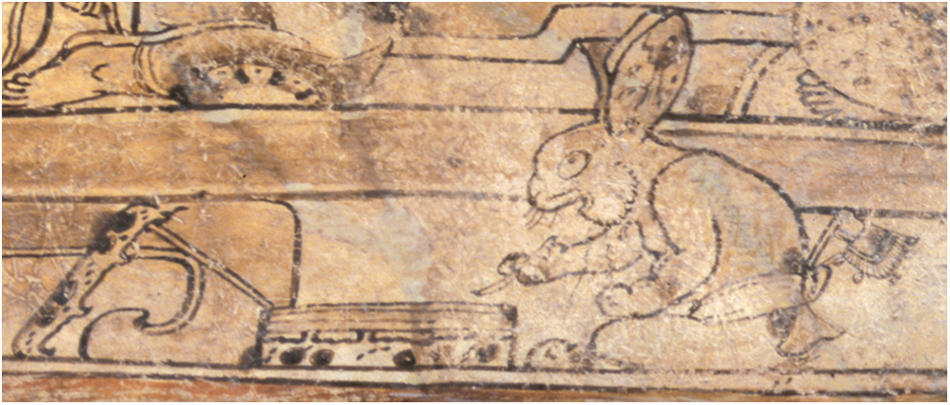
These trends are instructive even if they appear to have served as general conventions rather than rigid rules. There are a few notable exceptions. For instance, on the so-called “Nakbe Scribe vessel” a figure with attributes of the Maize God is shown gesturing to a book (Hansen et al. Reference Hansen, Bishop and Fahsen1991:231, Figures 5–6). This image closely resembles another writing scene (Figure 11a), which suggests that the images are connected and perhaps show two interrelated duties. There are also more anomalous images, like that of the famous “rabbit scribe” on the Princeton Vase who holds a tool over a codex (Figure 12). The rabbit may be engaged in a form of trickery, perhaps even taking the place of the proper scribe in the image (García Reference García2009:13; Houston Reference Houston2019:236; Houston et al. Reference Houston, Stuart and Taube2006:198). However, some details of this scene give pause: the rabbit appears to open its mouth while faint tendrils—possible speech scrolls—hang down from under its chin. Additionally, the tool in the rabbit’s paw does not make contact with the page and curves in much the same way as the pointing tool seen in Figure 5. This may indicate that some of the more puzzling “writing” scenes actually show a form of reading with a pointer, and it is worth noting that there are only a handful of images where a brush or pen clearly touches a page (this occurs on just two vessels: K1257 and K1523).
The rabbit scribe on the “Princeton Vase.” Justin Kerr photograph collection, K511, Dumbarton Oaks, Trustees for Harvard University, Washington, DC.

Reading, Writing, and Social Hierarchy
Even if a few images resist easy classification, the general trends remain clear. Monkeys and humanoid figures almost always read, while the Maize God writes. Most readers wear a miter and hipcloth, while those garments are rare amongst writers, who typically have the Jester God headdress. These general differences indicate that the Classic Maya conceived of writing and the vocal performance of texts as related, but largely separate acts associated with different regalia and patron deities. An emic distinction was made in the imagery between the production and reception of texts. These differences likely also had social and political implications. Recent work on Maya artists’ signatures indicates that even when painters and sculptors signed their names, rulers would have been understood as the ultimate “authors” of a text or image (Houston Reference Houston and Costin2016:422). Representations of reading and writing illustrate a similar idea: the Maize God, a deity with royal associations, literally puts pen to paper, while other lesser beings may only interpret or expound upon that divine word. This may also convey a notion, reinforced in the very grammar of Maya writing terminology, that the patrons of texts (frequently royals) could claim a privileged relationship to them that the texts’ actual creators did not share in (Matsumoto Reference Matsumoto2022:67–68).
Maya tz’ihb is thus portrayed as a restricted and highly elite domain, a form of “high culture” that accents social divisions (Baines and Yoffee Reference Baines, Yoffee, Feinman and Marcus1998; Inomata Reference Inomata2001). This is not to suggest that only rulers knew how to write; literacy was probably somewhat more widespread, at least amongst the upper classes (Houston and Stuart Reference Houston and Stuart1992). Nonetheless, by portraying writing as an almost exclusively royal privilege, Maya artists constructed tz’ihb as a jealously guarded and politically charged skill to which royals had a special claim. Readers, meanwhile, are more commonly represented, but are relegated to more supporting roles and are not shown as “protagonists” (Marc Zender, personal communication, 2020). It should also be noted that every representation of the Maize God as a writer (in total, nine figures) appears in the codex style. Given the close connection between this painting tradition and the Kaanu’l lords of Calakmul (Aimi and Tunesi Reference Aimi and Tunesi2017; García Barrios and Carrasco Reference García Barrios and Carrasco2006), it seems that if some Maya artists did seek to frame tz’ihb as a royal prerogative, it was under the patronage of this specific regional hegemon. In fact, few representations of writers exist outside of the codex style at all, indicating that the entire trend of representing tz’ihb was a geographically and temporally restricted phenomenon.
For the Maya artists who created these images, such scenes would also necessarily involve a degree of meta-commentary on their own activities. Depicting elite deities in the act of text production would serve to underscore the charged nature of tz’ihb, but it would also defer the credit for authorial acts to a higher power. With this in mind, it may also be that the association between monkeys and reading was meant to encode a deeper moral about proper scribal comportment. The limits of interpreting Classic-period imagery based on the Popol Vuh have already been noted. However, it still merits mention that in this epic, Hun Batz and Hun Chouen were transformed into monkeys as a direct punishment for mistreating the Hero Twins (Hunahpu and Xbalanque). The authors of the Popol Vuh made the lesson of this story explicit by stating: “They became spider monkeys because of their pride, for they had abused their younger brothers…Thus their community and their home is now among the flautists and the singers [emphasis added]” (Christenson Reference Christenson2007:133). In the moment of their fall, which is clearly framed as a consequence of their misdeeds, the text places special emphasis on Hun Batz and Hun Chouen’s status as “flautists” and “singers.” The term “writers,” though previously used to describe the Monkey Twins, is noticeably absent from this passage. The message seems clear: at least for the K’iche’ authors of the Popol Vuh, those who recite and interpret texts had their place in society, but they were subordinate to other higher-ranking figures.
Any connections between the K’iche’ myth and Classic-period vase paintings must be treated as tentative, though there is reasonable evidence that some aspects of this story existed in the Classic period (Chinchilla Mazariegos Reference Chinchilla Mazariegos2017:162). Nonetheless, the visual distinction between monkey readers and their more regal counterparts is instructive: just as they resemble humans but are not quite the same, monkeys are not granted the privilege of composing texts on paper, as if by some sort of punishment. Rather, they can only recite and thus in a sense, reproduce, their more illustrious brothers’ composition (much like how monkeys as a species appear to imitate humans). Their ability to only perform texts rather than compose them directly may have been understood as a form of compensation for a mythical transgression. This is also in keeping with Mary Miller’s suggestion that some images of the Monkey Scribes represent “a carefully cultivated representation of humility and effacement,” as well as the assertion made elsewhere that some literate elites “may well have kept their heads down and promoted their kinship to clever but mindless monkeys” (Miller Reference Miller2014:201; Miller and Martin Reference Miller and Martin2004:132).
It seems that reading played a role in this intentional “effacement”: it was probably deemed improper to show a monkey explicitly engaged in the authorial act of tz’ihb. Following Miller, the literate pottery painters who created these images may have chosen to emphasize these associations as a form of self-presentation and self-preservation. Even if non-royals achieved greater prominence in texts and image during the eighth century a.d. (Jackson Reference Jackson2013; Martin Reference Martin2020), that new visibility was qualified—some domains remained off limits. The expectation that literate elites maintain a low profile probably also extended to other parts of Mesoamerica. A passage on the Aztec tlacuilo from Bernadino de Sahagún’s sixteenth-century Florentine Codex specifies that “The good scribe is honest, circumspect, far-sighted” (Sahagún Reference Sahagún, Anderson and Dibble1981:28), indicating a degree of self-awareness (William Fash, personal communication, 2021). In the Maya images, readers’ intentional “humility” could also be reinforced by the presence of the miter and hipcloth, which are often associated with liminality and subjugation (elsewhere these items are also worn by lesser nobles and captives) (Stone Reference Stone1995:134). Maya art may therefore embody a broader hierarchy in which the priests and nobles who performed texts were expected to be mindful of their subordinate position and not upset the social order.
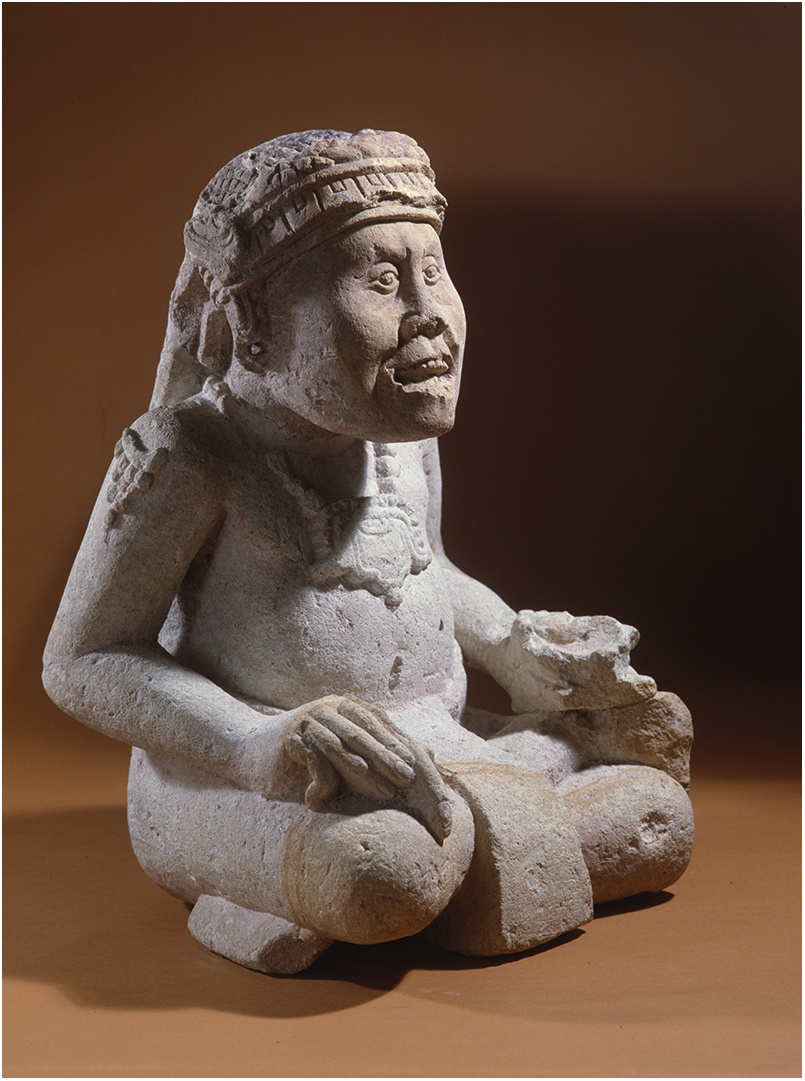
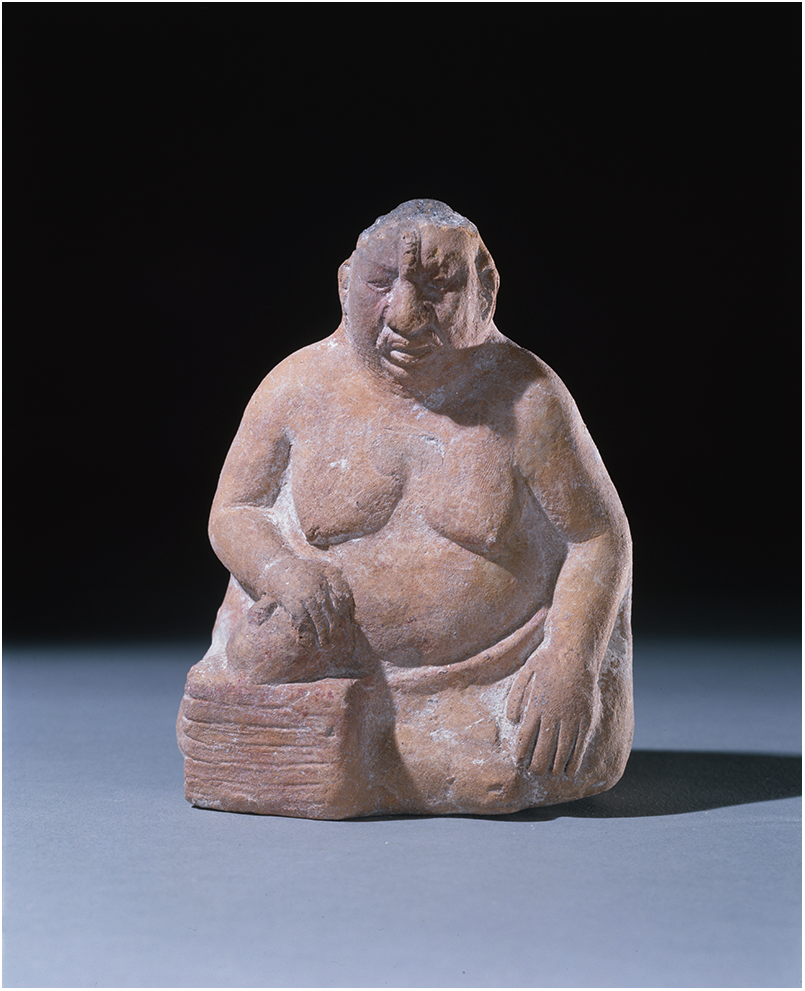
As if to further reinforce the idea that writing was the restricted purview of the upper echelon of Maya society, the act of writing also seems to have formed a sort of taboo for Maya artists working in other media. Two of the only known sculptures of Maya scribes stop short of explicitly depicting tz’ihb. One famous representation (Figure 13) shows a Monkey Scribe and was excavated from construction fill in the House of the Bacabs at Copán (Fash Reference Fash and Webster1989:55). Crucially, although this figure holds a paint-pot and brush, a codex book is noticeably absent. Similarly, a clay figurine now in the collection of the Los Angeles County Museum of Art depicts a corpulent scribe in front of a book, but he is at rest and does not hold any tools over the page (Figure 14). It is as if showing the actual act of putting pen to paper was largely off limits: figures may appear with writing tools or codices, but they are only rarely shown with both. Examples such as these therefore place an emphasis on the potential of writing rather than the act itself. Many Maya vase paintings take a similar approach: there are numerous representations of figures who hold paint pots and brushes but have nothing to paint. Explicit representations of the act of writing were the exception rather than the rule.
Sculpture of a Monkey Scribe from the House of the Bacabs at Copán. Justin Kerr photograph collection, K2870c, Dumbarton Oaks, Trustees for Harvard University, Washington, DC.

Figurine of a scribe, now in the collection of the Los Angeles County Museum of Art (M.2010.115.251). Justin Kerr photograph collection, K5768, Dumbarton Oaks, Trustees for Harvard University, Washington, DC.

Reading and Writing Materials
This aversion to showing the actual creative act may also partly explain why other forms of Maya reading and writing (for instance, in stone, stucco, or wood) were rarely, if ever, represented. That the act of two-dimensional painting in a codex (tz’ihb) was depicted at all is somewhat exceptional given the lack of corresponding images for the many other materials in which the Maya wrote. Likewise, figures are rarely shown reading texts written in other media, although a possible exception would be painted vessels, which are sometimes discussed out loud (for instance see Just Reference Just2012:74) These are points which merit further consideration in future studies, but the dominance of codex books in reading and writing scenes does suggest some sort of primacy for the painted form. Books stand in here for a much greater diversity of Maya text objects, though even in these scenes there is a sense of awed respect for the power of putting pen to paper. The reasons for this trend may be partly mythological. Centuries after the Classic Maya collapse, the Texcocan poet and leader Nezahualcoyotl would compare all of creation to a painted manuscript, stating: “We live only in Your [the creator’s] book of paintings,/here on the earth,” (León-Portilla Reference León-Portilla1992:83). This could indicate that the acts of producing and interpreting Mesoamerican books carried particular weight and were associated with creation, an idea which has also received some prior consideration (Reents-Budet 1998:84). At the same time, the special place of books in the Maya iconographic corpus may also have a more practical explanation: given their greater portability and the need to regularly consult the auguries for specific days, painted almanacs may have simply been consulted and performed more frequently in Maya courts than their monumental counterparts.
If the materiality of codex books merits further consideration, though, then so too does the material support for the images themselves. It must be remembered that most of these reading scenes would also be interpreted and expounded upon in a courtly context, given the fact that they adorn painted drinking vessels which were meant to be handled and discussed (Boot Reference Boot2014b; Brittenham Reference Brittenham and Joe2023:75; Houston Reference Houston, Kerpel and O’Neil2022:458; Just Reference Just2012:74). Some images seem to acknowledge this dynamic, and a few figures even look up expectantly from their books, often towards the rim of the vessel, as if acknowledging the presence of an unseen listener (Figure 10a). This positions the human viewer as not only the audience to the painted readers’ performances but also a second form of “reader” who interprets the imagery. The result is a complicated meta-relationship between viewer and vessel or an almost mirror-like dynamic in which both the human drinker and the painted figure read and are read to in turn. It is probable that the resultant visual and semantic doubling of “readers” is meant to replicate the spoken couplets and parallelism that define Maya ritual speech (Hull and Carrasco Reference Hull and Carrasco2012). These observations offer an important reminder that the material matrix of these images should not be ignored. Far from flat images, Maya “book interpreters” are dynamic agents that complicate Western notions of the subject–object relationship. The present study lays the groundwork for further considerations of this relationship.
Conclusion
Although there is therefore still much more work to be done on Maya “book interpreter” images, at its core, this paper marks an important first step by drawing new attention to the role of orality as a prominent subject of representation. In short, images of Classic Maya “book interpreters” place a strong emphasis on the act of reading in its many forms, with close attention to the distinctions between readers and writers. Writing was constructed as a restricted privilege associated with a select group of elite deities, most notably the Maize God, while reading, as the domain of subordinate figures like the Monkey Scribes, was more widely represented. This points to the exclusivity of writing and painting skills and to the association, whether real or imagined, of text production with rulership. Yet in parallel with early comments on Maya “recitation literacy” (Houston and Stuart Reference Houston and Stuart1992:590), tz’ihb was ultimately situated in relationship to orality, and while the production of text and image may be afforded a restricted place in Maya art, writing always implied reading. These images therefore illustrate the value of reconceptualizing Maya artistic production, at least as it relates to books, as a complex nexus of oral, written, and performed practices. These nuances, however, only become apparent through a systematic examination of the distinct literate acts represented in the corpus of Maya imagery.
Furthermore, this research illustrates the importance of considering how oral cultures may co-exist with a written tradition; Maya tz’ihb, although one of the utmost markers of Maya cultural achievement, did not preclude or supplant the importance of recitation and vocal performance. A marked shift from an oral to a written culture of the sort once imagined by Walter Ong (Reference Ong1982) is not at play here. Instead, these images highlight the complex interrelationship between tz’ihb and orality and invite their viewers to contemplate the parallels between spoken and written composition. Yet crucially, terms such as “scribe” potentially obscure this nuance by evoking the production of texts and images at the expense of textual reception. Along with epigraphic scholarship on the richness of scribal titles (Jackson and Stuart Reference Jackson and Stuart2001; Rossi Reference Rossi2021; Stuart Reference Stuart1989), the present study makes it clear that such labels need to be qualified in scholarly discourse in order to better approximate emic Maya conceptions of literate elites.
The centrality of orality in these images ultimately indicates that for the Maya and other Mesoamerican cultures, a painted text or image would always represent an incomplete picture. As specialists continue to debate the appropriacy of applying Western terms like “art” to ancient American contexts (Dean Reference Dean2006; Cummins Reference Cummins2019), these scenes reinforce prior discussions of indigenous synaesthetics (Houston and Taube Reference Houston and Taube2000; Houston et al. Reference Houston, Stuart and Taube2006; Cummins Reference Cummins2019) to indicate that visuality was just one component of Mesoamerican art. Sound and speech come to the forefront here as an indispensable complement to written words and painted texts, an idea which may be applicable to other aspects of Maya art, as well as the art of other cultures. Thus, while it may ultimately be impossible to fully access the content of ancient performances, this study reveals one way that careful attention to the images themselves may still allow scholars to read reading back into the picture.
Supplementary material
The supplementary material for this article can be found at https://doi.org/10.1017/S0956536125100783.
Acknowledgements
This research originated in work that I conducted for my undergraduate thesis at Harvard University. My thanks go to Wiliam Fash and Thomas Cummins for their ongoing advice and investment in this project since its early stages. I also thank Stephen Houston and Claudia Brittenham for their insightful and detailed comments on earlier drafts. I am grateful as well to Alexandre Tokovinine, Marc Zender, Dorie Reents-Budet, and Felipe Pereda for discussing many of these ideas with me. Frances Gallart Marques and Audrey Verderaime provided valuable suggestions on the prose.
Competing interests
The author declares none.
Data availability statement
The dataset used for this research is available in the supplement to this article.
Funding statement
This research was not funded.


 Open access

