


Take-Home Points
-
1. A paradigm shift is afoot for the prognosis and treatment of major depressive episodes (MDEs) accompanied by a few symptoms of mania/hypomania, but many questions persist.
-
2. A debate is ongoing about how to define the number and type of manic/hypomanic symptoms in order to diagnose “MDEs with mixed features,” a condition that may comprise up to one-half of all MDEs depending upon how many and which type of manic symptoms are included in the definition.
-
3. The evidence base of studies on the treatment of MDEs with subthreshold manic/hypomanic symptoms is scant, and there are no FDA-approved treatments.
-
4. Nevertheless, it is already clear that clinicians should always inquire about manic/hypomanic symptoms in all patients with MDEs, and no longer automatically view classical antidepressant monotherapy for first-line treatment of all MDEs. For many patients with MDEs plus subthreshold manic/hypomanic symptoms, antidepressants may be ineffective and may actually induce worsening of mania or suicidality in some patients. Instead of antidepressant monotherapy, certain atypical antipsychotics are evolving as best practice for first-line treatment options for many patients with MDEs mixed with subthreshold mania/hypomania.
Introduction
Historically, major depressive episodes have been treated—not surprisingly—with drugs known as antidepressants.Reference Stahl 1 , Reference Stahl, Morrissette and Faedda 2 The first shift away from this simple notion was the recognition that major depressive episodes (MDEs) in a patient with a prior manic episode may be better treated first with mood stabilizers and atypical antipsychotics rather than antidepressants.Reference Stahl 1 , Reference Stahl, Morrissette and Faedda 2 Now comes the question of how to manage MDEs when a few symptoms of mania/hypomania are also present, whether or not there has been a past episode of mania or hypomania.Reference Stahl, Morrissette and Faedda 2
What’s “a Little Bit of Mania?”
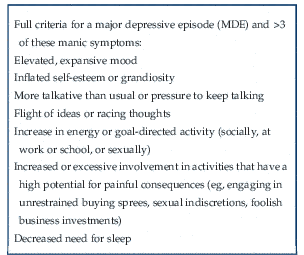
In the Diagnostic and Statistical Manual of Mental Disorders, Fourth Edition (DSM-IV-TR), “mixed” meant full depressive syndrome plus full manic syndrome (Figure 1) 3 and was treated the same as mania without depression.Reference Stahl, Morrissette and Faedda 2 In the Fifth Edition (DSM-5), however, “mixed” now means 3 or more symptoms from a designated list (Table 1 and Figure 1). 4 Controversy exists with this DSM-5 definition of mixed features, because even 1 or 2 symptoms of subthreshold mania/hypomania increases the chance of a patient progressing to bipolar disorder, and half of patients with subthreshold manic/hypomanic symptoms have only 1 or 2 symptoms, not 3 or more.Reference Hu, Mansur and McIntyre 5 Are they not “mixed?” Furthermore, DSM-5 does not count 3 of the most common manic/hypomanic symptoms toward the mixed features diagnosis, namely the symptoms of irritability, distractibility, and psychomotor agitation, because they overlap with other disorders (eg, anxiety disorders) and with both mania and depression. 4 However, several diagnostic criteria other than the DSM-5 do include these 3 symptoms, the argument being that excluding them will lead to misdiagnosis and inappropriate, if not dangerous, treatment strategies for those patients with MDEs who narrowly miss full DSM-5 criteria.Reference Koukopoulos and Sani 6 – Reference Perugi, Angst and Azorin 10 For example, 4 times as many patients are identified as having MDEs with mixed features using research diagnostic criteria than with the DSM-5.Reference Stahl, Morrissette and Faedda 2 Imagine, for example, if we were to exclude psychosis as a diagnostic feature of schizophrenia because it overlaps with other disorders!
Conceptualization of pure and mixed states in DSM-IV-TR and DSM-5.

DSM-5 Mixed Features Specifier
Is Depression with “a Little Bit of Mania” Different?
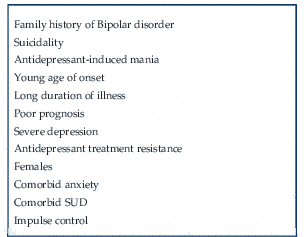
Patients who experience MDEs with subsyndromal manic/hypomanic symptoms have a younger age of onset of their depressive episodes, more episodes, higher comorbidity, and more suicide attempts, as well as other distinguishing characteristics (Table 2).Reference Akiskal and Benazzi 11 – Reference Goldberg, Perlis and Bowden 13 The more symptoms you have, the more likely you are to progress to bipolar disorder, especially in the presence of psychosis.Reference Fiedorowicz, Endicott, Leon, Solomon, Keller and Coryell 14 Perhaps the biggest difference between MDEs with and without mixed features is treatment response to antidepressants.Reference Angst, Cui and Swendsen 15 – Reference Post, Leverich and Altshuler 20 That is, there is some evidence that certain antipsychotics may be effective for MDEs with mixed features, but no FDA approvals have been forthcoming yet (Table 3).Reference Stahl, Morrissette and Faedda 2 It is neurobiologically and psychopharmacologically plausible that mood stabilizers could be effective for MDEs with mixed features, but there is essentially no evidence for or against this theory (Table 4).Reference Stahl, Morrissette and Faedda 2 Finally, the existing evidence shows that antidepressant monotherapy either does not work or may even be harmful for patients with MDEs and mixed features.Reference Stahl, Morrissette and Faedda 2
Clinical Features Associated with Depression With Mixed Features
Atypical Antipsychotics for Mood Disorders including Mixed Features

Mood Stabilizers in Mood Disorders including Mixed Features

Overall, there is insufficient evidence for what to do for MDEs with mixed features from large scale, replicated, randomized, controlled trials, and many troubling questions persist regarding the use of antidepressants in this condition. Therefore, we have organized and published a set of consensus guidelines from 20 experts from 7 countries on 4 continents on the treatment of MDEs with mixed features.Reference Stahl, Morrissette and Faedda 2
However, many important questions still remain: Do all atypical antipsychotics have efficacy? Will lithium and mood stabilizers eventually be proven to have efficacy? Is there a role for antidepressants in this condition? Is the use of antidepressant monotherapy in MDEs with mixed features a recipe for inducing mania, treatment-emergent activation syndrome, or suicidality? Does delay of effective treatment contribute to treatment resistance and poor outcomes? Answers to these questions will have to await evidence from large-scale and replicated, randomized, controlled trials, some of which are in progress now.
Do No Harm
Like it or not, the clinician treating mood disorders is now immersed in a paradigm shift for the diagnosis and treatment for MDEs with mixed features (compare Figures 2 and 3). The first question to ask may be how to do no harm when treating patients now, while the data are unclear and more data are being generated. The answer may be to determine which is potentially more detrimental: misdiagnosing someone who is “pure unipolar” wrongly as MDE with mixed features and treating him or her wrongly with antipsychotics; or treating unidentified MDEs with mixed features wrongly with a sequence of several antidepressant monotherapies?
Major depressive episodes: a whiff of depression means treat with an antidepressant?

Major depressive episodes: a whiff of mania means treat with an antipsychotic?

In the past, the paradigm seemed to be that “a whiff of depression” in a patient meant antidepressant monotherapy (Figure 2). This meant treating pure unipolar depression well, but treating unidentified MDEs with mixed features, perhaps wrongly, with antidepressant monotherapy. Is the paradigm now shifting to “a whiff of mania” means certain atypical antipsychotics get prescribed instead of antidepressant monotherapy? In this case, MDEs with mixed features are treated well, but those wrongly identified MDEs with mixed features get antipsychotics instead of antidepressants (Figure 3).
More precisely, the DSM-5 approach is to enhance specificity at the expense of sensitivity, and here “mixed” means 3 or more symptoms from a designated list (Table 1) that excludes 3 of the most common subthreshold manic/hypomanic symptoms, namely distractibility, irritability, and psychomotor agitation. In the case of the DSM-5 diagnosis of mixed features, there is 100% specificity (everybody really has mixed features by this definition), but only 5.1% sensitivity.Reference Benazzi 7 , Reference Takeshima and Oka 9 So, all patients diagnosed will indeed have mixed features, but only 5.1% of individuals with mixed features will be identified. If the goal is impeccably accurate diagnosis, this is the way to go, particularly for research studies perhaps. However, in clinical practice, this means that 95% of individuals with mixed features are wrongly diagnosed without mixed features, and are at risk of receiving inappropriate or harmful treatment with antidepressant monotherapy rather than first line with certain atypical antipsychotics.
On the other hand, utilizing criteria that include distractibility, irritability, and psychomotor agitation for the diagnosis of mixed features, there is 87% specificity, but 55% sensitivity.Reference Benazzi 7 , Reference Takeshima and Oka 9 That means in practice that 13% of patients identified with mixed features actually do not have it and might inappropriately get an atypical antipsychotic rather than antidepressant monotherapy. But, less than half of patients with mixed features are at risk of getting the wrong treatment. If diagnostic criteria were relaxed to allow just 1 or 2 symptoms of mania, there could be even greater sensitivity but a greater loss of specificity. Likely, clinicians will increasingly wish to treat mixed features appropriately with certain antipsychotics instead of antidepressant monotherapy, even if it means inadvertently treating pure unipolar depression too early with antipsychotics.
Whatever action a clinician takes, one thing is already clear (Figure 4). We now have a very important question to ask any patient with depression: Do you have any mania/hypomania symptoms and any family history of bipolar disorder?
One of the most important questions to ask any patient with depression.

Every patient. Every time.
Acknowledgment
The author wishes to thank Dr. Debbi A. Morrissette for her assistance in preparing the figures, tables, and references for this manuscript and for inspiring the author by collaborating on this project including the guidelines published in this special issue, her own editorial, and slide preparation for my lectures.



