

Introduction
In this paper we examine the efficacy of educator professional development (PD) for a field-based research immersion experience where an international team of educators was embedded within ANDRILL (ANtarctic geological DRILLing Project), a large international Antarctic research project. The primary Education and Public Outreach (EPO) program of ANDRILL was ARISE (ANDRILL Research Immersion for Science Educators). Our examination is accomplished through voluntary ANDRILL scientist and ARISE educator surveys as well as via a review of ARISE educator output and self-reported impacts measured ten years after the immersion experience. This paper and the associated surveys were written, distributed, and analysed by a subset of ARISE participants and the 2007 ANDRILL EPO coordinator.
Effective EPO, particularly for large interdisciplinary science projects in polar regions, is challenging, especially when the cost of deploying educators to the field is considered. In addition, how do the educators perceive the impact of the field immersion experience on both their teaching and outreach as well as their students and the general public? How does the experience support their continued engagement? In the larger context of discussions on effective PD for science educators (Kastens & Manduca, Reference Kastens and Manduca2017; Manduca, Reference Manduca2017; Penuel, Gallagher, & Moorthy, Reference Penuel, Gallagher and Moorthy2011; Wilson, Reference Wilson2013), what are the factors that promote a long-term positive impact from research immersion experiences? The aim of this paper is to provide data and analysis that can be used to guide decision-making on future funding and deployment of education and outreach individuals versus teams of educators in polar regions and elsewhere.
Models for professional development and integrating educators into field research teams
A strength of the 4th International Polar Year (IPY) was the focus on education and outreach (Carlson, Reference Carlson, Barr and Luedecke2010). A large international community of educators and communicators created partnerships and developed ways to make polar scientific research results accessible to a wide variety of audiences (Beck, Huffman, Xavier, & Walton, Reference Beck, Huffman, Xavier and Walton2014; Carlson, Reference Carlson2009a, Reference Carlson2009b; Huffman & Sparrow, Reference Huffman and Sparrow2008; Huffman et al., Reference Huffman, Levy, Lacy, Harwood, Berg, Cattadori and Diamond2008–Reference Huffman, Levy, Lacy, Harwood, Berg, Cattadori and Diamond2009; Huffman, Xavier, Beck, & Lehmann, Reference Huffman, Xavier, Beck and Lehmann2015; Kaiser, Reference Kaiser2010; Provencher et al., Reference Provencher, Baeseman, Carlson, Badhe, Bellman, Hik, Huffman and Zicus2011; Salmon, Carlson, Huffman, & McCaffrey, Reference Salmon, Carlson, Huffman and McCaffrey2007; Salmon et al., Reference Salmon, Carlson, Zicus, Pauls, Baeseman, Sparrow, Bautista and Raymond2011). Before, during, and after the IPY several US EPO models (Table 1) have included educators in polar field research experiences as part of PD, although little in the way of quantitative or qualitative evaluation of polar immersion experiences has been reported in the literature, with Klene, Nelson, Nevins, Rogers and Shiklomanov (Reference Klene, Nelson, Nevins, Rogers and Shiklomanov2002) and Connor (Reference Connor2009) being the only ones to detail and evaluate the structure, educator involvement and outcomes. One well-described non-polar model for earth science field-based immersive PD for educators is the International Ocean Discovery Program (IODP) School of Rock (SOR) described by Leckie et al. (Reference Leckie, St. John, Peart, Klaus, Slough and Niemitz2006) and St. John et al. (Reference St. John, Leckie, Slough, Peart, Niemitz and Klaus2009) who provide a detailed summary and discussion of design tenets, evaluation design, and long-term impacts.
Summary of models for integrating educators into scientific field research teams
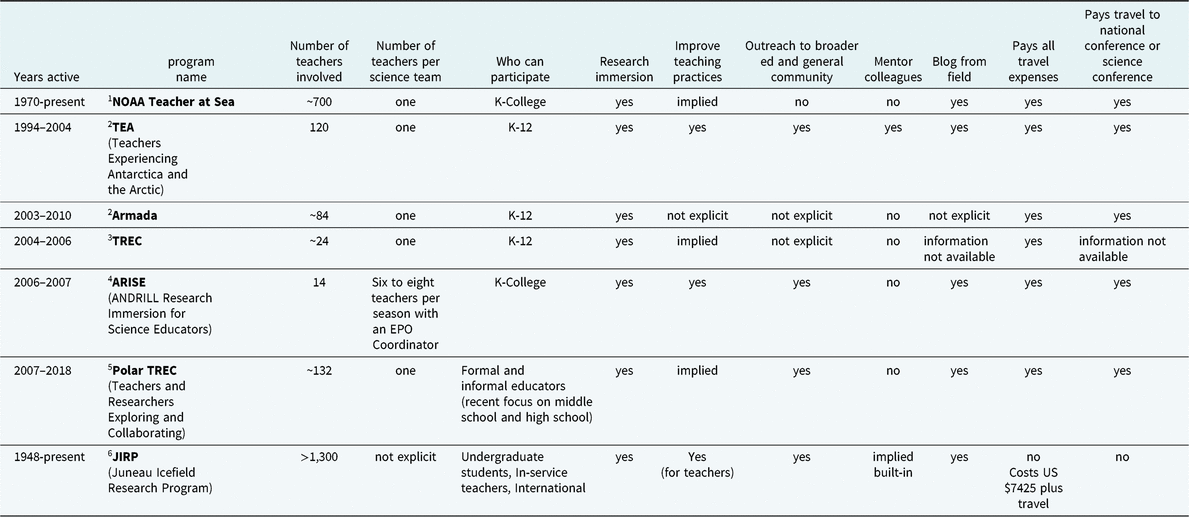
Data were obtained from program websites; program efficacy evaluations are largely unavailable.
2 http://tea.armadaproject.org/ and Klene, et al. (Reference Klene, Nelson, Nevins, Rogers and Shiklomanov2002)
6 http://juneauicefield.org/ as well as Conner (Reference Connor2009)
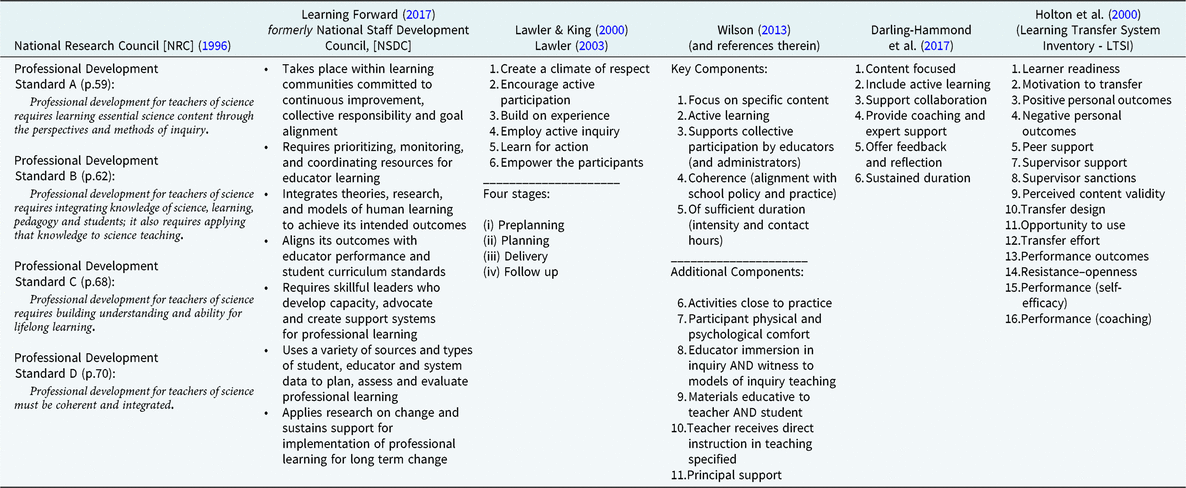
Research on and questioning about educator PD for primary and secondary educators as well as university faculty has blossomed over the past twenty years (Manduca et al., Reference Manduca, Iverson, Luxenberg, Macdonald, McConnell, Mogk and Tewksbury2017; Wilson, Reference Wilson2013) as the need for improved science, technology, engineering, and mathematics (STEM) education has been recognised (e.g. Egger, Kastens, & Turrin, Reference Egger, Kastens and Turrin2017). Field immersion experiences are a small subset of educator PD opportunities, which are often tied to targeted interventions (e.g. White, Shockley, Hutzel, & Wilson, Reference White, Shockley, Hutzel and Wilson2014) that include either training in content knowledge and/or pedagogical skills (Amundsen & Wilson, Reference Amundsen and Wilson2012) tied to student pre- and post-tests (e.g. Penuel et al., Reference Penuel, Gallagher and Moorthy2011) used for evaluative purposes. In the United States, the Next Generation Science Standards (NGSS) and the associated Framework for K-12 Science Education (National Research Council, 2012) do not address PD science standards, whereas PD science standards have been outlined in the National Science Education Standards (National Research Council, 1996), and by Learning Forward (2017) (formerly the National Staff Development Council), and by Darling-Hammond, Hyler, & Gardner (Reference Darling-Hammond, Hyler and Gardner2017). The education research literature has identified key criteria for science educator PD (Table 2), although their interconnections warrant further study (Wilson, Reference Wilson2013). Most recently, Bitting, Arthurs, Chapman, Macdonald, & Manduca (Reference Bitting, Arthurs, Chapman, Macdonald, Manduca and St. John2018) have identified grand challenges in PD research on institutional change and PD in the geosciences; our study provides some input to their grand challenge number 3: “What roles do different types of professional development experiences play in promoting, facilitating, and sustaining ongoing evolution in geoscience instructors’ teaching practices over time?” (Bitting et al., Reference Bitting, Arthurs, Chapman, Macdonald, Manduca and St. John2018, p. 125). Discussion items relating to science educator PD (regardless of level) include length of experience (Wilson, Reference Wilson2013; Darling-Hammond et al., Reference Darling-Hammond, Hyler and Gardner2017), the balance between content knowledge versus pedagogical skills and understanding (Penuel et al., Reference Penuel, Gallagher and Moorthy2011), the importance of community-building (D’Avanzo, Reference D’Avanzo2013), and development of teacher leaders as a pathway to reform (Alemdar, Cappelli, Criswell, & Rushton, Reference Alemdar, Cappelli, Criswell and Rushton2018). A key component of professional learning is motivation (Condon, Iverson, Manduca, Rutz, & Willett, Reference Condon, Iverson, Manduca, Rutz and Willett2016; Naquin & Holton, Reference Naquin and Holton2002). The transition (Holton, Bates, & Ruona, Reference Holton, Bates and Ruona2000) between learning that takes place at a workshop (or teacher immersion in this case) and implementation in classroom or other setting are also key. Holton et al. (Reference Holton, Bates and Ruona2000) have developed a set of 16 constructs that impact the effective transfer of learning. Central to effective PD are the building of a community of practice, the overall characteristics of the learning organisation within which the educator resides (Brancato, Reference Brancato2003; Senge, Reference Senge2006), an understanding of adult learners (Brancato, Reference Brancato2003; Lawler, Reference Lawler2003), and the barriers to (and supports for) effective PD (Caffarella & Zinn, Reference Caffarella and Zinn1999). As new initiatives in STEM PD evolve, the increased importance of not only design (Amundsen & Wilson, Reference Amundsen and Wilson2012; Manduca, Reference Manduca2017) but also effective formative and summative evaluation has been recognised (Alemdar et al., Reference Alemdar, Cappelli, Criswell and Rushton2018; Garet, Porter, Desimone, Birman, & Yoon, Reference Garet, Porter, Desimone, Birman and Yoon2001; Ebert-May et al., Reference Ebert-May, Derting, Hodder, Momsen, Long and Jardeleza2011; Kastens & Manduca, Reference Kastens and Manduca2017), drawing heavily from the literature on systems thinking (Hummelbrunner, Reference Hummelbrunner2011; Kastens & Manduca, Reference Kastens and Manduca2017; Preskill, Gopal, Mack, & Cook, Reference Preskill, Gopal, Mack and Cook2014; Senge, Reference Senge2006). Discussions on how the impacts of educator PD are measured (Desimone, Reference Desimone2009) are also key to changes and improvements in educator PD. It is through this PD lens that the efficacy of the ARISE program, and its potential as a model for educator PD through field-based research immersion, is examined and discussed.
Summary of key components of Professional Development (PD) Science Education Standards from US National Research Council (1996), Learning Forward (2017), Lawler & King (Reference Lawler and King2000) and Lawler (Reference Lawler2003), Wilson (Reference Wilson2013) and references therein, and Darling-Hammond et al. (Reference Darling-Hammond, Hyler and Gardner2017). Measures used by Holton et al. (Reference Holton, Bates and Ruona2000) for Learning Transfer System Inventory (LTSI) are also included
ANDRILL
ANDRILL was a multi-year, multinational, multidisciplinary project supported by New Zealand, Germany, Italy, and the USA, each of which provided on-ice and off-ice scientific personnel and ARISE educators. ANDRILL (1) developed the technology for acquiring two > 1 km sediment cores from the floor of the Ross Sea, Antarctica (Harwood et al., Reference Harwood, Levy, Cowie, Florindo, Naish, Powell and Pyne2006); and (2) successfully retrieved and interpreted two > 1 km largely sedimentary cores over two field seasons – the 2006 McMurdo Ice Shelf (MIS) season, and the 2007 Southern McMurdo Sound (SMS) season (Harwood et al., Reference Harwood, Florindo, Talarico, Levy, Kuhn, Naish, Niessen and Wilson2009). The aims of ANDRILL were to better understand the Eocene, Oligocene, and Pliocene record of ice advance and retreat in the Antarctic hinterland, as well as the changing extent of sea-ice, and to build a dataset on which climate models could be based, as well as address a variety of targeted Antarctic and global research topics (Fielding et al., Reference Fielding, Browne, Field, Florindo, Harwood, Krissek, Levy and Pekar2011; Florindo, Harwood, & Levy, Reference Florindo, Harwood and Levy2009; Harwood, Lacy, & Levy, Reference Harwood, Lacy and Levy2003; Shevenell, Kennett, & Lea, Reference Shevenell, Kennett and Lea2004; Warny et al., Reference Warny, Askin, Hannah, Mohr, Raine, Harwood and Florindo2009).
ARISE: Structure and unique aspects
The primary mission of the ANDRILL EPO program was to communicate polar geoscience and climate change science to non-technical audiences and to support formal and informal education programs. The unique and unprecedented aspects of the ARISE program are that a team of international educators was deployed to McMurdo Station as a group. A search of available data (Table 1) reveals that other than ANDRILL, the inclusion of educators in field research experiences is almost entirely limited to a single educator embedded in a team of researchers, with no international educator teams. The ARISE program also included a geoscience course taught on-ice by ANDRILL research scientists and a pre-deployment meeting; all ARISE participants also had the opportunity to attend and present at post-deployment workshops and meetings. Another distinctive aspect of the ANDRILL program was the inclusion of a full-time EPO coordinator who was deployed on-ice with the educators. The on-ice component of ARISE took place over the two years of coring – the 2006 MIS season and the 2007 SMS season. This paper draws on the experiences and work by educators from both the MIS and SMS seasons. Adjustments to on-ice coordination of the ARISE participants were made during and after the 2006 MIS season, with the 2007 ARISE deployment and work routine largely being the one described herein.
Role of ANDRILL coordinator of education and public outreach
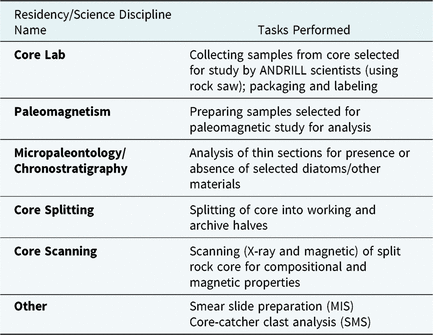
The off-ice and on-ice responsibilities of the EPO coordinator included facilitating planning pre-deployment, managing the ARISE team, organising the on-ice geoscience course, assigning the educators to residencies (‘lab jobs’) with the disciplinary science teams (Table 3), as well as general troubleshooting and organising, and arranging on-ice opportunities and field trips for ARISE participants. Post-deployment the EPO coordinator facilitated participation in workshops and conferences as well as liaising across the MIS and SMS participants to encourage and support a variety of outreach projects. The EPO coordinator also led the writing of articles on the ANDRILL EPO work and presented at national conferences on ARISE work (e.g. Huffman et al., Reference Huffman, Dahlman, Frisch-Gleason, Harwood, Pound, Rack, Riesselman and Winter2008; Huffman & Sparrow, Reference Huffman and Sparrow2008; Huffman et al., Reference Huffman, Levy, Lacy, Harwood, Berg, Cattadori and Diamond2008−2009; Huffman, Petersen, & Brown, Reference Huffman, Petersen and Brown2008). The ANDRILL EPO Coordinator 2007−2013 was a former primary educator with a strong background in curriculum development and facilitation of educator PD. She was the chair of the formal education subcommittee of the IPY International Program Office (IPO) from 2006−2012. ANDRILL also employed (and deployed to the ice) a student worker to do EPO projects (e.g. ‘Project Iceberg’) for ANDRILL, which included creation of 21 video journals (Berg, Reference Berg2007; Berg Reference Berg2008; Berg, Dahlman, & Thomson, Reference Berg, Dahlman and Thomson2007), and ancillary support including linkage of the MIS and SMS ARISE blog accounts to the ANDRILL website (http://www.andrill.org/iceberg/arise/index.html).
Summary of ANDRILL ARISE residencies (‘lab jobs’) with on-ice disciplinary science groups
ARISE participant selection and responsibilities
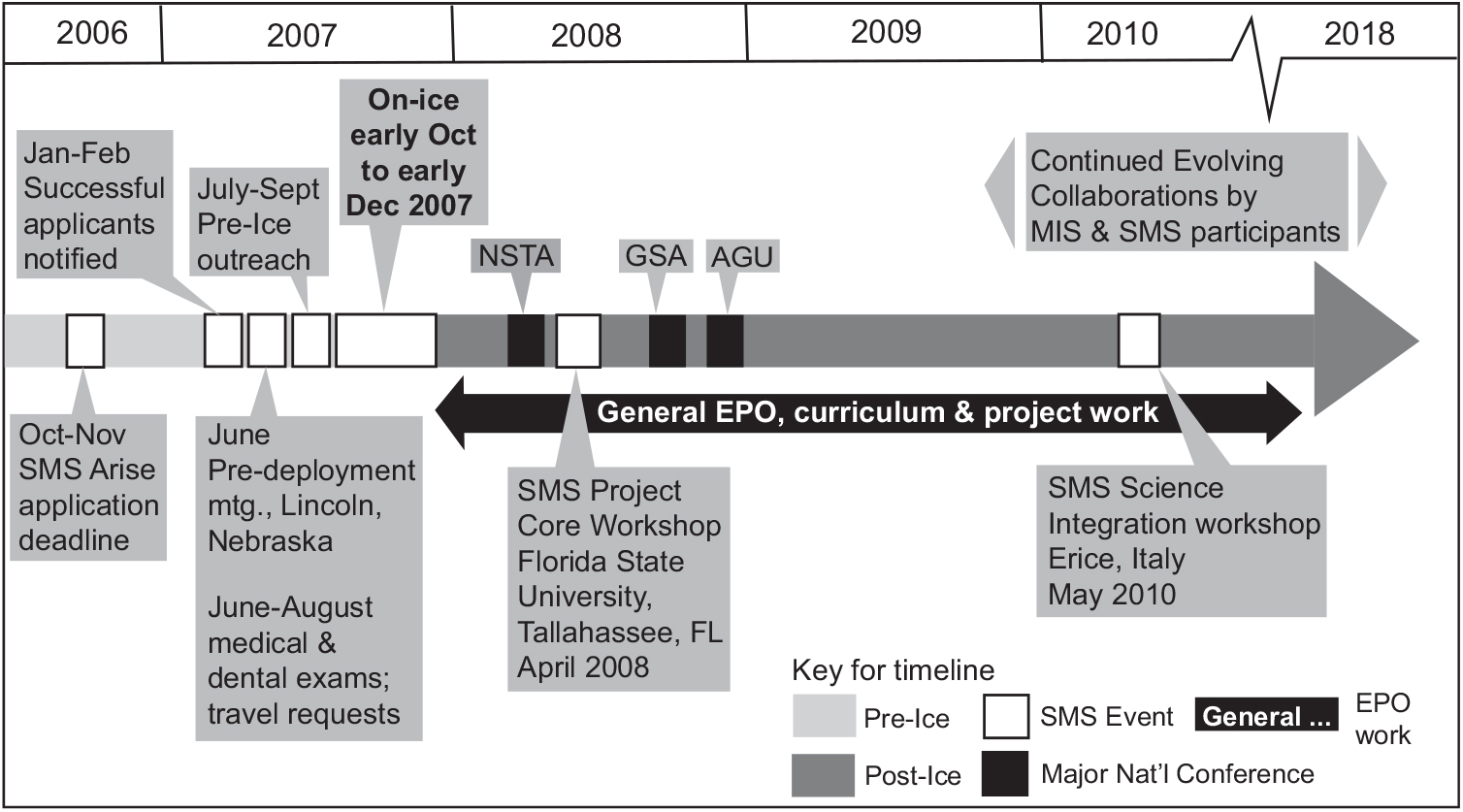
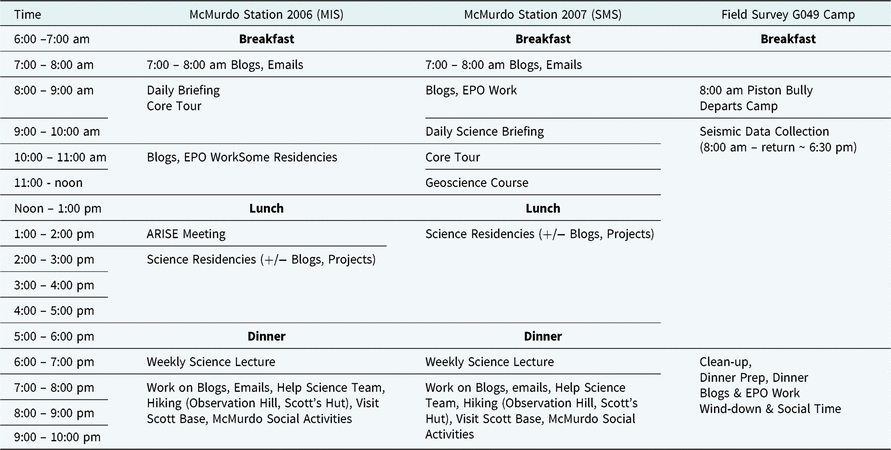
ARISE Participants were selected through an application process that included a proposal for an independent outreach project with targeted audience (Fig. 1). Individual countries developed and conducted their own application processes. In addition to their individual projects, ARISE participants contributed to the ARISE blog and participated in ‘Windows to the Universe’ (https://www.windows2universe.org/people/postcards/andrill/andrill_post.html) and other online media. ARISE educators were an essential part of the on-ice team, completing two ‘residencies’ with separate disciplinary science teams. ARISE educators also attended the daily science briefing, participated in an on-ice geoscience course, and routinely volunteered to assist research teams that needed additional help with workflow. ARISE participants took field trips to venues at McMurdo Station in addition to a trip to the ANDRILL drill rig and to Beacon Valley. They also organised presentations during an ANDRILL outreach event for the community at McMurdo Station. The typical daily schedule for an ARISE participant is summarised in Table 4.
Timeline for application process and EPO ‘deliverables’ for ARISE participants, using the Southern McMurdo Sound (SMS) 2007 season as the example. NSTA = (US) National Science Teachers Association National Meeting; GSA = Geological Society of America Annual Meeting; AGU = American Geophysical Union Annual Fall Meeting.
Typical daily schedule on-ice for ARISE participants in both the McMurdo Ice Shelf (MIS) 2006 season, and the Southern McMurdo Sound (SMS) 2007 season. The schedule for the 2007 Field Survey G049 Camp is also shown
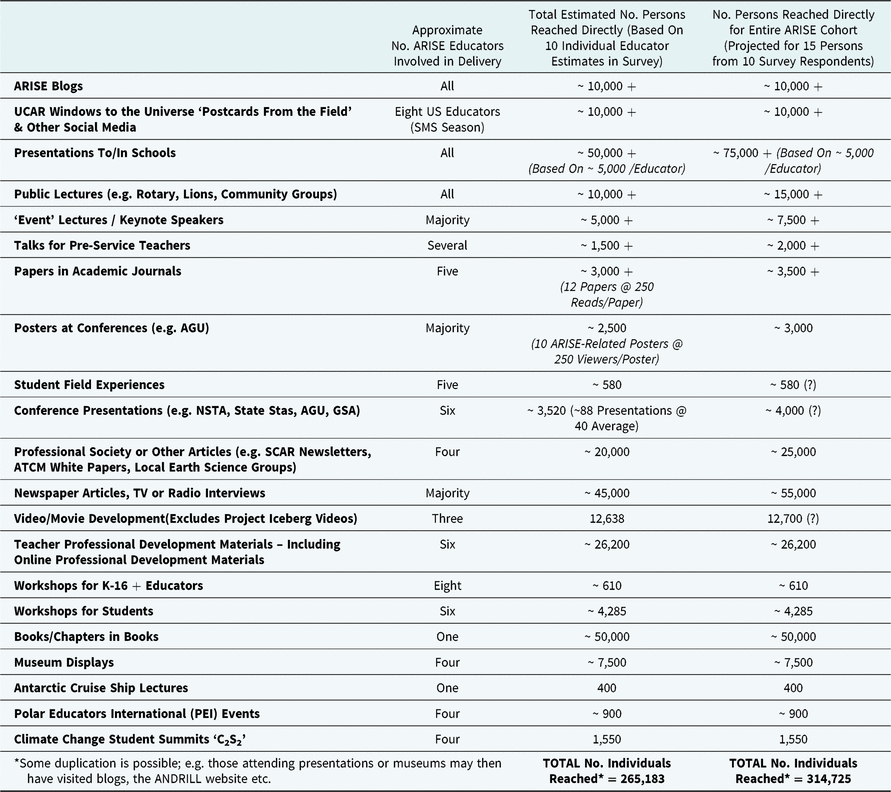
ARISE EPO overview
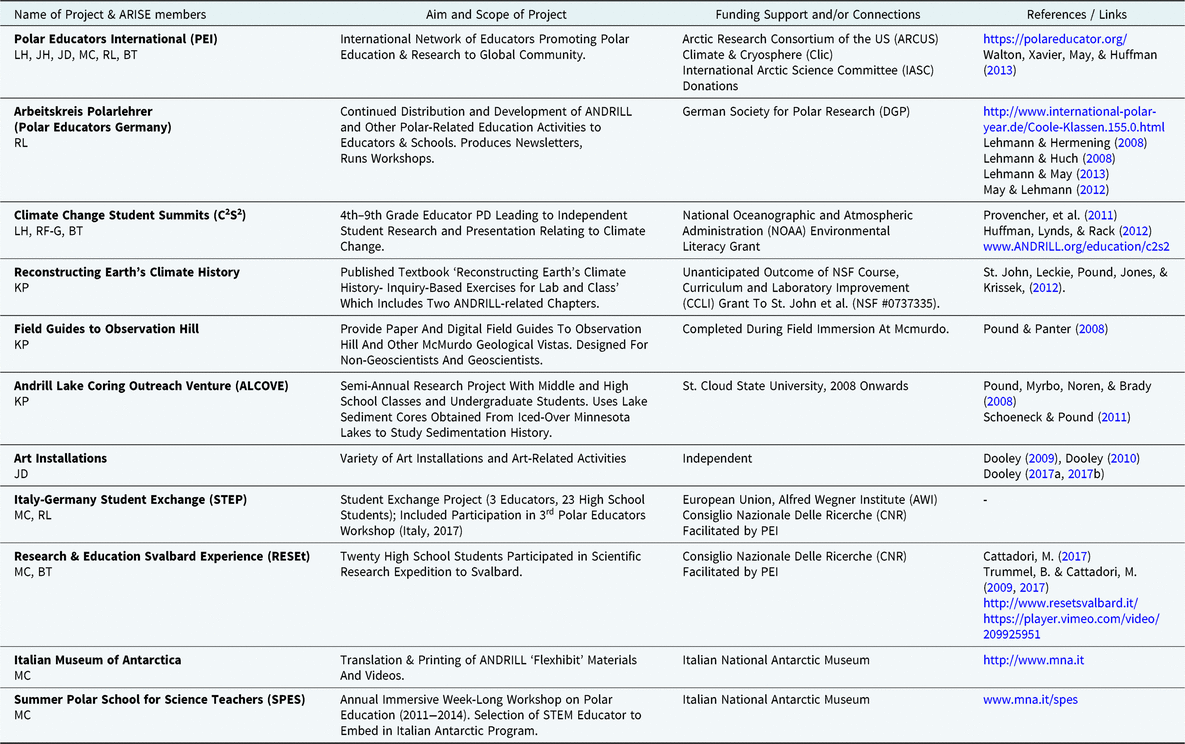
ARISE educators reached out to a variety of audiences (classrooms, entire schools, community groups) prior to deployment. This cultivated an audience that was interested in following the on-ice adventure, through blogs and other online postings. The total number of individuals reached through combined efforts of the MIS and SMS cohorts prior to deployment is conservatively estimated to be around 10,000. Data and personal experience of ARISE educators indicate that the audience grew once on-ice − many of the educators connected via phone or video to their home classrooms during deployment. The dramatic increase in audience (to a conservatively estimated 314,700) took place post-ice (Table 5) with implementation of the planned individual projects. The number 314,700 is extrapolated from feedback by survey respondents and is based largely on in-person connections; the total is more likely to be closer to ca. 1 million if online connections are considered. New EPO endeavours spawned by collaborations arising from ANDRILL continue to evolve today through other funding streams (Table 6).
Summary of ARISE EPO activities and numbers of persons reached by survey respondents (10), and extrapolation for the entire ARISE cohort; includes some but not all ongoing EPO work with roots in ANDRILL or with ANDRILL connections
Summary of ARISE educator projects or EPO activities that evolved on-ice and post-ice, and were not part of the original educator projects. Initials in ‘Project Name’ column indicate participating ARISE member: LH = Louise Huffman, JH = Joanna Hubbard, JD = Julia Dooley, MC = Matteo Cattadori, RL = Rainer Lehmann, BT = Betty Trummel, RL-G = Robin Frisch-Gleason, KP = Kate Pound
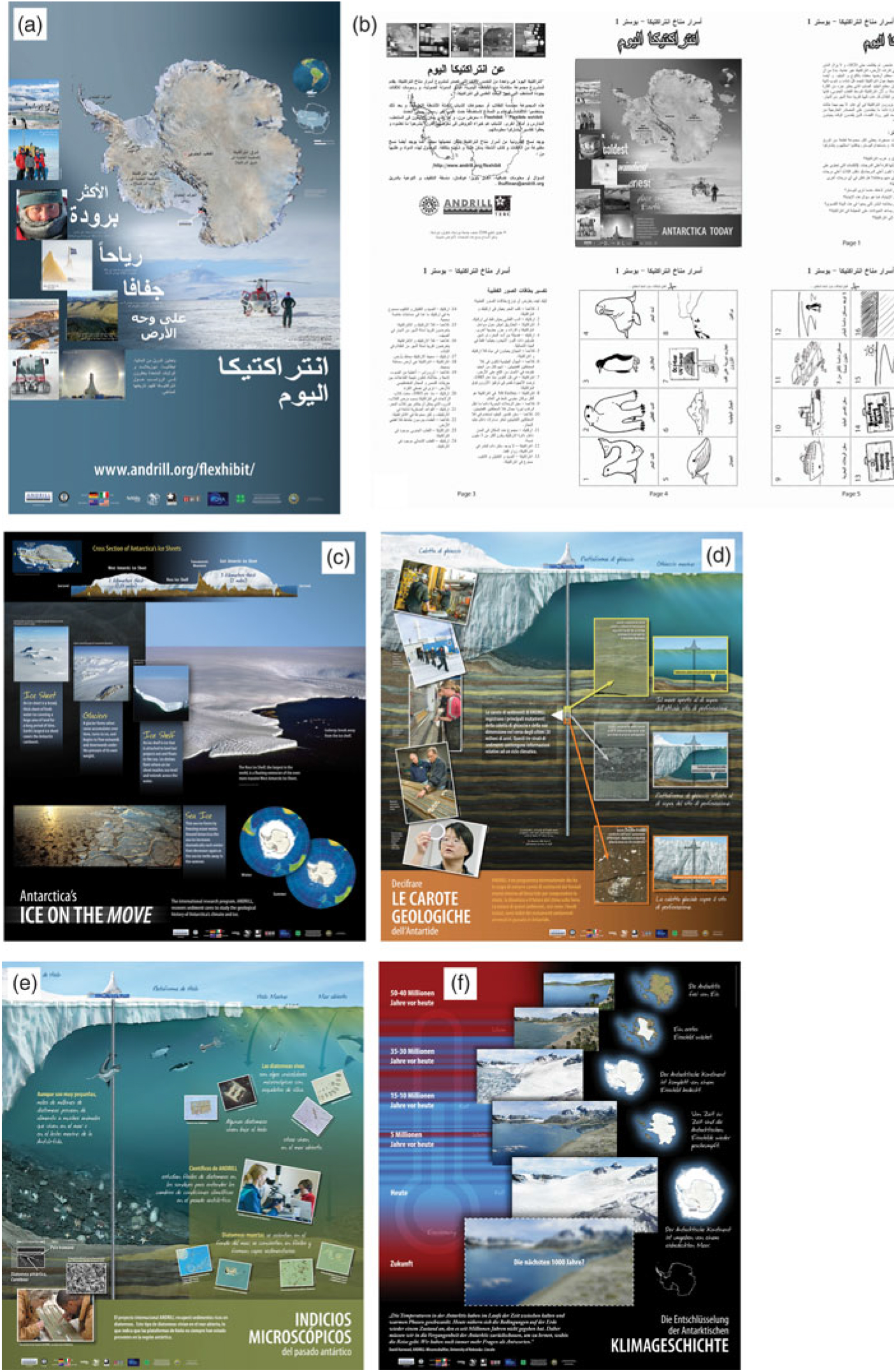
A key element in ANDRILL EPO work was the rollout of multilingual exhibit banners (Fig. 2, Diamond, Reference Diamond2008) tied to a curriculum titled ‘Antarctica’s Climate Secrets’ nicknamed the ‘Flexhibit’, or ‘flexible exhibit’ (Dahlman, Reference Dahlman2008) which was developed as part of a US National Science Foundation IPY Informal Science Education project, titled ‘Engaging Antarctica’ (Farrell, Dahlman, & Diamond, Reference Farrell, Dahlman and Diamond2006). The Flexhibit is a set of curriculum activities in which learners produce a set of models. Later, learners use the models as ‘explainers’ in their own flexible exhibit to teach others about Antarctic geology and ANDRILL research. A series of 15 videos/podcasts is linked to the Flexhibit (Berg, Reference Berg2008), and a full-length documentary ‘Secrets Beneath the Ice’ was released in 2010 (Hochman, Reference Hochman2010). A series of 21 short (three to seven minutes long) ANDRILL video journals (Berg, Reference Berg2006; Berg Reference Berg2007; Berg, Dahlman, & Thomson, Reference Berg, Dahlman and Thomson2007) were produced for ANDRILL’s ‘Project Iceberg’. Full development of these materials spanned both the MIS and SMS seasons, with the banners available for use in pre- and post-ice outreach work.
Selected ANDRILL EPO banners (Diamond, Reference Diamond2008) designed for use at EPO and Flexhibit events. The banners are available online (http://www.andrill.org/flexhibit/flexhibit/materials/index.html) and can be printed in sizes up to ~1m x 1m on specialized paper or durable fabric-like material. Each of the five banners presents a theme, with activity ideas printed on the back. A. Theme 1 – Antarctica Today (Arabic). B. Reverse of each banner has a variety of activities printed on it. C. Theme 2 – Antarctica’s Ice on the Move (English). C. Theme 3 – Reading Antarctica’s Rock Cores (Italian). D. Theme 4 – Tiny Clues to Antarctica’s Past (Spanish). E. Theme 6 – Decoding Antarctica’s Climate History (German).
Survey methods
This paper synthesises educator and scientist responses to voluntary online surveys of ARISE educators and ANDRILL scientists conducted in Fall 2017, just over ten years after the on-ice deployment of ARISE educators to Antarctica. The internal evaluations completed for the ARISE program immediately following deployment are protected and cannot be used for PD research. The questions in the educator and scientist surveys used for this research (see supplemental materials and Tables 7 and 8) were written to capture educator and scientist response to, and reflections on, the unique aspects of the ARISE program, namely (1) deployment as a team; (2) financial support for participation in pre- and post-deployment workshops and meetings; (3) deployment of the program EPO Coordinator to Antarctica as part of the educator team; (4) full educator participation on daily science briefings as well as on-ice residencies; and (5) participation in an on-ice ‘geoscience course.’ These five areas are the main ‘topic areas’ discussed in the results section (Tables 7 and 8). Survey questions included a Likert-scale response with an option for an open-ended written response or comment. The open-ended responses were read multiple times by the lead author to identify emerging themes. All responses were linked to one or more of the four emerging themes (value of team, access to scientists, ‘doing’ science, and the sense of excitement, engagement and inspiration). The survey questions were already structured into ‘topic areas’, so the open responses to each question were classified to indicate if they were positive, neutral, or negative, and text snippets were identified and organised. The number of positive, neutral, or negative quotes used for each topic area in this paper is generally proportional to the Likert-scale average, but quote length and the need to fully capture the range of responses overrode the effort to be strictly quantitative in quote use. Where multiple open responses were largely identical, the most expressive quote was used.
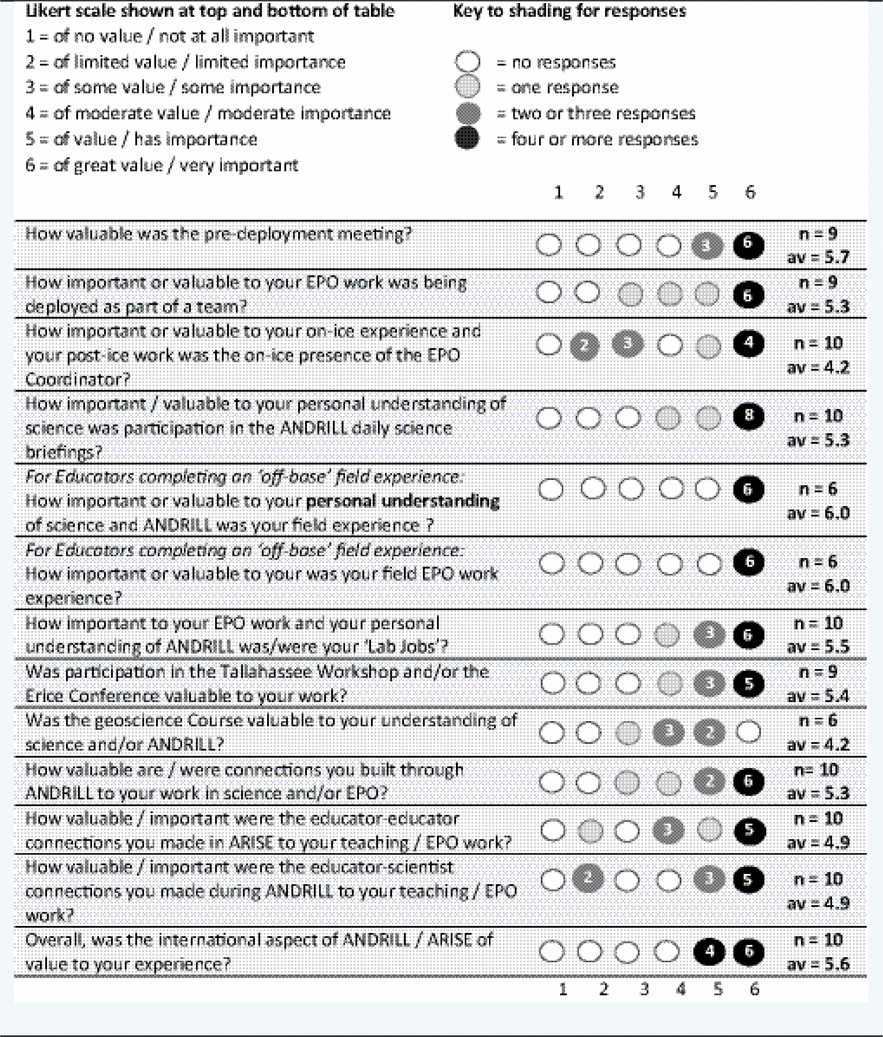
Educator survey responses. Questions asked for a 6-point Likert-scale response ranging from 1 ‘no impact’ or ‘of no value’ to 6 ‘very important’ or ‘of high value’, as well as an open response. Respondents had the option of not answering any of the questions, thus the number of respondents varies with each question. The raw data and the average response (total numerical value of responses divided by number of respondents) for each Likert-scale question are presented
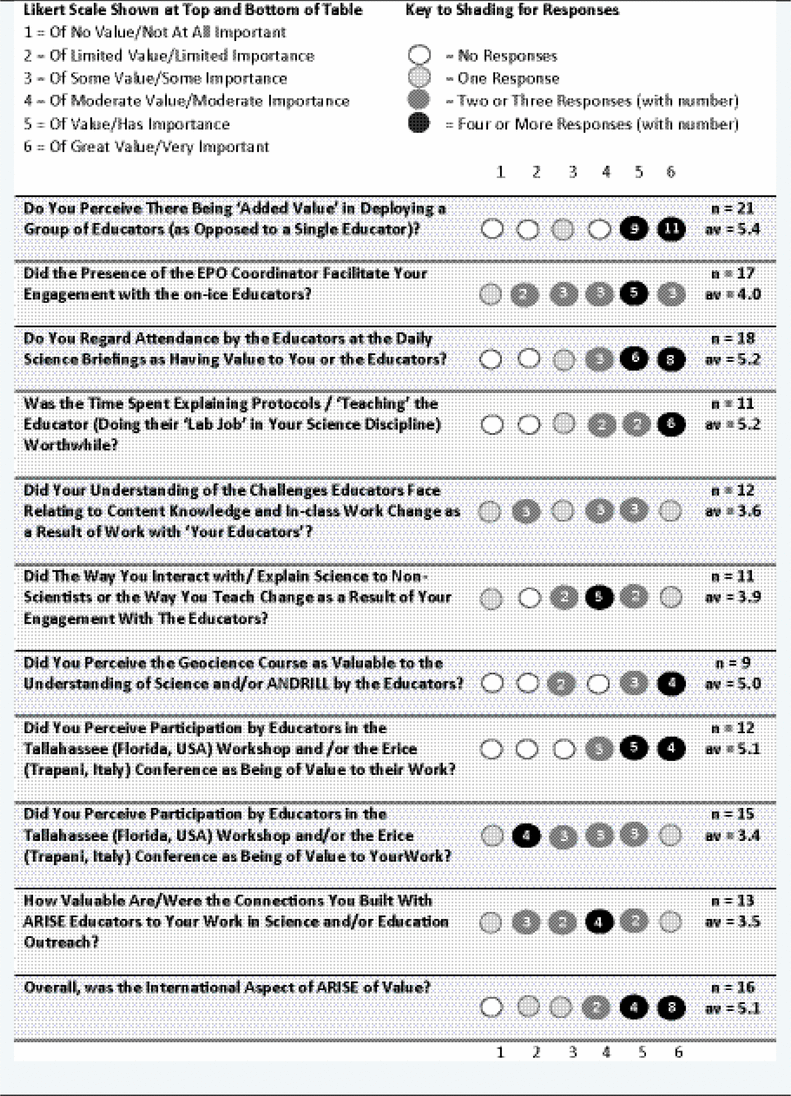
Scientist survey responses. Questions asked for a 6-point Likert-scale response ranging from 1 ‘no impact’ or ‘of no value’ to 6 ‘very important’ or ‘of high value’, as well as an open response. Respondents had the option of not answering any of the questions, thus the number of respondents varies with each question. The raw data and the average response (total numerical value of responses divided by number of respondents) for each Likert-scale question are presented
Educator demographics
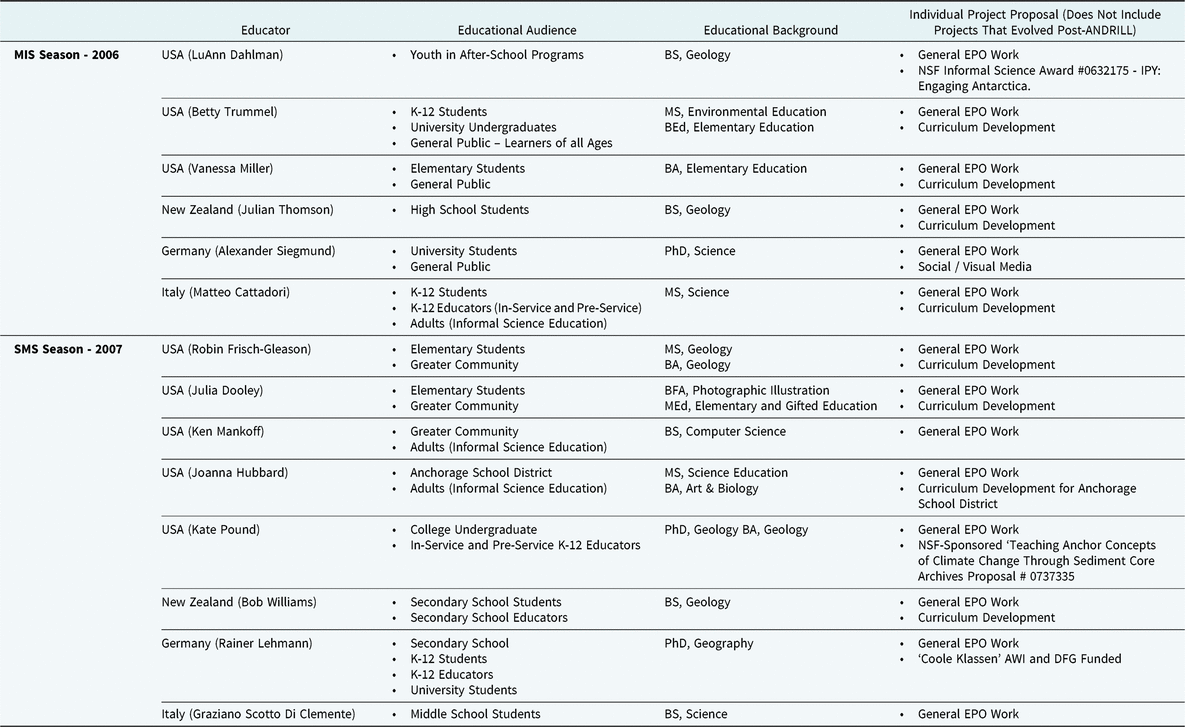
A total of 14 educators were deployed over MIS (six educators) and SMS (eight educators), plus the on-ice EPO coordinator. The survey response rate for educators was 71% (10 out of 14). The single participants in the 2005 and 2008 ANDRILL-related deployments were not surveyed, neither was the EPO coordinator. Three of the survey respondents were deployed with MIS, and seven with SMS. At the time of deployment, educator experience in the sciences ranged from elementary educators with minimal science background to university educators with PhDs in the geosciences (Table 9).
Summary of demographic data for ARISE Educators
Scientist response
Scientist survey respondents included scientists on-ice for both MIS and SMS (Table 8). Out of a total of approximately 160 on-ice and off-ice ANDRILL scientists, 24 (15%) responded to the survey, with between nine and sixteen of them answering each individual question, and between six and fifteen of them providing open response written feedback (depending on the question). Seventy-five percent of the respondents identified as having regular interaction with non-scientists or undergraduate students, thus the respondents probably represent a select group of ANDRILL scientists that were already engaged in and committed to EPO work, suggesting that their responses are likely to be more supportive of the ARISE team endeavours.
Survey results
Pre-deployment meeting
Organisation of polar research projects is long-term and detail-oriented in nature. The timeline for SMS ARISE participants is summarised in Fig. 1. Following their acceptance in January 2007, the majority of ARISE participants met with the EPO coordinator and Lincoln-based ANDRILL Scientists at the US ANDRILL office in Lincoln, Nebraska in June 2007. Nine out of ten respondents participated in the pre-deployment meeting. Participants learned about ANDRILL science, built the foundation for effective teamwork, received guidance on the multitude of paperwork and the physical qualification process required for travel to Antarctica. The costs associated with travel to this meeting were significant, but participants indicated that it had significant added value (Table 7); the responses are reflective of the season deployed (see section on EPO coordinator).
As might be expected, the educator responses focused on the value of team-building ‘… it helped build my comfort level with the logistics and personnel aspects of our work.’ Educators also commented on the value of being introduced to ANDRILL science and scientists ‘it was a useful general introduction to the scientists … and the actual science aims.’ One educator whose first language was not English commented ‘The pre-deployment stage was crucial and extremely important, but I didn’t realise it immediately – only months and years later … having the time to listen and understand carefully.’ This meeting also focused educators on plans for pre-deployment outreach and plans for their individual projects ‘… [it] gave [us] the chance to begin development of our own individual education [and]outreach plans and share them with each other. It was a great starting point.’ These responses speak to the importance of building a diverse, adult community of learners (Lawler, Reference Lawler2003) and a support network (Caffarella & Zinn, Reference Caffarella and Zinn1999).
Deployment as a group
Deployment of multiple educators is an expensive proposition. An exact cost is difficult to calculate because there are unknown intangible costs linked to transportation to Antarctica, housing and feeding each participant at McMurdo Station, variable costs associated with replacing the educator in the classroom if required, and administrative costs. This investment is likely to be over US $50,000 per educator. We asked ‘Is there value to embedding more than one educator with a group of scientists?’, and if so, ‘What is the added value?’ Seven out of ten educators indicated that deployment as a group added significant extra value, with three indicating neutral to valuable responses (Table 7). More illuminating were the reflections on group deployment, which extolled the benefits of ‘being part of a team helped greatly in terms of creative idea generation and productivity, both on-ice and post-deployment’. Educators starting out with less experience in the sciences gained more from being part of a team ‘I gained confidence as a science educator … because of the solid [connections with other] educators.’ Many of the ARISE participants are experienced in curriculum development, with one commenting ‘I was inspired by their activities … I would say it was helpful to be a big team, but not essential if the budget couldn’t allow it.’ Most informative was insight from a teacher that had also participated in a TEA (‘Teachers Experiencing Antarctica and the Arctic’ – see Table 1) immersion at Cape Roberts ‘… although [the TEA]experience was amazing and I felt included, valued, and part of the science team, having other educators right there every day during ANDRILL …was a bonus. Our group could bounce ideas off each other, discuss the science … build relations that have carried on for the years since ANDRILL.’ Teamwork is a key component in education (Bencsik, Noskay, & Marosi, Reference Bencsik, Noskay and Marosi2009; Hall, Reference Hall, Leithwood and Hallinger2002; Marosi & Bencsik, Reference Marosi and Bencsik2009; OECD, 2014), supported by the educator comment ‘we learned from each other, supported each other, shared outreach efforts, collaborated on products - we were a team.’
ANDRILL scientists regarded the group deployment as having significant added value (Table 8), recognizing that ‘… educators working alone on a science project may feel isolated,’ and seeing the value of teamwork ‘… they can interact and share best practices … both teaching and [content]knowledge as well as their [respective] classroom experiences.’ Scientists also recognised the complexity of undertaking EPO work for a multidisciplinary project ‘… with a multidisciplinary project there is too much for one educator to cover.’ Scientists also observed that ‘… interactions within the group provided synergies that led to the production of educational materials … where the whole was greater than the sum of its parts.’ The group deployment was clearly a benefit to the amount and quality of EPO work conducted (Tables 5 and 6). The experience of both the educators and the scientists supports the key role that a community of practice plays (Lave & Wegner, Reference Lave and Wenger1991).
Deployment with on-ice EPO coordinator
The EPO coordinator was deployed with ARISE participants each season, with different EPO coordinators for the MIS and SMS seasons. Educator and scientist evaluation of the role and efficacy of the EPO coordinator was radically different for the two seasons. The MIS Coordinator left the ice mid-deployment due to inability to meet the expectations of the position, with ANDRILL scientists assuming on-ice EPO coordinator responsibilities for the remainder of the MIS season. The SMS Coordinator was in place for four months prior to deployment and continued in that role for six years post-deployment. The coordinator in place for SMS was able to adjust expectations for, and activities of, the ARISE cohort based on lessons learned during MIS, and worked closely with MIS educators during SMS and beyond.
The educators largely recognized the value of having the EPO coordinator to provide the team with ‘some kind of structure, direction, and organisation … without the Coordinator being on-ice [we] would have relatively little idea of how and where … support [for the residencies] was needed. The [EPO coordinator] being on-ice, and having previously been an on-ice educator, was critical as she was able to do lots of logistical planning and organizational work, which kept the EPO team free to do their work.’ One educator felt that ‘for the daily work at Crary Lab an EPO coordinator was not necessary’ although another recognized that ‘her largely invisible work helped make my on-ice experience far more enjoyable and productive.’ Non-US educators recognized that ‘… the EPO Coordinator proved very useful once at McMurdo Station for brokering arrangements with our US hosts, i.e. acting in an advocacy role.’ Some of the educators perceived that ‘not all of the science team treated the educators with respect or wanted us participating in the project’ and saw that the EPO coordinator ‘… served as an interface between the different personalities and attitudes and was able to maximise teacher productivity.’ Educators generally agreed that ‘…the idea of the role itself was good … if the right person was given the role.’
As with many large projects, some scientists had minimal interaction with educators, while others spent significant time working with the educators. Scientist feedback on having an on-ice EPO coordinator was conceptually strong ‘[An EPO] coordinator is a must with such a logistically complicated program.’ Scientists recognised that ‘having the [EPO coordinator]allows the educators to focus on their work and enables the education and outreach work to reach a far broader audience than otherwise. I think it is important that this is not just an on-ice role; the prep. work and follow-up work is essential.’ Despite the recognition of the value of an on-ice EPO coordinator, scientist responses to the value of the EPO coordinator were mixed (Table 8), but this can clearly be attributed to individual coordinator characteristics. One scientist summed it up ‘the value of an on-ice EPO Coordinator was HUGELY dependent on the individual [serving as the EPO coordinator].’ This scientist continues ‘If a group of educators is embedded into a large science project … an appropriately trained EPO coordinator is essential to the success of the EPO program.’ Another scientist noted ‘…I would have interacted closely with the educator assigned to our discipline team regardless of whether an EPO coordinator was present. The effectiveness of my interactions with the educator group, however, was strongly affected by the EPO coordinator.’ In summary, it is clear from both educator and scientist responses that the presence of an on-ice EPO coordinator is beneficial, and that the skills of that individual are essential.
Daily science briefings
At the daily science briefing, the core description team presented a summary of the core characterised the previous night (Table 4). As drilling progressed, individual topics of relevance to the core description and interpretation, technical challenges, or background knowledge were presented by the on-ice science team. The scientists that presented at the briefings shared their PowerPoint slides with the educators, many of whom then used the scientists’ slides in their subsequent EPO endeavours. ARISE participants also presented their projects. The daily briefings were followed by an opportunity to examine the core; this is when scientists in specialised disciplines identified the portions of core they wished to sequester for further on-ice and/or off-ice analysis.
The majority of educators (Table 7) indicated that participation in the daily briefings and the core examination were very important not only to their personal understanding of science (60%), but also to their EPO work (80%). Educators took away ANDRILL-specific knowledge, commenting ‘… these daily meetings were critical for me … to understand the process of every facet of ANDRILL from start to finish’ and ‘without the daily science briefing there is no way I would have been able to follow the scientific import of a project like ANDRILL’s size and scope.’ While some of the educators recognised that it was hard to know how much they took away from the briefings, they observed that ‘they had a HUGE impact on my learning and ability to convey the science and technology to my various audiences; [they]allowed the educators to gain knowledge, feel part of the group/project, and to ask questions to continue our learning.’ The educators also took away deeper appreciation for the process of science ‘…[the briefings] provide[d] an outstanding demonstration that in this kind of research in order to get each single number /data you have to struggle day-by-day, each single moment.’ The briefings also captured ‘the human dimension of the experience; improvements or worsening in drilling or recovery rates, the excitement [about]a beautiful or promising lithological facies’ and‘ … the daily update … provided me with background material for my blogs.’ The daily briefings also captured some of the short-term challenges during drilling ‘they were eye-openers for witnessing the problem-solving genius of science.’ One educator wrote and ‘I [also]learned more about how ‘pigeon-holed’ many of the specialist geoscientists are – and that even they struggle [to understand]topics outside their field of expertise. It was valuable listening to them question each other on details of their expertise.’
Scientists recognised (Table 8) the importance of educators attending the daily briefings ‘the educators were part of the team and to gain the full science experience I believe they needed to attend the briefings.’ They also noted that the briefings provided a segue ‘to talk effectively with the educators about the progress.’ The scientists also recognised the importance of the briefings for the understanding of the process of science, saying ‘for educators to see that the workings of science are not always as smooth as in the introductory textbooks – well, that’s priceless. Science can be messy, and if the educators can bring [that]back to their curricular discussions, then … advances will occur.’
Participation in the daily science briefings was key not only to inclusion and to understanding of ANDRILL science, but most importantly it provided both educators and the scientists with a point of departure for further discussions during educator residencies, building on the recognition (Bransford & Donovan, Reference Bransford, Donovan, Donovan and Bransford2005) that educators construct their understanding of science through first-hand experience.
On-ice residencies (‘lab jobs’) and field experiences
During their time on-ice at McMurdo, the educators were assigned to at least two separate residencies (Table 3). There were multiple aims linked to these residencies. First, they provided the science team with help in completing the myriad of tasks required for initial core characterisation. Second, they provided the educators with a very direct first-hand experience ‘doing’ science, in a situation where they could learn not only the specifics of a discipline, but also build a connection with disciplinary specialists. In addition, a total of six educators (four at a time, two swapped out part-way through) participated in a four-week field-based seismic survey (Camp G049, Table 4). Additional field experiences included a day in Beacon Valley and a trip to the ANDRILL drill rig site. Several educators were able to travel to the Italian base; others visited a penguin rookery, a seal colony or South Pole Station.
We asked the educators about the importance of their ‘field-based work’ and ‘residencies’ to their personal understanding of science and to their understanding of ANDRILL science. Educators regarded their residencies as critical to their EPO work and personal understanding of science and ANDRILL (Table 7) saying ‘… thanks to [the residency] my knowledge of the whole scientific process of the research was stronger, and hence I was even more confident answering questions posed … during EPO activities.’ The residencies were key to developing EPO work ‘… the lab jobs were an essential part of figuring out how/what to do for E and O [(Education and Outreach)], as well as building my understanding of scientific workflow’ and also found that ‘the jobs provided an opportunity for one-on-one discussions about the science and pedagogy with the scientists – they also allowed me to bounce ideas for teaching materials off scientists.’ Some educators learned slightly less from their lab job ‘… I was thrilled to have an opportunity to work in the lab. However, much of what I learned was procedural, and less about the science. I was happy to contribute, and delighted to be part of the team, but it did not greatly enhance my scientific understanding.’ Most of the educators spent some time working in the core lab, partly because this is where help was most essential, saying ‘…[it]allowed me to spend more time looking at the core, see how it changed … I also enjoyed ‘eavesdropping’ on the scientific discussions as I did my jobs.’ The response to the residencies is captured in ‘… the hands-on work I did as part of the various science discipline teams was essential in my own understanding of the scientific process, and gave me so much more insight into how to explain this to my audiences. Without the hands-on component, I feel my experience would not have been as rich, and the deeper knowledge gained would not have happened … DOING IT had a profound impact on the transfer of knowledge.’ Educators participating in the field survey (Camp G049) expressed similar sentiments.
Scientists (Table 8) perceived the residencies as an essential part of the immersion experience ‘… this was essential. It is an important part of the technical and scientific process.’ The scientists also saw that ‘… it was extremely important to understand the entire process in order to develop curriculum that is accurate.’ Clearly, both the educators and the scientists were actively engaged in considering the challenges of the learning transfer process (Holton et al., Reference Holton, Bates and Ruona2000).
On-ice geoscience course
During SMS the on-ice geoscience course comprised presentations (lectures, active learning, discussions, field trips) on ANDRILL-related science topics including sedimentology, biostratigraphy (and age models), volcanology, and paleomagnetism. The presentations were scheduled at widely ranging times – to fit with the schedule of the science team. As part of the geoscience course, the ARISE team also learned about operations at McMurdo Station, had a guided tour of the ice ridges near Scott Base, and participated in a volcanology field trip to the flanks of Observation Hill.
Educator responses to the question ‘How valuable was the geoscience course to your understanding of science and ANDRILL?’ were mixed (Table 7). Some educators clearly found the scientist presentations useful, reporting ‘… I did learn new details – biostratigraphy, paleomagnetism - but it did not really help me learn about ANDRILL or Science. I did gain valuable perspective on the aspects of ANDRILL science [which]helped me with my EPO work.’ One educator made the suggestion ‘… I think I would have found the geoscience course more valuable prior to deployment, then focused [on-ice]on using the experts to add in-depth ANDRILL-specific knowledge on-ice.’
The scientists generally thought the geoscience course was valuable to educators with limited science or geology background but felt that ‘…the biggest learning gains about science came from watching/participating in the actual ANDRILL science.’ The value of not only presenting for the geoscience course but the challenge of explaining complex concepts was recognised in scientist comments such as ‘… my experience with ARISE members was one of the first times I had to really think of how to communicate scientific information to non-scientists. I … [was]… encouraged to develop meaningful metaphors to convey complex concepts.’ Another scientist commented ‘I … think that an on-ice education course for the scientists would have been valuable.’ One scientist recognised what the educators also pointed out ‘… having a group [of educators] together made my contributions more efficient, by allowing me to reach multiple educators at the same time.’ These responses (Table 8) support the fact that active learning works and lectures (on their own) are often less helpful (Freeman et al., Reference Freeman, Eddy, McDonough, Smith, Okoroafor, Jordt and Wenderoth2014); the educators saw its greatest value being the direct connection to scientists, thus this component needs some modification.
International aspect
The international aspect of ANDRILL meant that during both MIS and SMS there was a team of educators that included two non-native speakers of English working together with a New Zealander and three to five American educators. The expectations for the non-US educators varied according to their countries’ stipulations and their EPO project, but the educators worked together despite this difference; all respondents indicated that the international aspect had significant ‘extra value’ (Table 7). All of the educators spoke to the value of cooperation across boundaries ‘… the international aspect made it a multi-cultural experience, broadening my view of science and education around the world,’ and one captured the essence of ANDRILL ‘… the international aspect of ANDRILL added unique value to my on- and off-ice experience, because the research was focusing on global changes, a topic of global impact.’
Educators also found reassurance as they discussed challenges in education ‘it [was] beneficial to share … the challenges and successes that seem to be the commonalities of education.’ Other educators observed ‘… there are culturally different approaches to science … it brought a whole other set of discussions to the table, because it led to discussions on politics and science, and the way in which science gets conducted,’ and ‘… helped me explore and understand how science and education policy and practice are done differently around the world.’
Scientist feedback on the international aspect of ANDRILL spanned the spectrum (Table 8). One scientist involved in subsequent international research projects commented ‘… the international aspect of the ANDRILL ARISE program helped me understand the similarities, as well as the considerable differences in approaches to E and O, and the classroom setting across a range of ages in other countries. This broader understanding has helped me in discussions about, planning for, and trying to evaluate E and O efforts in [other programs].’ Another scientist opined that ‘… having a multi-educator team has significant impact whereas [it being]a multinational team had minimal impact.’
The value of deploying an educator team is clear from this study, and the level to which ARISE participants have worked (and continue to work) across international boundaries to develop meaningful educational experiences (Table 6) is a very compelling argument for supporting an international educator team.
Participation in post-ice meetings
While the on-ice participation in geoscience research was essential to development of EPO ‘deliverables’, participation in the follow-up meetings was a key bookend (Fig. 1). ARISE participants were encouraged to participate in the SMS Project Core Workshop held at the Antarctic Marine Geology Research Facility, Florida State University, in Tallahassee, Florida in March 2008. Together with the scientists, they presented on their progress, viewed the core repository and facilities, and planned for future work. At the SMS Science Integration Conference in Erice (Trapani, Italy) in April 2010 the educators shared the outcome of their own EPO projects, and learned about research outcomes from the scientists, which built an understanding of the scientific surprises and challenges as the core studies continued, witnessing how the ‘nature of science’ works in real life. As one educator wrote ‘… I can’t imagine not participating, it would have been like reading a really intriguing novel but never getting to the last half of it.’ The scientists (Table 8) appreciated that ‘… these meetings … provided an opportunity for the educators to see how the science continued after the on-ice activities, and … provided an opportunity for the educators to … get answers to questions that arose as educators developed their products.’ This bookending provided a better appreciation and understanding of the ‘long game’ in scientific research, as well as specific understanding of the key outcomes of the research, which they could translate into their continuing EPO work (Tables 5 and 6). Both the educators and scientists supported participation in the follow-up post-ice meetings. The small number (4) of ARISE educators that were able to attend the meeting in Italy was a consequence of the post-ice demands placed on the teachers in their schools. Participation in these meetings is a key part of closing the PD loop (the ‘Follow-Up’ of Lawler, Reference Lawler2003).
ARISE educators have continued to present at national and international meetings (e.g. Cattadori, Huffman, & Trummel, Reference Trummel2009; Dooley, Reference Dooley2010; Dooley, Courville, & Artinian, Reference Dooley, Courville and Artinian2016; Hubbard, Reference Hubbard2010a, Reference Hubbard2010b; Pound & Morin, Reference Pound and Morin2008; Pound & Panter, Reference Pound and Panter2008; Pound, Krissek, Jones, Leckie, & St. John, Reference Pound, Krissek, Jones, Leckie and St. John2009; Pound, Reference Pound2011; Pound, Krissek, St. John, Leckie, & Jones, Reference Pound, Krissek, St. John, Leckie and Jones2011) and publish articles in a variety of venues (e.g. Cattadori, Reference Cattadori2016; Cattadori, Florindo, & Rack, Reference Cattadori, Florindo and Rack2011; Dahlman & Cattadori, Reference Dahlman and Cattadori2009; Thomson, Reference Thomson2017; Trummel, Reference Trummel2012; Trummel, Reference Trummel2016; Trummel, Dahlman, & the ANDRILL MIS Science Team, Reference Trummel and Dahlman2007; Trummel & Cattadori, Reference Trummel and Cattadori2009).
Educator comparison to other professional development experiences
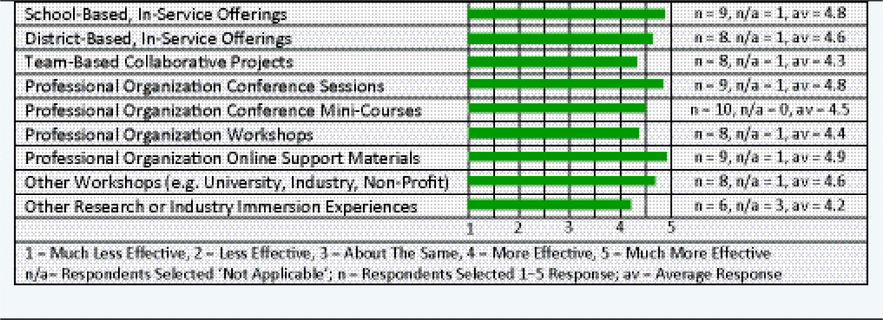
When asked to compare their immersion experience with other STEM-related professional development experiences, it is not surprising that the ARISE educator responses were resoundingly positive (Table 10). Their reflections captured their responses ‘…it is incomparable. Nothing will beat the impact of my ANDRILL immersion experience.’ The educators recognised that not only did the location set it apart, but that ‘… the most effective portion was the immersion – having scientists to work along with, plan with … right when things came up.’ The positive impact of the amount of time spent on-ice with ANDRILL was recognised ‘… overall I think the greatest benefit was [time to]engage fully in the science process and time to develop ideas/activities.’ The challenges associated with participating in a field-immersion experience like ARISE were recognised ‘… it spans a 3-month [period]which makes it difficult to manage …’ as well as the range of challenges in getting support from their teaching districts for participation. An educator who has participated in other Antarctic immersion programs said ‘… the thing that sets ANDRILL apart … was that there was an E and O team, not one teacher working in isolation. This made a HUGE difference in both my learning, and … after the on-ice experience.’ While the temporal and administrative (and often personal or family-related) challenges associated with the almost three-month deployment are real, none of the educators indicated any regrets about their immersion experience.
ARISE Educator comparison with other educator PD opportunities. The raw data and the average response (total numerical value of responses divided by number of respondents) for each Likert-scale question are presented
The educators were also surveyed on the impact and importance of their immersion experience on their subsequent professional work (Table 11). Unsurprisingly, the responses indicated a significant impact, ranging from what they learned about science, to improved engagement and performance by their students. Results also show an increase in their confidence in their engagement in leadership roles and public speaking, as well as increased opportunities for leadership roles. This development of teacher leaders has been recognised (Alemdar et al., Reference Alemdar, Cappelli, Criswell and Rushton2018) as a key to changes in STEM education.
ARISE Educator evaluation of relative impact of immersion experience on range of educational and other PD outcome areas. The raw data and the average response (total numerical value of responses divided by number of respondents) for each Likert-scale question are presented

‘Flexhibit’, ‘Secrets Beneath the Ice’, and ‘Project Iceberg’ videos
Nine out of ten educators have used the Flexhibit materials in some way; many of them have used them repeatedly in their EPO work. ARISE participants have also used them in presentations at the US National Science Teachers Association (NSTA) conferences (e.g. Trummel, Reference Trummel2009) and in a wide variety of public workshops (Table 4). One of the Italian educators has translated the Flexhibit materials and banners into Italian (Cattadori, Reference Cattadori2017a; Dahlman & Cattadori, Reference Dahlman and Cattadori2009) and used them to organise museum exhibits in Italy. Educators almost universally rave about the banners (Fig. 2) and Flexhibit materials and ‘can see them being used well into the future’ based on the timeless interest in Antarctica and the continued relevance of the ANDRILL science, saying ‘students and teachers would gather around them in the ‘after-talk’ time and use them as a vehicle for asking questions.’ The majority of scientists have not used the Flexhibit materials, but the three that did report using them said ‘… extremely useful. Having well-drafted/drawn diagrams of the science has been very helpful for my own teaching and outreach as well as research poster displays.’
Seventy percent of the educators have used the ‘Secrets Beneath the Ice’ documentary (Hochman, Reference Hochman2010) at some time, however many of them have dropped its use primarily because of its length and challenges for non-native speakers of English, and the need to spend their limited time with students doing hands-on learning. Educators prefer using the shorter ‘Project Iceberg’ videos (http://www.andrill.org/iceberg/videos/), which meld better with limited contact time, and the need to convey the process of science in short segments. One caveat regarding the videos is that the challenge of engaging diverse audiences is amplified because the videos ‘…largely focus on white men.’
Connections and evolving collaborations
A synopsis of both the educator and scientist feedback (Tables 7 and 8, quotes) shows that the connections built between the educators, and between the educators and scientists, were the key component in building the robust EPO outcomes (Tables 5 and 6). The educators almost universally found scientists that were giving of their time, both on-ice and off-ice ‘… I was lucky to find a few scientists who I could talk with very easily. Some of the scientists helped to guide me on lectures I gave to adult audiences post-ice. I have [also]connected with other ANDRILL scientists who were not present on-ice.’ Some scientists ‘… were happy to provide reviews and insights for educational materials.’ Most educators found one or two scientists that they were particularly comfortable bouncing ideas off – usually scientists involved in their disciplinary residency – or scientists that had presented for the geoscience course. The educators were universally appreciative of scientists that supported their work ‘… without their interest and investment in E and O our team wouldn’t have been very successful at all.’ Even more important is the fact that many of the scientists have made themselves available over the past ten years ‘…because I had worked with the scientists on-ice I was not shy about asking for data or help or clarification when I needed assistance.’ Again, the educators appreciated building human connections ‘… I could also tell stories about the scientists that made them ‘human’ to the students.’ The scientists largely valued the connections with the educators, with one of the scientists reflecting ‘… I have been impressed and motivated to do more outreach due to [my] interaction with motivated [and] passionate educators.’
The educator survey captured the volume and range of EPO activities conducted by the educators prior to, during and after deployment (Tables 5 and 6). Additional projects include development of informational booklets and activity books (Huffman, Carr, & Thomas, Reference Huffman, Carr and Thomas2009; Huffman, Dahlman, Pennycook, & Youngman, Reference Huffman, Dahlman, Pennycook and Youngman2011, Pennycook et al., Reference Pennycook, Huffman, Reed, Cowan, Winter and Youngman2010) which have provided long-term EPO resources. The continuing endeavours that have built on synergies developed during ARISE are summarised in Table 6.
Educator reflections
The survey also captured the power of ARISE to inspire and motivate educators beyond the more easily measured variables. The educators recognise that ‘…having participated in research that informs science about the global climate system makes me qualified to tell stories about it.’ A testament to the pre- and on-ice outreach work is the educator comment ‘… when I returned from Antarctica [after] my ANDRILL experience, my students were so very excited to see me …. at the end of the presentation one of the second graders asked “When are we going back” … the students actually felt they had taken the journey WITH me and it felt real and immediate to them.’ Unsurprisingly, the capacity of Antarctica to engage students was apparent - one educator reported that ‘six girls from that class have gone on to earn PhDs in science and when asked what got them interested in science, they point to their classroom Antarctica experiences.’ EPO work with adult audiences was equally impactful. An educator using the Flexhibit for a ‘science night’ said ‘… the parents were WOWED by the knowledge, poise, and confidence with which their children presented.’
While it is typical to try and quantify the impact on the various audiences the educators were working with, an equally important impact was on the educators themselves. All of the educators spoke of the ways in which they were impacted by their experience, ranging from their appreciation for science ‘… I recall reading the science plan before heading to the ice. The level of detail described for each scientific project, interwoven with the big picture of the logistics helped me understand the number of years and the amount of work that went into planning this high-risk, high-reward scientific endeavour. Seeing scientific papers come out of the effort years after the field season has given me a realistic view of how field projects … contribute to human knowledge …’ to how it changed the way they teach ‘… over time, the most important impact of the ANDRILL immersion on my teaching practice has been on my understanding of science as multidisciplinary’ and the professional doors it has opened for them ‘… we managed to create a new international association [for] polar science education [Polar Educators International: PEI].’ The educators also reflected on their life trajectories and long-term networks‘… some of my strongest teacher supports and connections’. While none of these impacts can be directly quantified, it is immediately clear that the personal impacts elevated the engagement of the ARISE educators in their EPO work.
Limitations of the study
The broad range of ARISE projects and audiences, while one of the strengths of ARISE, also renders it a challenge to evaluate. The ARISE program was not designed as a specific intervention and was not tied to universal learning outcomes to be tested quantitatively for evaluative purposes. For this reason, the survey focused on self-reported semi-quantitative and qualitative educator and scientist perceptions of learning, engagement, and impact despite Ebert-May et al. (Reference Ebert-May, Derting, Hodder, Momsen, Long and Jardeleza2011) having concerns about the accuracy of self-reported data. The small population of educators (14, with a 70% response rate) precludes meaningful statistical analysis of the Likert-scale responses. The low (24%) response rate for the ANDRILL scientists is clearly skewed towards those already engaged in science education. Limited literature documenting educator field-based research immersion PD renders comparisons a challenge, particularly when one considers the inherent uniqueness and motivation associated with being selected to spend time in Antarctica, which probably drew on an already motivated group of educators, appreciative and upbeat about the opportunities presented to them. Lastly, the estimates for individuals reached through the spectrum of EPO activities were challenging; despite technology we were unable to obtain reliable data on web pages accessed, or consumption of other media (blogs, newspaper, radio, and TV).
Discussion
Persistent and recurring themes emerging from the survey were (1) the positive and reinforcing impact of deployment as a team; (2) the importance of access to scientists across an extended period of time and venues; (3) the importance of ‘doing science’ as a means of learning; and (4) recognition of the senses of excitement, engagement and inspiration displayed by both educators and scientists as well as the EPO audience.
These themes reflect the combined key aspects of educator PD (Table 2) supporting the focus on specific content, active learning and collaboration (Wilson, Reference Wilson2013; Darling-Hammond et al., Reference Darling-Hammond, Hyler and Gardner2017). Overall, a climate of respect dominated connections between scientists and educators and facilitated the empowerment of ARISE participants – supporting ‘learning for action’ (Lawler, Reference Lawler2003; Lawler & King, Reference Lawler and King2000). Educators supported each other and coached each other (Darling-Hammond et al., Reference Darling-Hammond, Hyler and Gardner2017), not only on scientific topics, but also on pedagogical techniques and approaches, with the active-learning component clearly being most important for those with less science experience. The ARISE team in conjunction with supporting scientists essentially built a ‘community of practice’ (D’Avanzo, Reference D’Avanzo2013; Gehrke & Kezar, Reference Gehrke and Kezar2016) with positive feedback loops. Some recent research (Manduca et al., Reference Manduca, Iverson, Luxenberg, Macdonald, McConnell, Mogk and Tewksbury2017) suggests that longer-duration PD may not be essential if a community is established. In the case of ARISE the longer immersion experience was required logistically and was endorsed by the educators as instrumental in building the team that continues to work together. The overall transfer of learning (Holton et al., Reference Holton, Bates and Ruona2000) by ARISE educators to their audiences was successful (Tables 5 and 6), probably a result of their motivation (Naquin & Holton, Reference Naquin and Holton2002). While ARISE was not specifically designed to develop teacher leadership (Caffarella & Zinn, Reference Caffarella and Zinn1999) or effect institutional change (Bryk, Sebring, Allensworth, Luppescu, & Easton, Reference Bryk, Sebring, Allensworth, Luppescu and Easton2010), six ARISE participants have held leadership positions in PEI (Table 6) as a result of their participation in ARISE, and 55% have reported a significant increase in opportunities for leadership roles.
The ARISE program was envisioned prior to the recognition that ‘systems thinking’ (Hawe, Bond, & Butler, Reference Hawe, Bond and Butler2009; Hummelbrunner, Reference Hummelbrunner2011) plays a key role in designing successful research projects and educator PD but ARISE nonetheless included many of the approaches advocated (Kastens & Manduca, Reference Kastens and Manduca2017). Particularly important were the ‘semi-autonomous parallel subsystems’ (e.g. the disciplinary teams, the individual ARISE projects, individual EPO events, workshops or meetings) and the ability to redirect or troubleshoot problems that occurred at the leverage points between these subsystems (the role of the EPO coordinator or the ANDRILL executive coordinator if necessary). The flow of information between systems facilitated efficiency where necessary (getting on-ice work done), but also allowed for support of emergent opportunities (one-off on-ice opportunities and new endeavours). The on-ice EPO coordinator essentially monitored ‘the state of the system’ (Kania, Kramer, & Russell, Reference Kania, Kramer and Russell2014). The scientific imperative (understanding the consequences of past climate events to better understand and model the consequences of future global warming) acted as a unifying vision (Kastens & Manduca, Reference Kastens and Manduca2017) embraced by both educators and scientists.
Lessons learned and recommendations
This study shows the primary importance of having an EPO coordinator with strong interpersonal skills as well as an understanding of both the science and the challenges that educators face, as well as a mastery of administrative and managerial tasks, and prior on-ice experience. Also essential to success is (1) financial support and (2) strong advocacy for the EPO mission from the science research leadership. Without these foundations the unique components of the program would not have been as effective. These components are:
The pre-deployment meeting, which was key to building a connected and focused community that continues to work together on EPO ten years later.
Financial support for ARISE participants to participate in post-deployment workshops and meetings reaped benefits for continued EPO work.
Access to and engagement with scientists over a long time span (on-ice and post-ice) and in a variety of settings (daily briefings, disciplinary residencies, science course and socially) provided the educators with opportunities for ongoing dialogue, supporting construction of quality EPO materials.
The residencies were the primary ‘hands-on’ experience in ‘doing’ and ‘learning’ science for the educators – while also facilitating direct connections to scientists.
The on-ice science course facilitated learning for some, and helped to build connections, but might have been more effective as an online pre-deployment ‘course’, backed up by further in-person development of disciplinary themes on-ice.
Finally, a factor influencing the continued work of ARISE participants is the character of their learning institution, a key factor recognised as grand challenge number 2 (“Does it support curricular innovations? Time taken to travel to workshops or meetings?”) by Bitting et al. (Reference Bitting, Arthurs, Chapman, Macdonald, Manduca and St. John2018). This support is critical for long-term educator engagement. While financial limitations may preclude the deployment of educator groups the size of ARISE, this study at a minimum demonstrates the value of multi-educator deployment, and the importance of financial support and advocacy for the EPO vision.
Conclusions
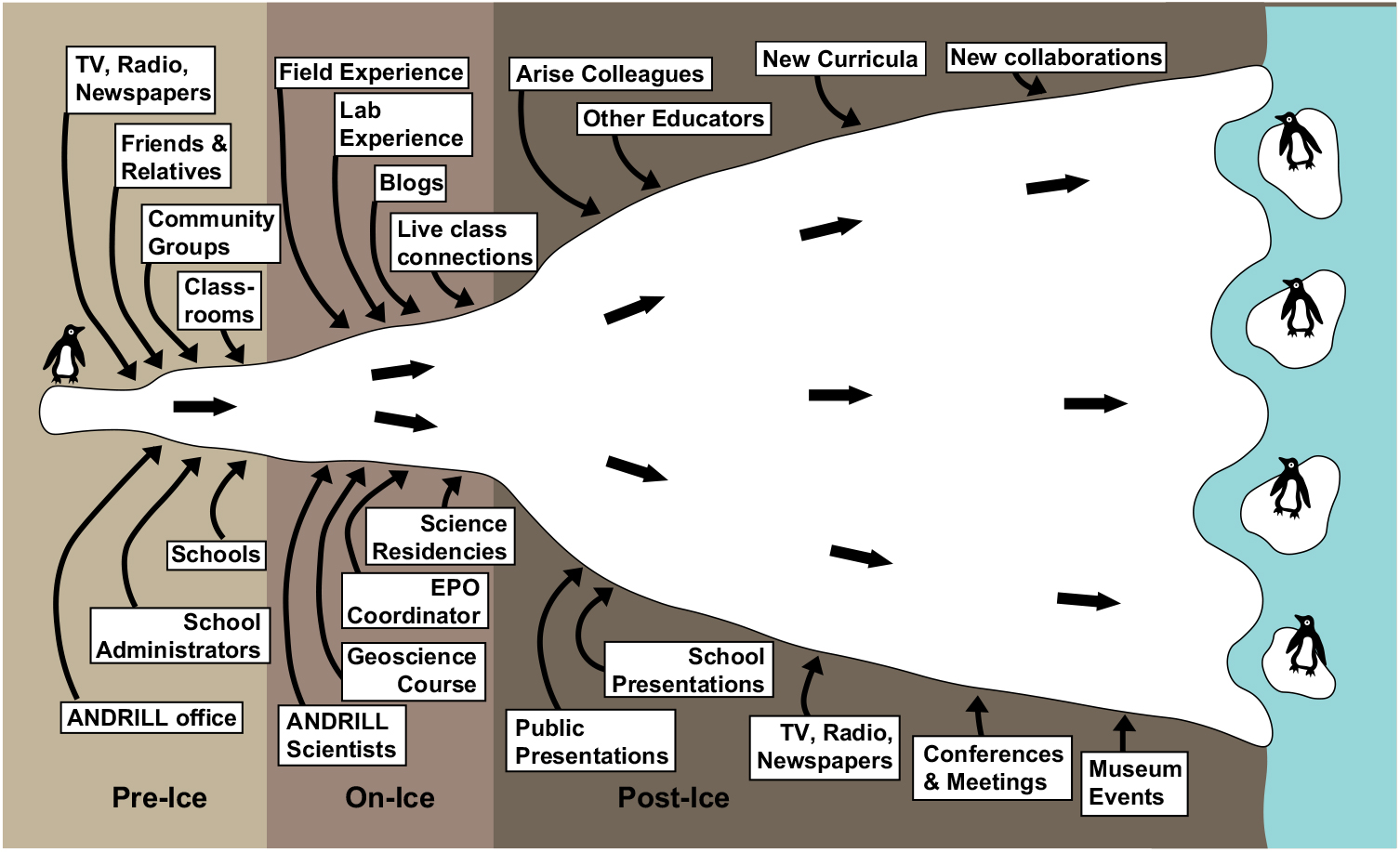
Educator PD field research immersion experiences such as ANDRILL ARISE impact both the scientists and the educators in powerful and sometimes surprising ways. The experience has long-term effects on the teacher’s knowledge, effectiveness, and their impact on students, with the experience lasting for years beyond deployment. The productivity and broad network of far-reaching EPO activities undertaken by the ARISE cohort of educators is a result of multiple intertwined factors. The extent of the EPO reach was able to grow substantially over time to more than 314,000 − not only because the backdrop of Antarctica provided an engaging and superb visual palette, but also because of the network and strength of connections that grew over time (Fig. 3). The key factors include a structure and support network that existed and evolved pre-, syn-, and post-ice. Facilitation of on-ice activities by the EPO coordinator (though largely invisible to the educators) resulted in the educators being able to focus on their on-ice work (e.g. residencies, blogs). The variety of mechanisms (geoscience course, residencies, daily science briefings) set up to support the educators building connections with ANDRILL scientists allowed for effective transfer of knowledge, and even more important, built long-lived connections between university researchers, classrooms and the greater community. The deployment of a multi-educator team was key to the success of ARISE.
Evolution and scope of ARISE EPO work pre-, on-, and post-ice using the analogy of an outlet glacier that incorporates increasingly more and varied debris down-ice, ultimately spreading out and calving icebergs. The penguin on the left is lost and alone, and those on the icebergs have easy access to water (food) and are not ‘alone.’ A single educator will have limited knowledge and connections pre-ice. Their knowledge, resources, and community will grow significantly on-ice, with post-ice curricular development and EPO drawing on all the pre-ice and on-ice resources and experiences, leading to teacher leaders confident in their role as educators, always open to new opportunities.
Supplementary material
To view supplementary material for this article, please visit https://doi.org/10.1017/S0032247419000056.
Author ORCIDs
Kate Pound 0000-0003-4157-2593
Acknowledgements
The authors thank Kristen St. John and two anonymous reviewers for their constructive suggestions which helped us improve the manuscript. Larry Krissek provided constructive comments on portions of early drafts. David Harwood provided essential assistance in securing IRB approval for the surveys. The ANDRILL (ANtarctic geologic DRILLing) Project is a multinational collaboration between the Antarctic programs of Germany, Italy, New Zealand and the United States. Antarctica New Zealand is the project operator and has developed the drilling system in collaboration with Alex Pyne at Victoria University of Wellington and Webster Drilling and Exploration. The ANDRILL Science Management Office was supported by the US National Science Foundation under Cooperative Agreement No. 0342484 with the University of Nebraska–Lincoln. The US Antarctic Program (USAP) and Raytheon Polar Services Corporation (RPSC) supported the science team at McMurdo Station and in the Crary Science and Engineering Laboratory, while Antarctica New Zealand supported the drilling team at Scott Base. Scientific studies are jointly supported by the US National Science Foundation, the New Zealand Foundation for Research, Science & Technology, the Italian Antarctic Research Program, the German Science Foundation and the Alfred Wegener Institute. We recognise the hard work and vision of the ANDRILL office, particularly Richard Levy, David Harwood, and Laura Lacy in developing and supporting ARISE.


 Open access

