
Skip to main content Accessibility help
×
  • Cited by 42
    • Show more authors
    • You may already have access via personal or institutional login
    • Select format
    • Publisher:
      Cambridge University Press
      Publication date:
      22 September 2009
      04 March 2004
      ISBN:
      9780511482229
      9780521829441
      9780521036221
      Dimensions:
      (228 x 152 mm)
      Weight & Pages:
      0.47kg, 200 Pages
      Dimensions:
      (228 x 152 mm)
      Weight & Pages:
      0.308kg, 200 Pages
    You may already have access via personal or institutional login
  • Selected: Digital
    Add to cart View cart Buy from Cambridge.org

    Book description

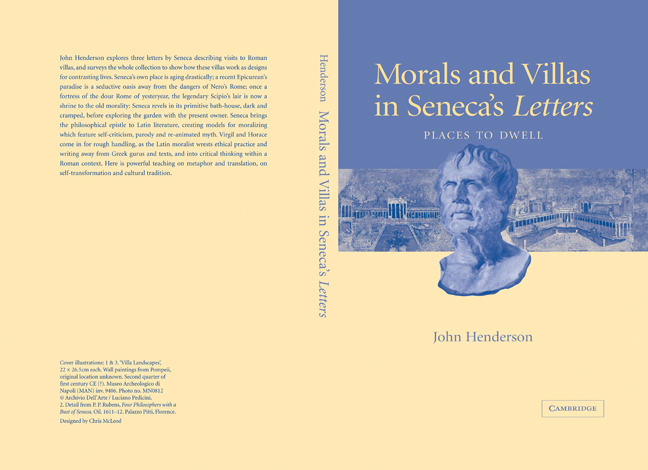
    John Henderson explores three letters of Seneca describing visits to Roman villas, and surveys the whole collection to show how these villas work as designs for contrasting lives. Seneca's own place is ageing drastically; a recent Epicurean's paradise is a seductive oasis away from the dangers of Nero's Rome; once a fortress of the dour Rome of yesteryear, the legendary Scipio's lair was now a shrine to the old morality: Seneca revels in its primitive bath-house, dark and cramped, before exploring the garden with the present owner. Seneca brings the philosophical epistle to Latin literature, creating models for moralizing which feature self-criticism, parody and re-animated myth. Virgil and Horace come in for rough handling, as the Latin moralist wrests ethical practice and writing away from Greek gurus and texts, and into critical thinking within a Roman context. Here is powerful teaching on metaphor and translation, on self-transformation and cultural tradition.

    Refine List

    Actions for selected content:

    Select all | Deselect all
    • View selected items
    • Export citations
    • Download PDF (zip)
    • Save to Kindle
    • Save to Dropbox
    • Save to Google Drive

    Save Search

    You can save your searches here and later view and run them again in "My saved searches".

    Please provide a title, maximum of 40 characters.
    ×

    Contents

    Bibliography
    Bibliography
    Ahl, F. M., , M. A. Davis, and Pomeroy, A. (1986) ‘Silius Italicus’, Aufstieg und Niedergang der Römisches Welt ii.32.4: 2492–561
    Allegri, S. (1999) ‘“Naufragium feci”: autoanalisi di un fallimento’, Paideia 54: 85–93
    Alpers, J. (1912) Hercules in biuio, Göttingen
    Andria, G. (1982) Le Figure retoriche nel primo Libro delle Epistule a Lucilio, Salerno
    Armisen-Marchetti, M. (1986) ‘Imagination et méditation chez Sénèque: l'exemple de la praemeditatio’, Révue des Etudes Latines 64: 185–94
    Armisen-Marchetti, M. (1989) Sapientiae facies: étude sur les images de Sénèque, Paris
    Armisen-Marchetti, M. (1991) ‘La métaphore et l'abstraction dans la prose de Sénèque’, in Grimal (1991): 99–139
    Armisen-Marchetti, M. (1995) ‘Sénèque et l'appropriation du temps’, Latomus 54: 545–67
    Avotins, I. (1977) ‘Training in frugality in Epicurus and Seneca’, Phoenix 31: 214–17
    Barchiesi, A. (2001) Speaking Volumes. Narrative and Intertext in Ovid and Other Latin Poets, London
    Barnes, J. (1997) Logic in the Imperial Stoa, Leiden
    Barton, C. (1999) ‘The Roman blush: the delicate matter of self-control’, in J. I. Porter, ed. (1999) Constructions of the Classical Body, Michigan, 212–34
    Bassett, E. L. (1963) ‘Scipio and the ghost of Appius’, Classical Philology 58: 73–92
    Batinski, E. E. (1993) ‘Seneca's response to Stoic hermeneutics’, Mnemosyne 46: 69–77
    Beard, M. (2002) ‘Ciceronian correspondences: making a book out of letters’, in T. P. Wiseman, ed. (2002) Classics in Progress. Essays on Ancient Greece and Rome, Oxford, 103–44
    Bedon, R. (1991) ‘Sénèque, Ad Lucilium, 91: l'incendie de 64 à Lyons, exploitation littéraire et réalité’, in R. Chevallier and R. Poignault, eds. (1991) Présence de Sénèque, Paris, 45–61
    Bek, L. (1976) ‘Antithesis. A Roman attitude and its changes as reflected in the concept of architecture from Vitruvius to Pliny the Younger’, Studia Romana in honorem P. Krarup, Odense, 15–66
    Berthet, J. F. (1979) ‘Sénèque lecteur d'Horace d'après des Lettres à Lucilius’, Latomus 38: 940–54
    Bickel, G. (1957) ‘Metaschêmatizesthai, ein übersehener Grundbegriff des Poseidonios’, Rheinisches Museum 100: 98–9
    Bodel, J. (1997) ‘Monumental villas and villas as monuments’, Journal of Roman Archaeology 10: 5–35
    Boesch, P. (1920) ‘Zu Seneca Ep. 55, 7’, Berliner Philologisches Woche 40: 524–5
    Boys-Stones, G. R. (2001) Post-Hellenistic Philosophy: a Study of Its Development from the Stoics to Origen, Oxford
    Brena, F. (1999) ‘Osservazioni al libro IX del Bellum Ciuile’, in Esposito and Nicestri (1999) 275–301
    Bruère, R. T. (1956) ‘Pliny the Elder and Virgil’, Classical Philology 51: 228–46
    Cancik, H. (1967) Untersuchungen zu Senecas Epistulae Morales, Meisenheim-am-Glan
    Castagna, L. (1991) ‘Storia e storiografia nel Pensiero di Seneca’, in Setaioli (1991b) 91–117
    Courtney, E. (2001) A Companion to Petronius, Oxford
    D'Arms, J. H. (1970) Romans on the Bay of Naples. A Social and Cultural Study of the Villas and their Owners from 150 bc to ad 400, Cambridge, MA
    Davis, L. (1996) A Dying Light in Corduba, London
    Rentiis, D. (1998) ‘Der Beitrag der Bienen: Überlegungen zum Bienengleichnis bei Seneca und Macrobius’, Rheinisches Museum 141: 30–44
    Dihle, A. (1973) ‘Posidonius’ system of moral philosophy', Journal of Hellenic Studies 93: 50–7
    Dominik, W. J. (1997) ‘From Greece to Rome: Ennius’ Annales', in A. J. Boyle, ed. (1997) Roman Epic, London, 37–58
    Edwards, C. (1993) The Politics of Immorality in Ancient Rome, Cambridge
    Edwards, C. (1997) ‘Self-scrutiny and self-transformation in Seneca's Letters’, Greece & Rome 44: 23–38
    Edwards, C. (1999) ‘The suffering body: philosophy and pain in Seneca's Letters’, in J. I. Porter, ed. (1999) Constructions of the Classical Body, Ann Arbor, 252–68.
    Esposito, P. and L. Nicestri, eds. (1999) Interpretare Lucano. Miscellanea di Studi, Naples
    Feeney, D. C. (1991) The Gods in Epic. Poets and Critics of the Classical Tradition, Oxford
    Freudenburg, K. (1993) The Wa*king Muse. Horace on the Theory of Satire, Princeton
    Fowler, D. P. (1996) ‘Even better than the real thing: a tale of two cities’, in J. Elsner, ed. (1996) Art and Text in Roman Culture, Cambridge, 57–74
    Fucecchi, M. (1993) ‘Lo spettacolo della virtù nel giovane eroe predestinato: analisi della figura di Scipione in Silio Italico’, Maia 45: 17–48
    Galinsky, G. K. (1972) The Herakles Theme, Oxford
    Gambet, D. G. (1970) ‘Cicero in the works of Seneca Philosophus’, Transactions of the American Philological Association 101: 171–83
    Germani, A., ed. and comm. (1958) Seneca, Epistole morali a Lucilio, Libro iii, Milan
    Gibson, R. and R. Morello, eds. (2003) Re-imagining Pliny the Younger, Baltimore (= Arethusa 36)
    Goldhill, S. (1991) The Poet's Voice. Essays on Poetics and Greek Literature, Cambridge
    Goldhill, S. (1994) ‘The naive and knowing eye: ekphrasis and the culture of viewing in the Hellenistic world’, in S. Goldhill and R. Osborne, eds. (1994) Art and Text in Ancient Greek Culture, Cambridge, 197–223
    Goldhill, S. (2001) ‘The erotic eye: visual stimulation and cultural conflict’, in S. Goldhill, ed. (2001) Being Greek under Rome. Cultural Identity, the Second Sophistic and the Development of Empire, Cambridge, 154–94
    Graver, M. (1998) ‘The manhandling of Maecenas: Senecan abstractions of masculinity’, American Journal of Philology 119: 607–32
    Green, C. M. C. (1996) ‘Terms of venery: Ars Amatoria I’, Transactions of the American Philological Association 126: 221–63
    Griffin, M. (1976) Seneca. A Philosopher in Politics, Oxford
    Grimal, P., ed. (1991) Sénèque et la prose latine. Entretiens Fondation Hardt 36
    Habinek, T. (1982) ‘Seneca's circles: Ep. 12.6–9’, Classical Antiquity 1: 66–9
    Habinek, T. (1992) ‘An anthology of virtue. Seneca on the beginnings of wisdom’, in F. M. Dunn and T. Cole, eds. (1992) Beginnings in Classical Literature, Cambridge (= Yale Classical Studies 29), 187–207
    Hachmann, E. (1995) Die Führung des Lesers in Senecas Epistulae Morales, Münster
    Hachmann, E. (1996) ‘Die Spruchepiloge in Senecas Epistulae Morales’, Gymnasium 103: 385–410
    Hardie, A. (1983) Statius and the Siluae. Poets, Patrons and Epideixis in the Graeco-Roman World, Liverpool
    Harlow, M. and R. Laurence (2002) Growing up and Growing Old in Ancient Rome, London and New York
    Henderson, J. (1989) ‘Not “Women in Roman satire” but “When satire writes ‘woman’”’, in S. H. Braund, ed. (1989) Satire and Society in Ancient Rome, Exeter, 89–125
    Henderson, J. (1991) ‘Wrapping up the case: reading Ovid, Amores, 2, 7 (+8). I’, Materiali e Discussioni 27: 37–88
    Henderson, J. (1997a) Figuring out Roman Nobility: Juvenal's Eighth Satire, Exeter
    Henderson, J. (1997b) ‘The name of the tree: recounting Odyssey 24 340–2’, Journal of Hellenic Studies 117: 87–116
    Henderson, J. (1998) Fighting for Rome: Poets and Caesars, History and Civil War, Cambridge
    Henderson, J. (1999) Writing down Rome: Comedy, Satire, and Other Offences in Latin Poetry, Oxford
    Henderson, J. (2000) ‘The Camillus factory: per Ardeam ad astra’, Ramus 29: 1–26
    Henderson, J. (2001a) Telling Tales on Caesar. Roman Stories from Phaedrus, Oxford
    Henderson, J. (2001b) ‘On Pliny on Martial on Pliny on anon and on …’ (Epistles 3.21/Epigrams 10.19), Ramus 30: 56–87
    Henderson, J. (2002a) Pliny's Statue: the Letters, Self-Portraiture, and Classical Art, Exeter
    Henderson, J. (2002b) ‘Knowing someone through their books: Pliny on Uncle Pliny (Epistles 3.5)’, Classical Philology 97: 256–84
    Henderson, J. (2002c) ‘Columella's book of gardening: the living hedge’, Journal of Roman Studies 92: 110–33
    Henderson, J. (2004) HORTVS: The Roman Book of Gardening, London
    Hijmans, Jr., B. L. (1976) Inlaboratus et facilis: Aspects of Structure in some Letters of Seneca, Mnemosyne Supplement 38, Leyden
    Holliday, Peter J. (2002) The Origins of Roman Historical Commemoration in the Visual Arts, Cambridge
    Hutchinson, G. O. (1998) Cicero's Correspondence: a Literary Study, Oxford
    Inwood, B. (1997) ‘Seneca in his philosophical milieu’, Harvard Studies in Classical Philology 97: 63–76
    Jaeger, M. (1997) Livy's Written Rome, Ann Arbor
    Johannovsky, W. (1976) ‘Liternum’, in Princeton Encyclopedia of Classical Sites, Princeton, 520
    Kaster, R. A., ed. (1995) Suetonius, De grammaticis et rhetoribus, Oxford
    Kenney, E. J. (1979) ‘Incertum an et ante gnarus’, Farrago (Michaelmas 1): 5–8
    Kerkhecker, A. (1999) Callimachus' Book of Iambi, Oxford
    Kinzie, M (1986–7) ‘“Irreference”, the poetic diction of John Ashbery’, Modern Philology 84: 267–81, 382–400
    Konstan, D. (1973) Some Aspects of Epicurean Psychology, Leiden
    Krostenko, B. A. (2001) Cicero, Catullus, and the Language of Social Performance, Chicago
    Lakoff, G. and M. Johnson (1980) Metaphors We Live By, Chicago
    Lana, I. (1991) ‘Le lettere a Lucilio nella letteratura epistolare’, in Grimal (1991) 253–302
    Lavery, G. B. (1980) ‘Metaphors of war and travel in Seneca's prose works’, Greece & Rome 27: 147–57
    Leach, E. W. (1993) ‘Horace's Sabine topography in lyric and hexameter verse’, American Journal of Philology 114: 271–302
    Luce, T. J. (1977) Livy. The Composition of His History, Princeton, NJ
    McCullough, C. (1993) Fortune's Favourites, London
    McKay, A. G. (1975) Houses, Villas and Palaces in the Roman World, London
    Maiuri, A. (1937) The Phlegraean Fields, Rome
    Maiuri, A. (1950) ‘Significato e natura del solium nelle terme romane’, Parola del Passato 5: 223–7
    Maltby, R. (1991) A Lexicon of Ancient Latin Etymologies, Leeds
    Manning, C. E. (1976) ‘Seneca's 98th Letter and the praemeditatio mali’, Mnemosyne 29: 301–4
    Maso, S. (1999) Lo Sguardo della Verità. Cinque Studi su Seneca, Padova
    Maurach, G. (1970) Der Bau von Senecas Epistulae Morales, Heidelberg
    Mayer, R. G. (1991) ‘Roman historical exempla in Seneca’, in Grimal (1991) 141–69
    Mazzoli, G. (1970) Seneca e la Poesia, Milan
    Mazzoli, G. (1989) ‘Le “Epistulae Morales ad Lucilium” di Seneca: valore letterario e filosofico’, Aufstieg und Niedergang des Römisches Welt ii.36.3: 1823–77
    Morretta, R. (1937) Pubblio Cornelio Scipione L'Africano, Turin
    Morrissette, A. (2002) Under Rug Swept, Maverick Recording Co
    Motto, A. L. (1973) Seneca, New York
    Motto, A. L., and Clark, J. R. (1968), ‘Paradoxum Senecae: the Epicurean Stoic’, Classical World 62: 37–42
    Motto, A. L., and Clark, J. R. (1970) ‘Epistle lvi: Seneca's ironic art’, Classical Philology 56: 102–5
    Motto, A. L., and Clark, J. R. (1971) ‘Et terris iactatus et alto: the art of Seneca's Epistle liii’, American Journal of Philology 92: 217–25
    Motto, A. L., and Clark, J. R. (1972–3) ‘Descensus Auerno in Seneca's Epistle 55’, Classical Journal 68: 191–8 = (1993) 115–24
    Motto, A. L., and Clark, J. R. (1973) ‘Seneca's Epistle 57: a journey to wisdom’, Classical Bulletin 49: 33–6
    Motto, A. L., and Clark, J. R. (1979) ‘Hic situs est. Seneca on the deadliness of idleness’, Classical World 72: 207–15 = (1993) 87–98
    Motto, A. L., and Clark, J. R. (1987) ‘Time in Seneca: past, present, future’, Emerita 55: 31–41 = (1993) 51–64
    Motto, A. L., and Clark, J. R. (1990) ‘The art of paradox in Seneca's Epistle 60’, Maia 42: 47–50 = (1993) 99–104
    Motto, A. L., and Clark, J. R. (1991a) ‘Seneca and Ulysses’, Classical Bulletin 67: 27–32 = (1993) 181–7
    Motto, A. L., and Clark, J. R. (1991b) ‘The artistry of Seneca's Epistle 62’, Athenaeum 79: 583–8 = (1993) 105–14
    Motto, A. L., and J. R. Clark (1993) Essays on Seneca (Studien zur klassischen Philologie 79, Frankfurt-am-Main)
    Newlands, C. E. (2002) Statius' Siluae and the Poetics of Empire, Cambridge
    Newman, R. J. (1989) ‘Cotidie meditari: theory and practice of the meditatio in imperial Stoicism’, Aufstieg und Niedergang des Römisches Welt ii.36.3: 1473–517
    Nielsen, I. (1990) Thermae et Balnea, the Architecture and Cultural History of Roman Public Baths, Aarhus
    Nisbet, R. G. M. and M. Hubbard (1978) A Commentary on Horace Odes Book ii, Oxford
    O'Hara, J. J. (1996) True Names. Vergil and the Alexandrian Tradition of Etymological Wordplay, Ann Arbor
    Otto, A. ([1890] 1971) Die Sprichwörter und sprichwörtlichen Redensarten der Römer, Leipzig/Hildesheim
    Pasoli, E. (1975) ‘A proposito del giudizio di Seneca sulle Georgiche’, Atti del Convegno Virgiliano sul Bimilenario delle Georgiche, Naples: 461–9
    Penwill, J. L. (1995) ‘Image, ideology and action in Cicero and Lucretius’, in A. J. Boyle, ed. (1995) Roman Literature and Ideology, Bendigo, Victoria (= Ramus 23), 68–91
    Pohlenz. M. (1965) ‘Der Eingang von Ciceros Gesetzen’, in Kleine Schriften (ed. H. Dörrie), Hildesheim, vol. II. 410–35
    Pomeroy, A. J. (1990) ‘Silius Italicus as “Doctus Poeta”’, in A. J. Boyle, ed. (1990) The Imperial Muse, vol. II, Bendigo, Victoria (= Ramus 18), 119–39
    Rist, J. M. (1969) Stoic Philosophy, Cambridge
    Rist, J. M. (1972) Epicurus. An Introduction, Cambridge
    Rosenmeyer, P. A. (2001) Ancient Epistolary Fictions. The Letter in Greek Literature, Cambridge
    Rosivach, V. J. (1995) ‘Seneca on the fear of poverty in the Epistulae Morales’, L'Antiquité Classique 64: 91–8
    Rozelaar, M. (1976) Seneca. Eine Gesamtdarstellung, Amsterdam
    Russell, D. A. (1974) ‘Letters to Lucilius’, in C. D. N. Costa, ed. (1974) Seneca, London, 70–95
    Saint-Denis, E. de (1971) ‘Columelle, miroire de Virgile’, in H. Bardon and R. Verdière, eds. (1971) Vergiliana. Recherches sur Virgile, Leiden, 328–43
    Santini, C. (1999) ‘Lucan 3, 399–455: lucus horridus e codice etimologico in Lucano’, in Esposito and Nicestri (1999) 207–22
    Saylor, C. (2002) ‘Thinking about friends: Seneca, Epist. 55’, Latomus 61: 102–5
    Scarpat, G. (1965) La Lettera 65 di Seneca, Brescia
    Scarpat, G. ed. and comm. (1975) Lucio Anneo Seneca, Lettere a Lucilio, Libro Primo (epp.i–xii), Brescia
    Scarpat Bellincioni, M. (1986) Studi Senecani e Altri Scritti, Brescia
    Schmidt, E. G. (1958) Der 118. Brief Senecas, Leipzig
    Scholz, U. W. (1984) ‘Der “Scipio” des Ennius’, Hermes 112: 183–99
    Schönegg, B. (1999) Senecas Epistulae Morales als philosophisches Kunstwerk, Bern
    Schrijvers, P. J. (1990) ‘Douleur: où est ta victoire?’, Mnemosyne 43: 374–94
    Scullard, H. H. (1970) Scipio Africanus: Soldier and Politician, London
    Setaioli, A. (1988) Seneca e i Greci. Citazioni e Traduzioni nelle Opere filosofiche, Bologna
    Setaioli, A. (1991a) ‘Seneca e gli Arcaici’, in Setaioli (1991b): 35–45
    Setaioli, A. ed. (1991b) Seneca e la Cultura, Perugia
    Smith, D. R. (1976) ‘The poetic focus in Horace, Odes, 3, 13’, Latomus 35: 822–6
    Snyder, H. G. (2000) Teaching and Texts in the Ancient World, London and New York
    Spentzou, E. (2003) Readers and Writers in Ovid's Heroides. Transgressions of Genre and Gender, Oxford
    Stückelberger, A. (1965) Senecas 88 Brief, Heidelberg
    Summers, W. C. ed. and comm. (1910) Select Letters of Seneca, London
    Tedeschi, A. (1998) Lo Storico in Parola: Livio, Scipione l'Africano e le Tecniche dell'Argomentazione. Commento a Liv. 28. 43–44, Bari
    Thomas, R. F. (1982) ‘Gadflies (Virg. Geo. 3.146–148)’, Harvard Studies in Classical Philology 86: 81–5
    Thomas, R. F. ed. and comm. (1988) Virgil, Georgics, vols. I–II, Cambridge
    Thomsen, O. (1979–80) ‘Seneca the storyteller. The structure and function, the humour and psychology, of his stories’, Classica et Mediaevalia 32: 151–97
    Tissol, G. (1997) The Face of Nature. Wit, Narrative, and Cosmic Origins in Ovid's Metamorphoses, Princeton
    Toner, J. P. (1995) Leisure and Ancient Rome, Cambridge
    Tossi, G. (1974–5) ‘La villa romana nelle Epistulae ad Lucilium di L. Annaeo Seneca’, Aquileia Nostra45–6: 217–26
    Vassileiou, A. (1971) ‘Les voyages de Lucilius d'après Sénèque, Ep. 31.9’, Révue des Etudes Latines 49: 217–27
    Walbank, F. W. (1967) ‘The Scipionic legend’, Proceedings of the Cambridge Philological Society 13: 54–69
    Walsh, P. G. (1961) Livy. His Historical Aims and Methods, Cambridge
    Wenskus, O. (1994) ‘Der Seekranke Odysseus: Senecas 53. Briefe’, Hermes 122: 479–85
    Wilkinson, L. P. (1969) The Georgics of Virgil. A Critical Survey, Cambridge
    Williams, G. D. and A. D. Walker, eds. (1997) Ovid and Exile, Bendigo, Victoria (= Ramus 26)
    Wilson, M. (1987) ‘Seneca's Letters to Lucilius: a revaluation’, in A. J. Boyle, ed. (1987) The Imperial Muse, vol. I, Berwick, Victoria (= Ramus 16), 102–21
    Wilson, M. (1997) ‘The subjugation of grief in Seneca's Epistles’, in S. Morton Braund and C. Gill, eds. (1997) The Passions in Roman Thought and Literature, Cambridge, 48–67
    Wilson, M. (2001) ‘Seneca's Epistles reclassified’, in S. J. Harrison, ed. (2001) Texts, Ideas, and the Classics. Scholarship, Theory, and Classical Literature, Oxford, 164–88
    Wiseman, T. P. (2002) ‘History, poetry, and Annales’, in D. S. Levene and D. P. Nelis, eds. (2002) Clio and the Poets. Augustan Poetry and the Traditions of Ancient Historiography, Leiden, 331–62
    Woodman, A. J., ed. and comm. (1977) Velleius Paterculus, the Tiberian Narrative (2.94–131), Cambridge

    Metrics

    Full text views

    Total number of HTML views: 0
    Total number of PDF views: 0 *
    Loading metrics...

    Book summary page views

    Total views: 0 *
    Loading metrics...

    * Views captured on Cambridge Core between #date#. This data will be updated every 24 hours.

    Usage data cannot currently be displayed.

    Accessibility standard: Unknown

    Why this information is here

    This section outlines the accessibility features of this content - including support for screen readers, full keyboard navigation and high-contrast display options. This may not be relevant for you.

    Accessibility Information

    Accessibility compliance for the PDF of this book is currently unknown and may be updated in the future.
